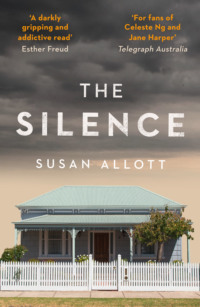
Read the book: «The Silence»
THE SILENCE
Susan Allott

Copyright
The Borough Press
An imprint of HarperCollinsPublishers Ltd
1 London Bridge Street
London SE1 9GF
www.harpercollins.co.uk
HarperCollinsPublishers
1st Floor, Watermarque Building, Ringsend Road
Dublin 4, Ireland
First published in Great Britain by HarperCollinsPublishers 2020
Copyright © Susan Allott 2020
Cover design by Sim Greenaway © HarperCollinsPublishers Ltd 2020
Cover images © jax10289 / Alamy Stock Photo (house), Shutterstock (sky)
Susan Allott asserts the moral right to be identified as the author of this work.
A catalogue copy of this book is available from the British Library.
This novel is entirely a work of fiction. The names, characters and incidents portrayed in it are the work of the author’s imagination. Any resemblance to actual persons, living or dead, events or localities is entirely coincidental.
All rights reserved under International and Pan-American Copyright Conventions. By payment of the required fees, you have been granted the non-exclusive, non-transferable right to access and read the text of this e-book on screen. No part of this text may be reproduced, transmitted, down-loaded, decompiled, reverse engineered, or stored in or introduced into any information storage and retrieval system, in any form or by any means, whether electronic or mechanical, now known or hereinafter invented, without the express written permission of HarperCollins.
Source ISBN: 9780008361341
Ebook Edition © April 2020 ISBN: 9780008361327
Version: 2021-02-24
Praise for The Silence:
‘A riveting mystery, beautifully unwound. The Silence excavates dark, decades-old secrets buried in human hearts, in families and in nations. I read it in one weekend’
ERIN KELLY
‘A darkly gripping and addictive read. I tore through it in a few days’
ESTHER FREUD
‘Deeply engrossing … an exquisite literary thriller’
PHILIPPA EAST, author of Little White Lies
‘Allott uses the scandal of Australia’s stolen children to devastating effect in this memorable debut’
SUNDAY TIMES
‘An atmospheric, convincing portrayal of the way that the decisions we make, both individually and collectively, reverberate down the years’
GUARDIAN
‘Emotionally wrenching’
WALL STREET JOURNAL
‘An impressive and beautifully written, Australian-set debut with the devastating subject of the Stolen Generation at its core’
FIONA MITCHELL, author of The Swap
‘Tense, atmospheric and brilliantly paced. The Silence is fraught with disturbing secrets and powerful emotions. I loved it’
FRANCESCA JAKOBI, author of Bitter
‘A suspenseful, beautifully crafted debut for fans of Celeste Ng and Jane Harper’
TELEGRAPH AUSTRALIA
‘Intricate and suspenseful … [a] stellar debut’
NEW YORK JOURNAL OF BOOKS
‘A suspense-filled story set in Australia, highlighting the effects of an official policy that has haunted generations. Allott’s prose builds an incredibly convincing portrayal of the destruction caused by dysfunctional relationships. A fantastic debut’
NIKKI SMITH, author of All in Her Head
‘A poignant literary mystery, impossible to put down. One of those books that stops you rushing to your next read for fear it won’t compare’
TREVOR WOOD, author of The Man on the Street
‘A brooding, suspenseful debut’
SUNDAY MIRROR
‘A compelling account of loyalty, familial trust and distrust’
LANCASHIRE TIMES
‘A compelling and powerful read. Susan Allott is a writer to watch’
HOOKED FROM PAGE ONE
‘An unsettling portrayal of unhappy marriage, alcohol abuse and a dark chapter of history, with a plot that grips like an anaconda’
SAGA MAGAZINE
Dedication
For David
Contents
Cover
Title Page
Copyright
Praise for The Silence
Dedication
Chapter 1: London, 1997
Chapter 2: Sydney, 1966
Chapter 3: Ivanhoe, New South Wales, 1966
Chapter 4: Sydney, 1967
Chapter 5: Sydney, 1967
Chapter 6: Sydney, 1997
Chapter 7: Sydney, 1967
Chapter 8: Sydney, 1967
Chapter 9: Sydney, 1967
Chapter 10: Sydney, 1967
Chapter 11: Sydney, 1997
Chapter 12: Sydney, 1967
Chapter 13: Sydney, 1967
Chapter 14: Sydney, 1997
Chapter 15: Sydney, 1967
Chapter 16: Sydney, 1967
Chapter 17: Leeds, 1967
Chapter 18: Sydney, 1967
Chapter 19: Sydney, 1997
Chapter 20: Sydney, 1967
Chapter 21: Ivanhoe, 1967
Chapter 22: Leeds, 1967
Chapter 23: Sydney, 1997
Chapter 24: Sydney, 1967
Chapter 25: Sydney, 1997
Chapter 26: Sydney, 1967
Chapter 27: Sydney, 1967
Chapter 28: Sydney, 1997
Chapter 29: Sydney, 1967
Chapter 30: Sydney, 1967
Chapter 31: New South Wales, 1997
Chapter 32: Sydney, 1967
Chapter 33: Sydney, 1967
Chapter 34: Sydney, 1997
Chapter 35: Sydney, 1967
Chapter 36: Sydney, 1967
Chapter 37: Sydney, 1997
Chapter 38: Sydney, 1967
Chapter 39: Leeds, 1967
Chapter 40: Sydney, 1967
Chapter 41: Sydney, 1997
Chapter 42: Sydney, 1967
Chapter 43: Victoria, 1967
Chapter 44: Sydney, 1997
Chapter 45: Victoria, 1967
Chapter 46: Sydney, 1967
Chapter 47: Sydney 1997
Chapter 48: Sydney, 1997
Chapter 49: Sydney, 1997
Chapter 50: Sydney, 1997
Chapter 51: Victoria, 1967
Chapter 52: New South Wales, 1997
Chapter 53: Leeds, 1967
Chapter 54: Sydney, 1997
Author’s Note
Notes
A note about language
Acknowledgements
Questions for Reading Groups
Erin Kelly interviews Susan Allott
About the Author
About the Publisher
1
London, 1997
In a basement flat in Hackney, the telephone rings. It’s two in the morning. Isla Green stands in the hallway, pyjamaed, barely awake. She is entirely sober. A good thing, if a little fragile; a little surprising. No tide of shame waits for her, no bloom of pain. She feels clean in her skin, like a schoolgirl. She can taste toothpaste in her throat.
On the third ring she reaches for the receiver. It’s Dom’s voice she will hear if the answerphone picks up, and his voice will set her back. It’s three months since he left and every day she means to wipe the message. She lifts it to her ear just in time.
‘Hello?’
It takes her a second to place him. ‘Dad?’
‘I didn’t wake you, did I?’
She doesn’t know why she’s gripping the receiver. Why a trill of fear has sounded in her head. It’s good to hear her dad’s voice, which is more Australian than her own these days. He’s got the time difference wrong, that’s all. At the end of the street a police siren starts its upward loop and cuts out. Its blue light flashes silently.
‘What time is it there?’
‘I don’t know.’ She stretches her free arm above her head, arching her back. In the eight weeks and three days since her last drink, she has been sleeping like the dead.
‘Shall I call back later?’
‘It’s fine. Is everything ok?’
‘I wanted to talk to you,’ he says. ‘Your mother doesn’t know I’m calling. She went into town.’
She sits down on the carpet. This is the thing she couldn’t put her finger on, that she should have known was wrong from the start. Her dad hasn’t called her in the decade she’s lived in London. It’s her mum who makes the phone calls, leaves messages on the answerphone. Her dad writes letters. He hates the phone.
‘What is it?’
‘I didn’t want you to hear it from your mother. She hasn’t taken it well. I wanted to tell you myself.’
She drops her head between her knees. She thinks, if he’s going to die, I’ll need a drink. Cold, practical thoughts: she will finish this call and she will put her clothes on. There’s an all-night takeaway at Clapton Pond where they sell six-packs of beer under the counter.
‘The police came to see me,’ he says.
‘The police?’
‘They’re looking for a woman I used to know.’
Isla lifts her head. She’s sweating. She runs her hand through her damp hair. ‘What woman?’
‘She was a neighbour of ours, back when we first moved to Sydney. You wouldn’t remember.’ He coughs. ‘It looks like she’s been missing a long time. Nobody’s seen her in thirty years.’
The police car crawls past outside, swinging its blue light across the walls.
‘What’s this got to do with you?’
‘The police think her disappearance is suspicious,’ he says. ‘They think I was the last person to see her, before she went missing.’
‘And were you?’ She tries to sound calm. ‘Were you the last person to see her?’
‘I can’t have been. She moved away with her husband. I told them there must be some mistake.’
He lights a cigarette, exhales. She thinks of Dom, smiling behind a flame.
‘Is she dead?’
‘They think she must be.’ His voice is quiet. A bad news voice. ‘There’s no record of her at all, in all that time. Her father died last month, left her most of his estate, but she hasn’t come forward. Her brother’s been asking around, trying to trace her. He turned up a few things that the police are looking into.’ He laughs unconvincingly. ‘One of those things is me.’
Isla finds a line of stubble along her shin. She runs her thumbnail over it, back and forth, until it hurts.
‘The cops are searching through their records,’ he says. ‘They keep records of people who died without being identified.’
‘What if it turns out she was killed?’
‘That would be the worst-case scenario, love,’ he says. ‘That would mean a murder enquiry.’
‘Jesus.’
‘Look, I don’t want you to worry.’
‘But if you were the last person to see her –’
‘I wasn’t.’ He shouts it. ‘I told you, I wasn’t.’
Isla rests her head back on her knees. In the part-light she sees unopened post on the doormat, soiled with the tread of her lace-up boots. Her bike, leaning against the wall, its basket stuffed with junk mail. On a hook by the door, the smart coat with the belt that she wears to the office. All of it familiar, unchanged.
‘Are you there?’
‘I’m here,’ she says.
‘Sorry to snap at you.’
‘Dad.’ She feels hot, but her skin is cold. Her pyjamas cling to her. ‘What was her name?’
He hesitates. ‘Mandy.’
Mandy. Isla smells a hot iron against cotton sheets. Eucalyptus.
‘She looked after you a few days a week, before you started school. Back when your mum was working at Hordern & Sons.’
‘She had a washing line strung out across her yard,’ Isla says, remembering as she speaks. ‘I used to hand her the pegs when she hung out her laundry.’
‘Did you?’
Isla can’t recall Mandy’s face but she remembers being in her presence. Being liked by someone she liked. An easiness about her company that made other people seem less than her.
‘Your mother wants to cancel the party for my birthday,’ he continues. ‘She’s been upset since the police called round. She can’t put it out of her mind.’
A door slams in one of the flats upstairs. Raised voices. Isla sits up. She understands now why he called.
‘Does she believe you, Dad?’
‘I don’t think so. No.’
She cradles the phone. New connectors are opening in her brain these past few weeks, fuelled by mineral water and sleep. Unbidden memories startle her on the bus; on the escalator at Bethnal Green; as she sits in traffic on the Essex Road. Her life has an awful clarity now the protective, hungover fug is gone. She sits cross-legged on the carpet, in the middle of her life, in its crisp, central crease. She is thirty-five years old, tall and lean; striking, people say. A body that has been neglected but is still strong, surprisingly resilient. A thick head of hair, cropped short at the back; blonde strands on top that grow up and out, like a dandelion. A woman whose life took a nosedive, who is getting herself together, who needs to be careful. Whose father is silent at the end of the line, asking her wordlessly to come home.
‘I could come back for a couple of weeks,’ she says. It’s the only thing to say. ‘I could help with the party. Get Mum to see sense.’
‘Could you?’
‘I think so. I’m owed some leave.’
‘That would be wonderful, Isla.’ His voice has lifted. ‘What about the apartment? Aren’t you buying a place?’
The apartment. A two-bed on Sinclair Road with high ceilings and a Juliet balcony. It’s beautiful, well-located and well over budget. They exchange in three weeks. She rubs her forehead with the heel of her hand. ‘I can deal with it over the phone,’ she says.
‘Can they spare you at work?’
‘They’ll have to.’
‘Are you sure this is a good time for you?’
No, she is not sure. She doesn’t want to be in Sydney, where there are empty hours to fill and people she hasn’t seen in a decade. She wants to sleep and work and hide.
‘I’m sure,’ she says. ‘It’s about time.’
Rain falls hard over London as the sun comes up. Isla lies on the surface of sleep, refusing the dreams that want her to be four years old again, walking through rooms that are familiar but not home. She starts the day, dresses herself. Her dad’s voice is loud and scared in her head, playing on a loop, acquiring a strain of panic. She makes coffee, tells herself she does not need anything stronger. She is over-thinking this whole thing. He is not lying.
2
Sydney, 1966
Mandy supposed Steve must always have opened his gifts this way. A ham-fisted rip-and-crunch of the paper; a quick kiss and a ‘thanks darl’, and that was it. No ceremony. No comment on the way she’d lined up the stripes on the gift wrap. He did appreciate the gift itself, mind, so long as it was something practical that he could use or wear, that wasn’t too different from anything he already owned.
Nothing new there, except Mandy found it aggravating this year, and wanted to thump him. She knew she was being unreasonable. Why would he notice the paper? He was the same man she’d been married to for seven years. And it was daft that she’d done that with the stripes. She’d become a woman who was uptight about gift wrap. How had that happened?
She sat beside him on the bed and turned her gift from him around in her hands. A bigger box than she’d expected. She picked at a piece of tape with her thumbnail and peeled it, slowly, free of the gift wrap. She did the same with the tape at the other side of the box.
‘Why don’t you just rip it, Mand? We’ll still be here for New Year’s at this rate.’
She gave him a look. ‘I feel like taking my time.’
Turning the box onto its side, she reached her hand under the wrapping and managed to slide it free, without any tearing of the paper or damage to its hollow structure. Steve picked up the paper, as if to crush it, but thought better of it and put it back where it was.
‘A watch!’ She hadn’t expected that. ‘You got me a watch?’
He sat up straight, arranging the pillows behind him, and smiled. ‘Let’s see it on you.’
She fixed the tiny buckle and turned the watch so its face was centred. It was designed for a woman with bony wrists. A frail, skeletal woman who couldn’t lift the weight of anything bigger. It made her arm look huge and muscular. She hated it.
‘There. Fits nicely. Just snug,’ she said. First lie of the day: ‘I love it.’ Second lie: ‘What a nice surprise.’
Steve shifted onto his side and pulled her down to lie next to him. ‘Merry Christmas,’ he said. He reached around and stretched his hand over the flesh of her backside. ‘I knew you’d like it.’
She moved closer against him so he couldn’t see her face. Her nightdress crackled with static against his pyjamas. ‘You dark horse,’ she said into the warm meat of his neck. ‘I thought you were getting me the necklace I showed you.’
‘What necklace?’ He rolled her away from him and pushed her hair from her face. ‘You didn’t mention a necklace.’
‘It’s all right.’ She brightened her voice. ‘Sorry. It’s a beautiful watch. I didn’t mean –’
His eyes moved side to side, trying to remember. ‘You didn’t say anything about a necklace.’
‘I showed you, is all. In my catalogue. A gold chain with a pendant.’ She held a finger to the base of her neck, where the pendant might have hung. ‘I showed you a while back. It had a small letter A for Amanda. A pendant.’
He shook his head. ‘You have to spell it out, Mand. If you want a necklace, tell me you want a necklace. You can’t expect me to pick up on a hint like that.’
She smiled, and pinched his face until he smiled back. ‘D’you like the jacket?’
‘I love it, darl. Good for the truck when I’m driving at night.’
‘That’s what I thought.’
She turned her back to him and picked up the gift wrap the watch had come in, red with gold bells, still holding its box shape. From this position on the bed she could see one of Steve’s socks beside the wash basket, where he must have thrown it and missed. He’d left his new jacket on the carpet at the foot of the bed, and the striped paper was torn, strewn across the floor. The Christmas cards she’d arranged on the chest of drawers had fallen sideways, and the water needed changing in the glass vase where she’d arranged a few orchids earlier in the week. The rest of the house could do with a once-over. She ought to get moving.
‘I could take it back,’ he said, sitting up. ‘The watch. I kept the receipt. I think.’
‘Don’t be daft.’ She balled up the gift wrap in her hand and wondered how long she could pretend to like the watch. Not much past Boxing Day, she figured. ‘I’m hungry.’ She swung her legs over the side of the bed. ‘You take a shower and I’ll get breakfast going.’
‘No rush, is there?’ Steve patted the sheets where she’d lain and looked up at her hopefully.
It was only nine-thirty, according to the Timex, and already she felt like a bitch. She ought to get back into bed with him, she knew that. Start the day again. Morning sex was a tradition she could get behind, as a rule. More her bag than Christmas. But the fun had gone out of it lately, and she couldn’t bring herself to fake it.
‘You know it’s been weeks, since we—’
‘It has not.’ She tightened her grip on the ball of paper. ‘It has not been that long,’ she said, smiling through the third lie of the day. ‘You’re exaggerating.’
‘Come back to bed, Mandy.’
‘The Walkers are coming over before lunch. I need to get the house clean.’
‘It’s nine-thirty, Mand—’
‘I know the bloody time.’
‘So are we still trying then or not?’
Her heart thumped at the question, the starkness of it in the morning light of their bedroom. It was typical of Steve to come out and say the thing that needed saying; the thing she was trying to pretend was not a thing.
‘’Course we are. Not right now, is all.’
‘My timing off again?’
‘Don’t go on about it, Steve. Just – leave it. Please.’
He thumped a pillow with the palm of his hand and his face flushed a dark red. He didn’t look at her. ‘Righto,’ he said, to the pillow. ‘I’ll take a shower.’
In the kitchen she leaned against the counter, rubbed her hands over her face and let out a sigh. So warm in here. She turned to look out at the yard, opened the window and got a burst of noise from the cicadas. The heat was taking a grip; you could feel the strength of it, even at this hour. The cloud had burned off already. It was going to be a belter of a day.
She nudged the back door open and sat on the step to light a cigarette. Holding her arm out, she tried to like the watch, to reconsider it. It was a nice enough watch, if you could forgive it for not being the necklace she’d wanted, and for being too tiny for an ample woman like herself. It had a gold-plated strap and a small oval face, with notches where the numbers should be and a dial on the side which moved the hands around. She’d have preferred a watch with numbers on it, since the whole point was to tell her the time. Why would you leave the numbers off a watch?
But that wasn’t it. She disliked the way it sliced time into prim, breathy little ticks. She’d never noticed seconds before, and now they were twitching around the dial, interfering with her natural rhythm. That was why she’d never owned a watch, come to think of it. She liked to do things as and when she was ready, in her own time. The watch was trying to push her around.
She heard him singing in the shower. He was good-natured, her Steve. Didn’t take the hump for too long. She sat back against the door frame and smoked her cigarette, watching the horizon, a fine blue line just darker than the sky, visible through the tea trees at the back of the yard. She could hear the waves from here, whenever the cicadas took a breather: a low boom; quiet; another boom. That was a rhythm she could appreciate.
‘You’ll need to give those up, Amanda.’ Steve was standing in the kitchen with a towel around his middle, dripping on the lino. His skin was paler from the neck down, and the hair on his chest was blacker than the hair on his head. ‘Meant to be bad for you. For your lungs. I read an article in the Herald.’
‘I know. I read the same article.’ She turned back to the yard. ‘You have the odd ciggie yourself.’
‘Let’s pack ’em in together, then.’
‘Since when did you get to be a health fanatic?’
He sat down next to her, holding onto the towel, knees together. It was a squeeze, the two of them side by side on the back step. His skin was damp, soaking through the sleeve of her nightdress. She could see the tracks of the comb through his hair.
‘It can be bad for the baby too, they reckon.’ He watched her crush her cigarette into the ashtray. ‘Bad for the unborn baby.’
‘I didn’t read that part.’
‘It said it can cause the baby to be born too small.’
She looked out at the yard and managed not to say that she thought a small baby sounded better than a big one, from a logistical point of view. ‘I’ll give up if I get pregnant,’ she said. ‘How’s that?’
‘Mandy.’ He reached out and held her hand. ‘You’ll make a great mum, you know.’
She moved her thumb back and forth across the palm of his hand and kept her mouth shut. He didn’t know. He could hope, was all. If she turned out to be anything like her own mother, she’d be a disaster. Mandy had a growing fear, which she would not speak out loud in case it became irreversibly true, that she was very much like her own mother. Her own mother, for example, would have snubbed a kind, well-intentioned gift from Mandy’s father, would have returned it the minute the shops opened. Mandy looked down at the Timex on her wrist and dropped Steve’s hand, hoping he’d go off and get dressed now, leave her alone for a bit.
He didn’t budge.
Steve also didn’t know that Mandy had not yet stopped taking her daily contraceptive pill. Every morning, as she popped the small, white tablet from its foil bubble, she told herself this was a temporary situation. When she was ready for motherhood, she would stop taking the Pill and get herself pregnant and that would be that. The time would come, surely, when she would long for children; she would need to be pregnant and be unable to think of anything else. Louisa next door had told her she’d felt that way before she fell pregnant with Isla. She’d felt ready, and that readiness had been all-consuming. Mandy would have that feeling one of these days, Louisa had told her. But Louisa didn’t know either.
Mandy leaned in against Steve and felt his chin on her head; his good, strong arms around her. She let her head rest against his shoulder. Shoulders like an anvil, her Steve.
‘I’m sure you’re right,’ she said.
Fourth lie of the day. Mandy knew that this lie, the Baby Lie, was the one that made everything else a lie, and made it pointless counting the small, polite ones. She also knew, in a quiet, buttoned-down place, that she was falling out of love with her husband. And she wasn’t fighting it, this fading out, this dimming of the light. Because it made the lie easier to tell.
‘I was thinking,’ he said. ‘I might set off on this job first thing tomorrow. Get it over with.’
‘Oh?’ She managed, she hoped, not to sound delighted. ‘First thing?’
‘Might as well crack on. Won’t be any easier if I leave it.’
‘You’re probably right, love.’ She could smell the sea spray in the air. ‘You’ll be gone a few days, then?’
‘’Fraid so, darl. You know I’d sooner be home with you.’
‘I know.’ She stood and put her cigarettes in the drawer under some serviettes. ‘I do know that.’
3
Ivanhoe, New South Wales, 1966
Steve saw her first, kneeling in the dirt at the edge of the creek. She looked happy enough. Five or six older kids with her, poking at something in the water with a stick. He turned away, kept his foot on the gas and hoped to God she’d run off before Harry spotted her. His shirt was wet against the car seat. He hummed a tune, to break the silence, and let himself believe he wouldn’t have to do this one; he’d tell Ray they couldn’t find her. With any luck they’d have a busy few months and it would go on the back burner. He’d be able to sleep tonight.
No such luck. The kid jumped to her feet and started shouting at the others to come and see, come and look at this. Waving the stick in the air. Steve kept driving, kept humming, and she kept waving the stick and yelling. What did she have to go and do that for?
‘There she is!’ Harry jumped clean out of his seat. ‘Over there, by the creek.’
Steve braked. Turned off the ignition. ‘Well spotted, mate.’
Harry wandered over to her, nice and easy, for all the world like he was her favourite uncle come to visit. He started talking to her, squatting down by the water. Steve knew what he’d say: ‘I’m going to take you for a ride in a police truck.’ He always said that. ‘And then you’re going to have a little holiday.’
Steve climbed out of the truck and waited. Harry held his hand out and the girl took it. She was taken with him, you could see it. Looking up at him and smiling. With any luck they could do this nice and quick without a scene.
‘There’s a baby too,’ Harry said, just loud enough to reach him. ‘A boy.’
‘Do we need to do that today?’
‘I should say we do.’ Harry looked at him like he was out of his mind. ‘Get the job done, mate. No sense dragging it out.’
Steve looked away, over at the creek where the kids had been playing. They’d all cleared off. It had gone quiet; just a dog barking, a door slamming shut. Someone must’ve raised the alarm. They’d be hiding their kids under the beds, in cupboards. The older ones would have made it into the bush by now.
‘I’d just as soon leave it.’ He kept his voice low. ‘Why don’t we leave it, Harry? It’s never easy when it’s a baby.’
‘It’s not meant to be easy.’ Harry held the car door open for the kid, still with the nice guy smile on his face. ‘You wouldn’t be here if it was easy,’ he said, shutting the door behind her.
‘Not easy for them, I mean.’ He glanced up at the house behind them, where the family lived. ‘It doesn’t seem right, does it?’
‘Jesus, Steve. What are you saying?’
Steve stared back at Harry. Another dog started barking, closer than the first. ‘Nothing,’ he said.
The kid leaned out the window. ‘Where am I going on holiday?’ She was looking wary. ‘Can I say goodbye to Grandpa?’
‘I’ll speak to him,’ Steve said. His voice sounded fake, like an actor with a bit part. ‘I’ll let him know.’
‘Get a bloody move on,’ said Harry. ‘And don’t let ’em get to you. It’s been signed off.’
The house was quiet. Tin-roof verandah and a dog sleeping in the shade. He knocked, not too loud, but footsteps came right away. He braced himself.
‘What’s wrong?’ An old fella answered the door. He was darker than the girl: black skin and white hair, like a photo negative. What Ray would call a ‘full blood’ Aboriginal. He was none too happy to see a copper on the doorstep, and he’d clocked the truck down by the creek too. ‘What’s the problem?’
A baby cried quietly in the front room, out of sight.
‘I’m here about the kids,’ Steve said. ‘You the grandpa?’
‘What d’you mean?’ He took a better look at the truck and saw the girl through the window. He reared back in shock. Tried to push past, hollering her name. Dora.
‘Listen. Don’t make this hard on yourself.’ Steve gripped him by the shoulder and shoved him back into the house, just enough force so he knew this was serious. ‘Let me in.’
It was dark inside, and a tight knot of flies was frantic over a piece of meat on a plate near the stove. Three empty beer bottles lined up next to the sink. The baby was propped up on the couch in a singlet and a nappy. He’d gone quiet, big wet eyes following Steve as he moved.
‘Where’s the mother?’
‘Out,’ the old fella said, and looked at his feet. ‘Her sisters help with the kids. There’s three sisters and five cousins. Plenty of us to care for the younguns.’
‘Look, mate. We’ve been told to take the baby. Orders from above.’
The old fella shook his head. ‘You can’t.’ He picked the boy up and held him tight, both arms across his body. ‘We’re a loving family. We look after the kids.’
A fly thumped against the small window and dropped to the floor. The room was stifling. Steve started feeling separate from his body, like he might not be in charge of himself. He didn’t know what he’d do next. He locked eyes with the baby: a steady gaze, wise and sad. Something in Steve shifted then, standing in that small room in Ivanhoe, although he barely felt it. The slight loosening of a knot.
‘I’m not going to take him,’ he said. ‘You get to keep the boy.’ The old bloke didn’t react. Steve didn’t know if he’d said what he thought he’d said. ‘I’m going to leave him here with you. I won’t take him. But his sister’s coming with me, mate. Foster family’s lined up already.’ He went into automatic. ‘She’ll be looked after. She’ll get a good education. Good start in life.’
The old man started to cry then, his face stretched long and trembling. ‘Can I see her?’
‘Best you don’t. Stay here and keep the baby quiet. Or else I’ll have to take him.’
Steve heard the old man wailing as he shut the door behind him. White, hard sunlight after the dark of the house. The dog lifted its head and got up on its haunches, barked at him until he was off the property.
He shook his head at Harry as he got into the truck.
‘No baby in there,’ he told him. His hand trembled on the ignition. He wanted to cry himself, now he was out of there, away from the old man and his despair, his grief. He had no reason to cry next to that, but still his throat ached and his eyes threatened to well up. He was a lily-livered, poisonous bastard. He couldn’t even look at the girl in the back.
‘I changed my mind,’ she said, swinging round in her seat. ‘I want Grandpa.’
‘Your grandpa says to be a good girl.’ He said it without turning. ‘He says to sit down nice and quiet and don’t muck about.’
He reversed back a few yards and a great cloud of dust rose up around them. The old bloke was out on the verandah as he pulled away, then he was chasing the truck. Steve crunched through the gears, put his foot down and drove blind through the dust till he’d gone.
4
Sydney, 1967
Mandy had taken her eye off of Isla for one minute. Two, maximum. She’d been right there in the wet sand, a few feet away, digging with her hands. Mandy stood beside the little hole Isla had dug; the damp heaps of sand beside it. The hole was full of water. A huge great wave had come and covered the beach, wetting the tip of Mandy’s towel. Which was when she’d looked up and found Isla gone.
She searched up and down the beach; strode off in one direction shouting Isla’s name, then went back the way she came and did the same thing. She must have missed her. She kept calling. There were too many little girls in blue swimmers on this beach. All of them looked familiar from a distance and became strangers as she drew closer. Panic seized her. Her legs became heavy and slow. She stood on the shingle and faced out to the water, calling again, her voice lost to the boom and crash of the waves. The heat of the day, the laughter and movement, became nauseating; the gulls sounded shrill and full of dread. She waded into the sea and shouted, ‘Isla! Isla!’
The waves were coming in tall and strong. She tried to head back to shore but a wave rose up and she was caught in the swell, lifted off her feet and carried powerfully to the beach, where she landed on her forearms. Pulling herself to her knees, she imagined Isla drowned, her neck broken, her lungs full of water.
She hooked the straps of her costume back over her shoulders, coughing. Further down the beach, Isla waved, and ran towards her through the shallows.
‘Mandy!’ Isla was wearing red swimmers. Red. ‘I saw you in the water! You got your hair wet!’
This was why Mandy didn’t have children. It was scary, and exhausting. She crawled onto the beach where their towels were laid out and sat herself down. Christ Almighty.
‘You went swimming!’ Isla threw herself onto her knees in the sand. ‘Did you like it?’
‘Not much.’ Mandy laughed. She pushed Isla’s flattened, gritty hair out of her face. ‘I didn’t see that wave coming.’
‘You said you don’t like the water.’
‘I don’t!’ Mandy pulled her costume away from her skin and saw she had sand all over the place, thickly gathered in the folds of her belly. ‘Let’s go and get showered. Your mum will be back soon. We should head home.’
Isla shook her head. ‘She won’t be back yet. She went shopping. I reckon she’ll be ages.’
‘It’s getting choppy out there. That’s enough for today.’ Mandy stood and reached for her towel, flicking the worst of the sand out of it. ‘Tell you what. Next time we’ll catch a shark and take it home for lunch. How’s that sound?’
Isla nodded, and picked up her own towel. ‘Tomorrow, can we?’
‘Don’t see why not.’ She nodded up at the showers at the top of the beach. ‘You have first shower. I’ll be right behind you.’
Mandy’s legs were heavy as she followed Isla up the coastal path towards the house. She stood a moment under the shade of the tea trees, listening to the waves, getting her breath back. Steve would be home soon. He’d been away over a week, so he must have finished the job. She had a bad feeling about this one, she didn’t know why. It was getting harder for him as time went on. And it was getting harder to deal with him afterwards.
Her skin turned cold, thinking of it. She found her sundress, sandy and damp at the bottom of her bag, and pulled it over her head, brushed the dried sand from her skin and climbed the last few yards to the bottom of her backyard. The best she could hope for was that he wouldn’t get back before she’d had a chance to open the gin.
‘Mummy’s back already!’ Isla ran across the yard towards her. ‘She’s back! She didn’t even get any shopping!’ Isla stopped and attempted a handstand, leaving one foot on the grass, one bent leg pointing skywards. She stood up and lifted her hands above her head, triumphant. ‘That’s why she’s cranky, and much too hot.’
Mandy followed Isla across the grass to where Louisa was waiting for them at the rear of the house. She looked gorgeous, as usual. Tall and elegant in a pale blue dress, perfectly upright, and that dark slab of hair down her back. Mandy felt plump and crumpled in her presence. ‘You should have let yourself in, Lou. Door’s open.’
‘I’ve only been waiting a few minutes.’ Louisa held her arm across her forehead to block the sun. ‘I was quicker than I expected. Thanks for having her.’
‘Don’t mention it. We had a great time.’ Mandy pushed the back door open, dropped her bag on the lino and switched the electric fan on, more for Louisa’s benefit than her own. ‘Come in and I’ll fix you a drink. You look like you need a pick-me-up. I know I do.’
Louisa took a coaster from the kitchen table and fanned herself. ‘Sounds wonderful.’
She seemed nervy, smiling too brightly, Mandy thought. She tried to catch her eye, but Louisa sat down at the table and stared out at the yard, kicking her long legs out in front of her. The sun was pulling back behind the house, and Isla was skipping up and down, her shadow folding over the plant pots and the coil of garden hose.
‘Is anything wrong?’ Mandy asked.
‘Still can’t get used to Christmas out here,’ Louisa said, without turning round. ‘It hits me hard at this time of year, you know.’
Mandy did know. Louisa was so homesick you could feel it coming through the walls. She reminded Mandy of her mother in that way. The British accent and the pining for home, always fed up with this country. Her mum had never let up about the stinking heat, as she’d called it. Forever fanning herself and looking for the shade. Nothing had cheered that woman up like a dark bank of cloud.
Louisa turned to face her. ‘I made a down payment,’ she said, waving a fly away. ‘I went into town to make a down payment.’
‘On what?’
She glanced out at Isla in the yard. ‘Fix me that drink and I’ll tell you.’
Mandy flexed the ice tray and dropped a few cubes into each tumbler. ‘Happy New Year, Lou. Here’s to 1967.’ She knocked her glass against Louisa’s. This was her first toast to the New Year. With Steve being away she’d thought she might ignore it, but in the end she’d had a few drinks and stayed up past midnight on her own. She took a long sip of gin and wondered, was it unlucky to bring in the New Year on your own? An omen of some kind?
‘You got a new watch?’ Louisa reached for the Timex, which sat on the kitchen table, curled around the salt and pepper.
‘Got it for Christmas.’
‘It’s beautiful.’
‘D’you think?’ She felt the alcohol reach her, its welcome lift. ‘I can’t get used to it. Never had a watch before.’
Louisa wrapped it around her own wrist and fastened the buckle. She stretched her arm out to look at it, turning it back and forth. Her arm was damp with a fine sheen of sweat, Mandy noticed. Even her sweat was lovely.
‘You should wear it,’ Louisa said. ‘It’s elegant.’
Mandy smiled and took the watch from Louisa. ‘That’s the problem,’ she said. ‘I’m not the elegant sort.’ She buckled the watch, keeping it loose so it didn’t pinch.
Louisa sat back and lifted her hair, pulling it into a comb. The soft hair at the nape of her neck was wet, stuck to her skin.
‘What did you say about a down payment, Lou?’
Isla bolted past them, straight through the kitchen into the lounge room. ‘Isla, don’t run!’ Louisa called. ‘Slow down!’
Isla jumped onto the couch to look out the window. Mandy took a swallow of gin and waited.
‘Steve’s back!’ Isla held onto the back of the couch and sprang up and down, her backside in the air. ‘He’s back, Mandy!’
Mandy stood at the window and looked out. Steve had parked up already, and the truck was filthy, as always. Mud-caked wheels; brick-red dust at the fenders. The windscreen was covered in muck but for the small double-arc of the wipers.
Steve turned the engine off and slumped over the steering wheel, resting his head on the bridge of his hands.
Mandy’s stomach turned. ‘Here we go,’ she said, as he lifted his head. She stepped away from the window, afraid to catch his eye.
‘Here we go!’ Isla leapt off the couch and turned a pirouette. ‘Here we go!’
‘Isla, stop jumping around.’ Louisa stood in the doorway with Isla’s sandals in one hand. ‘We should get going.’
‘No rush. Don’t feel you have to leave.’
‘No, we’ll be off. Steve will want a bit of quiet, if he’s been away.’
Mandy nodded and stubbed her cigarette out in the ashtray on the coffee table. She could see from here, he wasn’t going to keep it together on account of company. ‘I hope he’s not too cut up, this time.’
Louisa made a sympathetic face but didn’t reply. She was miles away. Troubles of her own.
‘It’s not an easy job,’ Mandy said. ‘He takes it hard.’
Louisa walked through to the kitchen with Isla, making for the back door. She didn’t want to meet Steve out the front, most likely. It was best avoided, this whole business. Mandy would have avoided it herself, given the chance.
5
Sydney, 1967
Isla jumped from Mandy’s back door into the yard, clearing the gap between the paving stones. She was glad she was going home. Steve’s truck was dirty again because he was a policeman and he had a dirty job. He had told Isla this. A dirty rotten job but some bugger’s gotta do it. It got him cranky like Isla had never seen.
Mummy was standing at the rear of the house, talking to Mandy about grown-up stuff. Isla knew they would forget she was there if she stayed quiet. She prodded at the space between the paving stones with the tip of the hose and squatted down to see if any creatures appeared. They hid in the cracks and you had to budge them out. She had disturbed a spider once which made Mandy scream and say two bad words.
‘Very drastic,’ Mandy said.
Isla liked the sound of drastic. She said the word quietly to herself as she pushed the hose around the edge of the paving stone nearest to Mummy’s feet.
‘Please don’t say anything,’ Mummy said.
Isla kept small and silent, her knees by her ears, until Mandy spoke again. ‘You don’t do things by halves, Lou.’
A line of ants emerged from the base of a large plant pot. Isla put the tip of the hose in their path and watched them scatter. A few ants crawled onto the hose and she held it against her bare leg to see if one of them might run over her skin.
‘I thought it was getting easier,’ Mandy said.
Isla looked up to see Mummy shake her head.
‘I thought the job was helping. You were making friends. Out of the house.’
‘But now there’s the baby,’ Mummy said. ‘I can’t go through that again.’
Isla dropped the hose and stood up. ‘I’m not a baby,’ she said.
Mummy put her hand on her belly. ‘I know you’re not,’ she said.
‘I’m four.’
‘That’s right,’ Mummy nodded. ‘Silly me. Sorry, darling.’
Mandy gave Isla a wink. ‘Four and a half,’ she said. ‘Isn’t that right?’
Isla winked back. Mandy had taught her to wink. Mandy could do good faces with her eyes crossed and her tongue out. If you did a face Mandy would give you a score out of ten. Isla’s highest score was a seven. She squatted back down and saw the ants disappear into a gap in the concrete.
‘Listen to me,’ Mummy said. ‘Keeping you talking when you need to see to your husband.’
‘Takes my mind off it,’ Mandy said. ‘Where is he, anyway?’
Mummy knelt down beside Isla and pushed the straps of her swimmers up onto her shoulders. She wiped Isla’s face with her thumb. ‘Come on,’ she said. ‘Let’s get inside before we burn.’
Isla ran to the side of the house and waited for her mum beside the hedge that grew between their house and Mandy’s. It was hot in the passage between the houses and the bins smelled bad. They didn’t collect the rubbish over New Year’s and the stink got worse every day. Isla leaned into the hedge. The seawater had made her skin tight and she liked the scratch against her back.
From the other side of the hedge, Isla heard Mandy’s voice. ‘Come inside. Don’t you want to come in?’
Isla crouched down to look through the low branches. Steve was sitting on the top step of his verandah and Mandy stood behind him with the front door open. Steve had his hand over his face.
‘Come in,’ Mandy said. She stood beside him and touched his arm. ‘Please, love. Come in.’
Steve didn’t move. Mandy waited a little while and then she shut the door and went back into the house. Isla listened. Her legs ached from crouching down and she wanted to go inside but she was frozen there in the hedge, waiting for it to start. Steve’s shoulders began to shake and he made a high, thin noise before he broke down and cried.
‘There you are.’ Mummy held her hand out and twitched her fingers. ‘What are you doing?’
‘Look.’ Isla pointed through the hedge at Steve. ‘Look. He’s crying again.’
Mummy reached for Isla’s hand. She lifted Isla away from the hedge and picked twigs from her hair. Behind them, Steve sobbed and moaned. Mummy seemed not to notice. ‘You’re getting straight in the bath,’ she said.
‘He’s crying,’ Isla repeated.
‘Who?’
‘Steve.’
Mummy stood still. She held Isla tightly by the hand and listened. ‘So he is.’
The air was thick with a bad, rotting smell. A cloud of flies hummed around the bins.
‘We shouldn’t snoop,’ Mummy said.
Isla followed Mummy up the steps of their own verandah, stepping over the tiles with the cracks in them so bad things wouldn’t happen. Andrea Walker had told Isla about the cracks. Andrea was nearly ten and she lived across the street in a house with stairs. She was going to be in Fifth Class at school after the holidays and she knew about all the Kings and Queens of England. There was practically nothing Andrea did not know.
Mummy found her keys and put them into the lock. ‘Poor man,’ she said. ‘He must have had a hard day.’
‘The children don’t want to go in his truck,’ Isla said.
Mummy looked down at Isla. She brushed a fly away from her face. ‘What did you say?’
Isla felt less sure this time as she spoke. ‘The children don’t want to go in his truck.’
‘Where did you get that from?’
‘Steve told me.’
‘Did he?’ Mummy pushed the door open. ‘What a strange thing to say to a child.’
‘It’s true,’ Isla said. When there was no reply she said it again, louder. ‘It’s true!’
Her mum’s voice reached her from inside the house. ‘I didn’t say it wasn’t.’
Isla sat down on the step. Mrs Walker opened her front door and threw a bucket of dirty water over her roses. The Walkers had a car and Mr Walker drove it to work and back every day. The only other car on their street was Steve’s truck. Isla could see it from here, parked up with one wheel on the kerb. The windscreen was dirty with red mud.
‘Isla?’ Mummy was calling her. ‘Come in and shut the door.’
Isla tried not to look at Steve as she turned around. Her greatest fear was that he would try to take her away in his truck. Mandy had explained that Steve only took children from problem families. You don’t need to worry, she’d said. But Isla had not been reassured by this. Not at all. At the edge of her vision, Steve was a dark shape, hunched over, watching her.
The free sample has ended.