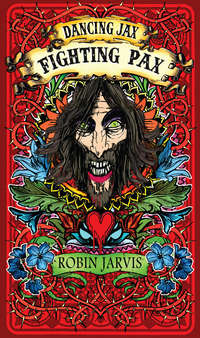
Read the book: «Fighting Pax»

Table of Contents
Cover
Title Page
Chapter 1
Chapter 2
Chapter 3
Chapter 4
Chapter 5
Chapter 6
Chapter 7
Chapter 8
Chapter 9
Chapter 10
Chapter 11
Chapter 12
Chapter 13
Chapter 14
Chapter 15
Chapter 16
Chapter 17
Chapter 18
Chapter 19
Chapter 20
Chapter 21
Chapter 22
Chapter 23
Chapter 24
Chapter 25
Chapter 26
Chapter 27
Chapter 28
Chapter 29
Copyright
About the Publisher
“All this – this insanity, the terror and the hellish creatures everywhere – it’s all because of a book, a kids’ book, called Dancing Jax. It was written back in 1936 by… I don’t know what you’d call him there, but I’d say ‘occultist’. Do you know what that is? But he was and is much more than that: Austerly Fellows – the most dangerous and evil man to have ever lived – and he’s still very much alive. The book wasn’t published until late last year, by a man who Austerly Fellows has completely taken over. The guy was just some layabout chancer who broke into the wrong place and that was the end of him. He goes by the name of the Ismus now, after the main character in the story, and the world hangs on his every word.
“So many people have died, so many lives torn apart, so many more are suffering right now, but what really scares me, what keeps me wide awake, well into the night, is not the fear of him and his foul creatures finding me: it’s wondering what he’s got planned. What next? This isn’t it – this won’t be enough. Austerly Fellows is working to a plan, something even more terrible than what we’ve already seen. No, I have no idea what it is. How could I?
“Look, I’m nothing, a nobody – this isn’t political. That – all that – is history now; it doesn’t exist any more. I’m just a maths teacher from a tiny place in England called Felixstowe, and I’m tired and desperate. Why else would I be here, begging for your help? You’ve got to believe me, Dancing Jax is coming – and not even you can shut it out. You’ve been cut off from the rest of the world for a long time, but that won’t help you now. Nothing can stop it! Nothing… except just maybe… one of those kids back in the UK. He just might be the answer to our prayers and that’s why you have to help. It’s the only hope we have.”
The video message ended and the TV screen went blank. The Marshals turned to the figure in black seated between them.
“Do what he asks,” their Supreme Leader said quietly. “Instigate the rescue – immediately.”
1
ACROSS LONDON, COLUMNS of dark, oily smoke rose high in the still air. There were always fires now: cars, homes, people. There was always something to burn. The mirrored towers of Canary Wharf flashed with the apricot light of an evening in late summer. Although many of those windows were now shattered or smeared with the filthy trails of bloated creatures that crawled down at night, there were enough panes left for the setting sun to dazzle and flare in.
The Thames was high. Its surface was unmarred by river traffic, but fouled by scum, creeping weeds and long waving chains of jelly-like spawn. The water moved thickly around half-submerged wrecks of lorries and buses. They had been torn from the bridges by things that made their nests in the shadowy arches beneath, where great clusters of leathery eggs hung in webbed nets.
A teenage couple strolled along the deserted South Bank, heedless of the ruined city, eyes only for each other and the occupant of the buggy pushed by the boy. It was one of those overdesigned three-wheelers that looked like it should be roving the surface of Mars. But garlands of fluffy pink feathers had been twined about the handles to soften and personalise it and a foil Garfield balloon bobbed above.
Lee Charles smiled down at the infant secured safely in the seat. A knitted hat, shaped like a cupcake, with pink woolly icing and a glittery cherry on top, sat lightly on her small sleeping head. The biggest grin in the world lit up Lee’s face whenever he looked at her. She was the most precious and beautiful baby he had ever seen. He lived for her smiles, and her innocence lapped around her like a flame. He would surrender his life to keep it burning. By his side, arm linked through his, the girl called Charm rested her chin on his shoulder.
“Aww,” she said. “What is you like? What a softy. Some gangsta you is.”
Lee planted a chuckling kiss on her lips.
“You two’s my gang now, Sweets,” he told her, his nose pressing against hers.
The girl kissed him back then glanced across the river at the once grand buildings, now derelict and unsafe.
“Were it worth it though?” she murmured. “I mean… all that. All what went on. Were it worth what you did?”
Lee pushed his fingers through her long hair and guided her lovely face back to him.
“For you to be here with me, right now? For our little angel? You messin’ with me? It were worth it all. I’d do it again a million times over, babes. Don’t you never think otherwise. You hear?”
Charm lowered her gaze and nodded.
Lee gripped the handles of the buggy once more.
“Time we got back,” he announced. “Be gettin’ dark soon. We don’t wanna be out when the big things start movin’ and the sky gets busy.”
“Where we goin’?”
“Back to our place, babes. You know.”
“Our place?”
“Yeah, the rad warehouse makeover, with steel shutters, gun emplacements and trick flame-throwers – all that good stuff.”
The girl’s forehead puckered slightly as she struggled to remember.
“I don’t… is me ma there?”
“Let’s get goin’,” Lee urged softly.
“Well, is she or what?”
“She ain’t there.”
“Where then?”
“I told you, babes.”
“If you did, I forgot. Why ain’t me ma here to share this? Why ain’t she wiv her granddaughter? She’d go freakin’ mental for her she would.”
“Your mother ain’t around no more,” Lee said, walking off. “She’s gone. I told you.”
Charm hesitated and put a hand to her temple in confusion. “Gone?” she repeated. “Where’d she go? I can’t fink straight. When were this? When did you tell me?”
Lee halted, left the buggy and came back to her. Cupping her face in his hands, he looked into her eyes.
“She’s dead, hun,” he said gently. “When she found out what happened to you, it were too much. She couldn’t face it and had to bail. Man, I almost caved too. Your mother was strong and fierce – you should be proud. She got the rest of us outta that hellhole, but she couldn’t hack it out here without you. She thought you was dead forever. She didn’t know what I had planned, how I was gonna go fetch you from that Mooncaster place. I’m gonna make sure our angel don’t never forget she had a lioness for a grandma.”
Charm blinked her tears away. Lee stroked her cheek. She never remembered. Perhaps it was best that way. Perhaps he should stop reminding her. The horrors of that camp, where children immune to the effects of Dancing Jax had been interned, were best forgotten, especially by her. She moved away, towards the railing, and stared down at the cloudy river. Lee followed, drew the girl close and held her tightly. As long as they were together, nothing else mattered. He would do anything to keep her in his arms forever. Sometimes he couldn’t believe what he had already done.
And then that sudden sense of dread tore at his stomach, as it did every night. Still wrapped in his embrace, Charm raised her eyes and screamed.
Running along the path towards them were a dozen hideous little hunchbacked men, with hooked noses that curved down to meet the upturned tips of equally grotesque chins. They were Punchinello Guards from the pages of that evil children’s book, ugly and brutal creatures that had crossed over into this world. They were dressed in the yellow and crimson livery of Mooncaster, with large velvet bicorn hats on their deformed heads and spears in their fists.
Lee grabbed the girl’s hand and the couple ran back towards the buggy. But the guards were already upon them.
A savage kick knocked Lee’s legs from under him. His knees crashed on to the concrete. Charm’s hand was torn from his fingers and his face slammed against the ground. He roared in pain and rage as a steel-heeled boot stamped on his shoulders. His arms were yanked up over his back until he thought they would snap or be ripped from the sockets. His joints felt on fire. He tried to struggle, but a brass knuckleduster crunched into his ribs and a pinched, nasal voice squawked in his ear.
“Goody goody!” it screeched. “Oh, goody goody! You twitch again, Creeper, and me smash bones. Me likey hear them splintery crack, splintery crack.”
The boy could only stare as three of the Punchinellos bounded after Charm, squealing and quacking with cruel delight.
“Get away from her!” he bawled. “Don’t you touch her!”
Even as he yelled those words, the girl was dragged to the floor by her hair and powerful hands clamped over her mouth, smothering her terrified shrieks.
Then two more guards came waddling up. Between them they carried a large leather suitcase. It was so long it required two handles and, when Lee saw it, his eyes widened in horror. The suitcase was shaped like a coffin.
“No!” he bellowed.
The guards set the macabre case down and skipped around it, flicking the catches open. Then they threw back the lid. Charm was hoisted into the air and flung inside.
“We had a deal!” Lee cried. “I did what your Ismus psycho wanted. We had a deal!”
The Punchinellos ignored him. They hopped and danced about the suitcase, tormenting the petrified girl within, jabbing and prodding her with the tips of their spears.
“You hurt her and I’ll kill you!” Lee thundered.
“Prick the squassage!” they taunted. “Prick it, poke it, make it spit, make it sing and squeal in the pan.”
“Girl no belong here,” the evil voice hissed in the boy’s ear. “You not done what Ismus want.”
“I did!” Lee protested. “I did it and damned myself to Hell. But I didn’t care! Don’t you take her from me now!”
“You liar. You no do it. Girl stay dead till you does.”
Lee watched them reach for the lid of the suitcase and looked on Charm’s stricken face one final time.
“Don’t you be scared now!” he shouted across to her. “I ain’t gonna lose you again! Wherever you is, I’ll find you! I promise! I promise!”
The lid snapped down and quick, dirty fingers locked it. Then the suitcase was snatched up and the two guards went scurrying away with it. Charm’s muffled screams faded in the distance.
The crushing weight of the boot lifted from Lee’s shoulder and the owner of the voice stepped before his eyes. There stood Captain Swazzle, chief warder of the castle guards. He was dressed in the same absurd outfit as the last time the boy had seen him, back at the camp. The pinstriped, 1920s, Al Capone-style suit, complete with pearl-grey spats and white fedora, was still in place and a stream of pale blue smoke curled up from the fat cigar in his mouth.
“You want see girl again?” he snarled, tapping ash down on to the boy’s face. “Do what Ismus say.”
“Big mistake messin’ with me!” Lee thundered back. “You know what I’m capable of. You know why your head guy is so scared o’ me. I am gonna make it my personal business to take you right outta this world and scrub you from that book forever – like you never was – an’ there ain’t nuthin’ could…”
The threat died on his lips. The other Punchinellos had started to squawk.
“Oohhhh, a baby! Look at the baby! Looky – looky!”
They gathered round the buggy and began pawing at the infant inside.
Lee roared at them to get away, but they paid no attention and fawned over the baby, distorting their misshapen features even more by pulling faces and sticking their dark tongues out. A moment later, the child was crying and the guards started squabbling.
“You woke the baby!”
“No, you woke the baby!”
“You did!”
“You!”
Bickering, they jostled for possession of the buggy, wrenching it from one another’s greedy grasp.
Lee bawled at them. The hands gripping his arms gave them a sudden, violent twist and his face smacked the ground.
“Please stop,” he begged fearfully. “Don’t do this. Don’t hurt my angel. I’ll do whatever you want.”
Captain Swazzle cackled and swaggered across to join the others.
“I make baby sleep,” he declared. Grabbing the buggy’s handles, he rocked it roughly from side to side. Leering down, he brought his hideous face close to the child’s and blew a smoke ring. Then he began to croon a foul Punchinello lullaby.
“Halt your wailing temper or you shall earn a clout,
only bitches whimper, only cats mew out.
I’ll pinch and pull your nose to grow,
I’ll give your chin a curl.
Dream of stunted legs that bow
and be a humpbacked girl.”
While he sang, another guard took hold of the front wheel and, together, they swung the buggy in ever-increasing arcs.
Lee tried to break loose, but every movement was rewarded with a vicious wrench on his arms and a violent stamp on his legs.
“Stop!” he pleaded. “Stop!”
“More!” Captain Swazzle squawked. “Up she goes!”
The swings became wilder. The buggy swept higher and higher into the air until it was level with the Punchinellos’ hats. If the baby hadn’t been secured in the seat, she would have fallen out. Then it went higher still. Captain Swazzle’s yellow eyes bulged in their sockets and he hooted repulsively.
“Up and down!” he screeched. “Up and down – up and down… that’s the way to do it.”
The rest of them joined in the familiar chant, stamped their feet and flourished their spears.
“That’s the way to do it, that’s the way to do it!”
Lee couldn’t bear it. Hot tears streaked his face. He prayed and he shouted, but there was nothing he could do.
“Aaaaaand… up she goes!” Captain Swazzle shrieked one last time. As the buggy went higher than ever, he let go of the handles and the other Punchinello released the front wheel. The buggy continued sailing through the air. It flew up and over the railings, then down again.
Lee squeezed his eyes tight shut. He heard the splash, followed by the trampling of the guards’ boots as they charged across to watch the buggy sink into the river.
“Oooooh, what a pity,” Captain Swazzle cried, staring down at the cloudy waters where a woollen hat, in the shape of a cupcake, floated on the scum. “Oh, what a pity.”
Lee’s scream ripped across the Thames.
The pain bit deeply into his wrists and he lurched upright.
His face was dripping, drenched in icy sweat that stung his eyes. He wrenched at his arms, but they were still held firm. His despairing yell filled the room.
“Mr Lee Charl,” a calm, female voice soothed. “You fine, you safe, you not worry, please.”
The boy’s frantic, heaving breaths continued and his heart pounded as his eyes stared blankly around. The river was gone. The Punchinellos had disappeared. He was in a dimly lit room with blank walls and no window. A hospital bed was before him, surrounded by monitoring equipment, and four men in smart olive uniforms, armed with AK-47 rifles, were standing impassively on either side. There was a figure on the bed, sitting bolt upright, with wires attached to his forehead. A petite woman, wearing a white lab coat over her army uniform, crossed to the door and snapped on the main light switch. Overhead, a fluorescent strip began to stutter. Lee now saw that the eyes of the patient were wide and the stark, traumatised expression on that face was painful to witness. Then something pink glinted under the clinical light. It was a diamanté stud in the patient’s ear. With a jolt, Lee remembered he was staring at a large mirror covering one entire wall and the pitiful figure on the bed was him.
Repulsed, he looked away and the calmly efficient female doctor consulted his case notes.
“You want sedative, Mr Lee Charl?” she asked with crisp politeness.
“Hell, no,” he answered thickly. “I slept plenty already – and they make the dreams worse.”
“Same dream, please?” she asked, ready to jot his words down.
“Pretty much.”
“Was Ismus in dream?”
“He’s never in them, Doctor Choe. They’re just dreams. It’s not like the other thing. I’m not sneakin’ off and going to Mooncaster, you know that. They’re just bad dreams. I ain’t havin’ no secret cosies with that mad son of a…”
“Detail of dream, please.”
He shook his head. “Laters – I’ll save it for the shrink session.”
“You might forget detail,” she said a little more forcefully, though the smile didn’t slip from her face. “Detail important.”
“Fat chance of that,” he uttered bitterly. “Now can I hit the shower and get me some dry clothes? Feels like I peed in these. Is there hot water today?”
Doctor Choe Soo-jin put the notes down and reached for a syringe.
“First I take bloods,” she told him.
“More? You supportin’ a family of vampires at home or somethin’? You’ve had enough juice outta me since I got here to fill a hot tub.”
“Not so much,” she said through her implacable smile. “We need to test, Mr Lee Charl. Test important.”
“So you says, but I can hardly find a vein no more. My arms are worse than a dead junkie’s. Gimme a break, yeah? If it ain’t the red stuff, you’re moochin’ every other damn thing I got.”
Doctor Choe Soo-jin proceeded to take the sample. Lee gazed around at the four young soldiers flanking the bed. They might have been shop-window dummies for all the expression on their features. None of them spoke English, or at least had never acknowledged that they could. Sometimes he wondered if they listened to what was said when he was in the company of his friends and then reported everything to Doctor Choe, or their commanding officer, afterwards.
Lee cast a piercing glance at the mirrored wall. He was sure it was one of those two-way numbers; probably a video camera behind there taping it all anyway.
He looked back at the two grim-faced men on his left. There were three different sets who ‘nannied’ him in rotation, with a changeover every four hours. He’d given each group a name to amuse himself. This quartet were the Sex and the City women, because his mother used to enjoy that show, and they’d taken over from Take That (minus Robbie) sometime during the night when he was asleep. His grandmother had been a big fan of “that nice Gary Barlow”. Soon it would be the turn of the Spice Girls (minus Geri). He didn’t know anyone who had liked them, but it cracked him up to call these stern guards Sporty, Posh, Baby and Scary.
His eyes dropped to the aluminium chain threaded through their belts. The pair on the right were joined in the same way. Both chains ended in a set of steel handcuffs, locked round Lee’s wrists. He blew on them gently. He’d been pulling on them in his sleep and the skin was raw and broken.
“Just another day chained up in North Korea,” he murmured. “Can my life blow any more? How the hell did it get to this?”
 2
THE SECRET STRONGHOLD in the northern region of the Baekdudaegan Mountains had taken seventeen years to excavate. From the outside there was no evidence of the extensive tunnel system in which 7,500 members of the People’s Army were stationed at any one time. The largest terraces and balconies were built in the style of old temples, with sagging tiled roofs, artificially distressed to appear ancient and neglected, while others were simply cut horizontally into the slope and disguised with camouflage. The two helipads and missile silos were similarly obscured. The single road which zigzagged up to the main, but discreet, entrance was constantly monitored by sniper outposts.
Beneath the pagoda-like roof that sheltered one of the terraces, Maggie rested her elbows on the low wall and pulled the fur-lined collar of the greatcoat round her chin. The biting December air was sharp in the fifteen-year-old’s nostrils and she buried them in her mittened hands. She couldn’t remember ever being warm and, to make it worse, there was no hot water in the showers. The primitive plumbing had broken down again.
The usually breathtaking view was hidden today. Beyond the wall, the grey slopes of the mountain dropped steeply into a thick white mist that filled the valley, blotting out the dark forests and surrounding snowy peaks. It was like staring into a universe of nothing, an endless blank canvas waiting for the first mark or stroke of colour to be applied. It was almost hypnotic and Maggie’s mind drifted.
She thought back to that July night, when they escaped from the prison camp in England – how she and the other aberrant children had crowded into a military helicopter, with no idea where they were being taken. Through the darkness, they were flown across the Channel to a private airstrip in France, where a jet was waiting to whisk them on across the world.
At the time it felt so unreal, like an adventure happening to someone else. They didn’t question anything. The elation of having got out of that horrendous place alive, combined with the food provided on the journey, drove all other thoughts out of their heads. They didn’t care where they were going. They were finally safe from Punchinello bullets and starvation. Each new day would no longer be a hopeless struggle for survival. Even when they touched down and sleepily discovered just where this sanctuary was, it didn’t really register.
North Korea, or ‘the Democratic People’s Republic of Korea’ as they swiftly learned to call it, had shown them its most benign and welcoming face. The children of the camp had been fêted as honoured guests and, for the first week, enjoyed the best that this secretive and isolated corner of the world could offer. After the privations and sadistic treatment they had suffered back home, it was like a surreal holiday.
They were given grand tours of the capital city, Pyongyang, and the surrounding provinces. They were bussed to old Buddhist temples, imposing monuments and battle sites, and attended a banquet at which the Supreme Leader, Kim Jong-un, was present, surrounded by an austere array of Generals and Grand Marshals. They were even ushered into the palatial mausoleum where the embalmed corpses of Kim Jong-un’s revered father and grandfather were ceremoniously displayed in glass cases. Maggie and the other refugees filed past them in disbelief: what sort of a country was this? A girl called Esther threw up on the steps afterwards.
A crew from Korean Central Television, the only news broadcaster, followed them everywhere. Just three channels were available to the people of Pyongyang and the rest of the country made do with one. There was no satellite TV or Internet for ordinary citizens: such things were forbidden. Every TV set was configured to receive only these official channels and regular checks were made to ensure they were not tampered with.
The rescued foreign children became instant celebrities. They were interviewed together, in small groups of three or four and individually. North Korea wanted to know the exact nature of the madness happening outside its borders. How could a mere book of European fairy tales be the cause of so much turmoil and confusion? Viewers watched with horrified fascination as the youngsters recounted frightening stories of the camp and the rejection by their own families.
Maggie lost track of the times she had repeated the same information.
“No, it’s not a normal book,” she had said, struggling to explain the unexplainable. “It sucks you in and you really believe you’re one of the characters in it and all this, the real world, is just a dream. Honest, that’s what it is – and you wear a playing card to show who you are in that story! No, it didn’t work on me, or any of the others here. We don’t know why, it just didn’t. That’s why they locked us up and treated us worse than animals. We were rejects. You wouldn’t believe what they did to us.”
The interviewer pressed for details and the interpreter had difficulty keeping up with the barrage of questions. Maggie was shown footage, gathered by the Research Department for External Intelligence, of foreign cities where protests against Dancing Jax had escalated into violent riots. Bookshops and publishers were firebombed. Civil war had burned fiercely but briefly until everyone was under the book’s spell.
“Same happened in Britain,” she said, watching a pitched battle storm through the streets of Moscow, between those who had read it and those who hadn’t. “We went through all that. You can’t fight it. It’s too strong. Then there are the… things.”
The microphone almost poked her in the nose as it was pushed closer.
“Somehow things are coming through, from the book,” she said. “It sounds mad, but it’s true. Nightmares, monsters in those fairy tales, are becoming real. I’ve seen them, I’ve fought them. I thought the Punchinello Guards were bad enough, but then there were… I dunno what they really are, but they’re called Doggy-Long-Legs in the book and all they want to do is eat your face. One of the guards had his nose chewed right off. Then there was the… we never found out what it was – all giant worms and tentacles. It killed my… a friend of mine. It got him – it got my Marcus.”
Maggie fell silent. The interview had then cut to a segment of an American news report from several months ago, back when America was wondering what was happening in the UK. It was second- or third-generation video, again acquired by the intelligence department. The reporter was Kate Kryzewski, speaking from Kew Gardens, investigating a previously unknown invasive shrub with pulpy grey fruit, called minchet. Eventually she too had fallen victim to the power of the book.
When the news cut back, Maggie had been replaced by a self-conscious, bespectacled boy wearing a cowboy hat. “Er… yes,” he said. “That stuff grows everywhere now and it stinks. The creatures from the book eat it, as well as other things… and the Jaxers use it to heighten the reading experience. Makes it better… sharper somehow. It tastes worse than it smells though and gives you gut ache.”
“Gives you the trots!” Maggie’s voice shouted off camera.
The picture cut to an army scientist holding a single horned skull, fixed to a stout stick. The austere, shouting voice-over told the audience it had been thoroughly examined and undergone testing. It was not a hoax; this was a genuine unicorn skull. In North Korea they called it a kirin and its appearance was seen as an auspicious sign, for these mythical creatures only appeared during the reign of wise rulers. But where had it come from? None of the children seemed to know and the boy in the Stetson only admitted to bringing it from the camp. Another strange item was held up for the viewers. A long, crooked silver wand, tipped with an amber star. The interviewer waved it around, pulling comical faces. Maggie said it belonged to the retired Fairy Godmother character, but didn’t say how it came to be in the camp. Both it and the skull were confiscated.

“I don’t want my damn face on TV!” Lee had growled, among other things that didn’t get translated.
“What they do to you?” he was badgered. “What they do?”
“You really wanna know?” he snarled back. “They dragged my girlfriend to an abattoir and slaughtered her like a pig, that’s what. Then those sick bastards fed her to us. You got that? You comprende that? Yeah, you heard right – they fed her to us!”
And so the Democratic People’s Republic of Korea learned about Dancing Jax. For once the ceaseless, bombastic propaganda machine didn’t need to exaggerate the evils of the imperialist Western aggressors; in fact, it concentrated its efforts in downplaying the dangers to dampen the mounting sense of panic. Yes, it was a state of emergency and they stood alone against the entire world, but that was nothing new. Such a crisis is what their founder, Kim Il-sung, foresaw in his great wisdom and why they would survive even this. Whatever threatened their borders would be dealt with. They had no need to fear. Kim Jong-un, the founder’s grandson, would ensure no harm would come to his people. They would remain isolated from the world and stay safe.
But the presence of the foreign children was a constant reminder of the outside danger and so, when that first week was over, the special treatment, the visits, the interviews stopped. Then the only adult female, Mrs Benedict, was found dead in the bathroom of their hotel. She had killed herself and the euphoria of having escaped the camp died with her. Two nights later, they were all removed from Pyongyang.
Maggie recalled that less comfortable journey in the back of military trucks through rugged, hilly terrain and seemingly endless forests, along rudimentary roads until, finally, they reached this secret base built into the mountain. The holiday was over. They had swapped one prison for another.
“Your face will freeze and drop off out here,” a friendly voice declared.
The teenage girl blinked. She had stared into the fog too long and her eyes ached. Turning away from the blank void, she saw a neat, elderly gentleman approaching along the terrace.
“Morning, Gerald,” she called, glad to see him. “I was miles away.”
“A chon for your thoughts?”
“Oh – I was thinking back to when we first got here.”
The man clapped his gloved hands and shuddered inside his overcoat.
“All those months ago,” he said. “When you piled out of those wagons. It was like something from Oliver! I almost started singing ‘Consider yourself’ and giving you my Artful Dodger.”
He gripped his lapels and did some nimble footwork. Maggie laughed.
“More like an Artful Codger nowadays, mind,” he chuckled.
“I wish I’d seen you back when you were performing,” Maggie said. “I bet you were amazing.”
Gerald Benning put his arm round her. He never really spoke about his show-business past, but somehow word had got around the children here, probably via Martin, and they liked to ask him questions about his former life. Gerald always answered with good humour, but usually steered the conversation around to other things and asked them about themselves. He thought it was important to remind them, especially the younger ones, what their world was like before all this had happened.
He got them talking about the little aspects of that time, the simple things that they’d forgotten: family holidays, best birthday presents, favourite movies and songs, names of pets and who they’d sat next to in school. He didn’t promise them that, one day, those things would return and everything would be as it was. That would have been cruel. They wouldn’t have believed him anyway. But those memories told them they weren’t just refugees dependant on the charity of a suspicious nation, and that there had been goodness and love in their lives, and they shouldn’t hate their parents for rejecting them. It wasn’t their fault. Dancing Jax was to blame.
Maggie smiled at him. “God knows what we’d have done without you,” she said. “All these months, stuck away up here with less freedom than we had in the camp and nothing to do, day in, day out, but snipe and bitch. We’d have probably killed each other by now. I was ready to strangle that Esther first thing today. She’s worse than she ever was. What a spiteful cow; she’s really doing my head in.”
“She’s difficult to like, that one,” Gerald conceded. “And, since she went all limpet-like on Nicholas, he’s developed full-blown annoyingness too. But we’re none of us perfect and you’ve all been through enough to send most people round the twist and back again. Being cooped up here like battery hens doesn’t help. Don’t let it get to you. Rise above it, my dear.”
“You always make it seem better somehow. Even in this miserable place…”
“Titipu,” he interrupted with a wink. Gerald had mischievously christened the mountain base after the fictional town featured in The Mikado, which was a huge insult to their North Korean hosts. There was nothing but enmity between them and Japan, where The Mikado was set.
“See, all the kids call it that now. They dunno what it is, but it sounds funny. You’ve given them something to laugh at, as long as the Generals don’t find out. You make it bearable and keep us busy with daft schemes. Look how you wangled your way into the kitchens to make that birthday cake for Lee last month.”
“He’d have been happier if I’d managed to get him some ciggies.”
“Oh, don’t expect him to show gratitude, he’s never been the demonstrative type, but that meant a lot to him that did. He’s not the same since Charm… since she died.”
“Poor girl,” Gerald said sadly. “That was horrific for all of you. I’d like to have known her. She sounds dazzling.”
Maggie lowered her eyes. “Best friend I ever had,” she said. “Not a day goes by when I don’t think about her – and my Marcus – and miss them. After all these months, it still hurts.”
“Course it does. And it always will, but it won’t always be as sharp and you’ll remember how good they made you feel more often than the pain of losing them. Takes a long time though.”
Maggie bit her lip guiltily. She had forgotten the Scottish boy, Alasdair. He had lured the Punchinellos away so that the rest of them could escape. They had all heard the ferocity of the gunfire in those dark woods and understood what it signified. His body was probably still in the New Forest, unburied and picked at by birds and animals – or worse.
And then there was Mrs Benedict…
“I should’ve done more to help Charm’s mum,” Maggie said unhappily. “That first week, after she found out what happened, I should’ve…”
“There was nothing anyone could do,” Gerald told her firmly. “Mrs Benedict just couldn’t live with her grief. Not everyone can. Don’t you ever think you could have stopped her. Despair is a terrible thing, the absolute worst.”
He blew on his gloved hands as if to dispel the sadness and the vapour cloud melted into the fog.
“But it’s no use dwelling on the past, young Maggie,” he declared breezily. “‘Turn, oh turn, in this direction,’ as the chorus sing in Patience. Worse things are undoubtedly just around the corner and we’ve got to be ready for them. But, in the meantime, ‘Let the merry cymbals sound.’ We’re not at home to Mr Despair and we’ve got to ensure your friend Lee doesn’t slip down into that dark pit.”
The girl agreed. “He’s not about to join your choir though,” she told Gerald. “I don’t know how you roped the rest of us into it either. My voice is never going to be mistaken for Adele’s. And then there’s the music lessons you do, way more popular than Martin’s boring maths classes. You really do keep our spirits up, not to mention the stuff you coax out of the guards for us. I’ve no idea how you manage that. I can’t get a smile out of the surly buggers.”
“I let them slay me at chess,” said Gerald, waving the compliment aside. “They’re mad about it. Now, glad you mentioned the choir because I’ve decided it’s going to be Christmas carols all this week – and not just the obvious ones. There’ll be no jingle bells, Batman smells or shepherds’ socks from you lot. Let’s show these gloomy Titiputians what they’re missing.”
“They’re not going to let us sing Chrimble songs, are they? I thought you said they were anti the whole thing in a mega way?”
“Oh, they are. Before this madness happened, the South Koreans used to put lights round a tower near the demilitarised zone so it looked like a Christmas tree and this bunch always threatened to fire rockets at it. They didn’t want their hoi polloi getting any fancy ideas. So what we’re not going to do is tell them we’re singing carols. I know some lovely old ones that aren’t too specific and I can tweak the words in others. They won’t cotton on; they’ll just think we’re doing our usual practising. I might even get the interpreters and guards joining in – now there’s a challenge. If I could get them to warble a wassail, or ‘The Coventry Carol’, that would be my Christmas present to myself. How hot do you think their Latin is?”
Maggie laughed. “About as good as mine – which is non-existent.”
“Fab, I might see if we can get away with a bit of ‘Quem Pastores’. That should fox them.”
“Feels weird talking about Christmas here where they don’t believe in anything but the party and their precious leader,” the girl murmured. “I used to love it: tinsel and telly, parties and the food – specially the food. I used to really wind up my stepmum by pigging out. Seems like another life now; so much has happened since.”
Gerald gave her shoulder a gentle squeeze. “You’ve grown up, that’s what’s happened to you,” he said. “You’ve realised you don’t need to live up to anyone’s expectations but your own. That stepmother was a monster, trying to make you anorexic, and, of course, you being you went and did the exact opposite – you barmpot. But look at you now. How much weight have you lost since you got here? Not that you needed to: you were lovely as you were. The other kids have managed to put some on, but you must’ve trimmed down by a couple of stone at least.”
Maggie looked back into the fog. “I didn’t need to be big any more,” she said. “And, one thing the camp taught me, there’s a better chance of survival if I can run a hundred metres without collapsing. That’s why I jog up and down here every morning; besides, there’s not much else to do.”
“Yes,” Gerald agreed. “And the running isn’t done with yet. This place has lasted much longer than I expected. Austerly Fellows must be saving it for the very end.”
“When do you think that will be?”
“Not long now.” He turned to glance back at the female soldier who had followed him out on to the terrace and gave her a cheery wave. Their ever-watchful hosts were never far away. “They’re extra nervy lately,” he muttered, just loud enough for Maggie to hear. “Haven’t you noticed? There’s rumours about all kinds of things happening near the demilitarised zone in the south. Quite a lot of them have families back there you know; you can learn a lot whilst twiddling with your bishop.”
“If they ever find out you’re picking up the lingo, you’ll be in serious trouble.”
Gerald grinned. “I’m not about to give myself away,” he said. “And my best teacher is General Chung’s youngest daughter, little Nabi. It’s just a game to her. Besides, I’m only picking up the odd word here and there, although the Korean for ‘piano’ is exactly the same as ours. Who’d have thought that? But, from what I gather, there’s been books smuggled in across the frontier and unnatural creatures have been sighted in the woods there.”
“It’s started then,” Maggie said flatly. “Soon it’ll be the helicopter fly-pasts with readings over loudspeakers. Not that they need them in Pyongyang: the whole place is wired up to that annoying PA system. But where do we go from here? There’s nowhere left to hide. We’re trapped in the last corner of the world. What’ll happen to us then?”
“Anything that comes flying into this airspace won’t last long,” Gerald reminded her. “The Marshals are itching to launch their missiles as it is, specially Tark the Shark. He’s a blood-soaked devil, that one, and just back from the south. He’d have pressed every red button already, given half the chance. That’s probably why the Chinese haven’t tried the old helicopter routine around here. They’re only thirty or forty kilometres behind these mountains don’t forget. No, I think Mr Fellows is going to try a different approach. After all, we’ve got the two things he desperately wants.”
“Lee and Martin.”
“Yes, Lee and Martin. For two very different reasons.”
They fell silent and huddled together, facing the featureless mist.
Gerald and Maggie had clicked the moment they met and greatly enjoyed one another’s company. The fact he was almost seventy years old and she only fifteen didn’t matter. She was not only the granddaughter he had never had, they were also firm friends and laughed at the same things.
“Time to go,” he announced presently. “Martin and I have got another of those useless coffee mornings with the big hats in half an hour. Get in out of this cold and tell everyone choir practice at the usual time later. Oh – and remember: ’tis the season…”
“Fa la la la la,” she sang after him as he departed along the terrace, followed by the female soldier.
Maggie turned back to the fog. The last time she had sung a Christmas carol had been back in the camp, over the fresh grave of a young boy killed by one of the Punchinello’s spears. Maggie was ashamed to realise that she couldn’t even remember his name now. Too many faces had gone from her life. But one she would never forget belonged to a girl called Jody. She shuddered in horror whenever she recalled what Dancing Jax had done to her. Jody had been caught between the two worlds. Here her eyes turned to blue glass, while in Mooncaster she had become a hollow glass rabbit, filled with a virulent plague. The memory of that would haunt Maggie for as long as she lived.
“Which probably won’t be too much longer,” she murmured softly.
Peering into the thick white vapour, Maggie thought over what Gerald had said, about the creatures sighted in the far south. What if others had started to creep across the nearby Chinese border? The wooded valleys and mountain slopes could already be crawling with them, invisible in the concealing mist. This disturbing thought caused her to jump away from the wall and she hurried back inside the military base. The metal door clanged shut behind her.
3
IT WAS ONLY marginally less cold inside the mountain. Martin Baxter was waiting on the concourse, behind the main entrance. It was a huge imposing space, where five of the key tunnels converged. The facility was so large and rambling it required transport to travel from one area to another, and each of those routes was wide enough to accommodate two lanes of traffic. One of the tunnels even had rails laid down to convey heavy equipment and munitions. The walls of this man-made cavern were bare rock and the lighting was basic and functional, connected by hanging wires and cables.
Dominating the central area was a scaled-down version of the twenty-metre-high bronze statue of Kim Il-sung in Pyongyang. Even though it was smaller, this was still seven metres tall. With its right arm outstretched, it looked as though it was directing the vehicles driving around it. Above the entrance to each passage hung the red starred flag, and the same design, with its blue borders, had been worked into the mosaic floor.
The first time Martin had set eyes on this impressive interior, it reminded him of early James Bond movies, with those amazing sets of the villain’s lair designed by Ken Adam. The geek in him had gone a step further and couldn’t help imagining daleks gliding around, instead of the old jeeps and bicycles that the base used, and robot Yeti lumbering around outside. But he hadn’t mentioned that to anyone. Only Paul, his partner’s twelve-year-old son, would have appreciated it. But Paul had been one of the first victims of Dancing Jax and was now part of the Ismus’s entourage, together with Carol, the boy’s mother. Martin missed them both desperately.
That morning he was agitated and annoyed. These weekly meetings with the Generals were pointless. They never listened to what he had to say and barely concealed their contempt at his presence. Since the rescue of the children from England, absolutely nothing had been accomplished. He couldn’t understand it. They wouldn’t even discuss a campaign against the Ismus. Their policy was to wait and gather as much information as they could, which, more often than not, they didn’t share with him. Martin decided that today he was going to get some answers. They owed him that much. He wasn’t just anybody. He was the thorn in the Ismus’s side, the man who had denounced him from the start, who had spent the best part of a year trying to warn the rest of the world.
A tinny voice barked and crackled from the tannoy system and went echoing through the tunnels. The language was Korean, but it was so distorted that, even if it had been in English, Martin wouldn’t have been able to understand what was said. Just the usual announcements and orders of the day, he supposed.
A veteran jeep pulled up alongside. The North Korean war machine was a curious hotchpotch of new technology and relics of the past. Although it had almost a thousand missiles trained on South Korea, possessed ZM-87 laser weapons, was nuclear capable and had an active space programme, most of its other arms and vehicles dated as far back as World War Two.
An even younger female soldier than the one that had been shadowing Gerald was at the wheel and a grim-looking guard with an AK-47 sat beside her. She directed a stony-faced expression at Martin and the former maths teacher clambered in beside Gerald who was sitting in the back.
“Piccadilly, please, cabbie,” Gerald quipped. “And don’t go the long way round or you won’t get a tip.” These trifling games were what got him through his time here. Life inside this mountain was barely tolerable, so he embraced every opportunity to tickle it along. At times his teasing attitude infuriated Martin, but the children adored him for it.
The girl betrayed no sign she had heard and drove on. Her name was Chung Eun-mi, eldest daughter of General Chung Kang-dae.
When he first arrived in the country, Martin’s irrepressible sci-fi self had noted that, just like the Bajorans in Star Trek, here the family name preceded the individual name.
Conscription at seventeen was mandatory for everyone, but, for Eun-mi, there was no other possible path. This was a vocation. It was her life’s dream to wear this uniform. She was everything her father could have wished for in a son. Perhaps, if she had been a boy, their relationship would have been different.
Eun-mi was passionately loyal to the state, determined to devote herself to the People’s Army, and strove to be the best in all she did, pushing herself to the limit at the expense of everything else. She had trained harder than any cadet in her unit, could strip a rifle and put it back together faster than the rest and was fluent in Russian, Mandarin and English. She and her young sister, Nabi, had been assigned to the Western refugees, to serve as interpreter, guide and companions. Maggie and the others knew they were also reporting back everything that was said. Well, perhaps not Nabi, who was only six and, unlike Eun-mi, appeared to enjoy spending as much time with the English children as she was allowed.
Gerald had grown very fond of little Nabi and had learned many Korean words from her, but he had no such affection for her older sister. Those beautiful yet flinty features gave nothing away. However, he could see the disgust glittering in her eyes whenever she addressed him or the others. Like everyone else in the country, she had been raised to distrust the West and she, being a General’s daughter, magnified that into rabid hatred. She genuinely considered these Europeans to be an inferior race and would’ve preferred to have been given other duties away from them, but she was fiercely obedient and it never occurred to her to even think about questioning her orders.
As the jeep skirted the bronze statue, Eun-mi and the guard bowed respectfully until they passed into one of the tunnels. Martin and the others were only permitted access to a small fraction of the base. Dormitories and an exercise area had been allocated for them in the medical centre. Everywhere else was forbidden. The personnel they were allowed contact with were also restricted and they ate in their own separate refectory. Even some sections of the medical centre were out of bounds and doors to mysterious rooms were either locked or heavily guarded, or both.
The room where these weekly meetings were held was located in the northernmost section of the base. It was one of the most secure areas, where intelligence was gathered via spy satellites, and row after row of computers were manned round the clock by teams of hackers leaching data from foreign security systems. Neither Gerald nor Martin saw any of that. They were always guided from the jeep to the meeting room without deviation and, once inside, weren’t allowed to leave, not even to use the toilet. Once the meeting was over, they were shepherded straight back to the jeep again.
Gerald always found this journey interesting. The installation was constantly bustling with activity and the ting-a-ling of bicycle bells. He wondered what everyone did, and why they were in such a hurry the whole time. Whatever it was, they were very serious and intense about it. Sometimes he tried to make the guards laugh, but the most he had achieved was a triumphant grin when they checkmated him.
The jeep came to a stop before a set of red double doors, blocked by two hefty sentries bearing the familiar Kalashnikovs.
“A wandering minstrel I,” Gerald sang softly to himself as he got out, waving a hanging wisp of exhaust fume away from his face. The ventilation system had broken down again in this tunnel. That was the third time since September.
The soldier next to Eun-mi took her place behind the wheel and drove off. The girl spoke to the sentries and they stood aside to let the three of them pass.
“And I shouldn’t be surprised if nations trembled,” Gerald continued in a low, lilting murmur. “Before the mighty troops, the troops of Titipu!”
The meeting room was another space designed to impress. It was what every supervillain’s war room should look like: oval in shape, with low-level lighting around the walls that accentuated the texture of the roughly hewn rock. A print of a vibrantly colourful, highly idealised and flattering painting of the three presidents, from Kim Il-sung to his grandson, hung in the centre of the longest wall. Sticking with his Mikado theme, Gerald called them the Three Little Maids and, whenever he saw one of these paintings, which were all over the place, sang a line from the song that seemed appropriate.
“Nobody’s safe, for we care for none.”
A large, elliptical table, made from cherry wood, dominated the centre, with a massive TV screen at one end. At least it was warmer in here than out in the tunnels. Three incongruous electric fires, the old-fashioned sort often found in pensioners’ front rooms back in the UK, had been brought in to lift the temperature and all their bars blazed brightly orange.
The Vice-Marshals and Generals were already gathered and waiting; they rose from the table when the two Europeans came in and bowed.
Martin and Gerald returned the bow and cast their eyes over who was present. These fourteen middle-aged men were the most powerful in the country, under the Supreme Leader. The Chief of the General Staff was here, as was Eun-mi’s father, General Chung Kang-dae, who made no acknowledgement of her presence. Then there was Marshal Tark Hyun-ki or, as Gerald called him, Tark the Shark. His sour face was half hidden behind large mirrored sunglasses as usual. He never attempted to disguise his hostility towards the English refugees. Martin despised him.
When they first arrived and Lee’s incredible ability had been thoroughly discussed, Marshal Tark Hyun-ki had demanded they send the boy into Mooncaster, strapped to an atomic warhead. Upon its detonation, everyone on the planet who was under the book’s spell would be wiped out, leaving only this glorious nation in command of a depopulated earth and finally safe from foreign aggressors.
Some of the other officers supported this efficient method of genocide and were only dissuaded when the practicalities were debated. The sudden death of entire populations would have serious consequences. How could they make safe and maintain every nuclear facility, chemical plant, gas field, oil refinery, pipeline and the innumerable other toxic industries around the globe? It would be physically impossible. And what pestilence would billions of unburied human corpses produce? What guarantee did they have that the monsters from Dancing Jax would also be killed?
Marshal Tark Hyun-ki refused to listen to the counter-arguments. He was adamant it was the perfect moment to settle accounts with the hated West. The time of empty rhetoric was over and they would be triumphant.
Lee’s reaction, when he heard what they’d been planning, was nuclear in itself. In ferocious language he yelled that anything he took to Mooncaster was only a copy; the original objects always remained with his unconscious self in this world and so any bomb would blow up in both places. In spite of this raging outburst, it took a phone call from Kim Jong-un himself to dissuade the Marshal. After that, there was no more talk of sending Lee to Mooncaster and the boy had been chained to four guards, day and night, to keep him anchored here.
As a consequence, at these meetings, Tark the Shark’s bow was always the curtest and he showed his displeasure further by never facing the two Englishmen. Ever since his grotesque proposal had been rejected, he had brought his aide along and communicated only through him.
The aide, a good-looking twenty-year-old called Du Kwan, was the one person who smiled when Martin and Gerald entered, but the friendly greeting was not for them. Over the preceding months he had grown to admire the beauty and composure of Eun-mi. He longed to speak to her privately, but such contact was forbidden. He was anxious to declare his affections, but how could such a thing be? Was she even aware of his existence? Her lovely eyes never strayed in his direction; she was focused solely on her duties as interpreter and kept her gaze fixed on the centre of the table. It was making Du Kwan despondent. Just one look from her would bring him joy.
Also present in the room that morning was Doctor Choe Soo-jin, clutching an overstuffed folder. She was due to deliver the report on her findings so far and the results of the tests she had been running. She cast a quick, sly glance at Martin. She also had certain recommendations to make that she would instruct Eun-mi not to translate.
“Good morning,” Martin said in his no-nonsense schoolteacher’s voice.
Gerald scattered friendly smiles left and right. He was always amused by the oversized hats the top brass wore here. They all looked like army pillar boxes and the medals that studded their jackets were like magnified milk-bottle tops.
Everyone sat down and those with briefcases placed them on the table as they took out laptops or files or sheaves of paper. The Chief of the General Staff chaired the meeting and he called on General Chung Kang-dae to relate the most recent intelligence.
Eun-mi’s father opened a file. He was a smallish man and marginally younger than most of the others in there. Under his hat the hair was thinning, but his eyebrows were thick and black like caterpillars. It was not an unpleasant or harsh face, but laughter had been an infrequent visitor to his lips since the death of his wife, soon after the birth of Nabi.
Before he could speak, Martin interjected.
“I need to know what’s being done about the Ismus!” he said firmly. “Where is he, what is he doing and why haven’t we come up with a plan of action to deal with him?”
The officers glowered in surprise and anger. How dare he interrupt? He was only here out of courtesy. He had nothing to contribute. They stared at Eun-mi and waited for her to translate.
The girl did so dutifully. She was also angered by Martin’s outburst. Her role as interpreter meant that she too had interrupted her father and the colour rose in her cheeks as she felt his disapproval.
“All this time and you’ve done nothing!” Martin continued. “Every day you hesitate it gets worse and worse out there. God knows what abominations are crawling through the streets now. If you allowed me access to the Internet, at least I’d be able to see for myself. The one thing I do know is that Austerly Fellows has something far more evil planned than anything we’ve seen yet. The last I heard he was writing a second book, a sequel to Dancing Jax. He may have even completed it by now. When that gets published, what’s happened already will pale in comparison!”
He paused as the girl repeated his words in Korean. When she finished, she dared to raise her eyes and saw the icy fury on her father’s face. She looked away quickly and caught sight of Du Kwan. The aide was smiling shyly at her, giving her gentle encouragement. The unexpectedness of that flustered her. She snapped her attention back to the centre of the table and her cheeks burned redder.
“And then there’s the items the kids brought with them from England,” Martin pressed on, before they could stop him. “Where are they? The wand and the skull? What did you do with them? They should be monitored constantly. And what about the kids in those camps set up in other countries? Why haven’t you done anything to help them escape? There must be hundreds if not thousands of them out there, suffering God knows what, and nothing’s been done.
“Look, you’ve got this boy, Lee, who has this miraculous power to enter the world of that book and not be taken over by it. The Ismus is terrified of him. That lad is the one thing that can turn his madness against him. You should be thanking me for bringing him to you. Using him to our maximum advantage should be our top priority and I don’t mean as a method of bomb delivery. But all you’ve done is kept him chained up like a veal calf since he got here. What sort of a strategy is that?”
The Chief of the General Staff slammed his hand down and called for silence, flecks of spit flying as he yelled.
“You listen, you learn,” Eun-mi translated rapidly. “You have no voice here. The Democratic People’s Republic of Korea shows you kindness and good will. You nothing, you Western beggar. This emergency the blame of imperialist weakness. Your peoples dirty and corrupt. You spread sickness over whole world. The Democratic People’s Republic of Korea will find solution. Wisdom of Supreme Leader Kim Jong-un will protect us.”
Martin slumped back in his chair. It was no use: he couldn’t make them understand the urgency. Austerly Fellows was going to inflict something new and unimaginable upon everybody and here they were building sandcastles, believing they could withstand the tide.
The Chief of the General Staff bowed to General Chung Kang-dae. Eun-mi’s father took up his files once more and began his report.
Gerald folded his arms and listened politely. He’d had no idea Martin was going to blow up like that. He should know by now it would be a waste of energy. Nobody could comprehend the horror of Dancing Jax until they had witnessed its effects first hand on people they knew.
General Chung Kang-dae listed the fresh information gathered that week. The poorer African countries were now completely under the influence of the book and powdered minchet was being added to baby-milk formula for the remote villages where missionaries were spreading the words of Austerly Fellows. From the smallest fishing communities in Greenland, to the nomadic tribes of Afghanistan, Dancing Jax was supreme. All fighting, all disputes over territory, drugs, race or religion had been forgotten. For the first time in history, the world was at peace.
A murmur of sneering distaste rippled round the table.
The General continued. Many major cities were being abandoned. Satellite images disclosed streets empty of traffic as people sought a more rural, simpler existence to match the one in the book that they believed to be their true lives. Fires were raging out of control in Sydney, Berlin and Tokyo, while pollution clouds over Chinese factories producing components for iPads and Samsung tablets had increased to extremely toxic levels. In spite of the global desire to live medieval, Mooncaster-themed lives, the production of such electronic devices was at a record high. Of more immediate concern, however, was the fact that more and more footage of unnatural creatures was coming to light on CCTV across the world.
Flame-throwers and chemicals were being deployed near the border with South Korea to sterilise the ground so that the minchet plant could not take root and citizens had been commanded to be vigilant. Any sighting of the invasive shrub had to be reported immediately. They were forbidden to approach it themselves.
Gerald’s concentration wandered. It was pretty much the same report as last week and the week before that. He wasn’t sure why he was required at these meetings. They never asked his opinion on anything. He gazed distractedly about the table and pined wistfully for a tall gin and tonic.
Marshal Tark Hyun-ki hadn’t taken any notice of Martin’s tirade. The Shark sat there with his face turned resolutely aside, palms down on his briefcase. Gerald couldn’t begin to guess how much blood was on those hands. He suspected that man had overseen the torture of many. Brutality was graven into his face, with its cruel, downturned mouth, framed by deep creases. It was a blessing those pitiless eyes were concealed behind sunglasses. He was too sinister to be given any name from The Mikado, even ‘the Lord High Executioner’ wasn’t adequate, as that was a comic role and the Shark was anything but funny.
Gerald’s attention shifted to the young aide.
Gerald’s people radar was highly developed. Not much got past him; he could read the intricacies and dynamics of strangers’ relationships with just a few moments’ study. People interested him; his talent for observation had been put to expert use during his former career as an entertainer and then as the proprietor of the most select guesthouse in Felixstowe. He knew the main reason Eun-mi pushed herself so hard was to earn her father’s admiration and he also knew that she would always be disappointed. The General favoured his younger daughter, Nabi, over her and the more Eun-mi tried to get him to notice her, the more he found to praise in her sister. Family troubles were the same the world over.
For some time now Gerald had been perfectly aware of Du Kwan’s feelings towards Eun-mi, and that it was a futile infatuation. But now, suddenly, that granite maiden had noticed Kwan, and Gerald was fascinated to see the bloom on her cheek and how often her eyes flicked back across the table.
“Here’s a pretty how-de-do,” he told himself. “This is a story that can only end in tears.” But his estimation of Eun-mi thawed a little. She wasn’t just a robot of the party; there was a flicker of human feeling in there after all.
With a final disparaging word about the progress of the full-scale replica of the White Castle of Mooncaster that was being built in England, General Chung Kang-dae came to the end of his report and the Chief of the General Staff bowed to Doctor Choe Soo-jin.
The doctor rose from her seat.
“Medical analysis of juvenile group now complete,” Eun-mi translated. “Or complete as possible within restriction. When arrive, health poor, malnutrition. Physical and mental stress level high, test result not reliable not consistent. Good diet, good rest, thanks to generosity of Democratic People’s Republic of Korea, they improve. Now final result ready.”
“You’re wasting your time,” Martin said impatiently. “This phenomenon isn’t something you can explain away with science. You can’t point a microscope at it and understand what’s going on. Don’t you think others haven’t tried? Every country I’ve been in since this thing started has had their top people on it, with better technology, better scientists than you have here! They found nothing because this is bigger… it’s older than that.”
The doctor ignored him as she consulted her notes.
“It my conclusion,” she declared, “nothing unique in any aberrant. Abnormality in blood – none. Immunology studies say no antigens present.”
“Ha!” Martin said.
The doctor carried on as if he wasn’t there.
“DNA profile: chromosomal analyses inconclusive. Cannot rule out they carry homozygous recessive trait, need more positive control tissue samples. Neural activity, cognition, ECG – also inconclusive and compare to People’s Army subject volunteer test group. Nothing to suggest medical reason for resistance to influence of book. None I can find, under restriction. Further examination of immunity not possible under restriction. Search for viable vaccine against book influence therefore not possible under restriction.”
The Generals and Marshals muttered in disappointment while Martin and Gerald wondered what on earth she meant by “under restriction”. What restriction?
“Male subject sixteen year, Lee Charl,” she continued. “Subject continue experience nightmare, but it normal and consistent with psychological trauma. No biological reason for remarkable ability. Further study necessary. Most strongly recommend lifting of restriction only way forward.”
She looked directly at Eun-mi and told her to stop translating. Then she made a direct appeal to the Chief of the General Staff.
“What was that?” Martin asked when nothing was repeated in English. “What did she say?” He hated it when they shut him out like this.
“Business of state,” Eun-mi had been instructed to reply and she did it with cold finality and controlled relish.
Gerald regarded her. The stony mask was back in place, but he thought he had marked the slightest tremble in her eye when the doctor said a certain word and then when the Chief of the General Staff said it again. He made a mental note of it and wondered what they were talking about. Doctor Choe was beginning to lose her cool, professional manner. It was turning into a bit of an argument. The Chief of the General Staff was refusing to agree to her request and she was brandishing her notes at him in frustration.
Presently he slapped the table and practically screamed at her. The doctor collected herself and sat down, defeated.
Martin and Gerald exchanged glances. Whatever she had been insisting upon, they were relieved it had been rejected.
But now Du Kwan had been invited to speak.
The young aide rose and bowed. With a hesitant, secret smile in Eun-mi’s direction, he explained that Marshal Tark Hyun-ki had been making a nine-day tour of inspection in the three provinces divided by the demilitarised zone. He had also overseen the destruction of the incursion tunnels leading to South Korea that were excavated by the People’s Army underneath the border during the 1970s.
“People near zone are afraid,” Du Kwan said. “They hear of monsters breaching fences. They hear of farmers finding book out in fields and whole families fall under its spell.”
“Is this true?” the Chief of the General Staff asked.
The young man bowed. “Soldiers of Marshal Tark Hyun-ki discover seven farms where families think they live in fairy-tale land. Marshal Tark Hyun-ki order families shot. They no in fairy tale now.”
The Chief of the General Staff nodded with satisfaction. Martin and Gerald turned away.
“Border guards also need be shot,” the aide continued. “Many loudspeakers across checkpoints; many bad Korean brothers and sisters read from book beyond fences. Border guards, they listen and believe in fairy tale. They shoot at soldiers of Marshal Tark Hyun-ki. We lose twelve men in battle. Now new guards at checkpoints wear ear defenders. Reinforcements needed. Marshal Tark Hyun-ki demand three thousand men go to south with tanks.”
The Chief of the General Staff laced his fingers together and considered this.
“Marshal Tark Hyun-ki also find monster,” Du Kwan added quickly. “Spider big as dog making nest in thorn tree. Marshal Tark Hyun-ki shoot and kill. Marshal Tark Hyun-ki most brave.”
“Where is spider?” Doctor Choe asked. “Why you not bring here?”
Du Kwan bowed to her. “Monster on way to medical centre,” he explained. “Marshal Tark Hyun-ki gave order when we arrive.”
The doctor wrote something at the top of a sheet of paper. An examination of this creature could be invaluable. She wanted to race off now and start working on it.
Du Kwan was about to say something more when the Shark stirred at his side. The young man turned to him in some surprise. It wasn’t like the Marshal to speak to him during one of these meetings. Everything that was to be said was planned in advance. The aide listened to a whispered command then sat down sharply.
The mirrored shades of Marshal Tark Hyun-ki reflected everyone around the table as he shifted to address them.
In the locked darkness of a steel box, inside a metal vault, behind one of those forbidden doors of the medical centre, a pale amber glow began to glimmer. A pulse of light flared within the star on Malinda’s wand.
“Gangle not all I find,” the Marshal announced, removing his palms from the briefcase and flicking the catches open. “I find also – blessed truth.”
Reaching inside, he brought out a book covered in plain green paper. With an expression of ecstasy on his face, he began to read aloud from it and rocked backwards and forwards in his chair.
“Beyond the Silvering Sea,” Eun-mi translated, puzzled by his actions.
Martin and Gerald sprang up.
“Stop him!” Martin yelled. He threw himself across the table and tried to snatch the book out of the Shark’s hands. But the Marshal slid sideways out of the chair and carried on reading.
The other Generals had leaped up and were shouting in fear and confusion. Suddenly the room was full of noise as four shots exploded. Marshal Tark Hyun-ki was catapulted backwards in a grotesque ballet as the bullets ripped through him. Three in the head, one through the heart. He was dead before he crashed to the floor and his mirrored sunglasses went skittering across the carpet.
Everyone’s ears were ringing. The gunshots were deafening. Gerald looked away from the Shark’s body and down the table. Pistol in hand, General Chung Kang-dae stared dispassionately at what he had done. Then he turned to the young aide.
Du Kwan was stammering with shock. A speckled mist of the Marshal’s blood was sprayed across his face. He raised his eyes, aghast. Then he saw how everyone was looking at him.
“I… I did not know!!” he protested. “Marshal Tark Hyun-ki said nothing of this to me – I swear it. I did not know. I have not read the book! I swear – I swear!”
“What are you doing?” Martin cried when he saw General Chung’s grim face. “The lad hasn’t been affected. Look at his eyes. They’re normal! He’s not a Jaxer!”
He rounded on Eun-mi and begged her to translate. The girl wavered. Then she hurriedly beseeched her father to listen.
The pistol fired two more bullets and the handsome young man joined the Marshal on the floor.
Eun-mi gave a horrified gasp.
“Animal!” Martin bawled at the General. “That poor lad was one of us! He wasn’t any threat. You just murdered an innocent boy!”
General Chung didn’t understand what he said. He merely smiled and gave a little bow as he returned the pistol to its holster.
The meeting was over. A short while later, an ashen-faced Eun-mi drove Gerald and Martin back to their section.
“They’re all innocent, Martin,” Gerald reminded him gently. “Don’t forget that. Even the Shark, vile devil though he was, wasn’t responsible once the book got hold of him. If you start thinking the Jaxers are anything but victims then what does that make you? Think of Carol and Paul: they’re innocent too.”
Martin Baxter said nothing. He was sick to the stomach by what had just happened, but there was something more. Gerald’s words had touched upon a very raw nerve and he couldn’t think about it right now.
Back in the meeting room, the Chief of the General Staff had just taken a phone call. The entire meeting had been transmitted via webcam to the palace in Pyongyang. The order from the Supreme Leader was very plain.
“Tell Doctor Choe Soo-jin the restriction is lifted – with immediate effect.”
4
LEE WAS IN the refectory that also served as the refugees’ common room. He was sitting at one of the long tables, with his feet up. The four guards he was chained to stood stiffly either side. It was the Spice Girls, four young men in their early twenties. They had taken over from the Sex and the City quartet under an hour ago.
Many of the other children were there, because their dorms were small and cell-like and unheated. Here there was a wood-burning stove, but the logs were rationed and their daily allocation lasted only about four hours.
The children were wrapped in rough blankets or oversized military greatcoats. Having escaped from the prison camp in England with nothing but the rags they had on, they now wore clothing generously donated by the People’s Army and looked like the destitute outcasts that they were. Most days they sat, clumped together in small groups, either playing the Korean board games also given to them by the military or whispering among themselves.
Maggie was a dab hand with a needle and thread, so Gerald miraculously scrounged the rudiments of a basic sewing kit for her, including a small pair of scissors. She happily filled her hours adapting the cast-off uniforms, cutting them down for a snugger fit or turning them into completely different garments. Spencer’s Stetson had been confiscated as being too strong a symbol of the US, so she had made him a cowboy-style waistcoat with a star on it like a sheriff’s badge to compensate.
She paid special attention to the group of girls who had been in Charm’s hut back in the camp. Her late friend had asked her to look out for them so she made sure their requests were dealt with first. Western dress was forbidden in North Korea so the guards raised their eyebrows at the home-made fashions. It was the closest Maggie ever got to making them smile. With the remnants, she created small dolls and animals, initially to keep herself occupied in between alterations and to put around the dorm and refectory to cheer the place up. But they turned out so well every girl wanted one, except Esther who said they were “fugly”.
That afternoon Maggie sat across from Lee, stitching eyes on to a bear with coloured thread. It was a gift for little Nabi, who spent as much time as she could in the company of the English aberrants. Maggie found it hard to believe she was Eun-mi’s sister. The two were poles apart. Six-year-old Nabi was a lively, excitable, curious child whose laughter could be heard ricocheting down the long, bleak corridors. Her raven hair was tied in bunches and her face was almost always scrunched up in a toothy grin that swallowed her almond eyes. She was nearly too cute at times and Maggie jokingly suggested Nabi had slid off one of the chocolate-boxy propaganda posters.
The six-year-old was besotted with Lee. He was something new and amazing to her. Black people were extremely rare in the Democratic People’s Republic of Korea, usually embassy staff and diplomats who lived separately in gated communities. They had all been ejected from the country many months ago, so she had never seen anyone like him before. For the first few weeks she’d followed him around with an open mouth and bulging eyes. When he touched something, like a door, or set a cup down, she would pounce and inspect it to see if his colour came off. To begin with he yelled and roared at her and she would run and hide like a terrified hamster. But, eventually, she would come stealing back for more and gaze at him with those bright, worshipping eyes.
Even though he was still numb with grief and raging against his chains, Lee found it impossible to take his anger out on Nabi. He knew exactly what Charm would do if she was still alive. She would have befriended and loved the child and so he tolerated her.
That morning she was sitting next to Maggie, watching the bear take shape and insisting it look fiercer by making savage faces and growling. Her English consisted of the few words and nursery rhymes Gerald had taught her and several other pieces of choice language that she had picked up from Lee, which always scandalised her sister, if her vocabulary stretched that far. Then there was that infamous occasion when Nabi had squealed, tunelessly, in front of their father, “I see you, baby, shakin’ that ass, shakin’ that ass.” For three weeks after that she was forbidden to visit the refugees, but had finally managed to bring the General around, as she always did.
Outside the refectory, in the long, gloomy corridor painted a bilious green that was blistered and peeling, Spencer waited for Martin and Gerald to return. There was nothing else to do; besides, he liked being on his own. In this place there was little privacy. The dorms were smaller and more cramped than the huts in the camp had been and the toilet facilities were basic and communal.
He scuffed the worn heel of his shabby shoes across the concrete floor and the sound went echoing eerily up and down. Five small dorms, the refectory, the shared bathroom, the stone steps to the terrace and Lee’s hospital room were accessed by this broad yet claustrophobic passage. Further on it turned a sharp right corner into the prohibited area with the mysterious doors they weren’t allowed to enter.
Spencer glanced towards that corner and squinted at the armed soldier standing rigidly still there. It was impossible to be alone anywhere here. If it wasn’t the guards, it was the other children, or visits from that overzealous, pushy doctor wanting to do more tests. The boy craved a bit of solitude. He yearned for the desolate stretches of sand dunes in his home town of Southport and missed the lonely walks he used to take there out of season, when he could roam all day and not meet another soul. Everything about this place was so oppressive, at times it made him breathless. It wasn’t just the joyless regime and the fear of what lay ahead, but the mountain itself. He tried not to think about the millions of tonnes of rock that surrounded him, but was constantly aware of them and could almost feel them pressing down.
He would often lie awake in his bunk, listening to the distant noises of the base and the eerie sound of the air coursing through the vents and tunnels. If the main entrance was open, and the wind came squalling in, it howled through the connecting passageways. When other unknown and distant doors were unbolted, it could be like the whispering of ghosts. Spencer wondered how frequent earth tremors were in this part of the world. One slight judder would be cataclysmic and the mountain would come crushing down. When he did sleep, it was fitful and shallow and the faintest creak or scratching of mice caused him to lurch awake.

Unlike the other refugees, he didn’t call this place Titipu. Instead he preferred ‘the Hole-in-the-Wall’ after the Wild West hideout of outlaws. But that didn’t help much. Passing a hand over his bare head, he tried to suppress the anxiety he could feel rising in his chest. The loss of his Stetson had been like a kick in the gut. It was his comfort object and he felt bereft without it. In the camp, when the Punchinello with the silver nose had swiped it from him, at least Spencer knew where it was. These people had probably burned it and that likelihood distressed him deeply. Maggie had been extremely sympathetic, but the waistcoat she had made was no substitute for his beloved hat, although he secretly liked it when Lee called him “Sheriff Woody”.
Spencer turned his unhappy face to the other end of the corridor, where it opened out on to one of the main tunnels. Digging his cold hands into his pockets, he leaned against the rocky wall and waited.
“It really Christmas already?” Lee asked, back in the refectory.
“At the end of the week,” Maggie answered. She had been telling him Gerald’s plans for the choir.
“Dunno how or why you bother keepin’ track. Ain’t no point no more.”
“I bother because it helps,” she said.
“One day’s like every other in this dump. Could be Pancake Tuesday for all the difference it makes. Those things mean nuthin’ now. Sooner you stop pretendin’ they does, the better.”
Maggie didn’t let him nettle her. She had got used to his attitude and temper. After all this time, they were like background noise, but he was getting worse and not many of the others talked to him any more. Today he was particularly volatile and ready to kick off. She didn’t know the details of his nightmare, he never shared them with anyone but the doctor, but everyone could hear his screams.
“Gerald says he makes fantastic mince pies,” she rattled on, “with chocolate in. They must be gorgeous. Suppose it’ll be same old kimchi and rice or noodles here on the day.”
Nabi’s ears pricked up. “Kimchi!” she repeated, patting her stomach and nodding. “Good yum.”
Lee curled his lip at her and she squirmed with pleasure.
“Long as it’s not no more of those thin spicy soups,” he grumbled. “Thought we’d done with that kinda slop when we left the camp.”
“Don’t suppose I’ll ever so much as sniff another roast potato,” Maggie said mournfully.
“Girl, you ain’t never gonna do a whole mess of things again. This, right here, this is your life now, till the Jaxers catch up with us – and that can’t be far off. After that, you won’t have no life no more. Think they’re gonna keep you as a pet or somethin’? The lot of you’ll be lined up against the wall and be a bullet buffet.”
“‘The First Noel’,” she declared, switching back to the subject of the choir. “That’s my favourite carol. I’d rather sing that old Slade song though. Bit too obvious what they’re about I suppose, so we probably won’t be singing either of them. What’s yours? You must have one, even if you won’t join in with the Wenceslassing.”
He threw her a disbelieving ‘WTF?’ glance. “You think you pierced my brain when you did my ear?” he snapped. “I ain’t forgot the last time we sang ‘Silent Night’, over the grave of that crazy kid Jim, who thought he was a superhero and got himself stuck in the guts. Have you?”
“Ah, of course – his name was Jim. Poor lad.”
“And there’s no way I’m ever gonna forget what that Ismus guy wants outta me. Don’t you remember what he said when you, me and Spence went to Mooncaster that time? I do not want to hear no songs about no towns in Bethlehem or herald angels bein’ noisy in the neighbourhood and I specially don’t wanna hear nuthin’ about no shepherds. You got that? I am gonna be spending that entire day hooked up to my bleepy machines in my hospital bed – Scroogin’ it large.”
Maggie had forgotten nothing about that, how could she? But she had hoped he’d stopped brooding by now. She was wrong. That time when Lee had accidentally dragged her and Spencer to that other fantastical realm, the Ismus had proposed a disgusting bargain that she had never been able to get her head around. That evil man had promised Lee could be reunited with Charm, there in Mooncaster, but only if the boy did something for him, only if he killed someone – someone very special.
“That was just mad talk,” she said with a frown and a shrug. “He was screwing with your head. I don’t believe it; it isn’t possible. There’s no way she can come back, not even there. You know what he’s like, all filthy lies and nastiness. What he says eats at you because that’s what it’s meant to do. Best to shut it away and not think about it – ever. Drive you nuts that will.”
Lee swung his feet off the table and pushed his chair away. Not think about it? It was the only thing that kept his heart beating throughout the day, and what fuelled his nightmares. He gave his chains a sharp tug and one of the attached guards blurted an angry protest. If he hadn’t been tethered in this way, Lee would have returned to Mooncaster long ago. His mind was made up. He was going to accept the Ismus’s obscene offer. He would do anything to have Charm back in his life, even if it meant spending the rest of their days in that extreme world of castles and monsters. He had to be with her.
He was about to leave when the door opened and Spencer entered. His spectacles misted over as they encountered the warmer air. Some of the girls sniggered idly.
“Er… Martin and Gerald are back,” he announced, wiping the lenses. “The jeep’s just pulled in.”
“Woohoo,” Lee uttered woodenly. “Break out the Pringles and party dips.”
“Ohhh… Pringles,” Maggie breathed dreamily.
The other children stopped what they were doing and faced the door. Those weekly meetings were their only source of outside news and they looked forward to them with an intense mix of curiosity and dread.
“They don’t seem happy,” Spencer warned everyone.
“When is Baxter ever happy?” Lee asked. “He gets off peddlin’ the-end-is-nigh stuff.”
“Shh,” Maggie hissed.
The door opened again and the two men came in. A shocked murmur escaped the children’s lips. Spencer’s warning had been a huge understatement. They looked terrible. Maggie rose and tried to take Gerald’s hand, but he said he was fine and eased himself on to a chair. It was the first time he had looked his age. Little Nabi pattered over and rested her head on his arm.
Perching on the edge of a table, Martin considered what to tell them. There was no point concealing what had happened and these kids had been through too much already not to know the truth.
“No easy way of saying this,” he began solemnly. “And maybe I should wait till you’re all here, but you’ve a right to be told straight away. Now I don’t want to alarm you…”
“Spit it, Baxter,” Lee heckled. “You ain’t on TV now, no need to milk your moment. Get to the point.”
“One of the Marshals, Tark Hyun-ki, had been turned,” Martin continued. “He started reading from it in the meeting.”
The children uttered cries of dismay. They all knew exactly what ‘it’ was and they also knew this day was inevitable, but it was still an appalling jolt.
“Oh, game over!” Lee snorted with a twisted grin. “Why’d it take so long?”
“What about the others in the meeting?” Maggie asked. “Are they Jaxers now as well?”
Martin shook his head. “The Marshal was shot, killed before he could turn anyone else.”
“What?” Lee roared in disbelief. “You know better than that! It don’t take more than a few lines to sucker some people in. You, me, we both seen that happen.”
“No one else was affected,” Martin repeated firmly.
“You is talking pure, unrefined, steamin’ straight from the sphincter BS and you know it!” the boy countered. “This is how it starts. Every damn time! Them words is in this base now. No way that guy was the only one. It’s gonna be all round this place like the flu, come tomorrow. You can say goodbye to playing hide-and-seek. We been busted and that Ismus is gonna be poncin’ through this ass end of nowhere any day, rubbin’ his greasy mitts together.”
“There is no immediate danger of that happening!” Martin stated, raising his voice. “This facility is still the safest place for us and will continue to be defended for some time.”
Lee jumped to his feet. He couldn’t believe what he was hearing.
“Listen to you!” he shouted. “Who does you think you is? You don’t have no special handle on this. You know nuthin’! You is nuthin’!”
“Sit down!” Martin told him.
“What? You don’t get to order me around, Baxter. You ain’t in no classroom no more and you sure as hell ain’t the boss of me. I’m outta here – can’t stand the stink of stoopid in the morning.”
He yanked on the chains and the guards marched with him to the door.
Martin ground his teeth. That lad was impossible. He took a calming breath, but, as Lee left the room, he heard him growl the word “Loser” and Martin boiled over.
Racing into the corridor after him, he surprised the four guards when he grabbed hold of Lee’s shoulders and pushed him against the wall. The Koreans shouted and brandished their rifles to make him back off, but Martin was so incensed he didn’t hear them.
Lee yelled fiercely and lunged at him, but the chains stopped his fists flying. It took all four guards to restrain him.
“Touch me again and you’re dead, Baxter!” the boy raged, kicking out.
“What is your problem?” Martin shouted. “From the minute we met you’ve done nothing but antagonise and undermine me. So you’ve had it rough. Big deal. There’s not one of us who hasn’t. What makes you different, what makes you so special?”
Lee raised his hands and rattled the chains, almost proudly. “Is you dumb or what, Mr Maths Teacher?” he sneered. “These make me special. I’m the Castle Creeper – I’m the most special and coolest thing there is.”
A slow, mocking grin appeared on his face. “Yeah,” he said. “That’s what this is about, ain’t it? You can’t stand that you’re just another nobody now. All that TV you used to do, telling the world how bad that book is, all them shrill blogs and runnin’ from country to country, tweetin’ and preachin’ – pushin’ your own brand of panic an’ drama at anyone who’d listen. Thinkin’ you’re the leader of some sort of resistance, what a joke!”
“Oh, you really are a piece of work,” Martin growled in disgust. “You make me sick. And to think, at first, I couldn’t wait to meet you. You were going to be the answer to this madness. I honestly believed you were going to turn it around. Well, more fool me!”
The free sample has ended.