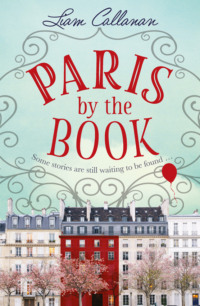
Read the book: «Paris by the Book: One of the most enchanting and uplifting books of 2018»
LIAM CALLANAN is the author of the novels The Cloud Atlas and All Saints. His work has appeared in Slate, The New York Times, The Washington Post, San Francisco Chronicle, Forbes, Good Housekeeping and elsewhere. He lives in Milwaukee with his wife and three daughters, and teaches in the University of Wisconsin-Milwaukee’s creative writing program and at Warren Wilson. Visit Liam’s website at www.liamcallanan.com

Copyright

An imprint of HarperCollins Publishers Ltd
1 London Bridge Street
London SE1 9GF
First published in Great Britain by HQ in 2018
Copyright © Liam Callanan 2018
Liam Callanan asserts the moral right to be identified as the author of this work.
A catalogue record for this book is available from the British Library.
This novel is entirely a work of fiction. The names, characters and incidents portrayed in it are the work of the author’s imagination. Any resemblance to actual persons, living or dead, events or localities is entirely coincidental.
All rights reserved under International and Pan-American Copyright Conventions. By payment of the required fees, you have been granted the non-exclusive, non-transferable right to access and read the text of this e-book on-screen. No part of this text may be reproduced, transmitted, downloaded, decompiled, reverse engineered, or stored in or introduced into any information storage and retrieval system, in any form or by any means, whether electronic or mechanical, now known or hereinafter invented, without the express written permission of HarperCollins.
Ebook Edition © April 2018 ISBN: 9780008273675
To the one I found
It is inevitable that when we really need someone we find him. The person you need attracts you like a magnet. I returned to Paris, after these long years spent in the countryside and I needed a young painter, a young painter who would awaken me. Paris was magnificent, but where was the young painter?
— Gertrude Stein
Paris, 1945
Contents
Cover
About the Author
Title Page
Copyright
Dedication
Epigraph
PROLOGUE
PARIS, WISCONSIN
CHAPTER 1
CHAPTER 2
CHAPTER 3
CHAPTER 4
CHAPTER 5
PARIS, FRANCE
CHAPTER 6
CHAPTER 7
CHAPTER 8
CHAPTER 9
CHAPTER 10
CHAPTER 11
CHAPTER 12
CHAPTER 13
CHAPTER 14
CHAPTER 15
CHAPTER 16
CHAPTER 17
CHAPTER 18
EPILOGUE
ACKNOWLEDGEMENTS
About the Publisher
PROLOGUE
Once a week, I chase men who are not my husband. (After everything, I do this still.)
I should not, but there are many things I do that I should not—smoke, own a bookstore, pay for French lessons I always find ways to skip—and this is one. I walk my daughters to school, stare past the parents staring past me, and start my search for that day’s man.
I’ve sometimes begun right there on the sidewalk, trailing a fellow parent, a father, as he frees himself from the clutch outside the massive school door. More frequently, I walk up to the teeming rue Saint-Antoine and sift the passing crowd. Some mornings I find someone to chase right away. Some mornings it takes all morning. Some mornings I follow someone for a while, usually someone just like my husband, or as close as I can manage, or bear—the ink-black hair, the narrow shoulders, the hands that can’t stay in pockets, the head that can’t stop turning every way but mine—only to lose interest when some errant detail distracts. My husband would never wear blue glasses. My husband would never not yield a taxi to a pregnant woman. My husband would never steal a magazine from a newsstand, an apple from a greengrocer, a book from a bouquiniste. My husband would never—and I saw this once on one of my forays, a dad I’d trailed from the school door—kiss a woman not his wife.
Some mornings I find no one. This always surprises me, though I suppose what should surprise me more is all those other mornings when everything is right, when I find a man within a half kilometer of wandering, when I’m able to follow him for a good long while.
Following these men should be more difficult than it is; it’s not. Paris is a crowded city, far more so than travel ads and posters portray, and I—well, although I’m fit, have long legs, and helplessly project the “stay away” vibe men adore, I am forty-two, roughly twice the age of any woman who interests men here.
So be it. Invisibility suits me, serves me.
Every so often, too often, the authorities will issue a special warning, a reminder: we must be watchful. And so I am, and so others must be, but I’ve learned I’m never more invisible than in the wake of such warnings. I do not look like anyone whom anyone thinks to look for.
Even on those days, on any day, it can become awkward if the man I am pursuing leaves the main streets for narrower ones. On busier boulevards, I have trailed someone as close as a meter or two behind, close enough to see the thickness of his hair (my husband’s, so thick), smell his cologne (my husband, none, not ever), taste the smoke coming off his clothes if he smoked (my husband, when he smoked, always lied about doing so, and I always uncovered the lie this same way, a scent, a sniff—but still, a reminder that yes, he could lie).
On the quieter streets, I will let the distance stretch a block or more. I’ll ponder what I would do if it really were my husband up ahead: embrace him, take up his hand, hold tight as I kick him, cuff him, ask him why and what and where. But it’s not him, it’s never him, so I’ll study the shops, I’ll study my phone, I’ll read the historical markers and put any man I’m chasing at ease: c’est juste une autre touriste perdue.
Once (and only once), it finally happened. A man I followed confronted me.
This was six months after we’d first arrived. Not so long ago. Long enough; I was different then. So was Paris.
Still, I should have known. I did know—I’d known he was going to be trouble from the very start, because he looked too, too much like my husband. Same hair, same glasses, same smile. He gave that smile to a woman at the Apple store beneath the Louvre (almost as popular, as crowded, as the museum above) and that was what caught my eye, that lopsided grin: I didn’t even see it was my husband’s doppelgänger until I did, and then I couldn’t not chase him. He circled the Louvre pyramid’s subterranean twin, inverted like an arrow pointing down, as if to say, this is the place—which isn’t wrong—and then he moved smoothly past all the other temptations for sale in the underground mall there (coffee, toys, luxury toilet paper), before reaching the spot where everyone must decide: down deeper to the Métro, or up to the surface?
And had he descended, I would have let him be, because I wasn’t looking for a Métro chase that day. This was an unplanned mission. I’d only meant to buy my daughters—Ellie, sixteen at that point, and Daphne, fourteen—new charging cords; the cheap knockoffs I’d bought them had failed. I wanted to do something right for a change, and be home, cords in hand, when they arrived from school.
But he didn’t descend, he climbed, and at the top of the stairs, he did something that made no sense. Instead of continuing on to the crowded rue de Rivoli, he doubled back into the vast plaza the wide wings of the Louvre embrace. He must have wanted just one more look.
So did I.
After a minute or two, he checked his watch and then chose a new path back out to the world, the Passage Richelieu, a colonnaded pedestrian tunnel that burrows through the Louvre’s French sculpture galleries. Glass walls allow passersby a free peek, no lines.
Would he look? No.
I couldn’t not, but pausing almost made me lose him, and I had to skip a step or two to catch him as he exited, crossed the street, and started north along the rue de Valois.
And now I set before him another test. If he turned right toward the Banque de France, I would drop him immediately; if left, into the Palais-Royal, with its gorgeous gardens and stately rows of trees that I might weave among, I would follow.
The free sample has ended.