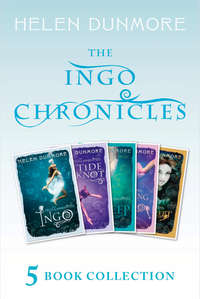
Read the book: «The Complete Ingo Chronicles: Ingo, The Tide Knot, The Deep, The Crossing of Ingo, Stormswept»
THE INGO CHRONICLES: COMPLETE COLLECTION
Ingo, The Tide Knot, The Deep, The Crossing of Ingo, Stormswept
5 Book Collection


COPYRIGHT
HarperCollins Children’s Books An imprint of HarperCollinsPublishers Ltd. 1 London Bridge Street London SE1 9GF
www.harpercollins.co.uk
This ebook collection first published in Great Britain by HarperCollins Children’s Books in 2017
Ingo text © Helen Dunmore 2005 The Tide Knot text © Helen Dunmore 2006 The Deep text © Helen Dunmore 2007 The Crossing of Ingo text © Helen Dunmore 2008 Stormswept text © Helen Dunmore 2011
Cover art © HarperCollins Publishers 2012, Photography: Elena Kalis, Shutterstock, Decorative Illustration: Eliz Hüseyin
Helen Dunmore asserts the moral right to be identified as the author of this work.
A catalogue record for this book is available at the British Library.
All rights reserved under International and Pan-American Copyright Conventions. By payment of the required fees, you have been granted the nonexclusive, nontransferable right to access and read the text of this ebook on-screen. No part of this text may be reproduced, transmitted, downloaded, decompiled, reverse engineered, or stored in or introduced into any information storage and retrieval system, in any form or by any means, whether electronic or mechanical, now known or hereinafter invented, without the express written permission of HarperCollins ebooks
HarperCollinsPublishers has made every reasonable effort to ensure that any picture content and written content in this ebook has been included or removed in accordance with the contractual and technological constraints in operation at the time of publication
Ingo ISBN: 9780007381371 The Tide Knot ISBN: 9780007369294 The Deep ISBN: 9780007369287 The Crossing of Ingo ISBN: 9780007373253 Stormswept ISBN: 9780007468003
Ebook Edition © 2017 ISBN: 9780008261450
Version: 2017-05-24
CONTENTS
Cover
Title Page
Copyright
Ingo
The Tide Knot
The Deep
The Crossing of Ingo
Stormswept
About the Author
In this Series
About the Publisher


PRAISE
“The electric thrill of swimming with dolphins, of racing along currents, and of leaving the world of reason and caution behind are described with glorious intensity.” Amanda Craig, The Times
“Compellingly lyrical.” Independent
“Helen Dunmore may have a few drowned readers on her conscience, so enticing and believable is the underwater world she creates in Ingo.” Telegraph
“Helen Dunmore is an exceptional and versatile writer and she writes with a restrained, sensual grace.” Observer
“A remarkable fantasy… It’s a haunting, beautifully written book which creates a totally believable parallel world.” Northern Echo
“Ingo is an intoxicating adventure… Wonderful, evocative storytelling.” Publishing News
“As ever, Dunmore’s characters are beautifully drawn… Though the first in a series, this book works perfectly as a standalone title, with a satisfying resolution but enough left hanging in the air to make the characters and situations live on in the reader’s mind. Ingo has a haunting, dangerous beauty all of its own.” Philip Ardagh, Guardian
DEDICATION
FOR TESS
CONTENTS
Cover
Title Page
Praise
Dedication
Chapter One
Chapter Two
Chapter Three
Chapter Four
Chapter Five
Chapter Six
Chapter Seven
Chapter Eight
Chapter Nine
Chapter Ten
Chapter Eleven
Chapter Twelve
Chapter Thirteen
Chapter Fourteen
Chapter Fifteen
Chapter Sixteen
Chapter Seventeen
Chapter Eighteen
Chapter Nineteen
Chapter Twenty
Chapter Twenty-One
Chapter Twenty-Two
Chapter Twenty-Three
Chapter Twenty-Four
CHAPTER ONE
You’ll find the mermaid of Zennor inside Zennor Church, if you know where to look. She’s carved from old, hard, dark wood. The church is dark, too, so you have to bend down to see her clearly. You can trace the shape of her tail with your finger.
Someone slashed across her with a knife a long time ago. A sharp, angry knife. I touched the slash mark very gently, so I wouldn’t hurt the mermaid any more.
“Why did they do that to her, Dad? Why did they hurt her?”
“I don’t know, Sapphy. People do cruel things sometimes, when they’re angry.”
And then Dad told me the mermaid’s story. I was only little, but I remember every word.
“The Zennor mermaid fell in love with a human,” said Dad, “but she was a Mer creature and so she couldn’t come to live with him up in the dry air. It would have killed her. But she couldn’t forget him, and she couldn’t live without him. She couldn’t even sleep for thinking about him. All she wanted was to be with him.”
“Would she have died in the air?” I asked.
“Yes. Mer people can’t live away from the water. Anyway, the man couldn’t forget her either. The sight of the mermaid burned in his mind, day and night. And the mermaid felt just the same. When the tide was high, she would swim up into the cove, then up the stream, as close as she could to the church, to hear him singing in the choir.”
“I thought it was mermaids that sang, Dad.”
“In this story it was the man who sang. In the end the mermaid swam up the stream one last time and he couldn’t bear to see her go. He swam away with her, and he was never seen again. He became one of the Mer people.”
“What was his name, Dad?”
“Mathew Trewhella,” said Dad, looking down at me.
“But Dad, that’s your name! How come he’s got the same name as you?”
“It’s just by chance, Sapphy. It all happened hundreds of years ago. You know how the same names keep on going in Cornwall.”
“What was the mermaid called, Dad?”
“She was called Morveren. People said she was the Mer King’s daughter, but I don’t believe that’s true.”
“Why not?”
“Because the Mer don’t have kings.”
Dad sounded so sure about this that I didn’t ask him how he knew. When you’re little, you think your mum and dad know everything. I wasn’t surprised that Dad knew so much about the Mer.
I stroked the wooden mermaid again, and wished I could see her in real life, swimming up the stream with her beautiful shining tail. And then another thought hit me.
“But Dad, what about all the people the man left behind? What about his family?”
“He never saw them again,” said Dad.
“Not even his mum or his dad?”
“No. None of them. He belonged to the Mer.”
I tried to imagine what it would be like never to see Dad again, or Mum. The thought was enough to make my heart beat fast with terror. I couldn’t live without them, I knew I couldn’t.
I looked up at Dad. His face looked faraway and a bit unhappy. I didn’t like it. I wanted to bring him back to me, now.
“Can’t catch me!” I shouted, and I ran off clattering up the stone aisle of the church to the door. The door was heavy and the fastening was stiff but I wrestled it open.
“You can’t catch me!” I yelled back over my shoulder, and I ran out through the porch, down the stone steps and into the sunshine of the lane. I heard the church door bang and there was Dad, leaping down the steps after me. The faraway look had gone from his face.
“Look out, Sapphy, I’m coming to get you!”
That was a long time ago. Dad never talked about the Mer again, and nor did I. But the story lodged deep inside my mind like an underwater rock that can tear a ship open in bad weather. I wished I’d never seen the Zennor mermaid. She was beautiful, but she scared me.
It’s Midsummer Eve now, and when it gets dark they’ll light the Midsummer Fire on Carrack Down. We go up there every Midsummer Eve. I love it when they throw the wreath of flowers into the flames, and the wreath flares up so that for a few seconds you watch flowers made out of fire. The bonfire blazes and everyone drinks and dances and laughs and talks. Midsummer Night is so short that dawn arrives before the party’s over.
Dad’s up there now, helping build the fire. They pile furze and brushwood until the bonfire stands taller than me or Conor. Conor’s my brother; he’s two years older than me.
“Come on, Saph! I’m going on up to see how big the bonfire is now.”
I run after Conor. This is how it usually is. Conor ahead, and me hurrying behind, trying to keep up with him.
“Wait for me, Con!”
We wait for the sun to set and for the crowd to gather, and then it’s time to light the Midsummer Fire. The first star shines out. Geoff Treyarnon thrusts his flaming torch into the dry heart of the bonfire. The fire blazes up and everyone links hands and begins to dance around it, faster and faster. The flames leap higher than the people and we have to jump back.
Conor and I join the ring around the fire. Mum and Dad dance too, holding hands. It makes me so happy to see them like this, dancing and smiling at each other. If only it was always like this. No quarrels, no loud voices…
The flames jump higher and higher and everyone yells and laughs. Conor drinks a bottle of ginger beer, but I don’t like the taste. I wrap myself in a rug and sit and watch until the flames blur into red and orange and gold. My eyes sting and I shut them, just for a minute. The fire melts into velvety blackness. There are stars in the blackness and I want to count them one by one, but they’re dancing too fast…
I must have fallen asleep. Suddenly Dad’s here, swooping down out of the night to pick me up.
“All right, Sapphy? Hold on tight now and I’ll carry you down the hill.”
I’m too big to be carried, but it’s Midsummer Night and Dad says that’s the one night when all the rules can be broken. He picks me up, still wrapped in the rug with my feet poking out. I look back over his shoulder. The fire has flattened down into a heap of red ash. People are still sitting around it drinking, but the dancing’s over.
The path that leads down to our cottage is rough and steep, but Dad won’t let me drop. My dad is strong. He takes his boat out in most weathers and he can swim more than three miles. He has a medal for life-saving.
Mum and Conor are walking ahead of us on the path down. They’re talking, but I can’t hear the words. I put my arms round Dad’s neck and hold on tight, partly because the path is rough and partly because I love him. His strength makes me feel so safe.
Dad begins to sing. He sings O Peggy Gordon and his voice rises up loud and sweet into the summer night.
I wish I was away in Ingo
Far across the briny sea,
Sailing over deepest waters…
I love it when Dad sings. He has a great voice and people used to say that he should be in the church choir, but Dad only laughs at that.
“I’d rather sing in the open air,” he says. It’s true that when he’s working in our garden people lean against our wall to listen to him. Dad likes singing in the pub as well.
Mum, Dad, me and Conor. All of us going home safe on a summer night.
I always think that our family is made up of two halves. There is Conor and Mum, who are calm and sensible and always do what they say they’re going to do. And there’s me and Dad. We flare up like the Midsummer Bonfire, lose our tempers and say things we should never say. Sometimes we don’t know what we’re going to do until we’ve done it. And I sometimes tell lies when I need to, which Conor never does. Conor tells you the truth straight out. You just have to get used to it.
But it doesn’t matter that we’re a family of two halves, as long as we stick together.
We come to the steepest part of the path, and Dad has to put me down. Westward over the sea there is still a bit of light, like the ghost of a sunset or maybe the ghost of the moon rising. The sea stretches out dark in the distance. I’m glad that Dad’s stopped here, because I love to watch the sea.
Dad has stopped singing too. He stands there still and silent, staring way out to sea. He looks as if he’s searching for something. A boat maybe. But there won’t be any boats out tonight. Not on Midsummer Night.
Even though Dad’s standing next to me, I feel as if he’s forgotten me. He’s far away.
“Dad,” I say at last. I feel uneasy. “Dad?” But Dad doesn’t answer. I’m tired and cold now and my legs are shivery. I just want to be at home, all four of us safe inside our cottage, with the door shut. I want to be in bed, falling into sleep.
“Dad, let’s catch up with Mum and Conor. They’re way ahead of us. Da – ad—”
But Dad holds up his hand. “Hush,” he says. “Listen.”
I listen. I hear an owl hunting. I hear the deep noise of the sea, like breathing. On a calm night you have to listen for it, but it’s there all the time. You would only hear silence if the world ended and the sea stopped moving. As soon as this thought comes into my mind the uneasy feeling gets stronger. I don’t like this. I’m afraid.
“Listen,” says Dad again. The way he says it makes my skin prickle all over with fear.
“What, Dad?” I say sharply. “What are you listening to?”
“Can’t you hear it?”
“What?”
But Dad still won’t answer. He stares out to sea a little longer and then he shakes himself as if he needs to wake up.
“Time to go, Sapphy.”
It’s too dark for me to see Dad’s face clearly, but his voice is normal again. He swings me back up into his arms. “Let’s be getting you home.”
By the time we reach our cottage, Mum has already sent Conor upstairs to bed.
“Go on up now, Sapphy,” says Dad. He stretches and yawns, but his eyes are brilliant and wide awake. I notice that he’s left the door ajar, as if he’s planning to go back outside. The front door to our cottage comes straight into our living room, and then you go through the back to the kitchen. Mum’s in the kitchen, clattering plates.
“I’m away down to the shore,” Dad calls to her. “I can’t settle to sleep yet.”
Mum emerges from the kitchen, blinking with tiredness.
“What? At this time of night?”
“It’s a wonderful night,” says Dad. “The longest day and the shortest night. Think of it, Jennie, we won’t get another night like this for a whole year.”
“You’ll break your neck on the rocks one of these nights,” says Mum.
But we all know he won’t. Dad knows his way too well.
This is how you get down to our cove. The track runs by our cottage. You follow it to the end, and then there’s a path where bracken and brambles and foxgloves grow up so high that you wouldn’t find the way unless you knew it. Push them aside, and there’s the path. When I was little I used to pretend it was magic. You go down the path, and suddenly you come out on to a grassy shelf above the cove. You might think you’re nearly there, but you’re not, not at all. You have to scramble over the lip of the cliff and then climb down over a jumble of huge black rocks.
The rocks are slippery with weed. Sometimes you have to stretch yourself down for the next foothold. Sometimes you have to jump. Sometimes you fall. Conor and I have both got scars on our legs from falling on the rocks.
Down and down, and then you can squeeze between the two boulders that guard the way to the cove. It’s damp and dank in the shadow of the boulders, and it smells of fish and weed. Conor and I find long-legged spider crabs there, and lengths of rope, and fish skeletons, and pieces of driftwood.
After you pass through the boulders there are more rocks to climb across. But you can see the beach now. You’re nearly there.
The beach. Our beach, made of flat, white sand. The best beach in the world.
You jump down on to it. You’re there! But the beach only exists at mid to low tide. At high tide it disappears completely, and the whole cove is full of the sea.
But when the beach is there, you can swim, climb on the rocks and dive, picnic and sunbathe, make a fire of driftwood and cook on it, explore the rock pools, watch the gulls screaming round their nests… Conor and I go there nearly every day in summer, when the tide’s right.
Sometimes we explore the caves at the back of our beach. They’re all dark and slimy, and they echo when you call. Hello… lo… lo… Can you hear me… hear me… hear me…
The air’s clammy, and there’s a sound of water dripping. You can’t tell where it’s coming from. You can wriggle your way down narrow passages, but not too far in case you get stuck and the tide comes in and drowns you. Imagine being stuck in a slimy tunnel of rock while the cold sea curls round your toes and then your legs, and you know all the time what’s going to happen, no matter how much you struggle.
“Keep a sharp lookout when you’re in those caves,” Dad always tells us. “Don’t forget the time. The tide comes in fast, and you could get cut off.”
You have to watch the tide. When the water reaches a black rock that me and Conor call the Time Rock, it’s time to go. Back over the sand, scramble over the stones, squeeze between the boulders and then up the rocks, as fast as you can. No good thinking you can swim for safety. If you tried to swim around the headland you’d be caught by the rip and carried away.
Dad keeps his boat on the other side of the rocks, where it’s deep water. When the weather’s bad the waves could smash the boat against the rocks, so Dad has a winch to haul the Peggy Gordon up above the tide line. Dad’s always out in the Peggy Gordon, fishing or checking the crab pots, or else taking photographs. He takes photos and changes the images on his computer and he writes text on them; then they get framed and he sells them to tourists.
So when Dad says he is going down to the cove, there’s no reason to worry. Dad would never break his neck on those rocks, and it will be dawn before long. I used to be scared when he was out in his boat and the weather turned bad, but he always came home safe. He knows every wrinkle of the coast. I know every pool of salt water and every creature in it, he says, and it doesn’t sound like boasting, because it’s the truth.
But tonight, Mum’s worried.
“Don’t go, Mathew,” she says. “It’s much too late. Let’s get to bed.”
“Why don’t you come with me?” he answers. I can tell he really wants her to come. “Why don’t you leave these children for once and come with me?”
He says ‘these children’ as if it’s strangers he’s talking about, not me and Conor. As if I’m not even in the room. I hate it. I feel cold again, and scared.
“How can I leave Sapphire in the middle of the night?” asks Mum.
“What’s going to happen? You’ll be all right, won’t you, Sapphy, if me and Mum take a walk together down to the cove? Conor’s only upstairs.”
I look at Mum, then back to Dad.
“Yes,” I say, in a voice that means no. Mum’s got to understand that I mean no…
“She’s too young,” says Mum. “It’s all right, Sapphy, don’t look so scared. I’m not leaving you.”
Dad flashes with anger. “Are we never going to have a life of our own again?” he asks fiercely. “They’re not babies any more. Come down to the sea with me, Jennie.”
But Mum shakes her head. I feel guilty now as well as scared. I hate it when Dad’s angry, and it’s my fault this time.
“I’ll go on my own then,” says Dad. His face is hard. He turns away. “Don’t bother to wait up for me, Jennie.”
“Mathew!” says Mum, but the door swings wide and Dad’s vanished into the night. The door bangs.
“Go on up to bed now, Sapphy,” says Mum, in a tired, quiet voice.
I go up to bed. There are two bedrooms in our cottage. Mum and Dad sleep in one, and I sleep in the other. Conor has the best deal of all. There’s a ladder up from my bedroom that goes into the loft, where Conor sleeps. Dad made him a window in one end. When Conor wants to be alone he can pull up the ladder and no one can get him.
I get undressed, thinking sleepily about the bonfire, and about Mum and Dad arguing, then I put it all out of my mind. I roll into bed and snuggle down deep under the duvet and sleep comes up over me like a tide.
I don’t know anything yet.
I don’t know that this is the last night of me and Conor, Mum and Dad, all safe together. I don’t know that the two halves of my family are starting to rip apart while I sleep.
But I dream about the mermaid of Zennor. I dream that I’m tracing the deep knife cut that slashes across her body. I’m trying to rub it out, so that the mermaid will be whole and well again. I dream that she opens her wooden eyes and smiles at me.
CHAPTER TWO
Next morning I wake up late to the smell of cooking. Dad’s in the kitchen, frying mushrooms in the big black pan. He’s whistling softly through his teeth. Mum’s banging knives into the drawer.
“He didn’t come home until eight this morning,” Conor whispers to me.
The atmosphere in the kitchen is thick with anger. Conor and I retreat into the living room with a bowl of cereal each. As we eat, they start to quarrel again. Their voices grow loud. “Are you crazy, Mathew, taking that boat out at night alone when you’d been drinking?”
“I didn’t take the boat out.”
“Don’t lie to me. I can smell the sea on you. Look at the wet on your clothes. It wasn’t enough to risk your neck climbing down those rocks in the dark, you had to take the boat out too. I haven’t slept a wink. Are you out of your mind?”
Dad’s voice crashes back. “I know what I’m doing. I’m in no danger. Are you going to stay on land for the rest of your life, Jennie? If you’d only come with me—”
His voice breaks off. He’s angry with Mum, too, just as much as she’s angry with him. But why? Dad knows Mum hates the sea. She never goes out in the boat, and for once I’m glad of it. It makes me shiver to think of them both away out there on the sea, on the dark water. So far away that even if I called as loud as I could, they’d never hear me.
“You know why I won’t come,” says Mum. “I’ve got good reason to keep away from the sea.” Her voice is full of meaning. We’re so used to the idea that Mum hates the sea and won’t go near it that we don’t ask why, but suddenly I want to know more.
“Conor, why won’t Mum ever go out in the Peggy Gordon?” I whisper. It’s always, always been Dad who takes me and Conor out on the sea, and Mum who stays at home. Conor shrugs, but suddenly I see in his face that he knows something I don’t.
“Conor! You’ve got to tell me. Just because I’m the youngest, no one ever tells me anything.”
“They didn’t exactly tell me, either.”
“But you do know something.”
“I heard them talking one day,” says Conor reluctantly. “Mum was saying that she was going to cook a saddle of hare for Sunday dinner.”
“Hare! Yuck! I’m not eating that.”
“Yeah, that’s exactly what Dad said. He said it was bad luck to eat a hare. So Mum said she didn’t care, she wasn’t superstitious. Dad said she was the most superstitious person he’d ever met in his life. And Mum said, Only over one thing, Mathew. And I’ve got a good reason to fear the sea.”
“What did she mean? What good reason?”
“I asked Dad later. I said they were talking so loud I couldn’t help overhearing. He wasn’t going to tell me, and then he did. He said a fortune-teller had told Mum’s fortune once, and after that she’d never gone out on the sea again. It was years ago, but she never has. Not once.”
“What do you think the fortune-teller said?”
“Dad wouldn’t tell me. It must have been something really bad, though.”
“Maybe the fortune-teller said that Mum would die by drowning.”
“Don’t be stupid, Saph. A fortune-teller wouldn’t ever say that to someone. You’re going to drown, that’ll be ten pounds please.”
“But she must have told Mum something terrible. Mum wouldn’t stop going in boats for the rest of her life otherwise—”
“Saph, please don’t go on about it or I’ll wish I hadn’t told you. And don’t let them know you know. Dad said not to tell you in case you got scared.”
Mum and Dad’s voices rise again. Why do they have to argue so much? I hardly ever quarrel with Conor.
“I’m going in to make some toast,” says Conor. “That’ll stop them.”
“I’ll come with you.”
Mum and Dad are standing by the stove. They go quiet when they see us, but the air prickles with all the bad things they’ve said. Sometimes I think that if adult quarrels had a smell, they would smell like burned food. Dad’s mushrooms are shrivelled up and black. He sees me looking at them, and he picks up the pan and scrapes the burned mushrooms into the pig bin.
What a waste. I love mushrooms.
The next night Conor and I bike up to see his friend Jack. We stay longer than we mean to, because Jack’s Labrador bitch has three puppies. We haven’t played with them before, because they’ve been too little, but now they’re seven weeks old. Jack lets us hold one each. My puppy is plump and wriggly and she sniffs my fingers, licks them, and makes a hopeful whining sound in the back of her throat. She is so beautiful. Conor and I have always wanted a dog, but we haven’t managed it yet.
“You are the most beautiful puppy in the whole world,” I whisper to her, holding her close to my face. She has a funny little folded-down left ear, and soft, inquisitive brown eyes. If I could choose one of the puppies, it would be her. She wrinkles her nose, does a tiny puppy sneeze, and then snuggles in under my chin. I feel as if she’s chosen me already.
Poppy, the pups’ mother, she knows us, so she doesn’t mind us playing with them. She stays near, though, looking pleased and proud and watchful. Every time a pup tries to sneak away to explore, Poppy fetches it back and drops it in the basket. I love the way Poppy makes her mouth soft to pick up the pups by the scruff of their neck.
We forget all about the time. When we remember, it’s getting late and we have to rush.
“Come on, Saph. Mum’s going to kill me if we’re any later!”
Conor’s up ahead, racing. My bike’s too small for me and I have to pedal like crazy, but it still won’t go fast. When Conor gets a new one, I’ll have his old one. Dad says maybe at Christmas Conor will get his new bike.
“Wait for me!” I yell, but Conor’s away in the distance. At the last bend he waits for me to catch up.
“You are so slow,” he grumbles, as we bike the final downhill stretch side by side.
“I’m just as fast as you are, it’s only my bike that’s slow,” I say. “If I had your bike…” Conor’s already told me he’ll paint his old bike for me when he gets a new one, and I can keep the lights. He’ll paint it any colour I like.
We reach the gate where the track goes down past our cottage. Ours isn’t the only cottage here, but our neighbours are set far apart. At night we can see the lights from the other cottages’ windows, shining out against the dark hillside. Our cottage is closest to the sea.
“Look, there’s Mum. What’s she doing?” asks Conor suddenly.
Mum has climbed to the top of the stile opposite our cottage. She’s standing there, outlined against the light of the sunset. She strains forward, as if she’s looking for something.
“Something’s wrong,” says Conor. He drops his bike on the side of the track and starts to run. I drop mine too, but its handlebars get tangled up with Conor’s bike. I stop to sort out the bikes and prop them against the wall. I want to run to Mum, but I also don’t want to. I hang back. I have a cold feeling in my heart that tells me that Conor is right. Something is wrong. Something has happened.
This is when the long night begins. The longest night of my life so far, even though it’s summer and the nights are short.
None of us goes to bed. At first we all sit together in the kitchen, round the table, waiting. Sometimes I start to fall asleep. My head lolls and then I lurch out of sleep just before I tip off my chair. Mum doesn’t notice, and she doesn’t send me to bed. She watches the door as if any moment it will open, and Dad will be back.
“Dad often takes the boat out this late,” Conor keeps saying stubbornly, as the clock moves on. Ten o’clock. Eleven o’clock.
“Not like this,” says Mum. Her lips barely move. I know that she’s right, and so does Conor. Something’s wrong. When Dad goes fishing he usually goes with Badge or Pete. He does go on his own sometimes, but he never, ever just disappears without telling us where he’s going. We help him load up the boat and often we watch him go out on the tide.
But this time Dad has said nothing. He was working in the garden all afternoon. Mum heard him singing. She went to lie down for half an hour, because she was so tired from not sleeping the night before. She must have fallen asleep. When she woke the sun was low. She called to Dad, but no one answered. She went down the track and called again but everything was still. Our neighbour, Mary Thomas, came out.
“Is something wrong, Jennie?” she asked. “I heard you calling for Mathew.”
“No, nothing’s wrong,” said Mum. “It’s just I don’t know where he is. Maybe he’s working on the boat. I’ll go down to the mooring and check.”
Imagine Mum going all the way down to the cove, so near to the sea. She must have been scared, but she did it. She slipped on a rock as she climbed down, and cut her hand on mussel shells and got blood all over her jeans. She went down as far as she dared, until she could see that there was no boat tied up at the mooring place. The tide was high, just on the turn. Mum called and called again even though she was sure by now that Dad wasn’t there. She couldn’t stop herself calling.
“I had a feeling that Mathew was nearby. He was trying to get to me, but he couldn’t.”
Mum doesn’t tell us all this as we sit around the kitchen table. Much later that night, when she’s told us to go upstairs and get some sleep, we sit on the stairs and listen to her talking to Mary Thomas, telling her all the things she hasn’t told us – about calling Dad, and thinking he was nearby, but he couldn’t get to her.
Dawn comes, and Dad’s still not back. Mary Thomas is with Mum in the kitchen. Conor and I are still sitting on the stairs, waiting and listening. I must have fallen asleep, because suddenly I wake up with Conor’s arm round me. I’m stiff all over. My head hurts and the heavy frightened feeling inside is stronger than ever.
Mum said Dad would be back in the morning. But it’s morning now, and he’s not here. There’s a murmur of voices through the closed kitchen door, and we strain to make out what Mum’s saying.
“I don’t know what to do now, Mary!” she says, and we can hear the fear and panic in her voice. I wait for Mary to tell her to relax and calm down, because Dad’s been out in that boat a million times and no harm has ever come to him. But Mary doesn’t. Morning light creeps into our cottage, and Mary says, “Maybe we should call the coastguard now, Jennie.”
“Come on Saph,” says Conor. He stands up, and his face suddenly looks much older. We push through the kitchen doorway, and Mum stares at us as if she’s forgotten who we are. She looks awful.
Mary says to Conor, “I was saying to your mum, Conor, that maybe it’s time to call the coastguard now. It’s not like your father to go off like this and leave your mother worrying. There’s enough light to search by. If he’s out there fishing, there’s no harm done if the coastguard happens by. I’ll get the phone for you now, Jennie.”
Mum phones, and everything begins. Once it starts you can’t stop it. I’m still clinging to the hope that the police and the coastguard will say we’re being stupid to bother them. Take it easy, your dad’ll be fine. Wait a while and he’ll turn up. But they don’t.
The coastguard Jeep comes bouncing down the track. People talk into radios and mobiles. The police crowd into the kitchen, filling it with their uniforms.
Neighbours knock on the door. Mary goes out to talk to them, quietly, so that none of us will hear her telling the story over and over again. There are mugs of tea on the kitchen table, some empty, some half full. People start bringing sandwiches and cakes and biscuits until there’s so much food I think it’ll never get eaten I can’t eat anything. I try to swallow a biscuit and I choke, and Mum holds a glass of water to my mouth while I sip and splutter. Mum’s face is creased with fear and lack of sleep.
The old life of me and Dad and Mum and Conor has stopped like a clock. Another life has begun. I can hear it ticking: your dad has gone, your dad has gone, your dad has gone.
The sun shines brightly, and it’s getting warm. Conor stays downstairs with Mum but I go up to my bedroom and wrap the duvet tight around me and shut my eyes and try to bring Dad back. I shut out all the sounds of people in the kitchen below, and concentrate. If you love someone so much, how can he not hear you when you call to him?
“Dad,” I say, “Dad. Please. Please come home. Can you hear me, Dad? It’s me, Sapphy. I won’t let Mum be angry with you if you just come home.”
Nobody. Nothing. All I can hear is the rushing sound of my own blood, because the duvet is wrapped around my ears.
“Dad, please…”
I sit up, cold all over, and strain my ears for the two things I want to hear more than anything else in the world. One is the beating of Dad’s heart, as I heard it when he was carrying me down from the Midsummer Fire. The other is his voice rising up in the summer air, singing O Peggy Gordon.
O Peggy Gordon, you are my darling,
Come sit you down upon my knee…
My name’s not Peggy, I used to say when I was little. Come and sit on my knee anyway, Dad always answered, and he’d cup his hands under my elbows and swoop me up to sit on his lap and I would bounce and laugh and he would laugh back and bounce me higher and higher until Mum told him to stop before I was sick. But she wasn’t ever angry then. She was laughing too.
If only time would go back, like the tide. Back and back, past yesterday, past the night before. Back when the bonfire wasn’t lit, back to when none of this had happened. And then we could all start again…
The coastguard search up and down the coast, but they find nothing. All that day they search, all the next day and the one after. A helicopter comes down from the air-sea rescue. It flies low and hammers the air, searching coves and cliffs.
After two days Conor explains to me that they are now scaling down the search. He tells me what that means. It means that if Dad is in the sea, or on the cliffs, they don’t believe that they’ll find him safe any more. Too much time has passed. The helicopter stops flying, and there are only neighbours in our kitchen now, instead of police and coastguards and volunteer searchers. And then the neighbours go back to their own lives, except for Mary.
A few days later Mum says she thinks it’s better if we both go back to school. It isn’t doing us any good, staying in the cottage and waiting, always waiting.
Five weeks later a climber on the cliffs miles down the coast sees something. It’s the hull of the Peggy Gordon, wedged upside down between the rocks. He reads the name on it. The coastguards go down, and a team of divers searches the area. There is no sign of Dad. Finally, they pull the boat off the rocks and tow it into shore, so they can examine it thoroughly and find out what caused the accident. But the boat doesn’t give a single clue.
Mum says to us, “We have to accept it now. Your Dad had an accident.”
“No!” says Conor, slamming his fists on the table. “No, no, no. Dad wouldn’t lose the Peggy Gordon like that, on a calm night. That’s not what happened.” He bangs out of the house and gets his bike and disappears. I think he goes up to Jack’s. Anyway he comes home late, and when he creeps into my room to climb up his loft ladder, I’m already half asleep.
“Conor?”
“Ssh.”
“It’s all right. Mum’s asleep. She’s been—”
“Crying?”
“No. Just sitting, not looking at anything. I hate it when she does that.”
“I know.”
“Conor, where’s Dad?”
I’m still half asleep, or I’d never ask that question. How can Conor know, when nobody knows? The question just slips out. But Conor doesn’t get angry. He tiptoes over and kneels by my bed.
“I don’t know what happened, Saph. But he’s not drowned. I’m sure of it. We’d know if he was drowned. We’d feel it. We’d feel a difference, if he was dead.”
“Yes,” I say. Relief floods me. “You’re right. I don’t feel as if he’s dead either.”
Conor nods. “We’re going to find Dad, Saph. However long it takes. But you mustn’t tell Mum. Swear and promise.”
“Swear and promise,” I answer, and I spit on my right palm and Conor spits on his, and we slap our palms together. After that I sleep.
They hold a memorial service for Dad in the church. Mum explains that we can’t have a proper funeral, because Dad’s body hasn’t been found. It hasn’t been found because there isn’t a body to find. Dad isn’t dead, I think to myself, and I know Conor is thinking the same thing.
Everyone comes to the memorial service in dark clothes, with sad faces.
“Oh Jennie, Jennie dear,” they say, and they put their arms round Mum. Some women kiss me, even though I don’t want them to. Conor stands there frowning, with his arms folded so no one will dare to kiss him. Conor’s angry because everybody’s flocking to the memorial service like sheep, believing that Dad’s dead, even though no one has found his body. Most people think that Conor is being brave, for Mum’s sake.
“You’re the man of the house now, Conor,” says Alice Trewhidden in her creaky old voice. “Your mother’s lucky that she’s got a son to take care of her.” Alice only likes boys, not girls. In fact girls practically don’t exist in Alice’s eyes.
“Conor has his own life to live, Alice,” says Granny Carne sharply. I didn’t see Granny Carne arrive, but suddenly she’s there, tall and strong and wild-looking. People fall back a little, to give her room, out of respect. Everyone shows respect to Granny Carne, as if she’s a queen. “Conor has his own choices to make,” Granny Carne goes on. “None of us can make them for him.”
Grumpy, sharp-tongued Alice Trewhidden says nothing back. She just mumbles under her breath and shuffles off sideways like a crab to find the best seat. She’s not exactly scared of Granny Carne, but she doesn’t want to cross her. Nobody does.
I’m surprised that Granny Carne has come to the memorial service. I’ve never seen her inside the church before. Everybody else looks surprised too. Heads bob round to look at her as she comes in, and murmurs fly around the cool, echoing space.
Look who’s here!
Who?
Granny Carne. Can’t remember the last time we saw her inside the church.
“I never seen her inside this church in my life, and that’s going back many years,” mutters Alice Trewhidden.
Granny Carne doesn’t go far inside the church today. She stands by the open door at the back, watching and listening. Maybe she hears all the mutters and murmurs, but she takes no notice. She wears her usual shabby old earth-coloured clothes, but her poppy-red scarf is the brightest thing in the church.
Granny Carne is tall and forbidding. People are still pushing their way into the crowded church, and they glance sideways at her as they come in, and a lot of them nod respectfully, just the same way as they nod to the vicar. The thought of Granny Carne being like the vicar makes my lips twitch.
Granny Carne catches me looking at her. The faintest smile crosses her face. Suddenly I feel a flicker of hope and courage in the dark sadness of the church.
Who is Granny Carne? Why is she different from everyone else?
I remember asking Dad that, when I was about seven. We were sitting on the beach on a day of flat calm, and Dad was skimming stones on the water with a flick of his wrist. Just Dad and me, on our own. The stones hopped on the silky smooth water. One jump, two, four, six jumps—
“Dad, who is Granny Carne? Why do they call her that when she’s not anyone’s real granny?”
“Some say she’s a witch,” answered Dad.
“I know,” I said. I’d heard that in the playground. “But there aren’t real witches now, are there?”
“Who knows?” said Dad. “She has power in her, that’s for sure. If you want to put a label on it, you could call it witchcraft. Or you could call it magic.”
“Does she do spells, Dad?”
“Out of a great big spell book, do you mean?”
“Or she might know them off by heart.”
“She might. She has earth magic in her. That’s why she’s so strong, old as she is.”
“How old is she, Dad?”
Dad shrugged. “She’s always been as old as she is now. If you ask her how old she is she’ll say she’s as old as her tongue and a little bit older than her teeth. Maybe she’s been old for ever.”
“Are you scared of her, Dad?”
“No, I’m not scared. There are two sorts of magic, Sapphy. I’d say that Granny Carne’s magic is mostly benign.”
“What does that mean?”
“That her magic does good, rather than harm. Most of the time.”
“Not all the time?”
“Magic’s wild. You can’t put a harness on it, or make it do what you want. Even the best magic can be dangerous.”
I remember being very surprised that Dad talked about magic as if it was a real thing. I knew that most grown-ups didn’t believe it was.
“Always show respect to Granny Carne, Sapphy,” said Dad. “If you do that, and you don’t cross her, she’ll be a good friend to you. She’s always been a good friend to me. Never whisper about her behind her back, like ignorant people do. You think she doesn’t know, but she does.”
Benign. Dad thought that Granny Carne’s magic was benign. I didn’t even know what the word meant then, but much later I looked it up in a dictionary. Characterised by goodness, kindness, it said. I thought about good magic, and wondered what Granny Carne’s magic was really like.
And here she is at Dad’s memorial service, dressed in earth colours and red like flame, not in best black like all the others crowding into the church. Her face is deep brown from wind and sun, and her eyes are yellow amber, like an owl’s.
Is there such a thing as owl magic? Maybe Granny Carne is really an owl, changed to a human and sailing high above the church and then swooping down on us. Owls are strong and powerful and wise, but they can tear you with their claws. Mostly benign, Dad said. Her owl-eyes are piercing and full of light, as if they can see everything you try to hide.
People have come to the church from miles around, in their dark clothes. Mum and Conor and I sit in the front pew. No one except the vicar can see our faces.
The choir sings, but no one has a voice as good as Dad’s. I remember what Dad said about wanting to sing in the open air, instead of inside the church, in the choir. If Dad was here, he wouldn’t stay. He’d slip out of the open back door. He’d wink at Granny Carne as he went. I nearly laugh when I think of Dad escaping from his own memorial service, but I stop myself.
Oh hear us when we cry to thee
For those in peril on the sea…
They sing this hymn because it’s the hymn for sailors and fishermen, and they believe that Dad has drowned.
And ever let us cry to thee
For those in peril on the sea…
Mum doesn’t sing. She stares straight ahead as the song swells louder. Her lips are pressed so tightly together that there’s no colour in them. If you didn’t know Mum was sad, you’d think she was furiously angry. She often looks like that since Dad went. It’s such a slow, gloomy, droning hymn. Dad would hate it. He likes music to have life in it.
I close my eyes, and shut my ears to the church hymn. I strain to listen to a different music. Yes, I can almost believe that I hear Dad’s voice:
I wish I was away in Ingo
Far across the briny sea,
Sailing over deepest waters…
Maybe that’s where Dad has gone, sailing over deepest waters. He’s away in Ingo, wherever Ingo is. That’s where we’ll find him. If I can just catch one note of his voice, I’ll be able to follow it. I’ll follow a single thread of his voice, to where Dad is.
The hymn ends. People cough and rustle as they sit down, cramming themselves into the tight pews. Fat Bridget Demelza is spilling over the edge of the pew and into the aisle. I turn to Conor and whisper, “We’ll find him, won’t we, Conor?”
“Yes,” whispers back Conor. “Don’t worry, Saph. Let them get on with their memorial service if it makes them happy. It doesn’t mean Dad’s dead. I know we’ll find him.”
We’ll find Dad in Ingo, I tell myself. In Ingo, however long it takes. We’ll find Dad, however hard it is.
No, I am not going to cry. I tip my head back so the tears that are swelling in my eyes will not fall. They run down the back of my throat and into my mouth, tasting of salt. I swallow them. Dad’s still alive. He wouldn’t want me to cry.
CHAPTER THREE
It seems like a hundred years since the day of Dad’s disappearance. But really it’s a year and a month and a day. Three hundred and ninety-six days.
Sometimes when I first wake up I don’t remember. I think I can hear Dad downstairs, or in the bathroom. Everything’s normal. And then it sweeps over me like a dark cloud.
In the daytime I make myself forget. It doesn’t always work, even when I’m doing things I love, like swimming or eating chocolate cake, or designing stuff on the school computers. The thought of Dad is always in my mind somewhere, like a bruise. It’s the same for Conor. We don’t talk about Dad in front of Mum, because she gets upset. We hate her getting upset. She’s a lot better than she was. She eats proper meals now, and she doesn’t get up in the night and drink cups of tea and walk about downstairs for hours.
We never, ever tell Mum that we think one day we’ll find Dad again. She wouldn’t believe us anyway.
I used to run to the phone every time it rang.
Yes? Hello? Who is it?
Each time it wasn’t Dad’s voice I felt as if all the lights had been switched off. When the postman came I’d try to get to the door first, and grab the letters with my heart pounding. But it was never Dad’s handwriting on the envelopes. Even when somebody knocked at the door my hopes would spring up again. But why would Dad knock at the door of his own house?
I don’t do those things any more. The phone ringing is just the phone ringing, the postman’s probably bringing another bill, and a knock on the door means a neighbour.
You know how the sea grinds down stones into sand, over years and years and years? Nobody ever sees it, it happens so slowly. And then at last the sand is so fine you can sift it in your fingers. Losing Dad is like being worn away by a force that’s so powerful nothing could resist it. We are like stones, being changed into something completely different.
If you looked casually at me and Mum and Conor now, you might think we were the same people as we were a year ago, except that we’re a year older. But we are not the same people. We’ve changed where no one can see it, inside our minds and our feelings. I didn’t want us to change, but I can’t stop it.
“Where’s Conor? Have you seen him?” Mum’s rushing round, getting ready for work. She’s always rushing these days, but at least that means that she never just sits, staring into space…
Mum’s on the evening shift this week, at the restaurant where she works in St Pirans. She leaves at four, and she’ll be back after midnight.
Mum stops in front of the living-room mirror to pin up her hair and put on her lipstick. She never used to wear lipstick every day…
“Sapphire! Are you listening to me?” Mum snaps. I jump. Mum snaps quite a lot these days. She doesn’t mean it, it’s because she’s always tired. She works in one of the expensive new restaurants down by the harbour. The tips are good, but the hours are long in the summer season. Mum got a twenty pound note from one party last week. Twenty pounds! Imagine having so much money you can give away a twenty pound tip on top of paying for your meal. But then there are also mean people, who spend a hundred pounds on one dinner, and think a pound tip is enough—
“Sapphire! Will you please stop daydreaming!”
“Sorry, Mum.”
“For the third time, where’s Conor?”
“Gone up to Jack’s.” I have no idea where Conor is, but I want Mum to go off to work happy.
“I told him to be back by three,” says Mum. “I don’t like leaving you here on your own, Sapphy. Yes, I know you’ll be all right, but I feel safer if Conor’s here. Oh dear, these school holidays, they go on for ever.”
“But they’ve only just started, Mum!”
“It’s all right for the teachers. They get the whole holiday off work, to be with their own kids. They don’t have to go to work all summer and worry themselves half to death about leaving their children on their own—”
“Mum, we’re not little kids. We’re really sensible, and anyway, Conor’ll be back in a minute. But Mum, I wouldn’t ever be on my own if we had a dog—”
“Sapphire, please don’t start that dog business again. Oh no, now I’ve messed up my lipstick.”
“I think you look nicer without lipstick.”
“The customers don’t,” mumbles Mum as she wipes off the smudged lipstick and puts on more.” Look at the rings under my eyes, Sapphy, I need a bit of colour… Now, if Conor’s not back by five, call me on my mobile.”
It is so unfair. Jack’s got three dogs and we haven’t even got one. His mum said we could have Sadie, my favourite puppy, the one with the folding-down ear, but Mum wouldn’t let us. We kept telling Mum we’d look after Sadie and take her for walks and do everything, but Mum said what would happen when she was at work and we were at school?
Sadie is so beautiful. She’s over a year old now, but Jack’s family hasn’t sold her to anyone else. Her coat is pale biscuity gold and she has huge soft brown eyes that look at you as if she knows all about you. And she understands when you tell her things. I take Sadie out for walks whenever I can. It’s a little bit like having a dog of my own, when I’m out with her. She comes to heel immediately when I say, “Heel, Sadie!” People who go past in cars probably do think she’s my dog.
Sadie is so affectionate, but she’s not clingy. In fact she has a perfect character. She always gets so excited when she sees me. Dogs can tell if you really love them. If Jack’s mum and dad ever sold Sadie to someone else, I don’t think she’d be happy. I know she’d miss me as much as I’d miss her—
“Sapphire, listen,” says Mum. “There’s a pepperoni pizza in the freezer, and Mary’s lettuce, and those spring onions.”
I nod. I hate spring onions. Why does anyone bother to grow them?
“You’ll be all right, won’t you?” says Mum, frowning anxiously. She hates leaving me alone, and she’ll worry about it while she’s at work. She’s got to work, because we need the money. Dad didn’t have any life insurance.
I hate Mum worrying.
“Mum, we’ll be fine.”
Mum gives me a quick rushing-out-of-the-door kiss, and she’s gone. I listen to the car starting then Mum toots the horn and I remember I’ve got to open the gate at the end of the track for her. I run outside, untie the orange twine from the gate post and swing the gate wide. Mum accelerates through, waving at me with a bright smile that doesn’t fool me for a second.
Back into the cottage. It’s too warm inside, and so I leave the door open. I wonder where Conor is?
He’ll be up at Jack’s, on Jack’s computer, or playing with the dogs.
But Conor usually tells me where he’s going. He doesn’t just disappear.
No. Don’t think about that word. I’ll make our tea. We’ll have it early and then we can watch loads of TV. I get out the pizza and put it on a baking sheet. I wash Mary’s lettuce, shake it dry, and carefully cut the roots off the spring onions for Conor. We haven’t grown any vegetables ourselves this year. Dad did all the gardening, and usually he grew everything: onions and potatoes and beans and peas and carrots and all our salad stuff. I used to help him. But now our garden is tangled and overgrown and weedy, and I don’t know where to start clearing it. Dad would hate the way it looks.
But then I remember something. Deep in the weeds there are three gooseberry bushes. I wonder if any of the gooseberries are ripe yet?
They are. They are fat and juicy and when I hold them up to the light I can see the dark seeds inside the yellow skin. I run into the kitchen, get the colander, and start picking. We’ll have gooseberries with sugar and cream. There’s half a carton of clotted cream in the fridge, which Mum brought back from work yesterday.
I pick and pick. Brambles scratch my legs and gooseberry thorns jab at my hands, but I don’t mind. I’ve got nearly a whole colander full now. There’ll be plenty for tomorrow as well, so Mum will be pleased. Conor’s going to love them—
Conor. Where is he? Worry stabs through me again. I look at my watch and it’s twenty-five past five. Mum said to call her if he wasn’t back by five, but I can’t do that. She’d be so scared. She might have an accident from driving back here too fast. And she’d lose a whole night’s pay.
I look around. Everything’s still. Way in the distance I can see Alice Trewhidden watering the geraniums by her front door. Even from a distance you can see the crabbed way that Alice moves. She has to peer up close at things before she can see them. No good asking her if she’s seen Conor.
I could ask Mary.
No, I won’t. Conor hasn’t disappeared. He’s late back, that’s all. If I ask Mary, it will make Conor’s absence seem serious, like the night when Dad—
No. Don’t think about it. I never, ever want to visit that awful night again.
I could phone Jack’s house. Maybe a bit later. But what if his mum answers and says, No, Conor’s not been up here today. Is everything all right, Sapphire?
I go back inside and put the colander of gooseberries on the kitchen table. I’ll top and tail them later.
The cottage seems quieter than ever. I can’t settle anywhere. I turn the TV on and then quickly turn it off, in case it stops me hearing Conor’s bike. Suddenly I think that maybe Conor is up in his bedroom, asleep.
“Conor?” I call. “Conor?”
Maybe he can’t hear me because he’s got the duvet over his head. I run up to my room and climb the loft ladder to Conor’s room, almost sure by now that he’ll be curled up under the duvet.
The bed is empty. The duvet is on the floor. I wonder if he’s left me a note on his pillow, the way people do in books, but of course he hasn’t. I end up searching all round the loft, as if Conor might have left a clue somewhere. I even bend down to peer out of the little window that Dad made. I remember him making it, after he’d boarded the loft for Conor. He let me sit on the floor and watch and pass his tools to him—
No. Sapphire, you are not allowed to think about things like that. They only make you—
They only make your eyes hurt. And Dad’s not dead. You know that. He’s just—
Stop making that stupid baby noise this minute.
Conor’s window. It looks straight out to sea. The sea is striped blue and purple and aquamarine in the late afternoon light. It’s very calm, although the swell is rolling in under the surface of the water. There’s a fishing boat near the horizon.
It’s much too hot and stuffy in Conor’s loft. If only I was down at the cove, walking into the water, feeling the delicious coldness of it move up my body. I’d walk in as deep as I could and the buoyancy of the water would lift me off my feet, and I’d be swimming. I would swim right out into the middle of the bay and lie on my back and stare up into the clear sky… Or maybe I’d dive down, deep, deep into the water, and open my eyes and see the ridges of sand that the tide makes on the sea floor, and the tiny shells. I’d see the red and orange weed that clings on to the rocks and sways to and fro as the tide comes in. I could watch the crabs scuttling when they felt my shadow over them, and the fish in little shoals, spurting this way and that. I could cup my hands into a little cave for the fish to swim in and out…
I’m falling into a dream, even though I’m wide awake. The sea feels stronger and more real than Conor’s loft room. The white walls seem to sway like water. The sea’s all around me, whispering to me in a voice that ebbs and flows like the tide. I want to follow its voice. I want to wade out into the water, far from everything on land. The sea is pulling at me, like a strong current that wraps itself around your legs and lifts you off your feet.
If only I was down at the cove. I must get there. I must go now, this minute.
CHAPTER FOUR
I’ve never climbed down the rocks so fast, even though they’re wet and slippy. The sea’s only just been here, but now the tide’s turned and it’s falling, dragging me with it.
I jump down on to the sand. Another minute and I’ll be in the sea. I kick off my sandals. My toes are in the water, then my ankles, my knees…
The sea is dazzling. I lift my hand to shade my eyes, and as I do, I see him. It’s Conor, far away, sitting on the rocks at the mouth of the cove. I recognise him at once, even though he’s turned away from me. His hair is slick with water. He’s been swimming! But we never swim here alone, because we know how dangerous it can be. Why did Conor come without me?
Cold. I’m cold. I look down. Already the water is up to my waist. My hands trail in the water. That’s so strange. I didn’t think I had waded so deep. And I’m still wearing my shorts and T-shirt. The tide is falling fast and it’s pulling more and more strongly, as if it wants me to come with it. It’s like a magnet. If I didn’t dig my feet into the sand, the tide would carry me away with it.
But what’s Conor doing, sitting on the rocks at the mouth of the cove, where the water’s deep? He must have swum out there.
He hasn’t seen me yet. He’s still got his back to me. I open my mouth to call him. But suddenly Conor turns his head as if he’s…
…As if he’s talking to someone.
I push hard against the tug of the water. I’m not going to let it pull me in deeper. I’m not going to call to Conor. I turn round and the tide sucks my legs hungrily as I force my way back into shallow water. The sea doesn’t want to let me go, but it has to. Its power is broken.
Knee-deep in the water, I wade towards the left side of the cove. I’ll be able to see Conor better from there. I don’t want to attract his attention now. In fact I’m hoping that he won’t see me. From over here, I should be able to get a good view of the rock.
And now I can see them clearly. No, Conor’s not alone. There’s a second head outlined against the edge of the rock. A sleek, dark head. It turns, so I see the profile and the long wet hair. It’s a girl. Her hair is long, right down her back, like mine. And now I realise that what I thought was part of the rock is part of the girl’s body. She must be wearing a wetsuit. She and Conor are close together, talking like old friends who’ve got so much to say that they don’t notice anything or anyone else.
They haven’t seen me. Conor hasn’t even looked up. What are they talking about? They’re much too far away for me to hear their voices.
I’ve never seen her before, I’m sure of it. But I know everyone who lives round here. Who can she be?
Maybe she’s a tourist. Not many tourists come down to the cove, because it’s so hard to find. Maybe this girl asked Conor to help her find the way down, and then they got talking, and went swimming together… without me.
No, I don’t want them to see me. Conor will think I’ve been following him and spying on him. He didn’t want me here, or he’d have told me he was going down to the cove. We always swim together, not just because it’s dangerous to swim alone, but because we like being together.
I wade right out of the water. It pulls at my heels, but feebly now, as if it knows it’s not going to win. My wet shorts and T-shirt stick clammily to my skin. Maybe I should go back to the cottage and change? No, I don’t want to leave Conor, right out there. It isn’t safe.
I wander up and down the tide line, feeling cold even though the air is still warm. I pick up shells and tiny white pieces of driftwood, and let them drop again, and every few minutes I glance out to the rocks at the mouth of the cove. They are still there, Conor and the strange girl who doesn’t live round here, still sitting close together. And they haven’t noticed me at all. They only notice each other.
And then suddenly, the next time I look, the girl has vanished, and Conor is alone. He’s standing right on the edge of the rock, staring down into the deep water. But where has the girl gone? He looks down at the water and his body flexes, as if he’s about to dive in. A wave of panic sweeps over me, from nowhere. Before I know what I’m going to do, I’ve yelled out his name.
“Conor! CONOR!”
He looks up, stares around. I run along the water’s edge, waving and calling.
“Conor, it’s me! Conor!”
He turns and sees me. For a long moment we stare at each other across the water. We are too far away to see each other’s expressions. And then, slowly, he raises his hand and waves to me.
“Conor, come back! Tea’s ready!”
He waves again, and begins to pick his way carefully back across the wet, slippery rocks at the side of the cove. It would be quicker to dive in and swim across to me, but he doesn’t do that. He scrambles all the way back across the rocks that line the edge of the cove, and only jumps into the water when it is shallow. Knee-deep, he splashes towards me. He’s frowning – not in an angry way, but just as he frowns when he’s doing his toughest maths homework.
“What are you doing here, Saph?”
“Looking for you.”
“But it’s not time for tea yet, is it?”
I look down at my wrist, and then I realise something terrible. I must have walked into the water with my watch on. My beautiful watch that Dad got for me in Truro. Now I remember my arms trailing in the water. I forgot all about my watch! I can’t believe it. The hands point to five past seven, but the second hand isn’t moving. I shake my wrist hard. Nothing happens. My watch has stopped.
“Oh, Saph. You went into the water with it on,” says Conor, looking at my wet shorts and T-shirt.
“It’s broken.”
“Maybe it’ll be all right if we dry it out. I’ll take the back off and see,” says Conor. But we both know it won’t be all right.
“It’s broken, Conor.” Thick, painful tears crowd behind my eyes. Dad helped me to choose the watch, but he didn’t choose for me. The shop assistant had laid my three favourites out on the counter. A watch with a blue face and gold hands, a silver watch on a silver wristband, and this watch. My watch. Dad waited and didn’t say anything while I tried them all on again, for the third time. I held my wrist out to see how each one looked, and then I knew. This one was mine. I loved it. But it was the most expensive of the three. I took it off and put it down.
“I think I like the blue one best,” I said. I’d looked at the price labels, and I knew that was the cheapest one. But guess what Dad did then? He picked up the one I liked best and said, “Don’t look at the prices, Sapphy. You only have one birthday a year. It wasn’t the blue one you liked, it was this one.”
“How did you know, Dad?”
“You can’t fool me. I know you too well, Sapphy.”
He knew me too well, because we were alike. Me and Dad, Mum and Conor. It wasn’t that I loved Dad more than Mum, but—
“Don’t cry, Saph.” Conor puts his arm round my shoulders. “You didn’t mean to break it. But listen. You mustn’t come down here and swim on your own. You know we promised Mum we wouldn’t.”
Mustn’t come down here and swim—Indignation shocks my tears away. “What about you? Look at you, your hair’s all wet. You’ve been swimming with that girl, haven’t you?”
“What girl?”
I stare at him. “What girl? The girl who was sitting on the rock talking to you, of course. The girl with long hair like mine.”
Conor looks at me with the elder-brother look I hate. “How could you see her hair, if we were right over on the rocks?”
“I could. I could see her quite clearly.”
“The trouble with you, Saph, is that you see one thing and then you imagine something else.”
“I don’t. I don’t make up stuff. I used to when I was little, but I don’t now.”
“If you say so.”
“I don’t, Conor. Not much, anyway. You’re only saying that to stop me asking about her.”
“All right then. I went swimming after I cleaned out the shed. Maybe I should have told you I was going, but I didn’t. Just for once I wanted…”
I feel cold inside from fear of what he’s going to say. What did Conor want, that I couldn’t give him?
“…I don’t know,” goes on Conor, as if he’s talking to himself. “I wanted some space, I suppose…”
“Oh.”
“And then, after I’d been swimming, I sat on the rocks to get dry. End of story.”
“But Conor – it was this morning that you cleaned out the shed. It’s way past seven o’clock in the evening now. Probably past eight. Mum went to work hours ago. You’re telling me you’ve been here swimming for seven hours?”
“What?” Conor seizes my wrist and stares at the face of my watch.
“It stopped when I went into the water,” I say.
“It can’t be that late. You must have been messing about with your watch.” He shakes my wrist as if the hands of the watch might suddenly run backwards, to match the time he thinks it is.
“Get off me, Conor. It’s evening, can’t you see that? Look at the sun. Look how low it is.”
Conor stares around. He gazes at the mouth of the cave, where the sun is low and golden as it sinks towards the horizon. I watch him realise that I’m telling the truth.
“Maybe I fell asleep,” he says slowly. He looks lost, confused, not like my brother Conor at all.
“You were talking to someone. I saw her. She must have gone off across the rocks,” I say, but this time I say it quietly, not because I want to win an argument with Conor, but to make the truth clear. And this time Conor doesn’t answer.
“Who was she?” I ask, not even expecting him to tell me. And he doesn’t. Conor’s face is pale. Tired out, the way you’re tired out after a long day in the sea. He doesn’t want to talk. Side by side, we walk back up the sand, towards the rocks, the boulders, the way that leads home. I feel shaky all over. There was a girl there, I know there was. One minute she was sitting on the rocks with Conor, and then she was gone.
In bed that night I lie awake. Conor’s upstairs in his loft room. He can’t climb down the ladder without me knowing. I’m afraid to fall asleep in case he creeps past me, down the stairs and out of the cottage. But why would Conor want to do that? I can’t think of a reason, and yet I can’t stop being afraid.
There was no reason for Dad to leave us, either.
I know Conor’s not asleep yet, because a minute ago I heard his feet stepping lightly across the floor above me, towards the window. The slap of bare feet, and then silence. He’s by his window, looking out towards the sea. I know it for sure. My eyes are stinging with tiredness but I can’t let go and drop into sleep. Not yet, not until Mum comes back.
We both promised Mum that we would never go off swimming alone in the cove. It’s so quiet and lonely there that if anything happened, there would be no chance of help. We’ve always kept our promise, until today. It wasn’t just Conor who broke it, either. If I hadn’t seen him on the rock, I would have gone on walking deeper into the water, with the sea pulling me like a magnet.
How far would the sea have pulled me? Maybe there’s sea magic too, the same as Dad once said there was earth magic. Granny Carne’s magic was mostly benign, Dad said. But what about the sea’s magic? The sea’s strong, and wild, and if you make a mistake the sea will make you pay. Sometimes you pay with your life.
Dad used to say that the sea doesn’t hate you and it doesn’t love you. It’s up to you to learn its ways, and keep yourself safe.
But I didn’t even think about keeping myself safe today, down at the cove. All I wanted was to go with the tide. I didn’t even think of Mum or Conor, because the sea was pulling me so hard.
Is that how Conor felt? Did he forget about all of us, so that hours passed like minutes? He was talking to that girl. He was. I didn’t imagine it. She was wearing a wetsuit, and her hair was long and wet and tangly, hanging over her shoulders and hiding her body. They were laughing and talking. She and Conor didn’t look as if they’d just met for the first time.
My watch! Mum will go crazy when she finds out that my watch isn’t working any more. She said it was too good for everyday, and I should put it away and only wear it on special occasions.
“Dad said I could wear it every day,” I argued. In the end Mum agreed.
“But you’d better look after it, Sapphy. You can be so careless.”
She sounded like my school report. Good work is spoiled by carelessness. Sapphire needs to concentrate, and stop daydreaming in class.
Mum said, “It’ll be a miracle if that watch is still on your wrist in six months’ time, Sapphy.”
“It will be.”
“Good. I’m hoping you’ll prove me wrong.”
Mum was wrong. My watch is still on my wrist, and more than a year has passed. Maybe she won’t notice that it isn’t working any more.
Conor’s up there in his loft room, not moving, not sleeping, staring out of the window. All I want to hear is the tread of Conor’s bare feet back over the floorboards to his bed. But he stays at the window. I pull my curtain open, and see that the moon is rising. Even ordinary things are starting to look mysterious. The thorn bushes look like bodies that have been bent and bowed. Those white towels on the washing line that I forgot to bring in look like ghosts. It is so bright that you could find the path down to the cove quite easily by moonlight. Sometimes the moon makes a path on the sea and it looks real and solid, as if you could walk out on it to the horizon.
I hear a creak. It’s Conor, pushing his window wide. Maybe I should go up to him? No. He’ll be angry. He’ll think I’m following him around. But I’m not. I’m just looking out for him. Trying to look after him, the way Dad said we had to look after each other.
“As long as you two look out for each other, you’ll be safe enough.”
I can hear Dad’s voice saying those words, exactly as if he was here in the room. If I shut my eyes, it will be almost as if he were here…
No. If I’m not careful I’m going to fall asleep, and then Conor could creep down the ladder and out of the house, without me knowing. I sit up in bed and very quietly switch on the little lamp by my bed. As soon as I hear Mum’s car up by the gate, I can quickly turn the light off before she opens the gate and drives down the track and sees it.
On my bedside table there is a green and silver notebook which I used to keep my diary in. I’ve torn out the diary pages, because they were all about things that happened a long time ago when our life was different. Now I write lists.
I pick up my favourite black and silver pencil.
List of things that might have happened to Dad:
1. One of those factory fishing boats came too close inshore. Dad’s boat got dragged in its net and he was drowned. They untangled his boat and dropped it overboard so no one would have any evidence, because it’s against the law to be fishing where they were fishing.
This is what Josh Tregony says his dad says.
2. There was a freak squall and the boat went down.
This was one of the things they suggested in The Cornishman, but everyone remembers that it was flat calm that night.
3. Dad never went in his boat at all. He took her out as far as the mouth of the cove then he let her go on the tide and he swam back and went off another way. He had his own reasons for wanting folk to think he had drowned.
Someone said this in the Miners’ Arms. I heard it from Jessie Nanjivey, in my class. She said Badge Thomas said he would ram the teeth of the man who said it right down his throat if he opened his mouth again. The man was from Towednack, Jessie said. No one who knows Dad would ever believe it. He would never let the Peggy Gordon go on the tide. He loves her too much.
4. “Was your husband worried about anything? Debts? Problems at work? Did he seem depressed or unlike himself? Had he been drinking?”
These are some of the questions that the police asked Mum. Conor and I guessed what the police were trying to find out, but it was all rubbish. Dad was happy. We were all happy.
5. “You remember what happened to that other Mathew? Could be it’s the same thing come again.”
“You don’t really reckon, do you?”
“Well, they do say—”
This was Mrs Pascoe and her cousin Bertha talking in the post office stores. They saw me come in and they bit off the rest of what they’d been going to say. I hung around the birthday-card stand pretending to choose one, but the women just paid for their stuff and went out. They could have been talking about something else, but I don’t think so. I could see from their looks that they’d been talking about us, and there’s no other Mathew around here except Dad. That other Mathew – what did they mean?
I look down at the list I’ve written, and cross out three and four straight away. That leaves one, two and five. Josh Tregony’s dad told him that a factory fishing trawler did once pull down a small boat off the Scottish coast. The small boat got caught in the nets and dragged down, and the fishermen drowned. So maybe it could happen here. I don’t believe the freak squall theory. I remember that night too well, and how flat the sea was. So number two can be crossed out as well.
That leaves one and five. I don’t understand five at all, so maybe I’d better leave it on the list for the time being, until I find out more.
Suddenly I hear three sounds at once. The crunch of Mum’s tyres on the stony track up by the gate. The creak of a window shutting upstairs. The slap of Conor’s feet on the boards as he runs back to bed.
I slam my notebook shut, snap off the light, and dive under my duvet.
CHAPTER FIVE
When I wake the next morning, there’s heavy white mist outside my window. I can’t even see the garden wall. I push my window open and lean out. There’s a mournful lowing sound, like the moo of a cow who has been separated from her calf. It’s the foghorn, calling to warn the ships.
So many ships have run aground and broken up on the rocks around here. Dad used to tell me a long list of their names: the Perth Princess, the Andola, the Morveren, the Lady Guinevere. Some of the wrecked ships were homeward bound from wars more than two hundred years ago, Dad said. You can still find driftwood from ships that sailed to fight Napoleon and never reached home again. Dad once showed me a piece of driftwood with a hole where a ship’s brass nail would have fitted.
I held it up and put my finger over the nail hole. I tried to imagine what it was like when the ship sank. The noise of the wind screaming and the waves pounding. Men would yell out orders on deck, trying to save the ship. But the wind and current were stronger than the power of the men, and the ship was driven on to the black spine of the rocks.
The rocks ripped the hull and water gushed in, on top of the people who were struggling to escape. There was nowhere to go, except into the wild black water.
Boys Conor’s age worked on those ships. Maybe they climbed the masts as high as they could, trying to save themselves. They clung to the spars as the ship tossed this way and that like a horse that falls at a jump and breaks its back.
They had no chance. The sea knows how to break up any ship. Those rocks are too far out for people on shore to throw lines and save them. In that raging sea you could never launch a boat for rescue.
The foghorn lows again. Danger, it says. Keep away. Danger. I hope the ships are listening today.
Mum’s up. I can hear her banging around in the kitchen. No sound of Conor.
My heart jumps in fear. Barefoot, I tiptoe to the loft ladder. I grasp its sides and climb up as quietly as a squirrel, high enough to see Conor’s bed.
He’s there. I can see the back of his head poking out of the top of the duvet. He’s fast asleep.
I climb down the ladder, go to the bathroom and then pull on my jeans and a sweatshirt. If I’m quick, I’ll get the chance to talk to Mum before Conor wakes up. Maybe I’ll be able to tell her what happened yesterday – ask her what we can do—
But as soon as I see Mum, I know I can’t say anything about Conor and the sea and the girl, and why it frightens me. In the daytime world, none of it makes sense. Mum won’t understand why I’m scared.
“She’ll have been one of Conor’s friends from school,” Mum would say. “Conor can’t spend all his time with you, you know, Saph. He’s growing up.”
Mum’s busy, making coffee, ironing a dress for work, and finishing off peeling the potatoes, all at the same time. She’s got the radio on and she’s humming to a song called Happy Days, which is getting played about twice an hour this summer:
Happy days babe,
I got them for you,
The morning sunshine
The sweet dark too,
Yeah the sweet dark too…
It’s the kind of song people Mum’s age love. Her face has gone soft and dreamy, listening to it. She lifts the iron and the steam sizzles, then she smiles at me.
“Hi, Mum. Wow, is that strawberry tart for us?”
Mum brings leftover stuff back from the restaurant sometimes. But this is something special. A big tart stuffed full of shiny ripe strawberries, glazed with jelly. There’s only a quarter taken out of it.
“Have a piece for breakfast if you like, Sapphy.”
For breakfast? I stare at Mum. There is something completely different about her this morning, but I can’t work out what it is. Quickly, before she changes her mind, I divide the strawberry tart into three pieces and take my own.
“Mm, s’dlishus, Mum.”
“Don’t talk with your mouth full,” says Mum, sounding more like herself. But she still doesn’t look like herself. What’s going on?
And then I see what it is. The tight lines around Mum’s mouth have melted away. She’s wearing her favourite jeans and her pink top. She looks happy. I swallow the mouthful of tart and ask, “Did you get good tips last night, Mum?”
“Mm.” Mum shakes her work dress and puts it on a hanger. “All right. Nothing special.”
So it’s not that.
My heart leaps. Suddenly I know what it is. “Mum, is there news about Dad?”
Mum’s face changes. “Sapphire, if there was news about Dad, I’d tell you both straight away. I wouldn’t keep it from you. But there isn’t. And—”
“What, Mum?”
Mum’s face struggles. “Even if there was news – even if they found… something… it wouldn’t be good news. You know that, don’t you? That’s why we had the memorial service.”
“You mean you want me to forget about Dad.”
“No. I’d never, never ask you to do that. But you’re not a baby, Sapphy. You can’t keep on living in dreams. It’s not good for you, it’s holding you back.”
She starts ironing again, and the subject of Dad is closed. I wish I hadn’t said anything. The lines are back around Mum’s mouth. Quietly, I make myself a cup of tea and start on the washing-up from last night. After a while Mum says, “Guess who we had in the restaurant last night, Sapphy.”
“Um – dunno,” I say dully, but that doesn’t stop Mum.
“A party of divers. They’re exploring up this way, looking for wrecks. They might call in here at the weekend.”
“Oh.”
“You wouldn’t believe the number of wrecks there are that have never been explored.”
“I know. Dad told us about it. There’s—”
“Your father never went diving,” says Mum. “Now Roger – he’s one of the divers – he’s gone all over the world. He was telling me about it. They have sonar equipment and everything. He’s discovered wreck sites in the West Indies, and off the coast of Spain, and all over. He got interested when he was just a boy. He saw them raising this old Tudor ship called the Mary Rose, on TV, and they showed how the divers worked. That got him thinking. He made up his mind he was going to be a diver.” The iron hisses as Mum attacks one of Conor’s shirts. “He had ambition,” she goes on. “He knew what he wanted to do with his life. He didn’t mess around.”
“Dad didn’t mess around!”
Mum turns to me with the iron in her hand.
“I never said he did. I was talking about Roger. I wish you wouldn’t be so touchy, Sapphy. Anyway, Roger was telling me about how they’re planning to explore the coast down here, off the Bawns—”
“You didn’t tell him about our cove, did you, Mum?”
“For heaven’s sake, Sapphire, it’s not your own private cove. That’s a public footpath that goes down by there.”
“I know, but nobody ever uses it except us and people who live round here. Usually there’s no one down there except me and Conor.”
“That’s the whole trouble with this place,” mutters Mum, zizzing her iron down the seams. “Nobody does come. Well, they’re welcome to explore off the cove as far as I’m concerned, and they’re welcome here too. It’s good to see some different faces. I do wish you’d be more friendly, Sapphy. You’re like a – like a sea anemone. If anyone comes close, you shut yourself up tight.”
“That’s how sea anemones survive,” I point out.
“But you do it to me too, Sapphy, and I’m your mum. It’s got to be a habit, that’s what it is. We’re spoiled out here, seeing no one all day long unless we choose. If you lived in town you’d have to learn to get along with all sorts of people. Maybe that’d be a good thing. You can’t stay in a little world of your own choosing for ever—”
“Mum, we’re not moving!” I burst out. Conor and I have a secret fear that Mum plans to move us all into St Pirans, close to her work, so that she can keep an eye on us. She keeps saying how much we’d enjoy the surfing, and how many nice shops there are, and how good the school is.
“Who said anything about moving?” asks Mum in surprise. Or maybe she’s not really surprised. Maybe she’s preparing the way, so that the idea of moving becomes something familiar…
But we can’t move. What if Dad comes back and we’re not here?
“All that’s happening is Roger’s coming for Sunday dinner,” Mum goes on. “I’ve got my day off then. You’ll like him, Sapphy. He’s very nice.”
“Just him?”
“Well, just him this time,” says Mum, bending over the board and guiding the iron very carefully.
“I hope you told Roger about how much you love the sea,” I mutter, quietly enough that Mum won’t hear me. “Maybe you could even go out in his boat?”
The strawberry tart isn’t as good as I thought when I took the first bite. The strawberries are mushy and the pastry’s soft. In fact, it’s disgusting. That must be why they let Mum take it home. I slip the rest of my slice into the bin and cover it with potato peelings.
“My God, Sapphy,” says Mum, looking up and seeing my empty plate, “I hope you won’t stuff your food like that on Sunday.”
“Don’t worry, Mum, I’ll do my best to impress Roger,” I say.
“Roger,” says a sleepy voice. “Who’s Roger?”
Conor appears, with his duvet wrapped round him.
“Conor, please don’t trail your duvet on the floor,” says Mum. “How many times have I told you? This kitchen floor gets covered in mud with the two of you traipsing in and out all day long. Sapphy, what time did you go to bed last night?”
“Um – about ten o’clock, wasn’t it, Conor?”
“Yeah, ’bout that.”
Conor reaches into the fridge, gets out the orange juice and tips the carton to his mouth. He doesn’t ever touch the carton with his lips; Conor has perfected the art of tipping a stream of orange juice straight into his mouth, without choking or spilling a drop.
“Get a glass, Conor,” says Mum, as she always does.
“Saves washing-up,” says Conor, as he always does. “So who is Roger?” he asks again, fitting the carton back into the fridge door.
“A friend,” says Mum.
“He’s a diver,” I say quickly. “He’s one of a party of divers who are going to explore wrecks. They’re going to dive from our cove, Conor. They think there’s a wreck out there, by the Bawns. They’re coming on Sunday, aren’t they, Mum?”
Conor stands still. I can see thoughts flickering in his eyes but I don’t know what they are.
“Oh, OK,” he says at last, as if there’s nothing more to talk about. As if he doesn’t care if twenty Rogers come to our cove and have Sunday dinner in our cottage. I stare at him in disbelief, but he just looks back at me without expression.
“Conor, will you please get that duvet off the floor?” says Mum. “I haven’t had time to mop it this week – and I’m on the early shift today. What time is it, Sapphy?”
“Um…” I look at my wrist and it still says five past seven. But there’s the radio clock winking. Eight fifty-two.
“Nearly five to nine, Mum.”
“Oh no, I’ve got to get going. Conor, we need eggs and potatoes today. A dozen eggs, and mind you check they’re not cracked. If Badge can help you bring a sack of potatoes down, thank him and say I’ll pay for them tonight. While you’re up there, ask if they can set aside two pints extra milk for us on Saturday. Sapphy, put your duvet cover and Conor’s in the machine, put them on programme four and don’t forget to hang them out on the line. And then if Conor sweeps this floor, you can wash it down. The mop’s outside the back door. If the man calls about the MOT, Conor, tell him I’ll bring the car in at eight o’clock tomorrow morning, before I go to work.
“Now then, there’s plenty of bread for sandwiches. Use up the rest of that chicken, and you can take crisps and a KitKat each. I’ll be back at six tonight. Mind you clean your teeth properly, Sapphy. You’re seeing the dentist soon.”
“Yes, Ma’am,” says Conor, saluting.
Reluctantly, Mum smiles. “I know, I know. But someone’s got to think of everything.”
“OK, Mum.”
“OK, Mum,” I echo.
Suddenly Mum stops in her rush from ironing board to fridge to door. She stands and looks at us, really looks at us.
“Come here, both of you,” she says. Conor shuffles forward in his duvet. I hang back.
“Come on, Sapphy. Give me a proper hug.”
She reaches out for me. I feel bony and awkward, as if I don’t fit into her arms any more. But Mum strokes the back of her hand down my cheek and says, “Your Mum loves you,” just as she did when I was little, and suddenly I feel myself relaxing, melting…
“You’re good children,” says Mum, so quietly I’m not sure I’ve heard her right. “Stay together, mind. Look after each other.”
“We will,” I say, and I mean it. I am not letting Conor out of my sight today. “Will you be all right driving, Mum? The mist’s so thick.”
“It’ll be clearer up on the road,” says Mum. “There’s my good girl. Now, I’ve got to go, or I’ll be late.”
I go out with her, to open the gate and shut it again after she’s gone through. The mist is not quite so bad once you’re out in it. I can see as far as the wall, and the thorn bush looming in the field beyond.
Mum has her fog lamps on and she drives forward cautiously, gripping the wheel. She hates driving in bad weather. The mist blows in from the sea. It’s thick and silent and salty, and the damp of it is all over the gate post in silvery beads. Mum’s tyres crunch over the rough stones, and through the gateway. She gives a little toot of the horn, and drives on up the track. I swing the gate shut, watch the red rear fog lights disappear into the mist, and then tie the twine securely around the gate again. There won’t be many walkers coming down here today, not in these conditions. It’s dangerous on the coast path when the mist is down like this. You could walk straight over the edge of a cliff. We won’t go down to the cove today.
But for once I don’t mind that. It feels safer inside the cottage.
Safer? Why did I say that? The mist swirls, dragging wet fingers across my face. I’m going to go back inside and maybe I’ll light a fire if we’ve got any wood left in the shed. It’s cold when the mist is down. I hurry back inside and there’s Conor’s duvet on the floor.
“Conor! I’m not picking up your dirty washing for you! You can put it in the machine yourself.”
But there’s no answer. The cottage is silent.
Maybe he’s gone up to the farm to get the eggs and potatoes.
No. He’d have had to go past me. Even in the mist he couldn’t have gone past without me seeing him.
“Conor?” But this time I don’t shout. I am asking the empty, familiar kitchen to tell me where he is. The radio clock winks. The fridge whirrs. They must have seen him go, but they’re not telling me.
They don’t need to. A cold shiver is creeping over my skin, as cold as the mist. I know where Conor’s gone. Down the track, through the bracken and foxgloves, down the path and out on to the grassy lip of cliff above the cove. Everything wet and shining with mist. The rocks hidden, the sea hidden. Down the rocks, between the boulders, on to the rocks. Everything slippery and dangerous—
The sea pulling like a magnet. Pulling Conor as it pulled me.
What’s the time? The tide will be going out. I remember how the sea swirled round my legs, urging me deeper and deeper—
Conor, wait. Wait, wait. Don’t go without me. Wait, Conor, I’m coming.
CHAPTER SIX
Never go down to the cove alone. Are you listening to me, Sapphire? If Conor isn’t with you, you don’t go.
But Mum—
Sapphy, I want you to promise me that you won’t go on your own. Ever. It’s for your own safety.
I can swim just as well as Conor.
I know. But you’re such a daydreamer, Sapphy. If the tide comes in while you’re dreaming, I won’t be there to help you. So promise.
Make Conor promise too.
He has already.
All right, Mum. I promise.
Mum’s words from years ago drum in my head as I feel my way through the mist, down the track and along the path. Shapes loom out frighteningly, but when I get close, they’re only bushes. The mist has already closed up behind me, damp and woolly and smothering. I can’t see any of the cottages. I can’t see the track, or the gate, or even the gap where the path begins—
I trip and stumble, and scramble up again, rubbing my grazed leg. Pebbles rattle under my feet, wet bracken slaps my legs. I can hear the sea echoing, and the mournful sound of the foghorn.
Danger. Danger. Don’t come here.
But I’ve got to carry on. This is the path to where Conor is. I must follow it. My heart bumps so hard it feels as if it’s up in my mouth. Take a deep breath, Sapphire. There’s nothing to be scared of. It’s only mist.
I creep out on to the grass. I’ve nearly reached the cliff, but I can’t see the edge. The grass is wet and slippery and I’m afraid of falling, so I get down on hands and knees and crawl forward slowly, feeling my way.
Haaaaa says the sea, haaaaaa. I creep forward, digging my fingers into tussocks of rough grass. I won’t go over the edge, whatever happens.
Here it is. I lie down on my belly, lean over, and look down. Below me, mist swirls. It’s coming in from the sea, thicker and thicker. The shapes of boulders loom beneath, like dark heads rearing out of the mist. I can just about find my way down, but the rocks are shining wet. I mustn’t slip.
I try to remember where the tide will be. It should be low tide, just on the turn. I’m safe for now.
I let myself down very carefully, over the grassy lip of the cliff, scrabbling for footholds.
You’ve been down here hundreds of times. It’s completely safe. But my heart bangs and sweat prickles under my arms.
Climbing down through the mist is like trying to do your best handwriting with your fingers in thick gloves. My left foot brushes a foothold, finds it. I lower my weight gently. No. My foot slips on wet rock and I start to slide. I grab a clump of thrift and cling on. My fingers want to hold on for ever but I won’t let them. Don’t be stupid, Sapphire. You won’t fall. You can’t stay here clinging on to a cliff. No one’s going to come and rescue you, and anyway you’ve got to find Conor.
I take a deep breath. My feet will know where to go if I can just stop panicking. They know where the next foothold is, and the next, and the next. My feet have been learning the way down for years.
I take another deep breath. Slowly, slowly, I let go of the clump of thrift. My right foot finds its way down to the next ledge like a key finding its place in a lock.
Down the rocks, squeeze between the boulders, over the stones. The dripping of water sounds eerie in the mist. I can hear the waves breaking, far out, but I can’t see them. I move as quietly as I can. I don’t want anyone to hear me coming.
At last, at last, my feet touch firm, flat sand. I’m down on our beach, safe. My legs are shaking, but I did it! I did it on my own, in the mist, without Conor.
Yeah, you did it on your own, my thoughts jeer at me. But don’t get too excited. You haven’t found Conor yet, have you?
I’m going to, I tell myself firmly. And maybe – maybe the mist’s lifting a little? I can just about see the edge of the tumble of rocks that meets the sand. The cliff I climbed down has vanished back into white woolliness, but I can’t get lost. When I want to go home, all I have to do is walk away from the sound of the sea, and I’m bound to come back to the rocks, with the cliff above them.
I step forward cautiously, one foot after another on the hard sand that slopes downward slightly to the water. White, echoey swirls of mist stroke my skin.
“Conor! Conor, where are you? Are you here?” I call softly. I don’t dare call too loud. Anything could come out of this mist.
Nobody answers.
“Conor! Conor! Please, if you’re here, come out!”
I don’t like hide-and-seek when I’m the seeker, and everyone’s hiding and waiting and watching, ready to jump out. Coming, ready or not! I hate things that jump out on me. But I’m still sure I was right to come down to the cove. I’m sure Conor came this way, and that he’s here, close.
But I’m scared to call again. I glance back up the beach, but even the rocks have vanished now. I’m surrounded by white, choking mist. The sound of the sea seems to come from everywhere. Haaa… Haaa… Haaaa…
I clench my hands so tight that my nails dig into my palms. You’re safe, Sapphire. Don’t be such a stupid little baby. It’s all right, because as long as the sand slopes downward, then it must be leading towards the sea. I know the shape of this cove as well as I know the shape of my own hand. The sea bed slopes gently for a long way, nearly as far as the mouth of the cove, but then it drops down sharply. When you’re swimming you can see the water go suddenly dark, where the deep comes. Conor has tried to dive to the bottom, but neither of us has ever touched it.
I hold my arms out in front of me and step forward, fumbling through the mist.
And that’s when I hear the voice. It’s far away, over the water, and it’s singing.
I wish I was away in Ingo
Far across the briny sea,
Sailing over deepest waters
Where love nor care never trouble me—
Dad? Dad, it’s Dad! My body prickles all over as if I’m standing in lightning.
“Dad!” I call, “Dad, where are you? It’s me! It’s Sapphy! Dad, please come back!”
The singing breaks off, and there is a long silence. I hear the echo of the song in my head. I know that song so well, and the voice singing it…
But do I? Very softly, very far away, the singing starts again. And this time I am not so sure. The singing is beautiful. The voice is so sweet and pure that I can’t tell if it’s a man’s voice, or a woman’s, or a child’s. It’s so sweet that I want the mist to lift me and carry me away to where the voice is.
Come tell to me the very reason
That I am slighted so by thee…
I asked Dad once what the word “slighted” meant. He told me that to slight someone was to put them aside and take no notice of them. To make them feel that you don’t want them. In the song, the singer wants to know why that has happened. Why he’s been slighted by the one he loves.
Slighted. I don’t need to ask what the word means now.
Why have you left us, Dad? Didn’t you want us any more? Weren’t we good enough for you? Where are you, Dad? If you can hear me, please, please answer…
But I don’t say these words aloud. I stand as still as a stone in the mist, trying to catch the echo of the singing. It’s Dad’s song, but the more I listen the less I can believe that the voice is his. The song is Dad’s, but the singer isn’t him.
Now something else is happening. The mist is starting to lighten. It’s lifting. There’s brightness in the air and as the mist swirls again it parts to show a white disc of sun, struggling to come out. I look back and the outline of the rocks appears. There are the caves. There are the boulders. I turn towards the sea. And there, down by the water, perched on one of the high rocks at the side of the cove, is a boy.
He’s facing out to sea, away from me. I can only see his head and shoulders. But that dark wet hair… It looks like – it must be—
“Conor!”
The boy turns round. Even from here I can see that he’s not Conor, but a stranger. A shiver of fear runs through me. He raises one hand and waves as if he knows me. But I don’t know him. I’ve never seen him in my life. He waves again, and this time he beckons. He wants me to come over.
And suddenly I’ve got to go to him. My feet are pounding over the hard wet sand towards the rock. There’s a pool of water around the base of the rock, and I splash through it. The boy leans over the side of the rock and looks down.
“Can you climb up to me?” he asks.
“Of course I can.”
But it’s not so easy. The rock is overhung, slimy and covered with seaweed. There are mussels and limpets that hurt my hands. A baby crab scuttles over my fingers and I nearly lose my grip.
The boy doesn’t scramble down to help me, as Conor would. Maybe that’s because he’s wearing a wetsuit – or at least I think he is. I can’t see properly from this angle, but it looks as if he’s wearing a wetsuit pulled down to the waist.
I grab hold of a spur of rock near the top and haul myself up. And that’s when I see him clearly for the first time.
I topple backwards. I nearly fall. I would fall, except that the boy’s hand shoots out and grabs mine.
“Careful,” he says.
It’s a costume. He’s wearing a costume. He must be. It can’t be real. He can’t be—
“You can’t be,” I say aloud, without meaning to. “It’s impossible.” I look down at the hand that is still holding on to me. Human fingers, just like mine. Human arms, head, neck, chest… but then…
“I’m asleep, aren’t I? You’re part of a dream.”
He squeezes my fingers tight, and then lets go of them.
“Did that feel real enough? I can pinch you if you like.”
“No, no, that’s all right. But you can’t be a—”
I still can’t get the word out. It’s not a word I’ve ever heard outside a story. It doesn’t belong to real life. I stare at the dark curve of what I thought was a wetsuit, and the smooth place where flesh like mine joins on to – what? It reminds me of something. It’s not like the scaly fish tail you see in a kid’s book. It’s like the tail of another creature altogether. Powerful, glistening, sleek, made for water and not for land—
“A seal,” I whisper. The two halves of what I’m seeing won’t join up. I see a boy like Conor, with dark wet hair and brown eyes and suntanned skin. And I see the curving tail of a seal.
He looks as if he’s heard every thought I’ve had. “Seals can’t talk,” he points out. His teeth are perfectly white and even. His mum won’t be nagging him about going to the dentist.
Why am I thinking about dentists, when I’m looking at a—
“You thought I was Conor, didn’t you? Don’t worry, Conor’s here somewhere. He’s with my sister.”
“Your sister?” I bleat. Thoughts and pictures whirl in my head. The girl with the long wet hair. The girl in the wetsuit. His sister.
“I know your name,” he goes on. His eyes glint with satisfaction. “I know all about you. You’re Sapphire. Conor told me about you.”
“Oh.”
“Don’t you want to know mine?”
“Your what?”
“My name,” he says.
“Oh. Um, yes, that’d be good.”
“My name is Faro,” he says with grandeur, as if I must have heard it. But I still can’t get my mind working.
“How come you’re speaking English?” I blurt out. “I mean, you’re not—”
“Not English?”
“Not – um – human.”
“Human? I should think not,” says Faro, as if there aren’t many worse things to be. “And how do you know we’re speaking English anyway? We might be speaking Mer.”
“I can’t speak anything except English,” I say. This is one thing I am certain about, at least.
“You think you can’t,” says Faro. “But if your mother was here, she wouldn’t be able to understand a word we’re saying.”
“She wouldn’t be listening. She’d be too busy yelling at me for coming down here on my own.”
“That’s true,” says Faro, as if he knows Mum well.
“But I thought – I mean, don’t mermaids have tails like fish? With scales? I’m sure that’s what I’ve seen in pictures.”
Faro raises his eyebrows. “Mermaids. That is such a human way of talking. I suppose you’re friends with lots of maids at school, are you?”
“Well no, we don’t call them maids, not any more. That was in the olden days. The Tudors or the Victorians or something.”
“So what makes you think the Mer are living in the olden days?” asks Faro, laying a faint sarcastic emphasis on the last two words.
Of course you’re living in the olden days, I want to say. You sit on rocks and you have a golden comb in one hand and a mirror in the other and you sing all day and comb your hair and wait for sailors to come past so you can tempt them into the sea. That’s not exactly twenty-first century behaviour, is it?
“So, that’s two things you’ve got wrong,” says Faro, almost purring with satisfaction. “One, I’m male, not female, so how could I be a mermaid anyway? Anatomically impossible. Two, all that scaly-tail and hair-combing mermaid and merboy and merman stuff comes from humans. It’s got nothing to do with the way we live. It’s all up in the Air.”
“So what do you call yourselves?” I ask curiously.
Faro’s eyes darken. His smile disappears. “I can’t tell you that,” he says. “We don’t talk about it to Air people. But you can call us ‘the Mer’ if you want. That’s the word we use when we’re talking in the Air. Mer, Meor, Mor, Mare… any of those will do.” He shrugs his shoulders as if the whole subject bores him.
The sun is coming out more and more strongly now, burning up the mist. Everything is clear again. And Faro is as clear and solid as the shape of the rock. I glance sideways at his tail. I don’t want to stare too much. Now that the mist is burning off, his tail is drying too. It doesn’t shine as much. I wonder if he should dip it in the water. There are patches of sand on his skin.
Faro catches me looking and raises his eyebrows again. I feel myself blush.
“Do you think that we are speaking Mer? Really?” I ask quickly. I listen to the words as they come out of my mouth. They sound the same as always. They don’t seem to make different shapes.
“Not full Mer,” says Faro. “But you’ve got a bit of Mer in you. You must have, or you wouldn’t be here. It means we can speak to each other. But if we were speaking full Mer, you’d be able to understand what he’s saying.” And Faro nods at the gull that’s riding the air above us, screaming out gull abuse.
“What’s he saying?”
“Think of all the swear words you know, and then double them.”
I stare up at the gull. It tilts its wings to balance itself more comfortably on the air, and stares back with its cold yellow eye. It opens its beak wide and lets out another volley.
“They don’t like people looking at them,” says Faro.
“Can you talk to it?”
“Talking’s a waste of time, the mood he’s in. He doesn’t like me talking to you.”
“Why not?”
“Gulls are like that. They think it’s safer to keep separate. Humans are bad news to most of them.”
“Oh.”
Faro watches a tiny spider crab haul itself up a strand of bladder wrack.
“Can you hear what he’s saying?” he asks.
“No.”
“You might be able to – if you weren’t in the Air.”
“But I can’t live out of the air.”
“You only think you can’t,” says Faro. “Listen to that gull. Listen. Really listen.”
I strain my ears but all I can catch is the usual cry as the herring gull swoops low, skimming the water, then soars again.
“You were looking for Conor,” says Faro, after a pause.
“Yes. Yes, I was,” I say slowly, realising that I haven’t thought of him since I saw Faro. I can’t believe that I forgot I was searching for Conor.
“I told you, he’s with my sister. He’s quite safe.”
“But where are they?”
Faro shifts a little. Out of the water, the tail is strong and smooth, but also a little clumsy. He puts his weight on his arms and moves himself forward again, so that he can look over the edge of the rock.
“They’ll be in the water,” he says. “Somewhere down there.”
I look where he points and I see that the flat sand has gone. The tide is bubbling around our rock. Already the water is deep. How has it come in so quickly, without me noticing?
“How has it come in so quickly?” I repeat aloud.
“It’s only the tide,” says Faro easily. “It always comes in like this.”
“But – it was low tide a few minutes ago.”
“Was it?”
“I’ll have to swim back to the rocks. I’ve got to go back now, before it gets too deep.”
I’ll have to be careful. The incoming tide can be dangerous. It can sweep you against the rocks and bruise you or worse. Keep in the middle of the cove and swim straight for the shore.
“Where are you going?” asks Faro, as I stand and peer over the edge of the rock to see if it’s safe to jump. Jumping’s quicker than climbing down – and the water is rising fast—
“I’ve got to get back. I’ll get caught by the tide.”
“But your brother’s still here,” says Faro casually.
My body freezes. Slowly, I turn back to him. How could I have forgotten Conor again? How could I ever think of getting myself home safe, and leaving him behind?
“Where? Where is he?”
“I’ll take you to him,” says Faro. “Take my hand, Sapphire, and I’ll take you to him.”
Faro is poised on the edge of the rock now. His strong seal tail hangs above the water and his arms are braced as if he’s ready to push off from the rock and plunge in. He faces the mouth of the cove, where the fresh water of the new tide is pouring in. I know in every bone of my body that Faro’s not going to take me in, to the safe sand at the back of the cove, where I can climb up and find the path home. He’s going to take me out into deep water, beyond the mouth of the cove. But I’m not allowed to go there – it’s too dangerous—
“I can’t,” I say. “I’ve got to get back.”
“Without Conor?” asks Faro, critically. “If I knew that my sister was in the Air, I would never leave her. I would never go home without her.”
“Do you mean that Conor’s in danger?”
Faro looks at me but says nothing. He’s testing me, I know he is. If Conor were really in any danger, how could Faro just sit here on this rock and tell me about it without doing anything to help? People don’t act like that.
People. Humans. I glance down at Faro’s curved, powerful tail. I can hardly see the place where human flesh ends and Mer flesh begins. One part of Faro seems to melt into another. Faro catches my glance.
“It must be strange to be divided, the way you are,” he says, with a tinge of pity in his voice.
“Divided?”
“You know,” goes on Faro, looking embarrassed, the way you do when you have to point out that someone’s got a splodge of ketchup on their chin. “You know, the way you are. Cleft.” He points at my legs. “Must feel strange, having two of those.”
“But it’s you that’s divided, not me. You’re half-human and half—”
“Half?” snaps Faro. “There you go again, with your Air thinking. I am not half of anything. I am wholly Mer.” He says it proudly, as if being Mer is like being royal, and he glances down at his tail with satisfaction.
“Conor is with my sister,” says Faro. “Now, are you coming?”
I have no choice. No matter how deep the shelf that drops away at the mouth of the cove, no matter how fast the tide pours in, it’s only Faro who can take me to Conor. And how can I go back home without Conor?
“I’ll come with you,” I say.
“Good,” says Faro. “But you have to leave your Air thinking here on this rock. We don’t swim as you do, half up in the Air.” He mimics someone doggy paddling along with their face stuck up out of the water.
“I can’t breathe underwater!”
“Don’t even think about breathing. Breathing is what you do in the Air. We Mer do things differently. Hold my wrist, just here. Clasp your fingers around me. Tighter than that. When I dive, you dive. Don’t try to hold your breath. Don’t even think about breathing. You must let it all out, all your breath. Hold my wrist. You won’t drown while you’re with me.”
Faro’s wrist feels warm and strong. It feels like that word he says so mockingly: human. But I look down at his strong smooth tail. It twitches, as if it already feels the water and wants to be in it.
“When I dive,” says Faro again, “you dive.”
I hold his wrist tight. I look down at the water which has risen so fast that it’s slapping at the rock less than a metre below us. I look at Faro and see that he has shut his eyes. His nostrils are narrowing, closing up like the nostrils of a seal before it dives deep.
I clasp Faro’s wrist. I shut my eyes, lean forward, take the deepest breath I can, and push off from the rock. We dive.
CHAPTER SEVEN
We dive. I cling to Faro’s wrist because there’s nothing else, but it doesn’t feel like a human wrist any more. It feels cold and smooth, like a thick stem of oar weed. My hands slip and I dig my fingers into the flesh. I’m too frightened to care if it hurts him.
I open my eyes. We’re moving faster than I’ve ever swum before, rushing down and down in a race of bubbles. Faro’s tail is driving us both. There’s salt in my nose and I want to cough but I can’t cough underwater. Water presses in on me, crushing my chest and making it burn. There’s a tight band around my ribs, squeezing in, like iron hands squashing my lungs.
I can’t breathe. The water won’t let me breathe. It’s choking me. The iron band around my chest is red hot now. My fingers tingle and sparks of light shoot across my eyes. The water’s rushing up past me and I don’t even know which way up we are any more. It’s like being wiped out by a wave when you’re surfing, but this time there’s no way up into the air. No way to cough and gasp and spit the salt away. The weight of the water won’t let me.
Terror rushes over me, and wipes me out.
“Conor! Conor!” I scream inside my head. I can’t make the words into sound because there’s no air to make them with. My eyes are full of darkness. The band round my ribs is a circle of fire. It hurts so much that I think I’m going to die.
Thoughts fly through my head like frightened birds. I’m going to die. Not sometime far away in the future, but now. Here. I see Mum’s face, turning to the door, waiting for me. I hear her voice calling me: Sapphy, Sapphy where are you? It’s time to come home! I try to call back, to say I’m sorry I broke my promise, to beg Mum to come and save me, but my mouth is full of salt and no words come out.
“Hold on to me,” someone says, close to my ear. “Don’t let go. As long as you hold on to me, you’re safe. You’re safe with me, Sapphire.”
I remember Faro. I open my eyes and he’s there, beside me. We’re deep, deep under the water and I’m still gripping his wrist as if it’s the only thing that holds me to life.
I can’t hold my breath any more. I’ve got to let go. The last of my human breath streams away in bubbles. Little bright pictures rush with the bubbles. Mum ironing in our cottage, the memorial service for Dad with the choir singing, the Midsummer Bonfire flaring up into the sky—
No bubbles of air come from Faro’s mouth. He turns to me with his hair streaming upwards. His nostrils are still closed.
“Let go,” he says urgently. “You’re safe with me.”
He’s talking! Faro’s talking underwater and I can hear him.
“Let go,” says Faro again. “Let go, Sapphire. Leave the Air. Let go, or you’ll drown.”
His words boom in my ears. Leave the Air, leave the Air. Can I do it, like Faro? How can I leave the Air? I’m not Mer, I’m human. My ears are bursting, my chest flares with fire that is licking up my throat now and into my brain. I’ve got to breathe in. I’ve got to. But I’m so far down underwater that I’ll never get back to the surface in time to breathe.
“Leave the Air,” says Faro imperatively. “Now.”
I have no choice. Water thrums in my ears. Let go or die, let go or die.
I let go. Mum’s face fades away as Air leaves me. All the bright pictures in my head fade and disappear as the sea rushes into me. Into my mouth, my nose, my ears, even my eyes. And suddenly it doesn’t matter. The sea is in me and I am in the sea. The tight band around my chest loosens. The burning eases. The darkness dissolves into light. I am breathing. I am in the water, but I am breathing. I’m cool and light and free. Why was I so terrified? I’m breathing, deep under the water, and all the pain has gone.
The sea combs out my hair and it flows behind me in the rush of our speed. We dive down, down, like swallows diving in summer sky. My hand is on Faro’s wrist, but I don’t cling to him any more. My feet are close together, like fins, and my free arm pulls strongly through the water. How fast we’re swimming! The sea floor rushes past as if we’re freewheeling downhill.
“I’m breathing!” I say in wonder. “I can do it, Faro!”
Faro laughs.
“You’re not Mer yet, Sapphire. But I let you in, so you’ll be safe here. I’ll look after you. You can let go of my wrist if you want.”
“I don’t want to… not just yet.”
“Don’t worry. It’s all right. I let you in, so you’re safe as long as I’m with you.”
I lift my hand from his arm, just for a second, then I grab hold of him again. I’m not ready to swim alone down here, in this strange place where the whole world is water.
We rush onwards, side by side. Sunlight strikes down through the water and we swim in and out of pillars of light and shadow. Below us is white sand, gleaming and glittering. The pull of the tide has made deep ridges in it, so it looks like ploughed land.
“Look up,” says Faro. I look where he’s pointing, and there’s a brilliant skin of light way up above us, wobbling and shimmering.
“That’s the surface,” says Faro. “Air.”
“Oh.” It looks so far away. “Can I get back to it if I want?”
“Yes, of course,” says Faro. But there’s something in his face – doubt, or maybe fear—
“What’s the matter? I can get back, can’t I, Faro?”
“If – when you want to go back, you can. But it hurts. You get a pain – here…” Faro puts his free hand on his ribs, exactly where I felt the burning circle of pain when I dived. I feel a shiver run through his body and into the wrist I’m holding.
“But it hurt exactly like that when I dived down with you. And I was going into the water, not leaving it.”
“That’s the way it is for humans. Some of them drown of it.”
“Some of them?”
“Well – most of them. Nearly all of them. We call and call to them but they can’t listen. They can’t let go of the Air, and that’s why they drown. It’s the other way round for us Mer. You drown in water. We can drown in the Air.”
“But you were in the air when I met you. You were all right, you weren’t choking or anything.”
Faro frowns. “Yes, some of us can go there. There are reasons—” he breaks off.
“What reasons?”
“Never mind. But it hurts when you go through the skin. It’s dangerous.”
“What skin?”
“Look up there.” Faro points at the bright, distant surface. “That’s the skin. You have to go through it. That’s what hurts. The change is bad every time.”
“So when I go back, it’ll hurt—”
“No, not for you. You’re human, aren’t you?You’ll be all right, going back to the Air. Anyway, you’re here now. Safe with Faro.” Faro smiles, and very gently peels my hand off his wrist. “There. Try again. You really don’t need me now. You only think you do, because of your Air thinking.”
We’re not moving any more. I’m floating free, in deep, deep water. My hair drifts across my face, then drifts away. The sea holds me like a baby. I’m not scared of it any more. I’m rocking, rocking in the hammock of the sea. Faro is right, the sea will look after me. Gently, my hand floats away from his wrist. I cup my hands and scull the water. Faro’s right. I am safe.
Suddenly, with a strong flick of the tail, Faro turns a perfect somersault. And again, and again, faster and faster until he’s a whirling circle of human body and seal tail.
“You try it, Sapphire!”
“I couldn’t do that. I’ll just float.”
I spread out my arms to the water as if I have never touched the sea before. And I haven’t, not like this. I’m not bouncing about on top of the water doing breaststroke or backstroke or what humans call floating. The skin of the sea has parted and let me in. I’m living in the sea. I’m part of it.
“Let’s surf a current,” says Faro. “Come on, we’ll find a strong one.”
All my life I’ve been trying not to find currents. I know there’s a rip beyond the headland. That’s why we never swim out there, because it’s too dangerous. If the rip catches you, it can pull you a mile out to sea. Even if you’re a good swimmer you won’t be able to swim against it. You’ll be swept out, and you’ll drown fighting it.
“There’s a good current this way,” says Faro. “Come on.”
“But—”
“This way, Sapphire!”
I see the current before I feel it. There’s movement in the water ahead of us, like a twisting, glassy rope. Or like a powerful sea snake coiling itself in and out. The current looks thicker and much more solid than the calm water around it. Once it gets hold of me, I’ll never escape. It’ll coil itself around me, pull me tight and take me wherever it wants.
Never, never swim out beyond those rocks, Sapphire. That’s where the rip runs.
But I can’t see anything, Dad.
It’s there, believe me. Now promise.
All right, Dad. I promise.
“Let’s go!” calls Faro, springing forward eagerly like a surfer trying to catch the perfect wave. His body twists, and vanishes into the snake of the current. But I can’t follow. I promised Dad. I can’t—
But I can’t stay here alone either. What did Faro say? As long as you’re with me, you’re safe.
I dive, and the current swallows me. Just for a second I feel the terrible python pull of it and I’m scared it’s going to crush me like a snake would crush me in its coils. And then I’m part of it. No, once you’re inside it, the current is nothing like a python. I feel as if I’m in a plane racing down the runway at full power. There’s no choice any more. The plane has got to fly, and I’ve got to fly with it.
And there’s Faro, right in the middle of the current.
“Come farther in, Sapphire!” he calls.
Now I see what you have to do. You have to swim until you’re where the current’s fastest, where you can feel the muscle of it all around you. And then lie there inside it like an arrow, as Faro’s lying. The pull is so strong that it doesn’t feel like pull at all. I only know how fast I’m going when I look down and see the ridged floor of the sand fall away as we rush into the deep.
“Yeee – hiiiii!” It’s Faro yelling, and then it’s me too, riding the back of the current as if it’s a wild horse, letting it twist me and turn me and spin me until I don’t know where we are or where we’re going. And I don’t care. All that matters is the ride. Faro’s standing upright on the current, balanced on the curve of his tail. I try to copy him but my legs won’t do what his tail does. I’ll try again—
“Rocks coming up! HOLD ON,” shouts Faro, and he swipes us sideways with his tail, and out of the current just before it rushes on to the underwater rocks and splits into a million threads of white.
“You didn’t look ahead,” Faro points out, as we hang suspended in the calm, gasping.
“Can’t look – not when going so fast—”
“Hmm. Slow human reactions. Better not get into any currents without me for the time being. They like to play rough.”
“I think I’ll keep out of currents altogether.”
“Don’t be stupid, Sapphire, how’re you going to travel without surfing currents? You need to know them, that’s all. They follow their own patterns, but you can learn them. Every current has its own path, but sometimes they come close and you can hop from one to another. That’s how you make the longest journeys. Once you’ve learned to current-hop, we can really travel. Elvira’s taking Conor to the Lost Islands next—”
He breaks off, as if he’s said something he didn’t mean to say.
“Who’s Elvira?”
“I told you. My sister. She’s around here somewhere.”
“Can I see her?”
“Maybe. She’s talking to the sunfish with Conor. We keep telling the sunfish they can go farther north now that the water’s grown warmer, but they won’t believe it. They think this isn’t their territory. Sunfish are stubborn, and they have long memories. They still remember when it was the Age of Ice here.”
“You mean the Ice Age? Faro, they can’t possibly remember that. The Ice Age was thousands and thousands of years ago,” I say confidently. It’s good to know something that Faro doesn’t, for once.
“Fish don’t keep their memories in their heads like you do.”
“Where do they keep them?”
“In the shoal. Obviously the shoal keeps changing as the sunfish get born and die, but the memory stays in the shoal and every sunfish can access it.”
Then I catch up with something else that Faro’s just said.
“Did you say that Conor was talking to the sunfish? It wasn’t just Elvira talking to them? You mean that Conor’s learned their language?”
“I wouldn’t say he’s exactly speaking it yet. Elvira’s trying to teach him.”
“Faro, how many times has my brother been here? With… with Elvira?”
“Oh, I don’t know,” says Faro carelessly. ‘A few. You do ask a lot of questions, Sapphire. Conor’s just the same. It must be a human thing. Come on, let’s find another current to surf.”
And we do. Current after current after current. Riding and rising and skimming and swooping and falling and starting again. Little playful currents that whisk you in circles. Powerful ones that pull you for miles. And far, far out, way beyond where we are, there are the Great Currents. Faro says he’ll take me there one day. But not yet. I need a lot more practice before I can surf the Great Currents. They are too strong and wild for me yet.
“Has Conor surfed them?”
“No.”
The strange thing is that I’m no longer anxious about Conor. I’ve nearly forgotten that the whole reason I’m here is that I had to find him and bring him home. I haven’t quite forgotten; it’s there somewhere in the back of my mind, like the daytime world when you’re in the middle of a dream. But it doesn’t seem to matter all that much. Conor’s fine. He’s safe with Elvira, talking to the sunfish. All that really matters is the rush of the currents, the tingle of flying water – again, again, again. I don’t want it ever to stop.
But just as we slide off a tricky little current that Faro says goes too near the Great Currents for safety, I look up. Between me and the skin of the surface a huge shape hangs. A shape that I’ve known all my life, although this is the first time I’ve ever seen one.
Wide jaw, gaping. Body as long as a helicopter. Fins, tail—“Faro!” I whisper, afraid it might pick up the vibration of my voice through the water. “Faro, there’s a shark!”
Faro flips on his back, stares up. The shark hangs above us. Its jaws are spread wide, waiting for something. Or someone.
CHAPTER EIGHT
“I know,” says Faro. He lies on his back, sculling with his hands, watching the shark. “She’s been here a lot this season. This is a good feeding ground for her.”
I’m still shivering with shock. How can he be so relaxed? “But Faro, it’s a shark.”
“You don’t need to be scared of her. She’s a little-feeder.”
As if she’s heard him, the shark slowly turns her great head. She’s seen us.
“She can smell us,” says Faro. He’s watching the shark carefully, but he still doesn’t seem worried.
“What do you mean, Faro? What’s a little-feeder?”
“Watch her.”
I watch as the shark points her head forward again, jaw wide, and advances very slowly, swinging her whole body from side to side in the way an elephant swings its trunk. With her mouth open like that, she looks as if she’s hoovering the sea.
“She’s feeding,” says Faro. “Everything goes into her mouth. Her throat acts as a sieve. Most of the stuff she eats is so small you can’t see it.”
“You mean, like plankton?”
“Plankton. Whatever. You Air People have a word for everything, don’t you? Especially for things you don’t know much about. It takes a long time to get to know a shark. Keep still, Sapphire! Sharks don’t like being disturbed. And don’t stare too hard. She can sense when she’s being watched. Lucky for you she’s not a seal-feeder.”
“But Faro, sharks that eat seals don’t come here. There aren’t any dangerous sharks in Cornish waters.”
But as I say it, a shiver of memory runs over my skin. There was something about sharks on TV a while ago. A fisherman thought he’d seen a Great White, two miles off Newquay. He claimed that he’d found a half-eaten seal in his net. No other creature but a shark could have torn into a seal like that, he said, and the camera showed how the seal’s belly had been ripped away. I’d wished that Dad was there, so I could ask him whether it really could have been a Great White. Dad would have known.
I had forgotten about the Great White shark off Newquay.
Until now.
“When you say ‘seal-feeder’,” I ask Faro, “does that mean the same as a Great White?”
“How should I know all your Air names? Seal-feeders eat seals. Sometimes they’ll hear you and sometimes they won’t, so it’s best to keep away from them.”
“Do they ever hurt you?”
“I told you. You can’t predict what a seal-feeder’s going to do. They do what they want, so you have to keep out of their way. Sometimes they can’t hear that we’re Mer. They want to hear that we’re seals, because they’re hungry or because they feel that way. And they’re very fast, not like her up there.”
The shark above us swings her head again. The gape of her mouth shines wide. Even though Faro says she’s a little-feeder, she’s still a shark—
“She heard us,” says Faro sharply. “She doesn’t like us talking about her. Let’s go.”
Faro jackknifes into a dive. When we’re a long way from the shark, we slow down and I ask him, “Why do we have to be so careful? You said she wouldn’t hurt us. You said she only eats little sea creatures like plankton.”
“I don’t know how you humans ever get anything done, you ask so many questions.” Faro does two perfect somersaults, head over tail, head over tail. “She’s got cousins all over the place,” he says casually, flicking back his hair. “You don’t want to offend a shark, Sapphire, not even a little-feeder like her. Sharks may not be very clever, but they’ve got long, long memories, and they stick together. They’re terrible for holding a grudge. You’ve got to remember that sharks are fish. I told you, fish share their memories. They never forget a place where they can find food, and they never forget an insult.”
“I thought she looked very intelligent,” I say loudly, and Faro laughs.
“If we meet any more sharks, I’ll let you do the talking,” he says sarcastically.
“Well, at least I noticed the shark.” I feel triumphant. I may have ‘slow human reactions’, but I saw the shark first. “You didn’t see her until I pointed her out, even though she was right above us.”
“Oh, didn’t I?” asks Faro. He rolls lazily in the water. “Of course, we Mer aren’t very observant, compared to Air people like you. You even put air on your backs and come down and peer around.”
“Do you mean divers?”
Faro shrugs. “Air people dressed in black, with air on their backs. It’s bad to bring Air into Ingo. They shouldn’t do it.”
“Ingo?” My heart thuds. I have the strangest feeling, as if I know that word better than I know anything else in the world. But it’s hazy, distant. There’s a part of my mind I can’t reach while I’m underwater. “Faro, what is Ingo?”
“Don’t you know that? I thought you knew so much. Ingo is where we are. Ingo is everything that doesn’t belong to the Air.”
“So am I – am I away in Ingo now?”
“Not all that far away,” says Faro in a voice that sounds as if he’s secretly laughing at me inside himself. “Just on the edge of it, maybe.”
“Ingo,” I repeat, tasting the sound of it in my mouth. “I’m in Ingo.”
“Those – those divers – they bring Air with them, so they can go down where they shouldn’t come. They poke around where they shouldn’t be,” goes on Faro. “Exploring, they call it. Spying, we call it. Trying to get into Ingo without going through the skin. Luckily they don’t see much. They don’t enter Ingo at all.”
“But they dive down here, don’t they? How can you say they don’t enter Ingo?”
Faro shrugs. “A stone drops into the water. That doesn’t mean that the stone is swimming. Divers come into the water, but that doesn’t mean they’re in Ingo. So, you saw the shark first, did you? Look around, Sapphire, and tell me what else you’ve noticed,” he challenges.
I peer through the water.
“Well, rocks – over there, look, sharp ones. I wouldn’t want to go near them. And there’s a fish! Just going out of sight, look, it’s a really big one.”
“Huge,” Faro agrees. “It must be at least as big as this,” and he puts his hands a few centimetres apart. “What else have you noticed?”
“Um – is that a current over there? And I think I saw something scuttling down on the sea bed just now – but it’s so far down, it’s hard to tell—”
“Anything else?”
“I noticed that shark, anyway. And you didn’t.”
“All right. My turn.” A rush of sound pours out of Faro’s mouth.
“Faro, I can’t understand—”
“I know you can’t. I’m not talking to you. I’m asking everyone who is here to come out where you can see them.”
The sea around us begins to thicken. Two grey seals slide by, twisting as they go. They turn to circle us, almost touching us. They have big eyes like retriever dogs, and they look as if they’re laughing. Their nostrils are closed tight and their whiskers are flattened against their muzzles. But how strong they are, how powerful. Their muscles ripple under their skin as they go by. A dazzling cloud of silver fish flickers in and out of my fingers. I shut my hand but they vanish between my · fingers like droplets of mercury.
I look to my left and there’s a huge flatfish, as big as our kitchen table, with one popeye goggling at me. One after another a raft of purple jellyfish floats past, tentacles drifting, their jelly skirts bellying in and out, in and out…
“So that’s how they move,” I whisper. Their tentacles are thick and snaky and have suckers all the way down – what if one of them whipped across my leg? They look as if they would sting. I scull backwards, out of range. The jellyfish sail on in a line, like battleships now, making for war.
“Look down there,” says Faro, and a giant spider crab appears out of a whirl of sand, and then another. Conor hates spider crabs. I can always frighten him by picking up a dead one on the shore and chasing after him with it, flapping its claws. But I wouldn’t touch one of these.
The sand settles and shows an angler fish, almost buried but for the shine of her lure. Dad caught one once when he was deep-sea fishing, and showed it to me. “It lives far out, on the sea bottom. They’re adapted to the dark. Just as well, poor creature, it’s ugly as sin. It wouldn’t want to see itself in the light.”
“Look up,” says Faro, and I see a soup of plankton shimmering in the light from the surface. And right above us there’s another shark, much smaller but the same shape as the other little-feeder. A shoal of tiny grey fish darts to the side, away from the sieving jaws. And that rock there – it’s covered with dog whelks, thickly striped. More fish flick past – and here’s a herd of sea horses riding the curve of Faro’s tail—
“It’s not fair. You made them come. All these creatures weren’t here when I was looking.”
“Not fair,” echoes Faro mockingly. “This isn’t a game we’re playing, Sapphire. All these creatures were here all the time. You weren’t looking, that’s all.” More of the liquid language pours from his mouth. Pure Mer, it must be. I wish I could speak that language. The seals nuzzle him and I think they’re speaking it too, but I can’t understand a word. Tail to tail, Faro and the seals look the same, sleek and shining and strong, with the herd of sea horses dancing around them…
I have a sudden fear that Faro’s going to disappear with them, leaving me alone, way out in the ocean, not knowing my way back—
“Faro, I think we should go back now.”
“Go back?”
“I’ve got to go home. It’s late.”
“Without Conor?”
Faro’s face is teasing. Suddenly I have the feeling that he knows something else I don’t. That Conor is close, like the seals and the jellyfish and the spider crabs. That if I looked in the right place, I would see him. Now.
I turn. Something flickers, nearly out of sight. I turn again, trying to catch whatever’s hiding. Come out, come out, wherever you are! Faro turns too, as if he knows exactly where to look. He stares deep into the water. He’s watching for something I can’t see. I think he’s going to call again, and I can’t guess what or who might come this time. But he doesn’t call.
“What a pity,” he says softly, after a while. “We’ve just missed them.”
“Who?”
“Conor and Elvira, of course. They were here, but they’ve gone.”
“Did Conor see me?” I feel as if Faro’s punched me. Conor was here. He was so close that Faro saw him, and he disappeared again, without me. Conor didn’t let me see him. Conor didn’t try to find me. He didn’t even call to me. But Conor’s my brother.
“He was with the seals. He missed you,” says Faro.
Conor was with the seals. Maybe Conor understands the language that was just sound to me.
“Does Conor speak pure Mer?”
Faro shakes his head.” No. Not yet. Nowhere near to it. He’s only just beginning. He’s like you, Sapphire, he doesn’t know anything.”
I turn away. I don’t want Faro to see how I feel. I don’t even know how I feel. Faro says that Conor doesn’t know anything, but I don’t believe it. If Conor’s gone this deep, if he can swim with seals and plans to surf to the Lost Islands with Elvira, then he’s gone far away from me already. He’s learned too much that I don’t know. And the worst part is that he’s done it all secretly, without telling me or wanting to share it with me.
Conor and I have always been together. We’ve always done the same things. Conor’s a better diver than me, and he can swim faster, but he waits for me. He used to get impatient sometimes when I was little and I couldn’t keep up with him. Sometimes I’d cry and yell after him, Conor, Conor! Wait for me!
And he’d come back and find me all covered in tears and he’d take my hand and we’d be friends again.
But that was a long time ago. Dad’s gone, and Mum’s working all the time. If she works a late shift, we sometimes don’t see her from after breakfast to the next morning. Conor and me have only got each other. That’s why we always look after each other.
But he hasn’t waited for me this time.
No, Conor wouldn’t do that. He wouldn’t go away without even speaking to me. Faro’s lying.
But Conor didn’t tell me about meeting the Mer, did he? He kept it secret until I saw him with Elvira. And what about Elvira? Where’s she taking him? Conor’s going in too deep – I’m frightened—
“Conor!” I call, with all my strength, and all the voice I can find. “Conor!” Suddenly, the pain is there again, beginning to burn around my ribs. I feel the heavy water on top of me, pressing me down. I can’t breathe.
“No, Sapphire!” says Faro urgently. “Don’t do it! Don’t try to call him! You’ll get hurt.” He seizes hold of my hand and puts it around his wrist. The burning pain eases, like the tide going out.
“Think like us,” says Faro. “Look at me.”
I look at his strong, curved seal tail, his human face.
“Think like us. Look at the seals.”
The seals come close, touching me with their sleek sides. Their big eyes seem to be telling me something. Seal language is flowing towards me, not made out of words but made out of something else that I’m just on the edge of understanding. I reach out my hand and the seals let me touch them as they play. They want me to go with them. They want us all to roll and play in the deep water.
There’s no pain around my ribs now. I’m safe with Faro. Safe with the Mer.
“It’s dangerous to think of Air when you’re here,” says Faro. His face is serious, his voice urgent. “You must never do it. Promise me.”
“How can I promise that? I belong to the air. I’m human. I can’t just forget about it.”
Faro nods, slowly, as if he’s weighing things up. “Yes, but—” and then he stops.
“Yes but what?”
“Nothing.” Whatever he was going to tell me, he’s changed his mind. “It’s time to leave now, Sapphire. Can’t you feel the tide?”
CHAPTER NINE
Tides are powerful. Tides know where they want to be and they take the whole sea world with them, dragging it to and fro. Faro says tides are the moon talking to Ingo. When the moon talks, Ingo has to listen.
We come in on the tide together, me and Faro and the seals. Faro finds a current first, and then we feel the tide folding us into its strong journey. It’s strange that the same tide is still rising, even though I seem to have been with Faro for hours.
“Conor and Elvira have already come in on the tide,” says Faro. “Conor’s left Ingo now.”
I feel calm and easy about Conor again. All my fears have drifted away. I can’t remember why I cried out for him, or why I felt so desperate. I’m holding Faro’s wrist, and I am safe in Ingo.
Faro takes me as far as the mouth of our cove. I don’t want him to come any farther, because I know how much his lungs would burn, and how terror would seize him as he went through the skin of the sea, into Air. He says he’ll come with me all the way if I want, but I say no. I’m not worried about leaving Faro, because I know I’ll be back. The pull of Ingo has got into me, strong as the tide.
“It’s all right, Faro, I know where I am now. You don’t need to come any farther with me.” I can see that he’s relieved, although he tries to hide it.
The seals are still with us. It’s easy for them to slip from Ingo into Air, because they can live in both. So they’ll come all the way with me, swimming in on the tide. I’m still holding Faro’s wrist when I see the place where the deep, deep water meets the shelf of sand. He mustn’t come any farther. I’m safe to swim in from here.
“It won’t hurt you to go through the skin,” Faro reminds me. “You’re going home this time.”
“Don’t come any farther in, Faro,” I tell him. I feel protective of him now. He’s been looking after me deep in Ingo, and I’m going to look after him here, where we’re coming close to my own country. The surface of the sea wobbles not far above out heads. The light is sharp and dazzling, and the air will hurt Faro like knives, the way the sea hurt me when I first went down.
There are flickery broken-up shadows of sunlight all over the sea floor and all over Faro. He looks like a boy and a seal and a shadow all at once as he does a last back-flip and his tail swirls around his head. And suddenly there’s only a shadow, and Faro’s gone. I haven’t said goodbye to him. I haven’t asked when I’m going to see him again.
I don’t need to. I’m sure that I’ll see him soon.
The two seals are close to me, one on each side. They want to push me onwards into the shallower water. The tide’s pushing me too and there’s sand not far below me, almost underfoot now—
“Tell Faro that I’ll be back,” I say to the seals. They roll and circle round me and I don’t know if they understand or not. Mer, I think. Speak Mer to them, not Air. I open my mouth and the cool sweet underwater rushes into it. Speak Mer, not Air. I let the sea flow out of my mouth and make its own words.
“We will,” says the seal closest to me in a gravelly voice like the tide sucking over a pebble beach. I feel his breath on my ear, and then he’s gone with his partner, and I’m diving up through the skin of the water, into Air.
It doesn’t hurt. It’s like stepping off a boat after hours out at sea with Dad. The land feels wobbly when you do that, as if it’s still going up and down, up and down. You can’t get your balance. Dad says it’s because you’ve still got your sea legs, and you have to get your land legs back. In a while you get used to it and the land stops behaving like the sea, and you’re back at home.
I’m back in the Air. I wade through the shallow water, up the beach, towards the rocks at the back of the cove, where I have to climb. It’s a perfect day now, hot and still, without a trace of mist. The sand is warm underfoot.
I climb the rocks very slowly. My legs are tired. The rough, dry rock feels so strange under my hands. I’ve got used to the textures of Ingo. My arms and legs feel much too light, now that there’s no water pressing against them.
I clamber up the rocks, through the gap between the boulders, and haul myself up over the grassy lip of the cliff.
Conor.
Conor’s sitting there, waiting. He’s pale and there are dark shadows under his eyes. He jumps up when he sees me. He looks shocked, as if he can’t believe it’s really me. He grabs hold of my arm, and drags me on to the grass. He holds me so tight it hurts. For a moment I’m scared. Conor looks furious. I even think for a second that he’s going to hit me. But of course he doesn’t. He just stares and stares at me, as if he hasn’t seen me for years. Our faces are very close. Conor scans mine, searching for something.
“Saph,” he says very quietly, as if he can hardly believe it’s me. He shakes me gently, the way he does when he’s trying to wake me on a school morning.
“Saph, where’ve you been? I’ve been waiting and waiting for hours. I thought you were never going to come back.”
“Back from where?”
“Where do you think!” he explodes. “Don’t try and fake it, Saph! I know where you’ve been. You’ve been away nearly twenty-four hours. Mum would’ve gone crazy if she’d known. But the car wouldn’t start, so she stayed overnight in St Pirans after work. She got Mary to come up last night and check if we were OK. I lied for you. I said you were in the bath. And then I came out here to look for you. I’ve been waiting all night.”
I look around. There’s Conor’s sleeping bag, and his torch, a KitKat wrapper, and a bottle of water. Maybe… maybe it’s true…
“Twenty-four hours,” I repeat slowly. I remember the other day, when I saw Conor on the rock with the girl, Elvira. Conor thought he’d only just cleaned out the shed, but it was already evening. He didn’t know how much time had passed, because he was away in Ingo. Like me. So time in Ingo is different from time here.
“If I’ve really been gone twenty-four hours, then time must move more slowly in Ingo…” I say, thinking aloud.
“Ssh! Don’t talk about it here!” hisses Conor.
“Why not? There’s no one but us.”
Conor glances around, as if the grass might be listening. A herring gull swoops low, screaming over our heads. Everything sounds hollow and noisy, now that I’m back in the Air.
“You don’t know who might be listening,” he whispers.
“But Faro said that you were in Ingo too, at the same time as me. He said you and Elvira were talking to the sunfish.”
“I wasn’t talking to them. I don’t know how. Elvira was.”
“But that was only a little while ago. How could you have been there in Ingo, and up here waiting for me on the cliff, at the same time?”
Conor pulls a grass stem out of its sheath and nibbles the sweet end of it, thinking too.
“What Faro tells you,” he says at last, “I mean, the things that Faro says, they’re true in his mind. But they may not be true in yours.”
“Do you mean he’s lying?”
“It’s not like that in Ingo. Elvira’s just the same. There isn’t only one thing that’s true, and everything else is a lie. And I think maybe time’s like that in Ingo, too. It stretches out – then it presses itself together, like this –” and Conor squeezes his hands together, as if he’s crushing time.
“Who told you all that? Elvira?” I ask jealously. “Were you there with Elvira, like Faro says, or not?”
“Yes, I was there… but I don’t know how long for. I think time in Ingo isn’t just different in how fast it goes, but in the whole way it works. You said it was only a little while since I was in Ingo, but I’ve been back here for ages. Since yesterday. So maybe time there moves quite differently.”
“But did you see me? Did you and Elvira see me, and hear me calling, and then hide from me?”
It feels like the most important question I’ve ever asked Conor. I want him to kill the picture in my mind that shows him and Elvira slipping away together, maybe laughing, not wanting me to see them—
“You came to me,” says Conor slowly. “You came into my mind, Saph, but I didn’t see you. I was with the seals, and suddenly you were there in my mind. I thought something bad had happened to you. I told Elvira I had to go back and find you.”
“What do you mean, I was ‘in your mind’?”
“You know how it is in Ingo,” says Conor reluctantly. “Everything you usually think about – everything that’s up in the Air – it floats away and fades. It doesn’t seem real. Even people fade. Even you and Mum started to feel like dreams, when I was in Ingo. But suddenly all that changed. You were really there, in my mind, solid. I stopped feeling easy and dreamy. I was scared. I thought you were in trouble, Saph, and I might not get to you in time.”
“But I was there, in Ingo, all the time. Close to you.”
“Yes.” Conor’s face closes in a frown. “But it didn’t feel like that. It felt as if you were far away – calling to me – and I was losing you. Like when a mobile breaks up and you keep losing someone’s voice. Elvira said—” He breaks off and frowns even more deeply.
“What did she say?”
“She told me not to call you. She said it could be dangerous. She wanted us to go on surfing the currents. There’s a group of islands she’s going to take me to – but I said I couldn’t go with her. I had to come back and find you. She wasn’t very…”
He shakes his head, as if trying to shake away the troubled feeling.
“Wasn’t very what?”
“She wasn’t very happy about it.”
Your precious Elvira didn’t care what happened to me, did she? I think, but I don’t say it.
“I don’t understand how it all works,” says Conor.
“Me neither.”
Conor was there, in Ingo, and so was I, but we never met. Faro and Elvira kept us separate.
But they didn’t stop us when we said we wanted to come back.
No, I’m sure Faro doesn’t want to hurt me. He looked after me and made sure I was safe in Ingo.
“You look terrible,” says Conor. “Lucky Mum’s not back. She’d know straight away something had happened.”
The KitKat wrapper glints in the sun. My mouth waters.
“Is there any of that KitKat left?”
“No, I ate it. It was a long night.”
“I’m sorry.” I’m so hungry. Starving. Hungry for food and hungry for sleep. “Can I sleep in your sleeping bag, Con?”
My legs feel like jelly. I can’t walk another step. All I want is to dive into Conor’s sleeping bag and sleep until tomorrow – or even the next day—
“No, Saph,” says Conor urgently, as my legs begin to fold. “We’ve got to get home. You can sleep in your own bed once we’re there.”
“Can’t I even rest for a bit?”
“No, Saph, not here. It’s not—” Conor breaks off what he’s saying, and glances around again. A black-headed gull sits quietly on a rock nearby, his head cocked. If he wasn’t a gull, you’d think he was listening to us. Conor whispers, “It’s too close here.”
“Close to what?”
“To Ingo. The tide will be high again soon.”
I remember what happens at high tide. The waves come right in, under the cliffs. There are gullies that the sea has been carving for centuries, and blowholes where the water spouts up with a hiss of foam. When it’s rough you can hear the sea roaring like a lion beneath you, and feel the thump of the waves through the granite.
Conor’s right. Air and Ingo are close, here. This shore is where they touch. Conor and I are standing on the border, between the two countries. I look out to the shining water and think of Ingo. All the colour and creatures and life of Ingo are there, so close I could still touch them – if I just reached out—
Before I know it, I’ve moved forward, closer to the edge of the cliff.
“Saph!”
The gull opens his beak in a hideous squawk as Conor grabs my arm again and pulls me back.
“Come on, Saph! We’ve got to go home!”
CHAPTER TEN
I wake up slowly. I’m in my own room, lying in bed. Sleep doesn’t want to let go of me, and my head is fuzzy with dreams. Strange dreams, that seem more real than the daylight. I dreamed of a huge cavern deep, deep under the cliffs where I slept in a bed of silky sea-moss while a warm current fanned my face. The dream was so real that I can still feel the touch of moss, like feathers against my skin.
But I’m lying under my old blue duvet cover. From the look of the light, it’s late morning. I can hear Mum downstairs, talking. I prop myself up on my elbow to listen, but I can’t hear another voice answering her. She must be on the phone. I can’t hear what she’s saying, either, but suddenly I guess who she’s talking to. It’s that diver, Roger. The man who’s coming here on Sunday. Mum’s voice murmurs on and on, as if she’s already known Roger for years and has a million things to tell him. Sometimes she laughs.
Roger the diver. Mum likes him, you can tell that from her voice. But Faro hates divers. What did he say about them? Air People with air on their backs, bringing Air into Ingo, spying on Ingo. That’s what he thinks they are: spies.
I’m glad Faro hates them. Now that Mum’s told me about Roger the diver coming on Sunday, I don’t like divers either. I think they should keep out of the way and not come where they aren’t wanted.
Mum thinks I should stop waiting and hoping for Dad to return. She says I’ve got my life to live. I know she’s only trying to help me, but it isn’t helping. I’m afraid it means that she’s stopped waiting for Dad. She doesn’t think he’s coming back, and she’s trying to make a life without him.
She can’t do that. I won’t let her. I’ve got to make Mum believe that Dad’s not dead or disappeared off to somewhere like Australia. I know that’s what some people think. They whisper things about Dad, and when Conor or I come close enough to hear they stop whispering, and give us sly little glances that say, We know something you don’t know.
I roll over in bed and thump my pillow angrily. Josie Sancreed didn’t even bother to whisper. She turned round to me in the playground and said out loud, “Everyone thinks your dad drowned, and they feel really sorry for you, but my mum says most likely he’s gone off with another woman.”
Gone off with another woman. I couldn’t believe Josie had said that. The words scraped me like gravel when you fall off your bike. Gone off. He’s gone off because he’s found someone better. That’s what’s happened to Mathew Trewhella. Everybody knows, it’s only his family that doesn’t believe it.
I wanted to run away, right out of the playground and all the way home, but I didn’t. No one was going to make me run away. Josie stared at me with a stupid little smile, but I could tell she was also a bit scared at what she’d done. Loads of people had heard, so she couldn’t pretend she hadn’t said it. Katie said, “Shut up, Josie,” but the rest of the girls just stared at me too. I think maybe they were embarrassed, or they didn’t know what to do, but at the time I thought they were on Josie’s side.
I couldn’t bear it. I grabbed Josie by the shoulders and shoved her as hard as I could against the playground wall. She fell, and started crying really loudly so all the girls gathered round her and helped her up. “It’s my hand, she’s hurt my hand,” Josie wailed, and suddenly everything was my fault, not Josie’s.
What was worse was that Mrs Tehidy saw me push Josie into the wall. She started clucking round Josie, and she put her arm around her and took her in to the office to have her hand seen to.
“I’ll talk to you later, Sapphire,” she said over her shoulder.
Mrs Tehidy hadn’t heard what Josie said about Dad. I didn’t ever, ever want to hear those words again, so I didn’t tell. Katie was going to, but I wouldn’t let her. So I was sent to Mr Carthew, and he said, “I’m disappointed in you, Sapphire. Violence doesn’t solve anything.”
Oh, doesn’t it? I thought. As soon as I got out of Mr Carthew’s office, I went to find Josie. Mrs Tehidy had finished washing Josie’s hand and she’d put a big plaster on it. Josie was in the girls’ toilets telling everyone what I’d done to her. I walked in, and they all stopped talking.
“If you open your mouth about my dad again,” I said, “I’ll push you into the ditch that’s full of nettles, behind the hall.”
Josie knew I meant it, and so did everyone else. Some people were on my side, because they’d heard what Josie said to me, but Esther put her arm round Josie and said, “Stop bullying Josie, Sapphire.”
“She’s the bully,” said Katie angrily.
I never get into fights normally, but it’s funny, once you start it seems easier. And when Josie looked at me in that scared way, I felt good. Maybe violence doesn’t solve anything, but Josie never said another word about Dad. I didn’t tell Conor. He’d only get into a fight with Josie’s brother Michael. And besides, I didn’t feel so good later on, once the hot angry feeling inside me had died down. I went and sat on a tree stump by the school gate. I kept thinking about what Dad would have thought if he’d seen me grabbing hold of Josie like that. And maybe Josie really did hurt her hand. It was quite a big plaster…
Don’t think about all that now. Think about something else. But the only thoughts that crowd into my head are thoughts I don’t want.
Roger. I turn around and thump the pillow again. I don’t want Roger the Diver at our table, eating our food. Maybe even sitting where Dad used to sit.
Suddenly another thought curls over in my mind like a fresh new wave, washing all the tangle of worries away. It’s all right. I don’t even have to be there when Roger comes.
It’s true. I can go off somewhere else, somewhere far away. It won’t matter how much Mum calls me, I won’t be able to hear her. And she’ll never be able to find me. The thought of it makes me smile. I’ve got somewhere to go now, a place of my own where no one can find me. Ingo.
I can hear the sea. Even though I’m lying in bed, the sound of the waves is as close as if I were lying on the beach. I can hear each one break on the beach, then the long hushhhh as it goes out again. My window’s shut, but the sea sounds as if it’s inside my room—
“Sapphire!” Conor’s voice makes me jump. He’s climbed down the ladder from his loft room without me noticing. And the strange thing is that suddenly I realise I’m not lying on my bed any more. I’m standing beside my window, which isn’t shut at all: it’s wide open. But I don’t know how I got there, or who opened the window. Was it me? My hand is on the windowsill and the noise of the sea is louder than ever. A huge wave topples over and crashes on to the sand in a rush and swirl of foam—
“What are you doing?” asks Conor sharply.
“What?”
“Saph, shut that window. Now. I’ve got to talk to you.”
Slowly, reluctantly, I push the window shut. But the air pushes back, hard. The window wants to be open, wide open, so the noise of the sea can come in—
“Shut it, can’t you?”
The snap in Conor’s voice makes me push hard enough to close the window and fasten the catch.
“Mum’s cooking sausages,” says Conor. “She’s making a late breakfast for you, Saph. Listen, this is what I told Mum about what happened, so you’d better say the same thing. I said you woke up in the night. You had a nightmare and you couldn’t get back to sleep for ages, so that’s why you’re still in bed now. Mum’s really worried about you, Saph. She thinks you’re ill. She kept creeping up to look at you while you were asleep, and she says you don’t look right.”
“I feel fine.”
“You don’t look fine. Look in the mirror.”
I go over to the dressing table Mum bought for me at an auction in Penzance. On top of the dressing table there’s a mirror on a wooden stand. Mum bought it for me after Dad left. She bought some stencils and we painted the stand white and then stencilled shells over it, and painted them sea blue. I painted tiny shells around the frame of the mirror, too.
You have to bend down to peer into the mirror, because of the way the ceiling slopes at the side of my room.
I bend down and stare into the mirror. The glass is old, and when you look into it, it’s like looking into another world. The mirror is spotted and tarnished and its light is green, like underwater. My face in the mirror is pale, and my hair hangs over my shoulders like seaweed. The colour of my eyes is swallowed up in huge black pupils. Do I really look like that?
“Mum says you look washed out,” says Conor.
But I don’t take any notice. His voice sounds distant, as if he’s not really in the room with me. I’m watching watery ripples of light pass over my reflection, like waves rippling over sand. They move across the glass in their dream-like rhythm, and I count them as they go. One, two, three, four, five… and now there’s the sound of the sea again, soft and sweet this time, like a breath in my ear… closer and closer…
Full fathom five
Thy father lies,
Of his bones
Are coral made,
These are pearls
That were his eyes,
These are pearls
That were his eyes.
But who’s singing? Why are their voices so clear and strong? I’ve got to see them. I lean closer, closer—
“Sapphire, stop it! Don’t look in the mirror!”
But I can’t look away. The singing of the sea is so sweet that I want to go on listening to it for ever. It’s pulling me into the mirror, farther in, farther in, into the green underwater depths—
There’s a crash. I jump back, and the singing stops. The enchantment shatters. My mirror is just an old second-hand mirror again, lying on the floor, smashed, face down. What happened? And why’s my duvet on the floor?
It was Conor. He threw my duvet over the mirror to stop me looking at it. But the weight of the duvet knocked the mirror to the floor. The glass has broken.
“What’s going on up there?” shouts Mum from downstairs.
“Nothing!”
“Nothing!”
“What was that crash?”
“Saph fell off the bed.”
“Stop messing about, the pair of you. These sausages’ll be done in five minutes.”
I kneel down, gently lift my mirror and turn it over. The glass has cracked all over into the shape of a starfish.
“Why did you do that?” I hiss furiously at Conor. “You’ve broken my mirror and you’ve broken the—”
“Broken the what?”
“The – the song. They were singing to me.”
“Saph, how many times do I have to tell you? It’s dangerous. It’s too powerful. It’s stronger than we are.”
“You were in Ingo too, Con! You’re such a hypocrite. You just don’t want me to share it. You want to keep it all for yourself, so you’ll be the only one who knows about Ingo. You and Elvira.”
But to my surprise, Conor refuses to get angry. He kneels down beside me, and starts carefully picking up the shards of glass. He’s bending over, and his face is hidden as he says, “It’s not like that, Saph.”
“Well, what is it like then? What am I going to tell Mum about my mirror? She’ll kill me.”
“I’ll tell her I was mucking about and I broke it. Listen, Saph. I’m scared.”
He lifts his face and I stare at him. Conor, scared? But Conor is never frightened. I’m the one who gets spooked on wild nights when the wind howls around our cottage walls. I’m the one who lies straining her ears for the sound of Mum’s car coming home, because I’m convinced she’s had an accident on her way back from work. Conor is the sensible one, who knows what can happen in real life, and what can’t.
He’s only pretending to be scared. But when I look at him, and I know that’s not true. His face is pale and tense.
“You were gone too long,” says Conor, fumbling for the right words. “The first time I was there – in Ingo – their time was almost the same as our time. Maybe, when I got home, it was a little bit later than I thought it would be. You wouldn’t really notice it. But each time I go there, time in Ingo eats up more of our time. It’s like – it’s like Ingo time is more powerful than our human time.
“When you came down to the cove to find me the other day, and you said that I’d been away for seven hours, and it was already evening, I didn’t believe you at first. I thought you were making it up to scare me. But then I saw the sun going down in the west.
“And then the very first time you went into Ingo, you were gone for nearly a day and a night. That’s how strong Ingo time was for you. But how long did you think you were away, Saph? I mean, while you were down there? What did it feel like?”
I try to remember, but it’s not easy. What did I do in Ingo? Faro and I talked. We dived and swam. We surfed some currents, we saw a shark and jellyfish and spider crabs…
But we didn’t eat, or drink, or sleep. And I’ve never in my life got through more than two or three waking hours without eating or drinking.
“I don’t know. When I was there, time seemed to slip away.”
“That’s what’s so scary,” says Conor. “If you go to Ingo again, how long do you think you’ll be there? How much of our human time will it eat up? It could be days. Weeks. Or even longer.”
“That’s stupid, Conor. It can’t be like that. You’re making it sound like that story about Rip Van Winkle. You know, when Rip Van Winkle comes back and a hundred years have passed or something, and all his family and friends are dead. That’s not going to happen. I won’t ever stay away that long. I’ll come back when I want to.”
“But you won’t know how long it is! That’s the point. You’ll forget about our human time again, once you’re in Ingo. You’ll want to forget. Look how strongly Ingo’s calling you now. You think I don’t know? You should have seen your face when you were looking into the mirror. But I couldn’t hear anything. You’re already much deeper into Ingo than I am, Saph. After only one visit. You’re changing – you don’t understand what Ingo’s doing to you—”
“That’s not true! You’re the one that’s in deep, Conor. You’ve been there lots of times and Elvira takes you everywhere. Faro told me.”
But Conor shakes his head. “No. We don’t go deep. Elvira gets angry with me, because she says I can’t get the Air out of my head, even when I’m in Ingo. She keeps saying I’m too human. Getting in deep means living in Ingo time, not ours. But you slipped into it straight away. Why? And it’s you they’re calling for, not me. What if next time you’re away for weeks – or months? You’ve got to think about it, Saph. That’s why I’m scared.”
Weeks – or months. The words chime deep inside me, like a bell. Gone for months without a trace, and no one would know where—
“Like Dad,” whispers Conor.
“You mean, you think that’s what happened to Dad?”
“I don’t know.”
“Did you ask Elvira?”
“No. I couldn’t ask her that.”
“Why not?”
“She’d get angry. Would you ask Faro? When you were deep in Ingo and you didn’t know the way back? Would you want to make him angry? I mean, down there, we depend on them. They’re powerful. We can’t survive on our own.”
I think about it for a while. A shiver goes over my mind.
“Would you ask Faro?” Conor repeats.
“Maybe not.”
“They’re not human,” whispers Conor, as if someone might hear us, even inside my room with the window shut. “You’ve got to remember that. I keep thinking that Elvira’s – well, you know, that she’s just a girl – but then suddenly something happens – she does something, or says something – and then I remember.”
“What sort of thing do you mean?”
“Well – once Elvira talked about someone drowning. A surfer, up at Gwithian. And I remembered it happening, because everyone talked about it at school. But Elvira heard about it from one of her friends, who’d seen it happen. One of the Mer, I mean. The way Elvira described it made me feel strange. It was a bit the way we’d talk about a horse dying. We’d be sorry, we wouldn’t like it, but we wouldn’t care in the way we care about – about people. And then I thought, no, of course she doesn’t care about the surfer the way we do. When that surfer drowned, it was important, even though we didn’t know him. We’ve all been surfing up there – it could have happened to any of us. But it couldn’t happen to Elvira and so she’s not – she’s not connected to it the way we are.”
“Faro said they try to help people when they’re drowning. They call and call to them.”
“Yes, but what do they call? Are they calling to save them, or to—”
“To what?”
“You know. To pull them in deeper. You’ve got to remember they’re not human. It’s so easy to forget.
“And they don’t want us to take too much knowledge of Ingo back into the Air. We might be a danger to them. Or they’d think we might be. And if they thought we were a danger, I’m not sure what they’d do.”
“But Con, they’re our friends! Faro and Elvira are our friends, I know they are—”
“But all their calling doesn’t save people, does it? They drown.”
“That’s not their fault—”
“These sausages won’t be fit to eat by the time you two get down the stairs!” yells Mum.
I love sausages, but these don’t taste too good. Maybe they’re overcooked. I cut them up and push the bits under my knife and fork to make it look as if I’ve eaten more than I have. Mum hates it when we don’t eat our food. But she doesn’t seem angry this time. She looks worried.
“Have some bread then, Sapphy, if you don’t want the sausages. It’s not like you not to be hungry.”
But the bread tastes funny too. Much too dry, and chalky – it’s as if I’m trying to swallow earth.
“Have a drink of water with it,” says Mum. “Here you are.”
She passes me a fresh glass of water and I start to drink. But even the water doesn’t taste good. There’s something missing.
Without knowing that I’m going to do it, I reach out to the saltcellar and tip a white stream of salt into my hand. I lick the tip of the index finger on my other hand and dip it in the salt. Then I taste it. It tastes so delicious that I dip my finger again. Salt. That’s what I need. No wonder the food didn’t taste good, and the water was all wrong. It needs salt.
“Sapphire, for heaven’s sake, what are you doing putting salt in your water?”
I drink down a long, refreshing gulp.
“You can’t drink salt water! It’s bad for you!”
Mum snatches my glass away. Never mind, I’ll make some more when she’s not looking.
“Mum, what are those little brown fish called that you get on pizzas?”
“Anchovies.”
“Have we got any?”
“You wouldn’t like them, Sapphy. One or two on top of a pizza taste all right, but they’re much too salty to eat on their own.”
“But have we got any?”
“I might have a tin in the cupboard somewhere. Now please, try and finish at least one of those sausages. You haven’t eaten anything.”
Conor is watching me. Mum’s watching me. I cut up one of the sausages into small pieces and try to chew it.
“I can’t, Mum. It tastes awful.”
“Oh dear, you are ill. You’re so pale. Maybe you’ve got a stomach bug. But I’ve got to go to work tonight, there’s no one to take over my shift. Maybe I could ask Mary to come in and keep an eye on you again—”
“I’m not ill. I’m fine, Mum, I just don’t want to eat these sausages.”
“Saph, cool it,” says Conor warningly. I make a huge effort and swallow the hot, angry words that are rising in my mouth. Of course Mum’s got to go to work, but I don’t want Mary here to keep an eye on me. I’m not a baby. I don’t want Conor spying on me either. Everyone’s trying to stop me from doing what I want to do.
Mum goes to the sink to start the washing-up. Normally I do it in the mornings, and Conor washes up in the evenings. Mum’s tired. She works so hard. I’ll get up in a minute and dry the dishes. Mum ought to be sitting down with a cup of tea.
I watch Mum’s back as she scrubs out the frying pan. Everything seems different suddenly: safe. This is my home, the same as it’s always been. Mum’s radio is on as usual, Mum’s wearing her old jeans and a white T-shirt and she’s got her hair pulled back in a ponytail. That means she’s not going to work until later.
I’m in the kitchen, having a late – well, very late – breakfast with my mum and my brother in a normal school holiday. Maybe I am hungry, after all. I don’t want the sausages, but maybe a piece of toast with Marmite. I’ll make a mug of tea for myself as well as one for Mum. When she’s finished the washing-up, she’ll sit down opposite me at the kitchen table and drink her tea and tell me funny stories about last night’s customers. What they said, and how much they drank, and how much money she made in tips. I love hearing about all the weird things that customers do in the restaurant. A customer even snapped his fingers to call Mum over once, but Mum just said to him, “Have you lost your dog?”
“Mum,” I begin, but just then Mum turns the cold tap full on and the gush of the water hides my voice from her.
And at that same moment, I hear it again. A sweet sound, sweet but sharp, like a knife that can cut deep inside you. It’s like the sound I heard in the mirror, but this time it’s shaping itself into words. The song grows louder and louder, and the comfort of Mum’s presence fades like a dream, until she doesn’t seem important at all.
I wish I was away in Ingo
Far across the briny sea,
Sailing over deepest waters
Where love nor care never trouble me…
“Saph, what is it?” whispers Conor urgently. “What can you hear?”
“Listen, Conor. Can’t you hear them?”
Conor listens. I wait for the sound to fill his ears as it’s filling mine. I watch his searching, suspicious expression. I can tell that he hears nothing at all.
I wish I was away in Ingo…
“Conor, can you really not hear it?” I feel frightened, as if Conor and Mum are far away and I’m alone. The words are for me. Only for me, not for Mum or Conor. Conor can’t hear anything, and Mum goes on calmly washing-up.
“Don’t listen to them, Saph,” whispers Con. “Close your ears. If you ignore them, they’ll go away.”
He thinks it’s Faro calling me, and maybe Elvira, but I know it’s not them. These are the words Dad used to sing. But he is not the singer. Even Dad, my Dad with his fine voice, couldn’t sing so sweetly. The sweetness draws me like a magnet, out of my chair, across the kitchen, through the open door, away from everything I know and into another world—
But Conor’s following me. “Where are you going, Saph?”
“I’ve got to go, Con. They want me to come. They want me to come now.”
“You mean Faro and Elvira?”
“No, not them,” I say. I feel as if I’m speaking in a dream. I can hardly hear my own voice, and Conor’s is thin and distant. “They’re Mer voices, that’s all I know. They’re trying to tell me something – I’ve got to go there again – they want me—”
“I’m not going to let you, Saph,” says Conor. He stands in front of me and spreads his arms wide. “You’re staying here. I’m not going to lose you as well as Dad.”
I can easily get past him. I’ve got Mer strength in me now. I could walk straight through Conor, as if he were mist instead of flesh and blood. But Conor’s gaze is fixed on my face, holding me back.
“I’m not going to let you go, Saph,” he repeats, and this time his voice is stronger.
“I’m sorry, Conor. You have to let me go. I know I can find Dad.”
“What do you mean?”
“He’s there. You were right. He’s away in Ingo.”
“Don’t you understand, Saph? They’re trying to make you think that! They want you to think you’re following Dad! That’s what this is all about.” Conor’s eyes blaze. “And then I won’t have a sister either. And Mum’ll lose you as well as Dad. Can’t you think of us at all? Can’t you think of anything except Ingo, Ingo, Ingo?”
“I just want to find Dad, that’s all.”
“What’s the good of trying to find Dad, if we end up losing you as well as him? It’s dangerous. You know it is.”
“We swore, Conor. We swore and promised. This is our chance. Maybe the only one we’ll have.”
“All right then,” says Conor at last. “You win. I can’t watch you all the time. I can’t beat you and Ingo. But you’re not going alone. I’m coming with you.”
CHAPTER ELEVEN
“Mum, we’re going out for a bit,” Conor calls back casually through the open kitchen door. Usually Mum would shout, “OK, see you later. Stay together,” but today she comes to the door, wiping her hands on a towel and frowning.
“But Sapphy’s not well,” she says. “Don’t you want to stay at home with me, Saph?”
“I’m fine, Mum! I’m OK now, really,” I say as brightly as I can. Mum looks puzzled, and a bit disappointed.
“Come here, love. Let me have a look at you.”
Conor drifts away across the garden. I know he’ll wait for me. Mum puts her hands on my shoulders. She smells of the rose perfume she only wears on special days. Why is today a special day? Maybe she’s going to meet Roger, I think. I frown at Mum, and try to pull away from her.
“What’s the matter? Sapphire, look at me,” says Mum, gripping me tight as if she thinks I’m going to run away.
Slowly, I lift my head. Mum’s eyes, close up, search my face. For once, we’re really looking at each other. We’re always rushing around these days. Mum’s off to work, Conor and I are off to school or else we’re going out somewhere, or there are loads of jobs to do. Mum worries about our clothes and our schoolwork and the house and money and everything. Sometimes it feels as if she hardly sees us. All she sees are her worries about us.
I know it’s not Mum’s fault. She’s only one person, trying to do everything that two people used to do. She’s got to earn the money and look after us and keep the house. Even though we help as much as we can, she’s always rushing.
We don’t even have our meals together very often, because Mum’s at work nearly every evening and often in the day as well. Mum tells us where she’ll be and what time she’ll be back and what time we’ve got to be in by, and she leaves lots of notes and we have her mobile number. But it’s a different family from the one we used to have, and sometimes it’s not much like a family at all.
We’re just three people who live in the same house, I think. We’re not a proper family any more.
I look down, in case Mum sees the thoughts in my eyes. She’d be so upset. She’d think I’m blaming her for working all the time, and that I don’t understand that she has to earn the money, because Dad’s gone.
If only I could tell Mum how strange the days are when she’s gone off to St Pirans to work, and I know she won’t be back until midnight. The days are long and there’s no shape to them. Mum gone, Dad gone, the house quiet. Sometimes I go down to the kitchen at night, when Conor’s gone to sleep and I can’t. If Mum was at home, she’d come up with a glass of water for me and sit on the side of my bed and say, Don’t worry, Sapphy, just relax and you’ll soon drop off. But when Mum’s not here, I can’t make myself stop worrying.
I listen to the fridge purring. Every so often it gives a click and stops. I wait for it to start purring again and when it does I feel glad, as if the fridge is a friend – which is so completely pathetic that I could never in a million years say that thought aloud to anyone. Certainly not to Mum.
Visitors say that where we live is like paradise. They pay a fortune to come here on holiday. They say we don’t know how lucky we are to live here all the time. This is the best summer we’ve had for years, everyone says so. It’s hot and dry and there’s sunshine day after day after day. All the verges are brown from the heat. Mum says St Pirans is jam-packed with tourists. The restaurant is full every night, that’s why she gets back so late.
If only I could explain to Mum how empty the days are. How scared I get when Conor wants to go out without me, even if it’s only up to Jack’s for an hour. He always asks if I’ll be OK, and I always say, “I’ll be fine. I’m going to watch TV.” Mum thinks I go and see Katie, or one of my other friends, but I don’t. I feel cut off from them, because their lives are going on the same as ever, but mine has completely changed.
It’s all right as long as Conor’s here. When he’s at Jack’s he’s not that far away. I could get on my bike and find him if I had to. But when he went away to Ingo without me I was so afraid I thought I would die.
I won’t stay here on my own, being scared. I won’t be the one who is left behind. I’ll leave before Conor does, this time. I’ll go far away, where I won’t need any of them.
“You’re all right, Sapphy, aren’t you? You’d tell me if anything was wrong, wouldn’t you?” Mum asks. She smoothes down my hair. “This hair’s like a tangle of seaweed. We need to brush it all out,” she says.
“Can you do a henna wax on it, Mum?”
“I’m sorry, Saph. There isn’t time today.”
I love it when Mum does a henna wax on my hair. It takes a long time. She washes my hair first, and dries it a little, then she massages henna wax all over my hair, and she wraps my head in a hot towel and we sit and chat for half an hour so that the henna has time to work. The henna’s not coloured, it’s just to make your hair soft and shiny again after you’ve been swimming in the sea every day.
“Maybe you should have your hair cut. It’d be easier to keep it in good condition if it was short.”
“No, Mum!”
“All right, all right. But if you want it long, you’ve got to look after it. Some of these knots are so bad they’ll need to be cut out soon. And look how long it’s getting. It’s below your waist.”
I’m growing it.
Mum lets my hair fall. She looks at her watch.
“I’m sorry, Sapphy. I’ve got to—”
You’ve got to go. I know. But I don’t say it. I want to keep the soft look on Mum’s face.
“Will you do my hair on your day off, Mum?”
“Mm, maybe Sapphy, we’ll have to see—”
I forgot. On Mum’s day off, on Sunday, Roger is coming. Maybe that’s why Mum’s got to go now. Maybe she’s meeting Roger before work, and that’s why she’s wearing the rose perfume.
“Conor’s waiting for me, Mum. Got to go,” I say, pulling away from her. But again, she holds me tight. She strokes her hand over my rough, tangly hair again.
“Your hair,” she says, “I really ought to do it,” and she glances again at her watch. “Come on, Sapphy, we’ve just got time.”
But I don’t want Mum doing my hair in a big rush, glancing at her watch. I like it when we’ve got loads of time, and we sit and chat. Henna hair waxes are one of the best things I do with Mum, just the two of us.
But not now, not while she’s really wanting to be in St Pirans, with Roger. I draw myself out of Mum’s grasp.
“We’ll do it another time, when you’re not so busy,” I say. For some reason Mum’s eyes go shiny, as if she’s about to cry. I’m so alarmed by this that I gabble, “Got to go, Mum, see you later, have a good day,” and turn and run across the garden, so that for once it’s Mum who is left standing at the door, watching me go.
“You didn’t tell her anything, did you?” asks Conor.
“No.”
“Make sure you don’t, Saph. Mum’s got enough to worry about. Besides, she’d think we were crazy. No one is going to believe any of this stuff.”
Our trainers scuff up dust and pebbles as we run. The pebbles rattle, and that’s when I realise what the sound is that I’m not hearing. There’s no sweet sound any more, no singing voice. There’s no pull from the sea either. When did it stop? Was it while Mum was talking to me? There’s no hurry any more, no pressure. Conor and I might go down to the cove, or we might not.
As we come round the corner of the track, between the tall granite hedges, we see someone standing in the middle of the track. It’s Granny Carne.
“What’s she doing down here?” mutters Conor. And it’s true that you don’t often see Granny Carne so close to the sea. She belongs up on the Downs, in her cottage near where the Midsummer Bonfire’s built. Her cottage is half-buried in the side of the Downs. Half-buried, or maybe half-growing out of the earth. That’s why her earth magic is strong, maybe, because she lives so close to it.
“I don’t know,” I answer. I feel uneasy. Granny Carne’s eyes always make me feel as if she knows things about me that I don’t even know myself.
Granny Carne stands waiting for us to come up to her. She is tall and straight and full of dignity, like a tree growing from deep earth.
“How’s your mother?” Granny Carne asks. Her amber gaze sweeps over our faces.
“She’s all right,” says Conor.
“Is she? Let’s see, it’s more than a year since Mathew went now.”
The way she says Dad’s name reminds me that Granny Carne was his friend. Dad knew – Dad has known Granny Carne ever since he was a boy. He used to say she always seemed just as old as she is now. Granny Carne doesn’t change like other people change.
“My dad drowned,” says Conor abruptly. “That’s what they say.”
“But they never found him,” says Granny Carne. “Strange. A drowned man usually washes up somewhere, no matter if it takes weeks, or months. Do you think your father drowned, Sapphire?”
“I don’t know, I—”
I don’t know what to say, but strangely, I don’t mind Granny Carne’s questions. They’re not like some people’s questions about Dad, which drip with rumour and inquisitiveness. Granny Carne is asking for a reason. Conor draws close to her, as if he wants to ask her for help.
Granny Carne’s called Granny, but she has no grandchildren. I don’t think she ever had children. She lives her wild life alone. She’s always lived in her cottage under the Downs. Sometimes people go there, when they need help. They go secretly. They don’t even tell their friends or their family. They knock on Granny Carne’s door and wait for her to answer. People say Granny Carne has the power to know the future, and sometimes she can look into your future for you. I don’t know how she does it, or what it’s like. It sounds scary to me.
Dad once told me most people round here have been up to Granny Carne’s at some time. When they had need of her.
“What kind of need, Dad?”
“To help you make a decision, maybe. To resolve a question that’s troubling you. To see beyond the present.”
“How can anyone see beyond the present?”
“They say she can,” said Dad. I had the feeling he was hiding something from me.
“Have you ever been to see her, Dad?”
“I’m always seeing her.”
“You know what I mean. To ask her about the future, like you said.”
“I did once.”
“What was it about, Dad?”
“Well, it was about that dummy you still had when you were nearly three years old, Sapphire. I wanted to know if you would ever give it up, or if you would be taking it to school with you along with your packed lunch.”
“Dad!” It was so annoying. But he wouldn’t tell me any more, no matter how much I asked.
“Mathew knows this coast like the back of his hand,” says Granny Carne. “And the sea was flat that night he disappeared.”
She said, Mathew knows. Not Mathew knew. That means for Granny Carne, Dad is still in the present tense. Just as he is for me and Conor. And if you’re in the present tense, then that means you must be alive. If Granny Carne really can see into the future, maybe she knows he’s alive. Maybe she can see that Dad’s going to come back.
“So where is he, if he didn’t drown?” asks Conor.
“He’s away somewhere, I believe.”
“Away in Ingo,” I say immediately, without knowing that I was going to say it. Granny Carne’s amber eyes flash on me. I feel like a mouse or a vole when the eyes of a hunting owl light on it.
“Ingo,” she says. “In Ingo, you say? It’s strange you should say that, Sapphire, because when I saw you coming down the lane I thought you had a look of Ingo on your face. There’s a bit of it on Conor’s face too, but not as strong as on you.”
She knows, I thought. How can she know? How much does she know?
“What’s Ingo?” I ask her.
“I think you know that,” says Granny Carne. Now I feel like a vole when the owl’s rushing down towards it, talons spread. “Ingo’s a place that has many names,” says Granny Carne. “You can call it Mer, Mare or Meor. And it has its own Morveren name, but we don’t say that name, not while we’ve got our feet planted on the earth. Earth and Ingo don’t mix, even though we live side by side. Earth and Ingo aren’t always friends. Do you know the old name of Ingo, Sapphire? The old Morveren name?” Granny Carne asks the question casually, but now the owl is so close I can hear the rush of her wings. She really wants to know how much I know. But what would it mean, if I did know the Morveren name?
“No,” I say, reluctantly, because now I wish I did know it. I wish I was truly part of Ingo and knew everything about it.
“But you know who the Morveren are?”
“No. Not really.”
“Ah.”
I think she’s pleased that I don’t know. Suddenly her eyes lose their fierce, owl-like glitter, and she’s an old woman again. Granny Carne turns, pulls a bramble out of the hedge, and gives me a plump, shiny blackberry. Even from the look of it you can tell it’s warm and ripe. But surely it’s too early for blackberries to be ripe – it’s only the end of July. I walked up the lane yesterday and I didn’t see any.
“You have that one, Sapphire, and I’ll find another for Conor.” She searches the hedge and brings out another ripe berry. I hold my blackberry. I want to eat it, but at the same time I don’t.
“Eat it, Sapphire,” says Granny Carne. I put the blackberry into my mouth. It tastes of earth and sunshine and spicy fruit. It reminds me of fields, woods, the farm, the puppies, Mum cooking apple and blackberry pie, autumn, wood smoke, lighting the fire, kicking through fallen leaves with Conor when we were little…
“There’ll be plenty of fruit this year, with all the sun we’ve had,” says Granny Carne. “Now, Conor, tell me. Were you thinking of swimming today, down at the cove?”
“Maybe,” says Conor. It doesn’t sound rude. He smiles across at her and I think that Conor and Granny Carne look a bit alike. Both of them have strong brown skins that love the sun, and shiny dark eyes.
“I wouldn’t go today,” says Granny Carne. “There’s a strong current running. You might be able to swim against it, but not Sapphire. It would carry her away. She should keep inland today.”
“But I want to go,” I say.
“I know you do. Believe me, Sapphire, I know how much you want to go. I can feel it in you.” Granny Carne reaches forward and grasps my wrist. Her hand is strong and warm. “I can feel it running in you. But we lost the first Mathew – and then your father – and now who knows what’s going to happen? The story’s not ended yet. There’s a pattern, and it’s got to work itself out. Ingo’s growing strong. We’ll have fish from the sea swimming up the stream to my cottage next. But that’s not right. If Ingo breaks its bounds, then Earth will break its bounds. Ingo should stay in its place, and then I can stay in mine.”
She stands tall and stern. Her voice is a voice I have never heard from her before. Deep and powerful and not caring about anything but saying what it wants to say.
If Ingo breaks its bounds. I don’t understand what she means. The sea comes in to the high tide mark, but no farther. The cove fills with water, and then it empties again. That’s what has always happened, so how can it change?
Granny Carne is standing between me and the sea. She’s stopping me from getting to it. She’s planted in my way like a tree, or a rock. Suddenly I’m sure that if I can only get to the other side of Granny Carne, I’ll hear the sea singing again. Her body is blocking out the music of Ingo. I know it, and she knows it too. She’s standing there on purpose.
“You’ll have heard about the other Mathew Trewhella,” Granny Carne goes on. “The first one. He was a fine man. Handsome as a prince, and he sang in the church choir. People used to say that he had a voice like an angel. You know the nonsense people talk. One person says it and then they’re all repeating it. But it’s true that he had a fine voice. Your father’s voice is the only one I’ve known that ever matched the first Mathew Trewhella’s.”
I feel as if an electric current’s flowing through Granny Carne’s hand and into my wrist. It’s the same story, the story Dad told me when we were in the church, years ago. The mermaid, the wooden mermaid they slashed with a knife. Here she is again.
Granny Carne won’t let go of me. Her voice rises louder. “But of course the story got told wrong over the years,” she goes on. “Stories get mixed up as they’re passed from mouth to mouth, down the years. It wasn’t just one mermaid that enchanted Mathew Trewhella. He fell in love with Ingo. It was Ingo that captured him. Mer… Mare… Meor… Ingo… That’s what took Mathew from his friends and family. And he’s never returned in all this time.”
Why are you telling me all this? I think fiercely, trying to resist the current of Granny Carne’s story. You’re trying to stop me from going to Ingo. You’re trying to frighten me.
“You mean – are you talking about the Mathew Trewhella in the old story?” asks Conor in a strange, doubting voice.
“Yes, the first Mathew Trewhella. I’m going back a way, now” Granny Carne’s face is stern. She looks as if the things she’s remembering aren’t easy or peaceful.
Conor asks no more questions. He takes hold of my other hand, which is something he never does, and keeps it in a firm grip. And then he touches Granny Carne’s arm, so that the three of us are joined together in a circle. Earthed. The lane smells of dust and blackberries. I don’t want to get to the other side of Granny Carne any more. I only want to stay here, safe with her and Conor, with the sun warm on us.
Granny Carne’s brown face creases into a smile. She likes Conor, I know that. And Conor likes her. Like, like – do I really mean that? No, it’s not that Conor likes Granny Carne. It’s that Conor is like Granny Carne.
But how can that be? Granny Carne’s as old as the hills. Conor’s my brother. She’s tall and wrinkled and strange, and when Dad said she was full of earth magic, it wasn’t hard to believe him. Conor’s just a normal boy. But all the same, they are two of a kind.
The circle holds. It seems like a long, long time that we stand there, the three of us, but probably it’s only a few seconds. And then a dog barks. I glance up quickly, because it sounds like Sadie. What’s Sadie doing down here?
Yes, it is Sadie! She races down the track towards me, and skids to a halt on her front paws, looking pleased with herself. I run to her, kneel down, put my arms round her neck and rub my cheek against her face. She’s quivering all over with excitement, and her coat is hot from the sun.
“Sadie, what are you doing down here? Did you come all on your own? You bad girl, stravaiging over the countryside, you’ll get hit by a car…”
But Sadie doesn’t care. She’s panting from her long run and wriggling all over with the pleasure of finding us. She’s done it all on her own, clever Sadie, finding our scent in the middle of all the other smells of cows and foxes and chickens and cars. The world of smells is like a library with a million books in it, for Sadie.
“Good girl, clever girl, now take it easy, you’ve been racing much too fast in this hot sun.” I give her one last hug and then stand up, slipping my hand through her collar in case she runs off again. She presses against my legs, looking up with her intelligent brown eyes and giving short, sharp little barks.
“We must take her home,” says Conor.
Suddenly I realise that Conor and I are alone with Sadie. Granny Carne’s gone. When did she go? Conor shrugs. “You know what she’s like.”
“Sadie, come on Sadie girl, let’s go on up to the cottage and I’ll find something for a lead, and then we’re going for a long walk, all the way back home. They’ll be worrying about you. They’ll be wondering where you are.”
Sadie bows her head consideringly. She loves the word “walk”, but it’s still the end of her freedom, and she knows it.
“And we’ll get you a bowl of water. It’s uphill all the way back, you’re going to need a drink.”
We walk on up to our cottage, Sadie close at my side and Conor behind.
I’m so hungry. Why ever didn’t I eat those sausages? If Conor calls Jack to tell him we’ve got Sadie, we can eat before we walk her up to the farm. What food have we got? I bring up a mental picture of the fridge’s contents. There’s bolognese sauce, and half a tub of chocolate and pecan ice cream, a bag of peaches Mum brought back—
Suddenly Sadie stops dead. Her rear legs are stiff, her body quivers. Her head goes up, pointing towards the sea. She whines, deep in her throat, then lets out a volley of barks.
“What is it, Sadie? What can you hear?”
“Whatever it is, she doesn’t like it,” says Conor. “Hold on to her.”
I grasp her collar with both hands. She’s rigid, trembling. She’s not trying to escape, she’s flattening herself against me. She’s scared.
“It’s all right, Sadie, come on, girl. Come on in the house.”
Sadie shivers and backs away, pulling me with her. She whines and stares at me as if asking why I’m not hearing what she hears.
I can’t hear anything. I’m not going to hear anything. I put my hands over my ears. Stop it, stop it. I’m not listening. I can’t hear anything. Chocolate and pecan ice cream, spag bol, chocolate and pecan ice cream, spag bol, CHOCOLATE AND PEC—”
“Saph, why’ve you got your hands over your ears?”
“Quick, Con, Sadie’s going crazy. Open the door, let’s get her in the house.”
We’re in. Sadie races around the kitchen, her claws skittering on the tiles. Suddenly she’s just a dog going wild and I’m just a girl trying to stop her. Calm down, Sapphire, and stop imagining things. You’re home.
The free sample has ended.