Read the book: «Hercule Poirot: The Complete Short Stories»

The Complete Short Stories

Copyright

HarperCollinsPublishers Ltd.
1 London Bridge Street
London SE1 9GF
www.harpercollins.co.uk
Copyright © 1999 Agatha Christie Ltd.
Agatha Christie asserts the moral right to be identified as the author of this work
A catalogue record for this book is available from the British Library
All rights reserved under International and Pan-American Copyright Conventions. By payment of the required fees, you have been granted the nonexclusive, nontransferable right to access and read the text of this ebook on-screen. No part of this text may be reproduced, transmitted, downloaded, decompiled, reverse engineered, or stored in or introduced into any information storage and retrieval system, in any form or by any means, whether electronic or mechanical, now known or hereinafter invented, without the express written permission of HarperCollins ebooks
HarperCollinsPublishers has made every reasonable effort to ensure that any picture content and written content in this ebook has been included or removed in accordance with the contractual and technological constraints in operation at the time of publication
Source ISBN: 9780006513773
Ebook Edition © JULY 2011 ISBN 9780007438969
Version: 2018-11-05

Introduction
Enter Hercule Poirot
Who could I have as a detective? I reviewed such detectives as I had met and admired in books. There was Sherlock Holmes, the one and only – I should never be able to emulate him. There was Arsene Lupin – was he a criminal or a detective? Anyway, not my kind. There was the young journalist Rouletabille in The Mystery of the Yellow Room – that was the sort of person whom I would like to invent: someone who hadn’t been used before. Who could I have? A schoolboy? Rather difficult. A scientist? What did I know of scientists? Then I remembered our Belgian refugees. We had quite a colony of Belgian refugees living in the parish of Tor. Why not make my detective a Belgian? I thought. There were all types of refugees. How about a refugee police officer? A retired police officer. Not too young a one. What a mistake I made there. The result is that my fictional detective must really be well over a hundred by now.
Anyway, I settled on a Belgian detective. I allowed him slowly to grow into his part. He should have been an inspector, so that he would have a certain knowledge of crime. He would be meticulous, very tidy, I thought to myself, as I cleared away a good many untidy odds and ends in my own bedroom. A tidy little man. I could see him as a tidy little man, always arranging things, liking things in pairs, liking things square instead of round. And he should be very brainy – he should have little grey cells of the mind – that was a good phrase: I must remember that – yes, he would have little grey cells. He would have rather a grand name – one of those names that Sherlock Holmes and his family had. Who was it his brother had been? Mycroft Holmes.
How about calling my little man Hercules? He would be a small man – Hercules: a good name. His last name was more difficult. I don’t know why I settled on the name Poirot, whether it just came into my head or whether I saw it in some newspaper or written on something – anyway it came. It went well not with Hercules but Hercule – Hercule Poirot. That was all right – settled, thank goodness.
Hercule Poirot had been quite a success in The Mysterious Affair at Styles, so it was suggested that I should continue to employ him. One of the people who liked Poirot was Bruce Ingram, editor at the time of The Sketch. He got in touch with me, and suggested that I should write a series of Poirot stories for The Sketch. This excited me very much indeed. At last I was becoming a success. To be in The Sketch – wonderful! He also had a fancy drawing made of Hercule Poirot which was not unlike my idea of him, though he was depicted as a little smarter and more aristocratic than I had envisaged him. Bruce Ingram wanted a series of twelve stories. I produced eight before long, and at first it was thought that that would be enough, but in the end it was decided to increase them to twelve, and I had to write another four rather more hastily than I wanted.
It had escaped my notice that not only was I now tied to the detective story, I was also tied to two people: Hercule Poirot and his Watson, Captain Hastings. I quite enjoyed Captain Hastings. He was a stereotyped creation, but he and Poirot represented my idea of a detective team. I was still writing in the Sherlock Holmes tradition – eccentric detective, stooge assistant, with a Lestrade-type Scotland Yard detective, Inspector Japp.
Now I saw what a terrible mistake I had made in starting with Hercule Poirot so old – I ought to have abandoned him after the first three or four books, and begun again with someone much younger.
People never stop writing to me nowadays to suggest that Miss Marple and Hercule Poirot should meet – but why should they? I am sure they would not enjoy it at all. Hercule Poirot, the complete egoist, would not like being taught his business by an elderly spinster lady. He was a professional sleuth, he would not be at home at all in Miss Marple’s world. No, they are both stars, and stars in their own right. I shall not let them meet unless I feel a sudden and unexpected urge to do so.
AGATHA CHRISTIEfrom An Autobiography
1
The Affair at the Victory Ball
‘The Affair at the Victory Ball’ was first published in The Sketch, 7 March 1923.
Pure chance led my friend Hercule Poirot, formerly chief of the Belgian force, to be connected with the Styles Case. His success brought him notoriety, and he decided to devote himself to the solving of problems in crime. Having been wounded on the Somme and invalided out of the Army, I finally took up my quarters with him in London. Since I have a first-hand knowledge of most of his cases, it has been suggested to me that I select some of the most interesting and place them on record. In doing so, I feel that I cannot do better than begin with that strange tangle which aroused such widespread public interest at the time. I refer to the affair at the Victory Ball.
Although perhaps it is not so fully demonstrative of Poirot’s peculiar methods as some of the more obscure cases, its sensational features, the well-known people involved, and the tremendous publicity given it by the Press, make it stand out as a cause célèbre and I have long felt that it is only fitting that Poirot’s connection with the solution should be given to the world.
It was a fine morning in spring, and we were sitting in Poirot’s rooms. My little friend, neat and dapper as ever, his egg-shaped head tilted on one side, was delicately applying a new pomade to his moustache. A certain harmless vanity was a characteristic of Poirot’s and fell into line with his general love of order and method. The Daily Newsmonger, which I had been reading, had slipped to the floor, and I was deep in a brown study when Poirot’s voice recalled me.
‘Of what are you thinking so deeply, mon ami?’
‘To tell you the truth,’ I replied, ‘I was puzzling over this unaccountable affair at the Victory Ball. The papers are full of it.’ I tapped the sheet with my finger as I spoke.
‘Yes?’
‘The more one reads of it, the more shrouded in mystery the whole thing becomes!’ I warmed to my subject. ‘Who killed Lord Cronshaw? Was Coco Courtenay’s death on the same night a mere coincidence? Was it an accident? Or did she deliberately take an overdose of cocaine?’ I stopped, and then added dramatically: ‘These are the questions I ask myself.’
Poirot, somewhat to my annoyance, did not play up. He was peering into the glass, and merely murmured: ‘Decidedly, this new pomade, it is a marvel for the moustaches!’ Catching my eye, however, he added hastily: ‘Quite so – and how do you reply to your questions?’
But before I could answer, the door opened, and our landlady announced Inspector Japp.
The Scotland Yard man was an old friend of ours and we greeted him warmly.
‘Ah, my good Japp,’ cried Poirot, ‘and what brings you to see us?’
‘Well, Monsieur Poirot,’ said Japp, seating himself and nodding to me, ‘I’m on a case that strikes me as being very much in your line, and I came along to know whether you’d care to have a finger in the pie?’
Poirot had a good opinion of Japp’s abilities, though deploring his lamentable lack of method, but I, for my part, considered that the detective’s highest talent lay in the gentle art of seeking favours under the guise of conferring them!
‘It’s the Victory Ball,’ said Japp persuasively. ‘Come, now, you’d like to have a hand in that.’
Poirot smiled at me.
‘My friend Hastings would, at all events. He was just holding forth on the subject, n-est-ce pas, mon ami?’
‘Well, sir,’ said Japp condescendingly, ‘you shall be in it too. I can tell you, it’s something of a feather in your cap to have inside knowledge of a case like this. Well, here’s to business. You know the main facts of the case, I suppose, Monsieur Poirot?’
‘From the papers only – and the imagination of the journalist is sometimes misleading. Recount the whole story to me.’
Japp crossed his legs comfortably and began.
‘As all the world and his wife knows, on Tuesday last a grand Victory Ball was held. Every twopenny-halfpenny hop calls itself that nowadays, but this was the real thing, held at the Colossus Hall, and all London at it – including your Lord Cronshaw and his party.’
‘His dossier?’ interrupted Poirot. ‘I should say his bioscope – no, how do you call it – biograph?’
‘Viscount Cronshaw was fifth viscount, twenty-five years of age, rich, unmarried, and very fond of the theatrical world. There were rumours of his being engaged to Miss Courtenay of the Albany Theatre, who was known to her friends as “Coco” and who was, by all accounts, a very fascinating young lady.’
‘Good. Continuez!’
‘Lord Cronshaw’s party consisted of six people: he himself, his uncle, the Honourable Eustace Beltane, a pretty American widow, Mrs Mallaby, a young actor, Chris Davidson, his wife, and last but not least, Miss Coco Courtenay. It was a fancy dress ball, as you know, and the Cronshaw party represented the old Italian Comedy – whatever that may be.’
‘The Commedia dell’ Arte,’ murmured Poirot. ‘I know.’
‘Anyway, the costumes were copied from a set of china figures forming part of Eustace Beltane’s collection. Lord Cronshaw was Harlequin; Beltane was Punchinello; Mrs Mallaby matched him as Pulcinella; the Davidsons were Pierrot and Pierrette; and Miss Courtenay, of course, was Columbine. Now, quite early in the evening it was apparent that there was something wrong. Lord Cronshaw was moody and strange in his manner. When the party met together for supper in a small private room engaged by the host, everyone noticed that he and Miss Courtenay were no longer on speaking terms. She had obviously been crying, and seemed on the verge of hysterics. The meal was an uncomfortable one, and as they all left the supper-room, she turned to Chris Davidson and requested him audibly to take her home, as she was “sick of the ball”. The young actor hesitated, glancing at Lord Cronshaw, and finally drew them both back to the supper-room.
‘But all his efforts to secure a reconciliation were unavailing, and he accordingly got a taxi and escorted the now weeping Miss Courtenay back to her flat. Although obviously very much upset, she did not confide in him, merely reiterating again and again that she would “make old Cronch sorry for this!” That is the only hint we have that her death might not have been accidental, and it’s precious little to go upon. By the time Davidson had quieted her down somewhat, it was too late to return to the Colossus Hall, and Davidson accordingly went straight home to his flat in Chelsea, where his wife arrived shortly afterwards, bearing the news of the terrible tragedy that had occurred after his departure.
‘Lord Cronshaw, it seems, became more and more moody as the ball went on. He kept away from his party, and they hardly saw him during the rest of the evening. It was about one-thirty a.m., just before the grand cotillion when everyone was to unmask, that Captain Digby, a brother officer who knew his disguise, noticed him standing in a box gazing down on the scene.
‘“Hullo, Cronch!” he called. “Come down and be sociable! What are you moping about up there for like a boiled owl? Come along; there’s a good old rag coming on now.”
‘“Right!” responded Cronshaw. “Wait for me, or I’ll never find you in the crowd.”
He turned and left the box as he spoke. Captain Digby, who had Mrs Davidson with him, waited. The minutes passed, but Lord Cronshaw did not appear. Finally Digby grew impatient.
‘“Does the fellow think we’re going to wait all night for him?” he exclaimed.
‘At that moment Mrs Mallaby joined them, and they explained the situation.
‘“Say, now,” cried the pretty widow vivaciously, “he’s like a bear with a sore head tonight. Let’s go right away and rout him out.”
‘The search commenced, but met with no success until it occurred to Mrs Mallaby that he might possibly be found in the room where they had supped an hour earlier. They made their way there. What a sight met their eyes! There was Harlequin, sure enough, but stretched on the ground with a table-knife in his heart!’
Japp stopped, and Poirot nodded, and said with the relish of the specialist: ‘Une belle affaire! And there was no clue as to the perpetrator of the deed? But how should there be!’
‘Well,’ continued the inspector, ‘you know the rest. The tragedy was a double one. Next day there were headlines in all the papers, and a brief statement to the effect that Miss Courtenay, the popular actress, had been discovered dead in her bed, and that her death was due to an overdose of cocaine. Now, was it accident or suicide? Her maid, who was called upon to give evidence, admitted that Miss Courtenay was a confirmed taker of the drug, and a verdict of accidental death was returned. Nevertheless we can’t leave the possibility of suicide out of account. Her death is particularly unfortunate, since it leaves us no clue now to the cause of the quarrel the preceding night. By the way, a small enamel box was found on the dead man. It had Coco written across it in diamonds, and was half full of cocaine. It was identified by Miss Courtenay’s maid as belonging to her mistress, who nearly always carried it about with her, since it contained her supply of the drug to which she was fast becoming a slave.’
‘Was Lord Cronshaw himself addicted to the drug?’
‘Very far from it. He held unusually strong views on the subject of dope.’
Poirot nodded thoughtfully.
‘But since the box was in his possession, he knew that Miss Courtenay took it. Suggestive, that, is it not, my good Japp?’
‘Ah!’ said Japp rather vaguely.
I smiled.
‘Well,’ said Japp, ‘that’s the case. What do you think of it?’
‘You found no clue of any kind that has not been reported?’
‘Yes, there was this.’ Japp took a small object from his pocket and handed it over to Poirot. It was a small pompon of emerald green silk, with some ragged threads hanging from it, as though it had been wrenched violently away.
‘We found it in the dead man’s hand, which was tightly clenched over it,’ explained the inspector.
Poirot handed it back without any comment and asked: ‘Had Lord Cronshaw any enemies?’
‘None that anyone knows of. He seemed a popular young fellow.’
‘Who benefits by his death?’
‘His uncle, the Honourable Eustace Beltane, comes into the title and estates. There are one or two suspicious facts against him. Several people declare that they heard a violent altercation going on in the little supper-room, and that Eustace Beltane was one of the disputants. You see, the table-knife being snatched up off the table would fit in with the murder being done in the heat of a quarrel.’
‘What does Mr Beltane say about the matter?’
‘Declares one of the waiters was the worse for liquor, and that he was giving him a dressing down. Also that it was nearer to one than half past. You see, Captain Digby’s evidence fixes the time pretty accurately. Only about ten minutes elapsed between his speaking to Cronshaw and the finding of the body.’
‘And in any case I suppose Mr Beltane, as Punchinello, was wearing a hump and a ruffle?’
‘I don’t know the exact details of the costumes,’ said Japp, looking curiously at Poirot. ‘And anyway, I don’t quite see what that has got to do with it?’
‘No?’ There was a hint of mockery in Poirot’s smile. He continued quietly, his eyes shining with the green light I had learned to recognize so well: ‘There was a curtain in this little supper-room, was there not?’
‘Yes, but –’
‘With a space behind it sufficient to conceal a man?’
‘Yes – in fact, there’s a small recess, but how you knew about it – you haven’t been to the place, have you, Monsieur Poirot?’
‘No, my good Japp, I supplied the curtain from my brain. Without it, the drama is not reasonable. And always one must be reasonable. But tell me, did they not send for a doctor?’
‘At once, of course. But there was nothing to be done. Death must have been instantaneous.’
Poirot nodded rather impatiently.
‘Yes, yes, I understand. This doctor, now, he gave evidence at the inquest?’
‘Yes.’
‘Did he say nothing of any unusual symptom – was there nothing about the appearance of the body which struck him as being abnormal?’
Japp stared hard at the little man.
‘Yes, Monsieur Poirot. I don’t know what you’re getting at, but he did mention that there was a tension and stiffness about the limbs which he was quite at a loss to account for.’
‘Aha!’ said Poirot. ‘Aha! Mon Dieu! Japp, that gives one to think, does it not?’
I saw that it had certainly not given Japp to think.
‘If you’re thinking of poison, monsieur, who on earth would poison a man first and then stick a knife into him?’
‘In truth that would be ridiculous,’ agreed Poirot placidly.
‘Now is there anything you want to see, monsieur? If you’d like to examine the room where the body was found –’
Poirot waved his hand.
‘Not in the least. You have told me the only thing that interests me – Lord Cronshaw’s views on the subject of drug taking.’
‘Then there’s nothing you want to see?’
‘Just one thing.’
‘What is that?’
‘The set of china figures from which the costumes were copied.’
Japp stared.
‘Well, you’re a funny one!’
‘You can manage that for me?’
‘Come round to Berkeley Square now if you like. Mr Beltane – or His Lordship, as I should say now – won’t object.’
We set off at once in a taxi. The new Lord Cronshaw was not at home, but at Japp’s request we were shown into the ‘china room’, where the gems of the collection were kept. Japp looked round him rather helplessly.
‘I don’t see how you’ll ever find the ones you want, monsieur.’
But Poirot had already drawn a chair in front of the mantelpiece and was hopping up upon it like a nimble robin. Above the mirror, on a small shelf to themselves, stood six china figures. Poirot examined them minutely, making a few comments to us as he did so.
‘Les voilà! The old Italian Comedy. Three pairs! Harlequin and Columbine, Pierrot and Pierrette – very dainty in white and green – and Punchinello and Pulcinella in mauve and yellow. Very elaborate, the costume of Punchinello – ruffles and frills, a hump, a high hat. Yes, as I thought, very elaborate.’
He replaced the figures carefully, and jumped down.
Japp looked unsatisfied, but as Poirot had clearly no intention of explaining anything, the detective put the best face he could upon the matter. As we were preparing to leave, the master of the house came in, and Japp performed the necessary introductions.
The sixth Viscount Cronshaw was a man of about fifty, suave in manner, with a handsome, dissolute face. Evidently an elderly roué, with the languid manner of a poseur. I took an instant dislike to him. He greeted us graciously enough, declaring he had heard great accounts of Poirot’s skill, and placing himself at our disposal in every way.
‘The police are doing all they can, I know,’ Poirot said.
‘But I much fear the mystery of my nephew’s death will never be cleared up. The whole thing seems utterly mysterious.’
Poirot was watching him keenly. ‘Your nephew had no enemies that you know of?’
‘None whatever. I am sure of that.’ He paused, and then went on: ‘If there are any questions you would like to ask –’
‘Only one.’ Poirot’s voice was serious. ‘The costumes – they were reproduced exactly from your figurines?’
‘To the smallest detail.’
‘Thank you, milor’. That is all I wanted to be sure of. I wish you good day.’
‘And what next?’ inquired Japp as we hurried down the street. ‘I’ve got to report at the Yard, you know.’
‘Bien! I will not detain you. I have one other little matter to attend to, and then –’
‘Yes?’
‘The case will be complete.’
‘What? You don’t mean it! You know who killed Lord Cronshaw?’
‘Parfaitement.’
‘Who was it? Eustace Beltane?’
‘Ah, mon ami, you know my little weakness! Always I have a desire to keep the threads in my own hands up to the last minute. But have no fear. I will reveal all when the time comes. I want no credit – the affair shall be yours, on the condition that you permit me to play out the dénouement my own way.’
‘That’s fair enough,’ said Japp. ‘That is, if the dénouement ever comes! But I say, you are an oyster, aren’t you?’ Poirot smiled. ‘Well, so long. I’m off to the Yard.’
He strode off down the street, and Poirot hailed a passing taxi.
‘Where are we going now?’ I asked in lively curiosity.
‘To Chelsea to see the Davidsons.’
He gave the address to the driver.
‘What do you think of the new Lord Cronshaw?’ I asked.
‘What says my good friend Hastings?’
‘I distrust him instinctively.’
‘You think he is the “wicked uncle” of the story-books, eh?’
‘Don’t you?’
‘Me, I think he was most amiable towards us,’ said Poirot noncommittally.
‘Because he had his reasons!’
Poirot looked at me, shook his head sadly, and murmured something that sounded like: ‘No method.’
The Davidsons lived on the third floor of a block of ‘mansion’ flats. Mr Davidson was out, we were told, but Mrs Davidson was at home. We were ushered into a long, low room with garish Oriental hangings. The air felt close and oppressive, and there was an overpowering fragrance of joss-sticks. Mrs Davidson came to us almost immediately, a small, fair creature whose fragility would have seemed pathetic and appealing had it not been for the rather shrewd and calculating gleam in her light blue eyes.
Poirot explained our connection with the case, and she shook her head sadly.
‘Poor Cronch – and poor Coco too! We were both so fond of her, and her death has been a terrible grief to us. What is it you want to ask me? Must I really go over all that dreadful evening again?’
‘Oh, madame, believe me, I would not harass your feelings unnecessarily. Indeed, Inspector Japp has told me all that is needful. I only wish to see the costume you wore at the ball that night.’
The lady looked somewhat surprised, and Poirot continued smoothly: ‘You comprehend, madame, that I work on the system of my country. There we always “reconstruct” the crime. It is possible that I may have an actual représentation, and if so, you understand, the costumes would be important.’
Mrs Davidson still looked a bit doubtful.
‘I’ve heard of reconstructing a crime, of course,’ she said. ‘But I didn’t know you were so particular about details. But I’ll fetch the dress now.’
She left the room and returned almost immediately with a dainty wisp of white satin and green. Poirot took it from her and examined it, handing it back with a bow.
‘Merci, madame! I see you have had the misfortune to lose one of your green pompons, the one on the shoulder here.’
‘Yes, it got torn off at the ball. I picked it up and gave it to poor Lord Cronshaw to keep for me.’
‘That was after supper?’
‘Yes.’
‘Not long before the tragedy, perhaps?’
A faint look of alarm came into Mrs Davidson’s pale eyes, and she replied quickly: ‘Oh no – long before that. Quite soon after supper, in fact.’
‘I see. Well, that is all. I will not derange you further. Bonjour, madame.’
‘Well,’ I said as we emerged from the building, ‘that explains the mystery of the green pompon.’
‘I wonder.’
‘Why, what do you mean?’
‘You saw me examine the dress, Hastings?’
‘Yes?’
‘Eh bien, the pompon that was missing had not been wrenched off, as the lady said. On the contrary, it had been cut off, my friend, cut off with scissors. The threads were all quite even.’
‘Dear me!’ I exclaimed. ‘This becomes more and more involved.’
‘On the contrary,’ replied Poirot placidly, ‘it becomes more and more simple.’
‘Poirot,’ I cried, ‘one day I shall murder you! Your habit of finding everything perfectly simple is aggravating to the last degree!’
‘But when I explain, mon ami, is it not always perfectly simple?’
‘Yes; that is the annoying part of it! I feel then that I could have done it myself.’
‘And so you could, Hastings, so you could. If you would but take the trouble of arranging your ideas! Without method –’
‘Yes, yes,’ I said hastily, for I knew Poirot’s eloquence when started on his favourite theme only too well. ‘Tell me, what do we do next? Are you really going to reconstruct the crime?’
‘Hardly that. Shall we say that the drama is over, but that I propose to add a – harlequinade?’
The following Tuesday was fixed upon by Poirot as the day for this mysterious performance. The preparations greatly intrigued me. A white screen was erected at one side of the room, flanked by heavy curtains at either side. A man with some lighting apparatus arrived next, and finally a group of members of the theatrical profession, who disappeared into Poirot’s bedroom, which had been rigged up as a temporary dressing-room.
Shortly before eight, Japp arrived, in no very cheerful mood. I gathered that the official detective hardly approved of Poirot’s plan.
‘Bit melodramatic, like all his ideas. But there, it can do no harm, and as he says, it might save us a good bit of trouble. He’s been very smart over the case. I was on the same scent myself, of course –’ I felt instinctively that Japp was straining the truth here – ‘but there, I promised to let him play the thing out his own way. Ah! Here is the crowd.’
His Lordship arrived first, escorting Mrs Mallaby, whom I had not as yet seen. She was a pretty, dark-haired woman, and appeared perceptibly nervous. The Davidsons followed. Chris Davidson also I saw for the first time. He was handsome enough in a rather obvious style, tall and dark, with the easy grace of the actor.
Poirot had arranged seats for the party facing the screen. This was illuminated by a bright light. Poirot switched out the other lights so that the room was in darkness except for the screen. Poirot’s voice rose out of the gloom.
‘Messieurs, mesdames, a word of explanation. Six figures in turn will pass across the screen. They are familiar to you. Pierrot and his Pierrette; Punchinello the buffoon, and elegant Pulcinella; beautiful Columbine, lightly dancing, Harlequin, the sprite, invisible to man!’
With these words of introduction, the show began. In turn each figure that Poirot had mentioned bounded before the screen, stayed there a moment poised, and then vanished. The lights went up, and a sigh of relief went round. Everyone had been nervous, fearing they knew not what. It seemed to me that the proceedings had gone singularly flat. If the criminal was among us, and Poirot expected him to break down at the mere sight of a familiar figure the device had failed signally – as it was almost bound to do. Poirot, however, appeared not a whit discomposed. He stepped forward, beaming.
‘Now, messieurs and mesdames, will you be so good as to tell me, one at a time, what it is that we have just seen? Will you begin, milor’?’
The gentleman looked rather puzzled. ‘I’m afraid I don’t quite understand.’
‘Just tell me what we have been seeing.’
‘I – er – well, I should say we have seen six figures passing in front of a screen and dressed to represent the personages in the old Italian Comedy, or – er – ourselves the other night.’
‘Never mind the other night, milor’,’ broke in Poirot. ‘The first part of your speech was what I wanted. Madame, you agree with Milor’ Cronshaw?’
He had turned as he spoke to Mrs Mallaby.
‘I – er – yes, of course.’
‘You agree that you have seen six figures representing the Italian Comedy?’
‘Why, certainly.’
‘Monsieur Davidson? You too?’
‘Yes.’
‘Madame?’
‘Yes.’
‘Hastings? Japp? Yes? You are all in accord?’
He looked around upon us; his face grew rather pale, and his eyes were green as any cat’s.
‘And yet – you are all wrong! Your eyes have lied to you – as they lied to you on the night of the Victory Ball. To “see” things with your eyes, as they say, is not always to see the truth. One must see with the eyes of the mind; one must employ the little cells of grey! Know, then, that tonight and on the night of the Victory Ball, you saw not six figures but five! See!’
The lights went out again. A figure bounded in front of the screen – Pierrot!
‘Who is that?’ demanded Poirot. ‘Is it Pierrot?’
‘Yes,’ we all cried.
‘Look again!’
With a swift movement the man divested himself of his loose Pierrot garb. There in the limelight stood glittering Harlequin! At the same moment there was a cry and an overturned chair.
‘Curse you,’ snarled Davidson’s voice. ‘Curse you! How did you guess?’
Then came the clink of handcuffs and Japp’s calm official voice. ‘I arrest you, Christopher Davidson – charge of murdering Viscount Cronshaw – anything you say will be used in evidence against you.’
It was a quarter of an hour later. A recherché little supper had appeared; and Poirot, beaming all over his face, was dispensing hospitality and answering our eager questions.
‘It was all very simple. The circumstances in which the green pompon was found suggested at once that it had been torn from the costume of the murderer. I dismissed Pierrette from my mind (since it takes considerable strength to drive a table-knife home) and fixed upon Pierrot as the criminal. But Pierrot left the ball nearly two hours before the murder was committed. So he must either have returned to the ball later to kill Lord Cronshaw, or – eh bien, he must have killed him before he left! Was that impossible? Who had seen Lord Cronshaw after supper that evening? Only Mrs Davidson, whose statement, I suspected, was a deliberate fabrication uttered with the object of accounting for the missing pompon, which, of course, she cut from her own dress to replace the one missing on her husband’s costume. But then, Harlequin, who was seen in the box at one-thirty, must have been an impersonation. For a moment, earlier, I had considered the possibility of Mr Beltane being the guilty party. But with his elaborate costume, it was clearly impossible that he could have doubled the roles of Punchinello and Harlequin. On the other hand, to Davidson, a young man of about the same height as the murdered man and an actor by profession, the thing was simplicity itself.
‘But one thing worried me. Surely a doctor could not fail to perceive the difference between a man who had been dead two hours and one who had been dead ten minutes! Eh bien, the doctor did perceive it! But he was not taken to the body and asked, “How long has this man been dead?” On the contrary, he was informed that the man had been seen alive ten minutes ago, and so he merely commented at the inquest on the abnormal stiffening of the limbs for which he was quite unable to account!
‘All was now marching famously for my theory. Davidson had killed Lord Cronshaw immediately after supper, when, as you remember, he was seen to draw him back into the supper-room. Then he departed with Miss Courtenay, left her at the door of her flat (instead of going in and trying to pacify her as he affirmed) and returned post-haste to the Colossus – but as Harlequin, not Pierrot – a simple transformation effected by removing his outer costume.’
The uncle of the dead man leaned forward, his eyes perplexed.
‘But if so, he must have come to the ball prepared to kill his victim. What earthly motive could he have had? The motive, that’s what I can’t get.’
‘Ah! There we come to the second tragedy – that of Miss Courtenay. There was one simple point which everyone overlooked. Miss Courtenay died of cocaine poisoning – but her supply of the drug was in the enamel box which was found on Lord Cronshaw’s body. Where, then, did she obtain the dose which killed her? Only one person could have supplied her with it – Davidson. And that explains everything. It accounts for her friendship with the Davidsons and her demand that Davidson should escort her home. Lord Cronshaw, who was almost fanatically opposed to drug-taking, discovered that she was addicted to cocaine, and suspected that Davidson supplied her with it. Davidson doubtless denied this, but Lord Cronshaw determined to get the truth from Miss Courtenay at the ball. He could forgive the wretched girl, but he would certainly have no mercy on the man who made a living by trafficking in drugs. Exposure and ruin confronted Davidson. He went to the ball determined that Cronshaw’s silence must be obtained at any cost.’
‘Was Coco’s death an accident, then?’
‘I suspect that it was an accident cleverly engineered by Davidson. She was furiously angry with Cronshaw, first for his reproaches, and secondly for taking her cocaine from her. Davidson supplied her with more, and probably suggested her augmenting the dose as a defiance to “old Cronch”!’
‘One other thing,’ I said. ‘The recess and the curtain? How did you know about them?’
‘Why, mon ami, that was the most simple of all. Waiters had been in and out of that little room, so, obviously, the body could not have been lying where it was found on the floor. There must be some place in the room where it could be hidden. I deduced a curtain and a recess behind it. Davidson dragged the body there, and later, after drawing attention to himself in the box, he dragged it out again before finally leaving the Hall. It was one of his best moves. He is a clever fellow!’
But in Poirot’s green eyes I read unmistakably the unspoken remark: ‘But not quite so clever as Hercule Poirot!’
2
The Jewel Robbery at the Grand Metropolitan
‘The Jewel Robbery at the Grand Metropolitan’ was first published as ‘The Curious Disappearance of the Opalsen Pearls’ in The Sketch, 14 March 1923.
‘Poirot,’ I said, ‘a change of air would do you good.’
‘You think so, mon ami?’
‘I am sure of it.’
‘Eh – eh?’ said my friend, smiling. ‘It is all arranged, then?’
‘You will come?’
‘Where do you propose to take me?’
‘Brighton. As a matter of fact, a friend of mine in the City put me on to a very good thing, and – well, I have money to burn, as the saying goes. I think a weekend at the Grand Metropolitan would do us all the good in the world.’
‘Thank you, I accept most gratefully. You have the good heart to think of an old man. And the good heart, it is in the end worth all the little grey cells. Yes, yes, I who speak to you am in danger of forgetting that sometimes.’
I did not relish the implication. I fancy that Poirot is sometimes a little inclined to underestimate my mental capacities. But his pleasure was so evident that I put my slight annoyance aside.
‘Then, that’s all right,’ I said hastily.
Saturday evening saw us dining at the Grand Metropolitan in the midst of a gay throng. All the world and his wife seemed to be at Brighton. The dresses were marvellous, and the jewels – worn sometimes with more love of display than good taste – were something magnificent.
‘Hein, it is a good sight, this!’ murmured Poirot. ‘This is the home of the Profiteer, is it not so, Hastings?’
‘Supposed to be,’ I replied. ‘But we’ll hope they aren’t all tarred with the Profiteering brush.’
Poirot gazed round him placidly.
‘The sight of so many jewels makes me wish I had turned my brains to crime, instead of to its detection. What a magnificent opportunity for some thief of distinction! Regard, Hastings, that stout woman by the pillar. She is, as you would say, plastered with gems.’
I followed his eyes.
‘Why,’ I exclaimed, ‘it’s Mrs Opalsen.’
‘You know her?’
‘Slightly. Her husband is a rich stockbroker who made a fortune in the recent oil boom.’
After dinner we ran across the Opalsens in the lounge, and I introduced Poirot to them. We chatted for a few minutes, and ended by having our coffee together.
Poirot said a few words in praise of some of the costlier gems displayed on the lady’s ample bosom, and she brightened up at once.
‘It’s a perfect hobby of mine, Mr Poirot. I just love jewellery. Ed knows my weakness, and every time things go well he brings me something new. You are interested in precious stones?’
‘I have had a good deal to do with them one time and another, madame. My profession has brought me into contact with some of the most famous jewels in the world.’
He went on to narrate, with discreet pseudonyms, the story of the historic jewels of a reigning house, and Mrs Opalsen listened with bated breath.
‘There now,’ she exclaimed, as he ended. ‘If it isn’t just like a play! You know, I’ve got some pearls of my own that have a history attached to them. I believe it’s supposed to be one of the finest necklaces in the world – the pearls are so beautifully matched and so perfect in colour. I declare I really must run up and get it!’
‘Oh, madame,’ protested Poirot, ‘you are too amiable. Pray do not derange yourself!’
‘Oh, but I’d like to show it to you.’
The buxom dame waddled across to the lift briskly enough. Her husband, who had been talking to me, looked at Poirot inquiringly.
‘Madame your wife is so amiable as to insist on showing me her pearl necklace,’ explained the latter.
‘Oh, the pearls!’ Opalsen smiled in a satisfied fashion. ‘Well, they are worth seeing. Cost a pretty penny too! Still, the money’s there all right; I could get what I paid for them any day – perhaps more. May have to, too, if things go on as they are now. Money’s confoundedly tight in the City. All this infernal EPD.’ He rambled on, launching into technicalities where I could not follow him.
He was interrupted by a small page-boy who approached him and murmured something in his ear.
‘Eh – what? I’ll come at once. Not taken ill, is she? Excuse me, gentlemen.’
He left us abruptly. Poirot leaned back and lit one of his tiny Russian cigarettes. Then, carefully and meticulously, he arranged the empty coffee-cups in a neat row, and beamed happily on the result.
The minutes passed. The Opalsens did not return.
‘Curious,’ I remarked, at length. ‘I wonder when they will come back.’
Poirot watched the ascending spirals of smoke, and then said thoughtfully:
‘They will not come back.’
‘Why?’
‘Because, my friend, something has happened.’
‘What sort of thing? How do you know?’ I asked curiously.
Poirot smiled.
‘A few minutes ago the manager came hurriedly out of his office and ran upstairs. He was much agitated. The liftboy is deep in talk with one of the pages. The lift-bell has rung three times, but he heeds it not. Thirdly, even the waiters are distrait; and to make a waiter distrait –’ Poirot shook his head with an air of finality. ‘The affair must indeed be of the first magnitude. Ah, it is as I thought! Here come the police.’
Two men had just entered the hotel – one in uniform, the other in plain clothes. They spoke to a page, and were immediately ushered upstairs. A few minutes later, the same boy descended and came up to where we were sitting.
‘Mr Opalsen’s compliments, and would you step upstairs?’
Poirot sprang nimbly to his feet. One would have said that he awaited the summons. I followed with no less alacrity.
The Opalsens’ apartments were situated on the first floor. After knocking on the door, the page-boy retired, and we answered the summons. ‘Come in!’ A strange scene met our eyes. The room was Mrs Opalsen’s bedroom, and in the centre of it, lying back in an armchair, was the lady herself, weeping violently. She presented an extraordinary spectacle, with the tears making great furrows in the powder with which her complexion was liberally coated. Mr Opalsen was striding up and down angrily. The two police officials stood in the middle of the room, one with a notebook in hand. An hotel chambermaid, looking frightened to death, stood by the fireplace; and on the other side of the room a Frenchwoman, obviously Mrs Opalsen’s maid, was weeping and wringing her hands, with an intensity of grief that rivalled that of her mistress.
Into this pandemonium stepped Poirot, neat and smiling. Immediately, with an energy surprising in one of her bulk Mrs Opalsen sprang from her chair towards him.
‘There now; Ed may say what he likes, but I believe in luck, I do. It was fated I should meet you the way I did this evening, and I’ve a feeling that if you can’t get my pearls back for me nobody can.’
‘Calm yourself, I pray of you, madame.’ Poirot patted her hand soothingly. ‘Reassure yourself. All will be well. Hercule Poirot will aid you!’
Mr Opalsen turned to the police inspector.
‘There will be no objection to my – er – calling in this gentleman, I suppose?’
‘None at all, sir,’ replied the man civilly, but with complete indifference. ‘Perhaps now your lady’s feeling better she’ll just let us have the facts?’
Mrs Opalsen looked helplessly at Poirot. He led her back to her chair.
‘Seat yourself, madame, and recount to us the whole history without agitating yourself.’
Thus abjured, Mrs Opalsen dried her eyes gingerly, and began.
‘I came upstairs after dinner to fetch my pearls for Mr Poirot here to see. The chambermaid and Célestine were both in the room as usual –’
‘Excuse me, madame, but what do you mean by “as usual”?’
Mr Opalsen explained.
‘I make it a rule that no one is to come into this room unless Célestine, the maid, is there also. The chambermaid does the room in the morning while Célestine is present, and comes in after dinner to turn down the beds under the same conditions; otherwise she never enters the room.’
‘Well, as I was saying,’ continued Mrs Opalsen, ‘I came up. I went to the drawer here’ – she indicated the bottom right-hand drawer of the knee-hole dressing-table – ‘took out my jewel-case and unlocked it. It seemed quite as usual – but the pearls were not there!’
The inspector had been busy with his notebook. ‘When had you last seen them?’ he asked.
‘They were there when I went down to dinner.’
‘You are sure?’
‘Quite sure. I was uncertain whether to wear them or not, but in the end I decided on the emeralds, and put them back in the jewel-case.’
‘Who locked up the jewel-case?’
‘I did. I wear the key on a chain round my neck.’ She held it up as she spoke.
The inspector examined it, and shrugged his shoulders.
‘The thief must have had a duplicate key. No difficult matter. The lock is quite a simple one. What did you do after you’d locked the jewel-case?’
‘I put it back in the bottom drawer where I always keep it.’
‘You didn’t lock the drawer?’
‘No, I never do. My maid remains in the room till I come up, so there’s no need.’
The inspector’s face grew greyer.
‘Am I to understand that the jewels were there when you went down to dinner, and that since then the maid has not left the room?’
Suddenly, as though the horror of her own situation for the first time burst upon her, Célestine uttered a piercing shriek, and, flinging herself upon Poirot, poured out a torrent of incoherent French.
The suggestion was infamous! That she should be suspected of robbing Madame! The police were well known to be of a stupidity incredible! But Monsieur, who was a Frenchman –
‘A Belgian,’ interjected Poirot, but Célestine paid no attention to the correction.
Monsieur would not stand by and see her falsely accused, while that infamous chambermaid was allowed to go scot-free. She had never liked her – a bold, red-faced thing – a born thief. She had said from the first that she was not honest. And had kept a sharp watch over her too, when she was doing Madame’s room! Let those idiots of policemen search her, and if they did not find Madame’s pearls on her it would be very surprising!
Although this harangue was uttered in rapid and virulent French, Célestine had interlarded it with a wealth of gesture, and the chambermaid realized at least a part of her meaning. She reddened angrily.
‘If that foreign woman’s saying I took the pearls, it’s a lie!’ she declared heatedly. ‘I never so much as saw them.’
‘Search her!’ screamed the other. ‘You will find it is as I say.’
‘You’re a liar – do you hear?’ said the chambermaid, advancing upon her. ‘Stole ’em yourself, and want to put it on me. Why, I was only in the room about three minutes before the lady came up, and then you were sitting here the whole time, as you always do, like a cat watching a mouse.’
The inspector looked across inquiringly at Célestine. ‘Is that true? Didn’t you leave the room at all?’
‘I did not actually leave her alone,’ admitted Célestine reluctantly, ‘but I went into my own room through the door here twice – once to fetch a reel of cotton, and once for my scissors. She must have done it then.’
‘You wasn’t gone a minute,’ retorted the chambermaid angrily. ‘Just popped out and in again. I’d be glad if the police would search me. I’ve nothing to be afraid of.’
At this moment there was a tap at the door. The inspector went to it. His face brightened when he saw who it was.
‘Ah!’ he said. ‘That’s rather fortunate. I sent for one of our female searchers, and she’s just arrived. Perhaps if you wouldn’t mind going into the room next door.’
He looked at the chambermaid, who stepped across the threshold with a toss of her head, the searcher following her closely.
The French girl had sunk sobbing into a chair. Poirot was looking round the room, the main features of which I have made clear by a sketch.
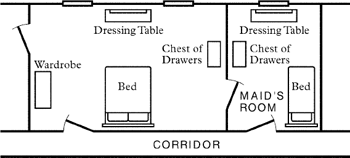
‘Where does that door lead?’ he inquired, nodding his head towards the one by the window.
‘Into the next apartment, I believe,’ said the inspector. ‘It’s bolted, anyway, on this side.’
Poirot walked across to it, tried it, then drew back the bolt and tried it again.
‘And on the other side as well,’ he remarked. ‘Well, that seems to rule out that.’
He walked over to the windows, examining each of them in turn.
‘And again – nothing. Not even a balcony outside.’
‘Even if there were,’ said the inspector impatiently, ‘I don’t see how that would help us, if the maid never left the room.’
‘Évidemment,’ said Poirot, not disconcerted. ‘As Mademoiselle is positive she did not leave the room –’
He was interrupted by the reappearance of the chambermaid and the police searcher.
‘Nothing,’ said the latter laconically.
‘I should hope not, indeed,’ said the chambermaid virtuously. ‘And that French hussy ought to be ashamed of herself taking away an honest girl’s character.’
‘There, there, my girl; that’s all right,’ said the inspector, opening the door. ‘Nobody suspects you. You go along and get on with your work.’
The chambermaid went unwillingly.
‘Going to search her?’ she demanded, pointing at Célestine.
‘Yes, yes!’ He shut the door on her and turned the key.
Célestine accompanied the searcher into the small room in her turn. A few minutes later she also returned. Nothing had been found on her.
The inspector’s face grew graver.
‘I’m afraid I’ll have to ask you to come along with me all the same, miss.’ He turned to Mrs Opalsen. ‘I’m sorry, madam, but all the evidence points that way. If she’s not got them on her, they’re hidden somewhere about the room.’
Célestine uttered a piercing shriek, and clung to Poirot’s arm. The latter bent and whispered something in the girl’s ear. She looked up at him doubtfully.
‘Si, si, mon enfant – I assure you it is better not to resist.’ Then he turned to the inspector. ‘You permit, monsieur? A little experiment – purely for my own satisfaction.’
‘Depends on what it is,’ replied the police officer noncommittally.
Poirot addressed Célestine once more.
‘You have told us that you went into your room to fetch a reel of cotton. Whereabouts was it?’
‘On top of the chest of drawers, monsieur.’
‘And the scissors?’
‘They also.’
‘Would it be troubling you too much, mademoiselle, to ask you to repeat those two actions? You were sitting here with your work, you say?’
Célestine sat down, and then, at a sign from Poirot, rose, passed into the adjoining room, took up an object from the chest of drawers, and returned.
Poirot divided his attention between her movements and a large turnip of a watch which he held in the palm of his hand.
‘Again, if you please, mademoiselle.’
At the conclusion of the second performance, he made a note in his pocket-book, and returned the watch to his pocket.
‘Thank you, mademoiselle. And you, monsieur’ – he bowed to the inspector – ‘for your courtesy.’
The inspector seemed somewhat entertained by this excessive politeness. Célestine departed in a flood of tears, accompanied by the woman and the plain-clothes official.
Then, with a brief apology to Mrs Opalsen, the inspector set to work to ransack the room. He pulled out drawers, opened cupboards, completely unmade the bed, and tapped the floor. Mr Opalsen looked on sceptically.
‘You really think you will find them?’
‘Yes, sir. It stands to reason. She hadn’t time to take them out of the room. The lady’s discovering the robbery so soon upset her plans. No, they’re here right enough. One of the two must have hidden them – and it’s very unlikely for the chambermaid to have done so.’
‘More than unlikely – impossible!’ said Poirot quietly.
‘Eh?’ The inspector stared.
Poirot smiled modestly.
‘I will demonstrate. Hastings, my good friend, take my watch in your hand – with care. It is a family heirloom! Just now I timed Mademoiselle’s movements – her first absence from the room was of twelve seconds, her second of fifteen. Now observe my actions. Madame will have the kindness to give me the key of the jewel-case. I thank you. My friend Hastings will have the kindness to say “Go!”’
‘Go!’ I said.
With almost incredible swiftness, Poirot wrenched open the drawer of the dressing-table, extracted the jewel-case, fitted the key in the lock, opened the case, selected a piece of jewellery, shut and locked the case, and returned it to the drawer, which he pushed to again. His movements were like lightning.
‘Well, mon ami?’ he demanded of me breathlessly.
‘Forty-six seconds,’ I replied.
‘You see?’ He looked round. ‘There would have not been time for the chambermaid even to take the necklace out, far less hide it.’
‘Then that settles it on the maid,’ said the inspector with satisfaction, and returned to his search. He passed into the maid’s bedroom next door.
Poirot was frowning thoughtfully. Suddenly he shot a question at Mr Opalsen.
‘This necklace – it was, without doubt, insured?’
Mr Opalsen looked a trifle surprised at the question.
‘Yes,’ he said hesitatingly, ‘that is so.’
‘But what does that matter?’ broke in Mrs Opalsen tearfully. ‘It’s my necklace I want. It was unique. No money could be the same.’
‘I comprehend, madame,’ said Poirot soothingly. ‘I comprehend perfectly. To la femme sentiment is everything – is it not so? But, monsieur, who has not the so fine susceptibility, will doubtless find some slight consolation in the fact.’
‘Of course, of course,’ said Mr Opalsen rather uncertainly. ‘Still –’
He was interrupted by a shout of triumph from the inspector. He came in dangling something from his fingers.
With a cry, Mrs Opalsen heaved herself up from her chair. She was a changed woman.
‘Oh, oh, my necklace!’
She clasped it to her breast with both hands. We crowded round.
‘Where was it?’ demanded Opalsen.
‘Maid’s bed. In among the springs of the wire mattress. She must have stolen it and hidden it there before the chambermaid arrived on the scene.’
‘You permit, madame?’ said Poirot gently. He took the necklace from her and examined it closely; then handed it back with a bow.
‘I’m afraid, madame, you’ll have to hand it over to us for the time being,’ said the inspector. ‘We shall want it for the charge. But it shall be returned to you as soon as possible.’
Mr Opalsen frowned.
‘Is that necessary?’
‘I’m afraid so, sir. Just a formality.’
‘Oh, let him take it, Ed!’ cried his wife. ‘I’d feel safer if he did. I shouldn’t sleep a wink thinking someone else might try to get hold of it. That wretched girl! And I would never have believed it of her.’
‘There, there, my dear, don’t take on so.’
I felt a gentle pressure on my arm. It was Poirot.
‘Shall we slip away, my friend? I think our services are no longer needed.’
Once outside, however, he hesitated, and then, much to my surprise, he remarked:
‘I should rather like to see the room next door.’
The door was not locked, and we entered. The room, which was a large double one, was unoccupied. Dust lay about rather noticeably, and my sensitive friend gave a characteristic grimace as he ran his finger round a rectangular mark on a table near the window.
‘The service leaves to be desired,’ he observed dryly.
He was staring thoughtfully out of the window, and seemed to have fallen into a brown study.
‘Well?’ I demanded impatiently. ‘What did we come in here for?’
He started.
‘Je vous demande pardon, mon ami. I wished to see if the door was really bolted on this side also.’
‘Well,’ I said, glancing at the door which communicated with the room we had just left, ‘it is bolted.’
Poirot nodded. He still seemed to be thinking.
‘And anyway,’ I continued, ‘what does it matter? The case is over. I wish you’d had more chance of distinguishing yourself. But it was the kind of case that even a stiff-backed idiot like that inspector couldn’t go wrong over.’
Poirot shook his head.
‘The case is not over, my friend. It will not be over until we find out who stole the pearls.’
‘But the maid did!’
‘Why do you say that?’
‘Why,’ I stammered, ‘they were found – actually in her mattress.’
‘Ta, ta, ta!’ said Poirot impatiently. ‘Those were not the pearls.’
‘What?’
‘Imitation, mon ami.’
The statement took my breath away. Poirot was smiling placidly.
‘The good inspector obviously knows nothing of jewels. But presently there will be a fine hullabaloo!’
‘Come!’ I cried, dragging at his arm.
‘Where?’
‘We must tell the Opalsens at once.’
‘I think not.’
‘But that poor woman –’
‘Eh bien; that poor woman, as you call her, will have a much better night believing the jewels to be safe.’
‘But the thief may escape with them!’
‘As usual, my friend, you speak without reflection. How do you know that the pearls Mrs Opalsen locked up so carefully tonight were not the false ones, and that the real robbery did not take place at a much earlier date?’
‘Oh!’ I said, bewildered.
‘Exactly,’ said Poirot, beaming. ‘We start again.’
He led the way out of the room, paused a moment as though considering, and then walked down to the end of the corridor, stopping outside the small den where the chambermaids and valets of the respective floors congregated. Our particular chambermaid appeared to be holding a small court there, and to be retailing her late experiences to an appreciative audience. She stopped in the middle of a sentence. Poirot bowed with his usual politeness.
‘Excuse that I derange you, but I shall be obliged if you will unlock for me the door of Mr Opalsen’s room.’
The woman rose willingly, and we accompanied her down the passage again. Mr Opalsen’s room was on the other side of the corridor, its door facing that of his wife’s room. The chambermaid unlocked it with her pass-key, and we entered.
As she was about to depart Poirot detained her.
‘One moment; have you ever seen among the effects of Mr Opalsen a card like this?’
He held out a plain white card, rather highly glazed and uncommon in appearance. The maid took it and scrutinized it carefully.
‘No, sir, I can’t say I have. But, anyway, the valet has most to do with the gentlemen’s rooms.’
‘I see. Thank you.’
Poirot took back the card. The woman departed. Poirot appeared to reflect a little. Then he gave a short, sharp nod of the head.
‘Ring the bell, I pray you, Hastings. Three times for the valet.’
I obeyed, devoured with curiosity. Meanwhile Poirot had emptied the waste-paper basket on the floor, and was swiftly going through its contents.
In a few moments the valet answered the bell. To him Poirot put the same question, and handed him the card to examine. But the response was the same. The valet had never seen a card of that particular quality among Mr Opalsen’s belongings. Poirot thanked him, and he withdrew, somewhat unwillingly, with an inquisitive glance at the overturned waste-paper basket and the litter on the floor. He could hardly have helped overhearing Poirot’s thoughtful remark as he bundled the torn papers back again:
‘And the necklace was heavily insured …’
‘Poirot,’ I cried, ‘I see –’
‘You see nothing, my friend,’ he replied quickly. ‘As usual, nothing at all! It is incredible – but there it is. Let us return to our own apartments.’
We did so in silence. Once there, to my intense surprise, Poirot effected a rapid change of clothing.
‘I go to London tonight,’ he explained. ‘It is imperative.’
‘What?’
‘Absolutely. The real work, that of the brain (ah, those brave little grey cells), it is done. I go to seek the confirmation. I shall find it! Impossible to deceive Hercule Poirot!’
‘You’ll come a cropper one of these days,’ I observed, rather disgusted by his vanity.
‘Do not be enraged, I beg of you, mon ami. I count on you to do me a service – of your friendship.’
‘Of course,’ I said eagerly, rather ashamed of my moroseness. ‘What is it?’
‘The sleeve of my coat that I have taken off – will you brush it? See you, a little white powder has clung to it. You without doubt observed me run my finger round the drawer of the dressing-table?’
‘No, I didn’t.’
‘You should observe my actions, my friend. Thus I obtained the powder on my finger, and, being a little overexcited, I rubbed it on my sleeve; an action without method which I deplore – false to all my principles.’
‘But what was the powder?’ I asked, not particularly interested in Poirot’s principles.
‘Not the poison of the Borgias,’ replied Poirot with a twinkle. ‘I see your imagination mounting. I should say it was French chalk.’
‘French chalk?’
‘Yes, cabinet-makers use it to make drawers run smoothly.’
I laughed.
‘You old sinner! I thought you were working up to something exciting.’
‘Au revoir, my friend. I save myself. I fly!’
The door shut behind him. With a smile, half of derision, half of affection, I picked up the coat and stretched out my hand for the clothes brush.
The next morning, hearing nothing from Poirot, I went out for a stroll, met some old friends, and lunched with them at their hotel. In the afternoon we went for a spin. A punctured tyre delayed us, and it was past eight when I got back to the Grand Metropolitan.
The first sight that met my eyes was Poirot, looking even more diminutive than usual, sandwiched between the Opalsens, beaming in a state of placid satisfaction.
‘Mon ami Hastings!’ he cried, and sprang to meet me. ‘Embrace me, my friend; all has marched to a marvel!’
Luckily, the embrace was merely figurative – not a thing one is always sure of with Poirot.
‘Do you mean –’ I began.
‘Just wonderful, I call it!’ said Mrs Opalsen, smiling all over her fat face. ‘Didn’t I tell you, Ed, that if he couldn’t get back my pearls nobody would?’
‘You did, my dear, you did. And you were right.’
I looked helplessly at Poirot, and he answered the glance.
‘My friend Hastings is, as you say in England, all at the seaside. Seat yourself, and I will recount to you all the affair that has so happily ended.’
‘Ended?’
‘But yes. They are arrested.’
‘Who are arrested?’
‘The chambermaid and the valet, parbleu! You did not suspect? Not with my parting hint about the French chalk?’
‘You said cabinet-makers used it.’
‘Certainly they do – to make drawers slide easily. Somebody wanted the drawer to slide in and out without any noise. Who could that be? Obviously, only the chambermaid. The plan was so ingenious that it did not at once leap to the eye – not even to the eye of Hercule Poirot.
‘Listen, this was how it was done. The valet was in the empty room next door, waiting. The French maid leaves the room. Quick as a flash the chambermaid whips open the drawer, takes out the jewel-case and, slipping back the bolt, passes it through the door. The valet opens it at his leisure with the duplicate key with which he has provided himself, extracts the necklace, and waits his time. Célestine leaves the room again, and – pst! – in a flash the case is passed back again and replaced in the drawer.
‘Madame arrives, the theft is discovered. The chambermaid demands to be searched, with a good deal of righteous indignation, and leaves the room without a stain on her character. The imitation necklace with which they have provided themselves has been concealed in the French girl’s bed that morning by the chambermaid – a master stroke, ça!’
‘But what did you go to London for?’
‘You remember the card?’
‘Certainly. It puzzled me – and puzzles me still. I thought –’
I hesitated delicately, glancing at Mr Opalsen.
Poirot laughed heartily.
‘Une blague! For the benefit of the valet. The card was one with a specially prepared surface – for fingerprints. I went straight to Scotland Yard, asked for our old friend Inspector Japp, and laid the facts before him. As I had suspected, the fingerprints proved to be those of two well-known jewel thieves who have been “wanted” for some time. Japp came down with me, the thieves were arrested, and the necklace was discovered in the valet’s possession. A clever pair, but they failed in method. Have I not told you, Hastings, at least thirty-six times, that without method –’
‘At least thirty-six thousand times!’ I interrupted. ‘But where did their “method” break down?’
‘Mon ami, it is a good plan to take a place as chambermaid or valet – but you must not shirk your work. They left an empty room undusted; and therefore, when the man put down the jewel-case on the little table near the communicating door, it left a square mark –’
‘I remember,’ I cried.
‘Before, I was undecided. Then – I knew!’
There was a moment’s silence.
‘And I’ve got my pearls,’ said Mrs Opalsen as a sort of Greek chorus.
‘Well,’ I said, ‘I’d better have some dinner.’
Poirot accompanied me.
‘This ought to mean kudos for you,’ I observed.
‘Pas du tout,’ replied Poirot tranquilly. ‘Japp and the local inspector will divide the credit between them. But’ – he tapped his pocket – ‘I have a cheque here, from Mr Opalsen, and, how you say, my friend? This weekend has not gone according to plan. Shall we return here next weekend – at my expense this time?’
3
The King of Clubs
‘The King of Clubs’ was first published as ‘The Adventure of the King of Clubs’ in The Sketch, 21 March 1923.
‘Truth,’ I observed, laying aside the Daily Newsmonger, ‘is stranger than fiction!’
The remark was not, perhaps, an original one. It appeared to incense my friend. Tilting his egg-shaped head on one side, the little man carefully flicked an imaginary fleck of dust from his carefully creased trousers, and observed: ‘How profound! What a thinker is my friend Hastings!’
Without displaying any annoyance at this quite uncalled-for gibe, I tapped the sheet I had laid aside.
‘You’ve read this morning’s paper?’
‘I have. And after reading it, I folded it anew symmetrically. I did not cast it on the floor as you have done, with your so lamentable absence of order and method.’
(That is the worst of Poirot. Order and Method are his gods. He goes so far as to attribute all his success to them.)
‘Then you saw the account of the murder of Henry Reedburn, the impresario? It was that which prompted my remark. Not only is truth stranger than fiction – it is more dramatic. Think of that solid middle-class English family, the Oglanders. Father and mother, son and daughter, typical of thousands of families all over this country. The men of the family go to the city every day; the women look after the house. Their lives are perfectly peaceful, and utterly monotonous. Last night they were sitting in their neat suburban drawing-room at Daisymead, Streatham, playing bridge. Suddenly, without any warning, the french window bursts open, and a woman staggers into the room. Her grey satin frock is marked with a crimson stain. She utters one word, “Murder!” before she sinks to the ground insensible. It is possible that they recognize her from her pictures as Valerie Saintclair, the famous dancer who has lately taken London by storm!’
‘Is this your eloquence, or that of the Daily Newsmonger?’ inquired Poirot.
‘The Daily Newsmonger was in a hurry to go to press, and contented itself with bare facts. But the dramatic possibilities of the story struck me at once.’
Poirot nodded thoughtfully. ‘Wherever there is human nature, there is drama. But – it is not always just where you think it is. Remember that. Still, I too am interested in the case, since it is likely that I shall be connected with it.’
‘Indeed?’
‘Yes. A gentleman rang me up this morning, and made an appointment with me on behalf of Prince Paul of Maurania.’
‘But what has that to do with it?’
‘You do not read your pretty little English scandal-papers. The ones with the funny stories, and “a little mouse has heard –” or “a little bird would like to know –” See here.’
I followed his short stubby finger along the paragraph: ‘– whether the foreign prince and the famous dancer are really affinities! And if the lady likes her new diamond ring!’
‘And now to resume your so dramatic narrative,’ said Poirot. ‘Mademoiselle Saintclair had just fainted on the drawing-room carpet at Daisymead, you remember.’
I shrugged. ‘As a result of Mademoiselle’s first murmured words when she came round, the two male Oglanders stepped out, one to fetch a doctor to attend to the lady, who was evidently suffering terribly from shock, and the other to the police-station – whence after telling his story, he accompanied the police to Mon Désir, Mr Reedburn’s magnificent villa, which is situated at no great distance from Daisymead. There they found the great man, who by the way suffers from a somewhat unsavoury reputation, lying in the library with the back of his head cracked open like an eggshell.’
‘I have cramped your style,’ said Poirot kindly. ‘Forgive me, I pray … Ah, here is M. le Prince!’
Our distinguished visitor was announced under the title of Count Feodor. He was a strange-looking youth, tall, eager, with a weak chin, the famous Mauranberg mouth, and the dark fiery eyes of a fanatic.
‘M. Poirot?’
My friend bowed.
‘Monsieur, I am in terrible trouble, greater than I can well express –’
Poirot waved his hand. ‘I comprehend your anxiety. Mademoiselle Saintclair is a very dear friend, is it not so?’
The prince replied simply: ‘I hope to make her my wife.’
Poirot sat up in his chair, and his eyes opened.
The prince continued: ‘I should not be the first of my family to make a morganatic marriage. My brother Alexander has also defied the Emperor. We are living now in more enlightened days, free from the old caste-prejudice. Besides, Mademoiselle Saintclair, in actual fact, is quite my equal in rank. You have heard hints as to her history?’
‘There are many romantic stories of her origin – not an uncommon thing with famous dancers. I have heard that she is the daughter of an Irish charwoman, also the story which makes her mother a Russian grand duchess.’
‘The first story is, of course, nonsense,’ said the young man. ‘But the second is true. Valerie, though bound to secrecy, has let me guess as much. Besides, she proves it unconsciously in a thousand ways. I believe in heredity, M. Poirot.’
‘I too believe in heredity,’ said Poirot thoughtfully. ‘I have seen some strange things in connection with it – moi qui vous parle … But to business, M. le Prince. What do you want of me? What do you fear? I may speak freely, may I not? Is there anything to connect Mademoiselle Saintclair with the crime? She knew Reedburn of course?’
‘Yes. He professed to be in love with her.’
‘And she?’
‘She would have nothing to say to him.’
Poirot looked at him keenly. ‘Had she any reason to fear him?’
The young man hesitated. ‘There was an incident. You know Zara, the clairvoyant?’
‘No.’
‘She is wonderful. You should consult her some time. Valerie and I went to see her last week. She read the cards for us. She spoke to Valerie of trouble – of gathering clouds; then she turned up the last card – the covering card, they call it. It was the king of clubs. She said to Valerie: “Beware. There is a man who holds you in his power. You fear him – you are in great danger through him. You know whom I mean?” Valerie was white to the lips. She nodded and said: “Yes, yes, I know.” Shortly afterwards we left. Zara’s last words to Valerie were: “Beware of the king of clubs. Danger threatens you!” I questioned Valerie. She would tell me nothing – assured me that all was well. But now, after last night, I am more sure than ever that in the king of clubs Valerie saw Reedburn, and that he was the man she feared.’
The Prince paused abruptly. ‘Now you understand my agitation when I opened the paper this morning. Supposing Valerie, in a fit of madness – oh, it is impossible!’
Poirot rose from his seat, and patted the young man kindly on the shoulder. ‘Do not distress yourself, I beg of you. Leave it in my hands.’
‘You will go to Streatham? I gather she is still there, at Daisymead – prostrated by the shock.’
‘I will go at once.’
‘I have arranged matters – through the embassy. You will be allowed access everywhere.’
‘Then we will depart – Hastings, you will accompany me? Au revoir, M. le Prince.’
Mon Désir was an exceptionally fine villa, thoroughly modern and comfortable. A short carriage-drive led up to it from the road, and beautiful gardens extended behind the house for some acres.
On mentioning Prince Paul’s name, the butler who answered the door at once took us to the scene of the tragedy. The library was a magnificent room, running from back to front of the whole building, with a window at either end, one giving on the front carriage-drive, and the other on the garden. It was in the recess of the latter that the body had lain. It had been removed not long before, the police having concluded their examination.
‘That is annoying,’ I murmured to Poirot. ‘Who knows what clues they may have destroyed?’
My little friend smiled. ‘Eh – Eh! How often must I tell you that clues come from within? In the little grey cells of the brain lies the solution of every mystery.’
He turned to the butler. ‘I suppose, except for the removal of the body, the room has not been touched?’
‘No, sir. It’s just as it was when the police came up last night.’
‘These curtains, now. I see they pull right across the window recess. They are the same in the other window. Were they drawn last night?’
‘Yes, sir, I draw them every night.’
‘Then Reedburn must have drawn them back himself?’
‘I suppose so, sir.’
‘Did you know your master expected a visitor last night?’
‘He did not say so, sir. But he gave orders he was not to be disturbed after dinner. You see, sir, there is a door leading out of the library on to the terrace at the side of the house. He could have admitted anyone that way.’
‘Was he in the habit of doing that?’
The butler coughed discreetly. ‘I believe so, sir.’
Poirot strode to the door in question. It was unlocked. He stepped through it on to the terrace which joined the drive on the right; on the left it led up to a red brick wall.
‘The fruit garden, sir. There is a door leading into it farther along, but it was always locked at six o’clock.’
Poirot nodded, and re-entered the library, the butler following.
‘Did you hear nothing of last night’s events?’
‘Well, sir, we heard voices in the library, a little before nine. But that wasn’t unusual, especially being a lady’s voice. But of course, once we were all in the servants’ hall, right the other side, we didn’t hear anything at all. And then, about eleven o’clock, the police came.’
‘How many voices did you hear?’
‘I couldn’t say, sir. I only noticed the lady’s.’
‘Ah!’
‘I beg pardon, sir, but Dr Ryan is still in the house, if you would care to see him.’
We jumped at the suggestion, and in a few minutes the doctor, a cheery, middle-aged man, joined us, and gave Poirot all the information he required. Reedburn had been lying near the window, his head by the marble window-seat. There were two wounds, one between the eyes, and the other, the fatal one, on the back of the head.
‘He was lying on his back?’
‘Yes. There is the mark.’ He pointed to a small dark stain on the floor.
‘Could not the blow on the back of the head have been caused by his striking the floor?’
‘Impossible. Whatever the weapon was, it penetrated some distance into the skull.’
Poirot looked thoughtfully in front of him. In the embrasure of each window was a carved marble seat, the arms being fashioned in the form of a lion’s head. A light came into Poirot’s eyes. ‘Supposing he had fallen backwards on this projecting lion’s head, and slipped from there to the ground. Would not that cause a wound such as you describe?’
‘Yes, it would. But the angle at which he was lying makes that theory impossible. And besides there could not fail to be traces of blood on the marble of the seat.’
‘Unless they were washed away?’
The doctor shrugged his shoulders. ‘That is hardly likely. It would be to no one’s advantage to give an accident the appearance of murder.’
‘Quite so,’ acquiesced Poirot. ‘Could either of the blows have been struck by a woman, do you think?’
‘Oh, quite out of the question, I should say. You are thinking of Mademoiselle Saintclair, I suppose?’
‘I think of no one in particular until I am sure,’ said Poirot gently.
He turned his attention to the open french window, and the doctor continued:
‘It is through here that Mademoiselle Saintclair fled. You can just catch a glimpse of Daisymead between the trees. Of course, there are many houses nearer to the front of the house on the road, but as it happens, Daisymead, though some distance away, is the only house visible this side.’
‘Thank you for your amiability, Doctor,’ said Poirot. ‘Come, Hastings, we will follow the footsteps of Mademoiselle.’
Poirot led the way down through the garden, out through an iron gate, across a short stretch of green and in through the garden gate of Daisymead, which was an unpretentious little house in about half an acre of ground. There was a small flight of steps leading up to a french window. Poirot nodded in their direction.
‘That is the way Mademoiselle Saintclair went. For us, who have not her urgency to plead, it will be better to go round to the front door.’
A maid admitted us and took us into the drawing-room, then went in search of Mrs Oglander. The room had evidently not been touched since the night before. The ashes were still in the grate, and the bridge-table was still in the centre of the room, with a dummy exposed, and the hands thrown down. The place was somewhat overloaded with gimcrack ornaments, and a good many family portraits of surpassing ugliness adorned the walls.
Poirot gazed at them more leniently than I did, and straightened one or two that were hanging a shade askew. ‘La famille, it is a strong tie, is it not? Sentiment, it takes the place of beauty.’
I agreed, my eyes being fixed on a family group comprising a gentleman with whiskers, a lady with a high ‘front’ of hair, a solid, thick-set boy, and two little girls tied up with a good many unnecessary bows of ribbon. I took this to be the Oglander family in earlier days, and studied it with interest.
The door opened, and a young woman came in. Her dark hair was neatly arranged, and she wore a drab-coloured sportscoat and a tweed skirt.
She looked at us inquiringly. Poirot stepped forward. ‘Miss Oglander? I regret to derange you – especially after all you have been through. The whole affair must have been most disturbing.’
‘It has been rather upsetting,’ admitted the young lady cautiously. I began to think that the elements of drama were wasted on Miss Oglander, that her lack of imagination rose superior to any tragedy. I was confirmed in this belief as she continued: ‘I must apologize for the state this room is in. Servants get so foolishly excited.’
‘It was here that you were sitting last night, n’est-ce pas?’
‘Yes, we were playing bridge after supper, when –’
‘Excuse me – how long had you been playing?’
‘Well –’ Miss Oglander considered. ‘I really can’t say. I suppose it must have been about ten o’clock. We had had several rubbers, I know.’
‘And you yourself were sitting – where?’
‘Facing the window. I was playing with my mother and had gone one no trump. Suddenly, without any warning, the window burst open, and Miss Saintclair staggered into the room.’
‘You recognized her?’
‘I had a vague idea her face was familiar.’
‘She is still here, is she not?’
‘Yes, but she refuses to see anyone. She is still quite prostrated.’
‘I think she will see me. Will you tell her that I am here at the express request of Prince Paul of Maurania?’
I fancied that the mention of a royal prince rather shook Miss Oglander’s imperturbable calm. But she left the room on her errand without any further remark, and returned almost immediately to say that Mademoiselle Saintclair would see us in her room.
We followed her upstairs, and into a fair-sized light bedroom. On a couch by the window a woman was lying who turned her head as we entered. The contrast between the two women struck me at once, the more so as in actual features and colouring they were not unalike – but oh, the difference! Not a look, not a gesture of Valerie Saintclair’s but expressed drama. She seemed to exhale an atmosphere of romance. A scarlet flannel dressing-gown covered her feet – a homely garment in all conscience; but the charm of her personality invested it with an exotic flavour, and it seemed an Eastern robe of glowing colour.
Her large dark eyes fastened themselves on Poirot. ‘You come from Paul?’ Her voice matched her appearance – it was full and languid.
‘Yes, mademoiselle. I am here to serve him – and you.’
‘What do you want to know?’
‘Everything that happened last night. But everything!’
She smiled rather wearily.
‘Do you think I should lie? I am not stupid. I see well enough that there can be no concealment. He held a secret of mine, that man who is dead. He threatened me with it. For Paul’s sake, I endeavoured to make terms with him. I could not risk losing Paul … Now that he is dead, I am safe. But for all that, I did not kill him.’
Poirot shook his head with a smile. ‘It is not necessary to tell me that, mademoiselle. Now recount to me what happened last night.’
‘I offered him money. He appeared to be willing to treat with me. He appointed last night at nine o’clock. I was to go to Mon Désir. I knew the place; I had been there before. I was to go round to the side door into the library, so that the servants should not see me.’
‘Excuse me, mademoiselle, but were you not afraid to trust yourself alone there at night?’
Was it my fancy, or was there a momentary pause before she answered?
‘Perhaps I was. But you see, there was no one I could ask to go with me. And I was desperate. Reedburn admitted me to the library. Oh, that man! I am glad he is dead! He played with me, as a cat does with a mouse. He taunted me. I begged and implored him on my knees. I offered him every jewel I have. All in vain! Then he named his own terms. Perhaps you can guess what they were. I refused. I told him what I thought of him. I raved at him. He remained calmly smiling. And then, as I fell to silence at last, there was a sound – from behind the curtain in the window … He heard it too. He strode to the curtains and flung them wide apart. There was a man there, hiding – a dreadful-looking man, a sort of tramp. He struck at Mr Reedburn – then he struck again, and he went down. The tramp clutched at me with his bloodstained hand. I tore myself free, slipped through the window, and ran for my life. Then I perceived the lights in this house, and made for them. The blinds were up, and I saw some people playing bridge. I almost fell into the room. I just managed to gasp out “Murder!” and then everything went black –’
‘Thank you, mademoiselle. It must have been a great shock to your nervous system. As to this tramp, could you describe him? Do you remember what he was wearing?’
‘No – it was all so quick. But I should know the man anywhere. His face is burnt in on my brain.’
‘Just one more question, mademoiselle. The curtains of the other window, the one giving on the drive, were they drawn?’
For the first time a puzzled expression crept over the dancer’s face. She seemed to be trying to remember.
‘Eh bien, mademoiselle?’
‘I think – I am almost sure – yes, quite sure! They were not drawn.’
‘That is curious, since the other ones were. No matter. It is, I dare say, of no great importance. You are remaining here long, mademoiselle?’
‘The doctor thinks I shall be fit to return to town tomorrow.’ She looked round the room. Miss Oglander had gone out. ‘These people, they are very kind – but they are not of my world. I shock them! And to me – well, I am not fond of the bourgeoisie!’
A faint note of bitterness underlay her words.
Poirot nodded. ‘I understand. I hope I have not fatigued you unduly with my questions?’
‘Not at all, monsieur. I am only too anxious Paul should know all as soon as possible.’
‘Then I will wish you good day, mademoiselle.’
As Poirot was leaving the room, he paused, and pounced on a pair of patent-leather slippers. ‘Yours, mademoiselle?’
‘Yes, monsieur. They have just been cleaned and brought up.’
‘Ah!’ said Poirot, as we descended the stairs. ‘It seems that the domestics are not too excited to clean shoes, though they forget a grate. Well, mon ami, at first there appeared to be one or two points of interest, but I fear, I very much fear, that we must regard the case as finished. It all seems straightforward enough.’
‘And the murderer?’
‘Hercule Poirot does not hunt down tramps,’ replied my friend grandiloquently.
Miss Oglander met us in the hall. ‘If you will wait in the drawing-room a minute, Mamma would like to speak to you.’
The room was still untouched, and Poirot idly gathered up the cards, shuffling them with his tiny, fastidiously groomed hands.
‘Do you know what I think, my friend?’
‘No?’ I said eagerly.
‘I think that Miss Oglander made a mistake in going one no trump. She should have gone three spades.’
‘Poirot! You are the limit.’
‘Mon Dieu, I cannot always be talking blood and thunder!’
Suddenly he stiffened: ‘Hastings – Hastings. See! The king of clubs is missing from the pack!’
‘Zara!’ I cried.
‘Eh?’ He did not seem to understand my allusion. Mechanically he stacked the cards and put them away in their cases. His face was very grave.
‘Hastings,’ he said at last, ‘I, Hercule Poirot, have come near to making a big mistake – a very big mistake.’
I gazed at him, impressed, but utterly uncomprehending.
‘We must begin again, Hastings. Yes, we must begin again. But this time we shall not err.’
He was interrupted by the entrance of a handsome middle-aged lady. She carried some household books in her hand. Poirot bowed to her.
‘Do I understand, sir, that you are a friend of – er – Miss Saintclair’s?’
‘I come from a friend of hers, madame.’
‘Oh, I see. I thought perhaps –’
Poirot suddenly waved brusquely at the window.
‘Your blinds were not pulled down last night?’
‘No – I suppose that is why Miss Saintclair saw the light so plainly.’
‘There was moonlight last night. I wonder that you did not see Mademoiselle Saintclair from your seat here facing the windows?’
‘I suppose we were engrossed with our game. Nothing like this has ever happened before to us.’
‘I can quite believe that, madame. And I will put your mind at rest. Mademoiselle Saintclair is leaving tomorrow.’
‘Oh!’ The good lady’s face cleared.
‘And I will wish you good morning, madame.’
A servant was cleaning the steps as we went out of the front door. Poirot addressed her.
‘Was it you who cleaned the shoes of the young lady upstairs?’
The maid shook her head. ‘No, sir. I don’t think they’ve been cleaned.’
‘Who cleaned them, then?’ I inquired of Poirot, as we walked down the road.
‘Nobody. They did not need cleaning.’
‘I grant that walking on the road or path on a fine night would not soil them. But surely after going through the long grass of the garden, they would have been soiled and stained.’
‘Yes,’ said Poirot with a curious smile. ‘In that case, I agree, they would have been stained.’
‘But –’
‘Have patience a little half-hour, my friend. We are going back to Mon Désir.’
The butler looked surprised at our reappearance, but offered no objection to our returning to the library.
‘Hi, that’s the wrong window, Poirot,’ I cried as he made for the one overlooking the carriage-drive.
‘I think not, my friend. See here.’ He pointed to the marble lion’s head. On it was a faint discoloured smear. He shifted his finger and pointed to a similar stain on the polished floor.
‘Someone struck Reedburn a blow with his clenched fist between the eyes. He fell backward on this projecting bit of marble, then slipped to the floor. Afterwards, he was dragged across the floor to the other window, and laid there instead, but not quite at the same angle, as the Doctor’s evidence told us.’
‘But why? It seems utterly unnecessary.’
‘On the contrary, it was essential. Also, it is the key to the murderer’s identity – though, by the way, he had no intention of killing Reedburn, and so it is hardly permissible to call him a murderer. He must be a very strong man!’
‘Because of having dragged the body across the floor?’
‘Not altogether. It has been an interesting case. I nearly made an imbecile of myself, though.’
‘Do you mean to say it is over, that you know everything?’
‘Yes.’
A remembrance smote me. ‘No,’ I cried. ‘There is one thing you do not know!’
‘And that?’
‘You do not know where the missing king of clubs is!’
‘Eh? Oh, that is droll! That is very droll, my friend.’
‘Why?’
‘Because it is in my pocket!’ He drew it forth with a flourish.
‘Oh!’ I said, rather crestfallen. ‘Where did you find it? Here?’
‘There was nothing sensational about it. It had simply not been taken out with the other cards. It was in the box.’
‘H’m! All the same, it gave you an idea, didn’t it?’
‘Yes, my friend. I present my respects to His Majesty.’
‘And to Madame Zara!’
‘Ah, yes – to the lady also.’
‘Well, what are we going to do now?’
‘We are going to return to town. But I must have a few words with a certain lady at Daisymead first.’
The same little maid opened the door to us.
‘They’re all at lunch now, sir – unless it’s Miss Saintclair you want to see, and she’s resting.’
‘It will do if I can see Mrs Oglander for a few minutes. Will you tell her?’
We were led into the drawing-room to wait. I had a glimpse of the family in the dining-room as we passed, now reinforced by the presence of two heavy, solid-looking men, one with a moustache, the other with a beard also.
In a few minutes Mrs Oglander came into the room, looking inquiringly at Poirot, who bowed.
‘Madame, we, in our country, have a great tenderness, a great respect for the mother. The mère de famille, she is everything!’
Mrs Oglander looked rather astonished at this opening.
‘It is for that reason that I have come – to allay a mother’s anxiety. The murderer of Mr Reedburn will not be discovered. Have no fear. I, Hercule Poirot, tell you so. I am right, am I not? Or is it a wife that I must reassure?’
There was a moment’s pause. Mrs Oglander seemed to be searching Poirot with her eyes. At last she said quietly: ‘I don’t know how you know – but yes, you are right.’
Poirot nodded gravely. ‘That is all, madame. But do not be uneasy. Your English policemen have not the eyes of Hercule Poirot.’ He tapped the family portrait on the wall with his fingernail.
‘You had another daughter once. She is dead, madame?’
Again there was a pause, as she searched him with her eyes. Then she answered: ‘Yes, she is dead.’
‘Ah!’ said Poirot briskly. ‘Well, we must return to town. You permit that I return the king of clubs to the pack? It was your only slip. You understand, to have played bridge for an hour or so, with only fifty-one cards – well, no one who knows anything of the game would credit it for a minute! Bonjour!’
‘And now, my friend,’ said Poirot as we stepped towards the station, ‘you see it all!’
‘I see nothing! Who killed Reedburn?’
‘John Oglander, Junior. I was not quite sure if it was the father or the son, but I fixed on the son as being the stronger and younger of the two. It had to be one of them, because of the window.’
‘Why?’
‘There were four exits from the library – two doors, two windows; but evidently only one would do. Three exits gave on the front, directly or indirectly. The tragedy had to occur in the back window in order to make it appear that Valerie Saintclair came to Daisymead by chance. Really, of course, she fainted, and John Oglander carried her across over his shoulders. That is why I said he must be a strong man.’
‘Did they go there together, then?’
‘Yes. You remember Valerie’s hesitation when I asked her if she was not afraid to go alone? John Oglander went with her – which didn’t improve Reedburn’s temper, I fancy. They quarrelled, and it was probably some insult levelled at Valerie that made Oglander hit him. The rest, you know.’
‘But why the bridge?’
‘Bridge presupposes four players. A simple thing like that carries a lot of conviction. Who would have supposed that there had been only three people in that room all the evening?’
I was still puzzled.
‘There’s one thing I don’t understand. What have the Oglanders to do with the dancer Valerie Saintclair?’
‘Ah, that I wonder you did not see. And yet you looked long enough at that picture on the wall – longer than I did. Mrs Oglander’s other daughter may be dead to her family, but the world knows her as Valerie Saintclair!’
‘What?’
‘Did you not see the resemblance the moment you saw the two sisters together?’
‘No,’ I confessed. ‘I only thought how extraordinarily dissimilar they were.’
‘That is because your mind is so open to external romantic impressions, my dear Hastings. The features are almost identical. So is the colouring. The interesting thing is that Valerie is ashamed of her family, and her family is ashamed of her. Nevertheless, in a moment of peril, she turned to her brother for help, and when things went wrong, they all hung together in a remarkable way. Family strength is a marvellous thing. They can all act, that family. That is where Valerie gets her histrionic talent from. I, like Prince Paul, believe in heredity! They deceived me! But for a lucky accident, and test question to Mrs Oglander by which I got her to contradict her daughter’s account of how they were sitting, the Oglander family would have put a defeat on Hercule Poirot.’
‘What shall you tell the Prince?’
‘That Valerie could not possibly have committed the crime, and that I doubt if that tramp will ever be found. Also, to convey my compliments to Zara. A curious coincidence, that! I think I shall call this little affair the Adventure of the King of Clubs. What do you think, my friend?’
4
The Disappearance of Mr Davenheim
‘The Disappearance of Mr Davenheim’ was first published in The Sketch, 28 March 1923.
Poirot and I were expecting our old friend Inspector Japp of Scotland Yard to tea. We were sitting round the tea-table awaiting his arrival. Poirot had just finished carefully straightening the cups and saucers which our landlady was in the habit of throwing, rather than placing, on the table. He had also breathed heavily on the metal teapot, and polished it with a silk handkerchief. The kettle was on the boil, and a small enamel saucepan beside it contained some thick, sweet chocolate which was more to Poirot’s palate than what he described as ‘your English poison’.
A sharp ‘rat-tat’ sounded below, and a few minutes afterwards Japp entered briskly.
‘Hope I’m not late,’ he said as he greeted us. ‘To tell the truth, I was yarning with Miller, the man who’s in charge of the Davenheim case.’
I pricked up my ears. For the last three days the papers had been full of the strange disappearance of Mr Davenheim, senior partner of Davenheim and Salmon, the well-known bankers and financiers. On Saturday last he had walked out of his house, and had never been seen since. I looked forward to extracting some interesting details from Japp.
‘I should have thought,’ I remarked, ‘that it would be almost impossible for anyone to “disappear” nowadays.’
Poirot moved a plate of bread and butter the eighth of an inch, and said sharply:
‘Be exact, my friend. What do you mean by “disappear”? To which class of disappearance are you referring?’
‘Are disappearances classified and labelled, then?’ I laughed.
Japp smiled also. Poirot frowned at both of us.
‘But certainly they are! They fall into three categories: First, and most common, the voluntary disappearance. Second, the much abused “loss of memory” case – rare, but occasionally genuine. Third, murder, and a more or less successful disposal of the body. Do you refer to all three as impossible of execution?’
‘Very nearly so, I should think. You might lose your own memory, but someone would be sure to recognize you – especially in the case of a well-known man like Davenheim. Then “bodies” can’t be made to vanish into thin air. Sooner or later they turn up, concealed in lonely places, or in trunks. Murder will out. In the same way, the absconding clerk, or the domestic defaulter, is bound to be run down in these days of wireless telegraphy. He can be headed off from foreign countries; ports and railway stations are watched; and as for concealment in this country, his features and appearance will be known to everyone who reads a daily newspaper. He’s up against civilization.’
‘Mon ami,’ said Poirot, ‘you make one error. You do not allow for the fact that a man who had decided to make away with another man – or with himself in a figurative sense – might be that rare machine, a man of method. He might bring intelligence, talent, a careful calculation of detail to the task; and then I do not see why he should not be successful in baffling the police force.’
‘But not you, I suppose?’ said Japp good-humouredly, winking at me. ‘He couldn’t baffle you, eh, Monsieur Poirot?’
Poirot endeavoured, with a marked lack of success, to look modest. ‘Me also! Why not? It is true that I approach such problems with an exact science, a mathematical precision, which seems, alas, only too rare in the new generation of detectives!’
Japp grinned more widely.
‘I don’t know,’ he said. ‘Miller, the man who’s on this case, is a smart chap. You may be very sure he won’t overlook a footprint, or a cigar-ash, or a crumb even. He’s got eyes that see everything.’
‘So, mon ami,’ said Poirot, ‘has the London sparrow. But all the same, I should not ask the little brown bird to solve the problem of Mr Davenheim.’
‘Come now, monsieur, you’re not going to run down the value of details as clues?’
‘By no means. These things are all good in their way. The danger is they may assume undue importance. Most details are insignificant; one or two are vital. It is the brain, the little grey cells’ – he tapped his forehead – ‘on which one must rely. The senses mislead. One must seek the truth within – not without.’
‘You don’t mean to say, Monsieur Poirot, that you would undertake to solve a case without moving from your chair, do you?’
‘That is exactly what I do mean – granted the facts were placed before me. I regard myself as a consulting specialist.’
Japp slapped his knee. ‘Hanged if I don’t take you at your word. Bet you a fiver that you can’t lay your hand – or rather tell me where to lay my hand – on Mr Davenheim, dead or alive, before a week is out.’
Poirot considered. ‘Eh bien, mon ami, I accept. Le sport, it is the passion of you English. Now – the facts.’
‘On Saturday last, as is his usual custom, Mr Davenheim took the 12.40 train from Victoria to Chingside, where his palatial country seat, The Cedars, is situated. After lunch, he strolled round the grounds, and gave various directions to the gardeners. Everybody agrees that his manner was absolutely normal and as usual. After tea he put his head into his wife’s boudoir, saying that he was going to stroll down to the village and post some letters. He added that he was expecting a Mr Lowen, on business. If he should come before he himself returned, he was to be shown into the study and asked to wait. Mr Davenheim then left the house by the front door, passed leisurely down the drive, and out at the gate, and – was never seen again. From that hour, he vanished completely.’
‘Pretty – very pretty – altogether a charming little problem,’ murmured Poirot. ‘Proceed, my good friend.’
‘About a quarter of an hour later a tall, dark man with a thick black moustache rang the front door-bell, and explained that he had an appointment with Mr Davenheim. He gave the name of Lowen, and in accordance with the banker’s instructions was shown into the study. Nearly an hour passed. Mr Davenheim did not return. Finally Mr Lowen rang the bell, and explained that he was unable to wait any longer, as he must catch his train back to town.
‘Mrs Davenheim apologized for her husband’s absence, which seemed unaccountable, as she knew him to have been expecting the visitor. Mr Lowen reiterated his regrets and took his departure.
‘Well, as everyone knows, Mr Davenheim did not return. Early on Sunday morning the police were communicated with, but could make neither head nor tail of the matter. Mr Davenheim seemed literally to have vanished into thin air. He had not been to the post office; nor had he been seen passing through the village. At the station they were positive he had not departed by any train. His own motor had not left the garage. If he had hired a car to meet him in some lonely spot, it seems almost certain that by this time, in view of the large reward offered for information, the driver of it would have come forward to tell what he knew. True, there was a small race-meeting at Entfield, five miles away, and if he had walked to that station he might have passed unnoticed in the crowd. But since then his photograph and a full description of him have been circulated in every newspaper, and nobody has been able to give any news of him. We have, of course, received many letters from all over England, but each clue, so far, has ended in disappointment.
‘On Monday morning a further sensational discovery came to light. Behind a portière in Mr Davenheim’s study stands a safe, and that safe had been broken into and rifled. The windows were fastened securely on the inside, which seems to put an ordinary burglary out of court, unless, of course, an accomplice within the house fastened them again afterwards. On the other hand, Sunday having intervened, and the household being in a state of chaos, it is likely that the burglary was committed on the Saturday, and remained undetected until Monday.’
‘Précisément,’ said Poirot dryly. ‘Well, is he arrested, ce pauvre M Lowen?’
Japp grinned. ‘Not yet. But he’s under pretty close supervision.’
Poirot nodded. ‘What was taken from the safe? Have you any idea?’
‘We’ve been going into that with the junior partner of the firm and Mrs Davenheim. Apparently there was a considerable amount in bearer bonds, and a very large sum in notes, owing to some large transaction having been just carried through. There was also a small fortune in jewellery. All Mrs Davenheim’s jewels were kept in the safe. The purchasing of them had become a passion with her husband of late years, and hardly a month passed that he did not make her a present of some rare and costly gem.’
‘Altogether a good haul,’ said Poirot thoughtfully. ‘Now, what about Lowen? Is it known what his business was with Davenheim that evening?’
‘Well, the two men were apparently not on very good terms. Lowen is a speculator in quite a small way. Nevertheless, he has been able once or twice to score a coup off Davenheim in the market, though it seems they seldom or never actually met. It was a matter concerning some South American shares which led the banker to make his appointment.’
‘Had Davenheim interests in South America, then?’
‘I believe so. Mrs Davenheim happened to mention that he spent all last autumn in Buenos Aires.’
‘Any trouble in his home life? Were the husband and wife on good terms?’
‘I should say his domestic life was quite peaceful and uneventful. Mrs Davenheim is a pleasant, rather unintelligent woman. Quite a nonentity, I think.’
‘Then we must not look for the solution of the mystery there. Had he any enemies?’
‘He had plenty of financial rivals, and no doubt there are many people whom he has got the better of who bear him no particular goodwill. But there was no one likely to make away with him – and, if they had, where is the body?’
‘Exactly. As Hastings says, bodies have a habit of coming to light with fatal persistency.’
‘By the way, one of the gardeners says he saw a figure going round to the side of the house towards the rose-garden. The long french window of the study opens on to the rose-garden, and Mr Davenheim frequently entered and left the house that way. But the man was a good way off, at work on some cucumber frames, and cannot even say whether it was the figure of his master or not. Also, he cannot fix the time with any accuracy. It must have been before six, as the gardeners cease work at that time.’
‘And Mr Davenheim left the house?’
‘About half-past five or thereabouts.’
‘What lies beyond the rose-garden?’
‘A lake.’
‘With a boathouse?’
‘Yes, a couple of punts are kept there. I suppose you’re thinking of suicide, Monsieur Poirot? Well, I don’t mind telling you that Miller’s going down tomorrow expressly to see that piece of water dragged. That’s the kind of man he is!’
Poirot smiled faintly, and turned to me. ‘Hastings, I pray you, hand me that copy of Daily Megaphone. If I remember rightly, there is an unusually clear photograph there of the missing man.’
I rose, and found the sheet required. Poirot studied the features attentively.
‘H’m!’ he murmured. ‘Wears his hair rather long and wavy, full moustache and pointed beard, bushy eyebrows. Eyes dark?’
‘Yes.’
‘Hair and beard turning grey?’
The detective nodded. ‘Well, Monsieur Poirot, what have you got to say to it all? Clear as daylight, eh?’
‘On the contrary, most obscure.’
The Scotland Yard man looked pleased.
‘Which gives me great hopes of solving it,’ finished Poirot placidly.
‘Eh?’
‘I find it a good sign when a case is obscure. If a thing is clear as daylight – eh bien, mistrust it! Someone has made it so.’
Japp shook his head almost pityingly. ‘Well, each to their fancy. But it’s not a bad thing to see your way clear ahead.’
‘I do not see,’ murmured Poirot. ‘I shut my eyes – and think.’
Japp sighed. ‘Well, you’ve got a clear week to think in.’
‘And you will bring me any fresh developments that arise – the result of the labours of the hard-working and lynx-eyed Inspector Miller, for instance?’
‘Certainly. That’s in the bargain.’
‘Seems a shame, doesn’t it?’ said Japp to me as I accompanied him to the door. ‘Like robbing a child!’
I could not help agreeing with a smile. I was still smiling as I re-entered the room.
‘Eh bien!’ said Poirot immediately. ‘You make fun of Papa Poirot, is it not so?’ He shook his finger at me. ‘You do not trust his grey cells? Ah, do not be confused! Let us discuss this little problem – incomplete as yet, I admit, but already showing one or two points of interest.’
‘The lake!’ I said significantly.
‘And even more than the lake, the boathouse!’
I looked sidewise at Poirot. He was smiling in his most inscrutable fashion. I felt that, for the moment, it would be quite useless to question him further.
We heard nothing of Japp until the following evening, when he walked in about nine o’clock. I saw at once by his expression that he was bursting with news of some kind.
‘Eh bien, my friend,’ remarked Poirot. ‘All goes well? But do not tell me that you have discovered the body of Mr Davenheim in your lake, because I shall not believe you.’
‘We haven’t found the body, but we did find his clothes – the identical clothes he was wearing that day. What do you say to that?’
‘Any other clothes missing from the house?’
‘No, his valet was quite positive on that point. The rest of his wardrobe is intact. There’s more. We’ve arrested Lowen. One of the maids, whose business it is to fasten the bedroom windows, declares that she saw Lowen coming towards the study through the rose-garden about a quarter past six. That would be about ten minutes before he left the house.’
‘What does he himself say to that?’
‘Denied first of all that he had ever left the study. But the maid was positive, and he pretended afterwards that he had forgotten just stepping out of the window to examine an unusual species of rose. Rather a weak story! And there’s fresh evidence against him come to light. Mr Davenheim always wore a thick gold ring set with a solitaire diamond on the little finger of his right hand. Well, that ring was pawned in London on Saturday night by a man called Billy Kellett! He’s already known to the police – did three months last autumn for lifting an old gentleman’s watch. It seems he tried to pawn the ring at no less than five different places, succeeded at the last one, got gloriously drunk on the proceeds, assaulted a policeman, and was run in in consequence. I went to Bow Street with Miller and saw him. He’s sober enough now, and I don’t mind admitting we pretty well frightened the life out of him, hinting he might be charged with murder. This is his yarn, and a very queer one it is.
‘He was at Entfield races on Saturday, though I dare say scarfpins was his line of business, rather than betting. Anyway, he had a bad day, and was down on his luck. He was tramping along the road to Chingside, and sat down in a ditch to rest just before he got into the village. A few minutes later he noticed a man coming along the road to the village, “dark-complexioned gent, with a big moustache, one of them city toffs,” is his description of the man.
‘Kellett was half concealed from the road by a heap of stones. Just before he got abreast of him, the man looked quickly up and down the road, and seeing it apparently deserted he took a small object from his pocket and threw it over the hedge. Then he went on towards the station. Now, the object he had thrown over the hedge had fallen with a slight “chink” which aroused the curiosity of the human derelict in the ditch. He investigated and, after a short search, discovered the ring! That is Kellett’s story. It’s only fair to say that Lowen denies it utterly, and of course the word of a man like Kellett can’t be relied upon in the slightest. It’s within the bounds of possibility that he met Davenheim in the lane and robbed and murdered him.’
Poirot shook his head.
‘Very improbable, mon ami. He had no means of disposing of the body. It would have been found by now. Secondly, the open way in which he pawned the ring makes it unlikely that he did murder to get it. Thirdly, your sneak-thief is rarely a murderer. Fourthly, as he has been in prison since Saturday, it would be too much of a coincidence that he is able to give so accurate a description of Lowen.’
Japp nodded. ‘I don’t say you’re not right. But all the same, you won’t get a jury to take much note of a jailbird’s evidence. What seems odd to me is that Lowen couldn’t find a cleverer way of disposing of the ring.’
Poirot shrugged his shoulders. ‘Well, after all, if it were found in the neighbourhood, it might be argued that Davenheim himself had dropped it.’
‘But why remove it from the body at all?’ I cried.
‘There might be a reason for that,’ said Japp. ‘Do you know that just beyond the lake, a little gate leads out on to the hill, and not three minutes’ walk brings you to – what do you think? – a lime kiln.’
‘Good heavens!’ I cried. ‘You mean that the lime which destroyed the body would be powerless to affect the metal of the ring?’
‘Exactly.’
‘It seems to me,’ I said, ‘that that explains everything. What a horrible crime!’
By common consent we both turned and looked at Poirot. He seemed lost in reflection, his brow knitted, as though with some supreme mental effort. I felt at last his keen intellect was asserting itself. What would his first words be? We were not long left in doubt. With a sigh, the tension of his attitude relaxed and turning to Japp, he asked:
‘Have you any idea, my friend, whether Mr and Mrs Davenheim occupied the same bedroom?’
The question seemed so ludicrously inappropriate that for a moment we both stared in silence. Then Japp burst into a laugh. ‘Good Lord, Monsieur Poirot, I thought you were coming out with something startling. As to your question, I’m sure I don’t know.’
‘You could find out?’ asked Poirot with curious persistence.
‘Oh, certainly – if you really want to know.’
‘Merci, mon ami. I should be obliged if you would make a point of it.’
Japp stared at him a few minutes longer, but Poirot seemed to have forgotten us both. The detective shook his head sadly at me, and murmuring, ‘Poor old fellow! War’s been too much for him!’ gently withdrew from the room.
As Poirot seemed sunk in a daydream, I took a sheet of paper, and amused myself by scribbling notes upon it. My friend’s voice aroused me. He had come out of his reverie, and was looking brisk and alert.
‘Que faites-vous là, mon ami?’
‘I was jotting down what occurred to me as the main points of interest in this affair.’
‘You become methodical – at last!’ said Poirot approvingly.
I concealed my pleasure. ‘Shall I read them to you?’
‘By all means.’
I cleared my throat.
‘“One: All the evidence points to Lowen having been the man who forced the safe.
‘“Two: He had a grudge against Davenheim.
‘“Three: He lied in his first statement that he had never left the study.
‘“Four: If you accept Billy Kellett’s story as true, Lowen is unmistakably implicated.”’
I paused. ‘Well?’ I asked, for I felt that I had put my finger on all the vital facts.
Poirot looked at me pityingly, shaking his head very gently. ‘Mon pauvre ami! But it is that you have not the gift! The important detail, you appreciate him never! Also, your reasoning is false.’
‘How?’
‘Let me take your four points.’
‘One: Mr Lowen could not possibly know that he would have the chance to open the safe. He came for a business interview. He could not know beforehand that Mr Davenheim would be absent posting a letter, and that he would consequently be alone in the study!’
‘He might have seized the opportunity,’ I suggested.
‘And the tools? City gentlemen do not carry round housebreaker’s tools on the off chance! And one could not cut into that safe with penknife, bien entendu!’
‘Well, what about Number Two?’
‘You say Lowen had a grudge against Mr Davenheim. What you mean is that he had once or twice got the better of him. And presumably those transactions were entered into with the view of benefiting himself. In any case you do not as a rule bear a grudge against a man you have got the better of – it is more likely to be the other way about. Whatever grudge there might have been would have been on Mr Davenheim’s side.’
‘Well, you can’t deny that he lied about never having left the study?’
‘No. But he may have been frightened. Remember, the missing man’s clothes had just been discovered in the lake. Of course, as usual, he would have done better to speak the truth.’
‘And the fourth point?’
‘I grant you that. If Kellett’s story is true, Lowen is undeniably implicated. That is what makes the affair so very interesting.’
‘Then I did appreciate one vital fact?’
‘Perhaps – but you have entirely overlooked the two most important points, the ones which undoubtedly hold the clue to the whole matter.’
‘And pray, what are they?’
‘One, the passion which has grown upon Mr Davenheim in the last few years for buying jewellery. Two, his trip to Buenos Aires last autumn.’
‘Poirot, you are joking?’
‘I am serious. Ah, sacred thunder, but I hope Japp will not forget my little commission.’
But the detective, entering into the spirit of the joke, had remembered it so well that a telegram was handed to Poirot about eleven o’clock the next day. At his request I opened it and read it out:
‘“Husband and wife have occupied separate rooms since last winter.”’
‘Aha!’ cried Poirot. ‘And now we are in mid June! All is solved!’
I stared at him.
‘You have no moneys in the bank of Davenheim and Salmon, mon ami?’
‘No,’ I said wondering. ‘Why?’
‘Because I should advise you to withdraw it – before it is too late.’
‘Why, what do you expect?’
‘I expect a big smash in a few days – perhaps sooner. Which reminds me, we will return the compliment of a dépêche to Japp. A pencil, I pray you, and a form. Voilà! “Advise you to withdraw any money deposited with firm in question.” That will intrigue him, the good Japp! His eyes will open wide – wide! He will not comprehend in the slightest – until tomorrow, or the next day!’
I remained sceptical, but the morrow forced me to render tribute to my friend’s remarkable powers. In every paper was a huge headline telling of the sensational failure of the Davenheim bank. The disappearance of the famous financier took on a totally different aspect in the light of the revelation of the financial affairs of the bank.
Before we were half-way through breakfast, the door flew open and Japp rushed in. In his left hand was a paper; in his right was Poirot’s telegram, which he banged down on the table in front of my friend.
‘How did you know, Monsieur Poirot? How the blazes could you know?’
Poirot smiled placidly at him. ‘Ah, mon ami, after your wire, it was a certainty! From the commencement, see you, it struck me that the safe burglary was somewhat remarkable. Jewels, ready money, bearer bonds – all so conveniently arranged for – whom? Well, the good Monsieur Davenheim was of those who “look after Number One” as your saying goes! It seemed almost certain that it was arranged for – himself! Then his passion of late years for buying jewellery! How simple! The funds he embezzled, he converted into jewels, very likely replacing them in turn with paste duplicates, and so he put away in a safe place, under another name, a considerable fortune to be enjoyed all in good time when everyone has been thrown off the track. His arrangements completed, he makes an appointment with Mr Lowen (who has been imprudent enough in the past to cross the great man once or twice), drills a hole in the safe, leaves orders that the guest is to be shown into the study, and walks out of the house – where?’ Poirot stopped, and stretched out his hand for another boiled egg. He frowned. ‘It is really insupportable,’ he murmured, ‘that every hen lays an egg of a different size! What symmetry can there be on the breakfast table? At least they should sort them in dozens at the shop!’
‘Never mind the eggs,’ said Japp impatiently. ‘Let ’em lay ’em square if they like. Tell us where our customer went to when he left The Cedars – that is, if you know!’
‘Eh bien, he went to his hiding place. Ah, this Monsieur Davenheim, there may be some malformation in his grey cells, but they are of the first quality!’
‘Do you know where he is hiding?’
‘Certainly! It is most ingenious.’
‘For the Lord’s sake, tell us, then!’
Poirot gently collected every fragment of shell from his plate, placed them in the egg-cup, and reversed the empty egg-shell on top of them. This little operation concluded, he smiled on the neat effect, and then beamed affectionately on us both.
‘Come, my friends, you are men of intelligence. Ask yourself the question I asked myself. “If I were this man, where should I hide?” Hastings, what do you say?’
‘Well,’ I said, ‘I’m rather inclined to think I’d not do a bolt at all. I’d stay in London – in the heart of things, travel by tubes and buses; ten to one I’d never be recognized. There’s safety in a crowd.’
Poirot turned inquiringly to Japp.
‘I don’t agree. Get clear away at once – that’s the only chance. I would have had plenty of time to prepare things beforehand. I’d have a yacht waiting, with steam up, and I’d be off to one of the most out-of-the-way corners of the world before the hue and cry began!’
We both looked at Poirot. ‘What do you say, monsieur?’
For a moment he remained silent. Then a very curious smile flitted across his face.
‘My friends, if I were hiding from the police, do you know where I should hide? In a prison!’
‘What?’
‘You are seeking Monsieur Davenheim in order to put him in prison, so you never dream of looking to see if he may not be already there!’
‘What do you mean?’
‘You tell me Madame Davenheim is not a very intelligent woman. Nevertheless I think if you took her up to Bow Street and confronted her with the man Billy Kellett she would recognize him! In spite of the fact that he has shaved his beard and moustache and those bushy eyebrows, and has cropped his hair close. A woman nearly always knows her husband, though the rest of the world may be deceived.’
‘Billy Kellett? But he’s known to the police!’
‘Did I not tell you Davenheim was a clever man? He prepared his alibi long beforehand. He was not in Buenos Aires last autumn – he was creating the character of Billy Kellett, “doing three months”, so that the police should have no suspicions when the time came. He was playing, remember, for a large fortune, as well as liberty. It was worth while doing the thing thoroughly. Only –’
‘Yes?’
‘Eh bien, afterwards he had to wear a false beard and wig, had to make up as himself again, and to sleep with a false beard is not easy – it invites detection! He cannot risk continuing to share the chamber of madame his wife. You found out for me that for the last six months, or ever since his supposed return from Buenos Aires, he and Mrs Davenheim occupied separate rooms. Then I was sure! Everything fitted in. The gardener who fancied he saw his master going round to the side of the house was quite right. He went to the boathouse, donned his “tramp” clothes, which you may be sure had been safely hidden from the eyes of his valet, dropped the others in the lake, and proceeded to carry out his plan by pawning the ring in an obvious manner, and then assaulting a policeman, getting himself safely into the haven of Bow Street, where nobody would ever dream of looking for him!’
‘It’s impossible,’ murmured Japp.
‘Ask Madame,’ said my friend, smiling.
The next day a registered letter lay beside Poirot’s plate. He opened it and a five-pound note fluttered out. My friend’s brow puckered.
‘Ah, sacré! But what shall I do with it? I have much remorse! Ce pauvre Japp? Ah, an idea! We will have a little dinner, we three! That consoles me. It was really too easy. I am ashamed. I, who would not rob a child – mille tonnerres! Mon ami, what have you, that you laugh so heartily?’
5
The Plymouth Express
‘The Plymouth Express’ was first published as ‘The Mystery of the Plymouth Express’ in The Sketch, 4 April 1923.
Alec Simpson, RN, stepped from the platform at Newton Abbot into a first-class compartment of the Plymouth Express. A porter followed him with a heavy suitcase. He was about to swing it up to the rack, but the young sailor stopped him.
‘No – leave it on the seat. I’ll put it up later. Here you are.’
‘Thank you, sir.’ The porter, generously tipped, withdrew.
Doors banged; a stentorian voice shouted: ‘Plymouth only. Change for Torquay. Plymouth next stop.’ Then a whistle blew, and the train drew slowly out of the station.
Lieutenant Simpson had the carriage to himself. The December air was chilly, and he pulled up the window. Then he sniffed vaguely, and frowned. What a smell there was! Reminded him of that time in hospital, and the operation on his leg. Yes, chloroform; that was it!
He let the window down again, changing his seat to one with its back to the engine. He pulled a pipe out of his pocket and lit it. For a little time he sat inactive, looking out into the night and smoking.
At last he roused himself, and opening the suitcase, took out some papers and magazines, then closed the suitcase again and endeavoured to shove it under the opposite seat – without success. Some obstacle resisted it. He shoved harder with rising impatience, but it still stuck out half-way into the carriage.
‘Why the devil won’t it go in?’ he muttered, and hauling it out completely, he stooped down and peered under the seat …
A moment later a cry rang out into the night, and the great train came to an unwilling halt in obedience to the imperative jerking of the communication cord.
‘Mon ami,’ said Poirot, ‘you have, I know, been deeply interested in this mystery of the Plymouth Express. Read this.’
I picked up the note he flicked across the table to me. It was brief and to the point.
Dear Sir,
I shall be obliged if you will call upon me at your earliest convenience.
Yours faithfully,
EBENEZER HALLIDAY
The connection was not clear to my mind, and I looked inquiringly at Poirot.
For answer he took up the newspaper and read aloud: ‘“A sensational discovery was made last night. A young naval officer returning to Plymouth found under the seat of his compartment the body of a woman, stabbed through the heart. The officer at once pulled the communication cord, and the train was brought to a standstill. The woman, who was about thirty years of age, and richly dressed, has not yet been identified.”
‘And later we have this: “The woman found dead in the Plymouth Express has been identified as the Honourable Mrs Rupert Carrington.” You see now, my friend? Or if you do not I will add this – Mrs Rupert Carrington was, before her marriage, Flossie Halliday, daughter of old man Halliday, the steel king of America.’
‘And he has sent for you? Splendid!’
‘I did him a little service in the past – an affair of bearer bonds. And once, when I was in Paris for a royal visit, I had Mademoiselle Flossie pointed out to me. La jolie petite pensionnaire! She had the joli dot too! It caused trouble. She nearly made a bad affair.’
‘How was that?’
‘A certain Count de la Rochefour. Un bien mauvais sujet! A bad hat, as you would say. An adventurer pure and simple, who knew how to appeal to a romantic young girl. Luckily her father got wind of it in time. He took her back to America in haste. I heard of her marriage some years later, but I know nothing of her husband.’
‘H’m,’ I said. ‘The Honourable Rupert Carrington is no beauty, by all accounts. He’d pretty well run through his own money on the turf, and I should imagine old man Halliday’s dollars came along in the nick of time. I should say that for a good-looking, well-mannered, utterly unscrupulous young scoundrel, it would be hard to find his mate!’
‘Ah, the poor little lady! Elle n’est pas bien tombée!’
‘I fancy he made it pretty obvious at once that it was her money, and not she, that had attracted him. I believe they drifted apart almost at once. I have heard rumours lately that there was to be a definite legal separation.’
‘Old man Halliday is no fool. He would tie up her money pretty tight.’
‘I dare say. Anyway, I know as a fact that the Honourable Rupert is said to be extremely hard up.’
‘Aha! I wonder –’
‘You wonder what?’
‘My good friend, do not jump down my throat like that. You are interested, I see. Suppose you accompany me to see Mr Halliday. There is a taxi-stand at the corner.’
A few minutes sufficed to whirl us to the superb house in Park Lane rented by the American magnate. We were shown into the library, and almost immediately we were joined by a large stout man, with piercing eyes and an aggressive chin.
‘M. Poirot?’ said Mr Halliday. ‘I guess I don’t need to tell you what I want you for. You’ve read the papers, and I’m never one to let the grass grow under my feet. I happened to hear you were in London, and I remembered the good work you did over those bombs. Never forget a name. I’ve the pick of Scotland Yard, but I’ll have my own man as well. Money no object. All the dollars were made for my little girl – and now she’s gone, I’ll spend my last cent to catch the damned scoundrel that did it! See? So it’s up to you to deliver the goods.’
Poirot bowed.
‘I accept, monsieur, all the more willingly that I saw your daughter in Paris several times. And now I will ask you to tell me the circumstances of her journey to Plymouth and any other details that seem to you to bear upon the case.’
‘Well, to begin with,’ responded Halliday, ‘she wasn’t going to Plymouth. She was going to join a house-party at Avonmead Court, the Duchess of Swansea’s place. She left London by the twelve-fourteen from Paddington, arriving at Bristol (where she had to change) at two-fifty. The principal Plymouth expresses, of course, run via Westbury, and do not go near Bristol at all. The twelve-fourteen does a non-stop run to Bristol, afterwards stopping at Weston, Taunton, Exeter and Newton Abbot. My daughter travelled alone in her carriage, which was reserved as far as Bristol, her maid being in a third class carriage in the next coach.’
Poirot nodded, and Mr Halliday went on: ‘The party at Avonmead Court was to be a very gay one, with several balls, and in consequence my daughter had with her nearly all her jewels – amounting in value, perhaps, to about a hundred thousand dollars.’
‘Un moment,’ interrupted Poirot. ‘Who had charge of the jewels? Your daughter, or the maid?’
‘My daughter always took charge of them herself, carrying them in a small blue morocco case.’
‘Continue, monsieur.’
‘At Bristol the maid, Jane Mason, collected her mistress’s dressing-bag and wraps, which were with her, and came to the door of Flossie’s compartment. To her intense surprise, my daughter told her that she was not getting out at Bristol, but was going on farther. She directed Mason to get out the luggage and put it in the cloakroom. She could have tea in the refreshment-room, but she was to wait at the station for her mistress, who would return to Bristol by an up-train in the course of the afternoon. The maid, although very much astonished, did as she was told. She put the luggage in the cloakroom and had some tea. But up-train after up-train came in, and her mistress did not appear. After the arrival of the last train, she left the luggage where it was, and went to a hotel near the station for the night. This morning she read of the tragedy, and returned to town by the first available train.’
‘Is there nothing to account for your daughter’s sudden change of plan?’
‘Well there is this: According to Jane Mason, at Bristol, Flossie was no longer alone in her carriage. There was a man in it who stood looking out of the farther window so that she could not see his face.’
‘The train was a corridor one, of course?’
‘Yes.’
‘Which side was the corridor?’
‘On the platform side. My daughter was standing in the corridor as she talked to Mason.’
‘And there is no doubt in your mind – excuse me!’ He got up, and carefully straightened the inkstand which was a little askew. ‘Je vous demande pardon,’ he continued, re-seating himself. ‘It affects my nerves to see anything crooked. Strange, is it not? I was saying, monsieur, that there is no doubt in your mind as to this probably unexpected meeting being the cause of your daughter’s sudden change of plan?’
‘It seems the only reasonable supposition.’
‘You have no idea as to who the gentleman in question might be?’
The millionaire hesitated for a moment, and then replied: ‘No – I do not know at all.’
‘Now – as to the discovery of the body?’
‘It was discovered by a young naval officer who at once gave the alarm. There was a doctor on the train. He examined the body. She had been first chloroformed, and then stabbed. He gave it as his opinion that she had been dead about four hours, so it must have been done not long after leaving Bristol – probably between there and Weston, possibly between Weston and Taunton.’
‘And the jewel-case?’
‘The jewel-case, M. Poirot, was missing.’
‘One thing more, monsieur. Your daughter’s fortune – to whom does it pass at her death?’
‘Flossie made a will soon after her marriage, leaving everything to her husband.’ He hesitated for a minute, and then went on: ‘I may as well tell you, Monsieur Poirot, that I regard my son-in-law as an unprincipled scoundrel, and that, by my advice, my daughter was on the eve of freeing herself from him by legal means – no difficult matter. I settled her money upon her in such a way that he could not touch it during her lifetime, but although they have lived entirely apart for some years, she had frequently acceded to his demands for money, rather than face an open scandal. However, I was determined to put an end to this. At last Flossie agreed, and my lawyers were instructed to take proceedings.’
‘And where is Monsieur Carrington?’
‘In town. I believe he was away in the country yesterday, but he returned last night.’
Poirot considered a little while. Then he said: ‘I think that is all, monsieur.’
‘You would like to see the maid, Jane Mason?’
‘If you please.’
Halliday rang the bell, and gave a short order to the footman.
A few minutes later Jane Mason entered the room, a respectable, hard-featured woman, as emotionless in the face of tragedy as only a good servant can be.
‘You will permit me to put a few questions? Your mistress, she was quite as usual before starting yesterday morning? Not excited or flurried?’
‘Oh no, sir!’
‘But at Bristol she was quite different?’
‘Yes, sir, regular upset – so nervous she didn’t seem to know what she was saying.’
‘What did she say exactly?’
‘Well, sir, as near as I can remember, she said: “Mason, I’ve got to alter my plans. Something has happened – I mean, I’m not getting out here after all. I must go on. Get out the luggage and put it in the cloakroom; then have some tea, and wait for me in the station.”
‘“Wait for you here, ma’am?” I asked.
‘“Yes, yes. Don’t leave the station. I shall return by a later train. I don’t know when. It mayn’t be until quite late.”
‘“Very well, ma’am,” I says. It wasn’t my place to ask questions, but I thought it very strange.’
‘It was unlike your mistress, eh?’
‘Very unlike her, sir.’
‘What do you think?’
‘Well, sir, I thought it was to do with the gentleman in the carriage. She didn’t speak to him, but she turned round once or twice as though to ask him if she was doing right.’
‘But you didn’t see the gentleman’s face?’
‘No, sir; he stood with his back to me all the time.’
‘Can you describe him at all?’
‘He had on a light fawn overcoat, and a travelling-cap. He was tall and slender, like and the back of his head was dark.’
‘You didn’t know him?’
‘Oh no, I don’t think so, sir.’
‘It was not your master, Mr Carrington, by any chance?’
Mason looked rather startled.
‘Oh, I don’t think so, sir!’
‘But you are not sure?’
‘It was about the master’s build, sir – but I never thought of it being him. We so seldom saw him … I couldn’t say it wasn’t him!’
Poirot picked up a pin from the carpet, and frowned at it severely; then he continued: ‘Would it be possible for the man to have entered the train at Bristol before you reached the carriage?’
Mason considered.
‘Yes, sir, I think it would. My compartment was very crowded, and it was some minutes before I could get out – and then there was a very large crowd on the platform, and that delayed me too. But he’d only have had a minute or two to speak to the mistress, that way. I took it for granted that he’d come along the corridor.’
‘That is more probable, certainly.’
He paused, still frowning.
‘You know how the mistress was dressed, sir?’
‘The papers give a few details, but I would like you to confirm them.’
‘She was wearing a white fox fur toque, sir, with a white spotted veil, and a blue frieze coat and skirt – the shade of blue they call electric.’
‘H’m, rather striking.’
‘Yes,’ remarked Mr Halliday. ‘Inspector Japp is in hopes that that may help us to fix the spot where the crime took place. Anyone who saw her would remember her.’
‘Précisément! – Thank you, mademoiselle.’
The maid left the room.
‘Well!’ Poirot got up briskly. ‘That is all I can do here – except, monsieur, that I would ask you to tell me everything, but everything!’
‘I have done so.’
‘You are sure?’
‘Absolutely.’
‘Then there is nothing more to be said. I must decline the case.’
‘Why?’
‘Because you have not been frank with me.’
‘I assure you –’
‘No, you are keeping something back.’
There was a moment’s pause, and then Halliday drew a paper from his pocket and handed it to my friend.
‘I guess that’s what you’re after, Monsieur Poirot – though how you know about it fairly gets my goat!’
Poirot smiled, and unfolded the paper. It was a letter written in thin sloping handwriting. Poirot read it aloud.
‘Chère Madame,
It is with infinite pleasure that I look forward to the felicity of meeting you again. After your so amiable reply to my letter, I can hardly restrain my impatience. I have never forgotten those days in Paris. It is most cruel that you should be leaving London tomorrow. However, before very long, and perhaps sooner than you think, I shall have the joy of beholding once more the lady whose image has ever reigned supreme in my heart.
Believe, chère madame, all the assurances of my most devoted and unaltered sentiments –
ARMAND DE LA ROCHEFOUR.’
Poirot handed the letter back to Halliday with a bow.
‘I fancy, monsieur, that you did not know that your daughter intended renewing her acquaintance with the Count de la Rochefour?’
‘It came as a thunderbolt to me! I found this letter in my daughter’s handbag. As you probably know, Monsieur Poirot, this so-called count is an adventurer of the worst type.’
Poirot nodded.
‘But I want to know how you knew of the existence of this letter?’
My friend smiled. ‘Monsieur, I did not. But to track footmarks and recognize cigarette-ash is not sufficient for a detective. He must also be a good psychologist! I knew that you disliked and mistrusted your son-in-law. He benefits by your daughter’s death; the maid’s description of the mysterious man bears a sufficient resemblance to him. Yet you are not keen on his track! Why? Surely because your suspicions lie in another direction. Therefore you were keeping something back.’
‘You’re right, Monsieur Poirot. I was sure of Rupert’s guilt until I found this letter. It unsettled me horribly.’
‘Yes. The Count says “Before very long, and perhaps sooner than you think.” Obviously he would not want to wait until you should get wind of his reappearance. Was it he who travelled down from London by the twelve-fourteen, and came along the corridor to your daughter’s compartment? The Count de la Rochefour is also, if I remember rightly, tall and dark!’
The millionaire nodded.
‘Well, monsieur, I will wish you good day. Scotland Yard has, I presume, a list of the jewels?’
‘Yes, I believe Inspector Japp is here now if you would like to see him.’
Japp was an old friend of ours, and greeted Poirot with a sort of affectionate contempt.
‘And how are you, monsieur? No bad feeling between us, though we have got our different ways of looking at things. How are the “little grey cells”, eh? Going strong?’
Poirot beamed upon him. ‘They function, my good Japp; assuredly they do!’
‘Then that’s all right. Think it was the Honourable Rupert, or a crook? We’re keeping an eye on all the regular places, of course. We shall know if the shiners are disposed of, and of course whoever did it isn’t going to keep them to admire their sparkle. Not likely! I’m trying to find out where Rupert Carrington was yesterday. Seems a bit of a mystery about it. I’ve got a man watching him.’
‘A great precaution, but perhaps a day late,’ suggested Poirot gently.
‘You always will have your joke, Monsieur Poirot. Well, I’m off to Paddington. Bristol, Weston, Taunton, that’s my beat. So long.’
‘You will come round and see me this evening, and tell me the result?’
‘Sure thing, if I’m back.’
‘The good inspector believes in matter in motion,’ murmured Poirot as our friend departed. ‘He travels; he measures footprints; he collects mud and cigarette-ash! He is extremely busy! He is zealous beyond words! And if I mentioned psychology to him, do you know what he would do, my friend? He would smile! He would say to himself: “Poor old Poirot! He ages! He grows senile!” Japp is the “younger generation knocking on the door.” And ma foi! They are so busy knocking that they do not notice that the door is open!’
‘And what are you going to do?’
‘As we have carte blanche, I shall expend threepence in ringing up the Ritz – where you may have noticed our Count is staying. After that, as my feet are a little damp, and I have sneezed twice, I shall return to my rooms and make myself a tisane over the spirit lamp!’
I did not see Poirot again until the following morning. I found him placidly finishing his breakfast.
‘Well?’ I inquired eagerly. ‘What has happened?’
‘Nothing.’
‘But Japp?’
‘I have not seen him.’
‘The Count?’
‘He left the Ritz the day before yesterday.’
‘The day of the murder?’
‘Yes.’
‘Then that settles it! Rupert Carrington is cleared.’
‘Because the Count de la Rochefour has left the Ritz? You go too fast, my friend.’
‘Anyway, he must be followed, arrested! But what could be his motive?’
‘One hundred thousand dollars’ worth of jewellery is a very good motive for anyone. No, the question to my mind is: why kill her? Why not simply steal the jewels? She would not prosecute.’
‘Why not?’
‘Because she is a woman, mon ami. She once loved this man. Therefore she would suffer her loss in silence. And the Count, who is an extremely good psychologist where women are concerned – hence his successes – would know that perfectly well! On the other hand, if Rupert Carrington killed her, why take the jewels which would incriminate him fatally?’
‘As a blind.’
‘Perhaps you are right, my friend. Ah, here is Japp! I recognize his knock.’
The inspector was beaming good-humouredly.
‘Morning, Poirot. Only just got back. I’ve done some good work! And you?’
‘Me, I have arranged my ideas,’ replied Poirot placidly.
Japp laughed heartily.
‘Old chap’s getting on in years,’ he observed beneath his breath to me. ‘That won’t do for us young folk,’ he said aloud.
‘Quel dommage?’ Poirot inquired.
‘Well, do you want to hear what I’ve done?’
‘You permit me to make a guess? You have found the knife with which the crime was committed, by the side of the line between Weston and Taunton, and you have interviewed the paper-boy who spoke to Mrs Carrington at Weston!’
Japp’s jaw fell. ‘How on earth did you know? Don’t tell me it was those almighty “little grey cells” of yours!’
‘I am glad you admit for once that they are all mighty! Tell me, did she give the paper-boy a shilling for himself?’
‘No, it was half a crown!’ Japp had recovered his temper, and grinned. ‘Pretty extravagant, these rich Americans!’
‘And in consequence the boy did not forget her?’
‘Not he. Half-crowns don’t come his way every day. She hailed him and bought two magazines. One had a picture of a girl in blue on the cover. “That’ll match me,” she said. Oh, he remembered her perfectly. Well, that was enough for me. By the doctor’s evidence, the crime must have been committed before Taunton. I guessed they’d throw the knife away at once, and I walked down the line looking for it; and sure enough, there it was. I made inquiries at Taunton about our man, but of course it’s a big station, and it wasn’t likely they’d notice him. He probably got back to London by a later train.’
Poirot nodded. ‘Very likely.’
‘But I found another bit of news when I got back. They’re passing the jewels, all right! That large emerald was pawned last night – by one of the regular lot. Who do you think it was?’
‘I don’t know – except that he was a short man.’
Japp stared. ‘Well, you’re right there. He’s short enough. It was Red Narky.’
‘Who is Red Narky?’ I asked.
‘A particularly sharp jewel-thief, sir. And not one to stick at murder. Usually works with a woman – Gracie Kidd; but she doesn’t seem to be in it this time – unless she’s got off to Holland with the rest of the swag.’
‘You’ve arrested Narky?’
‘Sure thing. But mind you, it’s the other man we want – the man who went down with Mrs Carrington in the train. He was the one who planned the job, right enough. But Narky won’t squeal on a pal.’
I noticed Poirot’s eyes had become very green.
‘I think,’ he said gently, ‘that I can find Narky’s pal for you, all right.’
‘One of your little ideas, eh?’ Japp eyed Poirot sharply. ‘Wonderful how you manage to deliver the goods sometimes, at your age and all. Devil’s own luck, of course.’
‘Perhaps, perhaps,’ murmured my friend. ‘Hastings, my hat. And the brush. So! My galoshes, if it still rains! We must not undo the good work of that tisane. Au revoir, Japp!’
‘Good luck to you, Poirot.’
Poirot hailed the first taxi we met, and directed the driver to Park Lane.
When we drew up before Halliday’s house, he skipped out nimbly, paid the driver and rang the bell. To the footman who opened the door he made a request in a low voice, and we were immediately taken upstairs. We went up to the top of the house, and were shown into a small neat bedroom.
Poirot’s eyes roved round the room and fastened themselves on a small black trunk. He knelt in front of it, scrutinized the labels on it, and took a small twist of wire from his pocket.
‘Ask Mr Halliday if he will be so kind as to mount to me here,’ he said over his shoulder to the footman.
The man departed, and Poirot gently coaxed the lock of the trunk with a practised hand. In a few minutes the lock gave, and he raised the lid of the trunk. Swiftly he began rummaging among the clothes it contained, flinging them out on the floor.
There was a heavy step on the stairs, and Halliday entered the room.
‘What in hell are you doing here?’ he demanded, staring.
‘I was looking, monsieur, for this.’ Poirot withdrew from the trunk a coat and skirt of bright blue frieze, and a small toque of white fox fur.
‘What are you doing with my trunk?’ I turned to see that the maid, Jane Mason, had entered the room.
‘If you will just shut the door, Hastings. Thank you. Yes, and stand with your back against it. Now, Mr Halliday, let me introduce you to Gracie Kidd, otherwise Jane Mason, who will shortly rejoin her accomplice, Red Narky, under the kind escort of Inspector Japp.’
Poirot waved a deprecating hand. ‘It was of the most simple!’ He helped himself to more caviar.
‘It was the maid’s insistence on the clothes that her mistress was wearing that first struck me. Why was she so anxious that our attention should be directed to them? I reflected that we had only the maid’s word for the mysterious man in the carriage at Bristol. As far as the doctor’s evidence went, Mrs Carrington might easily have been murdered before reaching Bristol. But if so, then the maid must be an accomplice. And if she were an accomplice, she would not wish this point to rest on her evidence alone. The clothes Mrs Carrington was wearing were of a striking nature. A maid usually has a good deal of choice as to what her mistress shall wear. Now if, after Bristol, anyone saw a lady in a bright blue coat and skirt, and a fur toque, he will be quite ready to swear he had seen Mrs Carrington.
‘I began to reconstruct. The maid would provide herself with duplicate clothes. She and her accomplice chloroform and stab Mrs Carrington between London and Bristol, probably taking advantage of a tunnel. Her body is rolled under the seat; and the maid takes her place. At Weston she must make herself noticed. How? In all probability, a newspaper-boy will be selected. She will insure his remembering her by giving him a large tip. She also drew his attention to the colour of her dress by a remark about one of the magazines. After leaving Weston, she throws the knife out of the window to mark the place where the crime presumably occurred, and changes her clothes, or buttons a long mackintosh over them. At Taunton she leaves the train and returns to Bristol as soon as possible, where her accomplice has duly left the luggage in the cloakroom. He hands over the ticket and himself returns to London. She waits on the platform, carrying out her role, goes to a hotel for the night and returns to town in the morning, exactly as she said.
‘When Japp returned from his expedition, he confirmed all my deductions. He also told me that a well-known crook was passing the jewels. I knew that whoever it was would be the exact opposite of the man Jane Mason described. When I heard that it was Red Narky, who always worked with Gracie Kidd – well, I knew just where to find her.’
‘And the Count?’
‘The more I thought of it, the more I was convinced that he had nothing to do with it. That gentleman is much too careful of his own skin to risk murder. It would be out of keeping with his character.’
‘Well, Monsieur Poirot,’ said Halliday, ‘I owe you a big debt. And the cheque I write after lunch won’t go near to settling it.’
Poirot smiled modestly, and murmured to me: ‘The good Japp, he shall get the official credit, all right, but though he has got his Gracie Kidd, I think that I, as the Americans say, have got his goat!’
6
The Adventure of the Western Star
‘The Adventure of the Western Star’ was first published in The Sketch, 11 April 1923.
I was standing at the window of Poirot’s rooms looking out idly on the street below.
‘That’s queer,’ I ejaculated suddenly beneath my breath.
‘What is, mon ami?’ asked Poirot placidly, from the depths of his comfortable chair.
‘Deduce, Poirot, from the following facts! Here is a young lady, richly dressed – fashionable hat, magnificent furs. She is coming along slowly, looking up at the houses as she goes. Unknown to her, she is being shadowed by three men and a middle-aged woman. They have just been joined by an errand boy who points after the girl, gesticulating as he does so. What drama is this being played? Is the girl a crook, and are the shadows detectives preparing to arrest her? Or are they the scoundrels, and are they plotting to attack an innocent victim? What does the great detective say?’
‘The great detective, mon ami, chooses, as ever, the simplest course. He rises to see for himself.’ And my friend joined me at the window.
In a minute he gave vent to an amused chuckle.
‘As usual, your facts are tinged with your incurable romanticism. This is Miss Mary Marvell, the film star. She is being followed by a bevy of admirers who have recognized her. And, en passant, my dear Hastings, she is quite aware of the fact!’
I laughed.
‘So all is explained! But you get no marks for that, Poirot. It was a mere matter of recognition.’
‘En vérité! And how many times have you seen Mary Marvell on the screen, mon cher?’
I thought.
‘About a dozen times perhaps.’
‘And I – once! Yet I recognize her, and you do not.’
‘She looks so different,’ I replied rather feebly.
‘Ah! Sacré!’ cried Poirot. ‘Is it that you expect her to promenade herself in the streets of London in a cowboy hat, or with bare feet, and a bunch of curls, as an Irish colleen? Always with you it is the non-essentials! Remember the case of the dancer, Valerie Saintclair.’
I shrugged my shoulders, slightly annoyed.
‘But console yourself, mon ami,’ said Poirot, calming down. ‘All cannot be as Hercule Poirot! I know it well.’
‘You really have the best opinion of yourself of anyone I ever knew!’ I cried, divided between amusement and annoyance.
‘What will you? When one is unique, one knows it! And others share that opinion – even, if I mistake it not, Miss Mary Marvell.’
‘What?’
‘Without doubt. She is coming here.’
‘How do you make that out?’
‘Very simply. This street, it is not aristocratic, mon ami! In it there is no fashionable doctor, no fashionable dentist – still less is there a fashionable milliner! But there is a fashionable detective. Oui, my friend, it is true – I am become the mode, the dernier cri! One says to another: “Comment? You have lost your gold pencil-case? You must go to the little Belgian. He is too marvellous! Everyone goes! Courez! And they arrive! In flocks, mon ami! With problems of the most foolish!”’ A bell rang below. ‘What did I tell you? That is Miss Marvell.’
As usual, Poirot was right. After a short interval, the American film star was ushered in, and we rose to our feet.
Mary Marvell was undoubtedly one of the most popular actresses on the screen. She had only lately arrived in England in company with her husband, Gregory B. Rolf, also a film actor. Their marriage had taken place about a year ago in the States and this was their first visit to England. They had been given a great reception. Everyone was prepared to go mad over Mary Marvell, her wonderful clothes, her furs, her jewels, above all one jewel, the great diamond which had been nicknamed, to match its owner, ‘The Western Star’. Much, true and untrue, had been written about this famous stone which was reported to be insured for the enormous sum of fifty thousand pounds.
All these details passed rapidly through my mind as I joined with Poirot in greeting our fair client.
Miss Marvell was small and slender, very fair and girlish looking, with the wide innocent blue eyes of a child.
Poirot drew forward a chair for her, and she commenced talking at once.
‘You will probably think me very foolish, Monsieur Poirot, but Lord Cronshaw was telling me last night how wonderfully you cleared up the mystery of his nephew’s death, and I felt that I just must have your advice. I dare say it’s only a silly hoax – Gregory says so – but it’s just worrying me to death.’
She paused for breath. Poirot beamed encouragement.
‘Proceed, madame. You comprehend, I am still in the dark.’
‘It’s these letters.’ Miss Marvell unclasped her handbag, and drew out three envelopes which she handed to Poirot.
The latter scrutinized them closely.
‘Cheap paper – the name and address carefully printed. Let us see the inside.’ He drew out the enclosure.
I had joined him, and was leaning over his shoulder. The writing consisted of a single sentence, carefully printed like the envelope. It ran as follows:
‘The great diamond which is the left eye of the god must return whence it came.’
The second letter was couched in precisely the same terms, but the third was more explicit:
‘You have been warned. You have not obeyed. Now the diamond will be taken from you. At the full of the moon, the two diamonds which are the left and right eye of the god shall return. So it is written.’
‘The first letter I treated as a joke,’ explained Miss Marvell. ‘When I got the second, I began to wonder. The third one came yesterday, and it seemed to me that, after all, the matter might be more serious than I had imagined.’
‘I see they did not come by post, these letters.’
‘No; they were left by hand – by a Chinaman. That is what frightens me.’
‘Why?’
‘Because it was from a Chink in San Francisco that Gregory bought the stone three years ago.’
‘I see, madame, that you believe the diamond referred to to be –’
‘“The Western Star”,’ finished Miss Marvell. ‘That’s so. At the time, Gregory remembers that there was some story attached to the stone, but the Chink wasn’t handing out any information. Gregory says he seemed just scared to death, and in a mortal hurry to get rid of the thing. He only asked about a tenth of its value. It was Greg’s wedding present to me.’
Poirot nodded thoughtfully.
‘The story seems of an almost unbelievable romanticism. And yet – who knows? I pray of you, Hastings, hand me my little almanac.’
I complied.
‘Voyons!’ said Poirot, turning the leaves. ‘When is the date of the full moon? Ah, Friday next. That is in three days’ time. Eh bien, madame, you seek my advice – I give it to you. This belle histoire may be a hoax – but it may not! Therefore I counsel you to place the diamond in my keeping until after Friday next. Then we can take what steps we please.’
A slight cloud passed over the actress’s face, and she replied constrainedly:
‘I’m afraid that’s impossible.’
‘You have it with you – hein?’ Poirot was watching her narrowly.
The girl hesitated a moment, then slipped her hand into the bosom of her gown, drawing out a long thin chain. She leaned forward, unclosing her hand. In the palm, a stone of white fire, exquisitely set in platinum, lay and winked at us solemnly.
Poirot drew in his breath with a long hiss.
‘Épatant!’ he murmured. ‘You permit, madame?’ He took the jewel in his own hand and scrutinized it keenly, then restored it to her with a little bow. ‘A magnificent stone – without a flaw. Ah, cent tonnerres! and you carry it about with you, comme ça!’
‘No, no, I’m very careful really, Monsieur Poirot. As a rule it’s locked up in my jewel-case, and left in the hotel safe deposit. We’re staying at the Magnificent, you know. I just brought it along today for you to see.’
‘And you will leave it with me, n’est-ce pas? You will be advised by Papa Poirot?’
‘Well, you see, it’s this way, Monsieur Poirot. On Friday we’re going down to Yardly Chase to spend a few days with Lord and Lady Yardly.’
Her words awoke a vague echo of remembrance in my mind. Some gossip – what was it now? A few years ago Lord and Lady Yardly had paid a visit to the States, rumour had it that his lordship had rather gone the pace out there with the assistance of some lady friends – but surely there was something more, more gossip which coupled Lady Yardly’s name with that of a ‘movie’ star in California – why! it came to me in a flash – of course it was none other than Gregory B. Rolf.
‘I’ll let you into a little secret, Monsieur Poirot,’ Miss Marvell was continuing. ‘We’ve got a deal on with Lord Yardly. There’s some chance of our arranging to film a play down there in his ancestral pile.’
‘At Yardly Chase?’ I cried, interested. ‘Why, it’s one of the showplaces of England.’
Miss Marvell nodded.
‘I guess it’s the real old feudal stuff all right. But he wants a pretty stiff price, and of course I don’t know yet whether the deal will go through, but Greg and I always like to combine business with pleasure.’
‘But – I demand pardon if I am dense, madame – surely it is possible to visit Yardly Chase without taking the diamond with you?’
A shrewd, hard look came into Miss Marvell’s eyes which belied their childlike appearance. She looked suddenly a good deal older.
‘I want to wear it down there.’
‘Surely,’ I said suddenly, ‘there are some very famous jewels in the Yardly collection, a large diamond amongst them?’
‘That’s so,’ said Miss Marvell briefly.
I heard Poirot murmur beneath his breath: ‘Ah, c’est comme ça!’ Then he said aloud, with his usual uncanny luck in hitting the bull’s-eye (he dignifies it by the name of psychology): ‘Then you are without doubt already acquainted with Lady Yardly, or perhaps your husband is?’
‘Gregory knew her when she was out West three years ago,’ said Miss Marvell. She hesitated a moment, and then added abruptly: ‘Do either of you ever see Society Gossip?’
We both pleaded guilty rather shamefacedly.
‘I ask because in this week’s number there is an article on famous jewels, and it’s really very curious –’ She broke off.
I rose, went to the table at the other side of the room and returned with the paper in question in my hand. She took it from me, found the article, and began to read aloud:
‘… Amongst other famous stones may be included The Star of the East, a diamond in the possession of the Yardly family. An ancestor of the present Lord Yardly brought it back with him from China, and a romantic story is said to attach to it. According to this, the stone was once the right eye of a temple god. Another diamond, exactly similar in form and size, formed the left eye, and the story goes that this jewel, too, would in course of time be stolen. “One eye shall go West, the other East, till they shall meet once more. Then, in triumph shall they return to the god.” It is a curious coincidence that there is at the present time a stone corresponding closely in description with this one, and known as “The Star of the West”, or “The Western Star”. It is the property of the celebrated film star, Miss Mary Marvell. A comparison of the two stones would be interesting.’
She stopped.
‘Épatant!’ murmured Poirot. ‘Without doubt a romance of the first water.’ He turned to Mary Marvell. ‘And you are not afraid, madame? You have no superstitious terrors? You do not fear to introduce these two Siamese twins to each other lest a Chinaman should appear and, hey presto! whisk them both back to China?’
His tone was mocking, but I fancied that an undercurrent of seriousness lay beneath it.
‘I don’t believe that Lady Yardly’s diamond is anything like as good as mine,’ said Miss Marvell. ‘Anyway, I’m going to see.’
What more Poirot would have said I do not know, for at that moment the door flew open, and a splendid-looking man strode into the room. From his crisply curling black head, to the tips of his patent-leather boots, he was a hero fit for romance.
‘I said I’d call round for you, Mary,’ said Gregory Rolf, ‘and here I am. Well, what does Monsieur Poirot say to our little problem? Just one big hoax, same as I do?’
Poirot smiled up at the big actor. They made a ridiculous contrast.
‘Hoax or no hoax, Mr Rolf,’ he said dryly, ‘I have advised Madame your wife not to take the jewel with her to Yardly Chase on Friday.’
‘I’m with you there, sir. I’ve already said so to Mary. But there! She’s a woman through and through, and I guess she can’t bear to think of another woman outshining her in the jewel line.’
‘What nonsense, Gregory!’ said Mary Marvell sharply. But she flushed angrily.
Poirot shrugged his shoulders.
‘Madame, I have advised. I can do no more. C’est fini.’
He bowed them both to the door.
‘Ah! la la,’ he observed, returning. ‘Histoire des femmes! The good husband, he hit the nail – tout de même, but he was not tactful! Assuredly not.’
I imparted to him my vague remembrances, and he nodded vigorously.
‘So I thought. All the same, there is something curious underneath all this. With your permission, mon ami, I will take the air. Await my return, I beg of you, I shall not be long.’
I was half asleep in my chair when the landlady tapped on the door, and put her head in.
‘It’s another lady to see Mr Poirot, sir. I’ve told her he was out, but she says as how she’ll wait, seeing as she’s come up from the country.’
‘Oh, show her in here, Mrs Murchinson. Perhaps I can do something for her.’
In another moment the lady had been ushered in. My heart gave a leap as I recognized her. Lady Yardly’s portrait had figured too often in the Society papers to allow her to remain unknown.
‘Do sit down, Lady Yardly,’ I said, drawing forward a chair. ‘My friend, Poirot, is out, but I know for a fact that he’ll be back very shortly.’
She thanked me and sat down. A very different type, this, from Miss Mary Marvell. Tall, dark, with flashing eyes, and a pale proud face – yet something wistful in the curves of the mouth.
I felt a desire to rise to the occasion. Why not? In Poirot’s presence I have frequently felt a difficulty – I do not appear at my best. And yet there is no doubt that I, too, possess the deductive sense in a marked degree. I leant forward on a sudden impulse.
‘Lady Yardly,’ I said, ‘I know why you have come here. You have received blackmailing letters about the diamond.’
There was no doubt as to my bolt having shot home. She stared at me open-mouthed, all colour banished from her cheeks.
‘You know?’ she gasped. ‘How?’
I smiled.
‘By a perfectly logical process. If Miss Marvell has had warning letters –’
‘Miss Marvell? She has been here?’
‘She has just left. As I was saying, if she, as the holder of one of the twin diamonds, has received a mysterious series of warnings, you, as the holder of the other stone, must necessarily have done the same. You see how simple it is? I am right, then, you have received these strange communications also?’
For a moment she hesitated, as though in doubt whether to trust me or not, then she bowed her head in assent with a little smile.
‘That is so,’ she acknowledged.
‘Were yours, too, left by hand – by a Chinaman?’
‘No, they came by post; but tell me, has Miss Marvell undergone the same experience, then?’
I recounted to her the events of the morning. She listened attentively.
‘It all fits in. My letters are the duplicate of hers. It is true that they came by post, but there is a curious perfume impregnating them – something in the nature of joss-stick – that at once suggested the East to me. What does it all mean?’
I shook my head.
‘That is what we must find out. You have the letters with you? We might learn something from the postmarks.’
‘Unfortunately I destroyed them. You understand, at the time I regarded it as some foolish joke. Can it be true that some Chinese gang are really trying to recover the diamonds? It seems too incredible.’
We went over the facts again and again, but could get no further towards the elucidation of the mystery. At last Lady Yardly rose.
‘I really don’t think I need wait for Monsieur Poirot. You can tell him all this, can’t you? Thank you so much, Mr –’
She hesitated, her hand outstretched.
‘Captain Hastings.’
‘Of course! How stupid of me. You’re a friend of the Cavendishes, aren’t you? It was Mary Cavendish who sent me to Monsieur Poirot.’
When my friend returned, I enjoyed telling him the tale of what had occurred during his absence. He cross-questioned me rather sharply over the details of our conversation and I could read between the lines that he was not best pleased to have been absent. I also fancied that the dear old fellow was just the least inclined to be jealous. It had become rather a pose with him to consistently belittle my abilities, and I think he was chagrined at finding no loophole for criticism. I was secretly rather pleased with myself, though I tried to conceal the fact for fear of irritating him. In spite of his idiosyncrasies, I was deeply attached to my quaint little friend.
‘Bien!’ he said at length, with a curious look on his face. ‘The plot develops. Pass me, I pray you, that Peerage on the top shelf there.’ He turned the leaves. ‘Ah, here we are! “Yardly … 10th viscount, served South African War” … tout ça n’a pas d’importance … “mar. 1907 Hon Maude Stopperton, fourth daughter of 3rd Baron Cotteril” … um, um, um … “has iss. two daughters, born 1908, 1910 … Clubs, residences” … Voilà, that does not tell us much. But tomorrow morning we see this milord!’
‘What?’
‘Yes. I telephoned to him.’
‘I thought you had washed your hands of the case?’
‘I am not acting for Miss Marvell since she refuses to be guided by my advice. What I do now is for my own satisfaction – the satisfaction of Hercule Poirot! Decidedly, I must have a finger in this pie.’
‘And you calmly wire Lord Yardly to dash up to town just to suit your convenience. He won’t be pleased.’
‘Au contraire, if I preserve for him his family diamond, he ought to be very grateful.’
‘Then you really think there is any chance of it being stolen?’ I asked eagerly.
‘Almost a certainty,’ replied Poirot placidly. ‘Everything points that way.’
‘But how –’
Poirot stopped my eager questions with an airy gesture of the hand.
‘Not now, I pray you. Let us not confuse the mind. And observe that Peerage – how you have replaced him! See you not that the tallest books go in the top shelf, the next tallest in the row beneath, and so on. Thus we have order, method, which, as I have often told you, Hastings –’
‘Exactly,’ I said hastily, and put the offending volume in its proper place.
Lord Yardly turned out to be a cheery, loud-voiced sportsman with a rather red face, but with a good-humoured bonhomie about him that was distinctly attractive and made up for any lack of mentality.
‘Extraordinary business this, Monsieur Poirot. Can’t make head or tail of it. Seems my wife’s been getting odd kind of letters, and that Miss Marvell’s had ’em too. What does it all mean?’
Poirot handed him the copy of Society Gossip.
‘First, milord, I would ask you if these facts are substantially correct?’
The peer took it. His face darkened with anger as he read.
‘Damned nonsense!’ he spluttered. ‘There’s never been any romantic story attaching to the diamond. It came from India originally, I believe. I never heard of all this Chinese god stuff.’
‘Still, the stone is known as “The Star of the East”.’
‘Well, what if it is?’ he demanded wrathfully.
Poirot smiled a little, but made no direct reply.
‘What I would ask you to do, milord, is to place yourself in my hands. If you do so unreservedly, I have great hopes of averting the catastrophe.’
‘Then you think there’s actually something in these wildcat tales?’
‘Will you do as I ask you?’
‘Of course I will, but –’
‘Bien! Then permit that I ask you a few questions. This affair of Yardly Chase, is it, as you say, all fixed up between you and Mr Rolf?’
‘Oh, he told you about it, did he? No, there’s nothing settled.’ He hesitated, the brick-red colour of his face deepening. ‘Might as well get the thing straight. I’ve made rather an ass of myself in many ways, Monsieur Poirot – and I’m head over ears in debt – but I want to pull up. I’m fond of the kids, and I want to straighten things up, and be able to live on at the old place. Gregory Rolf is offering me big money – enough to set me on my feet again. I don’t want to do it – I hate the thought of all that crowd play-acting round the Chase – but I may have to, unless –’ He broke off.
Poirot eyed him keenly. ‘You have, then, another string to your bow? Permit that I make a guess? It is to sell The Star of the East?’
Lord Yardly nodded. ‘That’s it. It’s been in the family for some generations, but it’s not essential. Still, it’s not the easiest thing in the world to find a purchaser. Hoffberg, the Hatton Garden man, is on the lookout for a likely customer, but he’ll have to find one soon, or it’s a washout.’
‘One more question, permettez – Lady Yardly, which plan does she approve?’
‘Oh, she’s bitterly opposed to my selling the jewel. You know what women are. She’s all for this film stunt.’
‘I comprehend,’ said Poirot. He remained a moment or so in thought, then rose briskly to his feet. ‘You return to Yardly Chase at once? Bien! Say no word to anyone – to anyone, mind – but expect us there this evening. We will arrive shortly after five.’
‘All right, but I don’t see –’
‘Ça n’a pas d’importance,’ said Poirot kindly. ‘You will that I preserve for you your diamond, n’est-ce pas?’
‘Yes, but –’
‘Then do as I say.’
A sadly bewildered nobleman left the room.
It was half-past five when we arrived at Yardly Chase, and followed the dignified butler to the old panelled hall with its fire of blazing logs. A pretty picture met our eyes: Lady Yardly and her two children, the mother’s proud dark head bent down over the two fair ones. Lord Yardly stood near, smiling down on them.
‘Monsieur Poirot and Captain Hastings,’ announced the butler.
Lady Yardly looked up with a start, for her husband came forward uncertainly, his eyes seeking instruction from Poirot. The little man was equal to the occasion.
‘All my excuses! It is that I investigate still this affair of Miss Marvell’s. She comes to you on Friday, does she not? I make a little tour first to make sure that all is secure. Also I wanted to ask Lady Yardly if she recollected at all the postmarks on the letters she received?’
Lady Yardly shook her head regretfully. ‘I’m afraid I don’t. It’s stupid of me. But, you see, I never dreamt of taking them seriously.’
‘You’ll stay the night?’ said Lord Yardly.
‘Oh, milord, I fear to incommode you. We have left our bags at the inn.’
‘That’s all right.’ Lord Yardly had his cue. ‘We’ll send down for them. No, no – no trouble, I assure you.’
Poirot permitted himself to be persuaded, and sitting down by Lady Yardly, began to make friends with the children. In a short time they were all romping together, and had dragged me into the game.
‘Vous êtes bonne mère,’ said Poirot, with a gallant little bow, as the children were removed reluctantly by a stern nurse.
Lady Yardly smoothed her ruffled hair.
‘I adore them,’ she said with a little catch in her voice.
‘And they you – with reason!’ Poirot bowed again.
A dressing-gong sounded, and we rose to go up to our rooms. At that moment the butler emerged with a telegram on a salver which he handed to Lord Yardly. The latter tore it open with a brief word of apology. As he read it he stiffened visibly.
With an ejaculation he handed it to his wife. Then he glanced at my friend.
‘Just a minute, Monsieur Poirot, I feel you ought to know about this. It’s from Hoffberg. He thinks he’s found a customer for the diamond – an American, sailing for the States tomorrow. They’re sending down a chap tonight to vet the stone. By Jove, though, if this goes through –’ Words failed him.
Lady Yardly had turned away. She still held the telegram in her hand.
‘I wish you wouldn’t sell it, George,’ she said, in a low voice. ‘It’s been in the family so long.’ She waited, as though for a reply, but when none came her face hardened. She shrugged her shoulders. ‘I must go and dress. I suppose I had better display “the goods”.’ She turned to Poirot with a slight grimace. ‘It’s one of the most hideous necklaces that was ever designed! George has always promised to have the stones reset for me, but it’s never been done.’ She left the room.
Half an hour later, we three were assembled in the great drawing-room awaiting the lady. It was already a few minutes past the dinner hour.
Suddenly there was a low rustle, and Lady Yardly appeared framed in the doorway, a radiant figure in a long white shimmering dress. Round the column of her neck was a rivulet of fire. She stood there with one hand just touching the necklace.
‘Behold the sacrifice,’ she said gaily. Her ill-humour seemed to have vanished. ‘Wait while I turn the big light on and you shall feast your eyes on the ugliest necklace in England.’
The switches were just outside the door. As she stretched out her hand to them, the incredible thing happened. Suddenly, without any warning, every light was extinguished, the door banged, and from the other side of it came a long-drawn piercing woman’s scream.
‘My God!’ cried Lord Yardly. ‘That was Maude’s voice! What has happened?’
We rushed blindly for the door, cannoning into each other in the darkness. It was some minutes before we could find it. What a sight met our eyes! Lady Yardly lay senseless on the marble floor, a crimson mark on her white throat where the necklace had been wrenched from her neck.
As we bent over her, uncertain for the moment whether she was dead or alive, her eyelids opened.
‘The Chinaman,’ she whispered painfully. ‘The Chinaman – the side door.’
Lord Yardly sprang up with an oath. I accompanied him, my heart beating wildly. The Chinaman again! The side door in question was a small one in the angle of the wall, not more than a dozen yards from the scene of the tragedy. As we reached it, I gave a cry. There, just short of the threshold, lay the glittering necklace, evidently dropped by the thief in the panic of his flight. I swooped joyously down on it. Then I uttered another cry which Lord Yardly echoed. For in the middle of the necklace was a great gap. The Star of the East was missing!
‘That settles it,’ I breathed. ‘These were no ordinary thieves. This one stone was all they wanted.’
‘But how did the fellow get in?’
‘Through this door.’
‘But it’s always locked.’
I shook my head. ‘It’s not locked now. See.’ I pulled it open as I spoke.
As I did so something fluttered to the ground. I picked it up. It was a piece of silk, and the embroidery was unmistakable. It had been torn from a Chinaman’s robe.
‘In his haste it caught in the door,’ I explained. ‘Come, hurry. He cannot have gone far as yet.’
But in vain we hunted and searched. In the pitch darkness of the night, the thief had found it easy to make his getaway. We returned reluctantly, and Lord Yardly sent off one of the footmen post-haste to fetch the police.
Lady Yardly, aptly ministered to by Poirot, who is as good as a woman in these matters, was sufficiently recovered to be able to tell her story.
‘I was just going to turn on the other light,’ she said, ‘when a man sprang on me from behind. He tore my necklace from my neck with such force that I fell headlong to the floor. As I fell I saw him disappearing through the side door. Then I realized by the pigtail and the embroidered robe that he was a Chinaman.’ She stopped with a shudder.
The butler reappeared. He spoke in a low voice to Lord Yardly.
‘A gentleman from Mr Hoffberg’s, m’lord. He says you expect him.’
‘Good heavens!’ cried the distracted nobleman. ‘I must see him, I suppose. No, not here, Mullings, in the library.’
I drew Poirot aside.
‘Look here, my dear fellow, hadn’t we better get back to London?’
‘You think so, Hastings? Why?’
‘Well’ – I coughed delicately – ‘things haven’t gone very well, have they? I mean, you tell Lord Yardly to place himself in your hands and all will be well – and then the diamond vanishes from under your very nose!’
‘True,’ said Poirot, rather crestfallen. ‘It was not one of my most striking triumphs.’
This way of describing events almost caused me to smile, but I stuck to my guns.
‘So, having – pardon the expression – rather made a mess of things, don’t you think it would be more graceful to leave immediately?’
‘And the dinner, the without doubt excellent dinner, that the chef of Lord Yardly has prepared?’
‘Oh, what’s dinner!’ I said impatiently.
Poirot held up his hands in horror.
‘Mon Dieu! It is that in this country you treat the affairs gastronomic with a criminal indifference.’
‘There’s another reason why we should get back to London as soon as possible,’ I continued.
‘What is that, my friend?’
‘The other diamond,’ I said, lowering my voice. ‘Miss Marvell’s.’
‘Eh bien, what of it?’
‘Don’t you see?’ His unusual obtuseness annoyed me. What had happened to his usually keen wits? ‘They’ve got one, now they’ll go for the other.’
‘Tiens!’ cried Poirot, stepping back a pace and regarding me with admiration. ‘But your brain marches to a marvel, my friend! Figure to yourself that for the moment I had not thought of that! But there is plenty of time. The full of the moon, it is not until Friday.’
I shook my head dubiously. The full of the moon theory left me entirely cold. I had my way with Poirot, however, and we departed immediately, leaving behind us a note of explanation and apology for Lord Yardly.
My idea was to go at once to the Magnificent, and relate to Miss Marvell what had occurred, but Poirot vetoed the plan, and insisted that the morning would be time enough. I gave in rather grudgingly.
In the morning Poirot seemed strangely disinclined to stir out. I began to suspect that, having made a mistake to start with, he was singularly loath to proceed with the case. In answer to my persuasions, he pointed out, with admirable common sense, that as the details of the affair at Yardly Chase were already in the morning papers the Rolfs would know quite as much as we could tell them. I gave way unwillingly.
Events proved my forebodings to be justified. About two o’clock, the telephone rang. Poirot answered it. He listened for some moments, then with a brief ‘Bien, j’y serai’ he rang off, and turned to me.
The free sample has ended.