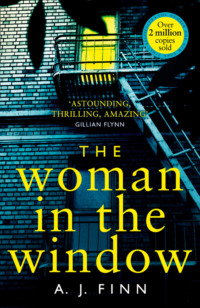
Read the book: «The Woman in the Window»


Copyright
Published by HarperCollinsPublishers Ltd
1 London Bridge Street
London SE1 9GF
www.harpercollins.co.uk
First published in Great Britain by HarperCollinsPublishers 2018
First published in the United States by William Morrow, an imprint of HarperCollinsPublishers 2018
Copyright © A. J. Finn, Inc. 2018
Cover design © HarperCollinsPublishers Ltd 2021
Cover artwork © Netflix 2021. Used with permission
A. J. Finn asserts the moral right to be identified as the author of this work.
A catalogue copy of this book is available from the British Library.
This novel is entirely a work of fiction. The names, characters and incidents portrayed in it are the work of the author’s imagination. Any resemblance to actual persons, living or dead, events or localities is entirely coincidental.
All rights reserved under International and Pan-American Copyright Conventions. By payment of the required fees, you have been granted the non-exclusive, non-transferable right to access and read the text of this e-book on screen. No part of this text may be reproduced, transmitted, down-loaded, decompiled, reverse engineered, or stored in or introduced into any information storage and retrieval system, in any form or by any means, whether electronic or mechanical, now known or hereinafter invented, without the express written permission of HarperCollins.
Source ISBN: 9780008234157
Ebook Edition © January 2018 ISBN: 9780008292737
Version: 2021-04-30
Praise for The Woman in the Window:
‘Astounding. Thrilling. Lovely and amazing. I could weave in more superlatives but you get the idea. Finn has created a noir for the new millennium, packed with mesmerizing characters, stunning twists, beautiful writing and a narrator with whom I’d love to split a bottle of pinot. Maybe two bottles—I’ve got a lot of questions for her’ GILLIAN FLYNN
‘Twisted to the power of max. Hitchcockian suspense with a 21st-century spin’ VAL McDERMID
‘A dark, twisty confection with an irresistible film noir premise. Hitchcock would have snapped up the rights in a heartbeat’ RUTH WARE
‘The Woman in the Window is one of those rare books that really is unputdownable. The writing is smooth and often remarkable. The way Finn plays off this totally original story against a background of film noir is both delightful and chilling’ STEPHEN KING
‘An incredible debut, I absolutely loved it. I read The Woman in the Window in a single day. Full of suspense and surprises and told with heart, The Woman in the Window will send readers racing through its pages. A stunning first outing from A. J. Finn. He is a tremendous new talent’ JANE HARPER, bestselling author of The Dry
‘Amazing. Riveting. Just plain fantastic!’ TESS GERRITSEN
‘A truly phenomenal debut. A taut, utterly compelling story. Smart, heart-wrenching—and really scary’ NICCI FRENCH
‘Amazing. What an elegant, beautifully written thriller. I loved Dr Fox from the word go, and the twists and turns were just exquisite. It’s so rare to find a story so compelling, yet so gracefully told – the flair and class of Hitchcock on every page. It’s quite a cliché, but I was genuinely walking around the house/answering the door/eating my meals with the book in my hand.’ JOANNA CANNON, bestselling author of The Trouble with Goats and Sheep
‘Dense, brilliant and unforgettable; tight in focus, widescreen in execution’ JENNY COLGAN
‘A. J. Finn pulled me into the world of The Woman in the Window so completely that I barely drew breath until I turned the final page. The vulnerable protagonist, Anna, is isolated from friends, family, community and reality in this gripping, compelling and utterly intriguing novel that is deservedly sure to grab readers by their heartstrings in 2018’ LIZ NUGENT, bestselling author of Lying in Wait
‘The Woman in the Window reads like a classic Hitchcock movie in novel form, in fact I was half expecting a cameo. Dripping with suspense. Creaking with menace. Beautifully written. There’s a lot of buzz around this book and every single bit of it is totally justified’ SIMON TOYNE, bestselling author of the Sanctus trilogy
‘There hasn’t been a debut thriller this good since Scott Smith’s A Simple Plan appeared twenty-five years ago. The Woman in the Window is compelling, wrenching, and gasp-for-breath exciting—I was blown away’ JOE HILL, bestselling author of Heart-Shaped Box
‘Hitchcock himself would have been proud. Masterfully uncomfortable reading that had me racing to the end for relief’ HELEN FIELDS, bestselling author of Perfect Remains
‘This is a wonderfully dark, elegant thriller, evocative of Hitchcock and classic noir. Tense, twisty and SO beautifully written. Amidst the many twists and turns, which are rolled out to perfection, the descriptions of Anna’s dusty, gothic townhouse create a nail-shreddingly claustrophobic atmosphere. And Anna herself is a gift of an unreliable narrator—agoraphobic, alcoholic, by turns tragic and spiky. An absolute one-sitting read’ C.J. TUDOR, author of The Chalk Man
‘The Woman in the Window is a tour de force. A twisting, twisted odyssey inside one woman’s mind, her illusions, delusions, reality. It left my own mind reeling and my heart pounding. An absolutely gripping thriller’ LOUISE PENNY, author of the Chief Inspector Gamache novels
Dedication
for George
Epigraph
I have a feeling that inside you somewhere,
there’s something nobody knows about.
—Shadow of a Doubt (1943)
Contents
Cover
Title Page
Copyright
Praise for The Woman in the Window
Dedication
Epigraph
Sunday, October 24
Chapter 1
Monday, October 25
Chapter 2
Tuesday, October 26
Chapter 3
Wednesday, October 27
Chapter 4
Thursday, October 28
Chapter 5
Friday, October 29
Chapter 6
Saturday, October 30
Chapter 7
Chapter 8
Chapter 9
Sunday, October 31
Chapter 10
Chapter 11
Chapter 12
Monday, November 1
Chapter 13
Chapter 14
Chapter 15
Tuesday, November 2
Chapter 16
Chapter 17
Chapter 18
Chapter 19
Wednesday, November 3
Chapter 20
Chapter 21
Chapter 22
Chapter 23
Chapter 24
Chapter 25
Chapter 26
Thursday, November 4
Chapter 27
Chapter 28
Chapter 29
Chapter 30
Chapter 31
Chapter 32
Chapter 33
Chapter 34
Friday, November 5
Chapter 35
Chapter 36
Chapter 37
Chapter 38
Chapter 39
Chapter 40
Chapter 41
Chapter 42
Chapter 43
Chapter 44
Chapter 45
Saturday, November 6
Chapter 46
Chapter 47
Chapter 48
Chapter 49
Chapter 50
Chapter 51
Chapter 52
Chapter 53
Chapter 54
Chapter 55
Sunday, November 7
Chapter 56
Chapter 57
Chapter 58
Chapter 59
Chapter 60
Chapter 61
Chapter 62
Chapter 63
Chapter 64
Chapter 65
Monday, November 8
Chapter 66
Chapter 67
Chapter 68
Chapter 69
Chapter 70
Chapter 71
Chapter 72
Chapter 73
Chapter 74
Chapter 75
Chapter 76
Tuesday, November 9
Chapter 77
Wednesday, November 10
Chapter 78
Thursday, November 11
Chapter 79
Chapter 80
Chapter 81
Friday, November 12
Chapter 82
Saturday, November 13
Chapter 83
Chapter 84
Chapter 85
Chapter 86
Chapter 87
Chapter 88
Sunday, November 14
Chapter 89
Chapter 90
Chapter 91
Chapter 92
Chapter 93
Chapter 94
Monday, November 15
Chapter 95
Chapter 96
Chapter 97
Chapter 98
Six Weeks Later
Chapter 99
Chapter 100
Acknowledgments
About the Author
About the Publisher
SUNDAY,
1
HER HUSBAND’S ALMOST HOME. He’ll catch her this time.
There isn’t a scrap of curtain, not a blade of blind, in number 212—the rust-red townhome that once housed the newlywed Motts, until recently, until they un-wed. I never met either Mott, but occasionally I check in online: his LinkedIn profile, her Facebook page. Their wedding registry lives on at Macy’s. I could still buy them flatware.
As I was saying: not even a window dressing. So number 212 gazes blankly across the street, ruddy and raw, and I gaze right back, watching the mistress of the manor lead her contractor into the guest bedroom. What is it about that house? It’s where love goes to die.
She’s lovely, a genuine redhead, with grass-green eyes and an archipelago of tiny moles trailing across her back. Much prettier than her husband, a Dr. John Miller, psychotherapist—yes, he offers couples counseling—and one of 436,000 John Millers online. This particular specimen works near Gramercy Park and does not accept insurance. According to the deed of sale, he paid $3.6 million for his house. Business must be good.
I know both more and less about the wife. Not much of a homemaker, clearly; the Millers moved in eight weeks ago, yet still those windows are bare, tsk-tsk. She practices yoga three times a week, tripping down the steps with her magic-carpet mat rolled beneath one arm, legs shrink-wrapped in Lululemon. And she must volunteer someplace—she leaves the house a little past eleven on Mondays and Fridays, around the time I get up, and returns between five and five thirty, just as I’m settling in for my nightly film. (This evening’s selection: The Man Who Knew Too Much, for the umpteenth time. I am the woman who viewed too much.)
I’ve noticed she likes a drink in the afternoon, as do I. Does she also like a drink in the morning? As do I?
But her age is a mystery, although she’s certainly younger than Dr. Miller, and younger than me (nimbler, too); her name I can only guess at. I think of her as Rita, because she looks like Hayworth in Gilda. “I’m not in the least interested”—love that line.
I myself am very much interested. Not in her body—the pale ridge of her spine, her shoulder blades like stunted wings, the baby-blue bra clasping her breasts: whenever these loom within my lens, any of them, I look away—but in the life she leads. The lives. Two more than I’ve got.
Her husband rounded the corner a moment ago, just past noon, not long after his wife pressed the front door shut, contractor in tow. This is an aberration: On Sundays, Dr. Miller returns to the house at quarter past three, without fail.
Yet now the good doctor strides down the sidewalk, breath chugging from his mouth, briefcase swinging from one hand, wedding band winking. I zoom in on his feet: oxblood oxfords, slick with polish, collecting the autumn sunlight, kicking it off with each step.
I lift the camera to his head. My Nikon D5500 doesn’t miss much, not with that Opteka lens: unruly marled hair, glasses spindly and cheap, islets of stubble in the shallow ponds of his cheeks. He takes better care of his shoes than his face.
Back to number 212, where Rita and the contractor are speedily disrobing. I could dial directory assistance, call the house, warn her. I won’t. Watching is like nature photography: You don’t interfere with the wildlife.
Dr. Miller is maybe half a minute away from the front door. His wife’s mouth glosses the contractor’s neck. Off with her blouse.
Four more steps. Five, six, seven. Twenty seconds now, at most.
She seizes his tie between her teeth, grins at him. Her hands fumble with his shirt. He grazes on her ear.
Her husband hops over a buckled slab of sidewalk. Fifteen seconds.
I can almost hear the tie slithering out of his collar. She whips it across the room.
Ten seconds. I zoom in again, the snout of the camera practically twitching. His hand dives into his pocket, surfaces with a haul of keys. Seven seconds.
She unlooses her ponytail, hair swinging onto her shoulders.
Three seconds. He mounts the steps.
She folds her arms around his back, kisses him deep.
He stabs the key into the lock. Twists.
I zoom in on her face, the eyes sprung wide. She’s heard.
I snap a photo.
And then his briefcase flops open.
A flock of papers bursts from it, scatters in the wind. I jolt the camera back to Dr. Miller, to the crisp “Shoot” his mouth shapes; he sets the briefcase on the stoop, stamps a few sheets beneath those glinting shoes, scoops others into his arms. One tearaway scrap has snagged in the fingers of a tree. He doesn’t notice.
Rita again, plunging her arms into her sleeves, pushing her hair back. She speeds from the room. The contractor, marooned, hops off the bed and retrieves his tie, stuffs it into his pocket.
I exhale, air hissing out of a balloon. I hadn’t realized I was holding my breath.
The front door opens: Rita surges down the steps, calling to her husband. He turns; I expect he smiles—I can’t see. She stoops, peels some papers from the sidewalk.
The contractor appears at the door, one hand sunk in his pocket, the other raised in greeting. Dr. Miller waves back. He ascends to the landing, lifts his briefcase, and the two men shake. They walk inside, trailed by Rita.
Well. Maybe next time.
MONDAY,
2
THE CAR DRONED PAST a moment ago, slow and somber, like a hearse, taillights sparking in the dark. “New neighbors,” I tell my daughter.
“Which house?”
“Across the park. Two-oh-seven.” They’re out there now, dim as ghosts in the dusk, exhuming boxes from the trunk.
She slurps.
“What are you eating?” I ask. It’s Chinese night, of course; she’s eating lo mein.
“Lo mein.”
“Not while you’re talking to Mommy, you’re not.”
She slurps again, chews. “Mo-om.” This is a tug-of-war between us; she’s whittled Mommy down, against my wishes, to something blunt and stumpy. “Let it go,” Ed advises—but then he’s still Daddy.
“You should go say hi,” Olivia suggests.
“I’d like to, pumpkin.” I drift upstairs, to the second floor, where the view’s better. “Oh: There are pumpkins everywhere. All the neighbors have one. The Grays have four.” I’ve reached the landing, glass in hand, wine lapping at my lip. “I wish I could pick out a pumpkin for you. Tell Daddy to get you one.” I sip, swallow. “Tell him to get you two, one for you and one for me.”
“Okay.”
I glimpse myself in the dark mirror of the half bath. “Are you happy, sweetheart?”
“Yes.”
“Not lonely?” She never had real friends in New York; she was too shy, too small.
“Nope.”
I peer into the dark at the top of the stairs, into the gloom above. During the day, sun drops through the domed skylight overhead; at night, it’s a wide-open eye gazing into the depths of the stairwell. “Do you miss Punch?”
“Nope.” She didn’t get along with the cat, either. He scratched her one Christmas morning, flashed his claws across her wrist, two quick rakes north-south east-west; a bright grid of blood sprang to the skin, tic-tac-toe, and Ed nearly pitched him out the window. I look for him now, find him swirled on the library sofa, watching me.
“Let me talk to Daddy, pumpkin.” I mount the next flight, the runner coarse against my soles. Rattan. What were we thinking? It stains so easily.
“Hey there, slugger,” he greets me. “New neighbors?”
“Yes.”
“Didn’t you just get new neighbors?”
“That was two months ago. Two-twelve. The Millers.” I pivot, descending the stairs.
“Where are these other people?”
“Two-oh-seven. Across the park.”
“Neighborhood’s changing.”
I reach the landing, round it. “They didn’t bring much with them. Just a car.”
“Guess the movers will come later.”
“Guess so.”
Silence. I sip.
Now I’m in the living room again, by the fire, shadows steeped in the corners. “Listen …” Ed begins.
“They have a son.”
“What?”
“There’s a son,” I repeat, pressing my forehead against the cold glass of the window. Sodium lamps have yet to sprout in this province of Harlem, and the street is lit only by a lemon-wedge of moon, but still I can make them out in silhouette: a man, a woman, and a tall boy, ferrying boxes to the front door. “A teenager,” I add.
“Easy, cougar.”
Before I can stop myself: “I wish you were here.”
It catches me off guard. Ed too, by the sound of it. There’s a pause.
Then: “You need more time,” he says.
I stay quiet.
“The doctors say that too much contact isn’t healthy.”
“I’m the doctor who said that.”
“You’re one of them.”
A knuckle-crack behind me—a spark in the fireplace. The flames settle, muttering in the grate.
“Why don’t you invite those new people over?” he asks.
I drain my glass. “I think that’s enough for tonight.”
“Anna.”
“Ed.”
I can almost hear him breathe. “I’m sorry we’re not there with you.”
I can almost hear my heart. “I am, too.”
Punch has tracked me downstairs. I scoop him up in one arm, retreat to the kitchen. Set the phone on the counter. One more glass before bed.
Grasping the bottle by its throat, I turn to the window, toward the three ghosts haunting the sidewalk, and hoist it in a toast.
TUESDAY,
3
THIS TIME LAST YEAR, we’d planned to sell the house, had even engaged a broker; Olivia would enroll in a Midtown school the following September, and Ed had found us a Lenox Hill gut job. “It’ll be fun,” he promised. “I’ll install a bidet, just for you.” I batted him on the shoulder.
“What’s a bidet?” asked Olivia.
But then he left, and she with him. So it flayed my heart all over again when, last night, I recalled the first words of our stillborn listing: LOVINGLY RESTORED LANDMARK 19TH-CENTURY HARLEM GEM! WONDERFUL FAMILY HOME! Landmark and gem up for debate, I think. Harlem inarguable, likewise 19th-century (1884). Lovingly restored, I can attest to that, and expensively, too. Wonderful family home, true.
My domain and its outposts:
Basement: Or maisonette, according to our broker. Sub-street, floor-through, with its own door; kitchen, bath, bedroom, tiny office. Ed’s workspace for eight years—he’d drape the table in blueprints, tack contractor briefs to the wall. Currently tenanted.
Garden: Patio, really, accessible via the first floor. A sprawl of limestone tile; a pair of disused Adirondack chairs; a young ash tree slouched in the far corner, gangling and lonely, like a friendless teenager. Every so often I long to hug it.
First floor: Ground floor, if you’re British, or premier étage, if you’re French. (I am neither, but I spent time in Oxford during my residency—in a maisonette, as it happens—and this past July began studying français online.) Kitchen—open-plan and “gracious” (broker again), with a rear door leading to the garden and a side door to the park. White-birch floors, now blotched with puddles of merlot. In the hall a powder room—the red room, I call it. “Tomato Red,” per the Benjamin Moore catalogue. Living room, equipped with sofa and coffee table and paved in Persian rug, still plush underfoot.
Second floor: The library (Ed’s; shelves full, cracked spines and foxed dust jackets, all packed tight as teeth) and the study (mine; spare, airy, a desktop Mac poised on an IKEA table—my online-chess battlefield). Second half bath, this one blued in “Heavenly Rapture,” which is ambitious language for a room with a toilet. And a deep utility closet I might one day convert into a darkroom, if I ever migrate from digital to film. I think I’m losing interest.
Third floor: The master (mistress?) bedroom and bath. I’ve spent much of my time in bed this year; it’s one of those sleep-system mattresses, dually adjustable. Ed programmed his side for an almost downy softness; mine is set to firm. “You’re sleeping on a brick,” he said once, strumming his fingers on the top sheet.
“You’re sleeping on a cumulus,” I told him. Then he kissed me, long and slow.
After they left, during those black, blank months when I could scarcely prise myself from the sheets, I would roll slowly, like a curling wave, from one end to the other, spooling and unspooling the bedclothes around me.
Also the guest bedroom and en-suite.
Fourth floor: Servants’ quarters once upon a time, now Olivia’s bedroom and a second spare. Some nights I haunt her room like a ghost. Some days I stand in the doorway, watch the slow traffic of dust motes in the sun. Some weeks I don’t visit the fourth floor at all, and it starts to melt into memory, like the feel of rain on my skin.
Anyway. I’ll speak to them again tomorrow. Meanwhile, no sign of the people across the park.
WEDNESDAY,
4
A RANGY TEENAGER BURSTS from the front door of number 207, like a horse from the starting gate, and gallops east down the street, past my front windows. I don’t get a good look—I’ve awoken early, after a late night with Out of the Past, and am trying to decide if a swallow of merlot might be wise; but I catch a bolt of blond, a backpack slung from one shoulder. Then he’s gone.
I slug a glass, float upstairs, settle myself at my desk. Reach for my Nikon.
In the kitchen of 207 I can see the father, big and broad, backlit by a television screen. I press the camera to my eye and zoom in: the Today show. I might head down and switch on my own TV, I muse, watch alongside my neighbor. Or I might view it right here, on his set, through the lens.
I decide to do that.
IT’S BEEN a while since I took in the facade, but Google furnishes a street view: whitewashed stone, faintly Beaux-Arts, capped with a widow’s walk. From here, of course, I can set my sights only on the side of the house; through its east windows, I’ve a clear shot into the kitchen, a second-floor parlor, and a bedroom above.
Yesterday a platoon of movers arrived, hauling sofas and television sets and an ancient armoire. The husband has been directing traffic. I haven’t seen the wife since the night they moved in. I wonder what she looks like.
I’M ABOUT to checkmate Rook&Roll this afternoon when I hear the bell. I shuffle downstairs, slap the buzzer, unlock the hall door, and find my tenant looming there, looking, as they say, rough and ready. He is handsome, with his long jaw, his eyes like trapdoors, dark and deep. Gregory Peck after a late evening. (I’m not the only one who thinks so. David likes to entertain the occasional lady friend, I’ve noticed. Heard, really.)
“I’m heading to Brooklyn tonight,” he reports.
I drag a hand through my hair. “Okay.”
“You need me to take care of anything before I go?” It sounds like a proposition, like a line from a noir. You just put your lips together and blow.
“Thanks. I’m fine.”
He gazes past me, squints. “Bulbs need changing? It’s dark in here.”
“I like it dim,” I say. Like my men, I want to add. Is that the joke from Airplane? “Have …” Fun? A good time? Sex? “… a good time.”
He turns to go.
“You know you can just come on in through the basement door,” I tell him, trying for playful. “Chances are I’ll be home.” I hope he’ll smile. He’s been here two months, and I haven’t once seen him grin.
He nods. He leaves.
I close the door, double-bolt the lock.
I STUDY myself in the mirror. Wrinkles like spokes around my eyes. A slur of dark hair, tigered here and there with gray, loose about my shoulders; stubble in the scoop of my armpit. My belly has gone slack. Dimples stipple my thighs. Skin almost luridly pale, veins flowing violet within my arms and legs.
Dimples, stipples, stubble, wrinkles: I need work. I had a down-home appeal once, according to some, according to Ed. “I thought of you as the girl next door,” he said sadly, toward the end.
I look down at my toes rippling against the tile—long and fine, one (or ten) of my better features, but a bit small-predator right now. I rummage through my medicine cabinet, pill bottles stacked atop one another like totem poles, and excavate a nail clipper. At last, a problem I can fix.
THURSDAY,
5
THE DEED OF SALE POSTED YESTERDAY. My new neighbors are Alistair and Jane Russell; they paid $3.45 million for their humble abode. Google tells me that he’s a partner at a midsize consultancy, previously based in Boston. She’s untraceable—you try plugging Jane Russell into a search engine.
It’s a lively neighborhood they’ve chosen.
The Miller home across the street—abandon all hope, ye who enter here—is one of five townhouses that I can survey from the south-facing windows of my own. To the east stand the identical-twin Gray Sisters: same box cornices crowning the windows, same bottle-green front doors. In the right—the slightly Grayer Sister, I think—live Henry and Lisa Wasserman, longtime residents; “Four decades and counting,” bragged Mrs. Wasserman when we moved in. She’d dropped by to tell us (“to your faces”) how much she (“and my Henry”) resented the arrival of “another yuppie clan” in what “used to be a real neighborhood.”
Ed fumed. Olivia named her stuffed rabbit Yuppie.
The Wassermen, as we dubbed them, haven’t spoken to me since, even though I’m on my own now, a clan unto myself. They don’t seem much friendlier toward the residents of the other Gray Sister, a family called, fittingly, Gray. Twin teenage girls, father a partner at a boutique M&A firm, mother an eager book-club hostess. This month’s selection, advertised on their Meetup page and under review right now, in the Grays’ front room, by eight middle-aged women: Jude the Obscure.
I read it too, imagined I was one of the group, munching coffee cake (none handy) and sipping wine (this I managed). “What did you think of Jude, Anna?” Christine Gray would ask me, and I’d say I found it rather obscure. We’d laugh. They’re laughing now, in fact. I try laughing with them. I take a sip.
West of the Millers are the Takedas. The husband is Japanese, the mother white, their son unearthly beautiful. He’s a cellist; in the warm months, he rehearses with the parlor windows thrown open, so Ed used to hoist ours in turn. We danced one night in some long-gone June, Ed and I, to the strains of a Bach suite: swaying in the kitchen, my head on his shoulder, his fingers knotted behind me, as the boy across the street played on.
This past summer, his music wandered toward the house, approached my living room, knocked politely on the glass: Let me in. I didn’t, couldn’t—I never open the windows, never—but still I could hear it murmuring, pleading: Let me in. Let me in!
Number 206–208, a vacant double-wide brownstone, flanks the Takedas’ house. An LLC bought it two Novembers ago, but no one moved in. A puzzle. For nearly a year, scaffolding clung to its facade like hanging gardens; it disappeared overnight—this was a few months before Ed and Olivia left—and since then, nothing.
Behold my southern empire and its subjects. None of these people were my friends; most of them I’d not met more than once or twice. Urban life, I suppose. Maybe the Wassermen were onto something. I wonder if they know what’s become of me.
A DERELICT Catholic school abuts my house to the east, practically leans against it: St. Dymphna’s, shuttered since we moved in. We’d threaten to send Olivia there when she misbehaved. Pitted brown stone, windows dark with grime. Or at least that’s what I remember; it’s been a while since I laid eyes on it.
And directly west is the park—tiny, two lots across and two deep, with a narrow brick path connecting our street to the one directly north. A sycamore stands sentry at either end, leaves flaming; an iron fence, low to the ground, hems in both sides. It is, as that quotable broker said, very quaint.
Then there’s the house beyond the park: number 207. The Lords sold it two months ago and promptly cleared out, flying south to their retirement villa in Vero Beach. Enter Alistair and Jane Russell.
Jane Russell! My physical therapist had never heard of her. “Gentlemen Prefer Blondes,” I said.
“Not in my experience,” she replied. Bina’s younger; perhaps that’s it.
All this was earlier today; before I could argue with her, she laced one of my legs over the other, capsized me onto my right side. The pain left me breathless. “Your hamstrings need this,” she assured me.
“You bitch,” I gasped.
She pressed my knee to the floor. “You’re not paying me to go easy on you.”
I winced. “Can I pay you to leave?”
Bina visits once a week to help me hate life, as I like to say, and to provide updates on her sexual adventures, which are about as exciting as my own. Only in Bina’s case it’s because she’s picky. “Half the guys on these apps are using five-year-old photos,” she’ll complain, her waterfall of hair poured over one shoulder, “and the other half are married. And the other half are single for a reason.”
That’s three halves, but you don’t debate math with someone who’s rotating your spine.
I joined Tinder a month ago “just to see,” I told myself. Tinder, Bina had explained to me, matchmakes you with people whose paths you’ve crossed. But what if you haven’t crossed paths with anyone? What if you forever navigate the same four thousand vertically arranged square feet, and nothing beyond them?
I don’t know. The first profile I spotted was David’s. I instantly deleted my account.
IT’S BEEN four days since I glimpsed Jane Russell. She certainly wasn’t proportioned like the original, with her torpedo breasts, her wasp waist, but then neither am I. The son I’ve seen only that once, yesterday morning. The husband, however—wide shoulders, streaky brows, a blade of a nose—is on permanent display in his house: whisking eggs in the kitchen, reading in the parlor, occasionally glancing into the bedroom, as though in search of someone.
FRIDAY,
6
MY FRENCH LEÇON TODAY, and Les Diaboliques tonight. A rat-bastard husband, his “little ruin” of a wife, a mistress, a murder, a vanished corpse. Can you beat a vanished corpse?
But first, duty calls. I swallow my pills, park at my desktop, knock the mouse to one side, enter the passcode. And log on to the Agora.
At any hour, at all hours, there are at least a few dozen users checked in, a constellation sprawled across the world. Some of them I know by name: Talia from the Bay Area; Phil in Boston; a lawyer from Manchester with the unlawyerly name of Mitzi; Pedro, a Bolivian whose halting English is probably no worse than my pidgin French. Others go by handles, me included—in a cute moment, I opted for Annagoraphobe, but then I outed myself to another user as a psychologist, and word swiftly spread. So now I’m thedoctorisin. She’ll see you now.
Agoraphobia: in translation the fear of the marketplace, in practice the term for a range of anxiety disorders. First documented in the late 1800s, then “codified as an independent diagnostic entity” a century later, though largely comorbid with panic disorder. You can read all about it, if you like, in the Diagnostic and Statistical Manual of Mental Disorders, Fifth Edition. DSM-5 for short. It’s always amused me, that title; it sounds like a movie franchise. Liked Mental Disorders 4? You’ll love the sequel!
The medical literature is uncommonly imaginative when it comes to diagnostics. “Agoraphobic fears … include being outside the home alone; being in a crowd, or standing in a line; being on a bridge.” What I wouldn’t give to stand on a bridge. Hell, what I wouldn’t give to stand in a line. I like this one, too: “Being in the center of a theater row.” Center seats, no less.
Pages 113 through 133, if you’re interested.
Many of us—the most severely afflicted, the ones grappling with post-traumatic stress disorder—are housebound, hidden from the messy, massy world outside. Some dread the heaving crowds; others, the storm of traffic. For me, it’s the vast skies, the endless horizon, the sheer exposure, the crushing pressure of the outdoors. “Open spaces,” the DSM-5 calls it vaguely, anxious to get to its 186 footnotes.
As a doctor, I say that the sufferer seeks an environment she can control. Such is the clinical take. As a sufferer (and that is the word), I say that agoraphobia hasn’t ravaged my life so much as become it.
THE AGORA welcome screen greets me. I scan the message boards, comb the threads. 3 MONTHS STUCK IN MY HOUSE. I hear you, Kala88; almost ten months and counting here. AGORA DEPENDENT ON MOOD? Sounds more like social phobia, EarlyRiser. Or a troubled thyroid. STILL CAN’T GET A JOB. Oh, Megan—I know, and I’m sorry. Thanks to Ed, I don’t need one, but I miss my patients. I worry about my patients.
A newcomer has emailed me. I direct her to the survival manual I whipped up back in the spring: “So You Have a Panic Disorder”—I think it sounds agreeably jaunty.
Q: How do I eat?
A: Blue Apron, Plated, HelloFresh … there are lots of delivery options available in the US! Those abroad can likely find similar services.
Q: How do I get my medication?
A: All the major pharmacies in the US now come straight to your door. Have your doctor speak to your local pharmacy if there’s a problem.
Q: How do I keep the house clean?
A: Clean it! Hire a cleaning agency or do it yourself.
(I do neither. My place could use a wipe-down.)
Q: What about trash disposal?
A: Your cleaner can take care of this, or you can arrange for a friend to help.
Q: How do I keep from getting bored?
A: Now, that’s the tough question …
Et cetera. I’m pleased with the document, on the whole. Would have loved to have had it myself.
Now a chat box appears on my screen.
Sally4th: hello doc!
I can feel a smile twitching on my lips. Sally: twenty-six, based in Perth, was attacked earlier this year, on Easter Sunday. She suffered a broken arm and severe contusions to her eyes and face; her rapist was never identified or apprehended. Sally spent four months indoors, isolated in the most isolated city in the world, but has been getting out of the house for more than ten weeks now—good on her, as she’d say. A psychologist, aversion therapy, and propranolol. Nothing like a beta-blocker.
thedoctorisin: Hello yourself! All okay?
Sally4th: all ok! picnic this morning!!
She’s always been fond of exclamation marks, even in the depths of depression.
thedoctorisin: How was it?
Sally4th: i survived!:)
She likes emoticons, too.
thedoctorisin: You are a survivor! How is the Inderal?
Sally4th: good, i’m down to 80mg
thedoctorisin: 2x a day?
Sally4th: 1x!!
thedoctorisin: Minimum dosage! Fantastic! Side effects?
Sally4th: dry eyes, that’s it
That’s lucky. I’m on a similar drug (among others), and from time to time the headaches nearly rupture my brain. PROPRANOLOL CAN LEAD TO MIGRAINE, HEART ARRHYTHMIA, SHORTNESS OF BREATH, DEPRESSION, HALLUCINATIONS, SEVERE SKIN REACTION, NAUSEA, DIARRHEA, DECREASED LIBIDO, INSOMNIA, AND DROWSINESS. “What that medicine needs is more side effects,” Ed said to me.
“Spontaneous combustion,” I suggested.
“The screaming shits.”
“Slow, lingering death.”
thedoctorisin: Any relapses?
Sally4th: i had a wobble last week
Sally4th: but got thru it
Sally4th: breathing exercises
thedoctorisin: The old paper bag.
Sally4th: i feel like an idiot but it works
thedoctorisin: It does indeed. Well done.
Sally4th: thanx :)
I sip my wine. Another chat box pops up: Andrew, a man I met on a site for classic-film enthusiasts.
Graham Greene series @ Angelika this w/e?
I pause. The Fallen Idol is a favorite—the doomed butler; the fateful paper plane—and it’s been fifteen years since I watched Ministry of Fear. And old movies, of course, brought me and Ed together.
But I haven’t explained my situation to Andrew. Unavailable sums it up.
I return to Sally.
thedoctorisin: Are you keeping up with your psychologist?
Sally4th: yes :) thanx. down to just 1x week. she says progress is excellent
Sally4th: meds and beds is the key
thedoctorisin: Are you sleeping well?
Sally4th: i still get bad dreams
Sally4th: u?
thedoctorisin: I’m sleeping a lot.
Too much, probably. I should mention that to Dr. Fielding. Not sure I will.
Sally4th: ur progress? u fit for fight?
thedoctorisin: I’m not as quick as you! PTSD is a beast. But I’m tough.
Sally4th: yes u r!
Sally4th: just wanted to check on my friends here—thinking about u all!!!
I bid Sally adieu just as my tutor dials in on Skype. “Bonjour, Yves,” I mutter to myself. I pause for a moment before answering; I look forward to seeing him, I realize—that inky hair, that dark bloom to his skin. Those eyebrows that bolt into each other and buckle like l’accent circonflexe when my accent puzzles him, which is often.
If Andrew checks in again, I’ll ignore him for now. Maybe for good. Classic cinema: That’s what I share with Ed. No one else.
I UPEND the hourglass on my desk, watch how the little pyramid of sand seems to pulse as the grains dimple it. So much time. Nearly a year. I haven’t left the house in nearly a year.
Well, almost. Five times in eight weeks I’ve managed to venture outside, out back, into the garden. My “secret weapon,” as Dr. Fielding calls it, is my umbrella—Ed’s umbrella, really, a rickety London Fog contraption. Dr. Fielding, a rickety contraption himself, will stand like a scarecrow in the garden as I push the door open, the umbrella brandished before me. A flick of the spring and it blooms; I stare intently at the bowl of its body, at its ribs and skin. Dark tartan, four squares of black arranged across each fold of canopy, four lines of white in every warp and weft. Four squares, four lines. Four blacks, four whites. Breathe in, count to four. Breathe out, count to four. Four. The magic number.
The umbrella projects straight ahead of me, like a saber, like a shield.
And then I step outside.
Out, two, three, four.
In, two, three, four.
The nylon glows against the sun. I descend the first step (there are, naturally, four) and tilt the umbrella toward the sky, just a bit, peek at his shoes, his shins. The world teems in my peripheral vision, like water about to flood a diving bell.
“Remember, you’ve got your secret weapon,” Dr. Fielding calls.
It’s not a secret, I want to cry; it’s a fucking umbrella, wielded in broad daylight.
Out, two, three, four; in, two, three, four—and unexpectedly it works; I’m conducted down the steps (out, two, three, four) and across a few yards of lawn (in, two, three, four). Until the panic wells within, a rising tide that swamps my sight, drowns out Dr. Fielding’s voice. And then … best not to think of it.
SATURDAY,
7
A STORM. THE ASH TREE COWERS, the limestone glowers, dark and damp. I remember dropping a glass onto the patio once; it burst like a bubble, merlot flaring across the ground and flooding the veins of the stonework, dark and bloody, crawling toward my feet.
Sometimes, when the skies are low, I imagine myself overhead, in a plane or on a cloud, surveying the island below: the bridges spoked from its east coast; the cars sucked toward it like flies swarming a lightbulb.
It’s been so long since I felt the rain. Or wind—the caress of wind, I nearly said, except that sounds like something you’d read in a supermarket romance.
It’s true, though. And snow too, but snow I never want to feel again.
A PEACH was mixed in with my Granny Smiths in this morning’s FreshDirect delivery. I wonder how that happened.
THE NIGHT we met, at an art-house screening of The 39 Steps, Ed and I compared histories. My mother, I told him, had weaned me on old thrillers and classic noir; as a teenager I preferred the company of Gene Tierney and Jimmy Stewart to that of my classmates. “Can’t decide if that’s sweet or sad,” said Ed, who until that evening had never seen a black-and-white movie. Within two hours, his mouth was on mine.
You mean your mouth was on mine, I imagine him saying.
In the years before Olivia, we’d watch a movie at least once a week—all the vintage suspense flicks from my childhood: Double Indemnity, Gaslight, Saboteur, The Big Clock … We lived in monochrome those nights. For me, it was a chance to revisit old friends; for Ed, it was an opportunity to make new ones.
And we’d make lists. The Thin Man franchise, ranked from best (the original) to worst (Song of the Thin Man). Top movies from the bumper crop of 1944. Joseph Cotten’s finest moments.
I can do lists on my own, of course. For instance: best Hitchcock films not made by Hitchcock. Here we go:
Le Boucher, the early Claude Chabrol that Hitch, according to lore, wished he’d directed. Dark Passage, with Humphrey Bogart and Lauren Bacall—a San Francisco valentine, all velveteen with fog, and antecedent to any movie in which a character goes under the knife to disguise himself. Niagara, starring Marilyn Monroe; Charade, starring Audrey Hepburn; Sudden Fear!, starring Joan Crawford’s eyebrows. Wait Until Dark: Hepburn again, a blind woman stranded in her basement apartment. I’d go berserk in a basement apartment.
Now, movies that postdate Hitch: The Vanishing, with its sucker-punch finale. Frantic, Polanski’s ode to the master. Side Effects, which begins as a Big Pharma screed before slithering like an eel into another genre altogether.
Okay.
Popular film misquotes. “Play it again, Sam”: Casablanca, allegedly, except neither Bogie nor Bergman ever said it. “He’s alive”: Frankenstein doesn’t gender his monster; cruelly, it’s just “It’s alive.” “Elementary, my dear Watson” does crop up in the first Holmes film of the talkie era, but appears nowhere in the Conan Doyle canon.
Okay.
What next?
I FLIP open my laptop, visit the Agora. A message from Mitzi in Manchester; a progress report courtesy of Dimples2016 in Arizona. Nothing of note.
IN THE front parlor of number 210, the Takeda boy draws his bow across the cello. Farther east, the four Grays flee the rain, charging up their front steps, laughing. Across the park, Alistair Russell fills a glass at the kitchen tap.
The free sample has ended.