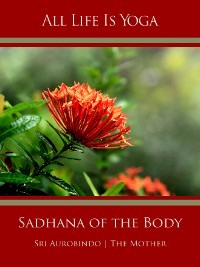
Read the book: «All Life Is Yoga: Sadhana of the Body»

Omsriaurobindomira
All
Life
Is
Yoga
“All life is Yoga.” – Sri Aurobindo
Sadhana of the Body
Sri Aurobindo | The Mother

SRI AUROBINDO
DIGITAL EDITION

Copyright 2019
AURO MEDIA
Verlag und Fachbuchhandel
Wilfried Schuh
www.auro.media
eBook Design
SRI AUROBINDO DIGITAL EDITION
Germany, Berchtesgaden
ALL LIFE IS YOGA
Sadhana of the Body Selections from the Works of Sri Aurobindo and The Mother First edition 2019 ISBN 978-3-96387-029-3

© Photos and selections of the works of Sri Aurobindo and the Mother:
Sri Aurobindo Ashram Trust
Puducherry, India

Flower on the cover:
Ixora coccinea. Deep red. Spiritual significance and explanation given by the Mother: Aspiration in the physical Manifold, simple and joyful.
Publisher’s Note
This is one in a series of some e-books created by SRI AUROBINDO DIGITAL EDITION and published by AURO MEDIA under the title All Life Is Yoga. Our effort is to bring together, from Sri Aurobindo and the Mother, simple passages with a practical orientation on specific subjects, so that everyone may feel free to choose a book according to his inner need. The topics cover the whole field of human activity, because true spirituality is not the rejection of life but the art of perfecting life.
While the passages from Sri Aurobindo are in the original English, most of the passages from the Mother (selections from her talks and writings) are translations from the original French. We must also bear in mind that the excerpts have been taken out of their original context and that a compilation, in its very nature, is likely to have a personal and subjective approach. A sincere attempt, however, has been made to be faithful to the vision of Sri Aurobindo and the Mother.
The excerpts from the writings of Sri Aurobindo and the Mother carry titles and captions chosen by the editor, highlighting the theme of the excerpts and, whenever possible, borrowing a phrase from the text itself. The sources of the excerpts are given at the end of each issue.
We hope these e-books will inspire the readers to go to the complete works and will help them to mould their lives and their environments towards an ever greater perfection.
“True spirituality is not to renounce life, but to make life perfect with a Divine Perfection.” – The Mother
* * *
ContentsTitle PageCopyrightPublisher’s NoteQuotation from Sri AurobindoI. PHYSICAL EDUCATION1. Perfection of the Body2. Control of the Body3. The Primary Importance of Physical Culture4. Principal Aspects of Physical Education5. The Discipline of the Body6. Sports and Physical Exercises7. Concentration and Dispersion8. Conscious Will9. How to Awaken in the Body an Aspiration for the Divine10. Go Beyond the Limit You Have Reached11. The Basis of Equanimity in the External Being12. The ABC of the Transformation of the BodyII. YOGA OF THE BODY1. A New Possibility for the Body2. The Body: Human and Divine3. Beginnings of the Physical Transformation4. Building the Bridge in the Body5. The Great Transition6. The Transfer of Power7. Descent of the Superman8. The Consciousness of Immortality9. The New Body of the Mother10. The Victory Over Death – Reminiscences of Nolini Kanta GuptaAPPENDIXReferencesGuideCoverTable of ContentsStart Reading

Sri Aurobindo
A divine life in a divine body is the formula of the ideal that we envisage. — Sri Aurobindo
* * *
Part 1
PHYSICAL EDUCATION
I must tell you once more that for us spiritual life does not mean contempt for Matter but its divinisation. We do not want to reject the body but to transform it. For this physical education is one of the means most directly effective. — The Mother
Chapter I
Perfection of the Body
Words of the Mother
I must tell you once more that for us spiritual life does not mean contempt for Matter but its divinisation. We do not want to reject the body but to transform it. For this physical education is one of the means most directly effective.
*
Words of Sri Aurobindo
The perfection of the body, as great a perfection as we can bring about by the means at our disposal, must be the ultimate aim of physical culture. Perfection is the true aim of all culture, the spiritual and psychic, the mental, the vital and it must be the aim of our physical culture also. If our seeking is for a total perfection of the being, the physical part of it cannot be left aside; for the body is the material basis, the body is the instrument which we have to use. Sariram khalu dharmasadhanam, says the old Sanskrit adage, – the body is the means of fulfilment of dharma, and dharma means every ideal which we can propose to ourselves and the law of its working out and its action. A total perfection is the ultimate aim which we set before us, for our ideal is the Divine Life which we wish to create here, the life of the Spirit fulfilled on earth, life accomplishing its own spiritual transformation even here on earth in the conditions of the material universe. That cannot be unless the body too undergoes a transformation, unless its action and functioning attain to a supreme capacity and the perfection which is possible to it or which can be made possible.
I have already indicated in a previous message a relative perfection of the physical consciousness in the body and of the mind, the life, the character which it houses as, no less than an awakening and development of the body’s own native capacities, a desirable outcome of the exercises and practices of the physical culture to which we have commenced to give in this Ashram a special attention and scope. A development of the physical consciousness must always be a considerable part of our aim, but for that the right development of the body itself is an essential element; health, strength, fitness are the first needs, but the physical frame itself must be the best possible. A divine life in a material world implies necessarily a union of the two ends of existence, the spiritual summit and the material base. The soul with the basis of its life established in Matter ascends to the heights of the Spirit but does not cast away its base, it joins the heights and the depths together. The Spirit descends into Matter and the material world with all its lights and glories and powers and with them fills and transforms life in the material world so that it becomes more and more divine. The transformation is not a change into something purely subtle and spiritual to which Matter is in its nature repugnant and by which it is felt as an obstacle or as a shackle binding the Spirit; it takes up Matter as a form of the Spirit though now a form which conceals and turns it into a revealing instrument, it does not cast away the energies of Matter, its capacities, its methods; it brings out their hidden possibilities, uplifts, sublimates, discloses their innate divinity. The divine life will reject nothing that is capable of divinisation; all is to be seized, exalted, made utterly perfect. The mind now still ignorant, though struggling towards knowledge, has to rise towards and into the supramental light and truth and bring it down so that it shall suffuse our thinking and perception and insight and all our means of knowing till they become radiant with the highest truth in their inmost and outermost movements. Our life, still full of obscurity and confusion and occupied with so many dull and lower aims, must feel all its urges and instincts exalted and irradiated and become a glorious counterpart of the supramental super-life above. The physical consciousness and physical being, the body itself must reach a perfection in all that it is and does which now we can hardly conceive. It may even in the end be suffused with a light and beauty and bliss from the Beyond and the life divine assume a body divine.
But first the evolution of the nature must have reached a point at which it can meet the Spirit direct, feel the aspiration towards the spiritual change and open itself to the workings of the Power which shall transform it. A supreme perfection, a total perfection is possible only by a transformation of our lower or human nature, a transformation of the mind into a thing of light, our life into a thing of power, an instrument of right action, right use for all its forces, of a happy elevation of its being lifting it beyond its present comparatively narrow potentiality for a self-fulfilling force of action and joy of life. There must be equally a transforming change of the body by a conversion of its action, its functioning, its capacities as an instrument beyond the limitations by which it is clogged and hampered even in its greatest present human attainment. In the totality of the change we have to achieve, human means and forces too have to be taken up, not dropped but used and magnified to their utmost possibility as part of the new life. Such a sublimation of our present human powers of mind and life into elements of a divine life on earth can be conceived without much difficulty; but in what figure shall we conceive the perfection of the body?
In the past the body has been regarded by spiritual seekers rather as an obstacle, as something to be overcome and discarded than as an instrument of spiritual perfection and a field of the spiritual change. It has been condemned as a grossness of Matter, as an insuperable impediment and the limitations of the body as something unchangeable making transformation impossible. This is because the human body even at its best seems only to be driven by an energy of life which has its own limits and is debased in its smaller physical activities by much that is petty or coarse or evil; the body in itself is burdened with the inertia and inconscience of Matter, only partly awake and, although quickened and animated by a nervous activity, subconscient in the fundamental action of its constituent cells and tissues and their secret workings. Even in its fullest strength and force and greatest glory of beauty, it is still a flower of the material Inconscience; the inconscient is the soil from which it has grown and at every point opposes a narrow boundary to the extension of its powers and to any effort of radical self-exceeding. But if a divine life is possible on earth, then this self-exceeding must also be possible.
In the pursuit of perfection we can start at either end of our range of being and we have then to use, initially at least, the means and processes proper to our choice. In Yoga the process is spiritual and psychic; even its vital and physical processes are given a spiritual or psychic turn and raised to a higher motion than belongs properly to the ordinary life and Matter, as for instance in the Hathayogic and Rajayogic use of the breathing or the use of Asana. Ordinarily a previous preparation of the mind and life and body is necessary to make them fit for the reception of the spiritual energy and the organisation of psychic forces and methods, but this too is given a special turn proper to the Yoga. On the other hand, if we start in any field at the lower end we have to employ the means and processes which Life and Matter offer to us and respect the conditions and what we may call the technique imposed by the vital and the material energy. We may extend the activity, the achievement, the perfection attained beyond the initial, even beyond the normal possibilities but still we have to stand on the same base with which we started and within the boundaries it gives to us. It is not that the action from the two ends cannot meet and the higher take into itself and uplift the lower perfection; but this can usually be done only by a transition from the lower to a higher outlook, aspiration and motive: this we shall have to do if our aim is to transform the human into the divine life. But here there comes in the necessity of taking up the activities of human life and sublimating them by the power of the spirit. Here the lower perfection will not disappear; it will remain but will be enlarged and transformed by the higher perfection which only the power of the spirit can give. This will be evident if we consider poetry and art, philosophic thought, the perfection of the written word or the perfect organisation of earthly life: these have to be taken up and the possibilities already achieved or whatever perfection has already been attained included in a new and greater perfection but with the larger vision and inspiration of a spiritual consciousness and with new forms and powers. It must be the same with the perfection of the body...
The body, we have said, is a creation of the Inconscient and itself inconscient or at least subconscient in parts of itself and much of its hidden action; but what we call the Inconscient is an appearance, a dwelling place, an instrument of a secret Consciousness or a Superconscient which has created the miracle we call the universe. Matter is the field and the creation of the Inconscient and the perfection of the operations of inconscient Matter, their perfect adaptation of means to an aim and end, the wonders they perform and the marvels of beauty they create, testify, in spite of all the ignorant denial we can oppose, to the presence and power of consciousness of this Superconscience in every part and movement of the material universe. It is there in the body, has made it and its emergence in our consciousness is the secret aim of evolution and the key to the mystery of our existence.
In the use of such activities as sports and physical exercises for the education of the individual in childhood and first youth, which should mean the bringing out of his actual and latent possibilities to their fullest development, the means and methods we must use are limited by the nature of the body and its aim must be such relative human perfection of the body’s powers and capacities and the powers of mind, will, character, action of which it is at once the residence and the instrument so far as these methods can help to develop them. I have written sufficiently about the mental and moral parts of perfection to which these pursuits can contribute and this I need not repeat here. For the body itself the perfections that can be developed by these means are those of its natural qualities and capacities and, secondly, the training of its general fitness as an instrument for all the activities which may be demanded from it by the mind and the will, by the life-energy or by the dynamic perceptions, impulses and instincts of our subtle physical being which is an unrecognised but very important element and agent in our nature. Health and strength are the first conditions for the natural perfection of the body, not only muscular strength and the solid strength of the limbs and physical stamina, but the finer, alert and plastic and adaptable force which our nervous and subtle physical parts can put into the activities of the frame. There is also the still more dynamic force which a call upon the life-energies can bring into the body and stir it to greater activities, even feats of the most extraordinary character of which in its normal state it would not be capable. There is also the strength which the mind and will by their demands and stimulus and by their secret powers which we use or by which we are used without knowing clearly the source of their action can impart to the body or impose upon it as masters and inspirers.
Among the natural qualities and powers of the body which can be thus awakened, stimulated and trained to a normal activity we must reckon dexterity and stability in all kinds of physical action, such as swiftness in the race, dexterity in combat, skill and endurance of the mountaineer, the constant and often extraordinary response to all that can be demanded from the body of the soldier, sailor, traveller or explorer to which I have already made reference, or in adventure of all kinds and all the wide range of physical attainment to which man has accustomed himself or to which he is exceptionally pushed by his own will or by the compulsion of circumstance. It is a general fitness of the body for all that can be asked from it which is the common formula of all this action, a fitness attained by a few or by many, that could be generalised by an extended and many-sided physical education and discipline. Some of these activities can be included under the name of sports; there are others for which sports and physical exercises can be an effective preparation. In some of them a training for common action, combined movement, discipline are needed and for that our physical exercises can make one ready; in others a developed individual will, skill of mind and quick perception, forcefulness of life-energy and subtle physical impulsion are more prominently needed and may even be the one sufficient trainer. All must be included in our conception of the natural powers of the body and its capacity and instrumental fitness in the service of the human mind and will, and therefore in our concept of the total perfection of the body.
There are two conditions for this perfection, an awakening in as great an entirety as possible of the body consciousness and an education, an evocation of its potentialities, also as entire and fully developed and, it may be, as many-sided as possible. The form or body is, no doubt, in its origin a creation of the Inconscient and limited by it on all sides, but still of the Inconscient developing the secret consciousness concealed within it and growing in light of knowledge, power and Ananda. We have to take it at the point it has reached in its human evolution in these things, make as full a use of them as may be and, as much as we can, further this evolution to as high a degree as is permitted by the force of the individual temperament and nature. In all forms in the world there is a force at work, unconsciously active or oppressed by inertia in its lower formulations, but in the human being conscious from the first, with its potentialities partly awake, partly asleep or latent: what is awake in it we have to make fully conscious; what is asleep we have to arouse and set to its work; what is latent we have to evoke and educate. Here there are two aspects of the body consciousness, one which seems to be a kind of automatism carrying on its work in the physical plane without any intervention of the mind and in parts even beyond any possibility of direct observation by the mind or, if conscious or observable, still proceeding or capable of continuing, when once started, by an apparently mechanical action not needing direction by the mind and continuing so long as the mind does not intervene.
There are other movements taught and trained by the mind which can yet go on operating automatically but faultlessly even when not attended to by the thought or will; there are others which can operate in sleep and produce results of value to the waking intelligence. But more important is what may be described as a trained and developed automatism, a perfected skill and capacity of eye and ear and the hands and all the members prompt to respond to any call made on them, a developed spontaneous operation as an instrument, a complete fitness for any demand that the mind and life-energy can make upon it. This is ordinarily the best we can achieve at the lower end, when we start from that end and limit ourselves to the means and methods which are proper to it. For more we have to turn to the mind and life-energy themselves or to the energy of the spirit and to what they can do for a greater perfection of the body. The most we can do in the physical field by physical means is necessarily insecure as well as bound by limits; even what seems a perfect health and strength of the body is precarious and can be broken down at any moment by fluctuations from within or by a strong attack or shock from outside: only by the breaking of our limitations can a higher and more enduring perfection come. One direction in which our consciousness must grow is an increasing hold from within or from above on the body and its powers and its more conscious response to the higher parts of our being. The mind pre-eminently is man; he is a mental being and his human perfection grows the more he fulfils the description of the Upanishad, a mental being, Purusha, leader of the life and the body. If the mind can take up and control the instincts and automatisms of the life-energy and the subtle physical consciousness and the body, if it can enter into them, consciously use and, as we may say, fully mentalise their instinctive or spontaneous action, the perfection of these energies, their action too become more conscious and more aware of themselves and more perfect. But it is necessary for the mind too to grow in perfection and this it can do best when it depends less on the fallible intellect of physical mind, when it is not limited even by the more orderly and accurate working of the reason and can grow in intuition and acquire a wider, deeper and closer seeing and the more luminous drive of energy of a higher intuitive will. Even within the limits of its present evolution it is difficult to measure the degree to which the mind is able to extend its control or its use of the body’s powers and capacities and when the mind rises to higher powers still and pushes back its human boundaries, it becomes impossible to fix any limits: even, in certain realisations, an intervention by the will in the automatic working of the bodily organs seems to become possible.
Wherever limitations recede and in proportion as they recede, the body becomes a more plastic and responsive and in that measure a more fit and perfect instrument of the action of the spirit. In all effective and expressive activities here in the material world the cooperation of the two ends of our being is indispensable. If the body is unable whether by fatigue or by natural incapacity or any other cause to second the thought or will or is in any way irresponsive or insufficiently responsive, to that extent the action fails or falls short or becomes in some degree unsatisfying or incomplete. In what seems to be an exploit of the spirit so purely mental as the outpouring of poetic inspiration, there must be a responsive vibration of the brain and its openness as a channel for the power of the thought and vision and the light of the word that is making or breaking its way through or seeking for its perfect expression. If the brain is fatigued or dulled by any clog, either the inspiration cannot come and nothing is written or it fails and something inferior is all that can come out; or else a lower inspiration takes the place of the more luminous formulation that was striving to shape itself or the brain finds it more easy to lend itself to a less radiant stimulus or else it labours and constructs or responds to poetic artifice. Even in the most purely mental activities the fitness, readiness or perfect training of the bodily instrument is a condition indispensable. That readiness, that response too is part of the total perfection of the body.
The essential purpose and sign of the growing evolution here is the emergence of consciousness in an apparently inconscient universe, the growth of consciousness and with it growth of the light and power of the being; the development of the form and its functioning or its fitness to survive, although indispensable, is not the whole meaning or the central motive. The greater and greater awakening of consciousness and its climb to a higher and higher level and a wider extent of its vision and action is the condition of our progress towards that supreme and total perfection which is the aim of our existence. It is the condition also of the total perfection of the body. There are higher levels of the mind than any we now conceive and to these we must one day reach and rise beyond them to the heights of a greater, a spiritual existence. As we rise we have to open to them our lower members and fill these with those superior and supreme dynamisms of light and power; the body we have to make a more and more and even entirely conscious frame and instrument, a conscious sign and seal and power of the spirit. As it grows in this perfection, the force and extent of its dynamic action and its response and service to the spirit must increase; the control of the spirit over it also must grow and the plasticity of its functioning both in its developed and acquired parts of power and in its automatic responses down to those that are now purely organic and seem to be the movements of a mechanic inconscience. This cannot happen without a veritable transformation, and a transformation of the mind and life and very body is indeed the change to which our evolution is secretly moving and without this transformation the entire fullness of a divine life on earth cannot emerge. In this transformation the body itself can become an agent and a partner. It might indeed be possible for the spirit to achieve a considerable manifestation with only a passive and imperfectly conscious body as its last or bottom most means of material functioning, but this could not be anything perfect or complete. A fully conscious body might even discover and work out the right material method and process of a material transformation. For this, no doubt, the spirit’s supreme light and power and creative joy must have manifested on the summit of the individual consciousness and sent down their fiat into the body, but still the body may take in the working out its spontaneous part of self-discovery and achievement. It would be thus a participator and agent in its own transformation and the integral transformation of the whole being; this too would be a part and a sign and evidence of the total perfection of the body.
If the emergence and growth of consciousness is the central motive of the evolution and the key to its secret purpose, then by the very nature of that evolution this growth must involve not only a wider and wider extent of its capacities, but also an ascent to a higher and higher level till it reaches the highest possible. For it starts from a nethermost level of involution in the Inconscience which we see at work in Matter creating the material universe; it proceeds by an Ignorance which is yet ever developing knowledge and reaching out to an ever greater light and ever greater organisation and efficacy of the will and harmonisation of all its own inherent and emerging powers; it must at last reach a point where it develops or acquires the complete fullness of its capacity, and that must be a state or action in which there is no longer an ignorance seeking for knowledge but Knowledge self-possessed, inherent in the being, master of its own truths and working them out with a natural vision and force that is not afflicted by limitation or error. Or if there is a limitation, it must be a self-imposed veil behind which it would keep truth back from manifestation in Time but draw it out at will and without any need of search or acquisition in the order of a right perception of things or in the just succession of that which has to be manifested in obedience to the call of Time.
This would mean an entry or approach into what might be called a truth-consciousness self-existent in which the being would be aware of its own realities and would have the inherent power to manifest them in a Time-creation in which all would be Truth following out its own unerring steps and combining its own harmonies; every thought and will and feeling and act would be spontaneously right, inspired or intuitive, moving by the light of Truth and therefore perfect. All would express inherent realities of the spirit; some fullness of the power of the spirit would be there. One would have overpassed the present limitations of mind: mind would become a seeing of the light of Truth, will a force and power of the Truth, Life a progressive fulfilment of the Truth, the body itself a conscious vessel of the Truth and part of the means of its self-effectuation and a form of its self-aware existence. It would be at least some initiation of this Truth-consciousness, some first figure and action of it that must be reached and enter into a first operation if there is to be a divine life or any full manifestation of a spiritualised consciousness in the world of Matter. Or, at the very least, such a Truth-consciousness must be in communication with our own mind and life and body, descend into touch with it, control its seeing and action, impel its motives, take hold of its forces and shape their direction and purpose. All touched by it might not be able to embody it fully, but each would give some form to it according to his spiritual temperament, inner capacity, the line of his evolution in Nature: he would reach securely the perfection of which he was immediately capable and he would be on the road to the full possession of the truth of the Spirit and of the truth of Nature.
In the workings of such a Truth-consciousness there would be a certain conscious seeing and willing automatism of the steps of its truth which would replace the infallible automatism of the inconscient or seemingly inconscient Force that has brought out of an apparent Void the miracle of an ordered universe, and this could create a new order of the manifestation of the Being in which a perfect perfection would become possible; even a supreme and total perfection would appear in the vistas of an ultimate possibility. If we could draw down this power into the material world, our agelong dreams of human perfectibility, individual perfection, the perfectibility of the race, of society, inner mastery over self and a complete mastery, governance and utilisation of the forces of Nature could see at long last a prospect of total achievement. This complete human self-fulfilment might well pass beyond limitations and be transformed into the character of a divine life. Matter after taking into itself and manifesting the power of life and the light of mind would draw down into it the superior or supreme power and light of the spirit and in an earthly body shed its parts of inconscience and become a perfectly conscious frame of the spirit. A secure completeness and stability of the health and strength of its physical tenement could be maintained by the will and force of this inhabitant; all the natural capacities of the physical frame, all powers of the physical consciousness would reach their utmost extension and be there at command and sure of their flawless action. As an instrument the body would acquire a fullness of capacity, a totality of fitness for all uses which the inhabitant would demand of it far beyond anything now possible. Even it could become a revealing vessel of a supreme beauty and bliss, – casting the beauty of the light of the spirit suffusing and radiating from it as a lamp reflects and diffuses the luminosity of its indwelling flame, carrying in itself the beatitude of the spirit, its joy of the seeing mind, its joy of life and spiritual happiness, the joy of Matter released into a spiritual consciousness and thrilled with a constant ecstasy. This would be the total perfection of the spiritualised body.
All this might not come all at once, though such a sudden illumination might be possible if a divine Power and Light and Ananda could take their stand on the summit of our being and send down their force into the mind and life and body illumining and remoulding the cells, awaking consciousness in all the frame. But the way would be open and the consummation of all that is possible in the individual could progressively take place. The physical also would have its share in that consummation of the whole.
There would always remain vistas beyond as the infinite Spirit took up towards higher heights and larger breadths the evolving Nature, in the movement of the liberated being towards the possession of the supreme Reality, the supreme existence, consciousness, beatitude. But of this it would be premature to speak: what has been written is perhaps as much as the human mind as it is now constituted can venture to look forward to and the enlightened thought understand in some measure. These consequences of the Truth-consciousness descending and laying its hold upon Matter would be a sufficient justification of the evolutionary labour. In this upward all-uplifting sweep of the Spirit there could be a simultaneous or consecutive downward sweep of the triumph of a spiritualised Nature all-including, all-transmuting and in it there could occur a glorifying change of Matter and the physical consciousness and physical form and functioning of which we could speak as not only the total but the supreme perfection of the body.
*
Words of the Mother
Mother, how can the functioning of the body “attain to a supreme capacity”?
Precisely by transformation... For the moment, our body is simply a doubtful improvement on the animal body, for if we have gained from a certain point of view, we have lost from another. It is certain that from the point of view of purely physical capacities many animals are superior to us. Unless by a special culture and transformation we succeed in really transforming our capacities, it could be said that from the point of view of strength and muscular power a tiger or a lion is far superior to us. From the point of view of agility a monkey is far superior to us; and, for instance, a bird can travel without needing any exterior mechanism or plane, which is not yet possible for us... and so on. And we are bound by the animal necessities of the functioning of our organs; so long as we depend, for instance, on material food, on absorbing matter in such a crude form, we shall be quite inferior animals.
...but all this purely animal functioning of our body, all this part which is exactly the same as in animal life – that we depend for life on the circulation of the blood and to have blood we need to eat, and so on, and all that this implies – these are terrible limitations and bondages! As long as material life depends on that, it is obvious that we won’t be able to divinise our life.
So, we must assume that animality in the human being should be replaced by another source of life, and this is quite conceivable – not only conceivable but partially realisable; and this is obviously the aim we ought to set before ourselves if we want to transform matter and make it capable of expressing divine qualities.
In the very, very old traditions – there was a tradition more ancient than the Vedic and the Chaldean which must have been the source of both – in that ancient tradition there is already mention of a “glorious body” which would be plastic enough to be transformed at every moment by the deeper consciousness: it would express that consciousness, it would have no fixity of form. It mentioned luminosity: the constituent matter could become luminous at will. It mentioned a sort of possibility of weightlessness which would allow the body to move about in the air only by the action of will-power and by certain processes of control of the inner energy, and so on. Much has been said about these things.
I don’t know if there ever were beings on earth who had partially realised this, but in a very small way there have been partial instances of one thing or another, examples which go to prove that it is possible. And following up this idea, one could go so far as to conceive of the replacement of material organs and their functioning as it now is, by centres of concentration of force and energy which would be receptive to the higher forces and which, by a kind of alchemy, would use them for the necessities of life and the body. We already speak of the different “centres” in the body – this knowledge is very widespread among people who have practised yoga – but these centres could be perfected to the point where they replace the different organs by a direct action of the higher energy and vibrations on matter. Those who have practised occultism well enough, in its most integral form, it could be said, know the process of materialisation of subtle energies and can put them in contact with physical vibrations. Not only is it something that can be done, but it is something which is done. And all that is a science, a science which must itself be perfected, completed, and which will obviously be used for the creation and setting in action of new bodies which will be able to manifest the supramental life in the material world.
But, as Sri Aurobindo says, before this can be done, it is good to utilise all that we have in order to increase and make more exact the control of physical activities. It is very obvious that those who practise physical culture scientifically and with coordination acquire a control over their bodies that’s unimaginable for ordinary people. When the Russian gymnasts came here, we saw with what ease they did exercises which for an ordinary man are impossible, and they did them as if it was the simplest thing in the world; there was not even the least sign of effort! Well, that mastery is already a great step towards the transformation of the body. And these people who, I could say, are materialists by profession, used no spiritual method in their education; it was solely by material means and an enlightened use of human will that they had achieved this result. If they had added to this a spiritual knowledge and power, they could have achieved an almost miraculous result.... Because of the false ideas prevalent in the world, we don’t usually see the two things together, spiritual mastery and material mastery, and so one is always incomplete without the other; but this is exactly what we want to do and what Sri Aurobindo is going to explain: if the two are combined, the result can reach a perfection that’s unthinkable for the ordinary human mind, and this is what we want to attempt.
*
Words of the Mother
...the greatest spiritual power, if it enters material that’s not educated, will produce a result far superior to what that individual would have been able to achieve in his ordinary state, but far inferior to what a genius who has mastered matter can produce. It is not enough that “the Spirit bloweth”, the instrument must also be capable of manifesting it.
I believe that is one of the things Sri Aurobindo is going to explain: why it is necessary to give to the physical, external being, its full development, the capacity of controlling matter directly; then you put at the disposal of the Spirit an instrument capable of manifesting it, otherwise... Yes, I knew several people who in their ordinary state could not write three lines without making a mistake, not only spelling mistakes but mistakes of language, that is, who could not express one thought clearly – well, in their moments of spiritual inspiration, they used to write very beautiful things, but all the same these very beautiful things were not so beautiful as the works of the greatest writers. These things seemed remarkable in comparison with what they could do in their ordinary state; it was true, their present possibilities were used to the maximum, it was something that gave a value to what otherwise would have had none at all. But supposing you take a real genius – a musician or artist or writer of genius – who has fully mastered his instrument, who can use it to produce works that express the utmost human possibility, if you add to this a spiritual consciousness, the supramental force, then you will have something truly divine.
And this is precisely the key to the effort Sri Aurobindo wanted us to make.
And your body, if you draw from it all the possibilities it holds, if you educate it by the normal, well-known, scientific methods, if you make this instrument into something as perfect as possible, then, when the supramental truth manifests in that body, it will become immediately – without centuries of preparation – a marvellous instrument for the expression of the Spirit.
That is why Sri Aurobindo used to repeat and has always said: You must work from both ends, not let go of one for the other. And certainly, if you want to have a divine consciousness, you must not give up spiritual aspiration; but if you want to become an integral divine being on earth, take good care not to let go of the other end, and make your body the best possible instrument.
It is a disease of the ordinary human intellect – which comes, moreover, from separation, division – to make a thing always either this or that. If you choose this, you turn your back on that; if you choose that, you turn your back on this.
It is an impoverishment. One must know how to take up everything, combine everything, synthesise everything. And then one has an integral realisation.
* * *
Chapter II
Control of the Body
Words of the Mother
It might be better to remind you that we are here for a special work, a work which is done nowhere else.
We want to come in contact with the supreme consciousness, the universal consciousness, we want to bring it down in ourselves and to manifest it. But for that we must have a very solid base; our base is our physical being, our body. Therefore we have to build up a body solid, healthy, enduring, skilful, agile and strong, ready for everything. There is no better way to prepare the body than physical exercise: sports, athletics, gymnastics, and all games are the best means to develop and strengthen the body.
*
Words of the Mother
...to master one’s ego is the first indispensable step for doing yoga. And this is what can make sports a powerful aid for the realisation of the Divine.
Very few people understand this, and generally those who are against this outer discipline of sports, this concentration on the material realisation, are people who completely lack control over their physical being. And to realise the integral yoga of Sri Aurobindo the control of one’s body is a first indispensable step. Those who despise physical activities are people who won’t be able to take a single step on the true path of integral yoga, unless they first get rid of their contempt. Control of the body in all its forms is an indispensable basis. A body which dominates you is an enemy, it is a disorder you cannot accept. It is the enlightened will in the mind which should govern the body, and not the body which should impose its law on the mind. When one knows that a thing is bad, one must be capable of not doing it. When one wants something to be realised, one must be able to do it and not be stopped at every step by the body’s inability or ill-will or lack of collaboration; and for that one must follow a physical discipline and become master in one’s own home.
It is very fine to escape into meditation and from the height of one’s so-called grandeur look down on material things, but one who is not master in his own home is a slave.
* * *
Chapter III
The Primary Importance of Physical Culture
Words of the Mother
Its [the soul takes birth in a new body] descent into the physical body is necessarily a descent into darkness, ignorance, unconsciousness; and for a very long time it must labour simply to bring a little consciousness into the material substance of the body, before it can make use of it for the experience it has come for. So, if we cultivate the body by a clear-sighted and rational method, at the same time we are helping the growth of the soul, its progress and enlightenment.
Physical culture is the process of infusing consciousness into the cells of the body. One may or may not know it, but it is a fact. When we concentrate to make our muscles move according to our will, when we endeavour to make our limbs more supple, to give them an agility, or a force, or a resistance, or a plasticity which they do not naturally possess, we infuse into the cells of the body a consciousness which was not there before, thus turning it into an increasingly homogeneous and receptive instrument, which progresses in and by its activities. This is the primary importance of physical culture. Of course, that is not the only thing that brings consciousness into the body, but it is something which acts in an overall way, and this is rare. I have already told you several times that the artist infuses a very great consciousness into his hands, as the intellectual does into his brain. But these are, as it were, local phenomena, whereas the action of physical culture is more general. And when one sees the absolutely marvellous results of this culture, when one observes the extent to which the body is capable of perfecting itself, one understands how useful this can be to the action of the psychic being which has entered into this material substance. For naturally, when it is in possession of an organised and harmonised instrument which is full of strength and suppleness and possibilities, its task is greatly facilitated.
I do not say that people who practise physical culture necessarily do it for this purpose, because very few are aware of this result. But whether they are aware of it or not, this is the result. Moreover, if you are at all sensitive, when you observe the moving body of a person who has practised physical culture in a methodical and rational way, you see a light, a consciousness, a life, which is not there in others.
There are always people with a wholly external view of things who say, “Workers, for example, who have to do hard physical labour and who are compelled by their work to learn to carry heavy weights – they too build up their muscles, and instead of spending their time like aristocrats doing exercises with no useful outward results, they at least produce something.” This is ignorance. Because there is an essential difference between the muscles developed through specialised, local and limited use and muscles which have been cultivated deliberately and harmoniously according to an integral programme which leaves no part of the body without work or exercise.
People like workers and peasants, who have a specialised occupation and develop only certain muscles, always end up with occupational deformities. And this in no way helps their psychic progress because, although the whole of life necessarily contributes to the psychic development, it does so in such an unconscious way and so slowly that the poor psychic being must come back again and again and again, indefinitely, to achieve its purpose. Therefore we can say without fear of being mistaken that physical culture is the sadhana of the body and that all sadhana necessarily helps to hasten the achievement of the goal. The more consciously you do it, the quicker and more general the result, but even if you do it blindly, if you can see no further than the tips of your fingers or your feet or your nose, you help the overall development.
Finally, one can say that any discipline that is followed rigorously, sincerely, deliberately, is a considerable help, for it enables life on earth to attain its goal more rapidly and prepares it to receive the new life. To discipline oneself is to hasten the arrival of this new life and the contact with the supramental reality.
As it is, the physical body is truly nothing but a very disfigured shadow of the eternal life of the Self. But this physical body is capable of progressive development; through each individual formation, the physical substance progresses, and one day it will be capable of building a bridge between physical life as we know it and the supramental life which is to manifest.
* * *
Chapter IV
Principal Aspects of Physical Education
Words of the Mother
Of all the domains of human consciousness, the physical is the one most completely governed by method, order, discipline, process. The lack of plasticity and receptivity in matter has to be replaced by a detailed organisation that is both precise and comprehensive. In this organisation, one must not forget the interdependence and interpenetration of all the domains of the being. However, even a mental or vital impulse, to express itself physically, must submit to an exact process. That is why all education of the body, if it is to be effective, must be rigorous and detailed, far-sighted and methodical. This will be translated into habits; the body is a being of habits. But these habits should be controlled and disciplined, while remaining flexible enough to adapt themselves to circumstances and to the needs of the growth and development of the being.
All education of the body should begin at birth and continue throughout life. It is never too soon to begin nor too late to continue.
Physical education has three principal aspects: (1) control and discipline of the functioning of the body, (2) an integral, methodical and harmonious development of all the parts and movements of the body and (3) correction of any defects and deformities.
* * *
Chapter V
The Discipline of the Body
Words of the Mother
There can be no physical education without discipline. The body itself could not function without a strict discipline. Actually, the failure to recognise this fact is the principal cause of illness.
Digestion, growth, blood-circulation, everything, everything is a discipline. Thought, movement, gestures, everything is a discipline, and if there is no discipline people immediately fall ill.
*
Words of the Mother
...by means of a rational and discerning physical education, we must make our body strong and supple enough to become a fit instrument in the material world for the truth-force which wants to manifest through us.
In fact, the body must not rule, it must obey. By its very nature it is a docile and faithful servant. Unfortunately, it rarely has the capacity of discernment it ought to have with regard to its masters, the mind and the vital. It obeys them blindly, at the cost of its own well-being. The mind with its dogmas, its rigid and arbitrary principles, the vital with its passions, its excesses and dissipations soon destroy the natural balance of the body and create in it fatigue, exhaustion and disease. It must be freed from this tyranny and this can be done only through a constant union with the psychic centre of the being. The body has a wonderful capacity of adaptation and endurance. It is able to do so many more things than one usually imagines. If, instead of the ignorant and despotic masters that now govern it, it is ruled by the central truth of the being, you will be amazed at what it is capable of doing. Calm and quiet, strong and poised, at every minute it will be able to put forth the effort that is demanded of it, for it will have learnt to find rest in action and to recuperate, through contact with the universal forces, the energies it expends consciously and usefully. In this sound and balanced life a new harmony will manifest in the body, reflecting the harmony of the higher regions, which will give it perfect proportions and ideal beauty of form. And this harmony will be progressive, for the truth of the being is never static; it is a perpetual unfolding of a growing perfection that is more and more total and comprehensive. As soon as the body has learnt to follow this movement of progressive harmony, it will be possible for it to escape, through a continuous process of transformation, from the necessity of disintegration and destruction. Thus the irrevocable law of death will no longer have any reason to exist.
When we reach this degree of perfection which is our goal, we shall perceive that the truth we seek is made up of four major aspects: Love, Knowledge, Power and Beauty. These four attributes of the Truth will express themselves spontaneously in our being. The psychic will be the vehicle of true and pure love, the mind will be the vehicle of infallible knowledge, the vital will manifest an invincible power and strength and the body will be the expression of a perfect beauty and harmony.
*
Words of the Mother
The tapasya or discipline of beauty will lead us, through austerity in physical life, to freedom in action. Its basic programme will be to build a body that is beautiful in form, harmonious in posture, supple and agile in its movements, powerful in its activities and robust in its health and organic functioning.
To achieve these results, it will be good, as a general rule, to make use of habit as a help in organising one’s material life, for the body functions more easily within the framework of a regular routine. But one must know how to avoid becoming a slave to one’s habits, however good they may be; the greatest flexibility must be maintained so that one may change them each time it becomes necessary to do so.
One must build up nerves of steel in powerful and elastic muscles in order to be able to endure anything whenever it is indispensable. But at the same time great care must be taken not to demand more from the body than the effort which is strictly necessary, the expenditure of energy that fosters growth and progress, while categorically excluding everything that causes exhaustion and leads in the end to physical decline and disintegration.
A physical culture which aims at building a body capable of serving as a fit instrument for a higher consciousness demands very austere habits: a great regularity in sleep, food, exercise and every activity. By a scrupulous study of one’s own bodily needs – for they vary with each individual – a general programme will be established; and once this has been done well, it must be followed rigorously, without any fantasy or slackness. There must be no little exceptions to the rule that are indulged in “just for once” but which are repeated very often – for as soon as one yields to temptation, even “just for once”, one lessens the resistance of the will-power and opens the door to every failure. One must therefore forgo all weakness: no more nightly escapades from which one comes back exhausted, no more feasting and carousing which upset the normal functioning of the stomach, no more distractions, amusements and pleasures that only waste energy and leave one without the strength to do the daily practice. One must submit to the austerity of a sensible and regular life, concentrating all one’s physical attention on building a body that comes as close to perfection as possible. To reach this ideal goal, one must strictly shun all excess and every vice, great or small; one must deny oneself the use of such slow poisons as tobacco, alcohol, etc., which men have a habit of developing into indispensable needs that gradually destroy the will and the memory. The all-absorbing interest which nearly all human beings, even the most intellectual, have in food, its preparation and its consumption, should be replaced by an almost chemical knowledge of the needs of the body and a very scientific austerity in satisfying them. Another austerity must be added to that of food, the austerity of sleep. It does not consist in going without sleep but in knowing how to sleep. Sleep must not be a fall into unconsciousness which makes the body heavy instead of refreshing it. Eating with moderation and abstaining from all excess greatly reduces the need to spend many hours in sleep; however, the quality of sleep is much more important than its quantity. In order to have a truly effective rest and relaxation during sleep, it is good as a rule to drink something before going to bed, a cup of milk or soup or fruit-juice, for instance. Light food brings a quiet sleep. One should, however, abstain from all copious meals, for then the sleep becomes agitated and is disturbed by nightmares, or else is dense, heavy and dulling. But the most important thing of all is to make the mind clear, to quieten the emotions and calm the effervescence of desires and the preoccupations which accompany them. If before retiring to bed one has talked a lot or had a lively discussion, if one has read an exciting or intensely interesting book, one should rest a little without sleeping in order to quieten the mental activity, so that the brain does not engage in disorderly movements while the other parts of the body alone are asleep. Those who practise meditation will do well to concentrate for a few minutes on a lofty and restful idea, in an aspiration towards a higher and vaster consciousness. Their sleep will benefit greatly from this and they will largely be spared the risk of falling into unconsciousness while they sleep.
After the austerity of a night spent wholly in resting in a calm and peaceful sleep comes the austerity of a day which is sensibly organised; its activities will be divided between the progressive and skilfully graded exercises required for the culture of the body, and work of some kind or other. For both can and ought to form part of the physical tapasya. With regard to exercises, each one will choose the ones best suited to his body and, if possible, take guidance from an expert on the subject, who knows how to combine and grade the exercises to obtain a maximum effect. Neither the choice nor the execution of these exercises should be governed by fancy. One must not do this or that because it seems easier or more amusing; there should be no change of training until the instructor considers it necessary. The self-perfection or even simply the self-improvement of each individual body is a problem to be solved, and its solution demands much patience, perseverance and regularity. In spite of what many people think, the athlete’s life is not a life of amusement or distraction; on the contrary, it is a life of methodical efforts and austere habits, which leave no room for useless fancies that go against the result one wants to achieve.
In work too there is an austerity. It consists in not having any preferences and in doing everything one does with interest. For one who wants to grow in self-perfection, there are no great or small tasks, none that are important or unimportant; all are equally useful for one who aspires for progress and self-mastery. It is said that one only does well what one is interested in doing. This is true, but it is truer still that one can learn to find interest in everything one does, even in what appear to be the most insignificant chores. The secret of this attainment lies in the urge towards self-perfection. Whatever occupation or task falls to your lot, you must do it with a will to progress; whatever one does, one must not only do it as best one can but strive to do it better and better in a constant effort for perfection. In this way everything without exception becomes interesting, from the most material chore to the most artistic and intellectual work. The scope for progress is infinite and can be applied to the smallest thing.
This leads us quite naturally to liberation in action. For, in one’s action, one must be free from all social conventions, all moral prejudices. However, this does not mean that one should lead a life of licence and dissoluteness. On the contrary, one imposes on oneself a rule that is far stricter than all social rules, for it tolerates no hypocrisy and demands a perfect sincerity. One’s entire physical activity should be organised to help the body to grow in balance and strength and beauty. For this purpose, one must abstain from all pleasure-seeking, including sexual pleasure. For every sexual act is a step towards death. That is why from the most ancient times, in the most sacred and secret schools, this act was prohibited to every aspirant towards immortality. The sexual act is always followed by a longer or shorter period of unconsciousness that opens the door to all kinds of influences and causes a fall in consciousness. But if one wants to prepare oneself for the supramental life, one must never allow one’s consciousness to slip into laxity and inconscience under the pretext of pleasure or even of rest and relaxation. One should find relaxation in force and light, not in darkness and weakness. Continence is therefore the rule for all those who aspire for progress. But especially for those who want to prepare themselves for the supramental manifestation, this continence must be replaced by a total abstinence, achieved not by coercion and suppression but by a kind of inner alchemy, as a result of which the energies that are normally used in the act of procreation are transmuted into energies for progress and integral transformation. It is obvious that for the result to be total and truly beneficial, all sexual impulses and desires must be eliminated from the mental and vital consciousness as well as from the physical will. All radical and durable transformation proceeds from within outwards, so that the external transformation is the normal, almost inevitable result of this process.
A decisive choice has to be made between lending the body to Nature’s ends in obedience to her demand to perpetuate the race as it is, and preparing this same body to become a step towards the creation of the new race. For it is not possible to do both at the same time; at every moment one has to decide whether one wants to remain part of the humanity of yesterday or to belong to the superhumanity of tomorrow.
The free sample has ended.