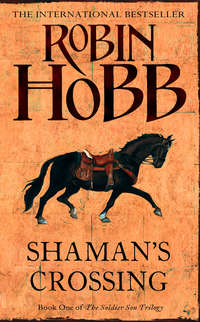
Read the book: «Shaman’s Crossing»
Shaman’s Crossing
Book One of the Soldier Son Trilogy
Robin Hobb

Copyright
HarperVoyager An Imprint of HarperCollinsPublishers 77–85 Fulham Palace Road, Hammersmith, London W6 8JB
www.harpervoyagerbooks.com
Published by Voyager 2006
Copyright © Robin Hobb 2005
Cover illustration © Jackie Morris
Map by Andrew Ashton
Robin Hobb asserts the moral right to be identified as the author of this work
A catalogue record for this book is available from the British Library
This novel is entirely a work of fiction. The names, characters and incidents portrayed in it are the work of the author’s imagination. Any resemblance to actual persons, living or dead, events or localities is entirely coincidental.
All rights reserved under International and Pan-American Copyright Conventions. By payment of the required fees, you have been granted the nonexclusive, nontransferable right to access and read the text of this e-book on-screen. No part of this text may be reproduced, transmitted, downloaded, decompiled, reverse engineered, or stored in or introduced into any information storage and retrieval system, in any form or by any means, whether electronic or mechanical, now known or hereinafter invented, without the express written permission of HarperCollins e-books.
HarperCollinsPublishers has made every reasonable effort to ensure that any picture content and written content in this ebook has been included or removed in accordance with the contractual and technological constraints in operation at the time of publication.
Source ISBN: 9780007196128
Ebook Edition © SEPTEMBER 2008 ISBN: 9780007236886
Version: 2014–12–03
Dedication
To Caffeine and Sugar, my companions through many a long night of writing.
Contents
Cover
Title Page
Copyright
Dedication
Map
One: Magic and Iron
Two: Harbinger
Three: Dewara
Four: Crossing the Bridge
Five: The Return
Six: Sword and Pen
Seven: Journey
Eight: Old Thares
Nine: The Academy
Ten: Classmates
Eleven: Initiation
Twelve: Letters From Home
Thirteen: Bessom Gord
Fourteen: Cousin Epiny
Fifteen: Séance
Sixteen: A Ride in the Park
Seventeen: Tiber
Eighteen: Accusations
Nineteen: Intervention
Twenty: Crossing
Twenty-One: Carnival
Twenty-Two: Disgrace
Twenty-Three: Plague
Twenty-Four: Vindication
Acknowledgments
Keep Reading
Also by the Author
About the Publisher
Map

ONE
Magic and Iron
I remember well the first time I saw the magic of the plainspeople.
I was eight and my father had taken me with him on a trip to the outpost on Franner’s Bend. We had arisen before the dawn for the long ride; the sun was just short of standing at noon when we finally saw the flag waving over the walls of the outpost by the river. Once, Franner’s Bend had been a military fort on the contested border between the plainspeople and the expanding Kingdom of Gernia. Now it was well within the Gernian border, but some of its old martial glory persisted. Two great cannons guarded the gates, but the trade stalls set up against the mud-plastered stockade walls behind them dimmed their ferocity. The trail we had followed from Widevale now joined a road that picked its way among the remains of mud-brick foundations. Their roofs and walls were long gone, leaving the shells gaping at the sky like empty tooth sockets in a skull. I looked at them curiously as we passed, and dared a question. ‘Who used to live here?’
‘Plainspeople,’ Corporal Parth said. His tone said that was his full reply. Rising early did not suit his temperament, and I suspected already that he blamed me for having to get out of bed so early.
I held my tongue for a time, but then the questions burst out of me. ‘Why are all the houses broken and gone? Why did they leave? I thought the plainspeople didn’t have towns. Was this a plainspeople town?’
‘Plainspeople don’t have towns, they left because they left, and the houses are broken because the plainspeople didn’t know how to build any better than a termite does.’ Parth’s low-voiced answer implied that I was stupid for asking.
My father has always had excellent hearing. ‘Nevare,’ he said.
I nudged my horse to move up alongside my father’s taller mount. He glanced at me once, I think to be sure I was listening, and then said, ‘Most plainspeople did not build permanent towns. But some folk, like the Bejawi, had seasonal settlements. Franner’s Bend was one of them. They came with their flocks during the driest part of the year, for there would be grazing and water here. But they didn’t like to live for long in one place, and so they didn’t build to last. At other times of the year, they took their flocks out onto the plains and followed the grazing.’
‘Why didn’t they stay here and build something permanent?’
‘It wasn’t their way, Nevare. We cannot say they didn’t know how, for they did build monuments in various locations that were significant to them, and those monuments have weathered the tests of time very well. One day I shall take you to see the one named Dancing Spindle. But they did not make towns for themselves as we do, or devise a central government or provide for the common good of their people. And that was why they remained a poor, wandering folk, prey to the Kidona raiders and to the vagaries of the seasons. Now that we have settled the Bejawi and begun to teach them how to have permanent villages and schools and stores, they will learn to prosper.’
I pondered this. I knew the Bejawi. Some of them had settled near the north end of Widevale, my father’s holdings. I’d been to the settlement once. It was a dirty place, a random tumble of houses without streets, with rubbish and sewage and offal scattered all around it. I hadn’t been impressed. As if my father could hear my thoughts, he said, ‘Sometimes it takes a while for people to adapt to civilization. The learning process can be hard. But in the end it will be of great benefit to them. The Gernian people have a duty to lift the Bejawi folk and help them learn civilized ways.’
Oh, that I understood. Just as struggling with mathematics would one day make me a better soldier. I nodded and continued to ride at his stirrup as we approached the outpost.
The town of Franner’s Bend had become a traders’ rendezvous, where Gernian merchants sold overpriced wares to homesick soldiers and purchased hand-made plainsworked goods and trinkets from the bazaar for the city markets in the west. The military contingent had a barracks and headquarters there which was still the heart of the town but the trade had become the new reason for its existence. Outside the fortified walls a little community had sprung up around the riverboat docks. A lot of common soldiers retired there, eking out their existence with hand-outs from their younger comrades. Once, I suppose, the fort at Franner’s Bend had been of strategic importance. Now it was little more than another backwater on the river. The flags were still raised daily with military precision and a great deal of ceremony and pomp. But, as my father told me on the ride there, duty at Franner’s Bend was a ‘soft post’ now, a plum given to older or incapacitated officers who did not wish to retire to their family homes yet.
Our sole reason for visiting was to determine if my father would win the military contract for sheepskins to use as saddle padding. My family was just venturing into sheep herding at that time, and he wished to assess the market potential for them before investing too heavily in the silly creatures. Much as he detested playing the merchant, he told me, as a new noble he had to establish the investments that would support his estate and allow it to grow. ‘I’ve no wish to hand your brother an empty title when he comes of age. The future Lord Burvelles of the East must have income to support a noble lifestyle. You may think that has nothing to do with you, young Nevare, since as a second son you will go to be a soldier. But when you are an old man, and your soldiering days are through, you will come home to your brother’s estate to retire. You will live out your days at Widevale, and the income of the estate will determine how well your daughters will marry, for it is the duty of a noble first son to provide for his soldier brother’s daughters. It behooves you to know about these things.’
I understood little, then, of what he was telling me. Of late, he talked to me twice as much as he ever had, and I felt I understood only half as much of what he said. He had only recently parted me from my sisters’ company and their gentle play. I missed them tremendously, as I did my mother’s attentions and coddling. The separation had been abrupt, following my father’s discovery that I spent most of my afternoons playing ‘tea-party’ in the garden with Elisi and Yaril, and had even adopted a doll as my own to bring to the nursery festivities. Such play alarmed my father for reasons my eight-year-old mind could not grasp. He had scolded my mother in a muffled ‘discussion’ behind the closed doors of the parlour, and instantly assumed total responsibility for my upbringing. My schoolbook lessons were suspended, pending the arrival of a new tutor he had hired. In the intervening days he kept me at his side for all sorts of tedious errands and constantly lectured me on what my life would be like when I grew up to be an officer in the King’s Cavalla. If I was not with my father, and sometimes even when I was, Corporal Parth supervised me.
The abrupt change had left me both isolated and unsettled. I sensed I had somehow disappointed my father, but was unsure of what I had done. I longed to return to my sisters’ company. I was also ashamed of missing them, for was I not a young man now and on my path to be my father’s soldier son? So he often reminded me, as did fat old Corporal Parth. Parth was what my mother somewhat irritably called a ‘charity hire’. Old, paunchy, and no longer fit for duty, he had come to ask my father’s aid and been hired as an unskilled groundskeeper. He was now the temporary replacement for the nanny I had shared with my sisters. He was supposed to school me in ‘the basics of military bearing and fitness’ each day until my father could find a more qualified instructor. I did not think much of Parth. Nanny Sisi had been more organized and demanded more discipline of me than he did. The slouching old man who had carried his corporal’s rank into retirement with him regarded me as more of a nuisance and a chore than a bright young mind to be shaped and a body to be built with rigor. Often, when he was supposed to be teaching me riding, he spent an hour napping while I practised ‘being a good little sentry and keeping watch’, which meant that I sat in the branches of a shady tree while he slept beneath it. I had not told my father any of that, of course. One thing that Parth had already instructed me in was that he was the commander and I was the soldier, and a good soldier never questioned his orders.
My father was well known at Franner’s Bend. We rode through the town and up to the gates of the fortress. There he was saluted and welcomed without question. I looked curiously about me as we rode past an idle smith’s shop, a warehouse, and a barracks before we reined in our horses before the commander’s headquarters. I gaped up at the grand stone building, three storeys tall, as my father gave Parth his instructions regarding me.
‘Give Nevare a tour of the outpost and explain the layout. Show him the cannon and talk to him about their placement and range. The fortifications here are a classic arrangement of defences. See that he understands what that means.’
If my father had looked back as he ascended the steps, he would have seen how Parth rolled his eyes. My heart sank. It meant that Parth had little intention of complying with my father’s orders, and that I would later be held accountable for what I had not learned, which had happened before. I resolved, however, that it would not happen this time.
I followed him as we walked a short distance down the street. ‘That’s a barracks, where soldiers live,’ he told me. ‘And that’s a canteen, tacked onto the end of it, where soldiers can get a beer and a bit of relaxation when they aren’t on duty.’
The tour of the fort stopped there. The barracks and canteen were constructed of wooden planks, painted green and white. It was a long, low building with an open porch that ran the length of it. Off-duty soldiers idled there, sewing, blacking their boots, or talking and smoking or chewing as they sat on hard benches in the paltry shade. Outside the canteen, another porch offered refuge for a class of men I knew well. Too old to serve or otherwise incapacitated, these men wore a rough mix of military uniform and civilian garb. A lone woman in a faded orange dress slouched at one table, a limp flower behind her ear. She looked very tired. Mustered-out soldiers often approached my father in the hope of work and a place to live. If he thought they had any use at all he usually hired them, much to my lady mother’s dismay. But these men, I immediately knew, my father would have turned away. Their clothes were unkempt, their unshaven faces smudged with dirt. Half a dozen of them loitered on the benches, drinking beer, chewing tobacco and spitting the brownish stuff onto the earth floor. The stink of tobacco juice and spilled beer hung in the air.
As we passed by, Parth glanced longingly into the low windows, and then delightedly hailed an old crony of his, one he evidently hadn’t seen in years. I stood to one side, politely bored, as the two men exchanged reports on their current lives through the window opening, Parth’s friend leaning on the sill to talk to us as we stood in the street. Vev had only recently arrived at the fort with his wife and his two sons, having been mustered out after he injured his back in a fall from his horse. Like many a soldier when his soldiering days were done, he had no resources to fall back on. His wife did a bit of sewing to keep a roof over their heads, but it was rocky going. And what was Parth doing these days? Working for Colonel Burvelle? I saw Vev’s face lighten with interest. He immediately invited Parth to join him in a beer to celebrate their reunion. When I started to follow him up the steps, Parth glared at me. ‘You wait outside for me, Nevare. I won’t be long.’
‘You’re not supposed to leave me alone in town, Corporal Parth,’ I reminded him. I’d heard my father reiterate that carefully on the ride here; young as I was, I was still a bit surprised that Parth had forgotten it already. I waited for him to thank me for the reminder. I considered that my due, for whenever my father had to remind me of a rule I had forgotten, I had to thank him and accept the consequences of my lapse.
Instead Parth scowled at me. ‘You ain’t alone out here, Nevare. I can see you right from the window, and there’s all these old sojers keeping an eye on you. You’ll be fine. Just sit yourself down by the door and wait like I told you.’
‘But I’m supposed to stay with you,’ I objected. My order to stay in Parth’s company was a separate order from his to watch me and show me the fort. He might get in trouble for leaving me alone outside. And I feared my father would do more than rebuke me for not following Parth as I was supposed to.
His drinking companion came up with a solution. ‘My boys Raven and Darda are out there, laddie. They’re down by the corner of the smithy, playing knife toss with the other lads. Whyn’t you go and see how it’s done, and play a little yourself? We won’t be gone long. I just want to talk to your Uncle Parth here about what it takes to find a cushy job like what he’s found for himself, nursie-maiding for old Colonel Burvelle.’
‘Keep a civil tongue in your head when you speak of the boy’s pa in front of him! Do you think he hasn’t got a tongue of his own, to wag on about how you talk? Shut it, Vev, before you put my job on the block.’
‘Well, I didn’t mean anything, as I’m sure Colonel Laddie knew, right, lad?’
I grinned uncertainly. I knew that Vev was needling Parth on purpose, and perhaps mocking my father and me into the bargain. I didn’t understand why. Weren’t they friends? And if Vev were insulting Parth, why didn’t we just walk away like gentlemen, or demand satisfaction of him, as often happened in the tales my eldest sister read aloud to my younger sister when my parents were not about? It was all very confusing, and as there had been much talk over my head of late that I must be taught how men did things now or I should grow up to be effeminate, I hesitated long over what response I should make.
Before I could, Parth gave me a none-too-gentle push in the direction of some older boys lounging at the corner of a warehouse and told me to go and play, for he’d only be a moment or two, and immediately clomped up the steps and vanished into the tavern, so that I was left unchaperoned on the street.
A barracks town can be a rough place. Even at eight I knew that, and so I approached the older boys cautiously. They were, as Vev had said, playing a knife toss game in the alley between the smithy and a warehouse. They were betting half-coppers and pewter bits as each boy took a turn at dropping the knife, point first, into the street. The bets wagered were on whether or not the knife would stick and how close each boy could come to his own foot on the drop without cutting himself. As they were barefoot, the wagers were quite interesting apart from the small coins involved, and a circle of five or so boys had gathered to watch. The youngest of them was still a year or two older than me, and the eldest was in his teens. They were sons of common soldiers, dressed in their father’s cast-offs and as unkempt as stray dogs. In a few more years, they’d sign their papers and whatever regiment took them in would dust them off and shape them into foot soldiers. They knew their own fortunes as well as I knew mine, and seemed very content to spend the last days of their boyhoods playing foolish games in the dusty street.
I had no coins to bet and I was dressed too well to keep company with them, so they made a space in their huddle to let me watch but didn’t speak to me. I learned a few of their names only by listening to them talk to each other. For a time, I was content to watch their odd game, and listen intently to their rough curses and the crude name-calling that accompanied bets lost or won. This was certainly a long way from my sisters’ tea parties, and I recall that I wondered if this were the sort of manly company that of late my father had been insisting I needed.
The sun was warm and the game endless as the bits of coin and other random treasure changed hands over and over. A boy named Carky cut his foot, and hopped and howled for a bit, but soon was back in the game. Raven, Vev’s son, laughed at him and happily pocketed the two pennies and three marbles Carky had bet. I was watching them intently and would scarcely have noticed the arrival of the scout, save that all the other boys suddenly suspended the game and fell silent as he rode past.
I knew he was a scout, for his dress was half-soldier and half-plainsman. He wore dark-green cavalla trousers like a proper trooper, but his shirt was the loose linen of a plainsman, immaculately clean. His hair was not cropped short in a soldier’s cut nor did he wear a proper hat. Instead, his black hair hung loose and long and moved with his white kaffiyeh. A rope of red silk secured his headgear. His arms were bare that summer day, the sleeves rolled to his biceps, and his forearm was circled with tattooed wreaths and trade-bracelets of silver beads and pewter charms and gleaming yellow brass. His horse was a good one, solid black, with long straight legs and jingle charms braided into his mane. I watched him with intent interest. Scouts were a breed apart, it was said. They were ranked as officers, lieutenants usually and frequently were nobly born, but they lived independent lives, outside the regular ranks of the military and often reported directly to the commander of an outpost. They were our first harbingers of any trouble, be it logjams on the river, eroding roads or unrest among the plainspeople.
A girl of twelve or thirteen on a chestnut gelding followed the scout. It was a smaller animal with a finely sculptured brow that spoke of the best nomadic stock. She rode astraddle as no proper Gernian girl would, and by that as much as by her garb I knew her for a mixed blood. It was not uncommon, though still deplored, for Gernian soldiers to take wives from among the plainspeople. It was less common for a scout to stoop so low. I stared at the girl in frank curiosity. My mother often said that the products of cross-unions were abominations before the good god, so I was surprised to see that such a long and ugly-sounding word described such a lovely creature. She was dressed in brightly layered skirts, one orange, one green, one yellow, that blossomed over the horse’s back and covered her knees, but not her calves and feet. She wore soft little boots of antelope skin, and silver charms twinkled on their laces. Loose white trousers showed beneath her bunched skirts. Her shorter kaffiyeh matched her father’s and displayed to advantage the long brown hair that hung down her back in dozens of fine braids. She had a high, round brow and calm grey eyes. Her white blouse bared her neck and arms, displaying the black torc she wore around her throat and a quantity of bracelets, some stacked above her elbows and others jingling at her wrist. She wore the woman’s wealth of her family proudly for all to see. Her naked arms were brown from the sun and as muscled as a boy’s. As she rode, she looked round boldly, very unlike my sisters’ modest manner and downcast eyes when in public.
Her stare met mine, and we exchanged looks of honest appraisal. She had probably never seen a noble’s soldier son, and I stood a bit straighter, well aware that I was finely turned out in my dark green trousers and crisp blouse and black boots, and especially so in the company of the ragged street-jay boys. I was not so young that the attention of a girl was not flattering. Looking back, perhaps it annoyed the others that she looked so intently at me, for they stared at her like hungry dogs studying a plump kitten.
She and the scout dismounted outside the same building that my father had entered. The scout had a clear, carrying voice, and we all heard him tell her that he would join her as soon as he’d delivered his report to the commander. He gave her some coins and told her she might go down the street to the bazaar and get some sweets or fresh caralin juice or ribbons for her hair, but not to go beyond the line of stalls there. ‘Yes, Papa. I will.’ She promised her father quickly, her eagerness to get to the market evident in her voice. The scout glanced over at my cluster of lads and scowled at us absent-mindedly, and then hurried up the steps into the command quarters.
His daughter was left alone in the street.
In such a circumstance, I know my sisters would have been terrified. My parents would never have left Elisi and little Yaril in a barracks town without an adult chaperone. I wondered if her father did not care for her. Then, as she strode smiling down the street, heading past the knot of boys and toward the vendors’ stores on the market square just outside the outpost gates, I saw that she was not frightened or cowed in the least. She walked with confidence and grace, intent on exploring the many delights of the bazaar. My gaze followed her.
‘Look at her, will you?’ one of the older boys hissed to his friend.
Raven grinned knowingly. ‘That hinny’s tamed. See that iron thing round her neck? Long as she wears that, her charms don’t work.’
I looked from one leering young face to the other, confused. ‘Her charms?’ I asked.
It was flattering when Raven deigned to notice me. ‘Little silver jingly things, woven in her hair, supposed to protect her. Plains magic. But someone tamed her. Put an iron collar on a plainswoman, and she can’t use her charms against you. She’s ripe for the picking, that hinny is.’
‘Picking what?’ I boldly asked. There was no hinny to be seen, only the girl walking past us. I was confused and resolved to get an explanation. I did not know at that time that my bold assumption of not only equality but superiority to these sons of common soldiers would be resented by the older boys. Raven brayed a laugh out, and then said to me earnestly, ‘Why, to picking out her friends, of course. You seen how she looked at you? She wants to be your friend. And you want her to be friends with us, right, ’cause we’re your friends, too. Whyn’t you just go out there and catch her by the hand and lead her back here to us?’
Raven’s voice was sugary, but his words fell somewhere between a compliment and a dare. As he spoke, he gestured to the other boys, and they all retreated more deeply into the alley between the buildings. I stared up at him for a moment longer. His cheek was downy, and the fine hair held the dust of the street. The corners of his mouth were caked with dust that had been trapped there by stray, sticky crumbs. His hair was shaggily cut, his clothing dirty. But he was older than I was, and he’d been playing with a knife, and thus I yearned to distinguish myself in his eyes.
The girl walked like a gazelle going down to water. She was intent on her quest, and yet both wary and aware of what was around her. She did not look at us, but I knew she had seen us. She probably knew we were talking about her. I darted out a few steps into the street to intercept her, and when she looked at me, I smiled at her. She smiled down at me. It was all the encouragement I needed. I hurried up to her, and she halted in the street.
‘Hello. My friends want you to come and meet them.’ Such an ingenuous way for me to greet her. I had no idea I was leading her into a vile trap.
I think she did. She looked past me at the loitering boys inside the alley mouth, and then back at me again. I hope she saw I was innocent of their scheme. She smiled again but her words dismissed me. ‘I don’t think so. I’m going to the market. Goodbye.’ Her voice was clear and unaccented, and obviously intended to reach my playmates’ ears.
They heard her words and saw how she strode off. One of my erstwhile companions gave a catcall and Raven laughed at me. I couldn’t stand it. I ran after her and seized her hand. ‘Please? Just come over and say hello.’
She did not react with alarm, or take her hand from mine. She considered me kindly for a moment and then offered, ‘You’re a friendly little cub, aren’t you? Why don’t you come to the market with me instead?’
Her invitation instantly attracted me more than the company of the boys. I loved going to market almost as much as my sisters did. Exotic goods and trinkets demanded to be handled and explored. Market food was always exciting; I loved plains food, the spicy root-paste rolled in terna seed, sweet and peppery meat sticks, and little buns of salty ember-bread, each with a lump of carrada in the middle. My gaze met her grey eyes and I found myself nodding and smiling. I forgot the boys and their stick-knife game. For the moment, I ignored the knowledge that not only Parth but also my father would disapprove of me wandering off with a half-breed plainsgirl to saunter through the market.
We had gone less than five paces when my earlier companions suddenly ringed us. They were smiling, but their grins were wolfish, not friendly. Raven stood directly in front of us, forcing us to stop. Carky, his cut foot tied with a rag, stood at Raven’s elbow. The girl’s fingers twitched in mine, and as clearly as if she had voiced it, I felt the little jolt of fear that shot through her. My half-formed honour came to the fore and I said importantly, ‘Please step out of our way. We are going to the market.’
Raven grinned. ‘Well, listen to him! We’re not in your way, colonel’s son. In fact, we’re here to guide you. There’s a short cut to the market. We’ll show you. Right down that alley.’
‘But I can see the market from here!’ I protested stupidly. The girl tried to take her hand from mine, but I held on tightly. I suddenly knew my duty. A gentleman always protected women and children. I instinctively knew that these fellows meant my companion some sort of harm. Innocent as I was, I did not know what they intended for her, or perhaps I would have been more sensibly frightened. Instead, I only grew more determined to guard her. ‘Step out of our way,’ I commanded them again.
But they were bunching closer, and unwillingly both the girl and I stepped back, trying to gain space. They came on and again we stepped back. We were being herded toward the alley mouth as surely as dogs herd sheep into a pen. I glanced over my shoulder at the boys behind me, and Carky laughed an ugly laugh. At the sound, the girl beside me halted. Despite my grip on her fingers, she drew her hand free of mine. The boys advanced another step on us. They suddenly loomed larger and uglier than they had when I had watched them play. I could smell them, the cheap food on their breath, their unwashed bodies. I glanced quickly around, seeking some adult who would intervene, but the sun was hot and this part of the street was deserted. People were either inside the cooler buildings, or at the market. Down the street, the lounging soldiers on the canteen porch were talking amongst themselves. Even if I shouted for help, I doubted that anyone would respond. We were very near the alley mouth; we could quickly be dragged out of sight. I summoned the last of my quavering authority. ‘My father will be very angry if you do not let us pass.’
TWO
Harbinger
I was twelve when I saw the messenger who brought the first tidings of plague from the east.
Strange to say, it left little impression on me at the time. It was a day like many other days. Sergeant Duril, my tutor for equestrian skills, had been putting me through drills with Sirlofty all morning. The gelding was my father’s pride and joy, and that summer was the first that I was given permission to practise manoeuvres on him. Sirlofty himself was a well-schooled cavalla horse, needing no drill in battle kicks or fancy dressage, but I was green to such things and learned as much from my mount as I did from Sergeant Duril. Any errors we made were most often blamed on my horsemanship and justifiably so. A horseman must be one with his mount, anticipating every move of his beast, and never clinging nor lurching in his saddle.
But that day’s drill was not kicks or leaps. It involved unsaddling and unbridling the tall black horse, then demonstrating that I could still mount and ride him without a scrap of harness on him. He was a tall, lean horse with straight legs like iron bars and a stride that made his gallop feel as if we were flying. Despite Sirlofty’s patience and willingness, my boy’s height made it a struggle for me to mount him from the ground, but Duril had insisted I practise it. Over and over and over again. ‘A horse soldier has got to be able to get on any horse that’s available to him, in any sort of circumstances, or he might as well admit he has the heart of a foot soldier. Do you want to walk down that hill and tell your da that his soldier son is going to enlist as a foot soldier rather than rise up to a commission in the cavalla? Because if you do, I’ll wait up here while you do it. Better that I not witness what he’d do to you.’
It was the usual rough chivvying I received from the man, and I flatter myself that I handled it better than most lads of my years would have. He had arrived at my father’s door some three years ago, seeking employment in his declining years, and my father had been only too relieved to hire him on. Duril replaced a succession of unsatisfactory tutors, and we had taken to one another almost immediately. Sergeant Duril had finished out his many long years of honourable military service, and it had seemed only natural to him that when he retired he would come to live on my father’s lands and serve Lord Burvelle as well as he had served Colonel Burvelle. I think he enjoyed taking on the practical training of Nevare Burvelle, Colonel Burvelle’s second boy, the soldier son born to follow his father’s example as a military officer.
The sergeant was a shrivelled little man, with a face as dark and wrinkled as jerky. His clothing was worn to the point of comfort, holding the shape of a man who was most often in the saddle. Even when they were clean, his garments were always the colour of dust. On his head, he wore a battered leather hat with a floppy brim and a hatband decorated with beads and animal fangs. His pale eyes always peered watchfully from under the brim of his hat. What hair he had left was a mixture of grey and brown. Half his left ear was missing and he had a nasty scar where it should have been. To make up for that lack he carried a Kidona ear in a pouch on his belt. I’d only seen it once, but it was unmistakably an ear. ‘Took his for trying to take mine. It was a barbaric thing to do, but I was young and I was angry, with blood running down the side of my neck when I did it. Later that evening, when the fighting was over I looked at what I’d done, and I was ashamed. Ashamed. But it was too late to put it back with his body and I couldn’t bring myself to just throw it away. I’ve kep’ it ever since to remind me of what war can do to a young man. And that’s why I’m showing it to you now,’ he had told me. ‘Not so you can run tell your little sister and have your lady ma complain to the colonel that I’m learning you wild ways, but so that you can think on that. Before we could teach the plainspeople to be civilized, we had to teach them they couldn’t beat us in a fight. And we had to do that without getting down on their level. But when a man is fighting for his life that’s a hard thing to remember. Especially when you’re a young man and out on your own, ’mongst savages. Some of our lads, good honest lads when they left home, well, they wound up little better than the plainspeople we fought against before we were through. A lot of them never went home. Not jus’ the ones who died, but the ones who couldn’t remember how to be civilized. They stayed out there, took plains wives, some of ’em, and became part of what we’d gone out there to tame. Remember that, young Nevare. Hold on to who you are when you’re a man grown and an officer like the Colonel.’
Sometimes he treated me like that, as if I were his own son, telling me stories of his days as a soldier and passing on the homespun wisdom that he hoped would see me through. But most days he treated me as something between a raw recruit and a rather dim hound. Yet I never doubted his fondness for me. He’d had three sons of his own, and raised them and sent them off to enlist years before he’d got to me. In the way of common soldiers and their get, he’d all but lost track of his own boys. From year to year he might receive a message from one or another of them. It didn’t bother him. It was what he had always expected his boys to do. The sons of common soldiers went for soldiers, just as the Writ tells us they should. ‘Let each son rise up and follow the way of his father.’
Of course it was different for me. I was the son of a noble. ‘Of those who bend the knee only to the King, let them have sons in plenitude. The first for an heir, the second to wear the sword, the third to serve as priest, the fourth to labour for beauty’s sake, the fifth to gather knowledge…’ and so on. I’d never bothered to memorize the rest of that passage. I had my place and I knew it. I was the second son, born to ‘wear the sword’ and lead men to war.
I’d lost count that day of how many times I’d dismounted and then mounted Sirlofty and ridden him in a circle around Duril, without a scrap of harness to help me. Probably as many times as I’d unsaddled and unbridled the horse, and then replaced the tack. My back and shoulders ached from lifting the saddle on and off of the gelding’s back, and my fingertips were near numb from making the cavalryman’s ‘keep fast’ charm over the cinch. I was just fastening the cinch yet again when Sergeant Duril suddenly commanded, ‘Follow me!’ With those words, he gave his mare a sharp nudge with his heels and she leapt forth with a will. I had no breath for cursing him as I finished tightening the strap, hastily did the ‘keep fast’ charm over it and then flung myself up and into the saddle.
Those who have not ridden the plains of the Midlands will speak of how flat and featureless they are, how they roll on endlessly forever. Perhaps they appear so to passengers on the riverboats that wend their way down the waterways that both divide and unite the plains. I had grown up on the Midlands, and knew well how deceptive their gentle rises and falls could be. So did Sergeant Duril. Ravines and sudden crevasses smiled with hidden mouths, waiting to devour the unwary rider. Even the gentle hollows were often deep enough to conceal mounted men or browsing deer. What the unschooled eye might interpret as scrub brush in the distance could prove to be a shoulder-high patch of sickle-berry, almost impenetrable to a man on horseback. Appearances were deceiving, the sergeant always warned me. He had often told me tales of how the plainspeople could use tricks of perspective in preparing an ambush, how they trained their horses to lie down, and how a howling horde of warriors would suddenly seem to spring up from the earth itself to attack a careless line of cavalrymen. Even from the vantage of tall Sirlofty’s back, Sergeant Duril and his mount had vanished from my view.
The gentle roll of prairie around me appeared deserted. Few real trees grew in Widevale, other than the ones which Father had planted. Those that did manage to sprout on their own were indications of a watercourse, perhaps seasonal, perhaps useful. But most of the flora of our region was sparsely leaved and dusty grey-green, holding its water in tight, leathery leaves or spiny palms. I did not hurry, but allowed myself to scan the full circle of horizon, seeking any trace of them. I saw none; I had only the dry dents of Chafer’s hoofprints in the hard soil to guide me. I set out after them. I leant down beside Sirlofty’s neck, tracking them and feeling proud of my ability to do so until I felt the sudden thud of a well-aimed stone hit me squarely in the back. I pulled in Sirlofty and sat up, groaning as I reached back to rub my new bruise. Sergeant Duril rode up from behind me, his slingshot still in his hand.
‘And you’re dead. We circled back. You were too busy following our sign, young Nevare, and not wary enough about your surroundings. That pebble could just as easily have been an arrow.’
I nodded wearily. There was no use in denying his words. Useless to complain that when I was grown, I could expect to have a full troop of horsemen with me, with some men to keep watch while others tracked. No. Better to endure the bruise and nod than to bring an hour of lecture down on myself as well. ‘Next time, I’ll remember,’ I told him.
‘Good. But only good because this time it was just a little rock and so there will be a next time for you. With an arrow, that would have been your last time to forget. Come on. Pick up your rock before we go.’
He kneed Chafer again and left me. I dismounted and searched the ground around Sirlofty’s feet until I found the stone. Duril had been ‘killing’ me several times a month since I was nine years old. Picking up the stones had been my own idea at first; I think the first few times I was slain, I had taken to heart the concept that, had Duril truly been a hostile, my life would have ended in that moment. When Duril realized what I was doing, he began to take pains to find interesting stones to use in his sling. This time it was a river-worn piece of crude red jasper half the size of an egg. I slipped it into my pocket to add to my rock collection on the shelf in the schoolroom. Then I mounted and nudged Sirlofty to catch up with Chafer.
We rode on, stopping on a tall scarp that looked out over the lazily flowing Tefa River. From where we sat our mounts we could look down at my father’s cotton fields. There were four of them, counting the one that rested fallow this year. It was easy to tell which field was in its third year of cultivation and close to its end of agricultural usefulness. The plants there were stunted and scrubby. Prairie land seldom bore well for more than three years running. Next year, that field would lie fallow, in the hope of reviving it.
My father’s holdings, Widevale, were a direct grant to him from King Troven. They spanned both sides of the Tefa River and many acres beyond in all directions. The land on the north side of the river was reserved for his immediate family and closest servants. Here he had built his manor house and laid out his orchards and cotton fields and pasturage. Some day, the Burvelle estate and manor would be a well-known landmark like the ‘old Burvelle’ holdings near Old Thares. The house and grounds and even the trees were younger than I was.
My father’s ambition extended beyond having a fine manor house and agricultural holdings. On the south side of the river, my father had measured out generous tracts of land for the vassals he recruited from amongst the soldiers who had once served under his command. The town had become a much-needed retirement haven for foot soldiers and non-commissioned officers when they mustered out of the service. My father had intended that it be so. Without Burvelle’s Landing, or simply Burvelle as it was most often called, many of the old soldiers would have gone back west to the cities, to become charity cases or worse. My father often said that it was a shame that no system existed to utilize the skills of soldiers too old or too maimed to soldier on. Born to be a soldier and an officer, my father had assumed the mantle of lord when the king granted it, but he wore it with a military air. He still held himself responsible for the well-being of his men.
The ‘village’ his surveyors had laid out on the south bank of the river had the straight lines and the fortification points of a fortress. The dock and the small ferry that operated between the north and south banks of the river ran precisely on the hour. Even the six-day market there operated with a military precision, opening at dawn and closing at sundown. The streets had been engineered so that two wagons could pass one another, and a horse and team could turn round in any intersection. Straight roads like the spokes of a wheel led out of the village to the carefully measured allotments that each vassal earned by toiling four days a week on my father’s land. The village thrived and threatened soon to become a town, for the folk had the added benefit of the traffic along the river and on the river road that followed the shoreline. His old soldiers had brought their wives and families with them when they came to settle. Their sons would, of course, go off to become soldiers in their days. But the daughters stayed, and my mother was instrumental in bringing to the town young men skilled in needed trades who welcomed the idea of brides who came with small dowries of land. Burvelle Landing prospered.
Traffic between the eastern frontier and old Fort Renalx to the west of us was frequent along the river road. In winter, when the waters of the river ran high and strong, barges laden with immense, sap-heavy spond logs from the wild forests of the east moved west with the current, to return later laden with essential supplies for the forts. Teams of barge mules had worn a dusty trail on the south bank of the river. In summer, when the depleted river did not offer enough water to keep the barges from going aground, mule-drawn wagons replaced them. Our village had a reputation for honest taverns and good beer; the teamsters always stopped there for the night.
But today the seasonal traffic that crawled the road was not so convivial. The slow parade of men and wagons stretched out for half a mile. Dust hung in the wake of their passage. Armed men rode up and down the lines. Their distant shouts and the occasional crack of a whip were carried to us on the light wind from the river.
Three or four times each summer, the coffle trains would pass along the river road. They were not welcome to stop in the village. Not even the guards who moved the coffle along could take the ferry across to my father’s well-run town. Hours down the road, out of view of both my home and the village, there were six open-sided sheds, a fire pit and watering troughs set up for the coffle trains. My father was not without mercy, but he distributed it on his own terms.
My father had strictly forbidden my sisters to witness the passing of the penal trains, for the prisoners included rapists and perverts as well as debtors, pickpockets, whores, and petty thieves. There was no sense in exposing my sisters to such rabble, but on that day Sergeant Duril and I sat our horses for the better part of an hour, watching them wend their dusty way along the river road. He did not say that my father had wished me to witness that forced emigration to the east, but I suspected it was so. Soon enough, as a cavalry trooper, I’d have to deal with those whom King Troven had sentenced to be settlers on the lands around his eastern outposts. My father would not send me to that duty ignorant.
Two supply wagons led the penal coffle making its centipedian way toward us. Mounted men patrolled the length of the winding column of shackled prisoners. At the very end, choking their way through the hanging dust, teams of mules pulled three more wagons laden with the women and children that belonged to the convicts trudging their way toward a new life. When a trick of the wind carried the sounds of the prisoners to us, they sounded more animal than human. I knew that the men would be chained, day and night, until they reached one of the King’s far posts on the frontier. They’d be fed bread and water, and know a respite from their journey only on the Sixday of the good god.
‘I feel sorry for them,’ I said softly. The heat of the day, the chafing shackles, the dust; sometimes it seemed a miracle to me that any of the criminal conscripts survived their long march to the borderlands.
‘Do you?’ Sergeant Duril was disdainful of my soft sentiment. ‘I feel sorrier for the ones left behind in the city, to continue being scum the rest of their lives. Look at them, Nevare. The good god decrees for every man what he is to do. But those down there, they scoffed at their duty, and ignored the skills of their fathers. Now the King offers them a second chance. When they left Old Thares, they were prisoners and criminals. If they weren’t caught and hanged, they’d probably be killed by their fellows, or live out their lives like rats in a wall. But King Troven has sent them away from all that. They’ll walk a long hard way, to be sure, but it’s a new life that awaits them in the east. By the time they get there, they’ll have built some muscle and endurance. They’ll work on the King’s Road for a year or so, pushing it across the plains and then they’ll have earned the right to their freedom and two acres of land. Not bad wages for a couple of years of toil. King Troven’s given them all a new chance to be better than they were, to own land of their own and to live a clean life, to follow in their fathers’ trades as they should have done, with their old crimes forgotten. You feel sorry for them? What about the ones who refuse the King’s mercy, and end up with the chopping block taking their thieving hands off, or living in debtors’ prison with their wives and little ones alongside them? Those are the ones I pity, the ones too stupid to see the opportunity our king offers them. No. I don’t pity those men down there. They walk a hard road, and no mistake, but it’s a better road than the one they originally chose for themselves.’
I looked down at the ragged line of chained men and wondered how many truly felt it had been their own decision to choose this course. And what of the women and children in the wagons? Had they had any choice at all? I might have pondered longer if Duril had not distracted me with the terse word, ‘Messenger!’
I lifted my eyes and looked toward the east. The river snaked off into the distance, and the river road followed its winding course beside it. Passenger coaches, freight wagons and the post travelled that road. Ordinary mail travelled in wagons for the most part; letters to soldiers from their families and sweethearts in the west and their replies. But King Troven’s couriers travelled that road as well, bearing important dispatches between the far outposts and the capital in Old Thares. Part of my father’s duty to his king as a landed noble was to maintain a relay station and the change of horses for the messengers. Often the dispatch riders were invited up to my father’s manor for the evening after they had passed on their messages, for my father enjoyed being kept up to date on events at the frontier, and the messengers were glad of his generous hospitality in the harsh land. I hoped we would have company for the evening meal; it always enlivened the conversation.
Along the river road a man and horse were coming at a gallop. A thin line of dust hung in the still air behind them, and the horse was running heavily in a way that spoke more of spurs and quirt than willing effort. Even at our distance, I could see the billowing of the rider’s short yellow cape that marked him as the King’s courier, and notified every citizen of the duty to speed him on his way.
The watcher at the relay station below us had spotted the oncoming rider. I heard the clanging of the bell and in the next moment the inhabitants of the station sprang into action. One ran into the stable, to emerge almost immediately leading a long-legged horse wearing a tiny courier’s saddle. He held the fresh mount at the ready, while another man dashed out from the station bearing a waterskin and a packet of food for the rider. A fresh rider emerged, his face already swathed against the dust, his short bright yellow cape flapping in the river wind. He stood by his mount and waited for the message to be passed to him.
We watched as the messenger approached the station and then saw a frightening thing. The messenger only pulled in when his horse was abreast of the fresh mount. His feet never touched the ground as he lunged from one saddle to the next. He shouted something to the waiting men, leaned down to snatch up the packet of provisions and waterskin, and then set spurs to the new horse. In an instant he was gone, galloping down the centre of the road and through the penal coffle. Shackled men and mounted guards surged out of his way as he passed. There were angry shouts and cries as a section of the chained men were trampled by one of the mounted guards when they did not get out of the way quickly enough to avoid the horse. Heedless of the milling chaos in his wake, the courier was already dwindling to a tiny figure on the ribbon of road leading west. I stared after him for a moment, and then glanced back down at the relay station. A stableman was trying to lead the messenger’s horse, but the animal went suddenly down on his front knees, and then rolled onto his side in the dust. He lay there, kicking vaguely at the air.
‘His wind’s broke,’ Duril said sagely. ‘He’ll never carry a courier again. Poor beast will be lucky if he lives.’
‘I wonder what desperate message he bore, that he rode his horse to death and could not pass it on to a fresh rider.’ My mind was already full of possibilities. I visualized night attacks by the Specks on the Wildlands border towns, or fresh uprising amongst the Kidona.
‘King’s business,’ Sergeant Duril said tersely.
As we watched, we saw one of the men break free of the group, running toward the manor with something in his hand. A separate message for my father? He knew most of the commanders of the forts on the eastern boundary, and he was kept almost as well appraised of conditions on the frontier as the King himself. I saw curiosity light in the old sergeant’s eyes. Duril glanced at the sun and announced abruptly, ‘Time for you to go in to your books. We don’t want Master Quills-and-Ink to be looking at me nasty again, do we?’
And with that, he turned his horse’s head away from the river, the road, and the relay station and led me at an easy lope back to the trail that led down to my father’s manor house.
My boyhood home was set on a gentle rise of land that overlooked the river. In an indulgence of my mother, my father had planted scattered trees for two acres around it, poplar and oak and birch and alder. Water hauled up from the river irrigated the trees that both shaded the house and grounds and provided a windbreak from the constant wind. It was a little island of trees in the vast expanse of prairie all around us, green and shady and inviting. Sometimes I thought it looked small and isolated. At other times, it seemed like a green fortress of welcome in the windswept, arid lands. We rode toward it, the horses eager now for cool water and a good roll in the paddock.
As Sergeant Duril had predicted, my tutor was standing outside the manor awaiting us. Master Rissle’s arms were crossed on his narrow chest and he was trying to look forbidding. ‘Hope he don’t wallop ye too hard for being late, young Nevare. Looks like he could be cruel harsh, him so big and all,’ Duril said in quiet derision before we were in earshot of the man. I kept my face straight at his gentle gibe. He knew he should not mock my tutor, an earnest but scrawny young scholar come all the way from Old Thares to teach me penmanship and history and figuring and astronomy. Although Duril would not curb his own disrespectful tongue, he would freely cuff me for daring to smile at it. So I held my amusement inside as I dismounted. I called a farewell to Sergeant Duril as he led our mounts away, and he answered with a vague wave of his hand.
I longed to run and find my father, to discover what news had been so urgent, but I knew that if I did, I would only bring punishment down on myself. A good soldier did his duty, and waited for orders from above without speculating. If I ever hoped to command men, I must first learn to accept authority. I sighed and followed my tutor off to my lessons. The academics seemed more tedious than ever that day. I tried to apply myself, knowing that the foundation I built now would support my studies at the King’s Academy.
When the long afternoon of lessons were over and my tutor finally released me, I dressed for dinner and descended. We might live far from any cities or polite society on the plains, but my mother insisted that all of us observe the proprieties appropriate to my father’s station. Both my parents had been born into noble houses. As younger offspring, they had never expected to hold titles themselves, but their upbringing had left them with a keen awareness of what my father’s elevation to lordship required of them. Only later would I appreciate all the courtesy and manners that my mother had instilled in me, for those lessons enabled me to move more easily at the Academy than did many of my rustic counterparts.
Our family gathered in the sitting room until my father entered. Then he escorted my mother into the dining room and we children followed. I seated my younger sister Yaril while Rosse, my elder brother, held a chair for my elder sister Elisi. Vanze, the youngest at nine years old and my father’s priest son, said the blessing for all of us. Then my mother rang the tiny silver bell beside her place setting, and the servants began to bring in the food.
Our family was ‘new nobility’, my father elevated by the King himself to lordship for his valour in the wars against the plainspeople. For this reason, we had no dynasty of family servants. My mother was afraid of plainspeople and my father did not approve of them mingling with his daughters as servants in our household, so unlike many of the new nobility we had no servants from the conquered peoples. Instead, he offered house and grounds employment to the cream of his retired soldiers and their wives and daughters. This meant that most of the male servants in our household were elderly or crippled in some way that had left them unfit for military service. My mother would have preferred to hire servants from the cities in the west, but in this my father prevailed, saying that he felt a duty to provide for his men and give them a share of his own good fortune, for without them to lead to glory he never would have merited the King’s notice. So, my mother bowed her head to his will and did her best to school them in the proper ways of serving. She had taken it upon herself, in a few instances, to advertise in the western cities for suitable husbands from the serving classes for the soldiers’ daughters, and in this way we had acquired two young men who could properly wait a table, a valet for my father, and a butler.
I managed to contain my curiosity throughout most of the meal. My father spoke to my mother of his orchards and crops and she nodded gravely. She asked his permission to send to Old Thares for a proper tiring-maid for my sisters, now that they were both becoming young ladies. He replied that he would think about it, but I saw him looking at my sisters with a sudden awareness that Elisi was approaching marriageable age and would benefit from greater sophistication in her manners.
As he did at every evening meal, he asked each of his offspring in turn how we had employed our day. Rosse, my elder brother and the heir, had ridden down with our steward to visit the Bejawi settlement at the far north end of Widevale. The remnants of one branch of the formerly migratory people lived there at my father’s sufferance. When my father had first taken them in, the villagers had been mostly women, children and grandfathers too old to have fought in the Plains War. Now the children were young men and women, and my father wished to be sure they had useful tasks to occupy them and content them. There had been news from the Swick Reaches of an uprising of young warriors who had become discontented with settled ways. My father had no desire to see a similar restlessness in his nomads. He had recently gifted the Bejawi with a small herd of milk goats, and Rosse was pleased to report that the animals were thriving and providing both occupation and sustenance for the former hunters.
Elisi, my elder sister was next. She had mastered a difficult piece of music on her harp, and begun an embroidery of a Writ verse on a large hoop. She had also sent a letter to the Kassler sisters at Riverbend, inviting them to spend Midsummer week with us, planning a picnic, music, and fireworks in the evening of her sixteenth birthday. My father agreed that it sounded like a most pleasant holiday for Yaril and her and their friends.
Then it was my turn. I spoke first of my studies with my tutor, and then of my exercises with Duril. And then, almost as an afterthought, I mentioned that we had seen the messenger and cautiously added that I was very curious as to what could prompt such cruel haste. It was not quite a question, but it hung in the air, and I saw both Rosse and my mother hoping for an answer.
The free sample has ended.