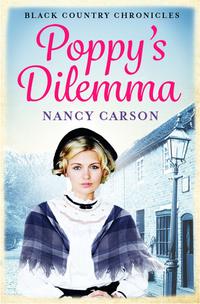
Read the book: «Poppy’s Dilemma»
Nancy Carson
Poppy’s Dilemma

Copyright
Published by Avon an imprint of
HarperCollinsPublishers Ltd
1 London Bridge Street
London SE1 9GF
www.harpercollins.co.uk
First published in Great Britain by Hodder & Stoughton in 2003 as Poppy Silk
First published in Great Britain by HarperCollinsPublishers 2015
This ebook edition published by HarperCollinsPublishers in 2016
Cover design © Debbie Clement 2016
Nancy Carson asserts the moral right to be identified as the author of this work.
A catalogue copy of this book is available from the British Library.
This novel is entirely a work of fiction. The names, characters and incidents portrayed in it are the work of the author’s imagination. Any resemblance to actual persons, living or dead, events or localities is entirely coincidental.
All rights reserved under International and Pan-American Copyright Conventions. By payment of the required fees, you have been granted the non-exclusive, non-transferable right to access and read the text of this e-book on screen. No part of this text may be reproduced, transmitted, down-loaded, decompiled, reverse engineered, or stored in or introduced into any information storage and retrieval system, in any form or by any means, whether electronic or mechanical, now known or hereinafter invented, without the express written permission of HarperCollins.
Source ISBN: 9780008252342
Ebook Edition © September 2016 ISBN: 9780007948482
Version 2018-01-09
POPPY’S DILEMMA
Table of Contents
Cover
Title Page
Copyright
Chapter 1
Chapter 2
Chapter 3
Chapter 4
Chapter 5
Chapter 6
Chapter 7
Chapter 8
Chapter 9
Chapter 10
Chapter 11
Chapter 12
Chapter 13
Chapter 14
Chapter 15
Chapter 16
Chapter 17
Chapter 18
Chapter 19
Chapter 20
Chapter 21
Chapter 22
Chapter 23
Chapter 24
Chapter 25
Chapter 26
Chapter 27
Chapter 28
Chapter 29
Chapter 30
Chapter 31
Chapter 32
Chapter 33
Chapter 34
Chapter 35
About the Author
By the Same Author
About the Publisher
Chapter 1
She did not really want to be there, but Poppy Silk loitered compliantly with her friend Minnie Catchpole outside the alehouse, which was called ‘The Wheatsheaf’, but somewhat appropriately known by some as the ‘Grin and Bear It’. Poppy was wearing the only reasonable frock she possessed; second-hand and made of red flannel with buttons down the front. It was a size too big for her slender figure and had cost her mother a shilling. Her black worsted stockings and inelegant clogs were made more conspicuous by the frock’s short skirt. Despite the frock, and despite her reluctance to be among her own kind, Poppy had seldom been short of admirers lately. She had the face of an angel, strikingly beautiful, manifesting all the innocence of the unenticed, and yet she was much too worldly to warrant a halo.
There was a stiff breeze, not uncommon for the middle of May, and the evening sky was shredded with sprinting clouds. The road, growing dustier and more uneven the longer the dry spell lasted, was strewn with old news-sheets that flapped like misshapen birds against the wind.
The Wheatsheaf stood alone, surrounded by wasteland on one side and the Old Buffery Iron Works on the other. Within spitting distance was a collection of wooden shanties that lined the Blowers Green section of the Oxford, Worcester and Wolverhampton Railway, which was just another of the huge civil engineering enterprises under construction.
The event was payday and it only occurred monthly. A horde of railway navvies had assembled in blustery sunshine two hours earlier at The Wheatsheaf, Poppy’s and Minnie’s fathers among them. The tavern was where they reaped their monetary reward for four weeks’ gruelling labour minus, of course, what they owed in truck to the contractor. Most were the worse for drink. Their pockets were bulging with money, which was begging to be spent on beer, whisky, or whatever other libation would intoxicate them into sublime oblivion and render painless their aching backs and limbs. Some had ventured further afield in their search for it, but were now returning, having boisterously worn out their welcome at other public houses and beer shops, and even wobble shops, which were illicit drinking houses.
Poppy and Minnie were not the only girls aware that it was payday and hoping to be treated at least to a drink; many neighbourhood girls had gathered, hoping some of the navvies’ hard-earned money would trickle down to them. Minnie, the flightier and more buxom of the two, struck a pose calculated to attract the favourable eye of the young workmen who were there in abundance, and she was flattered when some young buck whistled his approval. Poppy, though, was not so sure about those others who sidled up and made bawdy suggestions, even though those suggestions elicited girlish giggles, or feigned indignation, depending on what was being suggested and by whom.
‘I reckon our dads have forgot we,’ Minnie commented.
‘They forget everything once they’ve got the beer in ’em,’ Poppy replied realistically. ‘Shall we go inside and ask ’em for money so’s we can buy our own?’
A particularly well-built navvy, who looked old enough to be her father, suggested something spectacularly indecent to Minnie. She stared at the man in mock outrage for a moment or two, yet inwardly remained unruffled, before she turned round to reply to Poppy’s question. ‘I ain’t going in there. We’d get mauled to death by this lot o’ dirty buggers. I don’t mind somebody young, but not that lot o’ dirty old buggers.’
‘Well, I ain’t stoppin’ here much longer,’ Poppy said, glancing apprehensively at the same man. She turned to Minnie. ‘They ain’t doing to me what they done to that Peggy Tinsley the other week down by the Netherton turnpike. Seven of ’em, there was, she reckoned. They just left her there lying in the grass after. She couldn’t walk properly for days. And her best bonnet blowed away in the wind.’
‘Poor soul,’ Minnie commented, but with little sympathy. ‘Still, I’m glad it wasn’t me. If they’d done to me what they done to her, and Dog Meat had found out, it would’ve spoiled me chances.’
‘Why do they call that chap o’ yours “Dog Meat”?’ Poppy asked. ‘Does he eat dogs or summat?’
‘Course not. It’s ’cause he used to sell meat for dogs to the swells afore he was a navvy. Any road, it’s just a nickname. Everybody’s got a nickname.’
‘I ain’t got a nickname, Minnie.’
‘Nor me, but your dad has – “Lightning Jack”.’
Poppy smiled and her blue eyes sparkled. ‘So’s yours – “Tipton Ted” … Come on, where shall we go? We ain’t gunna get a drink here. And I want to be safe in me bed asleep come turning-out time when they’re all drunk and a-fighting.’
‘Let’s have a walk up the town,’ Minnie suggested with a gleam in her eye. ‘Let’s see what the swells am up to.’
As they were about to go, a packman carrying a case came up to them. He opened it up and displayed rows of necklaces, earrings, bangles and other trinkets.
‘Buy a necklace, Miss?’ he suggested to Poppy. He lifted one out and held it before her throat where it tantalisingly out-glittered the glass and paste example she was already wearing. ‘It’d look a treat on you with your pretty face, wouldn’t it?’ He regarded Minnie beseechingly, in an attempt to elicit her support. ‘Wouldn’t she look a picture, eh, miss?’
‘I got no money,’ Poppy informed him.
‘Got no money? Well, it’s soon got, a pretty wench like thee.’
‘It’s me dad what’s got the money,’ Poppy replied, the innuendo lost on her. ‘But he’s making sure he spends it on himself.’
‘What about you, my flower?’ he said, addressing Minnie.
‘I got no money neither.’
‘The men got paid tonight, didn’t they?’ the packman queried, placing the necklace back in the case and closing it up again. ‘I daresay I’ll be able to prise a sovereign from somebody afore I’m done.’
Poppy and Minnie turned to go. They were content to leave behind the hawker and the local girls who were making up to the young navvies, content to leave behind the guffaws and the swearing, the shouts and the bawling, which were increasing in direct proportion to the amount of beer being drunk. A hundred ordinary workmen, each with a pocketful of money, in even a large public house, could wreak havoc. A hundred drunken navvies, with their own brand of disregard for order and serenity, could triple the chaos. Poppy and Minnie were well aware of it. They were all too aware that towns which were being linked to the railways did not altogether embrace the arrival of hundreds of burly, uncouth men, some with their so-called wives, however transient their stay. It was commonly believed that the shanties they erected alongside the railway workings were hardly fit for pigs, let alone people. And heaven protect decent, God-fearing folk from the unspeakable goings-on inside. But how those men could shift earth!
The girls left the turnpike and walked steadily towards Dudley up a track known as Shaw Road that ran alongside the new cutting the men had been excavating. As they passed the gasworks, chattering amiably, Minnie imparted some very personal secrets about herself and her man Dog Meat.
Poppy giggled in disbelief. ‘You don’t do that, do yer?’
‘Course we do. It’s nice.’
They sauntered between the houses, factories, shops and alehouses of Vicar Street. The granite spire of the recently built St Thomas’s church came into view, pointing the way to heaven as it gleamed ethereally, caught by the sun’s dying orange glow. It was good to be away from the rabble and babble of the navvies. Here was the chance for Poppy to derive some notion of how civilised society functioned.
They reached the church, turned right and headed downhill towards the town hall and the market square. The market square occupied the area that split High Street into two carriageways before joining up again to form Castle Street. Poppy and Minnie nudged each other at the sight of bonneted women in fine dresses and handsome men in cylindrical top hats. A carriage passed them coming in the other direction, its wheels clattering over the uneven surface. Neither girl would have known whether it was a barouche or a phaeton, a landau or a clarence; the only horse-drawn vehicles they could recognise were the tip-trucks that conveyed spoil from the cuttings and the tunnel. Poppy marvelled at the pristine goods on display in shop windows. Soft feather mattresses adorned with clean white sheets and pillowcases lay on bedsteads fashioned from glistening brass. There was highly polished furniture you could almost see your face in. Shoe shops displayed modish boots, cuffed and lace-edged, with delicate heels. Poppy drooled over elegant white dresses – the height of fashion – and beautifully tailored coats, and bonnets bedecked with colourful ribbons and flowers. Oh, it was a fine town, this Dudley, both Poppy and Minnie agreed.
‘If me father’s got any money left after his randying I’d like to get me mother to come here and buy me a pair of them dainty boots,’ Poppy said, knowing it to be a vain hope. ‘I’d love a pair of new boots.’
They ambled on, past the old town hall and market. Things were subtly different in this part of the town. The street was busy with people. Even this early in the evening, several people were stumbling tipsily as they entered or left the profusion of noisy public houses. A few were sitting in sluggish stupors adorning alcoves, or lolling against convenient walls. Women and girls stood around, gossiping animatedly, cackling like hens in a farmyard. Some were overtly trying to tempt men with coquettish looks. Here and there a glimpse of some well-turned ankle promised heaven. Poppy and Minnie giggled at the sight and sound of an old man emptying his nose into the gutter with a voluble snort; that sort of action would hardly offend them, used as they were to witnessing far less refined behaviour. They chuckled even more at the pettiness of a woman walking behind them, who tutted self-righteously and muttered, ‘How disgraceful!’
They walked past the frontages of some more tightly squeezed shops, inns and houses; a succession of stone and red-brick porticoes, forming an unbroken way on both sides of the wide Georgian street. It narrowed as they approached St Edmund’s church, with its red-brick tower overshadowed by the cold grey stone of the old Norman castle on the high adjacent hill.
‘Shall we turn back?’ Poppy suggested. ‘We don’t want to walk down the hill towards the station, there’s no shops down there.’
‘Only the new railway bridge.’
Poppy chuckled. ‘Remember when the first one they built fell down? It’s lucky we weren’t under it.’
They turned around and retraced their steps. As they passed The Seven Stars opposite the town hall and the market place, four youths who were loitering around the doorway called after them. They made disparaging comments about the girls’ clogs, and their unusually short skirts which revealed their shins.
‘Show us your drawers!’ one called, and laughed with satisfaction at his own bravado. Rumour was rife that some working girls were wearing the long johns of their menfolk.
‘Show us your pego, then,’ Minnie replied with equal bluster. ‘If you’ve got e’er un worth showin’.’
With a cheeky grin, the lad put his hands to the fly buttons of his trousers and, fearing Minnie had failed to call his bluff, Poppy turned and walked on. Minnie, laughing, caught her up.
At the side of the road in front of the town hall a woman was arguing with a hawker about the price of a coal scuttle. A middle-aged man with sunken cheeks was sitting on a step, lecherously stroking the blooming cheeks of a full-bosomed woman sitting next to him. A couple of urchins in rags and tatters, who had been nowhere near a bar of soap in a fortnight, rolled over in the gutter and came to blows, one of them squawking with hurt pride.
After only a few minutes, Poppy and Minnie realised that the four youths were following them.
‘Quick, let’s hurry up,’ Poppy urged.
‘Let ’em come,’ Minnie said, unabashed. ‘Mine’s a nice-looking lad.’
‘Oh?’ Poppy queried. ‘What about Dog Meat?’
‘Sod Dog Meat. You take your pick of the other three.’
‘What if Dog Meat sees yer with one of ’em? What if he finds out?’
‘He won’t. He’ll be fuddled out of his mind by now. Any road, I always deny everything.’
‘Are yer gunna go with him then?’ She tilted her head to indicate she meant one of the four lads following at no more than ten yards’ distance now.
‘If he asks me. If he buys me a drink. You want a drink, don’t you, Poppy?’
‘I’m parched.’
‘Well, I’m parched an’ all, and we ain’t got no money to buy one. So let these.’
Minnie stopped and waited for the boys to catch them up. ‘D’you want to buy us a drink?’ she asked forwardly, catching the eye of the lad she fancied.
‘Will you show us your drawers after?’
‘Who says I’ve got any on?’
‘Show us then …’
Minnie shrugged and cocked an eyebrow suggestively. ‘That depends.’
‘Depends on what?’
‘On whether I like yer enough.’
‘Then what?’ the lad asked provocatively.
‘Depends on whether I like yer enough.’ Minnie tantalised him with an alluring look of devilment. ‘Tek me and Poppy for a drink and then it’ll be dark. Who knows what hidey-holes there am round here.’
‘They’m navvies’ wenches, Tom,’ one of the lads murmured apprehensively to the one in charge of these delicate negotiations. ‘From that new cutting down Blowers Green. Yo’ll get yer yed bosted.’
‘They’ll have to catch me fust.’ With a grin, Tom turned to Minnie again. ‘Come on, then. We’ll goo in The Three Crowns.’
It was of no consequence to Poppy and Minnie that The Three Crowns was scarcely more refined than The Wheatsheaf, with its sawdust floor and its spittoons not so strategically placed. Oil lamps hung from hooks screwed into the beams of the low ceiling. The lads barged a way through to the bar and the girls followed compliantly. Soon they were handed a tumbler of beer each, which they quaffed eagerly. They stayed for about an hour, laughing with the lads and their increasingly bawdy humour, until Poppy said it was time she went back to her mother and her brothers and sisters.
‘Stop a bit longer, Poppy,’ Minnie entreated.
Minnie had been getting on famously with Tom; she was obviously equal to his probing indelicacies, and their rapport showed immense mutual promise.
‘No, Min, not with me father out on a randy,’ Poppy insisted. ‘I want to go to my mother.’
‘Luke’ll goo with yer,’ Tom said, keen to part Minnie from her companion and so boost his chances further.
Luke was keen to oblige. He hadn’t taken his eyes off Poppy’s lovely face the whole time but, because of his complete lack of conversation, he had made no impression on her.
‘I’ll walk with yer, Poppy, if yer like,’ he mumbled.
She gave her assent and he finished his beer. Outside, darkness had fallen.
‘So what’s it like, being a navvy?’ Luke asked.
‘How should I know? You should ask me dad. He’s the navvy.’
‘They say it’s hard work.’
‘The hardest job in the world, me dad says.’
‘But they get paid plenty.’
‘And spend plenty,’ Poppy replied, and her contempt for the fact seeped through in her tone. ‘All on beer. They got paid tonight and they was all drunk two hours later. None of ’em will be sober till it’s all spent. About Wednesday at the latest, I reckon. Then they’ll all have to live on truck till the next payday.’
‘What’s truck?’
‘Vouchers,’ Poppy explained. ‘They can buy food, boots and clothes from the contractor’s tommy shop with the vouchers, and then it gets docked off their next wages.’
‘Sounds fair,’ Luke commented.
‘No, it ain’t fair, Luke. Some of the contractors charge a pound for fifteen shillings’ worth of goods. That ain’t fair at all.’
Poppy spied a group of navvies walking towards her and Luke. Even in the darkness you could tell they were navvies by their distinctive mode of dress. They wore white felt hats with the brims turned up, bright neckerchiefs and waistcoats, moleskin jackets and trousers, and big boots. She hoped they wouldn’t recognise her as they approached.
‘You’d best leave me now,’ Poppy suggested, fearing for Luke’s safety.
‘Not till we’ve gone past this lot.’
‘No, they’re navvies from the Blowers Green cutting. If they recognise me, they’ll make trouble for you.’ She looked around for some means of escape. ‘Quick, let’s hide in that alley, out of the way.’
She shoved him into it unceremoniously. There was a gate at the top and he took the initiative and opened it, leading her quickly through. He put his forefinger to her lips, gesturing her to remain silent, and pressed himself to her while they waited. The warmth of his body against her made her heart pound with a bewildering mixture of pleasure at his closeness, and fear at the sound of footsteps, scuffs and the navvies’ muttering and swearing in the alley. But the men were too drunk to know what they were doing or who they had seen, and quickly lost interest in their search. Poppy and Luke lingered a minute longer, enraptured by this enforced intimacy, yet lacking the confidence or know-how to exploit it.
‘You’d best go back,’ Poppy said, when they were out in the street again. ‘I’ll be all right from here. I know the navvies. They won’t hurt me, ’cause of me dad, but they’d kill you if they saw you with me.’
‘Any chance o’ seein’ you again, Poppy?’ Luke asked.
Poppy smiled appealingly and shrugged. ‘You never know. If me and Minnie come up to the town again.’ Luke seemed a decent lad; he’d shown her consideration and a heart-quickening, gentle intimacy she’d never experienced before. ‘Thanks for walking me back.’ She turned and gave him a wave as she hurried on down the road.
The hut Poppy shared with her family and eight other navvy lodgers was a ramshackle affair. It stood amongst a muddle of shacks huddled together in bewildering confusion, as if they had fallen randomly from the sky and been allowed to remain just where they had landed. Heaps of disused planks, discarded bottles and all manner of rubbish littered the place. The huts were owned by Treadwell’s, the contractors, and had been dismantled and reconstructed several times in several parts of the country before their sojourn at Blowers Green in Dudley. Although built predominantly of wooden planking, they were a mix of other waste materials such as engineering bricks and refractories, stone, tile and tarpaulin. Over the door of the hut occupied by Poppy and her kin hung a piece of wood that bore the name ‘Rose Cottage’, nailed there by some joker who’d been blessed with the ability to read and write. At least one of the four panes of glass in each window had been broken; one was replaced with a wooden board, the other a square of cardboard. Rose Cottage had three rooms. One was the communal living room that served as kitchen, dining room, brewhouse and gambling saloon. There was the family’s bedroom, and another separate bedroom for the lodgers, crammed with eight bunk beds and such other accoutrements as the navvies deemed necessary. The kitchen area was nothing more than the space at one end of the hut that had a fireplace. Also crowded in was a stone sink that emptied into the dirt outside, a copper for boiling vast amounts of water, a rickety table and a row of lockers that were the lodgers’ personal tommy boxes. Every navvy provided his own food, which he called his ‘tommy’, and which he paid for in either cash or vouchers from the tommy shop. It often fell to Sheba, Poppy’s mother, to cook it.
When Poppy returned to the hut, Sheba, a mere thirty-one years old, was sitting on a chair in the communal living room nursing her youngest child; her fifth that had survived. Another woman, a neighbour from a similar hut, was with her, smoking a clay pipe they called a ‘gum-bucket’. While they gossiped, they shared a jug of beer tapped from the barrel that stood cradled in a stillage against one wall. Neither woman was drunk but the beer had loosened their tongues, and they were talking over each other in their eagerness to chatter. Poppy undressed herself in the adjacent family bedroom and put on her nightgown. She could hear the women’s conversation clearly, but took little notice as she clambered over the rough, bare floorboards to the two dishevelled beds that were shoved together through lack of space. She slid into the one she shared with her two younger sisters and her younger brother Jenkin, better known as Little Lightning.
Poppy had consumed two half pints of beer and the effect of the alcohol was making her drowsy. The drone of the women’s voices became indistinct and in no time she was dreaming of Luke and his unexpected chivalry. She did not know how long she had been sleeping when she was awakened by the urgent shouts of agitated men and the sudden, alarmed crying of one of the children. Poppy raised her head off her pillow and tried to understand what was happening in the darkness. A lamp flared into life. Men were gathered in the open doorway, and her mother looked anxious as she stood at the bedroom door.
‘What’s the matter?’ Poppy asked as she rubbed her eyes.
‘They’ve got your father.’
‘Who’s got me father?’
‘The night watch. He’s in the lock-up in Dudley.’
‘Why, what’s he done?’
One of the navvies answered. ‘Nothing, as far as we can tell. A packman come in the public house selling baubles. Your father asked to see one and the packman handed one to him. When he asked for it back, Lightning Jack said somebody else had took it to have a look. But he accused Lightning of pinching it.’
Poppy looked with bewilderment at her mother, then at the navvy. ‘And had he pinched it?’
‘Nay,’ he answered. ‘Oh, somebody did, but I don’t reckon it was yer dad. He just passed it to somebody who asked to see it. Any road, the packman went out and the next thing we knowed, the police was there. The men am up in arms, and in the right mood. There’s gunna be trouble aplenty.’
Poppy quickly got dressed. Already she could hear the shouts from an army of angry men outside. Because they were navvies, they were regarded by those who didn’t know and understand their isolated way of life as the absolute dregs of society. Well, the navvies knew and understood their own way of life well enough and they stood together nobly, especially when one of their number was locked up for supposedly committing some felony of which he was innocent. The news had quickly spread. Those navvies who lodged in houses close by had been knocked up from their beds. They answered the call as well and joined those from the encampment, grabbing whatever they could that would serve as a weapon. It was time to set the record straight.
Poppy ran outside. Every man from the encampment still capable of standing must have been there. The ringleader was a ganger she knew only as ‘Billygoat Bob’. In the darkness, she could see that he was standing on a box as he incited the men with his ranting about injustice and bigotry. For the benefit of men who had been drinking elsewhere, he was explaining what had happened at The Wheatsheaf.
‘Nobody thought anythin’ on it, till the packman come back to the Grin and Bear It half an hour later with three bobbies. They came in like three devils, clouting everybody wi’ their blasted copper-sticks. The damned packman pointed out Lightning Jack and Dover Joe, so they dragged ’em out and chucked ’em in the Black Maria. Afore we knew what had hit us, they was away.’
The men were sufficiently inebriated to accept with fiery enthusiasm his tirades on the police and on the packman, which fed their lust for revenge.
‘If any one of you was in trouble, would ye not look to we, your own kind, to help yer in yer travail?’ Billygoat yelled over the hubbub, and there was a thunderous response of accord. ‘Well, Lightnin’ Jack and Dover Joe am innocent, but they’m in that stinkin’ gaol. It’s up to we to fetch ’em out afore they come before the beak and get sentenced. If we fail, they’ll end up doing penal servitude in Australia – that wilderness on the other side o’ the world … And they’ve both got women and families … It could have been you dragged out of that public house, mates. It could have been any one of you …’
A raucous jeer rang ominously through the night and a forest of arms shot up, most wielding pickaxe handles, shovels or hedge-bills. Billygoat stepped off his wooden box and led the incensed army away from the compound and up the hill towards Dudley. One or two stumbled and fell in their drunkenness, but they got up or were helped to their feet by mates bent on avenging this savage oppression.
Poppy followed behind. She had a vested interest. The other women, however, keen to witness some action, were caught up in the fervour of the moment as they hurried to keep up with the men, forming a separate, more passive group. The ragtag army fell more or less into step as they slogged on. Poppy had no idea of the time, but the streets were deserted except for the horde. They strode through the sleeping town, led by Billygoat Bob and those who knew the way, having deliberately followed the Black Maria which carried their comrades to the lock-up.
The two-hundred-strong mob reached the police station in Priory Street, a castellated, red-brick building with a mock portcullis through which they teemed. Hearing the commotion, the two policemen that were on duty presented themselves at the door on the other side of the yard that had rapidly filled up with the ranting crowd. One of the constables asked what the trouble was.
‘We want our two mates, Lightning Jack and Dover Joe,’ Billygoat Bob replied, with all the aplomb of a victorious army general negotiating a surrender. ‘They’ve been locked up for pinchin’ trinkets, but they took nothing. They’m innocent.’
‘Not according to what I’ve been told,’ the policeman said defiantly.
‘Then what you’ve bin told is a pack o’ lies. Some of these men here was in that public house, and they’d swear on their lives that them two men you’m holding had sod-all to do with any theft. Have you found the evidence on ’em?’
‘No, but they could’ve jettisoned that when they saw the arresting officers arrive.’
‘No evidence, eh?’ Billygoat called, loud enough for the throng to hear. ‘No evidence!’ He turned back to the policeman. ‘It strikes me as you should let ’em go, if you got no evidence.’
‘That ain’t up to me,’ the policeman said. ‘There’s nothing I can do. They’ll appear afore the magistrate tomorrow and he’ll decide what should happen to ’em. I’m just doing me duty.’
Billygoat turned to his men. ‘You heard what the constable said,’ he shouted. ‘He’s got no evidence, but there’s nothing he can do about it. There’s nothing he can do for us or our mates inside. He’s just doing his duty. Well, men … we have a duty as well …’
A roar of assent went up and the men surged forward in a mass. The policemen, realising that it was impossible to stand in the way of the mob and live, stood aside while the navvies poured into the police station. Inside, huge muscle-bound men wrenched open doors, pulling some off hinges, until one group came across the cells. Another policeman was on duty there. One of the mob asked him to unlock the padlock and set the prisoners free or be killed. Bravely, he refused. Acknowledging his courage and application to duty, Billygoat gave the order to leave him be. They would wrench the cell door down with physical force.
It took no more than five minutes. The two prisoners were helped out, to broad grins and triumphal cheers.
* * *
As the triumphant navvies and their women lurched back to the encampment, they dispersed into smaller groups. Poppy had gone up to her father as soon as she could get close to him and asked him if he really was innocent of the accusations levelled against him.
‘I’m innocent, my wench,’ he answered, ‘but I doubt the law will ever regard me as innocent. I had a necklace in me hand, I admit it – I was gunna buy it for you, my flower – but somebody snatched it from me and I don’t know who … Where’s your mother?’
‘She stayed with the kids.’
‘Good … I’m glad.’
‘You look worried, Dad …’
‘If I do, it’s ’cause we ain’t heard the last o’ this.’
‘What do you mean?’
‘What I say. The line will be crawling wi’ police tomorrer. They’ll never be able to let us navvies get off scot-free. They’ll never let us get away with this.’
They walked on together, silently considering the implications, and Poppy was touched that her father had been about to buy her a necklace. A few of the men were singing lewd songs as they trudged drunkenly homewards. Then, as the various clusters of navvies and women lumbered down Vicar Street towards Blowers Green, Poppy was aware of somebody else at her side and turned to see who it was.
‘What’s goin’ on, Poppy?’
‘Minnie! Where did you spring from?’
‘From that alleyway.’ She pointed over her shoulder. ‘I was with that Tom. So what’s up?’
Poppy told her, then asked what she was doing out so late.
‘That Tom,’ Minnie whispered behind her hand, rolling her eyes self-consciously. ‘He’s a bit of a buck. We was having it against the wall in that alley when we heard this commotion and saw all the navvies marching towards the town. I knew Dog Meat would be among ’em, so I thought it was a good time to leave Tom and get back in bed afore Dog Meat got back. Anyway, at that, Tom says, “Hey, I ain’t finished yet,” so we settled back to doin’ it again. It took longer than I thought …’ Minnie giggled unashamedly. ‘So if Dog Meat ever asks, I was with you on the way up to the gaol, as well as on the way back. I’ve bin with you all night. All right?’
Poppy chuckled. ‘You’re a crafty one, Min, and no two ways. Are you seein’ him again, this Tom?’
‘Who knows? I might. He’s worthy.’
Sheba, who had waited up anxiously for news of Lightning Jack, was overjoyed when he returned to Rose Cottage. She took his arm with concern and drew him to her proprietorially as he entered the hut.
‘Are you hurt, Jack?’ she asked, with sympathy in her eyes. ‘Did the police hurt you?’
‘I copped a clout across the shoulder, but I daresay it’s only bruised. Nothing to fret about.’
‘Oh, Jack, I was that worried. Thank God you’m all right.’
‘Aye, I’m all right, my wench. But I’m famished. Get me summat t’ate.’
‘There’s some bread and cheese.’
‘That’ll do.’
Two loaves of bread stood on the table in the communal living room. Sheba cut a hunk off one and handed it to Lightning with an ample lump of cheese. She poured him a glass of beer from the barrel, and treated herself to a smaller one.
While her father ate his supper, Poppy returned to the bed she shared. As she slid between the sheets, her sisters and brother roused but did not wake. Before long, her father and mother came in, carrying an oil lamp. Lightning Jack had sobered up following his experience in the gaol and was conducting a whispered conversation with Sheba. Then he blew out the flame and clambered into the adjacent bed, followed by Sheba. Poppy heard their stifled grunts and the squeaks of the iron bedstead as they performed their inevitable horizontal exercise. In the adjoining dormitory, the navvies who lodged with them clumped about as they stumbled over each other and swore profusely before they settled down. Poppy pulled the pillow over her head to shut out the various violations of her peace and tried to drift off to sleep, to the accompaniment of her own imaginings. It had been an eventful night.
Chapter 2
Morning came. Sheba and Lightning were up and dressed by the time Poppy awoke. Lightning was tying his clothes up in a bundle and Sheba was regarding him fretfully.
‘I’ll be back as soon as it’s safe,’ Poppy heard him say.
Alarmed, she sat up in bed and called, ‘Where you goin’, Dad?’
‘I’m goin’ on tramp, my wench. The police’ll be swarmin’ round this place like flies round shit, afore you can catch your breath. If they find me they’ll arrest me again. I’m gunna mek meself scarce. In the meantime, I’ll find work on another railway. The bobbies won’t know where I’ve gone and they won’t send men everywhere just to look for me. I’ll either send for yer all or, if the job’s no good, I’ll come back when the dust has settled.’
‘Will Dover Joe go with you, Dad?’
‘He’ll leave here if he’s got any sense, I reckon. But it’ll be best if we don’t go together.’
‘Oh, Dad, I shall miss you,’ Poppy declared with a flush of tenderness for this man, who protected her from the perils and coarseness of living among so many uncultured men. ‘Come back as soon as you can.’
He smiled, but sadness showed in his eyes as he ruffled her wayward fair hair. ‘I’ll be back for you, my flower. I’ll be back for you all. Have no doubt.’
‘You’d best be back soon an’ all, Jack,’ Sheba said. ‘Else we shall be turned out o’ this shant as sure as night follows day. Don’t forget as it’s owned by the contractors. Don’t forget we’re only tenant landlords, and that if you ain’t workin’ for the contractor we’ve got no rights being here.’
‘Ask Dandy Punch to cover for us,’ Lightning said. ‘He might ask a favour in return, but that’s fair enough.’ He arched an eyebrow, giving Sheba a knowing look.
Dandy Punch was the timekeeper. Poppy did not like Dandy Punch.
‘Tell him I’ll repay him handsomely as well for his trouble when I get back. Do whatever you think’s necessary, Sheba.’
Lightning kissed each of his children, gave Poppy a squeeze and clung to Sheba for a few seconds in a parting embrace. Then Poppy watched him turn around and walk out of the hut. Outside, he fastened a length of rope to various points on his wheelbarrow, creating a harness by which he could carry the thing on his back. He picked up his shovel, his pickaxe and his long drills, and tied them together and carried them on his shoulder like a soldier would a rifle. He threw his bundle of clothes over his other shoulder; a stone jar full of beer hung from that. Sheba handed him his straw bag, called a pantry, which held food to sustain him for a day or two. Then, heavily laden, he walked away from them, kicking up the dust as he went.
Poppy imagined that he had not turned around to wave lest they should see tears in his eyes. More likely, he would have seen theirs and, seeing them, might have been tempted to stay. But he could not stay. To stay might mean transportation. Transportation meant she would never see him again.
Through a haze of tears, Poppy watched him go. Lightning was a big man, tall and muscular. He was thirty-six years old, or so he believed, but because arduous work had taken its toll he looked nearer fifty. As a child, he had been a farm labourer in Cheshire. He had started work on the railways as a nipper, as a fat-boy greasing axles. Then, at twelve years old, on the construction of the Bolton and Leigh Railway, he’d been promoted to tipper boy, working with a horse and tip-truck, tipping the spoil from cuttings into wagons to be used subsequently as infill on embankments. After that, he worked on the Liverpool and Manchester till its completion. Lightning went back to farm labouring, but it could never offer enough, either in monetary terms or in excitement. So, when he heard about the starting of the London and Birmingham Railway, he tramped to the capital and worked the whole length of that line, starting as a bucket-steerer, but ending up as an excavator. Poppy recalled him telling her once how, at a place called the Kilsby Tunnel, he had witnessed three men, the worse for drink, fall to their deaths down a shaft as they tried to jump across its mouth, playing a game of follow-my-leader. When the London and Birmingham was finished, Lightning eventually joined the construction of Brunel’s Great Western Railway from London to Bristol with its controversial broad-gauge track.
Poppy turned to her mother, who was holding the youngest in her arms. ‘I wonder just how long it’ll be before we see him again.’ She had heard so many tales of men jacking up and going on tramp, leaving wives and families behind, never to be heard of again.
‘Within a month,’ Sheba replied with confidence. ‘Barring accidents. I know your father. He’s a man of his word.’
‘Tell me about how you came to be his woman, Mother.’
‘I was fourteen,’ Sheba said. ‘Two years younger than you are now. My own father was working on the London and Birmingham, but he’d gone off on tramp and left us. Lightning asked my mother if he could take me off her hands. She said yes, and he gave her a guinea for her trouble. She was glad of it as well.’ Sheba laughed as she recalled it. ‘That day we jumped the broomstick and the shovel together – the nearest a navvy ever gets to being proper wed – and that night I slept in his bed.’
‘But did you like him, Mother?’
‘Oh, I liked him well enough. He was strong and handsome with his long curls and drooping moustaches, and yet kind and gentle – not like some of them rough buggers. I caught straight away with you, our Poppy, and I had you when I’d just turned fifteen.’
‘I don’t know if I want to be a navvy’s woman, Mother,’ Poppy said, almost apologetically. ‘I reckon there’s a better life to be had.’
Sheba laughed and sat down, unbuttoning her dress to feed the baby. ‘Oh, there’s a better life, I daresay, but I wouldn’t know where to find it. This life is hard, though, tramping from one end of the country to the other, sleeping rough, just looking for work. I have to admit, no change could ever be a change for the worse. But getting away from it is another matter. Lord knows, everybody shies away from us as if we’re lepers when they know we’re navvies’ women. And yet a good many are glad to become navvies’ women – you only have to look how many wenches the single men pick up from the towns.’
‘Last night, me and Min went up into Dudley town,’ Poppy said. ‘We looked in the shops. They was full of stuff – beautiful stuff – shoes, frocks, coats, furniture, pots and pans, lovely crockery. And you should have seen how some of the women was dressed … the men as well …’
‘The shops in Dudley don’t do truck, do they? With no money coming in now, how am we supposed to get food and clothing except by truck?’
‘But that’s what I mean, Mother. If we didn’t have to rely on truck we could have what we wanted.’
‘Then you’d best find a feller who don’t drink every penny away in a couple of days, like your father does,’ Sheba said. ‘Somebody who won’t expect you to live on truck for the rest of the time, like most of ’em do.’
‘Yes, that’s what I’m saying, Mother. I don’t want to end up with a man that lives like that. So I don’t want to end up with a navvy. I want a house of my own. I want to sit in front of me own fireplace with a good husband and me kids safe abed upstairs.’
‘Dreams, our Poppy. And easier said than done. Any road, somebody’s already asked if he can have you.’
‘Who?’ Poppy asked with alarm.
‘Never mind. Your father wouldn’t agree to it.’
The rest of the hut’s occupants were stirring. Poppy heard the coughs and groans of men emerging from sleep with thick heads and wondered if it had been one of them that had asked for her. Through the thin partition she could hear the robust breaking of wind, followed by puerile laughter from those who thought it funny, and strings of abuse from those who considered the ensuing stink an intrusion. Somebody stepped outside and, through the small window, she glimpsed Tweedle Beak – so called because of his beaked nose – his back towards her, urinating into a patch of grass. Poppy was maybe the richer for having experienced this life, for nothing shocked her.
‘Shall we have some breakfast?’ she suggested. ‘Then I’ll scrub the floor.’
‘There’s plenty bread and cheese,’ Sheba said. ‘I’ll get some eggs today and some bacon.’
‘Did Father leave you any money then?’
‘About ten shillings. But I’ll have money from the beer we sell as well, and from the beds.’
Something else caught Poppy’s eye through the window. Towards the turnpike road she saw about a dozen policemen assembled, standing alongside a Black Maria and four horses. One of the policemen was clearly giving instructions to the others. Another man in a tall hat, a gentleman by his bearing, accompanied them. Her father had been right.
‘The police have come,’ Poppy warned her mother.
‘Let ’em come. They’ll not find my Lightning Jack here. He left just in time.’
The navvies lodging in the same hut grew strangely quiet; the irreverence and laughter were suspended, pending the intrusion of the police, whom they had evidently also seen. One thing was certain, however: if any of them knew anything about the missing trinkets, they were not about to confess it.
Soon they heard a loud rap at the door and it flew rudely open. A policeman was standing there with a young official employed by Treadwell’s, the contractors. Sheba withdrew the child from her breast and buttoned herself up, indignant at the interruption.
‘Are “excuse me” two words you’ve never heard of?’ she asked sarcastically. ‘Is there something you want of me, since you feel entitled to barge into my house?’
‘Good morning, ma’am,’ the police officer said, failing to sound deferential. ‘We are looking for two men who live in these barracks. They gave their names as Jack Silk, better known as “Lightning Jack”, and Joseph Wright, who is also known as “Dover Joe”. I suspect you know why we want them.’
‘You can suspect all you like, but there’s no Jack Silk here,’ Sheba said coldly. ‘Nor no Joseph Wright either. But if you want to check for yourselves, I won’t be able to stop you.’
‘I’m told Lightning Jack lives here.’
‘He used to,’ she responded defiantly. ‘But, thanks to you damned lot, he’s jacked and left us. Lord knows when we shall see him again – if we ever will.’
‘He should’ve thought of that afore he committed the crime,’ the policeman said, and nodded to the contractor’s man, who was young and handsome, and vaguely familiar to both Sheba and Poppy. Both men stepped inside the hut. The young man doffed his hat respectfully, but the policeman did not. Poppy appreciated this little demonstration of good manners from the young man and rewarded him with a brief smile, which he returned.
‘They’ve committed no crime,’ Sheba retorted. ‘It’s the packman’s word against theirs, but it suits you better to believe the packman, eh? Nobody ever believes there’s any good in a navvy.’
The policeman ignored her jibe, pulling sheets and blankets off the beds. He bent down to look under them.
‘Who’s in the next room?’
‘Lodgers,’ Sheba replied. ‘The men you’re looking for ain’t there either.’
The policeman opened the door and was greeted by eight surly, unshaven men leaning against their disorderly bunks. A birdcage with a tweeting canary hung from one beam; pairs of boots tied together and bags of kit hung from others. The constable spoke to the men and got several grunts in response as they shifted in turn so that he could search through the bedding. A small dog yapped from under a blanket, indignant at being so rudely disturbed.
The policeman turned to the contractor’s man. ‘Mr Crawford, do you recognise any of these men as the prisoners who were sprung last night?’
Mr Crawford shook his head solemnly.
The policeman then addressed the men. ‘Do any of you know where these two men, known to you as Lightning Jack and Dover Joe, might be hiding?’
All shook their heads and looked suitably solemn.
‘Well, we shall find ’em. Be sure of it. And woe betide ’em when we do.’
This encroachment on the navvies’ early morning routines as they prepared for work was not being well-received in other areas. Many had gathered together in the centre of the encampment and were muttering their dissatisfaction to each other. More joined them and the atmosphere thickened with a menacing air of belligerence. The policemen regrouped, truncheons drawn, the law firmly on their side, watching defiantly, until a lump of wood tossed from somewhere among the navvies hit one of them on the chest.
The older person, who was dressed in the top hat like a gentleman, moved to the front at once and shouted to make himself heard. He announced himself as a magistrate and told the men that unless they dispersed immediately and went about their business, the consequences for each of them would be serious. They must back off. Nothing was to be gained. The men the law was seeking had given them the slip. Why provoke more trouble?
So the navvies slowly dispersed. They took up their picks, their shovels and their barrows, and commenced work.
Only two days before his temporary incarceration at the Dudley lock-up, Lightning Jack had spoken to a navvy who had passed through the Blowers Green workings on tramp. The man had been looking for good, dry tunnelling work and had been disappointed to discover that the Dudley tunnel had already been completed. He’d told Lightning that he’d been working on the Oxford, Worcester and Wolverhampton at Mickleton, but had got into trouble with a card school to whom he owed some unpaid gambling debts, so he’d sloped off. Recalling what this man had told him, Lightning decided to head south and try his luck at Mickleton. That first Saturday, he walked about twenty miles and was refreshed and victualled at a public house in Ombersley, Worcestershire.
Afterwards, he found a suitable hedge under which to sleep, the weather being settled. Next morning, he awoke under a blue sky and took in a great gulp of the cool morning air, so fresh with the promise of summer, and free of the stench of coal gas that had normally greeted him at Blowers Green. The sight of the leaves stirring gently on the trees, and of the ordered pattern of fields that adorned the landscape, set his heart singing after the muck and filth of the Black Country. Maybe he should have gone on tramp before. He finished what food he had in his pantry, gathered his things together and set off again, intent on reaching Mickleton later that day. At Evesham, stopping for a gallon of ale at a beer shop, he met another navvy on tramp and they got talking. The stranger told Lightning that people knew him as ‘Bilston Buttercup’.
‘I’ve never seen anybody less like a buttercup in all me life,’ Lightning said, genially, as they supped. ‘Buttercups are pretty, dainty flowers. You’m as plain as a pikestaff and as ungainly as a three-legged donkey.’
The stranger laughed good-heartedly at Lightning’s banter. ‘That I am, and no doubt about it. Here … fill thy gum-bucket with a pinch or two o’ this best baccy.’
‘Ta …’ Lightning helped himself to some of the tobacco the man was offering and filled his clay pipe. ‘So you’re a Bilston bloke, eh?’
‘Bilston born and bred,’ the plain man said, filling his own gum-bucket. ‘Though I’ve been most places.’
‘So where are you heading for now?’ Lightning asked.
‘The Oxford, Worcester and Wolverhampton. They say there’s work on the Mickleton tunnel near Campden.’
‘That’s where I’m headed. We might as well tramp there together, if that’s all right by you.’
‘Let’s have a drink or three together and celebrate the fact,’ suggested Buttercup.
So Lightning Jack and Bilston Buttercup drank. They drank so much that they lost their resolve to reach Mickleton and, instead, discussed where they would doss down that night.
‘Under the stars,’ declared Lightning. ‘There’s nothing like it, and the weather’s fair.’
‘Then maybe we should find somewhere afore darkness falls. We can always find an inn afterwards for a nightcap.’
So they finished their drinks and set off in search of a place to sleep, into countryside that was wearing its vivid green May mantle. They pitched camp just outside a village called Wickhamford, alongside a stream that was invitingly clear. Buttercup contemplated building himself a sod hut, constructed by cutting turf from the ground and stacking it into walls, to be roofed with a tarpaulin.
‘So where’s your tarpaulin?’ Lightning enquired.
‘Oh, bugger!’ Bilston Buttercup replied with a laugh of self-derision. ‘I ain’t got ne’er un, have I? Damn it, I’ll sleep in the open … Like yo’ say, Lightning, the weather’s fair. Tell thee what – I’ll go and catch us our dinner. Why doesn’t thou gather some wood and kindle us a fire, eh?’
Lightning did what his new friend suggested. He collected some dry sticks of wood and had a respectable fire going in no time. He carried in his pantry a small round biscuit tin in which he kept his mashings, which was tea leaves mixed with sugar and wrapped in little parcels of paper screwed together at one end. From the stream, he filled this biscuit tin with fresh spring water and set it over the fire to boil. He stood up and stepped back to admire the fire. In an adjoining field he could hear the lowing of cows and knew at once where to get his milk. He took his metal tea bottle, rinsed it in the stream, and clambered through the hedge that surrounded the field. Startled rabbits bolted before him, but the cows regarded him with that indifferent curiosity of which only bovines are capable as he strutted towards them. Already he had picked his cow, its udders bulging.
‘Here, come to daddy,’ he said softly and stooped down alongside the compliant animal. As Lightning returned to the campfire with his bottle of fresh warm milk, he saw that Buttercup had arrived back also, and was feathering a chicken.
‘Bugger’s still nice and warm,’ he said. ‘Feel.’ Lightning felt. ‘There’s another, yon, for thee.’ Buttercup gestured his head towards the ground behind him. By the flickering light of the fire, Lightning could just make out another chicken lying forlornly dead, its neck broken.
‘Feather it, and I’ll draw the innards out for thee,’ Buttercup offered.
‘Where did you pinch these from?’ Lightning asked, collecting the chicken from the ground.
‘Some farm, yon. I picked up some eggs as well.’
‘Let’s hope no bugger heard you or saw you,’ Lightning said, recalling his brief stay in Dudley gaol for allegedly stealing something of similar value.
When the men had finished plucking feathers, Buttercup drew the innards out of both chickens and washed the hollow carcasses in the stream. Lightning constructed a spit from wood, on which they could cook the two fowls over the fire. Meanwhile the water in the little tin was steaming promisingly. Lightning watched his companion’s face by the light of the flickering fire as he rammed the chickens on the spit and began cooking them.
‘What brings you on tramp?’ Buttercup asked his companion.
Lightning Jack filled and lit his gum-bucket and told his story. ‘But it’s hard to leave a woman and kids. It is for me, at any rate. Some buggers couldn’t give a toss, but I think the world o’ my Sheba. I shall send for her and my babbies just as soon as I got meself settled at Mickleton. What about you, Buttercup?’
‘Me? I’m single, me.’ Buttercup turned the chickens on the spit and the fire crackled as it was fuelled with a further sputtering of fat. ‘I wouldn’t be in thy shoes, tied to a woman’s apron strings all thy natural. I’ve seen it all afore, watched men and women and seen how as they make each other as miserable as toads in a bag of flour. Look at another woman and just see how they moan. They swear as yo’m having it off. Dost ever look at other women, Jack?’
‘That I do. Show me a bloke as don’t and I’ll show you an elephant that can purr like a kitten.’
‘How old is your old woman, Jack?’
‘Not so old. Thirty-one. And not bad looking, considering she’s had seven. Two of ’em died, though, Buttercup.’
‘Aye, well when she’s forty-one her teeth’ll very likely fall out and all her hair. Then you’ll be gawping at even more women … younger women … and wondering why on earth thou ever messed with her in the fust place.’
‘Well, she was a right pretty young thing when we jumped the broomstick,’ Lightning said. ‘Fourteen, she was, and pretty as a picture. I was about nineteen.’
‘Aye,’ replied Buttercup. ‘But, by God, how quick they go to seed. The time will come when thou would’st rather kiss a scabby hoss.’
Lightning laughed. ‘Who knows? Mebbe …’ The water in the tin began bubbling. ‘I’ll drum up.’ His pipe clenched between his teeth, he poured some of it into his metal bottle and followed it with his mashings.
‘Just think,’ Buttercup said. ‘You and that Sheba o’ thine have got nothing to look forward to now but the workhouse or the grave.’
‘That’s it, cheer me up,’ Lightning said. ‘And what have you got to look forward to?’
‘Whatever I set me mind on,’ came the reply. ‘And if I want e’er a woman, I’ll have one, without it laying on me conscience.’
‘Have you never loved a woman, Buttercup?’
‘Oh, aye, to be sure. When I was younger and a lot safter than I bin now.’
‘Have you ever thought what it’d be like to have a little house o’ your own? To have the woman you love bring you your dinner on your own best bone china while you was warming your shins in front of a blazing fire?’
‘Oh, aye,’ Buttercup replied. ‘I was close to it once. Sadie Visick was her name. Met her while I was working once diggin’ up Wiltshire. Any road, I put Sadie in the family way …’
‘Then what?’ Lightning asked. ‘What steps did you take?’
‘Bloody big steps. I bloody well hopped it, sharp. I couldn’t see meself tethered down by e’er a wench and a screaming brat. Any road, as a navvy, what chance hast thou got o’ living a decent life? All around it’s dirty and depraved. Filthy, unkempt men like me and thee, Lightning, wi’ no money, one shirt to we name and a pair of boots what leak like a cellar in a flood. When was the last time you ever saw a priest?’
‘You mean one o’ the billycock gang?’
‘Aye. Some churchman who’d have a good try at saving thy soul, putting thee on the straight and narrow?’
Lightning shrugged. ‘Dunno if I want to see any o’ them stuck-up bastards. Dunno if I believe in God, to tell you the truth, Buttercup. I’d rather there was no God. If He’s keeping a tally on me and my misdeeds, I’ve got a fair bit of accounting to do come judgement day.’
‘Aye, me an’ all,’ Buttercup confessed. ‘Like I said, I never did right by Sadie Visick, though her was comely enough and pleasant with it. I wonder whether her had a little chap or a wench …’
‘Does it matter after all them years?’ Lightning commented. ‘It’s history now.’
Eventually, the chickens were cooked. The two navvies ate well and drank their hot tea, talking ceaselessly. So engrossed were they in their conversation that they stoked up the fire and their gum-buckets and talked into the night, never once thinking about beer. Tired, they eventually fell into a contented silence, firm friends, and slept soundly on the ground till daylight, awaking to air that was as full of the sounds of spring as it was of perfume. The ardent songs of nesting birds was as strange to both men’s ears as the whisper of water from the stream as it lapped over the stones and gravel of its bed.
They rekindled the fire and Lightning fried the eggs Buttercup had stolen in a bit of fat left over from the chicken, using his shovel as a frying pan. While they ate, they consulted the dog-eared map that Buttercup pulled out of his pantry, and pored over it.
‘Why … Mickleton’s no distance, judgin’ by this,’ Buttercup said, looking up from the map. ‘We’ll be there by drumming up time. I just wish I could read the blasted thing.’
Chapter 3
According to the navvies’ convention for nicknaming, anybody who was short and stocky was liable to be called ‘Punch’. But, to differentiate between the several Punches inevitably working together on the same line, they had to be further identified by some other pertinent feature. Thus, Dandy Punch was so named because of his taste in colourful and fancy clothes, as well as for his stockiness. He was about forty years old as far as anyone was able to guess, but he might have been younger. He was employed by Treadwell’s, the contractors, as a timekeeper, and one of his tasks on a Saturday was to collect rent from those workers who occupied the company’s shanty huts as tenants. Lightning Jack had been gone a week when he called on Sheba.
Poppy answered his knock and stood barefoot at the door of the hut, her fair hair falling in unruly curls around her face. Her eyes were bright, but they held no regard for Dandy Punch.
‘Rent day again,’ he said, a forced smile pinned to his broad face. His eyes lingered for a second on the creamy skin of Poppy’s slender neck as he tried to imagine the places covered by her clothing. ‘Comes around too quick, eh? But never too quick to see you, my flower. Heard from your father?’
Poppy shook her head.
‘Well, no news is good news. Is your mother here?’
Sheba had lingered behind the door, and thrust her head around it when she was summoned. ‘You’ve come about the rent … As you know, Lightning Jack has made himself scarce. He asked me to say that if you could put the rent down as owing … he’d look after you when he got back.’
‘When’s he coming back?’ Dandy Punch asked.
‘I don’t know.’
‘You don’t know, eh? Has he jacked off for good?’ He arched his unpitying eyebrows and fumbled with the thick ledger he was carrying, which bore the records of what was owed.
‘No, he’s coming back. For certain. I just don’t know when.’
Dandy opened his book, licked his forefinger and thumb and flipped through the handwritten pages unhurriedly. ‘He already owes a fortnight’s rent. Ain’t you got no money to pay it?’
Sheba shook her head. ‘He said you’d be able to cover it somehow, till he got back. As a favour.’
His eyes strayed beyond Sheba, into the hut, drawn by the sight of Poppy. She was pulling on a stocking as she sat on a chair in the shabby living room, and had pulled the hem of her skirt up above her knee. Dandy Punch tried to see up her skirt, but the dimness inside thwarted him.
‘I owe Lightning Jack no favours,’ he declared, irked. ‘D’you think you’ll be able to pay me next week?’
‘I doubt it. With Lightning away, how shall I be able to? But he’ll pay you when he gets back. He’ll have found work. He’ll have been earning.’
‘I bet you charge these lodgers fourpence a night to sleep in a bunk,’ he ventured.
‘Or a penny to sleep on the floor.’ Sheba was trying to hide her indignation. ‘But that’s got nothing to do with you. None of ’em have paid me yet for this week … or last.’
‘Well, all I can do for now is enter in me book that you owe me for this week as well. Let’s hope Lightning’s back next week so’s he can settle up.’
‘Let’s hope so,’ Sheba agreed.
Dandy Punch touched his hat, taking a last glance past Sheba at Poppy, who was pulling up the other stocking, unaware of his prying eyes.
Sheba shut the door and sat down. Her two younger daughters, Lottie and Rose, were outside playing among the construction materials stacked up in the cutting. The baby was propped up against a pillow on a bed. Poppy adjusted her garter and let the hem of her skirt fall as she stood up.
‘I wish I knew what me father was doing,’ she commented. ‘If only he could write, he could send us a letter.’
‘Even that wouldn’t do us any good,’ Sheba replied, ‘since none of us can read.’
Poppy shrugged with despondency. ‘I know.’ She grabbed her bonnet and put it on. ‘I’m going into Dudley again with Minnie Catchpole now I’ve finished me work. Can you spare me a shilling?’
‘A shilling? Do you think I’m made of money? You just heard me tell that Dandy Punch as I’d got none.’
‘Sixpence then.’
Sheba felt in the pocket of her pinafore. ‘Here’s threepence. Don’t waste it.’
A Staffordshire bull terrier scampered through the dust of the camp in front of Poppy and Minnie as they walked along the Netherton footpath towards Dudley town in the afternoon sunshine. After a morning scrubbing the wooden floor and laundering the men’s available rags, the prospect of seeing Luke once more was appealing.
‘Why didn’t you tell me you’d been seeing this Tom on the quiet?’ Poppy asked, as they began the climb to Dudley.
‘’Cause I want to keep it a secret. Dog Meat would murder me. Don’t breathe a word. Not to a soul.’
‘As if I would.’
‘And that Luke asked specially if I could bring you with me today. He took a real shine to you, you know, Poppy.’
Poppy smiled shyly. ‘He seemed decent an’ all. I liked him … But I couldn’t do with him what you do with that Tom – or with Dog Meat.’
‘Nobody’s asking you to.’
‘As long as he don’t expect me to. I see and hear enough of it with me mother and father going at it nights. It always seems as if me mother don’t like it, the way she moans. As if she’s just putting up with it to save having a row with me father. As if it’s her duty. It don’t appeal to me at all.’
Minnie burst out laughing. ‘Oh, you’ll change your mind all right once you’ve got the taste for it,’ she said. ‘Everybody does. And I’m sure your mother likes it as much as anybody.’
‘Maybe she does. Was Dog Meat the first lad you ever did it with, Minnie?’
Minnie laughed again. ‘No. I did it first with Moonraker’s son, Billy, when I was thirteen.’
‘And did you like it?’
‘Course I liked it. Else I wouldn’t have done it again. You do ask some daft questions, Poppy.’
‘But what about if you catch, Minnie? What about if you get with child?’
‘There’s ways to stop getting with child. It pays to know how if you’m going with chaps regular.’
It amazed Poppy how canny Minnie was for a girl of sixteen. She cheated on Dog Meat without a second’s thought, and he had no idea just how she was carrying on with other men.
‘Don’t you ever feel guilty?’ Poppy enquired. ‘Going behind Dog Meat’s back while he’s at work?’
‘Why should I? He’d do the same on me. He very likely does, if he gets the chance.’
Their conversation continued in the same vein until they reached The Three Crowns, where Minnie had arranged to meet Tom and Luke. The two lads were already waiting when the girls arrived. Poppy smiled bashfully at Luke and he smiled back, baring two front teeth that were black as coal.
‘It’s nice to see you again, Poppy,’ he said. ‘I didn’t really expect to, after the other Friday.’
But her eyes were fixed on his gruesome black teeth and she could not avert them. Why hadn’t she noticed those teeth before? He must not have smiled. He must have been too self-conscious of them and kept his mouth shut every time she looked his way. And besides, it had been dark when they walked down Vicar Street that night. Thank God she hadn’t kissed him. The thought of kissing him with those tarred tombstones in his mouth was repulsive. So Poppy quickly lost interest in Luke.
‘I fancy a walk round the town,’ she said experimentally, trying to extricate herself from his company. ‘I got threepence and it’s burning a hole in me pocket.’
‘I’ll come with yer,’ Luke said. ‘Tom and Minnie won’t mind being on their own together.’
She finished her drink, resigned to the idea that Luke was not going to be that easy to shake off. They walked around the town for a while until Poppy decided she really must go. Luke was uninteresting, he had little to say and, while she allowed him to walk with her as far as the gasworks, she pondered on the density of men in general and of this Luke in particular.
As Poppy walked down Shaw Road, she saw Dog Meat walking almost parallel with her below in the cutting, having just finished his shift. It was inevitable that they would meet before either reached their huts.
‘Hello, Poppy.’ He greeted her with a friendly grin that concealed his fancy for her.
‘Hello, Dog Meat. How’s the work going?’ she asked, hoping to divert him from the inevitable question about Minnie’s whereabouts.
‘It’s good,’ he answered in his thick, gruff voice. ‘I’ve bin labouring for the bricklayers … Hey, I thought you was going out with Minnie this afternoon.’
‘I had to be back early,’ Poppy lied. ‘I just left her. She’ll be back in a bit.’
The following Monday, a young navvy tramped into the encampment at Blowers Green looking for work. He was tall and lean and his broad shoulders gave no impression of the toil of carrying his wheelbarrow and tools over the miles. His very appearance was a monument to his strength and fitness. His eyes were a bluish grey with the glint of steel about them. He asked somebody to direct him to a foreman and found himself in an untidy office with Billygoat Bob, the ganger.
‘So what’s your name?’
‘They call me Jericho.’
‘Jericho what?’
Jericho shrugged. ‘Just Jericho.’
Billygoat tried to read the young man’s mind, thinking that he must be hiding his real identity for some reason, like so many of the navvies, but there was something about the lad that led him to believe he was not hiding anything. His hair was long, which meant he hadn’t been in prison recently. The name Jericho must be the only one the lad knew, but such a thing was not entirely unusual for somebody who was navvy-born.
‘I take it you’ve worked on the lines before?’ Billygoat asked.
‘Aye. I’ve been on the Leeds and Thirsk. But ’tis finished now. Afore that I worked on the Midland.’
‘What work have you been doing, lad?’
‘I done excavating, barrow-running, shaft-sinking …’
Billygoat eyed the younger man assessingly. ‘I can find you work excavating, Jericho. Your pay will be fifteen shillings a week for shifting twenty cube yards a day. Anything more will get you a bonus. Can you manage that?’
Jericho smiled. ‘I can manage twenty cube yards easy. I’ll take the job. Do you know of a hut where I can get lodgings?’
‘You’ll get a lodge over at Ma Catchpole’s.’ Billygoat pointed to a shanty that he could see from his office, and Jericho leaned forward to get a glimpse of where he should be heading. ‘They call it “Hawthorn Villa”.’ Billygoat smiled at the irony. ‘Tell the old harridan I sent you.’
‘Can you sub me a couple of bob till payday?’ Jericho asked.
‘I’ll see as you get a sub – as soon as you’ve finished your first day’s work.’
So Jericho collected his things from where he had dropped them outside and made his way over to the hut that Billygoat had pointed out. He knocked on the door and a pretty young girl with dark hair and brown eyes answered it. Her hands were wet from the work she was doing and she wiped them quickly on her apron as she smiled at him with approval.
‘Yes, what do you want?’ the girl asked, and self-consciously tucked a stray wisp of hair under her cap.
‘Is this Hawthorn Villa?’
The girl nodded. ‘That’s what everybody calls it.’
‘Good. I’m after a lodge. Billygoat told me that Ma Catchpole might have a spare bunk.’
‘Ma Catchpole is me mother,’ the girl replied. ‘I’m Minnie. Am you new here?’
‘I just got here.’ He smiled and his magnetic steel-blue eyes transfixed Minnie.
‘What’s your name?’
‘Folk call me Jericho.’
‘Jericho, eh? Well come in, Jericho.’ She stood back to allow him in and he towered above her. ‘I bet you’re thirsty after your walk. Fancy a glass of beer?’
‘I could murder a glass of beer, Minnie.’
She went over to the barrel that was standing on a stillage beneath the only window on that side of the hut and took a pint tankard, which she filled. She handed it to Jericho with an appealing smile.
‘How much do I owe you?’
‘Nothing. You can have your first pint free.’
He quaffed it eagerly and wiped his lips with the back of his hand. ‘Thanks. I don’t get a sub till I’ve finished me first shift.’
‘Then you’d better get a move on.’
Jericho emptied his tankard and handed it back to Minnie. ‘Can you show me the bunk I’ll be sleeping in?’
‘Gladly.’ She glided over the floor to the dormitory the lodgers occupied and opened the door, which creaked on its hinges. ‘That one, I think,’ she said, pointing. ‘Fourpence a night. Have you got fourpence for your first night?’
He rummaged in his pocket and pulled out a few coppers. ‘Just about.’ He handed her fourpence. ‘Where do you sleep, Minnie?’
She looked at him knowingly, then tilted her head towards the door. ‘In that bedroom there … with me mother and father and the kids …’
During the afternoon on the same day, Poppy had to go to the tommy shop owned and operated by the contractor, to buy beef, bacon, tea, condensed milk and bread. Minnie had also gone to the shop and Poppy entered just as Minnie was being served.
‘I’m glad I’ve seen you,’ Poppy whispered. ‘I wondered what had happened after Saturday. Did Dog Meat tell you I saw him after I left you and Tom? It was just as he was finishing his shift. Did he ask you where you’d been?’
Minnie grinned artfully. ‘There was no harm done, Poppy. He didn’t have any idea as I’d been with another chap. Even if he had, I would’ve denied it. He’s easy to fool, that Dog Meat.’ She collected her purchases and stuffed them into her basket. ‘I’d better go. I’ve got a load of work to do yet. We got a new lodger in our hut. Calls himself Jericho. He’s young and … well, Poppy … I come over all wet-legged when he’s near me. I don’t half fancy him.’
‘That’s a bit too close to home, don’t you think, Min?’
‘I only said I fancied him.’
Poppy chuckled. ‘You’re a right one, you are. Listen, will you be about tonight if I call for you? Or will you be with Dog Meat?’
‘Call for me.’ Minnie gave Poppy a wink and said she’d see her later.
Back outside, the blue sky had given way to dark clouds that threatened rain for the first time in ages. Poppy, carrying her loaded basket, stepped onto Shaw Road to return to the hut. Over to her right stood the head gear and the horse gins of several pits, the tall chimneys of ironworks volleying ever more coal-black smoke into a leaden sky that was already full of it. She was contemplating Minnie’s voracious appetite for men when she heard the rattle of wheels trundling over the uneven surface. Poppy turned to look, expecting to see a carriage. Instead, she saw a man wearing a top hat and frock coat, astride what looked like a hobby horse. As he drew closer, she recognised him as Mr Crawford, the considerate young man from Treadwell’s who had entered the hut with that arrogant policeman on the morning of her father’s unscheduled departure. She watched him and, as he overtook her, she caught his eye and smiled, and he smiled in return. A few yards further on, he drew to a halt and turned around, still astride his two-wheeled machine, waiting for her to catch up.
‘You’re Lightning Jack’s daughter, aren’t you?’ His voice was rich and his accent was definitely not working class. Yet he seemed pleasant and his smile was friendly.
‘Yes,’ she replied, a little surprised that he’d taken the trouble to stop and speak. ‘I’m Poppy Silk. I remember you. You came to our hut with that nasty policeman.’
‘He was nasty, wasn’t he? I thought he was most rude. Have you heard from your father? I wondered if he was all right.’
‘We ain’t heard nothing. We’ve got no idea where he might have gone.’
‘Well, he evidently hasn’t been caught. If he had, you’d have heard.’
‘Do you think so?’ Poppy said, her eyes brightening at the realisation.
‘It’s a certainty. Anyway, it’s so obvious he’d done nothing wrong. I, for one, don’t blame him in the least for scooting off out of the way until the hubbub’s died down.’ There was a sincerity, an earnestness in his soft brown eyes that Poppy found attractive.
She smiled again at the agreeable things Mr Crawford was saying and shifted her basket to her other arm. His smile was a pleasure to behold, the way his smooth lips formed a soft crescent around beautifully even teeth – not a bit like Luke’s.
‘He did handle a necklace, you know,’ Poppy said confidentially, as if she’d known and trusted this young man for ages. ‘He was going to buy it for me, but then somebody snatched it off him and he don’t know who it was.’
‘That’s how I understand it, Miss Silk.’
He’d called her ‘Miss Silk’ … Her … Nobody had ever called her ‘Miss Silk’ before. It made her feel ladylike and important. To hide her face – that seemed to be suddenly burning – she looked down at her clogs peering from beneath her skirt. No man had ever made her blush before.
‘Thank you for calling me “Miss Silk”,’ she said quietly, uncertain how she should react. ‘Nobody ever called me that before. But you can call me Poppy if you like. Everybody calls me Poppy.’
He laughed good-naturedly. ‘A pretty name for a pretty girl. Very well, Poppy. So I shall. And thank you for allowing it. Anyway, your father – I imagine he’ll be back soon. Now that Treadwell’s have agreed to pay for the damage the men caused to the police station, I doubt if any further action will be taken. Especially for such a small item as a necklace.’
‘Oh, that’s grand news,’ Poppy said happily. ‘Does that mean he can come home safely, do you think?’
‘With impunity.’ He smiled that tasty smile again. ‘I would certainly think so.’
A lull followed in their conversation while Poppy tried to work out who ‘Impunity’ was. She considered asking him, but had no wish to belittle herself by showing her ignorance.
‘Is this hobby horse new?’ she asked conversationally.
The frame was made of wood, as were the wheels, but each wheel was furnished with an iron rim. The handlebars and front forks were forged from wrought iron, as were the treadles for his feet at the side of the front wheel.
‘Not quite,’ Mr Crawford answered, and let go of the handlebars to sit back against the pad that shielded him from the larger rear wheel. ‘Actually, it’s not strictly a hobby horse – I don’t know what I should call it. You scoot a hobby horse along with your feet, which is dashed hard on the shoes. This has treadles at the front wheel, as you can see, with connecting rods to these crank arms that drive the back wheel.’ He diligently pointed them out to her. ‘So you don’t have to drag your feel along the ground like you would if you were astride an old hobby horse. Once you’ve got going, you can keep up the motion, just by working the treadles with your feet.’
‘I bet it cost a mint of money,’ Poppy commented.
‘I lost track, to tell you the truth. I built it myself, you see. All except the wheels, which were made for me by a wheelwright. I didn’t really keep a tally of how much it all cost.’
‘Where did you get the idea from?’
‘Well, I was living in Scotland a year or so ago and I saw some chap riding one. I thought, what a brilliant idea. So I made a few sketches and determined to build one just like it. This is the result.’
‘It looks as if it might be fun, Mr Crawford. Is it?’
‘Great fun! It’s cheaper than a horse and it doesn’t get tired or thirsty. You don’t have to find a stable either, nor buy feed … Look, since you’re allowing me to call you Poppy, please call me Robert,’ he said as an afterthought. ‘There’s really no need to call me Mister Crawford.’
Poppy smiled again. ‘Thank you … Robert.’ Savouring the feel of his name in her mouth and on her lips, she said his name again, quietly to herself.
He pulled his watch out from his fob and checked the time. ‘I really must go, Poppy. I’m glad I’ve seen you and had the chance to talk to you. I hope your father will soon return.’ He shoved off with his feet, travelled a few yards and stopped again near the entrance to the workings. ‘Look, if you’d like to try riding this machine of mine, you can meet me sometime, if you like.’
‘To ride it, you mean?’ Poppy queried.
‘Yes. You said it looked like fun, and it is.’
‘Oh, I don’t know,’ she remarked hesitantly. ‘I mean, I don’t think it would be seemly … the sight of me on a hobby horse.’ She was thinking about her skirt having to be hitched up. ‘Not very ladylike.’
He laughed, somewhat melted by this prepossessing young girl as he realised her predicament. Even to the uncultured young daughter of a navvy, modesty was still evidently a consideration. ‘You could sit side-saddle on the crossbar with me, while I rode.’
‘All right, I will,’ she agreed, with a shy smile and a nod. ‘When?’
‘Tomorrow?… No, not tomorrow, unfortunately. I have to take some measurements on the Brierley Hill section … Wednesday. I have my dinner at about one o’clock. I could meet you here, if you like. We could whizz down the rest of Shaw Road as fast as a steam locomotive. And beyond if we wanted to.’
She chuckled with delight. ‘All right. Wednesday.’
He waved, turning his machine into the compound, and she watched him dreamily as he leaned it against the wall of the hut the foremen used as an office.
The free sample has ended.