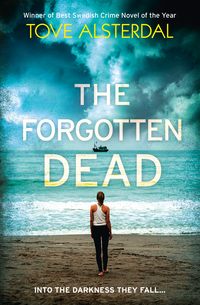
Read the book: «The Forgotten Dead: A dark, twisted, unputdownable thriller»


Translated from the Swedish by Tiina Nunnally

Copyright

Published by HarperCollinsPublishers Ltd
1 London Bridge Street
London SE1 9GF
www.harpercollins.co.uk
First published in Great Britain by HarperCollinsPublishers 2017
Copyright © Tove Alsterdal, 2009 By agreement with Grand Agency
Translation copyright © Tiina Nunnally 2016
Cover design by Alex Allden © HarperCollinsPublishers Ltd 2017
Cover photographs © Max Bailen/Cultura RM/ Alamy Stock Photo (woman on beach); Shutterstock.com all other images.
Tove Alsterdal asserts the moral right to be identified as the author of this work.
Originally published in 2009 by Lind & Co, Sweden, as Kvinnorna på stranden
A catalogue copy of this book is available from the British Library.
This novel is entirely a work of fiction. The names, characters and incidents portrayed in it are the work of the author’s imagination. Any resemblance to actual persons, living or dead, events or localities is entirely coincidental.
All rights reserved under International and Pan-American Copyright Conventions. By payment of the required fees, you have been granted the non-exclusive, non-transferable right to access and read the text of this e-book on screen. No part of this text may be reproduced, transmitted, down-loaded, decompiled, reverse engineered, or stored in or introduced into any information storage and retrieval system, in any form or by any means, whether electronic or mechanical, now known or hereinafter invented, without the express written permission of HarperCollins.
Source ISBN: 9780008158989
Ebook Edition © August 2017 ISBN: 9780008158996
Version: 2017-05-22
Table of Contents
Cover
Title Page
Copyright
Chapter 1
Chapter 2
Chapter 3
Chapter 4
Chapter 5
Chapter 6
Chapter 7
Chapter 8
Chapter 9
Chapter 10
Chapter 11
Chapter 12
Chapter 13
Chapter 14
Chapter 15
Chapter 16
Chapter 17
Chapter 18
Chapter 19
Chapter 20
Chapter 21
Acknowledgements
About the Author
About the Publisher
Chapter 1
Tarifa
Monday, 22 September
3.34 a.m.
The boat heeled over and the view through the small porthole changed. For a long while she could see only the masts of other boats and clouds, but now she glimpsed the town for a moment. All the windows were dark. If she waited any longer it would soon be dawn.
When she stood up a sharp pain shot through her left leg. The world swayed, or maybe it was the sea and the boat.
Before the man took off he had told her three or four o’clock. She had crept into the corner and sat as still as she could. ‘A las tres, cuatro,’ he said. ‘Esta noche,’ and she understood at last when he held up three, then four fingers and pointed at the sun, motioning that it was setting. Darkness. Night. That’s when she would leave. Tonight.
She couldn’t tell him that she had lost both her watch and her sense of time. That’s what happened when you prepared yourself to die and sank down into the big black deep where time no longer existed.
He had left a rolled-up rug on the floor of the cabin. She didn’t know what a rug was doing on a fishing boat. It was red, and woven in a beautiful pattern; it belonged on a tiled floor in an elegant room. If they have rugs like this in their boats, she thought as she unrolled it and curled up to wait, then I wonder what kind they have in their homes.
All sounds had ceased after that. The clatter of iron tossed onto asphalt, men’s voices, cars that started up and drove off. As the sun set the clouds turned a pale pink until all the colours vanished and the sky looked black and heavy. No moon, no stars, not a single fixed point. Like a silent prayer, a certainty that the world remained the same.
Slowly she pressed down the handle on the steel door. The smell of gasoline and the sea washed over her. She stepped quickly over the high threshold, closed the door behind her, and huddled on the boat’s deck.
The darkness she’d been waiting for had not arrived. The harbour was bathed in the yellow of sodium lights that were taller than church towers. She crouched there quietly and listened. A mooring line creaked when the boat moved. The rattle of a chain, the water sloshing gently against the quay. And the wind. Natural night-time sounds. That was all.
She grabbed the mooring line and slowly, very slowly, pulled the boat closer to the quay. With a dull thud the boat made contact.
She felt the rough surface of stone against her palms. Dry land. With her uninjured leg she kicked off and heaved herself up onto the dock. She rolled over and landed on her stomach behind a pile of rolled-up fishing nets. When she looked along the quay she saw a similar net with a rug covering it. So that’s what the fisherman uses those rugs for, she thought, to protect his nets from the rain and wind, or from animals that roam about, looking for fish scraps.
A few seconds passed, or maybe it was minutes. Everything was quiet, except for the wind and the beam pulsating on and off from the lighthouse.
She took a deep breath and then ran, stooping forward, moving as fast as her injured leg would allow, past a harbour warehouse. With his finger the man had drawn on the floor the way she should follow the wall out of the harbour, continue along the shore, and then go up through the town. To the bus station. From there she could catch a bus to Cádiz or Algeciras or Málaga. Cádiz was the name she recognized.
She stumbled over some pipes and heard the sound reverberate between the stone walls. Quickly she pressed herself close to a container.
There are guards, she thought as she listened intently. I can’t let myself be fooled by the calm and the quiet, and besides it isn’t really quiet. I can hear the surf striking the seawall, and the wind making the sheet metal clatter somewhere nearby, but I don’t hear any footsteps, and no one can hear mine.
She looked down at her bare feet. Her shoes had been swept out to sea, along with her skirt and cardigan. Now she was dressed in a green jacket that she’d found draped over her when she awoke on the deck of the fishing boat. In the cabin she’d found a towel and tied it around her hips as a skirt.
She pulled the cap further down over her forehead, climbed carefully over a pile of rebar. Hunched over, she ran the last bit before sinking onto a heap of empty plastic bottles bound for recycling.
This was where the harbour ended. She was hemmed in. In one direction was the high wall, in front of her a stone grate two metres high, and beyond that more harbour warehouses. She could see a section of street through the gaps, and some flowering weeds had pushed up through the holes in the asphalt. In the distance the ruin of a huge fortress loomed like a stone skeleton against the sky.
Her eyes hurt. She felt the strain of trying to focus in the yellow light, which was neither bright nor dim — more like a never-ending dusk. If she closed her eyes she would plunge into emptiness. It had been a long time since she’d slept a whole night through.
She got onto her knees and paused. That was something she’d learned in the past few months: to look all around, take notice of everything, and carefully plan her route.
Then she heard the sound. A vehicle approaching, inside the harbour area. She flattened herself against the ground and held her breath. The beams of the headlamps struck the wall right next to her feet. Bottles and other rubbish glinted in the light. That was when she caught a glimpse of the stairs leading up over the wall, white steps carved into the stone only a few metres away. Then semi-darkness descended again. The vehicle had turned and was heading away. It hadn’t stopped. Thank God it hadn’t stopped. She saw the blue light on its roof before it vanished in the direction of the gates, and the noise of its engine died away. A police car.
She raced up the stone steps and scrambled over the wall. To her surprise she landed on something soft. So far everything she’d encountered in this country had been hard: asphalt, stone, and iron pipes. But now she had soft sand underfoot, and it was like being caressed by the ground.
An umbrella lay overturned on the beach. Just for a moment, she thought, I’ll take shelter, I’ll rest here for only one breath of God’s eternity.
She picked up a fistful of the fine sand and let it run through her fingers. Tilted her head back and looked straight up at the black sky. The wind blew into her face and tore off her cap.
When is this wind going to stop? she thought. When will the wind subside and the sea grow calm?
She stood up again and realized that her leg would no longer support her. Her foot felt like it wanted to leave her body, and she had to drag it behind her.
Crouching down she continued along another low wall that kept the sand from drifting across the road and turning the town into a desert. Sharp weeds cut her feet. She raised her bad foot to see if it was bleeding and discovered that she had stepped in dog shit. Her foot stank. She couldn’t make her appearance in this country with such a foul smell clinging to her foot, but it was too far to hobble down to the sea and rinse it off. What sort of person had she become? She rubbed her sole on the sand to get rid of the stink, then wiped away her tears with her hand and got sand in her eyes. The sand was everywhere.
I could walk along the road instead, she thought. Like a normal person, not like a thief or a dog afraid of being beaten. The road was lit, and she knew it was dangerous. Yet she straightened up and soon the asphalt of the road was beneath her feet. For a moment she felt like a human being again. Someone who walks without fear.
As if such women walk barefoot through town in the middle of the night, she thought. And just then she caught sight of something lying on a slab of concrete, a resting place by the road.
I’m hallucinating, she thought, I can no longer trust my eyes. She went closer and found that her eyes hadn’t deceived her. A pair of shoes. She reached out her hand, but hesitated and looked all around. Was it a trap? Was somebody trying to trick her? But who would think up such an odd idea?
It was nothing short of a miracle. A gift from God. She hesitantly touched the shoes lying there. They were real. And they were made of gold.
All right, she thought and picked them up. They were quite ordinary cloth shoes that had been dyed gold, but still. They almost fit. Just a little tight in the toes. She didn’t intend to complain. Some divine power had placed these shoes in her path. Wearing these shoes she wouldn’t have to step in dog shit.
For the first time since she had come ashore she turned around and gazed back. On the horizon, across the straits, Africa loomed like a gigantic shadow. How close it was. She could see the mountains and the scattered lights in the dark.
Then she walked on, and did not turn back again.
Please let this be a nightmare, thought Terese Wallner when she awoke, lying on the beach. Let me wake up again, but for real this time, and in my own bed.
Slowly she sat up, a terrible pounding inside her skull. The sea was in motion, darkly surging towards her. A flock of slumbering gulls stood in a pool left by the receding tide. Otherwise the shore was deserted.
She closed her eyes, then opened them again, trying to comprehend what had happened. There was nothing around her, that much was true. He was gone.
Her white capri trousers were filthy, and the sequinned camisole and cardigan offered no protection from the cold. The wind cut right through them. Her mouth was as dry as a desert and filled with sand. She spat, cleared her throat, and tried to rub away the sand with her fingers, but it had settled under her tongue and seeped way down her throat. She would need a giant bottle of water, at the very least, to rinse it all away. But where was her purse?
Terese dug her hands into the sand around her. It was hard to see in the dim light. A dark-greyish dusk intermittently pierced by flashes that hurt her eyes, coming from the lighthouse beam. She knew it was out there on an island. Isla de las Palomas, island of the doves. Off limits to tourists. A military area. Reached by a causeway, but with signs posted at the gates. The waves slammed against the rocks out there, spraying high into the air.
Then she caught sight of her purse, and her heart leaped. It was lying half-buried in the sand, less than a metre from the dent where her head had lain. She grabbed it. Everything was still inside: her wallet and hotel room key, her mobile and make-up bag, even her good-luck charm, which was a tiny frog on a keychain. And the bottle of water, thank God. She always carried water with her when she went out, since the tap water tasted so terrible in Spain. There was still a little left in the bottle. First she rinsed her mouth and spat out the water. Then she drank the rest of it, wishing there was much more. She picked up her wallet and opened it, her heart racing. The banknotes were gone. She’d had almost a hundred euros when she’d gone out for the evening. She couldn’t possibly have spent that much on drinks. What about her passport? She rummaged through her bag, but it wasn’t there. Terese was positive she’d brought her passport, as she always did, even though everyone said it wasn’t necessary.
Her shoes were also gone. She stared at her feet. They were suntanned, but white around the edges, with sand clinging between her toes. She looked all around, but the ballet flats she’d worn were nowhere to be seen. When had she taken them off? Before or after? She rubbed the palms of her hands against her forehead to stop the uproar inside.
I need to think clearly. I need to remember.
Had she been barefoot as she ran across the sand with him holding her hand, urging her down towards the sea, both of them laughing loudly into the wind, wondering if their laughter would be blown away?
She pictured his tousled, sun-bleached hair, his eyes gleaming as he looked at her. His arms were hard and sinewy, muscles taut from working out. His shirt fluttered open so she could see his brown abdomen, not a scrap of fat anywhere. She couldn’t believe she was the one he’d taken by the hand as they closed up the Blue Heaven Bar. He’d whispered in her ear that they should move on to someplace else. ‘You can’t go home yet,’ he’d said. ‘Not when I’ve just found you.’
Terese ran her hand lightly over the sand next to her. It was cold. Was there a slight indentation, an impression that his body had left behind, a trace of warmth? But that might simply be her imagination, because the wind blew more steadily in Tarifa than anywhere else on earth, wiping away all tracks in an instant.
No one needs to know what happened, she thought. Nothing did happen. Not if I don’t tell anyone.
She drew her cardigan tighter around her. Sand chafed inside her knickers. She felt sticky down there.
‘But what if someone’s here?’ she’d said as he urged her towards the sea. ‘What if someone’s here, watching us?’
‘You’re thinking about the wrong things,’ he said, kissing her, pressing his tongue deep inside her mouth. And his hands were everywhere, under her camisole and inside her knickers all at once. Then he unbuttoned her tight capris and slid them down and they tumbled onto the sand together. And she thought she might fall in love with him. She thought he was the most gorgeous guy she’d ever been with.
If only her friends could see her now!
You can’t go to Tarifa without having sex on the beach, he’d told her. It would be like not seeing the Eiffel Tower in Paris.
Then she’d felt the sand against her skin as he pressed her down. Grains of sand rose up between her buttocks and pushed between her legs as he guided his cock with his hand, not finding his way at once, rooting around. All she felt was a scraping as he seemed to pump her full of sand.
She shouldn’t have fallen asleep afterwards. It had happened so fast.
From up in the mountains came the endless rumbling of the wind turbines, turning counter-clockwise. She had thought they looked like electric eggbeaters, whipping the air into cream. He laughed when she said that. Terese bit down on her fingertips to keep herself from crying.
He must have thought I was no good. Worthless. Otherwise he would have stayed and made love to me again and again.
Nausea rose up into her throat. She might have had two or three Cosmopolitans, and then a few Mojitos after that.
The whole beach swayed as she stood up. She leaned forward with her hands on her knees and stayed like that until things stopped moving, swallowing over and over to keep herself from throwing up and having to smell everything that spewed out of her. She couldn’t bear to be so disgusting. That was why she staggered down to the water. It wasn’t far, maybe twenty metres.
She moved slowly, setting her feet down carefully, so as not to step on anything unpleasant. The sand felt cold under her feet, and she was surprised when the first wave reached her. The water was almost lukewarm and silky smooth. She waded out a few steps to meet the next wave. When it broke, she caught the foamy water in her hands and splashed it over her face. It was refreshing and made her think a little more clearly.
To her left a low, black ridge rose from the sea, a jetty of large rocks that extended at least ten metres out into the water. It looked like a big prehistoric animal resting on the shoreline, the spine of a slumbering brontosaurus. She waded towards it, thinking that she would climb up and sit on the rocks at the very end. Let the sea wash over her wrists for a while. That usually helped against nausea. If she did throw up, the vomit would vanish into the water in seconds and be forgotten.
The water surged over her ankles. The wind from the sea picked up force. She’d thought the jetty would be hard and sharp, but when she set her foot on the first rock to clamber up, it felt soft and slippery and slid away.
She shrieked and fell forwards onto the rocks, striking her shoulder. She hauled herself up onto the jetty, quickly drawing her feet out of the water. Then she leaned forward and peered down. She had to find out what sort of revolting fish she’d stepped on.
The waves receded and the sea prepared to send in the next onslaught. Terese stared, the roaring sound growing inside her head.
It wasn’t a fish. A hand was sticking up out of the water, attached to an arm below the surface. For a long moment she stared at the place where the arm transitioned into a shoulder and then became an entire body. A person was lying there, wedged between the rocks. A black person.
She whimpered when she realized that was where she’d placed her foot. She’d stepped on a corpse. On the chest or stomach. She didn’t want to know where. She sobbed and stammered and slid backwards up onto the ridge, scraping her soles hard against the rough surface, trying to get rid of that soft and slippery feeling on the bottom of her foot.
But she couldn’t resist taking another look. It was a man lying down there. That much she could clearly see. His skin was black and shiny with water. Like a fish, an eel, something slimy that lived in the sea. He was naked. She thought she could make out an animal creeping along his shoulder, and against her better judgement, she leaned forward. The next wave struck the rocks and the shore, spraying up into her face and then receded, the water foaming and roiling around the body. It looked as if it were moving. For an instant she thought the black man would rise up, grab hold of her ankle, and pull her down into the water. What if he was alive?
At that moment the first traces of morning light appeared beyond the mountains, and the colour of the sea changed to green. She was looking directly into the face of the dead man. His eyes were closed, but his mouth was wide open, as if uttering an inaudible drowned scream, his teeth gleaming white and swaying under the water.
Dear God in heaven, thought Terese. Papa, please help me. I’m all alone here.
Then her stomach heaved, and she pressed her hand to her mouth as she made her way across the rocks and tumbled down the other side. She was still throwing up as she ran, staggering, away from the scene.
Chapter 2
New York
Monday, 22 September
According to the charts, I was probably in my seventh week. I’d put off taking a pregnancy test for as long as possible, hoping in my heart that Patrick would come home. Then we could have done it together. Not the actual peeing on the test stick, of course. There had to be a limit. But the waiting for the stripe to appear.
My pulse quickened as I took my cell phone out of my jacket pocket. I might have missed a call because of all the traffic noise.
I hadn’t. The display was blank.
There had to be some perfectly natural explanation, I told myself. For Patrick, his work was everything, and it wouldn’t be the first time that he’d become so immersed in some ugly and complicated story that he forgot about everything else. He wouldn’t give up until he’d turned over every last stone. Once, three years ago, before we were married, I didn’t hear from him for a whole week, and I was sure that he’d got cold feet and left me. It turned out that he’d latched onto some small-time gangsters in DC and had ended up sitting in jail down there, wanting to do in-depth research from the inside. He’d come home with a broken rib and a report that was nominated for a Pulitzer Prize.
I tapped in his speed-dial number for the eleventh time this morning.
If you answer, I promise we’ll do whatever you want, I thought as the call went through. We’ll leave Manhattan and buy that house in Norwood, New Jersey. If it has already been sold, we’ll find one just like it. And then we’ll have babies and invite the neighbours over for barbecues, and I’ll quit the theatre and start sewing appliquéd baby hats. Whatever. If only you pick up.
I heard a click on the line signalling his voicemail. Hi, you’ve reached Patrick Cornwall …
The same message I’d heard when I woke up in the morning, all last week. It sounded emptier with each day that passed.
If I’m not answering my phone, I’m probably out on a job, so please leave a message after the beep.
It had been ten days since he’d called.
That was on a Friday.
I was in Boston with Benji, my assistant, to pick up a chair dating from the Czarist period in Russia. That piece of furniture was the last puzzle piece needed for the staging of Chekhov’s Three Sisters. It had belonged to an ageing hairdresser’s paternal grandmother, who had fled St Petersburg in 1917.
Patrick had phoned just after I finished the transaction. Benji and I had each taken hold of one side of the chair and were on our way down a narrow flight of stairs in a building that looked like it might collapse at any minute from sheer exhaustion.
‘I just wanted to say goodnight,’ said Patrick from across the Atlantic. ‘I miss you so much.’
‘This isn’t the best time,’ I said, propping the chair onto a step while Benji held on tightly so the precious object wouldn’t tumble down the stairs.
The hairdresser stood in the doorway above us, watching nervously. I really wanted to get out of there before he changed his mind. He’d told us that this chair, which he’d inherited from his grandmother, was the dearest thing he owned, but he wanted to see Mother Russia before he died. Otherwise he would never have even considered selling it. If he had enough money, he wanted to buy a burial plot near the Alexander Nevsky church in St Petersburg, where the great men of his native country had been laid to rest.
‘You won’t believe what a story this is going to be,’ Patrick went on. ‘If it doesn’t turn out to be the investigative story of the year, I don’t know what—’
‘Are you in a bar or something?’ I glanced at my watch. It was 5.45 in Boston. Midnight in Paris. It warmed my heart to hear his voice.
He was audibly slurring his words. ‘No, I’m back at the hotel,’ he said. There were sounds in the background, a car honking, voices nearby. ‘And you know what I’m looking at right now? The dome of the Panthéon, where Victor Hugo is buried. I can see straight into the garret windows of the Sorbonne too. Did you know people live up there under the eaves? But their lights are out now, and they’ve gone to bed. I wish you were here.’
‘Well, I’m standing in a stairwell in Boston,’ I said, as I heard the hairdresser start arguing with Benji. Apparently he was asking for more money.
‘I’ll be damned if human life is worth anything here,’ Patrick went on. ‘Nothing but objects that can be bought and sold.’
‘I really have to go, Patrick. Let’s talk tomorrow.’
I could hear him taking a swig of something.
‘I can’t talk about it over the phone,’ he said, ‘but I’m going to plaster this story all over the world. I’m not going to let them think they can silence me.’
‘Who could possibly do that?’ I replied with a sigh, grimacing at poor Benji, whose face was starting to turn an alarming shade of red. I had no idea how much it might cost to be buried next to Dostoevsky, but it had to be more than my budget could handle.
‘And afterwards I went out for a while, over to Harry’s New York Bar, just to find somebody to speak English with. Did you know that Hemingway went there whenever he was in Paris?’
‘You’re drunk.’
‘I needed to clear my head and think about something other than death and destruction. You have no idea what this journey is like, I’m headed straight into the darkness.’
‘Sweetheart, let’s talk more in the morning. OK?’ I was having a ridiculously hard time getting off the phone. A small part of me was afraid he’d disappear if I ended the call.
Then I heard a shrill ringtone somewhere near him.
‘Just a sec,’ said Patrick. ‘Somebody’s calling on the other phone.’
I heard him say his name with a French accent. It sounded funny, as if he were a stranger. Who would be phoning him in the middle of the night in a hotel room in Paris? Patrick raised his voice, shouting so loud that even the Russian standing above us must have heard him. He said something about a fire, and God.
‘Mais qu’est-ce qui est en feu? Quoi? Maintenant? Mais dis-moi ce qui se passe, nom de Dieu!’
Then he was back on the line.
‘I’ve got to run, sweetie. Shit.’ I heard a bang, as if he’d knocked something over, or maybe stumbled. ‘I’ll call you tomorrow.’
We both clicked off, and that was the last I’d heard from him.
I cut across 8th Avenue, heading for the Joyce Theatre. Out of the corner of my eye I saw a whirling blue light at the next block, but the sirens seemed to be coming from far away, from another universe, where none of this was happening. The silent phone in my hand. The tiny speck growing inside me. Patrick, who didn’t know he was going to be a father.
‘Ally!’
That was the girl at the reception desk — Brenda something or other — calling to me as I entered the theatre. ‘Your last name is Cornwall, right? Alena Cornwall? There’s a letter for you.’ She held up a fat envelope. ‘From Paris.’
My heart leaped as I took the envelope.
It was addressed to Alena Cornwall, c/o The Joyce Theatre, 8th Avenue, Chelsea, New York.
There was no doubt it was his handwriting. Neat letters evenly printed, revealing that Patrick had once been a real mama’s boy.
The envelope felt rough to the touch and seemed to contain more than just paper. According to the postmark, it had been sent from Paris a week earlier, on 16 September. Last Tuesday. The image on the stamp showed a woman wearing a liberty cap, her hair fluttering, in a cloud of stars. The symbol for France and liberty.
‘When did this get here?’ I asked, looking up at Brenda. ‘How long has it been lying around?’
‘I don’t know,’ she said, wiping her fingers on a paper napkin. Under the desk she always kept a stash of sticky Mars bars, which she ate in secret. ‘Maybe on Friday. I wasn’t working that day. I guess they didn’t know where to put it.’
I went down the corridor, which led to the offices and dressing rooms. Why the hell couldn’t I even get my mail delivered on time? Certain people seemed to think I didn’t exist because I didn’t have a proper job contract or mailbox. But why on earth would Patrick send the envelope to the theatre and not to our apartment? That seemed incredibly impersonal. And he hadn’t even managed to write the whole address. No street number and no zip code. That had to be significant.
He must have been in a hurry. Something had happened. Maybe he’d met somebody new and didn’t dare come home to tell me. Maybe he was leaving me.
I stopped abruptly when a door crashed open, right in my face, and out rushed one of the dancers from the show.
‘But I nearly killed myself!’ Leia cried. ‘Don’t you get it? The wall practically reared up in front of me.’
I groaned loudly. Leia was a 22-year-old bundle of nerves who’d been singled out as the next big star on the New York dance scene, which had made her believe that the rest of the world revolved around her. She opened her eyes wide when she caught sight of me.
‘You need to do something about it,’ she said. ‘Or else I’m not setting foot on that stage ever again.’
‘I can’t rebuild the whole place,’ I told her. ‘Everybody knows how cramped the space is off-stage. You need to ask someone to stand there and catch you. That’s what they usually do.’ I turned my back on her and kept on walking. I had no intention of grovelling before a girl who was named after the princess in Star Wars.
‘You shouldn’t even be doing this job,’ she yelled after me. ‘Because you don’t care about other people.’
I turned around.
‘And you’re a spoiled little diva,’ I said.
Leia ran into her dressing room, slamming the door behind her.
The envelope I was holding was making my hand sweat.
I went into the small, windowless cubbyhole that was the production office for visiting ensembles and shut the door, but not all the way. Then I tore open the envelope.
A little black notebook tumbled out, along with a small memory stick and a postcard of the Eiffel Tower. I felt a burst of joy as I read the brief message.
Don’t worry, I’ll be home soon. There’s just one more thing I have to do. Love you always. P.
P.S. Keep this at the theatre until I get back.
I read the words over and over.
The air was getting stuffier in the cramped office. The walls were closing in on me, and I had to kick open the door to make the space seem bigger. I reminded myself what I’d memorized: Turning left, the corridor led to the loading dock on 19th Street. Turning right, I could reach the foyer, where the art deco stairs led up to street level. There were exits. It wouldn’t take me more than thirty seconds to run outside.
I sank back onto the desk chair and studied the famous steel structure on the front of the postcard.
There’s just one more thing I have to do, he’d written. The envelope had been postmarked a week ago. Shouldn’t he be done with whatever it was by now?
I leafed through the notebook. Scattered words and sentences, names and phone numbers. Why had he sent this to me? And why keep it at the theatre instead of taking it home? I saw darkness gaping beneath the illusory cheerfulness of the postcard.
Don’t worry meant that I had every reason to be nervous. I’d worked in the theatre long enough to know that people don’t say what they mean. The true meaning is hidden behind the words. I’ll be home soon and when I get back sounded like simple, practical information, but the words could just as well mean that he was trying to fool me. Or himself.
I stuck the memory stick in my laptop. While I waited for the pictures to upload, I slipped into an emotional limbo, a neutral position between plus and minus. It was something I did on opening nights or in disastrous situations. When Mama had suffered an embolism and I’d found her dead in her apartment, I’d wandered about in that state for several weeks afterwards. I’d finished up the set design for a music video at the same time as making arrangements for the cremation and funeral. My friends began telling me to see a psychologist. Instead, when it was all over, I slept for two weeks, and then I was ready to go back to work.
A picture appeared on the screen. It was blurry, showing a man partially turned away from the camera. In the next photo I saw two men standing outside a door. It seemed to be night time, and this picture was also blurry. I scrolled through more images, but couldn’t make any sense of them. Patrick was definitely not a great photographer. Words and language were his forte, but he was usually able to take decent pictures. These were awful. Nothing but hazy-looking men with disagreeable expressions. One of them appeared in several photos. A typical bureaucrat or banker, or maybe an advertising executive, with thin, rectangular glasses and light eyes, wearing an overcoat or suit. The pictures seemed to have been taken from some distance, in secret. The men could have been any anonymous strangers, in any city on earth. And they told me absolutely nothing about what sort of story Patrick was so immersed in over there.
I closed my eyes to think for a few minutes.
Then I opened the browser on my laptop and found the home page for The Reporter. I looked for the phone number of the editorial office.
‘I’d like to speak to Richard Evans,’ I said on the phone. He was the editor of the magazine that bought Patrick’s freelance stories, and a legend in the publishing world.
‘One moment, please.’
I was put on hold. An extended silence, while I waited to be put through. Then I heard that Richard Evans was not available. After half an hour of being rerouted to one person after another, I reached an editorial assistant, and I was able to trick her into telling me where he was. When I said that I had a story to deliver from Patrick, she told me that the editor would probably be back from the Press Café in an hour because he was due at a meeting. The assistant advised me to make an appointment. Instead, I slipped out of the theatre and took a cab to the corner of 8th Avenue and 57th Street. That was the location of the Universal Press Café, just across from the magazine offices.
Richard Evans was sitting next to the window, leaning over a table that was too low for his tall body. He was deeply immersed in a newspaper and gave me only a brief glance as I approached.
‘There are more tables over there,’ he said, motioning towards the other side of the café. Even though he was over sixty, his blond hair was thick and wavy.
‘I need to talk to you,’ I said. ‘My name is Ally Cornwall, and I’m married to Patrick Cornwall.’
Evans put down his paper. Though his gaze was piercing, his eyes were the faded blue of washed-out jeans.
‘Oh, right. Aren’t you from somewhere in Hungary? It seems to me Patrick mentioned that.’
‘I’m from the Lower East Side,’ I said and boldly sat down on the chair across from him. That was my standard reply whenever anyone wondered where I was really from. ‘We met once, at the celebration for the magazine’s fifteenth anniversary.’
‘Sure, of course.’ He managed a half-smile. ‘That’s also when Cornwall was nominated for the Pulitzer.’
‘But he didn’t get it,’ I said, waving to the waiter, who came rushing over to wipe off the table. I ordered a glass of orange juice.
I had stood beside Patrick on that evening, squeezed into a beautiful emerald-green sheath dress that I’d borrowed from a costume supplier. I had clutched his hand as the mingling stopped and everyone turned to look at the TV screens. In Patrick’s line of work there was no higher honour than the Pulitzer Prize. His series of articles about the Prince George police district in Maryland had aroused tremendous attention, and being nominated for the prize was the biggest thing that had ever happened to him. But in the end, his name was not the one announced. Instead, the prize for the best investigative reporting went to a couple of journalists from The New York Times, for uncovering insider trading on Wall Street. Patrick got good and drunk. The following year he’d spent four months, two of them without pay, reporting on who the losers were in the new economy. It was a blistering account that was given extensive coverage in The Reporter and had stirred vigorous debate. It was also cited by numerous politicians. But Patrick was not nominated again, and his self-esteem had suffered ever since.
‘I need to ask you about the assignment that Patrick’s on,’ I said. ‘About what he’s doing in Paris.’
‘Is he still over there? I thought he was supposed to deliver something soon.’
Evans frowned as he shovelled scrambled eggs onto his fork. It was clear that he would have preferred to eat his breakfast in peace.
‘I can’t get hold of him,’ I said. ‘He hasn’t answered his cell phone in over a week.’
‘It’s not always possible to call home when you’re out in the field,’ said Evans, peering at me over the rims of his glasses.
‘I know that,’ I said. ‘But we’re not exactly talking about the caves of Tora Bora. This is Paris. Europe. They have reception everywhere.’
Evans turned his fork to look at the piece of sausage he’d snared. It glistened with grease.
‘Well, at any rate it looks like a hell of a good story he’s working on over there. He was very insistent that I hold space for it in one of the October issues, front cover and all.’
‘What’s it about?’ I asked. ‘His article, I mean.’
Evans raised his eyebrows. I swallowed hard. It was embarrassing to admit how little I knew about my husband’s work.
‘Patrick is always careful to keep the magazine’s secrets,’ I added. ‘He never talks about his articles in advance.’
I had done my best to remember what he’d said. When he was drunk, on the phone, he’d talked about death and destruction, and about human lives not being worth anything. He’d mentioned cafés he’d been to in Paris, but not who he’d interviewed.
‘Selling human beings,’ said Richard Evans.
‘Selling human beings? You mean like trafficking? Prostitution?’
‘No, not exactly.’ He wiped his hands on a napkin. ‘He’s writing about immigrants who are exploited as labourers. Slave labour, pure and simple. And how the problem is growing as a result of globalization. Poor people who die inside containers when they’re being smuggled across borders, suffocating to death, or drowning in the seas between Africa and Europe, their bodies washing onto the beaches. A few years ago a whole group of Chinese immigrants drowned in England when they were forced to harvest cockles. They were farmers from somewhere, and no one had warned them about the tides. A shitty way to die, if you ask me.’
‘England? So what is Patrick doing in France?’
‘Exactly. There’s no clear angle.’ Having finished his breakfast Evans waved to the waiter behind the counter and then pointed at his plate. ‘When we buy foreign stories, there has to be a fresh perspective, a unique viewpoint. But that’s something Cornwall should know by now. He’s been working for us a long time. How many years is it? Five? Six?’
‘Patrick usually says that journalists who know exactly what they’re after are dangerous,’ I told him. ‘They merely confirm their own prejudices. They don’t see reality because they’ve already decided how they want it to look.’
Evans’s eyes gleamed as he smiled. Like glints of sunlight in ice-cold water.
‘I actually see something of myself in Patrick, back when I was his age. Equally stubborn and obsessed with work. The belief that you’ll always find the truth if you just dig deep enough. Not many people do that any more. These days journalists are running scared. Everybody’s scared. They all want a secure pension. They want to take care of their own.’
He ordered an espresso. I shook my head at the waiter. The smell of scrambled eggs and greasy sausage was already turning my stomach.
‘But why did he go to Europe?’ I asked. ‘All he had to do was go over to Queens to find that sort of thing going on.’
Evans shook his head and gave me a little lecture about why a story about the miseries in Queens wouldn’t sell as well as a report from Paris and Europe. He claimed that adversity is more appealing from a distance.
I felt sweat gathering in my armpits. The café was getting crowded. The lunch rush had started, and it was filling up with businessmen and media people.
‘And the whole point of hiring freelancers is that they’re willing to go places where no one else will go. That’s something all those marketing boys up there don’t understand.’ He pointed his finger at the top floors of the building across the street. ‘The minute I buy a story that’s the least bit controversial, they think I’m going to drag them back to 1968.’
I knew that The Reporter had been forced to shut down in ’68 because management couldn’t agree on how the Vietnam War should be depicted, but that wasn’t what I’d come here to discuss.
‘Are you saying he’s gone undercover?’ I asked.
‘If so, it would have been smart to talk to me about it first, but you never know. Maybe he’ll surprise us.’
Evans sighed heavily and ran his hand through his thick hair. According to Patrick, Evans would have been promoted to editor-in-chief, if only he’d been able to stay on budget. He understood the profession, unlike the marketing yokels who were in charge lately. They were people that Patrick despised as much as he worshipped old journalists like Bernstein, Woodward, and Evans.
‘In the past I could spend hours with the reporters,’ he said. ‘We’d go over the story in advance, try out specific analyses, and toss around various angles to take. But there’s no time for that any more.’
The tiny espresso cup had shrunk to the size of a doll’s cup in his big hand.
‘I was in Vietnam. I’ve seen Song My. I was in Phnom Penh right before the Khmer Rouge came in. Nowadays reporters come out of college thinking that journalism has to do with statistics. But if you really want to get into a story, you need to go out and smell reality.’
I glanced at my watch. It was 11.15 in New York. Almost dinnertime in Paris. I had to get back to the theatre.
‘So if I’m reading you right,’ I said, my voice chilly, ‘you’ve sent Patrick to Europe and paid him an advance, but you know almost nothing about the story he’s working on, and there’s no definite delivery date. Is that usual?’
‘No, no. We haven’t paid him any advance.’
My blood stopped. Time stood still. People passed by in slow motion outside the window, munching on sandwiches. I stared at Evans, but couldn’t think of anything to say.
‘We’re not allowed to pay out advances any more, not to freelancers. It’s a policy set in stone. I can remember when I was going to propose to my first wife, and I called up the editor to ask for an advance so I could buy her a ring. They’ve discontinued everything that once made this job fun.’
He shoved his newspaper in his briefcase and stood up.
‘I’m sure he’ll get in touch soon. Cornwall always delivers.’
I got up too. The whole place seemed to sway. Patrick had lied to me. He’d never done that before. Or had he?
‘What if he doesn’t?’ I said, and then cleared my throat. ‘I mean, hypothetically speaking. What would the magazine do then?’
‘He’s not on any specific assignment, so the magazine has no official responsibility, if that’s what you mean. As a freelancer, he’s in charge of getting his own insurance coverage.’
I felt someone shove me in the back as two students took over the table where we’d been sitting. Talking loudly, they put down their books and latte cups.
‘That’s all part of being freelance. Right?’ said Evans. ‘If you want to be free, with nobody telling you when to get up in the morning or send you out on routine jobs. I really miss those days.’
He smiled as he wrapped his shiny woollen scarf one more time around his neck.
‘When you hear from him, tell him hello and that I still have space in late November.’
I gritted my teeth. In his eyes I was merely a nervous wife in need of reassurance, so the boys could be kept out in the field. Phnom Penh? Kiss my ass.
Evans was busy putting his wallet away in his inside pocket, but then he stopped.
‘There’s a stringer in Paris that we sometimes use,’ he said, shuffling through a bunch of business cards. ‘If they decide to set fire to some suburb again, we give her a call.’ He dropped a few cards, and I watched them sail to the floor. Pick them up yourself, I thought.
‘She’s a political journalist.’ He bent down to gather up the scattered business cards. ‘I think I gave Patrick her name too. Damn. I can’t find it, but I’ve got it on my computer.’ He handed me his own card. ‘Send me an email if you want the info.’
‘Sure.’ I didn’t bother with any final courtesies and left the café, walking ahead of him and turning right on 8th Avenue. It was thirty-eight blocks to the theatre in Chelsea, and I walked the whole way. At that moment I needed air more than anything else.
‘There stands an oak on the shore, with golden chains around its trunk.’ The dancer on stage made the words float, her voice as delicate as a spirit or a dream.
The others joined in, repeating the words in a rhythmic chorus as Masha danced her longing. On the stage stood three substantial chairs from Russia’s Czarist period. I’d leased two of them from a private museum in Little Odessa, and then I’d spent weeks searching half the East Coast until I found the third chair in Boston.
I sank silently onto the seat next to Benji in the auditorium, noting that it had been worth all the effort. I watched the bodies in motion around the solid chairs, which were a constant, something on which to rest and yearn to flee. They were also practical obstacles that stood in the way, preventing the dancers from moving freely, forcing detours and pauses in the choreography. Chekhov’s play was about three sisters who spend the entire drama longing for Moscow without ever getting there, as the world around them changes. At first I’d imagined an empty stage, with the starry sky and space overhead, but then I realized that something solid was needed on stage, something that held the sisters there. Why didn’t they just leave? Take the next train?
I touched Benji’s arm to let him know I was back. His real name was Benedict, but I wasn’t allowed to tell anyone.
‘What is it?’ he whispered. ‘Where have you been?’
I shook my head. ‘Not now.’
I hadn’t told even Benji how worried I was. I’d gone about my job as usual, while thoughts of Patrick whirled through my mind.
‘They’re doing Masha now,’ he whispered in my ear.
The light changed from yellow to blue, then switched off before coming on again. The light technician hadn’t yet worked out all the cues.
‘They were supposed to rehearse Irina, but Leia has locked herself in her dressing room. She swears she’s never going to dance in this theatre again. She says there’s evil in the air, and she can’t express her innermost emotions.’
He gave me a sidelong glance and smiled sardonically.
‘And she says it’s all your fault.’
‘Oh my God. What the hell …’
I got up, groaning loud enough to be heard in the whole auditorium. He was talking about that girl I’d called a spoiled diva a few hours ago. Duncan, the choreographer, glared at me from the edge of the stage, motioning with his hand for me to leave. Out. Go fix the situation. OK, OK. I understood the signal.
‘I’ll go talk to her,’ I whispered to Benji. ‘Or do you think that would make her commit suicide?’
The whites of his eyes gleamed blue in the wrongly placed light.
‘I hear she actually tried that once, in all seriousness. It was Duncan who found her. Did you know they used to be an item?’
‘Be right back,’ I whispered.
A small group of people had gathered outside Leia’s dressing room.
‘She won’t come out,’ said Helen, who played the third sister, Olga. ‘She says we should find someone else for the part of Irina. But she knows full well that’s impossible.’
‘Take it easy,’ said Eliza, who was the theatre’s marketing manager. She’d witnessed all sorts of neurotic behaviour. ‘She’ll come out when she starts to wonder if we miss her.’
I knocked on the door.
‘Come on, Leia,’ I called. ‘I shouldn’t have said that to you. This show can’t manage without you. You are Irina. Nobody else can play her the way you do.’
The silence lasted thirteen seconds. I counted. Then the lock clicked. I opened the door and slipped inside the dressing room, shutting the door behind me. The dancer’s face was streaked with make-up. She was still sniffling.
‘I don’t understand what I ever did to you,’ she said. ‘Why are you so mean?’
‘I don’t know what got into me. I guess I’m just stressed out because of the opening night,’ I replied.
‘You don’t care how I feel,’ said Leia. ‘You only think about yourself. Everybody in this fucking business only thinks about themselves.’
‘Everyone’s nervous,’ I said. ‘It’s an important show.’
Leia looked at me from behind her smeared mask. A mask of despair, I thought. Maybe that’s what I should use. Streaked make-up, a person who’s on the verge of falling apart. First the make-up runs, then the whole face gives way, and underneath is an entirely different face. Neither is who she seems to be. There’s yet another face behind the mask, just as real or phony as the outer one.
‘What are you nervous about?’ asked Leia, who had now stopped crying. She cast a glance at herself in the mirror and reached for some cleansing cream. ‘You don’t have to stand on stage in front of an audience that might hate you.’
‘I’m not nervous,’ I tell her.
‘Then why do you keep yelling at me? Why do you call me names if you don’t mean it?’
‘They don’t hate you. They love you.’ I picked up a dress that had been tossed on the floor and brushed it off. What a stupid girl. She couldn’t even take care of her costumes. ‘It just slipped out. I must be tired. That’s all.’
The free sample has ended.