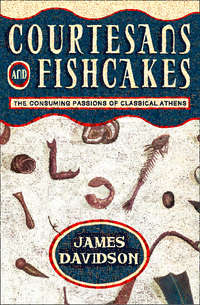
Read the book: «Courtesans and Fishcakes: The Consuming Passions of Classical Athens»
James Davidson
COURTESANS & FISHCAKES
THE CONSUMING PASSIONS OF
CLASSICAL ATHENS

Copyright
William Collins
An Imprint of HarperCollinsPublishers 1 London Bridge Street London SE1 9GF
www.harpercollins.co.uk
Published by Fontana Press 1998
First published in Great Britain by HarperCollinsPublishers 1997
Copyright © James Davidson 1997
James Davidson asserts the moral right to
be identified as the author of this work
All rights reserved under International and Pan-American Copyright Conventions. By payment of the required fees, you have been granted the nonexclusive, nontransferable right to access and read the text of this e-book on-screen. No part of this text may be reproduced, transmitted, downloaded, decompiled, reverse engineered, or stored in or introduced into any information storage and retrieval system, in any form or by any means, whether electronic or mechanical, now known or hereinafter invented, without the express written permission of HarperCollins e-books.
Source ISBN: 9780007329601
Ebook Edition © FEBRUARY 2016 ISBN: 9780007373185
Version: 2016-01-03
HarperCollinsPublishers has made every reasonable effort to ensure that any picture content and written content in this ebook has been included or removed in accordance with the contractual and technological constraints in operation at the time of publication.
Praise
‘James Davidson shows in this stylish, persuasive, scholarly book how classical Athens relished eating, drinking and copulating … It is a serious work, though always seasoned with wit, not only because it puts forward new ideas about big issues in social and cultural history, but also because it has a message for our times, a message unobtrusively but insistently registered.’
OLIVER TAPLIN, Observer
‘Commendably sceptical, Courtesans and Fishcakes is a significant contribution to Classical studies and marks an impressive debut. We will hear more from Mr Davidson.’
CHRISTOPHER STACE, Daily Telegraph
‘“Model democracy,” or model for sensualists everywhere? Ancient Athens – or at least its ruling class – took pleasure very seriously, and this highly enjoyable study concentrates on the important things in life: food, drink and sex. There are fascinating details here about both prostitution and the hetaeras; some of Davidson’s most amusing passages tell of the faux-respectable interpretations put, by prudish scholars, on frankly pornographic vase paintings and verses … For all its entertainment value, this is a serious contribution to classical studies.’
Independent on Sunday
‘A splendid story … Davidson’s canvas is vast.’
PETER JONES, Sunday Telegraph
‘A relaxed interpretation of sensual life in the time of Pericles, Socrates and Plato. Courtesans and Fishcakes is about sex, food and drink and the part all three played in developing Athenian identity. Where others have found exploitation and outrage, Davidson is more likely to have found fun. He spars with Foucault and Freud, biographers and bishops, with open glee.’
PETER STOTHARD, The Times
‘James Davidson with skill teases out deeper meanings from ancient literature to provide an absorbing look at society and politics in the world’s first democracy. If classical history had been like this at school I might have tasted its joys long before now … This book is itself a feast.’
DAVID STAFFORD, Scotland on Sunday
‘It is fashionable for classicists to lament the passing of their light. They have largely themselves to blame. Obsessed with arid language they continued to sell their vision of eternal oranges and sunshine in a land where people ate apples and it rained a lot. So we lost sight of a world that was vibrantly alive. Books like Courtesans and Fishcakes are doing much to turn the tide … Davidson does well with his rich material. He has a fine eye for semantics. It is delightful to learn that the language of purest thought has 33 terms for abusing a tax collector – and 52 for praising a king. Courtesans and Fishcakes [is full of] good academic work, an excellent reinterpretation. But above all, Davidson brings ancient Athens unforgettably to life.’
ROSS LECKIE, The Oldie
‘A worldly study of ancient Hellenic appetites concentrating on eating, drinking, sex and politics – but mostly sex. Whether interpreting erotic images on vases, taking us room by room through a 5th century BC brothel, or explaining the various declensions of Athenian prostitutes, Davidson uses accessible yet scholarly prose.’
ANDREW ROBERTS, Mail on Sunday
‘Excellent, promising, written with biting clarity … to my delight, he blows Nietzsche full of holes and blasts Foucault out of the water. We will watch what he undertakes next with the expectation of delight.’
PETER LEVI, Spectator
‘There’s much fascinating information on the relationships in Ancient Greece between men, women, and boys.’
WILLIAM LEITH, Observer, Summer Reading
‘The motto of the ancient Athenians was “nothing in excess,” but they still knew how to enjoy themselves. James Davidson’s survey of their eating, drinking and sexual habits reveals a more inventively hedonistic society than previous studies of the period. While conspicuous consumption was taboo in the age of Socrates and Plato, the Athenians still drank vast amounts of wine, adopted a myriad of sexual positions and were as keen on exotic fish dishes as any Nineties foodie.’
The Week
‘enjoyable … a splendid debut’
Oxford Mail
‘Eating, drinking and sex were the abiding passions of Classical Athens, but have so far been treated as no more than pleasures indulged in by the wealthy. Now James Davidson puts these pleasures in the context of society and politics and comes up with some startling conclusions. If you thought you knew all about the ancient Greeks, be prepared for some surprises.’
Northern Echo
Dedication
For D. A. D. and G. H. D.
Contents
COVER
TITLE PAGE
COPYRIGHT
PRAISE
DEDICATION
INTRODUCTION
PART I. FEASTS
I Eating
II Drinking
PART II . DESIRE
III Women and Boys
IV A Purchase on the Hetaera
PART III . THE CITIZEN
V Bodies
VI Economies
PART IV . THE CITY
VII Politics and Society
VIII Politics and Politicians
IX Tyranny and Revolution
CONCLUSION
BIBLIOGRAPHY
INDEX
ACKNOWLEDGEMENTS
ABOUT THE AUTHOR
NOTES
ABOUT THE PUBLISHER
Introduction
IN THE COLLECTION of the Vatican Museums is a mosaic signed by one Heraclitus. Across a white background is an even scattering of debris: a wish-bone, a claw, some fruit, various discarded limbs of sea-creatures, the remains of a fish. It is a copy of a famous mosaic by the artist Sosos of Pergamum, called the Unswept Hall. Sosos, whom the Roman antiquarian Pliny called ‘the most renowned’ of all mosaicists, worked in the first half of the second century BCE. He specialized in illusionistic works, trying to turn the unpromising medium of coloured tiles into something lifelike and real. His most famous and remarkable work depicted doves drinking from a birdbath. You could even see their reflections on the surface of the water, says Pliny. A copy was discovered at Hadrian’s villa at Tivoli. It is indeed a fine example of what ancient artists were capable of, achieving a very real sense of the basin’s three-dimensional form and burnished metallic sheen. What is so remarkable, however, about the Unswept Hall, is not its illusionistic ambition, but its objective humility. It is a floor that depicts a floor, closing the gap between art and life. This is most obvious, perhaps, with the white tiles, which have a perfect identity with the white tiles of an unswept floor. More honest than the sipping doves, on one level it really is what it claims to be; it is a trick-floor, impossible to clean.
But the floor is not really the subject at all. The true theme is an unseen banquet, as we can tell from the strewn litter. And this feast still seems to be going on. There was a pause in Greek banquets between the eating part and the drinking part of the meal, when tables were cleared, floors swept, hands washed and perfumes splashed. Sosos’ banquet has not quite reached that stage. Moreover, some of the debris casts rather strange shadows as if it is hovering half a millimetre above the ground, as if it has a little way still to fall.
The subject of this book is similar to Sosos’ – not the ancient banquet exactly, but the pleasures of the flesh that were indulged there: eating and drinking and sex. These are the consuming passions, three varieties of bodily gratification to which the whole human race, according to Plato, was susceptible from birth. Aristotle described them as animal cravings: hunger, thirst and lust, base and servile urges with their true foundation, contrary to appearances, in the sense of touch. This accounts for the gourmand, he says, who prayed for the throat of a crane so he could enjoy his food for the longest time, as it travelled slowly down. More exactly, this book is about the pleasures of the flesh in classical Athens, because although not all the material I have used falls inside the classical period (479–323 BCE – Before the Common Era) and a little of it is not even pure Athenian, it is Athens and the Athenian democracy that provide the context.
Its material is the scraps that have fallen from the tables of ancient literature, snatches of conversation, anecdotes abruptly curtailed and stories that seem to make no sense: an explorer comes across a savage tribe on the shores of the Persian Gulf who live off bread made from fish and ‘fishcakes’ for special occasions; the philosopher Socrates visits a beautiful woman who lives in luxury with no visible means of support and refers obliquely to ‘her friends’; the guests at a drinking-party imagine they are at sea and throw furniture out of the windows to prevent their boat from capsizing; a politician makes a speech about towers and walls and finds himself accused of prostitution; a tyrant finds a lost ring inside a magnificent fish and thinks he recognizes the work of the gods, but when he tells the King of Egypt he immediately breaks off their friendship; the general Alcibiades drinks wine without water, countless statues of Hermes are vandalized in the night and Athens loses the Peloponnesian War.
One particular table has provided especially rich pickings, Athenaeus’ Dinner-sophists or Banquet of Scholars, composed at the turn of the second century of the Common Era (CE), a long work in the form of a dialogue in the tradition of Plato’s Symposium. Instead of discussing the meaning of life or the nature of love, however, Athenaeus’ guests talk only of the banquet itself, of different kinds of food and wine, of famous courtesans and boastful chefs, of cups and riddles, of a league-table of luxurious nations. They are hardly interested in their own period, concentrating on the world before the Romans arrived, particularly the world of classical Athens which had succumbed to an army of Macedonians five hundred years before. Most importantly, the guests are astonishing pedants, bolstering the most trivial comments with a formidable array of quotations from ancient literature, literature which has now almost entirely disappeared.
Very few scholars are interested in Athenaeus himself and his pernickety banquet, but the scraps from his table provide a unique resource for historians of pleasure. Ancient historians often find themselves relying on only one author for matters of the greatest importance. Thanks to Athenaeus, however, those who wish to know what the Greeks thought of crustaceans, or of various courtesans, or of the proper way to drink wine, can draw on a huge number of authors and a wide range of genres. Of course Athenaeus has his own clear predilections and his selection must not be seen as a representative cross-section of Athenian culture or Athenian literature in general. He draws especially on the comic poets and it is Attic comedy, produced each year at festivals of Dionysus, that provides the basis for much of what we know of Athenian life. Unlike the tragedies which gave up on the present early in the classical period, comedy was very much about the contemporary world and contemporary issues. It often named contemporary politicians and public figures or featured them in its plots, resorting to the world of myths and heroes only in order to parody tragic rivals or to set up incongruous juxtapositions between then and now.
Comedy is not the only source, however, for Athenian pleasures. We also have a large number of speeches covering the period from the late fifth century to the late fourth in the corpus of the ‘Attic Orators’, the top ten classical rhetoricians, selected by later critics as suitable models for emulation and preservation – plus a few others who managed to slip incognito through the canon’s net. Most of these speeches are forensic, attacking enemies in the law-courts or trying to provide a feasible defence. Some are deliberative, speeches on public policy delivered in the Assembly. A few are epideictic, demonstration pieces, designed to show off the speaker’s skill. Because of their context they present a very different perspective on pleasure from the festive comedies, emphasizing the dangers that appetite presents to the household and the city and to fellow-citizens; not their own appetites of course, but those of their enemies.
Apart from these sources, there are a large number of miscellaneous works preserved in Athenaeus or independently; treatises and pamphlets on various themes, including one very famous manual of sex and seduction by Philaenis, a classical Kama Sutra, of which, sadly, only the barest scraps survive. There are also a large number of anecdotal works by the likes of Lynceus of Samos and Machon, who collected the witticisms of courtesans and put them in verse. Chief among these anecdotal works, perhaps, is Xenophon’s Memoirs, in which the philosopher Socrates discourses on various issues of everyday life, advising the author against kissing a handsome boy, and engaging the mysterious beauty, Theodote, in conversation.
It might be thought that such an interesting subject, fundamental as well as sensational, with such a wealth of material to work with, must have been thoroughly investigated long ago, but this is far from being the case. Even now there is considerable resistance to an area of ancient studies which is seen as no more than light relief between papers on more important topics. It is true that this kind of antiquarian/philological research into customs and lifestyles has a rather longer pedigree than other branches of ancient history. Isaac Casaubon, whose notes on Athenaeus first appeared in 1600, can still be useful to modern researchers. On the other hand, since the beginning of the twentieth century, and especially since the Second World War, there has been an astonishing decline in interest in the subject among professional historians. In part their attention has been absorbed by archaeology and inscriptions, which often have a more straightforward relationship to the ‘Real World’ than fantastical authors such as Aristophanes or unreliable gossips such as Lynceus, and which often carry with them the kudos of new discoveries. Material objects, documents and ‘solid facts’ carry a kind of mystical objectivity for many historians, constituting what some refer to as the ‘meat and potatoes’ part of history. In fact, some historians are so distrustful of airy-fairy texts and soufflés like Athenaeus, they would rather not use them at all, trusting only to silent stones, ground-plans and artefacts when conducting their research – as well as large doses of their own (objective) intuition. Ancient history, however, is not so rich in resources that it can afford to ignore any of them. A neglected or misused text is as much a lost artefact as something buried several feet underground.
While scholarly attention has been distracted elsewhere, some extraordinary gaps have been allowed to open up in our knowledge of ancient culture and society. The lack of work on Greek hetero-sexuality and (until recently and outside France) ancient food are particularly striking. I can only think that prostitutes and courtesans are not considered worthy of women’s history or that they have been overlooked in the belief that Greek homosexuality was more significant or important. Even at the end of this research I am left not with a sense of satisfaction that the material is exhausted, but with the realization that much is still preliminary and an anxiety about how much remains to be done. Anyone with time on their hands and a desire to make a substantial contribution to human knowledge will find few more promising areas of investigation than Greek bring-your-own ‘contribution-dinners’, Attic cakes, the ‘second’ dessert table, the consumption of game, gambling, perfumes, flower wreaths, hairstyles, horse-racing, pet birds and all the various entertainments of the symposium, including slapstick, stand-up comedy and acrobatics. The only necessary qualification would be a willingness to take these subjects seriously (not too seriously), since they are worth much more than a superficial survey. With the comic fragments recently edited and judiciously annotated by Rudolf Kassel and Colin Austin, there is no longer any excuse.
I mention the general neglect of this area of ancient studies in part to correct a common and rather bizarre misapprehension that sex and other indulgences have received more than their fair share of scholarly attention in recent years and to crave the reader’s indulgence for my notes. It has occasionally been necessary to spend time and space establishing some very basic facts which have to be argued for and supported with citations from ancient texts, before going on to the more interesting task of drawing out their implications, suggesting solutions and putting them in context, the main role of the second half of the book. However, those who get impatient with the spade-work can comfort themselves with the thought that they are at the cutting edge of this soft subject.
To be fair, one problem with this kind of research has always been that the evidence is rather slippery and difficult to handle. Historians of the ancient world prefer to work with honest-seeming, authoritative sources, such as Thucydides or Polybius who seem to have done their homework properly. Greek comedy, on the other hand, though it was clearly dealing with the real world, was far from straightforwardly realistic, as anyone will know who has attended a performance of one of Aristophanes’ plays. This means we have to approach comic fragments with caution to see whether they are referring to an everyday situation or some fantastic scenario. If a comic poet talks of a law to stop fishmongers drenching their fish with water to make them look fresher than they really are, do we imagine there really was a law at Athens to that effect, or rather that a law has been passed in the play because of some imaginary crisis (the Clouds boycotting Athens, Zeus on strike, or the goddess Truth taking over the city)? On the other hand, it is often in the most extravagant images that the most powerful insights into Athenian society are found. Aristophanes’ Ecclesiazusae, for instance, a satire on women seizing power, opens with the ringleader addressing a lamp, the trusty confidante of women’s secrets and witness to their adulteries, whose silence alone they trust. Few would consider Athenian women ever seriously contemplated a revolution or that they ever spoke to their lamps. Nor is it likely that they were engaged in endless bouts of sex with forbidden lovers. On the other hand, the address to the lamp throws light on various aspects of Athenian life and culture that can be confirmed from elsewhere: that the sexes were often segregated, that men looked on women as rather mysterious creatures, that the segregation carried an erotic charge, that women had to be extremely careful if they broke the sexual rules, that sexual insubordination and political insubordination could be linked in the imagination and on stage.
Speeches too have their pitfalls. Standards of proof were rather low in Athenian courts and truth was not necessarily placed at a premium. Modern scholars are extremely doubtful that the events are as the orators describe. They suspect orators of inventing laws, lying about their opponents’ families and status, lying about their age. One prosecutor positively boasts that he has no evidence for his accusations apart from rumour, whose testimony he praises to the skies. On the other hand, we know that the defendant against whom rumour testified was convicted and although the orators are unreliable witnesses of what went on in Athens, they are excellent witnesses of what was thought convincing. We may not really believe that a man could ‘spend an entire estate on affairs with boys’ or that the largest fortune in Greece could evaporate because of expensive parties and women, but the Athenians certainly did believe these things and that is interesting in itself.
It will be clear from this that ultimately the subject of this book is not so much the pleasures of the flesh themselves, but what the Greeks, and especially the Athenians, said about them, the way they represented them, the consequences they ascribed to them, the way they thought they worked. Instead of looking at the ancient sources as windows on a world, we can see them as artefacts of that world in their own right. We know that the Unswept Hall is not an accurate representation of the floor of a banquet. The randomly scattered rubbish is in fact not random at all, but evenly spaced, and contains a bit of everything without the repetitions and haphazard accumulations we would expect. But even though the picture is ‘wrong’, it might tell us a lot about the importance of banquets in the ancient world, the nature of realism, the notion of extravagance, of randomness; the artist’s ‘error’ might even give insights into why the lottery was made the linchpin of Athenian democracy. If, to take another example, a particular poet describes a courtesan as whorish, greedy and deceitful, it is rather difficult to decide now whether his assessment was accurate. On the other hand, we know for sure that it is very good evidence for the way courtesans were represented on stage. Alexander the Great may or may not have died from taking a massive swig of wine, but many Greeks said he did, and their ideas about the effects of wine are what concern us.
This kind of investigation is known as the study of discourse, a term popularized by the French philosopher and historian Michel Foucault. Discourse is more or less the same thing as ‘attitudes’, if we allow that term its full balletic implications of posturing and plurality. In Greece, above all, where the sophists had made praising gnats, playing devil’s advocate and arguing black was white a national sport, it would be dangerous to take our sources as good evidence even for their own views, but what is interesting about Foucault’s work is the realization that misrepresentations are just as interesting as representations, and even more useful, when you can identify them, are outrageous lies.
Critias, for instance, a right-wing philosopher and a leader in the oppressive regime imposed on Athens after its defeat in the Peloponnesian War, is almost certainly lying when he says the Spartans drank only water from their mug-like cups. If this was no more than a personal idiosyncrasy we could not draw any broader conclusions, but his little lie is part of a pattern we find in other authors who spend time and effort defending Spartan institutions, their effeminate long hair, their fancy cloaks dyed Tyrian purple. A whole host of other sources, moreover, seem to contradict Critias directly, representing Spartan cups as the kind of cups used for the most degenerate kind of drinking: strong wine, greedy swigs, drinking solely to get drunk as quickly as possible. Critias is clearly participating in a debate defending the Spartan reputation for asceticism in the face of the quite different reputation acquired in Athens by their cups.
These debates over Sparta and over the right way to drink, carried on by many different authors over a long period of time, are like super-discourses, a kind of generalized conversation carried on within Athenian culture, of which Critias’ extraordinary defence of Spartan cups is merely a particular exemplar. These ideal and repetitive debates are, for some cultural historians, the real object of historical investigation, and individual texts mere instances.
Historians not only use texts as windows, sometimes they assume that is their purpose too, as if the Greeks wanted to give us a view on the ancient world, to let posterity see what they were like, as if the real audience is not the audience sitting in the law-courts or the theatre, but us. Very occasionally, this view is fair enough. Thucydides wanted to put down the most accurate record of the war he lived through and intended his history to be a ‘possession for all time’ which includes us, even though he may not have been thinking quite so far ahead. People produce images and texts for all kinds of reasons, for beauty, for art itself, to make a living, to commemorate, to amuse, to create an atmosphere, as therapy and so on. It seems fair to say, however, that in Critias’ case it is the debate about Sparta that causes him to put pen to paper. He is intervening in a controversy. He is a propagandist, a pamphleteer. The debate, the problematization of Sparta, or of Spartan cups, comes first. The texts are symptoms of that controversy. This way of looking at our sources leads to some strange conclusions: the more people talk about something, the more contentious that subject was, the less of a consensus there was about it. Far from reflecting the way the Greeks normally spoke, texts are often arguing uphill, insisting on a point of view that few of their contemporaries would share. The text is produced to change minds. By the same argument, the most obvious and unquestioned things may never make it into texts at all. We hear very little, for instance, of how the Greeks ate their food, because it involved a set of banal practices that no one considered worthy of remark. In the case of appetites, we hear much more about dangerous activities than about everyday consumption.
Often, then, what looks like the most promising evidence, addressing a question directly, turns out to be the least trustworthy. When an orator stops in mid-speech to tell his audience the difference between wives, concubines and courtesans, we should be immediately on our guard. When a philosopher provides us with a useful definition of what a gourmand really is, we should resist the temptation to copy it into our dictionaries. Foucault himself seems to have forgotten this useful principle in his own study of sexuality, which is overwhelmingly dependent on philosophical and prescriptive texts which set out to tell him the answers. He seems to have thought that even if these sources were unreliable witnesses of what went on, they were good representatives of Greek concerns with sexuality. They were not. Foucault’s study of Greek sexuality has very little on women at all and gives the impression the Greeks were much more interested in boys. Any examination of comic fragments, vase-paintings and Attic oratory, however, shows this impression is quite false, a Platonic mirage. Philosophers are often useful, devoting more space to pleasure and working towards a deeper analysis, but they feature rather less in this book than in other studies of Greek attitudes and when they do appear, some context is sought to measure the angle and spin on what these tricksters are saying.
The shift from using texts as windows to using texts as artefacts in their own right has rescued the study of ancient pleasure from endless arguments about reliability and the ‘rhetorical topos’ or cliché. Private life has by its nature fewer witnesses than battles and political debates and there are fewer checks on lies and misrepresentations. The discourse of private life on the other hand is eminently public. Much of our evidence comes from central areas of debate, the theatres and law-courts, from the hill of the Pnyx itself where the Athenian Assembly met. The audiences it was supposed to amuse and persuade were numbered in their thousands. Moreover, in this context, statements gain meaning instead of losing it when they are found repeated elsewhere by other authors. Instead of dismissing such things as mere commonplaces that mean nothing apart from the speaker’s hostility, admiration or contempt, we can put them together, making connections, working out their mechanisms, illuminating patterns of debate. We can even construct little narratives of pleasure with their own implied beginnings and their own augured ends. We can try to see if our author is relating a casual consensus or casually trying to defend a sticky wicket and, thanks to Athenaeus, the conclusions we draw about what Athenians talked about and wrote about will be more reliable, since the statements have come from many different authors and have been exposed to a wide audience. We know next to nothing about Plato’s audience, by contrast, and he may be, and sometimes clearly is, a testament only to his own (very interesting) self.
We can, however, sometimes go too far with discourse and start fetishizing it as a new reality. Foucault and his followers often run into trouble on three counts especially. Although he is interested in ancient debates and not some single ‘ancient view’, the debate is often conceived too narrowly and rigidly. What the Greeks said about pleasure is much messier and much more varied than what you would expect from Foucault. Secondly, on the basis of this narrow and rigid idea of discourse, human history has been divided into discrete ages (often making sense only in France) or epistemes separated by world-shattering intellectual revolutions that open up great chasms in time. Each of these epistemes is viewed as a crystal that must be shattered before a new episteme is crystallized again in a quite new age. Originally the theory was applied only to the category of knowledge and used to account for a culture’s peculiar blind-spots and fantasies. In his later work on sexuality, however, and in the work of his followers, it was applied more generally. Greek civilization, according to this interpretation, is an irretrievably alien culture, constituting a separate sealed world with its own peculiar possibilities for experience. Finally, in fetishizing a culture’s representations of the world in this way, Foucault and his followers sometimes seem to forget about the world itself, which is still waving through the window, as if what a culture says is, is, on some important level, as if the Greeks walked around in a virtual reality they had constructed for themselves from discourse.
One very popular theory about the Greeks, for instance, showing the influence of Freud and de Beauvoir as well as Foucault, claims that the Greeks divided the world up into two parts, Them and Us. Us being the adult male citizens who wrote all the texts, Them being the others or Other, slaves, women, barbarians and so on who didn’t. Foucault unfortunately incorporated this Manichaean view into his history of sexuality. With Us cast as the penetrators, Them the penetrated. This absurd oversimplification predictably produces very banal self-fulfilling results. That slaves are like women, that women are like slaves, that slaves have automatically lost their phalluses, and are all always metaphorically penetrated by their masters, that everything is whatever the adult male citizen says it is. While it is true that the Greeks often talked about the world in binary terms as polarized extremes, this was simply a way of talking and thinking about things (and not the only way), while the terms of the opposition might change all the time. Sometimes they talk about Greeks versus Persians, sometimes about Persians versus Scythians, and the representation of what the Persians are will be transformed accordingly. Likewise, sometimes they talk about women in terms of an opposition between common prostitutes and wives. In the next sentence, however, the terms of the polarity might have changed. The distinction is now between flute-girls and courtesans, or concubines and hetaeras. This Black and White way of arguing does not reflect a Manichaean view of the world.
There are two main dangers in approaching the Greeks. The first is to think of them as our cousins and to interpret everything in our own terms. We are entering a very different world, very strange and very foreign, a world inconceivably long ago, centuries before Christ or Christianity, a century or so before the first Chinese emperor’s model army, a world indeed without our centuries, or weeks or minutes or markings of time. And yet these Greeks will sometimes seem very familiar, very lively, warm and affable. Occasionally we might even get their jokes. We must be careful, however, that we are not being deceived by false friends. Often what seems most familiar, most obvious, most easy to understand is in fact the most peculiar thing of all. On the other hand, we must resist the temptation to push the Greeks further into outer space than is necessary. They are not our cousins, but neither are they our opposites. They are just different, just trying to be themselves.
PART I FEASTS
I EATING
THERE WAS A BANQUET and people wereb talking and, as so often in accounts of banquets at this period, Socrates was there. The topic was language: the origin of words and their true meanings, their relationships with other words. In particular, according to Xenophon, who describes the scene in his Memoirs of Socrates, they were talking about the labels applied to people according to their behaviour.1 This was not in itself an uninteresting subject, but failed nevertheless to absorb Socrates’ complete attention. What distracted him was the table-manners of another guest, a young man who was taking no part in the discussion, too much engrossed in the food in front of him. Something about the way the boy was eating fascinated Socrates. He decided to shift the debate in a new direction: ‘And can we say, my friends,’ he began, ‘for what kind of behaviour a man is called an opsophagos?’
FISH
If Plutarch had been present (and Plutarch would have given anything to be present had five centuries not intervened) the question might have been a non-starter. For Plutarch is quite categorical: ‘and in fact, we don’t say that those, like Hercules, who love beef are opsophagoi… nor those who, like Plato, love figs, or, like Arcesilaus, grapes, but those who peel back their ears for the market-bell and spring up on each occasion around the fish-mongers.’2 An opsophagos, according to this ancient authority at any rate, was someone with a distinct predilection for fish.
‘But if you go to the prosperous land of Ambracia and happen to see the boar-fish, buy it! Even if it costs its weight in gold, don’t leave without it, lest the dread vengeance of the deathless ones breathe down on you; for this fish is the flower of nectar.’ The Greeks were fond of fish. Fondness, on second thoughts, is rather too moderate a word for such a passion. What the literature of pleasure manifests, time and time again, is something rather more intense, a craving, a maddening addiction, an indecent obsession. The flavour of this yearning is easily sampled in the work of Archestratus of Gela in Sicily, from whom the eulogy of the boar-fish is taken. Another passage from the same work advises readers on what to do if they come across a Rhodian dog-fish (émissole?): ‘It could mean your death, but if they won’t sell it to you, take it by force … afterwards you can submit patiently to your fate.’3 Archestratus acquired a certain amount of notoriety for his mock-heroic hexameters rhapsodizing food, but his work, variously known as Gastronomy, Dinnerology or The Life of Luxury, was by no means untypical of the discourse of gourmandise. What should be noted is not so much the extravagance of the language used to describe the fish, as the fact that in a work about the pleasures of eating in general, reference is made to almost nothing else. The Greeks, to be sure, recognized as delicacies some foods which had nothing to do with the sea: some birds and other game (especially thrushes and hares), various sausages and offal (sow’s womb was particularly revered), some Lydian meat stews and various kinds of cake, but these were exceptions. The edible creatures of the sea seem to have established a dominance over the realm of fine food in classical Greece that scarcely fell short of a monopoly.
It is hard to say who it was who first put the marine into cuisine. The invention of the sumptuous ‘modern’ style of cookery was usually traced back to the Sicilians or their neighbours across the straits, the people of Sybaris on the instep of Southern Italy. The latter were defeated by their neighbours in 510 and their city was razed to the ground, but stories of their fabulous riches were still being told at Athenian dinner-parties one hundred years later. One historian recorded a Sybaritic law that gave inventors of new dishes a year’s copyright (perhaps, says one modern commentator, the earliest patent known). Moreover, he claimed there was a special dispensation that eel-sellers and eel-fishers should pay no tax. In about 572, Smindyrides, distinguished even among the Sybarites for his decadence, had made a great impression when he came over to mainland Greece to seek the hand of the daughter of Cleisthenes the ruler of Sicyon near Corinth. Fearing that the motherland might not be up to his standards, he brought with him one thousand attendants, consisting of fishermen, cooks and fowlers.4
Fish also seems to have been very prominent in the culinary culture of Sicily. According to one source they called the sea itself ‘sweet’ because they so enjoyed the food that came out of it. Athenaeus tells us of a fish-loving painter from Cyzicus, Androcydes, who painted the sweet fare of these sweet waters in enthusiastic and luxurious detail when depicting a scene of the multiheaded monster Scylla in the early fourth century; we should, perhaps, view the numerous ancient mosaics of marine life with the same perspective we now bring to Dutch flower-paintings, not as cerebral studies in realism, but as loving reproductions of desirable and expensive commodities. The comic poet Epicharmus, who worked in Syracuse, the island’s greatest and richest city, at the beginning of the fifth century, seems to have been preoccupied with sea-food, judging from the surviving fragments, although later writers were not always sure what he was referring to: ‘According to Nicander another kind of crab, the colyb-daena, is mentioned by Epicharmus … under the name “sea-phallus”. Heracleides of Syracuse, however, in his Art of Cookery claims that what Epicharmus is referring to is, in fact, a shrimp.’ In one play, Earth and Sea, Epicharmus seems to have included a debate between farmers and fishermen, arguing over which element produced the best fare.
Sicily also produced the first cookbooks. Among the earliest of these treatises was one by Mithaecus of Sicily, a famous chef mentioned by Plato and described by one writer as the Pheidias of the kitchen. His fragments are very few, but do nothing to contradict the impression that fish already predominated by this time: ‘Mithaecus mentions wrasse’; Mithaecus advises, ‘Cut off the head of the ribbon fish. Wash it and cut into slices. Pour cheese and oil over it’ – one of the earliest surviving published recipes.5
No cookery books or treatises on gastronomy survive from Athens, and the Athenians’ own contribution to the history of gourmandize was confined to their cakes, but Attic comedy, especially the so-called Middle and New Comedy of the fourth and early third centuries, provides plenty of evidence that the preoccupations of the gourmands of Sicily and Southern Italy were fully shared by the citizens of this, the largest and richest classical city. Anyone who picks up a collection of fragments of fourth-century comedy is likely to be struck immediately by the large number of references to the consumption of fish. Characters regularly turn aside to enunciate long and metrically elaborate shopping-lists for fish, menus of fish and recipes for fish-dishes, with the ingredients and method of preparation graphically described. One comic chef, for example, in Philemon’s Soldier, describes a simple recipe in the following rodomontade:
For a yearning stole up on me to go forth and tell the world, and not only the world but the heavens too, how I prepared the dish – By Athena, how sweet it is to get it right every time – What a fish it was I had tender before me! What a dish I made of it! Not drugged senseless with cheeses, nor window-boxed with dandifying herbs, it emerged from the oven as naked as the day it was born. So tender, so soft was the fire I invested in the cooking of it. You wouldn’t believe the result. It was just like when a chicken gets hold of something bigger than she can swallow and runs around in a circle, unable to let it out of her sight, determined to get it down, while the other chickens chase after her. It was just the same: the first man among them to discover the delights of the dish leapt up and fled taking the platter with him for a lap of the circuit, the others hot on his heels. I allowed myself a shriek of joy, as some snatched at something, some snatched at everything and others snatched at nothing at all. And yet I had merely taken into my care some mud-eating river-fish. If I had got hold of something more exceptional, a ‘little grey’ from Attica, say, or a boar-fish from [Amphilochian] Argos, or from dear old Sicyon the fish that Poseidon carries to the gods in heaven, a conger-eel, then everyone would have attained to a state of divinity. I have discovered the secret of eternal life; men already dead I make to walk again, once they but smell it in their nostrils.
Outside comedy, references to fish-consumption are somewhat fewer in number, but often present even more direct and striking testimony to the citizens’ obsessions. Demosthenes notes in disgust that when Philocrates betrayed his city to the Macedonians for the price of a bribe he spent his ill-gotten gains on whores and fish. Aeschines attacking his opponent Timarchus with the aim of depriving him of his rights as a citizen recalls the many occasions he was seen hanging around the fish-stall with his ‘friend’ Hegesander.6
The Greeks were not so blinded by love as to ignore the responsibilities of connoisseurship. Within the exalted ranks of the piscifauna, distinct hierarchies were recognized, if not always with universal agreement. The preserved fish or tarichos, for instance, was generally looked down on and the phrase ‘cheaper than salt-fish’ is used by Aristophanes to mean ‘ten a penny’. Certain varieties did have their supporters; tuna bottled at the right season in steaks or chunks received much praise, and Archestratus had some nice things to say about salted mackerel. Euthydemus, a writer on diet of the Hellenistic period, even wrote a treatise on the subject although the encomium of salt-fish, which he ascribed to Hesiod and quoted in support of his cause, was strongly suspected of being a forgery.7
Among the fresh fish, the bottom rung was occupied by various small species and immature specimens, not always easily translatable into the taxonomies of modern biology. A fragment of Timocles’ comedy, Epichairekakos (He Who Enjoys Other Men’s Difficulties), follows the gate-crasher known as Lark in the, for him, rather novel exercise of shopping. He comes to the eels, the tuna, the electric rays, the crayfish, and asks the price of each in turn. They are all far beyond the range of the four bronze coins he is carrying. Finally realizing he is outclassed he scuttles off in the direction of the membradas, the anchovies or sprats. Another parasite in Alexis’ Principal Dancer complains of the hard work involved in cadging an invitation to a fancy dinner; he would prefer to share a plate of sprats with someone who can talk in plain Attic. Other passages confirm that in Athens, at least, these little fish were considered food fit only for beggars, freedmen, and peasants who didn’t know any better, attitudes that the sprats-seller in Aristophanes’ Wasps attacks vigorously, accusing those who disdain her wares of elitism.8
At the other end of the scale we find the great delicacies, among them the tuna, the sea-perch or grouper, the conger-eel, grey mullet, red mullet, gilt-head, sea-bass, an unidentified creature known as the ‘grey-fish’, or glaukos, and the crustacean known as the karabos, a heavy-handed crayfish lying somewhere along the line between langouste and langoustine. Certain parts were especially prized: of the tuna, the belly and the ‘keys’ taken from the shoulder or neck area, and of sea bass, grey-fish and conger-eels, the head. Towering effortlessly above all challengers, however, the undisputed master of the fishmonger’s stall was the eel. Archestratus thought the best were those caught opposite the straits of Messina:
There you have the advantage over all the rest of us mortals, citizen of Messina, as you put such fare to your lips. The eels of the Strymon river, on the other hand, and those of lake Copais have a formidable reputation for excellence thanks to their large size and wondrous girth. All in all I think the eel rules over everything else at the feast and commands the field of pleasure, despite being the only fish with no backbone.
It was widely believed that the Egyptians offered the eel worship, handing more than one comic author the opportunity for resonant cultural comparisons: ‘I would never be able to make an alliance with you; there is no common ground for our manners and customs to share, and great differences to separate them. You bow down before the cow, I sacrifice her to the gods. The eel you consider the greatest divinity, and we the very greatest dish.’ Another thought the Egyptians had got it just about right: ‘They say the Egyptians are clever, not least because they recognize that the eel is equal to the gods; in fact she has a much higher value than gods, since to gain access to them we just have to pray, whereas to get within sniffing distance of eels we have to pay at least a dozen drachmas, maybe more, so absolutely sacred a creature is she.’9
Reading these fragments we can get some idea of the extraordinary power their passion for fish exercised over the Athenians. Fish are treated as quite irresistible, lusted after with a desire that comes close to a sexual one. The strength of this Athenian appetite is demonstrated most graphically by passages in which fish are involved in a literal or metaphorical seduction. Anaxandrides’ play Odysseus, for instance, contains the following eulogy of the fisherman’s art:
What other craft gets youthful lips burning, gets their fingers fumbling, has their lungs gasping for air, in their haste to swallow? And isn’t it only when it’s well-supplied with fish that the agora brings about liaisons? For what mortal gets a dinner-date if all he finds for sale when he gets to the counter are fish-fingers, crow-fish, or a picarel? And when it comes to seducing a real beauty, with what magic words, with what chat-up lines would you overcome his defences if you take away the fisherman’s art? For his is the craft that conquers with stargazy pie’s overwhelming eyes, that draws up lunch’s (arsenal?) to undermine the defences corporal(?), his, the expertise that gets the free-loader to recline, unable to decline to pay his way.
The anecdotalist Lynceus of Samos even suggested, a little mischievously, that it was for the sake of a fish from Rhodes (the famous dogfish, of course) that the Athenian hero Theseus yielded his favours to Tlepolemus, the island’s mythical founding father. In a later period there is evidence that the influence exercised by fish in the processes of seduction was thought to reveal some occult power. Apuleius, author of the Golden Ass, had to defend himself from a charge of casting a love-spell over his rich and aged wife with the magical assistance of fish purchased in the market. There is little evidence for this supernatural connection in the classical period, although because of her triple-sounding name, the red-mullet, or trigle, was associated with the triple-faced patron of witches and guardian of road junctions, Hecate. On the other hand, fish are sometimes found used as love-gifts in Attic vase-painting. One depicts a young man and his attendant approaching a hetaera spinning wool, with gifts of an octopus and two birds. Another vase, once in Leningrad, now lost, had a boy seated and wrapped in a cloak being offered a hoop and a large fish by a winged Cupid.10
It is not just their tastiness that connects fish to seduction, but also the way they look. The two sisters popularly known as the ‘anchovies’ mentioned in a speech of Hyperides were apparently so named because of their ‘pale complexions, slender figures and large eyes’. And so, by way of a startling metaphorical transition from appetizement to seduction, fish come to be represented themselves as coquettish flirts and paramours. The conflation of images is found fully developed in a fragment of Diphilus’ comedy The Merchant. The speaker complains about the high price asked for the fish: ‘nevertheless, if one of them ever smiled at me, I would pay, albeit with a groan, all that the fishmonger asked of me.’ This representation, which sounds so extraordinary to our ears, of fish as seductive bodies comparable in some way to the beautiful boys and hetaeras they helped to seduce, is what lies behind the common trope in which the eel, typically ‘appareled’ in beet (perhaps, most feasibly, beet-leaves), is compared to a nubile woman or a gorgeous goddess. When Dicaeopolis, the hero of Aristophanes’ Acharnians, learns that the Boeotian smuggler has fifty ‘Copaic maidens’ in his sack, he goes into raptures: ‘O my sweetest, my long-awaited desire.’ In the Peace, someone imagines the reaction of Melanthius, a certain fish-loving tragedian, arriving at the fish-stalls too late for the eels: ‘Woe is me, woe is me,’ he cries, launching into a spoof soliloquy excerpted from a climactic scene of his own Medea, ‘bereaved of my darling in beet-bed confined.’ It could be suggested that such extraordinary metaphors are only to be expected in comic discourse, with its fondness for startling and jarring images, but the practice of comparing women to mouth-watering fish and fish to women seems to have been rather more general in Athenian society. Apart from the anchovy sisters mentioned above, we find flute-girls and hetaeras given nicknames like ‘Sand-smelt’, ‘Red Mullet’ and ‘Cuttlefish’, a practice exploited to full comic effect by the poet Antiphanes in his play She Goes Fishing, where he plays on this double-meaning of the names of fish, so that it is hard to know at any one time whether he is satirizing his victims for their love of fish or for their excessive devotion to hetaeras and boys.11
Fish seduces and conquers. It functions like the forces of persuasion, or the allure of a hetaera, or the magical power of charms. Comic authors made use of this notion of piscine irresistibility to create spoof imprecations and oaths. In Aristophanes’ Knights the Sausage-seller curses the Paphlagonian (a thinly disguised caricature of the demagogue Cleon), his rival for the favours of old Demos (i.e. the people), in the following terms:
I will not make threats, but I do offer the following prayer: May your sizzling skillet of squid be standing by. And may you be about to make a speech on the Milesian business and turn a talent in bribes if you get the job done. And may you hurry to get the calamary down in time for going to the Assembly. And may the man come for you before you have time to eat. And, in your eagerness to get the talent, may you choke to death with your mouth full.
In his Acharnians a similar malediction is invoked against a rival playwright; this time the longed-for squid is pictured sailing slowly and tantalizingly towards the accursed and putting ashore on the table beside him only to be snatched away at the last minute by a dog. Antiphanes even uses the irresistibility of fish to a fish-lover in an oath: ‘I’d as soon give up my purpose as Callimedon would give up the head of a grey-fish’, says one character in resolute defiance. It is perhaps not surprising that the Stoic Chrysippus, writing in the following century, preferred to refer to such people as opsomanes instead of opsophagos, meaning ‘fish-mad’, and comparing the man so afflicted to the gunaikomanes, mad about girls.12
THE FISH MISSING FROM HOMER
Historians are sometimes criticized for taking in earnest what their sources clearly meant in joke. Others are accused of deliberately exaggerating, without explaining, a period’s idiosyncrasies in order to exoticize a culture for the reader’s amusement. Any study of the phenomenon of ancient fish-madness is in danger of committing both these errors at the same time. These writers are being ironic. The extraordinary celebrations of fish penned by Archestratus or put by Aristophanes into the mouth of Melanthius are manifestly tongue-in-cheek. Demosthenes was sending up Philocrates and his treacherous purchases, Aristophanes was sending up the tragic fish-lover, and Archestratus, with his epic hexameters and mock epithets was sending up himself. Any amusement we might feel at the ancients’ excitement at the prospect of fish for dinner is forestalled by the irony and bathos which is already a distinctive feature of the Greek evidence. It’s almost as if they catch the amused eye of posterity in the rear-view mirror and play to it, as if they know how peculiar they are going to look to future generations.
It is true that the Greeks considered self-knowledge one of the very highest virtues, but that kind of foresight was beyond even them. So why is fish as strange and amusing for them as it is for us? This is more than a marginal question. Their ironic tone holds a clue to unravelling the mystery of fish-madness. What made fish funny for the Greeks goes some way towards explaining what made them so good to eat.
The first thing to notice is that fish never found its way into the rituals that surrounded the consumption of beef, mutton and pork. With one or two exceptions, fish was not considered a suitable animal for sacrifice. The origins of this exclusion are open to debate. Some believe it was because Greek sacrifice was essentially a blood sacrifice, or a sacrifice of large animals that must be eaten communally. The tuna, one of the few fish that could be sacrificed (to Poseidon, of course) is noted both for its exceptional bloodiness, and for the fact that these large fish are usually trapped and killed in large numbers, providing a single huge catch for the community to consume. Others emphasize that the Greeks sacrificed only domestic animals, and that fish are to be counted among the animals of the chase, wild game that could be killed willy-nilly, outside the symbolic rigours of formal sacrifice. However, the rationale behind the exclusion does not really concern us. What is important is that the omission of fish helped to construct an opposition between the meat of pigs, sheep and cattle, all of which had to be sacrificed before it could be eaten, and fish, which was quite free of such structures, an item for private, secular consumption, as and when desired. In an important sense, fish-consumption was simply not taken as seriously as other kinds of carnivorousness.
Fish were also absent from another important scene, noted by a character in a comedy of Eubulus: ‘Where has Homer ever spoken of any Achaean eating fish?’ Fish were not present at the banquets of the Iliad, something the fish-mad Greeks of the classical period were not slow to pick up on. A contemporary of Eubulus, the philosopher Plato, thought the missing fish very significant. In a discussion of the regime appropriate for the warrior athletes of his Republic he takes Homer as his reference:
‘You know that when his heroes are campaigning he doesn’t give them fish to feast on, even though they are by the sea in the Hellespont, nor boiled meat either. Instead he gives them only roasted meat, which is the kind most easily available to soldiers, for it’s easier nearly everywhere to use fire alone than to carry pots and pans … [The philosopher goes on to make other connections:] Nor, I believe, does Homer mention sauces anywhere. Indeed, aren’t even the other athletes aware that if one’s body is to be kept in good condition, one must abstain from all such things?’
‘Yes and they do well to be aware of it and to abstain from them.’
‘If you think that,’ Socrates continues, ‘then it seems you don’t approve of Syracusan cuisine, or Sicilian-style dishes.’
‘I do not.’
‘Then you also object to Corinthian girls for men who are to be in good physical condition … and Attic pastries … I believe that we would be right to compare this diet … to the kinds of lyric odes and songs that are composed in all sorts of modes and rhythms.’13
The modern banquet with its cakes and hetaeras is contrasted with the heroic feasts of the Iliad. The conspicuous absence of fish from these antique scenes and from sacrifice as well is perhaps connected, inasmuch as the sacrificial rituals of the classical period were often self-consciously based on the Homeric model. Put together, the structures of exclusion carve out a space for fish as something peculiarly secular and distinctively, decadently ‘modern’.
It is this absence of heroic gravity that produces the bathetic humour and mock epic irony of the classical period. The caricature and self-parody which seems to infect descriptions of fish-lovers and fish-loving has an eye not on our future, but on their past, looking back across the gap that yawns between the Homeric age and the classical present. The eulogies of fish in epic language and hexameter rhythms, which are such a feature of Middle Comedy and writers such as Archestratus and Matro, get their sense of bathos from a clash of tone between the heroic form and the fishy content.14 The very names of fish were unheroic and their presence in these inappropriate contexts was unavoidably ironic. The effect must have been in some respects like a recitation of modern brand-names, Daz and Persil, for instance, or Weetabix and Coca-Cola in the language and rhythms of Shakespeare. In particular, comic poets seem to have kept in mind the juxtaposition of comedy and tragedy in the dramatic festivals, the one placed firmly in the modern world, the other confining itself to the age of myth. It is no coincidence, perhaps, that fourth-century comedy is characterized both by its spoofs of mythological tales and its preoccupation with fish. By parodying tragic forms, by setting up a heroic context and then infiltrating it with incongruous and anachronistic images from the modern city, comic poets gave resonance to their representation of the present, a greater consciousness of being contemporary. It is not too much to say that fish in these comedies and parodies contributes significantly to one of the earliest manifestations of the idea of the modern, the contemporary, in Western intellectual history, an appropriate achievement perhaps for a food that in hot countries scarcely lasts a day.
The rule that excludes fish from sacrificial offerings to the gods is often transgressed for comic effect in a very similar way. One play has a chef whose conger-eel is described as cooked fit for the gods, the poet fully aware that no deity was likely to get near such a delicacy. Another talks of ‘the belly-piece of a tunny, or the head of a sea-bass, or a conger-eel, or cuttle-fishes, which I fancy not even the gods despise.’ These passages exalt the fish they refer to, but also denaturalize sacrifice, reinventing the gods as gourmands and connoisseurs in the modern style. An early play of Menander’s discusses the consequences of exclusion quite explicitly:
Well then, our fortunes correspond, don’t they, to the sacrifices we are prepared to perform? At any rate, for the gods, on the one hand, I bring an offering of a little sheep I was happy to pay ten drachmas for. For flute-girls, however, and perfume and girls who play the harp, for wines of Mende and Thasos, for eels, cheese and honey, the cost scarcely falls short of a talent; you see, you get out what you put in, and that means ten drachmas’ worth of benefit for the sheep, if, that is, the sacrifice is auspicious, and you set off against the girls and wine and everything, a talent’s worth of damages … At any rate if I were a god, I would never have allowed anyone to put the entrails on the altar unless he sacrificed the eel at the same time.
Here the eel represents ‘real’ food, some fish for pleasure’s sake, instead of a wretched and perfunctory sheep for ritual’s sake. Forget all of that smoking essence of cow and goat, the gods would much rather tuck into a plate of sea-food.15
The fact that fish was not sacrificed had more than symbolic repercussions. Ritual made a very real difference to the way animals were made into food. A crucial element in the sacrifice was the sharing out of the victim among the participants. The division had to be conspicuously fair, and to this end, after the animal had been disembowelled, and the gods and the priest had received their prerogatives, the animal was simply divided into portions of more or less equal size. This marks a substantial divergence from the way animals are butchered today, with very careful differentiation of the cuts according to relative tenderness, sliced along or against the grain. In terms of quality, therefore, the ancient portions of meat were both uneven and unequal, some mostly fat and bone, some largely fillet and rump, and had to be distributed among the sacrificing community by drawing lots to ensure everyone at least got an equal chance at a good piece. It seems probable that, as in many Middle Eastern cultures, all beef, pork and mutton available was the product of this ritualized process. Even the meat sold in the market, it seems, had been cut from animals that had been killed ritually. As a student of ancient butchery puts it: ‘The perpetuation of a method of butchering that maintained a careless disregard for the animal’s different joints meant for the eventual purchaser the possibility of making only one choice, meat (to kreas), or offal: we never get to see in our sources people presenting themselves at the market and asking for a gigot or a cutlet.’16 The ideology of sacrifice, therefore, and the isometric butchery which resulted, meant that the very form these animals assumed as items of food was dominated by their positioning within symbolic ritual, a positioning that tended to exclude concerns of taste or tenderness in favour of a theatre of participation, where equality took precedence over quality. Fish, on the other hand, along with game and offal, fell outside the rituals of sharing. It was free to be appreciated according to the excellence of its own flavours. Pleasure alone sorted out the most highly regarded species, the finest specimens, the most succulent parts, selected on their own terms according to the opsophagos’ taste. With other meat protected from gourmandise by religious rituals, it was the taxonomy, the biology and the body of fish that became subject to the exacting discourse of connoisseurship. Other meat had to be shared out. Fish you were free to fall in love with, grabbing the best bits for yourself. Here in this very small section of the Athenian economy in the fifth and fourth centuries BCE, we have what looks like a fully-fledged system of consumer objects.
In the Hellenistic period some Homeric scholars, the so-called ‘separators’, noted that although fish were indeed off the menu at the Iliad’s banquets, there were some occasions when they were eaten in the Odyssey. This seemed decisive proof that the two epics had different authors. Against this view, the scholar Aristarchus observed that, though he may have banned fishing and fish-eating from Troy, the author of the Iliad was not unaware of the existence of fishermen, or of the technologies of fishing, and used the imagery of angling and trawling in similes and metaphors.17 This meant on the one hand that the two poems could indeed have a single author and, on the other hand, that there must be some reason other than ignorance for the exclusion of fishing from the Iliad, namely that the poet wanted to avoid to mikroprepes, what was demeaning – the same reason he remained silent about vegetables.
But in that case how to explain the fact that fishing and fish-eating did occur in the Odyssey? This, argued Aristarchus, was only to be found in exceptional circumstances, when the heroes were suffering from extreme hunger, for instance. The episode when Odysseus and his companions disembark on the island where the Sun-god kept his cattle, having just survived the ordeal of Scylla and Charybdis, provided just such circumstances: ‘all the food in the ship was gone and they were forced instead to go roaming in search of prey, using bent hooks to catch fish and birds, anything that might come to hand, because hunger gnawed their bellies.’ From passages such as these it seems clear that in the Homeric world, as in medieval and early modern Europe, fish could be considered a poor man’s food, a food for Lent and Friday fasting.18 It was clearly not fitting for heroes of the calibre of Achilles and Diomedes to be seen eating such poor fare, unless the poet wanted to show them pushed to extremes of deprivation. Greeks of later generations, however, whose view of fish was, as we have seen, much more exalted, misunderstood the significance and saw the absence in quite different terms. Athenaeus, for instance, thought Homer was protecting his heroes not from the diet of paupers, but from luxury: the poet is silent about the eating of vegetables, fish and birds because that is a mark of gourmandise [lichneia].’
When Plato discusses the absence of fish in Homer, therefore, he probably gets it quite wrong, placing the omission in the context of the exclusion of hetaeras, fancy cakes and Sicilian cuisine, the decadent and debilitating accoutrements of the classical dinner-party. In fact, we could say that fish would have been rather an appropriate source of protein for the inhabitants of the simple proto-city outlined by Socrates, a providential food, as in the Odyssey, found in rivers and along shorelines to go with the collard greens and acorns he allows them. Between Homer and Plato a huge shift had occurred in perceptions of what a diet of fish represented. It had shifted from the country to the city, from something scavenged to something bought.
The feasts of the Homeric world take place in an economy without money, an economy based on the exchange of gifts and its attendant systems of patronage. Sacrifice is also decidedly part of this giving economy, and sacrificial meat is often conceived as a gift of the city or of the private citizen on whose behalf the sacrifice is made, a gift designed to extract favours from the gods, and to unite the participants in the act of eating together. Reciprocity meant an obligation to sacrifice, which few could ignore. Even the Pythagoreans, who were famous for their vegetarianism, felt the need to participate in sacrifice occasionally to avoid a charge of disrespect. Eating meat was a religious duty, and ultimately indispensable. Fish on the other hand was an extra, something that could not be justified on grounds other than a sheer love of pleasure. Ancient vegetarians in this respect display a striking contrast with their modern counterparts who are often more ready to eat fish than any other animal. In both cases it is perhaps the relative bloodlessness of the piscifauna that is the deciding factor.19
Meat did find its way occasionally from the altar to the market but it is only represented there on very rare occasions. Its potential as a consumer item was heavily limited, as we have seen, by the isometric techniques of butchery demanded by ritual. Fish, on the other hand, is the quintessential commodity. The agora is its element. It is even on occasion compared to money. The silver that comes to Athens from its allies is described in one image of Aristophanes as a shoal of tuna spied swimming from far out at sea. In comedies, jokes are made comparing fish-scales with the small change that Athenians carried in their mouths. As a corollary, fishermen, who are often represented as stereotypes of extreme poverty in the ancient world, are, with a few exceptions, quite invisible in the Athenian discourse of fish-madness, victims of the extraordinary fetishization of their products. Instead the focus is consistently and repetitively on the market-place and on the processes of buying and selling. A particular feature of this concern is the caricaturing of greedy fishmongers, often foreigners, and their attempts to trick the citizen-consumer. A typical example is from Antiphanes’ play the Pro-Theban: ‘Is it not strange, that if someone happens to be selling fish recently deceased, he addresses us with a devilish scowl and knotted brow, but if they are quite past their sell-by date, he laughs and jokes? It should be the other way round. In the first case the seller should laugh, and in the second go to the devil.’ Another fragment from Xenarchus’ Porphura (Mauve or The Purple-fish) includes a character praising fishmongers as more imaginative even than poets when it comes to inventing ways to get round a (probably fictional) law:
For since they are no longer at liberty to anoint their wares with water (this is forbidden by the law), one of these chaps, not exactly loved by the gods, when he saw his fish dehydrating, quite deliberately started a fair old scrap among the traders. Punches were thrown and one seemed to have mortally wounded him. Down he goes, gasping what seems to be his last gasp, lying prone amongst his fish. Someone shouts ‘Water! Water! Straightaway, another of his fellow-traders grabs a jug and empties it, missing him almost completely, but managing to drench the fish. You would say they had just been caught.
Such were the perils of shopping that the early Hellenistic writer Lynceus of Samos actually wrote a treatise on how to do it properly, addressed to one of his friends who was a market failure. He advises taking along a copy of Archestratus to intimidate the traders:
One thing you will find useful, when standing at the fish-stalls face to face with the unblinking ones, the unyielding-on-price ones, is abuse. Call Archestratus to the stand, the author of the Life of Luxury, or another one of the poets and read out a line, ‘the shore-hugging striped bream is an awful fish, worthy ever of nought’ and try the line ‘bonito buy when autumn wanes’, but now alas ’tis spring, and in summer ‘the grey-mullet is wonderful when winter has arrived’, and many other lines of that sort. For you will scare off shoppers by the score and many passersby, and in so doing you will force him to accept a price you think is right.20
The fishmongers in question belonged to a characteristically urban environment of crafty charlatans and tricksy merchants, for one consequence of the placing of fish in a trade-economy was that it came to be seen as part of the world of the. city. If fish do ever make an appearance in the countryside they seem almost exotic, as a fragment from a satire on peasants makes clear:
‘You, Pistus, will take some money and do some shopping for me.’
‘Not me, I never mastered the art of shopping.’
‘Well then, Philumenus, what’s your favourite fish?’
‘I like them all.’
‘Go through them one by one, which fish would you like to taste?’
‘Well, once a fishmonger came to the country, and he had sprats with him and little red-mullets, and by Zeus he was popular with all of us!’
‘So, now you would like some of them?’
‘Yes, and if there is any other small one; for it is my opinion that all those large fishes are man-eaters.’
The notion of the fish-ignorant countryside goes back at least as far as Aristophanes who in one fragment describes a city-dweller who decides to move out to the country so that he can ‘have chaffinches and thrushes to eat instead of hanging around for little fishies from the market, two days old, overpriced and tortured at the hands of a lawless fishmonger’.21 Eating fish, and knowing which ones to prefer, is not only an indication of modernity and secularity, it is also a mark of urbanity.
The ancient passion for fish, then, can be explained largely in terms of what it was not, in terms of its positioning within a series of intersecting contrasts that set it against other types of food. Eating fish was free of a prehistory commemorated in festival banquets, or Homer’s epics, or Platonic recollections of the primitive condition. It was not a serious or venerable activity. Fish were not slaughtered or distributed in a ritualized symbolic context. Fish stood outside the theatre of sacrifice and outside official banquets. It had no public role or responsibilities, free to play itself, the quintessential modern commodity fully fetishized for the private consumer, a food whose value could be gauged only according to desirability and demand, the object of constant assessment according to species and specimen, and the subject of an exquisite discourse, argued over and haggled for in comedies and dinner-parties, in markets and treatises.
The free sample has ended.