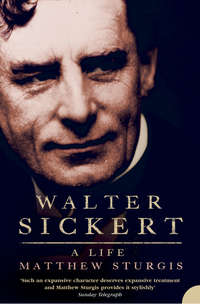
Read the book: «Walter Sickert: A Life»
WALTER SICKERT
A Life
Matthew Sturgis

For Rebecca
CONTENTS
Cover
Title Page
Dedication
1 A Well-Bred Artist
I The Münchener Kind’l’
II A New Home
III L’enfant Terrible
2 Apprentice or Student?
I The Utility Player
II Whistler’s Studio
III Relative Values
3 Impressions and Opinions
I The Butterfly Propaganda
II A New English Artist
III The London Impressionists
IV Unfashionable Portraiture
V In Black and White
4 The End of the Act
I Gathering Clouds
II Bridge of Sighs
III The Gentle Art of Making Enemies
IV Amantium Irae
5 Jack Abroad
I A Watering Place Out of Season
II Changing Effects
III Gaîté Montparnasse
IV Dal Vero
6 Londra Benedetta
I The Lady in Red
II Ambrosial Nights
III Mr Sickert at Home
IV The Artist as Teacher
7 Contre Jour
I Les Affaires de Camden Town
II An Imperfect Modern
III Red, White, and Blue
IV Suspense
8 The New Age
I The Conduct of a Talent
II Private View
III How Old Do I Look?
9 Lazarus Raised
I Over the Footlights
II Home Life
III Bathampton
IV Cheerio
Postscript Walter Sickert: Case Closed
Bibliography
Index
Acknowledgements and Preface
Notes
Praise
By the Same Author
Copyright
About the Publisher
CHAPTER ONE A Well-Bred Artist
I THE MÜNCHENER KIND’L’
He is a dear little fellow.
(Eleanor Sickert to Oswald Adalbert Sickert)
Walter Richard Sickert was born on 31 May 1860 in a first-floor flat at 59 Augustenstrasse, Munich, in what was then the independent kingdom of Bavaria.1 He was the first-born child of Oswald Adalbert Sickert and his wife Eleanor. Oswald Sickert was a Dane, from the town of Altona in the Duchy of Holstein. He was a trained artist, with ambitions as a painter, but he was constrained to work as a hack draughtsman-on-wood for a Bavarian illustrated comic-paper called the Fliegende Blätter. Eleanor – or Nelly as she was known by her affectionate husband and her friends and relatives – was English by birth. The couple spoke mainly English at home.2 Their new son was christened by the English chaplain at Munich: he was given the names Walter Richard.3 Walter was chosen as being a name that looked – even if it did not sound – the same in both English and German.4 Richard was the name of the boy’s maternal grandfather, the late Revd Richard Sheepshanks, a figure whose presence loomed over the young family, half beneficent, half reproachful.
Richard Sheepshanks had not been a conventional clergyman. He had scarcely been a clergyman at all. He never held any cure. His interest in the celestial sphere, though keen, had been scientific. He made his reputation as an astronomer and mathematician. The Sheepshanks came of prosperous Yorkshire stock. The family in the generation before had made a fortune in cloth, supplying – so it was said – material for military greatcoats to the British army during the Napoleonic Wars. The money from the Leeds factories amassed in this profitable trade allowed Richard and his five siblings to indulge their interests and enthusiasms. One brother, Thomas, chose Brighton and dissipation.5 Another, John, dedicated himself to art: he moved to London and built up a large and important collection of English paintings, which he exhibited to the public at his house in Rutland Gate and bequeathed to the nation in 1857, six years before his death.*6
Richard turned to the sciences. A brilliant university career at Trinity College, Cambridge, was crowned with a mathematics fellowship in 1817. He briefly contemplated the prospect of both the law and the Church and secured the necessary qualifications for both. (Having taken holy orders, he always styled himself ‘the Reverend’.) On receiving his inheritance, however, he was able to direct all his considerable energies to scientific research. He became a member of the Geological and Astronomical Societies, and was for several years the editor of the latter’s Monthly Notes. He was made a Fellow of the Royal Society, and of the University of London. His interests were many, ranging from demographics to the study of weights and measures. He had a particular passion for fine scientific instruments and devoted most of his income to buying them. He also busied himself in the intellectual and political disputes of the scientific world.7
In scientific circles Richard Sheepshanks was greatly respected – much loved by his friends and not a little feared by his enemies. He was, in the restrained words of his close colleague, the astronomer Augustus de Morgan, a man of ‘very decided opinions’. And he was not shy of expressing them. His first professional training had been as a lawyer, and throughout his academic career he had a relish for controversies. He was, as he himself put it, well suited to such business, having ‘leisure, courage and contempt for opinion when he knew he was right’. He was well armed with a ready, if somewhat sarcastic, wit and a piquant turn of phrase. But in matters of what he considered to be of real importance he would – according to one obituarist – drop these weapons in favour of a more ‘earnest deportment’ and a more ‘temperate’ utterance. Despite being of ‘hardly middle stature’, having red-tinged hair and the inevitable side-whiskers of mid-Victorian fashion, he was, from the evidence of his portraits, a handsome man. He was also excellent company – clever, witty, well read in both the classics and in modern literature, and widely travelled in Europe.8 He was knowledgeable too about art; and, tipped off by his brother John, commissioned Thomas Lawrence to paint a portrait of his beloved elder sister, Anne.9
Anne Sheepshanks was as remarkable as her brother. A woman of enormous practical capability, intelligence, and sound sense, she encouraged and supported Richard in all his endeavours. She allied her resources to his, sharing his interests, his cares, and his house. The home they established together at 30 Woburn Place, Bloomsbury – not far from the British Museum – became a lively gathering place for many of the intellectual luminaries of scientific London. They even built their own small observatory in the garden, from which, in an age before saturated street-lighting, they were able to mark the passage of the stars.10
The Reverend Richard Sheepshanks – like his sister – never married. His fellowship at Cambridge was dependent upon his remaining a bachelor, and he seems to have been in no hurry to give up his position, his salary, or his independence. Nevertheless, he did not allow professional considerations to stand altogether between him and the opposite sex.
It is not known exactly how or when he encountered Eleanor Henry. Indeed, very little is known about Eleanor Henry at all, except that she was Irish, fair-haired and handsome, and was a dancer on the London stage.11 Perhaps Mr Sheepshanks picked her out of a chorus line. Or perhaps he met her in the street. At the beginning of the 1830s she was living in Henrietta Street, a little cul-de-sac behind Brunswick Square, near to the Sheepshanks’ London home.* The popular reputation of dancers in the nineteenth century set them very low in the moral order; they were ranked beneath even actresses, and set almost on a par with prostitutes. This picture, however, was certainly a distortion. Although ‘respectability’ was a rather fluid concept during the early Victorian age, most ballet girls actually came from modestly ‘respectable’ homes, and lived – as far as can be ascertained – modestly ‘respectable’ lives.12 Eleanor Henry’s position seems to confirm this point. For a start she was married. Her husband was a Mr James Henry. He listed his profession as ‘Solicitor’, although he does not appear in the law lists of the period and may well have been little more than a lawyer’s clerk.13 At the beginning of the 1830s they were living together in the house of a Mrs Henry (perhaps James’s mother).14 Despite this unpropitious domestic arrangement, the Revd Richard Sheepshanks succeeded not only in forming an attachment with Eleanor but also in fathering a child on her. A daughter was born on 19 August 1830.15
Mr Henry’s attitude to, or indeed knowledge of, his wife’s liaison is unknown. He did, however, give his surname and his blessing to the infant. It was he, rather than Richard Sheepshanks, who attended the christening at St Pancras Parish Church and who had himself listed as the child’s legal father. The little girl was baptized Eleanor Louisa Moravia Henry. The last Christian name is something of a mystery, as the Henrys did not, as far as records show, belong to the Moravian sect.16
The young Eleanor Louisa – or Nelly – was brought up in the Henry household. If Richard Sheepshanks provided some assistance he did so covertly. Nevertheless, his interest in his natural daughter does seem to have been real and, given the proximity of Woburn Place to Henrietta Street, he must have had opportunities for observing her. Almost nothing is known of Nelly Henry’s childhood, except that it was not happy. The demands of her mother’s stage work meant that she was often neglected. She did, however, show an early love for music. Her mother sang to her, and the songs of the passing street performers also caught her ear, making a lasting impression on her memory and her imagination.17
The Henrys moved from Henrietta Street in 1833. They disappear from view but almost certainly remained in London, for, at some moment later in the decade, Eleanor broke with her husband and began a relationship with Samuel Buchanan Green, a dancing master from Highgate. She took her daughter with her and, though there is no evidence to suggest that she married Mr Green, she took his name and the young Nelly came to regard Mr Green as her ‘step-father’.18 In November 1838, when Eleanor gave birth to a son, christened Alfred, she listed her name on the birth certificate as ‘Green, late Henry’.19 In 1840, the Greens established a dancing school in connection with the Princess Theatre in Oxford Street. The teaching studio was immediately behind the theatre at 36 Castle Street and the family lived above it – an arrangement that can only have increased the 10-year-old Nelly’s love of music.20
Perhaps the Revd Richard Sheepshanks disapproved of these new domestic conditions, or maybe the arrival of young Alfred placed a strain on the resources of the Green household; perhaps the Sheepshanks’ own plans to move out of London precipitated the change. Whatever the reason, at about this time Richard offered to take his natural daughter under his own care, to remove her from the stage-door world of Castle Street, to arrange for her schooling, and to provide in some as yet unspecified measure for her future. The offer was accepted and, at the beginning of the 1840s, the old loosely fixed order was broken up.21
Nelly was sent over the Channel to a small boarding school at Neuville-lès-Dieppe. Richard Sheepshanks and his sister closed up Woburn Place and moved to a house on the outskirts of Reading, where once again they built a little observatory in the garden. The Greens continued with their school at Castle Street. And according to family tradition Mrs ‘Green, late Henry’ also performed on the stage of the Princess Theatre.22 It is doubtful that she ever saw her daughter again. She might have encountered Richard Sheepshanks occasionally. He returned often to London during the first years of the new decade. He was engaged in the great work of his later life: the establishment of a new set of standard weights and measures, the former one having been destroyed in the fire that swept through the Palace of Westminster in 1832. In a well-insulated subterranean laboratory in the cellars of Somerset House, he carried out tens of thousands of micro-measurements in order to determine the standard yard.23 It was a staggering exercise of both patience and artistry. He had, it was recognized, ‘an extraordinarily skilful eye with the micrometer’ and his comparisons ‘were so far superior to those of all preceding experimenters … as to defy all competition on grounds of accuracy’.24
In 1850, Eleanor and Samuel Green vanish from the London Directories. According to the family tradition preserved by Nelly, they emigrated to Australia, where Mrs Green took to drink.25 It has been supposed that Richard Sheepshanks arranged, if he did not insist upon, this removal, but there is no evidence to support such a theory. Nevertheless, the notion of a close relative disappearing to the Antipodes never to be heard of again was powerful in its suggestion. It became one of the defining elements in young Nelly Henry’s personal story. And it was a story that in time she would communicate to her own children, thrilling them with its mingled sense of mystery and loss. The actual moment of Eleanor Green’s departure from England, however, probably passed unknown across the Channel by her daughter.26
Dieppe in the 1840s already had an established expatriate colony. Living was cheap there compared to England. The completion of the London, Brighton and South Coast Railway and the introduction of steam packet-boats meant that it took a mere eleven hours to travel from London to the French port. Mrs Maria Slee’s school, set – across the harbour from the old town – on the still verdant slopes of Neuville, was one of several educational establishments in the area catering for English children:27 the bracing sea air was considered to be beneficial to youth.28 Mrs Slee’s was a happy place, and it offered Nelly the structure and companionship that had been lacking from the lonely and bohemian years of her childhood, and also the security of real affection.
She boarded there not only during the terms but also in the holidays, growing in time to be less a pupil than a part of the family. Mrs Slee was almost a second mother to Nelly; her daughters ‘became much attached’ to their young English charge, and she to them.29 It was during these years that Dieppe developed, for Nelly, into a charmed place – the place where ‘she was happy and well for the first time’.30
She stayed at the school until she was almost eighteen, becoming strong, handsome and accomplished. She learnt to speak French ‘with a good accent at least’.31 Her status and her future prospects, however, remained a mystery to her. She was aware that she was under the protection of a distinguished guardian – a Fellow of the Royal Society – but, although they corresponded, it seems that they did not meet. She did not learn the identity of her protector until 1848, when she was eighteen.32 Richard Sheepshanks was impressed with the progress made by his daughter, and he was anxious that it should continue. But perhaps not at Dieppe. The year 1848 was one of turmoil and revolution throughout Europe. The French once again overthrew their monarch, the unfortunate Louis Philippe. He fled to England and many English residents in France made the same trip. Anti-British sentiment was rife. Richard took the precaution of arranging for Nelly to leave Dieppe to finish her education in the pretty little Baltic town of Altona near the mouth of the river Elbe. Altona was nominally a Danish town, part of the Danish-controlled duchy of Holstein. But it was just across the river from Hamburg and had strong links with the German states.
Richard Sheepshanks knew the town well because it had a famous observatory, renowned for producing the clearest and most accurate astronomical tables. For many years it had been under the directorship of his close friend, Heinrich Schumacher. Schumacher was an astronomer of international standing, a member of the Royal Society in London, and the editor of Astronomische Nachrichten, the principal journal in the field.33 And it was with Professor Schumacher and his family that Nelly was sent to stay. The events of 1848 had not been without their effect on the Schumachers. Hostilities had also erupted between Denmark and Prussia over the disputed territory of Holstein, and while the conflict continued the professor’s salary was not paid. Richard Sheepshanks was happy to think that Nelly’s board-and-lodging expenses would contribute to the family coffers. The professor undertook to see to her education, while his wife, his daughter, and the widow of his son, promised to make her welcome.34
Initially, Nelly’s position in the household was slightly ambiguous. Richard had intimated to Professor Schumacher that, although Nelly was his ‘ward’, she would ‘not improbably’ have to make her own way in the world – perhaps as a governess, that established refuge for portionless but educated Victorian girls.35 Certainly Richard Sheepshanks’ hopes for his ward’s education suggested such a path. He wanted her to study music and drawing, as well as learning German and mathematics and perhaps even some Latin. But he repeatedly stressed that ‘Nelly’ was to be shown no special consideration,36 and that if she could be made use of ‘as nurse, amanuensis, housemaid, or [in] any other capacity’ it would be ‘the best education she could have’.37
Such promptings were unnecessary. Nelly had a generous and helpful disposition. She speedily endeared herself to the Schumachers through her acts of kindness and her expressions of gratitude. She also proved a ready pupil. She learnt, as she put it, ‘to sing very well and to paint very badly. She devoted herself to embroidery and fine sewing. She revealed a gift for languages, learning to speak German ‘like a native’.38 She also picked up Italian and Danish, though it is not known whether Professor Schumacher found time to teach her any Latin. (He had replied facetiously to Richard Sheepshanks’ suggestion that he might give Nelly some classical education with the French verse: ‘Soleil qui luit le matin,/Enfant qui boit du vin,/Femme qui sait le Latin/Ne viennent jamais a bonne fin.’*39)
The Revd Richard Sheepshanks corresponded regularly with both Nelly and Professor Schumacher and was encouraged by news of her progress. He was able to confirm this good impression when he visited Altona in October 1849. Over the previous year his plans for his ward’s future seem to have grown and developed. And it was perhaps during, or immediately after, this visit that he revealed to Nelly his true position and declared his intention of formally recognizing her as his child. She preserved always, as the one scrap of writing in his hand, a passage from the letter in which he revealed to her his fatherhood: ‘Love me, Nelly, love me dearly, as I love you.’40 The scrap is undated, but there is a detectable shift in Richard’s attitude to Nelly after that October; references to her are more open and more openly affectionate; and his letters end with expressions of ‘best love’.41
If Nelly’s knowledge of modern languages grew chez Schumacher so did her sense of fun and her sense of life’s possibilities. It was a convivial household in a convivial town, and she was surrounded by people of her own age. Altona had a sizeable English population and Nelly formed several long-lasting friendships. There were frequent picnics, concerts, operas, even balls. She made excursions into Italy and Austria.42 This round of diversion was interrupted at the end of 1850 by Professor Schumacher’s sudden illness and scarcely less sudden death.43 Nelly, however, had become part of the family by this stage. There was no suggestion that she should leave. She stayed on in the Schumacher household, a companion to the grieving family.
Perhaps it was this family tragedy that introduced her to Professor Schumacher’s son, Johannes.44 He was the artistic member of the family and had been away, studying painting in Rome. He immediately established a rapport with the family’s English houseguest, a rapport that deepened the following summer when Nelly nursed him through a bout of illness. She shared his love of Nature, and his enjoyment of climbing mountains. He admired her singing.45 In tandem with his friendship for Nelly, Johannes also developed a close tie with her guardian. Missing his own father, he took to writing to Richard Sheepshanks, seeking his advice, his encouragement and assistance. He even visited him in London in the autumn of 1852. Early in the following year, Johannes wrote from Italy declaring that he planned to leave Rome to continue his studies in Paris. For a painter, he declared, Paris was the place to learn.46
It was the common cry across the art schools of Europe at the time. Italy might boast the treasures of antiquity and the Renaissance, and the great German academies at Munich, Düsseldorf, Berlin, and Dresden could offer a thorough practical training; but the French capital had the glamour of innovation and even revolt. It was there that the new spirit of ‘Realism’ was asserting itself with most force: at the Salon of 1850, Gustave Courbet had struck a new note with his monumental canvas The Stonebreakers. The depiction of the contemporary working man on the heroic scale of antiquity caused a sensation that others were keen to experience and to echo. Students gravitated to Paris from all over Europe and America, to throng the ateliers of Troyan, Gleyre, Couture, and Lecoq de Boisbaudran, hangar-like studios bristling with easels, plaster-casts and ambitions. Johannes Schumacher was not the only son of Altona to be drawn to Paris. He found several others already there. Amongst his confrères was an earnest young art student called Oswald Adalbert Sickert.
Oswald Sickert belonged to Altona’s artistic elite. His father, the dashing fair-haired, blond-bearded Johann Jürgen Sickert, was a pillar of the cultural community: an artist, wit, and dandy who – despite his Nordic colouring – was known to at least some of his friends by the Italianate nickname, ‘Sickarto’.47 The son of a long line of Flensborg fishermen, he had trained as a ‘decorative painter’ and was – at least according to his grandson – for a while the ‘head of a firm of decorators who were employed in the royal palaces of Christian VIII of Denmark’.48 He became, in time, an accomplished landscape painter, and after moving to Altona in the late 1820s was a leading member of the town’s exhibiting society. He showed there regularly, and also at the neighbouring Hamburg Kunstverein.49 He was interested in technical innovations and was a pioneer of both lithography and photography. In 1850 the local directories list his address – at 34 Blücherstrasse – as a ‘studio of Daguerreotype’.*50
Nevertheless, he did not abandon his first calling. He continued to undertake decorative commissions: the museum in the town still contains a painted ‘overdoor’ by him of a woman with flowers. In 1855 – at the request of the municipality – he drew up a scheme for providing art training for the town’s artisans through ‘Sunday Continuation classes’. In it he emphasized the practical benefits and applications of art, insisting on a thorough grounding in geometry and perspective. He considered that it would be ‘of more use to a carpenter, a turner or a smith, if his lessons enable him to draw a vase or an ornament correctly, than if his schooling results in nothing more than the adornment of his bedroom with a few trophies’.51 But if Johann Jürgen thought that art could be useful he also believed that the artist’s life should be fun. He was a great promoter of artistic conviviality – a composer of drinking songs and comic verses, and a leading light in the Altona dining society known as the ‘Namenlosen’ or the ‘Unnamed’, all the members of which were designated only by numbers.52
Having been widowed in 1838 (when Oswald was only ten), Johann Jürgen seems to have done everything to encourage his only child’s artistic career. The young Oswald Adalbert showed precocious ability. In 1844, at the age of sixteen, he won a travelling scholarship to Copenhagen to study at the art academy. Once there, he revealed an independent spirit, abandoning the school’s classes after his first term and taking private tuition in ‘perspective drawing’ from the foremost Danish painter of the day, C. W. Eckersberg. He then devoted himself to working in the cast gallery for the whole of the following year. In 1846 he abandoned Denmark for the altogether more prestigious Academy at Munich.53
Oswald Sickert stayed in the Bavarian capital for the next six years, submitting himself to the rigours of the Germanic training system. He was supported by his father, who visited him on at least one occasion and encouraged him with regular letters. Each epistle ended, ‘somewhat … to his son’s irritation’, with the imprecation – the distilled essence of old Johann Jürgen Sickert’s artistic wisdom – ‘male gut und schnell’ (paint well – paint quickly).54 But Munich for all its virtues and opportunities had one great limitation: it was not Paris. The main drama, it was felt, was happening elsewhere. The students of Munich were alive to the new currents in French art; and in 1851 they even got a chance to view some of Courbet’s work at first hand when he exhibited in Munich, and perhaps even visited the city.55 Oswald Sickert and his companions soon came to idolize this new master.56 And the impact of his work prompted many of them to move to the French capital. In 1852 Oswald Sickert joined the exodus, enrolling at the Parisian teaching-studio of Thomas Couture.57
Couture was, and remains, famous for his depictions of Classical Rome. His monumental canvas, Romans of the Decadence, was the cynosure of the 1847 Salon and was bought by the Louvre. But despite his antique themes, he allied himself closely to the contemporary strains of artistic Realism. His depiction of the dissolute Romans had been intended – and taken – as a comment on the corruption of France under Louis Philippe’s rule. He retained a reputation as a radical and independent spirit and his studio was regarded as one of the most exciting in Paris. It attracted students from all over Europe, and from America too. They found Couture’s regime both liberating and challenging. His manner had a bracing informality, very different from that of other teachers. He startled more than one student with such direct criticisms as, ‘That’s horrid! If you can’t do better than that you had better stop!’58
Although he worked within the framework of tradition – the ‘good tradition’ of la bonne peinture that Sickert later described as being ‘sedulously nursed’ in that Paris of the 1850s – Couture was always open to the possibilities of new techniques and procedures.59 To young artists like Oswald Sickert who arrived from the rigorously exacting art academies of Germany, such an approach was electrifying. One young artist who came to Paris from Düsseldorf considered Couture’s teaching ‘a sublime reaction from the dry-as-dust German painting then in vogue’.60 Another thanked Couture for freeing him from ‘the niggling technique of the Germans’ as well as opening up his compositions to a much ‘broader vision & conception’.61 It was Paris that liberated Oswald Sickert. And although he was there a relatively short time (barely a year) it was, for him, a defining artistic experience: he came to regard himself as ‘more an antique Parisian than a Dane’ – or, indeed, a Bavarian.62
But of course, as in most educational establishments, it was the other students – and the place itself – that provided the real education. Oswald Sickert found himself in an exciting milieu. In Paris he had the chance to see more of Courbet’s pictures.63 He travelled in France, and discovered Dieppe as a sketching ground.64 He mixed with art students not only from Couture’s atelier but from the other studios as well. There was a strong Munich contingent, including Wilhelm Füssli, Moritz Delft and Cesar Willich, as well as others from Altona, including – from 1853 – Johannes Schumacher.65
It was Schumacher who, on one of their return visits to Altona, introduced the 24-year-old Oswald Sickert to the family houseguest, Eleanor Henry.66 The Eleanor he met was an accomplished young woman of twenty-two, vivacious, attractive, and with beautiful fair hair. Oswald Sickert, for his part, was touched with the metropolitan glamour of Paris. He had a fine beard and, despite a retiring manner, seems to have been considered rather a dashing figure by the young ladies of Altona. (Preserved amongst his papers is one letter from an admirer – not Eleanor Henry – who addressed him with more poetic ardour than geo-political exactness as ‘Dear German Lord Byron’.67) It was not, however, his romantic looks, nor even his fledgling artistic reputation, that seems to have drawn Eleanor Henry to him. It was music. They shared a common passion. Oswald Sickert played the piano with real sensitivity and skill. According to one exacting critic, his ‘technique was faulty, but his phrasing was musicianly, and … for passion and for singing quality in cantabile passages he excelled many public performers’. He had a strong sense of rhythm and was a ‘brilliant’ sight-reader.68 Eleanor, the dancer’s daughter, had her own sense of rhythm and allied it to a beautiful singing voice. Their romance flourished to an accompaniment of Schubert lieder.
He preferred the countryside around the town, and came to know it well. From the moment that the May-fest signalled the beginning of the summer, Munichers would flock to leave the city. The Sickerts joined this annual exodus, passing a month or two in the Bavarian countryside, lodging with peasants’ families, or staying at country inns. They would visit the little villages dotting the shore of the nearby Starnbergersee – the magnificent lake some sixteen miles long just south of Munich. Or they might venture further afield to other lakes in the Bavarian Tyrol – to the wooded shores of the Chiemsee or to the Staffelsee. In an alfresco variation of their Munich life, Oswald would sketch and paint, while Eleanor would look after the children. In the evening they would all gather in the biergarten of the inn.132
There were also happy outdoor days spent with the family of the Revd Rodney Fowler, the sometime rector of Broadway in Worcestershire, who became the English chaplain at Munich in 1866. He and his wife, arriving with two daughters, aged five and two, had been at once drawn into the Sickerts’ circle.133 The Sickerts also paid visits to Laufzorn, the Rankes’ country house. The place, a former hunting lodge of the kings of Bavaria, was supposedly haunted, which may have added to the excitement of the visits.134 But the main pleasure for the children was in playing in the huge echoing banqueting room, which contained an improvised swing – a long plank on which several children could sit astride while it was swung, fearfully, lengthways. As Helena recalled, ‘Every child had to cling tightly to the one in front and the exercise was performed to a chorus of “Hutsche-Kutscher-Genung!” the last word being shouted as loud and as long as possible.’ There was also a big hay barn where the children could jump from the rafters into the hay below.135
Walter delighted in such games and in such company. He was extremely sociable and made friends easily.136 Surrounded by boys at home, he seems to have enjoyed being surrounded by girls elsewhere. At the age of six he had managed to become engaged both to one of Dr Ranke’s daughters and to the eldest of Mr Fowler’s girls. ‘It never occurred to me,’ he remarked, when looking back on the arrangement, ‘that there was any inconsistency.’ It was an attitude of mind that he preserved in his relations with the female sex throughout his life.137
The Bavarian summers were months of almost idyllic pleasure for the children. It was in the Starnbergersee that Walter discovered the delights of swimming, and there, too, that he learnt to fish.138 Initially, he had merely tied a piece of bread to a length of string and watched the fishes nibble, but Mr Fowler, steeped in the sporting traditions of the Anglican clergy, showed him – much to Eleanor’s dismay – how to bait a hook. Death, however, seems to have intrigued Walter. One holiday game involved the construction of a miniature cemetery from pebbles and moss and twigs.139 In Walter’s memory these summers took on the hues of a golden age. He would look back to them as a time of peace, calm, and certainty. ‘When I used to play by mill streams in Bavaria [and] listened to my mother sing the Schoener Muller of Schubert,’ he recalled, ‘I thought it would always be like that.’
The extraordinary beauty of the Bavarian countryside in early summer – the greenness of the foliage, the clearness of the light, the profusion of flowers – made a profound and lasting impression on all the Sickert children. Walter, though he became the great artist of urban life and urban architecture, retained always a flickering sense that ‘woods & lakes & brooks’ were ‘the nicest things in the world’.140 It was the quality of light that made them special: the fall of broken sunshine through the overarching canopy of leaves. ‘I think,’ he declared, ‘the loveliest thing in Nature is a sous-bois.’141 Even as a child he sought to express his admiration in art. From the age of five he wanted to paint such verdant, sun-dappled scenes. It became one of the recurrent desires of his working life – recurrent, in part, because it was never achieved.142
In all the Sickert children’s games and activities Walter took the lead. Although Mrs Sickert maintained a clear structure of kindly authority, she rarely attempted any interference between her offspring, and would not countenance ‘tale bearing’. It was her principle that they should all learn to live together.143 This was a situation that rather suited Walter, who was ‘not only the eldest, but by far the cleverest’, and the most energetic of the siblings.144 Robert was a fretful child, Bernhard a fractious one, and Helena too young to exert her own considerable powers.145 From the outset, Walter imposed his will upon them all, getting his own way either by force of character or by guile – though he was not above climbing out of his cot in the nursery to pull his sister’s hair if he felt the occasion warranted.146 But, as Helena admitted, even at this young age ‘he was able to infuse so much charm into life’, and to make ‘our pursuits so interesting’, that ‘we were generally his willing slaves’.147 It became one of Mrs Sickert’s recurrent complaints that none of the siblings was able to ‘resist’ Walter, an indication – as Helena noted – that not all his activities were agreeable to authority. Walter, however, was a fickle leader, with no sense of responsibility to his followers. His restless intelligence needed the stimulation of constant change. For his siblings, the ‘tragedy’ came – and came frequently – when ‘the magician suddenly took flight to some other adventure and the one which had seemed so entrancing, while [Walter] led it, turned to folly in the grey morning after’.148
From a very young age Walter was regarded as being separate from and above his younger brothers. The phrase ‘Walter and the boys’ was a common and early family coinage.149 He enjoyed a privileged position as the eldest child. In the evenings he alone was allowed to sit up with his parents, not to supper, but at the supper table.150 Oswald Sickert’s long working hours and occasional absences encouraged Walter to develop a sense almost of responsibility towards his mother. In later years he would describe how, during his Munich childhood, he was ‘for many years’ her ‘only rational companion’.151 He alone amongst his siblings established a bond with his father. The other children were slightly frightened of ‘Papa’. It seemed that he never spoke to them unless it was to give an order or to make some disparaging comment.152 But then he did not speak very much to anyone. He was extremely taciturn and reserved by nature.153 Walter, however, he did talk to – after his own fashion. The trip to London had fostered relations between them. Walter always held dear the memory of his father’s kindly face looking down at him as he sank under the anaesthetic before the operation – a perhaps rare intimation of tenderness from his diffident parent.154 It was with Walter that Oswald Sickert took his daily walk on the Theresienwiese.155 And he impressed his son with his few words. He had, as Walter recorded, ‘a wide critical comprehension’. And though he was apt to judge himself as ‘coldly as he did everything else’, there seems to have been an edge of wit to his verdicts.156 Many years later, when reading Heine, Sickert was struck by the similarities between the poet’s self-deflating irony and his father’s own ‘expressions & attitude of spirit’. They came, he noted, from the same northern, Baltic world.157
Even as a child, Walter was interested in his father’s work – his paintings and, more particularly, his drawings. The arrival at 4 Kleestrasse of the Fliegende Blätter on Thursday evenings at supper time was ‘an event’ in Walter’s week, and not merely because he was presented with the paper wrapper to wear as a cap. He was interested to hear his father’s comments on the reproduction of the wood engravings. And he liked to look at the pictures. Many of the images lived with him throughout his life.* And although it was perhaps the comedy of the situations depicted that provided the initial attraction, he also imbibed an understanding of technique and an appreciation of how scenes of everyday life could be rendered in art. The quality of work in the paper was extremely high and the variety instructive. When he came to review the artistic masters of his Munich childhood Sickert singled out the work of Wilhelm Diez, Wilhelm Busch, and particularly Adolf Oberlander, whom he praised for his ‘frankness’ and his genius for rendering scenes ‘in terms of limpid light, and shade’.158 The set of bound copies of the Fliegende Blätter became part of the Sickert family library and Walter had plenty of opportunities to refresh his memory and refine his knowledge of its artists, but the foundation of his appreciation and understanding was laid in his early childhood.159
During the summer of 1866 the anxieties that Oswald and Eleanor had felt about the political situation in Europe were confirmed. The Prussian Chancellor, Bismarck, having carefully prepared the ground, engineered a dispute with Austria as a pretext for laying claim to Holstein. In what became known as the Seven Weeks War, the Prussians decisively defeated their former allies and their associates (nine German states, including Bavaria, had sided with the Austrians). In August, a peace treaty was signed at Prague giving Prussia full control of both Schleswig and Holstein. A new German constitution was established, and it was decreed that all citizens of Schleswig-Holstein would become naturalized Prussians in October of the following year. Oswald Sickert was concerned at the effect this might have on his young family. He did not wish his sons to be liable at some future date to conscription into the Prussian army (and he was anxious, too, that they should not become what he called ‘Beer-swilling Bavarians’).160 The idea of moving to England took serious hold. It was, however, an operation that required some planning.
Walter, in the meantime, began attending a local school, and his brothers soon followed him. It was a huge, impersonal place. Each class had between fifty and eighty boys, and pupils were drawn from all backgrounds. Robert found the noise and the number of boys altogether too much, but Walter remained unfazed. He got on ‘very nicely’, his mother reported: ‘He does not learn much, they do nothing but German & reckoning and these public schools are so large that the bright ones always have to keep pace with the slow ones.’161 Walter, in his mother’s informed – if not unbiased – opinion, was very definitely one of ‘the bright ones’.
By November 1867 the Sickerts’ plans for moving to England were well advanced. Anne Sheepshanks had given her blessing to the scheme. The Sickerts left Munich the following spring. Walter does not appear to have considered it a deracination. Although in the anti-German decades of the twentieth century he always enjoyed the shock that could be produced by announcing to an English audience that he was a ‘Münchener Kind’l’, he never thought of himself as a German or a Bavarian.162 He retained a passing enjoyment of German literature and relish for the tricks of the German language.163 But these were surface pleasures; they left very little mark on his character. Duncan Grant, who came to know Sickert well, considered that there was ‘very little of the German’ in his make-up.164 Sickert himself admitted only to having ‘a certain German quality, which is called in German sächlich – devoted to things, ideas, etc. – to the possible disadvantage of people’, a quality by which he excused his often disparaging critical comments upon the work of his friends.165 But while he certainly did possess this cool, critical, northern trait, he was more likely to have inherited it from his father than to have imbibed it amidst the hurly-burly of the Munich Volksschule.
The Sickerts, on leaving Munich, did not go at once to England. They passed a long summer at Dieppe. It was a happy interlude. Walter was even enrolled briefly at the Collège du Dieppe.166 He exchanged German for French. If he did not have an ear for music he had one for languages. Learning by mimicry rather than book study, his accent ran ahead of his understanding. He would pick up whole passages of French speech and recite them perfectly, convincing Frenchmen that he was a young compatriot. The disadvantage of this trick only came when they answered him and he was unable either to understand or to reply.167 The experience of being lost for words was a new one to him.
* It became the nucleus of the V&A picture collection.
* The whole area has since been remodelled: the west side of the square has been replaced by the Brunswick Centre, a 1960s shopping and housing development.
* ‘A sun that shines in the morning,/A child that drinks wine,/A woman who knows Latin/Never come to a good end.’
* Sickert preserved a daguerreotype of his grandfather, sitting very still in a dressing-gown and a smoking-cap ‘calculated to turn his pious grandson green with envy’. ‘From the Life’, Morning Post (18 May 1925).
* Though he may not have known it, he too had been born out of wedlock. His parents married in June 1828, four months after his birth.
* On the baptismal register, Bernard’s name is spelled ‘Bernhart’, though he never seems to have used this form. Robert was given the second name ‘Oswald’, like his father.
* ‘Milk and butter are in a state of barbarism,’ reported the travel writer Edward Wilberforce. The butter was often rancid. As to the difference between milk and cream in Munich, ‘a long experience has shown me that cream is milk with water put in it, while milk is water with milk put in it’.
* The trust was set up on 29 June, between Mr and Mrs Sickert, Anne Sheepshanks, and three trustees, Augustus de Morgan, William Sharp, and George Campbell de Morgan (a copy is in the Sutton papers at GUL).
* ‘I remember an illustration in the Fliegende Blätter in the early sixties in which was depicted a little girl guiding her blind grandmother. Finding the road rather even, and therefore tedious, the child from time to time feigned an obstacle, a brick or stone, and said, “Granny, jump,” which the old lady obediently did. When someone remonstrated with the child, she answered, “My grandmother is mine; I may do what I choose with her.”’ ‘The Polish Rider’, New Age (23 June 1910).
II A NEW HOME
My strongest memories of Walter as a boy are of his immense energy
& the variety & resourcefulness of his interests.
(Helena Sickert)
At the end of the summer of 1868 the Sickerts crossed the Channel and settled into a new home at 3 Windsor Terrace, Goldington Road, Bedford.1 The choice of Bedford was not an obvious one. There were no ties of family or existing friendship to draw them to this small but prosperous county town.2 There was no local art society to attract Oswald Sickert, and no illustrated satirical magazine to employ him. The recorded reason for the move was the number of excellent schools in the town. The five establishments endowed by the prosperous ‘Harper Charity’ had made Bedford a pedagogic centre with a staple production, according to one local guide, of ‘educated juvenile humanity’.3 Walter and his two brothers were enrolled at the local free school.4 But there was, too, perhaps some general principle of economy behind the choice: Bedford was less expensive than London.
Although Mrs Sickert’s allowance was increased to compensate for Oswald’s loss of salary in resigning from the Fliegende Blätter, the family was still relatively ‘poor’. The three-storey house in Windsor Terrace cost just £50 a year, and came fully stocked with a great deal of ‘mostly hideous’ furniture, built – as Helena remembered it – ‘to withstand the onslaughts of family life’. There were huge pier glasses, ‘a chiffonier with a marble top and curly-wiggly fronts’, and a sofa with three humps, which was soon dubbed ‘the camel’ and upon which it was impossible to lie with any degree of comfort. There was also a mahogany dinner table around which the family sat on chairs ‘with backs carved to represent swans’.5 But if Bedford was economical, that was all that could be said for it.
The town was not a success for the Sickerts. Coming from an international centre of music and art to the chill, provincial atmosphere of Middle England was a dispiriting experience. Mr and Mrs Sickert were ‘woefully depressed’.6 Their German maid, whom they had brought with them, was appalled. She took an immediate dislike to the place. She abhorred the house’s dirty coal grates and ranges, ‘accustomed as she was to [the] sweet wood ash’ of Bavaria. And she complained at the poor quality of the local beer.7 If the beer was bad, the water was worse. Almost as soon as the Sickerts arrived an epidemic of typhoid broke out in the town.8 It at once began to work its way through the family. The boys had barely started at their new school when they had to be removed. Walter soon fell ill. Mrs Sickert very nearly died.9 Only Oswald Sickert and Robert escaped the worst of it. Mrs Stanley, a family friend from Munich days, came to help with the children during the period of Ellen’s illness and convalescence. She was an ‘adored’ surrogate – vivacious and amusing. She would delight the children with her invented stories, one of which concerned the fantastical exploits of the ‘Black Bull of Holloway’ (probably Sickert’s first introduction to the artistic possibilities of that North London suburb). Mrs Stanley’s only fault was her kindness. She was apt to spoil her charges, and the young Sickerts, doubtless led – as they were in all else – by Walter, took advantage of her.10
Perhaps to remove his influence, Walter, as soon as he had recovered sufficiently from his illness, was sent, not back to his Bedford day school, but to a small boarding prep school at Reading.11 It was yet another instance of his being singled out for special treatment.12 Anne Sheepshanks lived nearby, but the proximity must have seemed a cruel jest to the 8-year-old Walter. He felt banished from the comforts of home life. His memories of the school were coloured with Dickensian horror. Many years later he told Virginia Woolf how the place was run by a ‘drunken old woman’ who, amongst her outrages, once beat a boy who had broken his arm while – as he put it – ‘we thirty little wretches lay there cowed’.13 The headmistress clearly took pleasure in such acts of cruelty, for it became one of Sickert’s verbal tics, when undertaking some disagreeable task, to remark, ‘And “what is more”, as my horrible old schoolmistress in Reading used to say, “I like it”.’14 He was very unhappy,15 and seems to have tried to project himself back to the lost paradise of Kleestrasse, writing home what his mother described as ‘such affectionate letters in such vile German’.16 In a delicious break from the tedious (and fattening) regimen of ‘bread and butter and sky blue’, he would go for Sunday lunch to his great aunt.* It was at Anne Sheepshanks’ table that he developed a precocious and enduring taste for jugged hare.17 But his readiest consolation came from work. As Mrs Sickert noted, despite his uneasiness of temper, he was ‘so fond of study’ and showed none of the ‘signs of idleness’ that his two younger brothers were already beginning to evince. Even at the age of nine Walter was ‘all ambition and energy’ – blessed with ‘a most clear head and accurate memory’.18
The Sickerts persevered at Bedford for a year. But the shock of the typhoid epidemic seems to have convinced them that it was not a suitable place to raise a family. In 1869, after consultation with Anne Sheepshanks, it was decided that they should move up to London.19 They fixed upon the modestly fashionable – and discreetly ‘artistic’ – quarter of Notting Hill, just across the way from the altogether grander, and more obviously artistic, quarter of Holland Park. Miss Sheepshanks found for them a little half-stucco-fronted house at 18 Hanover Terrace (now Lansdowne Walk), facing on to the communal gardens. It had been built, along with most of the others in the area, in the 1840s and was both slightly smaller and slightly more expensive than their Bedford home.20 There was an attic storey, and a basement, and two decidedly narrow main floors. Living arrangements were cramped. Walter and his two brothers had their bedrooms in the attic. Mr Sickert used one of the first-floor rooms as a studio, while the family ‘lived, worked, ate and played’ in the small red-flock-wallpapered dining room.21
By the time the Sickerts left Bedford, the deficiencies of the Reading boarding school were proving impossible to ignore, and Walter made the move to London along with the rest of the family. The relocation was a happy one for all. The Sickerts found old friends and connections. Their house became a sociable and lively place. The confraternity of painters came forward to welcome Oswald, among them several artists whom he had known from his days at Altona, Munich, and Paris. The sculptor Onslow Ford had worked at Munich and had married a friend of the Sickerts there.22 Frederic Burton, a student at Munich in the 1850s and now a successful and fashionable practitioner, called on the family. (Oswald was shocked, on entering the room, to discover one of his sons – almost certainly Walter – showing Burton through a bound volume of the Fliegende Blätter, pointing out the paternal drawings.)23 Hugh Carter, an artist who had spent time at Altona and married a girl from Hamburg, turned out to be a near neighbour at 12 Clarendon Road.24 The Sheepshanks name carried a weight and prestige in London that it rather lacked in provincial Bedford. In the capital, the achievements of the Revd Richard Sheepshanks and the munificence of his brother John were established facts. And this family fame reflected faintly on the Sickerts, giving them both a glow of glamour and – more importantly – a ‘social position’.25 Although Anne Sheepshanks was living out of London, the many friends she had in town provided a supportive structure for the young family. It was almost certainly through the influence of her friends the de Morgans that, in October 1870, Walter was enrolled (after a brief stint at a London ‘Dower School’) at University College School in Gower Street.26
Mrs Sickert conformed to what she considered were the established modes of English life. She took the children to church on Sunday mornings, walking them off to St Thomas’, Paddington, a little iron church off Westbourne Grove.27 It was a temporary structure, but the vicar, the Revd John Alexander Jacob, had a reputation as a preacher (his Building in Silence, and Other Sermons was published by Macmillan in 1875). Oswald Sickert did not attend, although, as a ‘tolerant minded agnostic’, he accompanied the family as far as the corner nearest the church and often met them coming out. The young Sickerts’ own involvement with proceedings was only slightly more engaged. Although they learnt the ‘Collect for the day’ and were taught their catechism by Mrs Sickert, their approach was so formal that, when asked ‘What is your name?’ they were liable to reply, ‘N or M as the case may be’.28 Walter showed no inclination towards the spiritual side of life. But churchgoing did have its social compensations. The Carters attended St Thomas’; and the Sickerts as they trooped up Holland Walk would also encounter the Raleighs, a lively family of one boy and five girls, children of the Revd Alexander Raleigh, who lived nearby.29
The move to England had a particular impact upon Oswald Sickert’s position. From being a cosmopolitan figure in a cosmopolitan milieu, he found himself a foreigner in an essentially English one. English, though he spoke it perfectly, was not his native – or even his second – tongue. Moreover, he no longer had a job or an income. Mrs Sickert wanted to make over to him the allowance that she received, but the terms of her trust made that impossible. Instead she drew her cheque every month and then handed over the cash to her husband, ‘so that she might have the pleasure of asking him for it, bit by bit’. Helena vividly recalled the playing out of this little charade: ‘It was her luxury to pretend he gave it to her, and his eyes would smile at her as he drew out his purse and asked, “Now how much must I give you, extravagant woman?” And she would say humbly, “Well, Owlie, I must get some serge for the little ones’ suits, and a new hat for Nell, and I want to bring back some fish. Will fifteen shillings be too much?” So she would get a pound and think how generous he was.’30 The fiction was a happy one but it could not quite obscure Oswald’s new, dependent status.
There were, in theory, some advantages to his new condition. Freed from the necessity of hackwork, he could rededicate himself exclusively to painting. London was a not unpropitious place for such a project. Compared to Munich, where the Kunstverein had exercised a virtual monopoly on exhibitions, there were several exhibiting groups and even a few commercial art galleries at which he could show. There were art collectors too. The example of John Sheepshanks had inspired several imitators, as the wealth generated by Britain’s ever expanding industrial and commercial imperium sought expression and dignity through art. With such patronage, artists were beginning to grow rich. The new mansions of Holland Park, with their lofty studio-rooms, were monuments to the fortunes being made in paint.31
Although Oswald had a painting room in the house, he soon took on a separate studio in Soho Square as well. Soho was some distance from Notting Hill, but it was close to Gower Street, and Oswald would walk the three and a half miles to UCS each morning with his eldest son. The link between them was reinforced. Walter would show off to his father. One of the challenges he undertook was to learn by heart the exotic polysyllabic name of the Indian Maharaja whose tombstone stood in the churchyard they passed each day. (Over seventy years later Sickert was still able to rattle off the name: Maharaja Meerzaram Guahahapaje Raz Parea Maneramapam Murcher, KCSI.)32 He was initiated, too, into his father’s professional world, accompanying him to buy materials at Cornelissen, the artists’ supply shop in Bloomsbury.33 The daily excursions into town, however, also made Walter aware of his father’s semi-alien status in their new home. Whenever they passed the shop of the friendly local cobbler, the man, ‘thinking in the English way, that it was necessary to shout and explain things to all foreigners, however well they spoke English’, would point at his display of porpoise-hide bootlaces and ‘roar at the top of his voice, “Papooze’s ‘ide!”’34 Perhaps it was the embarrassment of this daily performance that first inspired the slight note of protectiveness that came to colour Sickert’s view of his father – a protectiveness always mingled with real admiration, piety, and affection.35
The family maintained a European perspective. From the summer of 1870 onwards the unfolding drama of the Franco-Prussian war consumed their attention. Walter followed the rapid succession of French defeats in the pages of the Illustrated London News. It was a conflict that touched the Sickerts with painful closeness, setting familiar Germany against beloved France. Their sympathies lay entirely with the French. It was torture to Mrs Sickert when Dieppe was occupied by Prussian troops in December, and for Oswald when Paris fell at the beginning of the following year. French refugees became a feature of London life. Amongst the self-imposed exiles were several artists: Claude Monet came, and Camille Pissarro. The general exodus also brought a German painter – Otto Scholderer. After training at the Academy in Frankfurt, Scholderer had gone to Paris in 1857 and enrolled at the atelier of Lecoq de Boisbaudran. There he came to know Henri Fantin-Latour, Alphonse Legros, and other members of the Parisian studio world. He returned to Paris at the end of the 1860s, and in 1870 Fantin-Latour, whose great friend he had become, included his diffident red-bearded figure, standing behind Edouard Manet, in the group portrait, the Atelier des Batignolles. It is not clear whether he already knew Oswald Sickert before he came to London – he never studied at Munich, nor did the two men coincide at Paris – but they soon became friends. They had a shared love of music, and would often play together, either at Hanover Terrace or at the Scholderers’ house at Putney.36
Such gatherings had a comfortably familiar air. In more ‘English’ society – though the Sickerts found many ready friends – there always remained the faint hint of ambiguity about their exact position. The Sheepshanks connection, so beneficial in all other respects, carried with it the taint of Mrs Sickert’s illegitimate origins – even if the details of those origins were not known to all and were often confused by those who were aware of them. (At least one friend supposed that Mrs Sickert was the natural daughter of John, rather than Richard, Sheepshanks.37) Amongst most members of the ‘artistic’ world Mrs Sickert’s position would have counted for little, but on the broader social plane the possibility of affront and insult – if remote – could never be entirely forgotten. There clung, too, to the family and to the family home, a slight but distinct sense of difference – of foreignness. The Sickerts played German music, sang German songs, and had German books on their shelves.38 They preserved the Munich habit of eating their ‘dinner’ at noon, and having only a light ‘tea’ or ‘supper’ in the evening – a fact that occasionally caused the children embarrassment when English visitors called.39 The family, according with Continental custom, celebrated Christmas on the night of Christmas Eve, and did so in what outsiders considered a ‘high Germanic’ fashion.40 These marks of otherness were small, but they were sufficient to give the Sickerts both a sense of closeness amongst themselves and of detachment from the world they found themselves in.
Of these two impulses, ‘detachment’ was the one that touched Walter most strongly. It became his mark as both a person and a painter. And though essentially an innate trait of his character, the tensions of his London childhood sharpened it and gave it direction. Walter did not retreat into his own world. From the start he engaged enthusiastically with English life and English ways. ‘Nobody,’ it was later said of him, ‘was more English.’ But his understanding of Englishness was gained from the outside. It was – as one English friend noted – ‘his northern foreign blood’ that ‘afforded him just the requisite impetus to understand especially well this country and its ways’.41
The upheaval of the Franco-Prussian War encouraged the Sickerts to spend their holidays in England. In the summer of 1870, Mr Sickert took Walter and the other children to the seaside at Lowestoft. While he sketched and painted, the boys flew kites and built sandcastles. Walter was much impressed too by the sight of a drowned man, and much excited by the sight of the lovely Mrs Swears, the beauty of the season, who would drive up and down the front in her carriage, her long hair streaming in the wind.42 In the following years they visited Ilfracombe and Harwich.43
Mrs Sickert did not accompany the family to Lowestoft, perhaps because she was pregnant. At the beginning of 1871, Walter got a new brother. Born on 14 February, he was duly christened Oswald Valentine. To simplify the logistics of family life, Walter was taken out of UCS and sent, along with Robert and Bernhard, to a new school close to Hanover Terrace. The Bayswater Collegiate School was situated at ‘Chepstow Lodge’, 1 Pembridge Villas, on the corner with Chepstow Place, four doors down (as Sickert liked to point out) from the celebrated Victorian genre painter, W. P. Frith. It was run by William T. Hunt, a young man in his early thirties with progressive ideas.44
Helena’s chief recollection of her brothers’ schooling was of them being chivvied off by their mother in the morning and then coming home in the afternoon without the books necessary for their prep. In the case of Robert and Bernhard such oversights tended to be the result of inattention; both brothers were what was called ‘dreamy’. If Walter forgot his books, however, it was probably because he was thinking of so many other things. Although he hated organized games, he was always ‘prodigiously energetic’, busy with something outside the school curriculum – acting, drawing, even learning Japanese. There were five Japanese boys at the school, sent to England by their feudal clan – Hachizuka – to study English. (All subsequently rose to positions of prominence in Japan.) Walter adopted them, and brought them back to Hanover Terrace. ‘We liked them better than the English boys,’ Helena recalled. She was particularly fond of Hamaguchi Shintaro – ‘a delightful little fellow’ with ‘exquisite manners’ who could play six games of chess at once.45 But it is uncertain how long the close connection lasted. Walter’s enthusiasms for people were not always sustained. Though ‘very sociable and charming’, he had – as his sister put it – ‘a way of shedding acquaintances and even friends’. Sometimes an actual quarrel precipitated the break, but more often there was merely a removal of favour, as his interest shifted on to somebody – or something – new. To the rejected, this exclusion from the charmed radiance of Walter’s friendship tended to come as a horrid and unexpected blow, and it was often left to Mrs Sickert to ‘comfort’ the unfortunates and excuse her son’s fickleness.46
Many years later, the novelist Hugh Walpole, describing Sickert’s character, remarked, ‘[he] isolates himself utterly from everybody’. It was not that he was ‘hermit like or scornful of life’. Far from it: he was ‘eager to hear anything about life at all … but his personality is so entirely of its own and so distinctive that he makes a world of his own’. And it is clear that even in childhood these traits were evident. While a person stood in some relation to Sickert’s current interest they enjoyed the favour of access to his world. But his interests changed often. As Walpole noted, there was no limit to them: ‘morals, families, personal habits, colours, games’.47 In 1904 Sickert explained to a female friend that he found absolutely everything ‘absorbingly interesting’, that there was ‘no end to the wonderful delights of life’. She felt that he was telling the truth, but considered that ‘such delightful fluency and ease [could] only come either from a dead heart or from a love, like God’s, that had done with personality and material things’.48
Walter, as a young child, did give some hints of a capacity for universal love. His mother reported that, while at Munich, he had asked her one night, before saying his prayers, ‘Mama, may I say God Bless all the world? I should like to say it because it would be kind.’49 But it seems more probable that his extraordinary relish for the incidents of life was another aspect of his detachment. A ‘dead heart’ is perhaps an unduly pejorative phrase. Although Sickert’s behaviour and his pronouncements, as both a child and a man, could sometimes seem unfeeling, even callous in their unflinching objectivity, there was something grand and invigorating about his enthusiasms, his openness to all sides of life, his refusal to accept hierarchies or to make judgements. He infected others, too, with verve. And though he might abandon his friends, many of them remained loyal to him and his memory even after he had moved on.
Walter’s schoolboy pursuits were legion. Inspired by the Prussians’ defeat of the Emperor Napoleon III, he created a variant of chess, called Sedan, in which the king could be taken.50 He also conceived a fascinated interest in the case of the Tichborne Claimant and followed its long unwinding closely. Roger Charles Doughty Tichborne, the heir presumptive to the Tichborne Estates at Alresford, Hampshire, had sailed from Rio de Janeiro in 1854 at the age of twenty-five, in a ship that was lost at sea. No survivors were ever found. After the death of his father, Sir James, his younger brother, Alfred, assumed the title and estates, but died in 1866, leaving only an infant son. The old dowager Lady Tichborne, however, had never reconciled herself to the loss of her eldest son, and began to advertise abroad for news of his fate, hopeful that he had perhaps escaped the wreck. She was thrilled to receive word from a man in Australia who claimed to be her longlost boy. The man set sail for England at the end of 1866 and asserted his claim to be the Tichborne heir. In 1867 he was received by Lady Tichborne, who was living in Paris, and was apparently recognized by her as her son, even though there was no obvious physical resemblance, the claimant being a very stout man weighing some twenty stone and Roger Tichborne always having been conspicuously thin. His claim, unsurprisingly, was disputed by other members of the Tichborne family, and the matter went to court.
The trial was long-drawn-out and sensational, with its cast of minor aristocrats, duplicitous servants, old sea dogs, and colonial adventurers. The fat, bewhiskered, rather dignified claimant was the star of the show. Minutely cross-examined about the facts of his supposed early life by a defence intent on proving that he was not Roger Tichborne at all, but Arthur Orton, the opportunistic emigrant son of a Wapping butcher who, anxious to escape from his debts in Wagga Wagga, had embarked upon a career of profitable deception, he remained unperturbed and unperturbable. Public opinion was sharply divided on the question of his bona fides, and remained divided throughout the trial. As Sickert later wrote: ‘We are born believers in or doubters of Sir Roger Charles Doughty Tichborne’s identity.’ He was a born believer.51
His belief took a knock when the case collapsed in March 1871 and the claimant was arrested and charged with ‘wilful and corrupt perjury’. But the blow was not conclusive. The born believers held firm. While on bail awaiting trial (the new case was delayed for over a year) the claimant made a triumphal progress across England. In May 1872 he was given a hero’s welcome and a town parade at Southampton, not far from Alresford. When the second trial finally took place – it ran from February 1873 to February 1874 – the claimant was found guilty and sentenced to fourteen years’ penal servitude. Even so, Sickert refused to relinquish his beliefs completely. ‘Are we even now quite sure,’ he wrote almost sixty years after the event, ‘of the rights in the matter of Roger Charles Doughty Tichborne?’52 The case never lost its appeal for him. The story of a relative disappearing into Australia, perhaps one day to return, exciting enough in itself, had an additional resonance for the grandson of Eleanor Henry.
Walter also sought out drama in more conventional settings. He became stage-struck, or Bard-struck. At school they would read Shakespeare with Mr Hunt in the gardens of Pembridge Square. Walter soon purchased his own Globe edition of the works. He was taken by his parents to see Samuel Phelps, the great Shakespearean actor of the day, playing Shylock, Falstaff, Wolsey, Macbeth (and Sir Peter Teazle), and – enraptured by his performances – soon learnt to imitate his manner.53
But always alongside these other enthusiasms ran his constant interest in art. Throughout his schooldays, his sister recalled, ‘his most abiding pleasure was drawing & painting’. The ‘very little pocket money’ he received from his father was put towards buying art materials.54 He also looked at pictures. He pored over the popular illustrated weeklies, drinking in the dramatic reportage of the Illustrated London News, the humorous diversions of Punch, and the educational diet of the Penny Magazine.55 He began to be taken to public galleries, and he was excited by what he saw. ‘It is natural to all ages,’ he later remarked, ‘to like the narrative picture, and I fancy, if we spoke the truth, and our memories are clear enough, that we liked at first the narrative picture in the proportion that it can be said to be lurid.’ The young Walter’s ‘uninfluenced interest’ was first captured at the South Kensington Museum by John ‘Mad’ Martin’s swirling, almost cinematic vision of Belshazzar’s Feast and by George Cruikshank’s melodramatic series of prints, The Bottle, depicting the awful and inevitable effects of drink upon a Victorian family.56 From the early 1870s onwards, Walter also went with his father to the regular winter loanexhibitions held in the Royal Academy’s gallery at Burlington House.57 There he was introduced to the works of the old masters. He ‘loved’ them from the first, perhaps not least because they, too, were often ‘narrative pictures’ and sometimes ‘lurid’.58
Almost unconsciously Walter absorbed many of the practical and professional concerns of picture making. At home and elsewhere they were constant elements in the life around him. He spent time too in the studios of his father’s friends. He even posed for a history painting, appearing as a young – and rather gawky – Nelson, in George William Joy’s picture, Thirty Years Before Trafalgar.59
In 1873 Mrs Sickert gave birth to her sixth and last child, another boy. He was christened Leonard but was known in the family as Leo.60 Walter, however, was far removed from the world of the nursery. He was growing up. In the summer of 1874 the family went to the North Devon village of Mortehoe, renting a cottage from the local publican, Mr Conibear. It was a halcyon summer for Walter. The place was a ‘real favourite’. Several family friends joined them there. Walter helped on the farm, learning to cut and bind wheat, and how to drive a wagon through a gate. He made friends with the Conibear children. One day he discovered an octopus washed up on the seashore and, putting it on to a slate, took it up the hill to show to Professor T. H. Huxley, who was also staying in the village for the summer. The eminent scientist took at once to the inquisitive 14-year-old, and they became friends.61
An interest in cephalopods was not Walter’s only claim to precocity. He would rise early to help the milkmaids with their work – or, rather, to distract them. Years later, when writing to Nina Hamnett, he told her, ‘If you go to Barnstaple have look at Mortehoe, which I think adorable, probably because I used to make love to the milkmaids there when I was 14.’62 Although his love-making may have been no more than flirtation, it is possible that it went further.* The suggestion is easy enough to credit. Walter’s excitement at the holiday is palpable. As early as the following March he was writing to Mr Conibear informing him that his parents would definitely be taking the house again the following summer, and enclosing two sketches – one of Mortehoe parish church, the other of a rocking horse recently given to Oswald Valentine.63
The North Devon headland had charms not only for Walter. His father was inspired by the rugged coastal landscape. One of his paintings, worked up from sketches made that summer, was exhibited at the Royal Academy the following year. It was Oswald Sickert’s first exposure at Burlington House, and built upon his showings at the New Water Colour Society, the Dudley Gallery, and Boydell’s ‘Shakespeare Gallery’ in Pall Mall.64 The achievement gave Walter a first, vicarious, savour of the Academy’s extraordinary power as the arbiter of contemporary taste and artistic prestige. It was a pungent taste and one that both attracted and repelled him.
* ‘Sky blue’ was a slang term for bread-and-milk.
* An echo of his happy time with the milkmaids at Mortehoe perhaps lingers in his 1910 rhapsody upon the glorious physical presence of Juno, in Raphael’s The Council of the Gods at the Villa Farnesiana, Rome, with her ‘fleshy lustrous face, like one of Rowlandson’s wenches’; her hands, he remarks approvingly, ‘are gross, material hands, the hands, let us say, of a milkmaid’ (‘Idealism’, New Age, 12 May 1910). Sickert’s friend at Mortehoe, the farmer’s son, David Smith, certainly did get into trouble for getting one of the local farm girls pregnant (information from Mr Conibear’s great-grandson, George Gammon).
III L’ENFANT TERRIBLE
I think I could recommend you a boy.
(G. F. Maclear to Reginald Poole)
Within the family, Walter’s spirit and his domination of his younger brothers were beginning to cause some anxiety. It was decided that he needed a more challenging environment than could be provided by the little school in Pembridge Villas and that he needed to be separated from his brothers, or, rather, they needed to be separated from him. (Helena, whose health was causing some concern, had already been sent away to school at Miss Slee’s now somewhat reduced establishment in Dieppe.1) After the matter had been inquired into with obvious thoroughness, the boys were divided up between three of London’s leading public schools. Robert went to UCS, and Bernhard to the City of London School (where it was hoped that the formidable Headmaster, Dr Abbot, would ‘cure him of laziness’). Walter was enrolled at King’s College School. He arrived – aged fifteen – for the autumn term of 1875.2
The school was then housed in the basement of the east enfilade of Somerset House, next to King’s College itself. It was essentially a day school, though a few of the 550 pupils ‘boarded’ at the houses of the married masters. The main entrance was on the Strand, where, opposite the gates of St Mary-le-Strand, a broad flight of steps ran down to an inaptly named concrete ‘playground’ in which no games were ever played. Although the school dining room looked out over the river, and at least some of the classrooms were large high-ceilinged spaces level with the street, the principal flavour was one of subterranean gloom and confinement. The place was sometimes referred to, with as much truth as humour, as ‘the dungeon on the Strand’3. The first – and defining – feature of the school was a long, narrow, and dimly lit vaulted corridor off which most of the classrooms led. Dark, even during summer, it was lit by a line of gas lamps that lent their own particular aroma to the inevitable institutional scents of floor polish, cabbage, and unwashed boy. From 11.15 to 11.30 a.m. and from 1 to 1.30 p.m., and at the end of the day’s work, the corridor was generally ‘a pandemonium of yelling, shouting and singing’. Some of the bigger and ‘lustier fellows’ of the Lower School would sometimes amuse themselves by linking arms and rushing down the passage, ‘to the extreme discomfort of those who failed to get out of their way in time’.4 For Walter, however, the site was fraught with positive familial associations. It was in the basements of Somerset House that Richard Sheepshanks had carried out his comparative measurements to establish the new official yard.
At King’s College School in the 1870s the syllabus was rigorously limited. In the ‘Classical Division’ to which Sickert belonged the concentration was on Latin and Greek. The study of these was supplemented by courses in mathematics, English literature, French, and divinity. German and drawing were offered as optional extras, and a ‘course of lectures on some branch of experimental science’ was provided as an afterthought.* It was a system that Sickert came to appreciate. Many years later, when visiting St Felix School, Southwold in the late 1920s to give a lecture on art, he was amazed at the number of subjects being taught. There were at least nine different ones included in the weekly timetable. ‘Tiens!’ he exclaimed. ‘Three subjects are enough. Latin, English and Mathematics. Then the pupils may leave school knowing a little about something which would give them confidence which is so necessary for their future studies, instead of nothing about anything at all.’5
The school, presided over by the long-serving Revd G. F. Maclear, had established an excellent academic reputation. There were many good and several excellent teachers. Sickert’s form master was the genial Dr Robert Belcher. Walter soon began to flourish under his tutelage. He already had some grasp of both Latin and Greek, but this deepened under the regime of close reading, ‘prose writing’, and Greek verse composition. Walter developed a real familiarity with – and enduring love for – the language and literature of classical antiquity. Without laying claim to being a scholar, he continued to read – and to misquote – the classical authors with relish throughout his life. His particular favourite was the clear-sighted, unsentimental epigrammist Martial.6
Sickert, so he claimed, was also ‘naturally and from heredity interested in mathematics’. He would work out geometry propositions on his daily walk to school.7 But it was in the modern languages that he really excelled. His polyglot upbringing (and the fact that most of his contemporaries ‘took neither French or German classes very seriously’8) gave him ample opportunity to shine. He won the Upper School French Prize in Michaelmas 1876, and the Upper School German Prize the following term. And at the annual prize-giving, at Christmas 1877, he carried off the Vice-Master’s German Prize.9
Art was not one of the strengths of King’s College School. Although the great watercolourist John Sell Cotman had taught drawing at the school in the 1830s, and Dante Gabriel Rossetti had briefly been a pupil, they had left no enduring legacy. Art was not part of the curriculum and could only be taken as an extra option at the extra cost of a guinea a term.10 There is no evidence to suggest that Walter ever studied it. Not that he needed the structure of formal classes to stimulate his interest. He drew incessantly, and achieved some recognition for his work amongst his schoolfellows. On one memorable occasion when he was caught drawing caricatures in class, the form master, instead of punishing him, framed the confiscated picture.11
Class work, it seems, only ever absorbed so much of Walter’s attention. He was undaunted by the wider stage of his new school, and soon surrounded himself with new friends, among them the school’s leading scholar, Alfred Pollard, and Alfred Kalisch (who became the music critic for the Daily News).12 Sickert’s energy and liveliness were captivating, and so were his emerging good looks. One former classmate recalled that even as a schoolboy he had the glamour that attaches to the ‘extremely handsome’.13 He delighted in doing the unexpected. One of the Japanese boys from Mr Hunt’s school had also moved to KCS and Walter greatly surprised and impressed his new schoolmates by addressing him in Japanese.14
Amongst his other pranks was a scheme to undercut the school tuck shop by setting up his own doughnut stall at break time. KCS pupils had long been complaining at the quality of the fare provided by Mr Reynolds – the local baker who ran the tuck shop – and at ‘the enormous profits’ that he made from his monopoly. Like many of Sickert’s later commercial ventures, the doughnut stall was not a financial success and was closed down by the authorities. He sometimes claimed that the scam led to his expulsion from the school, but this was an exaggeration.15 The headmaster was, on the whole, indulgent of Walter’s irregularities.16 He was mindful perhaps of his contributions to other areas of school life.
Dr Maclear took a particular interest in the end-of-year performances put on as part of the Christmas prize-giving. A mixed programme was presented with scenes not only from Shakespeare and the other English classics but also from Greek, Latin, French, and German dramas – all done in their original languages. Sickert excelled in these. He earned an early fame for his performance in the late-medieval farce L’Avocat Pathelin, in which his French was considered to be ‘perfect’.17
Although divinity was a compulsory subject, and each day began with a fifteen-minute service in chapel, the atmosphere of the school was not markedly religious. Walter got confirmed while he was there, but he treated the whole matter with ‘genial cynicism’ and, having been rewarded with the gift of a watch, promptly gave up going to church on Sundays with his mother and siblings.18 It was just one of the ways in which he started to emancipate himself from family life. While Robert and Bernhard retreated home from their respective schools, becoming more dreamy and inward looking, Walter took off in new directions. He made his own friends and ‘lived a life of his own’.19
He began to explore London. It teemed outside the school gates. Alfred Pollard recalled that to attend KCS was to have it ‘daily borne in on one … that one [was] a citizen of a great city’.20 A constant tide of human – and animal – traffic passed before the school and through the triple portal of Temple Bar, Wren’s baroque gateway linking the City and the West End – the allied worlds of Business and Pleasure. King’s College School stood, albeit with a certain aloofness, in the world of Pleasure. Despite the nearby presence of the Law Courts, the surrounding area had a hazardous reputation. It was thick with public houses and theatres. The Strand was the most notorious thoroughfare in Central London: no respectable woman would walk down it unaccompanied for fear of being mistaken for a prostitute. North of the school lay Covent Garden, and the disreputable courts and alleys around Holywell Street – centre of the second-hand-book and pornography trades.
For the King’s College School students the pleasures afforded by the area tended to be rather more innocent. As one former pupil remembered, after school (3 p.m. on most days, but 1 p.m. on Wednesdays, and noon on Saturdays) many boys headed off to eat ices at Gatti’s in the Adelaide Gallery, or went to Sainsbury’s, ‘a chemist close to the school who sold splendid iced soda drinks from a fountain’.21 Sickert, however, was more adventurous and inquisitive. He was, in the words of one schoolfellow, ‘the cat that walked by itself’. ‘He didn’t care to do our things, he was aloof … but he could be wonderfully good company when he was in the mood. Everyone liked to be asked to walk home with him from school. He never invited more than two of us at a time. He knew North London like the back of his hand, he could tell us endless stories about the little streets and byways as we went along and pointed out pictures that we hadn’t seen.’22
His journey home would often be broken by a prolonged loiter in Wellington Street, before the office windows of Entr’acte magazine – a review of the contemporary theatrical and music-hall scene. There he could avidly scrutinize the most recent works of the paper’s star artist, Alfred Bryan, that were pinned up for display.23
Although he admired Bryan’s dashing if rather facile work, and that of several other black-and-white men, his great enthusiasm was for the drawing of Charles Keene. Since 1850, Keene had been one of the leading draughtsmen on Punch. His assured but loosely executed cartoons captured the vital flavours of Victorian popular life with unrivalled brio. Better than any of his contemporaries, it was said, he could ‘emphasise the absurdity of a City man’s hat’, suggest the ‘twist of a drunkard’s coat’ or ‘an old lady’s bombazeen about to pop’. And he did it with a delicacy that often left the viewer in some doubt as to whether it was caricature at all. Keene became Sickert’s first artistic hero.
It was an admiration that he shared with a select band of discerning spirits. Amongst his schoolfriends was a young boarder, a Scot called Joseph Crawhall, whose facility at drawing exceeded even Sickert’s own. Unlike Sickert, he took Mr Delamotte’s optional art classes, and he carried off the Middle School drawing prize in both the Lent 1878 and Summer 1879 terms; he had also exhibited a picture at the Newcastle Arts Association. These were distinctions, however, that counted for little in Sickert’s eyes besides the more important fact that his father – Joseph Crawhall Senior – was a friend of Charles Keene’s. Mr Crawhall would even send Keene jokes from time to time, which the artist might transform into cartoons, sending back a drawing by way of thanks. The presence of these Keene originals on the walls of the Crawhall home was, Sickert believed, the reason for young Joseph’s advanced abilities. He had enjoyed, as Sickert later put it, ‘the advantage of growing up in the most distinguished artistic atmosphere’ available in Great Britain in the late 1870s.24
Sickert, though he had to rely on the printed reproductions in Punch, rather than on originals, steeped himself in the same ‘distinguished’ atmosphere. Outside the circle of aficionados, of course, Keene’s work – though recognized as entertaining – was regarded as anything but distinguished. Keene, to the majority, was no more than a hack cartoonist turning out scenes of vulgar life for a comic weekly, in a style that many considered rather ‘rough’.25 But Sickert – with the example of his own father’s career on the Fliegende Blätter before him – was not inclined to make conventional distinctions between high and low culture; from the start he considered Keene as an artist.
The attractions of Keene’s art to the young Sickert were many. It provided a vivid commentary on the familiar aspects of contemporary life – aspects ignored in most other artworks. From looking at Keene’s drawings Sickert also began to understand the secret of composition. He observed the way in which ‘a situation’ was expressed pictorially by ‘the relationship of one figure to another’, and how figures needed to be conceived ‘as a whole’, rather than being mere appendages of their facial expressions.26 He admired Keene’s eye for the small but telling physical detail. In a picture of a lady remonstrating with her gardener, he would point out delightedly how the artist had drawn the gardener’s trousers, catching ‘the bagginess of the knees’, the result of a lifetime’s weeding: ‘You can see he is a gardener.’27 A love of Keene led Sickert back to discover his forebears: Leech, Cruikshank, Rowlandson, and Hogarth. Bit by bit he pieced together the extraordinarily vigorous tradition of eighteenth- and nineteenth-century English graphic art, with its abiding delight in ‘low life’ subjects and suggestive narratives.
In tandem with his enthusiastic study of Keene, Sickert also began to explore the National Gallery. Conveniently placed at the other end of the Strand, in Trafalgar Square, he passed it on his way home from school each day. He ‘saturated’ himself in the collection, and, through the parade of masterpieces, was able to acquaint himself with the outline of Western art history from the Renaissance onwards. (He always retained a belief that ‘chronological’ hanging was the best – indeed the only – way to arrange a major public gallery.28)
The pictorial diet of Keene and the National Gallery gave Sickert an early understanding of the possibilities of art, one that would have been hard to gain at Bedford, or almost anywhere else. As his father remarked with a touch of envy, ‘At your age I had never seen a good painting.’29 But the actual effect of all this stimulation upon Sickert’s own artistic experiments is hard to gauge. Nothing survives. The caricatures that he drew during his school lessons almost certainly reflected his study of Keene, Bryan, and the other popular cartoonists. There is no trace of either Punch or the old masters, however, in the small, well-constructed drawing of a girl sitting by a river, done in the summer of 1876 on the family holiday to the island of Fohr, off the Schleswig coast.* And it was the desire to imitate his father’s Bavarian sous-bois scenes that led him, the following summer, to take his gouaches to Kensington Gardens in order to try and capture the effects of sunlight falling through trees.30
CHAPTER TWO Apprentice or Student?
I THE UTILITY PLAYER
I wonder all the managers in London are not after him.
(Maggie Cobden to Dorothy Richmond)
Sickert’s stage career got off to a false start. At the beginning of the New Year of 1879 he collapsed with a bad case of flu and was laid up for almost a fortnight. Although, as he wrote to his friend Pollard, he might have been able to ‘excel in all dying scenes, old men & anything feeble’, his availability was unknown. Instead he was obliged to channel his returning energies into schemes of his own. The days of his convalescence were spent – when not ‘feebly pottering about the neighbourhood with a stick’ – in devising plays. After toying with, and discarding, several ideas he decided to dramatize a novel by the German, G. F. Richter, and then mount a drawing-room production of it. Progress, however, was slow.1
He hoped, on his recovery, to see Mrs Bateman, who had recently taken on the management of the Sadler’s Wells Theatre; but the main focus of his ambition was fixed, unsurprisingly, upon the Lyceum.2 Irving was now in sole charge of the theatre, opening his first production on the penultimate day of the old year, to the rapturous acclaim of his supporters. He had engaged, as his leading lady, Ellen Terry, and in her he found a perfect foil for his own greatness. Her acting was considered to have an unmatched candour, and an emotional depth that owed something to the vicissitudes of her early life.
She came of theatrical stock. The daughter of actors, four of her ten siblings were also on the stage. In 1864, at the age of sixteen, she had given up a successful career as a child star and contracted an ill-advised marriage with the already middle-aged and finicky painter, G. F. Watts. He had been captivated by her distinctive grace, and spent much of their short period together recording it in drawings and paintings. The rest of the time he spent in repenting of his decision to marry. He had hoped, as he put it, ‘to remove an impulsive girl from the dangers and temptations of the stage’, but he soon discovered that the stage could not be so easily removed from the girl. His new wife could create more than enough drama in a domestic setting. After barely a year, they separated.3 Ellen returned briefly to her family, before eloping with the mercurial architect and stage-designer E. W. Godwin. For five years they lived together happily in Hertfordshire, in sin and ever-increasing debt. Ellen bore two illegitimate children, Edith and Edward, before she was lured back to the theatre in 1874.* Her relationship with Godwin did not long survive her return, but in 1877, after finally receiving a divorce from Watts, she married the actor Charles Wardle (who performed under the stage name Charles Kelly), and achieved the haven of stability. At the time of her arrival at the Lyceum she was thirty-one and considered by discerning judges ‘the most beautiful woman of her times’ – even if it remained a mystery just how she achieved this with her pale eyes, long tip-tilted nose, broad mouth, and ‘tow-like’ hair.4 Her presence at the Lyceum added a new lustre to the place. The adulation that had previously been fixed upon Irving alone became fixed upon her as well. She was one half of a twin-headed deity. And she was another reason for Sickert wishing to join the Lyceum company.
At the beginning of March he reported excitedly that he was hoping for ‘something’ at the theatre. To prepare himself he went every night ‘to observe’.5 He also took up fencing lessons to improve his posture and fit himself for the swash and buckle of the high Victorian repertoire.6 Through a family friend he was introduced to Irving and put into contact with the person responsible for hiring the company’s ‘supers’ – the non-speaking extras needed for crowd scenes, stage battles, and general ‘business’.7 The Lyceum employed dozens, if not hundreds, of them. Most were mere drudges, ‘small wage earners’ adding to their income by taking on an evening job. But there was a select band of enthusiasts, known in the theatre as ‘Lyceum young men’ – ambitious trainees starting out on their theatrical careers. Sickert joined their ranks. The ‘Lyceum young men’ enjoyed certain small privileges. If any part required some modicum of intelligence or flair – or perhaps even included a line – it was given to one to them. They even had their own green room.8 It is not known in which production Sickert first ‘walked on’; but by the end of the month he was able to get tickets for Alfred Pollard and his sisters to attend the first night of Edward Bulwer-Lytton’s The Lady of Lyons.9 For Sickert, at the age of nineteen, to be on stage with Irving and Terry was to savour the full glamour of the theatrical world.10
Despite his lowly status he was acknowledged by Irving and treated with kindly consideration.11 He also came to know Ellen Terry. She lived in Longridge Road, close to the Sickerts’ Kensington home, and sent her two children to the same advanced primary school attended by young Oswald and Leonard.12 Walter developed a crush on her which she graciously indulged. In one letter to Pollard he boasted that he had spent an evening in her company, remarking complacently that friends had begun to suspect that there was some ‘MissTerry’ about his movements.13 On another occasion, after he had taken Helena to a musical soirée at a friend’s house, he made an impromptu call at Longridge Road on the way home, much to his sister’s delight and alarm.14
It was perhaps through Ellen Terry that Walter was introduced to E. W. Godwin. Despite their separation, he and Ellen had remained on close terms: he continued to design costumes for her, and to offer advice upon her acting.* Godwin called at Pembroke Gardens early in the year, and soon afterwards invited Walter to dine with him and his young wife – the painter Beatrice Birnie Philip – at their elegantly underfurnished home in Taviton Street, Bloomsbury, where the white and strawcoloured drawing room was dominated by a life-size cast of the Venus de Milo.15 Although he continued to carry out occasional architectural commissions, Godwin had become increasingly absorbed in his stage work, designing, with a devoted regard for the details of historical accuracy, sets, costumes, and properties. (When asked to make designs for Wilson Barrett’s production of Hamlet, his first step had been to visit Elsinore.) He had many theatrical friends and connections, and was potentially a very useful contact for an aspiring young actor.
For Walter, however, he had an additional attraction. He was a close friend of Whistler. Sickert’s commitment to a career on the stage had done nothing to diminish his passionate interest in the American painter. At the Grosvenor Gallery show that spring, the picture that impressed him most was Whistler’s Golden Girl.16 Godwin could tell him more about his hero. He, after all, had designed Whistler’s home, the elegant and austere White House in Tite Street, Chelsea, along with much of its furniture. The two men had collaborated on projects: they had created an exhibition stand together for the Paris Exposition Universelle the previous year. They shared a common passion for Japanese art and blue-and-white china. They were both members of the St Stephen’s Club and saw much of each other there.
If Sickert’s connection with Godwin brought him closer to Whistler’s world, it did not quite bring him into Whistler’s presence. It was Ellen Terry who, according to legend, was responsible for first drawing Sickert to his hero’s attention. It happened one evening at the Lyceum when Walter was not on duty. Wishing to throw a bunch of violets to Ellen at the curtain call, and anxious that it should carry over the footlights, he weighted his bouquet with lead shot. He rather overestimated the amount needed, and the flowers, after spinning through the air, dropped to the stage with a very audible clunk right next to the greatly surprised Henry Irving. Whistler, who was in the house that night, noted this miniature drama with amusement and took the trouble to discover its perpetrator.17
The two men met soon afterward. From the beginning of May the Forbes-Robertsons hosted a soirée each Friday at their house in Charlotte Street.18 They were exciting and crowded occasions: Mr Forbes-Robertson had a wide connection, and his offspring were numerous, talented, successful, charming, and gregarious. At their parties the worlds of art, letters, and the stage met and the generations mingled. Walter could encounter young actresses and old lions.19 Oscar Wilde, just down from Oxford and embarked upon a career of self-advertisement and poetical affectation, was a regular guest. So was Whistler. It was almost certainly in the crowded studio at Charlotte Street that Sickert was first introduced to his hero.20 The meeting, however, though momentous, was brief, and it was only on the following day, when Sickert by chance saw Whistler entering a tobacconist’s shop and followed him in, that he asked if he might call at his studio.21
Whistler, though he consented, barely had a studio in which to receive his young admirer. Overwhelmed by legal bills after his pyrrhic victory in the Ruskin trial, he had been declared bankrupt at the beginning of May.22 His collections of oriental china and Japanese prints had been sold off at auction along with many of his own works. The bailiffs were in possession of the White House, and bills were already posted announcing its imminent sale. Dispirited but not crushed by these setbacks, Whistler continued to live on in the denuded house, and to keep up a front of spirited defiance. A semblance of the old life continued. It was said that he pressed the bemused bailiffs into service at his Sunday breakfast parties. He found both the time and the heart to show Sickert over his studio. Although much had been sold, and not a little destroyed (to prevent it falling into the hands of his creditors), there was still plenty to admire.
Sickert wrote enthusiastically to Pollard: ‘I went to see Whistler the other day. He showed me some glorious work of his and it was of course a great pleasure to me to talk with him about painting. Such a man! The only painter alive who has first immense genius, then conscientious persistent work striving after his ideal[,] he knowing exactly what he is about and turned aside by no indifference or ridicule.’23 The account betrayed a depth of engagement that went beyond Sickert’s more conventional excitement at the deeds of Irving and Terry.
The tension between his theatrical ambitions and his artistic interests was quickened that summer. In August, when most of the London theatres closed, Walter accompanied the rest of the family to Dieppe. They had rented the Maison Bellevue, Miss Slee’s old school house on the heights of Neuville, for the holidays. The school had finally closed, but Miss Slee herself was still in residence. She was not the only addition to the Sickert party that summer. Various other friends came to stay, and Oscar Wilde accepted an invitation from Mrs Sickert to spend some time with them. Walter was initially suspicious of Wilde, considering him something of a poseur; but he was willing to suspend his verdict because, as he explained to Pollard, ‘firstly E[llen] T[erry] likes him and 2ndly he likes me’.24 Extended exposure encouraged him in this revised opinion. Wilde, beneath the deliberate extravagances of his manner, had real charm. Besides winning over the sceptical Walter, he was a source of delight to the rest of the family. His laughter was ceaseless and contagious. He played happily with Oswald and Leo, and made a special bond with Helena, then a bright but rather bolshy 15-year-old. He would discuss poetry with her, despite her determination to go to Cambridge – the Scientific University. When he caught her frowning doubtfully at the improbable tales he invented for Oswald and Leo’s amusement, he would appeal to her in a tone of mock anguish, ‘You don’t believe me, Miss Nelly. I assure you … well, it’s as good as true.’25
One afternoon he read – or chanted – his Newdigate Prize poem, ‘Ravenna’, to the assembled company as they sat beneath the apple trees in the orchard:
A year ago I breathed the Italian air
And yet methinks this Northern spring is fair …
It was a mellifluous performance, punctuated only by Miss Slee’s schoolmarmish insistence on correcting some minor point of pronunciation, an interruption that Wilde took with good humour.26 Sadly, he was not on hand to help Walter write a comic playlet for the company to act: Walter could have done with the assistance (he felt ‘totally devoid of fancy & originality’ in the field of comic writing) and Wilde might have discovered his true vocation earlier.27
Another visitor was Johnston Forbes-Robertson, who was on a walking holiday. His theatrical career was advancing swiftly. He had just been engaged by Irving for the forthcoming season at the Lyceum.28 Although he complained to Helena that he was usually cast in character parts – often as old men – even his geriatric disguises could not quite obliterate his broad-browed, straight-nosed good looks, nor muffle his perfect diction (learnt, so he claimed, from Phelps). At the age of twenty-six, he was beginning to gain the status of a stage idol. And yet he still managed to combine this achievement with his first love: painting. He continued to work on portraits – often of theatrical figures – in the studio at Charlotte Street.29
To Sickert, Forbes-Robertson’s life must have seemed both charmed and desirable: rather than having to decide between painting and acting, he had chosen both. Might he himself not follow suit, and become a star of the London stage and an acknowledged artist? For the moment, however, both goals remained frustratingly out of reach. And the vision paralysed almost more than it inspired him. He lapsed, as he told Pollard, in to ‘such despair about [himself]’ that he was unable to work. ‘As to painting,’ he confessed, ‘I have done nothing.’ He spent most of his time lying in the orchard reading Thackeray: Vanity Fair he pronounced ‘very perfect’.30
Nevertheless he returned to London with a sense of gathering resolve. Although he was still ‘appearing’ rather than ‘acting’ at the Lyceum, he sought to speed up the pace of his progress by mounting some drawing-room theatricals of his own. Together with his friend Justin Huntly M’Carthy (son of Justin M’Carthy MP) he put on a series of performances at the M’Carthys’ house in Gower Street. They acted scenes from Love’s Labour’s Lost (Sickert taking the part of the curate, Sir Nathaniel) together with the Irving staple, Raising the Wind (with Sickert in the Irving role of Jeremy Diddler), and L’Avocat Patelin (in which Sickert reprised his successful KCS performance). Walter devised elaborate make-ups and costumes for his various parts. He was so pleased with his get-up as Sir Nathaniel that he arranged to have himself photographed in costume. Walter marshalled his brothers Robert and Bernhard into minor parts but the productions were clearly intended as a showcase for his talents and as such they were not unsuccessful. Despite, as he put it, getting ‘lost a little’ during one of his Shakespearean speeches, he ‘muddled through somehow’ and no one noticed. Mr Kelly (perhaps Ellen Terry’s husband) promised him a part in a matinée he was putting on at the Gaiety, and also recommended him to ‘a very good agency’.31
In December, Sickert returned to King’s College School to give a performance of Clarence’s Dream from Richard III at the annual prize-giving. The school magazine – edited by his friend Alfred Kalisch – described the recitation as ‘one of the features of the day’: ‘Sickert surpassed himself, and evoked the greatest burst of applause heard during the evening. The only fault of the performance was its shortness. Sickert’s elocution was perfect, distinct without a trace of effort, and his gestures, though few, were most expressive.’ The notice ended with the hope that ‘he may meet with similar success in his professional career’.32
Perhaps on account of this success or by the efforts of his ‘very good agency’ – but most probably through the good offices of E. W. Godwin – Sickert was engaged almost immediately afterwards as a ‘super’ by George Rignold.33 Rignold (a close friend of Godwin’s) was mounting a production of Douglas Jerrold’s once-popular naval drama, Black-Eyed Susan, at the Connaught Theatre in Holborn.34 According to Sickert’s own account, this was his first real break. There was a difficulty in finding among the supers someone who could speak convincingly as the foreman of the jury in the court-martial scene. Sickert, it was considered, would make the most plausible ‘naval officer’, so he got the part.35 By January he had been promoted to ‘first servant’;36 and in February he achieved the distinction of his first proper speaking role as ‘Jasper’ in the English Civil War romance Amos Clark. E. W. Godwin and Beatrice were amongst the friends in the audience to witness this debut.37 It was not a large part. He had only one cue: ‘That man Jasper creeping among the laurels’, at which he made his appearance. The character – as might be guessed from his name and entry line – was a villain. One day, on mentioning to a family friend what part he was playing, Sickert was warned, ‘Take care, don’t let it affect your real character, Walter!’ There was little danger of that. Although he enjoyed piecing together his performances from the external incidents of costume, make-up, and gesture, he seems not to have lost himself in the characters he portrayed, nor in their situations. He never even bothered to read the whole of Amos Clark.38
In tandem with these small theatrical advances, Sickert continued to foster his artistic ambitions.* One interesting avenue, however, was closed off to him. He returned from his holidays to find that Whistler had left England. The painter, bankrupt and homeless, was in Venice, having decamped with his mistress, Maud Franklin, and a commission from the Fine Art Society for a series of etchings. In the absence of his hero, Sickert turned for direction to his father, and Oswald Sickert, satisfied that his son was now making progress on the professional stage (and conscious perhaps that a double career might be possible), was happy to offer him every practical assistance. Walter gained his first semi-formal art instruction by working alongside his father at Pembroke Gardens. There would sometimes be life drawing in the mornings, and Oswald painted a portrait of his eldest son, which must have been instructive for the sitter.39 Walter also worked from the model at Otto Scholderer’s studio in Putney.40
Sickert always claimed that this early instruction he received from his father and Scholderer provided the sound and necessary basis for his whole development as an artist. He certainly picked up good habits from them. He learnt to look, and to set down what he saw – not what he thought he saw. He recalled how Scholderer would chide those who substituted ‘the vapid head of convention’ for what was actually before them, with the remark, ‘Der Gypskopf steckt noch drin’ (The plaster cast is still inside it).41 But besides such particular lessons he also gained something more general: a first understanding of, and connection with, the great tradition of ‘the French school’.42
The tradition that the two men had imbibed in Paris in the 1850s was a distinctive one. It rested upon the conception that painting was divided into three elements: line, tone (the range of light and darkness), and colour. Following the traditional method, as taught at Couture’s studio, these three elements were still applied in three separate operations: an elegant outline drawing was first made on the prepared canvas. To this were added a few simple tonal ‘values’ in a ‘frotté of thin colour’, which was left overnight to dry. Another thin layer of lights and shadows could then be added in portions. In the next stage, a transparent coloured glaze of oil paint was laid over this underpainting with ‘long haired whipping brushes’ in a single process.43 By the time Oswald Sickert and Scholderer had got to Paris this classical arrangement was already being challenged. The development of ready-made conveniently transported oil paints had encouraged artists such as Courbet to experiment with the medium – to lay the oil paint on more thickly, to treat it as opaque rather than transparent. This effected a radical change in practice. Colour and tone were applied in a single operation (the colours being mixed to the right ‘value’ of tone on the palette), and line became a subordinate element.44 Nevertheless, the essential conception of the tripartite division remained as the basis against which these changes were made. And it was a conception that Sickert imbibed from his first teachers. It provided him with the essential framework for his future thoughts about painting, and for their future development.45
Sickert’s friendship with Justin Huntly M’Carthy brought him into contact with the whole secular, literary, intellectual, and politically committed world of Gower Street. The long, sober-fronted thoroughfare, taking its lead from the ‘godless’ institution of University College that stood at its head, exhaled a bracing aura of high-minded enquiry. Its hospitable drawing rooms hummed not only with amateur theatricals, but also with political discussions and intellectual debates. It could not be forgotten that Charles Darwin had written part of On the Origin of Species at one end of the street, or that the Italian political exile Giuseppe Mazzini had found a refuge at the other. At the M’Carthys’, the dominant topic was Ireland. Justin M’Carthy Senior, born in Cork and having come to maturity during the worst years of the Irish famine, was a fervent believer in the need for Irish Home Rule. His successes as a journalist, novelist and popular historian had both supported and furthered a political career, and in 1879 he was elected as an Irish MP for Parnell’s new Irish nationalist party.46 At the home of Mr and Mrs George Robinson, the subject matter was likely to be both classical and literary, and to be led by the Robinsons’ two conspicuously brilliant blue-stocking daughters, Mary and Mabel.47 Benjamin Leigh-Smith’s household – at number 54 – was a beacon for women’s rights; his sister, the watercolourist Barbara Leigh-Smith Bodichon, was one of the first benefactors of Girton College, Cambridge, and founder of the Society of Female Artists.48
Also staying in Gower Street in 1879 was the New Zealand politician and landscape painter John Crowe Richmond, together with his family. He was over in London not least so that his younger daughter, Dorothy, could gain a good art education. ‘Dolla’ Richmond, as she was known, had started attending the Slade, and was already achieving a reputation there – amongst the tutors as an artist, and amongst her fellows as both a beauty and a devotee of Henry Irving.49 On these two latter fronts she was thought to rival even the lovely Margery May. Sickert, when they met, was very much attracted to her, and they began a bantering, flirtatious friendship. But then it was a period for bantering flirtatious friendships, and Sickert’s was not exclusive.
His attention was drawn, too, by the Cobden sisters, who were friends of the Richmonds, the Leigh-Smiths, the Robinsons, and several other Gower Street worthies.50 Ellen, Jane, Annie, and Maggie: the four, unmarried daughters of the late Richard Cobden were something of a social phenomenon. They were young, beautiful, bright, and – in almost every sense of the word – independent.* Their father, the great apostle of Free Trade, founder of the so-called Manchester School, and scourge of the protectionist Corn Laws, had been the recipient of two large subscriptions from a grateful public during his lifetime, and at his death in 1865 he had divided up the greater part of his estate between his daughters. They were well provided for.* When, in 1877, the death of their mother had left them orphans, they had set up home together at 12 York Place, towards the northern end of Baker Street. Ellen, the eldest girl, was then 29, Jane 26, Annie 24, and Maggie – the ‘baby’ of the family by some way – just 16.
It was a cultured, vivacious household, and also a political one. The sisters remained proudly conscious of their paternal heritage and kept in close touch with their father’s old friends and allies. They espoused advanced causes with great practical energy. They were suffragettes, ‘ere ever the Suffragist movement began’;51 they believed passionately in Irish Home Rule; they supported Free Trade; and they worked to relieve the lot of the London poor. They became friendly with William Morris perhaps more on account of his radical principles than his artistic tastes. Their ardent idealism, however, did not make them solemn. They were sociable and humorous, fond of fun.
The liberal journalist (and Parnellite MP) T. P. O’Connor rated them ‘as beautiful a bevy of fair English girls’ as ever he had seen, with their ‘glowing rosy complexions, large, deep, soft, candid dark eyes’ – eyes which, he considered, held ‘something in the expression that revealed and yet half hid profound possibilities of emotion and compassion’.52 The term ‘bevy’ seems well chosen: there was a certain plump, partridge-like quality about them all. But, despite this point of similarity, they were never in any danger of being mistaken for each other: their colouring was in different shades, and so were their characters. Maggie was spirited and skittish with ‘a peculiar gypsy beauty’; Annie, dark, capricious, artistic, and – so her sisters thought – hard to please; Jane, with her fair hair and firm chin, was the most forthright and practical of the forthright and practical family; while the gold-tressed Ellen had perhaps the most generous spirit.53 They guarded their individuality with care. It was a family rule that, except on special occasions, they did not attend events en bloc.54
Walter, though he almost certainly met them in Gower Street, soon became a visitor at York Place. There was much for him to admire, even to envy, in the life he found there – a world free from parental controls and financial constraints. And the sisters were all so pretty, so entertaining, and so entertained by him. Already rather smitten by Dorothy Richmond, he became rather smitten by all four of the Cobden girls as well – and by their dog, Topsy. And they, for their part, were all rather smitten by their young, self-confident, handsome admirer, with his thick golden hair and irrepressible enthusiasms. Some hint of Sickert’s distinctive charm and the impact it had upon the Cobden clan is contained in Ellen’s autobiographical novel Wistons. Its hero, Robin Yaldwyn – a barely disguised portrait of Sickert – is described upon his first appearance as being ‘more wonderful and more beautiful than it’s possible to imagine’ – like ‘a spirit from some world where no one had ever been unhappy’ whose quick sympathies and charm ‘made all who came into his presence happier’.55 He did everything, Ellen noted, in less conventionally romantic terms, ‘exquisitely, there was a fine personal stamp upon his smallest action, and he drew up his chair to the table, poured out his tea and buttered his toast in a way that gave distinction to tea and toast and table’.56 He was, too, ‘cheerfully interested in all that personally concerned him; his morning toilette completely absorbed him; he enjoyed washing his hands, brushing his hair; it would have pleased him to dress twice for dinner. Yet with all this love of detail there was nothing fussy or finikin about him.’*57 Ellen’s admiration for Sickert’s looks and manner was echoed by her sisters; and, bowered in such appreciative female company, Sickert was in no hurry to decide between its enticing possibilities: with generous indiscrimination he bestowed favours upon all of the Cobden girls.58
From this enchanting world he was, however, soon dragged away. Clearly he had not disgraced himself in the role of ‘Jasper’, for Rignold engaged him as a ‘General Utility’ actor – to play five small parts – in a touring production of Henry V.59 He chose (or, perhaps, was obliged) not to appear under his own name, adopting instead the self-effacing alias, ‘Mr Nemo’. The tour opened in Birmingham at the beginning of April 1880 to good reviews and ‘crammed’ houses, before moving – with a blithe disregard for geographical convenience – to Liverpool, Wolverhampton, Bristol, Leicester, and Manchester, playing a week at each venue.60 Rignold, who took the title role, had conceived the production on a grand Victorian scale, with elaborate period costumes and props. He made one entrance wearing full armour and mounted upon a horse. It must have been a considerable burden for the horse. Rignold, though small, was stout, and even out of armour made what Maggie Cobden described as a rather ‘solid’ king. His wife was almost equally solid; she appeared as Chorus in a white Greek dress and yellow frizzy wig.61 For the rest, the company was, according to Sickert, very much ‘in the Music Hall line’. Some of the actors had even begun their careers in the circus and did ‘tight-rope bizness’. Many of them had some difficulty in ‘getting sober by the evening’.62 What they made of their assured, well-connected, well-educated young Utility Player is not known, but Sickert already had a gift for making friendships across the conventional barriers of class and age.
At Birmingham, Sickert’s Lyceum companions, led by Margery May, came down from London to see him; the Cobden sisters also attended a performance.63 He received baskets of roses from admirers, and the Birmingham theatre critic, C. J. Pemberton, a friend of Ellen Terry, invited him to dinner. Pemberton was encouraging about Sickert’s performance, singling out his impersonation of ‘the old man’ taken prisoner by Pistol for special praise.64 It was Sickert’s favourite part, and he certainly made the most of it. The critic for the Liverpool Daily Post gave him a glowing review: ‘An admirable bit of acting was that of Mr Nemo as the Captive Frenchman. The spasmodic fright with which he sharply jerked his head to this side and that between his persecutor and his persecutor’s interpreter was a notable touch of nature.’65 The terms of praise suggest that the lessons he had learned from his father and Scholderer found an echo on the stage. Good acting, like good drawing, depended upon direct observation and selection of the revealing detail: and Sickert was acquiring these skills.
The free sample has ended.