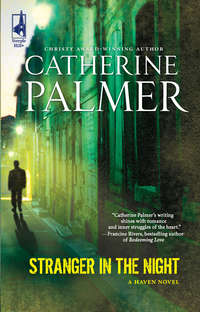
Read the book: «Stranger In The Night»
Praise for
CATHERINE PALMER
and her novels
“Catherine Palmer pens a page-turner with a…thought-provoking plot.”
— Romantic Times BOOKreviews on Fatal Harvest
“Palmer knows how to write about a sensitive subject with wisdom and kindness.”
— Romantic Times BOOKreviews on Thread of Deceit
“Marked by top-notch writing and sweeping drama.”
— Library Journal on The Briton
“Veteran romance writer Palmer…delivers a satisfying tale of mother-daughter dynamics sprinkled with romance.”
— Library Journal on Leaves of Hope
“Enjoyable…Faith fiction fans will find this novel just their cup of tea.”
— Publishers Weekly Religion Bookline on Leaves of Hope
“Believable characters tug at heartstrings, and God’s power to change hearts and lives is beautifully depicted.”
— Romantic Times BOOKreviews on “Christmas in My Heart” in That Christmas Feeling
“ Love’s Haven is a glorious story that was wonderfully told…. Catherine Palmer did a stand-up job of describing each scene and creating a world which no reader will want to leave.”
— Cataromance Reviews
Christy Award-Winning Author
Stranger In The Night
Catherine Palmer
A Haven Novel
 www.millsandboon.co.uk
To the refugees in Clarkston, Georgia,
who have brought such joy into my life.
Acknowledgments
Many thanks to those who shared stories of their work with refugees. In particular, I’m grateful to Tim Cummins, Terry Earl, Bennett Ekandem, Kim Kimbrell and all the caseworkers and other staff at World Relief. May God bless each of you. As always, my gratitude to my husband is boundless. Thank you for reading every word—sometimes more than once. I love you, Tim.
“When a stranger sojourns with you in your land,
you shall not do him wrong.
The stranger who sojourns with you
shall be to you as the native among you,
and you shall love him as yourself…
I am the Lord your God.”
— Leviticus 19:33–34
“Come, you who are blessed by the Father,
inherit the Kingdom prepared for you
from the foundation of the world.
For…I was a stranger,
and you took me in.”
— Jesus Christ
Matthew 25:34–35
Contents
Chapter One
Chapter Two
Chapter Three
Chapter Four
Chapter Five
Chapter Six
Chapter Seven
Chapter Eight
Chapter Nine
Chapter Ten
Chapter Eleven
Chapter Twelve
Chapter Thirteen
Chapter Fourteen
Chapter Fifteen
Chapter Sixteen
Chapter Seventeen
Chapter Eighteen
Chapter Nineteen
Chapter Twenty
Chapter Twenty-One
Questions for Discussion
Chapter One
S weat dampening the wrinkled sheet beneath him, Joshua Duff counted the spurts of AK-47 bullets hitting the front door. The first round slipped into his nightmare—house check on a nameless street in Kabul. A search for insurgents. Dread crawled through him like a snake, twining around his neck, suffocating him as he crept forward in the heat. Faces stared at him, brown eyes luminous beneath long, fringed black lashes. Mouths smiled, lips parting over missing teeth. Hands reached out, fingers extended.
Friend? Or enemy?
The second round of staccato hammering woke Joshua from the troubled dream. The strangled breaths were his own. Jerking upright, he reached for a gun that wasn’t there. The smell of gym shoes, basketballs, dusty concrete caught in his nostrils. This was not his barracks.
Or was it?
His eyes searched the darkness. Confusion tore through his brain as he worked to decipher data. A form lay on a bed across from him. The mound of muscled shoulder was motionless. Another man sprawled on a mattress near the door.
Comrade or civilian?
Asleep or dead?
A single window filled the only visible wall.
Somewhere nearby, an animal snuffled.
Death still stalking him, perspiration beading his bare chest, Joshua gripped the rounded aluminum frame of his cot. He licked his lips, expecting grit. Its absence surprised him. The tendon in his jaw flickered as he tried to force reality into his brain.
Of all the adversaries he’d faced in his thirty years, this was the most wily. This doubt and hesitation, this inability to decode the truth, eluded him like a Taliban sniper in the Hindu Kush Mountains. He tensed, waiting for an imam’s voice to drift from a distant minaret, the morning melody of Islam. The start of another day.
The hammering rang out a third time. Not a machine gun, it was fist against metal.
“Devil take ’em.” Sam Hawke’s familiar voice was drowsy in the stifling room. Hawke was a fellow Marine. Reconnaissance. They had patrolled the streets together too many times to count.
The other man unfolded now, a hiss groaning through the air mattress beneath him. “Where’s Duke? Come here, boy.”
A German shepherd’s low-throated growl answered. Joshua recognized it. He had seen the dog before. But where? Toenails clicked across the cement floor as Duke paced. The edges of Joshua’s nightmare began to sift away like desert sand.
“I’ll get the door,” Sam said, rising. He glanced at Joshua. “Duff, you stay put. Let’s go, Terell.”
Terell Roberts—the third man’s name. He stood and stretched. His dark skin shimmered with perspiration.
Duke tensed, waiting for one of them to open the door. The dog anticipated each movement the men made. He knew this routine.
Sam flipped on a lamp and Joshua scanned the room, distinguishing a heap of jeans and T-shirts awaiting detergent and a dryer. He noted a clipboard near his cot, the list of activities Sam had planned for the coming day. Joshua recalled his friend handing it to him, explaining what he’d written—basketball practice, homework and tutoring, woodworking, computer skills, ballet lessons, crochet, arts and crafts.
Hardly the business of their Marine Corps reconnaissance unit.
He spotted his wallet and keys on a low table. That wallet held U. S. tens, twenties, fifties. More than a month had passed since he’d carried colorful paper afghanis with their detailed etchings of mosques, and handfuls of jingling puls in his uniform pockets. He had rented a civilian car at the airport. He recalled parking the black Cadillac near the building’s front door the evening before.
This was what they called post-combat disorder. Post-traumatic stress syndrome…
A fourth round of hammering broke his focus.
“Persistent booger,” Sam muttered.
Shaking off his confusion, Joshua got to his feet. “What’s up, Hawke?”
“Nothing. We get this every night. Homeless folks in search of a bed, a drink, another fix bang on Haven’s door. Some think it says Heaven.”
“Yeah, and they’re ready.” Terell chuckled ruefully as he stepped into a pair of flip-flops.
Joshua recalled the old building now. Haven, the sign over the entrance read. This was Sam Hawke’s place, the youth center he and Terell Roberts had opened about a year ago. While deployed together, Sam had told Joshua about playing basketball in college. He had spoken of Terell, the consummate athlete, destined for the history books. Last night, Joshua learned that Terell had spent a few years in the pros before bottoming out. Sam had come to his rescue, and with the last of Terell’s NBA savings, they had started Haven.
Sam Hawke was loyal, a man who never forgot a friend. Joshua hadn’t been home in Amarillo for a full day before Sam called and invited his friend to St. Louis.
“Come see what I’ve got cooking, Duff,” Sam had urged. “Your old man is planning to slip those velvet handcuffs around your wrists any day now. Get over here and pay me a visit while you can.”
The idea of spending time at a youth center in the run-down inner city didn’t appeal to Joshua. He had invested more than enough of himself in the poverty and danger of Afghanistan. His parents’ rambling adobe house with its swimming pool and tennis court looked pretty good. He would enjoy riding out on one of the Arabians his father bred. There would be dinners with friends and family, flying over the spread in the Cessna, heading into town for a…
Come to think of it, Joshua couldn’t figure out what he’d want to do in Amarillo. The ranch certainly wasn’t going anywhere. His father’s oil business and the executive position could wait, too. With his parents both protesting, he had grabbed his duffel bag and headed back to the airport.
In St. Louis, he had rented the Cadillac. Then he drove into the city. Though it was late when Joshua arrived at Haven, he, Sam and Terell had stayed up talking for hours. When his head hit the pillow, Joshua had expected to sleep at least until the sun came up. But it seemed the two directors of the youth center were accustomed to regular interruptions of their night’s rest.
“Armed?” Sam asked Terell as they stood in the half-light of the large room.
Expecting the men to reach for handguns, Joshua was surprised when Terell picked up a can of pepper spray. Defensive weapon. Strange choice, he thought.
Sam reached for a box he kept under his bed. He offered it to his friend.
Gleaming steel knives. Joshua glanced up in confusion. Sam and he were both expert marksmen.
“We keep a low profile around here,” Sam said with a shrug.
Fingers closing around a slender stiletto, razor sharp, Joshua considered his friend’s arsenal. A knife was an offensive weapon. That fit with what he knew of Sam Hawke. Highly trained leaders, the men were still very much alike.
The German shepherd led the way out of the humid room, across a dank landing to a flight of chipped concrete steps.
“Male,” Terell said as they began the descent.
“Agreed.” Sam’s voice was husky. “White.”
“Nah, black. A kid. Scared.”
Joshua realized this must be a nightly guessing game.
“Middle-aged,” Sam offered. “Drunk.”
“Bleeding.”
“Probably.” Sam picked up a first-aid kit near the stairwell. “Knife wound.”
“Gunshot.”
None of it sounded good to Joshua.
The three men crossed the cavernous gym, the site of Haven’s single basketball court, two foursquare layouts, and just enough room for a gaggle of jump-ropers. Duke huffed with anticipation as he padded ahead. Yet another round of knocking began as they arrived at the front door.
“Whatcha need?” Terell called.
“Open the door. Please open.”
At the pleading voice outside, Sam and Terell looked at each other, blue eyes meeting brown.
“Illegal alien,” Sam said. “Adult male. Lost.”
“Bet he got kicked out of his apartment,” Terell muttered, reaching for the bar that secured the door.
Joshua weighed the stiletto in his palm. Earlier that evening, Sam had told him that African-American kids were a consistent majority at Haven. Latin Americans were part of the mix, too—most poor, persecuted, living on the brink. Unable to obtain visas or achieve refugee status, their parents had spent all they had and risked their lives to enter the U. S. illegally.
But the composition of the neighborhood had begun to change in recent months. Charitable foundations were resettling refugees by the score in St. Louis. An influx of immigrants from Burma, Somalia, Sudan, Congo, Bosnia and other war-torn countries led to new youngsters stepping timidly through the metal detector at Haven’s front door.
Long ago, Sam and Terell had decided to take a “don’t ask, don’t tell” policy regarding legal documentation, they told Joshua. Haven was about the business of God’s work. And the Lord had laid out a clear mandate for His people to welcome the alien.
“You ready?” Sam asked, flicking a glance at Joshua.
He gave a brief nod as he sized up Terell. Tall and massively built, the man held up his slender can of pepper spray while Sam lifted the bar and drew back the bolt.
At the slide and click of metal against metal, wisps of Joshua’s nightmare floated across his mind. He gritted his teeth. The door swung open.
Liz Wallace turned a page in her scrapbook and ran a fingertip over the photograph of her parents waving goodbye at St. Louis’s Lambert Airport. They had no clue that within three days, their precious child would be sitting down to a meal of roasted bush rat.
In fact, they never found out the whole story. You couldn’t just fire off an e-mail that read, Hi Mom and Dad. Ate monkey meat and fried termites for dinner today.
This was not the kind of thing that would boost their enthusiasm for Liz’s dreams of becoming a foreign aid worker. Of course, her brief trip to the Democratic Republic of Congo hadn’t exactly been about transforming the plight of a Third World nation. She and her college teammates went to help rebuild a primary school that had been hit too many times by mortar fire. They put up a few walls and hurried home.
But that trip, more than a year before, had changed Liz’s life. The moment she graduated from college, she took a job with Refugee Hope, a resettlement agency in St. Louis. Her goal: to learn Swahili, enter a training program and move to Africa to work for the United Nations in refugee camps.
On this stifling night, unable to sleep after long hours toting supplies to incoming families from Burma and Bosnia, Liz couldn’t sleep. Not unusual. Most days she was so exhausted she could hardly stand up. But after arriving home to her studio apartment, eating a quick bite of dinner and checking her schedule for the next day, she felt her second wind kick in. Wide-awake and unable to turn off her brain by 2:00 a.m., she made a cup of decaf tea and settled on her sofa with the scrapbook.
Liz turned the page and studied the faces gazing back at her, impassive and worn. She had briefly considered decorating the page in the colors of the Congo flag and placing stickers of wild animals here and there. But why distract from the beauty of the Congolese people with their buttery chocolate skin and deep eyes?
Yet what suffering the people had endured. Until that trip, Liz had never heard of such horrors. She understood now that Rwanda’s civil war had sent nearly a million refugees pouring over the border into Congolese camps. When those refugees began to build power to retake their homeland, they enlisted the help of men in Congo’s government. That brought resistance.
War began in Congo in the fall of 1996, complete with genocide, looting and genital mutilation. In some areas, soldiers raped more than half the women. Almost fifty thousand children were kidnapped and forced into combat, slave labor, sexual servitude.
Not long after a cease-fire was signed in 1999, insurgent groups led a second uprising. Yet another peace treaty was signed in 2003. By the time Liz arrived in Kinshasa, more than four million people had died. Some were killed in the conflict, but most perished from disease and starvation.
Three million were homeless. Houses, hospitals and schools lay in rubble. Fields and food supplies were burned. People hovered on the brink of starvation.
Under the umbrella organization of Refugee Hope, Liz cared for many of those woeful survivors who arrived in St. Louis. She wasn’t doing much to help, though. Her job was mostly desk work. Filing government forms.
She wondered if anyone could prevent genocide. Probably not.
Four sets of dark eyes stared back at Joshua. He had seen this before—a man, a woman, two children, a plea for help written on earnest faces. Their innocence could belie a body strapped with explosives. In battle, Joshua had learned not to trust any expression of virtue. But this wasn’t warfare—not the combat kind, anyway.
With a tired smile, Sam stepped into the open doorway of Haven. “Hey, there,” he greeted them. “What can we do for you tonight?”
The man gave an awkward little bow. Skin of polished ebony glowed in the streetlight. His gray shirt was too big, made of cotton, short-sleeved and wrinkled. Khaki trousers sagged at the ankles. Shoes, cracked patent leather with frayed laces, had parted at the seams to reveal threadbare socks.
“Good evening, sir,” he said, clutching a battered suitcase. A faint British accent, Joshua noticed. “I am Stephen Rudi. If you please, may I present my wife, Mary. And here is my daughter, Charity, and my son, Virtue. We come from Paganda.”
“What are you folks doing on the street at this time of night?” Sam asked. “This is a dangerous area.”
“Yeah, and it’s after two in the morning.” Terell was peering at his Rolex, evidently a vestige of his once-lucrative basketball career. “Mr. Rudi, your children ought to be in bed.”
“Indeed, sir. But we have had a most unfortunate day. Please, may I explain? You see, we had recently arrived in Atlanta when we received a letter from my wife’s brother. This man is our only family member to escape the recent unrest in Paganda. He invited us to join him here, where we could live with him and find better jobs. We traveled to St. Louis by bus, arriving this morning. But we searched all day, and we could not find him.”
“Aha.” Terell stifled a yawn. “So, you’re from where? South Africa?”
“Paganda, sir. It is in East Africa, near Lake Victoria.”
Joshua could see that neither Sam nor Terell recognized the country. He didn’t recall much about it himself. Former British colony. Few natural resources. Tribal conflict—humanity’s constantly failing effort to eradicate enemies. Sunnis and Shiites. Kurds and Iraqis. Hindus and Muslims. Nazis and Jews. Spaniards and Aztecs. Settlers and Natives. Boers and British.
Extermination never worked, but people forgot that. Again and again they attempted the wholesale slaughter of their foes. Genocide wouldn’t end until trumpets rang out in the eastern sky to announce the end of time.
“You still got that letter?” Terell asked, focusing on the man’s wife. “Uh…what was the name?”
“Mary.” Stephen Rudi spoke for her. He fished in his pocket and then unfolded a tattered sheet of notebook paper. Holding it out to Terell, he tapped a place near the end of the page. “This is the address, sir, but my wife’s brother is not to be found. Our search revealed nothing, not even the correct street.”
While Terell and Sam studied the letter, Joshua appraised the Pagandan woman who stood beside her husband. Tiny and thin-boned, she wore large round spectacles that all but masked the distinguishing features of her face. She kept her eyes downcast and her fingers woven together, as if determined to draw no attention to herself. Joshua had seen this attempt at self-preservation in Afghani women and children. An effort to hide in plain sight.
A scarf, elaborately knotted, covered her head. Her dress, threadbare pink gingham with eyelet lace at the neck, was mostly covered by a length of ethnic-patterned fabric. She had wrapped it in a sort of African sarong. The woman had the look of a frightened bird.
Turning his assessment to the two children, Joshua saw exhaustion weighing on them. They gazed up at their father in a mixture of respect and concern. Charity’s hair was braided in messy cornrows. Her bright almond eyes glowed with intelligence. She had white teeth, a pug nose, round cheeks. She would do well in school, Joshua thought.
The boy was a mirror image of his older sister—minus the cornrows and several teeth. How did so many five-year-olds manage to lose their two front teeth not long before Christmas? he wondered. The old song “All I Want for Christmas is My Two Front Teeth” wouldn’t be meaningful without a few toothless kids belting it out.
“I don’t think that street exists,” Terell commented. He passed the letter to Sam. “You ever heard of this place?”
Joshua eyed the document as his friend read it. Pulled from a college-ruled notebook, the page had been handled so much it was about to fall apart. Messy pencil marks were smudged, hard to read. A grease spot had blurred the signature. In the upper-right corner, a water ring muddied the blue lines. The letter was written in an African language, but the address at the end was clear enough.
Sam returned the precious page to its owner. “You sure this is in St. Louis, Mr. Rudi?”
“Indeed, sir.” Stephen glanced at his wife, suddenly hesitant. He spoke to her in their mother tongue for a moment. Head low, she uttered a couple of barely distinguishable words in response.
Stephen nodded. “If you please, sir. My wife is quite certain her brother lives in St. Louis.”
Terell and Sam eyed each other for a moment. Finally Sam spoke up. “I’m sorry, but Haven is not a homeless shelter. Our mission statement prohibits taking in strangers. We have a rule.”
Joshua couldn’t believe what he was hearing. He nudged his friend’s elbow. “Sam, can I talk to you for a second?” They stepped back into the building. “Since when did you abide by rules?”
“If we let these folks in,” Sam replied in a low voice, “we can’t turn anyone else away.”
“Come on, man. We can’t leave those kids on the street.”
Sam gave him a long look and shrugged. “I’ll probably regret this, but okay.”
As they emerged onto the sidewalk, Joshua reached for the children’s hands. “Come on, you two. The sooner you’re settled, the sooner we can all get some sleep.”
Sam let out a breath. “We’ll put you up for the night, Mr. Rudi. No longer than a week, though.”
“That’s our max, so don’t try to argue us out of it.” Terell spoke as firmly as he could, which wasn’t saying much. “Do you understand?”
Terell Roberts looked as if he could tear a man’s head off. But his gentle tone led Joshua to believe the guy was a bona fide teddy bear—compliant, impossibly kind, generous. How would he respond in a conflict situation?
“We would never wish to impose upon your kindness,” Stephen vowed to his benefactors as Sam bolted the door behind them. “Indeed, we are sincerely grateful.”
The Rudi family accompanied Terell across the basketball court toward the stairwell. Sam followed with Joshua.
“They’ll beg for more time,” Sam said under his breath. “They always do. The homeless, hungry, sick, battered, dying—they come to Haven hoping for a solution to their problems.”
“Do they ever find one?”
“Temporarily. We let them stay a night or two until they find other quarters. Relief agencies, shelters, food kitchens fill the gap. But it’s never enough.”
“Doesn’t the constant need drag you down?”
“Nah. It’s like the war. You focus on the good, the hopeful.”
“Your fiancée?”
Sam smiled. “Ana helps.”
The woman who had walked into Sam’s life that summer brought him to life again, he had told Joshua. He felt almost human for the first time since his military discharge. Sam said Ana’s intensity matched his own. She could be difficult and definitely stubborn. But with Ana, he could let down his guard.
Joshua was happy for his friend. He’d been too long without a woman in his own life, and he didn’t see much prospect for that changing anytime soon. Most of the girls at home were provincial. They believed everything they heard on television. Few had set foot outside the U. S. Some had never left Texas.
One or two women had caught Joshua’s eye while in Afghanistan, but a military romance was not for him. He enjoyed a lady who knew how the world functioned, but he didn’t want the separation or anxiety of such a relationship. He wouldn’t like to worry about safety. If he ever found love, he couldn’t risk losing it. So he had kept himself distant, focused on the task at hand.
“Ana’s not the only good thing in my life,” Sam said as they approached the stairwell. “We’ve got a lot to be thankful for around here. Lead paint abatement crews just finished stripping and recoating our walls. Ana wrote an article about the paint problem, and a surge of donations poured in. We formed a nonprofit organization—complete with a board of directors and grant writers. The bathrooms are finally working. The ramps, exits and stairwells meet code. It’s been a long haul.”
“The place looks good,” Joshua agreed.
“We’ve got new volunteers, too. Plus, the vet gave Duke an all-clear this morning. Hip dysplasia forced him out of police K-9 service too early, but he’s been God’s gift to us.”
“And this Pagandan family. Thanks to Haven, they’ll sleep safely tonight.”
“You’re the one who made that happen,” Sam said. “We’ve turned away people a lot more pitiful.”
“I’d never let a kid sleep on the streets. You wouldn’t, either, Hawke. You know it.”
As they began to climb the steps to the second floor, Charity and Virtue stretched tiny hands to pat the big dog. Joshua guessed the canine had been trained to sniff out drugs and could take down a grown man, but these small children sensed he wouldn’t harm them.
When Virtue sagged against the stairwell wall, Joshua lifted the tired boy into his arms. Sam scooped up the little girl.
“So Paganda has some big cities?” Terell was asking their father.
“One,” Stephen said. “But we come from a small village beside Lake Victoria. Our people were fishermen.”
“Were?” Terell frowned. “You mean they stopped?”
“Sir, the village was burned. My people…are not there now.”
Joshua silently prayed that Terell would take the hint. But subtlety was not the man’s strong suit.
“Headed for refugee camps, I’ll bet. Good thing you got your family out.”
“My children and I are three of only nine people who survived from my village.” Stephen paused in the stairwell, his voice growing low. “When my wife learned that the rebel army was coming, she placed these two—the youngest except for our baby—inside a metal water drum. There were only a few liters remaining inside it, and she put a padlock on the top. Because of rust, the drum had small holes. Through these, the air could come. When I returned to my house, I saw that the roof and walls had burned. Rebels had looted the furnishings. But God protected the drum. Inside it, I found my two children.”
As Stephen spoke the final words, a chill crawled up Joshua’s spine. The drowsy little boy whose head lolled against his shoulder had survived the destruction of his village because his mother had hidden him in a water drum? At their young ages, the kids might have drowned. The burning house could have caved in on top of them. They might have been discovered and killed. The child was a miracle.
“But where were you the whole time?” Terell asked Stephen as the group walked down a hall.
His grunt was bitter. “I was attending a pastors’ meeting in another town. When I heard news of the rebel attack, I rode my bicycle as fast as I could. But I arrived at my village too late.”
“So your baby? What…I mean…Where’s the baby?”
Shaking his head, Joshua realized that Tyrell had never seen the shell-shocked faces of civilians whose lives were destroyed by war and death. His own inability to shrug off nightmares and block memories of events he had witnessed showed how difficult it could be to recover from such trauma.
“My son, Justice, was killed,” Stephen said, the words muffled. “Also my first wife, Priscilla, and my other children, Purity, Hope, Fidelity and Honor. I would thank you, please, that we not discuss this subject further tonight, sir. By God’s grace, I still have Charity and Virtue. I must protect them from the memories of what they heard and saw.”
“Oh, yeah, my brother. We can drop that topic forever.” Terell looked shaken.
The group stepped into a small room outfitted with several beds and a table. Despite its rules, Haven had made provisions for just such an emergency as this.
“You’ve got clean sheets there,” Sam said. “We keep crackers and power bars on that shelf. Towels and soap are in the bathroom, along with paper drinking cups.”
“I could run out for some milk,” Terell offered. “I’d be glad to do it.”
“Water is most acceptable for us.” Stephen faced his benefactors. “May God bless you for your kindness.”
Joshua bent and gently laid the sleeping Virtue on one of the beds. He pulled a sheet and thin blanket over the child. Thumb thrust into his mouth, Virtue barely stirred. Charity, too, was sound asleep.
When he straightened, Joshua noted that Sam and Terell had left the room. Stephen was murmuring to his wife. It was time to leave the family in peace. Yet Joshua needed to speak.
“Excuse me,” he said. The two Pagandans fell silent as Joshua addressed Stephen. “You’re a pastor, then. A Christian.”
“I am, sir.”
Joshua hesitated a moment. “The pain and the loss you feel. The fear, too. I’ve known some of that. God takes care of it after a while. He uses it to make you better. Trust Him.”
Stephen swallowed, unable to meet the other man’s eyes. He nodded slightly, but did not otherwise respond.
“Good night,” Joshua said finally. “We’ll see you in the morning.”
He closed the door and started after Terell, who was questioning Sam as they walked to their shared room. “Did you hear what that guy said? Rebels killed his baby. His baby! That is just wrong. Those other names—were those his kids, too?”
“Yeah, and his wife,” Joshua said, catching up to them.
Sam frowned. “But his wife is with him.”
“Mary must be someone new. He said Priscilla was the mother of his children.”
Terell groaned. “Aw, man, the first wife must have gotten killed by the rebels. Sam, those two kids were locked in a barrel. They could have starved.”
“Or been slaughtered like their brothers and sisters. But they’re alive—that’s the important thing.”
Joshua nodded. “Now the family has to figure out a way to move ahead without the past dragging them down. Like all of us.”
He could feel Terell’s eyes on him as they entered the room. “You think the kids heard their mama being murdered?”
“Maybe. They know she’s dead.”
“That’s terrible, yo. If anybody went after my mama, I’d kill him.”
“Good job. You just described the basic recipe for genocide.” Joshua stretched out on the cot. “Revenge never did anyone a bit of good.”
Sam dropped down onto his bed. “Let it go, Terell.”
“You dudes don’t have any feelings. I can’t hear a story like that and then let it go. Those are my people.”
Sam gave a snort as he switched off the lamp. “They’re not your people any more than they’re mine.”
“They’re black. Africans are my ancestors.”
“And my great-great-grandfather was a Scottish laird. You don’t see me playing bagpipes and dancing a jig.”
Joshua knew he should let the two men hash it out, but he couldn’t resist offering his thoughts. “We’re all connected. Forget skin color and bloodlines. God doesn’t see that. Neither should we.”
“Haven may not have room for everyone,” Sam said. “But we’re here to help the Rudi family. If his wife’s killers walked in here, we’d probably help them, too. Get over yourself, Terell.”
“Me? You’re both loony tunes. The sand in your heads rusted out your brains. Go find a couple of camels, yo. Get on back to the desert where you belong.”
Joshua could hear Sam chuckling. A comforting sound. In a moment, both men began to snore.
Joshua stroked the warm steel blade in his palm. Turning onto his stomach, he slipped the knife under his pillow. It might just come in handy.
Chapter Two
L iz locked her purse inside the drawer under her desk and switched on the computer. She was tired. Too tired to be at work this early in the morning. But the day wouldn’t wait.
Before meeting a Somali family at the airport at ten, she had to fill out status reports on two groups of Burmese immigrants brought in by Refugee Hope. They had landed in St. Louis the week before. Ragged, little more than skin and bones, they had stared at her with gaunt faces and milky eyes. At the sight of an energetic white woman with a mass of brunette curls, the children clung to each other. Their parents couldn’t quite muster a smile at having finally arrived in America, the land of their dreams.
With a sigh, Liz shook her head.
“Incoming!” Her closest friend at the agency breezed past the small cubicle. Molly stuck a thumb behind her to indicate the cluster of people headed Liz’s way. “They’re all yours!”
Molly loved mornings.
Liz groaned and reached for her flask of hot tea. Before work, she always steeped a pot of the strongest black tea on the market. The first cup opened her eyes. The second turned on her brain. With the third, she usually had the gumption to say—
“No.” Holding up a palm, Liz rose from her chair before the newcomers could step into her cubicle. “I don’t know who sent you here, but you have the wrong office.”
“No?” A tall man with close-cropped brown hair stepped around the collection of bewildered Africans. His dark eyebrows narrowed. “Did you say no?”
“I’m sorry, but this is not one of my families.” She met his blue eyes. Deep navy with white flecks, they stared straight into her.
Why hadn’t she started that third cup on the drive to work?
“I know my own people,” she informed him. “This group doesn’t belong to me. If you’ll go back to the front office—”
“The front office sent us to you.” Gaze unwavering, he stuck out a hand. “Sergeant Joshua Duff, U. S. Marine Corps. And you are?”
“Liz.” She grasped the hand. His warm fingers curled around her palm, crushing her knuckles together. She caught her breath. “Liz Wallace.”
“A Scot. I’m Irish.”
“American, actually.” She pulled her hand away and stuck it in the pocket of her slacks. “So, Semper Fi and all that. I appreciate the interest you’ve taken in these people, Sergeant, but Refugee Hope is accountable only for the families we relocate. If you’re responsible for this group, you’ll have to—”
“Semper Fi and all that?” He leaned forward, as if he weren’t sure he heard her correctly.
Oh, great, Liz thought. She picked up her flask, unscrewed the lid and poured the third cup. Praying he couldn’t see her hand trembling, she lifted the mug to her lips. The tea slid down her throat.
This was not what she needed a few minutes after eight in the morning. Not an overwhelming, overbearing, overly handsome sergeant with a death grip. And certainly not a pair of striking blue eyes that never seemed to blink.
“Sergeant Duff.” She found a smile and hoped it looked sincere. “Please forgive my lack of courtesy. I have a large number of families in my caseload. An overwhelming number. This group isn’t among them.”
With effort, she dragged her focus from the man’s sculpted cheekbones and clean-shaven square jaw. The group huddled under his protection shrank into each other as she assessed them. A man, midforties, she guessed. His wife, hard to tell her age behind those big glasses, clearly traumatized. Two children. The girl, about seven, needing new clothes. The boy, probably five, missing several front teeth.
“This is Reverend Stephen Rudi,” Sergeant Duff said, clamping his big hand on the man’s shoulder. “His wife, Mary. Their children, Charity and Virtue. They’re from Paganda.”
Paganda. Images flashed into Liz’s mind. Photographs she’d seen. Villages burning. Mass graves. Boy soldiers toting machine guns. She thought of the people she had met in Congo. They spoke of Paganda in hushed tones. Even worse than most places, they said. Genocide. A bloodbath.
Liz shuddered and sized up the little family more closely. Who knew what these people had endured? Too often these days, she caught herself regarding the refugees as line items on one of her many lists. Family from Burundi: mother, father, eight children. Family from Bosnia: mother, her brother, four children. Family from Ivory Coast: mother (pregnant), father, six children.
When had they ceased to be human beings?
“Reverend Rudi, good morning.” Liz offered her welcome in the African way—right hand extended, left hand placed on the opposite arm near the crook of the elbow. A demonstration of honor, as if to say, “I will not greet you with one hand and stab you with the other.”
The man stepped forward, shook her hand and made a little bow. “Good morning, madam. Thank you very much for your time. My family is in great need of assistance.”
How often had she heard these words, Liz wondered. The need was a pit, bottomless and gaping. A hungry mouth, never sated.
“Which agency brought you to St. Louis?” she asked him. It was a relief to turn her attention from Sergeant Duff. Like a male lion poised to spring, the man didn’t budge. His presence filled the cubicle with a sort of expectant energy Liz could hardly ignore.
Reverend Rudi’s voice was strained but warm, carrying familiar ministerial overtones. “Madam, Global Care brought my family from a refugee camp in Kenya. We traveled by airplane from Nairobi to Atlanta. My wife’s brother invited us to St. Louis.”
“Global Care doesn’t have an office here,” Duff inserted. “The Rudis will need your help.”
Liz returned her focus to his face. The man had moved closer to her desk now, his fingertips touching her stack of files, his shoulder tilted in her direction.
“I’m sorry, Sergeant. As I said before, if Refugee Hope didn’t bring this family to the States, we won’t be able to provide assistance. The Rudis need to contact Global Care in Atlanta and make arrangements.”
“But as you see, they’re here now. So what can you do for them?”
“Nothing. I’m authorized to work only with my families. Those brought in by Refugee Hope.”
“So transfer them.”
She studied the blue eyes. He really did expect her to obey. He thought she would capitulate right on the spot. The man was used to giving orders, and to having them followed.
Liz had never done well with authority figures. She simply didn’t buckle.
“If Global Care wants to make provisions for this family,” she informed him, “you will need to speak to someone at their headquarters in Atlanta. Refugee Hope is based in Washington, D. C. St. Louis is a resettlement point. We follow our agency’s rules.”
Joshua Duff straightened. His eyes narrowed. Then he turned to the family. “Pastor Stephen, how about you go find a snack machine and get the kids something to eat.”
He fished a wallet from his pocket. Liz tried not to gawk at an accordion of cash that unfolded when he opened it. He removed several bills and held them out. The African minister took the money with some reluctance. Duff misunderstood.
“Snack machine.” He motioned as if he were pushing buttons with his index finger. “Food. Candy bars. Crackers.”
With a nod, Reverend Rudi shepherded his little flock out of the cubicle. The moment they were out of sight, Duff leaned into her desk.
“Listen, ma’am, I came across this family last night. I agreed to help them. You work for a refugee agency, right? These are refugees. So do your job.”
Liz stepped around her desk. “This is not the Marine Corps, Sergeant. But we do have a protocol and you’re asking me to violate it. I will not do that.”
The dark eyebrows lifted. “All right, I understand. So, what do we have to do to make this happen?”
“I’ve told you. Call Global Care and turn the family over to them.”
“And where is that pitiful bunch supposed to go while the agency figures out what to do with them?”
“You could put them on a bus and send them back to Atlanta.”
“They don’t want to live in Atlanta. They want to stay here and look for the lady’s brother.” He set one hip on her desk, bringing himself down to her eye level. “Ms. Wallace, you wouldn’t be working for this agency if you didn’t have compassion. These folks need a place to stay, decent jobs, a way to get around. That’s what you do, isn’t it? Why don’t you just help them out of the goodness of your heart?”
“Why don’t you? ”
“Because I live in Texas.”
He looked away, the muscle in his jaw flickering. Liz could see the man was struggling for control. Good. She had a full day of work ahead, and she didn’t like being pushed around.
In a moment, he faced her again. “Look, I’ve just spent seven months hunting insurgents in the Afghan mountains. My third deployment. I’m tired. My patience—never a strong suit—is wearing real thin right now. I came to St. Louis to visit a friend for a couple of days, and this morning he sent me out on a little mercy mission on behalf of Reverend Rudi and his family. Now, they’re nice folks, and they’ve been through an ordeal worse than most. I believe you know exactly how to arrange a happy American life for them, ma’am. Am I wrong about that?”
“I know how to resettle refugees, yes. But as I said, I’m not allowed to work with families who aren’t on my list. If you’re so worried, you help them. It’s time-consuming but not all that complicated. I’ll tell you what to do step by step. How does that sound?”
He bent his head and chuckled. “Well, well, well. You know something, Liz Wallace? You’re more trouble than a couple of Pashtuns haggling over the price of a camel. I can handle them. I can track a sniper across five miles of bare rock. I can even talk a sheikh into turning loose a few goats to feed some hungry beggars. But I can’t seem to get a social worker to help a family of refugees. Did I catch you on a bad day, or are you always this mean?”
Liz rolled her eyes. “Move. You’ve got your Duff on my files, Sergeant.”
With a laugh of disbelief, he stood. Liz scooped up her paperwork and flipped open the first file.
“You see this family?” she said, covering the name with her thumb. The photographs of four Somalis were lined up along one side. They looked like criminals posing for mug shots.
“This mother was raped by guerrilla soldiers. Seven of them. In front of her husband and children. They killed the father, the baby and the other two youngest of her five kids. Chopped them up with machetes. They took the oldest girl, raped her, tied her legs and arms together and then threw her into the back of their truck. They took the oldest boy as a slave. Then they drove away.”
She paused and glanced at Duff. His grim expression told Liz she was getting through.
“The mother never saw her children again,” she continued. “She was left with one daughter, a thirteen-year-old who had been fetching water from a stream when the rebels attacked. This woman and her daughter walked more than a hundred miles across the Somali desert into Kenya. They lived in a mud hut inside a United Nations refugee camp for five years. They ate gruel and got water from a spigot that served twenty other families. Both gave birth to sons. This mother, her daughter, son and grandson are here now. In St. Louis. Are you with me, Sergeant?”
“All the way.”
“Shall I continue?”
“Go ahead.” His face had grown solemn, but his eyes were not focused on the photographs. He was looking at Liz.
Disconcerted, she closed the file and set it back on her desk before speaking again.
“Two weeks ago, I greeted this woman and her family at the airport, Sergeant Duff. I took them to a run-down apartment in a high-rise not far from here. Refugee Hope has prepaid their rent for three months. Within those three months, it’s my job to make sure this mother learns how to use public transportation, goes to English language classes and attends job training. I have three months to enroll the daughter in a school where no one speaks her language and yet see that she’s able to cope. Three months to ensure that the two babies are brought back to health and provided with adequate day care. I have three months’ worth of funds with which to buy food and clothing. If this family isn’t successfully working, attending school, living independently and eating with proper nutrition in three months, I haven’t done my duty, Sergeant Duff. They’ll be cut loose from Refugee Hope, and no one will follow me to pick up the pieces.”
She looked into his eyes. The bluster was gone, and in its place, she saw a deep sympathy. A warmth. So unexpected she felt her heart stumble.
“How many families do you have, ma’am?”
“Twenty-three current groups. If I don’t get some work done at my desk this morning, I’ll be late to pick up family number twenty-four at Lambert. And you can call me Liz.”
“Liz.” He was silent for a moment. “I live in Amarillo, Liz. That’s a long way off.”
“But see, the Rudi family is here now.” She repeated what he had said to her earlier. “So what can you do for them?”
“You’re good. You’ve trapped me.”
“I can’t track a sniper over bare rock, but I’m not stupid. You wouldn’t have brought those people here if you didn’t have a compassionate streak. We’re alike in that way. Let me tell you how to help them, Sergeant.”
“You can call me Joshua.”
“You’ll enjoy lending a hand, Joshua. Lots more fun than dealing with squabbling sheikhs.”
He opened his mouth to answer, but the return of Reverend Rudi and his family silenced the Marine.
Charity and Virtue, it became evident, had discovered Cheetos. Their lips and fingers coated with orange dust, the two children sidled into the cubicle. Liz struggled not to laugh and scoop them up into her arms, as she so often did with the precious little ones who came under her wings of care. But she couldn’t afford to melt. Not now.
Sergeant Duff needed to take responsibility for this family. His wad of cash would surely buy bus tickets back to Atlanta. He was a good man, kind and concerned. But he had just returned from the war, and his home was in Texas. The last thing he would want to do was take on a group of Pagandans.
“What’ve you got there?” he asked, hunkering down in front of Virtue. “Let me see those fingers, kiddo.”
The child glanced up at his father. Pastor Stephen said something in their native tongue, and Virtue held out his hands. When he noticed his orange fingers, the boy gasped and then burst into a gale of giggles. His sister looked at her hands and started laughing, too.
“Cheetos,” Duff informed the pair. “Puffed or fried, can’t beat ’em. My favorite.”
He rubbed his stomach and made smacking sounds. The kids joined in, rubbing and smacking, clearly enjoying a moment of silliness in the midst of such a solemn day. Pastor Stephen held up the empty cellophane bag.
“The food is very…pink,” he told Liz. “Pardon me…orange. Yes, orange. Can it be washed?”
“Certainly,” she told him. “There’s a bathroom down the hall. You can stop by on your way out. I believe Sergeant Duff is going to help you contact Global Care and make sure you’re safely on your way back to Atlanta.”
“Am I?” Joshua stood, again filling the cubicle in a manner that seemed to dwarf everyone else in the tiny space. “I don’t remember telling you that, Ms. Wallace.”
“Liz. And I told you I couldn’t help them.”
“But you said you’d help me. You’ll tell me the steps, and I’ll settle the family here. Right?”
She couldn’t believe she had heard the man correctly. People didn’t do this. Volunteers might take a few hours out of their lives to assist refugees. A church might adopt a family or two. But no one dropped everything. No one single person simply gave up the weeks and months it took to acclimate an entire group. Liz was paid, and even she had to rely on other aid workers and volunteer helpers.
“You told me you live in Texas,” she said.
“Texas can wait. I’ll stick around here for a while.” He set his large palm on Virtue’s round head. “We’ll go to the airport with you and meet family number twenty-four. You can explain your system to me on the way.”
Liz bent her head and rubbed her eyes. This was absolutely not the way her morning should go. She had files to sort. Forms to fill out. A plane to meet. Clothing and food to deliver. A refugee patient to visit in the hospital. She did not need a U. S. Marine and four Pagandans following her around like a flock of lost sheep.
Unable to bring herself to speak, she held up her hand. Instantly, Joshua’s fingers closed around hers. As she lifted her head, he tucked her hand under his arm, splaying her fingers against his biceps.
“I don’t want to hear your favorite word, Liz,” he murmured, leaning close. “ No isn’t good. Yes is much better. Say yes to the Rudi family, Liz. If you say it, I will, too. And then we’ll make a difference together.”
Everything inside Liz begged to differ. But how could she keep arguing? The man refused to hear any of her very plausible reasons why his scenario wouldn’t work.
“Fine,” she said, pulling her hand from the warm crook of his elbow. “Step one. Take the Rudi family back where you found them. Make sure they have a decent place to live with running water, flushing toilets and enough beds. Drive them to the grocery store and buy a week’s supply of staples and a few perishables. Then go to a thrift shop and see if you can find several outfits for each person. And look for coats. Winter’s coming.”
She picked up a couple of business cards and handed one to Joshua and the other to Pastor Stephen. “Here’s my number. Call me if you need me.”
Before either man could protest, Liz pushed past Joshua and headed for Molly’s cubicle, leaving the five wayfarers standing inside her own. If this was going to be a good day, she needed fortification. Her best friend would be happy to accompany her to the coffee shop down the street for a couple of lattes.
A few hours later, Joshua pulled his Cadillac into a parking space in front of the large brick edifice and switched off the engine. He knew he shouldn’t do this. If he were at all smart, right this moment he’d be on his way back to Amarillo. After a couple of easy days on the road, he would drive out to the ranch. As a matter of fact, nothing would feel better than to strip off his jeans and T-shirt, dive into the Texas-shaped pool and swim a few laps.
No doubt Magdalena would put on the dog for him—enchiladas, chile rellenos, carne adovada, homemade tortillas and a big serving of flan for dessert. The cook had been with the Duff family for years, almost a second mother to Joshua and his four brothers. During each of his deployments, she faithfully e-mailed him once a week to let him know the menu of every meal he had missed. Exquisite torture.
After Magdalena’s home-cooked dinner, he would sleep well in his big, clean, nonsandy bed. Then the following day…
As always, Joshua’s thoughts came to a screeching halt at the idea of driving into town and stepping into the Duff-Flannigan Oil building. He could almost hear his boots squeaking down the long waxed hallway. His voice would echo as he greeted his father. The large corner office would still be waiting—as it had all these years.
Business. The oil business. That’s what we do, son. It’s a Duff thing. Your daddy did it. Your grandpas did it—both sides. And your great-grandpas. That’s why we sent you off to college to get that petroleum engineering degree. You’d be doing it right now if 9/11 hadn’t happened and made you want to serve your country. We’re proud that you did, but now it’s time to take your place here. Your big brother will be CEO one day. You’re our president of field operations. Duff-Flannigan Oil is counting on you.
Hadn’t Joshua just been fighting a war some said was based on a gluttonous thirst for foreign oil? Or had it been about terrorists and the need to quash insurgent cells? Was it about politics—or changing people’s lives for the better? Things could get confusing up in the high arid desert of Afghanistan.
There.
The object of Joshua’s latest quest pushed open the door of Refugee Hope and stepped out onto the sidewalk. At the sight of Ms. Liz Wallace, something slid right down his spine and settled into the base of his stomach. And this was why he should be headed for Texas.
Sam was right about his friend. Joshua had been too long without a woman. He needed to get home, find a couple of pretty gals, and…
What? He hardly knew how to go on an old-fashioned date anymore. Did people even do that these days?
He was thirty. Thirty and battle weary. And Liz Wallace looked so good he had almost dropped to his knees the moment he laid eyes on her.
Instead, he had bullied his way into her office and annoyed her to the point that she ran him off. Worse, he had hog-tied himself to the Rudi family. Not only did he feel obligated to help the dignified Reverend Stephen and his traumatized little wife, but Joshua was positively smitten with Charity and Virtue.
Sighing, he unlatched his door and pushed it open. Liz glanced his way. Her face…for an unguarded moment…said exactly what he needed to know. She had felt it, too. That something. A palpable pull. The irresistible beckoning toward what was probably a huge mistake.
“Liz.” He called her name as she approached on the sidewalk. “Thought you’d take me up on my offer to drive you to the airport. Get a little more information from you about how to manage my new best friends.”
She swallowed. Her brown eyes went depthless for a moment as she met his gaze. Then she focused on his car. “Too small. I’m bringing back a family of five. Thanks, but I always take the agency van to the airport.”
“Good. Where’s it parked?”
“Listen, I appreciate your interest in refugees, Sergeant.”
“Joshua.”
“I don’t need your help picking up this family, and I can’t take the time to explain our system to you right now. It’s very complicated. I have a lot on my mind.”
“I’ll drive while you think.” He imitated her frown. “You’re not going to use your favorite word again are you, Liz?”
Letting out a breath, she shrugged. “Oh, come on, then. But I’ll do the driving. Agency policy.”
“You sure? You look tired.”
“Thanks.”
“Beautiful but tired.”
At the expression of surprise on her face, Joshua mentally chastised himself. Bad form, Duff. You don’t tell a woman she’s beautiful right off the bat.
On the other hand, Liz Wallace was gorgeous. Slim and not too tall, she had the sort of understated figure he liked. Nothing demure about that hair, though. Big, glossy brown curls crowned her head, settled onto her shoulders and trickled down her back. Her skin was pale, almost milky. Those melted-chocolate eyes stirred something deep inside him. But it was her lips that drew his focus every time she spoke.
“We have twenty minutes to make it to the airport.” She pushed back her hair as they approached a mammoth white van sprinkled with rust spots. “When we get there, we’ll be going to the area where international flights arrive.”
“Been through those gates a few times myself.” He smiled as yet another look of surprise crossed Liz’s face.
“I’ve seen the Army grunts at Lambert,” she said. “In and out of Fort Leonard Wood for basic training. I didn’t think the Marine Corps used the airport.”
“You might be surprised at what Marines do.”
She opened the van’s door and with some effort clambered into the driver’s seat. Joshua had all he could do to keep from picking her up and depositing her in place. But he knew better than to manhandle Liz Wallace. She might be small and delicate, but the woman had a razor-sharp streak he didn’t want to mess around with.
“I’ve flown out of Lambert, too,” she said as Joshua settled into the passenger’s seat. Starting the engine, she added, “I left the international area on my way to the DRC.”
At that, she glanced his way. The slightest smirk tilted those sumptuous lips. Clearly this was a test she hoped he would fail. A little global one-upmanship.
He fastened his seat belt and tried to relax. It wasn’t easy. Liz had on a khaki skirt that had seemed more than modest in the agency building. But in the van, it formed to the curve of her hip and revealed just enough leg to mesmerize him. He slipped his sunglasses from his pocket and put them on.
Concentrate on the conversation, Duff.
“So, did you land in Kinshasa?” he asked. “Or maybe you were headed for the eastern part of the country. A lot of people fly into Kampala and travel across the border from there, don’t they?”
She laughed easily. “Okay, you’ve been around. My group landed in Kinshasa. Have you ever visited Congo?”
“You mean the DRC?” He returned her smirk. “Nah. North Africa mostly. How’d you like it?”
“Interesting. It changed me. I’m planning to spend the rest of my life working with refugees in Africa.”
“Africa?” He frowned at the thought of settlements plagued with disease, hunger, violence. “You’re doing a good thing right here, Liz.”
“The people who make it to St. Louis are the lucky ones. All I do is mop up. Try to repair what’s already been broken. I’d prefer to go into the UN camps where I can really make a difference.”
“You’re making a difference now.”
The brown eyes slid his way for an instant. “How do you know?”
“I saw what you do.”
“Not what I want to do. My job is too much about lists and quotas. It’s all red tape and documents and files.”
“It’s people.”
“It was once. In the beginning, I thought I was really helping. But there are so many people, and the needs are overwhelming. I don’t speak anyone’s language well enough to communicate the important things I want to say.”
“What is it you want to say?”
Again she glanced at him. “Were you an interrogator?”
“Tracker.” That left out a lot, but he didn’t want to drag his military service into the open. “I did a little interviewing.”
She nodded, her attention on the traffic again. “What I want to say is…meaningful things. But I can’t. My Swahili is horrible. I’m doing well to meet my refugees’ basic needs. I don’t have time to follow through with schools to make sure the kids are adjusting. I can’t teach the mothers how to provide good nutrition. Most don’t know the simplest things about life here.”
“Like what?”
“That eggs and milk go in the refrigerator. How to use hangers in a closet. Where to put a lamp. How to microwave popcorn or make brownies from a mix. What to do with credit card offers that pour in through the mail. A lot of them don’t realize children need to wear shoes in America. Especially in the winter. But it goes beyond that.”
Joshua held his breath as she swung the van into four-lane traffic. Interstate 70 at midmorning was a free-flowing river of passenger cars and 18-wheelers. The van nestled in behind a semi, then darted out to take a spot vacated by a cab. Liz drove as he did, fearlessly. Maybe recklessly.
“I don’t know the subtext,” she was saying. “So many people groups come through Refugee Hope, and I’ve only learned a few things. Each culture is different. If I were to ask about your family in Texas, you’d give me the names of your closest relatives, right?”
“Maybe.”
“Of course you would. But a Somali would recite twenty generations back to the name of his clan father. In Somalia, men and women don’t touch each other in greeting. Elders—even total strangers—are addressed as aunt or uncle. And babies aren’t diapered. Now, that’s been interesting in St. Louis.”
“I’ll bet.”
“The Burmese—people from Myanmar—have complicated customs that involve naming a baby by the day of the week he’s born on, and his age and gender. And the name changes according to who’s talking to them. In Somalia, it’s polite to give gifts to a mother before her baby is born, like in the U. S. But you’d never do that in Burma. It would bring misfortune on the child. And you don’t give scissors or knives or anything black—to anyone. Trust and honesty are important to the Burmese. Inconsistency and vagueness are considered good manners in Somalia. It’s a positive thing to be crafty, even sly and devious.”
The free sample has ended.