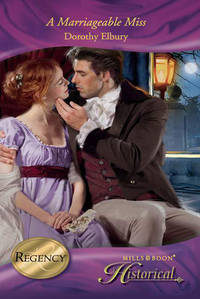
Read the book: «A Marriageable Miss»
Exerpt
‘It would seem your ladyships have been badly misled,’ Richard said.
‘Whilst it is perfectly true that I was obliged to eject Lord Barrington from the room rather forcibly,’ he continued, ‘I consider that my actions were wholly justified. Far from molesting this young lady, as his lordship suggested, I was in the process of proposing marriage to her!’
Steeling himself to ignore the barely concealed gasp of dismay from behind him, he then added, ‘As Miss Wheatley will no doubt be prepared to confirm, should you care to ask her.’
He stepped aside to reveal the scarlet-faced and somewhat dishevelled-looking Helena who, having listened to his astounding claim with mounting alarm, now found herself so utterly taken aback that she was incapable of speech.
‘Miss Wheatley?’
Taking her unresisting hand in his, Richard summoned up a smile of encouragement and said, ‘It would seem that our little secret is out, my love. Perhaps you would care to explain to their ladyships the true purpose of our clandestine rendezvous?’
Dorothy Elbury lives in a quiet Lincolnshire village—an ideal atmosphere for writing her historical novels. She has been married to her husband for fifty years (it was love at first sight, of course!), and they have three children and four grandchildren. Her hobbies include visiting museums and historic houses, and handicrafts of various kinds.
Recent novels by the same author:
A HASTY BETROTHAL
THE VISCOUNT’S SECRET
THE OFFICER AND THE LADY
AN UNCONVENTIONAL MISS
THE MAJOR AND THE COUNTRY MISS
A
Marriageable
Miss
Dorothy Elbury
 MILLS & BOON®
www.millsandboon.co.uk
For Dodie B, Jojobub and Tom Bloggs, with love.
Chapter One
Tossing aside yet another polite reminder of a still unpaid account, Richard Standish, now 6th Earl of Markfield, leaned back in his chair and stretched his aching limbs, wearily surveying the mounting pile of similar requests on the desk in front of him.
It hardly seemed possible that a mere six months had elapsed since his cousin Simon’s fatal accident, as a consequence of which, Standish had unexpectedly and, most reluctantly, found himself in possession of the ancient title. Having resigned his commission the previous year, following Napoleon’s decisive defeat at Waterloo, the ex-dragoon major had returned home to his own small estate, fully intent on realising a long-held aspiration to revive the Standish Stud which, in his grandfather’s day, had been highly regarded in horse-breeding circles.
Unfortunately, his sudden acquisition of Markfield’s vast acreage, along with its accompanying tenant farms and labourers’ cottages, had very quickly put a brake on his purchasing powers, owing to the numerous calls on his rapidly diminishing funds. Not that the expense of the estate itself was in any way responsible for his present financial crisis since, thanks to the competent management of his late grandfather’s land agent, Ben Hollis who, for the past fifteen years or so, had been allowed a more-or-less free hand in the running of the place, this concern was largely self-supporting.
The real headache, from the new earl’s point of view, was the appallingly run-down state of Markfield Hall, the family mansion house, which had been built to celebrate Sir Edmund Markfield’s elevation to the peerage in 1698. In its prime, the Hall had been much revered as an outstanding example of classical architecture but, due to severe neglect on the part of the 4th earl, the late Simon Standish’s father, two of the chimney stacks were now dangerously unstable, several parts of the roof were open to the elements and rain had caused considerable damage to much of the Hall’s fine oak panelling.
Following Simon Standish’s untimely death, the newly ennobled Richard had been appalled to discover how carelessly the previous two occupants had treated the magnificent old mansion house. Not that he had any real desire to take up residence there himself, since he much preferred the more modern comforts of his own house at Westpark—which, until his grandfather had made it over to Richard’s father Henry, upon the occasion of his marriage, some thirty years earlier, had originally formed part of the much larger Markfield estate.
Nevertheless, as his grandmother, the dowager countess, had been swift to point out to him, ‘The Hall has always been regarded as a symbol of the family heritage—to simply stand by and watch it crumble into ruins would be an act of pure sacrilege!’
Accordingly, more in deference to his ageing grandmother’s wishes than to his own requirements, Richard had set in motion an extensive refurbishment programme but, since it had then transpired that the estate kitty contained insufficient funds to bear the brunt of the mounting expense, he had found himself obliged to furnish the cost of the operation out of his own pocket. Having already invested most of his capital in setting up his fledgling stud farm, this additional burden on his finances had been more than enough to cause him concern. Added to which, it now seemed that he had seriously underestimated the likely cost of the venture and, as he stared glumly down at the column of figures before him, he could not help thinking that the project was getting to the stage where it could only be likened to some enormous millstone hanging round his neck! Where in Hades he was going to find enough money to finance the spiralling expenditure was proving to be an ever-increasing quandary. He had already been forced to sell off two of his most promising mares, both in foal to the one-time champion Gadfly, and now it was beginning to look as though he might well have to sacrifice his prize-winning stallion, too!
Distracted as he was by the weight of his problems, the distant sound of the front door bell failed to impinge itself upon his consciousness and it was only the opening of his study door some ten minutes later that eventually roused him from his deliberations.
‘Her ladyship has arrived from London, my lord,’ came the sepulchral tones of Kilburn, his butler. ‘She has instructed me to inform you that both she and Mr Standish are awaiting your presence in the drawing room.’
Stifling a groan, Richard laid down his pen and pushed back his chair.
‘Have some tea sent in and tell her ladyship that I will be with her directly,’ he instructed the man as, getting to his feet, he shrugged himself into his jacket and ran his fingers hurriedly through his dishevelled hair. After casting a perfunctory look at his reflection in one of the glass-fronted bookcases at the doorway, he made his way across the hallway into his drawing room, whereupon he was greeted by his grandmother’s ringing tones.
‘Oh, here you are at last, Richard! Charles was just about to come in search of you!’
‘Dreadfully sorry to have kept you waiting,’ said Richard, bending down to kiss the old lady’s surprisingly unlined cheek before turning to acknowledge his cousin. ‘Have you eaten?’
‘We stopped off for a quick bite at the Red Lion in Wimbledon, as usual,’ said Charles, returning his smile. ‘But Grandmama was keen to get on and view the latest improvements—I see they’ve started stripping the roof of the west wing.’
Mindful of the tiler’s recent statement of account, Richard gave a cursory nod. ‘The work is progressing more quickly than I had anticipated. I rather fear that, if the bills keep coming in at their present rate, I may well have to call a temporary halt in the proceedings.’
‘Oh, surely not, Richard!’ protested the dowager, laying down her teacup with such force that its contents spilled over its rim. ‘I have only just this minute finished telling Charles that the Hall is beginning to look almost as it did when I first went there as a bride over sixty years ago! Your poor grandfather would be so disappointed if he could hear you!’
‘It’s a question of juggling the finances, dear heart,’ returned her grandson, as he moved over to the sideboard to pour drinks for Standish and himself. ‘I already have a mountain of bills to pay and I must keep enough in the kitty for day-to-day expenses. However, if we are lucky enough to pull in good harvests on both estates, I dare say it might be possible to start on the east wing in the autumn.’
‘If only your Uncle Leo had paid heed to my warnings after that dreadful storm, the poor old Hall wouldn’t be in this state now!’ said Lady Isobel, with a plaintive sniff. ‘I begged and begged him to attend to the roof damage, but would he listen? Oh, no! Said he had better things to do with his money. And your cousin Simon was little better. I can only thank God that neither of you is a gambling man!’
‘An occupation for fools and tricksters, in my opinion,’ replied Richard, shooting a warning glance at his cousin, whose cheeks had reddened at the dowager’s remark. ‘Have no fear, Grandmama, I promise you that neither Charles nor I has any intention of following either Simon’s or Uncle Leo’s example.’
Lady Isobel frowned, but said nothing. Having suffered the loss of so many males in her family under somewhat unfortunate circumstances, she took considerable consolation from the knowledge that the current Lord Markfield had few, if any, of his predecessors’ bad qualities and was determined to restore the estate to its former grandeur.
Furthermore she was confident that once Richard was set on a course of action almost nothing would change his mind.
Glancing across at him now, as he stood chatting to Charles, the youngest of her grandsons, her eyes softened. The 6th earl certainly cut a fine figure and was very personable to boot. If only he could be persuaded to take himself a wife and start setting up his nursery! Having reached the ripe old age of eighty-one years herself, she was well aware that her time was running out and she dearly wanted to hear again the joyful sounds of childish laughter ringing through the old Hall before she eventually met her Maker.
‘You’ll stay for dinner, of course?’ Richard was asking his cousin.
Placing his empty glass down on the tray, Charles shook his head. ‘Better not, old chap,’ he replied. ‘I promised Mother I’d be back in time to dine with her. It’s been over a week now and you know how fidgety she’s apt to get if I’m away for more than a few days at a time. I’ll look in tomorrow, if I may?’
‘Of course—you’re always welcome, as I hope you know.’
After escorting his cousin to the door, Richard returned to his grandmother’s side. Sitting himself down on the sofa next to her, he leaned back and stretched out his legs, a slight frown on his forehead.
‘Take heart, my boy,’ Lady Isobel said bracingly. ‘At least you don’t have to face up to a complaining invalid every time you come home. How Charles finds the patience to deal with that woman is quite beyond me. I have never been able to understand what your Uncle Andrew ever saw in her, for she was always completely useless as a cleric’s wife!’
Richard, whose own mother had died when he was just seven years of age, gave a rueful smile. ‘Well, it’s not as though he can ignore her, is it? Besides which, he’s obliged to come down to Southpark to attend to various estate matters.’
‘To see how much is in the coffers, you mean!’ returned the countess, with some asperity. ‘He would do far better to get himself a wife and run his share of the estate as it should be run, instead of gallivanting about town!’
Well aware of what was about to follow his grandmother’s observation in regard to his cousin’s marital state, the earl, shifting uneasily on his seat, compressed his lips and waited.
‘And, much the same applies to you, Richard, my boy,’ she then went on. ‘Apart from anything else, you have the succession to consider! Four changes of title in eight years should be more than enough warning to you. What if you were to die without issue?’
‘Well, I did manage to get through an entire war pretty well undamaged,’ he felt constrained to point out. ‘I dare say I’m good for a few years yet! But, as to marrying, there’s time enough for that—besides which, I have far too many other problems to deal with without adding the complications of courtship to the list.’
‘That would depend on your requirements, surely?’ returned his grandmother. ‘In my experience—which is hardly limited—the acquisition of a wealthy wife tends to solve a good many problems!’
Richard stared at her in amazement. ‘You’re surely not suggesting that I should choose a wife on the strength of her dowry?’
Lady Isobel lifted one shoulder in a graceful shrug. ‘It’s hardly uncommon, amongst those of our standing, my boy. Always provided that the gel comes from good family stock, of course.’ Pausing for a moment, she then continued, in a seemingly offhand manner, ‘Added to which, a sizeable injection into those dwindling funds of yours would enable you to concentrate your efforts on that new horse-breeding programme you keep on about. I cannot think of anything that would please your grandfather more than knowing that you had brought the Standish Stud back into the forefront of horse-racing circles once again—he was deeply hurt that not one of his sons showed any interest in what had always been his pride and joy!’
One quick glance at her grandson’s expression assured the countess that she had hit the vital spot. ‘All those empty stables over at Markfield are just crying out to be restocked,’ she added persuasively.
For a moment, Richard regarded her in silence, the hint of a frown sifting across his brow. ‘I’m beginning to get the feeling that you won’t be satisfied until you see me actually standing at the altar. Indeed, it wouldn’t surprise me if you’d already drawn up a list of this Season’s likely candidates—the usual progression of whey-faced schoolroom misses out on the catch, I dare say!’
‘And I dare say that you might expect to do rather better than that!’ laughed the countess. ‘You are a Standish, after all! All you really need is some suitably endowed young female of acceptable breeding who fancies herself as a countess. Sadly, it would seem that this Season’s selection has very little of interest to offer. Why, only the other day I was talking to my stock-broker—trying to find out if any of my shares were worth more than a fig—and he was telling me—Oh! Good heavens! I do believe I may have hit upon the very thing!’
Giving little credence to the idea that the dowager might be seriously considering involving herself in his selection of a bride, Richard was, however, somewhat confused by her sudden change of topic. ‘Thinking of selling some of your shares?’ he queried. ‘I doubt if we have enough between us to cover even half of what’s needed to fix that roof.’
His grandmother shook her head impatiently. ‘Wheatley—my broker—I hear that he has been touting around for a leg-up into the beau monde for his girl for over a year now.’
‘You’re not about to suggest that I shackle myself to a Cit’s daughter, I hope!’
As she eyed him uncertainly, Lady Isobel’s brow furrowed. ‘Whilst it is perfectly true that Giles Wheatley is a man of business, he also happens to be positively dripping with lard. Besides which, it just so happens that the girl’s grandmother was a Coverdale.’
‘I’m afraid the name means nothing to me,’ said Richard, giving a careless shrug. ‘So, what’s she like—this daughter, I mean? She must be something of an anathema, since your man hasn’t been able to palm her off for a twelvemonth or more!’
‘That’s as may be,’ returned the countess, with some asperity. ‘She is, however, her father’s only heir and, apart from the fact of her dowry being something in the region of fifty thousand pounds, it would seem that her background is reasonably sound. In point of fact, if I remember correctly, I was slightly acquainted with her grandmother, Lady Joanna Coverdale, before she became Countess of Ashington. Be that as it may, it seems that Lord Ashington disowned their daughter—Louisa, I believe her name was—when she eloped with his accountant’s clerk—who is now my very wealthy stockbroker, Giles Wheatley. They—the Ashingtons, that is—died in a carriage accident shortly after the gel ran off and, since the estate was entailed to some distant cousin in the Antipodes, the daughter was left with nothing.’ Pausing reflectively, she then added, ‘Nevertheless, it seems that the pair did very well for themselves over the years, although it appears that Wheatley’s wife and son both died a couple of years ago. Can’t say that I have ever set eyes on the girl herself, but she is sure to have been brought up in a very proper manner, her mother being who she was.’
‘Well, there must be something deucedly odd about her,’ remarked her grandson, who was not at all happy with the direction in which this conversation was heading. ‘Plenty of fellows would be willing to sell their souls for fifty thousand!’
‘Perhaps she is just difficult to please?’ ventured the countess. ‘Her father is certainly wealthy enough for her to pick and choose—not that she will have been presented with a particularly inspiring set of individuals, if the usual set of fortune-hunters is still out on the prowl. You are sure to have far more chance with her than any of those ramshackle bucks.’
‘You are too kind!’ the earl ground out. ‘However, I am not sure that I care to join the ranks of such dubious company.’
Lady Isobel picked up her teacup and sipped tentatively at its now lukewarm contents. ‘Well, it’s entirely up to you, of course. However, I cannot help thinking that a readymade bride would certainly absolve you from having to go through all that tiresome business of formal introductions and correct procedures at Almack’s and so on.’
Although the idea of being obliged to contemplate marriage at all at this point in his life was sufficiently galling, without the added prospect of being saddled with a bride whose attributes had, it would seem, already failed to capture the interest of several previous suitors, the earl’s hitherto sceptical dismissal of his grandmother’s suggestions was now beginning to be replaced by the uncomfortable feeling that the dowager might actually be correct in her summation of the situation.
He was well aware that few men of his station married for love, an amicable mutual tolerance between the two parties being all that was usually required—and there was always the possibility that this Wheatley girl might not be quite as unprepossessing as she sounded, after all! It would mean giving up his occasional visits to Rachel Cummings, of course, although, in the event, that might not be such a bad thing, since that lady was beginning to develop rather expensive tastes of late—those ruby earrings he had recently presented her with had been a trifle extravagant, given his current financial position. Aside from which, the temporary cessation of his carnal delectations was a small enough price to pay for the restoration of the Markfield estate! Indeed, the very idea of being able to devote all his own resources to re-establishing the Standish Stud was beginning to prove an almost irresistible inducement.
Picking up his glass, he strode over to the window and stared pensively across the wide expanse of fresh green lawn that swept down to the river, which separated Westpark from its parent estate of Markfield—so very different from the baked and arid plains of the Iberian Peninsula where he had spent much of the past six years. The lush green landscapes of the English countryside were, as he knew, entirely dependent upon the weather, rainfall in particular. Just as rain could affect the outcome of a battle, so also could it affect the success of a harvest. He was well aware that his plans to utilise the returns from the forthcoming harvest to settle his outstanding bills lay very much at the mercy of the weather. And, given that they were still only in April, he was also shrewd enough to recognise that some of his creditors might be less than willing to hold out until August. Meanwhile, just the rumour of a possible alliance with a wealthy spouse could be all that was needed to deter further financial harassment. It would certainly make good sense to have, as it were, a second line of defence. After all, he then reasoned, it should not be too difficult to bring any such temporary relationship to a close, since it appeared that the female in question was merely out to gain herself a title and he was quite certain that there were any number of other fellows around who would be more than happy to fulfil that requirement.
As a Field Officer he had been used to choosing courses of action based on the information to hand and when timing was of the essence.
There was little doubt that this present situation required such an instant decision.
Draining his glass in one swift gulp, he swung round to face his grandmother.
‘Very well, you may go and see your Mr Wheatley and inform him that I’m willing to throw my hat into his ring.’
Chapter Two
‘Do come away from the window, Lottie, I beg of you,’ implored Helena. ‘It is not at all seemly to be seen twitching at the curtains in that manner!’
‘But are you not in the least bit interested in seeing what he looks like?’ queried her cousin Charlotte, reluctantly turning away from her self-appointed vigil at the window that over-looked the front doorstep.
‘Not in the slightest,’ returned Helena, with a weary sigh. ‘He will be much the same as all the others—rude, conceited and feigning an interest in me simply in order to get his hands on my dowry. If it were not for the fact that it upsets Papa so, I should have refused to go through this charade again. He seems incapable of understanding how very demeaning it is for me.’
As she watched Helena continue to ply her needle in silence, Lottie could not help but feel a certain sympathy for her cousin’s unusual plight. The Wheatleys’ runaway marriage had left their daughter stranded between the two distinctly separate worlds of upper and middle class. The young men of her father’s acquaintance considered her too far above their touch and those who moved in the circle on which her mother had turned her back all those years ago were not of a mind to consider the girl at all. Not until Mr Wheatley had, by word of mouth, advertised his present intention, that was, and, as Lottie well knew, this obsession of his had developed only as a direct result of dear Aunt Louisa’s death.
‘Perhaps I could try talking to him,’ she offered hesitantly. ‘If I explained how very much you have taken against the whole idea since that unpleasant business with Lord Barrington—’
‘No, Lottie! Please do not!’ urged Helena, her clear blue eyes widening with concern. ‘Papa got into such a dreadful state over that incident and you know that Doctor Redfern said that it was not good for him to be upset—his heart will simply not stand up to another attack.’
‘But what will you do this time?’ asked her cousin, perplexed.
An impish smile spread over Helena’s attractive features. ‘Oh, have no fear,’ she replied complacently. ‘I shall be sure to think of something. Fortunately, these town dandies—the ones with whom I have come into contact, anyway—hardly seem to be blessed with much in the way of intelligence, so it does not take a genius to find a dozen ways to send them packing!’
‘It is a good thing Uncle Giles does not realise what a minx his daughter is turning into,’ chuckled Lottie, as she resumed her seat at the window and picked up her book.
‘I just wish that I could persuade him that I have no desire to wed,’ sighed her cousin. ‘It is not as though I have any need to find a husband but, ever since Jason’s death and then poor dear Mama following him so soon after, Papa has had this bee in his bonnet about failing to give me my rightful place in society. I ask you! As though you and I could not rub along very nicely together if only he would allow us to do so!’
And, as the well-remembered image of her teasingly light-hearted elder brother once more invaded her thoughts, Helena’s eyes grew moist. Just four short years had passed since Jason had gone off to war, so handsome in his scarlet regimentals and so full of confidence. Sadly, a mere six months later, he had been shipped home so grievously wounded that, even with his mother’s devoted care, there was never any real chance of his recovery and, although he had clung courageously to life for several weeks, he had eventually slipped away.
Mrs Wheatley’s careless disregard for her own health during her son’s illness had resulted in her contracting the bout of pneumonia from which she had never recovered. The shock of his wife’s death, less than a year after that of their beloved son, had exacerbated Mr Wheatley’s prevailing heart condition, obliging him to take to his bed on more than one occasion since her passing.
From Helena’s point of view, these enforced periods of rest had enabled her father to spend rather too much time dwelling upon what he considered to be an unacceptable uncertainty regarding his remaining child’s future. His late wife’s ostracism from her social circle had always weighed heavily with him, and he had continually held himself to blame, despite Mrs Wheatley’s laughing insistence that, having happily relinquished her own title all those years ago, such things mattered not a jot to her. However, now that Helena was all that he had left in the world, Mr Wheatley was determined to do his utmost to—as he saw it—retrieve the situation for her sake.
Recognising that, after the death of her mother, Helena would be in need of a female companion and disliking the idea of bringing a stranger into his house, Mr Wheatley had invited his sister’s eldest daughter, Charlotte, to make her home with them. Lottie, being one of a family of seven children, had been more than delighted to accept her uncle’s offer, for with it had come the promise of a room of her own and a generous quarterly allowance, as well as an opportunity to move into a social circle that, whilst not being of the highest, was certainly considerably removed from that of her own country-vicarage upbringing.
However, despite being more than two years older than Helena, Lottie lacked her cousin’s fine judgement and presence of mind, possibly due in part to the fact that she had not had the benefit of the highly expensive schooling that the younger girl had received and, although Helena loved her dearly, she was frequently obliged to take Lottie gently to task in order to curb her somewhat impulsive behaviour.
Disregarding Helena’s constant pleadings that she had no wish to marry into high society and was perfectly happy to remain as she was, Mr Wheatley, concerned that his daughter had reached the ripe old age of twenty-two without so much as a single suitable offer, had made up his mind to take matters into his own hands. In reaching this conclusion, it had pleased him to ignore several tentative proposals he had received from various of his city acquaintances on their sons’ behalves since, despite his own relatively humble beginnings in the world of commerce, his aspirations for both of his offspring had always been somewhat more high-flown. Hence his current ambition to secure his daughter’s elevation.
Observing that her cousin was, once more, deeply absorbed in her sewing, Lottie was unable to resist taking the occasional quick peek out of the window along the path that led to the front gate, in the hope of catching sight of this new contender for Helena’s hand. Being an inveterate reader of romantic novels, she had developed the notion that it was simply a matter of time before Mr Right would ride out of the blue and capture her beloved cousin’s heart. For, quite apart from the fact that Helena was possessed of the most generous of natures and—as a result of having lost her brother in so tragic a manner—given to devoting much of her free time to the welfare of the many crippled or displaced soldiers who roamed the capital daily, she was, without doubt, an extremely attractive young woman. With shining russet-brown curls that framed the creamy complexion of her face, expressive violet-blue eyes and the neatest of noses, she was, in her cousin’s eyes at least, quite without equal. Lottie, although she had inherited her mother’s light-hearted and easygoing personality, had also been, somewhat unfortunately perhaps, blessed with her father’s somewhat Romanesque features and, well aware that she herself lacked the physical attributes of her storybook heroines, had long ago given up any thoughts of meeting her own Prince Charming. Instead, finding herself not entirely unsympathetic towards her uncle’s attitude regarding his daughter’s continued single state, she was quite content to spend a good deal of her time indulging in her own private fantasy that, any day now, the ultimate beau idéal would arrive and sweep Helena off her feet.
Therefore, when her eyes did finally alight upon the carriage that drew up at the gateway to the Wheatley house, she was obliged to push her disappointment firmly to one side. For, instead of the showy, dashing carriage of the sort with which each of Helena’s three previous potential suitors had equipped himself, today’s visitor had arrived in nothing more than a common hackney carriage!
‘I perceive that Lord Markfield has arrived, Nell,’ she began, her tone non-committal but then, as the earl’s rangy figure hove more closely into her view, her eyes brightened and she leant forward with deepening interest.
‘Lottie, please!’ urged her cousin. ‘If the gentleman should happen to look up and catch you staring, it might well give him the impression that I have been eagerly awaiting his attendance! With Papa in his present frame of mind, I swear that it will be difficult enough to turn this one off but if, in addition, I have to cope with the fellow’s puffed-up supposition that I am on tenterhooks to meet him…!’
‘I’m sorry, Nell,’ said Lottie contritely, as she pulled back from the window. ‘I don’t think he saw me—but I have to tell you,’ she added, in a breathless rush, ‘he really is most awfully good-looking!’
‘And, very probably, just plain awful!’ replied Helena tartly, folding away her sewing and getting to her feet. ‘Nevertheless, I suppose I shall have to go and tidy myself up in readiness for when Papa summons me to meet the odious sycophant!’
Richard, who had indeed caught a glimpse of Lottie peering down at him from the window of the morning room, suffered a moment’s irresolution as he approached the house but, steeling himself, he remembered his grandmother’s words about the Standish Stud and, striding purposefully up the steps to the front door, pulled at the bell knob.
He was ushered into what appeared to be a study and was pleasantly surprised to find that he was not confronted with the brash, modern furnishings that he had, for some reason, associated with the nouveau riche. Instead, the room was filled with comfortable, well-worn pieces that he recognised as being of very good quality.
Seated at the large mahogany desk that dominated the room was a rather stout gentleman with a florid complexion. At Richard’s entrance, he rose to his feet and offered his hand.
‘Your lordship,’ he said, inclining his head. ‘I am very pleased to meet you.’
Mr Wheatley’s voice, Richard noted, as he took the seat that his host had indicated to him, was nicely modulated and, relieved that the man was exhibiting neither servility towards his rank nor—and what he had dreaded more—the superior air of one who has all the cards at his disposal, he accepted the drink that Mr Wheatley offered him and leaned back in his chair.
‘You will no doubt have some questions that you wish to put to me,’ he ventured slowly. The man’s first impression of him, he knew, would be vital and, since he had made up his mind that, come hell or high water, he would do everything in his power to succeed in this undertaking, he forced his lips into some semblance of a smile.
Mr Wheatley waved his hand dismissively. ‘That will not be necessary, your lordship,’ he replied. ‘I have already made it my business to enquire into your background and find myself more than satisfied with your credentials. Let us proceed.’
Extracting a single piece of paper out of a folder, he placed it down on the desk in front of him and began, ‘In my taking what you might well consider to be this rather extraordinary course of action to find my daughter a suitable husband, you must realise that I have only her best interests at heart. She will be in possession of a considerable fortune when I am gone and I am sure that you will understand why I feel that it is my duty to ensure that she is not taken advantage of by some unscrupulous scoundrel.’
‘Naturally,’ replied Richard smoothly. ‘As her father, I would expect nothing less of you.’
‘I have drawn up this agreement,’ continued Wheatley, nodding to the sheet of paper under his hand. ‘It contains the main qualities that I require in any prospective candidate for my daughter’s hand—you will, no doubt, have heard that you are by no means the first such contender. I myself do not consider that these requirements to be particularly onerous but, for some reason, it appears to be increasingly difficult to find someone who is able to fulfil my expectations.’
Urging Richard to cast his eye over the several clauses therein, he pushed the sheet of paper across the desk. ‘It will save time if you read the thing yourself, my lord,’ he said. ‘If there are any points that you do not understand or on which you are not prepared to agree, we need not waste any more of each other’s time.’
Richard picked up the document and began to peruse it. It appeared to be a contract of sorts—an agreement that was to last for a period of three months, during which time the candidate for Miss Wheatley’s hand would be required to introduce her into his circle of friends—given that her father found them acceptable—acquire the necessary entry and escort her to as many of the Season’s upper-class functions as the time allowed. During this period, all expenses would be met, including that of furnishing the applicant with a suitable wardrobe, should he be in need of such refurbishment.
Whilst it was clear that the proposed schedule was one that might be achieved with very little difficulty on his part, he still could not help feeling that, by entering into such a calculated agreement, he would be in grave danger of signing away the last vestige of his self-respect. There was no question that the cost of the renovations at Markfield Hall had reached a crisis point and to be given another chance to try and re-establish the Standish Stud would be a dream come true but, as the Bible said, ‘For what shall it profit a man to gain the whole world, if he loses his own soul?’
Very gradually, a deep frown began to develop on his forehead as he contemplated the document and he was just in the process of questioning whether he could really bring himself to sign such an ignominious agreement, when an odd sound from across the desk caught his attention. Looking up, he encountered Wheatley’s frozen grimace. The man’s face was sweating profusely and he seemed to be having difficulty breathing; his hands were frantically tearing at his intricately tied neckcloth, in a vain endeavour to loosen the offending article.
At once, Richard leapt to his feet. ‘My dear sir,’ he gasped in dismay, ‘are you ill?’
In answer, Wheatley’s eyes bulged, a weak gurgle issued from his lips and, to his visitor’s consternation, he slumped forwards on to his desk, his outflung hands knocking over the inkstand and scattering his pile of papers in all directions.
Anxiously casting around for the bell-rope, the earl located it on the wall next to the marble fireplace and, having given it two hefty pulls, hurried back to Wheatley’s side where, gently lifting the man’s wrist away from the pool of ink into which it had fallen, he felt for some signs of life.
He was just beginning to discern a faint thready pulse beat when the door opened and a footman entered.
‘You must send at once for a doctor,’ barked the earl, without looking up. ‘Your master appears to have suffered some sort of attack.’
With a horrified gasp, the servant backed out of the room and hurried away to carry out the order.
Richard, meanwhile, was doing his best to make the old gentleman more comfortable. He had managed to untie the knot in Wheatley’s neckcloth and was endeavouring to unwind the linen band when he found himself violently thrust to one side, almost causing him to overbalance.
‘What have you done to him?’ an irate female voice demanded.
‘Hold hard, madam!’ he protested, ruefully rubbing his elbow, which had struck the corner of Wheatley’s high-backed chair in the foregoing scuffle. ‘I must assure you that Mr Wheatley’s collapse was not of my making!’
‘Get out!’ snapped Helena, as she knelt beside her father’s chair trying to get some response from her unconscious parent. ‘I beg of you—just go!’
Biting back the sharp put-down that had been on his lips, the earl, having quickly reached the conclusion that his presence seemed to be causing more of a hindrance than help, turned sharply on his heel and made for the open door. Clicking his fingers at the footman in the hall, he retrieved his hat and gloves and, without waiting to be helped into his greatcoat, left the house without a backward glance.
Chapter Three
‘And she refused to allow you to explain yourself?’ exclaimed
Lady Isobel in amazement, having listened to her grandson’s recital of the afternoon’s extraordinary events.
‘She told me to get out,’ replied Richard curtly. ‘In the circumstances, I could hardly argue with the girl, now could I?’
Striving to hide her disappointment over the fact that her resourceful scheme had gone so badly awry, the dowager pursed her lips. ‘I take it that you were not impressed with the gel? Was she as ill favoured as you had supposed?’
‘I was hardly given the opportunity to study her in depth.’ The earl shrugged. ‘I merely caught sight of her peering out of an upper window as I was arriving—she looked to be a plain, gawky sort of creature and, of course, she had her back to me in the study, so I was unable to determine the full extent of her charms. However, her manner did seem to be singularly unattractive and I have to say that it came as no great surprise to me to learn that she has already managed to frighten off no less than three aspiring suitors.’
‘Such a pity,’ sighed the dowager. ‘All our hopes dashed at the first hurdle.’ Then, eyeing her grandson speculatively, she added, ‘Although, it would be perfectly in order for you to pay a further visit to enquire as to how the poor man does.’
‘I would just as soon not, if it’s all the same to you,’ returned Richard tersely. ‘That agreement that your Mr Wheatley wanted me to sign was quite enough to put me off, thank you very much. The fellow seems to be looking for a veritable gigolo! I’ll have you know that I still have some pride left!’
‘Then we must hope that your resolve remains just as implacable when the bailiffs start to dun us for money that we don’t have,’ returned Lady Isobel with a resigned sniff. Then, after a slight pause, she continued in a somewhat plaintive tone, ‘And, of course, I shall not press you, my boy. It is your heritage, after all. I, myself, will soon be dust and ashes!’ And, dabbing affectedly at her eyes, she gave a heavy sigh. ‘I had, of course, always supposed that I would be buried in the Hall’s own chapel, alongside your dear dead grandfather!’
Well acquainted with his grandmother’s affectations, Richard had long ago learned when appeasement was the better part of confrontation. Furthermore, since the latest request from one of his creditors had been couched in a somewhat more belligerent manner than those received previously, it was reasonable to assume that should one creditor decide to take immediate action, the rest would be sure to follow like a pack of wolves, spelling financial disaster.
‘Very well, you old harridan, I will give your blessed scheme another try!’
‘That is very sensible of you, Richard,’ said his grandmother, brightening. ‘One ought not to allow one’s personal feelings to interfere with the ultimate objective. Besides which, it is infinitely possible that you might find that the Wheatley gel has hidden talents.’
‘Possible, but highly unlikely,’ Richard ground out, as he made his way towards the salon door. ‘But, since it is, apparently, her father’s money that I need to keep in my sights, I suppose I shall have to do my best to try to worm my way into the creature’s good books—regardless of her decidedly unattractive disposition.’
But, as he left the room, his jaw tightened and, under his breath, he murmured to himself, ‘Dear God above! What sort of a fellow is this business turning me into?’
The next morning, however, the earl was not a little surprised to receive a note from Miss Wheatley asking him if he would be so good as to call into Cadogan Place that afternoon. Although he had decided to comply with his grandmother’s suggestion, this timely invitation now meant that he would no longer have to return to the house ‘cap in hand,’ so to speak, for which reprieve he was profoundly thankful.
Therefore, it was in a considerably lighter frame of mind that, sharp on the dot of three o’clock that afternoon, he presented himself at the Wheatley house, whereupon he was straight away shown up to a pleasantly appointed sitting room on the first floor.
At his entrance, two equally elegantly clad young ladies turned to greet him; Miss Wheatley, he presumed, as he executed his bow, being the aquiline-featured, mousy-haired female whom he had spotted at the window on his previous visit. However, upon raising his eyes, he met the challenging stare of her very striking companion who, having returned to her own seat, indicated that he should take the chair opposite.
‘It was very good of your lordship to come,’ said this chestnut-haired vision, in a clear, mellow tone of voice which, noted the earl, his temporary loss of composure now restored, was quite as attractive as its owner and who, it was now becoming increasingly obvious to him, was in fact the daughter of the house.
‘Not at all, Miss Wheatley,’ he eventually found himself saying. ‘It is my pleasure, I assure you. I would, of course, have called in any case, to enquire after your father’s health. I trust that he suffered no serious hurt from yesterday’s unfortunate incident?’
‘Thank you for your concern, my lord,’ she replied coolly while, at the same time, beckoning Lottie to come forwards. ‘I am happy to say that he does, indeed, seem to be on the mend—please allow me to introduce my cousin and companion, Miss Charlotte Daniels.’
Rising to his feet, Richard bent his head and raised Lottie’s outstretched hand to his lips, which unexpected gallantry caused that young woman’s cheeks to turn bright scarlet and her heart to flutter quite atrociously. Bobbing a swift curtsy, she returned hurriedly to her seat where, still overcome, she took refuge in her book.
Finding herself somewhat irritated, not only as a result of her cousin’s gauche behaviour, but rather more so by Markfield’s extravagantly high-flown gesture, Helena, who had been agreeably surprised when the earl had walked into the room, was beginning to think that he was no better than any of her previous would-be suitors.
When she had arrived in the study on the previous afternoon to find him bent over her unconscious parent, other than pushing the visitor to one side, she had given him scant regard. Lottie had, of course, regaled her with enthusiastic descriptions of his dark, wavy hair, shapely limbs and broad-shouldered elegance, all of which Helena, for the most part, had ignored. In fact, had it not been for Mr Wheatley’s insistence that she should write and ask Markfield to pay another call, there, as far as she was concerned, the matter would have rested. However, loath to cause her father any unnecessary anxiety in his present fragile state, Helena felt that she had no choice but to obey his instructions that, since his own consultation with Markfield had been all but finalised before his seizure, she herself should complete the interview, which merely needed the earl’s signature on the document. Once this was obtained, Helena knew that she was then committed to yet another dreary round of accompanying the man to any tedious function to which he had managed to procure an invitation. Having already undergone similar ordeals with Markfield’s three predecessors—as undistinguished a set of no-hopers as one might ever expect to come across—the prospect of wasting still more of her time in another such pointless exercise filled her with the utmost despondency.
Nevertheless, after she had taken stock of her visitor, Helena found herself experiencing the oddest sense of disappointment that this latest contender for her hand had shown himself to be just as shallow as his peers.
Richard, having resumed his seat, was waiting patiently for his hostess to offer some explanation for her note. He knew that it was hardly likely that she had invited him here to apologise for her untoward behaviour on the previous afternoon and, since he had already expressed his regret over Wheatley’s mishap, he was beginning to feel that, other than the usual trite remarks about the weather, there was little that he could add to the conversation.
Uncomfortably aware of his intent gaze, Helena felt a warm flush creep across her cheeks and, vexed that his scrutiny should have such a remarkable effect upon her normally calm demeanour, she braced herself to carry out her father’s wishes and decided to go straight into the attack.
‘May I take it that you have read these requirements?’ she enquired, gesturing to a small table nearby upon which lay not only the dreaded document from Wheatley’s study but, in addition, an inkwell, a sandpot and a pair of newly sharpened quills.
‘Oh, I hardly think that this is a suitable subject—’ he began, somewhat taken aback at such a direct approach to what was, after all, a rather delicate matter and one that was, insofar as he was concerned, strictly between the girl’s parent and himself.
‘Nonsense!’ she interrupted briskly. ‘It is as much my affair as it is your own! Besides which, my father has expressed the wish that the business should be completed without further ado and so—if you are of a mind to agree to his terms…?’
Frowning, the earl flicked his eyes over to Helena’s companion who, he saw with some exasperation, was gazing at him in breathless fascination. Getting to his feet, he crossed the short distance between himself and his hostess and, lowering his voice, murmured, ‘I am inclined to think that a little more privacy might be in order for a discussion such as this, would you not agree?’
As the barely discernible scent of his lemon-verbena cologne wafted across her nostrils, Helena felt her pulses quickening, immediately causing her to reach the conclusion that this clearly practised popinjay seemed to be attempting, in her father’s absence, to gain some sort of advantage over her undoubted lack of experience in handling transactions of this kind. An indignant spurt of fury ran through her and, leaning well away from his undeniably compelling magnetism, she waved her hand dismissively.
‘That will not be necessary, your lordship,’ she said, in as airy a tone as she could conjure up. ‘You may rest assured that my cousin is perfectly well acquainted with my father’s plans for my future.’ And, picking up one of the pens, she held it out to him. ‘Will you sign first or shall I? My father has given me his authority.’
For, possibly, the first time in the whole of his twenty-nine years Richard found himself at something of a loss. It was becoming increasingly apparent to him that Lady Isobel’s stock-broker’s daughter was no ordinary title seeker. Indeed, the young lady appeared to have all the necessary qualities one might look for, if one were truly in search of a wife and, in any other situation, he might well have been tempted into getting to know her better. Nevertheless, since he considered his word far above any mere signature on a document, and despite the impending disastrous consequences of his actions, he was certainly not about to enter into any sort of written agreement.
‘Lord Markfield?’
Conscious that both of the ladies were watching his movements intently, the earl’s lips tightened. ‘I fear that I shall have to decline your father’s offer, Miss Wheatley,’ he said abruptly. ‘I find that I am, after all, unable to meet his—requirements. Please forgive me for wasting so much of your time.’ With which, he executed a stiff bow and turned to leave the room.
In consternation, Helena leapt to her feet and attempted to bar his way. ‘But you cannot mean to leave!’ she gasped. ‘That is—I gave Papa my word that I would soon have the matter tied up—may I be permitted to know what has caused you to change your mind?’
Looking down at the girl’s lovely face, with her exquisite blue eyes now so full of concern, Richard experienced a sharp pang of regret that he had not met her under more favourable circumstances. Immediately putting aside that obstructive thought, however, he made some attempt to formulate an adequate reply to her question.
‘I have not exactly changed my mind, Miss Wheatley,’ he began. ‘As it happens, it was not fully made up in the first place.’
‘Am I to take it then that you have been offended by my forthrightness?’ she faltered, suddenly conscious of the fact that she should, perhaps, have waited until the earl had signed the agreement before she set about demolishing his pretensions.
A swift smile creased his face. ‘No such thing, I promise you,’ he assured her. ‘Your candour is most refreshing.’
Although deeply perplexed, Helena found herself strangely unwilling to allow him to leave before she had discovered the true reason for his volte-face.
‘Then, why?’ she persisted, steadfastly ignoring the sound of her cousin’s sharp intake of breath.
Richard hesitated momentarily then, with a slight lift of his shoulders, said, ‘The fact of the matter is, Miss Wheatley, that I find I am having considerable difficulty in coming to terms with the idea of being—bought off—if you will excuse the expression!’
She flushed. ‘But I was under the impression that that was the whole point of the scheme!’ she rejoined. ‘Your title for my hand—or rather—the fortune that goes along with it! Why did you offer yourself up if you find the whole idea so repellent?’
The free sample has ended.