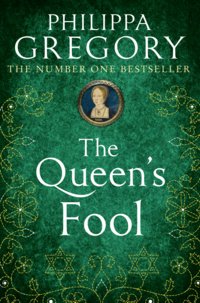
Read the book: «The Queen’s Fool»


Copyright
Published by HarperCollinsPublishers Ltd
The News Building
1 London Bridge Street
London SE1 9GF
www.harpercollins.co.uk
First published in Great Britain by HarperCollinsPublishers 2003
This edition published by Harper 2017
Copyright © Philippa Gregory Ltd 2003
Cover design and illustration: Holly Macdonald © HarperCollinsPublishers Ltd 2017
Cover image © Heritage Image Partnership Ltd / Alamy (portrait of Mary I of England, ca (1521-1525). Artist: Horenbout, Lucas 1490/95-1544).
Philippa Gregory asserts the moral right to be identified as the author of this work.
A catalogue copy of this book is available from the British Library.
This novel is entirely a work of fiction. The names, characters and incidents portrayed in it are the work of the author’s imagination. Any resemblance to actual persons, living or dead, events or localities is entirely coincidental.
All rights reserved under International and Pan-American Copyright Conventions. By payment of the required fees, you have been granted the non-exclusive, non-transferable right to access and read the text of this e-book on screen. No part of this text may be reproduced, transmitted, down-loaded, decompiled, reverse engineered, or stored in or introduced into any information storage and retrieval system, in any form or by any means, whether electronic or mechanical, now known or hereinafter invented, without the express written permission of HarperCollins.
Source ISBN: 9780007147298
Ebook Edition © December 2016 ISBN: 9780007370153
Version: 2017-01-23
Dedication
For Anthony

The Family of Henry VIII, c. 1545, artist unknown. Reproduced courtesy of The Royal Collection © HM Queen Elizabeth II.
Contents
Cover
Title Page
Copyright
Dedication
Summer 1548
Winter 1552–53
Spring 1553
Summer 1553
Autumn 1553
Winter 1553
Winter 1554
Spring 1554
Summer 1554
Autumn 1554
Winter 1554–55
Spring 1555
Spring–Summer 1555
Autumn 1555
Winter 1555
Spring 1556
Summer 1556
Autumn 1556
Winter 1556–57
Spring 1557
Summer 1557
Winter 1557–58
Spring 1558
Summer 1558
Autumn 1558
Winter 1558
Author’s Note
Discover More of Philippa Gregory’s Tudor Novels
Gardens for The Gambia
About the Author
Also by Philippa Gregory
About the Publisher

Summer 1548
The girl, giggling and over-excited, was running in the sunlit garden, running away from her stepfather, but not so fast that he could not catch her. Her stepmother, seated in an arbour with Rosamund roses in bud all around her, caught sight of the fourteen-year-old girl and the handsome man chasing around the broad tree trunks on the smooth turf and smiled, determined to see only the best in both of them: the girl she was bringing up and the man she had adored for years.
He snatched at the hem of the girl’s swinging gown and caught her up to him for a moment. ‘A forfeit!’ he said, his dark face close to her flushed cheeks.
They both knew what the forfeit would be. Like quicksilver she slid from his grasp and dodged away, to the far side of an ornamental fountain with a broad circular bowl. Fat carp were swimming slowly in the water; Elizabeth’s excited face was reflected in the surface as she leaned forward to taunt him.
‘Can’t catch me!’
‘’Course I can.’
She leaned low so that he could see her small breasts at the top of the square-cut green gown. She felt his eyes on her and the colour in her cheeks deepened. He watched, amused and aroused, as her neck flushed rosy pink.
‘I can catch you any time I want to,’ he said, thinking of the chase of sex that ends in bed.
‘Come on then!’ she said, not knowing exactly what she was inviting, but knowing that she wanted to hear his feet pounding the grass behind her, sense his hands outstretched to grab at her; and, more than anything else, to feel his arms around her, pulling her against the fascinating contours of his body, the scratchy embroidery of his doublet against her cheek, the press of his thigh against her legs.
She gave a little scream and dashed away again down an allée of yew trees, where the Chelsea garden ran down to the river. The queen, smiling, looked up from her sewing and saw her beloved stepdaughter racing between the trees, her handsome husband a few easy strides behind. She looked down again at her sewing and did not see him catch Elizabeth, whirl her around, put her back to the red papery bark of the yew tree, and clamp his hand over her half-open mouth.
Elizabeth’s eyes blazed black with excitement, but she did not struggle. When he realised that she would not scream, he took his hand away and bent his dark head.
Elizabeth felt the smooth sweep of his moustache against her lips, smelled the heady scent of his hair, his skin. She closed her eyes and tipped back her head to offer her lips, her neck, her breasts to his mouth. When she felt his sharp teeth graze her skin, she was no longer a giggling child, she was a young woman in the heat of first desire.
Gently he loosened his grip on her waist, and his hand stole up the firmly boned stomacher to the neck of her gown, where he could slide a finger down inside her linen to touch her breasts. Her nipple was hard and aroused, when he rubbed it she gave a little mew of pleasure that made him laugh at the predictability of female desire, a deep chuckle in the back of his throat.
Elizabeth pressed herself against the length of his body, feeling his thigh push forward between her legs in reply. She had a sensation like an overwhelming curiosity. She longed to know what might happen next.
When he made a movement away from her, as if to release her, she wound her arms around his back and pulled him into her again. She felt rather than saw Tom Seymour’s smile of pleasure at her culpability, as his mouth came down on hers again and his tongue licked, as delicate as a cat, against the side of her mouth. Torn between disgust and desire at the extraordinary sensation, she slid her own tongue to meet his and felt the terrible intimacy of a grown man’s intrusive kiss.
All at once it was too much for her, and she shrank back from him, but he knew the rhythm of this dance which she had so light-heartedly invoked, and which would now beat through her very veins. He caught at the hem of her brocade skirt and pulled it up and up until he could get at her, sliding his practised hand up her thighs, underneath her linen shift. Instinctively she clamped her legs together against his touch until he brushed, with calculated gentleness, the back of his hand on her hidden sex. At the teasing touch of his knuckles, she melted; he could feel her almost dissolve beneath him. She would have fallen if he had not had a firm arm around her waist, and he knew at that moment that he could have the king’s own daughter, Princess Elizabeth, against a tree in the queen’s garden. The girl was a virgin in name alone. In reality, she was little more than a whore.
A light step on the path made him quickly turn, dropping Elizabeth’s gown and putting her behind him, out of sight. Anyone could read the tranced willingness on the girl’s face; she was lost in her desire. He was afraid it was the queen, his wife, whose love for him was insulted every day that he seduced her ward under her very nose: the queen, who had been entrusted with the care of her stepdaughter the princess, Queen Katherine who had sat at Henry VIII’s deathbed but dreamed of this man.
But it was not the queen who stood before him on the path. It was only a girl, a little girl of about nine years old, with big solemn dark eyes and a white Spanish cap tied under her chin. She carried two books strapped with bookseller’s tape in her hand, and she regarded him with a cool objective interest, as if she had seen and understood everything.
‘How now, sweetheart!’ he exclaimed, falsely cheerful. ‘You gave me a start. I might have thought you a fairy, appearing so suddenly.’
She frowned at his rapid, over-loud speech, and then she replied, very slowly with a strong Spanish accent. ‘Forgive me, sir. My father told me to bring these books to Sir Thomas Seymour and they said you were in the garden.’
She proffered the package of books, and Tom Seymour was forced to step forward and take them from her hands. ‘You’re the bookseller’s daughter,’ he said cheerfully. ‘The bookseller from Spain.’
She bowed her head in assent, not taking her dark scrutiny from his face.
‘What are you staring at, child?’ he asked, conscious of Elizabeth, hastily rearranging her gown behind him.
‘I was looking at you, sir, but I saw something most dreadful.’
‘What?’ he demanded. For a moment he was afraid she would say that she had seen him with the Princess of England backed up against a tree like a common doxy, her skirt pulled up out of the way and his fingers dabbling at her purse.
‘I saw a scaffold behind you,’ said the surprising child, and then turned and walked away as if she had completed her errand and there was nothing more for her to do in the sunlit garden.
Tom Seymour whirled back to Elizabeth, who was trying to comb her disordered hair with fingers that were still shaking with desire. At once she stretched out her arms to him, wanting more.
‘Did you hear that?’
Elizabeth’s eyes were slits of black. ‘No,’ she said silkily. ‘Did she say something?’
‘She only said that she saw the scaffold behind me!’ He was more shaken than he wanted to reveal. He tried for a bluff laugh, but it came out with a quaver of fear.
At the mention of the scaffold Elizabeth was suddenly alert. ‘Why?’ she snapped. ‘Why should she say such a thing?’
‘God knows,’ he said. ‘Stupid little witch. Probably mistook the word, she’s foreign. Probably meant throne! Probably saw the throne behind me!’
But this joke was no more successful than his bluster, since in Elizabeth’s imagination the throne and the scaffold were always close neighbours. The colour drained from her face, leaving her sallow with fear.
‘Who is she?’ Her voice was sharp with nervousness. ‘Who is she working for?’
He turned to look for the child but the allée was empty. At the distant end of it he could see his wife walking slowly towards them, her back arched to carry the pregnant curve of her belly.
‘Not a word,’ he said quickly to the girl at his side. ‘Not a word of this, sweetheart. You don’t want to upset your stepmother.’
He hardly needed to warn her. At the first hint of danger the girl was wary, smoothing her dress, conscious always that she must play a part, that she must survive. He could always rely on Elizabeth’s duplicity. She might be only fourteen but she had been trained in deceit every day since the death of her mother, she had been an apprentice cheat for twelve long years. And she was the daughter of a liar – two liars, he thought spitefully. She might feel desire; but she was always more alert to danger or ambition than to lust. He took her cold hand and led her up the allée towards his wife Katherine. He tried for a merry smile. ‘I caught her at last!’ he called out.
He glanced around, he could not see the child anywhere. ‘We had such a race!’ he cried.

I was that child, and that was the first sight I ever had of the Princess Elizabeth: damp with desire, panting with lust, rubbing herself like a cat against another woman’s husband. But it was the first and last time I saw Tom Seymour. Within a year, he was dead on the scaffold charged with treason, and Elizabeth had denied three times having anything more than the most common acquaintance with him.
Winter 1552–53
‘I remember this!’ I said excitedly to my father, turning from the rail of the Thames barge as we tacked our way upstream. ‘Father! I remember this! I remember these gardens running down to the water, and the great houses, and the day you sent me to deliver some books to the lord, the English lord, and I came upon him in the garden with the princess.’
He found a smile for me, though his face was weary from our long journey. ‘Do you, child?’ he asked quietly. ‘That was a happy summer for us. She said …’ He broke off. We never mentioned my mother’s name, even when we were alone. At first it had been a precaution to keep us safe from those who had killed her and would come after us, but now we were hiding from grief as well as from the Inquisition; and grief was an inveterate stalker.
‘Will we live here?’ I asked hopefully, looking at the beautiful riverside palaces and the level lawns. I was eager for a new home after years of travelling.
‘Nowhere as grand as this,’ he said gently. ‘We will have to start small, Hannah, in just a little shop. We have to make our lives again. And when we are settled then you will come out of boy’s clothes, and dress as a girl again, and marry young Daniel Carpenter.’
‘And can we stop running?’ I asked, very low.
My father hesitated. We had been running from the Inquisition for so long that it was almost impossible to hope that we had reached a safe haven. We ran away the very night that my mother was found guilty of being a Jew – a false Christian, a ‘Marrano’ – by the church court, and we were long gone when they released her to the civil court to be burned alive at the stake. We ran from her like a pair of Judas Iscariots, desperate to save our own skins, though my father would tell me later, over and over again, with tears in his eyes, that we could never have saved her. If we had stayed in Aragon, they would have come for us too, and then all three of us would have died, instead of two being saved. When I swore that I would rather have died than live without her, he said very slowly and sadly that I would learn that life was the most precious thing of all. One day I would understand that she would have gladly given her life to save mine.
First over the border to Portugal, smuggled out by bandits who took every coin from my father’s purse and left him with his manuscripts and books, only because they could find no use for them. By boat to Bordeaux, a stormy crossing when we lived on deck without shelter from the scudding rain and the flying spray, and I thought we would die of the cold or drowning. We hugged the most precious books to our bellies as if they were infants that we should keep warm and dry. Overland to Paris, all the way pretending to be something that we were not: a merchant and his young apprentice-lad, pilgrims on the way to Chartres, itinerant traders, a minor lord and his pageboy travelling for pleasure, a scholar and his tutor going to the great university of Paris; anything rather than admit that we were new Christians, a suspicious couple with the smell of the smoke from the auto-da-fé still clinging to our clothes, and night terrors still clinging to our sleep.
We met my mother’s cousins in Paris, and they sent us on to their kin in Amsterdam, where they directed us to London. We were to hide our race under English skies, we were to become Londoners. We were to become Protestant Christians. We would learn to like it. I must learn to like it.
The kin – the People whose name cannot be spoken, whose faith is hidden, the People who are condemned to wander, banned from every country in Christendom – were thriving in secret in London as in Paris, as in Amsterdam. We all lived as Christians and observed the laws of the church, the feast days and fast days and rituals. Many of us, like my mother, believed sincerely in both faiths, kept the Sabbath in secret, a hidden candle burning, the food prepared, the housework done, so that the day could be holy with the scraps of half-remembered Jewish prayers, and then, the very next day, went to Mass with a clean conscience. My mother taught me the Bible and all of the Torah that she could remember together, as one sacred lesson. She cautioned me that our family connections and our faith were secret, a deep and dangerous secret. We must be discreet and trust in God, in the churches we had so richly endowed, in our friends: the nuns and priests and teachers that we knew so well. When the Inquisition came, we were caught like innocent chickens whose necks should be wrung and not slashed.
Others ran, as we had done; and emerged, as we had done, in the other great cities of Christendom to find their kin, to find refuge and help from distant cousins or loyal friends. Our family helped us to London with letters of introduction to the d’Israeli family, who here went by the name of Carpenter, organised my betrothal to the Carpenter boy, financed my father’s purchase of the printing press and found us the rooms over the shop off Fleet Street.
In the months after our arrival I set myself to learn my way around yet another city, as my father set up his print shop with an absolute determination to survive and to provide for me. At once, his stock of texts was much in demand, especially his copies of the gospels that he had brought inside the waistband of his breeches and now translated into English. He bought the books and manuscripts which once belonged to the libraries of religious houses – destroyed by Henry, the king before the young king, Edward. The scholarship of centuries was thrown to the winds by the old king, Henry, and every shop on each corner had a pile of papers that could be bought by the bushel. It was a bibliographer’s heaven. My father went out daily and came back with something rare and precious and when he had tidied it, and indexed it, everyone wanted to buy. They were mad for the Holy Word in London. At night, even when he was weary, he set print and ran off short copies of the gospels and simple texts for the faithful to study, all in English, all clear and simple. This was a country determined to read for itself and to live without priests, so at least I could be glad of that.
We sold the texts cheaply, at little more than cost price, to spread the word of God. We let it be known that we believed in giving the Word to the people, because we were convinced Protestants now. We could not have been better Protestants if our lives had depended on it.
Of course, our lives did depend on it.
I ran errands, read proofs, helped with translations, set print, stitched like a saddler with the sharp needle of the binder, read the backwards-writing on the stone of the printing press. On days when I was not busy in the print shop I stood outside to summon passers-by. I still dressed in the boy’s clothes I had used for our escape and anyone would have mistaken me for an idle lad, breeches flapping against my bare calves, bare feet crammed into old shoes, cap askew. I lounged against the wall of our shop like a vagrant lad whenever the sun came out, drinking in the weak English sunshine and idly surveying the street. To my right was another bookseller’s shop, smaller than ours and with cheaper wares. To the left was a publisher of chap books, poems and tracts for itinerant pedlars and ballad sellers, beyond him a painter of miniatures and maker of dainty toys, and beyond him a portrait painter and limner. We were all workers with paper and ink in this street, and Father told me that I should be grateful for a life which kept my hands soft. I should have been; but I was not.
It was a narrow street, meaner even than our temporary lodgings in Paris. Each house was clamped on to another house, all of them tottering like squat drunkards down to the river, the gable windows overhanging the cobbles below and blocking out the sky, so the pale sunshine striped the earth-plastered walls, like the slashing on a sleeve. The smell of the street was as strong as a farmyard’s. Every morning the women threw the contents of the chamber pots and the washing bowls from the overhanging windows and tipped the night-soil buckets into the stream in the middle of the street where it gurgled slowly away, draining sluggishly into the dirty ditch of the River Thames.
I wanted to live somewhere better than this, somewhere like the Princess Elizabeth’s garden with trees and flowers and a view down to the river. I wanted to be someone better than this: not a bookseller’s ragged apprentice, a hidden girl, a woman heading for betrothal to a stranger.
As I stood there, warming myself like a sulky Spanish cat in the sunshine, I heard the ring of a spur against a cobblestone and I snapped my eyes open and leaped to attention. Before me, casting a long shadow, was a young man. He was richly dressed, a tall hat on his head, a cape swinging from his shoulders, a thin silver sword at his side. He was the most breathtakingly handsome man I had ever seen.
All of this was startling enough, I could feel myself staring at him as if he were a descended angel. But behind him was a second man.
This was an older man, near thirty years of age, with the pale skin of a scholar, and dark deep-set eyes. I had seen his sort before. He was one of those who visited my father’s bookshop in Aragon, who came to us in Paris and who would be one of my father’s customers and friends here in London. He was a scholar, I could see it in the stoop of his neck and the rounded shoulders. He was a writer, I saw the permanent stain of ink on the third finger of his right hand; and he was something greater even than these: a thinker, a man prepared to seek out what was hidden. He was a dangerous man: a man not afraid of heresies, not afraid of questions, always wanting to know more; a man who would seek the truth behind the truth.
I had known a Jesuit priest like this man. He had come to my father’s shop in Spain, and begged him to get manuscripts, old manuscripts, older than the Bible, older even than the Word of God. I had known a Jewish scholar like this man, he too had come to my father’s bookstore and asked for the forbidden books, remnants of the Torah, the Law. Jesuit and scholar had come often to buy their books; and one day they had come no more. Ideas are more dangerous than an unsheathed sword in this world, half of them are forbidden, the other half would lead a man to question the very place of the earth itself, safe at the centre of the universe.
I had been so interested in these two, the young man like a god, the older man like a priest, that I had not looked at the third. This third man was all dressed in white, gleaming like enamelled silver, I could hardly see him for the brightness of the sun on his sparkling cloak. I looked for his face and could see only a blaze of silver, I blinked and still I could not see him. Then I came to my senses and realised that whoever they might be, they were all three looking in the doorway of the bookshop next door.
One swift glance at our own dark doorway showed me that my father was in the inside room mixing fresh ink, and had not seen my failure to summon customers. Cursing myself for an idle fool, I jumped forward into their path and said clearly, in my newly acquired English accent, ‘Good day to you, sirs. Can we help you? We have the finest collection of pleasing and moral books you will find in London, the most interesting manuscripts at the fairest of prices and drawings wrought with the most artistry and the greatest charm that …’
‘I am looking for the shop of Oliver Green, the printer,’ the young man said.
At the moment his dark eyes flicked to mine, I felt myself freeze, as if all the clocks in London had suddenly stopped still and their pendulums were caught silent. I wanted to hold him: there, in his red slashed doublet in the winter sunshine, forever. I wanted him to look at me and see me, me, as I truly was; not an urchin lad with a dirty face, but a girl, almost a young woman. But his glance flicked indifferently past me to our shop, and I came to my senses and held open the door for the three of them.
‘This is the shop of the scholar and bookmaker Oliver Green. Step inside, my lords,’ I invited them and I shouted, into the inner dark room: ‘Father! Here are three great lords to see you!’
I heard the clatter as he pushed back his high printer’s stool and came out, wiping his hands on his apron, the smell of ink and hot pressed paper following him. ‘Welcome,’ he said. ‘Welcome to you both.’ He was wearing his usual black suit and his linen at the cuffs was stained with ink. I saw him through their eyes for a moment and saw a man of fifty, his thick hair bleached white from shock, his face deep-furrowed, his height concealed in the scholar’s stoop.
He prompted me with a nod, and I pulled forward three stools from under the counter, but the lords did not sit, they stood looking around.
‘And how may I serve you?’ he asked. Only I could have seen that he was afraid of them, afraid of all three: the handsome younger man who swept off his hat and pushed his dark curled hair back from his face, the quietly dressed older man and, behind them, the silent lord in shining white.
‘We are seeking Oliver Green, the bookseller,’ the young lord said.
My father nodded his head. ‘I am Oliver Green,’ he said quietly, his Spanish accent very thick. ‘And I will serve you in any way that I can do. Any way that is pleasing to the laws of the land, and the customs …’
‘Yes, yes,’ the young man said sharply. ‘We hear that you are just come from Spain, Oliver Green.’
My father nodded again. ‘I am just come to England indeed, but we left Spain three years ago, sir.’
‘An Englishman?’
‘An Englishman now, if you please,’ my father said cautiously.
‘Your name? It is a very English name?’
‘It was Verde,’ he said with a wry smile. ‘It is easier for Englishmen if we call ourselves Green.’
‘And you are a Christian? And a publisher of Christian theology and philosophy?’
I could see the small gulp in my father’s throat at the dangerous question, but his voice was steady and strong when he answered. ‘Most certainly, sir.’
‘And are you of the reformed or the old tradition?’ the young man asked, his voice very quiet.
My father did not know what answer they wanted to this, nor could he know what might hang on it. Actually we might hang on it, or burn for it, or go to the block for it, however it was that they chose this day to deal with heretics in this country under the young King Edward.
‘The reformed,’ he said tentatively. ‘Though christened into the old faith in Spain, I follow the English church now.’ There was a pause. ‘Praise be to God,’ he offered. ‘I am a good servant of King Edward, and I want nothing more than to work my trade and live according to his laws, and worship in his church.’
I could smell the sweat of his terror as acrid as smoke, and it frightened me. I brushed the back of my hand under my cheek, as if to wipe away the smuts from a fire. ‘It’s all right. I am sure they want our books, not us,’ I said in a quick undertone in Spanish.
My father nodded to show he had heard me. But the young lord was on to my whisper at once. ‘What did the lad say?’
‘I said that you are scholars,’ I lied in English.
‘Go inside, querida,’ my father said quickly to me. ‘You must forgive the child, my lords. My wife died just three years ago and the child is a fool, only kept to mind the door.’
‘The child speaks only the truth,’ the older man remarked pleasantly. ‘For we have not come to disturb you, there is no need to be afraid. We have only come to see your books. I am a scholar; not an inquisitor. I only wanted to see your library.’
I hovered at the doorway and the older man turned to me. ‘But why did you say three lords?’ he asked.
My father snapped his fingers to order me to go, but the young lord said: ‘Wait. Let the boy answer. What harm is it? There are only two of us, lad. How many can you see?’
I looked from the older man to the handsome young man and saw that there were, indeed, only two of them. The third, the man in white as bright as burnished pewter, had gone as if he had never been there at all.
‘I saw a third man behind you, sir,’ I said to the older one. ‘Out in the street. I am sorry. He is not there now.’
‘She is a fool but a good girl,’ my father said, waving me away.
‘No, wait,’ the young man said. ‘Wait a minute. I thought this was a lad. A girl? Why d’you have her dressed as a boy?’
‘And who was the third man?’ his companion asked me.
My father became more and more anxious under the barrage of questions. ‘Let her go, my lords,’ he said pitifully. ‘She is nothing more than a girl, a little maid with a weak mind, still shocked by her mother’s death. I can show you my books, and I have some fine manuscripts you may like to see as well. I can show you …’
‘I want to see them indeed,’ the older man said firmly. ‘But first, I want to speak with the child. May I?’
My father subsided, unable to refuse such great men. The older man took me by the hand and led me into the centre of the little shop. A glimmer of light through the leaded window fell on my face and he put a hand under my chin and turned my face one way and then the other.
I nodded and Lord Robert took my hand and, drawing it into the crook of his arm, led me to the Northumberland private quarters. The great doors were guarded by Northumberland men, and as soon as they saw the favoured son of the house they snapped to attention and swung the double doors open. The great hall beyond was deserted, the retainers and the Northumberland court were in the Whitehall garden demonstrating their immense respect to the departing Lady Mary. Lord Robert led me up the grand stairs, through a gallery, to his own rooms. John Dee was seated in the library overlooking an inner garden.
He raised his head as we came into the room. ‘Ah, Hannah Verde.’
It was so odd for me to hear my real name, given in full, that for a moment I did not respond, and then I dipped a little bow. ‘Yes, sir.’
‘She says she will help. But I have not told her what you want,’ Lord Robert said.
Mr Dee rose from the table. ‘I have a special mirror,’ he said. ‘I think it possible that, one with special sight might see rays of light that are not visible to the ordinary eye, d’you understand?’
I did not.
‘Just as we cannot see a sound or a scent, but we know that something is there, I think it possible that the planets and the angels send out rays of light, which we might see if we had the right glass to see them in.’
‘Oh,’ I said blankly.
The tutor broke off with a smile. ‘No matter. You need not understand me. I was only thinking that since you saw the angel Uriel that day, you might see such rays in this mirror.’
‘I don’t mind looking, if Lord Robert wishes it,’ I volunteered.
He nodded. ‘I have it ready. Come in.’ He led the way to an inner chamber. The window was shielded by a thick curtain, all the cold winter light blocked out. A square table was placed before it, the four legs standing on four wax seals. On top of the table was an extraordinary mirror of great beauty, a gold-wrought frame, a bevelled rim, and a golden sheen on the silvering. I stepped up to it and saw myself, reflected in gold, looking not like the boy-girl I was, but like a young woman. For a moment I thought I saw my mother looking back at me, her lovely smile and that gesture when she turned her head. ‘Oh!’ I exclaimed.
‘D’you see anything?’ Dee asked, I could hear the excitement in his voice.
‘I thought I saw my mother,’ I whispered.
He paused for a moment. ‘Can you hear her?’ he asked, his voice shaking.
I waited for a moment, longing with all my heart that she would come to me. But it was only my own face that looked back at me, my eyes enlarged and darkened by unshed tears.
‘She’s not here,’ I said sadly. ‘I would give anything to hear her voice, but I cannot. She has gone from me. I just thought that I saw her for a moment; but it is my own face in the mirror.’
‘I want you to close your eyes,’ he said, ‘and listen carefully to the prayer that I am going to read. When you say “amen” you can open your eyes again and tell me what you see. Are you ready?’
I closed my eyes and I could hear him softly blowing out the few candles illuminating the shadowy room. Behind me I was conscious of Lord Robert sitting quietly on a wooden chair. I wanted only to please him. ‘I am ready,’ I whispered.
It was a long prayer in Latin, I understood it despite Mr Dee’s English pronunciation of the words. It was a prayer for guidance and for the angels to come and protect the work we would do. I whispered ‘amen’ and then I opened my eyes.
The candles were all out. The mirror was a pool of darkness, black reflected in black, I could see nothing.
‘Show us when the king will die,’ Mr Dee whispered from behind me.
I watched, waiting for something to happen, my eyes staring into the blackness.
Nothing.
‘The day of the king’s death,’ Dee whispered again.
In truth, I could see nothing. I waited. Nothing came to me. How could it? I was not some sibyl on a Greek hillside, I was not some saint to whom mysteries were revealed. I stared into the darkness until my eyes grew hot and dry and I knew that far from being a holy fool I was a fool pure and simple, looking at nothing, at a reflection of nothing, while the greatest mind in the kingdom waited for my answer.
I had to say something. There was no going back and telling them that the Sight came to me so seldom and so unheralded that they would have done better to leave me leaning against the wall of my father’s shop. They knew who I was, they had promised me sanctuary from danger. They had bought me and now they expected some benefit for their bargain. I had to say something.
‘July,’ I said quietly, as good a reply as any.
‘Which year?’ Mr Dee prompted me, his voice silky and quiet.
Common sense alone suggested that the young king could not live much longer. ‘This year,’ I said unwillingly.
‘The day?’
‘The sixth,’ I whispered in reply, and I heard the scratch of Lord Robert’s pen as he recorded my mountebank prophecy.
‘Tell the name of the next ruler of England,’ Mr Dee whispered.
I was about to reply ‘Queen Mary’, echoing his own tranced tone. ‘Jane,’ I said simply, surprising myself.
I turned to Lord Robert. ‘I don’t know why I said that. I am most sorry, my lord. I don’t know …’
John Dee quickly grasped my jaw, and turned my head back to the mirror. ‘Don’t talk!’ he ordered. ‘Just tell us what you see.’
‘I see nothing,’ I said helplessly. ‘I am sorry, I am sorry, my lord. I am sorry, I can’t see anything.’
‘The king who comes after Jane,’ he urged me. ‘Look, Hannah. Tell me what you see. Does Jane have a son?’
I would have said ‘yes’ but my tongue would not move in my dry mouth. ‘I cannot see,’ I said humbly. ‘Truly, I cannot see.’
‘A closing prayer,’ Mr Dee said, holding me in my chair by a firm grip on my shoulders. He prayed again in Latin that the work should be blessed, that the visions should be true, and that no-one in this world nor in any other should be harmed by our scrying.
‘Amen,’ I said, more fervently now that I knew this was dangerous work, perhaps even treasonous work.
I felt Lord Robert rise to leave the room and I pulled away from Mr Dee and ran after him.
‘Was it what you wanted?’ I demanded.
‘Did you tell me what you thought I wanted to hear?’
‘No! I spoke as it came to me.’ That was true of the sudden word ‘Jane’, I thought.
He looked sharply at me. ‘Do you promise? Mistress Boy, you are no use to John Dee nor to me if you choose your words to please me. The only way you can please me is by seeing true and saying true.’
‘I am! I did!’ My anxiety to please him and my fear of the mirror were together too much for me and I gave a little sob. ‘I did, my lord.’
His face did not soften. ‘Swear?’
‘Yes.’
He rested a hand on my shoulder. My head throbbed so much that I longed to lean my cheek against the coolness of his sleeve but I thought I should not. I stood stock-still like the boy he called me, to face his scrutiny.
‘Then you have done very well for me,’ he said. ‘That was what I wanted.’
Mr Dee came out of the inner chamber, his face alight. ‘She has the Sight,’ he said. ‘She has it indeed.’
Lord Robert looked at his tutor. ‘Will this make a great difference to your work?’
The older man shrugged. ‘Who knows? We are all children in darkness. But she has the Sight.’ He paused, and then turned to me. ‘Hannah Verde, I must tell you one thing.’
‘Yes, sir?’
‘You have the Sight because you are pure in heart. Please, for yourself and for the gift you bear, refuse any offers of marriage, resist any seduction, keep yourself pure.’
Behind me, Lord Robert gave a snort of amusement.
I felt my colour rise slowly from my neck to my ear lobes to my temples. ‘I have no carnal desires,’ I said in a voice as low as a whisper. I did not dare to look at Lord Robert.
‘Then you will see true,’ John Dee said.
‘But I don’t understand,’ I protested. ‘Who is Jane? It is Lady Mary who will be queen if His Grace dies.’
Lord Robert put his finger on my lips and at once I was silent. ‘Sit down,’ he said and pressed me into a chair. He drew up a stool and sat beside me, his face close to mine. ‘Mistress Boy, you have seen today two things that would have us all hanged if they were known.’
My heart raced with fear. ‘My lord?’
‘Just by looking in the mirror you put us all in danger.’
My hand went to my cheek as if I would wipe away smuts from a fire. ‘My lord?’
‘You must say not a word of this. It is treason to cast the horoscope of a king, and the punishment for treason is death. You cast his horoscope today and you foretold the day of his death. D’you want to see me on the scaffold?’
‘No! I …’
‘Do you want to die yourself?’
‘No!’ I could hear a quaver in my voice. ‘My lord, I am afraid.’
‘Then never say one word of this to anyone. Not even to your father. As to the Jane of the mirror …’
I waited.
‘Just forget all you saw, forget I even asked you to look in the mirror. Forget the mirror, forget the room.’
I looked at him solemnly. ‘I won’t have to do it again?’
‘You will never have to do it again unless you consent. But you must forget it now.’ He gave me his sweet seductive smile. ‘Because I ask it of you,’ he whispered. ‘Because I ask it of you as your friend, I have put my life in your hands.’
I was lost. ‘All right,’ I said.
The court moved to Greenwich Palace in February and it was given out that the king was better. But he never asked for me, nor for Will Somers, he did not ask for music nor for company, nor did he ever come to the great hall for dinner. The physicians, who had been in full-blown attendance with their gowns flapping, waiting in every corner of the court, talking amongst themselves and giving carefully guarded replies to all inquiries, seemed to slip away as the days wore on and there was no news of his recovery, and not even their cheerful predictions about leeches cleansing the young man’s blood and poison carefully administered killing his disease, seemed to ring very true. Lord Robert’s father, the Duke of Northumberland, was all but king in Edward’s place, seated at the right hand of an empty throne at dinner, taking the chair at the head of the council table every week, but telling everyone that the king was well, getting better all the time, looking forward to the finer weather, planning a progress this summer.
I said nothing. I was being paid as a fool to say surprising and impertinent things but I could think of nothing more impertinent and surprising than the truth – that the young king was half-prisoner to his protector, that he was dying without companions or nursing, and that this whole court, every great man in the land, was thinking of the crown and not of the boy; and that it was a great cruelty, to a boy only a little older than me and without a mother or a father to care for him, to be left to die alone. I looked around me at the men who assured each other that the young man of fifteen, coughing his lungs out in hiding, would be fit to take a wife this summer, and I thought that I would be a fool indeed if I did not see that they were a bunch of liars and rogues.
While the young king vomited black bile in his chamber, the men outside quietly helped themselves to the pensions, to the fees from offices, to the rents from monasteries that they closed for piety and then robbed for greed, and no-one said one word against it. I would have been a fool indeed to tell the truth in this court of liars, I would have been as incongruous as an angel in Fleet Street. I kept my head down, I sat near Will Somers at dinner, and I kept silent.
I had new work to do. Lord Robert’s tutor Mr Dee sought me out and asked if I would read with him. His eyes were tired, he said, and my father had sent him some manuscripts that could be more easily deciphered by young sight.
‘I don’t read very well,’ I said cautiously.
He was pacing ahead of me in one of the sunny galleries overlooking the river, but at my words he turned and smiled.
‘You are a very careful young woman,’ he said. ‘And that is wise in these changing times. But you are safe with me and with Lord Robert. I imagine you can read English and Latin fluently, am I right?’
I nodded.
‘And Spanish, of course, and perhaps French?’
I kept my silence. It was obvious that I spoke and read Spanish as my native tongue, and he would guess that I must have picked up some French during our stay in Paris.
Mr Dee came a little closer and bent his head to whisper in my ear. ‘Can you read Greek? I need someone who can read Greek for me.’
If I had been older and wiser I would have denied my knowledge. But I was only fourteen and proud of my abilities. My mother herself had taught me to read Greek and Hebrew, and my Father called me his little scholar, as good as any boy.
‘Yes,’ I said. ‘I can read Greek and Hebrew.’
‘Hebrew?’ he exclaimed, his interest sharpened. ‘Dear God, child, what have you seen in Hebrew? Have you seen the Torah?’
At once I knew I should have said nothing. If I said yes, that I had seen the laws of the Jews and the prayers, then I would have identified myself and my father beyond doubt as Jews and practising Jews at that. I thought of my mother telling me that my vanity would get me into trouble. I had always thought that she meant my love of fine clothes and ribbons for my hair. Now, dressed as a boy in a fool’s livery I had committed the sin of vanity, I had been prideful of my schooling and the punishment could be extreme.
‘Mr Dee …’ I whispered, aghast.
He smiled at me. ‘I guessed you had fled Spain as soon as I saw you,’ he said gently. ‘I guessed you were Conversos. But it was not for me to say. And it is not in Lord Robert’s nature to persecute someone for the faith of their fathers, especially a faith which they have surrendered. You go to church, don’t you? And observe feast days? You believe in Jesus Christ and his mercy?’
‘Oh yes, my lord. Without fail.’ There was no point in telling him that there was no more devout Christian than a Jew trying to be invisible.
Mr Dee paused. ‘As for me, I pray for a time when we are beyond such divisions, beyond them to the truth itself. Some men think that there is neither God nor Allah nor Elohim …’
At his speaking the sacred name of the only God I gave a little gasp of surprise. ‘Mr Dee? Are you one of the Chosen People?’
He shook his head. ‘I believe there is a creator, a great creator of the world, but I do not know his name. I know the names that he is given by man. Why should I prefer one name to another? What I want to know is His Holy Nature, what I want is the help of his angels, what I want to do is to further his work, to make gold from base, to make Holy from Vulgar.’ He broke off. ‘Does any of this mean anything to you?’
I kept my face blank. In my father’s library in Spain there had been books that told of the secrets of the making of the world, and there had been the scholar who had come to read them, and the Jesuit who wanted to know the secrets beyond those of his order.
‘Alchemy?’ I asked, my voice very low.
He nodded. ‘The creator has given us a world full of mysteries,’ he said. ‘But I believe that they will be known to us one day. Now we understand a little, and the church of the Pope, and the church of the king, and the laws of the land all say that we should not question. But I don’t believe that it is the law of God that we should not question. I think that he has made this world as a great and glorious mechanical garden, one that works to its own laws and grows to its own laws and that we will one day come to understand it. Alchemy – the art of change – is how we shall come to understand it, and when we know how things are made, we can make them ourselves, we will have the knowledge of God, we ourselves will be transubstantiated, we shall be angels …’
He broke off. ‘Does your father have many works on alchemy? He showed me only those on religion. Does he have alchemy texts in Hebrew? Will you read them to me?’
‘I only know the permitted books,’ I said cautiously. ‘My father does not keep forbidden books.’ Not even this kind man who trusted me with his own secrets could lure me into speaking the truth. I had been raised in utter secrecy, I would never lose the habit of fear-filled duplicity. ‘I can read Hebrew, but I don’t know the Jewish prayers. My father and I are good Christians. And he has not shown me any books on alchemy, he does not stock them. I am too young to understand books like that. I don’t know that he would want me to read Hebrew to you, sir.’
‘I will ask him and surely he will allow it,’ he said easily. ‘Reading Hebrew is a gift of God, a skill with languages is the sign of a pure heart. Hebrew is the language of the angels, it is the closest we mortals can come to speaking to God. Did you not know that?’
I shook my head.
‘But of course,’ he continued, glowing with enthusiasm. ‘God spoke to Adam and Eve in the Garden of Eden before the Fall and they became the first people of earth. They must have spoken Hebrew, they must have understood God in that language. There is a language beyond Hebrew, which is what God speaks with heavenly beings, and it is that language which I hope to discover. And the way to it must be through Hebrew, through Greek and through Persian.’ He broke off for a moment. ‘You don’t speak or read Persian, do you? Or any of the Arab tongues?’
‘No,’ I said.
‘No matter,’ he replied. ‘You shall come every morning and read with me for an hour and we shall make great progress.’
‘If Lord Robert says I may,’ I temporised.
Mr Dee smiled at me. ‘Young lady, you are going to help me to understand nothing less than the meaning of all things. There is a key to the universe and we are just beginning to grasp at it. There are rules, unchangeable rules, which command the courses of the planets, the tides of the sea, and the affairs of men, and I know, I absolutely know, that all these things are interlinked: the sea, the planets, and the history of man. With God’s grace and with the skill we can muster we will discover these laws and when we know them …’ He paused. ‘We will know everything.’
Spring 1553
I was allowed to go home to my father in April and I took him my wages for the quarter. I went in my old boy’s clothes that he had bought me when we first came to England and found that my wrists poked out at the sleeves and I could not get my growing feet into the shoes. I had to cut out the heels and go slipshod through the city.
‘They will have to put you in gowns soon,’ my father remarked. ‘You are half a woman already. What news of the court?’
‘None,’ I said. ‘Everyone says that the king is growing stronger with the warmer weather.’ I did not add that everyone was speaking a lie.
‘God bless him and keep him,’ my father said piously. He looked at me, as if he would know more. ‘And Lord Robert. Do you see him?’
I felt myself colour. ‘Now and then.’ I could have told him to the very hour and the minute when I had last seen Lord Robert. He had not spoken to me, perhaps he had not even seen me. He had been mounted on his horse, about to go hawking for herons along the mudflats of the river shore. He was wearing a black cape and a black hat with a dark feather pinned to the ribbon with a jet brooch. He had a beautiful hooded falcon on his wrist and he rode with one hand outstretched to keep the bird steady and his other hand holding the curvetting horse, which was pawing the ground in its eagerness. He looked like a prince in a story book, he was laughing. I had watched him as I might have watched a seagull riding the wind blowing up the Thames: as a thing so beautiful that it illuminated my day. I watched him, not a woman desiring a man; but a girl worshipping an icon, something far beyond reach but perfection in every way.
‘There is to be a great wedding,’ I said to fill the pause. ‘Lord Robert’s father has arranged it.’
‘Who is to marry?’ my father asked with a gossip’s curiosity.
I ticked off the three couples on my fingers. ‘Lady Katherine Dudley is to marry Lord Henry Hastings, and the two Grey sisters are to marry Lord Guilford Dudley and Lord Henry Herbert.’
‘And you know them all!’ my father boasted, proud as any parent.
I shook my head. ‘Only the Dudleys,’ I said. ‘And not one of them would know me out of livery. I am a very lowly servant at court, Father.’
He cut a slice of bread for me and one for himself. It was stale bread, yesterday’s loaf. He had a small piece of cheese on one plate. On the other side of the room was a piece of meat, which we would eat later, in defiance of the English way of doing things which was to set all of the dinner, meats, breads, puddings as well, on the table at the same time. I thought however much we might pretend, anyone who strolled into the room now would see that we were trying to eat the right way: dairy and meat separate. Anyone looking at my father’s vellum skin and my dark eyes would know us for Jews. We might say that we were converted, we might attend church as enthusiastically as Lady Elizabeth herself was loudly praised for doing, but anyone would know us for Jews, and if they wanted an excuse to rob or denounce us, they would have it to their hand.
‘Do you not know the Grey sisters?’
‘Hardly at all,’ I said. ‘They are the king’s cousins. They say that Lady Jane does not want to marry, she lives only to study her books. But her mother and her father have beaten her till she agreed.’
My father nodded, the forcible ordering of a daughter was no surprise. ‘And what else?’ he asked. ‘What of Lord Robert’s father, the Duke of Northumberland?’
‘He’s very much disliked.’ I lowered my voice to a whisper. ‘But he is like a king himself. He goes in and out of the king’s bedroom and says that this or that is the king’s own wish. What can anyone do against him?’
‘They took up our neighbour the portrait painter only last week,’ my father remarked. ‘Mr Tuller. They said he was a Catholic and a heretic. Took him off for questioning, and he has not come back. He had copied a picture of Our Lady some years ago, and someone searched a house and found it hidden, with his name signed at the foot.’ My father shook his head. ‘It makes no sense in law,’ he complained. ‘Whatever their conviction, it makes no sense. When he painted the picture it was allowed. Now it is heresy. When he painted the picture it was a work of art. Now it is a crime. The picture has not changed, it is the law which has changed and they apply the law to the years when it did not exist, before it was written. These people are barbarians. They lack all reason.’
We both glanced towards the door. The street was quiet, the door locked.
‘D’you think we should leave?’ I asked, very low. I realised for the first time that now I wanted to stay.
He chewed his bread, thinking. ‘Not yet,’ he said cautiously. ‘Besides, where could we go that was safe? I’d rather be in Protestant England than Catholic France. We are good reformed Christians now. You go to church, don’t you?’
‘Twice, sometimes three times a day,’ I assured him. ‘It’s a very observant court.’
‘I make sure I am seen to go. And I give to charity, and I pay my parish dues. We can do nothing more. We’ve both been baptised. What can any man say against us?’
I said nothing. We both knew that anyone could say anything against anyone. In the countries that had turned the ritual of the church into a burning matter no-one could be sure that they would not offend by the way they prayed, even by which direction they faced when they prayed.
‘If the king falls ill and dies,’ my father whispered, ‘then Lady Mary takes the throne, and she is a Roman Catholic. Will she make the whole country become Roman Catholic again?’
‘Who knows what will happen?’ I asked, thinking of my naming the next heir as ‘Jane’ and Robert Dudley’s lack of surprise. ‘I wouldn’t put a groat wager on Lady Mary coming to the throne. There are bigger players in this game than you and I, Father. And I don’t know what they are planning.’
‘If Lady Mary inherits and the country becomes Roman Catholic again then there are some books I shall have to be rid of,’ my father said anxiously. ‘And we are known as good Lutheran booksellers.’
I put my hand up and rubbed my cheek, as if I would brush smuts away. At once he touched my hand. ‘Don’t do that, querida. Don’t worry. Everyone in the country will have to change, not just us. Everyone will be the same.’
I glanced over to where the Sabbath candle burned under the upended pitcher, its light hidden but its flame burning for our God. ‘But we’re not the same,’ I said simply.
John Dee and I read together every morning like devoted scholars. Mostly he commanded me to read the Bible in Greek and then the same passage in Latin so that he might compare the translations. He was working on the oldest parts of the Bible, trying to unravel the secrets of the real making of the world from the flowery speech. He sat with his head resting in his hand, jotting notes as I wrote, sometimes raising his hand to ask me to pause as a thought struck him. It was easy work for me, I could read without comprehension, and when I did not know how to pronounce a word (and there were many such words) I just spelled it out, and Mr Dee would recognise it. I could not help but like him, he was such a kind and gentle man; and I had a growing admiration for his immense ability. He seemed to me to be a man of almost inspired understanding. When he was alone he read mathematics, he played games with codes and numbers, he created acrostics and riddles of intense complexity. He exchanged letters and theories with the greatest thinkers of Christendom, forever staying just ahead of the Papal Inquisitions, which forbade the very questions that everyone’s work suggested.
He had invented a game of his own that only Lord Robert and he could play, called Chess on Many Floors, for which Mr Dee had invented a chess board on three levels made of thick bevelled glass, where the players could go up and down as well as along. It made a game of such difficulty that he and Lord Robert would play the same round for weeks at a time. Other times he would retreat into his inner study and be silent for all the afternoon or all the morning and I knew that he was gazing in the scrying mirror and trying to see what might exist in the world just beyond our own, the world of the spirits which he knew must be there, but which he glimpsed only occasionally.
In his inner chamber he had a small stone bench, with a little fireplace hollowed out of the stone. He would light a charcoal fire, and suspend above it great glass vessels filled with herbs in water. A complicated network of glass tubes would drain liquor from one bottle to the other and then would stand and cool. Sometimes he would be in there for hours and all I would hear, as I copied page after page of numbers for him, was the quiet clink of one flask against another as he poured liquid into a vessel, or the hiss of the bellows as he heated the little fire.
In the afternoons Will Somers and I practised our sword fighting, leaving aside the comical tricks and concentrating on proper fighting, until he told me that I was a commendable swordsman for a fool, and that if I ever found myself in trouble I might use a sword to fight my way out: ‘Like a proud hidalgo’, he said.
Although I was glad to learn a useful skill, we thought that the lessons would have been for nothing since the king continued to be so sick; until in May we were commanded to the great wedding feasts at Durham House in the Strand. The duke wanted a memorable wedding for his family and Will and I were part of an elaborate dinner entertainment.
‘You would think it a royal wedding,’ Will said slyly to me.
‘How, royal?’ I asked.
He put his finger to his lips. ‘Jane’s mother, Frances Brandon, is King Henry’s niece, the daughter of his sister. Jane and Katherine are royal cousins.’
‘Yes,’ I said. ‘And so?’
‘And Jane is to marry a Dudley.’
‘Yes,’ I said, following this not at all.
‘Who more royal than the Dudleys?’ he demanded.
‘The king’s sisters,’ I pointed out. ‘Jane’s own mother. And others too.’
‘Not if you measure in terms of desire,’ Will explained sweetly. ‘In terms of desire there is no-one more royal than the duke. He loves the throne so much he practically tastes it. He almost gobbles it up.’
Will had gone too far for me. I got to my feet. ‘I don’t understand,’ I said flatly.
‘You are a wise child to be so dense,’ he said and patted my head.
Our sword fight was preceded by dancers and a masque and followed by jugglers, and we acquitted ourselves well. The guests roared with laughter at Will’s tumbles and my triumphant skill, and the contrast between our looks: Will so tall and gangling, thrusting his sword wildly this way and that; and me, neat and determined, dancing around him and stabbing with my little sword, and parrying his blows.
The chief bride was as white as the pearls embroidered on her gold gown. Her bridegroom sat closer to his mother than to his new bride and neither bride nor groom spoke so much as one word to each other. Jane’s sister had been married to her betrothed in the same ceremony and she and he toasted each other and drank amorously from the same loving cup. But when the shout went up for a toast for Jane and Guilford, I could see that it cost Lady Jane an effort to raise her golden goblet to her new husband. Her eyes were red and raw, and the shadows under her eyes were dark with fatigue; there were marks on either side of her neck that looked like thumbprints. It looked very much as if someone had shaken the bride by the neck till she agreed to take her vows. She barely touched the bridal ale with her lips, I did not see her swallow.
Summer 1553
Lady Mary was at her house at Hunsdon, in the county of Hertfordshire. It took us three days to get to her, riding northward out of London, on a winding road through muddy valleys and then climbing arduously through hills called the North Weald, journeying some of the way with another band of travellers, and staying overnight on the road, once at an inn, once at a grand house that had been a monastery and was now in the hands of the man who had cleansed it of heresy at some profit to himself. These days they could offer us no rooms better than a hay loft over the stable, and the carter complained that in the old days this had been a generous house of good monks where any traveller might be sure of a good dinner and a comfortable bed, and a prayer to help him on his way. He had stayed here once when his son had been sick nearly to death and the monks had taken him into their care and nursed him back to health with their own herbs and skills. They had charged him not a penny, but said that they were doing the work of God by serving poor men. The same story could have been told up and down the country at every great monastery or abbey on the roads. But now all the religious houses were in the possession of the great lords, the men of court who had made their fortunes by advising that the world would be a better place if wealth was stripped from the English church and poured into their own pockets. Now the feeding of the poor at the monastery gates, the making of free medicines in the nunnery hospitals, the teaching of the children and the care of the old people of the village had gone the way of the beautiful statues, the illuminated manuscripts, and the great libraries.
The carter muttered to me that this was the case all around the country. The great religious houses, which had been the very backbone of England, had been emptied of the men and women who had been called by God to serve in them. The public good had been turned to private profit and there would never be public good again.
‘If the poor king dies then Lady Mary will come to the throne and turn it all back,’ he said. ‘She will be a queen for the people. A queen who returns us to the old ways.’
I reined back my pony. We were on the high road and there was no-one within earshot but I was always fearful of anything that smacked of intrigue.
‘And look at these roads,’ he went on, turning on the box of the cart to complain over his shoulder. ‘Dust in summer and mud in winter, never a pot hole filled in, never a highwayman pursued. D’you know why not?’
‘I’ll ride ahead, you’re right, the dust is dreadful,’ I said.
He nodded and motioned me forward. I could hear his litany of complaint receding in the distance behind me:
‘Because once the shrines are closed there are no pilgrims, and if there are no pilgrims then there is no-one on the roads but the worst sort of people, and those that prey on them. Never a kind word, never a good house, never a decent road …’
I let the mare scramble up a little bank where the ground was softer beneath her small hooves and we ranged ahead of the cart.
Since I had not known the England that he said was lost, I could not feel, as he did, that the country was a lesser place. On that morning in early summer it seemed very fine to me, the roses twining through the hedgerows and a dozen butterflies hovering around the honeysuckle and the beanflowers. The fields were cultivated in prim little stripes, like the bound spine of a book, the sheep ranging on the upper hills, little fluffy dots against the rich damp green. It was a countryside so unlike my own that I could not stop marvelling at it, the open villages with the black-and-white beamed buildings, and the roofs thatched with golden reeds, the rivers that seemed to melt into the roads in glassy slow-moving fords at every corner. It was a country so damp that it was no wonder that every cottage garden was bright green with growth, even the dung hills were topped with waving daisies, even the roofs of the older houses were as green as limes with moss. Compared to my own country, this was a land as sodden as a printer’s sponge, damp with life.
At first I noticed the things that were missing. There were no twisted rows of vines, no bent and bowed olive trees. There were no orchards of orange trees, or lemons or limes. The hills were rounded and green, not high and hot and rocky, and above them the sky was dappled with cloud, not the hot unrelieved blue of my home, and there were larks rising, and no circling eagles.
I rode in a state of wonder that a country could be so lush and so green; but even among this fertile wealth there was hunger. I saw it in the faces of some of the villagers, and in the fresh mounds of the graveyards. The carter was right, the balance that had been England at peace for a brief generation had been overthrown under the last king, and the new one continued the work of setting the country into turmoil. The great religious houses had closed and thrown the men and women who served and laboured in them on to the roads. The great libraries were spilled and gone to waste – I had seen enough torn manuscripts at my father’s shop to know that centuries of scholarship had been thrown aside in the fear of heresy. The great golden vessels of the wealthy church had been taken by private men and melted down, the beautiful statues and works of art, some with their feet or hands worn smooth by a million kisses of the faithful, had been thrown down and smashed. There had been a great voyage of destruction through a wealthy peaceful country and it would take years before the church could be a safe haven again for the spiritual pilgrim or the weary traveller. If it ever could be made safe again.
It was such an adventure to travel so freely in a strange country that I was sorry when the carter whistled to me and called out, ‘Here’s Hunsdon now,’ and I realised that these carefree days were over, that I had to return to work, and that now I had two tasks: one as a holy fool in a household where belief and faith were key concerns, and the other as a spy in a household where treason and tale-bearing were the greatest occupations.
I swallowed on a throat which was dry from the dust of the road and also from fear, I pulled my horse alongside the cart and we went in through the lodge gates together, as if I would shelter behind the bulk of the four turning wheels, and hide from the scrutiny of those blank windows that stared out over the lane and seemed to watch for our arrival.
Lady Mary was in her chamber sewing blackwork, the famous Spanish embroidery of black thread on white linen, while one of her ladies, standing at a lectern, read aloud to her. The first thing I heard, on reaching her presence, was a Spanish word, mispronounced, and she gave a merry laugh when she saw me wince.
‘Ah, at last! A girl who can speak Spanish!’ she exclaimed and gave me her hand to kiss. ‘If you could only read it!’
I thought for a moment. ‘I can read it,’ I said, considering it reasonable that the daughter of a bookseller should be able to read her native tongue.
‘Oh, can you? And Latin?’
‘Not Latin,’ I said, having learned of the danger of pride in my education from my encounter with John Dee. ‘Just Spanish and now I am learning to read English too.’
Lady Mary turned to her maid in waiting. ‘You will be pleased to hear that, Susan! Now you will not need to read to me in the afternoons.’
Susan did not look at all pleased to hear that she was to be supplanted by a fool in livery, but she took a seat on a stool like the other women and took up some sewing.
‘You shall tell me all the news of the court,’ the Lady Mary invited me. ‘Perhaps we should talk alone.’
One nod to the ladies and they took themselves off to the bay window and seated themselves in a circle in the brighter light, talking quietly as if to give us the illusion of privacy. I imagined every one of them was straining to hear what I might say.
‘My brother the king?’ she asked me, gesturing that I should sit on a cushion at her feet. ‘Do you have any messages from him?’
‘No, Lady Mary,’ I said, and saw her disappointment.
‘I was hoping he would have thought of me more kindly, now he is so ill,’ she said. ‘When he was a little boy I nursed him through half a dozen illnesses, I hoped he would remember that and think that we …’
I waited for her to say more but then she tapped her fingertips together as if to draw herself back from memories. ‘No matter,’ she said. ‘Any other messages?’
‘The duke sends you some game and some early salad leaves,’ I said. ‘They came in the cart with the furniture, and have been taken round to your kitchens. And he asked me to give you this letter.’
She took it and broke the seal and smoothed it out. I saw her smile and then I heard her warm chuckle. ‘You bring me very good news, Hannah the Fool,’ she said. ‘This is a payment under the will of my late father which has been owed to me all this long while, since his death. I thought I would never see it, but here it is, a draft on a London goldsmith. I can pay my bills and face the shopkeepers of Ware again.’
‘I am glad of it,’ I said awkwardly, not knowing what else to say.
‘Yes,’ she said. ‘You would have thought that King Henry’s only legitimate daughter would have had her fortune in her own hands by now, but they have delayed and withheld until I thought they wanted me to starve to death here. But now I come into favour.’
She paused, thoughtful. ‘The question which remains, is, why I am suddenly to be so well treated.’ She looked speculatively at me. ‘Is Lady Elizabeth given her inheritance too? Are you to visit her with such a letter?’
I shook my head. ‘My lady, how would I know? I am only a messenger.’
‘No word of it? She’s not at court visiting my brother now?’
‘She wasn’t there when I left,’ I said cautiously.
She nodded. ‘And he? My brother? Is he better at all?’
I thought of the quiet disappearance of the physicians who came so full of promises and then left after they had done nothing more than torture him with some new cure. On the morning that I had left Greenwich, the duke had brought in an old woman to nurse the king: an old crone of a midwife, skilled only in the birthing of children and the laying out of the dead. Clearly, he was not going to get any better.
‘I don’t think so, my lady,’ I said. ‘They were hoping that the summer would ease his chest but he seems to be as bad as ever.’
She leaned towards me. ‘Tell me, child, tell me the truth. Is my little brother dying?’
I hesitated, unsure of whether it was treason to tell of the death of the king.
She took my hand and I looked into her square determined face. Her eyes, dark and honest, met mine. She looked like a woman you could trust, a mistress you could love. ‘You can tell me, I can keep a secret,’ she said. ‘I have kept many many secrets.’
‘Since you ask it, I will tell you: I am certain that he is dying,’ I admitted quietly. ‘But the duke denies it.’
She nodded. ‘And this wedding?’
I hesitated. ‘What wedding?’
She tutted in brief irritation. ‘Of Lady Jane Grey to the duke’s son, of course. What do they say about it at court?’
‘That she was unwilling, and he not much better.’
‘And why did the duke insist?’ she asked.
‘It was time that Guilford was married?’ I hazarded.
She looked at me, as bright as a knife blade. ‘They say no more than that?’
I shrugged. ‘Not in my hearing, my lady.’
‘And what of you?’ she asked, apparently abandoning interest in Lady Jane. ‘Did you ask to come to this exile? From the royal court at Greenwich? And away from your father?’ Her wry smile indicated to me that she did not think it likely.
‘Lord Robert told me to come,’ I confessed. ‘And his father, the duke.’
‘Did they tell you why?’
I wanted to bite my lips to hold in the secret. ‘No, my lady. Just to keep you company.’
She gave me a look that I had never seen from a woman before. Women in Spain tended to glance sideways, a modest woman always looked away. Women in England kept their eyes on the ground before their feet. One of the many reasons why I was glad of my pageboy clothes was that masquerading as a boy I could hold my head up, and look around. But Lady Mary had the bold look of her father’s portrait, the swaggering portrait, fists on hips, the look of someone who has been bred to think that he might rule the world. She had his gaze: a straight look that a man might have, scanning my face, reading my eyes, showing me her own open face and her own clear eyes.
‘What are you afraid of?’ she asked bluntly.
For a moment I was so taken aback I could have told her. I was afraid of arrest, of the Inquisition, afraid of suspicion, afraid of the torture chamber and the heretic’s death with kindling heaped around my bare feet and no way to escape. I was afraid of betraying others to their deaths, afraid of the very air of conspiracy itself. I rubbed my cheek with the back of my hand. ‘I am just a little nervous,’ I said quietly. ‘I am new to this country, and to court life.’
She let the silence run and then she looked at me more kindly. ‘Poor child, you are very young to be adrift, all alone in these deep waters.’
‘I am Lord Robert’s vassal,’ I said. ‘I am not alone.’
She smiled. ‘Perhaps you will be very good company,’ she said finally. ‘There have been days and months and even years when I would have been very glad of a merry face and an uplifted voice.’
‘I am not a witty fool,’ I said cautiously. ‘I am not supposed to be especially merry.’
Lady Mary laughed aloud at that. ‘And I am not supposed to be given especially to laughter,’ she said. ‘Perhaps you will suit me very well. And now, you must meet my companions.’
She called her ladies over to us and named them to me. One or two were the daughters of determined heretics, holding on to the old faith and serving a Roman Catholic princess for pride, two others had the dismal faces of younger daughters with scanty dowries whose chance of service to an out-of-favour princess was only slightly better than the marriage they would have been forced to undertake if they had been left at home. It was a little court with the smell of desperation, on the edge of the kingdom, on the edge of heresy, on the edge of legitimacy.
After dinner the Lady Mary went to Mass. She was supposed to go alone, it was a crime for anyone else to observe the service; but in practice, she went openly and knelt at the very front of the chapel and the rest of her household crept in at the back.
I followed her ladies to the chapel door and then I hovered in a frenzy of worry as to what I should do. I had assured the king and Lord Robert that my father and I were of the reformed faith, but both the king and Lord Robert knew that Lady Mary’s household was an island of illegal Papist practices in a Protestant kingdom. I could feel myself sweating with fear as the meanest housemaid slipped past me to say her prayers, and I did not know the safest thing for me to do. I was in a terror of being reported to the court for being a Roman Catholic, and yet how could I serve in this household as a steadfast Protestant?
In the end, I compromised, by sitting outside where I could hear the mutter of the priest and the whispered responses, but no-one could actually accuse me of attending the service. All the time that I perched on the draughty window-seat I felt ready to leap up and run away. Constantly my hand was at my face, wiping my cheek as if I could feel the smuts from the fires of the Inquisition sticking to my skin. It made me sick in my belly not to know the safest place to be.
After Mass I was summoned to Lady Mary’s room to hear her read from the Bible in Latin. I tried to keep my face blank as if I did not understand the words, and when she handed it to me to put it on its stand at the end of the reading, I had to remind myself not to check the front pages for the printer. I thought it was not such a good edition as my father printed.
She went to bed early, walking with her candle flickering before her, down the long shadowed corridor, past the dark draughty windows of the house, looking out over the darkness of the empty land beyond the tumbling-down castle walls. Everyone else went to bed too, there was nothing to wait up for, nothing was going to happen. There would be no visitors coming to see the popular princess, there would be no mummers or dancers or pedlars drawn by the wealth of the court. I thought that it was no wonder that she was not a merry princess. If the duke had wanted to keep Lady Mary in a place where she would be rarely visited, where her heart and spirits were sure to sink, where she would experience coldness and loneliness every day, he could not have chosen a place more certain to make her unhappy.
The household at Hunsdon turned out to be as I had thought: a melancholy place of outsiders, ruled by an invalid. Lady Mary was plagued with headaches, which often came in the evening, darkening her face as the light drained from the sky. Her ladies would notice her frown; but she never mentioned the pain and never drooped in her wooden chair nor leaned against the carved back, nor rested against the arms. She sat as her mother had taught her, upright like a queen, and she kept her head up, even when her eyes were squinting against dim candles. I remarked on her physical frailty to Jane Dormer, the Lady Mary’s closest friend and lady in waiting, and she said briefly that the pains I saw now were nothing. When it was the Lady’s time of the month, she would be gripped with cramps as severe as those of childbirth, which nothing could ease.
‘What ails her?’ I asked.
Jane shrugged. ‘She was never a strong child,’ she said. ‘Always slight and delicate. But when her mother was put aside and her father denied her, it was as if he had poisoned her. She could not stop vomiting and voiding her food, she could not get out of bed but she had to crawl across the floor. There were some who said she had been poisoned indeed, by the witch Boleyn. The princess was near to death and they would not let her see her mother. The queen could not come to her for fear of never being allowed back to her own court. The Boleyn woman and the king destroyed the two of them: mother and daughter. Queen Katherine hung on for as long as she could but illness and heartbreak killed her. Lady Mary should have died too – she suffered so much; but she survived. They made her deny her faith, they made her deny her mother’s marriage. Ever since then she has been tormented by these pains.’
‘Can’t the doctors …?’
‘They wouldn’t even let her see a doctor for many years,’ Jane said irritably. ‘She could have died for want of care, not once but several times. The witch Boleyn wanted her dead and more than once I swear she sent poison. She has had a bitter life: half-prisoner, half-saint, always swallowing down grief and anger.’
The mornings were the best times for Lady Mary. After she had been to Mass and broken her fast she liked to walk, and often she chose me to walk with her. One warm day in late June she commanded me to walk at her side and to name the flowers and describe the weather in Spanish. I had to keep my steps short so that I did not stride ahead of her, and she often stopped with her hand to her side, the colour draining from her face. ‘Are you not well this morning, my lady?’ I asked.
‘Just tired,’ she said. ‘I did not sleep last night.’
She smiled at the concern on my face. ‘Oh, it is nothing worse than it has always been. I should learn to have more serenity. But not to know … and to have to wait … and to know that he is in the hands of advisors who have set their hearts …’
‘Your brother?’ I asked when she fell silent.
‘I have thought of him every day from the day he was born!’ she burst out passionately. ‘Such a tiny boy and so much expected of him. So quick to learn and so – I don’t know – so cold in his heart where he should have been warm. Poor boy, poor motherless boy! All three of us, thrown together, and none of us with a mother living, and none of us knowing what would happen next.
‘I had more care of Elizabeth than I did of him, of course. And now she is far from me, and I cannot even see him. Of course I worry about him: about what they are doing to his soul, about what they are doing to his body … and about what they are doing to his will,’ she added very quietly.
‘His will?’
‘It is my inheritance,’ she said fiercely. ‘If you report, as I imagine you do, tell them I never forget that. Tell them that it is my inheritance and nothing can change that.’
‘I don’t report!’ I exclaimed, shocked. It was true, I had sent no report, there was nothing in our dull lives and quiet nights to report to Lord Robert or his father. This was a sick princess on a knife blade of watching and waiting, not a traitor spinning plots.
‘Whether or no,’ she dismissed my defence, ‘nothing and no-one can deny me my place. My father himself left it to me. It is me and then it is Elizabeth. I have never plotted against Edward, though there were some who came to me and asked me in my mother’s name to stand against him. I know that in her turn Elizabeth will never plot against me. We are three heirs, taking precedence one after another to honour our father. Elizabeth knows that I am the next heir after Edward, he came first as the boy, I come second as the princess, the first legitimate princess. We all three will obey our father and we stand to inherit one after the other as my father commanded. I trust Elizabeth, as Edward trusts me. And since you promise that you don’t report, you can make this reply if anyone asks you: tell them that I will keep my inheritance. And tell them that this is my country.’
Her weariness was gone, the colour had flamed into her cheeks. She looked around the small walled garden as if she could see the whole kingdom, the great prosperity which could be restored, and the changes she would make when she held the throne. The monasteries she would restore, the abbeys she would found, the life she could breathe back into it. ‘It is mine,’ she said. ‘And I am an English queen-to-be. No-one can put me aside.’
Her face was illuminated with her sense of destiny. ‘It is the purpose of my life,’ she said. ‘Nobody will pity me ever again. They will see that I have dedicated my life to being the bride of this country. I will be a virgin queen, I shall have no children but the people of this country, I shall be their mother. There shall be no-one to distract me, there shall be no-one to command me. I shall live for them. It is my holy calling. I shall give myself up for them.’
She turned from me and strode back to the house and I followed her at a distance. The morning sun burning off the mist made a lightness in the air all around her, and I had a moment’s dizziness as I realised that this woman would be a great queen for England, a queen who had a real vision for this country, who would bring back the richness and beauty and charity that her father had stripped out from the churches and from the daily life. The sun was so bright around her yellow silk hood that it was like a crown, and I stumbled on a tussock of grass and fell.
She turned and saw me on my knees. ‘Hannah?’
‘You will be queen,’ I said simply, the Sight speaking in my voice. ‘The king will die within a month. Long live the queen. Poor boy, the poor boy.’
In a second she was by my side, holding me up. ‘What did you say?’
‘You will be queen,’ I said. ‘He is sinking fast now.’
I lost my senses for a moment and then I opened my eyes again and she was looking down at me, still holding me closely.
‘Can you tell me any more?’ she asked me gently.
I shook my head. ‘I am sorry, Lady Mary, I barely know what I said. It was not said knowingly.’
She nodded. ‘It is the Holy Spirit which moves you to speak, especially to speak such news to me. Will you swear to keep it secret between us?’
For a moment I hesitated, thinking of the complicated webs of loyalties that were interwoven around me: my duty to Lord Robert, my honour for my father and mother and our kin, my promise to Daniel Carpenter, and now this troubled woman asking me to keep a secret for her. I nodded. It was no disloyalty not to tell Lord Robert something he must already know. ‘Yes, Lady Mary.’
I tried to rise but I dropped back to my knees with dizziness.
‘Wait,’ she said. ‘Don’t get up till your head is clear.’
She sat beside me on the grass and gently put my head in her lap. The morning sunshine was warm, the garden buzzed with the sleepy noise of bees and the distant haunting call of a cuckoo. ‘Close your eyes,’ she said.
I wanted to sleep as she held me. ‘I am not a spy,’ I said.
Her finger touched my lips. ‘Hush,’ she said. ‘I know that you work for the Dudleys. And I know you are a good girl. Who better than I to understand a life of complicated loyalties? You need not fear, little Hannah. I understand.’
I felt her soft touch on my hair, she wound my short-cropped curls around her finger. I felt my eyes close and the sinews of my back and neck unknot as I realised I was safe with her.
She, in her turn, was far away in the past. ‘I used to sit like this when Elizabeth took her afternoon nap,’ she said. ‘She would rest her head in my lap and I would plait her hair while she slept. She had hair of bronze and copper and gold, all the colours of gold in one curl. She was such a pretty child, she had that shining innocence of children. And I was only twenty. I used to pretend to myself that she was my baby, and that I was happily married to a man who loved me, and that soon we would have another baby – a son.’
We sat in silence for long moments, and then I heard the door of the house bang open. I sat up and saw one of Lady Mary’s ladies burst out of the shadowy interior and look wildly around for her. Lady Mary waved and the girl ran over. It was Lady Margaret. As she came close I felt Lady Mary’s posture rise, her back straighten, she steadied herself for the news I had foretold. She would let her companion find her here, seated simply in the English garden, her fool dozing beside her, and she would greet the news of her inheritance with words from the Psalms that she had prepared. She whispered them now: ‘This is the Lord’s doing; it is marvellous in our eyes.’
‘Lady Mary! Oh!’
The girl was almost speechless with her desire to tell, and breathless from her run. ‘At church just now …’
‘What?’
‘They didn’t pray for you.’
‘Pray for me?’
‘No. They prayed for the king and his advisors, same as always, but where the prayer says “and for the king’s sisters”, they missed you out.’
Lady Mary’s bright gaze swept the girl’s face. ‘Both of us? Elizabeth too?’
‘Yes!’
‘You are sure?’
‘Yes.’
Lady Mary rose to her feet, her eyes narrowed with anxiety. ‘Send out Mr Tomlinson into Ware, tell him to go on to Bishop Stortford if need be, tell him to get reports from other churches. See if this is happening everywhere.’
The girl bobbed a curtsey, picked up her skirts and ran back into the house.
‘What does it mean?’ I asked, scrambling to my feet.
She looked at me without seeing me. ‘It means that Northumberland has started to move against me. First, he does not warn me how ill my brother is. Then, he commands the priests to leave Elizabeth and me from the prayers; next, he will command them to mention another, the king’s new heir. Then, when my poor brother is dead, they will arrest me, arrest Elizabeth, and put their false prince on the throne.’
‘Who?’ I asked.
‘Edward Courtenay,’ she said decisively. ‘My cousin. He is the only one Northumberland would choose, since he cannot put himself or his sons on the throne.’
I suddenly saw it. The wedding feast, the white face of Lady Jane Grey, the bruises at her throat as if someone had taken her by the neck to shake their ambition into her. ‘Oh, but he can: Lady Jane Grey,’ I said.
‘Newly wed to Northumberland’s son Guilford,’ Lady Mary agreed. She paused for a moment. ‘I would not have thought they would have dared. Her mother, my cousin, would have to step aside, she would have to resign her claim for her daughter. But Jane is a Protestant, and Dudley’s father commands the keys to the kingdom.’ She gave a harsh laugh. ‘My God! She is such a Protestant. She has out-Protestanted Elizabeth, and that must have taken some doing. She has Protestanted her way into my brother’s will. She has Protestanted her way into treason, God forgive her, the poor little fool. They will take her and destroy her, poor girl. But first, they will destroy me. They have to. Robbing me of the prayers of my people is only the first thing. Next, they will arrest me, then there will be some charge and I will be executed.’
Her pale face suddenly drained even paler and I saw her stagger. ‘My God, what of Elizabeth? He will kill us both,’ she whispered. ‘He will have to. Otherwise there will be rebellions against him from both Protestant and Catholic. He has to be rid of me to be rid of men of courage of the true faith. But he has to be rid of Elizabeth too. Why would a Protestant follow Queen Jane and a cat’s-paw like Guilford Dudley if they could have Elizabeth for queen? If I am dead, she is the next heir, a Protestant heir. He must be planning to forge some charge of treason against us both; one of us is not enough. Elizabeth and I will be dead within three months.’
She strode away from me by a couple of paces, and then she turned and came back again. ‘I must save Elizabeth,’ she said. ‘Whatever else happens. I must warn her not to go to London. She must come here. They shall not take my throne from me. I have not come so far and borne so much for them to rob me of my country, and plunge my country into sin. I will not fail now.’
The free sample has ended.