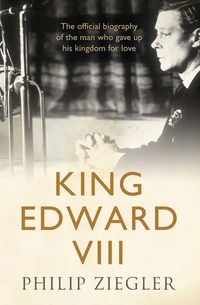
Read the book: «King Edward VIII»
King Edward VIII
Philip Ziegler

Contents
Cover
Title Page
List of Illustrations
Preface
Family Tree
1 The Child
2 The Youth
3 ‘Oh!! That I Had a Job’
4 The Captain
5 L’Éducation Sentimentale
6 The Role of the Prince
7 The First Tours
8 India
9 ‘The Ambassador of Empire’
10 ‘Half Child, Half Genius’
11 ‘A Steady Decline’
12 The Last Years as Prince
13 Mrs Simpson
14 Accession
15 ‘The Most Modernistic Man in England’
16 The King and Mrs Simpson
17 The Last Weeks
18 Abdication
19 Exile
20 Married Life
21 The Duke in Germany
22 Second World War
23 Spain and Portugal
24 The Bahamas
25 The American Connection
26 What Comes Next?
27 ‘Some Sort of Official Status’
28 The Duke as Author
29 The Final Years
Nomenclature
Notes
Bibliographical Notes
Index
Acknowledgments
Footnotes
Picture Section
About the Author
From the reviews of King Edward VIII
Copyright
About the Publisher
List of Illustrations
Princes Albert and Edward bathing at Cowes (Pasteur Institute)
The Princess of Wales with Prince Edward (Al Fayed Archives)
The Prince in formal dress (Sir Michael Thomas)
Punting at Oxford (Sir Michael Thomas)
The Prince on a route march (Al Fayed Archives)
With the King’s Guard (Pasteur Institute)
Portia Cadogan (Al Fayed Archives)
Rosemary Leveson-Gower (Imperial War Museum)
The Prince as Chief Morning Star (The Royal Collection © 2012)
Freda Dudley Ward (Lady Laycock)
Taking a jump successfully (Al Fayed Archives)
Falling at the last fence (Al Fayed Archives)
With Audrey Coates at Drummond Castle (Lady Alexandra Metcalfe)
With the Duchess of York (Al Fayed Archives)
Skiing with Prince George (Lady Alexandra Metcalfe)
Mrs Simpson (Michael Bloch)
The Duchess’s bedside snapshot of the Duke (Al Fayed Archives)
Wedding photograph (Lady Alexandra Metcalfe)
The Windsors in German (The Royal Collection © 2012)
Dignitaries in Nassau (Al Fayed Archives)
A visit to the United Seamen’s Service (Al Fayed Archives)
In dressing gown, photographed by the Duchess (Al Fayed Archives)
Preface
It is now more than twenty years since my biography of King Edward VIII appeared and three-quarters of a century since the abdication. To most contemporary readers Edward VIII’s father and grandfather – King George V and King Edward VII – are shadowy figures. Even George VI is remembered, except perhaps by those who experienced him as a wartime monarch, more for being the father of the present Queen than as a figure in his own right. Yet Edward VIII, who was on the throne for less than a year, remains vividly in the popular imagination. Within the last two decades there have been more than twenty further books dealing with his life or certain aspects of it, not to mention newspaper articles galore, plays, television documentaries, even a musical comedy. The Duchess of Windsor has been quite as prominent. There have been several recent biographical studies – the latest of which quotes letters suggesting that Mrs Simpson, as she then was, was still in love with, or at least anxious to keep her lines open to, her estranged husband, even when her courtship by the King was at its fiercest. But neither Duke nor Duchess in isolation is the principal focus of this intense attention; it is above all their relationship which has captured the public’s interest and is almost as potent an attraction now as it was in 1936. ‘The king who gave up his throne for love’ is a cliché of romantic fiction, but it is also an accurate rendering of that extraordinary event. Nothing can diminish its potency.
The fact that the Prince of Wales has now married Camilla Parker Bowles, both parties with a divorce behind them, inevitably makes one wonder whether there might have been no abdication if contemporary morality had stood then where it does today. The question whether the present Duchess of Cornwall might one day become Queen has, of course, not yet finally been resolved but, in the closing days of the abdication crisis, Edward VIII seemed ready to contemplate a morganatic marriage. The problem might therefore not have arisen. Would Mrs Simpson be acceptable today as consort of the King? Probably not. She had been divorced not once but twice, with both husbands still living. She was an American – not in itself a reason for rejecting her, but reinforcing the uneasy conviction that she did not belong so close to the throne. She was seen, fairly or unfairly, as being a smart, hard-boiled, wise-cracking society figure – an image which did not and does not fit happily with what the British people expect of their royal court. But the moral certainties of 1936 have been diminished if not extinguished in 2012 – the issue would be more keenly debated and the answer might possibly be different.
It may be for his marriage that Edward VIII is particularly remembered, but in a way he seems much closer to contemporary society than his far more considerable father, brother and niece. This is the age of celebrity, when, perhaps more than ever before, people are celebrated not for what they have done but for what they appear to be. Nobody would ever have described George V and George VI or indeed Elizabeth II as ‘celebrities’; Edward VIII would have rejoiced in the title, or at least accepted it with equanimity. He saw himself as a thoroughly modern monarch, a reformer, rejecting the outdated pomposities of the past, adopting a style which was less formal, less bound by protocol, more relevant to the needs of the day, than the creaky old court he had inherited. This was not all fantasy. He had some good ideas and, if he had had the energy and determination to carry them through, he might indeed have made a valuable contribution to the British monarchy. But it is in the nature of celebrities that they shine only fitfully and leave little mark in the pages of history. Edward VIII’s intentions were often excellent; his ability to carry them through to fulfilment was sadly lacking.
This sounds, indeed is, severely critical. It is no more than he deserves but, over the last twenty years, he has been subjected to attacks far more violent than his performance in fact merits. Most of the emphasis has been on his alleged sympathy for the German cause before and during the Second World War. As Prince of Wales, it is claimed, he had condoned, indeed applauded, the rise of National Socialism. As King he was an arch-appeaser, energetically intervening to ensure that his ministers did not react robustly to the German occupation of the Rhineland. As Duke of Windsor he wittingly betrayed secrets of military importance to the Germans in 1939 and 1940, while in Spain and Portugal he flirted with German emissaries who suggested that he remain in Europe and hold himself in readiness for his return to an occupied Britain. Until well on into the war he maintained that Britain must inevitably be defeated and that a negotiated peace was the only sane way forward. At any time, it was suggested, he would have been ready to supplant his brother and take back the throne if the opportunity had arisen. Such attacks reached a peak with a television programme entitled Edward, the Traitor King, without even the courtesy of a question mark. His great-nephew, Prince Edward, in 1996 made a valiant effort to retrieve the situation with another television programme showing the Duke in a rather more positive light. But, as is usually the case, the spreading of muck proved more effective than the subsequent sponging operation.
I would not pretend that the Foreign Office papers that have been released in recent years show the Duke in a particularly flattering light. They deal mainly with the period when he was in France in 1939 and 1940 with a Military Mission charged vaguely with liaison with the French; his escapades in Spain and Portugal after the fall of France; his time as Governor of the Bahamas; and his financial problems during that period and after the war was over. It was my study of these papers that convinced me that he was often, though by no means invariably, silly, indiscreet and egotistical, and that by 1936 he was unfit to occupy the throne. In particular, in Spain and Portugal, his behaviour was such as to give German agents – anxious to feed their superiors in Berlin the news that they wanted to hear – some reason for hoping that he might rally to the Axis cause if the circumstances were right. But German official documents published since the war show that this was mere supposition, and that there is no hard evidence to support the thesis of treachery, be it actual or potential.
Ah yes, say the Duke’s detractors, but the published documents do not tell the whole story. King George VI sent the royal librarian, Owen Moreshead, and the art historian (and, as it later transpired, Communist spy) Anthony Blunt on a secret mission to secure the papers that would have proved the Duke’s guilt and bring them back for destruction or incarceration in some inaccessible vault at Windsor. The fact that the mission was far from secret; that its task was to bring back certain nineteenth-century family papers – mainly letters from Queen Victoria to her eldest daughter, the Empress Frederick; that all these papers were eventually returned to Germany; and that a complete inventory exists of everything that was brought back has not been allowed to spoil a good story.
To reach the conclusion that the Duke of Windsor was a traitor it is necessary to credit every surmise of those who wanted him to be so and to ignore the testimony of all those who worked with him and who knew him best. Even then there would be no proof. It is a cardinal principle of British law that an accused is assumed innocent until proved guilty. In the case of the Duke of Windsor the reverse has been true; he has been assumed guilty because he cannot positively be proved innocent. And yet to prove that somebody did not do something is notoriously difficult: for a single crime an alibi can with luck be established, but if a pattern of behaviour or of thought is in question it is generally impossible to do more than establish a balance of probabilities, based on one’s knowledge of the person concerned. I make no claim to omniscience, but I probably know more about the Duke of Windsor than anyone else alive. I am absolutely certain that, with all his faults, he was a patriot who would never have wished his country to be defeated or have contemplated returning to an occupied Britain as a puppet king. I accept that I cannot prove my contention, but I have much better grounds for maintaining it than any of those who have asserted the contrary over the last twenty years. Nothing that they have said or written has caused me to change my mind.


1
The Child
EVEN IN THE TWILIGHT OF THE TWENTIETH CENTURY TO BE one of the 540 or so*1 living and legitimate descendants of Queen Victoria is a matter of some moment. To have been born in 1894, eldest son of the eldest surviving son of the eldest son of the Queen Empress, was to be heir to an almost intolerable burden of rights and responsibilities.
Queen Victoria had then been on the throne for fifty-seven years. The great majority of her subjects had no recollection of another monarch. She had weathered the unpopularity which had grown up when she retreated into protracted seclusion after the death of the Prince Consort and now enjoyed unique renown. The Widow of Windsor, ruler of a vast empire and grandmother to half the crowned heads of Europe, was a bewitching figure; her obstinate refusal to play to the gallery had eventually won her the reverent respect of all but a tiny republican minority among her people. She had become a myth in her own lifetime.
To have a myth as a mother is not necessarily a prescription for a happy family life. In 1894 the future King Edward VII had already been Prince of Wales for more than fifty years. The role is never an easy one to fill, and in Edward’s case was made almost impossible by the carping censoriousness of his parents. The Prince of Wales gave them something to censure – he was self-indulgent, indolent and licentious – but he was also uncommonly shrewd and well able to do a useful job of work if given the chance. The Queen gave him as few chances as possible. She treated him as an irresponsible delinquent, and in doing so ensured that his irresponsibility and delinquency became more marked. It was not until he at last succeeded to the throne that his qualities as a statesman were given a proper chance to flourish.
In 1863 he married Princess Alexandra of Denmark – ‘Sea-King’s daughter from over the sea’ – radiantly beautiful and with a sweetness of nature which enabled her to endure her husband’s infidelity with generosity and dignity. She was capable of great obstinacy and occasional selfishness but she was still one of the most endearing figures to have sat upon the British throne. She rarely read, her handwriting would have disgraced an intoxicated spider, increasing deafness cut her off from society, but she enjoyed a vast and justified popularity until the day she died.
The first duty of an heir to the throne is to ensure the succession. The Prince and Princess of Wales did their best, producing two sons, three daughters, and then another short-lived son. Unhappily, however, their eldest son, Prince Albert Victor, always known as Eddy, proved an unhopeful heir for the throne of England. Languid and lymphatic – ‘si peu de chose, though as you say a “Dear Boy”’, the Grand Duchess of Mecklenburg-Strelitz brutally dismissed him1 – he deplored the strident jollity of his family and preferred to trail wistfully in the wake of whatever unsuitable woman had attracted his attention. A determined and reliable wife seemed the only hope for his redemption, and a paragon was found in Princess Victoria Mary – May to the family – only daughter of the Duke and Duchess of Teck.
The Tecks were professional poor relations. The Duke was haunted by the fact that his father’s morganatic marriage had deprived him of his claim to the throne of Württemberg, and all his life attached to the rituals of rank and precedence an importance which seemed extravagant even to the courtiers who surrounded him. His mountainous wife Mary Adelaide, ‘Fat Mary’, was by no means unaware that she was a granddaughter of King George III, but she bore her royal blood more lightly. She devoted her energies to entertaining lavishly beyond her means and then recouping the family finances by ferocious economies and periods of exile in the relative cheapness of Florence. There Princess May spent some of her most formative years, learning the value of money the hard way, but also learning to appreciate beauty and acquiring a range of aesthetic interests which to her English cousins seemed odd if not actively undesirable. From her parents she inherited a respect for the blood royal which led her to regard the occupant of the British throne with something close to reverence.
The Tecks were protégés of the British royal family, who let them occupy rooms in Kensington Palace and make their home in the pleasant, rambling grace-and-favour White Lodge, in the heart of Richmond Park. The Princess of Wales was particularly fond of the Duchess, and it was hardly surprising that May’s name should have come to the fore when the quest began for a wife for Prince Eddy. It was not a spectacular match but it was respectable, and Queen Victoria considered that a future King of England needed no extra réclame in his bride to secure his immortality. To the Tecks the marriage was all that they had dreamed of; May’s morganatic blood would have proved an impediment to an alliance with any of the grander continental royal families, while the upper reaches of the British aristocracy had shown little eagerness to embrace this peripherally royal and penniless princess. Only May hesitated. ‘Do you think I can really take this on?’ she asked her mother. ‘Of course you can,’ was the robust reply, and of course she did.2 Her future husband was given equally little opportunity to object. ‘I do not anticipate any real opposition on Prince Eddy’s part if he is properly managed and told he must do it,’ wrote the Prince of Wales’s private secretary, Francis Knollys, ‘– that it is for the good of the country etc. etc.’3
May was spared what must have seemed an unappealing match. The engagement was announced at the end of 1891; the wedding fixed for February; early in January 1892 Prince Eddy contracted influenza, pneumonia developed, within a few days he was dead. His place in the line of succession was taken by his brother George. The change was in every way to the benefit of the country. In 1873 Queen Victoria had sent Prince George a watch, ‘hoping that it will serve to remind you to be very punctual in everything and very exact in all your duties … I hope you will be a good, obedient, truthful boy, kind to all, humble-minded, dutiful and always trying to be of use to others!’4 Few precepts can have been taken more earnestly to heart. Prince George had been conscientious, hard-working and responsible as a boy; he was no different as a man. The Royal Navy, for which he had been trained, can claim many men of cultivation and even a few eccentrics and intellectuals among the officers, but it takes considerable independence of mind to maintain such characteristics in a mainly unsympathetic environment. Prince George had neither the wish nor the ability to stand apart. He was an arch-conformist; bored by books, pictures, music; wholly without intellectual curiosity or imagination; suspicious of new ideas; entertained only by his stamp collection and the slaughter of ever greater quantities of pheasants, partridges and the like.
Yet his bluff and phlegmatic exterior was to some extent illusory. He was a worrier, an insomniac, a man whose sense of duty often stood between him and the enjoyment of his role in life. In 1892 his duty was to marry quickly and to provide heirs to a crown which would otherwise eventually fall into the unpromising hands of his sister Louise, Duchess of Fife. With a suitable bride for a future British monarch already selected, the solution seemed obvious to the Tecks and to his parents. The wedding planned for Prince Eddy should take place, only the date and the bridegroom would be changed. Prince George took little convincing that this was his destiny; May felt slightly greater qualms, but she too was soon persuaded. In May 1893 the Duke of York, as Prince George had been created the previous year, dutifully proposed to his late brother’s fiancée. He was as dutifully accepted. On 6 July the couple, by now very much, if undemonstratively, in love, were married in the Chapel Royal. A year later, on 23 June 1894, their first child, a boy, was born at the Tecks’ home in Richmond Park. He was not Victoria’s first great-grandchild but in her eyes he was beyond measure the most important.
The original plan had been for the baby to be born in Buckingham Palace but an early heatwave drove the couple to the comparative cool of White Lodge. The Duke of York was in the library, pretending to read Pilgrim’s Progress, when the birth took place at 10 p.m.; his father, the Prince of Wales, was holding an Ascot Week ball in the Fishing Temple at Virginia Water. The telephone that had recently been installed to link White Lodge to East Sheen was used to give him the news and enable him to propose a toast to the new prince.5 ‘My darling May was not conscious of pain during those last 2½ terrible hours,’ the Duke of York wrote to Victoria; in terms that sound as if the end of the operation had been not so much the cradle as the grave. ‘The baby weighed 8 lbs when he was born, and both grandmothers … pronounce him to be a most beautiful, strong and healthy child.’6 Fifteen hundred people signed their names on the following day in the book which had been placed in a marquee for the occasion, and the Duchess of Teck’s sister, the Grand Duchess of Mecklenburg-Strelitz, announced that she ‘went – mentally – on my knees, tears of gratitude and happiness flowing, streaming, and the hugging followed’.7
The bickering that normally accompanied the naming of a royal child now ensued. The Queen took it for granted that a daughter would be called Victoria and a son Albert. The Duke of York said it had long been decided ‘that if it was a boy, we should call him Edward after darling Eddy. This is the dearest wish of our hearts, dearest Grandmama, for Edward is indeed a sacred name to us, and one which I know would have pleased him beyond anything.’8 ‘You write as if Edward was the real name of dear Eddy,’ retorted the Queen severely; everyone knew that he had in fact been christened Victor Albert.9 The Duke proved unusually obstinate and the baby was called Edward Albert Christian George Andrew Patrick David. Christian was the name of the baby’s godfather, the King of Denmark; the other four names represented England, Scotland, Ireland and Wales. Some reports state that David was an afterthought, introduced to gratify the aged and moribund Marchioness of Waterford. There are differing views about her motives: that assiduous and well-informed courtier Lord Esher said it was because ‘she had some fad about restoring the Jews to the Holy City’;10 the Prince of Wales’s friend the Marquis de Breteuil recorded that the old lady had dreamed of an ancient Irish legend according to which there would be a great king over the water and his name would be David.11
The christening took place with all the pomp befitting a baby who stood third in line to the British throne. Twelve godparents, mainly German, attended; as well as the Prime Minister, Lord Rosebery. The gold bowl used as a font was brought from Windsor Castle. The cake, thirty inches high and five feet in circumference, was made by McVitie and Price in Edinburgh. ‘I have two bottles of Jordan water,’ the Duke proudly told his old tutor, Canon Dalton, and both were lavished on the occasion.12 The only discordant note was struck by the first socialist member of parliament, Keir Hardie. When it was proposed that the House of Commons should congratulate the Queen on the happy event, Hardie opposed the motion. ‘From his childhood onward,’ he said, with what to some will seem dreadful prescience, ‘this boy will be surrounded by sycophants and flatterers by the score … A line will be drawn between him and the people he is to be called upon some day to reign over. In due course … he will be sent on a tour round the world, and probably rumours of a morganatic alliance will follow, and the end of it will be the country will be called upon to pay the bill.’13
Prince Edward, who from birth was always known to his family as David, was followed eighteen months later by a brother, Albert George, who was in due course to become Duke of York and, less predictably, King George VI. Edward attended his sibling’s christening and behaved impeccably until Prince Albert, in the arms of the Bishop of Norwich, began to yell. Edward, evidently seeing this as a challenge to his primacy, yelled louder and was removed. ‘Of course he is very young to come to church,’ the Duke of York told the Queen, ‘but we thought that in years to come it would give him pleasure to know that he had been present at his brother’s christening.’14 A daughter, Mary, was born in 1897; then came a gap of three years, after which Henry – future Duke of Gloucester – was born in 1900 and George – future Duke of Kent – in 1902. The youngest child, John, born in 1905, was an epileptic who lived in seclusion and was to die at the age of fourteen.
The three elder children were close enough in age to be much together; Princes Edward and Albert – David and Bertie – being in particular inseparable. Lord Esher, visiting Sandringham, played with the children in the garden and noted that: ‘The second boy is the sharpest – but there is something rather taking about Prince Edward.’15 Most other observers agree it was Edward who was the sharper and who habitually took the lead – ‘because as the eldest son he had the highest status in the family,’ explained the Duchess of York’s close friend, Lady Airlie.16 He found that he could easily manage his tractable and worshipping younger brother, but that Princess Mary was an independent-minded tomboy who was disinclined to do the bidding of any mere boy.
It has often been alleged – not least by the subject of this biography – that the Duke and Duchess of York were cold and distant parents. It would be foolish to pretend that the relationship between the future King George V and his sons, in particular his eldest son, was a happy one. When they were babies, however, all the evidence is that he was a doting father; far more ready to take an interest in his children than was true of most English parents of the upper and upper middle classes. ‘I have got those two photographs of you and darling Baby on my table before me now,’ he wrote to his wife from Cowes in August 1894. ‘… I like looking at my Tootsums little wife and my sweet child, it makes me happy when they are far away.’17*2 ‘Baby is very flourishing. He walks about all over the house, he has 14 teeth,’ he boasted to Canon Dalton. A month later Prince Edward still walked about all over the house but had sixteen teeth.18 The Duchess was more critical in her attitude. Her baby, she told her brother, was ‘exactly what I looked like as a baby, consequently plain. This is a pity and rather disturbs me.’19 She does not seem to have had much idea of what was to be expected from a small child: ‘David was “jumpy” yesterday morning,’ she wrote when he was a little over two years old, ‘however he got quieter after being out, what a curious child he is.’20 When Edward began to get letters from his parents, the Duke of York was always the more demonstratively affectionate. He was coming to Sandringham on Saturday, he told his three-year-old son, and would be ‘so pleased to see our darling little chicks again’. When the chicks had chickenpox; ‘I hope none of you have grown wings and become little chickens and tried to fly away, that would be dreadful and we should have to go up in a balloon to catch you.’21
The trouble began when his children reached an age at which mature conduct might reasonably – or unreasonably – be expected of them. Admiral Fisher, at Balmoral in 1903, noted: ‘The two little Princes are splendid little boys and chattered away the whole of their lunch-time, not the faintest shyness.’22 The comment is notable as marking one of the last occasions on which father and sons were observed together without something being said about the constraint and fear which dominated the atmosphere. Kenneth Rose has convincingly challenged the story by which King George V is supposed to have told Lord Derby: ‘My father was frightened of his mother, I was frightened of my father, and I’m damned well going to see that my children are frightened of me!’23 But though the tale may well be apocryphal, like most apocryphal tales it contains an essential truth. The Duke of York loved and wanted the best for his children but he was a bad-tempered and often frightening man; he was never cruel, but he was a harsh disciplinarian who believed that a bit of bullying never did a child any harm; he shouted, ranted, struck out both verbally and physically to express his displeasure. A summons to the library almost always heralded a rebuke, and a rebuke induced terror in the recipient. His banter was well-intentioned but it could also be brutal. On the birth of Prince Henry: ‘David of course asked some very funny questions. I told him the baby had flown in at the window during the night, and he at once asked where his wings were and I said they had been cut off.’24 Prince Edward was six at the time, and he claimed the vision of his brother’s bleeding wings disturbed his sleep for weeks afterwards.
The Duke of York had rigid ideas, invested with almost totemic significance, about punctuality, deportment, above all dress. The children were treated as midshipmen, perpetually on parade. Any deviation from the approved ritual was a fall from grace to be punished for the sake of the offender. ‘I hope your kilts fit well, take care and don’t spoil them at once as they are new,’ wrote the Duke to his eldest son. ‘Wear the Balmoral kilt and grey jacket on week days and green kilt and black jacket on Sundays. Do not wear the red kilt till I come.’25 Inevitably they got things wrong, wore a grey jacket with a green kilt or a Balmoral kilt on Sundays. Retribution was swift and fearful. ‘The House of Hanover, like ducks, produce bad parents,’ the royal librarian, Owen Morshead, told Harold Nicolson. ‘They trample on their young.’ ‘It was a mystery,’ said a royal private secretary, Alec Hardinge, ‘why George V, who was such a kind man, was such a brute to his children.’26
2
The Youth
THERE WERE GOOD REASONS FOR CHOOSING THE ROYAL Navy as a training ground for future monarchs. Careers open to princes at the beginning of the twentieth century were rare indeed, and the armed services provided one of the few in which they could find employment. The Navy, as the senior, was the obvious choice. It was a cherished national institution, its officers were recruited largely from the gentry or aristocracy, it offered less opportunities for debauchery or any kind of escapade than its land-based counterpart, it inculcated those virtues which it was felt were above all needed in a future king: sobriety, self-reliance, punctuality, a respect for authority and instinct to conform. A few years at sea would do harm to few and most people a lot of good. But to thrust a boy into the Navy at the age of twelve and leave him there until he was nineteen or twenty, if not longer, was unlikely to produce the rounded personality and breadth of mind needed to cope with the plethora of problems which afflict the constitutional monarch. When Edward’s father and uncle went to sea, Queen Victoria complained that the ‘very rough sort of life to which boys are exposed on board ship is the very thing not calculated to make a refined and amiable Prince’.1
The risk seemed more that the Navy would blinker rather than brutalize a prince. The curious thing was that the Prince of Wales himself was aware of the limitations of a naval education. He knew that he had grown up without any understanding of international affairs, any knowledge of society or politics, any facility for languages. He deplored these handicaps. And yet when it came to his own sons, he condemned them to the same sterile routine. At least when he had joined the Navy it had not seemed likely that he would become King. Prince Edward was destined for the throne, yet still the same formula was applied. It was almost as if the Prince of Wales was determined that, as he had himself been deprived of proper training for his life work, his son should suffer equally; and yet in fact no thought could have been further from his mind.
The best hope for Edward seemed to be that he would fail to pass the entrance examination. Everyone agreed that he should be subjected to the same ordeal as any other candidate, though he was to be medically inspected by the royal doctors – ‘I may perhaps add that he is a particularly strong, healthy boy,’ wrote Hansell.2 He had no Latin, but at a pinch could have offered German as an alternative. No one doubted that he was intelligent enough, but his spelling was appalling and his knowledge of mathematics exiguous. The Prince of Wales was apprehensive, then delighted and relieved to be told his son had passed the viva voce examination with flying colours. ‘Palpably above the average,’ said Sir Arthur Fanshawe,3 while another examiner, Lord Hampton, said that of the three hundred boys he had seen, Edward had been equal to the best.4 ‘This has pleased us immensely,’ wrote the Princess of Wales proudly.5 But the overall results of the written examination were not so flattering. In fact he ‘failed by a few marks to pass the qualifying examination, an Admiralty official reported in 1936. ‘Prince Edward obtained 291 marks out of 600 … but I notice that 5 candidates with lower marks were entered.’6
At all events, he did well enough to be admitted without imposing too great a strain on the examiners’ consciences. In May 1907 his father took him to the Naval College at Osborne in the Isle of Wight. ‘I felt the parting from you very much,’ the Prince of Wales wrote two days later, ‘and we all at home miss you greatly. But I saw enough … to assure me that you would get on capitally and be very happy with all the other boys. Of course at first it will all seem a bit strange to you but you will soon settle down … and have a very jolly time of it.’7 It seems unlikely that Prince Edward saw jolly times ahead when he received this letter. For any small boy the first exile to boarding school must be a scarifying experience; for Edward the ordeal was worse since he had been evicted abruptly from a cloistered family circle in which the existence of other children was hardly known. He shared a dormitory with thirty others, adjusting himself painfully to the fact that the day began at six, discipline was rigid, all work and play were conducted in a hectic bustle. He slept between the sons of Lord Spencer and Admiral Curzon-Howe. They had been chosen because their parents were well known to the Prince of Wales, but to Edward they seemed at first as alien as if they had been visitors from Mars. He had no idea how to relate to his contemporaries and had to learn not only new manners but almost a new language. It was much to his credit that he managed to look cheerful when his father left and to write proudly a few days later: ‘I am getting on very well here now … I think nothing of going up the mast as I am quite used to it.’8 His mother gratefully took his protestations at face value. ‘He has fallen into his new life very quickly,’ she told her aunt Augusta, ‘which is such a blessing.’9
The Prince of Wales’s instructions were that his son was to be treated exactly like any other naval cadet. Edward asked for nothing better, his ruling desire was to conform and to be accepted by his peers. But there was no chance that he would be able to escape altogether from his identity. He was subjected to mild bullying by small boys determined to show that he was not anything very special; red ink was poured down his neck, his hands were tied behind his back and he was guillotined in the sash window of his classroom. But his inoffensiveness and obvious determination not to trade on his rank soon led to his acceptance. Within a few weeks he had won through, was given a nickname – ‘Sardines’, presumably because he was the son of the Prince of W[h]ales – and became a tolerated if not leading member of society.
‘Perhaps the actual hours of work at Osborne are not excessive,’ the Prince of Wales wrote to Hansell, with greater perception than might have been expected, ‘but the whole life is a very strenuous one and they are never alone and therefore never quiet from the time they get up till the time they go to bed.’10 Sociable by nature, Edward survived the hurly-burly well, but the gaps left by Hansell’s teaching quickly became apparent. He did well in French but even special coaching in mathematics failed to raise him from the bottom ten places in the Exmouth term of sixty or so cadets. On the whole he settled respectably, if without great distinction, a little above the halfway mark; more important, he worked steadily throughout his two years at Osborne, reaching his peak after eighteen months and then only slipping back because of ill health. His father applauded his achievements and was decently consolatory about his setbacks. ‘I am delighted with the good reports that were sent me about you and that you are now 24th in your term,’ he wrote at the end of 1907, ‘… that is splendid, and I am sure you must be very pleased about it too and it will make you more keen about your mark.’11
Edward’s letters to his parents were short and uncommunicative even by the standards of schoolboys, consisting mainly of excuses for not having written before or at greater length: ‘I am in a bean-bag team and I had to practise every morning,’ was one explanation; ‘I have had to practise Swedish drill every morning,’ occurred a few weeks later; then, in desperation, ‘I have been doing such a lot of things lately that I have not had much time.’12 His father tolerated brevity but not a failure to write at all. ‘You must be able to find time to write to me once a week,’ he protested, ‘… I am anxious to hear how you are getting on.’13 Edward endured stoically the separation from his family, but felt it a bit hard when his mother announced that she intended to visit Germany during the first two weeks of his first holidays. The Princess of Wales was apologetic but unrelenting; Aunt Augusta was eighty-five and unable to travel. ‘I hope we shall have great fun when we do meet,’ she wrote.14 In spite of the demands on their time the Waleses generally did manage to make the holidays fun. ‘We miss you most dreadfully,’ the Prince of Wales wrote when his son returned to Osborne. ‘I fear you felt very sad at leaving home. I know I did when I was a boy, it is only natural that you should, and it shows that you are fond of your home.’15
By the time Prince Albert followed his brother to Osborne, Edward was in his last term and a figure of some consequence. ‘I hope you have “put him up to the ropes” as we say,’ wrote their father. ‘You must look after him all you can.’16 Opportunities for such tutelage were limited, boys from different terms were not supposed to mix at Osborne and when the brothers wanted to talk together surreptitious assignations had to be made in the further reaches of the playing fields. Prince Edward was expected to do more than just give comfort to his sibling; the Prince of Wales frequently instructed him to make sure Bertie worked harder or to pass on complaints about his failure to concentrate. Edward seems to have relished the quasi-parental role, especially since his brother did conspicuously worse than him. ‘Bertie was 61st in the order which was not so bad,’ he wrote later from Dartmouth. ‘I really think he is trying to work a bit. This is an excellent thing …’17
Though Edward had hardly been an outstanding success at Osborne, let alone a hero, he had profited by his time there. He had gained immeasurably in confidence and found that it was possible to get on well with his contemporaries. ‘He is wonderfully improved,’ noted Esher, ‘Osborne has made him unshy, and given him good manners.’18 His father, after only one term, found him ‘more manly’ and much more able to look after himself.19 It had been sink or swim; anyone who could not look after himself in the maelstrom of Osborne life would not have survived for long. But he had swum, and even got some pleasure out of doing so. When he got home to Frogmore at the beginning of his first holidays he had found the entrance beflagged and a large banner reading ‘Vive l’amiral!’ No banners flew on his final departure from Osborne but a sense of achievement possessed him just the same.
Dartmouth follows Osborne as the day the night, and giving something of the same impression of light following dark. Though the discipline seemed almost as harsh, the bullying as mindless, the tempo of life as relentless as at Osborne, the cadets were that much nearer to maturity and their troubles easier to endure. ‘This is a very nice place, much nicer than Osborne …’ wrote Edward in relief in May 1909. ‘There is a very nice Chapel here and I think I am going to join the Choir.’ But the pressure was still on. ‘There is an awful rush here and everything has to be done so quickly. We are allowed 3 minutes to undress in the evening.’20 His mother was alarmed by this last piece of information. How could he do a proper job of cleaning his teeth in so short a time? ‘This is so important and I want to know. Don’t forget to answer this question.’21 Edward’s reply was tinged with the exasperation that a boy of fifteen properly feels towards a fussing mother. The three minutes did not include time for brushing teeth. ‘We are allowed plenty of time for that. There is also plenty of time in the morning, and I am taking great care of my teeth.’22
He had moved on to Dartmouth with his contemporaries from Osborne, so the process of adjustment was less painful than at the junior college. Stephen King-Hall, who was a cadet in the same year, recorded that he was ‘rather shy but generally liked’. In his first terms he was sometimes seen staggering back from the football fields with a load of boots, victim of the wish of some senior cadet to be able to say in later life: ‘The King once carried my boots.’23 His academic strengths and weaknesses did not greatly change. In May 1909 he reported proudly that he was top in German, second in history, top in English, third in French, but only thirty-seventh in the overall order, still dragged down by his inability to manage any branch of mathematics.24 In the exams in March 1910 he was forty-eighth in geometry and forty-fifth in trigonometry out of a term of fifty-nine: ‘That is quite good for me,’ he wrote defensively.25 He found exams difficult and regularly produced worse results than he had in class. Lord Knutsford stayed at York Cottage early in 1911 and spoke to Edward about the examination system. The Prince praised it, in spite of his own inadequacy. As to the final exams, he said, ‘I dare say I shall take some time, as I am not at all clever, but I might pass.’ Knutsford found him ‘a really charming boy, very simple and keen’. He taught him card tricks and found that ‘he could do the “French drop” fairly well’.26
The previous year his Easter holidays had been unexpectedly extended by the sudden illness of the King. During the night of 6 May 1910 Edward VII died. The first Edward knew of it was when Bertie saw from their window in Marlborough House that the Royal Standard over Buckingham Palace was at half mast. He mentioned this to his father who muttered, ‘That’s all wrong,’ and ordered the Standard to be transferred to Marlborough House and flown ‘close up’.27 King Edward VII might be dead but the King lived.
With his father now King George V, Edward automatically inherited the Dukedom of Cornwall. Life at Dartmouth in theory was unchanged but the cadets would have been less than human if they had not recognized that only one life stood between their fifteen-year-old contemporary and the throne.
Perhaps in deference to his presence, the authorities at Dartmouth had introduced a course of Civics. He told his father that he was much enjoying it and discovering a great deal about the constitution: ‘It is such a useful subject for me to learn.’28 He began to follow the daily papers, taking the Morning Post and the Westminster Gazette. It was ‘a very good thing, I think’, he told his mother. ‘It is about time I read the papers, as in years to come, when I am obliged to follow politics, I shall know something about it.’29 The King saw this letter and at once wrote to insist that The Times be substituted for the Morning Post – ‘the views and opinions expressed are much sounder in every way’. The Westminster Gazette was excellent and moderate – ‘You should always try and form moderate opinions about things, and never extreme ones, especially in politics.’30 He must have written with special feeling since Britain was involved in a constitutional crisis over the powers of the House of Lords in which moderate opinions were hard to find. ‘It must have been so very hard for Papa to say the right thing, and yet show at the same time that he was not partial to one party or the other,’ wrote Edward sympathetically.31
The succession of his father to the throne with all the attendant ceremonies reduced the usefulness of Edward’s last term at Dartmouth. His parents were sorry that he should find himself thrust into the position of heir to the throne ‘without being older and having more preparation’. Still, the Queen told her aunt Augusta, ‘we have done our best for him and we can only hope and pray we may have succeeded and that he will ever uphold the honour and traditions of our house’.32 The Rev. H. Dixon Wright, who prepared Edward for confirmation, had the same cause at heart. The Prince’s mind, he told Archbishop Davidson, was ‘absolutely innocent and uncontaminated’. With the consent of the King Wright had ‘warned him on the subject of “the sinful lusts of the flesh”, that he may be forearmed’.33 The Archbishop was somewhat dismayed to find that the King expected him to ‘examine’ the Prince in the presence of his parents and suggested some relaxation of the procedure. ‘I have no wish whatever for the examination which my dear brother and I had to undergo in the presence of the Queen and my parents,’ wrote George V cheerfully. ‘I thought it a terrible ordeal, but was under the impression it was always done with the members of my family. Delighted to hear that it is not necessary.’34 The confirmation passed off none the worse for this breach with precedent. ‘The impression made upon me by the quiet boyish simplicity, the clear and really thoughtful attitude, and the wistful keenness of the young Prince is one which can never be effaced,’ wrote the Archbishop, a tribute that would have been still more impressive if it had been written to anyone but the Queen.35
The Coronation was fixed for 22 June 1911. Being still only sixteen Edward could not wear a peer’s robes, so his father created him a Knight of the Garter. For one who was soon to show an almost pathological dislike of dressing up, Edward donned the somewhat fanciful costume with striking calm, in his diary noting merely that it would ‘look very well when ready’ and that it was lucky that his father no longer needed his, since the expense would otherwise have been considerable.36 The Queen told her aunt that he had carried off the ceremony with great sang-froid and dignity: ‘David wore the Garter dress white and silver with the cloak and big hat and feathers. He really looked too sweet.’37
The Coronation followed a few days later. The children paid their usual morning visit to their parents and found the King brusque and conspicuously nervous. He showed Edward the Admiralty Order in The Times gazetting him a midshipman and handed him the dirk that went with the rank.38 The children then processed together to the Abbey in one of the state coaches. Queen Alexandra had thought this a poor idea and was proved right when the younger princes began to giggle and play the fool. George tried to tickle Mary and fell on the floor. On the return journey things got so bad that only Edward’s threats to hit his brothers maintained any sort of order.39 In the Abbey, however, all was decorous. Edward was conducted to his stall, his brothers bowed as they filed in front of him, Princess Mary curtsied deeply ‘and the Prince rose and gravely bowed to her’.40 When the moment came for him to do homage he was consumed by nerves; if he blundered or behaved clumsily, he believed his father would feel that he had failed him.41 He did not blunder. That night George V wrote in his diary: ‘I nearly broke down when dear David came to do homage to me, as it reminded me so much [of] when I did the same thing to beloved Papa. He did it so well.’42
By then Edward was already Prince of Wales, given the title on his sixteenth birthday. There had been no formal investiture of a Prince of Wales for more than three hundred years, but the Empress Frederick had suggested the ceremony should be revived; the Bishop of St Asaph espoused the idea; and Lloyd George, Chancellor of the Exchequer and Constable of Caernarvon Castle, saw a chance to gratify Welsh national pride and win political support.43 Some time-honoured traditions were hurriedly invented, Caernarvon Castle refurbished, gold quarried from the Merionethshire hills to make the Prince’s regalia, and a quaint costume of white satin breeches and purple velvet surcoat devised for the occasion. At this point Edward struck. What, he asked, ‘would my Navy friends say if they saw me in this preposterous rig?’44 The Queen talked him into grudging acquiescence and Lloyd George taught him some Welsh phrases for the occasion. He practised in the garden at Frogmore, bellowing ‘Mor o gan yw Cymru i gyd’ – all Wales is a sea of song – to Hansell fifty yards away. He could hear every word, reported Hansell.45
The ceremony was a great success; the only people who recorded their displeasure were the Mayor and Aldermen of Chester, who felt that since Prince Edward was among other things Earl of Chester, the investiture should have happened there. The leading man earned himself a crop of compliments. Winston Churchill, the Home Secretary, congratulated him on possessing a voice ‘which carries well and is capable of being raised without losing expressiveness’.46 Lloyd George assured him that he had forged a lasting bond of affection with the Welsh ‘and won the admiration of all those who witnessed the spectacle’.47 Queen Mary told Aunt Augusta that he had played his part to perfection, ‘It was very émouvant for George and me.’48 To the youthful Harry Luke he seemed ‘the incarnation of all the Fairy Princes who have ever been imagined’.49 The last description encapsulated everything that disquieted Edward about the ceremony. He was not sure he wanted to be a prince at all, certainly he did not wish to be a fairy prince. He hated anything which made him a man apart, which set him on a pedestal for his fellows to goggle at and worship. If to be Prince of Wales meant to put on fancy dress and strike attitudes in remote Welsh castles, then it was not a job for him.
There were good points about the position too. As Duke of Cornwall, he now enjoyed the revenues of the Duchy of Cornwall, derived from much valuable property in London and huge estates in the West Country. These amounted to some £90,000 a year, far more than he could possibly require before he came of age and set up his own establishment. The Treasurer of the Duchy of Cornwall, Walter Peacock, estimated that by the end of his minority savings would probably amount to £400,000; say, very roughly, £10 million at current values.50 With new wealth and consequence came new responsibilities. J. C. Davidson, some time in 1912, was summoned from his work in the Colonial Office to St James’s Palace to be looked over as a prospective private secretary. He quickly decided it was no job for him: ‘I would have made a very poor courtier, nor did I quite like the character of the Prince of Wales, charming in some ways as he was.’51 The Prince possibly reciprocated the mild dislike; certainly no job was offered to Davidson, nor any private secretary appointed.
Meanwhile his naval career was running to its close. His last term at Dartmouth had been truncated by a fierce attack of measles. He retreated to Newquay to convalesce and to pay a few perfunctory visits to his recently acquired estates in the vicinity. On 29 March 1911 he returned briefly to Dartmouth to give presents and signed photographs to the officers, masters and a few particularly close friends. On the same day he presented to the town of Dartmouth the silver oar which symbolized the ancient rights of the Duke of Cornwall over the adjoining waters: ‘This was my first function, and I think it went off very well,’ he noted in his diary.52 Neither he nor his father appeared to have any doubts about the value of the education he had received. ‘I certainly think the College is the best school in England,’ wrote the King.53 The Prince echoed the sentiment when he visited Winchester in 1913. ‘I believe it is a very good school,’ he told his father. ‘… It is amusing to see the difference between an ordinary school and Dartmouth. The boys talk of discomfort, but in the dormitories they have cubicles and they sit about in studies all day. Their life is not half as strenuous as it is at Dartmouth and we were more contented. There can be no better education than a naval one.’54
The Dartmouth course ended with a training cruise. The Coronation made it impossible for the Prince to take part, but as a consolation in the autumn of 1911 he was sent on a three-month tour in the battleship Hindustan. The Prince served as a midshipman as the ship sailed along the south coast to Portland, Plymouth and Torbay, then for a month to Queensferry and back to Portland for the final weeks. The Captain, Henry Campbell, was a shining example of those bluff sailor men who maintain a conspicuous independence of attitude while keeping a weather eye always open to the wishes of those likely to further their careers. ‘Not the smallest exception or discrimination has been made in his favour,’ he wrote in his final report on the Prince.55 Up to a point it was true. The Prince did work hard, get up at 6 a.m. to do rifle drill or P.T., receive the same pay – 1/9d (9p) a day – as the other midshipmen, keep his watches, do a stint in the coal bunkers – ‘the atmosphere is thick with coal dust and how the wretched stokers who have to remain down there can stand it, I do not know’.56 But not many midshipmen ate regularly with their captain, went for walks ashore with him when the ship was near land, lunched in their stately homes with Lord Mar, Lord Rosebery and Lord Mount Edgcumbe. He was always the Prince of Wales and though he seems to have been genuinely welcome in the gunroom by the other midshipmen, he was there as a guest, not as a member.
‘I like the Captain very much indeed, he is always so interesting,’ wrote the Prince in his diary. ‘The Chaplain had a talk with me … and gave me some tracts to read.’57 The Chaplain, one suspects, was found less interesting than the Captain. Campbell reciprocated the boy’s affection, and, though he was not above flattery, his letter to Queen Mary has the ring of sincerity:
We in the Navy rate a man for what he does, not for what he is; from the highest to the lowest he was looked upon with affection and respect. His character has formed; it is strong but very gentle and is best described in the old Scotch words ‘Ye can break but ye canna bend me.’ In spite of his very happy nature he thinks a great deal and he one day made it quite clear to me that he was fully alive to the fact that false speech and fond hopes do not alter facts … The Prince said to me one day; ‘If I have learnt nothing else since I have been with you, I have learnt what inconvenience is and what it means to be really tired.’ I thought of my promise to you and felt that it had been fulfilled.58
When he went ashore for the last time the ship’s company sang ‘God Bless the Prince of Wales’ and ‘Auld lang syne’. The Prince knew it was the end of his naval life. ‘I only wish it was possible for you to continue serving in what I consider the finest service in the world,’ his father had written to him.59 But it was not possible. The first year of his reign had finally convinced George V that life aboard a ship could not equip a prince to be King. Edward must travel, he must learn languages, he must study history and the constitution, he must serve in the Army, he must become the very model of a modern monarch. The Prince of Wales was disconsolate, but he knew his father was right.
‘You know, I think father now is quite a nice man,’ Edward had said in apparent surprise to his mother in the summer of 1910.60 That George V was in fact quite a nice man is hardly in question; that his son continued to think him quite a nice father is more doubtful. The trouble was partly that the King tried too hard. ‘Now that you are leaving home, David, and going out into the world,’ he said when he deposited his son for the first time at Osborne, ‘always remember that I am your best friend.’61 The same refrain reverberated down the years: in 1908, ‘I wish you always to look upon me as your best friend, when in doubt and want advice, come to me’; in 1913, ‘I want you always to look upon me as your best friend’; in 1914, ‘I want you to treat me as your best friend.’62 It is possible that some boys may indeed regard their fathers as their best friends, but even if they did it is unlikely that they would relish being constantly reminded of the fact.
There was a sententiousness about the King’s approach which must have grated on its victim. ‘I trust that you will always remember …’ wrote George V just after his accession, ‘that now you must always set a good example to the others by being very obedient, respectful to your seniors and kind to everyone.’63 ‘May God spare you for many, many years and may you grow up to be a happiness and a credit to your parents and your Country,’ was the message for the Prince’s thirteenth birthday.64 The sentiments were unexceptionable, but no teenage boy could be expected to pay much attention to such exhortations. In later life Edward was apt to say that his father never said anything nice about him, always it was carping criticism and rebuke. This is not altogether fair. The King did sometimes congratulate his son on his manners, his letter-writing or some new achievement. But such occasions were the exception. ‘Papa has been so nice to me since my return …’ wrote the Prince in his diary in 1913. ‘No faults have been found … Such a change!!’ It was too good to last. Within a few days there was ‘an awful row’ when the King took exception to his sons going out for a walk with small rifles and shooting rabbits. ‘Those things are always a great bore,’ noted the Prince wearily.65 His recreations were a frequent source of recrimination: ‘You seem to be having too much shooting and not enough riding or hunting. I can’t understand why you didn’t hunt when Sir G. Fitzwilliam came expressly for that … What on earth were you doing? … I must say I am disappointed.’66
A less sensitive or more self-confident boy might have recognized the genuine solicitude which lay behind the King’s captiousness and have responded to the spirit rather than the manner. The Prince did not. His health provided grounds for constant skirmishes. ‘Do smoke less, take less exercise, eat more and rest more,’ wrote the King, in despair at his eighteen-year-old son’s increasingly eccentric train of life. ‘You are just at the critical age from now till you are 21 and it is most necessary that you should develop properly, both in mind and body. It all depends … whether you develop into a strong, healthy man or remain a sort of puny, half grown boy.’67 The Prince paid little attention. He had, for reasons difficult to follow, concluded that he was teetering always on the verge of fatness, and to avoid such a fate submitted his body to much violent physical exercise and ate with ill-judged frugality. He considered his parents’ efforts to modify this regime to be fussy and interfering, and dismissed the injunctions of the royal doctors as the vapourings of the King’s hired lackeys. He found it hard to credit what to the outsider seems the patent sincerity of his father’s heartcry: ‘I am only telling you these things for your own good and because I am so devoted to you and take such an interest in everything.’68 There were interludes of harmony: ‘We now understand each other so well,’ wrote the Prince of Wales in July 1913;69 a conversation with the King at York Cottage a few months later ‘made a difference to my life and made me look on everything in a totally different light’;70 but soon there would be more grumbles and recriminations and all the good would be undone.
It has been said that the sympathy for Germany which the Prince of Wales showed in the 1930s stemmed from the success of his pre-war visits. All the evidence is that, though he enjoyed his stay there and liked some of his relations, he was not particularly struck by the country or its people. ‘The Germans as a race,’ he told a friend, ‘are fat, stolid, unsympathetic, intensely military, and all the men have huge cigars sticking out of their faces at all times.’159 ‘The trip was very interesting,’ he reflected when he got back to London, ‘but I don’t care much about the Germans.’160 Of the countries which he visited before the First World War, the one that pleased him most was Norway, where he loved the skiing, the open-air existence and the informality of court life – ‘a lovely country with a charming people,’ he found it. ‘It was just like home.’161 This last comment betrayed his real priorities. Far though he might wander, and much pleasure though he might derive from his wanderings, whether as Prince, as King, or as Duke of Windsor, there was always for him to be no place like home.
By the summer of 1914 the King had agreed that his son should spend the last few months of the year travelling and should join the Grenadier Guards the following year. The prospect was pleasing enough, but already shades of the prison house were beginning to close upon the growing Prince. The first dread intimation of what was to come had struck him in June 1912, when he got back at lunch time from his stay in France to find that the same afternoon he had to go with the King and Queen to a St John’s Ambulance Parade – ‘rather, if not very dull’; at 6.30 p.m. he was receiving the Khedive of Egypt and at 8.30 he was taking the wife of the Bishop of Winchester in to dinner.162 From then on public functions multiplied. He quickly decided that the more formal and decorous they were, the more he would dislike them. He attended his first court in March 1914 and found it ‘mighty poor fun … I went in with the parents to the ballroom and stood till 11.00 while hundreds of women went by, each one plainer than the last … I don’t mind if I never go to one again.’ He did go, of course, and resented it even more: ‘a bum show. This court etiquette is intolerable.’ As for the state visit of the King and Queen of Denmark: ‘What rot and a waste of time, money and energy all these state visits are.’163
When he had a proper job to do, however, he did it conscientiously and well. He was sent by the King to greet Poincaré, now President of the Republic, on his arrival at Portsmouth. The French statesman was impressed by his ‘charm of manner and vivacity’. The Prince had ‘lost none of his former delightful simplicity’ but had ‘“come on” a good deal’.164 The King was delighted by the reports he was given of his son’s performance: ‘It gave both Mama and me great pleasure … I may sometimes find fault with you but I assure you it is only for your own good and because I am so devoted to you.’165 The Prince’s first important solo performance came in June 1914 when he opened the new church of St Anselm on the Duchy of Cornwall estates in south London. He took endless trouble with his speech and carried it off well: ‘I had a wonderful sense of confidence in the audience, who I felt would make allowances for it being my 1st public function.’166 At present, he told his audience, he knew little of the difficulties which beset those who were concerned with housing for the working classes, ‘but by studying the comfort and happiness of my tenants I hope to gain experience’. Congratulations flowed in, on his diction, his pace, his obvious sincerity; the one that would have pleased him most because it was not intended for his eyes was sent to one of the ladies-in-waiting, Lady Fortescue. ‘It was a wonderful success. He did it quite beautifully. At first he seemed a little nervous but it wore off and his speech was quite charming. He said it as if he really meant it … and in such a firm, charming voice. Everyone was tremendously enthusiastic … He looked so young among all those elderly prelates, but so dignified.’167
For the first time he began to talk seriously to politicians and form opinions of them. Churchill was his hero, mainly because he was now First Lord of the Admiralty and arch advocate of a larger Navy: ‘He is a wonderful man and has a great power of work.’ Asquith, the Prime Minister, he liked, though he found Mrs Asquith ‘rather tiring and never stops talking’; Esher and Lulu Harcourt (the Colonial Secretary) were particularly tiresome.168 If he had any preference between the parties he did not confide it to his diary, though on certain issues he feared the Liberal government would be insufficiently firm. He had strong views about the suffragettes and told his father that he hoped ‘the woman suffrage bill will never be passed. It is curious how divided the present cabinet is on the subject.’169 To his relief Asquith held firm. ‘I really think that at last some drastic measures are to be taken as regards those bl-d- suffragettes, whose conduct is becoming more and more infamous every day,’ he told Godfrey Thomas in the summer of 1914.170 He was as strongly opposed to Home Rule for Ireland. ‘I hope it will not pass,’ he wrote in his diary when the Home Rule Bill was introduced in 1912.171 His parents shared his views on the future of Ulster. Queen Mary wrote him outspoken letters in March and April 1914 about the weakness of the government and the deplorable way they had treated the Army.172 ‘Although we aren’t supposed to have any politics,’ the Prince responded, ‘there does come a time when all that outward nonsense must be put aside, and that time has come.’173
Socially his life was transformed in that last summer before the war. His parents had had a party for him at Buckingham Palace in March 1913. ‘I had to dance, a thing I hate,’ he wrote forlornly in his diary: ‘The whole thing was a great strain.’ He did not change his views for a year at least; then in July 1914 as a twenty-year-old he went to the Londesboroughs’ ball. ‘I stuck out to the bitter end and got back at 2 a.m. It was really great fun,’ he recorded in mild astonishment. Next night it was the turn of the Portlands: ‘The floor was perfect and my dancing is improving.’ He stayed till 3.45, and did the same the following night at the Salisburys’.174 A looker-on at the Salisburys’ dance who did not know about his change of heart commiserated on his sad plight: ‘The Prince is no dancer … It was something of an ordeal for so young a boy and of so retiring a disposition.’175 The sympathy was uncalled for: ‘I have now become fond of dancing and love going out!’176 But he was still discriminating. Baroness Orczy saw him at a court ball in mid-July, dancing the quadrille d’honneur with one of his aunts and looking ‘moody and somewhat bored’.177 Nor did he allow his new-found enthusiasm in any other way to change his train of life. He was up at 6 a.m. after the Londesborough ball, rose at 7 a.m. for a swim after the Portlands’ and was playing squash by 7 a.m. after the Salisburys’: ‘I’ve had only 8 hours sleep in the last 72 hours.’178
The ferocious social round was combined with a course with the Life Guards – riding school, sword drill, care of horses and equipment, marching. ‘Not very exciting but anyhow a definite job which is the gt thing!!’ he wrote in his diary. ‘Military life and ways are curious.’179 He still pined for the Navy. Halfway through his cavalry course he went with the King to Portsmouth for the naval review and visited old friends aboard HMS Collingwood. It was ‘glorious. God what a life this is compared to my attachment.’180 But he knew that it was a paradise not to be regained. The plan was that he should spend 1915 with the Grenadier Guards, 1916 with the Royal Horse Artillery, and then join the 10th Hussars on their return from South Africa. Meanwhile he danced the summer away and made plans for another grand tour of Europe in the autumn. A break in the routine came at the end of June when he spent a week with the Officers’ Training Corps and manoeuvred vigorously about the plains near Aldershot. ‘When in camp I make it a rule never to open a newspaper,’ he wrote to a friend, ‘so am completely ignorant of all happenings in the outer World, except that the Austrian Archduke and his wife have been assassinated. I expect it has caused a stir in Germany.’181
3
‘Oh!! That I Had a Job’
THAT IN 1914 THE YOUTH OF BRITAIN WENT EXULTANTLY to war is one of the stranger features of that agonizing conflict. The Prince of Wales had even less reason than most to share in this exultation. For one thing, many of his close relations, whom he had grown to know and like over the past few years, were now numbered among the enemy. For another, his position as heir to the throne set him apart from his contemporaries: they set off with armour shining to defeat the Huns and be home by Christmas, he knew that his armour was likely to be more ornamental than useful and that he had only a slim chance of wearing it in battle. Yet when he heard that he was to join the Army in France, he wrote to Sir George Arthur of this ‘wonderful and joyous surprise’. Twenty-five years later he was shown this letter and commented how terrifying he found it, coming as it did from an average boy of twenty. He had conceived war almost as a holiday, ‘a glorious adventure’. ‘How disillusioned we all were at the end of it,’ he commented ruefully. ‘One wonders if the generation of that age today feel as we did, or are they conscious of the appalling consequences of another World war and its futility? No! far worse than that how it would utterly destroy civilization.’1
The run-up to war found the Prince incredulous and baffled. The murder of the Archduke Franz Ferdinand at Sarajevo embroiled first Austria and Serbia, then Germany and Russia, finally France and Britain. The Prince was inclined to believe that Russia and Germany were behaving reasonably and that Austria was the prime offender, but admitted, ‘I must stop talking all this rot, for I know nothing about it.’2 As war between France and Germany became inevitable, his chief fear was lest the government should stay neutral. ‘That will be the end of us; we shall never be trusted by any power again.’3 The decision to stand by our allies came as a great relief but ‘Oh!! God; the whole thing is too big to comprehend!! Oh!! That I had a job.’4 That last expostulation was to be his constant refrain for the next four years. He went on to the balcony with his parents at Buckingham Palace to acknowledge the cheers of the crowd. The King wrote in his diary that night that he prayed to God he would protect dear Bertie’s life.5 It never occurred to him that his eldest son might be exposed to danger. How could he be? He was the Prince of Wales.
The Prince poured out his woes to his closest confidant, his brother Bertie:
Well, this is just about the mightiest calamity that has ever or will ever befall mankind … To think that but 17 days ago we were together with everything working peacefully in Europe, and now we are at the commencement of a most hideous and appalling war, the duration or issue of which are impossible to predict … ‘England at war with Germany!!’ that seems a sentence which would appear nowhere but in a mad novel.
The Germans could never have chosen a worse moment, and serve them right too if they are absolutely crushed, as I can but think they will be. The way they have behaved will go down to history as about the worst and most infamous action of any govt!! Don’t you agree? I bet you do.
I am as good as heartbroken to think I am totally devoid of any job whatsoever and have not the faintest chance of being able to serve my country. I have to stay at home with the women and children, a passenger of the worst description!! Here I am in this bloody gt palace, doing absolutely nothing but attend meals … Surely a man of 20 has higher things to hope for? But I haven’t apparently! Oh God it is becoming unbearable to live this usual life of ease and comfort at home, when you my dear old boy, and all naval and army officers, are toiling under unpleasant conditions, suffering hardships and running gt risks with your lives, for the defence and honour of England … At such a time you will picture me here, depressed and miserable and taking no more part in this huge undertaking than Harry and George, 2 irresponsible kids who run about playing inane games in the passage. However, enough about my rotten self, for I am a most bum specimen of humanity, and so must not be considered.6
The self-disparagement in the last sentence is a constant feature of his letters and his diary; consciously overstated, yet nonetheless sincere. He knew that it was not his fault that he was not among the first of the volunteers to fight for King and country, but he still condemned himself for being left behind. In fact his period of misery hanging around ‘this awful palace where I have had the worst weeks of my life’7 was quickly over. On 6 August 1914, only the day after he had written in such anguish to his brother, he asked for and was given a commission in the Grenadier Guards. He was only 5 feet 7 inches tall instead of the regulation 6 feet, but recorded in triumph: ‘I am to go to the King’s Company but shall be treated just like an ordinary officer, thank goodness, and am to share a room in barracks.’8 In fact his treatment for the first fortnight was far worse than the ordinary officer, let alone the ordinary Guards officer, would have expected while serving at home. The 1st Battalion was training at Warley Barracks in Brentwood. The officers’ mess was a ‘filthy hole’, the rooms were garrets, there was no furniture and no carpet. ‘But what does one care when living under war conditions? I am so glad to have joined up and to have escaped from the palace!!’9
When the battalion moved back to London his euphoric mood persisted. He established that he was the first Prince of Wales ever to carry the colours on the King’s Guard at Buckingham Palace, and accepted with relish what in peacetime he would have dismissed as a piece of pompous ritual, as well as positively welcoming the long, boring route marches from Wellington Barracks through Kensington and Fulham returning down the King’s Road. ‘It is pretty rotten in London,’ he told Godfrey Thomas, ‘and we can’t do any training. But anyhow we are on the spot and feel that this is a stepping stone to getting out!! How we long for it.’10 He deluded himself that he would continue to be treated ‘just like an ordinary officer’ and would soon go to France and the front with his fellow officers. His delusion was quickly dispelled. On 8 September, a week before the 1st Battalion sailed, his father told him that he would not accompany it. Instead he would join the 3rd Battalion and remain in London. ‘This is a bitter disappointment,’ he wrote in his diary.11 When the time came for him to watch the battalion march off from the barracks, his bitterness was still greater. ‘I am a broken man,’ he told his friend Jack Lawrence. ‘It is terrible being left behind!!’12
His closest friend in the Grenadiers, Lord Desmond Fitzgerald – one of the very few contemporaries who was invited to call him ‘Eddie’ – wrote to console him and tell him how much he had admired ‘the way you have borne your disappointment … However, it is not the fact of going to war, when thousands are doing so, that needs bravery; but to cheerfully accept the unpleasant things of life needs the greatest strength of character. And thus you have been able to set a wonderful example of how to do one’s duty.’13 The Prince was unconvinced. In public he put a good face on it, but his misery was too acute to conceal from his friends. Indeed, he was anxious to advertise it; he would have been less than human if he had not wanted everyone to know that he was eager to share the dangers of war and stayed behind against his will. How real those dangers were became rapidly apparent; by 2 November only six officers of his beloved 1st Battalion remained unwounded.
He appealed to the Secretary of State for War, Lord Kitchener, and called on him with his father’s assistant private secretary, Clive Wigram. ‘He is now a gt fat bloated man,’ he wrote vengefully in his diary, who put forward what seemed to the Prince most unconvincing reasons for refusing him leave to return to the 1st Battalion, but held out vague hopes of his joining the staff of the Commander-in-Chief of the British Expeditionary Force, Sir John French, in a few months when the line had been stabilized. ‘A pretty rotten contrast to my gt wish,’ commented the Prince, adding grudgingly: ‘He is a rough customer but mighty strong, and is just the man to boss these politicians at such a time!!’14 The King told Esher that his son had argued that he was expendable; if he were killed there were four brothers to take his place. ‘What if you were not killed, but taken prisoner?’ Kitchener asked drily.15
While eating his heart out in London with the 3rd Battalion of the Grenadiers – ‘strictly entre nous,’ he told Lady Glenusk, ‘there are not many really nice people in the 3rd Batt … The junior ensigns are a poor lot!!’16 – he made himself useful in other ways. Shortly before the outbreak of war he had become President of a National Fund for providing food for the poor, and had published an appeal in the daily papers. A quarter of a million pounds came in on the first day and within a week the total was more than £1 million. Most of the work was done by a Liberal member of parliament, Ernest Benn – future Lord Stansgate – whom the Prince judged ‘a nice, capable little man’.17 Public relations were entrusted to a Mr Pearson, who wanted the Prince to be painted by the military artist Caton Woodville at the head of his regiment, and the resultant poster to be exhibited on every available hoarding. This idea was quashed (as also was a still more eccentric suggestion that a certain celebrated music hall artist should be drawn in a cart to Trafalgar Square where he would delight the populace by playing patriotic airs on a piano with his nose).18 The King approved the principle of the Fund, but insisted that whatever publicity there was should stress that his son had nothing to do with its administration. Otherwise he foresaw the disgruntled poor blaming the Prince if their applications for relief were rejected.19 The Prince took the point and fully shared his father’s apprehension. All his life he disliked the role of patron, lending his name to some enterprise over which he had no real control. At the end of 1915 he became Chairman of the Statutory Committee of the Patriotic Fund, a body set up to concern itself with the care of sailors and soldiers who had suffered during the war. ‘Its work will, alas!, be carried into long years to come …’ explained Lord Stamfordham. ‘It will indeed be a vast machine of National Relief.’20 Few projects could have appealed more strongly to the Prince, but after the inaugural meeting he still wrote gloomily: ‘It’s such a rotten show for me; just a mere figurehead with the name of P of Wales as usual!!’21
Major Cadogan had rejoined his regiment when war broke out, and to help him with the Fund and his other duties the Prince persuaded Godfrey Thomas to take time off from the Foreign Office and join him as part-time equerry. His chief function, in Stamfordham’s eyes at any rate, was to persuade his master to eat more and take less exercise. Thomas tried dutifully but soon admitted defeat. He won the King’s confidence, however, and was held to be a healthy influence on his employer. Towards the end of 1914 he spent a weekend with the royal family at York Cottage. After dinner everyone sat around while the King, in big tortoiseshell spectacles, read extracts from the newspapers, ‘generally adding explosive comments about the Germans’. When the Queen and Princess Mary had gone to bed, the party adjourned to the billiard room, where the Prince of Wales and Prince Albert played while the King read his telegrams. Next day they went for a long walk. On the way back they met the epileptic Prince John and his nurse. ‘The Prince of Wales took him for a run in a kind of push-cart he had, and they both disappeared from view.’22
The Prince’s initial distaste for the idea of a job on French’s staff lessened as other possibilities faded, and when the King finally told him the time had come he was ecstatic: ‘This seems almost too good to be true, for once across the Channel lots of things are possible.’23 Stamfordham told French that the King wanted his son ‘to gain practical experience of the vast machinery employed in the conduct of a Campaign’. He was to be attached to the various sections of the headquarters and to attend talks with the Chief of Staff – ‘You will find him an attentive, silent listener, absolutely reticent and discreet.’24 This was not at all how the Prince saw his future, and Thomas observed that he was in a notably bad temper when he had to put aside his normal regimental kit and don the staff uniform with red tabs and cap to match;25 but he comforted himself with the thought that once in France it would surely be possible to get to the front. The most serious danger seemed to be that the fighting would be over before he could be in the thick of it. His comments on the progress of the war were resolutely optimistic. ‘Those bloody Germans are fairly getting it in the neck and no mistake,’ he told Jack Lawrence on 20 August,26 and a month later assured his aunt Alice: ‘It really looks as if the allies were getting a proper grip of the situation and that the German downfall has commenced.’27
With the declaration of war the Germans had become unequivocally ‘bloody’, guilty of ‘savage barbarism’28 and ‘infamous conduct’; ‘As for the Emperor’s conduct, words fail me!!’29 When words did fail him, he filled the gap with obscenities. Writing after gas had just been used he told his friend Houston-Boswell: ‘One can’t be surprised at anything those German buggers do. One really can’t believe we are fighting European christians … I am a great advocate of the principle of taking no prisoners or as few as possible!!’30 Godfrey Thomas commented on the Prince’s propensity at this time to use bad language and tell filthy stories: ‘It is a phase that most people go through at their public school and I hope that it has merely come a bit late in his case and that he’ll soon get out of it.’31 He did, but in the years that followed his escape from the Palace he felt bound to emphasize his independence by larding his diary and letters to his contemporaries with the more conventional expletives.*3
The Prince’s arrival in France, General Lambton told the King, had given universal pleasure: ‘I will try to keep him well occupied and as far from shells as possible.’32 In this sentence were encapsulated the Prince’s two principal causes for woe over the next eighteen months – indeed, for the duration of the war; he was kept far from shells, he was not well occupied. The latter was not the fault of French or Lambton. A stray and untrained second lieutenant in supreme headquarters will inevitably be at a loose end and overworked senior officers cannot always be inventing tasks for him. If he had not been the Prince of Wales he might have been of modest use at the most menial level; if he had possessed a forceful personality and administrative skills he might have worked himself into a position unjustified by his rank; but he was the Prince, he was far from forceful, his skills were limited. ‘It’s a pretty rotten life for me,’ he complained to Thomas. ‘I feel I’m the only man out here without a job, and it’s true; thus I am but an onlooker in uniform, and become less like an officer every day.’33 To have been an orthodox ADC to French would at least have involved regular duties, but the King felt it was improper for the Prince of Wales to act in such a role.34 Instead he was in attendance but with no real function: ‘I merely sloped along astern, looking a bloody fool and very much in the way.’35
Occasionally he was given some proper work to do. Once he was allowed to use his German in the interrogation of prisoners. The peasants were the most ready to talk, and, even if taciturn originally, could usually be persuaded to tell all they knew by a show of amazement at their ignorance. The more educated prisoners he found ‘all lie, and one can’t blame them’. In such a case the approved technique was to give the prisoner a good meal with plenty of wine. This loosened his tongue. ‘Rather a beastly idea, perhaps, but still it is necessary.’36 He hoped that similar work would follow, but it never did. When, very occasionally, he found himself doing something useful, his gratification was obvious. In March 1915 he reconnoitred the defences around Le Quesnoy. ‘The work is really rather responsible,’ he told his father proudly, ‘as it is v. necessary that the staff should have detailed information …’37
Stamfordham urged him not to admit to the King that he was bored and under-employed lest he found himself called back to England. ‘You are so terribly keen and full of “go” that you wish always to be doing something …’38 More cheeringly, Desmond Fitzgerald insisted that he was always doing something: ‘You have little idea what an enormous amount of good you do and how much everyone admires and loves you.’39 But it was not the sort of love and admiration the Prince wanted. Shortly after his arrival he was made to inspect some Indian troops. He accepted that his visit had done wonders for their morale but, ‘I hated this, as I haven’t come out for that sort of thing.’40 French was restrained in his use of the Prince as popular figurehead, but he knew well that ‘that sort of thing’ was what the Army wanted.
Hospital visiting was another valuable service. ‘It pleases the men and shows you take a sympathetic interest in their welfare,’ George V told his son.41 The sympathy was real, and though the Prince felt he should be playing a more valiant role, the warmth and generosity of his nature ensured that the memory of his visits was cherished by all those who experienced them. There is a story, often recounted, of the occasion when the Prince noticed that one patient had been segregated behind curtains. He asked why, and was told that the man had been so fearfully mutilated that it was thought better to keep him out of the way. The Prince insisted on seeing him, stood by his bed, then leant over and kissed him. Lady Donaldson in her admirable biography, properly sceptical of such picturesque but unsubstantiated anecdotes, dismissed it as apocryphal.42 It does sound too good to be true. But many years later Gordon Selwyn, the chaplain of the hospital and later Dean of Winchester, told Shane Leslie how well he recalled the scene. ‘Remember,’ the Dean said, ‘men have gone to heaven for less. Never can we forget that action.’43
Keeping on good terms with the French was another way the Prince could help significantly. He was frequently despatched on liaison visits to French headquarters. The reports which he drafted on his return were of slight value. The cavalry were ‘not bad riders … but they are about the worst horse masters in the world!!’; the officers were markedly inferior to their British counterparts: ‘They are brave enough and some of them very capable, but they don’t possess that personality or refineness [sic] which the British officer does, giving the latter complete control over his men, who will generally respect him and follow him anywhere!! How can this ideal state of affairs be reached when frequently the officer is of much lower birth than some of his men?’ In spite of this, he concluded in some surprise, ‘discipline in the French army is good one would say’.44 But what mattered was not his somewhat jejune judgment of the French Army but the impression he left behind him. ‘I only hope I did some good,’ the Prince wrote to his father … ‘I went out of my way to be civil and always called on any general or senior officer at any place I passed.’45 Staunch republicans usually make the most fervent royalists and the French military warmed to their shy, friendly and unassuming visitor. ‘Il a su ravir tout le monde par sa simplicité, sa bonne grace et sa belle jeunesse,’ wrote General Huguet. ‘Il sait par ses charmantes qualités gagner les coeurs autour de lui.’46 Huguet was an anglophile; more remarkable was the notoriously rebarbative and anti-British general who, after a visit by the Prince, admitted reluctantly: ‘Il parait que parmi vous autres, il y a quand même des gens civilisés.’47
But this was not why he had come to France. Endlessly he reproached himself for the comfort and ease of his existence, compared with the rigours of ‘the poor people in the trenches. I fear this is going to be a very soft life.’48 His initial impression of Sir John French was good – ‘he seems a charming man, so human’ – but he could not say as much for the rest of the staff; ‘a d—d uninteresting crowd and no mistake’.49 In a less atrabilious mood he would admit that it was not so much that the staff were boring as that they were twenty years older than him. At GHQ a colonel was small fry; young men of twenty were unheard of. Osbert Sitwell, who sometimes found himself similarly out of place at large gatherings of dignitaries, remembered ‘the very young, slight figure of the Prince of Wales … with his extreme charm, his melancholy smile and angry eyes, trying like myself, I expect, to pretend he was enjoying himself’.50 The Prince was lonely, and the loneliness was only exacerbated by the constant presence of the officer charged with his day-to-day wellbeing, the middle-aged and portly Colonel Barry. Only when Barry was joined in January 1915 by a young Grenadier captain, Lord Claud Hamilton, was the Prince’s desolation mitigated: ‘He is such a good chap and has done very well in the 1st batt and got a DSO. It is very nice for me having him here.’51
The free sample has ended.