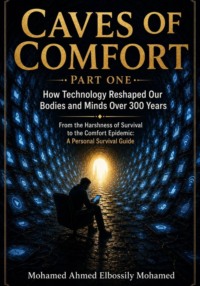
Read the book: «Caves of Comfort: Part One»
Caves of Comfort Part One English
Caves of Comfort — Part One
How Technology Reshaped Our Bodies and Minds Over 300 Years
From the Harshness of Survival to the Comfort Epidemic: A Personal Survival Guide
Mohamed Ahmed Elbossily Mohamed
Opening Quote
We are not returning to the past in search of a life we wish to restore. We return to it to understand the road that brought us here.
The First Movement
6:23 a.m.
Before your feet touch the floor, before you hear your own voice, before the light has fully reached your eyes — your hand reaches for the phone.
It is not entirely a conscious habit. No one sat down one evening and decided that a screen should become their first encounter with a new day.
And yet, that is what it has become.
Before water, before prayer, before feeling the body.
Before you know whether you slept well, whether your back feels rested, or whether your mind needs a moment of quiet, you have already entered a world of notifications, images, news, demands, and noise.
This is not a judgment against the person holding the phone. Nor is it an accusation against an entire generation.
It is a description of an environment in which the screen has become closer, easier, and faster than many of the things with which human beings once began their days.
The Comfort We Longed For
Human beings never dreamed of exhaustion.
The farmer worn down by the land did not wish for more hardship. The mother who lost a child to an infection that could be treated today did not dream of a world with less medicine. The worker forced to carry more than his body could bear did not wish for everything to remain heavy, slow, and dangerous.
The dream was understandable and simple:
Food closer at hand. A warmer home. Stronger treatment. Faster travel. Work that was less cruel.
And humanity achieved an extraordinary part of that dream.
The problem was not that comfort arrived. The problem was that, at some point, comfort stopped being a reward after effort and became the environment in which we live almost all the time.
We sit to work. We sit to eat. We sit to recover from sitting. And we carry with us a screen capable of filling every silent minute before we have the chance to ask ourselves: what would we once have done with that minute?
The Cage That Never Ran Out of Food
Decades ago, the American researcher John Calhoun created a colony of laboratory mice inside a closed environment where essential resources were available and many of the ordinary threats to survival were absent. As time passed, profound behavioural and reproductive disturbances appeared within the colony. [Source]
At first, the scene may sound tempting:
A safe place. Food available. Water available. No predators. No visible hunger.
But the question left behind by the experiment is not only: what happened to the mice?
It is also this:
Is abundance alone enough to make life good?
Here we must be precise.
A human being is not a mouse in a cage. Human societies cannot be explained by a single laboratory experiment. And Universe 25 must not be used as a prophecy claiming that civilisation will collapse simply because we have become more comfortable.
But it can be used as a small intellectual mirror held up to a much larger question:
What happens to a living being when comfort is abundant, while movement declines, relationships are disrupted, and meaning gradually disappears from daily life?
This is not an answer.
It is the beginning of the question.
We Are Not Against Civilization
This book does not ask you to hate the age in which you live.
The past was not a paradise of health. It contained hunger, infection, pain without treatment, early death, and work that sometimes consumed the body before a person had the chance to use their mind or enjoy their life.
Nor is medicine the enemy in this story.
A drug that controls blood pressure is not a deception. An operation that saves a heart is not a sign of moral failure. And a patient who needs long-term treatment is not guilty of anything, nor can their illness be reduced to the claim that they simply “did not try hard enough.”
Medicine is one of humanity’s greatest achievements.
Yet respecting treatment does not prevent us from asking another question:
Has our daily environment begun to push growing numbers of people toward illnesses whose risks can, in part, be reduced — and then make long-term treatment seem so normal that the conditions leading to it no longer deserve examination?
The enemy here is not medicine.
The enemy is forgetting how the problem was shaped in the first place.
More Years… or More Life?
Second Section The Answer Is Not to Die Younger, but to Live Longer — and Better
Between 2000 and 2019, global life expectancy rose from 66.8 to 73.1 years.
That is a genuine human achievement.
During the same period, global healthy life expectancy rose only from 58.1 to 63.5 years. In other words, the years we can expect to live in full health did not increase by the same amount as total years of life. [Source]
Here lies the distinction on which this entire book is built:
Living for more years is a remarkable achievement. But living those years able to move, think clearly, sleep, work, and share life with the people you love matters no less.
We are not choosing between a short, strong life and a long, exhausted one.
The answer is not to die younger, but to live longer — and better.
When Danger Changes Shape
Three centuries ago, many of the dangers facing human beings were visible in front of them.
Bitter cold. Food that was not enough. An infection for which no effective medicine was available. Daily labour that gave the body little permission to stop.
Today, much of the danger enters our lives in a more comfortable form:
A chair that never asks you to rise. Food that does not ask you to wait or exert effort. A screen that leaves the mind no empty moment. A night that can slip later and later, hour after hour, without making you feel that anything dangerous is happening now.
The truth is that none of these things, on its own, explains a person’s illness or determines their fate.
But when total comfort becomes a lasting way of life, it becomes reasonable to ask:
Are our bodies beginning to pay the price of a world designed to protect us from effort?
No Return to the Past
This book will not tell you that you should live as people lived before electricity, antibiotics, or modern transport.
It will not ask you to leave your desk job simply because the human body was not made for an office. Nor will it ask you to reject the phone, medical treatment, available food, or everything that has made life safer and more dignified.
The question is more realistic — and more difficult:
How do we use the gains of civilisation without surrendering our bodies and minds entirely to them?
How do we keep medicine when we need it, without treating preventable or reducible illness as our only possible fate?
How do we live inside the digital world without allowing our attention to become its permanent property?
How do we benefit from comfort without allowing comfort to become a trap?
The Journey Begins
To understand what happened, we will not begin with the phone alone. We will not begin with one chronic illness. And we will not begin with a quick formula for changing a life.
We will go back.
To a world that was not perfectly healthy, and not necessarily more just or more merciful, but one in which danger stood more clearly before the eye.
We will begin in 1726.
Not because history began there. Not because the whole world looked the same in that year. But because it stands three hundred years before our present, before the accelerating transformation that would change the way human beings worked, ate, moved, fell ill, and rested.
That is where the story begins:
1726 — When Danger Was Visible
Why Begin in 1726?
Three hundred years.
A distance that seems short when measured against the age of history, and extraordinarily long when measured by what has changed inside a single human day.
We do not begin in 1726 because the world was one uniform place. People’s lives were not identical across village and city, continent and continent, rich and poor.
Nor do we begin there because human beings before that year were healthier, happier, or wiser. The past was not a golden age; it was filled with hunger, illness, fear, hard labour, and early loss.
And we do not begin there because industry suddenly started in that year.
Industrial transformation was not a button pressed on a single day, nor did it reach every society at the same speed. The common historical account places the start of the Industrial Revolution in Britain during the eighteenth century, while more recent historical research suggests that some shifts in the organisation of work and production in England began much earlier. [Source]
We begin in 1726 for a simpler and clearer reason:
It stands three hundred years away from our present.
From this point, we can watch the journey slowly take shape:
How the body moved because daily life required movement. How the machine entered work, then the home, then time itself. How medicine saved us from dangers that once killed millions, while other dangers began to slip in quietly. And how, in the end, we reached a world in which much of the danger has become comfortable, bright, and easy to use.
We are not returning to 1726 in search of a life we wish to restore.
We return to it to understand the road that brought us here.
A Morning That Begins with the Body
In a home somewhere in the world of 1726, morning opens its eyes before the human being has fully opened his own.
No sound of a phone. No blue light across a sleeping face. No urgent message arriving before its recipient rises from bed.
The absence of a screen does not mean that the day is quieter.
There is water that must be brought. A fire that must be lit or kept alive. Food that will not appear on the table until it has passed through hands, shoulders, and feet. And there is work waiting, without asking whether the body is ready for it.
This is not one documented household, nor an image claiming to represent the entire world. It is an entrance into a wider truth: in many societies before industrial acceleration, movement was not a healthy option added to the day; it was part of how the day itself got done.
In that world, danger was not hidden inside comfort.
It was visible. It could arrive as cold, hunger, infection, a long road, a birth the family feared, or a season that failed to deliver what it promised.
Movement Was Not Exercise
No one left home because they had read that walking was good for the heart.
They walked because distance did not disappear by itself. They carried because things did not move at the press of a button. They bent, lifted, ground, gathered, pushed, cut, and transported because much of what the home, market, or field required was not being performed on the body’s behalf by a silent machine.
Before engines, fossil fuels, and electricity became widespread, many societies depended, to varying degrees and in varying places, on human and animal muscle and on the energy of wind, water, and biomass. [Source]
It would be a mistake to read this scene as a perfect prescription for health.
A body that moves all the time is not necessarily a happy body. Movement may be a strength when a person chooses it, and exhaustion when they have no right to stop.
In 1726, people were not practising a “healthy lifestyle” in the modern sense.
Many of them moved because life did not permit stillness.
The Price of Compelled Movement
The body worked in order for life to remain possible.
Its hands did not work only within set job hours and then return to their owner when a shift ended. The body itself might be transport, lifting equipment, the route by which water reached the home, and part of the work of preparing food, producing heat, and making a living.
Even rest was not a guaranteed right.
A person might rest because the task was finished. Or stop because darkness had fallen. Or stop only because the body could no longer continue.
And this movement carried an obvious price.
An injury to the hand could mean losing the means of earning a living. Pain in the back could remain without effective treatment. The fatigue of the season did not disappear because the body needed a slower day. Hard labour could consume years of a person’s life before it gave them time to feel they had lived them.
We do not look at this world as one long course of healthy training.
We look at it as a world in which the body was intensely present because it directly bore a large part of the burden of life.
The free sample has ended.