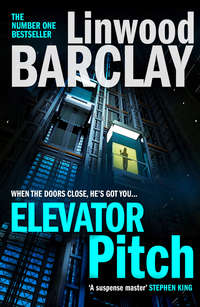
Read the book: «Elevator Pitch»
LINWOOD BARCLAY is an international bestselling crime and thriller author with over twenty critically acclaimed novels to his name, including the phenomenal number one bestseller No Time For Goodbye. Every Linwood Barclay book is a masterclass in characterisation, plot and the killer twist, and with sales of over 7 million copies globally, his books have been sold in more than 39 countries around the world and he can count Stephen King, Shari Lapena and Peter James among his many fans.
Many of his books have been optioned for film and TV, and Linwood wrote the screenplay for the film based on his bestselling novel Never Saw It Coming. He is currently working with eOne to turn the Promise Falls trilogy into a series. Born in the US, his parents moved to Canada just as he was turning four, and he’s lived there ever since. He lives in Toronto with his wife, Neetha. They have two grown children. Visit Linwood Barclay at www.linwoodbarclay.com or find him on Twitter at @linwood_barclay.
Also by Linwood Barclay
A Noise Downstairs
Parting Shot
The Twenty-Three
Far from True
Broken Promise
No Safe House
A Tap on the Window
Never Saw It Coming
Trust Your Eyes
The Accident
Never Look Away
Fear the Worst
Too Close to Home
No Time for Goodbye
Bad Luck
Bad News
Bad Guys
Bad Move
Elevator Pitch
Linwood Barclay

ONE PLACE. MANY STORIES
Copyright
An imprint of HarperCollins Publishers Ltd
1 London Bridge Street
London SE1 9GF
First published in Great Britain by HQ in 2019
Copyright © Linwood Barclay 2019
Linwood Barclay asserts the moral right to be identified as the author of this work.
A catalogue record for this book is available from the British Library.
This novel is entirely a work of fiction. The names, characters and incidents portrayed in it are the work of the author’s imagination. Any resemblance to actual persons, living or dead, events or localities is entirely coincidental.
All rights reserved under International and Pan-American Copyright Conventions. By payment of the required fees, you have been granted the non-exclusive, non-transferable right to access and read the text of this e-book on-screen. No part of this text may be reproduced, transmitted, downloaded, decompiled, reverse engineered, or stored in or introduced into any information storage and retrieval system, in any form or by any means, whether electronic or mechanical, now known or hereinafter invented, without the express written permission of HarperCollins.
Ebook Edition © September 2019 ISBN: 978-0-008-33201-3
Note to Readers
This ebook contains the following accessibility features which, if supported by your device, can be accessed via your ereader/accessibility settings:
Change of font size and line height
Change of background and font colours
Change of font
Change justification
Text to speech
Page numbers taken from the following print edition: ISBN 9780008332006
Contents
Cover
About the Author
Booklist
Title Page
Copyright
Note to Readers
Monday
Prologue
One
Two
Three
Four
Five
Six
Seven
Eight
Nine
Ten
Tuesday
Eleven
Twelve
Thirteen
Fourteen
Fifteen
Sixteen
Seventeen
Eighteen
Nineteen
Twenty
Twenty-One
Twenty-Two
Twenty-Three
Twenty-Four
Twenty-Five
Twenty-Six
Twenty-Seven
Twenty-Eight
Twenty-Nine
Thirty
Thirty-One
Thirty-Two
Thirty-Three
Thirty-Four
Wednesday
Thirty-Five
Thirty-Six
Thirty-Seven
Thirty-Eight
Thirty-Nine
Forty
Forty-One
Forty-Two
Forty-Three
Forty-Four
Forty-Five
Forty-Six
Forty-Seven
Forty-Eight
Forty-Nine
Fifty
Fifty-One
Fifty-Two
Fifty-Three
Fifty-Four
Fifty-Five
Thursday
Fifty-Six
Fifty-Seven
Fifty-Eight
Fifty-Nine
Sixty
Sixty-One
Sixty-Two
Sixty-Three
Sixty-Four
Sixty-Five
Sixty-Six
Sixty-Seven
Sixty-Eight
Sixty-Nine
Seventy
Seventy-One
Seventy-Two
Seventy-Three
Seventy-Four
Seventy-Five
Seventy-Six
Friday
Seventy-Seven
Acknowledgments
About the Publisher
MONDAY
Prologue
Stuart Bland figured if he posted himself close to the elevators, there was no way he could miss Sherry D’Agostino.
He knew she arrived at the offices of Cromwell Entertainment, which were on the thirty-third floor of the Lansing Tower, on Third between Fifty-Ninth and Sixtieth, every morning between 8:30 and 8:45. A car was sent to her Brooklyn Heights address each day to bring her here. No taxi or subway for Sherry D’Agostino, Cromwell’s vice president of creative.
Stuart glanced about nervously. A FedEx ID tag he’d swiped a couple of years ago when he worked at a dry cleaner got him past security. That, and the FedEx cardboard envelope he was clutching, and the FedEx shirt and ball cap he had bought online. He kept the visor low on his forehead. There was every reason to believe the security desk had been handed his mug shot and been advised to keep an eye out for him. D’Agostino—no relation to the New York grocery chain—knew his name, and it’d be easy enough to grab a picture of him off his Facebook page.
But in all truth, he was on a delivery. Tucked into the envelope was his script, Clock Man.
He wouldn’t have had to take these extra steps if he hadn’t overplayed his hand, going to Sherry D’Agostino’s home, knocking on the door, ringing the bell repeatedly until some little girl, no more than five years old, answered and he stepped right past her into the house. Then Sherry showed up and screamed at him to get away from her daughter and out of the house or she’d call the police.
A stalker, she called him. That stung.
Okay, maybe he could have handled that better. Stepping into the house, okay, that was a mistake. But she had no one to blame but herself. If she’d accepted even one of his phone calls, just one, so that he could pitch his idea to her, tell her about his script, he wouldn’t have had to go to her house, would he? She had no idea how hard he’d been working on this. No idea that ten months earlier he’d quit his job making pizzas—unlike the dry-cleaning gig, leaving the pizza place was his own decision—to work full-time on getting his script just perfect. The way he figured it, time was running out. He was thirty-eight years old. If he was to make it as a screenwriter, he had to commit now.
But the whole system was so terribly unfair. Why shouldn’t someone like him be able to get a five-minute audience with her, make his pitch? Why should it only be established writers, those assholes in Hollywood with their fancy cars and big swimming pools and agents with Beverly Hills zip codes. Who said their ideas were any better than his?
So he watched her for a couple of days to learn her routine. That was how he knew she’d be getting into one of these four elevators in the next few minutes. In fact, it would be one of two elevators. The two on the left stopped at floors one through twenty, the two on the right served floors twenty-one through forty.
He leaned up against the marble wall opposite the elevators, head down, trying to look inconspicuous, but always watching. There was a steady flow of people, and it’d be easy for Sherry to get lost in the crowd. But the good thing was, she liked bright colors. Yellows, pinks, turquoise. Never black or dark blue. She stood out. And she was blond, her hair puffed up the way some women do it, like she went at it with a bicycle pump in the morning. She could be standing in a hurricane, have every stitch of clothing blown off her, but there wouldn’t be one hair out of place. As long as Stuart kept a sharp lookout, he was pretty sure he wouldn’t miss her. Soon as she got on the elevator, he’d step on with her.
Shit, there she was.
Striding across the lobby, those heels adding about three inches to her height. Stuart figured she was no more than five-two in her stocking feet, but even as small as she was, she had a presence. Chin up, eyes forward. Stuart had checked her out on IMDb, so he knew she was nearly forty. Looked good. Just a year or two older than he was. Imagine walking into Gramercy Tavern with her on his arm.
Yeah, like that was gonna happen.
According to what he’d read online, she’d started in television as a script supervisor in her early twenties and quickly worked her way up. Did a stint at HBO, then Showtime, then got lured away by Cromwell to develop new projects. The way Stuart saw it, she was his ticket to industry-wide acclaim as a hot new screenwriter.
Sherry D’Agostino stood between the two right-hand elevators. There were two other people waiting. A man, sixtyish, in a dark gray suit, your typical Business Guy, and a woman, early twenties, wearing sneakers she’d no doubt change out of once she got to her desk. Secretary, Stuart figured. There was something anonymous and worker bee about Sneaker Girl. He came up behind the three of them, waiting to step into whichever elevator came first. He glanced up at the numbers. A tiny digital readout above each elevator indicated its position. The one on the right was at forty-eight, the one on the left at thirty-one, then thirty.
Going down.
Sherry and the other two shifted slightly to the left set of doors, leaving room for those who would be getting off.
The doors parted and five people disembarked. Once they were out of the way, Sherry, Business Guy, Sneaker Girl, and Stuart got on. Stuart managed to spin around behind Sherry as everyone turned to face front.
The elevator doors closed.
Sherry pressed “33,” Sneaker Girl “34,” and the Business Guy “37.”
When Stuart did not reach over to press one of the many buttons, the man, who was standing closest to the panel, glanced his way, silently offering to press a button for him.
“I’m good,” he said.
The elevator silently began its ascent. Sherry and the other woman looked up to catch the latest news. The elevator was fitted with a small video screen that ran a kind of chyron, a line of headlines moving from right to left.
New York forecast high 64 low 51 mostly sunny.
Stuart moved forward half a step so he was almost rubbing shoulders with Sherry. “How are you today, Ms. D’Agostino?”
She turned her head from reading the screen and said, “Fine, thank—”
And then she saw who he was. Her eyes flickered with fear. Her body leaned away from him, but her feet were rooted to the same spot in the elevator floor.
Stuart held out the FedEx package. “I wanted to give you this. That’s all. I just want you to have it.”
“I told you to stay away from me,” she said, not accepting it.
The man and woman turned their heads.
“It’s cool,” Stuart said, smiling at them. “Everything’s fine.” He kept holding out the package to Sherry. “Take it. You’ll love it.”
“I’m sorry, you have to—”
“Okay, okay, wait. Let me just tell you about it, then. Once you hear what it’s about, I guarantee you’ll want to read it.”
The elevator made a soft whirring noise as it sped past the first twenty floors.
Sherry glanced at the numbers flashing by on the display above the door, then up to the news line. Latest unemployment figures show rate fell 0.2 percent last month. She sighed, her resistance fading.
“You’ve got fifteen seconds,” she said. “If you follow me off, I’ll call security.”
Stuart beamed. “Okay! Right. So you’ve got this guy, he’s like, thirty, and he works—”
“Ten seconds,” she said. “Sum it up in one sentence.”
Stuart suddenly looked panicked. He blinked a couple of times, his mind racing to encapsulate his brilliant script into a phrase, to distill it to its essence.
“Um,” he said.
“Five seconds,” Sherry said, the elevator almost to the thirty-third floor.
“Guy works at a factory that makes clocks but one of them is actually a time machine!” he blurted. He let out a long breath, then took one in.
“That’s it?” she said.
“No!” he said. “There’s more! But to try to explain it in—”
“What the hell?” Sherry said, but not to him.
The elevator had not stopped at her floor. It shot right past thirty-three, and then glided right on by thirty-four.
“Crap,” said Sneaker Girl. “That’s me.”
The two women both reached out to the panel at the same time to press the button for their floors again, their fingers engaged in a brief bit of fencing.
“Sorry,” said Sherry, who’d managed to hit the button for her floor first. She edged out of the way.
US militant group Flyovers prime suspect in Seattle coffee shop bombing that killed two.
As the elevator continued its ascent, Business Guy grimaced and said, “Guess I’ll join the club.” He put his index finger to the “37” button.
“Someone at the top must have pushed for it,” Sneaker Girl said. “It’s going all the way up first.”
She turned out to be right. The elevator did not stop until it reached the fortieth floor.
But the doors did not open.
“God, I fucking hate elevators,” she said.
Stuart did not share her distress. He grinned. The elevator malfunction had bought him a few extra seconds to make his pitch to Sherry. “I know time travel has been done a lot, but this scenario is different. My hero, he doesn’t go way into the past or way into the future. He can only go five minutes one way or the other, so—”
Business Guy said, “I’ll walk back down.” He pressed the button to open the doors, but there was no response.
“Jesus,” he muttered.
Sherry said, “We should call someone.” She pointed to the button marked with the symbol of a phone.
“It’s only been a few seconds,” Stuart said. “It’ll probably sort itself out after a minute or so and—”
With a slight jolt, the elevator started moving again.
“Finally,” Sneaker Girl said.
Storm hitting UK approaching hurricane status.
“The interesting angle is,” Stuart said, persisting, “if he can only go five minutes into the past or five minutes into the future, how does he use that? Is it a kind of superpower? What kind of advantages could that give someone?”
Sherry glanced at him dismissively. “I’d have gotten on this elevator five minutes before you showed up.”
Stuart bristled at that. “You don’t have to insult me.”
“Son of a bitch,” the man said.
The descending elevator had gone past his floor. He jabbed at “37” again, more angrily this time.
The elevator sailed past the floors for the two women as well, but stopped at twenty-nine.
“Aw, come on,” Business Guy said. “This is ridiculous.” He pressed the phone button. He waited a moment, expecting a response. “Hello?” he said. “Anyone there? Hello?”
“This is freaking me out,” Sneaker Girl said, taking a cell phone from her purse. She tapped the screen, put the phone to her ear. “Yeah, hey, Steve? It’s Paula. I’m gonna be late. I’m stuck in the fucking eleva—”
There was a loud noise from above, as though the world’s largest rubber band had snapped. The elevator trembled for a second. Everyone looked up, stunned. Even Stuart, who had stopped trying to sell his idea to Sherry D’Agostino.
“Fuck!” said Sneaker Girl.
“What the hell was that?” Sherry asked.
Almost instinctively, everyone started backing up toward the walls of the elevator, leaving the center floor area open. They gripped the waist-high brass handrails.
“It’s probably nothing,” Stuart said. “A glitch, that’s all.”
“Hello?” Business Guy said again. “Is anybody there, for Christ’s sake? This elevator’s gone nuts!”
Sherry spotted the alarm button and pressed it. There was only silence.
“Shouldn’t we be hearing that?” she asked.
The man said, “Maybe it rings someplace else, you know, so someone will come. Down at the security desk, probably.”
For several seconds, no one said anything. It was dead silent in the elevator. Everyone took a few calming breaths.
Average US life expectancy now nearly 80.
Stuart spoke first. “Someone’ll be along.” He nodded with false confidence and gave Sherry a nervous smile. “Maybe this is what I should be writing a—”
The elevator began to plunge.
Within seconds it was going much faster than it was designed to go.
Stuart and Sherry and the two others felt their feet lifting off the floor.
The elevator was in free fall.
Until it hit bottom.
One
Barbara Matheson was impressed by the size of the crowd. The usual suspects, more or less, but the fact that they’d turned out meant her story had made an impression.
This was a TV event, really. Get the mayor walking out of City Hall, lob a few questions his way, get video of him denying everything. The Times, the Daily News, the Post could all write their stories without being here. But NY1 and the local ABC, CBS, and NBC affiliates had crews waiting for Richard Wilson Headley to show. He might try sneaking out a back way, or leaving in a limo with windows so deeply tinted you wouldn’t know whether he was inside or not. But then the evening newscasts would say he made a point of avoiding the media, imply that he was a coward, and Headley never wanted to come across as a coward.
Even if he could be one at times.
Barbara was here on the off chance that something might actually happen. And yes, she was enjoying the shit she’d stirred up. This show of media force was her doing. She’d broken the story. Maybe Headley would take a swing at somebody who put a camera in his face, although that seemed unlikely. He was too smart for that. The TV stations were here for a comment, but she’d already gotten one and put it in her column.
“That’s a load of fucking horseshit,” Headley had said when Barbara ran the allegations past him. Her editors at Manhattan Today printed the response without asterisks to disguise the profanity, but that was hardly daring these days. The Times still avoided curse words except in the most extreme cases, but even The New Yorker, that staid institution, didn’t blink an eye about f-bombs and hadn’t for years.
“You really put his dick into the blender this time.”
She turned. It was Matt Timmins, instantly recognizable by his multidirectional black hair and glasses thick enough to see life on Mars. He worked for an online site that covered city issues, but she knew him back when he worked for NBC, before he got laid off. He had a phone in hand, waiting to take video, which would be good enough for the political blog he wrote.
“Hey, Matt,” Barbara said.
“Wearin’ Kevlar?”
Barbara shrugged. She liked Matt, vaguely remembered sleeping with him nearly ten years ago when they were both in their early thirties. The local press had been camped out in front of the house of a congressman in the midst of a bribery scandal. Barbara and Matt had shared a car to keep warm while waiting for the feds to arrive and walk the politician out the front door. After, they went to a bar, had too much to drink, and went back to his place. It was all a bit foggy. Barbara was pretty sure Matt was married now, with a kid, maybe two.
“Headley won’t shoot me,” she said. “He might hire someone to shoot me, but he wouldn’t do it himself.”
A woman with a mike in one hand looked up from the phone in her other. She’d been reading a text. “Dickhead’s on the move,” she said to the cameraman standing beside her, loud enough that it created a low-level buzz among the collected media. The mayor was on his way.
Of course, Mayor Richard Wilson Headley always went by “Richard,” sometimes “Rich,” but never “Dick.” But that didn’t stop his detractors from referring to him that way. One of the tabs, which had it in for him nearly as much as Manhattan Today did, liked to stack DICK over HEADLEY on the front as often as it could, usually with as unflattering picture as they could find of the man. They also took delight in headlines that coupled GOOD with HEADLEY.
Headley knew it was a losing battle, so sometimes he’d embrace the word so often used against him, particularly when it came to the city’s various unions. “Am I going to be a total dick with them on this new contract?” he asked the other day. “You bet your ass I am.”
“Here we go,” someone said.
The mayor, accompanied by Glover Headley, his twenty-five-year-old son and adviser, communications strategist Valerie Langdon, and a tall, bald man Barbara did not think she’d seen before, was coming out the front door of City Hall and heading down the broad steps toward a waiting limo. The media throng moved toward him, and everyone stopped halfway, allowing Headley a makeshift pulpit, standing two steps above everyone else.
But it was Glover who spoke. “Hey, guys, we’re on our way to the mansion, no time for questions at this—”
Headley shot his son a disapproving look and raised a hand. “No, no. I’m more than happy to take a few.”
Barbara, hanging at the back of the pack, smiled inwardly. Standard operating procedure for Headley. Overrule your aides; don’t hide behind them. Act like you want to talk to the press. The whole thing would have been rehearsed earlier. Valerie touched the mayor’s arm, as though asking him to think twice about this. He shook it off.
Nice touch, Barbara thought.
Even though the bald guy was standing back of the mayor and trying to be invisible, Barbara was sizing him up. Trim, over six feet, skin the color of caramel. Of the three men standing before the assembled media, this guy had the most style. Long dress coat over his suit, leather gloves even though it wasn’t that cold out. Looked like he’d stepped off the cover of GQ.
A looker.
She thought of the people she knew in City Hall, the ones who regularly fed her information. Maybe one of them could tell her who this guy was, what the mayor had hired him to do.
Then again, she could just go up and introduce herself, ask him who he was. But that would have to wait. NY1’s correspondent, a man Barbara knew to be in his fifties but could pass for midthirties, led things off.
“How do you respond to allegations that you strong-armed the works department to hire an independent construction firm owned by one of your largest political donors for major subway upgrades?”
Headley shook his head sadly and smirked, like he’d heard this a hundred times before.
“There is absolutely nothing to that allegation,” he said. “It’s pure fiction. Contracts are awarded based on a long list of factors. Track record—no pun intended—and ability to get the work done, cost considerations, and—”
The NY1 guy wasn’t done. “But yesterday Manhattan Today printed an email in which you told the department to hire Steelways, which is owned by Arnett Steel, who organized large fund-raisers for your—”
Headley raised a shushing hand. “Now hold on, right there. First of all, the veracity of that email has not been determined.”
Barbara closed her eyes briefly so no one would have to see them roll.
“I would not put it past Manhattan Today to manufacture something like that. But even if it turns out to be legitimate, the content of that message hardly qualifies as a directive. It’s more along the lines of a suggestion.”
In her head, Barbara composed her next piece.
“Headley alleges the email uncovered by Manhattan Today could be phony, but just to cover all his bases, says that if it turns out to be the real deal, it’s not that much of one.”
In other words, suck and blow at the same time.
“Everyone knows that Manhattan Today has an obsession with me,” Headley said, waving an accusing finger in Barbara’s general direction.
He’s spotted me, she thought. Or one of his aides alerted him that she was there.
Headley’s voice ramped up. “It’s been involved in a relentless smear campaign from day one. And that campaign has been led by one person, but I won’t give her the satisfaction of repeating her name before the cameras.”
“You mean Barbara Matheson?” shouted the reporter from the CBS affiliate.
Headley grimaced. He’d walked into that one, Barbara thought.
“You know who I’m talking about,” he said evenly. “But even though this vendetta is being led by a single individual, I have to assume this kind of character assassination is approved from the top. Maybe the opinions of this journalist, and I use the term loosely, are slanted the way they are because of direction from upstairs.”
Barbara yawned.
“That’s why I’m announcing today that I will be filing a defamation suit against Manhattan Today.”
Oh, goodie.
Textbook Headley. Threaten a lawsuit but never actually file. Act outraged, grab a headline. Headley had threatened to sue every news outlet in the city at some point. He’d used the same tactics back when he was in business, before he embarked on a political career.
“Furthermore,” he said, “I—”
Headley noticed Valerie waving her phone in front of Glover, who winced when he read what was on her screen. The mayor leaned her way as she turned the phone so he could see it. While he was reading the message, there was a stirring in the crowd as some received messages of their own. The NY1 guy and his cameraman were already on the move.
“Sorry,” Headley said. “We’re going to have to cut this short. You’re probably getting the same news I am.”
With that he continued on down the steps, Valerie, Glover, and the bald man trailing him. They all got into the back of the waiting limo, which was only steps away from Barbara. But she had her eyes on her phone, attempting to learn what it was everyone else already seemed to know. She was vaguely aware of the whirring sound of a car window powering down.
“Barbara.”
She looked up from her phone, saw Glover at the limo window.
“The mayor would like to give you a ride uptown,” he said.
Her mouth suddenly went very dry. She glanced quickly to both sides, wondering if anyone else was witnessing the offer. Matt, to her left, was smiling.
“I’ll always remember you,” he said.
Barbara, having made her decision, sighed. “How kind,” she said to Glover.
She made as though she was turning off her phone, but set it to record before dropping it into her purse.
Glover pushed open the door, stepped out, let Barbara in, then got back in beside her. The limo was already pulling away as he pulled the door shut.
Two
The stairwell on West Twenty-Ninth Street that led up to the High Line, just west of Tenth Avenue, was blocked off with police tape, a uniformed NYPD patrolman standing guard.
Detective Jerry Bourque parked his unmarked cruiser directly under the elevated, linear park that at one time had been a spur of the New York Central Railroad. He got out of his car and looked up. The viaduct was only about one and a half miles long, but it attracted millions of people—locals and tourists—annually. Lined with gardens and benches and interesting architectural features, it had quickly become one of Bourque’s favorite spots in the city. It cut through the heart of lower Manhattan’s West Side, yet was a ribbonlike oasis away from the noise and chaos. When it first opened, Bourque jogged it.
Not so much these days.
There were half a dozen marked NYPD cars, some with lights flashing, cluttering the street. As Bourque approached the stairwell entrance he recognized the patrolman standing there.
“Hey,” Bourque said.
“They’re expecting you,” the officer said, and lifted the tape.
Bourque still had to duck, and the tape brushed across his short, bristly, prematurely gray hair. He was a round-shouldered six foot three. When circumstances demanded he stand up straight, he pushed six-five. He started up the stairs. Halfway, he paused for several seconds, a slight wave of anxiety washing over him. It was still hanging in there, this sense of unease before he reached the scene of a homicide. It hadn’t always been this way. He reached into his pocket, feeling for something familiar, something reassuring, and upon finding it, he carried on the rest of the way to the top.
When he reached the High Line walkway, he looked left, to the north. The path veered slightly to the west, where the High Line crossed West Twenty-Ninth Street. A gently curved bench hugged the walkway on the left side, with a narrow band of greenery between the back and the edge.
This was where everyone—police, the coroner, High Line officials—were clustered.
Bourque walked on with a steady pace, his head extending slightly ahead of his body, as though tracking a scent. There was no need to run. The subject would still be dead when he got there. Bourque had turned forty only three months earlier, but his creased and weathered face would have allowed him to pass as someone five or ten years older. A woman had once told him he reminded her of those trees that grow out of the rocks up in Newfoundland. The relentless winds from the ocean caused them to lean permanently to one side, the branches all going in one direction. Bourque, the woman said, looked like someone who’d been worn down by the wind.
As he got closer, another detective, Lois Delgado, saw him and approached. Seeing her, his anxiety receded some. They were more than partners. They were friends, and if there was anyone Bourque trusted more than Delgado, he couldn’t think who it might be.
And yet, he didn’t tell her everything.
She had an oval face, the way she let a curl of her short dark hair fall across her upper left cheek where she had a port-wine stain about the size of a quarter. Bourque understood why she tried to disguise it, but he found it one of her most beautiful features. She pulled her hair back on the right side, usually tucking it behind her ear, giving her face a kind of lopsided quality. She was a year older than Bourque, but unlike him she could have passed for someone younger.
“Well?” he said.
“Dead male,” she said. “No ID on the body. If I had to guess, late forties, early fifties. Early-morning jogger noticed something behind the corner of the bench that turned out to be a foot.”
Bourque looked around. The High Line wound among countless apartment buildings. “Somebody must have seen something,” he said.
“Yeah, well, that part of the bench is up against a nearly windowless wall on the left, and an open area on the right, and then there’s the rink just up there, so …”
Delgado shrugged, then continued. “Had to have happened in the middle of the night when there was no one going by. Tons of pedestrian traffic up here through the day. Thousands of people walk along here.”
“High Line closes at what, ten or eleven?”
“Yeah,” Delgado said. “They roll down the gates at all the access points then. Opens up again at seven in the morning. Wasn’t long after that that the body was discovered. You couldn’t do this to someone during the open hours.”
Bourque gave her a look. “Do what?”
“Easier if you just come and see for yourself,” she said.
Bourque took a breath.
I’m fine.
As they approached the bench, he saw the dirty white rubber sole of the shoe the jogger had spotted.
“We think he got dragged into the tall grasses and that was where it happened,” Delgado said, pointing to all the vegetation at the edges of the walkway that made it such a popular place for people to stroll. “I guess, just before they close the High Line and security does its walkthrough, someone could hide in the grass and not be seen.”
A couple of other officers made some room for the two detectives, who stepped off the main part of the path and into the greenery at the left edge. Bourque knelt down close to the body.
“Jesus,” he said.
“Yeah,” said Delgado.
“Did a real number on the face.”
“Hamburger,” Delgado said.
“Yeah,” Bourque said, feeling a tightening in his chest.
“Check the fingers. At least, what’s left of them.”
Bourque looked. “Fuck me.”
The fingertips on both hands were missing.
“All cut off,” Bourque said. “What would you need for that? Small pruning shears? The kind you use in the garden? Who walks around with one of those, unless it’s one of the people who maintains this area.”
“Don’t think he used pruners,” Delgado said. She parted some grass to reveal a rusted ribbon of steel, one of the original tracks when the High Line was used to bring rail cars into the heart of the city. “See the blood?”
Bourque slowly nodded. “He holds the guy’s fingers over the rail, using it like a cutting board. Could have done it with a regular pocket knife, although he’d have had to press hard to get through bone.”
“Our guy would have to have been dead by then, Jer,” Delgado said.
“Would make it a tad easier,” Bourque said. He paused to take a breath. “You cut the ends off ten fingers, you’re going to get some objections if your guy is alive.”
They looked back from the bloody rail to the body.
“Why?” Delgado asked.
“Hmm?”
“I’ve seen a finger get cut off as a way of getting someone’s attention, of making them talk, of punishing them, but why cut ’em all off after he’s dead?”
“Identi—”
“Of course,” Delgado said. “So we can’t take fingerprints. And the smashed-in face keeps us from knowing who he is.”
“Maybe the killer’s never heard of DNA,” Bourque said, pausing to take another breath.
“You okay?” Lois asked. “You comin’ down with something?”
He shook his head.
Delgado said, “DNA takes time. Maybe whoever did this wants to slow us down. Or maybe our guy here isn’t in the database.”
“Could be.”
“Why not just cut off the hands? Why all the fingers? Why ten cuts instead of two?”
Bourque thought about that. “If he just had a simple knife, cutting through fingers was easier than sawing through wrists.”
Delgado nodded. “Yeah.”
Bourque raised his head over the top of the bench and looked down the walkway. “You walk off with ten fingertips, maybe you leave a blood trail.”
“It rained around five this morning,” Delgado said.
He sighed, looked at the body again. He took out his phone and started taking pictures. His gaze wandered farther down the body. The man’s tan khakis had inched up one leg far enough to reveal his socks.
“Check it out,” Bourque said, his voice barely above a whisper.
They were novelty socks, imprinted with several images of the shark from Jaws.
“Daaa-duh, daaa-duh,” Delgado said.
Bourque took some close-up shots.
“I’ve seen those for sale somewhere,” he said.
“Lotta places sell novelty socks these days,” Delgado said.
They both stood. Bourque gazed along the High Line, first to the north, then the south. “So if this happened after hours, and this is all locked up, how’d our killer get away?”
Delgado said, “Before you got here, I walked a block in each direction. One or two places, if you were really brave, you could jump onto a nearby roof. There’s some rooftop parking up that way. Get onto a roof, or a fire escape, work your way down.”
“Like Bruce Willis in Die Hard,” Bourque said. The words came out in a whisper.
“What?”
Bourque repeated himself, louder this time.
“Yeah, could be done,” Delgado said. “If you’re in good shape.”
Bourque coughed, cleared his throat. “I don’t ever remember a murder on the High Line. Nothing bad happens up here.”
Delgado said, “It’s lost its cherry.”
Bourque put a hand to his chest, indicating he had a call or a text coming in. “Give me a sec,” he said.
He took the phone from his pocket, glanced at it, put it to his ear as he came out from behind the bench and walked a few yards up the High Line, still within the area that was taped off, but free of police or any other city officials.
Bourque nodded a couple of times as he walked, as though responding to whatever his caller was saying. But there’d been no call, and no text.
And Bourque was not talking. He was wheezing. His windpipe had started constricting at the sight of those fingers with the missing tips.
When he felt confident he was far enough away from the murder scene to not be seen, he reached back into his pocket for that familiar object.
He brought out the inhaler, inserted it into his mouth, and inhaled deeply as he depressed the top of the tiny canister. A barely de-tectible puff of medicine entered his lungs. He held his breath nearly fifteen seconds, exhaled, and repeated the process.
Bourque tucked the inhaler back into his pocket. He took a few breaths through his nose, waiting for his air passages to open up again.
He turned around and walked back to have another look at the man with no fingertips.
Three
Barbara sank into a leather seat opposite the mayor and Valerie. Glover and the good-looking bald guy made space for her in the middle, so her feet had to straddle the driveshaft hump. Even though the car was roomier than most, she found her shoulders squeezed by the two men. She was picking up a cheap aftershave scent from Glover. But the bald guy was giving off something subtler, an almost coffee-like scent. Barbara wondered whether it was an actual cologne, or if he’d been in the Starbucks line for too long. Either way, she kind of liked it.
She turned her head to face the bald man. “You’re new.”
He smiled.
“I’m Barbara Matheson, but I’m guessing you know that.” When he didn’t say anything, she looked at Headley. “Does he talk? Stomp his foot once for yes, two for no?”
“That’s Chris Vallins,” Valerie said. “Say hello, Chris.”
“Hello,” said Chris. Deep voice. If brown velvet could make a sound, Barbara thought, this would be it. “Nice to meet you.” He snaked a gloved hand around in the tight quarters and offered it.
“A pleasure,” Barbara said, shaking it. “And what do you do for His Holiness?”
“Part of the team,” he said. “Whatever the mayor needs.”
Barbara didn’t see her new friend Chris as much of a chatterer, so she turned her attention back to those sitting across from her. She wondered whether to make anything of the fact that Valerie was sitting next to the mayor. There was a foot of space between them, but Barbara tried to read the body language. If Valerie found her boss as unappealing as Barbara believed she should, she’d be pressing herself up against the door. But there was a slight shoulder lean toward Headley.
Maybe she was reading too much into it. And what did it matter, anyway? If Headley wanted to screw the help, and the help was okay with it, then what business was it of Barbara’s? Valerie was a grown woman capable of making an informed choice. Surely she had to know the mayor’s background, what a shit he reportedly had been to his late wife, Felicia. Everyone knew that, ten years earlier, the night Felicia died in their uptown brownstone after a long fight with cancer, Headley was fucking the brains out of one of her caretakers in a room at the Plaza. It was a young Glover who called 911 to report that his mother had stopped breathing.
Headley was already one of the most famous, if not most notorious, businessmen in the city, so when the media picked up an emergency call at his address, a couple of TV vans were dispatched to the scene. What ended up on the news was a shot of a weeping Glover, his father nowhere to be seen and not reachable by phone. Headley claimed later he had muted his cell because he’d been meeting with a possible investor whose name he was not at liberty to reveal. No one believed it for a second.
Barbara had wondered if that was when Headley’s relationship with his son had soured. The boy had humiliated him. Unwittingly, of course, but that was what he’d done. Headley had been on the cusp of a mayoral bid way back then but delayed it, hoping that as time passed his reputation would be rehabilitated. When he finally did announce his candidacy, he had created a myth about himself as the sad widower who had raised his teenage son on his own.
Felicia had been a looker in her day, a onetime model who worked her way up to a senior editor position at Condé Nast. Valerie had some of Felicia’s attributes, at least those the mayor valued. In her late thirties, she was younger than him by more than a decade. Long legs, busty enough without being too obvious about it, dark, shoulderlength hair. Probably bought all her clothes at Saks, went to some trendy salon like Fringe or Pickthorn to get her hair done. Unlike Barbara, whose salon was the bathroom sink, did quite well pulling together a wardrobe at Target, and whose makeup budget was a pittance compared to what she spent on pinot grigio.
More than once, at political events, when Valerie was looking the other way, Barbara had observed the mayor checking out his communication director’s ass as if it harbored some mystical secret. Not that hers was the only one.
But now, in the back of this limo, Headley had a very different expression on his face as he sized up Barbara. He was scowling at her, like she was a teenage daughter who’d ignored curfew for the fifth night in a row.
“So what’s happened uptown?” Barbara asked, looking out the window. The driver had found his way from City Hall to the FDR and was making good time heading north.
Beside her, Glover said, “Some kind of elevator accident.”
Barbara was underwhelmed. Elevator accident, crane collapse, subway fire. Whatever. It was always something in a city this big. It’d be news if something didn’t happen. If Headley felt a need to attend, it had to be more serious than usual, but still. Headley liked being seen at catastrophes. Say a few things for the evening news, give the impression he knew what he was talking about, show his concern.
Barbara was willing to cut him some slack on this. It was something all mayors did, if they were smart. A mayor who couldn’t be bothered to show up when New Yorkers endured something particularly tragic would be pilloried. Rudy Giuliani had set the standard, way back on September 11, 2001, as he walked through the rubble, holding a handkerchief to his mouth. Say what you wanted about the guy’s shenanigans since, you had to give him credit for his service back in the day.
Barbara doubted Headley had it in him to be that kind of mayor. She just hoped he—and the city—would never be tested like that again.
“They’re saying four dead,” Valerie said.
Barbara nodded again. It wasn’t that she didn’t care. But industrial accidents, car crashes, drive-by shootings, apartment fires, these just weren’t her thing. She covered city politics. Let the youngsters chase ambulances. She’d cut her teeth on that kind of stuff, and it was valuable experience, but she’d moved on.
“Nice of you to give me a ride, but this isn’t the way to my place,” Barbara said to Headley, who was still looking at her through narrowed eyes. “So, what? Am I grounded? Being sent to bed without my dinner?”
“Barbara, Barbara, Barbara,” Headley said, looking weary and disappointed at the same time. “When’s it going to stop?”
“What?” Barbara asked. “Your love of quid pro quos or my love of writing about them?”
“You think you can keep poking the bear and never get a scratch,” he said. “You’re not untouchable.”
Untouchable. Interesting choice of word.
“Well, you told everyone you’re suing me and Manhattan Today. So I guess I’m not untouchable. But while we’re on that issue, how’s the suit against the Times for saying you were registered to vote federally in three different districts? And how long’s it been since you threatened to sue that actress who said you had performance anxiety?”
Valerie shot a glance at Barbara but said nothing.
Headley forced a smile. “Well, I think we know which of those accusations was the more ridiculous.” The smile faded. “Anyway, these things take a while to work their way through the courts.”
Barbara settled into the leather seat, taking advantage of the headrest. Don’t let them rattle you, she thought. Sure, there were four of them, not counting the driver, who was getting off at Forty-Second Street and heading crosstown. The one Barbara really wanted to know more about was this Chris dude beside her, who looked like he could get a job playing a Bond villain’s bodyguard if he lost his City Hall gig. Not that that was necessarily a knock against him. He was a handsome piece of work. Was being surrounded supposed to put her on edge? Did they know how much she was actually loving this? If Headley and his gang ignored her, gave no hint of how annoyed they were with her, well, that would be unbearable.
“I honestly don’t know why you seem to have it in for me,” Headley asked. “Why so angry?”
“I’m not angry,” Barbara said. “I just have this thing about hypocrisy.”
“Oh, please,” the mayor said. “Hypocrisy is the fuel that keeps the world running. Let me ask you this. Be honest. Have you ever had a source who did something bad, something worth writing about, worth exposing, but you looked the other way because they had good intel that gave you an even better story? Something that would give you an exclusive? Are you going to sit there and tell me you’ve never done that?”
Barbara said, “There are a lot of considerations when you’re working on a story.”
Headley grinned. “That sounds as evasive as something I would say. We’re really not that different, you and I. It’s all a game, isn’t it? Politics and the media? And it can be great fun, I’m not denying it. But sometimes”—and at this point his face grew stern—“it all starts to get a little annoying.”
“Am I annoying you?” Barbara asked, almost hopefully.
He held his thumb and forefinger apart a fraction of an inch. “Just a titch. But,” he said slowly, “we’d like to give you an opportunity to redeem yourself.”
Barbara eyed him suspiciously. “What’s that supposed to mean?”
Headley glanced at Glover and gave him a subtle nod.
Glover said, “The mayor certainly has his differences with you, but he also recognizes your skills as a journalist, that you are an accomplished writer. And he respects you for that.”
Headley looked out the window, watched the city go by as they traveled north on Third.
“Needless to say,” Glover continued, “the mayor, and the rest of the team here, wish you’d at least occasionally focus on the things that are getting done. This subway story you’ve latched on to, that’s a really positive story. But instead, you’re portraying it in a negative light. The current signal system is based on technology from the 1930s and desperately needs to be overhauled. And then there’s the switchover to electric cars. The mayor wants every city vehicle to be converted to electric power within his first term. Soon you’ll be seeing those little green stickers on the back of every car and truck that’s—”
“Glover, move it along,” Headley said to his son, still looking out the window, an edge of irritation creeping into his voice.
“We’re not announcing anything at the moment,” Glover said, “but in due time it may be in the mayor’s interest to tell his story to a broader audience, so voters have a better sense of who he is. That there’s more to him than two-bit scandals and salacious headlines. That he’s a man who wants to make a difference, but on a broader canvas.”
“Ah,” said Barbara, looking at Headley. “You want to move up the political food chain. After mayor of New York, there’s only governor, or president. Or going on TV endlessly to defend a corrupt president. How do you know someone wants to be the leader of the free world? They suddenly come out with a book, like the world’s been dying to hear their life story. Comes out, sells a few copies, then the primaries come, someone else gets the nomination, and the book ends up on the seventy-five-percent-off table at Barnes & Noble, and even then they can’t unload the copies. In the end, their life story gets pulped.”
Glover waited to see if she was done. When Barbara said nothing more, he continued. “As I was saying, we’re looking for someone who can assist the mayor in telling his story.”
Barbara nodded. “A ghost writer.”
Glover smiled. “My sources tell me you’re no stranger to that kind of work.”
It was true. Over the years, Barbara had ghostwritten three memoirs. One for a Broadway actress, one for a sports hero who’d lost both legs in a car accident, and one for a pop star who was once at the top of the charts but now would be lucky to get a gig singing in a SoHo night club. None of those assignments would have given her a shot at a Pulitzer, but they’d certainly helped pay the bills.
When Barbara failed to confirm or deny what Glover had said, he carried on. “We’ve started speaking to publishers. We’re meeting later with Simon & Schuster. They’re looking for possible writers to work with Da—with the mayor, but we have final approval on that and can make suggestions of our own. We think you’d be a leading candidate.”
“Seriously.”
Headley cleared his throat, turned away from the passing scenery, and looked directly at her. “There’s a feeling that choosing someone who’s had an antagonistic history with me would lend the project considerable credibility. That it wouldn’t be a whitewash.”
“It would be particularly credible if I were working for you at the same time you were suing me.”
Headley grimaced. “I suppose we could let that slide. There’s still enough of a history of animosity, I should think.”
Barbara nodded slowly. “Of course, you’d still have final approval on the manuscript.”
“Well,” said Valerie, weighing in for the first time, “of course, but we’re looking for a fair and balanced portrait. Warts and all. The mayor wants to lay everything out on the table. America’s becoming accustomed to candidates who are less than perfect. If you’re running for office these days, it helps if you’re relatable.”
“Warts and all,” Barbara said slowly. “Are you sure you want to go there?”
“And I haven’t mentioned perhaps the most important thing of all,” Glover said. “You’d be looking at a mid-six-figure fee. With the potential for bonuses should the book stay on the bestseller list for an extended period of time.” He grinned. “Or if anyone ever wanted to turn it into a movie. You know. A biopic. Despite your little speech, it could happen.”
Headley had the decency to blush. Barbara figured even he had to know that was over the top. She poked the inside of her cheek with her tongue. “Golly. That’s something.”
Headley leaned forward, lowered his voice, as if they were the only two in the car. He locked eyes with her and said, “I believe, despite our differences, we could work together.”
Barbara appeared to consider the offer as the mayor leaned back in his seat. “I could probably carve out some time from my Manhattan Today duties.” An eyebrow went up as she looked at the mayor. “Maybe weekends?”
“Oh,” said Glover, who had glanced down for two seconds to read a text on his phone. “Working on this book would be a full-time proposition. At least for the duration of the project, which I think would take the better part of a year. Wouldn’t you agree, Valerie?”
“I would,” she said.
“Jesus.” It was the driver. They all looked forward up Third, through the windshield—Barbara and Glover and Chris had to turn around in their seats—to see the traffic stopped dead at Fifty-Eighth. Police cars blocked any further passage northward. The limo driver snaked the car between some taxis, heading straight for the makeshift barricade of emergency vehicles. He powered down the window as a police officer approached.
“You can’t—”
The driver said, “I got the mayor here.”
The cop leaned forward to peer into the back to be sure, then nodded and waved them through. But it wasn’t possible to go much farther. Emergency vehicles clogged the street.
Glover, waving his phone, said, “Latest is three dead, not four. Elevator dropped at least twenty floors. No word yet on the survivor’s condition.”
Headley nodded solemnly.
“We’ll walk from here, David,” Valerie told the man behind the wheel.
The limo came to a dead stop. The driver jumped out and opened the door on the mayor’s side.
Chris Vallins opened his door and, once out, extended a hand to Barbara to help her out. Her first inclination would have been to refuse. I can get out myself, thank you very much. But some other, perhaps more primal, instinct overruled that inclination, and she accepted the offer. His grip was strong, his arm rigid enough.
“Thank you,” she said.
Vallins nodded.
Glover had gotten out the other side and ran around to Barbara. Quietly, he said, “It was my idea.”
“I’m sorry?”
“About the book. To see if you’d be interested. My father took some convincing. I think you’d be perfect.”
“Keep your friends close and your enemies closer,” Barbara said.
“No, it’s not like that. You’d do a good job.” His voice went even softer. “I’d never admit this to Dad, but I’ve admired your work for a long time.”
She hardly knew what to make of that.
They caught up to the rest of the group as they walked toward the office tower where, it appeared, the accident had occurred.
“Son of a bitch,” Headley said, more to himself than anyone else.
“What?” Valerie asked.
“Morris Lansing’s building,” he said. Valerie looked at her boss blankly, clearly not immediately recognizing the name. “Seriously?” he said.
A CBS camera crew spotted the mayor and zeroed in on him.
“Mr. Mayor!” someone shouted. “Do you know when this elevator was last inspected?”
A camera was in his face. Headley looked appropriately grim.
“Look, I’ve only just arrived, and haven’t been briefed, but I can assure you I’ll be speaking to all the involved parties and bringing all the powers of my office to bear on …”
Barbara slipped through the media throng and headed for the main doors in time to see the paramedics wheel out a gurney with a bloodied woman strapped to it.
“Make way!” one of them shouted, and the crowd scattered so that they could reach the open doors of the waiting ambulance.
The gurney passed within a few feet of Barbara, who got a look first at the woman’s sneakers, and then, as she was hustled past, her face.
Barbara only caught a glimpse of her. Two seconds, tops.
But it was long enough.
“Paula,” Barbara whispered.
The free sample has ended.