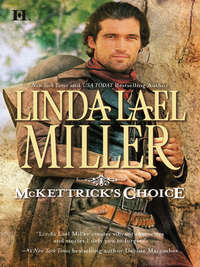
Read the book: «McKettrick's Choice»
Praise for the novels of
LINDA LAEL MILLER
“A passionate love too long denied drives the action in this multifaceted, emotionally rich reunion story that overflows with breathtaking sexual chemistry.”
—Library Journal on McKettricks of Texas: Tate
“As hot as the noontime desert.”
—Publishers Weekly on The Rustler
“This story creates lasting memories of soul-searing redemption and the belief in goodness and hope.”
—RT Book Reviews on The Rustler
“Loaded with hot lead, steamy sex and surprising plot twists.”
—Publishers Weekly on A Wanted Man
“Miller’s prose is smart, and her tough Eastwoodian cowboy cuts a sharp, unexpectedly funny figure in a classroom full of rambunctious frontier kids.”
—Publishers Weekly on The Man from Stone Creek
“[Miller] paints a brilliant portrait of the good, the bad and the ugly, the lost and the lonely, and the power of love to bring light into the darkest of souls. This is western romance at its finest.”
—RT Book Reviews on The Man from Stone Creek
“Sweet, homespun, and touched with angelic Christmas magic, this holiday romance reprises characters from Miller’s popular McKettrick series and is a perfect stocking stuffer for her fans.”
—Library Journal on A McKettrick Christmas
“An engrossing, contemporary western romance.”
—Publishers Weekly on McKettrick’s Pride (starred review)
“Linda Lael Miller creates vibrant characters and stories I defy you to forget.”
—#1 New York Times bestselling author Debbie Macomber
Linda Lael Miller
Mckettrick’s Choice

Dear Reader,
By the time in which this story is set, the proud Comanche tribe had, for all practical intents and purposes, been confined to various reservations. I am convinced, however, that a few ragged bands of renegades still pursued the lost dream of regaining their land and I have included them here, for the sake of the tale itself.

For Jeshua, Stiller of storms
“That’s how the bastards get you—by making you scared. Don’t you ever let anybody or anything do that.”
—Angus McKettrick, patriarch of the
McKettrick family
CONTENTS
CHAPTER 1
CHAPTER 2
CHAPTER 3
CHAPTER 4
CHAPTER 5
CHAPTER 6
CHAPTER 7
CHAPTER 8
CHAPTER 9
CHAPTER 10
CHAPTER 11
CHAPTER 12
CHAPTER 13
CHAPTER 14
CHAPTER 15
CHAPTER 16
CHAPTER 17
CHAPTER 18
CHAPTER 19
CHAPTER 20
CHAPTER 21
CHAPTER 22
CHAPTER 23
CHAPTER 24
CHAPTER 25
CHAPTER 26
CHAPTER 27
CHAPTER 28
CHAPTER 29
CHAPTER 30
CHAPTER 31
CHAPTER 32
CHAPTER 33
CHAPTER 34
CHAPTER 35
CHAPTER 36
CHAPTER 37
CHAPTER 38
EPILOGUE
CHAPTER 1
Arizona Territory, August 12, 1888
HOLT MCKETTRICK hooked a finger under his fancy collar in a vain effort to loosen it a little. Wedding guests milled on the wide, grassy stretch of ground alongside the Triple M ranch house, their finery dappled by shivering patches of shade from the young oaks thriving there. Two fiddlers played a mournful rendition of “Lorena,” and there was a whole hog roasting in the pit Holt’s three half brothers had dug in the ground and lined with flat rocks from the creek. The wedding cake, baked by Holt’s sisters-in-law, was the size of a buckboard, and a long table—an improvised arrangement of planks supported by half a dozen fifty-gallon barrels—wobbled under the weight of a week’s worth of fancy grub.
The old man and the rest of the McKettrick outfit had spared no effort or expense to make the gathering memorable. Holt reckoned he might have enjoyed it as much as the next fellow—if he hadn’t been the bridegroom.
A hand struck his back in jovial greeting, and Holt nearly spilled his cup of fruit punch, generously laced with whiskey from his brother Rafe’s flask, down the front of his dandy suit.
“I reckon that’s the preacher, yonder,” said Holt’s father, Angus McKettrick, nodding toward an approaching rider splashing across the sun-dazzled creek, driving his horse hard. “’Bout time he showed up. I was beginning to think we’d have to send somebody out to the mission to fetch that crippled-up padre.”
Holt swallowed, squinted. Heat prickled the back of his neck. Something stirred in him, a sweet, aching feeling like he got on hot summer nights, when a high-country breeze curled around his brain like a voice calling him back to Texas.
“I reckon,” he muttered. Holt wondered where Rafe had gotten to with that flask, though he didn’t look away from the rider to search the crowd.
The newcomer, his features hidden in the glare of midafternoon light, spurred his horse up the creek bank on the near side, man and mount flinging off diamonds of water as they came.
“Margaret is a fine woman,” Angus said. He had a way of cutting a statement loose without laying any groundwork first.
“Who?” Holt asked, distracted. The skin between his shoulder blades itched, and his chest felt wet beneath the starched cotton of his shirtfront.
“Your bride,” Angus answered, with a note of exasperation. Out of the corner of his eye, Holt saw his father tug at the knot in his string tie. Like as not, his wife, Concepcion, had cinched it tight as a corset ribbon.
The rider gained the edge of the yard and dismounted with the hasty grace of a seasoned cowpuncher, leaving the reins to dangle. He came straight for Holt.
“That ain’t the preacher,” Angus remarked unnecessarily, and with concern. Though he had almost no formal education, the old man read till his eyes gave out, and when he let his grammar slip, it meant he was agitated.
Holt glanced toward the house, where Miss Margaret Tarquin, his bride-to-be, was shut away in an upstairs bedroom getting herself gussied up for the wedding, then went to meet the messenger. The fiddle-playing ground to a shrill halt, and a silence settled over the crowd. Even the kids and the dogs were quiet.
“I’m lookin’ for Holt Cavanagh,” the newly arrived young man announced. His denim trousers were wet with creek water, and he shivered, despite the shimmering heat of that August afternoon. “You’d be him, I reckon?”
Holt nodded in brusque acknowledgment. It didn’t occur to him to explain that he’d set aside the name Cavanagh, once he and the old man had made their blustery peace, and went by McKettrick these days.
Angus stuck close, bristly brows lowered, and Rafe, Kade and Jeb, elusive until then, seemed to materialize out of the rippling mirages haunting the grounds like ghosts. Holt and his brothers had had their differences in the three years they’d been acquainted—still did—but blood was blood. If the rider brought good news, they’d celebrate. If it was bad, they’d do what they could to help. And if there was trouble in the offing, they’d wade right into the fray and ask for the particulars later.
Holt’s affection for them, though sometimes grudging, was in his marrow.
The visitor handed over a slip of paper. “Frank Corrales told me to give you this. He sent you a telegram, and when you didn’t answer, he figured it didn’t go through and told me to hit the trail. I carried that there letter all the way from Texas.”
A shock of alarm surged through Holt, like venom from an invisible snake. He hesitated slightly, then snatched the soggy sheet of brown paper and unfolded it with a snap of his wrist. He felt his father and brothers move a stride closer.
He took in the words in a glance, absorbed the implications, and read them again to make sure he had the right of the situation.
JOHN CAVANAGH ABOUT TO BE DRIVEN OFF HIS LAND.
GABE TO HANG FOR A HORSE THIEF AND A MURDERER ON THE FIRST OF OCTOBER. COME QUICK.
FRANK CORRALES
Holt was still digesting the news when a feminine voice jarred him out of his stupor, and a slender hand came to rest on his coat sleeve. “Holt? Is something wrong?”
Holt started slightly, turned his head to look down into the upturned face of his bride-to-be, resplendent in her lacy finery and gossamer veil. She was a pretty woman, with fair hair and expressive blue eyes, a sent-for wife, imported all the way from Boston. Holt never looked at her without a stab of guilt; Margaret deserved a man who loved her, not one who wanted a mother for his young daughter, a bed companion for himself and not much else.
“I’ve got to go back to Texas,” he said. The words had been shambling along the far borders of his mind for a long while, but this was the first time he’d let them come to the fore, let alone find their way out of his mouth.
Angus cleared his throat, and the whole party started up again, like it was some sort of signal. Reluctantly, Rafe, Kade and Jeb moved off, and Angus handed the rider a five-dollar gold piece, then steered him toward the food table.
One of the ranch hands took care of the exhausted horse.
Margaret’s smile faltered a little as she gazed up at Holt, waiting.
“Maybe when I get back…” he began awkwardly, but then his voice just fell away.
She sighed, shook her head. “I don’t believe I want to wait, Holt,” she said. “If that’s what you’re asking me to do, I mean.”
He touched her face, let his hand fall back to his side. “I’m sorry,” he rasped, and he was, truly, though he doubted it would count for much in the grand scheme of things. At his brothers’ urging, he’d brought this woman out from the east, and now here she was, all got up in a bridal gown, with half the territory in attendance, and there wasn’t going to be a wedding.
“I’ll go ahead and marry you anyhow,” he said, against his every instinct, because he was Angus McKettrick’s son and a deal was a deal. But he couldn’t make himself sound like that was what he wanted, and Margaret was no fool. “I’ve still got to leave, though, either way.”
A tear shimmered on her cheek, but Margaret held her chin high, shook her head again. “No,” she said, with sad pride. “If you really wanted me for a wife, you’d have gone ahead with the ceremony, put a ring on my finger so everybody would know I was taken, maybe even asked me to come along.”
“It’ll be a hard trip,” Holt said. From a verbal standpoint, he felt like a lame cow, turning in fruitless circles, trying to find its way out of a narrow place in the trail. Nonetheless, he kept right on struggling. “Hard things to attend to, too, once I get there.”
She worked up another smile. “Godspeed, Holt McKettrick,” she said. Then, to his profound chagrin, she turned to face the gathering.
All attempts at merriment ceased, and a hush fell.
“There will be no wedding today,” Margaret announced, in a clear voice, while everyone stared back at her in bleak sympathy. Her spine, Holt noted, with admiration, was straight as a new fence post. “But there will be a party. I’m going upstairs right now and change out of this silly dress, and when I come back down again, I expect to find every last one of you making merry.”
With that, Margaret started for the house. Holt’s sisters-in-law, Emmeline, Mandy and Chloe, all flung poisonous glances in his direction and hurried after his retreating almost-bride.
Only Lizzie, Holt’s twelve-year-old daughter, had the temerity to approach him, and her cheeks glowed pink with indignation.
“Papa,” she demanded, coming to a stop directly in front of him, “how could you?”
Holt loved his child, though he hadn’t known she’d existed until last year, and except for Margaret herself, Lizzie was the hardest person in the crowd to face just then. “I’ve got business in Texas,” he said, because that was the stark truth and he had nothing else to offer. “It can’t wait.”
Lizzie stiffened, blinked her large hazel eyes, and bit her lower lip. “You’re leaving?”
He reached out to lay a hand on her shoulder, but she shrank from him.
“Lizzie,” he whispered.
She turned on her heel, fled to her grandfather. Angus put an arm around the child and glowered at Holt. The old man looked like Zeus himself, shooting thunderbolts from his eyes.
“Hell,” Holt muttered, and started for the barn.
His brothers fell in beside him, their faces hard. Holt lengthened his stride, but they stuck to his heels like barn muck. Stubborn cusses, cut from the same itchy cloth as their pa, every one of them.
“What the hell is going on here?” Rafe snarled. The firstborn of Angus’s three younger sons, Rafe was a bull of a man, and always the first to demand an accounting. He and Kade and Jeb formed a semicircle in front of Holt, barring his way into the barn, where his horse was stabled, blissfully unaware of the long, arduous ride ahead.
Holt might have shoved his way through, if he hadn’t figured that would lead to a fight. He wasn’t afraid of tangling, but a brawl would mean a delay, and the need to get where he was going made an urgent clench in the pit of his belly.
He pulled out the crumpled letter, thrust into his vest pocket earlier, and shoved it at Kade, who happened to be the one standing directly in front of him. “See for yourself,” he said.
Kade scanned the page, while Jeb and Rafe peered at it from either side.
“I’ll saddle your horse,” Kade said, handing it back. He was the middle brother, the thoughtful, practical one.
“Best pack yourself some of that wedding grub, too, for the trail.”
“Have a word with Lizzie before you go, Holt,” Rafe interjected. “She doesn’t look like she’s taking this real well.”
“I could ride along,” Jeb put in, with typical eagerness. The youngest of the brood, he was also the fastest gun, and hands-down the best rider. Jeb was handy to have around in a tight place, for those reasons and a few others, but the plain and simple truth was that Holt didn’t want to have to look out for him. He wasn’t fool enough to say so, though.
He might have grinned, if he hadn’t just humiliated a fine woman and learned that two of the best friends he’d ever had were in trouble. Jeb had a wife to look after, and a baby daughter, barely walking. Rafe and Kade were in the same situation, since all three of their brides had managed to come a-crop with babies a year ago last Independence Day.
“This is my fight,” Holt said. “I’ll handle it.”
Rafe looked thoughtful. “John Cavanagh. That’s the man who raised you, isn’t it?”
Holt nodded, though Rafe’s assessment didn’t begin to cover what Cavanagh meant to him. “He’s got a spread outside San Antonio.”
“And this Gabe yahoo…?” Jeb fished. “Who’s he?”
“We were Rangers together,” Holt explained. Gabe Navarro was a wild man—part Comanche, part Mexican, part devil—but he was neither a murderer nor a horse thief. Holt had known him too long and too well ever to believe either accusation.
Apparently satisfied, Kade headed into the barn to get Holt’s horse, Traveler, ready.
Rafe and Jeb went to the feast table and commenced gathering food for the journey. Holt looked for Lizzie and found her still in Angus’s arms, her head resting against the old man’s broad shoulder.
“Here, now,” Angus murmured, giving his eldest son an unfriendly but resigned glance as Holt approached. “You talk to your papa, Lizzie-beth. It’s no good parting without saying what needs to be said.”
Lizzie sniffled, raised her head, and met Holt’s gaze.
Angus squeezed her upper arm, then favoring Holt with a withering glare, he walked away.
“Are you coming back?” Lizzie wanted to know.
“Yes,” Holt said, with certainty. He wasn’t through with Texas—he’d left too many things undone there—but in the deepest part of his heart, he knew the Arizona Territory and the Triple M were home. He belonged on this stretch of red, rocky dirt, with his impossible father, his rowdy brothers and his spirited daughter.
She dashed at her face with the back of one hand. “You promise?”
“You have my word.”
“What if you can’t come home? What if somebody shoots you?”
“I will come back, Lizzie.”
“I guess I have to believe you.”
He chuckled, extended an arm. Lizzie hesitated, then curled against his chest, clinging a little. “You be a good girl,” he said, resting his chin on top of her dark head, wishing he didn’t have to leave her behind. “Mind Concepcion and your grandfather.”
She trembled, tugged a cherished blue ribbon from her hair and tucked it into Holt’s vest pocket. “A remembrance,” she said softly, and Holt’s heart ached. Before he could find words to assure his daughter that forgetting her would be impossible, she went on, “Are you going to visit Mama’s grave? She’s buried in San Antonio, in the cemetery behind Saint Ambrose’s.”
He nodded, still choked up. Lizzie’s mother, Olivia, was part of the unfinished business waiting for him in Texas. He needed to say a proper goodbye to her, put her to rest in his mind and his heart, even though it was too late for her to hear the words.
“Will you take her flowers—the best you can find—for me?”
Holt’s throat still wouldn’t open. He nodded again.
Lizzie stared into his face, looking, perhaps, for the half-truths people tell to children, or even a bold-faced lie. Finding only truth, she straightened her shoulders and hoisted her chin.
“All right, then,” she said. “I guess you’d better ride while there’s still enough daylight to see the trail.”
He smiled, cupped her chin in one hand. “Don’t eat too much cake,” he said.
Her eyes glistened with tears. “Don’t get yourself shot,” she countered.
And that was their farewell.
Lizzie was a woman-child, with the run of one of the biggest ranches in the Arizona Territory. She could already ride like a pony soldier, and Kade’s wife, Mandy, a sharpshooter, had taught her niece to handle a shotgun as well as a side arm. Lizzie had lost her mother to a fever and seen her aunt murdered in cold blood alongside a stagecoach. She knew only too well that life was fragile, the world was a dangerous place and that some partings were permanent.
This one wouldn’t be, Holt promised himself as he rode out, Lizzie’s ribbon in his pocket.
CHAPTER 2
San Antonio, Texas, August 25
THE WEDDING DRESS was a voluminous cloud of silk and tulle, billowing in Lorelei Fellows’s arms as she marched into the center of the square and dumped it in a heap next to the fountain.
She did not look at the crowd, gathered on all sides, their silence as still and heavy as the hot, humid afternoon. With a flourish, she took a small metal box from the waistband of her skirt, extracted a match and struck it against the bottom of one high-button shoe.
The acrid smell of sulphur wavered in the thick air, and the flame leaped to life. Lorelei stared at it for a moment, then dropped the match into the folds of the dress.
It went up with a satisfying whoosh, and Lorelei stepped back, a fraction of a moment before her skirt would have caught fire.
The crowd was silent, except for the man behind the barred window of the stockade overlooking the square. His grin flashed white in the gloom. He put his brown hands between the bars and applauded—once, twice, a third time.
Bits of flaming lace rose from the pyre of Lorelei’s dreams and shriveled into wafting embers. Her throat caught, and she almost put a hand to her mouth.
I will not cry, she vowed silently.
She was about to walk away, counting on her pride to hold her up despite her buckling knees, when she heard the click of a horse’s hooves on the paving stones.
Beside her, a tall man swung down from the saddle, covered in trail dust and sweating through his clothes, and proceeded to stomp out the conflagration with both feet. Lorelei stared at him, amazed at his interference. Once the fire was out, he had the effrontery to take hold of her arm.
“Are you crazy?” he demanded, and his hazel eyes blazed like the flames he’d just squelched.
The question touched a nerve, though she couldn’t have said why. Blood surged up her neck, and she tried to wrench free, but the stranger’s grasp only tightened. “Release me immediately,” she heard herself say.
Instead, he held on, glaring at her. The anger in his eyes turned to puzzlement, then back to anger.
“Holt?” called the man in the stockade, the one who’d clapped earlier. “Holt Cavanagh? Is that you?”
A grin spread over Cavanagh’s beard-stubbled face, and he turned his head, though his grip on Lorelei’s arm was as tight as ever.
“Gabe?” he called back.
“You’d best let go of Judge Fellows’s daughter, Holt,” Gabe replied, still grinning like a jackal. For a man sentenced to hang in a little more than a month, he was certainly cheerful—not to mention bold. “She might just gnaw off your arm if you don’t.”
Lorelei blushed again.
Holt turned to look down into her face. He tried to assume a serious expression, but his mouth quirked at one corner. “A judge’s daughter,” he said. “My, my. That makes you an important personage.”
“Let—me—go,” Lorelei ordered.
He waited a beat, then released her so abruptly that she nearly tripped over her hem and fell.
“You must be an outlaw,” she said, brushing ashes from her clothes and wondering why she didn’t just walk away, “if you’re on friendly terms with a horse thief and a killer.”
“And you must be a fool,” Holt replied, in acid reciprocation, “if you’d set a fire in the middle of town and then stand there like Joan of Arc bound to the stake.”
Gabe Navarro laughed, and then a cautious titter spread through the gathering of spectators.
At last, the starch came back into Lorelei’s knees, and she was able to turn and walk away, holding her head high and her shoulders straight. She looked neither left nor right, and the crowd wisely parted for her, though they stared after her, she knew that much. She felt their gazes like a faint tremor along the length of her spine. Felt Holt Cavanagh’s, too.
She lengthened her stride and, as soon as she’d turned a corner, leaving the square behind, she hoisted her singed skirts and stepped up her pace, wishing she could just keep on going until she’d left the whole state of Texas behind.
By the time she reached her father’s front gate, Lorelei was sure Holt Cavanagh—whoever he was—had heard all the salient details of her scandalous story.
Today was to have been her wedding day.
The cake was baked, and gifts had been arriving for weeks.
The honeymoon was planned, the tickets bought.
Every church bell in San Antonio was poised to ring out the glad tidings.
It would have been carried out, too, the whole glorious celebration—if the bride hadn’t just found her groom rolling on a featherbed with one of the housemaids.
“WHAT THE HELL HAPPENED?” Holt demanded of his old friend when he’d bribed his way past a reluctant deputy and followed a warren of narrow hallways to find Gabe’s cell. The place was hardly bigger than a holding pen for a hog marked for slaughter; a prisoner could stand in the center and put a palm to each of the side walls, and the board floor was so warped that the few furnishings—a cot, a rusted enamel commode and a single chair—tilted at a disconcerting variety of angles. The stench made Holt’s eyes water.
“Damned if I rightly understand it.” Gabe gripped the bars as if to pry them apart and step through to freedom. The jovial grin he’d displayed during the burning wedding dress spectacle in the square below his one window was gone, replaced by a grim expression. Being locked up like that would be an ordeal of the soul for most men, but Holt reckoned it as a special torture for Gabe; he’d lived all his life in the open. Even as a boy, if the stories could be believed, Navarro wouldn’t sleep under a roof if he could help it. “How’d you know I was here?”
“Frank sent a rider up to the Triple M with a message.”
Gabe let go of the bars, poised to prowl back and forth like a half-starved wolf on display in a circus wagon, but there wasn’t room. His jawline tightened, and his eyes narrowed. “You’ve seen Frank?”
Holt frowned. “Not yet. I just rode in.”
Gabe shook his head like a man bestirring himself from a grim vision. “Maybe he’s alive after all, then.”
“What do you mean, ‘Maybe he’s alive’? You been thinking he might be otherwise?”
Gabe’s broad shoulders sagged. “Hell if I know,” he said. “I haven’t seen him since the night I was brought in. A month ago, maybe, just after sundown, a dozen men jumped us in an arroyo, where we’d made camp. Beat the hell out of me with rifle butts and whatever else they had handy, and just before I blacked out, I heard a shot. I figured they’d killed Frank.”
Holt cursed. The pit of his belly seized with the force of a greased bear trap springing shut, and his hands knotted into fists. “You know who they were?”
Gabe gave a mirthless laugh. “Way they snuck up on us, I figured they had to be Comanches, or at least Tejanos. I didn’t see much, but up close, I reckoned them for white men. My guess is they were hired guns, or maybe drifters.”
“Hired by whom?”
At last, the grin was back. It steadied Holt, seeing the old insolence, the old defiance, in his friend’s face and bearing. “‘Whom’?” Gabe taunted. “Well, now, Holt, it seems you must have fallen in with some fancy folks since you left Texas, if you’re using words like ‘whom.’”
“Answer the question,” Holt retorted. “Which brand were they riding for?”
Gabe let out his breath. His long hair, black as jet, was tangled and probably crawling with lice; his buckskin trousers and flour-sack shirt were stiff with dirt and rancid sweat. Once as robust as a prize bull pastured with a harem of prime heifers, Gabe was gaunt, with deep shadows under his eyes.
“I can’t say for sure,” he said at last. “But if I was laying a wager, I’d put my chips on the Templeton outfit. They’re the ones been devilin’ John Cavanagh and some of the other ranchers, too.”
“Templeton?” the name was unfamiliar to Holt, even though he’d run cattle around San Antonio himself, once upon a time, and thought he knew everybody.
“Isaac Templeton,” Gabe said, gripping the bars again, giving them a futile wrench with both hands. “He bought out T. S. Parker a couple of years ago.” Navarro paused, squinting as he studied Holt’s face. “I know what you’re thinking,” he said. “You mean to ride out there and ask a lot of questions. Don’t do it, Holt. The place is a snake pit.”
“Whatever happened to ‘one riot, one Ranger’?” Holt asked.
Gabe looked him over. “You’re not a Ranger anymore,” he said quietly. “You’ve been up North, living like a rich man. I can tell by your clothes, and that horse you rode into the square just now.” Navarro tried to smile but failed. “Besides, with Frank dead or holed up someplace nursing a bullet wound, you’re the only hope I have of getting out of here before Judge Fellows puts a noose around my neck. Can’t have you getting yourself gunned down in the meantime.”
Gabe’s assessment stung a little, but Holt reckoned there might be some truth in it. He worked hard on his corner of the Triple M, but he’d been eating three squares and sleeping in featherbeds for a few years. When he was a Ranger, then an independent cattleman, things had been different.
“Maybe you’ve gone soft, Navarro,” he said, “but I’m still meaner than a scalded bear. If you met my old man, you’d see just what kind of rawhide-tough, nail-chewing son of a bitch I’m cut out to be.”
Gabe seemed pleased by this remark, and Holt had the feeling he’d just passed some kind of test. “I’d like to meet your old man,” Navarro said. “’Cause that would mean I was a long ways from this hellhole.”
Holt reached between the bars, laid a hand on Gabe’s shoulder. “If I have to dynamite this place, I’ll get you out. And I’ll find Frank.”
“I believe you,” Gabe said simply. “Make it quick, will you? These walls are beginning to feel a lot like the sides of a coffin.” A bleak expression filled his eyes. “I can’t see but a little patch of sky, and I can hardly recall how it felt to walk on solid ground.”
Holt felt a constriction in his throat. Briefly, he tightened his grip on his friend’s shoulder. “Remember what the Cap’n used to say. This fight will be won or lost in the territory between your ears.”
Gabe chuckled, albeit grimly. “You suppose he’s still out there someplace—old Cap’n Jack, I mean?”
“Hell, yes,” Holt replied, without hesitation. “He’s too damn ornery to die, just like my old man.”
A door creaked open at the far end of the winding corridor.
“Time’s up,” the deputy called.
Holt ignored him. “Anything I can bring you?”
“Yeah,” Gabe said. “A chunk of meat the size of Kansas. All I get in here is beans.”
“Accounts for the smell,” Holt replied.
“You comin’?” the deputy demanded. “I don’t want to get into no trouble for lettin’ you stay too long.”
“I’ll see that you get the best dinner in this town,” Holt said.
“I’ll be right here to eat it,” Gabe quipped. Then he sobered, and a plea took shape in his proud dark eyes. “Thanks for making the ride, Holt.”
Holt swallowed, nodded. Gabe reached through the bars, and the two men clasped hands, Indian style.
There was no need to say anything more.
CHAPTER 3
“LORELEI,” JUDGE FELLOWS SAID, leaning forward in the chair behind the desk in his study, “be reasonable. I’ve spent a fortune on this wedding. There are guests in every hotel room in town. The food can’t be sent back. And Creighton is a good man—he can’t be blamed for wanting to make the most of his last hours of freedom.”
Lorelei flushed with indignation. It was like her father to take Creighton Bannings’s part, not to mention bemoaning the money he’d spent to make his daughter’s ceremony the grandest spectacle Texas had ever seen. “I will not marry that reprehensible scoundrel,” she said flatly. “Not today, not tomorrow, not ever. Not if all the angels in heaven come down and beg me to forgive and forget!”
The judge sighed a martyr’s sigh, but his eyes were canny, taking her measure. Creighton Bannings was a lawyer, and a wealthy man in his own right. He had powerful connections in Austin, as well as Washington. He was, in short, the proverbial good catch—and a fish her father would not willingly let off the hook.
“Must I remind you, my dear, that you’ll be thirty next month? You’re a beautiful woman, and you have a good mind, but you’ve been on the shelf for a good long while, and with your disposition…”
Lorelei, leaning against the thick door of the study, stiffened. Glancing at her reflection in the glass of the tall gun cabinet behind her father’s desk, she took a distracted inventory. Dark hair, upswept. A long neck. Blue eyes, high cheekbones, a slender but womanly figure. Yes, she supposed she could be called beautiful, but the knowledge gave her no satisfaction. It hadn’t been enough to keep her fiancé from straying, had it?
“What’s wrong with my disposition?” she demanded, after relaxing her clenched jaw by force of will.
The judge arched his bushy white eyebrows, ran a hand over his balding pate. “Please, Lorelei,” he said, with a mild note of disdain. “Do you think I haven’t heard that you burned your wedding dress—which cost plenty, mind you, coming all the way from that fancy place in Dallas like it did—in front of the whole city of San Antonio? Was that the act of a sensible, gracious, sweet-tempered woman?”
“It was the act,” Lorelei said pointedly, “of a woman who just found her intended husband in bed with a housemaid on her wedding day!”
“I’m sure Creighton could explain everything to your satisfaction, if you would only give him the chance.”
Lorelei rolled her eyes. “What excuse could he possibly give? I saw him with another woman!”
The judge tried again, saturating his words with saintly patience. “A man of Creighton’s sophistication—”
“To hell with sophistication!” Lorelei burst out. “What about loyalty, Father? What about common decency? How can you expect me to bind myself to a man who would betray me so brazenly on our wedding day—or any other?”
Her father sat back in his chair, tenting his chubby fingers under his chin. She’d seen that expression on his face a hundred times—in a courtroom, it meant a death sentence was about to be handed down. “Do you know what I think, Lorelei? I think you want to be a spinster. How many suitors have you rejected in the last ten years?”
Sudden tears throbbed behind Lorelei’s eyes, but she would not shed them. Not in her father’s presence. She braced herself for what she knew was coming and held her tongue. He wasn’t expecting an answer anyway, and wouldn’t leave space for one.
“Michael Chandler has been in his grave for almost a decade,” he said. “It’s time you stopped waiting for him to come back.”
One tear escaped and trickled down Lorelei’s over-heated cheek. Dropped to her bodice. “You hated Michael,” she whispered. “You were relieved that he died.”
“He was weak,” the judge said, quietly relentless. “You would have tired of him within a year and come weeping to me to get you out of the marriage.”
“When,” Lorelei countered, “have I ever ‘come weeping’ to you over anything?”
A muscle twitched in the judge’s jaw. “Creighton is your chance to have a home of your own, and a family. I know you want those things. If you persist in this—this tantrum of yours, you will be alone for the rest of your life.”
A chill quivered in the pit of Lorelei’s stomach. “Better alone, with my self-respect intact, than alone in a marriage with a man who doesn’t love me enough to be faithful.”
The judge gave a derisive snort. “Love? Come now, Lorelei. You aren’t a stupid woman. Love is for story-books and road-show melodramas. Marriage is an alliance, and sentiment has no place in it. Pull yourself together. Put on one of your ball gowns and let’s get on with this.”
Lorelei shook her head, momentarily unable to speak.
“Then I guess I have no choice,” the judge said, with a dolorous shake of his own head. “If you persist in this foolishness, I will have to send you away. Perhaps even to an asylum.” He frowned, studying her pensively. “I fear you are not quite sane.”
Lorelei’s knees threatened to give out. Though she’d never heard this particular threat before, she knew it wasn’t an idle one. Her father had the power and the means to lock her up in some sanitarium; it would be a matter of signing a few documents. He’d sent Jim Mason’s troublesome wife off to one of those places with the air of a man doing a simple favor for a friend, and there had been others, too.
“I see I’ve gotten your attention,” the judge said, a gleam of satisfaction in his eyes. Then, more gently, he added, “Go to Creighton now. Make things right. I shall expect you at the church at six o’clock, as planned, ready to go through with the wedding.”
Lorelei pushed away from the door, stiffening her spine once again. “Then you will be disappointed,” she said calmly. She turned the knob, pulled the great panel open.
“If you step over that threshold,” her father warned, “there will be no turning back. Just remember that.”
Lorelei hesitated a moment, then rushed out. She was so intent on packing her things and laying plans to escape before the judge sent her away to some madhouse that she didn’t see the man standing in the entryway until she collided with him.
“Lorelei!” her father roared, from inside his study.
“Looks like I came at a bad time,” said Holt Cavanagh.
HOLT STEADIED the hellcat by gripping her slender shoulders in his hands. She’d changed clothes since their encounter, as he had, but her ebony hair still smelled faintly of burning wedding dress.
“Holt McKettrick,” he said by way of introduction when she looked up at him, blinking cornflower-blue eyes in a vain effort to hide a sheen of tears. Her lashes were thick, even darker than her hair, and her lips…
Well, never mind her lips.
“I thought your name was Cavanagh,” she said.
“I didn’t say that, Gabe did. I went by it once.”
She raised a finely shaped eyebrow. “Neither here nor there,” she said crisply. Then, in a demanding tone of voice, “What do you want?”
She didn’t try to pull away, though. Nor, he reflected, with detached interest, was he particularly interested in releasing her. Curious, he thought.
“Actually,” Holt said, reluctantly letting his hands fall to his sides, “I came to see your father.”
“God help you,” Lorelei said, and, pushing past him, rushed up the broad, curving stairway.
This, Holt thought idly, was some hacienda.
“I don’t believe I’ve made your acquaintance, Mr. McKettrick,” observed a masculine voice from somewhere on Holt’s right. “Are you a friend of my daughter’s? If so, perhaps you can reason with her.”
Judge Fellows stood in the doorway of what was probably his office. He was around sixty, with shrewd eyes, mutton-chop whiskers and a well-fitted suit. Somewhere upstairs a door slammed, and Fellows flinched.
Holt didn’t bother to put out his hand. “I never met your daughter before today,” he said forthrightly. “I’m here about Gabe Navarro.”
Fellows’s mouth tightened. “The Indian.”
Holt did some tightening of his own, but it was all inside, out of the judge’s sight. “The Texas Ranger,” he said.
The other man shrugged. “I’m afraid Mr. Navarro’s past glories, whatever they might be, were rendered meaningless by the murder of a settler and his wife. He butchered them with a Bowie knife and then stole their horses.”
“He didn’t kill anybody,” Holt maintained. “Or steal any horses.”
“You’re entitled to your opinion, Mr. McKettrick,” Fellows said, with false regret. “However, as I said, your friend has determined his own fate. The knife used to cut those poor souls to ribbons was his, and the horses were found penned up outside that lean-to he calls a home.”
Holt didn’t bother to argue. He knew conviction when he butted heads with it. Evidently, Judge Fellows was as unreasonable and ill-tempered as his daughter. “Who represented him? During the trial, I mean?”
“Creighton Bannings,” the judge said, nodding toward the front walk, visible through the long leaded-glass window beside the front door. “Here he is now.”
Holt turned, frowning thoughtfully. Bannings. Where had he heard that name before? The answer tugged at the edge of his mind, staying just out of reach.
There was a brief, obligatory knock, then Bannings strolled in, fidgeting with his tie. He was tall, as tall as Holt, but leaner, and his clothes, though expensive, were rumpled. The face, fine-boned and too pretty, was as familiar as the name, but Holt still couldn’t place the man.
“Holt McKettrick,” Holt said.
“I remember you as Cavanagh,” Bannings replied. He put out a hand, hail fellow well met, and Holt hesitated a moment before shaking it.
“I guess I ought to remember you, too,” Holt allowed, “but I can’t say as I do.”
Bannings smiled, showing white but crooked teeth. “We got into a fight once, at a dance, over a girl. I believe we were sixteen or seventeen at the time. John Cavanagh hauled you off me by the scruff of your neck.”
It all came back to Holt then, clear as high-country creek water. So did the enmity he’d felt that night, when he’d found Mary Sue Kenton crying behind her pa’s buckboard because Bannings, down from Austin to visit his country cousins, had torn her sky-blue party dress.
Holt felt a rush of primitive satisfaction, recalling the punch he’d landed in the middle of Bannings’s smug face five minutes after he’d turned Mary Sue over to the care of a rancher’s wife. For a reason he couldn’t define, he glanced toward the stairs, where he’d last seen Lorelei.
“I understand you defended Gabe Navarro,” he said, after wrenching his brain back to the business at hand.
Bannings grimaced, resigned. “I fear I wasn’t successful,” he admitted.
Holt’s gaze strayed to the judge, shot back to Bannings. “You a friend of the family?” he asked.
“I’m about to marry the judge’s daughter, Lorelei,” Bannings said.
Holt gave him credit for confidence. “Given the fact that she set fire to her wedding dress in a public square this afternoon,” he ventured, “it would seem there’s been a change in plans.”
Bannings looked pained, but the expression in his eyes was watchful. “Lorelei has a temper,” he admitted. “But she’ll come around.”
Having been a witness to the burning of all that lace and silk, Holt had his doubts, but he hadn’t come here to discuss what he considered a private matter. “Gabe Navarro,” he said, “is an old friend of mine. We were Rangers together. He’s innocent, and he’s being treated like a dog. Just now, I’m wondering why you didn’t file an appeal.”
“How do you know I didn’t?”
“I read the paperwork over at the courthouse,” Holt said. “Along with the clerk’s notes. Seems to me, you didn’t put up much of an argument.”
Bannings glanced questioningly at the judge, which confirmed a few suspicions on Holt’s part. Gabe’s trial had been a monkey show, as sorry as the case against him.
“I did my best,” Bannings said, a little defensively.
“I’m thinking your best is pretty sorry,” Holt replied.
Bannings flushed. Holt suspected the lawyer would have liked to land a haymaker, but apparently his memory was better than his ethics. He clearly remembered the set-to over Mary Sue and her torn dress well enough to think better of the idea, which showed he was prudent, as well as spineless.
“Navarro was tried and found guilty,” Fellows put in. “He won’t be missed around here.”
Holt set his back teeth, pulled hard on the reins of his temper. Gabe was behind bars, and if he, Holt, got Fellows’s back up, Gabe would suffer for it. He’d sent a wire to the governor after leaving the courthouse, but there was no telling how long it would be before he got an answer.
“I won’t take up any more of your time,” he said.
The judge nodded.
Holt reclaimed his hat from its hook on the coat tree, where the maid had hung it after admitting him, and opened the door. There were still several hours of daylight left; he could reach the Cavanagh ranch before sunset if he rode hard. In the morning, he would return to San Antonio, look in on Gabe and find a lawyer with some backbone.
Deep in these thoughts, he was taken by surprise when Bannings followed him onto the porch.
“Leave this alone,” the lawyer said, in an anxious whisper, after glancing back at the closed door. He must have seen the judge looking out at him through that long window, because he paled a little. “You’ve got no idea what kind of man you’re dealing with.”
“Neither have you,” Holt said, and kept walking.
CHAPTER 4
GABE FIGURED he must be hallucinating. Roy, the jailer, was standing just on the other side of the cell doors with a covered tray in his hands, and the savory smells coming from under that checkered dish towel made Gabe’s mouth water and his belly rumble.
He sat up, blinking, and swung his legs over the edge of the cot.
Grumbling, the jailer set the food down on the floor and fumbled with his keys. Not for the first time, Gabe considered overpowering him—which would be easy—and taking his chances getting past the guards outside—which would not be so easy. He’d most likely get himself gut-shot if he tried.
“That friend of yours must have himself quite a bank account,” Roy muttered, pushing the door open cautiously and shoving the tray inside with his foot. “That there’s a fancy dinner from over the hotel.”
Roy slammed the cell door shut and locked it, while Gabe went for the grub. “I’ll be damned,” he murmured, crouching to toss back the dish towel. It was beef all right, and prime rib to boot. There were potatoes, a mountain of them, swimming in gravy, and green beans cooked up with bacon and onion.
The blood drained from Gabe’s head.
Roy tarried. “I wouldn’t have figured you had a friend,” he said.
Gabe sat on the side of the cot, the tray of food in his lap. His hand shook as he took up a fork. “What are you having for supper tonight, Roy?” he asked.
“What I’m having for supper ain’t none of your never-mind,” Roy said, but he still didn’t seem to be in any hurry to go on about his business. Maybe he was sucking in the smell of that feast.
Gabe cut off a chunk of beef with the side of his fork. Tender as stewed cloud. He damn near swooned when he took that first bite.
“Who is that feller, anyhow?” Roy persisted.
“Ain’t none of your never-mind,” Gabe answered with his mouth full.
“You’re pretty cocky for somebody about to be strung up.”
Gabe was busy savoring a second forkful of prime rib, so he didn’t bite on the gibe. His stomach seized on the food, growled for more.
“Hope you ain’t thinkin’ he can get you out of here. Nobody could do that, short of the governor.”
The mashed potatoes were as good as the beef, and the gravy—well, it was fare fit for angels. “You’d better get yourself ready for some real trouble,” Gabe said, chewing. “Holt Cavanagh, he’s like a freight train when he sets his mind on something. If I were you, I’d stay off the tracks.”
Roy paled, which gave Gabe almost as much satisfaction as the food. “Cavanagh? Same name as that rancher, the one who’s been tanglin’ with the Templeton bunch?”
Gabe smiled, though the mention of the name Templeton made all his old injuries take to aching again. “Same name,” he said.
“They can’t be related,” Roy fretted.
Gabe forked up some beans and a big hunk of bacon.
“Can’t they?”
JOHN CAVANAGH’S old heart nearly stopped when he looked up and saw the rider at the edge of the hayfield, with the last rays of the setting sun framing man and horse. He rubbed his stubbly chin, leaning on the long-handled scythe, and squinted into the glare.
Tillie, working beside him, let her scythe fall into the grass. “That’s Holt,” she whispered, and began to run, fairly tripping on the hem of her calico skirt. She fell once, got up again and went right on running.
It couldn’t be Holt, John thought. He was up in the Arizona Territory, helping to run the family ranch and raising up a daughter.
The rider swung down from the saddle as Tillie barreled toward him, and held his arms out wide. Tillie gave a shout of joy and flung herself into them.
God in heaven. It was Holt.
John let his own scythe fall, though he was not a man to be careless with tools, and hurried toward the pair, moving as fast as his rheumatism would allow.
Holt swung Tillie around in a circle and planted a smacking kiss on her forehead. She was laughing and crying, both at once, and hugging Holt’s neck as if she’d drown if he let her go.
“Holt,” John said, drawing up at the edge of the field and fair choking on the word.
The familiar grin flashed. “Yes, sir. It’s me, all right.”
John took a step toward him, still disbelieving. His vision blurred, and his throat closed up so tight he couldn’t have swallowed a hayseed, even with good whiskey to wash it down.
Holt stroked Tillie’s back; she still hadn’t turned loose of his neck. “I see my little sister is all grown-up,” he said.
Hope swelled up inside John Cavanagh, hope such as he hadn’t felt in a year of Sundays. “You figurin’ on stayin’?” he asked, and ran an arm across his mouth.
“Until you run me off,” Holt replied, and grinned again.
“Go ahead and hug him, Pa,” Tillie said joyously. “It’s the only way you’ll believe he’s real.”
John took another step, stumbling a little, and put his arms around the man he still thought of as his son. The two of them clung for a moment, and John felt tears on his old black face.
“Come on inside,” he managed when they drew apart again. “With you here, Tillie’s like to cook up a storm.”
Holt was looking around the place, taking in the sagging barn, the downed fences, the skinny cattle and slat-ribbed horses.
If John hadn’t been so damn glad to see the boy, he might have felt shame. Time enough later on to answer all those questions he saw brewing in Holt’s face. Tell him how Templeton and the bankers were trying to force him out.
Right now, there were more important things to be said.
“You bring me a picture of that little girl of yours?” John demanded, hobbling along between Holt and Tillie as the three of them made for the house.
Holt took a wallet from his inside pocket and pulled out a daguerreotype.
John snatched it from his hand and paused, right in the middle of the path, to have himself a look. “She’s the image of Olivia,” he said, just before his throat closed up again.
“Let me see,” Tillie pleaded. “Let me see!”
Reluctantly, John handed over the likeness.
Tillie gave a little cry, drinking in the image with her eyes. “You should have brought her,” she wailed. “Why didn’t you bring her?”
Holt laid a gentle hand on Tillie’s shoulder. She was twenty-eight years old, but simple-minded as a child. Something to do with the troubles her mother had bringing her into the world.
“It’s too far,” Holt said quietly. “And she’s going to school.” He glanced toward his horse, grazing happily in the good Texas grass. At least they still had the grass. “I brought you something, though. It’s in my saddlebags—left-hand side.”
Tillie picked up her skirts and ran for the gelding, supper forgotten, for the moment at least.
“Frank Corrales sent me a letter,” Holt said, watching as Tillie unbuckled the saddlebag and plunged an eager hand inside. “Said somebody was trying to force you off your land. Looks like he knew what he was talking about.”
Tillie pulled out a doll with long dark ringlets and skin the same coffee color as her own.
“Where the devil did you find a colored doll?” John asked.
“Bought it along the way,” Holt said, watching fondly as Tillie hugged the doll to her flat chest and danced around in a circle. In the next instant, he looked somber again. “Who’s after the land, John? Gabe told me his version, but I want to hear it from you.”
John rubbed his chin. Once Holt got his mind around something, there was no getting it loose. “Man named Templeton. His place borders this one, and he wants the grass for his fancy English cattle.” Tears welled in John’s eyes as he watched Tillie. Where would they go, if they left this ranch?
Four of John’s children were buried here, and so was Ella, his angel of a wife. There’d been as much blood and sweat fall on the land as rain, and more than a few tears, too.
“The banker’s his friend,” John went on, when he could. “They called my loans. Tried to cut off my water supply, too. Even rustled some of my cattle, though I can’t prove it.”
Holt laid a hand on John’s back. He didn’t speak, but he didn’t need to. John knew his intentions well enough.
“You can’t fight them, Holt,” John said, because he knew how Holt’s mind worked. “There must be three dozen men riding for that ranch, and they’re fierce as Comanches on the warpath.”
Tillie was on her way back, beaming and hugging that doll for all she was worth.
“Maybe,” Holt said. “But I reckon I’m at least twice that ornery.”
The free sample has ended.