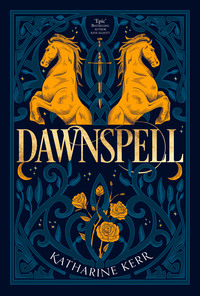
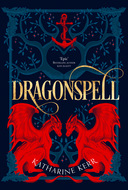
Read the book: «Dawnspell»
KATHARINE KERR
Dawnspell
The Bristling Wood
For the profit of kins, well did he attack the hosts of the
country, the bristling wood of spears, the grievous
flood of the enemy…
The Gododdin of Aneirin, Stanza A84

Copyright
Voyager An Imprint of HarperCollinsPublishers 1 London Bridge Street London SE1 9GF
www.voyager-books.com
Previously published in paperback by Grafton 1990 reprinted six times and by HarperCollins Science Fiction & Fantasy 1993 reprinted two times
First published in Great Britain by GraftonBooks 1989
Copyright © Katharine Kerr 1989
Cover design and illustration by Micaela Alcaino © HarperCollinsPublishers Ltd 2019
The Author asserts the moral right to be identified as the author of this work
All rights reserved under International and Pan-American Copyright Conventions. By payment of the required fees, you have been granted the nonexclusive, nontransferable right to access and read the text of this ebook onscreen. No part of this text may be reproduced, transmitted, downloaded, decompiled, reverse engineered, or stored in or introduced into any information storage and retrieval system, in any form or by any means, whether electronic or mechanical, now known or hereinafter invented, without the express written permission of HarperCollins e-books.
Ebook Edition © July 2019 ISBN 9780007404384
Version: 2019-07-15
HarperCollinsPublishers has made every reasonable effort to ensure that any picture content and written content in this ebook has been included or removed in accordance with the contractual and technological constraints in operation at the time of publication.
Note to Readers
This ebook contains the following accessibility features which, if supported by your device, can be accessed via your ereader/accessibility settings:
Change of font size and line height
Change of background and font colours
Change of font
Change justification
Text to speech
Epigraph
In memoriam
Raymond Earle Kerr, Jr, 1917–87,
an officer and a gentleman
Contents
Cover
Title Page
Copyright
Note to Readers
Epigraph
A Note on the Pronunciation of Deverry Words
Prologue: Spring, 1063
Part One: Deverry and Pyrdon, 833–845
1
2
3
4
Part Two: Summer, 1063
1
2
3
Appendix
Keep Reading
Glossary
Acknowledgements
About the Author
By the Same Author
About the Publisher
A Note on the Pronunciation of Deverry Words
The language spoken in Deverry is a member of the P-Celtic family. Although closely related to Welsh, Cornish, and Breton, it is by no means identical to any of these actual languages and should never be taken as such.
Vowels are divided by Deverry scribes into two classes: noble and common. Nobles have two pronunciations; commons, one.
A as in father when long; a shorter version of the same sound, as in far, when short.
O as in bone when long; as in pot when short.
W as the oo in spook when long; as in roof when short. Y as the i in machine when long; as the e in butter when short.
E as in pen.
I as in pin.
U as in pun.
Vowels are generally long in stressed syllables; short in unstressed. Y is the primary exception to this rule. When it appears as the last letter of a word, it is always long, whether that syllable is stressed or not.
Diphthongs generally have one consistent pronunciation:
AE as the a in mane.
AI as in aisle.
AU as the ow in how.
EO as a combination of eh and oh.
EW as in Welsh, a combination of eh and oo.
IE as in pier.
OE as the oy in boy.
UI as the North Welsh wy, a combination of oo and ee. Note that OI is never a diphthong, but is two distinct sounds, as in carnoic (KAR-noh-ik).
Consonants are mostly the same as in English, with these exceptions:
C is always hard as in cat.
G is always hard as in get.
DD is the voiced th as in thin or breathe, but the voicing is more pronounced than in English. It is opposed to TH, the unvoiced sound as in breath. (This is the sound that the Greeks called the Celtic tau.)
R is heavily rolled.
RH is a voiceless R, approximately pronounced as if it were spelled hr in Deverry proper. In Eldidd, the sound is fast becoming indistinguishable from R.
DW, GW, and TW are single sounds, as in Gwendolen or twit.
Y is never a consonant.
I before a vowel at the beginning of a word is consonantal, as it is in the plural ending -ion, pronounced yawn.
Doubled consonants are both sounded clearly, unlike in English. Note, however, that DD is a single letter, not a doubled consonant.
Accent is generally on the penultimate syllable, but compound words and place-names are often an exception to this rule.
I have used this system of transcription for the Bardekian and Elvish alphabets as well as the Deverrian, which is, of course, based on the Greek rather than the Roman model. On the whole it works quite well for the Bardekian, at least. As for Elvish, in a work of this sort it would be ridiculous to resort to the elaborate apparatus by which scholars attempt to transcribe that most subtle and nuanced of tongues. Since the human ear cannot even distinguish between such sound-pairings as B> and B<, I see no reason to confuse the human eye with them. I do owe many thanks to the various elven native speakers who have suggested which consonant to choose in confusing cases and who have laboured, alas, often in vain, to refine my ear to the elven vowel system.
A Note on Dating
Year One of the Deverry calendar is the founding of the Holy City, or, to be more accurate, the year that King Bran saw the omen of the white sow that instructed him where to build his capital. It corresponds roughly to 76 CE.
Prologue Spring, 1063
Often those who study the dweomer complain that it speaks in riddles. There is a reason for this riddling. What is it? Well, that happens to be a riddle of its own.
The Secret Book of Cadwallon the Druid
Out in the grasslands to the west of the kingdom of Deverry, the concepts of ‘day’ and ‘month’ had no meaning. The years flowed by, slowly, on the ebb and swell of the seasons: the harsh rains of winter, when the grass turned a bluish-green and the grey sky hung close to the earth; the spring floods, when the streams overflowed their banks and pooled around the willows and hazels, pale green with first leaves; the parching summer, when the grass lay pale gold and all fires were treacherous; the first soft rains of autumn, when wildflowers bloomed briefly in purple and gold. Driving their herds of horses and flocks of sheep, the People drifted north in the summer’s heat and south in the winter’s cold and, as they rode, they marked only the little things: the first stag to lose its antlers, the last strawberries. Since the gods were always present, travelling with their folk in the long wandering, they needed no high holidays or special feasts in their honour. When two or three alarli, the loosely organized travelling groups, happened to meet, then there was a festival to celebrate the company of friends.
Yet, there was one day of the year marked out from all the others: the spring equinox, which usually signalled the start of the floods. In the high mountains of the far north, the snows were melting, sending a tide down through the grasslands, just as another tide, this one of blood, had once swept over them from the north in the far past. Even though individuals of their race lived some five hundred years on average, by now there were none left who’d been present in those dark years, but the People remembered. They made sure that their children would always remember on the day of the equinox, when the alarli gathered in groups of ten or twelve for the Day of Commemoration.
Even though he was eager to ride east to Deverry, Ebañy Salomonderiel would never have left the elven lands until he’d celebrated this most holy and terrifying of days. In the company of his father, Devaberiel Silverhand the bard, he rode up from the sea-coast to the joining of the rivers Corapan and Delonderiel, near the stretch of primeval forest that marked the border of the grasslands. There, as they’d expected, they found an alardan, or clan-meet. Scattered in the tall grass were two hundred painted tents, red and purple and blue, while the flocks and herds grazed peacefully a little distance away. A little apart from the rest stood ten unpainted tents, crudely stitched together from poorly tanned hides.
‘By the Dark Sun herself,’ Devaberiel remarked. ‘It looks like some of the Forest Folk have come to join us.’
‘Good. It’s time they got over their fear of their own kind.’
Devaberiel nodded in agreement. He was an exceptionally handsome man, with hair pale as moonlight, deep-set dark blue eyes, slit vertically like a cat’s, and gracefully long pointed ears. Although Ebañy had inherited the pale hair, in other ways he took after his mother’s human folk; his smoky grey eyes had round irises, and his ears, while slightly sharp, passed unnoticed in the lands of men. They rode on, leading their eight horses, two of which dragged travois, loaded with everything they owned. Since Devaberiel was a bard and Ebañy a gerthddyn, that is, a storyteller and minstrel, they didn’t need large herds to support themselves. As they rode up to the tents, the People ran out to greet them, hailing the bard and vying for the honour of feeding him and his son.
They chose to pitch the ruby-red tent near that of Tanidario, a woman who was an old friend of the bard’s. Although she’d often given his father advice and help as he raised his half-breed son alone, Ebañy found it hard to think of her as a mother. Unlike his own mother back in Eldidd, whom he vaguely remembered as soft, pale and cuddly, Tanidario was a hunter, a hard-muscled woman who stood six feet tall and arrow-straight, with jet-black hair that hung in one tight braid to her waist. Yet when she greeted him, she kissed his cheek, caught his shoulders, and held him a bit away while she smiled as if to say how much he’d grown.
‘I’ll wager you’re looking forward to the spring hunt,’ he said.
‘I certainly am, little one. I’ve been making friends with the Forest Folk, and they’ve offered to show me how to hunt with a spear in the deep woods. I’m looking forward to the challenge.’
Ebañy merely smiled.
‘I know you,’ Tanidario said with a laugh. ‘Your idea of hunting is finding a soft bed with a pretty lass in it. Well, maybe when you’re fully grown, you’ll see things more clearly.’
‘I happen to be seventy-four this spring.’
‘A mere child.’ She tousled his hair with a calloused hand. ‘Well, come along. The gathering’s already beginning. Where’s your father got to?’
‘He went with the other bards. He’ll be singing right after the Retelling.’
Down by the river, some of the People had lashed together a rough platform out of travois poles, where Devaberiel stood conferring with four other bards. All around it the crowd spread out, the adults sitting cross-legged in the grass while restless children wandered around. Ebañy and Tanidario sat on the edge near a little group of Forest Folk. Although they looked like the other elves, they were dressed in rough leather clothes, and each man carried a small notched stick, bound with feathers and coloured thread, which were considered magical among their kind. Although they normally lived in the dense forests to the north, at times they drifted south to trade with the rest of the People. Since they had never been truly civilized, the events that they were gathered to remember had spared them.
Gradually the crowd quieted, and the children sat down by their parents. On the platform four bards, Devaberiel among them, took their places at the back, arms crossed over their chests, legs braced a little apart, a solemn guard of honour for the storyteller. Manaver Contariel’s son, the eldest of them all, came forward and raised his arms high in the air. With a shock, Ebañy realized that this would be the last year that this bard would retell the story. He was starting to show his age, his hair white and thin, his face pouched and wrinkled. When one of the People aged, it meant death was near.
‘His father was there at the Burning,’ Tanidario whispered.
Ebañy merely nodded his acknowledgement, because Manaver was lowering his arms.
‘We are here to remember.’ His highly trained voice seemed to boom out in the warm stillness.
‘To remember,’ the crowd sighed back. ‘To remember the west.’
‘We are here to remember the cities, Rinbaladelan of the Fair Towers, Tanbalapalim of the Wide River, Bravelmelim of the Rainbow Bridges, yea, to remember the cities, and the towns, and all the marvels of the far, far west. They have been taken from us, they lie in ruins, where the owls and the foxes prowl, and weeds and thistles crack the courtyards of the palaces of the Seven Kings.’
The crowd sighed wordlessly, then settled in to listen to the tale that some had heard five hundred times or more. Even though he was half a Deverry man, Ebañy felt tears rise in his throat for the lost splendour and the years of peace, when in the hills and well-watered plains of the far west, the People lived in cities full of marvels and practised every art and craft until their works were so perfect that some claimed them dweomer.
Over a thousand years ago, so long that some doubted when the Burning had begun, whether it was a thousand and two hundred years or only a thousand and one, several millions of the People lived under the rule of the Seven Kings in a long age of peace. Then the omens began. For five winters the snows fell high; for five springs, floods swept down the river. In the sixth winter, farmers in the northern province reported that the wolves seemed to have gone mad, hunting in big packs and attacking travellers along the road. The sages agreed that the wolves must have been desperate and starving, and this, coupled with the weather, meant famine in the mountains, perhaps even some sort of blight or plague that might move south. In council the Seven Kings made plans: a fair method of stockpiling food and distributing it to those in need, a small military levy to deal with the wolfpacks. They also gathered dweomerfolk and sages around them to combat the threats and to lend their lore to farmers in need. In the sixth spring, squadrons of royal archers went forth to guard the north, but they thought they were only hunting wolves.
When the attack came, it broke like an avalanche and buried the archers in corpses. No one truly knew who the enemies were; they were neither human nor Elvish, but a squat breed like enormous dwarves, dressed in skins, and armed only with crude spears and axes. For all their poor weapons, their warriors fought with such enraged ferocity that they seemed not to care whether they lived or died. There were also thousands of them, and they travelled mounted. When the sages rushed north with the first reinforcements, they reported that the language of the Hordes was utterly unknown to them. Half-starved, desperately fleeing some catastrophe in their homeland, they burned and ravaged and looted as they came. Since the People had never seen horses before, the attackers had a real advantage, first of surprise, then of mobility once the elves grew used to the horrifying beasts. By the time they realized that horses were even more vulnerable to arrows than men, the north was lost, and Tanbalapalim a heap of smoking timbers and cracked stone.
The kings rallied the People and led them to war. After every man and woman who could loose a bow marched north, for a time the battles held even. Although the corpse-fires burned day and night along the roads, still the invaders marched in under the smoke. Since he pitied their desperation, King Elamanderiel Sun-Sworn tried to parley with the leaders and offered them the eastern grasslands for their own. In answer, they slew his guard of honour and ran his head on to a long spear, which they paraded in front of their men for days. After that, no mercy was offered. Children marched north with bows to take the places of their fallen parents, yet still the Hordes came.
By autumn the middle provinces were swept away in a tide of blood. Although many of the People fell back in a last desperate attempt to hold Rinbaladelan on the coast, most fled, taking their livestock, rounding up the horses that had given the invaders such an edge, loading wagons and trekking east to the grasslands that the Hordes despised. Rinbaladelan fought out the winter, then fell in the spring. More refugees came east, carrying tales the more horrible because so common. Every clan had had its women raped, its children killed and eaten, its houses burned down around those too weak to flee. Everyone had seen a temple defiled, an aqueduct mindlessly toppled, a farm looted then burned instead of appropriated for some good use. All summer, refugees trickled in – and starved. They were settled folk, unused to hunting except for sport. When they tried to plant their hoarded seed-grains, the harsh grasslands gave them only stunted crops. Yet in a way few cared whether they lived another winter or not, because they were expecting that the enemy would soon follow them east. Some fled into the forests to seek refuge among the primitive tribes; a few reached what later became Eldidd; most stayed, waiting for the end.
But the Hordes never came. Slowly the People learned to survive by living off their flocks and herds while they explored what the grasslands had to offer them. They ate things – and still did – that would have made the princes of the Vale of Roses vomit: lizards and snakes, the entrails of deer and antelope as well as the fine meat, roots and tubers grubbed out wherever they grew. They learned to dry horsedung to supplement the meagre firewood; they abandoned the wagons that left deep ruts in the grassland that now fed them in its own way. They boiled fish-heads for glues and used tendons for bowstrings as they moved constantly from one foraging-ground to another. Not only did they survive, but children were born, replacing those killed in flash floods and hunting accidents.
Finally, thirty-two years after the Burning, the last of the Seven Kings, Ranadar of the High Mountain, found his people again. With the last six archers of the Royal Guard he rode into an alardan one spring and told how he and his men had lived among the hills like bandits, taking what vengeance they could for their fallen country and begging the gods to send more. Now the gods had listened to their grief. While the Hordes could conquer cities, they had no idea how to rebuild them. They lived in rough huts among the ruins and tried to plant land they’d poisoned. Although every ugly member of them wore looted jewels, they let the sewers fill with muck while they fought over the dwindling spoils. Plague had broken out among them, diseases of several different kinds, all deadly and swift. When he spoke of the dying of the Hordes, Ranadar howled aloud with laughter like a madman, and the People laughed with him.
For a long time there was talk of a return, of letting the plagues do their work, then slaughtering the last of the Hordes and taking back the shattered kingdom. For two hundred years, until Ranadar’s death, men gathered nightly around the campfires to scheme. Every now and then, a few foolhardy young men would ride back to spy. Even fewer returned, but those who did spoke of general ruin and disease still raging. If life in the grasslands hadn’t been so harsh at first, perhaps an army might have marched west, but every year, there were almost as many deaths as births. Finally, some four hundred and fifty years after the Burning, some of the younger men organized a major scouting party to ride to Rinbaladelan.
‘And I was among them, a young man,’ Manaver said, his voice near breaking at the memory. ‘With twenty friends I rode west, for many a time had I heard my father speak of Rinbaladelan of the Fair Towers, and I longed to see it, even though the sight might bring my death. We took many quivers of arrows, for we expected many a bloody skirmish with the last of the Hordes.’ He paused for a twisted, self-mocking smile. ‘But they were gone, long dead, and so was Rinbaladelan. My father had told me of the high temples, covered with silver and jet; I saw grassy mounds. He told of towers five hundred feet high made of many-coloured stones; I found a broken piece here and there. He told of vast processions down wide streets; I traced out the grassy tracks. Here and there, I found a stone hut, cobbled out of the ruins. In some, I found skeletons lying unburied on the floor, the last of the Hordes.’
The crowd sighed, a grief-torn wind over the grassland. Near the front a little girl squirmed free of her mother’s lap and stood up.
‘Then why didn’t we go back, if they were all dead?’ she called out in a clear, high voice.
Although her mother grabbed her, the rest of the gathering laughed, a melancholy chuckle at a child’s boldness, a relief after so much tragedy. Manaver smiled at the little girl.
‘Back to what, sweet one?’ he said. ‘The kingdom was dead, a tangle of overgrowth and ruins. We’d brought our gods to the grasslands, and the grasslands became our mother. Besides, the men who knew how to lay out fine cities and smelt iron and work in stone were all dead. Those of us who survived were mostly farmers, herdsmen, or foresters. What did we know about building roads and working rare metals?’
Her mouth working in thought, the girl twisted one ankle around the other. Finally she looked up at the dying bard.
‘And will we never go back, then?’
‘Well, “never” is a harsh word, and one that you should keep closed in your mouth, but I doubt it, sweet one. Yet we remember the fair cities, our birthright, our home.’
Even though the People sighed out the word ‘remember’ with proper respect, no one wept, because none of them had ever seen the Vale of Roses or walked the Sun Road to the temples. With a nod, Manaver stepped back to allow Devaberiel forward to sing a dirge for the fallen land. The songs would go on for hours, each bard taking a turn and singing of happier and happier things, until at last the alardan would feast and celebrate, dancing far into the night. Ebañy got up and slipped away. Since he’d heard his father practise the dirge for some months, he was heartily sick of it. Besides, his Deverry blood pricked him with guilt, as it did every year on the Day of Commemoration.
By talking with Deverry scholars, Ebañy had pieced together something about the Burning that no one else knew. Since it would only lead to hatred between his two races of kinsfolk, he kept the secret even from his father. The Hordes had been driven south by the great influx of the people of Bel, as the Deverry men called themselves, when they’d come from their mysterious homeland over a thousand years ago. Although to the People’s way of thinking the Deverry men were a bloodthirsty lot, in the old days they’d been even more ruthless conquerors, hunting their enemies’ heads to decorate the temples of their gods. In their wanderings before they founded their Holy City, they’d swept through the far north, slaughtering, looting, enslaving some of the strange race, even, before they passed down the valley of the Aver Troe Matrw to their new lands. And the Hordes had fled before them, fled south.
‘You never lifted a sword against us, oh men of Deverry,’ Ebañy whispered aloud. ‘But you slaughtered my father’s people sure enough.’
With a little shudder, he ducked into the tent, where the sun came through the dyed leather and turned the air to ruby. Since they’d arrived late for the alardan, piles of tent-bags and gear lay scattered on the leather ground-cloth. Idly he picked up a few bags and hung them from the hooks on the tent-poles, then sat down in the clutter to poke through a canvas bag of the Deverry sort. Down at the bottom he found a tiny leather pouch, opened it, and took out a simple silver ring. A flat band about a third of an inch wide, it was engraved with roses on the outside and words in Elvish characters but some unknown language on the inside. The roses caught the reddish light and seemed to bloom, double hybrids of the cultivated sort now found only in Deverry.
‘And are you spoil from Rinbaladelan or Tanbalapalim?’ he asked it. ‘The only roses my people know now are the wild ones with their five meagre little petals.’
The ring lay mute on his palm, a gleaming paradox. Although it possessed no dweomer of its own, it was tied to the dweomer. Many years ago, a mysterious, nameless wanderer had given it to Devaberiel as a present for one of his as-yet-unborn sons. Now the omen-reading of the dweomerwoman showed that it belonged to Rhodry, the youngest of the three, and like Ebañy, a half-breed. But unlike Ebañy’s, Rhodry’s mother was no pretty village lass, but one of the most powerful noblewomen in the kingdom. Rhodry could never learn the truth about his real father, who had given Ebañy the task of taking the ring to him.
‘And what am I supposed to tell him when I find him?’ he grumbled aloud, because talking came much easier to him than thinking. ‘Oh, well, this peculiar personage said it was yours, but I can’t tell you why. Of course, I don’t know why it’s yours – no one does – so, dear brother, I won’t be lying to you when I make my most feeble excuses. One dweomer says it encircles your Wyrd, and another working says that your Wyrd is Eldidd’s Wyrd, and so here we are, in the land of vagaries, nuances, and secrets. Ah by the gods, doesn’t my Elvish curiosity ache to know the truth!’
With a laugh, he slipped the ring back into its wrapping, then put that pouch into the one he carried around his neck. Soon he would be riding into the lands of men, where thieves prowl, and he would need a better hiding-place for the ring than an open canvas sack. Thinking of the journey ahead of him, he went outside and wandered down to the riverbank, where the Delonderiel rolled by, flecked with gold in the lowering sun. Distantly he heard his father’s voice, firm and clear in its sorrow as the stanzas marched on. He stared at the river and used it to focus his mind, until at last his dweomer scryed Rhodry out, a pale image of him at first, then a clear picture.
Rhodry was standing on the ramparts of a rough stone dun and looking out over countryside where patches of snow still lay under dark pine trees. He was wrapped in a cloak, and his breath came in a frosty puff. Now that Ebañy knew they shared a father, he could see what had eluded him the summer before, when he’d met Rhodry by chance and wondered why this young warrior looked so familiar. Although Rhodry had raven-dark hair and cornflower-blue eyes, they looked enough alike to be what they were, brothers. As he studied the resemblance, Ebañy found himself grumbling again.
‘So I’m not supposed to tell you the truth, brother, am I? What am I supposed to do, smash every mirror within your reach? Rhodry has to think himself human and a Maelwaedd, says my master in dweomer. Oh splendid! Then I’d best hand over this ring and disappear before you look too closely at my face!’
In the vision, Rhodry’s image suddenly turned and seemed to be staring right at him, as if he were listening to his faraway kin. Ebañy smiled at him, then widened the vision, switching his point of view this way and that around the countryside to the limits of the scrying, about two miles away from its focus. He saw sharp rocky hills, covered with pine, and here and there among them small farms. Most likely Rhodry was in the province of Cerrgonney, then, a good five hundred miles away at the very least.
‘It’s going to be a long summer’s riding, then, Ebañy, lad,’ he told himself. ‘On the other hand, it would be a wretched shame to leave before the feasting’s over.’
Although it was cold up on the ramparts of Lord Gwogyr’s dun, Rhodry lingered there a few moments longer and looked out over the Cerrgonney hills without truly seeing them. For a moment he wondered if he were going daft, because it seemed he’d heard someone talking to him though he was the only man on the walls. The words had been indistinct, but someone had called him brother and talked of giving him a gift. In irritation he tossed his head and decided that it had only been some trick of the wind. Since the only brother he knew of hated him with his very soul, it was unlikely that he’d be giving him any gift but a dagger in the back, and those words – if words they were – had sounded warm and friendly.
Leaning back against the damp stone, he pulled his silver dagger from his belt and looked at it while he idly thought of his elder brother, Rhys, Gwerbret Aberwyn, who had sent him into exile some years before. Although the dagger was a beautiful thing, as sharp as steel but gleaming like silver, it was a mark of shame, branding him a dishonoured mercenary soldier who fought only for coin, never for honour. It was time for him to wander down the long road, as the silver daggers called their lives. Although he’d fought well for Lord Gwogyr last autumn, even taking a wound in his service, a silver dagger’s welcome was a short one, and already the chamberlain was grumbling about having to feed him and his woman. Sheathing the dagger, he glanced up at the sky, cold but clear. It was likely that the snows were long past.
‘Tomorrow we’ll ride,’ he said aloud. ‘And if you were thinking of me, brother, may the thought turn your guts to fire.’
Far to the south, in a little town in Eldidd, an event was happening that would indeed bring Gwerbret Rhys the sort of pain his younger brother had wished upon him, even though Rhodry had no way of knowing it. Dun Bruddlyn, a fort only recently disposed upon its lord, Garedd, was filled with a tense sort of bustle. While the lord himself paced restlessly in his great hall with a goblet of mead in his hand, his second wife, Donilla, was giving birth up in the women’s hall. Since this was her first child, the labour was a long one, and Tieryn Lovyan as well as the other women in attendance was beginning to worry. Her face dead-white, her long chestnut hair soaked with sweat, Donilla crouched on the birthing stool and clung to the thick rope tied from one of the beams far above. Her serving-woman, Galla, knelt beside her and wiped her face every now and then with a cloth soaked in cold water.
‘Let her suck a bit of moisture from a clean rag,’ said the herbman who was attending the birth. ‘But just a bit.’
Another serving-lass hurried to get clean cloth and fresh water without a moment’s hesitation. Not only was old Nevyn known as the best herbman in the kingdom, but it was widely rumoured that he had the dweomer. Lovyan smiled at the lass’s awe, but only slightly, because she knew full well that the rumours were true. When she glanced at Nevyn in a questioning sort of way, he gave her a reassuring smile, then spoke to Donilla. His ice-blue eyes seemed to bore into her soft brown ones and capture her very soul. With a sigh she relaxed as if some of the pain had left her.
‘It’ll be soon now, my lady.’ His voice was very soft and kind. ‘Breathe deeply now, but don’t bear down on the babe. It’ll be coming soon.’
Donilla nodded, gasped at a contraction, and let out her breath in a long, smooth sigh. Although Lovyan had given birth to four sons herself, she couldn’t remember her own labours being this difficult. Perhaps I’ve just forgotten, she thought. One does forget the pain, and so oddly soon. Restlessly she paced to an open window and looked out on the bright spring day while she considered the irony. Poor Donilla had been so eager to have a child; now she was probably wishing that she truly had been barren. When the younger woman moaned again, Lovyan winced in sympathy.
‘It’s crowning, my lady!’ Nevyn crowed in victory. ‘Soon, very soon. Now – bear down.’
Lovyan stayed at the window until she heard the high-pitched wail, a good, healthy cry at that. She turned round to see Nevyn and the serving-woman laying Donilla down on the pallet prepared by the stool and laying the babe, still attached by the cord, at her breast. With trembling fingers the lady stroked the soft fuzz on her child’s head and smiled in wide-eyed triumph.
‘A son, Your Grace!’ she croaked. ‘I’ve given my lord another son.’
‘And a fine healthy one, at that,’ Lovyan said. ‘Shall I go and tell His Lordship the good news?’
Donilla nodded, her eyes on the tiny face already nuzzling at her breast.
As she went downstairs, Lovyan’s heart was heavy, and she felt badly about it. Of course Donilla deserved this moment of triumph, of vindication. After ten years of a childless marriage, her first husband had cast her off as barren, a bitter humiliation for any woman to bear, worse than the heart-breaking thought that she would never have children. Now she had her son, and everyone in Eldidd knew that she wasn’t the barren one. Unfortunately, her small triumph had important political consequences, of which her second husband seemed to be painfully aware. Garedd was a man of middle years, with two sons and a daughter by his first marriage; a solid sort with grey in his blond hair and moustaches, he was genuinely pleased at Lovyan’s news, breaking out into a laugh and yelling that he had a son to his warband across the hall. Then, almost instantly, he wiped the look of triumph off his face.
‘My apologies for gloating, Your Grace,’ he said. ‘But it takes a man that way.’
‘You don’t need to apologize to me, cousin,’ Lovyan said wearily. ‘Nor to Rhys, either, though I’d advise you to stay away from Aberwyn for a while.’
‘I was planning to, truly.’
There lay the crux of the matter; Gwerbret Rhys had been Donilla’s first husband, the one who had shamed her as barren because he had no heirs for his vast rhan, one of the most important in the entire kingdom. If he died childless, as now seemed most likely, Eldidd could well break out into open war as the various candidates tried to claim the gwerbretrhyn for their own clan. Although Lovyan was fond of her cousin and his wife, she was here to witness the birth because of its political implications. Since she was the tieryn of Dun Gwerbyn, with many vassals and large holdings, her time was too valuable for her to ride around the countryside playing at midwife for her vassals’ wives. But it had been necessary that she see with her own eyes that, truly, Donilla had given birth to a child.
‘Do you think Rhys will adopt a son?’ Garedd said.
‘I have no idea what Rhys will or won’t do any more, for all that he’s my first-born son. An adopted heir won’t have much of a chance in the Council of Electors, anyway. The sensible thing for him to do would be to recall Rhodry from exile.’
Garedd raised one questioning eyebrow.
‘I haven’t given up hope yet,’ Lovyan snapped. ‘But truly, my lord, I understand your scepticism.’
In another half-hour, Nevyn came down to the great hall. A tall man with a thick shock of white hair and a face as wrinkled as old burlap, still he moved with strength, striding up to the table of honour and making Garedd a smooth bow. When he announced that the lord could visit the lady, Garedd was off like a flushed hare, because he loved his young wife in an almost unseemly way. Nevyn accepted a tankard of ale from a page and sat down beside Lovyan.
‘Well,’ he remarked. ‘She had a remarkably good first birth for a woman her age. Knowing you, you’re pleased in spite of yourself.’
‘Just that. I was always fond of her. If only some other beastly man had cast her off.’
Nevyn gave her a thin smile and had a well-deserved swallow of ale.
‘I’ll be leaving tomorrow,’ he said. ‘Going to Dun Deverry. Now that I have a nephew at court, I can hear some of the gossip from the King’s councils.’
‘Nephew, indeed! But I’m glad he’s there, all the same. I’m beginning to think that our only hope is to get our liege to override Rhys’s sentence of exile. It’s happened before.’
‘Gwerbrets have also risen in rebellion against such meddling. Do you think Rhys will?’
‘I don’t know. Ah, by the Goddess herself, it aches my heart to think of war coming to Eldidd, and all over my two squabbling sons!’
‘The war hasn’t started yet, and I’m going to do my cursed best to make sure it doesn’t.’
Yet he looked so weary that she was suddenly frightened. Even though he was the most powerful dweomerman in the kingdom, he was still only one man. He was also caught up in political intrigue that – or so it seemed to her – his magical calling would ill-equip him to handle.
‘Ah well,’ she said at last. ‘At least the child himself was born with good omens. They always say it’s a lucky lad who’s born the first day of spring.’
‘So they do, and let’s hope this spring is as well-omened for us all.’
The absent way he spoke made her realize that he very much doubted it would be. She was hesitating, half wanting to ask more, half afraid to hear the truth if he should tell her, when a page came over to her. The young lad looked utterly confused.
‘Your Grace? There’s a noble lord at the gates. Should I ask you what to do, or go and find Lord Garedd?’
‘You may ask me, because I’m of higher rank. If I were of the same rank as Garedd, you’d have to go and find him. Now. Which noble lord is it?’
‘Talidd of Belglaedd, Your Grace. He said the strangest thing. He asked if he was welcome in the dun that should have been his.’
Beside her Nevyn swore under his breath.
‘Oh ye gods,’ Lovyan said feebly. ‘He would turn up right now! Well, lad, run and tell him that indeed he’s welcome in the dun called Bruddlyn. Tell him that exactly and not a word more.’
As soon as the page was on his way, Nevyn turned to her with the lift of a quizzical eyebrow.
‘It all goes back to Loddlaen’s war,’ she said, her voice heavy with weariness. ‘Talidd’s sister was Corbyn’s wife. She went back to her brother before the war even started, because having Loddlaen in the dun was driving her daft, and I can’t say I blame her for that, frankly. But then, after Corbyn was killed, I attainted this demesne because she’d left her husband. All my loyal men would have grumbled if I hadn’t. I offered her a settlement of coin and horses, but Talidd refused to let her take a copper or a filly of it.’
She broke off because the subject of this explanation was striding into the great hall, stripping off his cloak and riding gloves as he did so. Talidd of Belglaedd was a heavy-set man of forty, with grey hair still streaked with blond, and shrewd green eyes. Tossing his cloak to the page, he came over and made the tieryn a deep bow. His bland smile revealed nothing at all.
‘I’m surprised to see you here, my lord,’ Lovyan said.
‘I came to congratulate Garedd on the birth of a child. The page tells me it’s a lad.’
‘It is, and a healthy one.’
‘Then Dun Bruddlyn has yet another heir, does it?’ Talidd paused to take a tankard of ale from a serving lass. ‘Well, the gods may witness the justice of that.’
Lovyan debated challenging him then and there. If she’d been a man, and thus able to fight her own duels, she might well have done it, but as it was, she would have to call for a champion. Answering that call would be the captain of her warband, Cullyn of Cerrmor, who was without doubt the best swordsman in all Deverry. It seemed rather unfair to sentence Talidd to certain death for a few nasty remarks.
‘I choose to ignore that, my lord,’ Lovyan said, and she put ice in her voice. ‘If you feel injured, you may put your case before the gwerbret, and I shall come to court at his order.’
‘The gwerbret, Your Grace, happens to be your son.’
‘So he is, and I scrupulously raised him to be a fair-minded man.’
At that Talidd looked down abruptly at the table, and he had the decency to blush. In the duel of words, Lovyan had scored the first touch.
‘I’m surprised you’ve come here just to pour vinegar in an old wound,’ she said.
‘The matter’s of great moment for the gwerbretrhyn, isn’t it? You forget, Your Grace, that I hold a seat on the Council of Electors.’
Lovyan had forgotten, and she cursed herself mentally for the lapse. Talidd had a sip of ale and smiled his bland, secretive smile at her and Nevyn impartially.
‘I was hoping I’d be in time to witness the birth,’ he said at last. ‘I take it there were witnesses not of this household.’
‘Myself and the herbman here.’
‘And none, my lady, would dare dispute your word, not in open court nor in private meeting.’ The smile grew less bland. ‘We may take it as a given that, indeed, the Lady Donilla’s not barren, no matter what seemed to be the case before.’
Lovyan gave him a brilliant smile and hated his very heart.
‘Just so, my lord. I take it as another given that you’ll be summoning the council with this news as soon as ever you can.’
Talidd left well before the evening meal with the remark that he had a better welcome nearby. He sounded so martyred, and so genuinely injured, that Nevyn felt like kicking him all the way out of the great hall. For Lovyan’s sake, he refrained. Instead he went up to look in on Donilla, who was by then resting in her own bed with the swaddled babe beside her. In some minutes Lovyan joined him there, her expression as placid as if she’d never heard Talidd’s name, and made a few pleasantries to the younger woman. Nevyn left when she did, following her to the chamber in the suite that had been allotted to her on this visit. Although plain, it was obviously furnished with Dun Bruddlyn’s best; her cousin and his lady both had reason to be grateful for her gift of this demesne, as she remarked.
‘Although it’s turning out to be a troubled gift, sure enough,’ Nevyn said. ‘I didn’t realize Talidd felt so strongly.’
‘Him and half the lords in the tierynrhyn. I knew there’d be trouble when I gave it to Garedd, but there’d have been trouble no matter what I did. Well, I suppose if I’d apportioned it to you, no one would have grumbled, but you didn’t want it, and so here we are.’
‘Come now, Lovva! You almost make me feel guilty.’
‘I like that “almost”. But truly, whenever an overlord has land to give, there’s bound to be injured feelings. I only wish that Talidd didn’t have a seat on the council. Ah ye gods, what a nasty thing this is becoming! Even if Rhys’s wife did have a babe now, no one would believe it was his.’
‘Just so. I –’
With a bang of the door and a gleeful howl of laughter, a child of about two came charging into the chamber with a nursemaid in pursuit. She was slender for her age, with a mop of curly, raven-dark hair and violet eyes, almost as dark a purple as an elf’s – all in all, a breathtakingly beautiful child. With a gurgle, she threw herself into Lovyan’s exalted lap.
‘Granna, Granna, love you, Granna.’
‘And I love you, too, Rhodd-let, but you’re being naughty and interrupting.’
Rhodda twisted in her lap and looked solemnly at Nevyn. The family resemblance was profound.
‘I’d almost forgotten about Rhodry’s daughter. She certainly hasn’t inherited her looks from her mother’s side, has she?’
‘None, but Maelwaedd blood tends to be strong, and Olwen, poor lass, was one of those blonde and bland sorts. Rhodry’s bastard might have a very important role to play in what lies ahead, so I keep her with me at all times – to supervise her upbringing, of course.’ For all her talk of political purposes, she kissed the top of the child’s head with a genuine fondness, then motioned to the nursemaid. ‘Now let Mistress Tevylla take you away and give you some bread and milk. It’s almost time for bed.’
Although Rhodda whined, begged, and finally howled, Lovyan held firm and scooped her up bodily to give her to her nurse, who was hovering by the chamber door. Nevyn hadn’t truly noticed her before, but he saw now that she was a striking woman of about thirty, with dark hair, dark eyes and almost severely regular features. Once she and her small charge were gone, Nevyn asked about her.
‘Tevva?’ Lovyan said. ‘A charming woman, and with a will of steel, which she needs around Rhodda, I assure you. She’s a widow, actually, with a son of her own, who’s – oh ye gods, I don’t remember his age, but old enough for Cullyn to be training him for the warband. Her man was a blacksmith down in my town, but he died suddenly of a fever two winters ago. Since she had no kin, the priests recommended her to my charity, and I needed a woman for Rhodda. That child is a worse handful than even her father was.’ She sighed, and since they were alone, she could be honest. ‘I suppose it’s the elven blood in their veins.’
‘I’d say so, for all that Rhodda doesn’t have much of it.’
‘A full quarter, let us not forget. Don’t fall for your own lies about a trace of elven blood in the Maelwaedds.’
‘Well, it’s not a lie, because there is one, but of course, it doesn’t apply here. I take it you plan to make the child a good marriage some day?’
‘An influential marriage, certainly, and I plan to teach her now to make any marriage suit her own purposes. If she can learn to channel all that wilfulness, she’ll be a woman to reckon with in Eldidd, illegitimate or not.’
Although Nevyn agreed with vague words rather than burden her further, he privately wondered if the child could ever be tamed and forced into the narrow mould of a noble-born woman. Sooner or later, her wild blood was going to show.
Before he left Dun Bruddlyn, Nevyn made a point of scrying out Rhodry and, when he found him well, telling Lovyan so. As he rode out, leading his pack-mule behind him, he felt a dread that was as much logic as it was dweomer-warning. The summer before, he and those others who studied the dweomer of Light had won a series of victories over those who followed the dweomer of darkness. They had not only disrupted an elaborate plot of the dark masters but had also ruined one of their main sources of income, the importing of opium and various poisons into the kingdom. The dark ones would want revenge; they always did, and he reminded himself to stay on guard in his travels. Of course, it was likely that they’d scheme for years, trying to lay a plan so clever and convoluted that it would be undetectable. It was likely, but at the same time, the dweomer-warnings came to him in a coldness down his back. Since the dark masters were so threatened, they would doubtless strike back as soon as they could. The only question was how.
And yet other, more mundane matters demanded his attention as well. The gwerbretrhyn was too rich, too desirable, to stay peaceful if the line of succession should be broken. As much as he hated involving himself in the schemings and feudings of noble clans, Nevyn knew that his duty to Rhodry’s dweomer-touched Wyrd also imposed on him a duty to Rhodry’s rhan and to his innocent subjects, who preferred peace to war, unlike noble-born men like Talidd. He would fight with every weapon he had to keep Aberwyn safe. For all that Lovyan was sceptical about his political skills (and he knew full well that she was), he was better armed for this fight than any man in the kingdom, right down to the wisest of the High King’s councillors. Oh, I learned a trick or two that time, he thought to himself, and our Rhodry was right in the middle of that little mess, for all that he was a humble rider then, and an outlawed man! Although it had been well over a hundred years ago, he knew what it was to battle for the throne of not merely a gwerbret, but a king.
Part One Deverry and Pyrdon, 833–845
When Dilly Blind went to the river,
To see what he could see,
He found the King of Cerrmor
A-washing his own laundry …
Old Eldidd folk song
1
The year 833. Slwmar II, King in Dun Deverry, received a bad wound in battle. The second son of Glyn II, King in Cerrmor, died stillborn. We took these as bad omens. Only later would we realize that Bel in His Wisdom was preparing peace for His people …
The Holy Chronicles of Lughcarn
The flies were the worst thing. It was bad enough to be dying, but to have the flies so thick was an unjust indignity. They clustered, buzzing, round the wound and tried to drink the blood. It hurt too much to try to brush them away. The wound was on his right side, just below the armpit, and deep. If someone could have stitched it for him, Maddyn supposed, he might have lived, but since he was all alone in the wild hills, he was going to die. He saw no reason to lie to himself about it: he was bleeding to death. He clutched the saddle-peak with his left hand and kept his right arm raised, because the wound blazed like fire if he let his arm touch it. The blood kept oozing through his shattered mail, and the big shiny blue-black flies kept coming. Every now and then, a fly bit his horse, which was too exhausted to do more than stamp in protest.
Maddyn was the last rider in his warband left alive. Since, when he died, the enemy victory would be complete, it seemed honourable to try to postpone their victory for a while; it seemed important then, as he rode slowly through the golden autumn haze, to cheat them of their victory for twenty minutes more. Ahead, about a mile away, was a lake, the surface rippled gold and shining in the sunset. Along the edge stood white birches, rippling in the rising wind. He wanted water. Next to the flies, being thirsty was the worst thing, his mouth so dry that he could barely breathe. His horse ambled steadily for the lake. It wouldn’t matter, his dying, if only he could drink first.
The lake was coming closer. He could see the rushes, dark strokes against bright water, and a white heron, standing one-legged at the edge. Then something went wrong with the sun. It wasn’t setting straight down, but swinging from side to side, like a lantern held in someone’s hand as they walked. The sky was dark as night, but the sun kept swinging back and forth, a lantern in the night, back and forth, wider swings now, up up high up all the way to noon above him and blazing. Then there was darkness, the smell of crushed grass, the flies buzzing and the thirst. Then only darkness.
A lantern was burning in the darkness. At first, Maddyn thought it was the sun, but this light was too small, too steady. An old man’s face leaned over him. He had a thick mane of white hair and cold blue eyes.
‘Ricyn.’ His voice was low but urgent. ‘Ricco, look at me.’
Although Maddyn had never heard that particular name before, he knew somehow that it was his, and he tried to answer to it. His lips were too dry to move. The old man held a golden cup of water to his lips and helped him drink. The water was sweet and cold. I won’t die thirsty after all, Maddyn thought. Then the darkness came again.
The next time that he woke, he realized that he wasn’t going to die. For a long time, he lay perfectly still and wondered at it: he wasn’t going to die. Slowly he looked around him, for the first time wondering where he was, and realized that he was lying naked between soft wool blankets on a pile of straw. Firelight danced over the walls of an enormous stone room. Although his wound still hurt, it was nicely bound with linen bandages. When he turned his head, he saw the old man sitting at a rough wooden table by the stone hearth and reading in a leatherbound book. The old man glanced up and smiled at him.
‘Thirsty, lad?’
‘I am, good sir.’
The old man dipped water from a wooden barrel into the golden cup, then knelt down and helped him drink.
‘My horse?’ Maddyn said.
‘He’s safe and at his hay.’ The old man laid a hand on Maddyn’s forehead. ‘Fever’s broken. Good.’
Maddyn just managed to smile before he fell asleep. This time, he dreamt of his last battle so vividly that it seemed he could smell the dust and the horse-sweat. His warband drew up on the crest of the hill, and there were Tieryn Devyr and his men waiting across the road – over a hundred to their thirty-seven, but they were going to make the hopeless downhill charge anyway. Maddyn knew it by the way Lord Brynoic laughed like a madman, lounging back in his saddle. There was naught they could do but die; they were trapped, and they had naught left to live for. Even though he felt like a fool for doing it, Maddyn started thinking about his mother. In his mind, he could see her clearly, standing in the doorway of their house and holding out her arms to him. Then the horn blew for the charge, and he could only think of riding. Down the hill, on and on, with Devyr’s men wheeling to face them – the clash came with a shriek from both sides. In his dream Maddyn relived every parry and cut, choked again on the rising dust and woke with a cry when the sword bit deep into his side.
‘Here, lad.’ The old man was right beside him. ‘All’s well now.’
‘Can I have some water?’
‘All you want.’
After Maddyn gulped down six cupsful, the old man brought him bread and milk in a wooden bowl. Since his hands were shaking too badly to hold a spoon, the old man fed him, too, a spoonful at a time. The best feast in the Gwerbret of Cantrae’s hall had never tasted as good as that meal did.
‘My thanks,’ Maddyn said. ‘Truly, I owe you the humblest thanks I can give for saving my life.’
‘Saving lives is somewhat of a habit of mine. I’m a herbman.’
‘And wasn’t that the luck of my life, then!’
‘Luck?’ The old fellow smiled in a sly sort of way. ‘Well, truly, it may have been, at that. My name is Nevyn, by the by, and that’s not a jest; it truly is my name. I’m somewhat of a hermit, and this is my home.’
‘My name is Maddyn, and I rode for Lord Brynoic. Here, do you realize that I’m an outlawed man? By every black-hearted demon in the hells, you should have let me bleed to death where I fell.’
‘Oh, I heard me of Brynoic’s exile, sure enough, but the pronouncements of tieryns and suchlike mean little to me. Cursed if I’ll let a man die, when I can save him, just because his lord overstepped himself at court.’
With a sigh, Maddyn turned his head away. Nearby was his shield, leaning against the wall, and a tidy stack of his other gear, including his small ballad-harp, wrapped safe in its leather sack. The sight of the fox device stamped on everything he owned made tears burn in Maddyn’s eyes. His whole warband, all his friends, men he’d ridden with for eight years now – all dead, because Lord Brynoic had coveted another man’s land and failed in his gamble to get it.
‘Did the tieryn bury our dead?’ he whispered.
‘He did. I found the battlefield some days after I brought you home. From the sight of the slaughter, I’m surprised that even one man escaped.’
‘I ran like a coward. I made the charge and got my wound. I knew I was dying, then, and I just wanted to die alone, somewhere quiet, like. Ah ye gods, I never dreamt that anyone would save me!’
‘No doubt it was your Wyrd to live.’
‘It was a harsh Wyrd, then. I’m still an outlawed man. I threw away the last bit of honour I had when I didn’t die with my lord and my band.’
Nevyn made a soothing remark, but Maddyn barely heard him. For all that his shame bit at him, deep in his heart he knew he was glad to be alive, and that very gladness was another shame.
It was two days before Maddyn could sit up, and then only by propping himself against the wall and fighting with his swimming head. As soon as he was a bit stronger, he began wondering about the strange room he was in. From the smell of damp in the air and the lack of windows, he seemed to be underground, but the fire in the enormous hearth drew cleanly. The room was the right size for that massive hearth, too, a full fifty feet across, and the ceiling was lost above him in shadows. All along the wall by his bed was a carved bas-relief, about ten feet above the floor, that must at one time have run around the entire room. Now the severely geometric pattern of triangles and circles broke off abruptly, as if it had been defaced. Finally, on the day when he was strong enough to feed himself for the first time, it occurred to him to ask Nevyn where they were.
‘Inside Brin Toraedic. The entire hill is riddled with chambers and tunnels.’
Maddyn almost dropped his spoon into his lap. Since Lord Brynoic’s dun was only about five miles away, he’d seen the hill many a time and heard all the tales about it, too; how it was haunted, plagued by demons and spirits, who sent blue lights dancing through the night and strange howls whistling through the day. It certainly looked peculiar enough to be haunted, rising straight out of an otherwise flat meadow, like some old giant long ago turned to stone and overgrown with grass.
‘Now, now.’ Nevyn gave him a grin. ‘I’m real flesh and blood, not a prince of demons or suchlike.’
Maddyn tried to return the smile and failed.
‘I like to be left alone, lad,’ Nevyn went on. ‘So, what better place could I find to live than a place where everyone else is afraid to go?’
‘Well, true enough, I suppose. But then there aren’t any spirits here after all?’
‘Oh, there’s lots, but they go their way and I go mine. Plenty of room for us all.’
When Maddyn realized that the old man was serious, his hands shook so hard that he had to lay down his bowl and spoon.
‘I couldn’t lie to you,’ Nevyn said in a perfectly mild tone of voice. ‘You’ll have to shelter with us this winter, because you won’t be fit to ride before the snows come, but these spirits are a harmless sort. All that talk about demons is simple exaggeration. The folk around here are starved for a bit of colour in their lives.’
‘Are they now? Uh, here, good sir, just how long have I been here, anyway?’
‘Oh, a fortnight. You lay in a fever for a wretchedly long time. The wound went septic. When I found you, there were flies all over it.’
Maddyn picked up his spoon and grimly went on eating. The sooner he got the strength to leave this spirit-plagued place, the better.
As the wound healed, Maddyn began getting out of bed for longer and longer periods. Although Nevyn had thrown away his blood-soaked clothes, Maddyn had a spare shirt in his saddlebags, and the old man found him a pair of brigga that fitted well enough. One of the first things he did was unwrap his ballad-harp and make sure that it was unharmed. With his right arm so weak, he couldn’t tune it, but he ran his fingers over the sour, lax strings to make sure they still sounded.
‘I’m surprised that Lord Brynoic would risk a bard in battle,’ Nevyn remarked.
‘I’m not much of a bard, truly, more a gerthddyn who can fight. I know a good many songs and suchlike, but I never studied the triads and the rest of the true bard lore.’
‘And why not?’
‘Well, my father was a rider in our lord’s warband. When he was killed, I was but thirteen, and Lord Brynoic offered me a place in the troop. I took it to avenge my father’s death, and then, well, there never was a chance to study after that, since I’d given my lord my pledge and all.’
‘And do you regret it?’
‘I’ve never let myself feel regret. Only grief lies that way, good sir.’
‘Danger,’ he whispered to the Wildfolk. ‘Tell Nevyn.’
He felt some of them rush away, but the others crowded round, a trembling of small lives like gusts of warmer air.
‘You!’ the rider called. ‘Come forward!’
With a sinking heart, Maddyn recognized Selyn, one of Devyr’s men who knew him well. With Selyn at their head, the riders trotted over, spreading out in a semicircle to surround and trap him. Since it was a hopeless situation, Maddyn rode out to meet them. In the moonlight, he could just see an expression of exaggerated surprise on Selyn’s face.
‘Maddyn! Oh by the gods!’ His voice was a frightened hiss. ‘It’s long past Samaen.’
One of the others yelped sharply, like a kicked hound. The group pulled their horses to an abrupt halt, just as Maddyn felt the Wildfolk rushing about him in panic, lifting and trembling the edges of his cloak and hood.
‘Now, here, Maddo lad, don’t harm us. I used to be a friend of yours. It was only my lord’s orders that ever made us lift a sword against you. May peace be yours in the Otherlands.’
As Selyn began edging his nervous horse backwards, the truth hit Maddyn: Selyn, who thought he was dead with all the rest of Brynoic’s warband, could only assume that he was seeing Maddyn’s spirit. The thought made him laugh aloud. It was the perfect thing to do; the entire squad began edging their horses backwards, but they never took their terrified eyes off Maddyn’s face. Such profound attention was more than any bard could resist. Maddyn tossed his head back and howled, a long eerie note, sending his trained voice as far and high as he could. A rider shrieked, and the sound broke the squad.
‘Spirits!’ Selyn screamed. ‘Save yourselves.’
With a giggle of pure, delighted malice, the Wildfolk threw themselves forward among the horses. In the moonlight Maddyn could see them: a thickening in the air like frost crystals, little faces, little hands, fingers that began pinching every horse and rider they could reach. The horses kicked and plunged; the riders yelled, slapping at their mounts with their reins as they desperately tried to turn them. When Maddyn howled a second time, the horses lurched sideways and charged for the road at a gallop with their riders clinging to their necks. Maddyn sat in his saddle and sobbed with laughter until the Wildfolk returned. In a companionable crowd, he rode back to the hill, whose legend had just grown a good bit larger. As he led his horse into the stable, Nevyn came running to meet him.
‘What’s all this about danger?’
‘All over now, good sir, but it’s a pretty tale. I think I’ll make a song about it.’
First, though, he simply told the tale to Nevyn over a tankard of mulled ale, and the old man laughed his dry chuckle that always sounded rusty from long disuse.
‘The battlefield where your warband fell is only about five miles from here, certainly close enough for a haunt. One thing, though, if they ride back in the morning, they’ll see the hoofprints of your horse.’ Nevyn looked at a spot close to his right knee. ‘Do us a favour, will you? Take some of the lads and go out to the field. Do you remember the tracks Maddyn’s horse made? You do? Splendid! Sweep those away like a good lad, but leave all the other tracks where they are. We’ll have a good jest on those nasty men.’
Maddyn could feel that the crowd was gone, except for a tiny blue sprite. All at once, he saw her clearly, perched on his knee and sucking her finger while she stared up at him with alarmingly vacant green eyes. When she smiled, she revealed a mouth full of needle-sharp, bright blue teeth.
‘Oho!’ Nevyn said. ‘You see her, don’t you?’
‘I do, at that. Will I go on seeing the Wildfolk after I leave here?’
‘I’d imagine so, but I don’t truly know. I haven’t come across a puzzle like you before, lad.’
Maddyn had the ungrateful thought that if he were a puzzle, then Nevyn was the greatest riddle in the world.
The next afternoon, Nevyn rode down to the village to hear the gossip and brought back the tale of Maddyn’s meeting with the squad in its new and doubtless permanent form. Lord Romyl’s men had foolishly ridden by Brin Toraedic in moonlight, when every lackwit knows you should avoid the hill like poison during the full moon. There, sure enough, they’d seen the ghosts of Lord Brynoic’s entire warband, charging across the meadow just as they had during the last battle. Yet in the morning, when the riders went back to look, they found the hoofprints of only their own horses.
‘“And what did they think they’d find?” the tavernman says to me,’ Nevyn said with a dry laugh. ‘Everyone knows that spirits don’t leave tracks.’
‘So they did come back, did they? I’m cursed glad you thought of that.’
‘Oh, it’s one thing to be spirit-plagued by moonlight, quite another to think things over in the cold light of dawn. But they found naught for all their looking, and now none of Lord Romyl’s men will ride near the hill, even in daylight.’
‘Isn’t that a handy thing?’
‘It is, but ye gods, you warriors are a superstitious lot!’
‘Oh, are we now?’ Maddyn had to laugh at the old man’s indignation. ‘You show me a world full of spirits, send those spirits out to run me an errand, and then have the gall to call me superstitious!’
Nevyn laughed for a good long time over that.
‘You’re right, and I apologize, Maddyn my lad, but surely you can’t deny that your average swordsman believes that the strangest things will bring him luck, either good or ill.’
‘True, but you just can’t know what it’s like to ride in a war. Every time you saddle up, you know blasted well that maybe you’ll never ride back. Who knows what makes one man fall and another live in battle? Once I saw a man who was a splendid fighter – oh, he swung a sword like a god, not a man – and he rode into this particular scrap with all the numbers on his side, and you know what happened? His cinch broke, dumped him into the mob, and he was kicked to death. And then you see utter idiots, with no more swordcraft than a farmer’s lad, ride straight for the enemy and come out without a scratch. So after a while, you start believing in luck and omens and anything else you can cursed well turn up, just to ease the pain of not knowing when you’ll die.’
‘I can see that, truly.’
Nevyn’s good humour was gone; he looked saddened to tears as he thought things over. Seeing him that way made Maddyn melancholy himself, and thoughtful.
‘I suppose that’s what makes us all long for dweomer leaders,’ Maddyn went on slowly. ‘You can have the best battle plan in the world, but once the javelins are thrown and the swordplay starts, ah by the hells, not even the gods could think clearly. So call it superstition all you want, but you want a leader who’s got a touch of the dweomer about him, someone who can see more than you can, and who’s got the right luck.’
‘If being lucky and clear-sighted made a man dweomer, lad, then the world would be full of men like me.’
‘Well, that’s not quite what I meant, good sir. A dweomer leader would be different, somehow. Doubtless none exist, but we all want to believe it. You’d love to ride for a man like that, you tell yourself, someone the gods favour, someone you can believe in. Even if you died for him, it’d be worth it.’
Nevyn gave him such a sharp look that Maddyn hesitated, but the old man gestured for him to go on. ‘This is incredibly interesting.’
‘Then my thanks, truly. Now, Slwmar of Dun Deverry’s a great and generous man, but he’s not a dweomer leader. I always had trouble believing he was the true King, frankly, even though I always pledged him that way because my lord did. He used to walk among us men every now and again, talking to us and calling us by name, and it was splendid of him, but he was just an ordinary sort of lord, not a true king.’
‘Indeed! And what should the true King look like, then?’
‘Well, there should be somewhat of the dweomer about him. You should just be able to tell he’s the true King. I mean, he doesn’t have to be as tall as one of the gods, or as handsome, either, but you could look at him and know in your very soul that he was meant to rule. He’d have splendid good luck, and the gods would send omens of the things he was going to do. By the hells, I’d follow a man like that to the death, and most of the kingdom would, too, I’ll wager.’
With a wild, half-mad grin, Nevyn got up and began pacing furiously back and forth in front of the hearth.
‘Have I said somewhat stupid?’ Maddyn said.
‘What? You’ve just said the best thing I’ve heard in many a long year, actually. Lad, you can’t know how glad I am that I dragged you back from the gates of the Otherlands. My thanks for making me see what’s been under my nose all along. I’ll tell you one great fault of the dweomer. You get so used to using it and looking in strange places for stranger lore that you forget to use the wits the gods gave you in the first place!’
Utterly confused, Maddyn could only stare at him as he cackled and paced back and forth like a madman. Finally Maddyn went to bed, but when he woke restlessly in the middle of the night, he saw Nevyn standing by the hearth and smiling into the fire.
Over the next couple of snowbound weeks, Nevyn spent much time brooding over the idea that Maddyn had so inadvertently handed him, a splendid repayment for his healing. Although complex in its details, the plan was peculiarly simple at its core and thus possible. At the moment, things looked as if the wars might rage until the end of time, ravaging the kingdom until there wasn’t a man left fit to fight. After so many years of civil war, after so many leaders slain and buried, so many loyal followers wiped out, it seemed to men’s minds that each of the claimants had as good a right as the next one to the throne. When it came to figuring bloodlines and genealogies, even the priests had a hard time telling who was most fit to be King of all Deverry. The lords, therefore, pledged to the man who seemed to offer an immediate advantage, and their sons changed the alliance if the advantage changed.
But what if a man appeared who impressed his followers as the true King, a dweomer leader, as Maddyn said, whom half the kingdom would follow to the throne or the grave? Then at last, after one final gruesome bloodbath, the kingdom would come to peace. Dweomer leader, is it? Nevyn would think; give me a decent man, and I’ll make him look dweomer soon enough. It would be easy – disgustingly easy as he thought about it – to surround a good-looking man with glamour, to manipulate the omens around him, to pull a few cheap tricks just like the one that the Wildfolk had pulled on Selyn and his friends. They would have the troops on their knees and their lords along with them, all cheering the one true King. He realized, too, in those nights of brooding, that he shouldn’t have been surprised that Maddyn would bring him the idea. In his last life, as young Ricyn down in Cerrmor, he’d been the captain of a warband pledged to just such a dweomer leader, Gweniver of the Wolf, whose madness and undoubted piety to the Dark Goddess had combined to blaze her round with false glamour like a fire.
Thinking about her and her grim fate made Nevyn wary. Did he have the right to subject another man to the forces that had torn her fragile mind apart? He would have to be very careful, to wait and scheme until he found a candidate strong enough for the burden. He wondered, too, if he would even be allowed to use dweomer for such a purpose. He spent long hours in meditation, stripped his soul bare and begged for aid from the Lords of Light. In time, his answer grew slowly in his mind: the kingdom needs peace above all else, and if something goes wrong, then you will be the sacrifice. That he could accept, thinking of himself as the servant of, and the sacrifice for, the King he would create.
The permission given, it was time to plan. While Maddyn was away at Belyan’s, or sleeping his boredom away, Nevyn would talk through the fire to the other dweomerfolk of the kingdom, particularly Aderyn in the west and a woman who bore the honorary name of Rommerdda in the north. Everyone was so weary of war that they were eager to throw their dice on Nevyn’s long gamble.
‘But we can’t do this alone,’ Rommerdda remarked one night. ‘We’ll have to win over the priests. Can we?’
‘I intend to start turning the earth for this particular garden in the spring. At the same time, we can start scouting around for the proper prince.’
Her face dancing in the firelight, Rommerdda looked sceptical. She wore her long white hair in two braids like a lass of the Dawntime, and her face was even more wrinkled than his, so old, so exhausted that Nevyn knew she would never see the end of this work they were planning. Of all the dweomerfolk in the kingdom, only he and Aderyn had unnaturally long lives, each for their separate reasons. There would, however, soon be another Rommerdda to take up the task in hand.
And it was going to be a hard one: find the right man, then lay the proper omens for his coming with the aid of the priests. Once the kingdom lived for the day when the true King appeared, then Nevyn could orchestrate his moves. As he brooded over the details, Nevyn began to long for spring. The sooner he got started, the better.
2
The year 834. This was the year of the first omens of the coming King. A two-headed kid was born in a village near our temple. It died soon after, because a kingdom with two kings cannot live. In the sky we saw a vision of a great horse, running before a storm, and coming from the west. Although the omen was duly recorded, only later did we realize its import …
The Holy Chronicles of Lughcarn
Spring came too fast that year for Maddyn’s liking. Every morning, he would walk up on the hill and search the sky for weather omens. Although he would have to stay until the snows were well past, at the same time he had to be well away before the real spring, when the riders would be swarming on the Cantrae roads for the summer muster. First came the rains that melted the last of the snow and turned the world to brown muck; then the nights grew warmer until it seemed a hardy man could sleep beside the road without freezing. Yet he found excuses to stay until the pale grass began to come out in sheltered valleys. That very night, he rode down early to see Belyan.
When he climbed through her window, he found her still up, fussing over the fire in the clay stove. She gave him a distracted sort of kiss.
‘Take off those boots before sitting on the bed, will you, love? I don’t want muck all over the blankets.’
Maddyn leaned into the curve of the wall and began to pull them off.
‘Spring’s here,’ he said. ‘Will it ache your heart when I ride?’
‘It will, but not half as badly as seeing you hanged would ache it.’
‘True enough. But, Bell, I wish I could stay, and all for your sake. I want you to know that.’
‘It would be splendid, having you with us on the farm, but I don’t see how we could keep you hidden. A few of our friends already know I’ve got a man, and in a few months, the whole village will know.’
When he looked up, he found her smiling, her dark eyes as calm as always.
‘Oh by the hells, what have I done? Got you with child?’
‘What did you think would happen after all the rolling around we’ve done? I’m hardly barren, am I? Oh here, don’t look so troubled, love. I’ve wanted another babe for ever so long now. I’m just glad we had the time for you to give me one.’
‘But I have to desert you! I don’t even have the wretched coin for the midwife.’
‘Oh, the midwife’s a friend of mine, so don’t trouble your heart over that. I can tend a babe on my own, but I couldn’t have got one without a bit of help, could I?’ She laid her hands delicately on her stomach. ‘Oh, I do hope it’s a daughter, but if it’s a son, shall I name him after you?’
‘Only if you truly want to. I’d rather you gave him my father’s name. It was Daumyr.’
‘Then Daumyr it is, if it’s a lad. Well, either way, I hope it has your curly hair.’
Maddyn hesitated with a troubling suspicion rising in his mind. He’d always known she didn’t truly love him, but he was beginning to wonder if he’d just been put out to stud.
‘Bell? Will you miss me when I’m gone?’
Somewhat startled, she considered the question. ‘Well, I will,’ she said at last. ‘A bit.’
When Maddyn left that night, the air was warm with the moist rich smell of spring earth. At the hilltop he dismounted and stood looking out over the dark countryside, the glitter of streams in the moonlight, the distant mound of the sleeping village, and far away, the gleam of the lake where the gates of the Otherlands had almost opened to receive him. I’ve been happy this winter, he thought; ah, curse both false kings and their balls, too!
In the morning Maddyn led his horse down the gully one last time. Overhead, white clouds sailed by, sweeping their shadows over the pale grass on the muddy moorland. When they reached the foot of the hill, Nevyn handed him a worn leather pouch, jingling with coin.
‘Take it without arguing, lad. I didn’t save your life only to have you starve on the road.’
‘My thanks. I wish I could repay you for everything you’ve done for me.’
‘I’ll wager you will. Your Wyrd brought you to me once, and I suspect it’ll do so again, but in some strange way that neither of us can understand.’
Although Maddyn wanted to head straight west and put Cantrae behind him as soon as he could, he was forced to turn south, because the hills between Cantrae and Gwaentaer province were still snowy at this time of year. He went cautiously, avoiding the main road that ran beside the Canaver down to Dun Cantrae, sticking to winding farm lanes and what wild country there was. The only people he allowed to see him were farmers, who, like Belyan, cared less for the honour of war than they did for the coppers he spent for food. After four days of this careful riding, he was at the Gwaentaer border at a place roughly parallel with Dun Cantrae. Here the hills were low and rolling, dotted with small farms and the winter steadings of the horse-breeders who roamed with their herds all summer in the pasturelands. This time of year, every house bustled with activity. Mares were foaling; hooves needed shoeing; gear needed repairing; food had to be packed against the first long spring ride. No one had time to notice or to care about a solitary rider with a warrior’s saddle but a farmer’s shirt.
Just at dusk one warm day Maddyn came to the pillar stone that marked the boundary between the two gwerbretrhynau. As he rode past, he let out a long sigh of relief. Although he was still an outlaw, his neck was a good bit safer now. Once, back in that peaceful and now nearmythical past, every gwerbret in the kingdom would have honoured Tibryn’s decree of outlawry, but now in the midst of the long-bleeding wars, fighting men were too valuable for lords to go driving them away with awkward questions. For the first time in weeks he felt relaxed enough to sing. Two Wildfolk came for the song, the blue sprite perching on his saddle-peak and showing him her pointed teeth, a gnarled brown gnome who was new to him dancing in the road beside his horse. Maddyn was so glad to see them that he almost wept. At least one small part of his magical winter would travel with him.
As it turned out, he soon had human company, and in a way that he never would have expected. The morning after he passed the boundary stone, he came to the last of the hills and paused his horse for a moment to look down and over the vast green plain of Gwaentaer, the wind’s own country indeed, where the trees that the farmers laboriously planted soon grew leaning, as if they shrank in continuous fear from the constant whistling of the wind. Since the day was sparkling clear, he could see for miles over the land, softly furred with the first green of grass and winter wheat, dimpled here and there with tiny ponds or the round steadings of the widely separated farms. He could also see a well-marked road running deadwest, and on it, not more than a mile ahead of him, a solitary rider.
Something was wrong with the man. Even from this distance Maddyn could see it, because the fellow was riding doubled over in the saddle, and his horse was picking its own way, ambling slowly, pausing every now and then to snatch a tuft of grass from the side of the road before its rider would come to himself and get it back under control, only to slump again a few moments later. Maddyn’s first impulse was to ride on by a somewhat different route and not burden himself with anyone else’s troubles, but then he thought of Nevyn, risking his own life to heal and shelter an outlawed man. With a chirrup to his horse, he started off at a brisk trot. The rider ahead never heard him coming, or else cared not a whit if he were followed, because he never turned or even looked back the entire time that Maddyn was closing with him. Finally, when Maddyn was close enough to see that the entire back of the man’s shirt was thick with rusty-brown dried blood, the fellow paused his horse and sat slumped and weary, as if inviting Maddyn to have a clear strike at him and be done with it.
‘Here,’ Maddyn said. ‘What’s wrong?’
At that the rider did turn to look at him, and Maddyn swore aloud.
‘Aethan, by all the gods! What are you doing on the Gwaentaer road?’
‘And I could ask the same of you, Maddo.’ His voice, normally deep and full of humour, was rasped with old pain. ‘Or have you come to fetch me to the Otherlands?’
Maddyn stared for a moment, then remembered that everyone in Cantrae thought him dead.
‘Oh, here, I’m as much alive as you are. How were you wounded?’
‘I’m not. I’ve been flogged.’
‘Ah, horsedung and a pile of it! Can you ride any farther?’
Aethan considered this for a long moment. He was normally a handsome man, with even features, dark hair just touched with grey at the temples, and wide blue eyes that always seemed to be laughing at some jest, but now his face was twisted in pain, and his eyes were narrow and grim, as if perhaps he’d never laugh again.
‘I need a rest,’ he said at last. ‘Shall we sit awhile, or are you riding on and leaving me?’
‘What? Are you daft? Would I run out on a man I’ve known since I was a cub of fifteen?’
‘I don’t know any more what men will do and women neither.’
In a nearby meadow they found a pleasant copse of willows planted round a farmer’s duckpond, with the farmer nowhere in sight. Maddyn dismounted, then helped Aethan down and watered the horses while his friend sat numbly in the shade. As he worked, he was wondering over it all. Aethan was the last man in the kingdom that Maddyn would have expected to get himself shamed, flogged, and turned out of his warband. A favourite of his captain, Aethan had been a second-in-command of Gwerbret Tibryn’s own warband. He was one of those genuinely decent men so valuable to any good warband – the conciliator, everyone’s friend, the man who settled all those petty disputes bound to arise when a lot of men are packed into a barracks together. The gwerbret himself had on occasion asked Aethan’s advice on small matters dealing with the warband, but now here he was, with his shame written on his back in blood.
Once the horses were watered, Maddyn filled the waterskin with fresh drink and sat down next to Aethan, who took the skin from him with a twisted smile.
‘Outlawed we may be, but we still follow the rules of the troop, don’t we, Maddo? Horses first, then men.’
‘We need these mounts more than ever, with no lord to give us another.’
Aethan nodded and drank deep, then handed the skin back. ‘Well, it gladdens my heart that you weren’t killed in Lord Devyr’s last charge. I take it you found a farm or suchlike to hide in all winter.’
‘Somewhat like that. I was dying, actually, from a wound I took, when a local herbman found me.’
‘Gods! You’ve always had the luck, haven’t you?’
Maddyn merely shrugged and stoppered up the skin tight. For a moment they merely sat there in an uncomfortable silence and watched the fat grey ducks grubbing at the edge of the pond.
‘You hold your tongue cursed well for a bard,’ Aethan said abruptly. ‘Aren’t you going to ask me about my shame?’
‘Say what you want and not a word more.’
Aethan considered, staring out at the far flat horizon.
‘Ah horseshit,’ he said at last. ‘It’s a tale fit for a bard to know, in a way. Do you remember our gwerbret’s sister, the Lady Merodda?’
‘Oh, and how could any man with blood in his veins forget her?’
‘He’d best try.’ Aethan’s voice turned hard and cold. ‘Her husband was killed in battle last summer, and so she came back to her brother in Dun Cantrae. And the captain made me her escort, to ride behind her whenever she went out.’ He was quiet, his mouth working, for a good couple of minutes. ‘And she took a fancy to me. Ah, by the black ass of the Lord of Hell, I should have said her nay – I blasted well knew it, even then – but ye gods, Maddo, I’m only made of flesh and blood, not steel, and she knows how to get what she wants from a man. I swear to you, I never would have said a word to her if she hadn’t spoken to me first.’
‘I believe you. You’ve never been a fool.’
‘Not before this winter, at least. I felt like I was ensorcelled. I’ve never loved a woman that way before, and cursed if I ever will again. I wanted her to ride off with me. Like a misbegotten horseshit fool, I thought she loved me enough to do it. But oh, it didn’t suit her ladyship, not by half.’ Again the long, pain-filled pause. ‘So she let it slip to her brother what had been happening between us, but oh, she was the innocent one, she was. And when His Grace took all the skin off my back three days ago, she was out in the ward to watch.’
Aethan dropped his face into his hands and wept like a child. For a moment Maddyn sat there frozen; then he reached out a timid hand and laid it on Aethan’s shoulder until at last he fell silent and wiped his face roughly on his sleeve.
‘Maybe I shouldn’t be too hard on her.’ Aethan’s voice was a flat, dead whisper. ‘She did keep her brother from killing me.’ He stood up, and it was painful to watch him wince as he hauled himself to his feet. ‘I’ve rested enough. Let’s ride, Maddo. The farther I get from Cantrae the happier I’ll be.’
For four days Maddyn and Aethan rode west, asking cautious questions of the various farmers and pedlars that they met about the local lords and their warbands. Even though they sometimes heard of a man who might be desperate enough to take them in without asking questions, each time they decided that they were still too close to Cantrae to risk petitioning him. They realized, however, that they would have to find some place soon, because all around them the noble-born were beginning to muster their men for the summer’s fighting. With troops moving along the roads they were in a dangerous position. Maddyn had no desire to escape being hanged for an outlaw only to end up in a rope as a supposed spy.
Since Aethan’s back was far from healed, they rode slowly, stopping often to rest, either beside the road or in village taverns. They had, at least, no need to worry about coin; not only did Maddyn have Nevyn’s generous pouch, but Aethan’s old captain had managed to slip him money along with his gear when he’d been kicked out of Dun Cantrae. Apparently Maddyn wasn’t alone in thinking the gwerbret’s sentence harsh. During this slow progress west, Maddyn had plenty of time to watch and worry over his old friend. Since always before, Aethan had watched over him – he was, after all, some ten years Maddyn’s elder – Maddyn was deeply troubled to realize that Aethan needed him the way a child needs his father. The gwerbret might have spared his life, but he’d broken him all the same, this man who’d served him faithfully for over twenty years, by half beating him to death like a rat caught in a stable.
Always before Aethan had had an easy way with command, making decisions, giving orders, and all in a way that made his fellows glad to follow them. Now he did whatever Maddyn said without even a mild suggestion that they might do otherwise. Before, too, he’d been a talkative man, always ready with a tale or a jest if he didn’t have serious news to pass along. Now he rode wrapped in a black hiraedd; at times he didn’t even answer when Maddyn asked him a direct question. For all that it ached Maddyn’s heart, he could think of nothing to do to better things. Often he wished that he could talk with Nevyn and get his advice, but Nevyn was far away, and he doubted if he’d ever see the old man again, no matter how much he wanted to.
Eventually they reached the great river, the Camyn Yraen, an ‘iron road’ even then, because all the rich ore from Cerrgonney came down it in barges, and the town of Gaddmyr, at that time only a large village with a wooden palisade around it for want of walls. Just inside the gate they found a tavern of sorts, basically the tavernman’s house, with half the round ground floor set off by a wickerwork partition to hold a couple of tables and some alebarrels in the curve of the wall. For a couple of coppers the man brought them a chunk of cheese and a loaf of bread to go with their ale, then left them strictly alone. Maddyn noticed that none of the villagers were bothering to come to the tavern with them in it, and he remarked as much to Aethan.
‘For all they know, we’re a couple of bandits. Ah, by the hells, Maddo, we can’t go wandering the roads like this, or we might well end up robbing travellers, at that. What are we going to do?’
The free sample has ended.