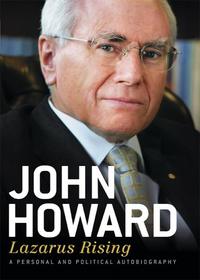
Read the book: «Lazarus Rising»
To my parents, who gave me the values and determination I took into public life
To John Carrick, my mentor, from whom I learned more about politics than anyone else
To my family, whose love and support sustained me through my years in parliament and government
Contents
Cover
PART 1 EARLY LIFE AND THE FRASER GOVERNMENT
1 THE SOURCE
2 INDULGING THE TASTE
3 DRUMMOYNE
4 REGROUPING AND REBUILDING
5 ‘THE ONLY GAME IN TOWN’
6 A SAFE SEAT
7 THE HONOURABLE MEMBER FOR BENNELONG
8 FRASER TAKES OVER
9 THE DISMISSAL
10 A MINISTER
11 ‘MAY I SPEAK TO THE TREASURER?’
12 ‘YOUR INDIRECT TAX IS DEAD, COBBER’
13 FOOLED BY FLINDERS
Picture Section 1
PART 2 THE OPPOSITION YEARS
14 PEACOCK VS HOWARD
15 LEADER BY ACCIDENT
16 JOH FOR PM
17 THE COUP
18 THE ‘UNLOSABLE’ ELECTION
19 LAZARUS HAS HIS TRIPLE BYPASS
20 THE ROAD TO THE LODGE
Picture Section 2
PART 3 THE HOWARD GOVERNMENT
21 SHAPING THE GOVERNMENT
22 SEIZING THE DAY ON GUNS
23 PAULINE HANSON
24 THE FOUNDATION BUDGET
25 THE CHALLENGE OF INDIGENOUS POLICY
26 ON THE WATERFRONT
27 THE HOLY GRAIL OF TAX REFORM
28 WE STILL WANT YOU, MA’AM — THE REPUBLICAN DEBATE
29 THE LIBERATION OF EAST TIMOR
30 AN EXCESS OF EXCISE — THE PRE-TAMPA RECOVERY
31 WASHINGTON, 11 SEPTEMBER 2001
32 MV TAMPA
33 THE BALI ATTACK
34 IRAQ
35 GEORGE BUSH
36 BLUE COLLARS AND GREEN SLEEVES — LATHAM’S IMPLOSION
37 THE HUMAN DIVIDEND
38 SHAKESPEARE IN MANDARIN
39 ASIA FIRST, NOT ASIA ONLY
40 A WONDER DOWN UNDER
41 OUR WARM, DRY LAND
42 BILLY GETS A JOB, BUT WHO CARES?
43 SHOPPING CENTRES, BOARDROOMS AND DRESSING ROOMS
44 THE LEADERSHIP
45 THE TIDE RUNS OUT
46 REFLECTIONS
APPENDIX
NOTES
AUTHOR’S NOTE
INDEX
CREDITS
Copyright
About the Publisher
PART 1 EARLY LIFE AND THE FRASER GOVERNMENT
1 THE SOURCE
Towards the bottom of William Street, Earlwood, in the 1940s there was a paddock; it was next to a baby health centre. Later, the paddock disappeared when a library and new baby health centre were built. Near the end of 1949 that paddock was a hive of activity as the nerve centre of the local efforts to re-elect Daniel Mulcahy as Labor member for the division of Lang, in the federal parliament. The Howard household, at 25 William Street, lay diagonally opposite this paddock. Mulcahy was the first member of parliament I had consciously set eyes on. He wore a three-piece suit and smoked a pipe.
The Labor campaign team for Lang had put up a temporary shed on the paddock. Plenty of people, mainly men, came and went, picking up leaflets and generally looking very busy. This was my first contact with local grassroots election campaigning. Although the suburb of Earlwood then produced a Liberal vote of about 45 to 50 per cent, the Labor Party never had much trouble in holding the seat; the other suburbs in Lang, like Campsie, Canterbury and Belmore, were very solidly Labor.
I knew nothing about Mulcahy other than what my mother told me: he lived in Darling Point, in Sydney’s wealthy eastern suburbs, owned a number of hotels and by reputation was one of the most affluent MPs in the parliament.
I once saw him speaking outside the Earlwood Hotel. Later I heard Liberal supporters say that he only turned up at election time, shouted the bar and on the strength of that got re-elected. I am sure that this was quite unfair, and that he was probably a conscientious member, but that was the typecasting of political opponents.
That Labor shed really interested me. I would stand on the edge of the paddock looking at it and the campaign workers milling around. They gave the impression of doing something important. Observing it began a lifelong fascination of mine with politics. This book is my story of that fascination, my career in Australian and world politics and a commentary on the changes in Australian society and national life during the 60 years which have passed since I first gazed at that shed.
Any narrative of politics must include the shaping and implementation of policies which influence the direction of a nation and as well the constant interaction of personalities, particularly within political parties. The regular swirl of ideas, ambition and egos inevitably produces rivalries and, in some instances, alienation.
In this book I explore the public policy issues I grappled with as a member of parliament for more than 33 years. In addition, I endeavour to deal objectively with the key relationships of my years in politics, the difficulties in them as well as the generosity, loyalty and decency which they involved.
Mum and Dad were born at the tail end of the 19th century, my father in 1896 and my mother in 1899. As such, their lives were forever shaped by the three historic tragedies of the 20th century — World War I, the Great Depression and World War II. To this day I marvel at the stoicism of a generation which coped with the trauma, deprivation and sadness of those epic events, but still kept intact the cohesive and optimistic society which later generations were to inherit.
The American journalist Tom Brokaw called the generation which came of age during the Great Depression and World War II the Greatest Generation, and that phrase has resonated powerfully amongst Americans. That same generation of Australians also is owed an immense debt of gratitude by mine and later generations for what they endured for Australia. In Australia, however, the description of the Greatest Generation would have to belong to the generation before the one of which Brokaw wrote. That was my parents’ generation, because it directly experienced the impact of World War I.
Although America joined the Great War in 1917, its effect on that nation was nothing like it was for Australia. For our nation, no tragedy has matched that of World War I. The loss of life was on a scale that today’s generation would find impossible to come to terms with. Many small country towns never recovered from the staggering losses of their young manhood. To lose more than 60,000 dead, with tens of thousands more blinded and crippled, from a male population of no more than 2.5 million, was a terrible depletion of our precious human resources. Les Carlyon, in his book The Great War, wrote, ‘There were so many of them, and we never really, saw them.’1
Both of my parents left school at the age of 14, as did most children of that era. It was their children’s generation that completed secondary education in large numbers, and often went on to university.
My father, Lyall Falconer Howard, was born at Cowper, near Maclean on the Clarence River in northern New South Wales, the eldest of nine children. He attended Maclean Public School. His parents had very little money, and shortly after leaving school he secured an apprenticeship as a fitter and turner at the Harwood Island Mill, on the Clarence River, owned by Colonial Sugar Refinery (CSR). He enlisted in the Australian Imperial Force (AIF) on 27 January 1916 at the age of 19. His first attempt to join up had been unsuccessful because he did not meet the height requirements. He became a signaller with C Company of the 3rd Pioneer Battalion of the 3rd Division.
After several months training in both Brisbane and Melbourne his unit sailed for England on the Wandilla on 6 June 1916. His youngest sibling, Ian, was barely a year old when my father left on the troopship for Europe. The 3rd Division was commanded by Sir John Monash, certainly the best field commander Australia has ever produced. Many rank him and Sir Arthur Currie of Canada as the most talented commanders of World War I. Monash insisted that his men undergo extensive training in England before being sent to the front.
Dad’s unit spent several months encamped on Salisbury Plain, in Wiltshire, undergoing rigorous training. It left for France late in November. My father spent his first day in the horrible trenches of the Western Front on 1 December 1916, near Armentières.
While my father was at the war, his parents and the remaining eight children moved from Maclean to the suburb of Petersham, in Sydney. My grandfather, who was a marine engineer, had a number of very different jobs in his working life, from harbourmaster at Coffs Harbour to starting what was believed to be the first motion picture show in northern New South Wales, at the Caledonian Hall in Maclean. I suspect that the reason for the family leaving the Clarence during the war was that my grandfather would have found it easier to obtain work in Sydney.
In July 1917, and at the age of 44, my grandfather, Walter Herbert Howard, also enlisted in the 1st AIF. He wound up in the 56th Battalion of the 5th Division, arriving in France during the early part of 1918. Meanwhile, my father had been gassed during a German attack near Messine Ridge, in Belgium, in July 1917; he returned to the front after a brief hospitalisation. For the rest of his life he would experience the aftereffects of the mustard gas he ingested, in the form of weakened lungs and recurring bouts of dermatitis.
The Australian divisions to which my father and grandfather were attached both took part in the Battle of Villers-Bretonneux in April 1918. The gratitude of the villagers from there to les Australiens, who halted a major German advance during the liberation of the town, persists to this day. Villers-Bretonneux is the site of the giant Australian War Memorial to those who perished on the Western Front, and the place where a special Anzac Day ceremony is now held.
Later that year, by a remarkable coincidence, my father and grandfather met near the French village of Clery on 30 August 1918, on the eve of the battle of Mont St Quentin, in which my father’s unit participated. Just three days later my grandfather was wounded in the stomach, evacuated and took no further part in the war.
Eighty-two years later, as Prime Minister of Australia, and with the assistance of the very helpful army defence attaché, Colonel Chris Galvin, from the Australian Embassy in Paris, I was able to establish roughly where my father and grandfather had met up all those years ago.
One of the journalists who accompanied me on that visit, Tony Wright of the Age, described the scene thus:
On Friday, at the village of Clery, between a farmhouse and the great marshes and ponds and swiftly-flowing streams of the Upper Somme River, those experts found for him the most likely spot where his father and grandfather had met. Howard carried with him excerpts from his father’s wartime diary. The entry for August 30 1918, reads simply ‘Met dad at Clery'. Here in Clery, close to the slopes of Mont St Quentin, the site of one of the great battles of World War I, Howard experienced a sort of coming home of the heart. You could see it in his face as he peered intently at the map laid out before him, not heeding the rain falling or the small crowd milling about him.2
Wright had captured the emotion of the occasion for me.
I had attended the 85th anniversary of the landing at Gallipoli, at Anzac Cove, and then called to see President Chirac in Paris before visiting the battlefields. French gratitude for the huge sacrifice of Australia in defence of France, so many years before, was not forgotten. At the beginning of our discussion, the President expressed the thanks of his nation for the war service of my father and grandfather.
It was fairly unusual to have father and son fight in the same war. My grandfather died when I was only nine, and it was only occasionally that I talked to my father about his wartime experiences. His generation were a reticent lot. Who could blame them? They had lived through unimaginable horrors, and to come home alive and intact would have been a miracle to celebrate in itself. All those years ago, veterans were encouraged to forget about things, and not talk about their experiences. That was thought to be the right therapy. There weren’t too many counsellors then, but returned soldiers were welcomed home as heroes, and in addition to repatriation benefits a variety of special schemes were set up to help them.
My father usually marched on Anzac Day, in Sydney, and the family would go and watch the march. The last Anzac Day that he was alive was in 1955. He hadn’t been very well that year so didn’t march. Instead he stayed at home, propped himself up on the couch in our back room, and reminisced with me, his youngest son, about his time on the Western Front 40 years earlier.
He told me of being detailed to escort an Australian officer back from the front, towards the end of the war. When they came under heavy attack the other man panicked, telling my father that he had been at the front for three years and was going on extended leave, and feared he would get hit before he made it to safety. There would have been numerous stories of men who had dodged bullets for several years, only to be hit minutes from the relative safety of being away from the front. I recall the story so vividly because Dad rarely spoke about the war. Like most Australians who served in that conflict, he thought that Australian soldiers were the equal of, or superior to, any others. Dad had no hostility towards the Germans who had been his enemies.
When my father came back from the war, he resumed his apprenticeship with CSR, only this time it was at Pyrmont, in inner Sydney, as his family had decamped there. According to my mother, he was retrenched in the early 1920s, during a slump, when the company had a policy of giving preference to the retention of married employees. My father was then still single.
After my mother left school she was employed doing office work with Nock & Kirby’s, then a well-known Sydney department store, which disappeared as a separate entity in the 1980s. Two of Dad’s sisters also worked in the office at N&K, and it was through them that my parents met.
I took a part-time job with that store in the late 1950s whilst going through university. I was in the pet section for a time, which resulted in Bill Hayden as Opposition leader, years later, dubbing me a budgerigar salesman. The description amused me.
My parents married at the Presbyterian church, Marrickville, on 11 July 1925 and honeymooned at the still-standing Clarendon Guesthouse, Katoomba, in the Blue Mountains west of Sydney.
My mother, born Mona Jane Kell in 1899 in Smith Street, Summer Hill, an inner suburb of Sydney, always found immense security in the familiarity of her home environment. She would often say to me that if she started early in the morning, she could walk to all of the locations in which she had lived and be back at home by lunchtime. Whilst a bit of a stretch, the point being made said a lot about my mother. Mum did not like straying far from her roots, either geographically or the value system by which she lived.
To my mother, family was everything. From her immediate family of husband and four sons to the very large extended Howard family, my mother’s life was all about the welfare and, importantly, the stability of her family. Her early family life had been far from happy: losing her mother to a brain tumour at age eight, and having a father whom she clearly adored, but who was a heavy drinker, she plainly found in my responsible and sober father a source of security and dependability.
The heavy drinking of my grandfather had a lasting impact on my mother. She retained throughout her life a real dread of alcoholism and virtually anything associated with drinking. I enjoy a drink but realised, as the years went by, how deep and understandable had been my mother’s reaction.
Many years ago, drinking habits were different; women drank a lot less. It was very much a male pursuit. Men got drunk at hotels and staggered home, often to the great public embarrassment of their families. There was much less drinking at home than is the case today. For many women and children, the local hotel was anything but a place associated with warm conviviality.
Something else was to touch Mum’s younger years: that was sectarianism. She was a child of what was once called a ‘mixed marriage'; that is, her father was a Protestant and her mother a Catholic. After her mother’s death, although Mum had been baptised a Catholic, her father sent her to a Church of England Sunday school. There was subsequent estrangement with her mother’s family and, given the Catholic/Protestant divide of the time, that action of my grandfather had likely been a cause.
Mum was a good Christian, totally lacking any pretensions in her dealings with others. She was privately devout. Every night she would kneel at her bedside to say her prayers. Sadly, however, she was always self-conscious about the fact that she had been born Catholic, but raised Protestant. For people of her generation, regrettably, those differences mattered much more than would later become the case. For all of her life she retained what I thought to be an unreasonable suspicion of Catholicism. Then I was of a generation which, in the 1960s, would experience the welcome disintegration of sectarianism.
Mum had a sister, May, and a brother, Charlie, and after her father’s remarriage following her mother’s death, two half-brothers, Ted and Arthur. She spoke frequently of her affection for her stepmother, and how fortunate she had been in having her after losing her mother at such an early age.
Premature death returned to Mum’s family in a particularly tragic way, several months before I was born. Ted, who had been diagnosed with epilepsy at the age of 16, suffered a seizure while standing on Newtown Railway Station, in inner Sydney, and fell under an oncoming train. He died from the terrible injuries he sustained. To add to the family’s grief, May, Mum’s sister, was a passenger on the train.
Mum’s family never owned their own home, and always lived in rented accommodation in and around Petersham and Lewisham, inner suburbs of Sydney. I suspect that my grandfather was an unsuccessful punter, and that his gambling habits were strongly disapproved of by both his wife and his elder daughter. Whenever I visited their home as a young child there was a sad atmosphere. As I grew older, and learned more of the background, I understood why.
Grandfather Joe Kell was a great walker. When over 80 he would regularly walk from his home in New Canterbury Road, Petersham, to his daughter May’s place in Wardell Road, Earlwood, a distance of almost 4 kilometres. That is something he passed on to one of his grandsons.
Mum’s brothers, Charlie and Arthur, had both fought in World War II, Charlie in the army, and Arthur in the Royal Australian Air Force (RAAF). Charlie had been part of an army unit guarding the Cowra prisoner of war camp when the Japanese breakout occurred The experience permanently clouded his attitude towards the Japanese because of their behaviour during the breakout.
Charlie’s marriage had broken up by the time I was in my teens, and his only close family were his two sisters. Charlie had always drunk heavily, and his failed marriage only made this worse. I respected the way in which Mum tried to help him, having him home regularly, despite Charlie often being the worse for wear. Her tense reaction whenever he was affected by drink showed just how strongly her childhood experiences of alcoholism had affected her. She often told me that she thought Charlie had had a tough life, frequently mentioning the fact that he had spent the night of his 21st birthday sleeping under a bridge, whilst on the track for work in the Shepparton area of Victoria in the mid-1920s.
My mother and her sister May (Roberts) were very close. May did not marry until her early 40s and had no children. She lived in the same suburb as us and saw a great deal of our family, especially me. We formed a very close bond, as she also did with my brother Bob, when we were all a good deal older. May had a genuinely sunny and positive disposition. To employ a phrase typical of her generation, her life had been no ‘bed of roses', yet she always seemed happy with her lot. She was a wonderful woman, and like my wife’s mother, Beryl Parker, had an extraordinary capacity always to see the best in people. She was a special person and I remember her with very deep love and affection.
Lyall and Mona Howard had four sons: Walter (Wal), born in 1926, Stanley (Stan) in 1930, Robert (Bob) in 1936 and me in 1939. The Great Depression had its impact on family planning.
As best I could describe it, I grew up in a stable, lower middle-class home. When Dad went into business, establishing a garage with his father, he was able to make a reasonably comfortable living for our family. Mum was a full-time homemaker, who dedicated her life to the care and upbringing of her four sons. Mum and Dad were both conservative, patriotic Australians.
The house I grew up in was a Californian bungalow, built in the early 1920s. Earlwood, in Sydney’s inner southwest, was full of them. It was heavily settled after the Great War. Street names such as Flers, Hamilton, Dellwood, Kitchener and Fricourt were testament to that. It was a three-bedroom home, so until I was well into my teens I shared a bedroom with Bob. About my earliest memory was looking at the blackout paper which my parents had placed over the small casement window in the loungeroom. That must have been in 1942, when there were frequent blackouts in Sydney through fear of possible air raids.
Politics was talked a lot at home. From a very early age I listened to discussions about world events, as well as particular issues affecting Sydney and Australia. Being the youngest in the family, it was natural that I imbibed much from my parents and elder brothers.
Towards the end of 1949, I knew that there was an election coming up from the talk at home, seeing the newspapers and listening to the Australian Broadcasting Commission (ABC) news. Mum and Dad were both strong Liberals and had plenty of good things to say about Bob Menzies, then Leader of the Opposition, but soon to become prime minister and to stay in that position longer than any other person in Australian history.
Owning a garage, or service station, my father had been bedevilled from the war years onwards by petrol rationing. Dad would bring home the ration tickets and my brother Bob would join me in counting them on the breakfast-room table. I thought this was a lot of fun, and I missed it when it ended. My parents didn’t. Menzies’ 1949 election promise to remove petrol rationing attracted them greatly, and they were delighted when it was abolished.
Petrol rationing had been an understandable wartime measure, but in peacetime it was a real bugbear for anyone in my father’s business, and motorists generally. It was abolished for a period and then brought back shortly before the 1949 election.
The Labor PM at the time, Ben Chifley, was well liked. To his credit, his Government began the great postwar migration surge — then overseen by his Immigration Minister Arthur Calwell — which helped shape the modern Australia. He also launched the Snowy Mountains Hydro-Electric Scheme, which remains a national development icon.
But when it came to economics, the Chifley Labor Government, in the late ‘40s, remained locked in the wartime mindset of controls and micromanagement of the economy.
Chifley led a government which tried to nationalise the private trading banks. This move galvanised into action many supporters of free enterprise, and not just the banks. Everything had gone wrong for Chifley following his Government’s re-election in 1946. His attempt to nationalise the banks had been rejected as unconstitutional by both the High Court of Australia and the Privy Council. Massive strikes on the NSW coalfields in 1949 produced prolonged blackouts in Sydney. In the end Chifley had to embrace what for a Labor man like him must have been a nightmare: the use of troops on the coalfields to keep essential supplies moving.
The times were clearly right for a man and a party preaching the gospel of competition and fewer government controls. Bob Menzies and the Liberal Party neatly filled the bill. Anyhow, that was what my parents, Lyall and Mona Howard, thought. So did my eldest brother, Wal, the only one of their children then to have a vote.
My parents were part of the ‘forgotten people’ who Menzies had defined in his famous radio broadcast in 1942: they neither belonged to organised labour, nor were rich and powerful. He called them middle class, with the description of ‘salary-earners, shopkeepers, skilled artisans, professional men and women, farmers, and so on'. Mum and Dad aimed to give their four sons more security and more opportunities than they themselves had had. In that, they were successful, for which I and my brothers are eternally grateful.
Several days before the election took place a newspaper I bought carried the headline ‘Final Gallup Poll Predicts Coalition Victory'. On election night, my brother Bob and I had gone to a local picture theatre with our parents. During the screening of the second film, the theatre management displayed a slide which showed that the Coalition had taken an early lead. In those days polling booths remained open until 8 pm.
When we got home, we found my brother Wal sitting on the floor in front of the radio. He said that Menzies had won and that the biggest swing had been in Queensland. On that latter score at least, nothing much has changed in almost 60 years. When the Coalition won government in 1996, Labor was routed in the Sunshine State, and in 2007 the Labor Party achieved a greater swing in that state than in any other part of Australia. Everyone in our household was very happy with the result. Daniel Mulcahy was comfortably returned as the Labor member for Lang. Those shed workers across the road had done their job.
For as long as I can remember, I was a regular listener to sport on ABC Radio, mainly cricket and rugby league. Cricket always came first. I knew the names of Bradman, Miller and Lindwall before I learned the name Menzies. My father took me to the Sydney Cricket Ground on 28 February 1949 to see Don Bradman play for the last time at that ground, in the Kippax-Oldfield Testimonial. It was the only occasion on which I saw the great man play.
I also had a keen interest in boxing. I could recite, in order, all of the heavyweight champions of the world from James J. Corbett onwards. Controversies in boxing, such as the famous long count in the bout between Jack Dempsey and Gene Tunney, enthralled me. I was fascinated when I read that Sydney had hosted a fight for the heavyweight title in 1909 between Tommy Burns and Jack Johnson. In my late teens I went to Sydney Stadium, in Rushcutters Bay, to see several bouts. Years later, when I was in politics, some of my friends were horrified when I confessed to my boyhood interest in boxing. As I grew older I lost interest in it, in part because I realised the terrible damage people suffered, but I had been quite taken by it in my youth.
From a young age I was an avid reader of the Biggles books, authored by Captain W.E. Johns, which told the story of a group of British airmen who not only fought heroically in the Battle of Britain but did other great things in defence of liberty. A little later I devoured books such as Reach for the Sky, by Paul Brickhill, an Australian, which covered the amazing war service of Douglas Bader, who lost both legs but resumed flying in the Royal Air Force (RAF); The Dambusters, the saga of the RAF bombing raids on the dams of the Ruhr Valley; and Nicholas Monsarrat’s classic The Cruel Sea. This book, which like the other two led to a film of the same name, covered the perils and heavy human losses involved in keeping open the sea lanes from Britain to Russia through the North Sea. Barely a decade had passed since the end of World War II and books and films about aspects of that huge conflict abounded.
I read a lot of sporting books, naturally starting with cricket. Two which I still have in the sports section of my bookshelves at home are Straight Hit, co-written by Keith Miller, one of Australia’s greatest-ever all-rounders, and R.S. Whitington. It told of the West Indies’ tour of Australia in 1951–52. I read it again and again over a period of years. The other was A Century of Cricketers, by A.G. ‘Johnny’ Moyes. He had compiled the stories of one hundred famous cricketers, ending in about 1950. Moyes was an accomplished analyst. It was a different era and a vastly different medium, but he was something of a Richie Benaud of radio.
As I grew older my reading tastes expanded to include history as well as biographies. To this day I maintain a marked preference for books in these two categories. My father subscribed to the Saturday Evening Post, a well-illustrated American periodical, which I read thoroughly. It gave me an early feel for some of the differences in both American culture and politics. This was the early 1950s, and hostility to communism came through strongly in the pages of the magazine.
2 INDULGING THE TASTE
Although undecided until my last year at school, I enrolled at Sydney University for a law degree. There is no doubt that I was influenced by my brother Stan having become a lawyer. He became a partner in one of Sydney’s best-known firms, Stephen Jaques and Stephen (much later Mallesons), aged only 27, and would be a most successful and highly regarded corporate lawyer as the years went by.
Thanks to Stan I had a great experience for eight weeks between school and university. He arranged a job for me as an assistant to a barrister’s clerk in Denman Chambers in Phillip Street, Sydney. In Phillip Street, each floor of barristers was looked after by a clerk; the really good ones were invaluable, such as Jack Craig, with whom Stan had arranged my job. The barristers looked after by Jack Craig were some of the best and most colourful then at the Sydney bar. They included Clive Evatt QC, brother of Bert, then still federal Labor leader. The latter often turned up and used the chambers for some of his meetings. The brothers were a big contrast. Clive was likeable and amusing. Bert was sullen and unfriendly. John Kerr was another cared for by Jack Craig. Kerr was friendly and stylish. Amongst other things, I did his banking. He had a good practice.
Another prominent one in the group was Ken Asprey QC, who became a judge, and who in the 1970s would write a report for the federal government recommending major taxation reform. I was just the office boy but, given the personalities involved and the taste of the legal profession I was able to indulge, it was a heady experience. I was very grateful to Stan for setting it up. It was my first paying job. When I served petrol in my father’s garage I was paid son’s rates!
When aged about nine, I had been identified with a hearing problem, during a routine health check conducted at my school. It was an affliction that I had been born with and, whilst something of a nuisance during my younger days, it was not until I entered my later teens that it became a real hindrance. It worsened quite markedly during my first year at university, and by my second year I had to wear a large and not particularly effective hearing aid.
Deafness made it very difficult for me at lectures. I would sit as close as possible to the lecturer with my hearing aid turned up, but still missed a lot. I owed much to some of my law school friends, who generously lent me their notes. Although I was reluctant to admit it to myself at the time, my bad hearing really meant that I could never become a barrister, something which I had had at the back of my mind for a long time. In 1960, I underwent an operation which gave me back some hearing in my right ear, and in 1963 there was a similar operation on my left ear. These two operations gave me about 60 per cent of normal hearing. This was a huge improvement, and I felt very grateful to the surgeon, the late Sir George Halliday.
Despite a restorative operation on my right ear in 1985, my hearing continued to deteriorate, but fortunately the development of modern and inconspicuous hearing aids meant that I have been able to retain reasonably serviceable hearing.
Directly enrolling for a law degree meant that all of my university time was spent at the law school in Phillip Street, Sydney. I only ever went to the main university campus to sit for exams, or attend Union Night debates, which I did fairly frequently. Lectures in Phillip Street were spread amongst the main law school building, the old Phillip Street Theatre and the Teachers Federation Building.
Some 250 enrolled in the first year, of which fewer than 20 were women. Thirty-five years later, when my daughter, Melanie, enrolled at Sydney University Law School, more than 50 per cent of the first-year intake were women.
Like all academic years the class of ‘57 had its share of students who achieved eminence in their chosen profession. It included Terry Cole, later a Supreme Court judge, a Building Industry Royal Commissioner and the man who conducted the Australian Wheat Board Inquiry. There was also Roger Gyles QC, who became a Federal Court judge and had previously been a Special Prosecutor pursuing illegally evaded tax. Murray Gleeson and Michael Kirby, later Chief Justice and a justice, respectively, of the High Court were in the class of ‘58.
My first two years were full-time, and then I commenced three years of articles with a solicitor, attending lectures early in the day and late in the afternoon. With the law school in easy walking distance, such a daily schedule worked smoothly.
My lecturers were a mixture of academics and practising lawyers. The doyen of the academics was Professor Julius Stone, Challis Professor of Jurisprudence and International Law. Julius Stone had a formidable intellect. An erudite English Jew, he had written a landmark textbook on international law. He was a lecturer of mine in 1960, the year in which the Israelis snatched Adolf Eichmann from Argentina and flew him to Israel for trial for his alleged major role in the Holocaust. There was much debate about the legality of what the Israelis had done. Stone held a public lecture on the legality of the Israeli action at the old Assembly Hall in Margaret Street, Sydney. I went to the lecture with three of my law school friends, Marcus Einfeld, Peter Strasser and Murray Tobias, all of whom were Jewish.
It was an emotional issue for them, especially for Peter, whose family had been directly touched by the Holocaust. After the lecture, the four of us stood on the steps of the hall, locked in furious argument about what Stone had said. Despite his understandable sympathy with the Jewish cause, Stone had applied his customary juridical objectivity to the issue. I fully agreed with what Israel had done. Eichmann, who played a key role in implementing the Nazis’ ‘Final Solution’ for the extermination of the Jewish people, decided upon in 1942, was convicted and hanged in Israel.
A relatively young Bill Deane tutored me in the subject of succession (probate and death duties). He became a judge of the High Court, and was appointed Governor-General, on the recommendation of Paul Keating, taking up that position just before the change of government in 1996. Deane’s first major duty as Governor-General was to swear me in as Prime Minister, on 11 March 1996.
I had graduated from the Sydney University Law School in early 1961, and in June 1962, having completed my articles, was admitted to practise as a solicitor of the Supreme Court of New South Wales. My articles were served with one of the most colourful and remarkable people I have ever known, Myer Rosenblum. As a youngster Myer had emigrated from South Africa with his family, who settled in Marrickville, not far from my father’s garage. Myer’s father became a regular customer at the garage. When Myer qualified as a solicitor and commenced his own practice, my father returned the compliment and engaged him as his solicitor.
Myer Rosenblum had very diverse tastes and talents. He had represented Australia at rugby union, having played breakaway (flanker) for the 1928 Waratahs; was a hurdler at the 1932 NSW Championships; represented Australia as a hammer thrower in the 1938 Empire Games in Sydney; and held the NSW hammer throw record for something like 20 years. A cultivated person, he played the bassoon in the Sydney Conservatorium Orchestra, spoke fluent German and Yiddish, and began to teach himself Italian when in his 50s.
My becoming articled to Myer Rosenblum followed the making of close friendships with a number of Jewish students at law school. One of them, Peter Strasser, remains a very close friend. Thus began, for me, a long association with members of the Jewish community in Australia. Those early friendships, and the experience I gained from working with much of the Jewish clientele which Myer’s firm attracted, created within me a deep respect, and in many ways affection, for the Jewish people.
As Prime Minister, I saw to it that Australia remained a staunch ally and friend of Israel. This was more than just a projection onto the international stage of my home-grown regard for Jewish people. I admired the remarkable struggle of the people of Israel against hostile Arab neighbours, and the democratic character of that country.
In 2006, Australia and the United States, almost alone amongst Western democracies, backed Israel in opposing a UN resolution condemning the latter for constructing a wall to protect its people against terrorists. I was staggered at the level of international hostility towards Israel over her action, which seemed to me to be a clear-cut case of self-defence.
Although I had joined the Earlwood branch of the Young Liberals when I was 18, participated in general campaigning for the 1958 federal election in the local area where I lived, and was briefly a member of the Sydney University Liberal Club, it was not until I had left university that I became really active in politics.
Largely due to my hearing problem, I found university quite taxing. I was reluctant to get too heavily involved in other activities until I knew that I would qualify as a lawyer. As a result, my experience was very different from that of many of my colleagues, who cut their teeth on university politics.
Once out of university, I hurled myself into Liberal Party activities, both at a local and NSW level. I took over the presidency of the local Young Liberal branch and became very active in the Youth Council, which comprised delegates from the various Young Liberal branches in the Sydney metropolitan area.
It was easy for cynics to dismiss Young Liberal activities as being entirely social and lacking in political gravitas. That was a superficial judgement. Sure there was plenty of social activity — and of course, why not? — but to those who were so inclined there were ample opportunities for political involvement. The Youth Council was a great forum for debate on contemporary political issues, and the physical participation of young people in local campaigns was especially welcome.
In those days members of parliament (MPs) did not have postal allowances; we were years away from direct-mail campaigns. Hand delivery of pamphlets to individual letterboxes, usually at night, was the staple way of getting the local candidate’s message across.
My first experience of serious organisational politics was my election, in 1962, as the Young Liberal representative on the state executive of the NSW division of the Liberal Party. This body was the power centre of the party in NSW and included the leader and deputy leader of the state parliamentary party as well as the most senior member from New South Wales of the Menzies Government. I was now involved in genuine politics.
It was then that I first really got to know John Carrick, the general secretary of the party in New South Wales, a person who would influence me enormously over the years. He was to become my political mentor. I learned more about politics from John than from any other person I have known.
He had become the party’s general secretary, the chief executive officer, in 1948 at the age of 29. During World War II, when a member of the Sparrow Force in Timor, he was captured by the Japanese and as a prisoner of war spent time working on the infamous Burma–Thailand railway. John would hold the position of general secretary for 23 years, until his election to the Senate in 1971. He became a senior minister in the Fraser Government, and served as Leader of the Government in the Senate, until that government was defeated in 1983.
Possessed of abundant energy, as well as immense organisational skills, John always realised that politics was a battle of ideas — a philosophical contest — and not merely a public relations competition. He drew many people to his orbit through the force of his intellect and his indefatigable commitment to the political cause of the Liberal Party. To him, one of the roles of a general secretary was to act as a constant talent scout for people who might contribute as members of parliament, irrespective of whether they were members of the party.
He formed a close relationship with Menzies, who much admired his tactical and strategic abilities. To my mind, one of John Carrick’s immense contributions to the continuing political success of the Liberal Party was the role he played along with others in persuading the Prime Minister to embrace a policy of direct government assistance to independent (principally Catholic) schools. This change was an important factor in the Liberal victory, federally, in 1963. Thus began the most enduring demographic shift in Australian politics in the past generation, namely the change in allegiance of a whole swag of middle-class Catholic voters, who hitherto had remained loyal to the Labor Party for none other than tribal reasons.
Until the 1960s the ALP was the party of choice for the majority of Australian Catholics. Theology played no part in this; it was driven by socioeconomic factors, with Irish Catholics being predominantly of a working-class background. The sectarianism of earlier generations served to reinforce this alignment. Although the warming of Catholics towards the Liberal Party had begun in earnest with Menzies’ state aid gesture in 1963, the first Fraser cabinet of 1975 still included only one Catholic, Phillip Lynch. Over the coming years the dam would really burst on this old divide. One-half of the final Howard cabinet in 2007 were Catholics. Once again this had nothing to do with religion, it being the inevitable consequence of a socioeconomic realignment.
When education became ‘free, compulsory and secular’ in the 1860s, Australian Catholics resolved to maintain their own school system, at enormous ongoing cost both to parents and the faithful. There was no government help for them. The prevailing view, in a much more sectarian age, was that those who sent their children to Catholic schools should bear the full cost of that choice: the free public system was available to Catholics and Protestants alike. As the decades rolled on, Catholic resentment grew, especially as, there being 20 per cent or so of the school-age population in Catholic schools, the state was relieved of a large financial burden.
By the 1960s attitudes had changed. There was more recognition of the immense sacrifice made by Catholics to keep their education system; sectarianism had begun to crumble and there was a realisation that state schools would not cope if the Catholic system collapsed.
Menzies, the self-styled ‘simply Presbyterian', became persuaded of the justice of the Catholic argument. In the 1963 election campaign he promised money for all schools in Australia to construct science blocks. Inspired politics, it was also cultural balm, and aided the decline of sectarianism. This symbolic breakthrough led over time to extensive funding of independent schools in Australia, with the greatest help going to those who were in most need.
The Menzies thrust was not easily accepted throughout the Liberal Party and internal debate continued to rage. Early in 1964 I pushed a pro-state aid motion through the Youth Council, which struck real turbulence. The Liberal leader in New South Wales (later premier), Bob Askin, remained very sensitive about opposition to the policy within the party and was still to summon the courage to assert the merits of it at a state level in the way that Menzies had federally. During a telephone conversation with me, Askin remonstrated about the pro-state aid position of the Young Liberals, even musing that perhaps the Young Liberals might have to be closed down if they continued to cause trouble. That did not change the Youth Council’s view.
Askin was an earthy and instinctive politician who loved horseracing, rugby league and card playing. He won four elections for the NSW Liberals, far ahead of any other Liberal leader in that state.
The 1963 election was a real triumph for Menzies. He called it a year early and increased his slender majority of two to 22. For me, the personal high of that election was the victory of Tom Hughes QC in the electorate of Parkes. I was still living in Earlwood, which was in this electorate, and was Tom’s campaign director. He needed a swing of some 6 to 7 per cent, something he did not believe that he would achieve. It was a classic grassroots campaign, attracting much high-profile attention.
Tom Hughes came from a well-known family of Sydney’s eastern suburbs. He had served in the RAAF in World War II. He was intelligent and engaging. I took an instant liking to him, and we have remained friends ever since. His Bellevue Hill address did not bother the Liberal locals in Parkes. They liked the way in which he quickly adapted his speaking style from the courtroom to the back of a truck.
Tom had close links with the Packer family, which led to him being dubbed ‘Packer’s pea for Parkes'. He enlisted their help to produce a local campaign newspaper, called the Parkes Examiner. I spent several hours, a week out from the election, in the office of the now defunct magazine the Bulletin, with Clyde Packer, elder brother of Kerry, Tom Hughes and Tom’s younger brother, Robert, working on the newspaper. Robert was at that time quite an accomplished cartoonist. Clyde Packer’s editorial skill did wonders with the copy written by Tom and me.
The incumbent Labor member for Parkes, Leslie Haylen, had a left-wing reputation. He had visited China, and we decided on a cartoon which depicted Haylen dancing arm in arm with the Chinese leader, Mao Zedong. They were doing the ‘Peking two-step'. This was 1963 after all; the Cold War was still in full swing, and consorting with the Chinese communist leadership was not calculated to impress middle Australia.
The 1963 election took place under the shadow of the assassination of President John F. Kennedy. ‘Where were you when Kennedy was assassinated?’ forever and a day would become a question asked of my generation. I was at home in Earlwood, about to leave and meet Tom Hughes in the Campsie shopping centre for some campaigning. My brother Bob telephoned me at about 8.30 am, and said simply, ‘Kennedy has been shot dead in Dallas.’ What more could be said! When I arrived at the campaign headquarters on the way to the Campsie shopping centre, volunteers had already assembled to help with pamphlet distribution. One of them, Roddy Meagher, a brilliant barrister who went on to become a much-admired judge of the Court of Appeal in New South Wales, speculated about the possibility of the Russians taking advantage of the situation.
Whatever one’s politics, and whatever one’s opinion of the quality of Kennedy’s presidency at that time, it was impossible to shake the view that a remarkably talented and attractive young president, offering much hope for the future, had been cut down before he really had a chance to prove himself.
In 1964, as NSW Young Liberal leader, I was a delegate to the federal council meeting of the party in Canberra in April. It was a memorable event for me, as it included my one and only meeting with Sir Robert Menzies. It was at the traditional cocktail party for federal council delegates at the Lodge hosted by the Prime Minister. He was a big man, with a commanding presence, who chatted amiably with the six Young Liberals present. The great man demonstrated his reputed passion for martinis by mixing some for his guests.
Thirty-two years later, on my first weekend at the Lodge as Prime Minister, Janette and I invited Menzies’ daughter, Heather Henderson, and her husband, Peter, over for a drink. We mixed and drank martinis in memory and honour of her late father. I have not had one since; I don’t like them, shaken or stirred, but proper respect had been paid.
There was an unhealthy air of smug self-satisfaction at that 1964 Federal Council meeting. Several speeches, including one from Menzies himself, suggested that the Liberal Party would remain in office indefinitely. As things turned out it was to be more than eight years before the party finally lost, but nonetheless the tone seemed wrong. Perhaps I was not sufficiently attuned to the ‘natural party of government’ sentiment amongst Liberals from Victoria. Henry Bolte had been Premier since 1955 and the Liberals would hold office in that state for a further 18 years.
By contrast, Labor seemed to have an iron grip on power in New South Wales. Moreover, there had been a very heavy swing against the Liberal Party in New South Wales at the 1961 federal election, prior to the 1963 resurgence. By contrast, again despite the recession, the Liberal Party had given no ground to Labor at the 1961 election in Victoria. This had been due, overwhelmingly, to the great bulk of DLP preferences flowing to Menzies.
The DLP emerged from the great Labor split of the mid-1950s, which played a major role in keeping Labor from office until 1972. The split was caused by a clash between, on the one hand, Labor trade unionists and branch members worried about communist influence in the unions and, on the other hand, the rest of the ALP, who regarded the activities of those worried about communist influence as having ulterior motives, subversive to the true interests of the Labor Party.
Those concerned about communist influence banded together in what were called industrial groups, in turn strongly supported by a Catholic lay organisation known as the Movement, led by B.A. (Bob) Santamaria, certainly the most influential person in post-World War II politics never to serve in parliament. Possessed of high intelligence and strong Catholic beliefs, he was a compelling and articulate critic of communism within both the ALP and elsewhere. He was a person for whom I developed enormous respect.
In 1955 the ALP’s National Conference declared membership of the industrial groups as out of bounds for ALP members. Many rank-and-file branch members, especially in Victoria, reacted against this and left the Labor Party. Seven federal Labor MPs resigned to form a new parliamentary Party, later called the DLP. As most Catholics then supported the Labor party, the split caused huge tension within the Church. Senior prelates took different positions: Archbishop Daniel Mannix of Melbourne backed the DLP, whereas his Sydney counterpart, Cardinal Norman Gilroy, urged Catholics to ‘stay in [the ALP] and fight'.
The new party, at first called the Labor Party (Anti-Communist) made a crucial decision to give its second preferences to the Coalition ahead of the ALP when Menzies called an early election for late in 1955, in part to capitalise on the ALP split. Menzies had already seen the split destroy Victoria’s Cain Labor Government; this catapulted Henry Bolte to office, with the help of Labor Party (Anti-Communist) preferences in May 1955. This preference decision was largely justified by the belief of the new party that the ALP’s foreign policy was not sufficiently anti-communist. Even though all of the seven MPs who had resigned from the ALP lost their seats to the Labor Party in the 1955 poll, that preference decision had far-reaching consequences. It conferred a huge advantage on the Liberal Party in marginal seats, not only in 1955 but also in subsequent elections. Normally 90 per cent of DLP preferences flowed to Liberals.
Many Liberals hung on in circumstances where they would otherwise have lost. This made the decisive difference in the 1961 election, which saw a huge swing against the Menzies Government, resulting in its majority being reduced from 32 at the 1958 election, to just two. Amazingly, in Victoria, where the DLP presence was greatest, the Liberal Party did not lose a single seat. In other states, Coalition seats tumbled. The DLP had saved Bob Menzies. He and other Liberals, such as Malcolm Fraser, never forgot this.
In July of 1964 I gave up the leadership of the Young Liberals and went overseas, following the familiar Australian pattern of the time. Go to London, work for a while, then ‘do Europe', return home. Although I added, atypically then, visits to India and Israel on the way across and a period of weeks in Canada and the United States on the way home. In London I worked for solicitors at Ilford, Essex. This frequently took me to the Stratford Magistrates Court, in East London, putting me in touch with a cross-section of Londoners. Representing people charged with all manner of offences was a huge experience, one that I would like to have pursued for longer.
My time in London coincided with the election of the Labour Government led by Harold Wilson, in October 1964. The Conservatives had been in power for 13 years, having been returned to office under Winston Churchill in 1951. Naturally, I volunteered my services to the Conservative Party, and helped out in a very narrowly held Tory constituency in London, Holborn and St Pancras. Polling day was a cultural shock for an Australian. It was all about getting people out to vote, not handing out how-to-vote tickets at polling booths. Voting in Britain is not compulsory. I spent hours running up and down flights of stairs of council flats in inner London, knocking on the doors of people believed to be Conservative voters, reminding them to vote. I was still on this round at 9.30 pm, and given that the polling booths closed at 10 pm, I developed a diminishing belief that the assurances I would receive that ‘She’ll be right, gov’ meant anything. The Tories lost Holborn and St Pancras.
Winston Churchill died whilst I was living in London, and I watched his funeral procession from Ludgate Hill with an English girlfriend. Returning to her home, I then, with her family, viewed a marvellous speech by our own Prime Minister, Sir Robert Menzies, delivered from the crypt of St Paul’s Cathedral. Menzies’ eloquence and sense of history deeply impressed this small English gathering, and left an Australian supporter feeling very proud.
The Britain I experienced was a nation in clear economic decline; worse than that, it had begun to lose that priceless quality of self-belief. I would not return to Britain for another 13 years when, as a junior minister in the Fraser Government, I paid a short visit. The process that I had sensed in 1964 was much further advanced in 1977.
It was to take that remarkable woman Margaret Thatcher to turn around her nation. I don’t remember her promising any revolutions during her 1979 election campaign. She did, however, deliver one in many areas of British life. The most important one was that of self-belief. She restored Britain’s pride and sense of achievement, as well as her economy.
My brief visit to the United States, on the way home from Europe, had me staying at Columbia University in New York with my cousin Glenda Felton (later Adams), who years later would win the Miles Franklin award with her book Dancing on Coral. It was well into 1965 by the time of my visit, and already mounting opposition to American involvement in Vietnam could be felt on university campuses. Not long before, the civil rights movement, led by Martin Luther King, Jr, had grabbed national consciousness. The enthusiasm of student bodies for the civil rights cause was strong and widespread.
When I returned to Australia I found that a full-scale debate was under way, not only about Australia’s involvement, side by side with the United States, in the war in Vietnam, but also about the decision of the Menzies Government, early in 1965, to bring in conscription to obtain the necessary numbers of troops to meet our country’s commitment. This debate was to continue for another seven years, until all of Australia’s combat troops had been withdrawn from South Vietnam. In that time a huge shift in public opinion took place.
Although the introduction of conscription was always a touchy subject, the Australian public began by endorsing the sending of troops to fight with the Americans. Support for the American alliance was strong; in addition, most Australians broadly accepted the so-called domino theory, namely that if one Southeast Asian country fell to communism, then others might follow, and this could bring potential aggressors closer to Australia.
In 1966 Lyndon Johnson became the first serving American President to visit Australia. He received an enthusiastic reception, and at the federal election at the end of the year the Coalition, led by Harold Holt (who had replaced Menzies as Liberal leader in January 1966), won with a significantly increased majority. Although there remained controversy over conscription, the war itself still attracted support; Holt benefited from that. Over time that would change. As the conflict dragged on, seemingly without end, domestic support for Australia’s commitment declined, and with a spitefulness of which this country should be ashamed, many of those opposed to our military support of South Vietnam vented their hostility towards our soldiers.
Labor’s defeat brought Arthur Calwell’s leadership of the Labor Party to an end and delivered stewardship of the opposition to Gough Whitlam, whose intellect, energy and modernity were to transform the Labor Party and make it an election-winning force.
After my return to Australia I re-entered Liberal Party activities wholeheartedly, and within a few months was back on the state executive, not as a Young Liberal but as a representative of the full membership of the party; this was a big step forward, once again putting me at the centre of the party’s affairs in New South Wales. My association with John Carrick strengthened, as it did with Eric Willis, deputy Liberal leader and, by then, a senior minister in the newly elected Askin Government.
From 1967 onwards, I began to participate in debates on Australia’s involvement in Vietnam. Before long they included opponents such as Jim Cairns, the federal Labor MP and future deputy prime minister, who was a relentless critic of the Australian commitment. These were tough encounters, before large and normally hostile audiences, but the political experience was priceless. Many of them were at universities, and they were sometimes euphemistically called ‘teach-ins'.
The bulk of the audiences were strongly opposed to our being in Vietnam. Many academics were active in their criticism of the war. Often they comprised the most vocal part of an audience, asking hostile but effective questions. It is impossible to exaggerate the extent to which this experience hardened me for later political life. Being booed and cat-called by hundreds of students in my late 20s, and receiving abuse delivered without a skerrick of good humour, was not only rigorous training for later public life, it also forced me to confront and be satisfied of the strength of my own beliefs on issues. By 1968 Vietnam had begun to deeply divide the Australian community. There were bitter feelings on the conflict which would only intensify as time passed.
3 DRUMMOYNE
During 1967 I decided to seek the Liberal Party’s nomination for the state seat of Drummoyne. A redistribution of electoral boundaries carried out in 1966 had made the seat winnable for the Liberal Party. A very pro-Labor slice had been removed from the electorate, leaving a small but useful Liberal majority, based on the results obtained in the 1965 election. The electorate was comprised of the suburbs of Drummoyne, Five Dock, Abbotsford, Haberfield and Croydon, all inner-western suburbs of Sydney.
Although my real goal was federal politics, I had the naïve belief that a seat in state parliament was a stepping stone to Canberra. It might have been so in the earlier days of Federation, but it became increasingly less so from the ‘60s onwards.
Also at that time, I saw a superficial connection between most of the law I was practising, such as dealing with commercial leases, other property transactions and common law matters, and state politics. State parliaments enacted most of the laws on which I gave advice.
I was encouraged to seek the Drummoyne nomination by both John Carrick and Eric Willis, who had held the seat of Earlwood since 1950. Through my activities in the local Young Liberals and ordinary party branches in the area, I had come to know Willis extremely well. I liked him a lot. He became something of a public patron of mine, and openly encouraged me to run for Drummoyne. He was Askin’s deputy and heir apparent for nine years. In 1976 he served briefly as premier, then lost narrowly to Neville Wran, after having called an election way too early.
I won the preselection for Drummoyne and set about campaigning for the seat. What I had not taken into calculation was the immense popularity and appeal of the sitting Labor member for Drummoyne, Reg Coady. He was a likeable, knockabout and hard-working local member. Partly crippled with polio at an early age, he continued, as a bachelor, to live in the old family home in Leichhardt. He had been an official in the union representing brewery workers and was a classic example of the committed Irish-Catholic working-class member of the Labor Party.
Whenever we met, he killed me with kindness, never saying anything critical of me. On the upcoming election his standard public lament was that because of the redistribution he had no hope of winning. It worked a treat. After a few months it was obvious to me that I’d face a real uphill battle to win the seat.
There was a lot of local resentment within the Liberal Party at my having won the preselection. Most of it came from a number of aldermen on the local council who had contested the preselection. Although I moved into the area, I continued to be regarded as an outsider, and a young, inexperienced one at that. Everywhere I went I was told what a decent, hard-working man Reg Coady was. This came back to me even from hardened Liberals.
I sensed that many people thought it unfair Coady might be removed as the member. And even some strong Liberals thought that they could have both a state Liberal Government and Reg Coady as their local member. The local Liberal Party branches were small, but willing to help. Many of my friends and family members came to assist in the campaign, but at no stage did I feel that I had gained any traction. I would comfort myself by regularly looking at the figures from the 1965 election, which showed that I should win.
The election was scheduled for 28 February 1968. It had been just under three years since the election of the Askin Government, and there was a widespread belief that the Government would gain ground against Labor at the election. Three seats, including Drummoyne, were generally regarded as near-certain wins for the Government. It had performed well during its first three years. Having been in office for almost 25 years before its defeat, the Labor Party was seen as tired and needing fresh blood at the top.
One of the other seats thought to be an easy Liberal win was the newly created seat of Fuller, which adjoined Drummoyne, and for which Peter Coleman, the journalist and former editor of the Bulletin magazine, had been chosen. I could not know it at the time, but both Coleman and the seat of Fuller would touch my life considerably in the future. Fuller included suburbs such as Gladesville, Hunters Hill and East Ryde, all within the federal electorate of Bennelong.
Reg Coady achieved a swing of about 3 per cent, which was contrary to a state-wide movement to the Liberals elsewhere, and held Drummoyne by 839 votes. Given the general result, it was a remarkable performance and a tribute to his hard work and popularity as a local member. It was a grim night for me and my supporters. When the first tally came in from a booth in Haberfield, then a pro-Liberal area, the sign was ominous. Malcolm Mackay, the federal member for the area, was with me that night and flinched at that first result. He lived in Haberfield, and would himself face the voters within a year or 18 months.
I was devastated by the outcome. In a climate which had been favourable to the Liberal Party, there had been a swing against me. There could be no excuses; I had been beaten by a much better man in a seat to which he had become deeply attached. Certainly I was young, not inexperienced in a political sense, but still very raw when it came to community activism, particularly when pitted against a sitting member who knew his electorate intimately. Coady had tentacles which reached into every organisation of any moment in the area.
The outcome was an early and hard lesson for me about the maturity of the voting public in Australia. Despite the condescending attitude of many commentators, the voters are very deliberate, and know what they are doing. In Drummoyne, on 28 February 1968, sufficient numbers of them knew that they could hang onto their well-loved Reg Coady and still keep the Askin Government, and as for that young fellow Howard, he was a bit of a blow-in anyway and could wait his turn.
When the result was known on the night, and quite on impulse, I went to the Labor campaign headquarters to congratulate Coady. The civic centre in Great North Road, Five Dock, was jam-packed with people celebrating a stunning victory. I made a short speech, paying tribute to him and the decency of his campaign. Not surprisingly, they liked that, and the mayor of Drummoyne, a Labor stalwart, Peg Armitage, who still possessed the rich brogue of her native Belfast, pulled me aside and said, ‘I hope you get a safe Liberal seat.’ It was the sort of generous remark, no doubt well meant, which the luxury of a political triumph encourages. Several years later, and after I had entered parliament as the member for Bennelong, which at that stage was a fairly safe Liberal electorate, I ran into Peg and reminded her of that comment. She seemed pleased for me; by that time she had become very disillusioned with the Labor Party.
The range of people who had come to the civic centre that night bore testament to the pull of a very popular local member. Many were staunch Labor people, proud of what they had brought off, but quite a lot were there because of Reg Coady, and would, in other circumstances, have voted Liberal. Local sporting and community leaders were thick on the ground.
It had been a big mistake going for Drummoyne, but I didn’t think so when I nominated. Even more importantly, it was a blessing that I had lost — I certainly didn’t think that then! I thought that I had let down the party and had blown a golden opportunity to get into parliament at the age of only 28. Moreover, I felt the loss had put paid to my future prospects of preselection, federal or state. I went through the miseries for quite a while. Amongst other things, I had failed all those family and friends who had toiled for me. My mother had upended her life by moving house with me to Drummoyne, and had then worked incredibly hard in the campaign.
That was the jumble of thoughts that consumed me in the wake of the Drummoyne defeat. It became crystal clear later, after I had won preselection for Bennelong, that my loss in Drummoyne had been a huge stroke of good fortune. If I had won Drummoyne it would have only been by the narrowest of margins, the demographics of the area were to move for some years against the Liberals, and with the natural swing of the pendulum I might have had no more than two terms and then lost.
Perfect field evidence for this piece of ex post facto rationalisation was, ironically, provided by my marginal-seat candidate in arms from 1968, Peter Coleman. He succeeded in Fuller where I had failed in Drummoyne. Sir John Cramer, the member for Bennelong, which enveloped Fuller, announced in 1973 that he would not fight the next federal election, and predictably Peter Coleman sought Liberal endorsement for Bennelong. So did I, and I was successful, beating him in the final ballot. So the 1968 state election failure had defeated a 1968 success, for a much greater prize than either had been aiming for in 1968. Apart from again demonstrating the vagaries of politics, it illustrated the difficulty of transferring from state to federal politics, particularly when any degree of marginality is involved.
Drummoyne had one marvellous human interest story which was a reminder of the often conflicting loyalties in politics. For many years Bill Brown had been the superintendent of the Sunday school at Earlwood Methodist Church, which I attended from early childhood. He was a Geordie, having come from Newcastle-on-Tyne as a young man to work with Dorman Long, the company that built the Sydney Harbour Bridge. He was a staunch unionist and Labor supporter. Bill typified the strong link there had always been between the organised labour movement and the Methodist Church in Great Britain. One wouldn’t meet a finer practical Christian. For a number of years I had helped him in running the Sunday school at Earlwood.
Bill and his wife had moved to Drummoyne to live, and I caught up with them when I began attending the Drummoyne Methodist Church. As the election approached, he sought me out to discuss the voting intentions of him and his wife. He said that in other circumstances both of them would have followed their normal loyalty and voted Labor. My being the Liberal candidate had complicated things. Bill told me that, after a lot of soul-searching, they had decided that one of them would vote for me and the other, as usual, vote Labor. I didn’t ask which would be which. I was pleased to know that I would receive at least one vote from the Brown household. I was quite touched by their gesture.
4 REGROUPING AND REBUILDING
I stayed in Drummoyne after my 1968 loss, even though I knew that I would never run for the seat again. It was a question of regrouping, and working out where I went next in politics. Besides, I had more or less agreed to be Malcolm Mackay’s campaign director, in the federal seat of Evans, at the election due at the end of 1969. It was going to be a tough fight for him; Gough Whitlam had given the Labor Party a new edge, and at least some movement back to Labor from the devastating loss of 1966 seemed likely. Evans would need a lot of work to hold. Mackay was a good local member. He listened well to people’s concerns, and both he and his wife, Ruth, had established close links with key organisations.
We had become good friends. The Mackays welcomed me into their home and we swapped thoughts on all political issues. I was in constant touch with Malcolm through the drama-packed days which followed Harold Holt’s drowning on 17 December 1967. In fact I had been at his home in Haberfield when news that Holt was missing came through. It was such an Australian tragedy. The Prime Minister had apparently drowned after plunging into a rough surf at Cheviot Beach near Portsea in Victoria. His body was never found.
John McEwen, Deputy Prime Minister and Leader of the Country Party, announced that the Country Party would not serve in a government led by Holt’s Liberal Party deputy and Treasurer, Bill McMahon. That complicated the imminent leadership stoush within the party. Due to the McEwen veto, McMahon ruled himself out of contention. Mackay started out as a supporter of 64-year-old Paul Hasluck, but over time, I watched him shift to John Gorton, who was energetic in pursuit of his leadership ambitions. This contrasted with Hasluck’s ‘merit unheralded’ approach, which shunned overt convassing for support.
The real clincher for Gorton, however, was his appearances on television in the lead-up to the leadership vote. His relaxed laconic manner, coupled with his crumpled war-hero face, really appealed to viewers. He was new. Most Australians had not previously noticed him. On first blush they liked him a lot; he gave direct answers and clearly wanted the job. He was the first person to win the leadership of a major political party in Australia largely through the force of his television appearances.
I remained on the party’s state executive and, therefore, heavily involved in the party’s organisational affairs. This was also the time when I went into partnership with Peter Truman, and the following year we were joined by John Nelson to form the firm Truman, Nelson and Howard. Although my passion for politics never receded, this was a period when I derived considerable satisfaction from the practice of law. The firm had offices in Pitt Street, Sydney.
There was nothing quite like having a direct stake in the business. It was a mixed practice, and I handled any variety of work. I had carriage of any litigation which came the firm’s way, including divorce work. I didn’t like doing divorce work very much, but it was part of the practice and someone had to look after it. Time and time again I was reminded of how irrational people would become when a formerly close relationship had broken down altogether. Levels of intelligence or wealth made no difference to the degrees of irrationality.
I drew much professional encouragement from a personal injury case I ran on behalf of a man called Bozanic. He was an immigrant from the old Yugoslavia, and had been injured whilst working on the Snowy Mountains Hydro-Electric Scheme. The injuries he sustained resulted from his being thrown from a loader. Bozanic had tried a number of solicitors who, after a while, told him he did not have a strong enough case. I felt sorry for him and took his case on, essentially on a speculative basis.
It took a long time for a hearing date to be fixed, and at times I wondered about the wisdom of having taken on the matter in the first place. The poor man had been referred to me by a friend in the Liberal Party who felt that because of his age and poor language skills Bozanic had been pushed around. The date of the court hearing finally arrived; the case went extremely well, and Bozanic was awarded $40,000 plus costs. In 1969, given the nature of his injuries, this was a terrific outcome. To me this was a good example of how the law could be used to help someone who really needed assistance.
The 1969 election saw Harold Holt’s 1966 majority of 38 reduced to seven. Whitlam outperformed Gorton during the campaign. At one stage, there had been real concern that Gorton might lose. He came to Mackay’s electorate, where I presided at a Liberal Party dinner held at the Western Suburbs Leagues Club, in Ashfield. He was late for the dinner because he had detoured to the members’ room of the club to have a game of darts and a beer with local club members. Some at the dinner were aggravated by this, but next morning a marvellous photo appeared in the Sydney Morning Herald showing the Prime Minister throwing darts. This kind of behaviour now by prime ministers would be regarded as quite commonplace and natural, but 40 years ago it was seen by some as unconventional.
John Gorton made no secret of his liking for parties and conviviality. This would not have mattered if he had applied more discipline and routine hard work to the job of being prime minister. He had an appealing personality, a direct style and was extremely intelligent. It was his lack of general discipline over such things as punctuality that did him damage. I had not been attracted to him when he was chosen as the party’s leader and would have preferred Paul Hasluck, but several people close to me, such as Tom Hughes, were strong Gorton supporters, and suffered in their own careers when Gorton was later removed as prime minister. I maintained my scepticism throughout his time in office. In later years, however, I changed my mind about Gorton.
The experience of government led me to identify more strongly with Gorton’s nationalistic views. During the last few years of his life I saw him and his wife, Nancy, often, and I felt that we had become quite good friends, overcoming earlier estrangement on account, firstly, of my closeness to Malcolm Fraser, whom he loathed, and my rivalry with Andrew Peacock, who had been a Gorton supporter. I spoke at a wonderful dinner to mark Gorton’s 90th birthday on 7 September 2001 and felt honoured to launch his biography, written by Ian Hancock.
Although he won the 1969 election, Gorton lost a lot of seats and had to beat off leadership challenges from both David Fairbairn, a senior minister from New South Wales, and Bill McMahon, then still deputy Liberal leader. By this time, John McEwen had dropped his veto of McMahon, a sure sign that the Country Party had grown uneasy with Gorton’s governing style.
It was an inauspicious start to a new term of government, having an incumbent prime minister challenged by two of his ministers. Gough Whitlam’s impressive performance in the campaign added to the list of ominous signs. Yet so lengthy had been the Coalition’s grip on power that the possibility of being defeated by Labor was still not seriously entertained by many people.
About this time, my brother Bob began to question his earlier support for the Liberals, and by the early 1970s he had joined the ALP. I respected his right to change his opinion and his political allegiance and, for that reason, I never asked him exactly why he had shifted. Over the years I divined that it had been a case of two people growing up in the same environment ultimately having a different take on events and society. For example, where I responded positively to people defeating disadvantage by personal initiative, Bob was repelled by the disadvantage and the fact that not all people could overcome it. That is where he saw a larger role for government. He opposed Australia’s involvement in the Vietnam War, but that was a companion to his change of political heart, not the main driver.
For several years Bob had been a Liberal Party member. Like me, he is an activist, and he became quite heavily involved in the local branches in the Earlwood area. He and his wife were living there. Later, and after they had moved to Armidale so that Bob could continue his studies at New England University, his political leanings shifted.
Although her personal commitment to the Liberal cause never faltered, our mother worried that politics would divide Bob from the rest of the family. Sometimes she asked that we steer clear of too many political discussions when all of us were together. Mum was especially anxious about our traditional family gathering on Christmas night, 1975. Bob, by then a staunch Labor man, was in high dudgeon about the dismissal of the Whitlam Government, and had been shattered by the electoral rout of his party. To cap it all, his young brother had just been made a minister by the dreaded Malcolm Fraser. It was a bit tense, but we made it.
Both of us were determined not to allow our political differences to come between us and, although we had plenty of intense arguments, particularly over the 1975 dismissal of Whitlam, this did not happen. By contrast Wal and Stan, my other brothers, who had always been Liberal followers, increased their active involvement and support, particularly after I entered parliament. Wal had been an enthusiastic branch office-bearer for years, and Stan would help out in a variety of ways, including with fund-raising.
In the 33 years that I was in parliament, including some of those difficult opposition years, Wal and Stan were loyal and consistent backers. They were the ultimate in true believers. And it was not just the loyalty that I valued. As a small businessman for much of his working life, Wal was a constant window into a world so important to the Liberal Party’s base of support. Stan was a senior partner for many years in one of Australia’s largest legal firms (Mallesons) and his professional activities gave him insights into the thinking of corporate Australia. In different ways they were both great sources of counsel and advice.
During the years that I was Prime Minister, Wal, Stan and their families joined Janette, me and our children in election-night celebrations (commiserations on one occasion), as well as other landmark events. Naturally Bob did not. He did, however, find personal ways of marking my success, consistent with his ongoing Labor convictions. When I was sworn in as Prime Minister on 11 March 1996, Bob came to the first part of the ceremony, when I took my oath of office alongside Tim Fischer as Deputy Prime Minister. Bob gave the rest a miss; that involved the swearing in of the remainder of the new Government. ‘You’ve got to draw the line somewhere,’ he joked. Likewise, he didn’t come to a large Liberal Party celebration of my 30 years in parliament in 2004, but instead asked me and my family to his home for a dinner to mark the occasion. Today we continue to discuss politics in an avid fashion, but with a sense of detachment.
My mother left me with a fount of old aphorisms and sayings, some of which endure today, others having slipped out of usage. ‘It’s a long road that has no turning’ is one that has largely disappeared. ‘Blood is thicker than water', though, remains a reasonably commonplace expression. It most certainly applied to the way my family handled political differences within.
5 ‘THE ONLY GAME IN TOWN’
The year 1970 was to be, for me, at a personal level, momentous. On 14 February I met Janette Parker, and was immediately smitten. She was a fantastic mix of brains and good looks. Fittingly, I suppose, the meeting had a political context. There was a by-election that day for the seat of Randwick, in the NSW Legislative Assembly. The previous incumbent, Lionel Bowen, had been elected as the federal Labor member for the seat of Kingsford Smith at the election late in 1969. The Labor candidate for Randwick was a very youthful Laurie Brereton, who became a senior minister both in state and federal Labor governments.
Janette had agreed to hand out how-to-vote tickets for the Liberal candidate, John McLaughlin, who, by coincidence, had been a law school colleague of mine a decade earlier. He had no chance of winning, and the Liberal campaign was very much a flag-flying exercise.
I had played cricket in the afternoon, but arrived in the electorate to help with scrutineering after the close of the polls at 8 pm. When the count had been completed, Liberal workers gathered at the Centennial Park home of a barrister, Malcolm Broun, to engage in the obligatory wake. It was there that Janette and I met.
From then on, we saw each other constantly. Janette was a high school teacher. She taught English and history at St Catherine’s Girls School, at Waverley, in Sydney. Before and after being at St Catherine’s Janette also taught, respectively, at Randwick Girls High School and at Killarney Heights High School. Though Janette never harboured a desire to enter the political arena herself, she was fascinated by the ongoing nature of the political contest. Over the years we have often agreed that politics is ‘the only game in town'.
Our views were similar on many issues, and she was a natural Liberal supporter, but her assessments were always self-generated. Like me, Janette had grown up in a household where both of her parents discussed politics. Her father, Charles Parker, had worked for the NSW railways, having joined the railway workshop in Newcastle as a young man prior to World War II. By the time of his retirement in 1973, he had risen to the position of Chief Civil Engineer. Although he held conservative views on most issues, because he had always been a public servant, he came at them often from a different perspective to mine.
Janette’s support and counsel throughout my career has been invaluable. To share a common interest in one’s vocation with one’s life’s partner is a real blessing. I know many politicians whose wives or husbands simply do not like politics and are constantly urging them, in one fashion or another, to leave the political arena. That never happened to me. From the start of our relationship Janette knew that my heart was set on a political career.
We became engaged in January 1971, and married on 4 April 1971 at St Peter’s Anglican Church, Watsons Bay, the local parish church attended by Janette and her mother. It is a beautiful church, perched on a cliff right beside the ocean, and close to the lighthouse at Watsons Bay. My best man was Alan Plumb, a fellow Young Liberal, who remains a close friend.
After we married, Janette and I rented a home unit in north Lane Cove, in the electorate of Bennelong. The Bennelong Liberal MP Sir John Cramer was 75 and would likely retire in the near future. I had firmly fixed my sights on winning preselection for that seat when Cramer went.
1970 ended poorly for both John Gorton and the Liberal Party. The Coalition fared very badly at a half-Senate election held in November. His detractors quickly blamed Gorton for the result. This added to the pressure on the Prime Minister.
The legendary political journalist Alan Reid had a colourful saying to describe a situation within a political party where an event, coming from nowhere, could bring about sudden change, usually of leadership. He would speak of there being ‘plenty of dry grass around', meaning that the leader’s position was inherently unstable, and all that was needed was for someone to throw a match to the dry grass. That was the position for John Gorton early in 1971. The person who threw the match was Malcolm Fraser.
Fraser had been one of John Gorton’s principal backers in 1968, when Gorton secured the leadership to succeed Holt and became PM. Yet it was Fraser quitting the Government, followed by a searing resignation speech, which triggered the events producing Gorton’s removal. Fraser had resigned because of what he regarded as Gorton’s disloyalty to him as Defence Minister, concerning press reports damaging to Fraser of army activities in Vietnam. He believed that Gorton could easily have stopped the story appearing, but had been content to let it go ahead — to Fraser’s embarrassment. In his speech Fraser went way beyond the immediate cause of his resignation, delivering a general broadside against Gorton’s style of government. This provoked the moving of a motion of confidence in Gorton in the party room which was sensationally tied — 33 each. Gorton used his casting vote to oust himself, thus surrendering the prime ministership.
The totally chaotic, and hopelessly compromised, way in which the Liberals changed from Gorton to McMahon was a symptom and not the cause of the party’s malaise after so long in office. Contested leadership changes should only occur where a majority clearly believe that an alternative to the incumbent can do a better job. In 1971, McMahon was not the preferred choice over Gorton. Rather, half the party room, for a whole variety of reasons, could no longer stomach Gorton. This was as much a reflection on their lack of foresight as it was on Gorton’s failings as a leader. They must have known that McMahon was the only alternative to Gorton.
The personal animosity which flowed from the manner of Gorton’s removal as prime minister was the most intense that I have ever seen in politics. Gorton never forgave Fraser for his perceived betrayal. In March 1975, when Malcolm Fraser was elected Leader of the Liberal Party, Gorton, who had voted for Snedden, immediately the result of the ballot was announced, walked out of the party room, slamming the door behind him, and never returned to the room again. In the 1975 election, sadly, the former Liberal Prime Minister contested a Senate seat from the ACT as an independent.
On two occasions I witnessed the refusal, some 30 years after the events of early 1971, of John Gorton to speak to Malcolm Fraser. One was at a Liberal Party dinner in the Great Hall of Parliament House to mark the 50th anniversary of the election of the Menzies Government, when Malcolm Fraser, John Gorton and I, with our wives, were left together as the last entrants to the dinner. Janette looked after the Gortons; I entertained Malcolm and Tamie. The other occasion was a formal dinner hosted by the Queen and Prince Philip at Buckingham Palace, where the six of us plus Gough Whitlam and Bob Hawke and their wives, Margaret and Blanche respectively, were also present. This dinner was one of a series of events honouring the centenary of the passage through the British Parliament of the Australian Constitution Act. With typical Buckingham Palace efficiency, the seating arrangements made appropriate allowance for all sensitivities, and no difficulties arose. I have reflected since that Her Majesty would not have minded Gorton’s intransigence, because he was the only one of her former Australian prime ministers who would have voted for her in the republic referendum in October 1999!1
Thirty-one years after Gorton’s deposing as leader, Tom Hughes, his former Attorney General, delivered the eulogy at Gorton’s state memorial service in Sydney. It consisted, largely, of a blow-by-blow account of what he saw as Malcolm Fraser’s dishonourable role in Gorton’s downfall. In the eulogy Hughes traversed many of the points of criticism of Gorton contained in Fraser’s resignation speech, rebutting all of them. It was an amazing performance, and largely reflected Hughes’ loyalty towards Gorton.
Towards the end of 1971, Tom Hughes presented me with an unexpected opportunity to obtain preselection for a safe seat in federal parliament. Disillusioned with federal politics, he had decided to retire from parliament and return full-time to the Sydney bar. McMahon had sacked him as Attorney General. Few people saw this as anything other than a pay-off to Gorton’s opponents within the party. It was an unwise and spiteful act. Hughes had been an extremely good Attorney General; on merit he should have been left there. His seat of Berowra was very safe and attracted a huge field. I lived a fair distance from the area, however had lots of Liberal Party contacts there, including my eldest brother, Wal, who was the president of one of the local branches.
Several people encouraged me to stand, including some who wished me out of the way of their own ambitions in other seats they believed would become vacant through retirements within the next few years. The party was fast reaching a stage when there would be a batch of sitting members retiring in seats like Bennelong, North Sydney, Mackellar, Bradfield and Wentworth. These were safe Liberal seats, and a once-in-a-generation cornucopia of opportunity for those wanting to get into federal parliament.
The fact that I did not live in Berowra at the time was not a problem. I had not long married and it would be quite easy for Janette and me to move to the electorate. My pitch to the preselectors was very much that, although young, I had a lot of political experience on my side. Preselection campaigns then were not as ‘full on’ as they are now. Too much overt campaigning could be counter-productive. Making sure that, on the day, the speech delivered and answers to questions were the best possible meant everything — even more so than now.
I didn’t win the preselection; it went to a local resident, Dr Harry Edwards, who was a professor of economics at Macquarie University. It became apparent prior to the ballot that many local branch members wanted somebody strongly identified with the electorate. I did, however, poll much better than anyone expected. I finished third behind Edwards and the local state member, Jim Cameron.
This surprised a lot of people, particularly given the high profile of other aspirants, such as the Commonwealth Solicitor General, Bob Ellicott QC, and Dr Peter Baume, a highly respected consultant physician. They both won seats in parliament at the 1974 federal election. The outcome boosted my stocks in the party. Incidentally, my brother Wal was precluded by party rules from sitting on the preselection committee. The Liberal Party in New South Wales, to its credit, is a lot stricter about family influences than is the Labor Party.
My morale-boosting performance in Berowra was followed by an unexpected request to assist the Prime Minister, Bill McMahon, in the two months immediately prior to the 1972 election. By that time I was metropolitan vice-president of the party in New South Wales. I was asked to go full-time onto his staff, to assist with liaison between his office and the party organisation as well as provide some campaign advice and help out with speechwriting. After some arm-twisting by my two partners (one of them kept saying, ‘John, it’s time'), I secured the necessary leave from my practice and hurled myself into what turned out to be the final weeks of 23 years of Coalition Government in Australia.
I travelled around Australia with McMahon and, despite some hilarious and erratic moments, took from the experience a healthy respect for the dignified manner in which he accepted defeat on 2 December 1972. Janette and I were both with him at his home in Drumalbyn Road, Bellevue Hill, and he showed a lot of grace under pressure. Later, we drowned our sorrows with those great Liberal stalwarts John and Sue Atwill, at their nearby Woollahra home. Whitlam, despite the length of time the Coalition had been in office and the skill of Labor’s advertising campaign, won by only nine seats. As was the case in 2007, the swing in Western Australia was to the Coalition and not to Labor.
Having spent so long in the wilderness, it was natural that Whitlam and his colleagues would luxuriate in the very experience of being in government. Yet shrewder political heads would have detected warning signs in the narrowness of his victory. It was not the clear rejection of the Coalition that the Fraser defeat represented in 1983, and it was narrower than Kevin Rudd’s victory in 2007. And on the other side, of course, it was nothing like the thumping victories achieved by the Coalition in 1975 and 1996. The truth is, despite all the hype and mythmaking of a generation, the Australian public barely thought that it was time in 1972.
The obverse of this was that a narrow defeat for the Coalition left it with a false sense of complacency about the need for fundamental policy reassessment. Both the ALP and the Coalition went to the watershed election of 1972 on the assumption that the good economic times would continue to roll on. In his Blacktown policy speech, Gough Whitlam declared that Labor would fund its vast public sector expansion from ‘the huge and automatic increase in Commonwealth revenue'.2 He fantasised about annual growth rates of 6 or 7 per cent a year, displaying fearful ignorance of the economic task ahead. When the economic upheaval flowing from the quadrupling of oil prices and the collapse of the old Bretton Woods-inspired fixed exchange system hit Australia, the responses of the ALP Government would massively aggravate rather than mitigate their effects. Labor would be hounded from office in 1975, with its economic reputation in tatters.
The early 1970s were a period of huge global economic change and turmoil, yet the two major political parties in Australia contrived in their different ways to ignore this. Whitlam had no coherent economic plan for government; that is why he proved completely unable to handle economic adversity when it confronted him.
Most in the Coalition felt that having only just lost, there was no need for a full policy appraisal. There were plenty of reviews, but there was no fundamental examination of such things as the heavy regulation of the Australian economy, our high tariffs or our increasingly out-of-date taxation system. As for any questioning of centralised wage fixation, that was not even thought to be a problem.
Like most people, I assumed that Whitlam would govern uninterrupted for three years. There was no perception of what lay ahead, or what Labor had in store for the Australian people.
The story of the disintegration of the Whitlam Government has been told in much detail many times. Labor inherited a strong economy, with low unemployment and apparently good prospects for growth. Whitlam assumed that the benign economic conditions, which he had seen as the natural order of things in Australia, would simply go on. From the start he was uninterested in economic issues and paid little attention to mounting inflationary pressures. By October 1973 when OPEC countries quadrupled the price of oil, with all the inflationary consequences that entailed, inflation in Australia already stood at 10 per cent — well above what it had been less than 12 months earlier. Worldwide inflation became the big problem, and national governments were required to manage their economies with imagination and flexibility and take hard decisions which courted short-term unpopularity, not lazily assume that the good times would always be there.
Whitlam found economics irksome, far less exciting than the foreign excursions and progressive social posturing that he had been elected to champion. This disconnection between the needs of the nation and the disposition of its leader was to prove very damaging to the former and fatal to the latter. Although the chaos of 1975 is seen as basic to Labor’s annihilation at the end of that year, the Government’s fate was really sealed in 1973 when, in the face of a clear need for a fresh policy direction, Whitlam ploughed on regardless.
He never once confronted the Australian people with the reality of the times and, therefore, the need for a different approach. He may well have been surprised with the response he would have received.
Australians are pragmatic, worldly people who respond well to governments which ask of them difficult things, provided they are taken into the confidence of the Government, and the nature of the national interest is laid out.
If Whitlam had told the people very directly in 1973 that the altered world circumstances meant that many parts of his electoral platform must either be put to one side or at least deferred, the popularity he still then enjoyed as the first Labor prime minister in a generation would have carried the day.
When the people decide to change their government, they cut the new man a lot of slack. They are slow to admit to themselves that they may have made a mistake. As a consequence, the public will accept a change in the direction of a fresh government early in its new term, provided a proper explanation is given. Gough Whitlam seemed oblivious to these political realities. He received an early warning from the electorate that they were not all that enchanted with the beginnings of his Government when Labor suffered a swing of 7 per cent against it in the Parramatta by-election held in September 1973. The seat was won by Philip Ruddock. He became a close and trusted colleague in my Government. Philip was an excellent Immigration Minister and Attorney General. In March of 2010 he became the third-longest-serving member of the House of Representatives since Federation.
The swing in the by-election was much larger than might have been expected for a newly elected government after less than 12 months in office. A lot of this was due to growing unease about the economy; some to the already apparent erraticism in the new Government’s style; and, as a local issue, Gough Whitlam’s arrogant declaration that the people of western Sydney would have the city’s second airport at Galston (which was close to the Parramatta electorate) didn’t help matters for Labor.
The by-election should have been a real warning for Whitlam, but it wasn’t. If anything, he pushed even harder on the accelerator. It gave Bill Snedden, the Opposition leader, a huge boost, perhaps engendering some of the false optimism which led the opposition to threaten the blocking of supply some months later.
The Liberal Party of late 1973 was static, policy-wise. Its personnel were beginning to change, but only gradually and not at the top. Certainly McMahon had gone from the leadership, but not from parliament. Nigel Bowen had gone to the Bench, but other big names from government days, such as Snedden, Lynch, Fraser, Peacock and Chipp remained, as did the National Country Party trio of Doug Anthony, Ian Sinclair and Peter Nixon. In fact, given the length of time the Coalition had been in power prior to 1972, there was remarkably little turnover. That was because those occupying senior positions were still relatively young themselves. Those on the backbench tended to be older, and it was there that generational change would begin in 1974.
Meanwhile, Janette and I had scraped together enough money to buy a home unit near Wollstonecraft station, in Sydney. It is the suburb in which we lived until I became Prime Minister, and the suburb to which we returned after the end of my parliamentary career. One of our happy recollections of living at the unit was to wake up on Sunday mornings to the sound of tennis being played on the grass court in a large home next door. That home was owned by the L’Estrange family. Dr Jim L’Estrange was one of Sydney’s most respected paediatricians. He was highly regarded in the Catholic Church, which conferred on him the honour of a papal knighthood. One of his sons, Michael, would become one of my closest advisors as PM.
6 A SAFE SEAT
As 1973 drew to a close, Australians had begun to feel nervous about Whitlam’s lack of interest in economic matters. They were also troubled by Lionel Murphy’s provocative ‘raid’ on the Australian Security Intelligence Organisation (ASIO), when, accompanied by federal police, he marched unannounced on the agency’s headquarters demanding access to papers. The Attorney General did not usually behave like this. ASIO may not have been everyone’s cup of tea, but it was pledged to protect the national interest. Murphy also tried to radically change the divorce laws by regulation, rather than legislation. Inevitably this was blocked by the Senate. The new Government was beginning to unsettle people.
Ensconced in our unit in Wollstonecraft, Janette and I were blissfully enjoying the early years of married life. Politics remained the main preoccupation. From almost the moment we had met, it was common ground between us that I would go into politics. I wanted it, and Janette wanted it for me. I had standing and respect in Liberal circles, but the challenge was to realise my ambition.
In the second half of 1973, the NSW division of the Liberal Party decided to call nominations for the preselection of candidates for safe seats in the federal parliament. I knew the moment of truth had arrived. It was inevitable that there would be a number of retirements, and possibly serious challenges to other sitting members of long standing. Both John Cramer in Bennelong and Harry Turner in Bradfield announced that they would retire. Naturally, I nominated for Bennelong, where we lived. I knew that I faced a tough battle.
My principal rival was Peter Coleman, the state MLA for the electorate of Fuller, which was entirely enclosed within Bennelong.
Coleman had a lot of support. Cramer backed him quite strongly, regarding me as a bit of an interloper, and because I was metropolitan vice-president of the division, he saw me as the head-office candidate. That was not entirely accurate. Although I had a close association with John Carrick and, as well, had developed a good friendship with Jim Carlton, the new general secretary, both of them had a high regard for Peter Coleman.
The committee to choose a candidate then comprised 50 people. Thirty were from the local branches in Bennelong, broadly according to the membership size of each branch, and the remainder from the membership of the state executive and the state council of the party. The logic of this approach was that a mixture of locals and others, with the locals having a majority, would more often than not produce the right result.
It will sound self-serving but, at that time, I thought this was a very balanced way to choose candidates. Some years ago I became a strong supporter of the branch plebiscite system, in which every financial member of the party in a given electorate, perhaps subject to some minimum membership time, has a vote. I have more to say about this at the conclusion of the book.
I knew virtually all of the 50 people who were to make the choice in Bennelong; some well, others only casually. Apart from Coleman and me, there were 21 other candidates. It was a very strong field. Although not absolutely blue-ribbon, Bennelong at that time was regarded as a safe Liberal seat.
Campaigning for the preselection meant some personal visits — but not too many, because the culture of the party at that time deprecated the hard sell — as well as participating in various branch forums with question-and-answer sessions. I had a good idea how the 20 people from state executive/state council would vote, but was less certain about how the locals would go. Bennelong was exactly composed of the two state electorates: Fuller, held by Coleman, and Lane Cove, held by Ken McCaw, Attorney General in the Askin Government, who pretty well kept out of local party political matters. The branches in Fuller were loyal to Coleman, but those from the Lane Cove end were up for grabs.
There was a bit of drama the day before the preselection. Whitlam had called a referendum to secure Commonwealth power to control both prices and wages. It was an unworkable notion, and despite public concern about inflation, the proposal was doomed to defeat. Liberal workers in Bennelong, including most of the preselectors, manned polling booths in support of the ‘no’ case. John Cramer, as the sitting member, visited all of the booths in his electorate, and lobbied hard for Coleman.
Some of Coleman’s supporters alleged that I had not done enough to keep the polling places in my part of the electorate adequately staffed with volunteers. These were signs that I was seen as a big threat to Coleman, who many observers originally had assumed would walk it in because he was already a local state member. My mood was far from good the night before the fateful day, which had been appointed for Sunday 9 December 1973 at the Menzies Hotel in Sydney. I was very nervous about what had happened during Saturday, and Janette had to keep telling me to concentrate on my speech and forget about other things.
There was a lot at stake for me. This would be my third preselection. I had won the first, for Drummoyne, but had failed to win the seat. I had lost the second, Berowra, but had done better than expected. If I missed out on Bennelong, the view might form that perhaps I wouldn’t end up making it. This was, after all, where Janette and I had made our home. If the Liberals of Bennelong knocked me back, what particular appeal might I have to those in other Sydney electorates? Bradfield was no longer available. Its preselection had been held the previous Friday and had been won by David Connolly, a serving diplomat. A preselection was scheduled for Wentworth within a few days and, although I could have flowed on to it under the party’s rules, that would have looked like an afterthought. The sitting member, Leslie Bury, a former Treasurer, was facing a strong challenge from Bob Ellicott, the Commonwealth Solicitor General, and there wouldn’t have been many spare votes around for a latecomer whose first choice had been another seat.
A lot hung on the Bennelong outcome, and it was a gruelling day. All of the candidates were assembled in front of the preselection committee, and the rules explained. Voting was by secret exhaustive ballot. That meant, in the absence of a tie, preselectors were always asked to write on a ballot paper the name of the candidate they wanted to be the Liberal representative in the electorate concerned.
Each candidate was to address the preselection committee for a maximum of eight minutes and then a period of seven minutes was allowed for questions. With large fields of candidates, such as in Bennelong in 1973, the field was reduced to six (unless of course a candidate had secured an absolute majority), who were invited to address the committee again for a shortened period, with an equally truncated time for questions. After this, the balloting resumed until a candidate was chosen.
The tension during the day was extraordinary. Candidates could not listen in on any of their opponents. There was a candidates’ room, and although we were free to come and go, no fraternising with preselectors was allowed. There was plenty of false bonhomie, but the whole day seemed to go on for an eternity.
I expected to make the final six. The real question was what happened after that. There is no rule of thumb about the type of speech which will appeal to a preselection committee. It depends entirely on the man or woman seeking selection, the character of the electorate and the political circumstances of the time. In my case I decided that, because the best quality I thought I could bring to the Liberals of Bennelong was a political appreciation of the circumstances in which the Liberals found themselves in 1973, I would focus on what was needed for the Liberal Party to win back political support in the Australian community.
Quite a lot of new, youngish business and professional people had joined branches in Bennelong, especially in the Lane Cove and Longueville areas. They were already angry with the economic policies of the Whitlam Government, and wanted a road map for a return to Liberal government. That was the pitch I took. The mood amongst many Liberal supporters was that while, in a very short period of time, the economy had begun to deteriorate, they were not at all sure that the Liberal Party had either the policies or the political strategy to offer an effective alternative. I intended to tell the preselectors of Bennelong what those policies and that strategy should be. Australia needed to stop spending recklessly, get on top of inflation, understand how the world economy had changed and stop insulting our traditional friends, such as the United States.
As I expected, I made the final six and was called to make my second speech and answer more questions. During my second appearance I sensed an interest in what I was saying beyond what I had experienced earlier in the day. It could have been imagination, but I nonetheless felt that. When the final six had made their speeches and answered further questions, the balloting recommenced, and finally Jim Carlton, who was returning officer, came to the candidates’ room and said that there was a result and that all of the candidates should join the preselectors for the announcement of the winner.
Back in the meeting room, Carlton was asked to declare the ballot. I shall never forget this moment. He announced that the ballot had been properly conducted and that ‘Mr J.W. Howard has been chosen as the candidate for Bennelong.’ In the final ballot I had defeated Coleman by 28 to 20. Two members of the committee had not turned up. At least one of them, I felt, would have been a certain supporter of mine. It’s as well he wasn’t needed.
It is impossible to exaggerate the significance of this moment in the life of someone who had dedicated his career to the profession of representative politics. I had achieved something that I had wanted for most of my adult life. I now knew that, all things being equal, I would be a member of the House of Representatives after the next federal election. I also knew that if I worked hard and was available to, and regularly communicated with, the Liberal Party branches in Bennelong, I would remain in parliament for a long time.
There was absolutely no doubt about my intention, or indeed ability, to both work hard and look after my Liberal Party branches. Already Janette and I had immersed ourselves in the activities of the Liberal Party in Bennelong. We had made, even at this early stage, some new and close friendships, particularly with people who had come into the party in reaction to the policies of the Whitlam Government.
As soon as I could decently escape the aftermath of the ballot result I rang Janette, who was overjoyed with the result. She came into the Menzies Hotel to collect me, and we invited plenty of people to the unit at Wollstonecraft for a celebration. It was a day that I would never forget, for the simple reason that it had launched me on a parliamentary career, which would be as secure as any in that uncertain profession could be. To say this is to put into context the real significance, in a parliamentary system, of winning the endorsement of one’s party for a seat in parliament. I have never forgotten my Liberal Party roots. I would never have been a member of parliament without the Liberal Party, nor a minister, and certainly not prime minister.
The evening of 9 December 1973 had been a high point, career-wise. The next day that experience was trumped by Janette informing me that she was pregnant. That was fantastic news. She had known for a few days, but had held back from telling me until after the preselection. It was one of many examples, throughout our life together, of the care and sensitivity she displayed towards my political career.
In the space of a few days my life had been irrevocably changed. We were thrilled at the prospect of having children. They have been not only the joy but, equally, the great success of our lives. To watch one’s children grow to adulthood, to see their professional and other achievements, but most preciously of all maintain a close and loving relationship with each of them, and also observe their obvious affection for each other, is the most rewarding experience imaginable. For me it dwarfs anything I may have realised in public life. I don’t say that lightly; I am proud of what I did in politics, but I am even prouder of what my family represents.
The Bennelong branches were very accepting of the result. Peter Coleman was most friendly; we both realised that we would need to work closely together looking after our common constituents. Eight years later, and after he had lost his state seat to the Neville Wran juggernaut of 1978, Peter entered federal parliament as the member for Wentworth. His daughter Tanya married Peter Costello in 1982. I continued working in my practice, expecting it to be some two years before my partners and I would need to work out arrangements once I entered parliament.
Janette and I indulged in some desultory house hunting, feeling that much as we liked our unit, we should have a house for our children to grow up in. Nine months later we bought a Federation-era house in a nearby street in Wollstonecraft. It needed a lot of work, but was by far the best investment we ever made. It was renovated and extended through the years, with a whole storey being added in the early 1980s. It was the house in which our children were raised; it remained vacant for almost 12 years whilst I was Prime Minister, and it was the home to which Janette and I returned after the election loss in November 2007. Incredibly, by the time we bought the house, in October 1974, I had already been a member of parliament for five months.
Despite Whitlam winning government in 1972, the Coalition, the DLP and independents controlled the Senate. As a result, many of the Whitlam Government’s initiatives in sensitive areas were blocked by the Senate. There were constant allegations that the Coalition was behaving in a negative fashion, although most of those who made those allegations ignored the frequent declarations made by both Gough Whitlam and Lionel Murphy, in earlier years, that it was the role of the Senate to oppose government legislation with which it disagreed.
Despite being aware, from closely following events in Canberra, that a lot of government legislation had been blocked, it came as a surprise to me when the opposition threatened to block supply in April 1974.
The catalyst had been Whitlam’s appointment of the DLP senator and former Queensland Premier Vince Gair as Australian Ambassador to Ireland. This appointment was designed to ensure there would be a sixth Senate vacancy from Queensland in the half-Senate election which Whitlam had called for 18 May 1974. If six vacancies were being filled from Queensland, there was a chance that the ALP could win control of the Senate. But Whitlam would be outsmarted in this ploy by the Premier of Queensland, Joh Bjelke-Petersen, who advised the Queensland Governor to issue the writs for the five Senate vacancies from that state normally up for election, separately from the vacancy caused by Gair’s appointment to Ireland. This meant that the Gair vacancy would be treated as a casual one; under the Constitution, casual Senate vacancies are filled by state parliaments.
There was plenty of Coalition outrage over the Gair Affair, and a lot of Liberal supporters wanted an early poll, but in the broader community, although there was growing disillusionment with the Whitlam Government, there was still a fundamental sense that the Government should be given a fair go. After all, Vince Gair had not been the first politically expedient diplomatic appointment. To my mind, the most reprehensible feature of the whole affair was Gair’s betrayal of his own party, the DLP, by doing the political bidding of the ALP for personal advancement. He was deservedly expelled from the DLP. It was the beginning of the end for the party. Its remaining senators would lose their seats in the coming election.
Whitlam responded to the Coalition threat by seeking and obtaining from the Governor-General, Sir Paul Hasluck, a double dissolution based on previous Senate rejection of several government bills. The election was to be on the same date, 18 May, originally chosen for a quiet half-Senate poll. In a double dissolution election, every Senate seat is vacant, so the original shenanigans about the Gair vacancy became academic.
Personally, I was pleased at the prospect of an early election. Within the space of a week, I went from being an endorsed Liberal candidate for an election still at least 18 months away to being someone who should start campaigning immediately. At long last I could get my teeth into the real business of winning a seat in parliament.
Naturally I campaigned entirely in Bennelong. My campaign was opened at St Mark’s Anglican Church hall in Hunters Hill by Andrew Peacock, shadow minister for Foreign Affairs. He was destined in the years ahead to play a major role in my political life. The local campaign attracted plenty of helpers.
Local branches of the ALP voted to install the left-wing legal activist Jim Staples as their Bennelong candidate. The Labor Party head office, however, would not have a bar of Staples, so they imposed the writer, and Whitlam confidant, Richard Hall as the ALP candidate.
Although I had nervous moments, particularly on the night of the election before the first results came in, deep down I expected to win Bennelong. I was far from sure, however, about the overall result. Whitlam campaigned extremely well, and was able to exploit the claim that his government had not been given a fair go. On the face of it this was a good argument. There had been a Coalition Government for 23 years, yet after less than 18 months the newly elected Labor Government had been forced to go back to the people by the non-Labor majority in the Senate.
One of the problems the Coalition had was that it had not really completed serious policy work when the election was called. This made it easier for Whitlam to claim that we were not ready for government. Much play was made of an intensive policy weekend which produced the Coalition’s manifesto ‘The Way Ahead'. Policy written in the pressure cooker of a weekend, in the shadow of an election which has already been called, is unlikely to be well thought through.
For my campaign we had established an office in Lane Cove Plaza. Although she was five months pregnant, Janette worked very hard and thoroughly enjoyed the campaign. She is a meticulous organiser and kept me and many others up to the mark with campaign tasks. I treated it as a marginal seat campaign.
Bennelong had scores of active community groups, particularly in areas of nature conservation. It also had, in 1974, an active Women’s Electoral Lobby, which played a particularly prominent role in the campaign with candidates’ forums, questionnaires and the like. The convener of the Bennelong WEL was Janelle Kidman, mother of Nicole. She, her husband, Antony, and children lived in the electorate at Longueville. They were strong Labor supporters.
They were cordial to me but I had no doubt that the majority of WEL’s members were sympathetic to Labor’s social agenda. The main WEL meeting was held at the Lane Cove Town Hall, attended by hundreds of people. I was asked my opinion about abortion; not surprisingly my rather conservative response caused an audible intake of breath from most of those in the audience. I hadn’t tried to sugar-coat the reply; that wins no one’s respect. On sensitive social issues it is always desirable to be direct and clear.
On polling day, 18 May 1974, it rained heavily all day, and must have been a nightmare for the booth workers. There were a record number of candidates for the Senate, and as a consequence the large how-to-vote papers became very sodden and cumbersome. It was a long day as I worked my way around each of the 34 polling booths in the electorate.
I went home to our unit in Wollstonecraft for dinner at 7 pm. I didn’t eat a lot, as I was very nervous. Janette’s parents came over for dinner and drove up to the campaign office with us. I had arranged for my mother to come to the office with one of my brothers. Wal and Stan had worked on polling booths during the day. We all waited in the campaign rooms, the arrangement being that as soon as a booth count had been completed, a scrutineer would ring through the result.
The first result was rung through at about 8.38 pm, and it was from the Congregational hall in Lane Cove. They were good figures, showing a lift in the Liberal vote of about 6 per cent. Figures then came in rapidly, and it became very apparent that not only had I won, but I had increased the majority won by Cramer in 1972. I had no reason to get delusions of grandeur, but it had been a good outcome. Nonetheless, Bennelong was not as blue-ribbon as Bradfield or North Sydney. The two-party-preferred Liberal vote was only 53–54 per cent. I would need to work hard. Having, at the age of 34, achieved my longstanding ambition to be a member of the national parliament, I had every intention of doing just that.
There had been a small swing against the Labor Government nationwide, its majority falling from nine to five seats. The Senate count took six weeks to complete, with the ALP picking up an extra three seats in the upper house. The initial reaction had been that Snedden had fought a good campaign and there was little doubt that he would be re-elected unopposed as leader. Nevertheless there remained, amongst many, real doubts about him as leader in the longer term. I shared those doubts. Even then I was attracted to Malcolm Fraser as a possible leader of the party. It was a tough judgement to make, but to me Bill Snedden seemed out of his depth as leader against Whitlam. There was too much bluster and not enough substance. He did not have strong philosophical positions on anything. I barely knew Fraser, but he seemed to have policy substance and clear attitudes on certain foreign policy issues.
Ironically, given his later change of heart on the issue, I had first been drawn to Fraser several years earlier when he had strongly and effectively argued the case for Australia’s involvement in Vietnam. He did a much better job than any other minister, or either Holt or Gorton. Fraser had presence and seemed to possess that streak of toughness and ruthlessness needed in a political leader. Although economic policy would dominate so much of my political thinking and action in the years ahead, at the time I entered parliament, foreign affairs was uppermost in my mind. It seemed that Malcolm Fraser’s attitudes on this subject were very close to mine.
After the election I remained a partner in my firm. There was no conflict of interest and I wanted to retain as much contact with the law as possible, feeling that this added to my usefulness as a member of parliament. Naturally I was not able to do as much work.
John Cramer had maintained his electorate office in the Commonwealth Bank building in Martin Place. So I decided, for the time being, to follow suit. Many of my federal colleagues from New South Wales, such as John Carrick and Bob Cotton, also had their offices there. It is a stylish old building and was used for cabinet, ministerial and parliamentary purposes up until the mid-1980s, when the Hawke Government finally agreed to the repeated urgings of the bank and shifted the last of the cabinet and ministerial facilities to the current Commonwealth Parliamentary Office in 70 Phillip Street, where they remain to this day.
The free sample has ended.