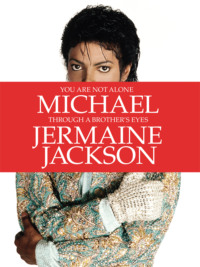
Read the book: «You Are Not Alone: Michael, Through a Brother’s Eyes»
YOU ARE NOT ALONE
Michael Through a Brother’s Eyes
Jermaine Jackson

Epigraph
I have built a monument more lasting than bronze and higher than the royal palace of the Pyramids. I shall not totally die, and a great part of me will live beyond death. I will keep growing, fresh with the praise of posterity.
– Horace, 23 BC
Contents
Title Page
Epigraph
Prologue – 2005
The Beginning – The Early Years
1. Eternal Child
2. 2300 Jackson Street
3. God’s Gift
4. Just Kids With a Dream
5. Cry Freedom
6. Motown University
7. Jackson-mania
The Middle – The Hayvenhurst Years
8. Life Lessons
9. Growing Pains
10. Separate Ways
11. Moonwalking
12. Animal Kingdom
13. The Hardest Victory
14. The Reunion Party
The End – The Neverland Years
15. Once Said …
16. Forever Neverland
17. Body of Lies
18. Love, Chess and Destiny
19. Unbreakable
20. 14 White Doves
21. The Comeback King
22. Gone Too Soon
Photographic Insert
Epilogue – Smile
Acknowledgements
About the Author
Credits
Copyright
About the Publisher
Prologue
2005
THE BATHROOM MIRROR AT A LITTLE hotel in Santa Maria, California, is fogged with condensation, and there is so much steam from my morning shower that my reflection is rendered invisible. As I stand at the sink, dripping wet and wrapped in a towel, the opaque glass is now nothing but an inviting canvas of mist on which to log a thought I have been repeating in my head.
‘MICHAEL JACKSON 1,000% INNOCENT’, I daub with my finger, ending with a full-stop that I convert into a smiley-face. Believe in the happy ending.
I stare at this message and focus on a visualised outcome: victory, justice and vindication. It is 10 March 2005: day 11 of the courthouse circus that sees my brother accused of child molestation.
‘MICHAEL JACKSON 1,000% INNOCENT’, I read again. I continue to stare at the top left corner of the mirror, watching the smiley-face start to run. Transfixed, I flash back to Michael’s bathroom at the Hayvenhurst estate in Encino, outside Los Angeles – his home prior to Neverland – and know that I am mimicking in 2005 what he did in 1982. Back then, in the top left corner of his mirror, he took a black felt permanent marker – to match the black marble – and scrawled: ‘THRILLER! 100 MILLION SALES … SELL OUT STADIUMS’.
Think it, see it, believe it, make it happen. Will it into reality, as taught to us in childhood by our mother, Katherine, and father, Joseph. ‘You can do this … you can do this,’ I can hear Joseph insisting during early, scratchy rehearsals as the Jackson 5, ‘we’re doing this over and over until you get it right. Think about it, say it, see yourself doing it, visualise it happening … and it will happen.’ Plant it in your head and focus with all your heart, Mother added, more gently. This was drilled into our young minds decades before positive-thinking became fashionable. Our minds are preprogrammed not to entertain doubt or half-heartedness.
Michael knew the scale of the breakthrough, innovation and success he desired as a solo artist with the Thriller album, so that one thought transcribed on his mirror was his positive starting point. Years after his move to Neverland, the permanence of the pen’s marker had flaked and the message appeared to have disappeared to the naked eye, yet it had left its imprint embedded in the glass, because each time that mirror fogged, the faintest outline of his words could still be seen, as if it were one of those secret codes written by a magic pen. Condensation and misted glass always remind me of Michael’s written ambition.
From the eighties, nobody knew about a lot of what he created until its execution, but the idea or concept was written down somewhere he could see it daily, or recited into a voice recorder as a visualisation he could see or hear. He didn’t share ideas because he didn’t want anyone to interfere; he relied on mental strength for his focus. Between November 2003 – when he was arrested and charged – and this day in March 2005, he’s needed that strength.
Awake at 4.30am each day of the trial, he’s bracing himself, getting prepared, psyching himself up to withstand another day of ritual humiliation.
Yesterday, 9 March, Gavin Arvizo, the 15-year-old boy being showcased as ‘the victim’, began his incredulous testimony, going into graphic detail. I was seated behind Michael the whole time, as I have been since the start.
Outwardly, my brother projects a hardened image: detached, expressionless, almost cold. Inwardly, the bolted brackets that had been holding him together are snapping violently under pressure, one by one.
I look at my mirrored message now fading as the air rushes in, but the intent remains stark: Michael will be found innocent. I would carve it into my grandmother’s gravestone if I could. Think it, see it, believe it, make it happen.
But whatever intent I put out there is not enough to remove the ache and worry we feel as a family. I find myself constantly reflecting, going back to a time when we believed Hollywood to be only a magical place; when we believed in the Yellow Brick Road.
I watch the local news on the television in my room, looking ahead to day 11 of the trial. I think of Michael at Neverland. The cars will be pulling up in the courtyard. He will have been up four hours, eaten breakfast on a silver tray in his room, alone – stealing time on his own – before coming downstairs, giving himself 45 minutes between departure and arrival. His routine is clockwork, organised like some back-stage itinerary.
I think of all he has achieved, and all he is now being put through.
How has something so beautiful turned so twisted and ugly? Did fame do it? Is this the end-game in the American Dream when a black man achieves success on this magnitude? Is this what happens when an artist becomes bigger than his record label? Is this about publishing rights? Ruin the man, keep the money-machine?
These are the questions that race through my mind.
Are his Hollywood friends and one-time attorneys, allies and producers staying away because they regard him as nuclear – treating friendship like a sponsorship deal? What about those divisive people who whispered into a malleable ear that we, his family, should be kept at a distance, not trusted. Why aren’t they alongside him now, whispering encouragement and support?
Michael is fast realising who his friends aren’t, and what family means. But now his liberty is at stake, and everything he has built up is in danger of collapsing. I want to turn back time: lift the needle off the record and return us to the first track as the Jackson 5 – a time of togetherness, unity and brotherhood. ‘All for one, and one for all,’ as Mother used to say.
I play this eternal game of ‘What If?’ in my head and can’t help but think that we could have – should have – handled things differently, especially with Michael. We stood off him too much when he wanted his space and that allowed vultures into the vacuum. We allowed outsiders in. I should have done more. Stood my ground. Barged down the gates of Neverland when the people around him never let me in. I should have seen this coming and been there to protect him. I feel a dereliction of duty in the promise of brotherhood we always had.
The cell-phone rings. It’s Mother, sounding alarmed. ‘Michael is at the hospital … We’re here with him … He’s slipped and fallen. It’s his back.’
‘I’m on my way,’ I say, already out the door.
The hotel is equidistant from the Santa Maria courthouse and Neverland, and the hospital is a short detour. I’m met at a side entrance by a hospital manager to avoid any fuss out front.
On the hospital’s second-floor corridor, I see an unusual number of nurses and patients hanging around and an audible fuss dies down as I approach. A presidential-style phalanx of familiar dark-suited bodyguards is clustered around a closed door to a private room. They step aside to allow me to enter.
Inside, the curtains are drawn.
In the half-light, Michael is standing, wearing patterned blue pyjama pants and a black jacket. ‘Hi, Erms,’ he says, in almost a whisper.
‘Are you okay?’ I ask.
‘I just hurt my back.’ He forces a smile.
The fall at the ranch, when getting out of the shower, has left him in miserable pain and it appears to be the final punch at a time when life keeps pounding him. But he’s a child molester, right? He deserves this, right? The police must have some hard evidence, or he wouldn’t be on trial, right? People have a lot to learn about how wrong this trial is.
Mother and Joseph are the only other people here, sitting against the wall to my right; they are like me in not knowing what to do but be present and appear strong. Michael winces with the pain in his rib-cage and lower back, but I sense his mental pain is far greater.
In the past week, I have witnessed his physical disintegration. At 46 years old, his lean dancer’s body has withered to a fragile frame; his walk has become a pained, faltering gait; his dazzle is reduced to that forced smile; he looks gaunt, haggard.
I hate what it’s doing to him and I want it to stop. I want to scream for the scream that Michael has never had in him.
As he stands, he talks about the court testimony yesterday. ‘They are putting me through this to finish me … to turn everyone against me. It’s their plan … it’s a plan,’ he says.
Our father has never been one for deep emotional examination and, as Michael talks, I can see him itching to divert the conversation towards other plans: a concert in China.
‘Your sense of timing is not good, Joe!’ Mother tells him in admonishment.
‘What better time is there than now?’ he says. That’s Joseph. Very direct, and interpreting this time away from court as a small window to discuss something other than the trial. ‘It’ll take his mind off things,’ he adds.
It doesn’t surprise or sidetrack Michael. Like the rest of us, he’s used to it and understands that this is Joseph’s way. I interpret it as a father’s ploy to deflect his own worry about events he can’t control; to look beyond the trial to a time when Michael is free and able to perform again. Indicate light at the end of the tunnel. But it doesn’t feel like a distraction, it feels inappropriate. Anyway, my brother keeps talking. ‘What have I done but good? I don’t understand …’
I know what he’s thinking: he’s done nothing but create music to entertain and spread the message of hope, love and humanity, and awareness of how we should be with one another – especially with children – yet he is accused of harming a child. It’s akin to putting Santa Claus on trial for entering the bedrooms of children.
There is not one shred of evidence to justify this trial. The FBI knows it. The police know it. Sony knows it. (This irrefutable truth would be confirmed by an FBI statement in 2009, making it clear after my brother’s death that there was never any evidence to support any allegation in 16 years of investigations.) The authorities are just making something fit in 2005. Think it, see it, believe it, make it happen. The negative version.
Michael lifts his eyes from the floor. He looks the saddest I have ever seen him, but I can tell he just wants to talk. Up until now, he has rarely released his emotions in front of us. He has been controlled and resolute, speaking about his faith, how he trusts the judge of God, not the judge in a robe. But his controlled demeanour is now undone, no doubt triggered by yesterday’s testimony, and compounded by the frustration of this back injury.
It’s all becoming too much.
‘Everything they say about me is untrue. Why are they saying these things?’
‘Oh, baby …’ says Mother, but Michael’s hand rises. He’s still talking.
‘They’re saying all these horrible things about me. I’m this. I’m that. I’m bleaching my skin. I’m hurting kids. I would never … It’s untrue, it’s all untrue,’ he says, his voice quiet, quivering.
He starts pulling at his jacket, like an exasperated child wanting out of a costume, shifting on to both his feet, ignoring his back pain.
‘Michael …’ Mother starts.
But the tears are coming now. ‘They can accuse me and make the world think they’re so right, but they are so wrong … they are so wrong.’
Joseph is paralysed by this show of emotion. Mother’s hands are to her face. Michael pulls at his jacket buttons and starts struggling out of its sleeves. It falls off his shoulders and hangs backwards from his upper arms, revealing his bare chest.
He is sobbing. ‘Look at me! … Look at me! I’m the most misunderstood person in the world!’ He breaks down.
He stands in front of us, head bowed, as if he feels shame. It is the first time I have seen the true extent of his skin condition and it shocks me. His self-consciousness is such that he has kept his body hidden from even his family until now. His torso is light brown, splashed with vast areas and blotches of white, spreading across his upper chest; one patch of white covers his ribs and stomach, another runs down his side, and blotches cover one shoulder and upper arm. There is more white than brown, his natural skin colour: he looks like a white man splashed with coffee. This is the skin condition – the vitiligo – that a cynical world says he doesn’t have, preferring to believe that he bleaches his skin.
‘I’ve tried to inspire … I’ve tried to teach …’ and his voice trails off as Mother goes to comfort him.
‘God knows the truth. God knows the truth,’ she keeps repeating.
We all surround him, unable to hug him tight due to his back, but it is comfort nonetheless. I help put his jacket back on. ‘Just be strong, Michael,’ I said. ‘Everything’s going to be all right.’
It doesn’t take him long to compose himself and he apologises. ‘I’m strong. I’m okay,’ he says.
I leave him with my parents, vowing to return to the trial after a visit overseas. The brothers are taking it in shifts to provide support and I’ll be back in a few days.
After I leave, the bodyguards convey a message relayed from his attorney, Tom Mesereau, at the courthouse. The judge is not happy that Michael is late, and if he’s not in court within the hour, his bail will be revoked. Even his genuine pain is not honoured or believed.
At the hotel, I finish packing and watch my brother’s delayed arrival at court on television. Shielded by an umbrella to protect his skin from the sun, he shuffles along just as I left him: in his pyjama bottoms and black jacket, now wearing a white undershirt. Joseph and a bodyguard stand either side, holding him steady.
Michael had always wanted to appear pristine and dignified for his trial, choosing his wardrobe carefully. To enter like this, in his pyjamas, will be making him cringe inwardly. This whole circus seems to be careening out of control … and we are only ten days in.
I grab the hotel phone and make a call. The person on the other end of the line provides the reassurance that I needed to hear one more time: Yes, the private jet is still available. Yes, it can be at Van Nuys airport. Yes, everything has been arranged. Yes, we are ready to go whenever you are. All that is required is a day’s notice, and this DC-8 with four engines will have Michael up in the air and heading east – to Bahrain – to start a new life away from the scam of American justice. After this charade, I’m happy to disown my citizenship and take Michael, and his family, to a place where they can’t touch him. We have the backer – a dear friend. We have the pilot. Everything is prepared. There is no way my brother – an innocent man – is going to jail for this. He wouldn’t survive, and I cannot sit back and even contemplate the possibility, let alone the reality.
We’ve arranged ‘Plan B’ without his knowledge, but when I had told him not to worry because every scenario is covered, he will have suspected something, without wishing to know. He doesn’t need to. Not yet.
I have negotiated with myself that the moment Tom Meserau starts to suggest that the scales of justice are tilting against us, I will action the plan and move him to the airport in the San Fernando Valley, outside L.A. We’ll sneak him out of Neverland under a blanket, during the night. Or something. In the meantime, I resolve to play it hour by hour because, so far, Tom has said nothing other than ‘yes, that was a good day for us’, even when the testimony sounded horrible. He knows the evidential nuances, and when the prosecution is swinging with its punches and missing. We’ve quickly learned not to judge the trial by its truncated media coverage. So, I bide my time, but this trust takes all my power and has me writing messages on bathroom mirrors.
As I hit the road and drive south on auto-pilot, I start to wonder where Michael resources the strength and belief that is pulling him through this. I feel immense pride in him – at a time when he is presumed guilty until proven innocent by a media coverage that is unbalanced. It trumpets the weird and titillating testimony, leaving valid defence points as a postscript. I remember what Michael said at the start of these proceedings in 2003: ‘Lies run in sprints, but the truth runs in marathons … and the truth will win.’ The truest lyric he never sang.
I start to visualise him walking free from the criminal court. I picture it like a scene in a movie. When this is over, I will do everything I can to clear his name in the public arena. The worst will be behind us. There will be nothing else they can throw at him. And I will defend him because I know what makes him tick – his heart, his soul, his spirit, his purpose. I know the boy inside the superstar’s costume. I know the brother from 2300 Jackson Street. We have been in sync since infancy, throughout everything: the dream, the Jackson 5, the fame, the separate paths, the rifts, the sorrows, the scandals, and the impossible pressure. He has cried with me. I have shouted in his face. He has refused to see me. He has begged me to be with him. We have known each other’s loyalty and each other’s unintended betrayal. And it is because of everything contained within this history – this brotherhood – that I know his character and mind like only true blood can.
One day, I tell myself – when 2005 is behind us – people will give him a break and attempt understanding, not judgement. They’ll treat him with the same gentleness and compassion he extended to everyone else. They’ll cast aside their preconceived ideas and view him not just through his music but as a human being: imperfect, complex, fallible. Someone very different from his external image.
One day, the truth will win the marathon …
THE BEGINNING
THE EARLY YEARS
CHAPTER ONE
Eternal Child
MICHAEL WAS STANDING BESIDE ME – I was about eight, he was barely four – with his elbows on the sill and his chin resting in his hands. We were looking into the dark from our bedroom window as the snow fell on Christmas Eve, leaving us both in awe. It was coming down so thick and fast that our neighbourhood seemed beneath some heavenly pillow fight, each floating feather captured in the clear haze of one streetlight. The three homes opposite were bedecked in mostly multicoloured bulbs, but one particular family, the Whites, had decorated their whole place with clear lights, complete with a Santa on the lawn and glowing-nosed reindeers. They had white lights trimming the roof, lining the pathway and festooned in the windows, blinking on and off, framing the fullest tree we had seen.
We observed all this from inside a home with no tree, no lights, no nothing. Our tiny house, on the corner of Jackson Street with 23rd Avenue, was the only one without decoration. We felt it was the only one in Gary, Indiana, but Mother assured us that, no, there were other homes and other Jehovah’s Witnesses who did not celebrate Christmas, like Mrs Macon’s family two streets up. But that knowledge did nothing to clear our confusion: we could see something that made us feel good, yet we were told it wasn’t good for us. Christmas wasn’t God’s will: it was commercialism. In the run-up to 25 December we felt as if we were witnessing an event to which we were not invited, and yet we still felt its forbidden spirit.
At our window, we viewed everything from a cold, grey world, looking into a shop where everything was alive, vibrant and sparkling with colour; where children played in the street with their new toys, rode new bikes or pulled new sleds in the snow. We could only imagine what it was to know the joy we saw on their faces. Michael and I played our own game at that window: pick a snowflake under the streetlight, track its descent and see which one was the first to ‘stick’. We observed the flakes tumble, separated in the air, united on the ground, dissolved into one. That night we must have watched and counted dozens of them before we fell quiet.
Michael looked sad – and I can see myself now, looking down on him from an eight-year-old’s height, feeling that same sadness. Then he started to sing:
‘Jingle bells, jingle bells, jingle all the way
Oh what fun it is to ride,
On a one-horse open sleigh …’
It is my first memory of hearing his voice, an angelic sound. He sang softly so that Mother wouldn’t hear. I joined in and we started making harmony. We sang verses of ‘Silent Night’ and ‘Little Drummer Boy’. Two boys carol-singing on the doorstep of our exclusion, songs we’d heard at school, not knowing that singing would be our profession.
As we sang, the grin on Michael’s face was pure joy because we had stolen a piece of magic. We were happy briefly. But then we stopped, because this temporary sensation only reminded us that we were pretending to participate and the next morning would be like any other. I’ve read many times that Michael did not like Christmas, based on our family’s lack of celebration. This was not true. It had not been true since that moment as a four-year-old when he said, staring at the Whites’ house: ‘When I’m older, I’ll have lights. Lots of lights. It will be Christmas every day.’
‘GO FASTER! GO FASTER!’ MICHAEL SHRIEKED, hitting an early high note. He was sitting tucked up in the front of a shopping cart – knees to chin – while Tito, Marlon and I were running and pushing it down 23rd Avenue, me with both hands on the handlebar, and my two brothers either side as the wheels wobbled and bounced off the road on a summer’s day. We built up speed and powered forward like a bobsleigh team. Except this, in our minds, was a train. We’d find two, sometimes three, shopping carts from the nearby Giants supermarket and couple them together. Giants was about three blocks away, located across the sports field at the back of our home, but its carts were often abandoned and strewn about the streets, so they were easy to commandeer. Michael was ‘the driver’.
He was mad about Lionel toy trains – small, but weighty model steam engines and locomotives, packaged in orange boxes. Whenever Mother took us shopping for clothes at the Salvation Army, he always darted upstairs to the toy section to see if anyone had donated a second-hand Lionel train set. So, in his imagination, our shopping carts became two or three carriages, and 23rd Avenue was the straight section of track. It was a train that went too fast to pick up other passengers, thundering along, as Michael provided the sound effects. We hit the buffers when 23rd Avenue ran into a dead-end, about 50 yards from the back of our house.
If Michael wasn’t on the street playing trains, he was on the carpet in our shared bedroom with his prized Lionel engine. Our parents couldn’t afford to buy him a new one, or invest in an electric-train set, complete with full length track, station, and signal boxes. That is why the dream of owning a train set was in his head long before the dream of performing.
SPEED. I’M CONVINCED OUR EXCITEMENT AS kids was built on the thrill of speed. Whatever we did involved going faster, trying to outgun one another. Had our father known the extent of our thirst for speed, he would have banned it for sure: the potential for injury was always considered a grave risk to our career.
Once we grew bored of the shopping-cart trains, we built ‘go-karts’, constructed from boxes, stroller wheels and planks of wood from a nearby junkyard. Tito was the ‘engineer’ of the brotherhood and he had the know-how in putting everything together. He was forever dismantling clocks and radios, and re-assembling them on the kitchen table, or watching Joseph under the hood of his Buick parked at the side of the house, so he knew where our father’s tool box was. We hammered together three planks to form an I-shaped chassis and axle. We nailed the open cockpit – a square wooden box – on top, and took cord from a clothes line for our steering mechanism, looping it through the front wheels, held like reins. In truth, our turning circle was about as tight as an oil tanker’s, so we only ever travelled in straight lines.
The wide open alleyway at the back of our house – with a row of grassy backyards on one side and a chain-link fence on the other – was our race-track, and it was all about the ‘race’. We often patched together two go-karts, with Tito pushing Marlon, and me pushing Michael in a 50-yard dash. There was always that sense of competition between us: who could go faster, who would be the winner.
‘Go, go, go, GO!’ yelled Michael, leaning forward, urging us into the lead. Marlon hated losing, too, so Michael always had fierce competition. Marlon was the boy who never understood why he couldn’t out-run his own shadow. I can picture him now: sprinting through the street, looking down to his side, with a fierce determination on his face that turned to exasperation when he couldn’t put space between himself and his clinging shadow.
We pushed those go-karts until the metal brackets were scraping along the street, and the wheels buckled or fell off, with Michael tipped up on his side and me laughing so hard I couldn’t stand.
The merry-go-round in the local school field was another thrill-ride. Crouch down in the centre of its metal base, hold on tight to the iron stanchions, and get the brothers to spin it as fast as they could. ‘Faster! Faster! Faster!’ Michael squealed, eyes tight shut, giggling hard. He used to straddle the stanchions, like he was on a horse, going round and round and round. Eyes closed. Wind in the face.
We all dreamed of riding the train, racing the go-karts and spinning on a proper carousel at Disney.
WE KNEW MR LONG WAY BEFORE we had heard of Roald Dahl. To us, he was the original African-American Willy Wonka; this magical man – white hair, wizened features, leathery dark skin – dished out candy from his house the next avenue up, on 22nd, en route to our elementary school at the far end of Jackson Street.
Many kids beat a path to Mr Long’s door because his younger brother went to our school. Knowing Timothy meant we got a good deal, two to five cents being good value for a little brown bag full of liquorice, shoe strings, Lemonheads, Banana Splits – you name it, he had them all neatly spread out on a single bed in a front room. Mr Long didn’t smile or say very much, but we looked forward to seeing him on school mornings. We grasped at our orders and he dutifully filled the bags. Michael loved candy and that morning ritual brightened the start of each day. How we got the money is a whole other story that I will reserve for later.
We each protected our brown paper bags of candy like gold and back at the house, inside our bedroom, we all had different hiding places which each brother would try and figure out. My hide-out was under the bed or mattress, and I always got busted, but Michael squirreled his away somewhere good because we never did find it. As adults, whenever I reminded him of this, he chuckled at the memory. That is how Michael laughed throughout his life: a mesh-up of a chuckle, a snicker, a giggle; always shy, often self-conscious. Michael loved playing shop: he’d create his counter by laying a board across a pile of books, then a tablecloth, and then he’d spread out his candy. This ‘shop’ was set up in the doorway to our bedroom, or on the lowest bunk-bed, with him kneeling behind, awaiting orders. We traded with each other, swapping or using change kept from Mr Long, or from a nickel found in the street.
But Michael was destined to be an entertainer, not a savvy businessman. That seemed obvious when our father challenged him about getting home late from school one afternoon. ‘Where were you?’ asked Joseph.
‘I went to get some candy,’ said Michael.
‘How much you pay for it?’
‘Five cents.’
‘How much you going to re-sell it for?’
‘Five cents.’
Joseph clipped him around the head. ‘You don’t re-sell something for the same price you bought it!’
Typical Michael: always too fair, never ruthless enough. ‘Why can’t I give it for five cents?’ he said, in the bedroom. The logic was lost on him and he was upset over the undeserved whack on the head. I left him on the bed, muttering under his breath as he sorted his candy into piles, no doubt still playing shop in his head.
Days later, Joseph found him in the backyard, giving out candy from across the chain-link fence to other kids from the street. The kids who were less fortunate than us – and he was mobbed. ‘How much you sell ’em for?’ Joseph asked.
‘I didn’t. I gave them away for free.’
EIGHTEEN HUNDRED MILES AWAY, AND MORE than 20 years later, I visited Michael at his ranch, Neverland Valley, in the Santa Ynez region of California. He had spent time and money turning his vast acres into a theme park and the family went to check out his completed world. Neverland has always been portrayed as the outlandish creation of ‘a wild imagination’ with the suggestion that a love of Disney was its sole inspiration. Elements of this may be correct, but the truth runs much deeper, and this was something I knew immediately when I saw with my own eyes what he had built.
Childhood memories were brought to life in a giant flashback: white Christmas lights trimming the sidewalk, the pathway, the trees, the frame and guttering of his English Tudor mansion. He had them turned on all year round to ensure that ‘it was Christmas every day.’ A huge steam train with carriages ran between the shops and the movie theatre, and a miniature train toured the circumference of the estate, via the zoo. In the main house – through the doors, passed the welcoming, model life-size butler with tray, up the wide stairway and down the hallway – was the playroom. Inside, beyond the full-size Superman and Darth Vader at the door, was the biggest table dominating the room. On it, a vintage Lionel train set was always running: two or three trains travelling the tracks with lights on, around a model landscape of hills, valleys, towns and waterfalls. Inside the house and out, Michael had built himself the biggest electric train set you could ever imagine.
Back outside, there was a full-on professional go-kart track with chicanes and tight bends, and the merry-go-round was spinning to music, a beautiful carousel of ornate horses. There was a candy store too, where everything was free, and a Christmas tree lit up all year round. In 2003, Michael said he developed the ranch ‘to create everything that I never had as a child.’ But it was also about re-creating what he had enjoyed for too short a time, rebuilding it in an exaggerated version. He called himself a ‘fantasy fanatic’ and this was his eternal fantasy.
Neverland brought back our lost days because that is how he perceived his childhood – as a missing person; an inner child wandering around his past looking to somehow reconnect with him in the future. It wasn’t a refusal to grow up because if you asked him, he never felt like he was a boy in the first place. Michael was expected to be an adult when he was a kid, and he regressed into a kid when he was expected to be an adult. He was more Benjamin Button than the Peter Pan comparison he made himself. However much I might remember laughter in our childhood, he struggled to recall it, which probably had a lot to do with the fact that I am four years older.
A friend, a nephew and I took quad bikes to explore Neverland’s 2,700 acres, which seemed endless, rolling beyond every green horizon, scattered with oak trees. One dusty fire road took us climbing to the highest peak, far away from the developed area, and a plateau, providing a 360-degree vista. My eyes scanned it all – the property, the theme park, the lake, the ferris wheel, the trains, the greenery – and it filled me with awe and pride. Look at what you’ve created, I said to my brother in my head, and repeated to him later.
‘A place of ultimate happiness,’ he told me.
The later warped perception of Neverland shows how Michael was judged on the face value of his world and, in many cases, on the claims of others. There only ever seemed to be lurid judgements about him and his ranch without any attempt to figure out the more complex ‘why?’. As with everyone, his background shaped him. But fame – especially the iconic status attached to my brother – built a public barrier as big as a dam in front of his need to be understood. But to understand him, we need to walk in his shoes and see life from his perspective. As Michael said in 2003, in a message to his fans via Ed Bradley at CBS: ‘If you really want to know about me, there’s a song I wrote. It’s called “Childhood”. That’s the one song people should listen to …’
Michael’s honest awareness that he was a grown man with a kid’s mind shows in the lyrics: ‘People say I’m strange that way because I love such elementary things … but have you seen my childhood?’ His way of saying, this is the way I’ve been made. This is who I am.
Many people have attempted to look through the window of our childhood, and see past the smears of media coverage and the persona of a pop icon. But I feel that you need to have lived it, and shared it, to truly know and understand it. Because ours was a unique world, as brothers and sisters under the roof of one big family. It was in a small house at 2300 Jackson Street – named after President Andrew Jackson, not us – that we shared memories, music and a dream. It is here that our stories and his lyrics begin, and where, I hope, a better understanding of just who Michael was can be found.
CHAPTER TWO
2300 Jackson Street
IT ALL STARTED ONE DAY WHEN we found our voices around the kitchen sink.
It was more assembly line than kitchen sink, the wash-dry-stack-put away ritual after dinner. We divided the chore into weekly shifts as pairs – two children drying, two others putting away, our mother standing in the middle, an apron over her gown, hands deep in soap suds. She always whistled or sang some tune, but the song that first enticed us into joining her was ‘Cotton Fields’, an old slave number by blues musician Lead Belly. This hit resonated with her, for her roots were in Eufaula, Alabama, where she was born Katie Scruse in May 1930.
Her grandparents had been cotton farmers in what was then named ‘the Cotton State’ and her great-grandfather was a slave to an Alabama family called Scruse. This forefather could sing, too – ‘You could hear his voice from church ring out through the valley’ – and so could Papa Prince, her father. She swears that the voice we heard in our kitchen was channelled from her ancestors and developed in a church choir; she was raised a Baptist. Fine voices ran in the family, we were told. My father’s father, Samuel Jackson, was a teacher and school director who always gave a near-perfect rendition of ‘Swing Low, Sweet Chariot’ but he also had ‘a beautiful high voice’ that graced a church chorus. Our mother played the clarinet and piano at high school, and Joseph the guitar.
When our parents met in 1949, their individual DNA must have combined to create some kind of super-gene for our musical inheritance. It was no accident of birth, Mother assured us: it was God’s gift. Or, as Michael later put it, ‘the divine union of song and dance.’
We each loved the sound of Mother’s voice. Standing at the sink singing, she was lost in those fields of Alabama, and she sent a shiver down my spine with a voice that was never flat and always on pitch. Her voice singing was like her voice talking: warm, soft and soothing. We began singing at the sink for entertainment when our black-and-white television was sent for repair, and one day I started making harmonies with Mother. I must have been about five, but I was keeping it high and staying on note. She looked down at me, still singing but beaming with surprise. Before she knew it, my brothers, Tito and Jackie, and sister Rebbie had joined the chorus. Michael was a baby, still stumbling into a walk with diapers on, but when the dishes were put away and the surfaces wiped spotlessly clean, Mother sat down, cradled him and sang him to sleep. ‘Cotton Fields’ was my vocal initiation and Michael’s lullaby.
Michael in his diapers is my first memory of him. I don’t remember his birth, or Mother walking through the door with him. New arrivals were no big event in our family. I was five when I started changing his diapers. I did what we all did – helping Mother where we could, providing an extra pair of hands for what would become a family of nine children.
Michael was born hyper, with boundless energy and curiosity. If any of us took our eyes off him for a second, he’d have crawled under the table or under the bed. When Mother turned on our excuse for a washing-machine, he jigged and bounced on the spot in time to its vibrations. Changing his mushy diaper on the sofa was like trying to hold a wet fish – wriggling, kicking and turning. The art of putting on a diaper with safety-pins was a test for any adult, let alone five-year-old me, and more often than not, Rebbie or Jackie came to my rescue. Michael had these extraordinarily long, thin fingers that used to grab my thumb, and he had wide, doe-eyes that said: ‘I’m having fun giving you a hard time, buddy.’ In my eyes, though, he was the kid brother who needed looking after. Caring for one another was instilled in all of us, but I felt protective of him from day one. Maybe it was because all I heard being shouted was ‘Where’s Michael?’ … ‘Is Michael okay?’ … ‘Is Michael changed?’
‘Yes, Mother … We got it … he’s here,’ one of us shouted.
Don’t worry. Michael’s okay. Michael’s okay.
OUR MOTHER’S MOTHER, MAMA MARTHA, USED to bathe us as babies in a bucket-sized pan brimming with soapy water. I watched Michael, arms held high and face screwed up, standing inside this tiny chrome ‘bath’, washed with tedious thoroughness from the gaps between his toes to the backs of his ears. We always had to be clean and stay on top of germs. I think this was drilled into us before we could walk or talk. And nothing beat Castile soap, and its coarse lather, for staying clean. Lather up and scrub hard. Mother was fastidious about cleanliness, and about everything being neat and looking pristine. Everything didn’t just have to be clean. It – and we – had to look pristine.
Germs were portrayed as invisible monsters. Germs lead to sickness, we were told. Germs are what other people carry. Germs are in the air, on the street, on the surfaces. We were constantly made to feel we were under threat of invasion. Whenever one of us sneezed or coughed, the castor oil came out: we all got a spoonful to keep infection at bay. I know I speak for Michael, La Toya, Janet and myself in saying that we grew up with an almost neurotic fear of germs, and it’s not hard to understand why.
In the kitchen, before the singing started, came the first elementary lesson: ‘We wash up only with clean water … CLEAN water!’ Then: ‘Use the hottest water your hands can bear, and lots of suds.’ Each plate was squeaked within a layer of its ceramic life. Each glass rinsed and dried, and held up to the light to make sure there was not a single watermark. If one was found, do it again.
After coming in from the street, we had to be virtually decontaminated. The first words out of Mother’s mouth were ‘Have you washed your hands? Go wash your hands.’ If she didn’t hear the tap running within seconds, there was trouble. On mornings before school, the hygiene inspection was always the same: ‘Did you wash your face? Wash your feet? In between your toes? Your elbows?’ Then came the acid test: a cotton swab dipped in alcohol rubbed across the back of the neck. If it turned grey, we weren’t clean enough. ‘Go back and wash yourself properly.’ If we wanted chocolate cake or a cookie, our hands were up for inspection, too. ‘But I washed them earlier!’ I often protested. ‘You been out touching door handles, boy – go wash them again!’
Clothes were never worn two days’ running, and had to be clean and pressed. No one from our family walked into the street with a single crease or stain. By the age of six, we had all learned to pitch in with the laundry. This was all part and parcel of a perfect order that helped keep so many kids – and potential chaos – in check.
When I joined the UK’s Big Brother house in 2007, everyone made fun of how I was always on guard against germs, asking house mates if they had washed their hands before preparing food. My wife, Halima, wasn’t surprised. She calls me a ‘germaphobe’ and I can hardly deny it. To this day, I won’t touch a door handle in a public restroom because I know how many men don’t wash their hands. I won’t touch the banister on public stairways or escalators. I’ll use a handkerchief or tissue to hold the gas pump trigger when filling the car. I’ll wash down with alcohol a hotel’s TV remote control before using it. I’m alive to cross-contamination from every surface.
Michael was no different. He even worried about other people’s pens when signing autographs, in the days when fans could get close enough. But his neurosis mainly centred on breathing in airborne germs. People mocked him for wearing surgical masks. There was speculation that he was hiding plastic surgery and I always laughed when I saw an article referencing the mask, saying it was ‘sparking fears about Michael’s health’. Because that was the point: it was all about fear – Michael’s fear that he could get ill. At these times, he will have felt he was coming down with something, or his immune system was low. He was, like me, on guard against germs all his life. At least, that was the origins of his surgical mask wearing and then, after a while, I think it became something of a fashion accessory that allowed him to ‘hide’; a mini shield for a man who wanted to grab whatever fraction of privacy that he could.
I DON’T REMEMBER A TIME WHEN Mother was not pregnant. I cannot recall her walking up the street with anything but a waddle, carrying in both hands two bags of shopping or second-hand clothes. Between 1950 and 1966, she produced nine children. That is some feat when measured against her and Joseph’s initial plan: three children maximum.
My sister Rebbie (pronounced Ree-bie) came first, then Jackie (1951), Tito (1953), me (1954), La Toya (1956), Marlon (1957), Michael (1958), Randy (1961) and Janet (1966). We would have been 10 but our other brother, Brandon, died during his twin birth with Marlon. That was why, at Michael’s memorial service in 2009, Marlon said, in his message to Michael: ‘I would like for you to give our brother, my twin brother, Brandon, a hug for me.’ A twin never loses that bond with his other half.
As kids, we received plenty of hugs from Mother. Contrary to the general depiction that we had some form of cold, unhappy childhood, our upbringing was full of love as Mother smothered us with kisses and affection. We still feel the strength of that love today. I was a real mama’s boy – as was Michael – and our worship became a fight between me, him and La Toya as to who occupied the coveted spot by Mother’s side, tight to her legs, gripping her skirt. La Toya did her best to unglue my attachment.
Whenever Mother was out and we brothers fought, we swore her into a pact. ‘Promise you won’t tell, La Toya. Promise!’
‘Promise,’ she said convincingly. ‘I won’t tell!’ As soon as Mother was through the door, the promise was undone with a dramatic confession. ‘Mother, Jermaine’s been fighting.’ We wanted to jack her up because she told on everyone. She always was the quiet observer, collecting her tales to spill later. It didn’t even matter if she made stuff up; she just wanted to win favour with Mother while I was left with extra chores as punishment. But the joke in later years was that I must have won favour more times than most because I was ‘always Mother’s pet,’ says Rebbie.
‘The favoured one!’ Michael said, which was a bit rich because he could do no wrong either.
I didn’t feel like a favourite but if Mother ever over-compensated, it had everything to do with an event that happened when she was pregnant with Michael. Aged about three, I decided it was a good idea to eat a bag of salt and so I was hospitalised with near kidney failure. I remember nothing of this trauma. I was a strong kid, but that illness put me in hospital for three weeks. Mother and Joseph couldn’t afford to visit me every day. When they did, the ward sister told them I had been screaming out my lungs for them. Every time they left, I stood on the bed, wailing. I’m kind of glad I don’t remember the look on Mother’s face as she was forced to walk away. She said it was ‘the most awful feeling.’
Eventually I was allowed home, but that event might explain why I became such a cry-baby and overly clingy, desperate not to be left behind again. On my first day at school, I struggled free of the teacher’s grip and sprinted down the corridor and out of the doors to find Mother. ‘You have to be here, Jermaine … You have to be here,’ she said, with the calmness that made everything okay again. Her compassion is rooted in a devout, unbreakable faith in God and she manages to strike a balance between the aura of a disciple and the authority of a Justice of the Peace. She has her breaking points, of course, but her calm made better any difficult situation.
She suffered for us, in being pregnant for 81 months of her life. She was beautiful, too, from the way she wore her wavy black hair to her pristine gowns, to the perfectly applied scarlet lipstick that left smudges on our cheeks. Mother was sunshine inside 2300 Jackson Street.
The moment she left for her part-time work at Sears department store, we couldn’t wait for her return. I have this warm image of her arriving through the front door, having trudged through the deep snow of an Indiana winter. She stood there, stamping her feet on the mat and shaking her head to dust off the snow. Then Michael – growing into the fastest of the brood – ran up and wrapped his arms around one leg, followed by me, La Toya, Tito and Marlon. Before taking off her coat, she brought out her hands from inside her pockets – and there was our regular treat: two bags of hot Spanish peanuts.
Meanwhile, Jackie and Rebbie prepared the kitchen for Mother to start cooking, waiting for Joseph to come home. We grew up calling him Joseph. Not Father. Or Daddy. Or Papa. Just ‘Joseph’. That was his request. In the interests of respect.
THERE IS A NURSERY RHYME ABOUT an old woman who lived in a shoe and ‘had so many children, she didn’t know what to do’. In terms of family size and cramped living quarters, it provides the best image of life inside the shoebox of 2300 Jackson Street. Nine children, two parents, two bedrooms, one bathroom, a kitchen and a living room were packed tight into a space about 30 feet wide and no more than 40 feet deep. From the outside, it looks like the kind of a house a child would sketch: a front door with a window either side and a chimney poking out the top. Our home was 1940s build, wood-framed, with a tiled pyramid lid that seemed so thin for a roof that we swore it would blow off during the first tornado. It faces on to Jackson Street on the corner of its T-junction with 23rd Avenue.
At the front, a short path from the sidewalk cut through grass to a black, solid door, which, when slammed, shook the whole house. One step inside and there was the living room – and the brown sofa-bed where the girls slept – with the kitchen and utility room to the left. Straight ahead was a hallway – about two strides long – leading to the boys’ bedroom on the right, and our parents’ room on the left, adjacent to the back bathroom.
Jackson Street was part of a quiet grid bounded by Interstate-80 to the south and a railroad to the north. Directions to our home were easy because of the landmark we backed on to: Theodore Roosevelt High School and a sports field. Its outer chain-link fence created 23rd Avenue’s dead-end, providing an open view of the running track to the left and, just to the right, a baseball field with bleachers on the far side. Joseph said we were lucky to own our home. Others in the neighbourhood were not so fortunate. For this reason, we never officially classed ourselves as ‘poor’ because the people who lived in the Delaney Projects – across the field on the other side of the high school – were living in government tract housing, which we could see in the distance from our backyard. ‘There is always somebody worse off, no matter how bad things might appear,’ we were told. So, the best way of describing our situation was: not enough money to buy anything new, but we somehow scraped by and survived.
Mother learned how to make food last: a freezer was more essential than a car or a television in the black community. Make food in bulk, freeze it, thaw it, eat it. We often had the same meals over and over again: bowls of pinto beans and pinto soup, chicken, chicken and chicken, egg sandwiches, mackerel with rice, and we ate so much spaghetti that I can’t stand pasta today. We made popsicles from Kool-Aid. We even grew our own vegetables because Joseph had a nearby allotment, producing potatoes, string beans, black-eyed peas, cabbage, beets … and peanuts. From an early age, we were taught how to plant seeds and peanuts, lining up enough space so they had room to grow. If we moaned – and we often did – about getting our hands and knees dirty, Joseph just reminded us that his first job as a teenager was working the cotton fields ‘where I collected 300 pounds of the stuff each day.’ He said Mother was ‘the best damn cook in the city!’ and dinner was always waiting for him as he walked through the door. She kept the house spotless, he said. Everything was always neat. This made her the perfect wife, he said.
He couldn’t fault Rebbie either because she took on motherly duties – preparing the food, cooking, cleaning, overseeing chores – whenever Mother worked. Rebbie was the big sister turned nanny and was equally stern, gentle, methodical and controlled. If I have one abiding memory of Rebbie, it’s of her standing in the kitchen, baking cookies and tea-cakes for us all. She was also the first child to show ‘promise’, according to Joseph, entering and winning local dance competitions. She and Jackie had some duet thing going on, and brought home prize certificates and trophies.
Mother worked weekdays, some Saturdays and some evenings as a cashier at Sears. She couldn’t really afford to shop there. When she did, she chose items to ‘put in Layaway’, reserving something with a down payment, then making a series of small instalments before taking the item home. Sears was our Harrods, and we grew up hearing the words ‘put it in Layaway’. We all hated seeing Mother handing over money and walking away empty-handed. That made no sense to us. Feeling hard done by, we kids regularly moaned about it, but not Mother. She just got on with life and trusted in God. If she ever had a moment to sit down, she spent it reading the Bible.
As a two-year-old, she had had polio, which led to partial paralysis; she had worn a wooden leg splint until she was 10. I don’t know too much about her suffering except that she had several operations, missed a lot of school and was left with a permanent limp because one leg is shorter than the other but I’ve never once heard her complain about it. Instead, she always said how grateful she was to have survived a disease that killed many others. She had dreamed of becoming an actress, but she showed no resentment over a dream that illness had crushed. Her condition led to some merciless taunting from other children when she was a teenager, which left her painfully self-conscious and shy. On one early date with Joseph as a 19 year old, they were on the dance-floor at some party, moving cheek to cheek to a slow number, when Mother started trembling. ‘What’s the matter, Katie?’ asked Joseph.
‘Everyone is staring at us,’ she said, head down, unable to look up.
He looked around and they were the only couple on the floor. He noticed people pointing and talking behind their hands, presumably about one of Mother’s legs being shorter than the other, or that one of her heels was a wedge to correct her balance. She had grown up dreading parties and social gatherings, but Joseph ignored the stares and turned it into a positive. ‘We have the floor to ourselves, Katie,’ he said. ‘Let’s keep dancing.’
Mother had moved from Alabama to Indiana as a child when Papa Prince chased work in the steel industry. She had dreamed of one day meeting a musician so guitar-playing Joseph fitted the bill, and it took the length of one spring and one summer for their romance to turn into marriage. They had ‘met’ in the street. It’s probably more accurate to say that Mother was in the street and Joseph was inside, sitting near his front window, when she rode by on a bicycle. They noticed each other and, for another week or two, she kept to the same route. One day, he plucked up the nerve to rush outside and introduce himself. That led to a date at the movies and then the party with the dance-floor. Katie Scruse, the golden-skinned girl so shy she struggled to look anyone in the face, fell in love with Joseph Jackson, the lean, brash, charismatic working man. They were wed by a Justice of the Peace in November 1949 and bought our childhood home in Gary for $8,500, using his savings and a loan from Mother’s step-father.
As their plans for three children became four, then five and so on, they started saving what little money Mother could earn as she harboured a dream that Joseph would one day build an extension for an extra bedroom and more space. We grew up with a stack of bricks in the backyard – a constant reminder of our mother’s hope for a bigger and better home.
Our little house comes with so many layers in my memory. Its compactness – huddling around Mother and living on top of one another – might not have made it the most comfortable home but it reflected our parents’ continual talk of togetherness and staying close. Within this togetherness, there comes loyalty. With loyalty comes strength. This was instilled in us. It was why we became a unit, moving together as one. Few in Gary could claim such family cohesion. It was a working man’s city built in 1906 by the muscle of African-American immigrants who helped turn a north-west Indiana landscape of sand dunes and scrub vegetation into a hub of the national steel industry.
Old men always spoke of a blood, sweat and toil work ethic back in the day. No man from Gary was ever afraid of putting in the hours and doing the grind. ‘If you work real hard, you will achieve,’ Joseph said. ‘You get back what you put in.’ In the eyes of his forefathers, getting a paid job and owning a house represented ‘achievement’, but he always wanted us to be more than he became. None of us grew up with a dream that ran into a father’s resistance: ‘You’ll stop this day-dreaming and get yourself a real job!’ No. Our father wanted us to have a dream, and hold on to it.
About 90 per cent of Gary’s population, and most of Indiana, found employment at ‘The Mill’ of Inland Steel, located a half-hour drive away in neighbouring East Chicago. Joseph was a crane operator, moving steel beams back and forth. He worked real hard in a tough job with rough eight-to-10 hour shifts. While inside his glass bubble atop the crane, his mind wandered back to his beginnings in Durmott, south of Little Rock, Arkansas. As a young man, he used his pocket money to watch back-to-back silent movies at the cinema, telling himself that, one day, he would be the first black actor to star in one. Ending up at The Mill was not part of that dream. It was slavish work, echoing generations of black men before him. ‘It’s about getting on top, not staying at the bottom,’ he said.
Before meeting Mother, and when he first arrived in Indiana, he had worked on the railroads. He then landed a job at a foundry, working a pneumatic jackhammer in the steel-melting heat of a blast furnace. ‘Hot? Men fainted,’ he said. ‘We worked in 10-minute bursts, then got out of there because those floors were heated white.’ He was skin and bone, apparently. No matter how much he ate, he couldn’t put on an extra pound because the work kicked his butt. It is a metabolism that most of us inherited – especially Michael. Joseph’s ‘worst kind of work’ continued when he had to collect dust from the furnace. This meant his skinny frame became useful when lowered by cord, in a bucket, into a deep flue, three feet in diameter. When I heard these stories, I thought a crane operator’s job was glamorous by comparison.
Let no one say that Joseph doesn’t know the meaning of hard work. I think it takes a certain type of man to do that kind of job – someone hardened and emotionally strong – and he worked his fingers to the bone to ‘earn a life’, as he put it. I think this is where his insistence on ‘respect’ comes from. Worked as a ‘subordinate’ for most of his young adult life, and with an ancestry rooted in the slave trade like Mother, he had earned respect so he expected it from his family. He knew his responsibilities, too. The more children he had, the more hours he worked to bring home extra pay. When Michael arrived, he got a second job and started juggling shifts at a canned-food factory.
As children, we sensed that struggle to make ends meet. Our parents’ combined take-home pay was about 75 dollars a week. They were too proud to claim welfare, so in the winter, Tito and I shovelled snow from neighbours’ driveways to put some extra money on the table. We always knew when Joseph had collected his pay packet because a new loaf of bread was on the kitchen worktop, with a packet of luncheon meat. On more than one occasion, Joseph was laid off and then hired again. During those lulls, he got work picking potatoes. We instantly knew when the steel shifts had dried up because all we ate was potatoes – baked, mashed, boiled, roasted.
Inland Steel was the end of the rainbow for generations of families. It was said there were only three outcomes to life in Gary: The Mill, prison or death. The last two options were related to the gang-life that was the flip-side to our community. But whatever destiny seemed laid out for us, Joseph was determined to change its course. Every hour he worked was with that in mind. Our escape was his escape, with Mother.
JOSEPH WAS ONE OF SIX CHILDREN: four boys, two girls. As the eldest, he was closest to the sister who followed him in order of birth: Verna Mae. Our sister Rebbie reminded him of her, he said – dutiful, kind, the proper little housewife, and wise beyond her years. Joseph loved how Verna Mae took care of the house and children. He remembers her, aged seven, reading bed-time stories to their brothers Lawrence, Luther and Timothy, by oil lamp. Then she fell ill and Joseph could do nothing to help her. The doctors couldn’t even diagnose what was wrong with her. From her bed, Verna Mae was stoical. ‘Everything is well. I will be healthy again,’ she said. But Joseph watched his sister’s deterioration from the bedroom door as the adults surrounded her bed. She succumbed to the illness and passed away. Joseph sobbed for days, unable to comprehend such a loss. As far as my understanding goes, that was the last time he shed a tear: he was 11.
CHAPTER THREE
God’s Gift
MICHAEL SAT ON THE CARPET WITH two empty, cardboard tubs of Quaker Oats sandwiched between his knees. He bound them together by sticking a pencil through their middle. This, he told everyone, was his set of bongos. Taking up his position as a spectator on the sidelines with Marlon, he was eager for rehearsals to start even though he wasn’t involved since he’d been deemed ‘too little’. But he had decided he was going to join in anyway and four fingers on each hand contributed his beat to whatever rhythm we played. He watched as a purposeful Joseph took Jackie, Tito and me by the shoulders and positioned us like chess pieces ‘on the stage’, which was our living room. Tito, on guitar, took centre position, with me to his right; the three of us stood around wondering what our next move was going to be.
In the kitchen, Mother stayed out of the way with Rebbie and La Toya, allowing us to do our thing. She knew what we’d soon find out: these sessions were not some dreamy pretence but a serious business in our father’s eyes. A single microphone was hooked into its stand in the middle of the room. No hairbrushes or shampoo bottles for his sons. It was borrowed from the Falcons, a baton passed to the next generation. ‘You’ve got to learn how to use it, not be afraid of it, hold it, play it,’ said Joseph.
Play the microphone? I think our faces said it all.
He put on a James Brown LP, turned it up loud, grabbed the mic, dipped left, dipped right, then threw it forward so it bounced right back. That was ‘playing’ the mic. ‘Hear that voice, Jermaine? Do it like that. Do it just like that.’ He played classic 45s and LPs so that we could study, over and over, one song at a time, how it was sung, and how it should be performed. I remember the repetitiveness of ‘Green Onions’ by Booker T. & the MGs, and James Brown’s version of ‘Night Train’. As Joseph encouraged us to move, we started doing the cow-step, snapping our fingers, and self-consciously shuffling around. He wasn’t impressed. ‘Boys, you can’t just sing and sway. You gotta move – put more feeling into it! Like this …’
He stepped in, with James Brown as his dance track, and started getting down, bobbing his head. We couldn’t help but giggle at his lack of grace. ‘I can see you laughing,’ he said, ‘but I don’t want you looking like amateurs.’
We went back to our ‘marks’, back to being choreographed. Back to the class where there was no motto above the door but if there had been, it would have read: ‘The Right Way Becomes Habit’.
In the meantime, there was always Joseph’s verbal handbook, which was seared into our memories. ‘You have to entertain. Be dynamic. Be different. Take it to the audience!’ We studied songs and learned moves for two, three, sometimes five hours a day for months on end. Whenever Joseph wasn’t working or sleeping, we practised. ‘Practice does not make perfect,’ he always said. ‘It makes consistency.’ Practice made us remember. And yet we seemed to forget regularly. ‘Let’s do it again … and again … and again, until we get it right,’ he said.
Meanwhile, Michael kept pounding those upturned oatmeal cartons. I lost count of how many he went through, but Joseph eventually found him a real set of second-hand bongos. And our lessons kept coming. ‘Imagine the crowd … picture them … look out … feel them … and SMILE!’
We looked straight out of the window on to Jackson Street – always facing the light – and saw other kids running around playing tag-football or roller-skating. We heard fun and laughter. When school friends knocked on our door to ask if we wanted to play, Joseph refused. ‘No, they’re busy rehearsing,’ he said. This, in turn, built an endless curiosity about the goings-on inside our house for the rest of the 1960s. On a few occasions, children came up to the window to see what was happening, mushing their noses against the glass. I guess that was the start of living in a goldfish bowl. Some kids banged on the window and made fun of us.
‘You’re locked up! You’re locked up!’ they chanted, and ran away laughing.
Joseph drew the curtains. No one got anywhere in life from playing in the street. ‘Focus’, he said. ‘You’ll always face distractions,’ he added, ‘but it’s about keeping your minds on the job.’ If he could take time out to work hard between his shifts, so could we. That was the unspoken message.
As we continued, he recognised our talents. But entertainment wasn’t just about skill: it was showmanship, he said. We had to create ‘the Jackson mystique’. As for those dance moves, never, ever start counting them. ‘You must not do that. It can’t be one, two, three … kick. That’s dancing by numbers,’ he said. ‘You’ve got to know and feel what’s coming up next. Take OUT the numbers, bring IN the feeling!’
In those early days, Joseph was patient and took his time shaping us. He knew we were green, so he was forgiving. When he witnessed our gradual improvement, this pleased him and in turn, made us dig deeper. Impressing him and winning his respect mattered. Family members like Uncle Luther and Mama Martha came over, and Joseph asked us to sing. He noted their enthusiastic reactions, but it was never good enough. ‘You can give more. We can do better!’ At least Joseph was kicking our butts with something we loved doing. At least he was spending time with us, unlike a lot of fathers in the neighbourhood. We felt driven, not pushed, guided into where we wanted to go.
‘Blood, sweat and tears, boys – if you wanna be the best, blood, sweat and tears,’ he said.
Tito had the guitar down, I was vocally strong, and Jackie’s forte was honed by the dance contests he’d won with Rebbie. He led the moves Joseph wanted, and we mirrored him until we were in sync. We were light on our feet so it soon came easy. Outside these sessions, I was encouraged to sing ballads: ‘Danny Boy’ and ‘Moon River’ – Mother’s favourites. I mastered them by putting on the LP and writing out the lyrics. The tough part was holding my notes with the lungs of a kid but Joseph noticed my initial struggle.
‘You gotta sing from your stomach,’ said our vocal coach, choreographer and manager. ‘Imagine a balloon expanding as it sucked in air,’ he said. ‘That’s breathing in. Releasing that air is how you sing, hold and control a note. Think bagpipes.’ I compared my lungs to balloons and bagpipes for many years because knowing how to breathe – swelling the stomach – taught me how to sing.
‘Master the melody before the lyrics. Know where the key change is. Know where the notes are,’ he said. This was the strongest lesson inside 2300 Jackson Street: understanding our voice is the melody, and that the melody is everything. ‘You should be able to sing a song without music.’
Even our ‘ear’ was being trained.
We knew it was all starting to click together when none of us looked down at Jackie’s feet, or muttered a countdown under our breath. We just fell into it. Performing felt like the most natural thing in the world.
MAMA MARTHA WAS EVER-PRESENT IN OUR childhood, always visiting from her house in Hammond, East Chicago, about 20 minutes away. She arrived with pound cake and a big smacker of a kiss, which, when planted on the cheek with vigour, made one of those squelching sounds of puckered lips on skin. A real grandmother’s ‘mwah’!
After we had put in endless practice as a trio, Joseph was keen to show his mother-in-law what his micro man-management had created. What we didn’t know was that Michael was also itching to get in on the action. As our all-female audience – Mother, Mama, Rebbie and La Toya (plus two-year-old Randy) – stood watching, Jackie, Tito and I lined up in formation, ready to do our father proud.
Michael was, as always, seated with his bongos on the floor. As we came out of the intro of some song I now forget, the girls started to clap with the rhythm and Michael stood. Then, sensing the song building, he started to sing spontaneously, coming in on a part. Distracted, I waved him away, trying to hush his mouth. As far as we were concerned, he was ruining our moment.
Before we knew it, Joseph had stopped the record.
‘He’s not supposed to be singing!’ I said, protesting.
Mama Martha jumped to his defence. ‘Leave him alone. Let the boy sing if he wants to sing! You want to sing, Michael?’
His face lit up. We stood to one side to let him have his moment in our grandmother’s sun and Joseph begrudgingly turned on the music as our little brother started to sing. What he produced was no ‘Jingle Bells’ at a Christmas window. It was one hundred times better because it was an invited rendition, not a forbidden carol. This was Michael, shy but confident and knowing exactly what to do: he played the mic, worked the floor and sang beautifully, and we were, like, ‘Damn – that’s good!’
I didn’t know where that voice came from.
‘Heaven,’ said Mother.
The wide-eyed look on Joseph’s face was a picture.
All that time on the sidelines, Michael had been memorising everything we were doing. And then Talent emerged from its hiding place.
As everyone applauded, he felt as big as his brothers, and that’s all a kid brother wants to feel.
Mama Martha and Mother nodded knowingly to one another, as if to say ‘Always knew that one had it in him’.
I don’t remember Joseph immediately installing him in the group because there were still reservations about his age: he had only just turned five on 29 August 1963. But a few weeks later that no longer mattered when Michael became the first brother to perform before a live audience – at a Parent Teacher Association gala at Garnett Elementary School. It was Michael’s first term there, and a set of grey, oblong blocks became his first stage.
The gymnasium was filled with wooden foldaway chairs and it felt like the whole community had turned out to see local kids perform. I was sitting with Mother and Papa Samuel, and we knew Michael’s class was due to sing and that he had been asked to do a solo. We sensed it was a big deal for him because he had left the house that morning in a blue shirt, buttoned up to the neck, and smart pants, not his usual T-shirt and jeans. His chosen song was ‘Climb Ev’ry Mountain’ from the 1959 Rodgers and Hammerstein musical The Sound of Music (which would become one of his all-time favourite movies).
Michael hadn’t made a big fuss about this spot and I don’t remember him rehearsing his solo at home but that probably speaks of a quiet confidence first being displayed; a boy getting on with something in his own head until the moment of execution. Something he’d do throughout his life.
When it came to his spot, the woman teacher on the piano nodded and Michael stepped forward. Mother squeezed the purse on her lap with both hands and I didn’t know what I was going to do: die of embarrassment or claim him as my own.
I shouldn’t have worried.
He did everything our father had taught us to do – and then came the unexpected ‘wow’ moment: the high note at the end, which soared and echoed around the gymnasium with acoustic perfection. It was like God had reached down into one moment and said: ‘Kid, I’m going to give you a voice that is out of this world. Now use it!’
Michael was animated, wandering the stage with confidence. He didn’t follow the lead of the teacher, like most kids: she followed him. What amazed everyone was that he sang it so high. On that end note everyone stood and applauded. Even the teacher at the piano was up, clapping faster than I had ever seen anyone clap.
That’s my brother! I thought.
Mother was in tears. And even Papa Samuel was choked.
Damn, Michael – you’ve even made Papa Samuel cry!
I suspect that was the very moment Michael’s soul locked into its purpose to entertain, upon feeling the buzz of applause and seeing the reaction he had created. I knew that I wanted to be alongside him, feeling the same thing.
After that day, our musical group became five. Michael was drafted in, and so too was Marlon. Not because he had demonstrated anything outstanding but because Mother wasn’t having him be the odd one out. ‘You’ll crush him if you don’t include him, Joe,’ she said.
Over the years, it has been written that I was somehow hurt or jealous over Michael’s inclusion but I was not: there was nothing to be jealous about. We were a group without a name that hadn’t even broken out of our living room, so there was no limelight to steal. There was nothing but enthusiastic harmony between brothers. We used to lie awake in our bunk-beds, imagining being stars. Our morning singing now took on purpose. As we climbed out of bed, one brother would sing, another would jump in, then another and before we knew it, we had a three-part harmony going.
There were notes I couldn’t hit and all of a sudden, Michael reached them with ease. That boy was like a bird. He found octaves that I didn’t know existed and our father was blown away. You could tell he viewed Michael as the unexpected bonus to his game plan. The only thing missing now was the right name.
I HAVE OFTEN WONDERED HOW MANY names my parents went through before agreeing on the final nine. Not that it mattered in the end, because the choice of ‘Sigmund Esco’ for their first son morphed into ‘Jackie’ when Papa Samuel thought it easy to refer to him as ‘Jackson boy’, then laziness shortened it some more. And ‘Tariano Adaryl’ became ‘Tito’ because it was easier for us all. I was forever curious as a child about how two people’s taste could go from the exotic-sounding ‘Jermaine LaJuane’ to ‘Michael Joe’. From somewhere, and especially after Michael’s death, a rumour began that his middle name was Joseph. Maybe this myth prefers the echo with our father’s name because the crossover reads better about a father and son who struggled to see eye to eye. ‘Joe’ was his middle name, as recorded on his birth certificate. His first name was almost ‘Ronald’, at the suggestion of Mama Martha, but Mother quickly quashed that one. In the light of history, ‘Ronald’ doesn’t have the same ring to it.
Michael was the seventh child with seven letters in his first name and ‘7’ was his favourite number. So, numerically, his name is ‘777’. That’s the Jackpot there. The Lucky 7s. A number that appears only once in the Bible. There’s a lot that can be read into a name. That’s the power of its sound and interpretation; the story it can tell, and the memories it can evoke. But ‘7’ was central to his identity. He wore jackets with ‘7’ sewn into the arm. When he doodled on paper, ‘7’ was tagged all over. And what the world never saw were his pencil sketches in later life for a furniture range he had in his head. He drew throne-like upholstered chairs with ‘7’ carved into the centre of the oak frame beneath the seat, set within an intricate, floral design.
I think about all the names we considered across the years: song titles, album titles and names for our own children, all in search of the one name that sounds right. That is one reason why biographers should always have known that ‘The Ripples and the Waves’ was not a name we would have chosen as a group. To our amusement, the rumour went around, and made it into print, that this was our first name. It started, no doubt, because a song titled ‘Let Me Carry Your Schoolbooks’ was released by the Ripples and the Waves + Michael on the Steeltown Records label – which would become our first label. I suspect the use of the name ‘Michael’ was a deliberate marketing ploy aimed at catching our coat-tails. But this Michael was a Michael Rogers, and the Ripples and the Waves was another group.
Our first name could actually have been a lot worse. One lady suggested we needed something fancy like the El Dorados. We were in danger of being made to sound like some damn Cadillac. Luckily, that idea was sunk when we discovered there was another band from Chicago of the same name. Joseph wanted ‘Jackson’ in the name, but it had to be catchy. Our parents talked about ‘The Jackson Brothers 5’ and that was the lead contender until Mother had a conversation with a local lady named Evelyn Lahaie, who said, ‘It’s too much of a mouthful. Why don’t you just call them the Jackson 5?’ Mrs Lahaie ran ‘Evelyn’s School of Charm’ for local girls in Gary and seemed to know a thing or two about image, so that was how the Jackson 5 was born. On paper, at least.
JOHNNY RAY NELSON, THE KID WHO lived next door, was always good value for entertainment because his brother Roy would chase him out the front door with a crow-bar, Johnny running and giggling, Roy vowing to get him; playfighting, Gary style. When Johnny had stopped running and peace had returned, he’d overhear us singing through the open windows. He said he was always amazed by how we could harmonise so young.
Once, Michael was out front in the sunshine when Johnny said, ‘Sing us a song and I’ll get you some cookies.’ On cue, Michael stood there and sang. Sure enough, we all caught on to this neighbourhood perk and before anyone knew it, five brothers were lined up at the fence, giving Johnny Ray Nelson a private performance for a plate of his cookies.
BETWEEN 1962 AND THE SUMMER OF 1965, Joseph kept honing our performance until he felt we were ready. He fixed us a rehearsal timetable: Monday, Wednesday and Friday evenings, starting at 4.30 after school, and running, non-stop, until seven or sometimes nine o’clock.
By the early sixties, the Temptations had broken through to become our newest role models. In Joseph’s eyes, Dave Ruffin’s mellow but raspy vocals, with his stage presence, set the bar for what he wanted us to achieve. But he didn’t expect us to match him, he expected us to better him. The Temptations, for all their greatness, represented basement level in our father’s standards. There were groups all over America trying to be the next Temptations, he said. ‘You aren’t going to be the next, you’re going to be better!’
He illustrated his point with one hand in the air to show where we needed to aim. ‘We don’t want you here,’ he said, jabbing a flat hand at waist level. ‘We want you here’ – top of the head – ‘and when you’re here, we want you here!’ Two feet above his head. ‘Reach higher … always go for more …’ He didn’t want the audience reaction to be ‘Hey, they were good for a bunch of kids.’ He wanted ‘Wow – who are they?’ We would achieve this by creating a performance that pulled on the audience’s emotions, he said. ‘When they watch you, you’re controlling them and bringing them into your world. Sell the lyric. Make ’em stand and make ’em scream.’
Five boys, none of us yet teenagers, wondered privately how we would ever make people scream.
When she was doing the dishes, Mama Martha could squeeze every last drop of water out of a wet tea-towel. If it didn’t think it had one more tear left in it, she would prove it wrong. Joseph was the same with us. And as we saw our performance coming together, we understood better – and then we embellished it some more, especially Michael. When he told us to slide a certain way, or fall to our knees, or show a certain expression, we added more. We watched and learned from Dave Ruffin’s anguished performances and James Brown’s pained soul.
When the Jackson 5 went live, many people said the body language and emotion Michael demonstrated belied his years. There was talk – then and now – that he was an old soul tapping into feelings he couldn’t know, let alone understand, as a child. People even suggested that this showed how quickly he had been forced to grow up. The truth is simpler: it was nothing more than another child imitating adults. Michael was a master of imitation, as coached by Joseph – our drama teacher. Each time a song required heartache or pain, he told us, ‘Show it in your face, let me feel it …’ Michael dropped to his knees, pulled at his heart and looked … pained. ‘No. NO!’ said our harshest critic. ‘It doesn’t look real. I’m not feeling it.’
Michael studied human emotions on the faces of others in the same microscopic way he studied song and dance. Ask him then what he was doing and he would have parroted our father: ‘I’m just selling the lyric …’ His practice began to focus more on the required showmanship, so he played James Brown records, this time breaking down the music into steps and dance moves. Or he’d watch a Fred Astaire movie, lying on the living-room carpet in front of the television, chin on hands. He didn’t make notes: he just watched awestruck and soaked it up like a sponge. If ever he was in bed, and Joseph was at work, and James Brown or Fred Astaire came on television, Mother would come into our bedroom. ‘Michael,’ she’d whisper, ‘James Brown is on TV!’
Michael’s world stopped for either James Brown or Fred Astaire. He idolised the very ground they danced on.
We had a black-and-white Zenith TV and its reception depended on a metal coat hanger. We tried to make the picture ‘colour’ by adding one of those transparent plastic sheets that could be fixed to the screen back in the day. It had a blue hue at the top for the sky, a yellow-bronze as the middle layer for people’s skin, and green at the bottom for grass. We even had to use our imaginations when it came to watching television.
It became Michael’s tool for memorising everything. If he saw someone doing a move, he channelled it, as if his brain sent an instant signal to his body. He watched James Brown and became James Brown junior. He moved with a finesse that was fluid from the start. From the very beginning, he was a man dancing in a kid’s body. It was innate. He always knew his part, and never asked where he was supposed to be.
His confidence gave us confidence. Joseph restrung his old guitar and put me on bass. Like Tito, I had never read a sheet of music in my life but I listened, played and picked it up. None of us understood notes or chords, or anything like that. I still wouldn’t know my way around a sheet of music if you put one in front of me. Notes on paper – a written instruction – do not carry feeling. A musical ear comes from the heart. Take Stevie Wonder – his blindness proves that it’s all about playing from the heart.
Michael and I often shared lead vocals by alternating verses, but he was very much the group’s frontman holding the mic. We lined up in the living room as we would line up on stage. Facing the audience, I was on the far left and bass, Michael to my right, then Jackie, Marlon – who was the same height as Michael – and Tito on the far right with his guitar. With Tito’s and my height book-ending us, and Jackie as the tallest in the middle, we stood with the symmetry of five bars on an equaliser.
But we weren’t the only group forming in Gary: dreams were being rehearsed in plenty of other houses because of the soul market sprouting in nearby Chicago. There were several barber-shop quartets going down, and the genre was all about choreographed routines. But we always sensed there was something unique about us, in real terms, not just in Joseph’s mind. Being brothers brought us an instant synchronicity and kinship that other groups didn’t have. This unity was our edge and I doubt anyone across all of America had a coach as fiercely passionate as Joseph. People ask about the pressure and burden we must have felt, but we didn’t. There was no such thing as fear of failure because Joseph made us imagine – and believe in – success: think it, see it, believe it, make it happen. As Michael said in an interview with Ebony magazine in 2007: ‘My father was a genius when it comes to the way he taught us: staging, how to work an audience, anticipating what to do next, or never let the audience know if you are suffering, or if something’s going wrong. He was amazing like that.’
One day, Joseph made us stand a few feet away from the wall and stick out our hands. As we stood in this position, our fingers fell a few inches short of the wall. ‘You can touch it,’ said Joseph.
‘How can we? Our fingers aren’t long enough … it’s impossible,’ we moaned.
‘Get it in your head that you can touch that wall!’ he insisted.
Here started yet another Joseph mental lesson: the mind is stronger than the physical. ‘Believe that you can touch the wall,’ he said. ‘When you think you’re at the limit of your reach, then reach more. Visualise reaching it. Picture yourself touching the wall.’ Michael stood on tiptoe and strained to outreach us all. That made us giggle. He was the tiniest boy, yet he always wanted to be fastest and first.
If Joseph had any doubt of his influence on Michael’s career, then that doubt will have gone when Michael put his stamp on Hayvenhurst in 1981. Nailed to an exterior wall of his old studio remains a sign with a pale blue background and big-lettered words: ‘Those Who Reach Touch The Stars’.
IF WE COULDN’T WAIT FOR MOTHER to return home from work, we couldn’t wait for Joseph to leave: with him out of the way, we could run around, act the fool, go outside and play. Rebbie, especially, couldn’t wait for him to work a night shift because then she could sleep in a proper bed with Mother, not on the sofa-bed. The common perception of our youth seems to be framed by the use of Joseph’s belt and the timetable for rehearsals, and it’s true that our circumstances developed us more as artists than as boys. But, as much as I hear the voice of discipline and instruction in my memories, I also hear the distinct sound of fun, laughter and play. As brothers, we always had someone to hang around with and those memories have not been allowed to breathe in public. Anyone from a large family will tell you that we each remember things differently.
With Joseph at work, Mother made sure we didn’t slacken off on the routines we were expected to know. ‘Did you learn that song you’re supposed to do? Did you learn those steps?’ she would ask. She was our father’s eyes and ears, but she balanced that with our need to play. As well as the go-karts, the trains and the merry-go-round, we rode our bikes (again built by Tito out of junkyard frames and wheels) and went roller-skating (with those wheeled brackets that clamped on to sneakers, bought second-hand). We couldn’t wait to get out and tear up and down Jackson Street – ‘But go no further than Mr Pinsen’s house!’ He was our baseball coach and lived 10 doors down.
We enjoyed family camping holidays to the Wisconsin Dells, where we went fishing with Joseph and he taught Jackie, Tito and me how to bait the hook. We always stayed near old Indian towns and walked the trails in homage to our ancestry. We grew up knowing we have Native American blood in our veins, passed down from both the Choctaw and Blackfoot tribes. The inherited physical attributes were our high cheekbones, light skin and hairless chests.
Back home, we watched lots of television and it was always a fight between Jackie wanting sports, Michael and Marlon wanting Mighty Mouse or The Road Runner Show, and me wanting Maverick, starring James Garner. The only programmes we all liked were The Three Stooges, Flash Gordon and any Western starring Randolph Scott. It’s The Three Stooges we must thank for first teaching us the harmonies we took to Mother at the kitchen sink. We loved mimicking their introductory triad-harmony of ‘Hello … Hello … Hello’.
We huddled around Mother on the sofa to watch TV. My abiding memory of this happy scene is of her seated in the middle and Michael lying across her lap, head facing the screen, me sitting on her other side, La Toya on the floor, against her legs, resting her back on the sofa, Marlon on the other side (with Janet when she entered the equation). Tito and Randy would lie on the floor, while Rebbie and Jackie took the armchair or a kitchen chair. In the window – opened during sultry summer evenings – we wedged one of those square fans that blew cold air into the room. Michael would stick his head in front of the fan, on its highest whirring speed, and hum – fascinated by how the blast of air made his voice waver.
In the winter, there was no shortage of cold air blowing through every crack of our poorly insulated home. The brutal winters of Indiana punched through the paper-thin walls and the walk to school sometimes felt like an expedition across Antarctica. On school mornings, Joseph ensured Mother cooked a pot of boiled potatoes before we set off from base camp into the deep snow. We couldn’t afford gloves – and didn’t wear hats because of our blowout Afros – so we placed a hot potato in each pocket to keep our hands warm. Mother then covered our faces with Vaseline, rubbing it in like sun-lotion, from hairline to chin, ear to ear. In those severe winters, this stopped our skin getting dry but it also served another purpose in Mother’s eyes: ‘It makes you look all shiny, fresh, new and clean,’ she said, making the greasy smears of Vaseline sound almost fashionable. We told her that other kids didn’t have Vaseline faces; she told us that they didn’t look as clean as we did.
MOTHER STILL WANTED JOSEPH TO BUILD an extra room on to the house and for as long as there was a stack of bricks in the backyard, she was not going to relent. We were eight-strong now with the addition of Randy (Janet was still to come), but if one sentence was repeated in our house – apart from ‘Let’s do it again’ – it was ‘This place is falling to pieces’, as expressed by our mother. Her savings, which had been building since Tito’s birth, were now somewhere in the region of $300, but I don’t think anyone dared point out that the money would be better spent on fixing the patched-up water-pipe or buying a new television: this was Mother’s growing nest-egg for another room …
Until, that is, the day Joseph made a unilateral decision in the interests of our group. His VW van, which had replaced his old Buick, pulled up outside and he started unloading microphones, stands, amplifiers, tambourines, a keyboard, drum-set and speakers. It was like the Christmas we were never allowed. Mother was breathless with anger. ‘Joseph!’ she said, rushing outside as he pulled our new instruments out of the van. ‘What have you done? What is all this stuff?’ We were too excited to know which ‘toy’ to play with first. Mother trailed Joseph as he went back and forth between living room and van. ‘I don’t believe it!’ she said. ‘We can’t dress our children in new clothes and Jackie has holes in his shoes, this place is falling to pieces, and you’ve gone and bought instruments?’
As with everything in our household, Joseph’s decision was final. He said it was a necessary investment, ‘if we are to support our boys.’
I had never really heard our parents fight before because Mother usually stepped down, but this time he had crossed the line. Not only had he failed to consult her, he had used most of her precious savings. ‘You’ll get your new room, Katie,’ he said. ‘We’re going to move to California and then I’ll buy you a bigger house, but our boys can’t perform without instruments!’ On several nights, we heard raised voices from their bedroom. Mother was worried that he was chasing a pipe-dream and building up our hopes, leading us towards disappointment. Joseph was adamant that he was doing the right thing, and he needed her support. This was how he expressed his love for us – by believing in our talent. Where Mother soaked us in love and affection, Joseph compensated with what she lacked: confidence and belief. In terms of what children should receive from two parents, these opposites weighed themselves out evenly. Mother tended to look pragmatically at life, whereas Joseph was more ‘speculate to accumulate’. His tough love was expressed not in affection or being tactile, but in the focus and discipline he instilled and the respect he asked for. It was the love of a football coach, expressed with a heart that was all about winning the game. A slap on the back, a smile on his face, and an excited clap of the hands was his way of expressing admiration. It was his only way of knowing how to express his love.
There was tension in the house for a few weeks, but eventually Mother calmed down and agreed to trust Joseph’s gamble. We just didn’t see the chips being pushed on to the red square in our name.
THE RADIO CRACKLED INTO ITS BROADCAST and that night in 1964, the house was the quietest it had ever been. ‘Good evening, sports fans across the land,’ the boxing commentator announced, ‘and now the questions will be answered. Liston in the white trunks with the black stripes. Clay – half an inch taller – in the white trunks and the red stripes …’ It amazed me that this man could take us there, painting a picture so vivid that we could ‘see’, heightening Joseph’s tension as he hunched forward in his kitchen chair, pulled up alongside the radio on the side cabinet. ‘The Heavyweight Championship of the World,’ the voice continued. ‘If it goes past the first round, there will be surprises already …’
We heard the bell. The crowd roared. We pictured the contender, Cassius Clay, the man from Louisville, Kentucky, springing from his corner to take on the reigning champ, Sonny Liston. ‘AND HERE THEY COME!’
Even before the 22-year-old Cassius Clay became known as Muhammad Ali, ‘The Greatest’, we were rooting for him because Joseph loved his boxing and said we should cheer the underdog who had the fire to take on the best. Joseph had boxed competitively as a teenager in Oakland and he always had Tito, Jackie and me on the front lawn with our red gloves on, teaching us ‘never be afraid of no one’. He’d referee bouts with other kids from the street and Michael would sit on the front step shouting, ‘Hit him! Hit him! Hit him!’
Joseph taught us technique and how to defend ourselves. ‘No one beats a Jackson,’ he said, and no one ever did. Joseph said he had trained using one of Papa Samuel’s solid oak doors, not a punchbag – it strengthened the callouses and toughened the mind. He was the strongest, hardest, toughest man we knew and I’m sure he imagined himself in the ring as we gathered around the radio.
As we listened, he couldn’t help making a link between entertainment and boxing. ‘Float like a butterfly and sting like a bee – that’s what you need to be doing onstage,’ he said, using Clay’s boast from a press conference earlier that week. Joseph found these convenient associations everywhere and disguised them as lessons. He did it with Jim Brown of the Cleveland Bears whenever we talked football. The No. 32 and the greatest running back of all time was an example of dedication: ‘Never missed a game or a training session in nine years because he knows you’ve got to work at being the best.’
He even hid lessons in the chores he made us do. That pile of bricks in the backyard – the ones Mother now knew would never be built on to the house – still served a purpose. There must have been 100 of those real heavy cinder-block bricks sitting in a stack at the left of the house. Our job was to carry them, one by one, to the other side and build a new stack. It was a pointless exercise, but we didn’t ask why; we just did as we were told. When Joseph returned home, he inspected our work. Every brick had to be flush, and every line must be straight, running down the pile. ‘No … do it again. I want them stacked evenly,’ he said – and we moved them from right to left until we had it just right. We learned discipline and perfection through cuts, blisters and grazes. Work as a team. Do it right. No room for error. If one person is off, it messes up everyone else – and messes up ‘the look’. Noted for choreographic reasons.
All this might explain why some of us turned into obsessive compulsives as adults. Whenever Michael walked into a room and saw a pillow ‘out of place’, he’d change it. ‘This is bothering me,’ he’d say with a smile. Same with me. Same with Rebbie. ‘Remember the bricks?’ we’d say, and then we’d fall about laughing.
So when Cassius Clay arrived on the boxing scene, he presented Joseph with the perfect new example to fold into his lectures. Because here was someone new, who was doubted by the experts yet supreme in his confidence. As we huddled around the radio, Michael and Marlon started shadow boxing to one side as the commentator took us through the first round. Sonny Liston was missing more punches than he landed. ‘That’s all about footwork,’ Joseph said. Mother muttered something about not agreeing with a violent sport but Joseph wasn’t listening – he was too busy translating the commentary. ‘Sonny Liston is like your audience … You’ve got to go out there, tear up the stage and lay ’em out flat!’
That night Cassius Clay won and became the youngest boxer ever to take the title from a reigning heavyweight champion. ‘I shook up the world,’ he told the media. Point made – both in the ring and in the minds of the kids he had no idea were rooting for him in Gary, Indiana.
ON THE GRASS BETWEEN OUR BEDROOM window and 23rd Avenue, there was a tree. During high winds and the tornado warnings that swept across Indiana, Michael and I watched from the window to see how strong that tree really was. It was endlessly fascinating to observe the bout between Mother Nature and the muscle of our tree. It bowed and bent, and ducked and dived like Ali, but it never snapped or uprooted. In my mind, the strongest trees represent family: the parents are the trunk – providing stability – and the branches are the children, sprouting new life in different directions. But everyone belongs to the same tree from the same seed: forever solid, whatever weathers it may face.
I once shared this analogy with Michael and he turned it into a plaque at Neverland. It had been inspired, no doubt, by Joseph telling us as children that our family’s roots were as deep and entwined as a tree’s. A solid family was important to our parents, both of whom came from broken homes. The tug-of-war between his own parents was something Joseph didn’t wish to repeat. Mother’s parents had divorced after moving from Alabama to Indiana: she went to live with her father – Papa Prince – and her sister Hattie with her mother, Mama Martha. Mother and Joseph had vowed to build a family and stick together, preaching to us that nothing and no one should ever come between us.
Before the Jackson 5 ever went public, Joseph took us outside the house one Fall to give us a final lesson to carry through life. He led us to our tree. There were broken twigs strewn all around it and he bent down to collect six, of more or less equal length. He asked us to gather round and pay attention.
He reminded us about togetherness and always looking out for one another. Then he separated one twig from the rest and snapped it in half. ‘They can break one of you when you are separated …’ he said, leaving five thick twigs in his hand. He bunched them tight, side by side, and tried breaking them between his hands and over his knee. Try as he might, with a mill worker’s grip, he couldn’t. ‘… but when you stick together, you are unbreakable,’ he added.
CHAPTER FOUR
Just Kids With a Dream
IN TODAY’S LIGHT, I THINK IT apt that our first true public performance as the Jackson 5 was on 29 August 1965: Michael’s seventh birthday. No one noticed it at the time. Birthdays were like Christmas: non-events that were not marked in the house of Jehovah. But at least Michael’s seventh birthday was different in that it wasn’t another ordinary, unremarkable day.
Evelyn Lahaie, the lady who first suggested our group name, invited us to take part in a child’s fashion event she had organised at the Big Top shopping centre on Broadway and 53rd. She was the commentator on a ‘Tiny Tots Jamboree’ and we were billed as ‘The Jackson Five Musical Group: Another Spectacular Little Folks Band’. All I remember is seeing a decent-sized crowd of young girls and Joseph telling us after the show to ‘get down there and start selling your photos.’
In our eyes, the jamboree was just a warm-up for the proper stage at Jackie and Rebbie’s school, Theodore Roosevelt High, a few months later in 1966. Mother had said at the mall that we’d get to perform at ‘nicer places’. The school held an annual talent contest, featuring a variety of acts from around the city – Gary’s equivalent to The Ed Sullivan Show. We were the youngest act by far and couldn’t wait to get out there.
Backstage, Michael tapped the bongos he still played. Jackie rattled his Maracas and two band members joined us: local boys Earl Gault, our first drummer, and Raynard Jones, who played bass on a couple of occasions. The school hall was packed. It was a paying crowd, too – 25 cents a ticket. We also knew it would include some familiar faces, such as those who had been mushed-up against the living-room window, waiting to laugh at us.
When Tito went for our guitars – left leaning against a wall in the wings – he discovered someone had attempted sabotage by messing with the tuning pegs. Joseph’s advice – ‘Always check your tuning before going on’ – came good in plenty of time. ‘Someone doesn’t want you to win,’ he said, ‘so go out there and show ’em!’
He stood with us in the wings, looking nowhere near as confident as we felt. He was always tense before a show, whether it was the talent-show days or record-label years. For the duration of a set, he had no input and no control. But we couldn’t have been more ready. When we walked on, met by polite applause, we just switched to the auto-pilot of rehearsals. ‘My Girl’ by the Temptations was our opener. As everyone’s quiet curiosity sat in that gap between applause ending and music starting, I looked across to Tito and behind him, in the shadows, to Joseph. Still pensive. Raynard, on bass, gave the song’s intro that opening bounce … and in came Tito on guitar with the melody lick … and Jackie with his Maracas … and Michael poised with his bongos … and then I started to sing.
Our momentum built as I led the vocals into another Temptations number: the more up-tempo ‘Get Ready’. And Jackie, Marlon and Michael killed it front of stage, revving them up for Michael’s lead vocal finale – James Brown’s ‘I Got You (I Feel Good)’. By his first verse, the crowd was on its feet. I looked to my right, for Joseph’s approval. Still pensive, arms by his sides. Only his lips were moving as he mouthed the lyrics, fixated on Michael. ‘Eeeeeooowwww!’ Michael screamed. ‘I FEEEEL good …’ With his high-pitched, hyena-like screech, the crowd’s jaws opened as one and they screamed. Then, during our closer, ‘I Got The Feeling’, he made them feel it. He jumped out front of stage and started to dance; a choreographed whirling dervish. Aged seven.
We were not supposed to be this good, but Michael tore up the place. It didn’t matter that this was only our local school. When you’re kids, a screaming crowd is a screaming crowd.
Backstage, post-show, we jumped around, reliving it all. I guess it was like hitting a home-run or scoring a great goal. Joseph was … content. ‘Overall, you did good,’ he told us, ‘but we’ve got some work to do.’
Next thing I remember is the MC announcing us as winners. We bounded on stage. More screaming. Funnily enough, one of the acts we beat was Deniece Williams. A few years later, she released her chart topper ‘Let’s Hear It For The Boy’. We didn’t need Joseph’s approval that night: we were winners first time out and that was good by anyone’s standards.
We went home and celebrated with ice-cream all round. Joseph pointed to a proud corner of the living room – home to a small collection of baseball trophies, speaking to our other obsession in life. Those trophies stood as unintended props to support the one point he always made: being rewarded is about becoming the best.
FROM OUR BEDROOM WINDOW, WE HAD an open view of the baseball field where we played, next to Theodore Roosevelt High. Had you asked us back then to choose between the musical dream or the sporting dream, I think we’d have opted for baseball. Especially Jackie, the jock of the family. Whenever he was in trouble with Joseph and wanted to run, we always knew where to find him: the dug-out across the way, in front of the bleachers, tossing a ball between hand and glove.
We’d have opted for the baseball dream for the simple reason that it seemed more realistic and three of us were already decent juniors. The miniature gold players swinging a bat on the podium of our trophies were testament to the glory and championships won with the Katz Kittens – the team we played for in Gary’s Little League baseball. We grew up watching the Chicago Cubs, aspiring to follow its stars: Ernie Banks, their first black player, and Ron Santo.
Jackie was so good he had people scouting him and he felt sure a contract was imminent. He was a great pitcher and batsman, hitting home run after home run. Baseball was where his heart was, more than any of us. At games, Michael was like our mini-mascot, sitting with Marlon and Joseph in the bleachers, wearing his mini green-and-white jersey, which came down to the knees of his jeans, chewing his red shoestring candy and cheering whenever one of us got the ball. One weekday evening, there was a ‘big game’ – a playoff or something – with some local rival. I was playing outfield, Tito was on second and Jackie was pitcher. We had started to earn a bit of a reputation as ‘The Jackson Boys’ and Jackie’s pitching was key to that hard-earned kudos.
During the warm-up, the coach hit balls into the air as catch practice and he hit one fly-ball that bounced off the clouds before it came back down. We were always taught to call it, so I ran and kept my eye on the ball, yelling, ‘MINE! I got it …’ Wesley, our catcher who had torn off his mask, was running for the same ball, but he didn’t call it and didn’t hear me. He just kept his eye on the falling ball. Then BOOM! We collided. For the first time, I saw stars without feeling Joseph’s belt on my behind. Wesley’s forehead hit me across the right eye and split me wide open. He was out cold and blood was everywhere. I remember seeing concerned faces peering down but then they parted as Joseph’s face came into full focus. His pained expression didn’t leave me all the way to the hospital or even as a doctor sewed me up with 14 butterfly stitches. I was bruised, swollen and messed up – my ‘image’ as an entertainer had been put at risk. As Mother thanked God that my sight was not impaired, Joseph cursed himself for allowing such an injury to take place. Then he made the swiftest decision. ‘No more baseball for you, Jermaine,’ he announced. ‘None of you. No more baseball! It’s too dangerous.’
I don’t remember much else about that night except Jackie’s grief for the dream that had ended all because one boy didn’t call the ball. ‘One day you’ll thank me,’ Joseph told him unsympathetically. ‘You’re too young to understand.’
AS ROOSEVELT HIGH’S TALENT CONTEST CHAMPIONS, we entered another competition that pitched us against the winning finalists from other schools in the area. We won that, too, and the Gary Post-Tribune’s flashbulb captured our triumph and trophy for posterity in black-and-white. I remember that grainy photo because of the giant bandage still plastered over my right eyebrow. The importance of first place – that prestige and that trophy – became obvious on the one occasion we didn’t win. It was at Horace Mann High and the reason it sticks in my mind is because of the prize we received for coming second: a brand new colour television.
The problem was that Joseph didn’t take losing very well, so none of us knew how to behave in defeat. We knew there was nothing to gloat about, but there didn’t seem any great reason to be disappointed either. It was Marlon who broke the ice as we packed our stuff and headed out. ‘Least we won a colour TV!’ he said, speaking for everyone as we sensed the end of watching programmes through the coloured hues of a plastic sheet.
But Joseph didn’t see any consolation in the prize. ‘There is only one winner, and winning is about being number one, not number two!’ he said, sharing his stare equally among us. We didn’t collect our colour TV that day: Joseph said we didn’t deserve it. There is no reward for second place.
I WISH I HAD ARCHIVED THOSE precious times and kept a diary or maintained a scrapbook, especially now that Michael has gone. A deep loss makes you grasp at nostalgia, wanting to recall every last detail of every experience you once took for granted. Things happened and moved so fast that performances and years have merged into one. In my mind, those early years of the Jackson 5 are a bit like a high-speed rail journey: the places en route whizzed by, and it’s only the departure, the destination, and certain memorable stations that remain vivid. Between 1966 and 1968, most weekends were spent on the road building our reputation. We played before a mix of audiences: the friendly, the enthusiastic, the drunken and the indifferent. Usually, just the sight of five kids walking on stage got people’s attention and the ‘cute’ factor was on our side, especially with Michael and Marlon up front. It was the best feeling when our performances animated a reserved crowd.
Mr Lucky’s, the main tavern in Gary, was where we spent many week-nights and where we earned our first performance fee: $11, split between us. Michael spent his on candy, which he shared with other kids in the neighbourhood. ‘He earns his first wage and spends it on candy to give to other kids?’ said Joseph, bemused. But when it came to ‘share and share alike’, Michael wore the shiniest halo; we were always encouraged by Mother to think of others and do the good deed.
Meanwhile, our parents backed our progress by investing in a ‘wardrobe’. Our customary uniform was either a white shirt, black bell-bottomed pants and red cummerbund, or a forest-green shiny suit with crisp white shirt. Mother had made all the alterations to our suits on her sewing-machine and a lady named Mrs Roach sewed ‘J5’ into the jacket breast pockets. I remember that detail because she sewed them on crooked and something felt imperfect but, for once, uncorrectable.
If we weren’t performing at Mr Lucky’s, we were at the supper club Guys and Gals, or the High Chaparral on the south side of Chicago. Often, we didn’t go on stage until 11.30pm on school nights and didn’t arrive home until 2am with school the next day: five brothers always asleep as we pulled into the driveway of 2300 Jackson Street.
One show night, we arrived outside some hotel in Gary and soon understood our city’s reputation as a rough place, infamous for crime. Folklore had it that if you dug deep enough you’d find the roots of the OGs – the original gangsters – before gang culture spread east to New York. I don’t know about that. All I know is that we discovered being ‘local’ offered no immunity from violence. It was dusk and we were carrying our equipment inside via the back entrance when Joseph was stopped by five thuggish 20-something men. ‘Do you want some help with that?’ asked one, grabbing a mic stand.
Joseph thought he was being robbed so he refused to let go of the stand and pushed away the man. The next two or three minutes happened quickly as all of them turned on him and he hit the ground under a windmill of punches. Michael and Marlon screamed, ‘JOSEPH! JOSEPH! No! No! No!’ The gang started using our drumsticks and mic stands as weapons. Joseph curled into a ball, covered his face with his forearms and took the beating.
Meanwhile, Michael had sprinted to the nearest phone booth at the bottom of the street and called the police. ‘I couldn’t reach, so I had to jump up to drop the coin into the slot!’ he said afterwards. By the time he ran back, the gang had fled and Joseph was being helped to his feet by hotel management. He got hurt real bad: his face was mashed up and had already started to swell. Someone ran inside to grab some ice and he used it to wrap the hand he had fractured. He had also suffered a broken jaw. Sitting on the bumper at the back of the van, he steadied himself. Then, through one-and-a-half eyes, he looked at us: ‘I’m okay.’ He told Michael and Marlon to wipe their tears. ‘You can’t perform in that state,’ he said.
‘You want us to go on?’ asked Jackie, incredulous.
‘People are here to see you – people are expecting to see you,’ he said, gingerly getting to his feet. ‘I’ll go to the doctor in the morning.’ That night, we had to pull ourselves together and focus on our performance. Joseph was ever-present, nursing his hand, with Band Aids on his face. He had taught us another hard, if unintentional lesson: whatever happens, the show must go on.
I DON’T REMEMBER DOING HOMEWORK ON school nights. We ate dinner and got ready to perform. Homework assignments were something we crammed in at weekends or scribbled in bed in the mornings. That was when our childhood started to become eclipsed by adult duties. There was always a new show to prepare for, a new routine to rehearse, or a new town to conquer.
Aged nine, Michael had to grow up fast. As we all did. We now had a profession where other kids had nothing to do but play all the time. But had it been any other way, we might never have broken through as the Jackson 5, and the world would never have known Michael’s music. Things were as they were meant to be. We found real joy on stage: we looked forward to it in the same way that other kids looked forward to whatever pastime brought them enjoyment.
With Mr Lucky’s and Guys and Gals offering us regular work, Joseph quit his canned-food-factory job and reduced his hours at The Mill to part-time day shifts. Our fees can’t have been all that good, but he maintained his gamble on the great future he banked on. Mother fretted, obviously, but Joseph reassured her that the momentum was building. She nodded silently in agreement and then, knowing Mother, she probably worried herself to sleep and said countless prayers to Jehovah.
What she didn’t immediately know was that some of the late-night acts that followed us included strippers. That was the variety of bar acts back then and we often came offstage to find half-naked ladies in fishnets and suspenders waiting in the wings. If Christmas and birthdays were a sin in the eyes of Jehovah, then sharing a venue with erotic strippers was tantamount to hanging with the Devil, so you can’t blame Joseph for not detailing our exact itinerary to Mother. But the game was up one night when a stray lacy accessory found its way into one of our bags. Mother marched out of our bedroom holding an elaborate nipple tassel between her fingers. ‘WHERE did THIS come from?’ For once in his life, Joseph was speechless. ‘You have our children up all night when they have school in the morning and you have them peeking at NAKED women? WHAT kind of people do you have our sons mixing with? This is QUITE the life you are showing them, Joseph!’
We brothers viewed such incidents differently. In my mind, a woman’s body is hypnotic and beautiful, but Michael saw these women as degrading themselves to tease men, and men treating them like sex objects. Yes, he gawped and giggled like the rest of us, but his lasting impression formed differently. He always remembered one regular stripper – her name was Rosie – tossing her panties into the crowd and jiggling her bits as men tried to touch her. Michael always hid his eyes. ‘Awww, man! That’s awful. Why she do that?’
Mother has said that she didn’t realise there were strippers until she read Michael’s autobiography. I think that’s the ‘official’ line for the sake of the Kingdom Hall. Not that her objections had anything to do with being a Jehovah’s Witness. As she says, what mother of any faith would want her young sons mixing in such an environment so late at night? I think that was where the crucial difference lay between Mother and Joseph. She viewed us as her sons and often worried about the impact of all the performing and travelling, and to Joseph, perhaps, we were performers first and sons second; he regarded anything and everything as a necessary step in the right direction.
PERFORMING MIDWEEK WASN’T ENOUGH FOR JOSEPH. Every weekend, he booked us anywhere he could find an opening, helped by two Chicago DJs, Pervis Spann and E. Rodney Jones. They acted as our club promoters and were also bookers for B.B. King and Curtis Mayfield, but their main job was on-air at Chicago-based WVON Radio, the most listened-to station in Gary. With Purvis working the graveyard shift and E. Rodney on days, they pushed soul music heavily, so our promotion was in good hands: black radio was the route-one approach to getting noticed back then. If you were ‘in’ with WVON, you were on the local recording industry’s radar.
Pervis, who always wore a grey-and-black fedora-type hat, had an Otis Redding look about him and he hyped us up by telling people, ‘Just wait till you see these kids perform!’ Joseph cursed about Pervis’s cheques occasionally bouncing, but what Pervis lacked in financial reliability, he compensated for by spreading the word. He and E. Rodney Jones waved our flag like no one else.
As a result, we five piled ourselves – and our instruments – into Joseph’s VW camper van while Mother and Rebbie stayed at home with La Toya, Randy and baby Janet. For a while we saw more of school and the insides of clubs and theatres than we did of the four walls of our own home. Our VW ‘tour bus’ had two seats up front, with the middle seats removed to make room for the amps, guitars, drum-kit and other equipment. There was a bench seat at the rear but we would sit and sleep wherever we could prop our bodies, using the drum as a head rest. We couldn’t have been more tightly packed, but the journeys were full of jokes, laughter and song. As Joseph drove, we brothers went over the whole show in our heads, unprompted.
‘On this part, don’t forget we turn on this word …’ Jackie would say.
Or Tito: ‘At the beginning of the bridge, remember, throw your hands in the air.’
Or Michael: ‘Jackie, you’ll go one end of the stage, I’ll be in the middle. Marlon, you go the other side …’
This was how we prepared en route: verbally walking through every routine. It didn’t matter that we were aged between seven and 17: there was no superiority in rank.
We each chipped in as equals and Michael, the youngest, was probably the most vociferous and creative. It wasn’t just the way he walked the walk that made him seem older than his years, it was the way he talked the talk, too. Due to Joseph’s conditioning, our focus was intense, but even as a boy Michael had something extra. He added dynamics that gave our choreography that extra punch and then, mid-performance, threw in his own freestyle section that took things to another level before falling seamlessly back into line. I knew when he was about to bring it because just as the music started, he’d turn to me and wink.
Michael also emerged as a prankster. If one of us fell asleep with our mouth open, he tore off a piece of paper, wrote something silly like ‘My breath smells’, dabbed it with a wet finger and affixed it to the sleeper’s bottom lip. He found this stunt endlessly hilarious. If it wasn’t notes on lips, it was itching powder down the pants or a whoopie cushion placed on a seat. Michael was carving out his role as the principal jester of the pack.
In the summer of 1966, we drove the 1,500 miles to Arizona – stopping only for gas – to perform a set at the Old Arcadia Hall in Winslow, near Phoenix, because Papa Samuel lived nearby and wanted to show us off to his home crowd. It meant driving through Friday night and into Saturday, performing that night, then heading back to arrive home beyond midnight on Sunday for school the next day. Michael didn’t laugh much on that torturously long journey. What I vividly remember is sitting upfront with Joseph and at one point, he pulled over, put his hands over his face and started vigorously rubbing his cheeks. His eyes were watering. He caught me staring. ‘Just tired,’ he said. He took five minutes and we hit the road again.
By this time, we had a newly installed drummer named Johnny Jackson and despite what the marketing hype would later claim, he was no cousin and no distant relation. His surname was just a happy coincidence that future publicists would exploit. We found him because he attended Theodore Roosevelt High with Jackie and a local music teacher recommended him. Aged about 14, he was a bubbly, animated little guy with a cheeky smile. He was the best young drummer around for miles, as confident with his skill as Michael was with his dance. Johnny had a great back-beat and a strong-foot, and his timing was exquisite. He used to hit the drums so hard that we could feel the rhythm coming through our feet from the stage. Johnny Jackson helped make our sound.
Another addition to the ‘family’ was the nicest man – Jack Richardson, a friend of Joseph’s. He arrived as designated driver because the endless miles became too much for our father. Jack would stick with us for years and become an integral part of the team. His hours behind the wheel without complaint told us how much he also believed in us. Wherever we were booked – Kansas City, Missouri, Ohio – Jack jumped up with enthusiasm.
Our marathon road trips were important, said Joseph, because ‘You need to appeal to white audiences as well as black audiences.’ He was determined to build for us an interracial fan base at a time when the civil rights movement was at its height. As kids, the racial nuances went over our heads. It didn’t matter to us if the faces in the crowd were black or white and it didn’t affect how we performed. The audience reaction was always the same – they loved us.
ALL BUSINESS TALK WENT OVER OUR heads, too: we just jumped into the van, showed up and performed. That was all we were interested in. As we hung around post-show in different venues and hotels, Joseph was busy hustling on our behalf, shaking hands and making connections. All we wanted was to go home but then he’d bring over some new ‘contact’ and we’d have to stop kicking our heels, reapply our show faces and smile. During our struggle for recognition, Joseph forever seemed to battle other people’s anxiety that a bunch of ‘minors’ could cut it. Typically, he was undeterred. He said that if Stevie Wonder could make it, then so could his kids.
And then came hope, in the face of a guitarist named Phil Upchurch, whom we met after some show in Chicago. Joseph told us enthusiastically how this artist had already worked with the likes of Woody Herman, Curtis Mayfield and Dee Clark. In 1961, he had released a single, ‘You Can’t Sit Down’, that sold more than one million copies. ‘Now, he’s going to work with you on a demo tape,’ announced Joseph. This was a big deal because Phil was an influential player on the scene in Detroit and we jumped around as if Jackie had just hit a forbidden home run.
Michael broke free from our elated huddle and hugged Phil around his legs. ‘Can I please have your autograph?’ Phil, no more than a fresh-faced 25-year-old, took out a scrap of paper from his jacket and scrawled a quick signature. Michael clutched it like a prize all the way home. What I love about this story is its postscript: decades later, Phil wrote to Michael and asked for his autograph. But he got more than that – he was invited to play guitar on ‘Working Day & Night’ from Michael’s first solo album, Off the Wall.
Back in Gary, 1967, Mother was more concerned about who was paying for the studio and copies of the tapes. ‘I am,’ said Joseph. ‘The momentum is just starting,’ he told her again.
I DON’T REMEMBER THE TRUE ORDER of how everything happened next, but the facts are these: Phil Upchurch shared the same manager as R&B artist Jan Bradley. In 1963, she released her hit ‘Mama Didn’t Lie’. The man behind that song’s core arrangement was saxophonist and songwriter Eddie Silvers, formerly of Fats Domino and musical director at a fledgling label, One-derful Records. Within the six degrees of separation, Eddie wrote the song for our demo tape, ‘Big Boy’.
I suspect that Pervis Spann also played a role in this set-up but my memory betrays me. I have no idea why the One-derful label wasn’t interested in us, but the next thing we knew was that Steeltown Records were at the door in the shape of songwriter and founding partner Gordon Keith. When he turned up, Joseph wasn’t overly excited because he was a fellow steel-worker who had established this mini label with a businessman named Ben Brown the previous year. It hardly represented the great dream. But Keith was keen to sign us. Or, as Mother tells it, ‘He wanted you locked into a long-term thing, but Joseph said, “No, we’ve got lots of interest, I’m not doing it.” He was that desperate to sign you that they agreed to the shortest contract – six months.’
Joseph never viewed Steeltown as capable players in the big game, but he saw the value of a recording contract: it would lead to local-radio air time. ‘Big Boy’ was our first single released in 1967. According to Keith, it sold an estimated 50,000 copies throughout the Midwest and New York. We even made the Best Top 20 Singles in Jet magazine. But the greatest moment was when WVON Radio played it for the first time. We huddled around the radio, hardly believing our voices were coming out of that box. It was like the times when you’re handed a group photo and the first thing you do is find yourself and see how you look. It was the same with the radio – we listened for our own voices within the harmonies and background oohs. We had worked damn hard in that living room and suddenly we were being broadcast to most of Gary and Chicago: we were ecstatic.
WITH OUR HEARTS SET ON PERFORMANCE, our academic education seemed almost irrelevant. It was hard to knuckle down when we knew our foundation in life was going to be the stage – and we knew Joseph knew it, too.
School actually made me feel sad because it divided us. It sent us our separate ways into different classrooms or, in Jackie and Tito’s case, different schools. I felt anxious without the brothers around me. I say ‘the brothers’ because we weren’t just siblings, we were a team. I found myself clock-watching, looking forward to the break when Marlon, Michael and I could get together again. Teachers mistook my listlessness for good behaviour so I became a teacher’s pet by default. I was one of those lucky students who didn’t have to try too hard to get B grades. As a result, I was trusted to go on errands – take this or carry that.
I used these ‘office-runs’ as an excuse to take a detour via Michael’s class, just to make sure he was okay. I’d stand in the corridor – with a clear view into his class through the open door, in a position where the teacher couldn’t spot me – and he was always concentrating intensely, head down writing or eyes fixed on the chalkboard. The kid sitting next to him would see me first and nudge him. His eyes darted between me and the teacher – he never liked getting into trouble. When her back was turned, he flashed a quick wave.
Mother found it curious that I checked up on him but, in my mind, I was just the older brother checking up on the younger brother. Doing my duty.
Michael applied himself better than I did at school. His thirst for knowledge was far greater than any of the rest of us. He was that curious kid who asked, ‘Why? Why? Why?’ and he listened to and logged every detail. I’m sure his head had an in-built recording chip for data, facts, figures, lyrics and dance moves.
I always walked Michael to school; he always ran home. The walk home from school mirrored the dynamics of our childhood, showing who was tightest with whom. Michael and Marlon ran around like Batman and Robin. In the street or on the athletics track, Michael always challenged Marlon to races – and always out-sprinted him. Marlon hated being beaten … and then he’d accuse Michael of cheating and they’d start fighting, and Jackie had to break them up. It always puzzled Michael why things had to turn nasty. ‘I won fair and square!’ he’d say, sulking.
Their combined energy was relentless, running around the house, inside and out, screaming, laughing, shouting. That double-act often drove Mother to distraction as she tried to prepare dinner. She’d spin around, grab them in mid-run by both arms and drill her middle knuckle into their temples.
‘Ow!’
‘You boys need to calm down!’ she’d say.
And they did. For about 20 minutes. Then, they would be at the bedroom window playing ‘Army’ – two broomsticks poking out the window, ‘shooting’ at passers-by.
Tito and I were each other’s shadows, too, and Mother dressed us alike, leaving our clothes as the hand-me-down wardrobe for our younger brothers. We used to boss Michael and Marlon, telling them to go get stuff for us, do this and do that, but we tended to give Jackie his space because he was older and crankier, and Randy was the baby brother still curious about everyone and anything.
Out of all of us, people outside the family found Michael hard to figure out because he only came alive in two certain places: in the privacy of our own home, and onstage. He had all this energy and focus when it came to the Jackson 5; no other child could have looked so sure and commanding as he. To watch him on stage was to witness a supreme, precocious confidence but in the school playground he seemed withdrawn until spoken to.
One of Michael’s closest buddies was a boy named Bernard Gross. He was close to both of us, really, but Michael liked him a lot. He thought ‘he was like a little teddy bear’ – all chubby-faced and round, someone who blushed when he laughed. He was the same age as me, but the same height as Michael, and I think Michael liked the fact that an older kid wanted to be his friend. Bernard was the nicest kid. We all felt for him because he was raised by a single mum and we struggled to understand how that could ever feel: the loneliness of being an only child. I think that’s why we embraced him as a rare friend; the one outsider given honorary membership to the Jackson brothers’ club.
Michael hated it when Bernard cried. He hated seeing him get upset over anything and if he did, Michael cried with him. My brother developed empathy and sensitivity at an early age. But Bernard felt for us, too. Once, Joseph told me to go out into the snow to buy some Kool-Aid from the store and I refused. He banged me across the head with a wooden spoon several times. I cried all the way there and all the way back, and Bernard walked with me to make me feel better. ‘Joseph scares me,’ he said.
‘Could be worse.’ I sniffled.
Could be worse. Might not have a father at all, I thought.
ONE OF THE BIGGEST EDUCATIONAL FORCES musically in Michael’s life was the emergence of Sly and the Family Stone. We were inspired to listen to them by Ronny Rancifer, our newly recruited keyboardist from Hammond, East Chicago, an extra-tall body to squeeze into the back of the VW camper van. His lively spirit added to the jovial atmosphere on the road, and he, Michael and I would dream about one day writing songs together. Which was why he made us take a look at the brothers Sly and Freddie Stone, keyboardist sister Rose and the rest of the seven-strong group that blew up in 1966/7 as their posters found their place into our bedroom alongside those featuring James Brown and the Temptations. With tight pants, loud shirts, psychedelic patterns and big Afros, this new group represented a visual explosion and we loved everything about their songs, the lyrics inspired by themes of love, harmony, peace and understanding, as epitomised by their 1968 hit ‘Everyday People’. They brought to the world music that was ahead of its time: R&B fused with Rock fused with Motown.
Michael thought Sly was the ultimate performer and described him as ‘a musical genius.’ ‘Their sound is different, and each one of them is different,’ he said. ‘They’re together, but also strong independently. I like that!’
Like the rest of us, Michael had started to sense that we could match Joseph’s belief. We released one more single on the Steeltown label, ‘We Don’t Have To Be 21 To Fall In Love’, but we wanted more than regional success.
IN THE SUMMER, WE ALWAYS SLEPT with our bedroom window open to feel the cooling night breeze, but this worried Joseph because we lived in a high-crime area. What he didn’t know until we were older was that the chief reason we left it open was for daytime access when we wanted to skip school. Michael was far too well-behaved to take part in such a thing, but when I didn’t feel like class, I’d walk out the front door, peel away from the crowd, hide and return home via the window. I hid in the closet – the den-like hideout space we used – and sat there, or slept, with my stash of candy or salami sandwiches. Tito and I used this space as our hideout for years. Come home time, I’d jump outside and return through the front door.
Eventually Joseph grew tired of yelling about the open window. One night, he waited until we were all asleep, went outside and crept in through the window, wearing an ugly, scary mask. As this large silhouette clambered into our bedroom legs first, five boys woke and screamed the house down. Michael and Marlon apparently just held on to one another, scared witless. Joseph turned on the lights and removed his mask: ‘I could have been someone else. Now, keep the window closed!’
There were a few nightmares in that bedroom afterwards, mainly in the middle bunk, but to suggest – as some have – that Michael was deeply traumatised and scarred by this event is laughable. Joseph always used to wear masks and get his thrills from jumping out of the shadows, creeping up behind us or placing a fake spider or rubber snake in the bed, especially at Hallowe’en. Ninety-nine per cent of the time, Michael found it hilarious, revelling in the scary thrill. If anyone was harmed by the new policy to close the window, it was me: it forced an improvement in my school attendance record.
JOSEPH ENTERED US IN A TALENT contest at the Regal Theatre, Chicago, and we won hands down. We kept returning and kept winning, taking the honours for three consecutive Sundays. In those days, the reward for such a hat-trick was to be invited back for a paid evening performance and that was how we found ourselves sharing a bill with Gladys Knight & the Pips, newly signed by Motown Records.
At rehearsals, we were midway through our routine when I looked to the wings to find the usual sight of Joseph accompanied by the unusual sight of Gladys Knight. As she tells it, she ‘heard some performance, jumped up and said, “Who is that?”’ When we came offstage, Joseph told us that she wanted to meet us in her dressing room. It was a big deal because she and the Pips were all the rage, having broken into the charts the previous year with their No. 2 hit ‘I Heard It Through The Grapevine’.
We shuffled into her room, led by Joseph. I don’t know what she must have thought when five shy brothers walked in, considering the performance that had grabbed her attention. Michael was so small that when he sat down on the sofa, his legs dangled off the end.
‘Your father tells me that you boys have big futures ahead of you,’ she said.
We nodded.
Gladys looked at Michael. ‘You enjoy singing?’
‘Yeah,’ said Michael.
She glanced at the other four of us. We all nodded. ‘You boys should be at Motown!’
That was the night Joseph asked Gladys if she could get someone from Motown to watch one of our performances. She promised she’d make that call, and she couldn’t have been more sincere.
Back home, Joseph told Mother that it was only a matter of time before the phone rang. But it never did.
As it turned out, Gladys was as good as her word because we later learned she had called Taylor Cox, an executive at Motown, but there was no interest higher up the ladder. Berry Gordy, the founder of the label, wasn’t looking for a kid group. He’d been there, done that with Stevie Wonder, and he didn’t want the headache of hiring tutors or the Board of Education’s restrictions on working hours.
Meanwhile, Joseph kept us on the road and we kept plugging away at the Regal and places like the Uptown Theater, Philadelphia, and the Howard Theater, Washington DC. Our road led towards ‘The Chitlin’ Circuit’ – the collective name given to a host of venues in the south and east of the country, showcasing predominantly new African-American acts. These were our ‘roughing-it years’, when the professional stage educated us in the dos and don’ts of live performance. And all the time, we just kept performing and pushing our Steeltown 45s.
CHAPTER FIVE
Cry Freedom
‘IF THEY LIKE YOU HERE, THEY’LL like you anywhere,’ Joseph said, in the van en route to New York City. Destination: the world-famous Apollo Theater in Harlem – a place ‘where stars are made’.
All the way from Indiana, he talked up a storm about what this venue meant and the singers who had triumphed here: Ella Fitzgerald, Lena Horne, tap-dancer Bill ‘Bo Jangles’ Robinson … and James Brown. In an era when black faces on television were still relatively rare, the Apollo was the platform for African-American acts. ‘But if you get it wrong, make a mistake, this audience will turn on you. Tonight, you have to be on your game,’ he continued.
We honestly weren’t intimidated: we knew that winning over the crowd meant we’d be walking through a door towards bigger things, so what greater motivation could there be for young boys with a dream? Sometimes there were benefits to being lambs in the entertainment industry – our innocence made us blind to the enormity of certain occasions. We pulled up beneath the Apollo sign, which hung vertically, lit sunset orange at night.
When we first went in, the walls were lined with the photographs of legends. We walked the corridors and then noticed the shabby carpet. Joseph asked us to imagine the feet that had worn it away; to imagine the kind of shoes we were walking in. We had our own dressing room with a mirror surrounded by light-bulbs and a chrome clothes rack on wheels. And the microphones popped up electronically from beneath the stage, all space age.
Inside our dressing room, Michael stepped up on a seat with Jackie and pushed up the window to look out. ‘There’s a basketball court!’ shouted Jackie. That brought a new burst of excitement. We wanted to get outside and shoot some baskets, but then Joseph walked in. Everyone jumped into line and pretended to be focused again. Time to get serious. I don’t know if Joseph ever realised how nonchalant we were on the inside about performing, but he knew Harlem wasn’t Chicago. The Apollo crowd was well versed in entertainment: it knew its music. If things went badly, disgruntled murmurs grew into boos, followed by missiles of tin cans, fruit and popcorn. When things went well, they were up on their feet, singing, clapping and dancing. No one walked off the Apollo stage and asked, ‘How did I do?’
Before going on, we sensed the buzz of a full house. Michael and Marlon stood in front of Tito, Jackie, Johnny and me in the shadows and whoever was on before us wasn’t getting the greatest reaction. The boos were loud and unforgiving. Then a can landed onstage, followed by an apple core. Marlon, startled, turned to us. ‘They’re throwin’ stuff!’
Joseph looked at us as if to say, ‘I’m telling you …’
Between the curtains, backstage and hidden from public view, there was a section of tree trunk. It was the Apollo’s ‘Tree of Hope’ chopped from a felled tree that had once stood in the Boulevard of Dreams, otherwise known as Seventh Avenue, between the old Lafayette Theater and Connie’s Inn. In an ancient superstition, black performers touched that tree, or basked beneath its branches, for good luck. It had come to symbolise hope for African-American acts in the same way that the tree outside our home symbolised unity. Michael and Marlon duly stroked the ‘Tree of Hope’, but I don’t think Lady Luck had anything to do with the performance we gave that night.
We rocked the Apollo and the crowd was soon on its feet. I don’t think we brought a finer performance to any venue in our pre-Motown days and we ended up winning the Superdog Amateur Finals Night. We must have impressed management because we were invited back … this time as paid performers. That May of 1968, we were on the same bill for an Apollo night with Etta James, the Coasters and the Vibrations. We knew we’d done good at the highest level. What we didn’t know was that a television producer had been sitting in the audience, taking notes and developing a keen interest.
A SHORT JEWISH LAWYER WHO ALWAYS wore suits arrived on the scene. Apparently Richard Aarons had knocked on Joseph’s hotel-room door in New York and sold his services. We were introduced to the debonair and playful Richard as the man ‘who is helping us get to where you need to be.’ As the son of the chairman of a musicians’ union in New York, Richard had useful connections.
Straightaway, Richard put together a professional pitch-package that contained our Steeltown hits, newspaper cuttings of rave reviews, promotional material and a letter explaining why the Jackson 5 should be given a chance. It was dispatched to labels such as Atlantic, CBS, Warner and Capitol. In addition, Joseph personally mailed a package to Motown Records in Detroit, addressed to Mr Berry Gordy, hoping to follow up on Gladys Knight’s recommendation. Apparently he used to tell Mother: ‘I’m going to take the boys to Motown if it’s the last thing I do!’
Many weeks later, and with us still technically attached to Steeltown Records, Joseph brought in an envelope, opened it and our demo tape slid out on to the table … Returned and rejected by Motown.
THE BEST THING ABOUT JOURNEYING THE Chitlin’ Circuit was the feeling that we were always tiptoeing in the shadows of the greats. We had already found ourselves in the dressing room of Gladys Knight and on the same stage as the Delfonics, the Coasters, the Four Tops and the Impressions but two thrilling ‘meets’ were golden and both at the Regal in Chicago.
On the first occasion, we were either waiting for Smokey Robinson to head to rehearsal or go onstage to perform. I can’t remember which. But Joseph reassured us that if we hung around and behaved ourselves, we’d get to meet the greatest songwriter of all time. That was one of the few times we’d ever feel butterflies in the stomach: getting ready to meet one of our heroes was more nerve-racking than performing.
When Smokey walked up to us and stopped to talk, we couldn’t believe he was actually taking time out for us. But there he stood, in a black turtleneck and pants, smiling broadly and shaking our hands, asking who we were and what we did. Michael was always intrigued by another artist’s way of doing things. He peppered Smokey with questions. How did you write all those songs? When do the songs come to you? I don’t remember the answers but I’ll guarantee that Michael did. Smokey gave us a good five minutes – and when he walked away, you know what we talked about? His hands. ‘Did you feel how soft his hands were?’ whispered Michael.
‘No wonder,’ I said. ‘He ain’t done nothing but write songs.’
‘They were softer than Mother’s!’ Michael added.
When we burst through the door in Gary, it was the first thing we told Mother, too. ‘MOTHER! We met Smokey Robinson – and you know how soft his hands were?’
That’s what people forget. We were fans long before we became anything else.
The day we met Jackie Wilson we advanced one stage further with our VIP access: we were invited into his hallowed dressing room. It was ‘hallowed’ because, to us, he was the black Elvis before the white Elvis had come along, one of those once-in-every-generation entertainers. Jackie and his revue were regular headliners at the Regal so our sole focus that day was to meet him. After Joseph had had a word with someone, we got the ‘Okay, five minutes’ privilege that our boyhood cuteness often bought. I’ll say this about our father: he knew how to open doors.
This big-name door opened and we entered single file from the darkness of the corridor into the brightness cast by the light-bulbs arcing around the dressing-table mirror, where Jackie was seated with his back to us. He had a towel wrapped into a thick collar to protect his white shirt from the foundation and eye-liner he was self-applying.
It was Michael who spoke up first, politely wondering if he could ask him some questions.
‘Sure, go ahead, kid,’ said Jackie, speaking to our reflections in his mirror.
He then bombarded him with questions. How does it feel when you go on stage? How much do you rehearse? How young were you when you started? My brother was relentless in his quest for knowledge.
But it was Joseph who handed us the biggest piece of information to take away that night: he told us that some of Jackie Wilson’s songs had been written by none other than Mr Gordy, the founder of Motown. (‘Lonely Teardrops’ had been Mr Gordy’s first No. 1.)
In meeting both Smokey Robinson and Jackie Wilson, we all knew theirs was the level where we needed to be. Maybe that was what Joseph had been doing all along: introducing us to the kings so that we, too, would want to rule. It was almost like he was saying, ‘This can be you – but you’ve got to keep working at it.’
I wish I could remember the pearls of show-business wisdom that each man left us with – because each one had ‘sound advice’, according to Joseph – but those words are now buried treasure somewhere deep in my mind. Michael hoarded these influences, absorbing every last detail: the way they talked, moved, spoke – and how their skin looked and felt. He watched them on stage with the scrutiny of a young director, focusing on Smokey’s words, focusing on Jackie’s feet. Then, in the van going home afterwards, he became the most vocal and animated out of all of us: ‘Did you hear when he said …’ or ‘Did you notice that …’ or ‘Did you see Jackie do that move …’ My brother was a master studier of people and never forgot a thing, filing it away in a mental folder he might well have called ‘Greatest Inspirations & Influences’.
WE WERE NOW EARNING ABOUT 500 dollars a show and our father worked us harder than ever, with an unremitting expectation of precision. ‘We’ve done this over and over. WHY are you forgetting what to do?’ he shouted, when a song or a move broke down – and then reminded us that James Brown used to fine his Famous Flames whenever they made a mistake.
But fines weren’t Joseph’s choice of sanction. Whippings were. Marlon got it the most because he was singled out as the weak link in the chain. It’s true that he wasn’t the most co-ordinated, and he had to work 10 times harder than the rest of us, but none of us saw anything in him that hampered our performance. But Marlon became the excuse for Joseph to cram in extra rehearsal time and keep us indoors more. It would turn out there was a deeper reason behind all this, but that would dawn later.
One time there was a step Marlon just couldn’t master and Joseph’s patience snapped. He ordered him outside to get a ‘switch’ – a skinny branch – from the tree outside. We watched as Marlon chose the stick with which we knew Joseph was going to beat him – from the very tree he had used to symbolise family and unity. ‘When you forget,’ Joseph barked, ‘it’s the difference between winning and losing!’ As he struck Marlon on the back of the legs, Michael ran away in tears, unable to watch.
The sight of that switch made us all dig deeper in rehearsals but time and again, Marlon messed up. ‘BOY! Go out there and get a switch!’ Marlon tried to get clever – taking his time to find the skinniest, weakest branch to lessen the impact. ‘NO! You go back out there and get a bigger one!’ said Joseph. Marlon learned to scream louder than it actually hurt. That way, the beating stopped sooner. What Marlon didn’t hear was the talk about turning the Jackson 5 into the Jackson 4.
‘He can’t do it, he’s out of step and out of tune, and he’s ruining our chances!’ Joseph told Mother. But over her dead body was Marlon going to be kicked out and scarred for life: Mother picked her battles, and Marlon stayed in the group.
I’ll say this about Marlon: he’s the most tenacious of us all. He knew his limits but never stopped trying to push beyond them. Whenever we took a break, he kept on practising. He even used the walk to school to rehearse. There we were, a group of brothers ambling to school, and Marlon broke out, dancing on the sidewalk, going through his steps, moving sideways.
From the middle bunk at bedtime, we heard Michael reassuring Marlon – ‘You’re doing good, you’ll get there, keep at it.’ At school, Michael would use break-time to show Marlon spins and different moves. As lovers of Bruce Lee movies, we had our own nunchucks – martial-art sticks – and Michael used to take them to school (rules were more lenient in the days when kids didn’t use weapons to harm one another). Michael and Marlon were like poetry in motion, using the nunchaku techniques to practise fluidity, flexibility and grace in movement. I think this was why Marlon eventually became an accomplished dancer, too – because he put in the extra hours. But Michael hated Joseph using his own excellence as the measure by which he judged his brother. He hated the way that such unforgiving scrutiny always planted doubt: ‘Was that good enough? Was that what he wanted? Did I make a mistake?’ – the early whisperings of a rabid self-doubt that would compel each one of us to worry if our best was our best.
Maybe the resentment this stoked was what lay behind Michael’s rebellion. During rehearsals, if Joseph asked him to do a certain new step, or try a new move, Michael, whose developing freestyle required no instruction, refused. At the age of nine, he had turned from a compliant, ask-me-to-do-anything child into the stubborn kid with attitude. ‘Do it, Michael,’ said Joseph, glaring, ‘or there’ll be trouble!’
‘NO!’
‘I’m not going to ask you again.’
‘NO – I wanna go outside and play!’
Michael became one of those kids who strained against imposed order, pushing his luck more than we ever dared. Inevitably, he received the switch. Time and again, he stood at the tree, crying, trying to choose his branch. Buying time. I remember getting the switch once – for not doing some chore – but Marlon (for errors) and Michael (for blatant disobedience) received it the most.
The free sample has ended.