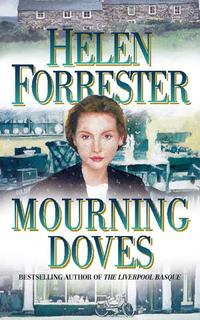
Read the book: «Mourning Doves»

HELEN FORRESTER
MOURNING DOVES

Dedication
To Stephen and Lauren, with love
Contents
Cover
Title Page
Dedication
Prologue: 11 November 1995
Chapter One: March 1920
Chapter Two
Chapter Three
Chapter Four
Chapter Five
Chapter Six
Chapter Seven
Chapter Eight
Chapter Nine
Chapter Ten
Chapter Eleven
Chapter Twelve
Chapter Thirteen
Chapter Fourteen
Chapter Fifteen
Chapter Sixteen
Chapter Seventeen
Chapter Eighteen
Chapter Nineteen
Chapter Twenty
Chapter Twenty-One
Chapter Twenty-Two
Chapter Twenty-Three
Chapter Twenty-Four
Chapter Twenty-Five
Chapter Twenty-Six
Chapter Twenty-Seven
Chapter Twenty-Eight
Chapter Twenty-Nine
Chapter Thirty
Chapter Thirty-One
Chapter Thirty-Two
Chapter Thirty-Three
Chapter Thirty-Four
Chapter Thirty-Five
Chapter Thirty-Six
Chapter Thirty-Seven
Chapter Thirty-Eight
Chapter Thirty-Nine
Chapter Forty
Chapter Forty-One
Chapter Forty-Two
Chapter Forty-Three
Chapter Forty-Four
Chapter Forty-Five
Chapter Forty-Six
Chapter Forty-Seven
Chapter Forty-Eight
Chapter Forty-Nine
Epilogue
Acknowledgment
About the Author
By the Same Author
Copyright
About the Publisher
Prologue 11 NOVEMBER 1995
The cenotaph stood on its great concrete plinth at the top of Grange Hill. To reach it meant a long climb for aged veterans and decrepit widows. Nevertheless, in this fiftieth anniversary year, a larger number than usual had turned out for the Remembrance Day service. Now the last wreath had been laid, and the parade had been formed up and was marching slowly down to the village.
As the voices faded away, Celia sat in her wheelchair, waiting with Rosemary, her West Indian carer, and her godson, Flight Lieutenant Timothy George Woodcock, DFC, until the narrow path down to the road was clear of people, and the wheelchair could be manoeuvred down.
Coming straight off the distant snow-topped mountains of North Wales and the estuary of the River Dee, the wind was cold, and, despite the blanket Rosemary had tucked round her, Celia was shivering.
She did not weep. Crying never helped anybody, she would say tartly. She had, however, a keen sense of inward loneliness, and she remembered suddenly her sister, Edna, friend and partner in so much of her life – ever since 1920.
What a year that had been. A year of final realisation that the men killed in the First World War would never come back, and neither would the safe, predictable life of 1914. Millions of ignorant, untrained women had had to remake their lives and find work to maintain themselves. I was one of them, considered Celia, as she sat patiently in her wheelchair and looked out across the misty landscape of the Wirral. And I suppose that, in some ways, I was lucky.
She was, she knew, the oldest person to attend the service, one hundred years next week; and she was probably the only person in the district with truly clear memories of the First World War, of life before it began and of its aftermath.
Her luck had not held. The names of five members of her family were listed on the cenotaph, and every year she made the effort to come to lay a family wreath, gorgeous with huge plastic poppies and black satin ribbons, at the foot of the memorial. From the wreath dangled an old-fashioned black-edged card, which said,
IN TENDER MEMORY OF MY SONS, PETER, PAUL AND BERTRAM TREMAINE, KILLED IN ACTION IN WORLD WAR II, AND OF MY GRANDSONS, MICHAEL AND DAVID TREMAINE, LIKEWISE KILLED IN ACTION IN THE FALKLANDS WAR. NEVER FORGOTTEN.
As they waited, Timothy George also felt the cold and longed for a warm fire and a whisky and soda. A pity Bertram’s wife could not be here, he thought; but, after her sons, Michael and David, had been killed, there was nothing to keep her in the Wirral, and she had gone south to live with her own mother in Devon.
Celia had remained, alone, in the red-brick Edwardian house which she and Alec had bought on their marriage.
It was strange to realise, Timothy ruminated, that, to most of the parishioners, both the First and the Second World Wars were forgotten wars, forgotten sacrifices. Except in special anniversary years such as this one, the crowds around the cenotaph grew smaller each year.
The flight lieutenant sighed. He supposed that Celia and he were, by now, simply walking history, not that Celia could walk very far; she was quite frail. This would probably be the last Poppy Day for her – and probably the last for many of the men like himself, some in uniform and some in shabby macintoshes, all with glittering collections of medals pinned to their breasts – and for the pitiful little bunch of widows and elderly spinsters, each with a red poppy in her buttonhole.
As he had glanced at the huddled old women, he had felt uneasily that even today there were some elderly women who were still not very good at managing life alone.
Their husbands, sons and lovers had died in the Second World War. Theirs was the second generation of women to be widowed by war or left without hope of marriage.
His own brother’s name and also the names of Celia’s brothers were on the Roll of Honour in the glass case on the cenotaph in Liverpool Cathedral. His brother, Eric, had been shot down by a sniper in Normandy during the Second World War, leaving a pregnant wife. His little nephew, he considered, had been fortunate to have been brought up by a kindly stepfather, considerably younger than his mother.
The wars had created a dreadful double generation gap, he thought grimly, and judging by the mismanagement in the country, the gap had not yet been closed.
He had for years held the notion that nobody had been able to fill the empty spaces left by the fathers and grandfathers who had died – or had been so wounded or exhausted that they were too weary to do anything much, once they had returned to civilian life. He remembered how tired he had been himself; it had been an enormous effort to start again after he had been demobbed.
Rosemary shook his arm, and said, ‘I think we can go down now.’
He jumped, and then grinned agreement. In the comparative silence now surrounding them, the cold wind whined and the artificial foliage of the wreaths rustled faintly in reply, like distant voices calling.
Before they moved her, Celia turned to glance once more at the wreaths and then upwards to the bronze soldier in battledress who stared out over the sands of the estuary.
She remembered three little boys who had built a sand castle on the seashore, and how they had squabbled about who should place a paper Union Jack on its summit. She felt a sudden terrible pain go through her. Years later, they had followed that Union Jack and had gone gaily off to war and never come back. And in the Falklands War her two grandsons had done the same, for reasons that she could never understand.
‘Goodbye, my dears,’ she whispered, as the wheelchair began to move. ‘See you soon.’
She took out a paper handkerchief and firmly blew her nose. One must never give in. Edna and I certainly never did.
Chapter One MARCH 1920
Was it really as small as that? Had that weed-covered quarter-acre ever held a formal flower garden, a lawn at the side of the house and a vegetable garden?
Louise Gilmore glanced up in despair at the house itself, one of a semi-detached pair. Sharp shards of glass stood upright in the frame of the broken hall bedroom window. She remembered how Gracie, her father’s housemaid, used to shake her dust mop out of that window – regardless of who might be standing below on the front step. When the family came to spend their holidays in the house, one of the maids had always come with them; it was usually Gracie, who hated the isolation of the place, the steady boom of waves on the sea wall, and the sand which constantly sifted in from the surrounding dunes.
Now, Louise noted hopelessly, damp brick beneath the windowsill indicated that rain had soaked into the wall. The front sitting-room window had had a piece of board nailed over it, and the front door had lost most of its shiny black enamel; what remained was bubbled from the heat of many summers.
There was no garden gate. Only the wooden gateposts remained, and the encroaching front hedge had nearly obliterated them, too.
As a result of the death of her husband the previous Saturday, Louise had been terrified by the dire warnings of his executor, Cousin Albert, and of his lawyer, Mr Barnett. She had, they said, been left almost destitute and must, in order to raise some money on which to live, sell their beautiful Liverpool mansion immediately.
It was essential that she find speedily some other place to live in, so she had, that morning – only the day after her husband’s funeral – dragged herself out of her bed and, with her younger daughter, Celia, made the tiring journey by train out to Meols, a small village on the Wirral Peninsula.
They had come to inspect a small – small from her perspective – summer cottage which had been in the family for years and had been rented out for most of the time. Cousin Albert had suggested that it would make a suitable retirement home for her, into which she could move almost at once.
She lifted her mourning veil from her face and flung it back over her black bonnet, then stepped on to the path leading to the front of the house. One of its dull red tiles had heaved and she tripped on it and nearly fell. She shivered, her breath coming in sobbing gulps.
‘Be careful, Mother!’ admonished her twenty-four-year-old spinster daughter, Celia, who was following closely behind her. ‘Hold your dress up. You’ll get it all muddy round the hem.’
Equally as scared as her mother, Celia was more snappish than usual. She herself was clutching her wide-brimmed black hat with one hand and holding down her own ankle-length skirt against the buffeting sea wind. She had sand in one eye and it was running tearfully from the painful irritation. She looked worn out.
Louise’s lips tightened. She did not reply to Celia, as she lifted her black satin dress and petticoat an inch so that they did not draggle in the damp puddles on the dirty path.
Sometimes Celia could be very trying. Wasn’t it enough that, only yesterday, they had stood by the grave of dear Timothy, her husband, who had shared her bed for thirty years? What was a bit of mud on the hem of one’s skirt compared to losing him?
To add to her misery, Cousin Albert Gilmore, sole executor of her husband’s will, had told her, upon his arrival, that Timothy had left heavy business debts, an announcement which had sent a frightening chill down her back. He had said that to keep up her fashionable home in the village of West Derby on the outskirts of Liverpool on what remained of her dowry would be impossible.
Cousin Albert had been completely heartless, she felt, not to give her some time to mourn, before unloading such cruel facts upon her.
Cousin Albert himself had, at first, not known what to do. He had, on Sunday, been telephoned by Mr Barnett, and he had arrived from his home in Nottingham on Monday. He had gone straight from Lime Street Station to see Mr Barnett in his office, and, warned by him, had gone on to Timothy’s office to interview his chief clerk and to look at his files and account books.
What he had found was a financial disaster, which would, he thought in quiet rage, take him weeks to sort out. He berated himself for ever agreeing to be his cousin’s trustee. He was, therefore, not in a very good temper and, when he arrived at Louise’s house, he was, in addition, rumpled and hungry from his journey.
He had paid off the taxi at the driveway entrance and, carrying his suitcase, had puffed his way up a slight slope round a fine bed of laurel bushes to the imposing front steps. He pulled a huge brass bell handle and fidgeted fretfully until the door was opened by a frightened-looking parlourmaid.
Close behind the maid came Celia, wringing her hands helplessly, and whispering, ‘Oh, Cousin Albert, I’m so glad you’ve come!’
‘Yes, yes, my dear, I’ve come.’
He plonked down his small suitcase, and took off his black bowler hat to reveal a tumble of snow-white curls. He handed the hat to the maid and then peeled off his heavy black overcoat and pushed that on to her, too. He gave Celia a light peck on one cheek, and asked abruptly, ‘Where’s Louise?’
‘In bed.’
‘And your father?’
‘He’s laid out in the downstairs front sitting room.’ Her voice quivered, and she added with evident anxiety, as she pointed to a closed, white-enamelled door, ‘Mother wanted him buried from home, so I sent for the undertaker in West Derby. The undertaker thought that that room would be most convenient for visitors to come into, so I agreed.’
‘Quite right, child. Quite right. When’s the funeral?’
He looked around the hall. Seeing a door open, he remembered the family breakfast room and made straight for it, hoping to find a fire where he could warm himself. Celia fluttered after him.
‘Tomorrow – at ten o’clock,’ she told him, as he thankfully turned his back to a good coal fire and let the heat flood over him.
He had no feelings about the loss of his cousin, only a sense of irritation. He knew that it would be his duty to deal quickly with the affairs of a pair of tear-sodden women, who must change their way of life immediately. He also knew that he must make sure that grasping creditors could not lay hold on Louise’s own modest assets. Timothy’s clerk had assured him that she had not jointly signed with Timothy anything in connection with the business, which was a relief. At least she had, according to what Timothy had once told him, her dowry in the shape of the rents from six working-class houses in Birkenhead, for what little they were worth, and, in addition, this very fine house.
But he had been a lawyer himself, and he knew from bitter experience that moneylenders could be quite ruthless and, occasionally, dishonest in their seizing of assets. Like any good Victorian gentleman, he was aware of his duty to any of his family, and nobody was going to strip his cousin’s widow of her assets, if he had anything to do with it.
This rectitude did not prevent his being judged by Celia and her mother as inhumanly abrupt and callous with them, when, the next morning, Louise was persuaded to get up very early and get dressed in order that she might receive the many callers who would come to pay their respects to the dead before the funeral.
On the day of his arrival, since he felt that time was of the essence, she had also had to face, after a late lunch, the sad truths discovered earlier by her husband’s trustee.
‘You will need money from somewhere on which to live,’ he had announced baldly. ‘You will certainly have to sell this Liverpool house, and do it very quickly.’ He sighed when he saw her shocked expression, but went on firmly, ‘Whatever you get for it can be invested in an annuity to give you a modest income on which to live.’
Albert had gazed reflectively at the lovely embossed ceiling of her large upstairs drawing room, normally used only for big parties, and added, ‘It’s a valuable property in a good district – so close to the countryside – so it should fetch a good price.’
In his opinion, it was little less than a miracle that Timothy had long ago had enough sense to put the house in her name, so that it could never be seized to settle his business debts. Timothy had always taken the most appalling financial chances, he reflected. Of course, he had made a lot of money, though his luck, it seemed, was running out just before he died.
Albert had, therefore, very early the next morning, while Louise dealt with her visitors, been to see an estate agent and arranged for the house to be put on the market immediately; because she owned it, there was no need to wait for Timothy’s will to be probated before doing this. With the money it fetched, he had decided, he would buy the annuity for her from a reputable insurance company, which should just produce enough to keep her and young Celia in genteel poverty. In the meantime, they would just have to manage on the rental money from her Birkenhead houses – or take a small loan from the bank, which could be repaid from the money received for her home. Though he was not her trustee, he assumed that Louise would expect him, as the only man in the family, to undertake these financial arrangements on her behalf. Women were, in his opinion, quite helpless; he would present his very sensible plans for her future to her and, undoubtedly, she would accept them.
Before Timothy’s sad demise, Louise had had no idea that she bore the burden of owning the Liverpool house, and the information had increased her bewilderment and her terror of being left alone. Timothy had always done everything, as a good husband should; all she had had to do was balance the housekeeping accounts, entertain his guests charmingly and be kind to him in bed.
It had been scant comfort to her when Cousin Albert, when talking to her on his arrival, had warned, ‘My dear, you will probably have to manage without a servant. However, since there will be only you and Celia, a very small house will be quite appropriate, and I am sure you are an excellent housekeeper.’ He had smiled at her with as much benignity as he could muster.
Louise moaned into her black handkerchief. Did he not realise that he was tearing her whole life apart? It was too much to endure.
He had watched her weep for a few moments, and then had leaned forward to pat her hand and remind her, as Mr Barnett, the solicitor, had earlier reminded him, that she also owned a little house, really a cottage, on the other side of the Mersey River. ‘Your father’s summer home – by the sea – in Meols, near Hoylake,’ he had encouraged. ‘When your sister Felicity died, she left it to you. Remember?
‘Mr Barnett tells me that he recollects that it was let for years. I understand, however, from the agent, Mr Billings, whom I phoned today from Mr Barnett’s office, that there is no one living in it at present.’
He heard Celia take a quick intake of breath, and he glanced over to her. Pale-blue eyes stared back at him from a dead-white face. She looked scared to death.
He continued in a more cheerful tone of voice, addressing himself partly towards her. ‘After being let for so long, it will almost certainly require renovation – but that is soon arranged. You’ve probably seen it, Celia?’
‘No, I haven’t,’ she muttered.
He stopped, wishing heartily that he had not been left the unpleasant task of telling these stupid women what they must do; he felt too old and tired to be bothered with them. He went on heavily, ‘When Mr Barnett told me about it, I had thought of selling the cottage on your behalf, instead of this house. But it would not fetch much – I hope, however, that it won’t need too much to make it a very comfortable home for you – and you must have an income from somewhere to live on, which only funds from this big house can provide.’ He reminded himself that, after the funeral the following morning, he should make a quick trip out to Meols to check that the cottage was indeed habitable.
Louise had temporarily forgotten the cottage; she had not seen it since Felicity had died ten years before. Though the day-to-day care of her property was done through Mr Billings, dear Timothy had always kept an eye on it for her, including that which had been settled on her by her father at the signing of her marriage contract. The thought made her weep ever more heavily into her black handkerchief.
Now, as she looked at the cottage, she despaired. What would happen to her in this awful place? How could she bear it? And to add to her distress, her scandalous elder sister, Felicity, did not seem to have done much to keep the building up during her ownership of it. She remembered that, when the property had passed to her, Timothy had insisted on letting it, because, he said, it was too shabby for family use. Perhaps it was the tenants who had left it in such a mess.
How devout churchman Timothy had condemned Felicity’s way of life. He would not hear of Louise having anything more to do with her. All because Felicity had dared to live in the cottage with handsome Colonel Featherstone, a scarred veteran of the Matabele and Boer Wars – without marrying him. As a result, Timothy had always insisted that she might have a bad influence on the children. He had even frowned when Louise bestirred herself enough to say defiantly that she must occasionally write to her only sister, no matter what she had done. And Timothy must have known very well that, if she married a second husband, Felicity would automatically lose the army pension left her by her first husband, dear Angus, killed at Rorke’s Drift during the Zulu Wars. But Timothy had always insisted that shortage of money was no excuse for Sin.
Only her father had understood Felicity, she thought, as she sniffed into her handkerchief. Felicity had died childless, but, sometimes, when her own elder daughter, Edna, had grown up, she had seen in her some of Felicity’s sprightliness and brave defiance of convention.
She would have been glad to have Edna with her now, but the girl was married and far away in Brazil.
When, before setting out for the cottage, cold dread of a future without a father or brother or son to care for her had consumed her soul, Louise had at breakfast wept openly in front of fat, elderly Cousin Albert.
Harassed Celia, at twenty-four far too old for marriage, had pressed a glass of sherry on her. Mother was so set in her ways, so difficult to deal with if her normal routine was upset, that Celia knew that if any action had to be taken, it would be she who must, somehow, take it.
She felt despairingly that she had no idea of business matters; Papa had always kept such information in his own hands. In consequence, she had become numb with fear as Cousin Albert explained to her her late father’s financial circumstances.
The loss of her father, however unloving, had reopened her grief over the loss of her brothers, Tom and George, during the war, and her stomach muscles were clenched as she did her best to keep calm.
The more she considered her mother’s and her own circumstances, the more terrified of the future she became. With no male to protect them or earn a living for them, what would happen to them? And still worse, what would happen to her when her mother died? She had nothing of her own; she had been her mother’s obedient companion-help ever since she was fourteen. She was totally dependent upon her.
She also felt a profound unease about Cousin Albert himself. Was he altogether trustworthy? She did not know him well, but he struck her as a manipulative man, a man with little idea of kindness or humanity – though her father must have had some faith in him to make him his executor.
Immediately after the funeral was over, Albert had had a private discussion with Timothy’s solicitor and old friend, Mr Barnett of Barnett and Sons.
Elderly Mr Barnett was himself trembling with fatigue and grief, because the AND SONS of his practice no longer existed; one had died while a prisoner of war and the other had succumbed to trench fever in the horrors of 1916. With difficulty, the old man had single-handedly kept the practice going for his sons while they were at war. Now, he knew he would never enjoy a peaceful retirement; to keep himself, his wife and three daughters, he must continue his practice until he dropped. It was no wonder that he found it hard to concentrate on what the pompous Mr Albert Gilmore was saying, and that he agreed to everything suggested in connection with Mrs Louise Gilmore’s affairs.
After lunch, Albert took out his gold hunter watch and announced that he would go again to Timothy’s office to do some more work, would stay one more night and then, the next morning, catch an early train back to his Nottingham home. ‘Mr Barnett will have the will probated and will do a further check in case there are any, as yet, undiscovered assets,’ he told Celia.
‘My dear Louise,’ he continued paternalistically to the tear-soaked widow, ‘I shall be in constant touch with Mr Barnett – fortunately, I have a telephone – and, in a few days’ time, I’ll be in touch with you again by mail. In the meantime, you should go out to Meols – that is the nearest railway station – to look at your cottage there.’ He tucked his watch back into his waistcoat pocket. ‘Mr Barnett will oversee the paperwork regarding the house for you. An estate agent may come tomorrow to evaluate it.’
He carefully did not mention to her that, since her present home and its contents already belonged to her, she had the right to refuse to sell it. Nor did he tell her that that afternoon he would pay a quick visit to the cottage to check that it looked repairable. She must face reality herself, he felt defensively.
Albert did not want any argument about the sale either. He dreaded dealing with women – they were so volatile and so lacking in common sense, and physically they revolted him. Better by far to persuade Louise to sign a quick agreement with Mr Barnett that he should arrange paperwork of the sale.
That evening, after Cousin Albert and Mr Barnett had dined with her, she had signed the agreement to sell without even reading it.
It never occurred to her that she was signing away her own property, that she was free to make her own decisions. She was certain that men always knew best.
Terrified, white-faced Celia’s instinct that something was wrong was, therefore, correct. Albert Gilmore’s intentions were, however, of the best. He was simply convinced that women were totally incapable of running their own lives, a belief certainly shared by his late cousin, Timothy. With money coming in every month from an annuity and with Celia to care for her, he could comfortably forget Louise.
Now, buffeted by a brisk sea breeze, Celia and her mother stood in front of a dwelling which looked as shabby as a house could look without actually falling down.
‘Built in 1821,’ Celia said without hope. ‘See! There’s the date above the front door. No wonder it’s shabby – it will be a hundred years old next year.’
A wave of pure panic began to envelop the younger woman, as her mother sniffed into her handkerchief, and wailed, ‘What are we going to do, Celia? We can’t possibly live here. What is Albert thinking about, suggesting such a thing? Couldn’t we buy another house?’
Her daughter shivered, and tried to muster some common sense. She replied, ‘Well, probably this is the cheapest roof we’ll ever find, Mama, even if we have to have it repaired. Mostly, I suspect that Cousin Albert wants us resettled quickly, because he doesn’t want us to live with him.’
Her mother turned back towards her, and with a sigh, inquired, ‘What did you say, dear?’
Celia had bent down to pick up two hairpins which had fallen out of her untidy ash-blonde bun. Her voice was muffled, as she replied, ‘I think he may wish us to begin a new life together without delay. He may fear that we expect him to invite us to live with him – he has a big house – I remember our going to visit him once, when I was little.’ She straightened up and pushed the pins into her handbag. ‘But he hasn’t offered us a home, Mother – and I don’t think he should have to. It is not as if he were your brother – then he’d have a duty towards us.’
Her mother responded with unexpected acerbity. ‘Well, he is your father’s trustee until the estate is settled. He might at least have stayed long enough to help us, instead of leaving us in the hands of a solicitor – and an estate agent who has had the insensitivity to come in the day after the funeral, and run around our home – with a tape measure!’
‘The estate agent is concerned only with selling our house, Mother. He came to see it this morning only because Cousin Albert wants it sold quickly. He did apologise for intruding on us, remember. And the house is enormous, Mother, with seven bedrooms and three servants’ rooms. Too much for just two of us.’
Her mother’s puffed eyelids made her eyes look like slits in her plump face, as she replied pitifully, ‘I don’t want to sell it, Celia. It’s our home. And, what’s more, I don’t like the agent – so officious and totally lacking in delicacy or compassion.’
Celia wanted badly to cry herself, but she put her arm round her mother’s waist, and said gently, ‘Try not to grieve, Mama. This little house is yours, too, remember – you can do anything you like with it. We can probably make it very pretty.’
Celia gestured towards the shabby front door facing them. ‘I suppose Cousin Albert imagines we can arrange for the renovations ourselves?’ She paused, as she tried to think clearly.
Louise continued to cry. At Celia’s remarks, however, her petulant little mouth dropped open. She could do anything she liked with this miserable cottage? What rubbish! Men always looked after property.
‘How can I get it done up? I have no idea how to proceed, and where would we get the money to do it?’ she wailed.
Celia had to admit that she did not know either. She responded firmly, however, by saying, ‘Perhaps we can find someone in the village, a builder, who could at least advise us about what it would cost.’
Then another frightening thought struck her, and she asked, ‘Did Cousin Albert say what we were to do about money until the house is sold? We would have to pay workmen, wouldn’t we?’
Albert had not mentioned immediate financial needs, except to say that he had himself advanced the money for dear Timothy’s funeral.
Her mother closed her eyes. She had no idea what, if any, money she had to draw on for the time being. It was all too much. She was trembling with fatigue and bewilderment at the sudden upheaval in her life. She wished heartily that she could follow Timothy – and simply die.
It really was most inconvenient that Timothy should have a heart attack before he had even reached his fiftieth birthday – and die in his office. What a fuss that had caused!
As if she could bear anything more, when they had already lost both their sons, George – her baby – in the dreadful sinking of the Hampshire in 1916. Drowned with Lord Kitchener, she had been told; as if that made it any the less painful to her. And big, strong Tom, her eldest and the pride of her soul, killed on the Somme.
Her terrible frustration at their youthful deaths still haunted her. There was nothing she could do to express her love of them. She could not give them beautiful funerals to mark the family’s grief at their passing. They had left no wives or children to be comforted. They did not even have graves which she could tend in memory of them. All she could do was weep for them.
And her own two brothers, who could have been so much help to her in the present crisis? Both long dead, Peter from yellow fever while serving as an administrator on the Gold Coast, and Donald, a major in the 43rd, killed in a skirmish in the Khyber Pass just before the war broke out. The Empire had cost an awful lot of men, she thought, with sudden resentment against governments as well as against poor Timothy.
Celia patiently repeated her question about money, and her mother mopped her eyes and responded mechanically, ‘I suppose he thinks I’ll find it out of my own small income – my dot. There may be a little money in the bank which is mine, and I still have most of my March housekeeping.’
‘Do you have any idea how much is in your banking account?’ Celia knew that her grandfather had settled on her mother a dowry – a dot, as such a settlement was popularly called – of rental housing in Birkenhead. It was doubtful whether the income from their small rents would be enough to tide them over, never mind pay for extensive repairs to this dismal house.
‘I don’t know how much. I will have to ask the bank manager – and Mr Billings.’
‘The agent who collected the rent for this cottage and manages your Birkenhead property?’
‘Yes, dear. Cousin Albert says I am lucky that, when I married, your grandfather made quite sure that that property always remained mine.’
At the mention of Mr Billings, some of Celia’s fear receded. Mr Billings would surely know how to deal with house repairs. He might know how they could obtain credit so that they did not have to pay immediately.
As she searched in her leather handbag for the key to the house, handed to her by Cousin Albert, who had found it, neatly labelled, in Timothy’s key cupboard in his office, she said with false cheerfulness to her mother, ‘Let’s go inside. It may not be so dreadful as we think. Then, instead of going directly back home to Liverpool, we could pause long enough in Birkenhead to see Mr Billings; he’ll know something about house repairs, I’m sure. We can take a later train back to Liverpool.’
‘Well, I suppose,’ Louise whispered wearily, ‘since we are here, we might as well look at the inside.’
As Celia slowly turned the big iron key in the rusty lock, Louise paused to look round what had been the front garden, and sighed deeply at the sight of the foot-high weeds. She sobbed again into her large, black mourning handkerchief, one of the same set of handkerchiefs she had used when crying for her lost boys.
Celia’s hand was trembling as she put the big key back into her handbag, before pushing hard on the stiff door to open it. What will become of us? she fretted. What shall we do?
Nineteen twenty was supposed to be a year when, two years after the war, things would settle down and life return to normal. Mourning was supposed to be over, your black dresses put away. But you can’t bury grief as quickly as you can bury men, she thought bitterly.
At best, life was proving to be totally different from that of 1914, when during a gloriously hot August, Europe was plunged into war, and life’s main preoccupation became the casualty lists.
Added to the death of her sons, her poor mother now had this burden of comparatively early widowhood, a penurious one, and the loss of her superbly furnished home.
As she pushed hard at the reluctant door, she thought for a moment of herself, and she saw no hope of a decent future anywhere.
Chapter Two
As the door swung open to reveal a tiny vestibule, decayed autumn leaves rustled across a dusty tiled floor. Facing them was an inner door, its upper panels consisting of a stained-glass window with an elaborate pattern of morning glory flowers.
In an effort to cheer her mother up a little, Celia exclaimed, ‘Wouldn’t that be pretty if it were cleaned?’
‘Mother loved it,’ Louise said abruptly. Because her nose was so swollen from weeping, she sounded as if she had a heavy cold.
Using the same key, Celia unlocked the pretty door and hesitantly opened it. She had never been in the cottage before, and did not know exactly what to expect.
A very narrow, gloomy hall was revealed. It was poorly lit by a window at the top of a steep staircase to her right. To the left of her, two doors led off the hall. At the back was a third door. The lower half of all the walls was painted brown; the upper half looked as if it had once been cream. It was, however, very dirty; every corner was hung with cobwebs, and dust clung to them. Dust lay thickly on the wooden banister of the stairs, on the bare wooden treads, and on the ridges of the door panels. Under their feet fine sand, blown in from the dunes at the back of the house, crunched faintly on reddish tiles.
Celia quickly flung open the two doors and they glanced in at tiny rooms which looked equally dirty and depressing, their fireplaces choked with ashes, the bare wooden floors grimy and littered with bits of yellowed newspaper. The light from the windows, filtering through gaps in the boards hammered over their exterior, did little to lift the general air of dinginess.
Determined to be brave, Celia said to her mother, again steeped in melancholy, ‘They’ve both got fireplaces – and quite big windows.’
Louise did not reply. She was past caring.
She did, however, follow Celia, as the younger woman approached the door at the end of the hallway, which she presumed correctly would lead into some sort of a kitchen.
A very rusty range had been built into one wall. With a long-handled water pump at one end, a sandstone sink was set below a filthy casement window positioned high in the house’s end wall. Through the window Celia caught a glimpse of the straggling tops of hedges which she supposed marked the edge of the property.
Cautiously she pressed down the pump handle. It gave a fearsome squeak, but no water came out.
Her mother stared at it, and then said heavily, ‘It has to be primed and it’s probably rusted inside.’ After a pause while she dabbed at her reddened nose, she added, ‘There’s a well at the bottom of the garden.’
Celia was appalled. The kitchen was awful, filthy beyond anything she had ever seen before. How on earth could one ever get such a neglected house clean – without a couple of skilled charwomen? But Cousin Albert had said no servants.
She realised with real shock that, if they did come to live in it, she herself would have to clean it. Her mother would not dream of doing an unpleasant job while she had a daughter to push it on to, and Celia had no idea even how to start.
She swallowed, and opened another door. ‘This must be the pantry,’ she said. ‘Phew! How it smells!’
Because there was a sudden scuffle of tiny feet in its confined space, she hastily slammed the door shut again. ‘Ugh!’
‘Mice!’ her mother burst out. ‘Oh, Celia!’ She hastily gathered her skirts up to her knees, as if expecting an immediate invasion of her petticoats by the tiny intruders. Tears ran down her face.
‘It’s all right, Mother. It’s all right! I don’t think any came out.’ Celia turned back to the hallway, and suggested heavily, ‘We’d better have a look upstairs.’
There were three small bedrooms, and, in addition, a very tiny room at the front, over the hallway, which Louise said, with an effort, had been her elder sister’s bedroom when they were children. It was in the latter that the window had been broken. Rain had got in and damaged the plaster. Under their feet brown linoleum squelched as they trod on it, indicating that there was water under it.
‘Pooh!’ exclaimed Celia. ‘This room reeks of damp.’
Her mother blew her nose, and said very wearily, ‘The floorboards have probably rotted.’
Celia nodded. She wondered, with a shiver, if they would ever have enough money, never mind enough strength, to put this tiny house into some sort of order. Cousin Albert must believe that it was possible, she decided.
In fact, Albert Gilmore had not thought the matter through very well. His main goal was to avoid having to take the two bereaved women into his own home in Nottingham, where he dwelled very happily with an obliging manservant. He did not want them there even temporarily – they might be hard to dislodge.
He hoped that they would agree to settle in the cottage, or, alternatively, go to live with Louise’s elder, married daughter, Edna, and her husband, Paul Fellowes, something he had not yet suggested to either lady – he felt that the latter idea must come from Paul and Edna, and was, in his opinion, a decision of last resort. In the meantime, he had pressed on Louise the idea of the cottage as a suitable home.
Paul was an electrical engineer, a director in his family firm which had grown hugely during the war, because of the international reputation of its engineers and their innovative approach to new problems. He had just completed managing a lucrative seven-year contract for the wiring of an entire city in Brazil. He and Edna would, according to Louise, sail for home this month. Once he was resettled in England, considered Cousin Albert, Paul Fellowes would certainly be able to afford to take in a couple of women, who would probably make themselves useful in his house, as such women always did.
On the other hand, he pondered, if they would agree to live in the cottage and were very careful, they should be able to manage on the rents from Louise’s six houses in Birkenhead. The rents, in addition to the annuity which he proposed to buy for them from the proceeds of the sale of the West Derby house, should be enough for two women to live on.
He knew from his talks with Mr Barnett and with Timothy’s chief clerk that there would, almost certainly, be nothing left of Timothy’s estate. The man owed money everywhere, probably because much of his basic income had come from investment in railways, which, now that the war was over, were not doing very well. Had he lived, he might have been able to pull through a difficult period, but now there was no hope. His few assets must be liquidated to meet his debts.
He trusted that Paul Fellowes would, when he returned to England, help him with the paperwork necessary to wind everything up. Paul should soon receive his letter, sent to Salvador, Brazil, informing him of his father-in-law’s death and asking him to break the news to his wife.
It was possible that the couple had already sailed for England before the letter’s arrival. In that case they would receive the news from a telegram, which he had dispatched to Paul’s father at their company head office in Southampton. Edna’s last letter to her mother had mentioned that they expected to dock in Southampton and spend a few days with Paul’s parents before coming north to visit her own parents.
As Louise and Celia struggled round the overgrown garden of the cottage by the sand dunes, Louise mentioned how relieved she would be to see Paul and Edna.
Celia agreed. She had almost forgotten what the couple looked like. She had never had a great deal to do with her elder sister, and she had met Paul only three times, so she was not particularly hopeful of being comforted. Their presence would, however, add a sense of stability to Louise in her shattered state, for which she would be grateful.
If Paul returned quickly enough, thought Celia, he would, at least, be someone to consult about the cottage – if he had any time; she had always understood from her father that businessmen never did have much time to spare for the affairs of women.
Standing in the cottage garden after the stuffiness of the house, it was a relief to Celia to breathe clean, salt-laden air, and, despite its total neglect, there was a healthy smell of damp earth and growing things.
At the bottom of the garden, they inspected an earth lavatory.
‘It’s utterly disgusting!’ Celia exclaimed. ‘Did you really use it?’
‘Yes,’ Louise admitted. ‘It wasn’t something we looked forward to. It was your father’s main objection to continuing to come here for holidays.’ She began to whimper, as she recalled with anguish the handsome water closet which Timothy had had installed in their West Derby home.
‘Perhaps we could get a proper bathroom put in here,’ Celia suggested doubtfully, as she shut the door firmly on the obnoxious little hut. Though she had long since learned that, to survive, she must bow her head and do whatever her parents decided, even her broken spirit had, on inspecting such primitive sanitary arrangements, begun to feel a sense of revolt.
After several days of being confined indoors, the fresh air was reviving Louise, and she looked around her, and sighed. She replied quite coherently, ‘I don’t think we could put in a water closet, without piped water and drains.’ Then she exclaimed with something of her normal impatience, ‘What a mess! I can’t imagine what kind of a tenant must’ve been living here. Mr Billings must have been very careless about his selection of one.’
Celia contemplated the jungle of weeds and sprawling bushes round her. ‘Did he pay the rent? The tenant, I mean,’ she asked practically.
Her mother shrugged. ‘I don’t know. Your father took care of these things.’
Celia turned to stare at the back of the house. The roof looked all right, no slate tiles missing and the chimneys were all intact, as far as she could judge. Her eyes followed the ridge of the roof, and she remembered suddenly that there was another house attached to theirs.
‘Do you own the house next door, Mother? I can see that the other side of the hedge has been trimmed, and there are curtains in the bedroom windows – and smoke is coming from the chimney. Someone must live there.’
Her mother looked up. ‘No, I don’t own it. My father bought this house simply as a summer cottage, rather than as an investment, and when he died he left it to your Aunt Felicity.’
Anxious to encourage her mother to take an interest in anything, Celia asked, ‘Who does own it?’
‘A Mr and Mrs Lytham bought the other side. I used to play with their children.’ Louise’s expression softened, and she added wistfully, ‘We had some lovely times, playing in the sand dunes and paddling in the sea. I wonder what happened to them?’
Celia forced a smile. ‘How nice that must have been.’ Then she looked at her brooch watch. ‘Perhaps we had better lock up, Mother, and go to have a talk with Mr Billings. He could advise us about repairs.’
Her mother nodded and they retraced their steps to the house, ruefully brushing down their long skirts. Even Celia’s ankle-length, tailored skirt had caught in the undergrowth and had burrs and bits of leaves and seeds clinging to it.
Celia locked the back door and they walked slowly and dismally through the house, leaving muddy tracks behind them.
While Celia turned to secure the inner front door, Louise proceeded slowly down the front steps. She suddenly let out a frightened little cry, ‘Oh!’
Celia spun round.
Standing in the middle of the red-tiled path was a tall thin man. As the women stared at him, he raised his cap and bowed. ‘Good afternoon,’ he greeted them politely.
Chapter Three
Confronted by a man, both women were suddenly acutely aware of how isolated the cottage was.
Walking down the lane to it, they had passed only one other cottage, a squat little dwelling with a thatched roof. It had, Louise told Celia, been lived in for centuries by a family of fishermen. Now, they stared uneasily at someone who seemed to have sprung from nowhere.
‘Good afternoon,’ responded Celia nervously, while her mother stiffened, as she catalogued the man as no gentleman, despite his courteous greeting. The lanky man’s grey hair was roughly cut and framed a lined, weather-beaten face. He wore a striped union shirt without a collar; a red and white cotton handkerchief was tied round his neck. His wrinkled, old-fashioned moleskin trousers, held up by a worn leather belt, were stained with dried mud.
As he looked down at her, Louise’s silence did not seem to disconcert him in the least. His faded blue eyes held the hint of a smile, as he said, ‘You must be Mrs Gilmore. The gentleman as was here to take a quick look at the cottage for you said as you would be coming. He come out late Tuesday. Nearly dark, it was.’
A quiet rage against Cousin Albert rose in Louise, blotting out all sense of fear or grief. So, during his stay with her, he had not spent all his time in Timothy’s office checking over with the clerk just exactly what the financial situation was; he had also been out here, planning to condemn her to live in this awful place. He knew precisely what it was like.
With sudden understanding she realised how she had been manipulated. Albert and Mr Barnett had made her sign away her present home.
It was so unfair. They should have explained to her what she was about to do. Consulted her. The fact that the outcome would probably have been the same did not make any difference. She had not been asked what she felt about moving out here.
Could she not have sold this horrible cottage and bought another tiny house in a decent, civilised Liverpool street?
No time had been allowed her to recover from her bereavement, she raged; there had been no understanding that she was distraught with grief.
She was healthily furious, not only with Albert and Mr Barnett, but also with Timothy.
Timothy might have had enough sense to tell her that she owned their home, when he had originally transferred it.
Unless he had not trusted her? What a dreadful thought!
That was it. He must have felt, like Cousin Albert, that she was not capable of dealing with the ownership of such a valuable property; in transferring the ownership to her he must simply have been ensuring that no creditor of his could ever seize his home.
Men were like that, she felt with sudden, bitter understanding of the helplessness imposed on women.
She drew herself up to her full height, and replied frigidly to the stranger. ‘Yes, I am Mrs Timothy Gilmore.’
‘And the young lady?’
‘My daughter, Miss Celia Gilmore.’
The man smiled down at the tiny younger woman. Framed by untidy blonde hair, her face had the whiteness of skin never exposed to sunlight. Her loose, black-belted jacket and full skirt were relieved only by a white blouse. A tiny gold cross and chain glittered on a blue-white throat. A wide-brimmed black hat, worn squarely on her head, did nothing to improve her looks. A proper little mouse, her mam’s companion-help, he judged her, but probably amiable enough to be a good neighbour. ‘Nice to know yez, luv,’ he said warmly.
Celia smiled nervously in return. She sensed that the old man approved of her. It felt nice; she rarely got approval from anybody. As her mother’s patient shadow, she was usually barely noticed.
Their visitor pointed an arthritic finger at the house next door, and, as if taking it for granted that the ladies would be moving into the cottage they had just inspected, he said, ‘I’m your neighbour. Me name’s Eddie Fairbanks. Was head gardener to the earl till he sold the family home to be a nursing home for wounded soldiers. Proper kind to me, he was. Served him forty years I did, ever since I were a lad of ten, so I was close to retirement, anyway. He give me the cottage rent free for me lifetime and me wife’s lifetime – ’cos, he said, I designed one of the best rose gardens in the north for him, and he loved roses. He hoped the servicemen would enjoy the garden. He lives in London now.’ He paused to take a breath, while the two women stared at him. Since they did not say anything, he went on, ‘My Alice passed away six years ago, so I manage by meself.’ He paused again, as if expecting some response from Louise, but when there was none, he asked, ‘Would you like a cuppa tea? The kettle’s already hot. That house must’ve been cold when you went in – with the wind, and all.’
‘No, thank you,’ Louise replied stiffly. Tea with a gardener? What was she coming to?
Celia, however, caught her arm and, smiling unexpectedly prettily at the old man, she said, ‘Mother! It would be so nice to get acquainted with Mr Fairbanks. He might be able to tell us more than Mr Billings would.’
‘Ha! Old Billings?’ interjected Mr Fairbanks. ‘In Birkenhead, eh? He hasn’t taken much care of the place for you, has he?’
Celia replied ruefully, ‘No, not by the look of it.’ She turned her head to smile up at her mother. ‘A cup of tea would be lovely, Mother.’ She gave Louise’s arm a warning little tug. In their desperate situation, a male neighbour could be very helpful.
Louise was still inwardly steaming with rage, but out of courtesy she reluctantly agreed. She said to Mr Fairbanks, ‘Very well. It is very kind of you.’
She made herself smile at the man, and he said, obviously pleased, ‘That’s better, Ma’am. This way, if you please.’
He led them down the path and round the wild, ragged front hedge. At the halfway mark, it suddenly became a neatly trimmed privet, and he led them into a front garden boasting a few daffodils and other small spring blooms. Near the house wall, sheltered from the cold wind, a blaze of red tulips stood tall and straight as an honour guard. The front window was neatly draped with lace curtains, and the front door stood open, giving a glimpse of a flowered stair carpet.
They entered through a lobby similar to the other one next door, though it lacked the stained-glass window in the inner door and the tiles were covered by a large doormat.
They carefully wiped their feet as they went in, and looked down the passageway with some curiosity.
It had the same brown paint with cream upperworks as the house they had just been in. It was, however, spotlessly clean, and the hall runner was thick cream wool with a lively Turkish pattern in dark reds and greens. Celia looked at it and hesitated to step on it.
‘My shoes must still be muddy from the garden,’ she said doubtfully to the old man.
‘Don’t worry, luv. The carpet cleans up fairly easy.’ He smiled at her and at her mother behind her, and gestured towards the colourful stair carpet. ‘Alice and me, we hooked all the carpets in the house. Pure wool, they are. They sponge clean something wonderful.’
Murmuring polite amazement at such industry, the ladies were ushered into the back room, where a good coal fire glowed. ‘Come in, come in and warm yourselves.’
He eased a rather bewildered Louise into a battered rocking chair, and told Celia to take the chair opposite, which was a low nursing chair with a padded seat and back, its velveteen worn with age.
As she sat down, she wondered how many babies Alice had fed while seated in the armless chair. She spread her skirt comfortably round her, and, a little sadly, thought how good it must feel to have a baby at the breast and be cosy with it by the fire. Then, as Mr Fairbanks hurried to get his best, flowered cups and saucers out of a corner cupboard and set them on a table in the centre of the little room, she almost blushed at her wickedness at harbouring such an idea.
Her duty was to her mother; she had been taught that in childhood, and, anyway, at aged twenty-four she was on the shelf – too old to think of marriage and babies.
Edna had been the pretty one, who had been groomed for marriage and had gone triumphantly to the altar with Paul Fellowes, a good solid match. Her father had, however, been worried when a besotted Edna had insisted on following her husband out to Brazil, though she was pregnant with their first child. Her daughter had survived being born in a hot climate, only to die of dysentery at the age of two. There had been no other children, and Celia often wondered why. Her friend, Phyllis Woodcock, had told her ruefully that babies arrived every year.
Edna was lucky that Paul was still alive. Had it not been for the contract in Brazil, he would surely have volunteered for the army at the beginning of the war, and it would have been remarkable if he had managed to survive until the conflict ended. She wondered if he had felt any regret at not being able to come home and fight – or had he thankfully made the business contract with Brazil, an allied country, an excuse not to have to sacrifice himself for king and country?
The latter was such an ignoble thought that she immediately turned her attention back to her mother.
Louise was sitting silently, her eyes half-closed, as the fire warmed her frozen feet. Her sudden spate of rage was draining away, and she felt dreadfully tired. She longed to lie down in the cosseting safety of her own bed.
After a few minutes, she roused herself sufficiently to take off her gloves and allow the heat to warm her hands. While Mr Fairbanks bustled into the kitchen to fill the kettle, Celia whispered to her, ‘When do you think Paul and Edna will dock?’
Before replying, Louise waited for Mr Fairbanks to push between them to place the kettle on the hob, and turn it over the fire. It soon began to sing, and Mr Fairbanks said cheerfully, ‘It won’t be long, Ma’am.’
Louise acknowledged his remark with a condescending nod, and then, as he vanished in search of milk and sugar, replied to Celia, ‘I really don’t know. Albert thought it would be within two weeks. He thought it very likely that they had sailed a day or two before … before …’ Her lower lip began to tremble.
Celia’s voice was very gentle, as she suggested, ‘So that it is possible that they will not receive his letter – or your letter to Edna?’
‘Yes, dear.’
‘That’s what he said to me. In any case, once they get word in Southampton, I am sure they will take the first train up here.’
‘Yes, dear.’
It was Celia’s turn to sigh. ‘I wish they were here. Paul would know what to do about everything.’ She felt like adding, ‘And he would know how to deal with Cousin Albert, so that at least we would know more exactly what our financial situation really is.’ She restrained herself, however, because she could see that her mother was crying silently to herself.
Louise’s tears had not gone unnoticed by Mr Fairbanks. It was clear that Albert had told him the reason for Louise’s coming to the cottage, because he said soothingly to her, as he rescued the puffing kettle and took it over to the table to fill the large earthenware teapot, ‘Don’t grieve, Ma’am. A good cup of tea’ll set you up.’
He stirred the pot briskly, put an ancient knitted tea cosy over it, and asked, ‘How much sugar, Ma’am?’
‘Two, please.’
‘And you, Miss Celia?’
‘The same, please.’ Really, he was being immensely kind, Celia thought, just like a grandfather would be. Both sets of her grandparents had died when she was small, and she had little recollection of them, except of veined wrinkled hands producing bonbons and popping them into her mouth, and being hugged and kissed. Her mother might not be getting much comfort from their encounter with Mr Fairbanks, but she herself was.
Before giving them their tea, Mr Fairbanks went back to his corner cupboard and produced a largish bottle.
‘Would you be liking a drop of rum in your tea, Ma’am? It might help you a bit, like …’
Louise glanced up at him. For a moment she was shocked out of her misery. ‘Oh, no, thank you. I couldn’t possibly!’ A gentlewoman drinking rum like a common sailor’s wife? Brandy, perhaps, but not rum!
Celia, however, saw the sense of his suggestion, and she said, ‘Have a tiny bit, Mother. It would give you strength. And we have yet to get to Birkenhead, to see Mr Billings – and then go home – it will take all your strength.’
Louise faltered. The remaining part of the afternoon stretched before her like a long staircase hard to climb, and she was so tired, so dreadfully tired.
The free sample has ended.