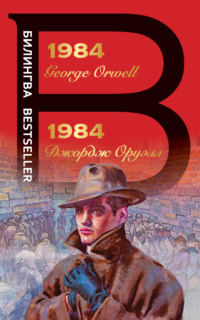
Read the book: «1984»
George Orwell
1984
© Шепелев Д.А., перевод на русский язык, 2021
© Издание на русском языке. ООО «Издательство «Эксмо», 2021
Part 1 / Часть 1
I
It was a bright cold day in April, and the clocks were striking thirteen. Winston Smith, his chin nuzzled into his breast in an effort to escape the vile wind, slipped quickly through the glass doors of Victory Mansions, though not quickly enough to prevent a swirl of gritty dust from entering along with him.
The hallway smelt of boiled cabbage and old rag mats. At one end of it a coloured poster, too large for indoor display, had been tacked to the wall. It depicted simply an enormous face, more than a metre wide: the face of a man of about forty five, with a heavy black moustache and ruggedly handsome features. Winston made for the stairs. It was no use trying the lift. Even at the best of times it was seldom working, and at present the electric current was cut off during daylight hours. It was part of the economy drive in preparation for Hate Week. The flat was seven flights up, and Winston, who was thirty nine and had a varicose ulcer above his right ankle, went slowly, resting several times on the way. On each landing, opposite the lift shaft, the poster with the enormous face gazed from the wall. It was one of those pictures which are so contrived that the eyes follow you about when you move. BIG BROTHER IS WATCHING YOU, the caption beneath it ran.
Inside the flat a fruity voice was reading out a list of figures which had something to do with the production of pig iron. The voice came from an oblong metal plaque like a dulled mirror which formed part of the surface of the right hand wall. Winston turned a switch and the voice sank somewhat, though the words were still distinguishable. The instrument (the telescreen, it was called) could be dimmed, but there was no way of shutting it off completely. He moved over to the window: a smallish, frail figure, the meagreness of his body merely emphasized by the blue overalls which were the uniform of the party. His hair was very fair, his face naturally sanguine, his skin roughened by coarse soap and blunt razor blades and the cold of the winter that had just ended.
Outside, even through the shut window pane, the world looked cold. Down in the street little eddies of wind were whirling dust and torn paper into spirals, and though the sun was shining and the sky a harsh blue, there seemed to be no colour in anything, except the posters that were plastered everywhere. The black moustachio’d face gazed down from every commanding corner. There was one on the house front immediately opposite. BIG BROTHER IS WATCHING YOU, the caption said, while the dark eyes looked deep into Winston’s own. Down at street level another poster, torn at one corner, flapped fitfully in the wind, alternately covering and uncovering the single word INGSOC. In the far distance a helicopter skimmed down between the roofs, hovered for an instant like a bluebottle, and darted away again with a curving flight. It was the police patrol, snooping into people’s windows. The patrols did not matter, however. Only the Thought Police mattered.
Behind Winston’s back the voice from the telescreen was still babbling away about pig iron and the overfulfilment of the Ninth Three Year Plan. The telescreen received and transmitted simultaneously. Any sound that Winston made, above the level of a very low whisper, would be picked up by it, moreover, so long as he remained within the field of vision which the metal plaque commanded, he could be seen as well as heard. There was of course no way of knowing whether you were being watched at any given moment. How often, or on what system, the Thought Police plugged in on any individual wire was guesswork. It was even conceivable that they watched everybody all the time. But at any rate they could plug in your wire whenever they wanted to. You had to live – did live, from habit that became instinct – in the assumption that every sound you made was overheard, and, except in darkness, every movement scrutinized.
Winston kept his back turned to the telescreen. It was safer, though, as he well knew, even a back can be revealing. A kilometre away the Ministry of Truth, his place of work, towered vast and white above the grimy landscape. This, he thought with a sort of vague distaste – this was London, chief city of Airstrip One, itself the third most populous of the provinces of Oceania. He tried to squeeze out some childhood memory that should tell him whether London had always been quite like this. Were there always these vistas of rotting nineteenth century houses, their sides shored up with baulks of timber, their windows patched with cardboard and their roofs with corrugated iron, their crazy garden walls sagging in all directions? And the bombed sites where the plaster dust swirled in the air and the willow herb straggled over the heaps of rubble; and the places where the bombs had cleared a larger patch and there had sprung up sordid colonies of wooden dwellings like chicken houses? But it was no use, he could not remember: nothing remained of his childhood except a series of bright lit tableaux occurring against no background and mostly unintelligible.
The Ministry of Truth – Minitrue, in Newspeak – was startlingly different from any other object in sight. It was an enormous pyramidal structure of glittering white concrete, soaring up, terrace after terrace, 300 metres into the air. From where Winston stood it was just possible to read, picked out on its white face in elegant lettering, the three slogans of the Party:
WAR IS PEACE
FREEDOM IS SLAVERY
IGNORANCE IS STRENGTH
The Ministry of Truth contained, it was said, three thousand rooms above ground level, and corresponding ramifications below. Scattered about London there were just three other buildings of similar appearance and size. So completely did they dwarf the surrounding architecture that from the roof of Victory Mansions you could see all four of them simultaneously. They were the homes of the four Ministries between which the entire apparatus of government was divided. The Ministry of Truth, which concerned itself with news, entertainment, education, and the fine arts. The Ministry of Peace, which concerned itself with war. The Ministry of Love, which maintained law and order. And the Ministry of Plenty, which was responsible for economic affairs. Their names, in Newspeak: Minitrue, Minipax, Miniluv, and Miniplenty.
The Ministry of Love was the really frightening one. There were no windows in it at all. Winston had never been inside the Ministry of Love, nor within half a kilometre of it. It was a place impossible to enter except on official business, and then only by penetrating through a maze of barbed wire entanglements, steel doors, and hidden machine gun nests. Even the streets leading up to its outer barriers were roamed by gorilla-faced guards in black uniforms, armed with jointed truncheons.
Winston turned round abruptly. He had set his features into the expression of quiet optimism which it was advisable to wear when facing the telescreen. He crossed the room into the tiny kitchen. By leaving the Ministry at this time of day he had sacrificed his lunch in the canteen, and he was aware that there was no food in the kitchen except a hunk of dark coloured bread which had got to be saved for tomorrow’s breakfast. He took down from the shelf a bottle of colourless liquid with a plain white label marked VICTORY GIN. It gave off a sickly, oily smell, as of Chinese rice spirit. Winston poured out nearly a teacupful, nerved himself for a shock, and gulped it down like a dose of medicine.
Instantly his face turned scarlet and the water ran out of his eyes. The stuff was like nitric acid, and moreover, in swallowing it one had the sensation of being hit on the back of the head with a rubber club. The next moment, however, the burning in his belly died down and the world began to look more cheerful. He took a cigarette from a crumpled packet marked VICTORY CIGARETTES and incautiously held it upright, whereupon the tobacco fell out on to the floor. With the next he was more successful. He went back to the living room and sat down at a small table that stood to the left of the telescreen. From the table drawer he took out a penholder, a bottle of ink, and a thick, quarto sized blank book with a red back and a marbled cover.
For some reason the telescreen in the living room was in an unusual position. Instead of being placed, as was normal, in the end wall, where it could command the whole room, it was in the longer wall, opposite the window. To one side of it there was a shallow alcove in which Winston was now sitting, and which, when the flats were built, had probably been intended to hold bookshelves. By sitting in the alcove, and keeping well back, Winston was able to remain outside the range of the telescreen, so far as sight went. He could be heard, of course, but so long as he stayed in his present position he could not be seen. It was partly the unusual geography of the room that had suggested to him the thing that he was now about to do.
But it had also been suggested by the book that he had just taken out of the drawer. It was a peculiarly beautiful book. Its smooth creamy paper, a little yellowed by age, was of a kind that had not been manufactured for at least forty years past. He could guess, however, that the book was much older than that. He had seen it lying in the window of a frowsy little junk shop in a slummy quarter of the town (just what quarter he did not now remember) and had been stricken immediately by an overwhelming desire to possess it. Party members were supposed not to go into ordinary shops (“dealing on the free market”, it was called), but the rule was not strictly kept, because there were various things, such as shoelaces and razor blades, which it was impossible to get hold of in any other way. He had given a quick glance up and down the street and then had slipped inside and bought the book for two dollars fifty. At the time he was not conscious of wanting it for any particular purpose. He had carried it guiltily home in his briefcase. Even with nothing written in it, it was a compromising possession.
The thing that he was about to do was to open a diary. This was not illegal (nothing was illegal, since there were no longer any laws), but if detected it was reasonably certain that it would be punished by death, or at least by twenty five years in a forced labour camp. Winston fitted a nib into the penholder and sucked it to get the grease off. The pen was an archaic instrument, seldom used even for signatures, and he had procured one, furtively and with some difficulty, simply because of a feeling that the beautiful creamy paper deserved to be written on with a real nib instead of being scratched with an ink pencil. Actually he was not used to writing by hand. Apart from very short notes, it was usual to dictate everything into the speakwrite which was of course impossible for his present purpose. He dipped the pen into the ink and then faltered for just a second. A tremor had gone through his bowels. To mark the paper was the decisive act. In small clumsy letters he wrote:
April 4th, 1984.
He sat back. A sense of complete helplessness had descended upon him. To begin with, he did not know with any certainty that this was 1984. It must be round about that date, since he was fairly sure that his age was thirty nine, and he believed that he had been born in 1944 or 1945; but it was never possible nowadays to pin down any date within a year or two.
For whom, it suddenly occurred to him to wonder, was he writing this diary? For the future, for the unborn. His mind hovered for a moment round the doubtful date on the page, and then fetched up with a bump against the Newspeak word doublethink. For the first time the magnitude of what he had undertaken came home to him. How could you communicate with the future? It was of its nature impossible. Either the future would resemble the present, in which case it would not listen to him, or it would be different from it, and his predicament would be meaningless.
For some time he sat gazing stupidly at the paper. The telescreen had changed over to strident military music. It was curious that he seemed not merely to have lost the power of expressing himself, but even to have forgotten what it was that he had originally intended to say. For weeks past he had been making ready for this moment, and it had never crossed his mind that anything would be needed except courage. The actual writing would be easy. All he had to do was to transfer to paper the interminable restless monologue that had been running inside his head, literally for years. At this moment, however, even the monologue had dried up. Moreover his varicose ulcer had begun itching unbearably. He dared not scratch it, because if he did so it always became inflamed. The seconds were ticking by. He was conscious of nothing except the blankness of the page in front of him, the itching of the skin above his ankle, the blaring of the music, and a slight booziness caused by the gin.
Suddenly he began writing in sheer panic, only imperfectly aware of what he was setting down. His small but childish handwriting straggled up and down the page, shedding first its capital letters and finally even its full stops:
April 4th, 1984. Last night to the flicks. All war films. One very good one of a ship full of refugees being bombed somewhere in the Mediterranean. Audience much amused by shots of a great huge fat man trying to swim away with a helicopter after him, first you saw him wallowing along in the water like a porpoise, then you saw him through the helicopters gunsights, then he was full of holes and the sea round him turned pink and he sank as suddenly as though the holes had let in the water, audience shouting with laughter when he sank. then you saw a lifeboat full of children with a helicopter hovering over it. there was a middle aged woman might have been a jewess sitting up in the bow with a little boy about three years old in her arms. little boy screaming with fright and hiding his head between her breasts as if he was trying to burrow right into her and the woman putting her arms round him and comforting him although she was blue with fright herself, all the time covering him up as much as possible as if she thought her arms could keep the bullets off him. then the helicopter planted a 20 kilo bomb in among them terrific flash and the boat went all to matchwood. then there was a wonderful shot of a child’s arm going up up up right up into the air a helicopter with a camera in its nose must have followed it up and there was a lot of applause from the party seats but a woman down in the prole part of the house suddenly started kicking up a fuss and shouting they didnt oughter of showed it not in front of kids they didnt it aint right not in front of kids it aint until the police turned her turned her out i dont suppose anything happened to her nobody cares what the proles say typical prole reaction they never —
Winston stopped writing, partly because he was suffering from cramp. He did not know what had made him pour out this stream of rubbish. But the curious thing was that while he was doing so a totally different memory had clarified itself in his mind, to the point where he almost felt equal to writing it down. It was, he now realized, because of this other incident that he had suddenly decided to come home and begin the diary today.
It had happened that morning at the Ministry, if anything so nebulous could be said to happen.
It was nearly eleven hundred, and in the Records Department, where Winston worked, they were dragging the chairs out of the cubicles and grouping them in the centre of the hall opposite the big telescreen, in preparation for the Two Minutes Hate. Winston was just taking his place in one of the middle rows when two people whom he knew by sight, but had never spoken to, came unexpectedly into the room. One of them was a girl whom he often passed in the corridors. He did not know her name, but he knew that she worked in the Fiction Department. Presumably – since he had sometimes seen her with oily hands and carrying a spanner – she had some mechanical job on one of the novel writing machines. She was a bold looking girl, of about twenty seven, with thick hair, a freckled face, and swift, athletic movements. A narrow scarlet sash, emblem of the Junior Anti Sex League, was wound several times round the waist of her overalls, just tightly enough to bring out the shapeliness of her hips. Winston had disliked her from the very first moment of seeing her. He knew the reason. It was because of the atmosphere of hockey fields and cold baths and community hikes and general clean mindedness which she managed to carry about with her. He disliked nearly all women, and especially the young and pretty ones. It was always the women, and above all the young ones, who were the most bigoted adherents of the Party, the swallowers of slogans, the amateur spies and nosers out of unorthodoxy. But this particular girl gave him the impression of being more dangerous than most. Once when they passed in the corridor she gave him a quick sidelong glance which seemed to pierce right into him and for a moment had filled him with black terror. The idea had even crossed his mind that she might be an agent of the Thought Police. That, it was true, was very unlikely. Still, he continued to feel a peculiar uneasiness, which had fear mixed up in it as well as hostility, whenever she was anywhere near him.
The other person was a man named O’Brien, a member of the Inner Party and holder of some post so important and remote that Winston had only a dim idea of its nature. A momentary hush passed over the group of people round the chairs as they saw the black overalls of an Inner Party member approaching. O’Brien was a large, burly man with a thick neck and a coarse, humorous, brutal face. In spite of his formidable appearance he had a certain charm of manner. He had a trick of resettling his spectacles on his nose which was curiously disarming – in some indefinable way, curiously civilized. It was a gesture which, if anyone had still thought in such terms, might have recalled an eighteenth century nobleman offering his snufbox. Winston had seen O’Brien perhaps a dozen times in almost as many years. He felt deeply drawn to him, and not solely because he was intrigued by the contrast between O’Brien’s urbane manner and his prize fighter’s physique. Much more it was because of a secretly held belief – or perhaps not even a belief, merely a hope – that O’Brien’s political orthodoxy was not perfect. Something in his face suggested it irresistibly. And again, perhaps it was not even unorthodoxy that was written in his face, but simply intelligence. But at any rate he had the appearance of being a person that you could talk to if somehow you could cheat the telescreen and get him alone. Winston had never made the smallest effort to verify this guess: indeed, there was no way of doing so. At this moment O’Brien glanced at his wrist watch, saw that it was nearly eleven hundred, and evidently decided to stay in the Records Department until the Two Minutes Hate was over. He took a chair in the same row as Winston, a couple of places away. A small, sandy-haired woman who worked in the next cubicle to Winston was between them. The girl with dark hair was sitting immediately behind.
The next moment a hideous, grinding speech, as of some monstrous machine running without oil, burst from the big telescreen at the end of the room. It was a noise that set one’s teeth on edge and bristled the hair at the back of one’s neck. The Hate had started.
As usual, the face of Emmanuel Goldstein, the Enemy of the People, had flashed on to the screen. There were hisses here and there among the audience. The little sandy-haired woman gave a squeak of mingled fear and disgust. Goldstein was the renegade and backslider who once, long ago (how long ago, nobody quite remembered), had been one of the leading figures of the Party, almost on a level with Big Brother himself, and then had engaged in counter revolutionary activities, had been condemned to death, and had mysteriously escaped and disappeared. The programmes of the Two Minutes Hate varied from day to day, but there was none in which Goldstein was not the principal figure. He was the primal traitor, the earliest defiler of the Party’s purity. All subsequent crimes against the Party, all treacheries, acts of sabotage, heresies, deviations, sprang directly out of his teaching. Somewhere or other he was still alive and hatching his conspiracies: perhaps somewhere beyond the sea, under the protection of his foreign paymasters, perhaps even – so it was occasionally rumoured – in some hiding place in Oceania itself.
Winston’s diaphragm was constricted. He could never see the face of Goldstein without a painful mixture of emotions. It was a lean Jewish face, with a great fuzzy aureole of white hair and a small goatee beard – a clever face, and yet somehow inherently despicable, with a kind of senile silliness in the long thin nose, near the end of which a pair of spectacles was perched. It resembled the face of a sheep, and the voice, too, had a sheep like quality. Goldstein was delivering his usual venomous attack upon the doctrines of the Party – an attack so exaggerated and perverse that a child should have been able to see through it, and yet just plausible enough to fill one with an alarmed feeling that other people, less level headed than oneself, might be taken in by it. He was abusing Big Brother, he was denouncing the dictatorship of the Party, he was demanding the immediate conclusion of peace with Eurasia, he was advocating freedom of speech, freedom of the Press, freedom of assembly, freedom of thought, he was crying hysterically that the revolution had been betrayed – and all this in rapid polysyllabic speech which was a sort of parody of the habitual style of the orators of the Party, and even contained Newspeak words: more Newspeak words, indeed, than any Party member would normally use in real life. And all the while, lest one should be in any doubt as to the reality which Goldstein’s specious claptrap covered, behind his head on the telescreen there marched the endless columns of the Eurasian army – row after row of solid looking men with expressionless Asiatic faces, who swam up to the surface of the screen and vanished, to be replaced by others exactly similar. The dull rhythmic tramp of the soldiers’ boots formed the background to Goldstein’s bleating voice.
Before the Hate had proceeded for thirty seconds, uncontrollable exclamations of rage were breaking out from half the people in the room. The self-satisfied sheep like face on the screen, and the terrifying power of the Eurasian army behind it, were too much to be borne: besides, the sight or even the thought of Goldstein produced fear and anger automatically. He was an object of hatred more constant than either Eurasia or Eastasia, since when Oceania was at war with one of these Powers it was generally at peace with the other. But what was strange was that although Goldstein was hated and despised by everybody, although every day and a thousand times a day, on platforms, on the telescreen, in newspapers, in books, his theories were refuted, smashed, ridiculed, held up to the general gaze for the pitiful rubbish that they were – in spite of all this, his influence never seemed to grow less. Always there were fresh dupes waiting to be seduced by him. A day never passed when spies and saboteurs acting under his directions were not unmasked by the Thought Police. He was the commander of a vast shadowy army, an underground network of conspirators dedicated to the overthrow of the State. The Brotherhood, its name was supposed to be. There were also whispered stories of a terrible book, a compendium of all the heresies, of which Goldstein was the author and which circulated clandestinely here and there. It was a book without a title. People referred to it, if at all, simply as the book. But one knew of such things only through vague rumours. Neither the Brotherhood nor the book was a subject that any ordinary Party member would mention if there was a way of avoiding it.
In its second minute the Hate rose to a frenzy. People were leaping up and down in their places and shouting at the tops of their voices in an effort to drown the maddening bleating voice that came from the screen. The little sandy-haired woman had turned bright pink, and her mouth was opening and shutting like that of a landed fish. Even O’Brien’s heavy face was flushed. He was sitting very straight in his chair, his powerful chest swelling and quivering as though he were standing up to the assault of a wave. The dark-haired girl behind Winston had begun crying out “Swine! Swine! Swine!” and suddenly she picked up a heavy Newspeak dictionary and flung it at the screen. It struck Goldstein’s nose and bounced off; the voice continued inexorably. In a lucid moment Winston found that he was shouting with the others and kicking his heel violently against the rung of his chair. The horrible thing about the Two Minutes Hate was not that one was obliged to act a part, but, on the contrary, that it was impossible to avoid joining in. Within thirty seconds any pretence was always unnecessary. A hideous ecstasy of fear and vindictiveness, a desire to kill, to torture, to smash faces in with a sledgehammer, seemed to flow through the whole group of people like an electric current, turning one even against one’s will into a grimacing, screaming lunatic. And yet the rage that one felt was an abstract, undirected emotion which could be switched from one object to another like the flame of a blowlamp. Thus, at one moment Winston’s hatred was not turned against Goldstein at all, but, on the contrary, against Big Brother, the Party, and the Thought Police; and at such moments his heart went out to the lonely, derided heretic on the screen, sole guardian of truth and sanity in a world of lies. And yet the very next instant he was at one with the people about him, and all that was said of Goldstein seemed to him to be true. At those moments his secret loathing of Big Brother changed into adoration, and Big Brother seemed to tower up, an invincible, fearless protector, standing like a rock against the hordes of Asia, and Goldstein, in spite of his isolation, his helplessness, and the doubt that hung about his very existence, seemed like some sinister enchanter, capable by the mere power of his voice of wrecking the structure of civilization.
It was even possible, at moments, to switch one’s hatred this way or that by a voluntary act. Suddenly, by the sort of violent effort with which one wrenches one’s head away from the pillow in a nightmare, Winston succeeded in transferring his hatred from the face on the screen to the dark haired girl behind him. Vivid, beautiful hallucinations flashed through his mind. He would flog her to death with a rubber truncheon. He would tie her naked to a stake and shoot her full of arrows like Saint Sebastian. He would ravish her and cut her throat at the moment of climax. Better than before, moreover, he realized why it was that he hated her. He hated her because she was young and pretty and sexless, because he wanted to go to bed with her and would never do so, because round her sweet supple waist, which seemed to ask you to encircle it with your arm, there was only the odious scarlet sash, aggressive symbol of chastity.
The Hate rose to its climax. The voice of Goldstein had become an actual sheep’s bleat, and for an instant the face changed into that of a sheep. Then the sheep face melted into the figure of a Eurasian soldier who seemed to be advancing, huge and terrible, his submachine gun roaring, and seeming to spring out of the surface of the screen, so that some of the people in the front row actually flinched backwards in their seats. But in the same moment, drawing a deep sigh of relief from everybody, the hostile figure melted into the face of Big Brother, black haired, black moustachio’d, full of power and mysterious calm, and so vast that it almost filled up the screen. Nobody heard what Big Brother was saying. It was merely a few words of encouragement, the sort of words that are uttered in the din of battle, not distinguishable individually but restoring confidence by the fact of being spoken. Then the face of Big Brother faded away again, and instead the three slogans of the Party stood out in bold capitals:
WAR IS PEACE
FREEDOM IS SLAVERY
IGNORANCE IS STRENGTH
But the face of Big Brother seemed to persist for several seconds on the screen, as though the impact that it had made on everyone’s eyeballs was too vivid to wear off immediately. The little sandy-haired woman had flung herself forward over the back of the chair in front of her. With a tremulous murmur that sounded like “My Saviour!” she extended her arms towards the screen. Then she buried her face in her hands. It was apparent that she was uttering a prayer.
At this moment the entire group of people broke into a deep, slow, rhythmical chant of “B—B!.. B—B!..” – over and over again, very slowly, with a long pause between the first “B” and the second – a heavy, murmurous sound, somehow curiously savage, in the background of which one seemed to hear the stamp of naked feet and the throbbing of tom toms. For perhaps as much as thirty seconds they kept it up. It was a refrain that was often heard in moments of overwhelming emotion. Partly it was a sort of hymn to the wisdom and majesty of Big Brother, but still more it was an act of self-hypnosis, a deliberate drowning of consciousness by means of rhythmic noise. Winston’s entrails seemed to grow cold. In the Two Minutes Hate he could not help sharing in the general delirium, but this sub-human chanting of “B—B!.. B—B!” always filled him with horror. Of course he chanted with the rest: it was impossible to do otherwise. To dissemble your feelings, to control your face, to do what everyone else was doing, was an instinctive reaction. But there was a space of a couple of seconds during which the expression of his eyes might conceivably have betrayed him. And it was exactly at this moment that the significant thing happened – if, indeed, it did happen.
Momentarily he caught O’Brien’s eye. O’Brien had stood up. He had taken off his spectacles and was in the act of resettling them on his nose with his characteristic gesture. But there was a fraction of a second when their eyes met, and for as long as it took to happen Winston knew – yes, he knew! – that O’Brien was thinking the same thing as himself. An unmistakable message had passed. It was as though their two minds had opened and the thoughts were flowing from one into the other through their eyes.
“I am with you,” O’Brien seemed to be saying to him. “I know precisely what you are feeling. I know all about your contempt, your hatred, your disgust. But don’t worry, I am on your side!”
And then the flash of intelligence was gone, and O’Brien’s face was as inscrutable as everybody else’s.
That was all, and he was already uncertain whether it had happened. Such incidents never had any sequel. All that they did was to keep alive in him the belief, or hope, that others besides himself were the enemies of the Party. Perhaps the rumours of vast underground conspiracies were true after all – perhaps the Brotherhood really existed! It was impossible, in spite of the endless arrests and confessions and executions, to be sure that the Brotherhood was not simply a myth. Some days he believed in it, some days not. There was no evidence, only fleeting glimpses that might mean anything or nothing: snatches of overheard conversation, faint scribbles on lavatory walls – once, even, when two strangers met, a small movement of the hand which had looked as though it might be a signal of recognition. It was all guesswork: very likely he had imagined everything. He had gone back to his cubicle without looking at O’Brien again. The idea of following up their momentary contact hardly crossed his mind. It would have been inconceivably dangerous even if he had known how to set about doing it. For a second, two seconds, they had exchanged an equivocal glance, and that was the end of the story. But even that was a memorable event, in the locked loneliness in which one had to live.
Winston roused himself and sat up straighter. He let out a belch. The gin was rising from his stomach.
His eyes refocused on the page. He discovered that while he sat helplessly musing he had also been writing, as though by automatic action. And it was no longer the same cramped, awkward handwriting as before. His pen had slid voluptuously over the smooth paper, printing in large neat capitals —
DOWN WITH BIG BROTHER
DOWN WITH BIG BROTHER
DOWN WITH BIG BROTHER
DOWN WITH BIG BROTHER
DOWN WITH BIG BROTHER
over and over again, filling half a page.
He could not help feeling a twinge of panic. It was absurd, since the writing of those particular words was not more dangerous than the initial act of opening the diary, but for a moment he was tempted to tear out the spoiled pages and abandon the enterprise altogether.
He did not do so, however, because he knew that it was useless. Whether he wrote DOWN WITH BIG BROTHER, or whether he refrained from writing it, made no difference. Whether he went on with the diary, or whether he did not go on with it, made no difference. The Thought Police would get him just the same. He had committed – would still have committed, even if he had never set pen to paper – the essential crime that contained all others in itself. Thoughtcrime, they called it. Thoughtcrime was not a thing that could be concealed for ever. You might dodge successfully for a while, even for years, but sooner or later they were bound to get you.
It was always at night – the arrests invariably happened at night. The sudden jerk out of sleep, the rough hand shaking your shoulder, the lights glaring in your eyes, the ring of hard faces round the bed. In the vast majority of cases there was no trial, no report of the arrest. People simply disappeared, always during the night. Your name was removed from the registers, every record of everything you had ever done was wiped out, your one time existence was denied and then forgotten. You were abolished, annihilated: vapourized was the usual word.
For a moment he was seized by a kind of hysteria. He began writing in a hurried untidy scrawl:
theyll shoot me i don’t care theyll shoot me in the back of the neck i dont care down with big brother they always shoot you in the back of the neck i dont care down with big brother —
He sat back in his chair, slightly ashamed of himself, and laid down the pen. The next moment he started violently. There was a knocking at the door.
Already! He sat as still as a mouse, in the futile hope that whoever it was might go away after a single attempt. But no, the knocking was repeated. The worst thing of all would be to delay. His heart was thumping like a drum, but his face, from long habit, was probably expressionless. He got up and moved heavily towards the door.
I
Был апрельский день, ясный и холодный, и часы отбивали тринадцать. Уинстон Смит вжал подбородок в грудь, пытаясь укрыться от злого ветра, и проскользнул за стеклянные двери жилого комплекса «Победа», впустив за собой завиток зернистой пыли.
В вестибюле пахло вареной капустой и старыми половиками. На дальней стене висел цветной плакат, непомерно большой для помещения. Плакат изображал огромное лицо, шириной более метра: мужчина лет сорока пяти, с густыми черными усами, грубовато-привлекательный. Уинстон направился к лестнице. Про лифт нечего было и мечтать. Даже в лучшие времена он редко работал, а сейчас в дневное время электричество отключали. Действовал режим экономии в преддверии Недели Ненависти. До квартиры было семь лестничных пролетов, и Уинстон с варикозной язвой над правой лодыжкой в свои тридцать девять лет поднимался медленно, то и дело останавливаясь. На каждом этаже со стены напротив лифта на него пялился тот же плакат. Его специально так разместили, что, где ни стой, глаза усача все равно будут смотреть на тебя. Надпись внизу гласила: «БОЛЬШОЙ БРАТ СМОТРИТ ЗА ТОБОЙ».
В квартире сочный голос зачитывал цифры, как-то связанные с производством чугуна. Звук раздавался справа от входа – из вделанной в стену продолговатой металлической пластины, похожей на помутневшее зеркало. Уинстон повернул на ней ручку, и голос стал тише, хотя слова остались различимы. Звук телеэкрана (так называлось устройство) можно было убавить, но не убрать совсем. Уинстон подошел к окну: невысокая, щуплая фигурка, еще более тщедушная в синем комбинезоне, отличавшем членов Партии. Волосы у него были совсем светлыми, на лице играл природный румянец, а кожа загрубела от хозяйственного мыла, тупых бритвенных лезвий и зимних холодов, только недавно отступивших.
Внешний мир даже сквозь закрытое окно отдавал холодом. Внизу, на улице, маленькие смерчи кружили пыль и бумажный мусор. И хотя светило солнце, а небо отливало резкой синевой, все казалось каким-то бесцветным, кроме повсюду развешанных плакатов. Усач взирал с каждого приметного угла – и с фасада дома прямо напротив. «БОЛЬШОЙ БРАТ СМОТРИТ ЗА ТОБОЙ», – гласила надпись, а темные глаза смотрели в лицо Уинстону. Ниже, на уровне улицы, еще один плакат трепетал на ветру оторванным краем, открывая и закрывая единственное слово: «АНГСОЦ». В отдалении скользил между крышами вертолет: завис на миг, точно трупная муха, и взмыл прочь по кривой. Это полицейский патруль заглядывал людям в окна. Но патрули – ерунда. Не то что Мыслеполиция.
За спиной Уинстона голос с телеэкрана продолжал бубнить о чугуне и перевыполнении Девятой Трехлетки. Телеэкран одновременно передавал и принимал информацию. Он улавливал любой звук громче тихого шепота, который издавал Уинстон. Более того, пока тот находился в поле зрения металлической пластины, его могли не только слышать, но и видеть. Конечно, никогда нельзя было сказать с уверенностью, следят за тобой в данный момент или нет. Никто не знал, как часто или по какой системе Мыслеполиция подключается к его каналу. Разумнее было считать, что следят за всеми и всегда. Так или иначе, к твоему телеэкрану могли подключиться в любой момент. Приходилось так жить – и ты жил, свыкаясь на уровне инстинкта с ощущением, что каждый звук в твоей квартире слышат, а движение – видят, особенно при свете.
Уинстон стоял спиной к телеэкрану. Так было надежнее, хотя он хорошо знал, что даже спина выдает человека. В километре от дома над обшарпанными зданиями высилась белая громада Министерства правды, место его работы. Вот он, Лондон, – подумал Уинстон с какой-то смутной неприязнью, – главный город Первой летной полосы, третьей по населенности провинции Океании. Он постарался припомнить, обратившись мыслями к детству, всегда ли Лондон был таким. Всегда ли так же тянулись вдаль вереницы трущоб девятнадцатого века: стены подперты бревнами, окна залатаны картоном, крыши – рифленым железом, а дикие заборы палисадников кренятся во все стороны? И прогалины от бомбежек, где в воздухе кружится известка, а по грудам обломков расползается кипрей; и более обширные пустыри, где бомбы расчистили место для отвратительных скоплений дощатых хибарок, похожих на курятники? Но его старания были тщетны, он не мог вспомнить из детства ничего кроме ярких обрывистых сцен, возникавших без всякого контекста и по большей части невразумительных.
Министерство правды – Миниправ на новоязе – разительно отличалось от всего, что его окружало. Это исполинское пирамидальное сооружение, сиявшее белым бетоном, вздымалось терраса за террасой, на триста метров ввысь. Уинстону были видны из окна квартиры три лозунга Партии, выложенные на белом фасаде элегантным шрифтом:
ВОЙНА – ЭТО МИР
СВОБОДА – ЭТО РАБСТВО
НЕЗНАНИЕ – ЭТО СИЛА
Министерство правды насчитывало, по слухам, три тысячи комнат над поверхностью земли и столько же в «корневой системе». Над Лондоном возвышались еще три сооружения подобного вида и размера. Они так явно доминировали над окружающим ландшафтом, что с крыши жилкомплекса «Победа» было видно сразу все четыре. В них размещались министерства, составлявшие весь правительственный аппарат. Министерство правды занималось новостями, досугом, образованием и изящными искусствами. Министерство мира заведовало войной. Министерство любви поддерживало закон и порядок. А Министерство изобилия решало вопросы экономики. На новоязе они назывались Миниправ, Минимир, Минилюб и Минизоб.
Министерство любви внушало страх. Это было здание без окон. Уинстон обходил его за полкилометра и никогда не был внутри. Туда пускали только по официальному делу, а вход защищало хитросплетение заборов с колючей проволокой, стальных дверей и скрытых пулеметных гнезд. Даже улицы, граничившие с Министерством любви, патрулировала гориллоподобная охрана в черной форме, вооруженная складными резиновыми дубинками.
Уинстон решительно отвернулся от окна. Он придал лицу выражение тихого оптимизма, наиболее уместное перед телеэкраном, и прошел через комнату на крохотную кухню. Покинув министерство в обеденный перерыв, он пожертвовал походом в столовую, хотя знал, что дома нет еды, кроме ломтя бурого хлеба, который надо оставить на завтрак. Уинстон снял с полки бутылку бесцветной жидкости с простой белой этикеткой: «ДЖИН ПОБЕДА». Из горлышка повеяло тошнотворным маслянистым духом, как от китайской рисовой водки. Он налил почти полную чашку, внутренне собрался и выпил залпом, точно лекарство.
Тут же лицо его покраснело, а из глаз потекли слезы. Как будто он глотнул азотной кислоты, а по затылку ему вмазали резиновой дубинкой. В следующий миг, однако, жжение в животе улеглось, и мир показался Уинстону более радостным. Он вытянул сигарету из мятой пачки с надписью «СИГАРЕТЫ ПОБЕДА» и нечаянно повернул ее вертикально, отчего табак высыпался на пол. Со следующей удалось справиться лучше. Вернувшись в гостиную, Уинстон сел за столик слева от телеэкрана. Из выдвижного ящика он достал перьевую ручку, пузырек чернил и толстую тетрадь большого формата с красным корешком и обложкой под мрамор.
Телеэкран в его квартире располагался почему-то в нестандартном месте – не на торцевой стене, откуда было бы видно всю комнату, а на длинной, напротив окна. Сбоку от экрана находилась неглубокая ниша, задуманная, вероятно, для книжных полок – там и сидел Уинстон. Вжавшись в нишу, он становился недосягаем для телеэкрана, по крайней мере, визуально. Его, разумеется, было слышно, но не видно, пока он не менял положения. Отчасти необычная география комнаты и побудила его когда-то к тому, чем он собирался заняться.
Но не в меньшей мере тому способствовала и сама тетрадь, которую он вытащил из ящика. Вид у нее был необычайно красивый. Такой гладкой кремовой бумаги, чуть пожелтевшей от времени, не выпускали уже лет сорок. Уинстон чувствовал тем не менее, что возраст этой тетради намного больше. Он приметил ее в витрине грязноватой лавки старьевщика где-то в районе трущоб (где именно, он уже не помнил) и немедленно загорелся всепоглощающим желанием заполучить ее. Членам Партии не полагалось заходить в обычные магазины (это называлось «отовариваться на свободном рынке»), но правило частенько нарушалось, поскольку некоторые вещи, такие как шнурки и бритвенные лезвия, невозможно было раздобыть иначе. Быстро скользнув взглядом по улице, Уинстон прошмыгнул внутрь лавки и купил тетрадь за два с половиной доллара. Тогда он еще и сам не знал, для чего она может понадобиться. Уинстон принес ее домой в портфеле, обуреваемый чувством вины. Тетрадь, даже чистая, компрометировала владельца.
А собирался он, собственно, вести дневник. Это не было запрещено законом (просто потому, что никаких законов больше не существовало), но если бы тетрадь обнаружили, то Уинстон мог поплатиться жизнью или получить как минимум двадцать пять лет лагерей. Он приладил к ручке перо и облизнул его для верности. Архаической перьевой ручкой мало кто пользовался даже для подписей, и он приобрел ее тайком и не без труда, просто по ощущению, что прекрасная кремовая бумага заслуживает настоящего пера, а не царапанья химическим карандашом. Вообще-то Уинстон не привык писать от руки. Не считая коротеньких записок, он обычно все надиктовывал в речепис, что в данном случае было, разумеется, невозможно. Он обмакнул перо в чернила и помедлил секунду. От волнения у него забурлило в животе. Оставить на бумаге след – это решительный шаг. Он вывел мелким неуклюжим почерком:
4 апреля 1984 года.
И выпрямился. Им овладело ощущение полной беспомощности. Для начала он даже не был уверен, что сейчас действительно 1984-й. Во всяком случае, что-то близкое к нему, поскольку Уинстон почти не сомневался, что ему тридцать девять, а родился он в 1944-м или 45-м; но теперь на любую дату можно было положиться лишь с погрешностью в пару лет.
Он вдруг задумался, для кого вообще собирался писать дневник? Для будущего, для тех, кто еще не родился. Его разум покружил секунду над сомнительной датой на странице, а затем наткнулся на слово из новояза «двоемыслие». Впервые он осознал, на что замахнулся. Как можно обращаться к будущему? Это по самой своей природе невозможно. Либо будущее станет походить на настоящее, и тогда никто не станет его слушать, либо оно будет другим, и невзгоды Уинстона покажутся ему чуждыми.
Какое-то время он сидел, тупо уставившись на бумагу. Телеэкран заиграл бравурную военную музыку. Что за ерунда: казалось, Уинстон не только лишился способности к самовыражению, но и вообще забыл, что намеревался сказать изначально. Несколько недель он готовился к этому моменту, и ему ни разу не пришло на ум, что потребуется нечто большее, нежели храбрость. Вести дневник – дело нехитрое. Нужно только перенести на бумагу неумолкаемый беспокойный монолог, звучащий в голове уже не первый год. Однако же сейчас иссяк и монолог. К тому же нестерпимо зазудела варикозная язва. Он не смел почесать ее, потому что от этого язва всегда воспалялась. Секунды проходили одна за другой. Он не осознавал ничего, кроме пустой страницы перед собой, чесотки над лодыжкой, гавканья военной музыки и легкого хмеля от джина.
Внезапно он принялся строчить, как в бреду, едва понимая, что именно пишет. Его мелкий, по-детски неровный почерк вихлял вверх-вниз по странице, потеряв сперва заглавные буквы, а затем и точки:
4 апреля 1984. Вчера смотрел кинокартины. Все про войну. Одна очень хорошая – как бомбили корабль полный беженцев где-то в Средиземном. Публику весьма забавляли кадры с огромным толстяком уплывающим от вертолета, сперва ты видел как он плещется в воде точно рыбина, затем смотрел на него через прицелы вертолета, потом его изрешетили пули и море вокруг стало розовым и он погрузился так резко словно набрал воды через раны, публика кричит и хохочет когда он тонет. потом ты заметил лодку полную детей и кружащий над ней вертолет. на носу лодки сидела женщина средних лет возможно еврейка с трехлетним мальчиком на руках. ребенок кричал от страха и прятал голову между ее грудей словно пытался зарыться внутрь а женщина обнимала его и успокаивала хотя сама посинела от страха, все время прикрывала его как могла словно думала защитить руками от пуль. затем вертолет сбросил на них 20 кг бомбу огромная вспышка и лодка разлетелась в щепки. потом был отличный кадр с детской рукой взлетающей выше выше выше прямо в воздух должно быть вертолет снимал ее фронтальной камерой и с партийных мест много аплодировали но женщина снизу из рядов пролов вдруг подняла хай и стала шуметь и кричать что не надо такое показывать не перед детьми им этого нельзя не перед детьми это пока полиция не забрала ее вывела ее не думаю что с ней что-то сделали никому нет дела что говорят пролы типично пролская реакция они никогда…
Уинстон перестал писать отчасти от спазма в руке. Он не знал, зачем выплеснул такой поток белиберды. Но интересный факт: пока он писал, у него в уме проявилось совершенно другое воспоминание, и так ясно оформилось, что хоть бери и записывай. Он теперь понял, что как раз это происшествие и побудило его так неожиданно пойти домой и начать дневник именно сегодня.
Оно произошло утром в министерстве, если слово «произошло» вообще применимо к чему-то столь туманному.
Было почти одиннадцать ноль-ноль, и в Отделе документации, где работал Уинстон, вытаскивали стулья из кабинок и расставляли посередине холла напротив большого экрана, готовясь к Двухминутке Ненависти. Уинстон как раз занимал свое место в одном из средних рядов, когда неожиданно появились два человека – их лица были ему знакомы, но и только. Девушка постоянно встречалась ему в коридорах. Уинстон не знал ее имени, но был в курсе, что она работает в Художественном отделе. Ему случалось видеть ее с гаечным ключом и замасленными руками, так что предположительно девушка числилась механиком по обслуживанию одной из романных машин. На вид лет двадцати семи, волосы густые, лицо в веснушках, держалась она заносчиво, а двигалась проворно и по-спортивному. Талию комбинезона перехватывал несколько раз узкий алый кушак, подчеркивая крутые бедра, – знак молодежной лиги Антисекс. Уинстон эту девушку сразу невзлюбил. И он понимал почему. От нее так и веяло духом хоккейных полей, купаний в ледяной воде, турпоходов и общей незамутненностью сознания. Он в принципе недолюбливал женщин, особенно молодых и хорошеньких. Именно женщины – и прежде всего юные – стали самыми ревностными приверженцами Партии, они жили лозунгами и всегда готовы были шпионить и вынюхивать отступников. Но эта девушка вызывала ощущение особенной опасности. Один раз, разминувшись в коридоре, она искоса взглянула на него, как ножом полоснула, и его вдруг пробрал липкий ужас. Ему даже подумалось, что она может служить агентом Мыслеполиции. Хотя, следовало признать, это было маловероятно. И все же всякий раз при встрече он испытывал безотчетное волнение с примесью страха и враждебности.
Вторым из вошедших был О’Брайен, член Внутренней Партии, занимавший настолько высокую и удаленную должность, что Уинстон имел о ней самое смутное представление. Как только люди, расставлявшие стулья, заметили черный комбинезон члена Внутренней Партии, все сразу притихли. О’Брайен был мощным, дородным мужчиной с толстой шеей и грубым насмешливым лицом. Несмотря на грозную внешность, ему было присуще своеобразное обаяние. Он имел привычку поправлять на носу очки, и этот неожиданно обезоруживающий жест придавал ему, странно сказать, нечто неуловимо интеллигентное. Такая характерная манера могла вызвать ассоциацию (если кто-то еще помнил подобные образы) с дворянином восемнадцатого века, предлагающим свою табакерку. Уинстон видел О’Брайена, пожалуй, с десяток раз за столько же лет. Он испытывал к нему симпатию, и не только из-за волнующего контраста между учтивыми манерами и телосложением боксера. В большей степени это объяснялось тайным убеждением – даже не убеждением, а лишь надеждой, – что политическая правоверность О’Брайена не была безупречной. Что-то в его лице наводило на подобные мысли. Хотя, возможно, что оно выражало не недостаток верности Партии, а просто интеллект. Так или иначе О’Брайен производил впечатление человека, с которым есть о чем поговорить, если бы каким-то образом удалось остаться с ним наедине и перехитрить телеэкран. Уинстон ни разу не пытался проверить свою догадку, да у него и не было такой возможности. Сейчас же О’Брайен взглянул на наручные часы, увидел, что уже почти одиннадцать, и по всей видимости решил остаться в Отделе документации до окончания Двухминутки Ненависти. Он сел в том же ряду, что и Уинстон, через пару сидений от него. Между ними расположилась маленькая рыжеватая женщина, которая трудилась в соседней с Уинстоном кабинке. Темноволосая девушка села прямо за ним.
Большой телеэкран на торцевой стене издал жуткий скрежещущий рев, словно чудовищная машина вдруг начала работать без смазки. От этого звука ломило зубы и волосы вставали на загривке. Ненависть началась.
На экране, как обычно, возникло лицо Эммануила Голдштейна, Врага Народа. В зрительских рядах зашикали. Рыжеватая женщина взвизгнула от страха и отвращения. Голдштейн был изменником и отступником, который когда-то давным-давно (насколько именно давно, никто толком не помнил) числился в предводителях Партии, чуть ли не наравне с самим Большим Братом, а потом ударился в контрреволюцию, был приговорен к смерти и таинственным образом сбежал, исчез. Программа Двухминутки Ненависти каждый день менялась, но на первый план всегда выходил Голдштейн. Он значился предателем номер один, первым осквернителем партийной чистоты. Все дальнейшие преступления против Партии, любые измены, вредительства, предательства, уклонения – все это было прямым следствием его учения. Он все еще был жив, скрываясь неведомо где и продолжая плести заговоры: возможно, где-то за морем, под защитой своих иностранных хозяев, а может быть – ходили и такие слухи, – он затаился на территории самой Океании.
Уинстону сдавило грудь. Всякий раз при виде Голдштейна его обуревали сложные и мучительные чувства. Это было сухое еврейское лицо в венчике пушистых белых волос и с козлиной бородкой – лицо умное и вместе с тем какое-то плюгавое, тронутое старческим маразмом, с очками на кончике длинного тонкого носа. В нем виделось что-то овечье, и сам голос изменника походил на блеянье. Голдштейн, как обычно, подвергал партийные доктрины ядовитым нападкам – столь вздорным и нелепым, что и ребенок мог их раскусить, однако достаточно убедительным для опасений, что кто-то менее здравомыслящий может на них повестись. Он поносил Большого Брата, обличал диктатуру Партии, требовал немедленно заключить мир с Евразией, призывал к свободе слова, свободе печати, свободе собраний, свободе мысли, он истерически вопил, что Революцию предали – и все это стремительной скороговоркой со сложными составными словами, будто пародируя манеру партийных ораторов, включая даже слова новояза, да в таких количествах, что никакому партийцу было за ним не угнаться. В это время, отметая любые сомнения в реальной подоплеке слов Голдштейна, на заднем фоне бесконечно маршировали колонны евразийской армии: шеренга за шеренгой кряжистых мужчин с бесстрастными азиатскими лицами. Они приближались к поверхности экрана и исчезали, уступая место своим точным копиям. Блеющий голос Голдштейна накладывался на ритмичный топот солдатских сапог.
Не прошло и полминуты Ненависти, а половина зрителей уже не могла сдерживать яростных возгласов. Невыносимо было видеть это самодовольное овечье лицо и ужасающую мощь евразийской армии за ним, хотя и без того одна только мысль о самом Голдштейне вызывала непроизвольный страх и гнев. Он был куда более привычным объектом ненависти, чем Евразия или Остазия, поскольку, когда Океания воевала с одной из них, то обыкновенно заключала мир с другой. Как ни странно, хотя Голдштейна ненавидели и презирали все подряд, и каждый день по тысяче раз за сутки – на трибунах, на телеэкранах, в газетах и книгах – его теории опровергали, громили, высмеивали, разбирали по кусочкам, доказывая их полнейшую несостоятельность, несмотря на все это, его влияние, казалось, не ослабевало. Всегда находились новые простофили, только и ждавшие идеологического совращения. Не проходило и дня, чтобы Мыслеполиция не разоблачала шпионов и вредителей, действующих по его указке. Он командовал огромной теневой армией, подпольной сетью заговорщиков, поставивших себе целью свергнуть Режим. Обычно на них ссылались как на Братство. А еще передавали шепотом истории о жуткой книге, собрании всех ересей, которую написал и тайно распространял Голдштейн. Книга не имела названия. В редких разговорах о ней упоминали просто как о книге. Но о таких вещах можно было узнать только по неясным слухам. Никто из рядовых партийцев старался не упоминать ни Братство, ни книгу.
На второй минуте ненависть перешла в истерию. Люди вскакивали с мест и кричали во все горло, стараясь заглушить одуряющий блеющий голос с экрана. Рыжеватая соседка Уинстона раскраснелась и разевала рот, словно рыба на суше. Даже тяжелое лицо О’Брайена побагровело. Он сидел очень прямо, его мощная грудь вздымалась и содрогалась, словно принимая на себя прибойную волну. Темноволосая девушка за спиной Уинстона начала кричать: «Сволочь! Сволочь! Сволочь!» – внезапно схватила тяжелый словарь новояза и запустила в телеэкран. Словарь врезался Голдштейну в нос и отскочил; голос с экрана звучал все так же неумолимо. Уинстон вдруг осознал, что тоже вопит вместе со всеми и яростно лягает ножку стула. Двухминутка Ненависти была ужасна не тем, что ты обязан играть свою роль, напротив, ты просто не мог не поддаться общему настрою. Через полминуты уже не нужно было притворяться. Словно электрический разряд толпу охватывали страх и гнев, исступленное желание убивать, истязать, крушить лица молотом, и люди против воли делались буйнопомешанными. Однако эта ярость оставалась отвлеченной, неперсонализированной эмоцией, которую можно было переводить с одного объекта на другой, как пламя паяльной лампы. Так ненависть Уинстона в какой-то миг оказывалась обращенной вовсе не на Голдштейна, а наоборот, на Большого Брата, на Партию и Мыслеполицию; в такие моменты сердце его тянулось к одинокому очерненному отступнику на экране, признавая в нем единственного поборника правды и здравомыслия в мире лжи. Однако в следующий миг Уинстон был един с людьми вокруг себя, и все, что говорили о Голдштейне, казалось ему правдой. Тогда его тайная неприязнь к Большому Брату сменялась обожанием, и Большой Брат вздымался надо всеми, как скала, превращаясь в неуязвимого, бесстрашного защитника от азиатских орд, а Голдштейн, несмотря на всю свою изоляцию, беспомощность и даже сомнение в самом его существовании, казался каким-то зловещим чародеем, который мог одной лишь силой голоса сокрушить целую цивилизацию.
Иногда можно было даже обратить свою ненависть волевым усилием на конкретный объект. Внезапно, диким усилием, каким отрываешь голову от подушки во время кошмара, Уинстон сумел перевести ярость с Голдштейна на темноволосую девушку позади себя. У него перед глазами замелькали отчетливые прекрасные галлюцинации. Он забьет ее до смерти резиновой дубинкой. Привяжет голой к столбу и истыкает стрелами, как святого Себастьяна. Овладеет ею и в момент оргазма перережет глотку. С небывалой ясностью он осознал причины своей ненависти. Потому что она была молода и красива и отрицала секс, потому что он хотел переспать с ней и никогда не сможет этого сделать, ведь ее прелестную гибкую талию, так и просившуюся в объятья, обнимал только жуткий алый кушак, агрессивный символ непорочности.
Ненависть достигла апогея. Голос Голдштейна перешел в настоящее овечье блеянье, и на миг его лицо обернулось бараньей мордой, которая плавно перетекла в фигуру евразийского солдата – огромный и ужасный, он наступал на зрителей, грохоча автоматной очередью. Казалось, он сейчас соскочит с экрана, так что некоторые в первом ряду отпрянули подальше. Но тут же раздался всеобщий вздох облегчения, когда враждебная фигура уступила место лицу Большого Брата – черноволосому, черноусому, исполненному могущества и загадочного спокойствия – да такому огромному, что оно едва умещалось на экране. Никто не мог расслышать, что говорил Большой Брат. Скорее всего, лишь несколько ободряющих слов, из тех, что произносят в пылу сражения, – сами по себе невнятные, они вселяли уверенность уже тем, что были произнесены. Затем лицо Большого Брата вновь поблекло, и на его месте жирным шрифтом возникли три лозунга Партии:
ВОЙНА – ЭТО МИР
СВОБОДА – ЭТО РАБСТВО
НЕЗНАНИЕ – ЭТО СИЛА
Лицо Большого Брата еще держалось на экране несколько секунд, словно бы его воздействие на человеческий глаз было слишком сильно, чтобы изгладиться сразу. Рыжеватая женщина навалилась на спинку переднего стула, лепеча дрожащим голосом что-то вроде: «Спаситель мой!» – и простерла руки к экрану. После чего спрятала лицо в ладони, вероятно, забормотав молитву.
И тут все собравшиеся принялись ритмично и неторопливо скандировать низкими голосами: «Бэ – Бэ!.. Бэ – Бэ!..» – снова и снова, очень медленно, с долгими интервалами между первым «Бэ» и вторым. В этом тяжелом, монотонном гуле слышалось что-то до странности дикарское, так что невольно представлялся топот босых ног и рокот туземных барабанов. Шум длился с полминуты. Люди нередко прибегали к этому рефрену от избытка чувств. Отчасти они восхваляли мудрость и величие Большого Брата, но в большей степени намеренно вводили себя в транс, одурманивая разум ритмичным повтором. Уинстон почувствовал, как внутри у него холодеет. Двухминутки Ненависти заставляли его поддаваться общему помешательству, но это дикарское скандирование «Бэ – Бэ!.. Бэ – Бэ!» всегда наполняло его ужасом. Разумеется, он повторял вместе со всеми – по-другому никак. Так велел инстинкт: скрывать свои чувства, управлять мимикой, делать все как все. Но на этот раз была пара секунд, когда он мог бы выдать себя выражением глаз. И вот тогда случилось нечто примечательное – если оно и вправду случилось.
В какой-то момент Уинстон поймал взгляд О’Брайена. Тот уже встал. Он снял очки и собирался снова водрузить их на нос своим характерным жестом. Но за долю секунды до этого их глаза встретились, и Уинстон понял – да, понял! – что О’Брайен думал так же, как и он сам. Ошибки быть не могло. Словно их сознания раскрылись и мысли передавались из глаз в глаза.
«Я с вами, – словно бы сказал ему О’Брайен. – Я понимаю ваши чувства. Я знаю все о вашем презрении, ненависти, отвращении. Но не волнуйтесь, я на вашей стороне!»
И тут же этот проблеск разума погас, а лицо О’Брайена стало таким же непроницаемым, как и у остальных.
Вот и все, Уинстон сразу начал сомневаться, произошло ли что-то вообще. Такие инциденты никогда ни к чему не вели. Они только поддерживали в нем убеждение или надежду, что были и другие враги Партии, не только он один. Возможно, что слухи о хитросплетенных подпольных заговорах имели реальную основу – не исключено, что Братство и вправду существовало! Нельзя было сказать с уверенностью, несмотря на бесконечные аресты, признания и казни, что Братство – не просто миф. Иногда Уинстон верил в него, иногда – нет. Свидетельств не было, только беглые взгляды, которые могли значить что угодно или вовсе ничего, обрывки чужих разговоров, неразборчивые надписи на стенах туалетов – а еще как-то раз он видел, как встретились два незнакомца, и один из них необычно шевельнул рукой, словно подав некий знак. Одни лишь догадки: вполне возможно, все это ему просто привиделось. Он вернулся в свою кабинку, не смея взглянуть на О’Брайена. Уинстон едва ли допускал возможность завязать с ним знакомство. Если бы он даже знал, как это устроить, опасность была слишком велика. Два человека обменялись двусмысленным взглядом, длившимся секунду, может, две – и дело с концом. Но даже это стало заметным событием для человека, вынужденного жить в одиночестве.
Уинстон встрепенулся и сел ровнее. Джин в желудке бунтовал и вызывал отрыжку.
Он снова всмотрелся в страницу. Оказалось, что пока он беспомощно витал в воспоминаниях, рука продолжала выводить строчки как бы сама по себе. Только почерк уже был не прежний корявый и неуклюжий. Перо размашисто скользило по гладкой бумаге, выводя крупными печатными буквами:
ДОЛОЙ БОЛЬШОГО БРАТА
ДОЛОЙ БОЛЬШОГО БРАТА
ДОЛОЙ БОЛЬШОГО БРАТА
ДОЛОЙ БОЛЬШОГО БРАТА
ДОЛОЙ БОЛЬШОГО БРАТА
Раз за разом одно и то же – и вот уже исписано полстраницы.
Уинстона захлестнула паника. Абсурдное ощущение, ведь дневник сам по себе был не менее опасен, чем эти конкретные слова. На миг им овладело желание вырвать исписанные страницы и забросить всю свою затею.
Однако он этого не сделал, поскольку понимал тщетность такого поступка. Не было разницы, написал он или нет «ДОЛОЙ БОЛЬШОГО БРАТА». Не было разницы и в том, станет ли он дальше вести дневник или нет. Мыслеполиция все равно его поймает. Он и так уже совершил – даже если бы никогда не касался пером бумаги – абсолютное преступление, содержавшее в себе все остальные. Мыслефелония – так это называлось. Мыслефелонию невозможно скрывать вечно. Можно изворачиваться до поры до времени, даже годами, но рано или поздно за тобой придут.
Приходили всегда по ночам – в другое время людей не арестовывали. Тебя резко будили, трясли за плечо, светили фонарем в глаза, кровать обступали суровые лица. Почти никогда никого не судили, об арестах не сообщали. Люди просто исчезали – всегда среди ночи. Твое имя удаляли из реестров, любые записи о твоих действиях уничтожали, само твое существование отрицалось и вскоре забывалось. Тебя аннулировали, стирали с лица земли – одним словом, испаряли, как об этом говорили.
Им вдруг овладело что-то вроде истерики. Уинстон принялся спешно писать неряшливым почерком:
меня застрелят мне плевать меня застрелят сзади в шею мне плевать долой большого брата они всегда стреляют сзади в шею мне плевать долой большого брата…
Он откинулся на спинку стула, чуть стыдясь себя, и отложил ручку. В следующий миг он нервно вздрогнул. Стучали в дверь.
Уже! Уинстон сидел тихо, как мышка, в тщетной надежде, что кто бы там ни был, он сейчас уйдет. Но нет, стук повторился. Медлить в такой ситуации было хуже всего. Сердце Уинстона бухало, как барабан, но лицо в силу долгой привычки оставалось почти невозмутимым. Он встал и тяжело направился к двери.
II
As he put his hand to the door knob Winston saw that he had left the diary open on the table. DOWN WITH BIG BROTHER was written all over it, in letters almost big enough to be legible across the room. It was an inconceivably stupid thing to have done. But, he realized, even in his panic he had not wanted to smudge the creamy paper by shutting the book while the ink was wet.
He drew in his breath and opened the door. Instantly a warm wave of relief flowed through him. A colourless, crushed looking woman, with wispy hair and a lined face, was standing outside.
“Oh, comrade,” she began in a dreary, whining sort of voice, “I thought I heard you come in. Do you think you could come across and have a look at our kitchen sink? It’s got blocked up and —”
It was Mrs. Parsons, the wife of a neighbour on the same floor. (“Mrs.” was a word somewhat discountenanced by the Party – you were supposed to call everyone “comrade” – but with some women one used it instinctively.) She was a woman of about thirty, but looking much older. One had the impression that there was dust in the creases of her face. Winston followed her down the passage. These amateur repair jobs were an almost daily irritation. Victory Mansions were old flats, built in 1930 or thereabouts, and were falling to pieces. The plaster flaked constantly from ceilings and walls, the pipes burst in every hard frost, the roof leaked whenever there was snow, the heating system was usually running at half steam when it was not closed down altogether from motives of economy. Repairs, except what you could do for yourself, had to be sanctioned by remote committees which were liable to hold up even the mending of a window pane for two years.
“Of course it’s only because Tom isn’t home,” said Mrs. Parsons vaguely.
The Parsons’ flat was bigger than Winston’s, and dingy in a different way. Everything had a battered, trampled on look, as though the place had just been visited by some large violent animal. Games impediments – hockey sticks, boxing gloves, a burst football, a pair of sweaty shorts turned inside out – lay all over the floor, and on the table there was a litter of dirty dishes and dogeared exercise books. On the walls were scarlet banners of the Youth League and the Spies, and a full-sized poster of Big Brother. There was the usual boiled cabbage smell, common to the whole building, but it was shot through by a sharper reek of sweat, which – one knew this at the first sniff, though it was hard to say how – was the sweat of some person not present at the moment. In another room someone with a comb and a piece of toilet paper was trying to keep tune with the military music which was still issuing from the telescreen.
“It’s the children,” said Mrs. Parsons, casting a half apprehensive glance at the door. “They haven’t been out today. And of course —”
She had a habit of breaking off her sentences in the middle. The kitchen sink was full nearly to the brim with filthy greenish water which smelt worse than ever of cabbage. Winston knelt down and examined the angle joint of the pipe. He hated using his hands, and he hated bending down, which was always liable to start him coughing. Mrs. Parsons looked on helplessly.
“Of course if Tom was home, he’d put it right in a moment,” she said. “He loves anything like that. He’s ever so good with his hands, Tom is.”
Parsons was Winston’s fellow employee at the Ministry of Truth. He was a fattish but active man of paralysing stupidity, a mass of imbecile enthusiasms – one of those completely unquestioning, devoted drudges on whom, more even than on the Thought Police, the stability of the Party depended. At thirty five he had just been unwillingly evicted from the Youth League, and before graduating into the Youth League he had managed to stay on in the Spies for a year beyond the statutory age. At the Ministry he was employed in some subordinate post for which intelligence was not required, but on the other hand he was a leading figure on the Sports Committee and all the other committees engaged in organizing community hikes, spontaneous demonstrations, savings campaigns, and voluntary activities generally. He would inform you with quiet pride, between whiffs of his pipe, that he had put in an appearance at the Community Centre every evening for the past four years. An overpowering smell of sweat, a sort of unconscious testimony to the strenuousness of his life, followed him about wherever he went, and even remained behind him after he had gone.
“Have you got a spanner?” said Winston, fiddling with the nut on the angle joint.
“A spanner,” said Mrs. Parsons, immediately becoming invertebrate. “I don’t know, I’m sure. Perhaps the children —”
There was a trampling of boots and another blast on the comb as the children charged into the living room. Mrs. Parsons brought the spanner. Winston let out the water and disgustedly removed the clot of human hair that had blocked up the pipe. He cleaned his fingers as best he could in the cold water from the tap and went back into the other room.
“Up with your hands!” yelled a savage voice.
A handsome, tough looking boy of nine had popped up from behind the table and was menacing him with a toy automatic pistol, while his small sister, about two years younger, made the same gesture with a fragment of wood. Both of them were dressed in the blue shorts, grey shirts, and red neckerchiefs which were the uniform of the Spies. Winston raised his hands above his head, but with an uneasy feeling, so vicious was the boy’s demeanour, that it was not altogether a game.
“You’re a traitor!” yelled the boy. “You’re a thought criminal! You’re a Eurasian spy! I’ll shoot you, I’ll vaporize you, I’ll send you to the salt mines!”
Suddenly they were both leaping round him, shouting “Traitor!” and “Thought criminal!” the little girl imitating her brother in every movement. It was somehow slightly frightening, like the gambolling of tiger cubs which will soon grow up into man eaters. There was a sort of calculating ferocity in the boy’s eye, a quite evident desire to hit or kick Winston and a consciousness of being very nearly big enough to do so. It was a good job it was not a real pistol he was holding, Winston thought.
Mrs. Parsons’ eyes flitted nervously from Winston to the children, and back again. In the better light of the living room he noticed with interest that there actually was dust in the creases of her face.
“They do get so noisy,” she said. “They’re disappointed because they couldn’t go to see the hanging, that’s what it is. I’m too busy to take them, and Tom won’t be back from work in time.”
“Why can’t we go and see the hanging?” roared the boy in his huge voice.
“Want to see the hanging! Want to see the hanging!” chanted the little girl, still capering round.
Some Eurasian prisoners, guilty of war crimes, were to be hanged in the Park that evening, Winston remembered. This happened about once a month, and was a popular spectacle. Children always clamoured to be taken to see it. He took his leave of Mrs. Parsons and made for the door. But he had not gone six steps down the passage when something hit the back of his neck an agonizingly painful blow. It was as though a red hot wire had been jabbed into him. He spun round just in time to see Mrs. Parsons dragging her son back into the doorway while the boy pocketed a catapult.
“Goldstein!” bellowed the boy as the door closed on him.
But what most struck Winston was the look of helpless fright on the woman’s greyish face.
Back in the flat he stepped quickly past the telescreen and sat down at the table again, still rubbing his neck. The music from the telescreen had stopped. Instead, a clipped military voice was reading out, with a sort of brutal relish, a description of the armaments of the new Floating Fortress which had just been anchored between lceland and the Faroe Islands.
With those children, he thought, that wretched woman must lead a life of terror. Another year, two years, and they would be watching her night and day for symptoms of unorthodoxy. Nearly all children nowadays were horrible. What was worst of all was that by means of such organizations as the Spies they were systematically turned into ungovernable little savages, and yet this produced in them no tendency whatever to rebel against the discipline of the Party. On the contrary, they adored the Party and everything connected with it. The songs, the processions, the banners, the hiking, the drilling with dummy rifles, the yelling of slogans, the worship of Big Brother – it was all a sort of glorious game to them. All their ferocity was turned outwards, against the enemies of the State, against foreigners, traitors, saboteurs, thought criminals. It was almost normal for people over thirty to be frightened of their own children. And with good reason, for hardly a week passed in which the Times did not carry a paragraph describing how some eavesdropping little sneak – “child hero” was the phrase generally used – had overheard some compromising remark and denounced its parents to the Thought Police.
The sting of the catapult bullet had worn off. He picked up his pen half heartedly, wondering whether he could find something more to write in the diary. Suddenly he began thinking of O’Brien again.
Years ago – how long was it? Seven years it must be – he had dreamed that he was walking through a pitch dark room. And someone sitting to one side of him had said as he passed: ‘We shall meet in the place where there is no darkness.’ It was said very quietly, almost casually – a statement, not a command. He had walked on without pausing. What was curious was that at the time, in the dream, the words had not made much impression on him. It was only later and by degrees that they had seemed to take on significance. He could not now remember whether it was before or after having the dream that he had seen O’Brien for the first time, nor could he remember when he had first identified the voice as O’Brien’s. But at any rate the identification existed. It was O’Brien who had spoken to him out of the dark.
Winston had never been able to feel sure – even after this morning’s flash of the eyes it was still impossible to be sure whether O’Brien was a friend or an enemy. Nor did it even seem to matter greatly. There was a link of understanding between them, more important than affection or partisanship.
“We shall meet in the place where there is no darkness,” he had said.
Winston did not know what it meant, only that in some way or another it would come true.
The voice from the telescreen paused. A trumpet call, clear and beautiful, floated into the stagnant air. The voice continued raspingly:
“Attention! Your attention, please! A newsflash has this moment arrived from the Malabar front. Our forces in South India have won a glorious victory. I am authorized to say that the action we are now reporting may well bring the war within measurable distance of its end. Here is the newsflash —”
Bad news coming, thought Winston. And sure enough, following on a gory description of the annihilation of a Eurasian army, with stupendous figures of killed and prisoners, came the announcement that, as from next week, the chocolate ration would be reduced from thirty grammes to twenty.
Winston belched again. The gin was wearing off, leaving a deflated feeling. The telescreen – perhaps to celebrate the victory, perhaps to drown the memory of the lost chocolate – crashed into “Oceania, ’tis for thee”. You were supposed to stand to attention. However, in his present position he was invisible.
“Oceania, ’tis for thee” gave way to lighter music. Winston walked over to the window, keeping his back to the telescreen. The day was still cold and clear. Somewhere far away a rocket bomb exploded with a dull, reverberating roar. About twenty or thirty of them a week were falling on London at present.
Down in the street the wind flapped the torn poster to and fro, and the word INGSOC fitfully appeared and vanished. Ingsoc. The sacred principles of Ingsoc.
Newspeak, doublethink, the mutability of the past. He felt as though he were wandering in the forests of the sea bottom, lost in a monstrous world where he himself was the monster. He was alone. The past was dead, the future was unimaginable. What certainty had he that a single human creature now living was on his side? And what way of knowing that the dominion of the Party would not endure for ever? Like an answer, the three slogans on the white face of the Ministry of Truth came back to him:
WAR IS PEACE
FREEDOM IS SLAVERY
IGNORANCE IS STRENGTH
He took a twenty five cent piece out of his pocket. There, too, in tiny clear lettering, the same slogans were inscribed, and on the other face of the coin the head of Big Brother. Even from the coin the eyes pursued you. On coins, on stamps, on the covers of books, on banners, on posters, and on the wrappings of a cigarette packet – everywhere. Always the eyes watching you and the voice enveloping you. Asleep or awake, working or eating, indoors or out of doors, in the bath or in bed – no escape. Nothing was your own except the few cubic centimetres inside your skull.
The sun had shifted round, and the myriad windows of the Ministry of Truth, with the light no longer shining on them, looked grim as the loopholes of a fortress. His heart quailed before the enormous pyramidal shape. It was too strong, it could not be stormed. A thousand rocket bombs would not batter it down. He wondered again for whom he was writing the diary. For the future, for the past – for an age that might be imaginary. And in front of him there lay not death but annihilation. The diary would be reduced to ashes and himself to vapour. Only the Thought Police would read what he had written, before they wiped it out of existence and out of memory. How could you make appeal to the future when not a trace of you, not even an anonymous word scribbled on a piece of paper, could physically survive?
The telescreen struck fourteen. He must leave in ten minutes. He had to be back at work by fourteen thirty.
Curiously, the chiming of the hour seemed to have put new heart into him. He was a lonely ghost uttering a truth that nobody would ever hear. But so long as he uttered it, in some obscure way the continuity was not broken. It was not by making yourself heard but by staying sane that you carried on the human heritage. He went back to the table, dipped his pen, and wrote:
To the future or to the past, to a time when thought is free, when men are different from one another and do not live alone – to a time when truth exists and what is done cannot be undone:
From the age of uniformity, from the age of solitude, from the age of Big Brother, from the age of doublethink – greetings!
He was already dead, he reflected. It seemed to him that it was only now, when he had begun to be able to formulate his thoughts, that he had taken the decisive step. The consequences of every act are included in the act itself. He wrote:
Thoughtcrime does not entail death: thoughtcrime IS death.
Now he had recognized himself as a dead man it became important to stay alive as long as possible. Two fingers of his right hand were inkstained. It was exactly the kind of detail that might betray you. Some nosing zealot in the Ministry (a woman, probably: someone like the little sandy-haired woman or the dark haired girl from the Fiction Department) might start wondering why he had been writing during the lunch interval, why he had used an old fashioned pen, what he had been writing – and then drop a hint in the appropriate quarter. He went to the bathroom and carefully scrubbed the ink away with the gritty dark brown soap which rasped your skin like sandpaper and was therefore well adapted for this purpose.
He put the diary away in the drawer. It was quite useless to think of hiding it, but he could at least make sure whether or not its existence had been discovered. A hair laid across the page ends was too obvious. With the tip of his finger he picked up an identifiable grain of whitish dust and deposited it on the corner of the cover, where it was bound to be shaken off if the book was moved.
II
Взявшись за дверную ручку, Уинстон обратил внимание на раскрытые страницы дневника на столе. «ДОЛОЙ БОЛЬШОГО БРАТА» повторялось на них столько раз и такими крупными буквами, что можно было разглядеть надписи через всю комнату. Немыслимая глупость! Несмотря на панику, он понял, что не хочет пачкать кремовую бумагу, захлопывая тетрадь, прежде чем просохнут чернила.
Уинстон вздохнул и открыл дверь. Облегчение теплой волной прокатилось по всему телу. За дверью стояла потрепанного вида женщина, невзрачная, с жидкими всклокоченными волосами и морщинистым лицом.
– Ох, товарищ, – затянула она тоскливым голосом, – я услыхала, вы вроде дома. Вы бы не зашли к нам посмотреть раковину на кухне? Она засорилась и…
Это была миссис Парсонс, жена соседа по этажу. (Партия почему-то не одобряла слово «миссис» – полагалось ко всем обращаться «товарищ», – но некоторых женщин называть иначе язык не поворачивался.) Женщина лет тридцати, но на вид гораздо старше. Казалось, в ее морщинах на лице залегла пыль. Уинстон пошел за ней по коридору. Слесарная самодеятельность стала едва ли не ежедневной морокой. Старый жилкомплекс «Победа» возвели годах в тридцатых – и весь он уже разваливался. С потолка и стен постоянно сыпалась штукатурка, трубы лопались при каждом крепком морозе, крыша текла всякий раз, как выпадал снег, а отопление обычно работало на половинном давлении, если его не отключали совсем из соображений экономии. Если ты не мог починить чего-то сам, то приходилось ждать распоряжений неуловимых комитетов, которые даже с ремонтом оконной рамы могли тянуть по два года.
– Я ведь только потому, что Том не дома, – пробормотала миссис Парсонс.
Квартира Парсонсов была больше, чем у Уинстона, и убожество ее выражалось иначе. Все вещи имели потрепанный, побитый вид, как будто здесь только что побывал крупный злобный зверь. По всему полу валялись спортивные принадлежности – хоккейные клюшки, боксерские перчатки, лопнувший футбольный мяч, вывернутые наизнанку потные шорты, – а на столе громоздилась грязная посуда и замызганные школьные тетради. На стенах алели знамена Молодежной лиги и лиги Разведчиков, и висел полноразмерный плакат Большого Брата. Пахло здесь, как и во всем доме, вареной капустой, но привычный запах оттеняла острая вонь едкого пота, которую оставил после себя кто-то отсутствующий в данный момент. Такие подробности по неизвестной причине становились понятны с первого вдоха. В соседней комнате кто-то трещал клочком туалетной бумаги по зубьям расчески, неумело подыгрывая военной музыке, продолжавшей звучать с телеэкрана.
– Это дети, – сказала миссис Парсонс, бросив тревожный взгляд на дверь. – Они сегодня не гуляли. И, конечно…
У нее была привычка обрывать предложения на середине. Раковина на кухне почти до краев заполнилась грязной зеленоватой водой, смердевшей хуже капусты. Уинстон опустился на колени и осмотрел угловую муфту на сливной трубе. Он терпеть не мог работать руками, терпеть не мог нагибаться – и всегда от этого кашлял. Миссис Парсонс стояла рядом с беспомощным видом.
– Был бы дома Том, он бы вмиг прочистил, – сказала она. – Он любит такими делами заниматься. Мастер на все руки.
Парсонс, как и Уинстон, работал в Министерстве правды. Это был полный, но неугомонный малый, тупой до невозможности сгусток кретинского энтузиазма – один из тех беспрекословных преданных трудяг, на которых Партия опиралась надежнее, чем на Мыслеполицию. Только в тридцать пять он с неохотой оставил ряды Молодежной лиги, а до этого умудрился пробыть в Разведчиках на год дольше положенного. В министерстве он занимал какую-то незначительную должность, для которой не требовалось особого ума, зато стал ведущей фигурой в Спортивном комитете и в целом ряде других структур для организации турпоходов, стихийных демонстраций, кампаний по экономии и прочих добровольных начинаний. Попыхивая трубкой, он не без гордости сообщал товарищам, что вот уже четыре года, как он не пропустил ни одного вечера в Центре досуга. Его всегда сопровождал одуряющий запах пота, являясь невольным знаком усердной жизнедеятельности и еще долго витая в помещении даже после ухода Парсонса.
– У вас есть гаечный ключ? – спросил Уинстон, тронув гайку на муфте.
– Гаечный, – сказала миссис Парсонс, обмякая на глазах. – Я даже не знаю. Может, дети…
Раздался топот, очередная трель расчески – и в комнату вкатились дети. Миссис Парсонс принесла гаечный ключ. Уинстон спустил воду и с отвращением извлек из трубы клок волос. Он, как мог, отмыл пальцы под холодной водой и вернулся в другую комнату.
– Руки вверх! – рявкнул свирепый голос.
Из-за стола вынырнул симпатичный крепыш лет девяти, наставляя на него игрушечный автоматический пистолет, а его сестренка, младше года на два, направила на Уинстона деревяшку. Оба были одеты в форму Разведчиков: синие шорты, серые рубашки, красные галстуки. Уинстон с беспокойством поднял руки над головой – мальчик держался так злобно, что это не было похоже на игру.
– Ты предатель! – завопил он. – Мыслефелон! Ты евразийский шпион! Я тебя застрелю, испарю, я тебя отправлю в соляные шахты!
И они оба принялись скакать вокруг Уинстона, вереща «Предатель!» и «Мыслефелон!» – девочка повторяла каждое движение за братом. Это немного пугало, как возня тигрят, которые скоро вырастут в людоедов. В глазах мальчика виднелась какая-то свирепая расчетливость, почти неодолимое желание ударить Уинстона и понимание того, что очень скоро это будет ему по силам. Уинстон подумал, как ему повезло, что у мальчика не настоящий пистолет.
Взгляд миссис Парсонс нервозно перебегал между гостем и детьми. В гостиной было светлее, и он с интересом отметил, что в морщинах на ее лице действительно засела пыль.
– Они что-то расшумелись, – сказала она. – Не понравилось, что их не возьмут на повешение, вот почему. Мне с ними некогда, а Том к тому времени еще не вернется с работы.
– Почему нам нельзя посмотреть, как вешают? – возмущенно завопил мальчик.
– Хочу смотреть, как вешают! Хочу смотреть, как вешают! – заголосила девочка, продолжая скакать.
Уинстон вспомнил, что сегодня вечером в парке будут публично вешать евразийских военных преступников. Такое зрелищное мероприятие устраивали примерно раз в месяц. Дети вечно просились со взрослыми. Он вышел от миссис Парсонс и направился к себе, но не прошел по коридору и шести шагов, как что-то больно ужалило его сзади в шею. Словно воткнули обрывок раскаленной проволоки. Уинстон резко обернулся и увидел, как миссис Парсонс затаскивает в дверь сына, прячущего в карман рогатку.
– Голдштейн! – заорал мальчик, исчезая за дверью.
Больше всего Уинстона изумило выражение беспомощного страха на сером лице матери.
Вернувшись к себе, он быстро прошел мимо телеэкрана и снова сел за стол, потирая шею. Музыка уже не играла. Теперь отрывистый военный голос, кровожадно смакуя подробности, зачитывал описание вооружений новой Плавучей крепости, только что вставшей на якорь между Исландией и Фарерскими островами.
Уинстон подумал, что с такими детьми эта несчастная женщина живет в постоянном страхе. Еще год-другой, и они начнут следить за ней днем и ночью, норовя уличить хоть в чем-нибудь. Теперь почти все дети ужасны. Хуже всего, что с помощью таких организаций, как Разведчики, их методично превращают в необузданных маленьких дикарей, но у них не возникает желания бунтовать против партийной дисциплины. Напротив, они обожают Партию и все, что с ней связано. Песни, парады, знамена, походы, муштра с учебными винтовками, громкие лозунги, восхваление Большого Брата – все это им представляется захватывающей игрой. Их натравливают на чужаков, на врагов Режима, на иностранцев, предателей, вредителей, мыслефелонов. Для людей старше тридцати стало в порядке вещей бояться собственных детей. И не без причины, ведь почти каждую неделю «Таймс» публикует заметки, как очередной мелкий ябедник – «маленький герой», как их обычно называют – грел дома уши и донес на родителей в Мыслеполицию, услышав подозрительные высказывания.
Боль в шее уже утихла. Уинстон взял ручку со смешанными чувствами, не зная, стоит ли занести в дневник что-то еще. Ему на ум вдруг снова пришел О’Брайен.
Несколько лет назад (сколько же именно – лет семь, пожалуй?) Уинстону приснилось, что он идет по комнате в кромешной тьме. И кто-то, сидевший чуть в стороне, говорит ему: «Мы встретимся там, где нет темноты». Это было сказано совсем тихо, почти между делом – замечание, а не приказ. Уинстон пошел дальше, не остановившись. Как ни странно, во сне он не придал значения этим словам. Только со временем, постепенно они стали обретать смысл. Он не мог теперь припомнить, увидел ли этот сон до или после знакомства с О’Брайеном, как не мог припомнить и когда он впервые решил, что слышал во сне именно его голос. Так или иначе голос он этот опознал. В темноте к нему обращался O’Брайен.
Уинстон никак не мог уяснить – даже после утреннего обмена взглядами – друг или враг ему О’Брайен. Хотя это как будто было не так уж и важно. Между ними промелькнуло понимание, значившее больше, чем взаимное расположение или заговорщицкий дух.
«Мы встретимся там, где нет темноты», – так он сказал.
Уинстон не понимал, что это значит, – знал только, что слова из сна так или иначе сбудутся.
Голос с телеэкрана прервался. В душном воздухе комнаты раздался звук фанфар, чистый и прекрасный. Голос проговорил со скрежетом:
«Внимание! Прошу внимания! Только что поступила сводка-молния с Малабарского фронта. Наши войска в Южной Индии одержали блестящую победу. Я уполномочен заявить, что настоящее событие вполне может приблизить завершение войны в обозримом будущем. Передаю сводку новостей…»
Уинстон подумал, что надо ждать плохих известий. И действительно: за кровавым описанием разгрома евразийской армии с колоссальными цифрами убитых и взятых в плен последовало объявление, что со следующей недели норма шоколадного рациона сокращается с тридцати граммов до двадцати.
Уинстон снова рыгнул. Джин почти выветрился, оставляя после себя чувство подавленности. Телеэкран разразился песней «Во славу твою, Океания» – то ли в честь победы, то ли чтобы отвлечь людей от сокращения шоколадного пайка. Полагалось встать по стойке «смирно», но Уинстон находился вне зоны видимости телеэкрана.
«Во славу твою, Океания» сменилась легкой музыкой. Уинстон подошел к окну, держась спиной к телеэкрану. День был все такой же холодный и ясный. Где-то вдалеке с глухим раскатистым грохотом взорвалась ракета. На Лондон их сбрасывали от двадцати до тридцати в неделю.
На улице ветер продолжал трепать оторванный угол плаката, то открывая, то скрывая слово «АНГСОЦ». Ангсоц. Священные устои Ангсоца.
Новояз, двоемыслие, пластичность прошлого. Уинстон почувствовал себя так, будто бредет по морскому дну через лес водорослей, затерявшись в монструозном мире, где и сам он – монстр. Он был один. Прошлое – мертво, будущее – невообразимо. Как он мог быть уверен, что на его стороне хоть одно человеческое существо из ныне живущих? И разве можно знать, что владычество Партии не будет вечным? Вместо ответа он прочитал три лозунга на белом фасаде Министерства правды:
ВОЙНА – ЭТО МИР
СВОБОДА – ЭТО РАБСТВО
НЕЗНАНИЕ – ЭТО СИЛА
Уинстон достал из кармана монетку в двадцать пять центов. На ней значились те же три лозунга, набранные аккуратным мелким шрифтом, а на оборотной стороне – лицо Большого Брата. Даже с монеты за тобой наблюдали эти глаза. Они были везде: на монетах, марках, книжных обложках, на знаменах и плакатах, на сигаретных пачках. Ты всегда чувствовал на себе взгляд и слышал вкрадчивый голос. Во сне и наяву, на работе и за едой, дома и на улице, в ванной и в постели – никуда от этого не деться. Не оставалось ничего своего, кроме нескольких кубических сантиметров внутри черепной коробки.
Солнце ушло, и мириады окон Министерства правды перестали отражать его свет, потемнев, как бойницы крепости. Сердце Уинстона сжалось при виде исполинской пирамиды. Она слишком прочна, ее не взять штурмом. И тысяча ракет не сможет сровнять ее с землей. Он снова задумался, ради кого пишет дневник. Ради будущего, ради прошлого – ради века, может, лишь воображаемого. Перед ним же маячила не смерть, но бесследное уничтожение. Дневник превратится в пепел, а сам он просто испарится. Его слова прочтет только Мыслеполиция, прежде чем стереть их с лица земли и из истории. Как можно обращаться к будущему, когда от тебя не останется никакого следа в этом мире, даже анонимных слов, нацарапанных на клочке бумаги?
Телеэкран пробил четырнадцать часов. До выхода десять минут. Он должен вернуться на работу к четырнадцати тридцати.
Бой часов, как ни странно, вернул ему присутствие духа. Уинстон был одиноким призраком, изрекавшим правду, которую никто никогда не услышит. Но пока он ее изрекает, связь времен таинственным образом продолжается. Ты несешь в себе человеческое начало не тогда, когда тебя слушают, а когда ты сохраняешь ясное сознание. Он вернулся к столу, обмакнул перо в чернила и написал:
Будущему или прошлому, времени, когда мысль свободна, когда люди отличаются друг от друга и не живут в одиночку – времени, когда существует правда, и что сделано, то сделано:
Из века одинаковых, из века одиночек, из века Большого Брата, из века двоемыслия – приветствую тебя!
Он подумал, что уже мертв. Ему показалось, что только сейчас, когда он обрел способность формулировать мысли, он пересек черту. Последствия любого действия заключены в самом этом действии. Он написал:
Мыслефелония не влечет за собой смерть: мыслефелония ЕСТЬ смерть.
Теперь, когда он признал в себе мертвеца, стало важным оставаться в живых как можно дольше. Два пальца правой руки запачкались чернилами. Как раз такая деталь и может выдать. Какой-нибудь востроносый ревнитель в министерстве (скорее всего, женщина: хотя бы та маленькая, рыжеватая или темноволосая из Художественного отдела) мог задуматься, почему Уинстон писал в обеденный перерыв, почему писал старомодной ручкой, что он писал – и обмолвиться об этом в нужном месте. Уинстон пошел в ванную и тщательно отмыл чернила зернистым бурым мылом, которое терло кожу, как наждачная бумага, и потому хорошо подходило для такой задачи.
Дневник он убрал в ящик. Пытаться как-то спрятать его было бессмысленно, но он мог хотя бы принять меры, чтобы заметить, если тетрадь обнаружат. Волос на краю страницы был бы слишком очевиден. Он подобрал кончиком пальца едва заметную белесую пылинку и поместил на угол обложки, где она будет покоиться, пока дневник кто-нибудь не возьмет в руки.
III
Winston was dreaming of his mother.
He must, he thought, have been ten or eleven years old when his mother had disappeared. She was a tall, statuesque, rather silent woman with slow movements and magnificent fair hair. His father he remembered more vaguely as dark and thin, dressed always in neat dark clothes (Winston remembered especially the very thin soles of his father’s shoes) and wearing spectacles. The two of them must evidently have been swallowed up in one of the first great purges of the fifties.
At this moment his mother was sitting in some place deep down beneath him, with his young sister in her arms. He did not remember his sister at all, except as a tiny, feeble baby, always silent, with large, watchful eyes. Both of them were looking up at him. They were down in some subterranean place – the bottom of a well, for instance, or a very deep grave – but it was a place which, already far below him, was itself moving downwards. They were in the saloon of a sinking ship, looking up at him through the darkening water. There was still air in the saloon, they could still see him and he them, but all the while they were sinking down, down into the green waters which in another moment must hide them from sight for ever. He was out in the light and air while they were being sucked down to death, and they were down there because he was up here. He knew it and they knew it, and he could see the knowledge in their faces. There was no reproach either in their faces or in their hearts, only the knowledge that they must die in order that he might remain alive, and that this was part of the unavoidable order of things.
He could not remember what had happened, but he knew in his dream that in some way the lives of his mother and his sister had been sacrificed to his own. It was one of those dreams which, while retaining the characteristic dream scenery, are a continuation of one’s intellectual life, and in which one becomes aware of facts and ideas which still seem new and valuable after one is awake. The thing that now suddenly struck Winston was that his mother’s death, nearly thirty years ago, had been tragic and sorrowful in a way that was no longer possible. Tragedy, he perceived, belonged to the ancient time, to a time when there was still privacy, love, and friendship, and when the members of a family stood by one another without needing to know the reason. His mother’s memory tore at his heart because she had died loving him, when he was too young and selfish to love her in return, and because somehow, he did not remember how, she had sacrificed herself to a conception of loyalty that was private and unalterable. Such things, he saw, could not happen today. Today there were fear, hatred, and pain, but no dignity of emotion, no deep or complex sorrows. All this he seemed to see in the large eyes of his mother and his sister, looking up at him through the green water, hundreds of fathoms down and still sinking.
Suddenly he was standing on short springy turf, on a summer evening when the slanting rays of the sun gilded the ground. The landscape that he was looking at recurred so often in his dreams that he was never fully certain whether or not he had seen it in the real world. In his waking thoughts he called it the Golden Country. It was an old, rabbit bitten pasture, with a foot track wandering across it and a molehill here and there. In the ragged hedge on the opposite side of the field the boughs of the elm trees were swaying very faintly in the breeze, their leaves just stirring in dense masses like women’s hair. Somewhere near at hand, though out of sight, there was a clear, slow moving stream where dace were swimming in the pools under the willow trees.
The girl with dark hair was coming towards them across the field. With what seemed a single movement she tore off her clothes and flung them disdainfully aside. Her body was white and smooth, but it aroused no desire in him, indeed he barely looked at it. What overwhelmed him in that instant was admiration for the gesture with which she had thrown her clothes aside. With its grace and carelessness it seemed to annihilate a whole culture, a whole system of thought, as though Big Brother and the Party and the Thought Police could all be swept into nothingness by a single splendid movement of the arm. That too was a gesture belonging to the ancient time. Winston woke up with the word “Shakespeare” on his lips.
The telescreen was giving forth an ear splitting whistle which continued on the same note for thirty seconds. It was nought seven fifteen, getting up time for office workers. Winston wrenched his body out of bed – naked, for a member of the Outer Party received only 3,000 clothing coupons annually, and a suit of pyjamas was 600 – and seized a dingy singlet and a pair of shorts that were lying across a chair. The Physical Jerks would begin in three minutes. The next moment he was doubled up by a violent coughing fit which nearly always attacked him soon after waking up. It emptied his lungs so completely that he could only begin breathing again by lying on his back and taking a series of deep gasps. His veins had swelled with the effort of the cough, and the varicose ulcer had started itching.
“Thirty to forty group!” yapped a piercing female voice. “Thirty to forty group! Take your places, please. Thirties to forties!”
Winston sprang to attention in front of the telescreen, upon which the image of a youngish woman, scrawny but muscular, dressed in tunic and gym shoes, had already appeared.
“Arms bending and stretching!” she rapped out. “Take your time by me. One, two, three, four! One, two, three, four! Come on, comrades, put a bit of life into it! One, two, three four! One, two, three, four!..”
The pain of the coughing fit had not quite driven out of Winston’s mind the impression made by his dream, and the rhythmic movements of the exercise restored it somewhat. As he mechanically shot his arms back and forth, wearing on his face the look of grim enjoyment which was considered proper during the Physical Jerks, he was struggling to think his way backward into the dim period of his early childhood. It was extraordinarily difficult. Beyond the late fifties everything faded. When there were no external records that you could refer to, even the outline of your own life lost its sharpness. You remembered huge events which had quite probably not happened, you remembered the detail of incidents without being able to recapture their atmosphere, and there were long blank periods to which you could assign nothing. Everything had been different then. Even the names of countries, and their shapes on the map, had been different. Airstrip One, for instance, had not been so called in those days: it had been called England or Britain, though London, he felt fairly certain, had always been called London.
Winston could not definitely remember a time when his country had not been at war, but it was evident that there had been a fairly long interval of peace during his childhood, because one of his early memories was of an air raid which appeared to take everyone by surprise. Perhaps it was the time when the atomic bomb had fallen on Colchester. He did not remember the raid itself, but he did remember his father’s hand clutching his own as they hurried down, down, down into some place deep in the earth, round and round a spiral staircase which rang under his feet and which finally so wearied his legs that he began whimpering and they had to stop and rest. His mother, in her slow, dreamy way, was following a long way behind them. She was carrying his baby sister – or perhaps it was only a bundle of blankets that she was carrying: he was not certain whether his sister had been born then. Finally they had emerged into a noisy, crowded place which he had realized to be a Tube station.
There were people sitting all over the stone flagged floor, and other people, packed tightly together, were sitting on metal bunks, one above the other. Winston and his mother and father found themselves a place on the floor, and near them an old man and an old woman were sitting side by side on a bunk. The old man had on a decent dark suit and a black cloth cap pushed back from very white hair: his face was scarlet and his eyes were blue and full of tears. He reeked of gin. It seemed to breathe out of his skin in place of sweat, and one could have fancied that the tears welling from his eyes were pure gin. But though slightly drunk he was also suffering under some grief that was genuine and unbearable. In his childish way Winston grasped that some terrible thing, something that was beyond forgiveness and could never be remedied, had just happened. It also seemed to him that he knew what it was. Someone whom the old man loved – a little granddaughter, perhaps – had been killed. Every few minutes the old man kept repeating:
“We didn’t ought to ’ave trusted ’em. I said so, Ma, didn’t I? That’s what comes of trusting ’em. I said so all along. We didn’t ought to ’ave trusted the buggers.”
But which buggers they didn’t ought to have trusted Winston could not now remember.
Since about that time, war had been literally continuous, though strictly speaking it had not always been the same war. For several months during his childhood there had been confused street fighting in London itself, some of which he remembered vividly. But to trace out the history of the whole period, to say who was fighting whom at any given moment, would have been utterly impossible, since no written record, and no spoken word, ever made mention of any other alignment than the existing one. At this moment, for example, in 1984 (if it was 1984), Oceania was at war with Eurasia and in alliance with Eastasia. In no public or private utterance was it ever admitted that the three powers had at any time been grouped along different lines. Actually, as Winston well knew, it was only four years since Oceania had been at war with Eastasia and in alliance with Eurasia. But that was merely a piece of furtive knowledge which he happened to possess because his memory was not satisfactorily under control. Officially the change of partners had never happened. Oceania was at war with Eurasia: therefore Oceania had always been at war with Eurasia. The enemy of the moment always represented absolute evil, and it followed that any past or future agreement with him was impossible.
The frightening thing, he reflected for the ten thousandth time as he forced his shoulders painfully backward (with hands on hips, they were gyrating their bodies from the waist, an exercise that was supposed to be good for the back muscles) – the frightening thing was that it might all be true. If the Party could thrust its hand into the past and say of this or that event, it never happened – that, surely, was more terrifying than mere torture and death?
The Party said that Oceania had never been in alliance with Eurasia. He, Winston Smith, knew that Oceania had been in alliance with Eurasia as short a time as four years ago. But where did that knowledge exist? Only in his own consciousness, which in any case must soon be annihilated. And if all others accepted the lie which the Party imposed – if all records told the same tale – then the lie passed into history and became truth.
“Who controls the past,” ran the Party slogan, “controls the future: who controls the present controls the past.”
And yet the past, though of its nature alterable, never had been altered. Whatever was true now was true from everlasting to everlasting. It was quite simple. All that was needed was an unending series of victories over your own memory. “Reality control”, they called it: in Newspeak, “doublethink”.
“Stand easy! ” barked the instructress, a little more genially.
Winston sank his arms to his sides and slowly refilled his lungs with air. His mind slid away into the labyrinthine world of doublethink. To know and not to know, to be conscious of complete truthfulness while telling carefully constructed lies, to hold simultaneously two opinions which cancelled out, knowing them to be contradictory and believing in both of them, to use logic against logic, to repudiate morality while laying claim to it, to believe that democracy was impossible and that the Party was the guardian of democracy, to forget whatever it was necessary to forget, then to draw it back into memory again at the moment when it was needed, and then promptly to forget it again: and above all, to apply the same process to the process itself. That was the ultimate subtlety: consciously to induce unconsciousness, and then, once again, to become unconscious of the act of hypnosis you had just performed. Even to understand the word “doublethink” involved the use of doublethink.
The instructress had called them to attention again.
“And now let’s see which of us can touch our toes!” she said enthusiastically. “Right over from the hips, please, comrades. One, two! One, two!..”
Winston loathed this exercise, which sent shooting pains all the way from his heels to his buttocks and often ended by bringing on another coughing fit. The half pleasant quality went out of his meditations. The past, he reflected, had not merely been altered, it had been actually destroyed. For how could you establish even the most obvious fact when there existed no record outside your own memory? He tried to remember in what year he had first heard mention of Big Brother. He thought it must have been at some time in the sixties, but it was impossible to be certain. In the Party histories, of course, Big Brother figured as the leader and guardian of the Revolution since its very earliest days. His exploits had been gradually pushed backwards in time until already they extended into the fabulous world of the forties and the thirties, when the capitalists in their strange cylindrical hats still rode through the streets of London in great gleaming motor cars or horse carriages with glass sides. There was no knowing how much of this legend was true and how much invented. Winston could not even remember at what date the Party itself had come into existence. He did not believe he had ever heard the word Ingsoc before 1960, but it was possible that in its Oldspeak form – “English Socialism”, that is to say – it had been current earlier. Everything melted into mist. Sometimes, indeed, you could put your finger on a definite lie. It was not true, for example, as was claimed in the Party history books, that the Party had invented aeroplanes. He remembered aeroplanes since his earliest childhood. But you could prove nothing. There was never any evidence. Just once in his whole life he had held in his hands unmistakable documentary proof of the falsification of an historical fact. And on that occasion —
“Smith!” screamed the shrewish voice from the telescreen. “6079 Smith W.! Yes, you! Bend lower, please! You can do better than that. You’re not trying. Lower, please! That’s better, comrade. Now stand at ease, the whole squad, and watch me.”
A sudden hot sweat had broken out all over Winston’s body. His face remained completely inscrutable. Never show dismay! Never show resentment! A single flicker of the eyes could give you away. He stood watching while the instructress raised her arms above her head and – one could not say gracefully, but with remarkable neatness and efficiency – bent over and tucked the first joint of her fingers under her toes.
“There, comrades! That’s how I want to see you doing it. Watch me again. I’m thirty nine and I’ve had four children. Now look.” She bent over again. “You see my knees aren’t bent. You can all do it if you want to,” she added as she straightened herself up. “Anyone under forty five is perfectly capable of touching his toes. We don’t all have the privilege of fighting in the front line, but at least we can all keep fit. Remember our boys on the Malabar front! And the sailors in the Floating Fortresses! Just think what they have to put up with. Now try again. That’s better, comrade, that’s much better,” she added encouragingly as Winston, with a violent lunge, succeeded in touching his toes with knees unbent, for the first time in several years.
III
Уинстону снилась мать.
Она исчезла, насколько он знал, когда ему было лет десять-одиннадцать. Мать была высокой, величавой женщиной с роскошными светлыми волосами, довольно молчаливой, медленной в движениях. Отца он припоминал менее отчетливо – темноволосый худощавый человек, всегда в опрятной темной одежде (Уинстону особенно запомнились очень тонкие подошвы его туфель) и в очках. Должно быть, их обоих проглотила система во время одной из первых больших чисток пятидесятых.
Во сне мать сидела где-то в глубине гораздо ниже него, держа на руках его младшую сестренку. Сестренку он почти не помнил – она была крохотным хилым младенцем, тихим и с большими внимательными глазами. Обе они смотрели снизу на Уинстона. Они находились в какой-то подземной норе – вроде дна колодца или очень глубокой могилы, – и эта нора, и без того глубокая, продолжала расти вниз. Они словно сидели в салоне тонущего корабля и смотрели на него сквозь темнеющую воду. В салоне еще оставался воздух, и они еще могли видеть его, а он – их, но они продолжали погружаться все глубже и глубже в зеленую воду – и в следующий миг вода скрыла их навсегда. Он стоял на свету и на воздухе, а их затягивала смерть, и они были там, внизу, потому что он был здесь, наверху. Он это знал, и они это знали, и это знание он видел на их лицах. Но ни на лицах, ни в сердцах у них не было упрека – только осознание того, что они должны были умереть, чтобы он мог дальше жить, потому что таков неизбежный порядок вещей.
Он не мог вспомнить, что же с ними случилось, но понял во сне, что каким-то образом жизни его матери и сестры принесли в жертву ради него. Это был один из тех снов, когда за внешней причудливостью продолжается обычный мыслительный процесс и возникает понимание событий и идей, сохраняющее новизну и значимость после пробуждения. Уинстона вдруг осенило, что смерть его матери почти тридцать лет назад была трагической и горестной в значении, теперь уже немыслимом. Ему открылось, что трагедия – это достояние былых времен, когда существовала частная жизнь, любовь и дружба, а родные люди стояли друг за друга без лишних вопросов. Воспоминание о матери разрывало ему сердце потому, что она умерла с любовью к нему, а он был еще слишком юн и эгоистичен, чтобы ответить тем же, а еще она каким-то образом – каким именно, он не помнил – принесла себя в жертву личной и несокрушимой идее верности. Он осознал, что сегодня такое уже невозможно. Сегодня есть страх, ненависть и боль, но нет ни уважения к чувствам, ни глубокого и сложного горя. Все это он словно бы увидел в больших глазах матери и сестры, смотревших на него сквозь зеленую воду снизу, с глубины в сотни саженей, и продолжавших погружаться.
Неожиданно он очутился на короткой упругой траве летним вечером, когда косые лучи солнца золотят землю. Простиравшаяся перед ним местность так часто ему снилась, что он не мог быть уверенным, видел он ее когда-то наяву или нет. Мысленно он называл ее Золотой страной. Это был старый, выщипанный кроликами луг, с протоптанной тропинкой и кочками кротовых нор. По дальнему краю луга неровной стеной тянулись вязы, легкий ветер едва шевелил их кроны, и густая листва колыхалась, словно женские волосы. А где-то неподалеку, вне зоны видимости, лениво журчал чистый ручей, и плотва плескалась в заводях под ивами.
Через луг шла девушка с темными волосами. Одним движением она сорвала с себя всю одежду и небрежно отбросила в сторону. Тело у нее было белым и атласным, но не пробудило в нем желания – он едва взглянул на него. Что захватило его в тот миг, так это сам жест, которым она отбросила одежду. Такая изящная беспечность словно перечеркнула целую цивилизацию и мировоззрение, как будто и Большого Брата, и Партию, и Мыслеполицию ниспровергли одним великолепным взмахом руки. Этот жест также был достоянием былого. Уинстон проснулся со словом «Шекспир» на губах.
Телеэкран издавал раздирающий уши свист, державшийся тридцать секунд на одной ноте. На часах 07.15 – время подъема для конторских служащих. Уинстон выдернул себя из постели – нагишом, поскольку член внешней партии получал всего три тысячи купонов на одежду в год, а пижамный костюм стоил шестьсот – и схватил со стула поношенную майку и шорты. До физзарядки оставалось три минуты. И тут его согнул жестокий приступ кашля, как почти всегда после пробуждения. Кашель норовил вывернуть легкие наизнанку, так что Уинстон повалился на спину и начал отчаянно ловить ртом воздух, пытаясь восстановить дыхание. Жилы у него вздулись от натуги, а варикозная язва зачесалась.
– Группа от тридцати до сорока! – пролаял пронзительный женский голос. – Группа от тридцати до сорока! Примите, пожалуйста, исходное положение. От тридцати до сорока!
Уинстон встал по стойке «смирно» перед телеэкраном, на котором уже возникла моложавая женщина: худощавая, но мускулистая, в тунике и спортивных туфлях.
– Сгибание рук и потягивание! – отчеканила она. – Считайте за мной. И раз, два, три, четыре! И раз, два, три, четыре! Ну-ка, товарищи, поживее! И раз, два, три, четыре! И раз, два, три, четыре!..
Жестокий приступ кашля едва не вытеснил из сознания Уинстона ощущения от сновидения, но ритмичные движения зарядки помогли их восстановить. Механически выбрасывая руки взад-вперед и удерживая на лице выражение сурового удовлетворения, какое полагалось на физзарядке, он старался прорваться к смутным воспоминаниям раннего детства. Неимоверно трудная задача. Время до конца пятидесятых терялось в тумане. Когда не можешь обратиться к внешним ориентирам, размываются даже события собственной жизни. Ты вспоминаешь крупные происшествия, которых, вполне возможно, и вовсе не было, вспоминаешь мелкую подробность какого-то отдельного случая, но не можешь восстановить общую атмосферу, а еще есть долгие периоды пустоты, о которых ты не помнишь ничего вовсе. Все тогда было другим. Даже названия стран и их очертания на карте. Первая летная полоса, к примеру, называлась тогда по-другому – Англия или Британия, а вот Лондон (Уинстон в этом почти не сомневался) всегда был Лондоном.
Уинстон не мог с уверенностью припомнить время, когда бы его страна не воевала. Кажется, на его детские годы пришелся длительный мирный период, поскольку одно из ранних воспоминаний было связано с авианалетом, очевидно, заставшим всех врасплох. Возможно, как раз тогда на Колчестер сбросили атомную бомбу. Сам налет стерся из памяти, но он помнил, как отец крепко держал его за руку, пока они спешно спускались все ниже и ниже в какое-то подземное убежище, кружа по винтовой лестнице, звеневшей под ногами. В итоге он так вымотался, что начал хныкать, и им пришлось остановиться отдохнуть. Мать тоже спускалась, но заметно отстала, двигаясь в своей медлительной манере, словно во сне. Она несла его сестренку, а может, то был просто сверток покрывал – он не помнил точно, родилась ли уже сестренка. Наконец, они вошли в шумное, многолюдное помещение, и он понял, что это станция метро.
Люди сидели по всей площади каменного пола и теснились на металлических нарах. Уинстон с родителями устроились на полу, а рядом на нарах сидели старик со старухой. Седой как лунь старик был одет в приличный темный костюм и черную матерчатую кепку, сдвинутую на затылок; лицо у него отливало густо-красным, а в голубых глазах стояли слезы. От него несло джином. Казалось, джин сочится из всех его пор, точно пот, и слезы его – тоже чистый джин. Несмотря на легкий хмель, старик терзался от горя, глубокого и нестерпимого. Уинстон понял своим детским умом, что случилось что-то ужасное, что-то такое, чего нельзя ни простить, ни исправить. Ему даже показалось, что он знает, в чем дело. У старика убили кого-то, кого он любил, – может, маленькую внучку. Старик ежеминутно повторял:
– Не надо нам было им доверять. Говорил же я, мать, говорил? Вот что бывает, когда доверяешь им. Я это всегда говорил. Не надо было доверять этим скотам.
Но что это были за скоты, которым нельзя доверять, Уинстон вспомнить не мог.
Примерно с тех пор война практически не прекращалась, хотя, строго говоря, это была не одна и та же война. Несколько месяцев в его детстве шли беспорядочные бои на улицах Лондона, и кое-что из этого Уинстон отчетливо помнил. Но проследить историю тех лет и установить, кто с кем сражался в тот или иной период, было совершенно невозможно. Никакие письменные свидетельства, равно как и устные, не упоминали ни о какой иной расстановке сил, кроме сегодняшней. Сегодня, к примеру, в 1984 году (если сегодня 1984-й), Океания воевала с Евразией, будучи в союзе с Остазией. Ни в официальных, ни в частных заявлениях никто не признавал, что отношения этих трех сил когда-то могли быть другими. Но Уинстон хорошо помнил, что еще четыре года назад Океания воевала с Остазией, будучи в союзе с Евразией. Память его была источником субъективным, на который он мог полагаться лишь постольку, поскольку его сознание не вполне подчинялось системе. Официально расстановка сил никогда не менялась. Океания ведет войну с Евразией, стало быть, Океания всегда вела войну с Евразией. Враг текущего момента всегда является абсолютным злом, из чего следует, что никакое соглашение с ним – ни в прошлом, ни в будущем – невозможно.
Страшнее всего, думал он в стотысячный раз, отводя плечи назад до ломоты (они вращали корпусом, держа руки на бедрах – это считалось полезным для мышц спины), страшнее всего, что все это может быть правдой. Если Партии под силу запустить руку в прошлое и заявить о том или ином событии, что его никогда не было, – разве это не страшнее любых пыток или смерти?
Партия утверждала, что Океания никогда не была в союзе с Евразией. Он же, Уинстон Смит, знал, что Океания была в союзе с Евразией как минимум четыре года назад. Но чем это знание подкреплялось? Только его личным сознанием, которое в любом случае скоро уничтожат. Если все примут за правду партийную ложь, если все официальные источники будут рассказывать одну и ту же сказку – тогда ложь войдет в историю и станет правдой.
«Кто управляет прошлым, – гласил лозунг Партии, – тот управляет будущим; кто управляет настоящим, тот управляет прошлым».
Однако же прошлое, по своей природе подлежащее пересмотру, на практике никогда не пересматривалось. Сегодняшняя истина была верна всегда и на веки вечные. Проще простого. Для этого требовался лишь бесконечный ряд побед над собственной памятью. «Управление реальностью» – вот как это называется, а на новоязе – «двоемыслие».
– Вольно! – гавкнула инструкторша уже чуть более приветливо.
Уинстон опустил руки по швам и медленно сделал глубокий вдох. Его разум соскользнул в лабиринт мира двоемыслия. Знать и не знать, полностью сознавать правду и говорить тщательно продуманную ложь, параллельно придерживаться двух противоположных взглядов, понимая, что они исключают друг друга, использовать логику против логики, аннулировать мораль, взывая к морали, не верить в возможность демократии и верить, что Партия является гарантом демократии, забывать все, что надлежит забыть, а затем снова обращаться к этому, когда нужно, и снова ловко забывать. А самое главное, нужно применять этот же процесс к самому процессу – в этом вся тонкость: сознательно добиваться бессознательности, а затем опять-таки подавлять понимание проделанного самогипноза. Даже понимание слова «двоемыслие» требует двоемыслия.
Инструкторша снова велела встать смирно.
– А теперь посмотрим, кто у нас сумеет дотянуться до носков! – произнесла она с энтузиазмом. – Пожалуйста, товарищи, тянемся от бедра. Раз-два! Раз-два!..
Уинстон терпеть не мог это упражнение – оно прошивало ноги болью от пяток до ягодиц и часто заканчивалось очередным приступом кашля. Его размышления лишились условной приятности. Прошлое, рассудил он, не просто изменили, его, по сути, уничтожили. Разве можно установить точно хотя бы самый очевидный факт, когда его не подтверждает ничего, кроме твоей памяти? Он попытался вспомнить, в каком году впервые услышал что-либо о Большом Брате. Предположительно где-то в шестидесятые, но нельзя было сказать наверняка. Разумеется, в истории Партии Большой Брат фигурировал как вождь и поборник Революции с первых ее дней. Подвиги его постепенно отодвигались в прошлое, пока не достигли легендарного мира сороковых и тридцатых годов, когда капиталисты в странных шляпах-цилиндрах еще разъезжали по улицам Лондона в огромных блестящих автомобилях или в остекленных каретах. Невозможно установить, что из этих легенд было правдой, а что – выдумкой. Уинстон не мог даже вспомнить дату возникновения самой Партии. Он полагал, что не слышал слова Ангсоц до 1960, но возможно, что в своей староязычной форме – то есть «английский социализм» – оно было в ходу и раньше. Все растворялось в тумане. Хотя иногда можно было уличить и явную ложь. К примеру, согласно партийным учебникам истории, Партия изобрела самолет, но это было неправдой. Он помнил самолеты с самого раннего детства. Но доказать ничего было нельзя. Не было никаких свидетельств. Лишь один раз за всю свою жизнь он держал в руках неопровержимое свидетельство фальсификации исторического факта. И на этот счет…
– Смит! – прокричал злобный голос с телеэкрана. – У. Смит, номер 6079! Да, вы! Пожалуйста, нагибайтесь ниже! Вы же можете. Вы не стараетесь. Ниже, пожалуйста! Так-то лучше, товарищ. Теперь вольно, вся группа, и наблюдайте за мной.
Вдруг Уинстона прошиб горячий пот по всему телу. Лицо его, однако, осталось совершенно невозмутимым. Не показывать тревоги! Не показывать недовольства! Одно движение глаз может выдать тебя. Он стоял и смотрел, как инструкторша поднимает руки над головой, нагибается и – не сказать что грациозно, но с похвальной четкостью и сноровкой – запихивает кончики пальцев рук под пальцы ног.
– Так-то, товарищи! Вот что я хочу от вас увидеть. Посмотрите еще раз. Мне тридцать девять, и я родила четырех детей. Теперь смотрите, – она снова нагнулась. – Видите, мои колени не сгибаются. Вы все так сможете, если захотите, – добавила она, распрямившись. – Каждый до сорока пяти прекрасно способен коснуться своих пальцев ног. Не всем нам повезло сражаться на передовой, но все мы можем хотя бы поддерживать себя в форме. Вспомните наших ребят на Малабарском фронте! И моряков на Плавучей крепости! Только подумайте, каково приходится им. Теперь попробуем еще раз. Так-то лучше, товарищ, так гораздо лучше, – добавила она ободряюще, когда Уинстон отчаянным выпадом сумел коснуться пальцев ног, не сгибая коленей, впервые за несколько лет.
IV
With the deep, unconscious sigh which not even the nearness of the telescreen could prevent him from uttering when his day’s work started, Winston pulled the speakwrite towards him, blew the dust from its mouthpiece, and put on his spectacles. Then he unrolled and clipped together four small cylinders of paper which had already flopped out of the pneumatic tube on the righthand side of his desk.
In the walls of the cubicle there were three orifices. To the right of the speakwrite, a small pneumatic tube for written messages, to the left, a larger one for newspapers; and in the side wall, within easy reach of Winston’s arm, a large oblong slit protected by a wire grating. This last was for the disposal of waste paper. Similar slits existed in thousands or tens of thousands throughout the building, not only in every room but at short intervals in every corridor. For some reason they were nicknamed memory holes. When one knew that any document was due for destruction, or even when one saw a scrap of waste paper lying about, it was an automatic action to lift the flap of the nearest memory hole and drop it in, whereupon it would be whirled away on a current of warm air to the enormous furnaces which were hidden somewhere in the recesses of the building.
Winston examined the four slips of paper which he had unrolled. Each contained a message of only one or two lines, in the abbreviated jargon – not actually Newspeak, but consisting largely of Newspeak words – which was used in the Ministry for internal purposes. They ran:
times 17.3.84 bb speech malreported africa rectify
times 19.12.83 forecasts 3 yp 4th quarter 83 misprints verify current issue
times 14.2.84 miniplenty malquoted chocolate rectify
times 3.12.83 reporting bb dayorder doubleplusungood refs unpersons rewrite fullwise upsub antefiling
With a faint feeling of satisfaction Winston laid the fourth message aside. It was an intricate and responsible job and had better be dealt with last. The other three were routine matters, though the second one would probably mean some tedious wading through lists of figures.
Winston dialled “back numbers” on the telescreen and called for the appropriate issues of the Times, which slid out of the pneumatic tube after only a few minutes’ delay. The messages he had received referred to articles or news items which for one reason or another it was thought necessary to alter, or, as the oficial phrase had it, to rectify. For example, it appeared from the Times of the seventeenth of March that Big Brother, in his speech of the previous day, had predicted that the South Indian front would remain quiet but that a Eurasian offensive would shortly be launched in North Africa. As it happened, the Eurasian Higher Command had launched its offensive in South India and left North Africa alone. It was therefore necessary to rewrite a paragraph of Big Brother’s speech, in such a way as to make him predict the thing that had actually happened. Or again, the Times of the nineteenth of December had published the official forecasts of the output of various classes of consumption goods in the fourth quarter of 1983, which was also the sixth quarter of the Ninth Three Year Plan. Today’s issue contained a statement of the actual output, from which it appeared that the forecasts were in every instance grossly wrong. Winston’s job was to rectify the original figures by making them agree with the later ones. As for the third message, it referred to a very simple error which could be set right in a couple of minutes. As short a time ago as February, the Ministry of Plenty had issued a promise (a “categorical pledge” were the official words) that there would be no reduction of the chocolate ration during 1984. Actually, as Winston was aware, the chocolate ration was to be reduced from thirty grammes to twenty at the end of the present week. All that was needed was to substitute for the original promise a warning that it would probably be necessary to reduce the ration at some time in April.
As soon as Winston had dealt with each of the messages, he clipped his speakwritten corrections to the appropriate copy of the Times and pushed them into the pneumatic tube. Then, with a movement which was as nearly as possible unconscious, he crumpled up the original message and any notes that he himself had made, and dropped them into the memory hole to be devoured by the flames.
What happened in the unseen labyrinth to which the pneumatic tubes led, he did not know in detail, but he did know in general terms. As soon as all the corrections which happened to be necessary in any particular number of the Times had been assembled and collated, that number would be reprinted, the original copy destroyed, and the corrected copy placed on the files in its stead. This process of continuous alteration was applied not only to newspapers, but to books, periodicals, pamphlets, posters, leaflets, films, sound tracks, cartoons, photographs – to every kind of literature or documentation which might conceivably hold any political or ideological significance. Day by day and almost minute by minute the past was brought up to date. In this way every prediction made by the Party could be shown by documentary evidence to have been correct, nor was any item of news, or any expression of opinion, which conflicted with the needs of the moment, ever allowed to remain on record. All history was a palimpsest, scraped clean and reinscribed exactly as often as was necessary. In no case would it have been possible, once the deed was done, to prove that any falsification had taken place. The largest section of the Records Department, far larger than the one on which Winston worked, consisted simply of persons whose duty it was to track down and collect all copies of books, newspapers, and other documents which had been superseded and were due for destruction. A number of the Times which might, because of changes in political alignment, or mistaken prophecies uttered by Big Brother, have been rewritten a dozen times still stood on the files bearing its original date, and no other copy existed to contradict it. Books, also, were recalled and rewritten again and again, and were invariably reissued without any admission that any alteration had been made. Even the written instructions which Winston received, and which he invariably got rid of as soon as he had dealt with them, never stated or implied that an act of forgery was to be committed: always the reference was to slips, errors, misprints, or misquotations which it was necessary to put right in the interests of accuracy.
But actually, he thought as he readjusted the Ministry of Plenty’s figures, it was not even forgery. It was merely the substitution of one piece of nonsense for another. Most of the material that you were dealing with had no connexion with anything in the real world, not even the kind of connexion that is contained in a direct lie. Statistics were just as much a fantasy in their original version as in their rectified version. A great deal of the time you were expected to make them up out of your head. For example, the Ministry of Plenty’s forecast had estimated the output of boots for the quarter at 145 million pairs. The actual output was given as sixty two millions. Winston, however, in rewriting the forecast, marked the figure down to fifty seven millions, so as to allow for the usual claim that the quota had been overfulfilled. In any case, sixty two millions was no nearer the truth than fifty seven millions, or than 145 millions. Very likely no boots had been produced at all. Likelier still, nobody knew how many had been produced, much less cared. All one knew was that every quarter astronomical numbers of boots were produced on paper, while perhaps half the population of Oceania went barefoot. And so it was with every class of recorded fact, great or small. Everything faded away into a shadow world in which, finally, even the date of the year had become uncertain.
Winston glanced across the hall. In the corresponding cubicle on the other side a small, precise looking, dark chinned man named Tillotson was working steadily away, with a folded newspaper on his knee and his mouth very close to the mouthpiece of the speakwrite. He had the air of trying to keep what he was saying a secret between himself and the telescreen. He looked up, and his spectacles darted a hostile flash in Winston’s direction.
Winston hardly knew Tillotson, and had no idea what work he was employed on. People in the Records Department did not readily talk about their jobs. In the long, windowless hall, with its double row of cubicles and its endless rustle of papers and hum of voices murmuring into speakwrites, there were quite a dozen people whom Winston did not even know by name, though he daily saw them hurrying to and fro in the corridors or gesticulating in the Two Minutes Hate. He knew that in the cubicle next to him the little woman with sandy hair toiled day in day out, simply at tracking down and deleting from the Press the names of people who had been vaporized and were therefore considered never to have existed. There was a certain fitness in this, since her own husband had been vaporized a couple of years earlier. And a few cubicles away a mild, ineffectual, dreamy creature named Ampleforth, with very hairy ears and a surprising talent for juggling with rhymes and metres, was engaged in producing garbled versions – definitive texts, they were called – of poems which had become ideologically offensive, but which for one reason or another were to be retained in the anthologies. And this hall, with its fifty workers or thereabouts, was only one subsection, a single cell, as it were, in the huge complexity of the Records Department. Beyond, above, below, were other swarms of workers engaged in an unimaginable multitude of jobs. There were the huge printing shops with their sub-editors, their typography experts, and their elaborately equipped studios for the faking of photographs. There was the teleprogrammes section with its engineers, its producers, and its teams of actors specially chosen for their skill in imitating voices. There were the armies of reference clerks whose job was simply to draw up lists of books and periodicals which were due for recall. There were the vast repositories where the corrected documents were stored, and the hidden furnaces where the original copies were destroyed. And somewhere or other, quite anonymous, there were the directing brains who coordinated the whole effort and laid down the lines of policy which made it necessary that this fragment of the past should be preserved, that one falsified, and the other rubbed out of existence.
And the Records Department, after all, was itself only a single branch of the Ministry of Truth, whose primary job was not to reconstruct the past but to supply the citizens of Oceania with newspapers, films, textbooks, telescreen programmes, plays, novels – with every conceivable kind of information, instruction, or entertainment, from a statue to a slogan, from a lyric poem to a biological treatise, and from a child’s spelling book to a Newspeak dictionary. And the Ministry had not only to supply the multifarious needs of the party, but also to repeat the whole operation at a lower level for the benefit of the proletariat. There was a whole chain of separate departments dealing with proletarian literature, music, drama, and entertainment generally. Here were produced rubbishy newspapers containing almost nothing except sport, crime and astrology, sensational five cent novelettes, films oozing with sex, and sentimental songs which were composed entirely by mechanical means on a special kind of kaleidoscope known as a versificator. There was even a whole subsection – Pornosec, it was called in Newspeak – engaged in producing the lowest kind of pornography, which was sent out in sealed packets and which no Party member, other than those who worked on it, was permitted to look at.
Three messages had slid out of the pneumatic tube while Winston was working, but they were simple matters, and he had disposed of them before the Two Minutes Hate interrupted him. When the Hate was over he returned to his cubicle, took the Newspeak dictionary from the shelf, pushed the speakwrite to one side, cleaned his spectacles, and settled down to his main job of the morning.
Winston’s greatest pleasure in life was in his work. Most of it was a tedious routine, but included in it there were also jobs so difficult and intricate that you could lose yourself in them as in the depths of a mathematical problem – delicate pieces of forgery in which you had nothing to guide you except your knowledge of the principles of Ingsoc and your estimate of what the Party wanted you to say. Winston was good at this kind of thing. On occasion he had even been entrusted with the rectification of the Times leading articles, which were written entirely in Newspeak. He unrolled the message that he had set aside earlier. It ran:
times 3.12.83 reporting bb dayorder doubleplusungood refs unpersons rewrite fullwise upsub antefiling
In Oldspeak (or standard English) this might be rendered:
The reporting of Big Brother’s Order for the Day in the Times of December 3rd 1983 is extremely unsatisfactory and makes references to non-existent persons. Rewrite it in full and submit your draft to higher authority before filing.
Winston read through the offending article. Big Brother’s Order for the Day, it seemed, had been chiefly devoted to praising the work of an organization known as FFCC, which supplied cigarettes and other comforts to the sailors in the Floating Fortresses. A certain Comrade Withers, a prominent member of the Inner Party, had been singled out for special mention and awarded a decoration, the Order of Conspicuous Merit, Second Class.
Three months later FFCC had suddenly been dissolved with no reasons given. One could assume that Withers and his associates were now in disgrace, but there had been no report of the matter in the Press or on the telescreen. That was to be expected, since it was unusual for political offenders to be put on trial or even publicly denounced. The great purges involving thousands of people, with public trials of traitors and thought criminals who made abject confession of their crimes and were afterwards executed, were special showpieces not occurring oftener than once in a couple of years. More commonly, people who had incurred the displeasure of the Party simply disappeared and were never heard of again. One never had the smallest clue as to what had happened to them. In some cases they might not even be dead. Perhaps thirty people personally known to Winston, not counting his parents, had disappeared at one time or another.
Winston stroked his nose gently with a paper clip. In the cubicle across the way Comrade Tillotson was still crouching secretively over his speakwrite. He raised his head for a moment: again the hostile spectacle flash. Winston wondered whether Comrade Tillotson was engaged on the same job as himself. It was perfectly possible. So tricky a piece of work would never be entrusted to a single person: on the other hand, to turn it over to a committee would be to admit openly that an act of fabrication was taking place. Very likely as many as a dozen people were now working away on rival versions of what Big Brother had actually said. And presently some master brain in the Inner Party would select this version or that, would re edit it and set in motion the complex processes of cross referencing that would be required, and then the chosen lie would pass into the permanent records and become truth.
Winston did not know why Withers had been disgraced. Perhaps it was for corruption or incompetence. Perhaps Big Brother was merely getting rid of a too popular subordinate. Perhaps Withers or someone close to him had been suspected of heretical tendencies. Or perhaps – what was likeliest of all – the thing had simply happened because purges and vaporizations were a necessary part of the mechanics of government. The only real clue lay in the words “refs unpersons”, which indicated that Withers was already dead. You could not invariably assume this to be the case when people were arrested. Sometimes they were released and allowed to remain at liberty for as much as a year or two years before being executed. Very occasionally some person whom you had believed dead long since would make a ghostly reappearance at some public trial where he would implicate hundreds of others by his testimony before vanishing, this time for ever. Withers, however, was already an unperson. He did not exist: he had never existed. Winston decided that it would not be enough simply to reverse the tendency of Big Brother’s speech. It was better to make it deal with something totally unconnected with its original subject.
He might turn the speech into the usual denunciation of traitors and thought criminals, but that was a little too obvious, while to invent a victory at the front, or some triumph of over production in the Ninth Three Year Plan, might complicate the records too much. What was needed was a piece of pure fantasy. Suddenly there sprang into his mind, ready made as it were, the image of a certain Comrade Ogilvy, who had recently died in battle, in heroic circumstances. There were occasions when Big Brother devoted his Order for the Day to commemorating some humble, rank and file Party member whose life and death he held up as an example worthy to be followed. Today he should commemorate Comrade Ogilvy. It was true that there was no such person as Comrade Ogilvy, but a few lines of print and a couple of faked photographs would soon bring him into existence.
Winston thought for a moment, then pulled the speakwrite towards him and began dictating in Big Brother’s familiar style: a style at once military and pedantic, and, because of a trick of asking questions and then promptly answering them (“What lessons do we learn from this fact, comrades? The lesson – which is also one of the fundamental principles of Ingsoc – that,” etc., etc.), easy to imitate.
At the age of three Comrade Ogilvy had refused all toys except a drum, a submachine gun, and a model helicopter. At six – a year early, by a special relaxation of the rules – he had joined the Spies, at nine he had been a troop leader. At eleven he had denounced his uncle to the Thought Police after overhearing a conversation which appeared to him to have criminal tendencies. At seventeen he had been a district organizer of the Junior Anti Sex League. At nineteen he had designed a hand grenade which had been adopted by the Ministry of Peace and which, at its first trial, had killed thirty one Eurasian prisoners in one burst. At twenty-three he had perished in action. Pursued by enemy jet planes while flying over the Indian Ocean with important despatches, he had weighted his body with his machine gun and leapt out of the helicopter into deep water, despatches and all – an end, said Big Brother, which it was impossible to contemplate without feelings of envy. Big Brother added a few remarks on the purity and single-mindedness of Comrade Ogilvy’s life. He was a total abstainer and a nonsmoker, had no recreations except a daily hour in the gymnasium, and had taken a vow of celibacy, believing marriage and the care of a family to be incompatible with a twenty-four hour a day devotion to duty. He had no subjects of conversation except the principles of Ingsoc, and no aim in life except the defeat of the Eurasian enemy and the hunting down of spies, saboteurs, thought criminals, and traitors generally.
Winston debated with himself whether to award Comrade Ogilvy the Order of Conspicuous Merit: in the end he decided against it because of the unnecessary cross referencing that it would entail.
Once again he glanced at his rival in the opposite cubicle. Something seemed to tell him with certainty that Tillotson was busy on the same job as himself. There was no way of knowing whose job would finally be adopted, but he felt a profound conviction that it would be his own. Comrade Ogilvy, unimagined an hour ago, was now a fact. It struck him as curious that you could create dead men but not living ones. Comrade Ogilvy, who had never existed in the present, now existed in the past, and when once the act of forgery was forgotten, he would exist just as authentically, and upon the same evidence, as Charlemagne or Julius Caesar.
IV
Уинстон не сдержал глубокого безотчетного вздоха, несмотря на близость телеэкрана, и начал рабочий день: подтянул поближе речепис, сдул пыль с микрофона и надел очки. Затем развернул и скрепил вместе четыре бумажных рулончика, выскочивших из пневматической трубки справа от стола.
В стенах кабинки было три отверстия. Справа от речеписа находилась пневматическая трубка для письменных сообщений, слева – труба побольше для газет; а в боковой стене – только руку протяни – широкий овальный паз с проволочной заслонкой. Он служил для избавления от ненужных бумаг. Таких пазов в здании были тысячи, десятки тысяч – не только в каждой комнате, но и по несколько в каждом коридоре. Их почему-то прозвали провалами памяти. Когда надо было избавиться от документа или даже бумажки на полу, человек машинально поднимал заслонку ближайшего «провала памяти» и бросал туда ненужную бумагу, которую подхватывал поток теплого воздуха и уносил в огромные печи, скрытые где-то в недрах здания.
Уинстон развернул и изучил четыре бумаги. На каждой напечатано сообщение в одну-две строчки на телеграфном жаргоне, предназначавшемся в министерстве для внутренних нужд, – не совсем новояз, но по большей части из слов новояза. Он прочитал:
таймс 17.3.84 речь бб невер африка уточ
таймс 19.12.83 прогноз 4 кварт 3 гплан 83 опечат соглас текущ номер
таймс 14.2.84 минизоб цит невер шоколад уточ
таймс 3.12.83 отчет прикпостр бб дубльплюснехор ссыл нелицо перепис всецело покнач доподшив
С чувством предвкушения Уинстон отложил в сторону четвертое сообщение. Запутанная и ответственная работа, которую лучше оставить напоследок. Три других задания были рядовыми, хотя со вторым, вероятно, потребуется нудно копаться в цифрах.
Уинстон набрал на телеэкране «задние числа», запросил нужные номера «Таймс» – и через несколько минут они выскользнули из пневматической трубы. Телеграфные сообщения ссылались на статьи или новости, которые по той или иной причине требовалось изменить, или, выражаясь официальным языком, уточнить. Например, из «Таймс» от семнадцатого марта следовало, что Большой Брат в речи накануне предрек затишье на южноиндийском фронте и скорое наступление евразийских агрессоров в Северной Африке. На самом же деле евразийское высшее командование решило наступать в Южной Индии, оставив в покое Северную Африку. Поэтому нужно было так переписать абзац в речи Большого Брата, чтобы он как будто предсказал реальные события. Или, опять же, «Таймс» опубликовала от девятнадцатого декабря официальный прогноз выпуска потребительских товаров в третьем квартале 1983 года, то есть в шестом квартале Девятой Трехлетки. Сегодняшний номер приводил реальные показатели выпуска, из которых следовало, что прогнозы оказались совершенно неверны. Задачей Уинстона было уточнить исходные цифры и привести их к единству с последующими. Что же касалось третьего сообщения, то оно ссылалось на элементарную ошибку, которую легко исправить за пару минут. Не далее как в феврале Министерство изобилия пообещало («категорически утверждало», по официальному выражению), что сокращения рациона шоколада в течение 1984 года не будет. В действительности, как было известно Уинстону, рацион шоколада урежут с тридцати до двадцати граммов к концу текущей недели. Всего-то и дел – заменить исходное обещание предупреждением о вероятном сокращении пайка где-нибудь в апреле.
Как только Уинстон разделался со всеми сообщениями, он приколол речеписные исправления к соответствующим номерам «Таймс» и опустил их в пневматическую трубу. После чего одним движением, доведенным почти до полного автоматизма, скомкал черновики и исходные сообщения и бросил их в провал памяти, на корм огню.
Что происходило в невидимом лабиринте, к которому вели пневматические трубы, Уинстон в точности не знал, но мог представить в общих чертах. Как только соберут и сверят все поправки для того или иного номера «Таймс», эти номера перепечатают, а исходные – уничтожат, и исправленные экземпляры займут их место в подшивке. Процесс постоянного изменения применялся не только к газетам, но и к книгам, журналам, брошюрам, плакатам, листовкам, фильмам, звукозаписям, карикатурам, фотографиям – ко всему художественному и документальному, что могло иметь любую политическую или идеологическую значимость. Ежедневно и чуть ли ни ежеминутно прошлое подгонялось к настоящему. Сейчас верность любого прогноза Партии можно было подтвердить документальным свидетельством, и не оставалось ни единой заметки, ни единого мнения, противоречащих нуждам текущего момента. Вся история превратилась в палимпсест, выскобленный дочиста и переписанный заново столько раз, сколько было нужно. Как только работа завершалась, не оставалось никаких доказательств какой-либо фальсификации. Крупнейшая секция Отдела документации (намного больше той, где работал Уинстон) состояла из людей, которые только тем и занимались, что искали, изымали и уничтожали все экземпляры книг, газет и прочей печатной продукции, подвергшейся исправлениям. Номер «Таймс» могли перепечатать десяток раз вследствие изменений политического курса или ошибочных пророчеств Большого Брата, а он по-прежнему оставался в подшивке под исходной датой, и не существовало ни единого противоречащего ему экземпляра. Книги также отзывали и переписывали раз за разом, в итоге печатая заново без какого-либо указания о внесенных правках. Даже в письменных указаниях, которые Уинстон получал и сразу после исполнения уничтожал, никогда не утверждалось, хотя бы косвенно, что следует совершить подлог – речь всегда шла об описках, ошибках, опечатках или неверных цитатах, которые необходимо исправить в интересах точности.
Но в действительности, рассуждал Уинстон, заменяя показатели Министерства изобилия, это даже не подлог. Это всего лишь нагромождение одной ахинеи на другую. Большая часть материалов, с которыми приходилось работать, не имела ни малейшего отношения к реальному миру, хотя даже откровенная ложь обычно с ним связана. Статистика в исходной версии оставалась такой же фантазией, как и в исправленной. Постоянно приходилось брать данные просто с потолка. Например, Министерство изобилия прогнозировало выпуск ста сорока пяти миллионов пар обуви в текущем квартале. Реальная цифра составила шестьдесят два миллиона. Уинстон переписывал первоначальный прогноз на пятьдесят семь миллионов, чтобы оправдать непременное заявление о перевыполнении плана. В любом случае шестьдесят два миллиона были не ближе к реальности, чем пятьдесят семь или сто сорок пять миллионов. Весьма вероятно, что никакой обуви не было вообще. А еще вероятнее, что никто ничего конкретного об этом не знал и знать не желал. Все знали только, что по бумагам ежеквартально выпускались астрономические объемы обуви, тогда как чуть ли не половина населения Океании ходила босиком. Так же обстояло дело с любыми учетными данными, большими и малыми. Все растворялось в мире теней. В итоге невозможно было установить даже год того или иного события.
Уинстон кинул взгляд через зал. В кабинке у противоположной стены усердно трудился Тиллотсон, аккуратный человечек с небритым подбородком: на коленях у него лежала сложенная газета, рот прижат к микрофону речеписа. Было заметно, что он пытается сохранить каждое слово в тайне между собой и телеэкраном. Он поднял голову, и его очки враждебно сверкнули в сторону Уинстона.
Уинстон едва знал Тиллотсона и не имел представления о его служебных обязанностях. Люди в Отделе документации не любили говорить о своей работе. В этом длинном зале без окон, с двумя рядами кабинок, неумолкаемым шелестом бумаг и гудением голосов над речеписами трудилось не меньше десятка людей, которых Уинстон не знал даже по имени, хотя ежедневно видел, как они снуют туда-сюда по коридорам или машут руками на Двухминутках Ненависти. Он знал, что в соседней кабинке маленькая женщина с рыжеватыми волосами дни напролет выискивает и удаляет из печатных изданий имена людей, которых испарили, а стало быть, признали несуществующими. Она определенно занималась своим делом, поскольку ее собственного мужа испарили пару лет назад. А еще через несколько кабинок сидело кроткое, нескладное, витающее в облаках создание по фамилии Эмплфорт, с очень волосатыми ушами и удивительным талантом жонглировать рифмами и размерами. Его работа состояла в переделке стихотворений (это называлось «создание канонических версий»), которые признали идеологически вредными, но по тем или иным причинам их нужно было оставить в антологиях. А ведь этот зал с полусотней служащих был лишь подсекцией – по существу, одной ячейкой – огромного и сложного Отдела документации. За ним, над ним, под ним располагались сонмы работников с самыми невообразимыми задачами. Имелись огромные типографии со своими редакторами, полиграфистами и прекрасно оборудованными студиями для подделки фотографий. Имелась секция телепередач со своими инженерами, продюсерами и актерскими труппами, специально подобранными за умение имитировать голоса. Имелись армии секретарей, которые только и делали, что составляли списки книг и периодических изданий, требующих ревизии. Имелись необъятные хранилища для переделанных документов и скрытые печи для уничтожения исходных версий. А где-то находились анонимные руководящие мозги, которые координировали всю эту деятельность и прокладывали политические курсы. В соответствии с ними одни события прошлого надлежало сохранить, другие – фальсифицировать, а третьи – вычеркнуть из истории.
Отдел документации, по большому счету, являлся всего лишь филиалом Министерства правды, главная задача которого состояла не в переделке прошлого, а в снабжении граждан Океании газетами, фильмами, учебниками, телепередачами, пьесами, романами – всеми мыслимыми видами информации, прикладной или развлекательной: от закона до лозунга, от лирического стихотворения до биологического трактата, от детского букваря до словаря новояза. А министерство должно было не только удовлетворять разнообразные нужды Партии, но и дублировать всю свою деятельность на более низком уровне для пролетариев. Существовал целый ряд специальных отделов, занимавшихся пролетарской литературой, музыкой, драмой и досугом в целом. Здесь выпускались газетенки, освещавшие только спорт, криминал и астрологию, бульварные романчики по пять центов, скабрезные фильмы и сентиментальные песенки, сочинявшиеся исключительно механическим способом – посредством особого барабана под названием «версификатор». Была даже целая подсекция по производству самой низкопробной порнографии (порносек на новоязе), которую рассылали в запечатанных пакетах – ни один член Партии кроме непосредственных изготовителей, не имел права ее видеть.
Пока Уинстон работал, из пневматической трубки выскользнули еще три сообщения. Простые задания, и он успел разделаться с ними до начала Двухминутки Ненависти. После Ненависти он вернулся в кабинку, снял с полки словарь новояза, отодвинул в сторону речепис, протер очки и взялся за главное задание этого утра.
Ничто в жизни Уинстона не доставляло ему такой радости, как работа. Пусть она в основном состояла из серой рутины, но иногда попадались настолько сложные и запутанные поручения, что можно было погрузиться в них с головой, как в решение математической задачи – настолько тонкие подтасовки, что единственным руководством в них становилось только знание принципов Ангсоца и собственное понимание того, что же Партия желает от тебя услышать. Уинстон знал толк в таких делах. Случалось, ему даже доверяли уточнять передовицы «Таймс», написанные полностью на новоязе. Он развернул сообщение, которое отложил в самом начале работы, и перечитал его:
таймс 3.12.83 отчет прикпостр бб дубльплюснехор ссыл нелица перепис всецело покнач доподшив
На староязе (или обычном английском) это могло означать:
Приказ Большого Брата по стране, напечатанный в «Таймс» от 3 декабря 1983 года, изложен крайне неудовлетворительно и ссылается на несуществующих лиц. Полностью перепишите его и представьте свой вариант вышестоящему начальству перед отправкой в архив.
Уинстон прочитал неугодную статью. Кажется, приказ Большого Брата по стране по большей части хвалил организацию, известную как ПКПП. Она снабжала сигаретами и прочими предметами потребления матросов Плавучей крепости. Особо отметили некоего товарища Уизерса, выдающегося члена Внутренней Партии, – он удостоился отдельного упоминания и получил Орден второй степени за выдающиеся заслуги.
Три месяца спустя ПКПП внезапно расформировали без объяснения причин. Напрашивалось предположение, что Уизерс с сотрудниками впали в немилость, однако ни в печати, ни на телеэкране об этом ничего не говорили. Неудивительно, поскольку устраивать судебный процесс или хотя бы публично разоблачать политических преступников было не принято. Большие чистки на тысячи человек с открытыми процессами по предателям и мыслефелонам, которые смиренно каялись перед казнью, представляли собой особые постановки и проводились с интервалом в пару лет. Как правило, ставшие неугодными Партии люди исчезали бесследно. И никто не имел ни малейшего представления, что с ними случилось. Нельзя было даже считать их умершими. Помимо своих родителей, Уинстон лично знал около тридцати человек, которые в какой-то момент просто исчезли.
Уинстон мягко почесал нос скрепкой. В кабинке напротив товарищ Тиллотсон все так же скрытно нависал над речеписом. Поднял голову на миг – и вновь враждебно блеснули очки. Уинстон подумал, что товарищ Тиллотсон, вполне возможно, выполняет то же самое задание. Почему бы нет? Такую тонкую работу ни за что бы не доверили одному человеку; с другой стороны, если созывать для этого комиссию, пришлось бы открыто признать фальсификацию. Очень может быть, что сейчас с десяток человек составляют свои версии слов Большого Брата. А потом какой-нибудь начальственный ум во Внутренней Партии выберет из них одну, подредактирует и запустит сложный процесс проставления перекрестных ссылок, после чего избранная ложь будет окончательно отправлена в архив и сделается правдой.
Уинстон не знал, в чем провинился Уизерс. Возможно, дело было в коррупции или некомпетентности. Возможно, Большой Брат решил избавиться от подчиненного, ставшего не в меру популярным. Возможно, Уизерса или кого-то из его окружения заподозрили в уклонизме. А возможно – и вероятнее всего – это случилось из-за самих принципов работы государственной машины, которой чистки и испарения были просто необходимы. Единственный определенный намек содержался в словах «ссыл нелица». Они означали, что Уизерс уже мертв. Не всегда при арестах можно было сказать такое с уверенностью. Иногда людей выпускали и давали пожить на свободе год-другой перед казнью. Изредка даже случалось, что кто-то, кого ты давно считал мертвым, возникал вдруг, точно призрак, на каком-нибудь открытом процессе и давал показания против сотен человек, после чего исчезал уже навсегда. Однако Уизерс уже был нелицом. Его не существовало, причем – никогда. Уинстон решил, что недостаточно просто изменить направление мыслей Большого Брата. Лучше написать о чем-то совершенно не связанном с исходной темой.
Можно свести все к обычному разоблачению предателей и мыслефелонов, но это было бы слишком прозрачно; с другой стороны, если выдумать победу на фронте или триумфальное перевыполнение Девятой Трехлетки, то это повлечет за собой лишнюю мороку с переписыванием документов. Здесь требовалась чистая фантазия. И вдруг в памяти у Уинстона всплыл – можно сказать, готовым к употреблению – образ некоего товарища Огилви, недавно павшего в бою смертью храбрых. Бывали случаи, когда Большой Брат посвящал целый приказ по стране памяти какого-нибудь скромного рядового члена Партии, жизнь и смерть которого могли служить достойным примером. Что ж, на этот раз он почтит память товарища Огилви. Правда, никакого товарища Огилви никогда не существовало, но несколько печатных строк и пара липовых фотографий решат эту задачу.
Подумав секунду, Уинстон притянул к себе речепис и начал диктовать в привычной манере Большого Брата. Манера эта, одновременно военная и педантичная, легко имитировалась одним характерным приемом: нужно было задавать вопросы и тут же на них отвечать («Какой же урок извлечем мы из этого факта, товарищи? А урок – и вместе с тем один из базовых принципов Ангсоца – таков…» и т. д., и т. п.).
В возрасте трех лет товарищ Огилви отказался от всех игрушек, кроме барабана, автомата и вертолета. В шесть – на год раньше, в виде особого исключения – его приняли в Разведчики, а в девять он уже был командиром отряда. В одиннадцать, подслушав дядин разговор, он уловил в нем преступные тенденции и донес в Мыслеполицию. В семнадцать он стал районным руководителем молодежной лиги Антисекс. В девятнадцать изобрел ручную гранату, которую приняли на вооружение в Министерстве мира, и на первом же испытании она разнесла в клочья тридцать одного евразийского военнопленного. В двадцать три года товарищ Огилви погиб, выполняя свой долг. Пролетая над Индийским океаном с важными донесениями, он попал под атаку вражеских истребителей, привязал к себе пулемет, как грузило, и выпрыгнул из вертолета в глубокие воды со всеми секретными документами. О такой кончине, сказал Большой Брат, нельзя говорить без зависти. Затем Большой Брат добавил несколько замечаний о жизни товарища Огилви в целом, которая была отмечена чистотой и целеустремленностью. Он не пил, не курил и не знал иного досуга, кроме ежедневного часа в спортзале. Решив, что женитьба и забота о семье несовместимы с круглосуточным служением долгу, товарищ Огилви дал обет безбрачия. Он не вел никаких разговоров, кроме как о принципах Ангсоца, и не имел иной цели в жизни, кроме победы над евразийским врагом и разоблачения шпионов, вредителей, мыслефелонов и прочих предателей.
Уинстон подумал было наградить товарища Огилви орденом за выдающиеся заслуги, но потом решил, что это будет лишним и повлечет за собой ненужные перекрестные ссылки и исправления.
Он снова взглянул на соперника в кабинке напротив. Что-то подсказывало ему, что Тиллитсон трудился над тем же заданием. Неизвестно, чью работу в итоге примут, но Уинстон был уверен в своем варианте. Невообразимый еще час назад товарищ Огилви вошел в реальность. Уинстон вдруг поразился, что можно создавать умерших, но не живых. Товарищ Огилви никогда не существовал в настоящем времени, но теперь существует в прошлом, и как только факт подлога забудется, Огилви станет столь же несомненной и неопровержимой фигурой, как Карл Великий или Юлий Цезарь.
V
In the low ceilinged canteen, deep underground, the lunch queue jerked slowly forward. The room was already very full and deafeningly noisy. From the grille at the counter the steam of stew came pouring forth, with a sour metallic smell which did not quite overcome the fumes of Victory Gin. On the far side of the room there was a small bar, a mere hole in the wall, where gin could be bought at ten cents the large nip.
“Just the man I was looking for,” said a voice at Winston’s back.
He turned round. It was his friend Syme, who worked in the Research Department. Perhaps “friend” was not exactly the right word. You did not have friends nowadays, you had comrades: but there were some comrades whose society was pleasanter than that of others. Syme was a philologist, a specialist in Newspeak. Indeed, he was one of the enormous team of experts now engaged in compiling the Eleventh Edition of the Newspeak Dictionary. He was a tiny creature, smaller than Winston, with dark hair and large, protuberant eyes, at once mournful and derisive, which seemed to search your face closely while he was speaking to you.
“I wanted to ask you whether you’d got any razor blades,” he said.
“Not one!” said Winston with a sort of guilty haste. “I’ve tried all over the place. They don’t exist any longer.”
Everyone kept asking you for razor blades. Actually he had two unused ones which he was hoarding up. There had been a famine of them for months past. At any given moment there was some necessary article which the Party shops were unable to supply. Sometimes it was buttons, sometimes it was darning wool, sometimes it was shoelaces; at present it was razor blades. You could only get hold of them, if at all, by scrounging more or less furtively on the “free” market.
“I’ve been using the same blade for six weeks,” he added untruthfully.
The queue gave another jerk forward. As they halted he turned and faced Syme again. Each of them took a greasy metal tray from a pile at the end of the counter.
“Did you go and see the prisoners hanged yesterday?” said Syme.
“I was working,” said Winston indifferently. “I shall see it on the flicks, I suppose.”
“A very inadequate substitute,” said Syme.
His mocking eyes roved over Winston’s face.
“I know you,” the eyes seemed to say, “I see through you. I know very well why you didn’t go to see those prisoners hanged.”
In an intellectual way, Syme was venomously orthodox. He would talk with a disagreeable gloating satisfaction of helicopter raids on enemy villages, and trials and confessions of thought criminals, the executions in the cellars of the Ministry of Love. Talking to him was largely a matter of getting him away from such subjects and entangling him, if possible, in the technicalities of Newspeak, on which he was authoritative and interesting. Winston turned his head a little aside to avoid the scrutiny of the large dark eyes.
“It was a good hanging,” said Syme reminiscently. “I think it spoils it when they tie their feet together. I like to see them kicking. And above all, at the end, the tongue sticking right out, and blue – a quite bright blue. That’s the detail that appeals to me.”
“Nex’, please!” yelled the white aproned prole with the ladle.
Winston and Syme pushed their trays beneath the grille. On to each was dumped swiftly the regulation lunch – a metal pannikin of pinkish grey stew, a hunk of bread, a cube of cheese, a mug of milkless Victory Coffee, and one saccharine tablet.
“There’s a table over there, under that telescreen,” said Syme. “Let’s pick up a gin on the way.”
The gin was served out to them in handleless china mugs. They threaded their way across the crowded room and unpacked their trays on to the metal topped table, on one corner of which someone had left a pool of stew, a filthy liquid mess that had the appearance of vomit. Winston took up his mug of gin, paused for an instant to collect his nerve, and gulped the oily tasting stuff down. When he had winked the tears out of his eyes he suddenly discovered that he was hungry. He began swallowing spoonfuls of the stew, which, in among its general sloppiness, had cubes of spongy pinkish stuff which was probably a preparation of meat. Neither of them spoke again till they had emptied their pannikins. From the table at Winston’s left, a little behind his back, someone was talking rapidly and continuously, a harsh gabble almost like the quacking of a duck, which pierced the general uproar of the room.
“How is the Dictionary getting on?” said Winston, raising his voice to overcome the noise.
“Slowly,” said Syme. “I’m on the adjectives. It’s fascinating.”
He had brightened up immediately at the mention of Newspeak. He pushed his pannikin aside, took up his hunk of bread in one delicate hand and his cheese in the other, and leaned across the table so as to be able to speak without shouting.
“The Eleventh Edition is the definitive edition,” he said. “We’re getting the language into its final shape – the shape it’s going to have when nobody speaks anything else. When we’ve finished with it, people like you will have to learn it all over again. You think, I dare say, that our chief job is inventing new words. But not a bit of it! We’re destroying words – scores of them, hundreds of them, every day. We’re cutting the language down to the bone. The Eleventh Edition won’t contain a single word that will become obsolete before the year 2050.”
He bit hungrily into his bread and swallowed a couple of mouthfuls, then continued speaking, with a sort of pedant’s passion. His thin dark face had become animated, his eyes had lost their mocking expression and grown almost dreamy.
“It’s a beautiful thing, the destruction of words. Of course the great wastage is in the verbs and adjectives, but there are hundreds of nouns that can be got rid of as well. It isn’t only the synonyms; there are also the antonyms. After all, what justification is there for a word which is simply the opposite of some other word? A word contains its opposite in itself. Take ‘good’, for instance. If you have a word like ‘good’, what need is there for a word like ‘bad’? ‘Ungood’ will do just as well – better, because it’s an exact opposite, which the other is not. Or again, if you want a stronger version of ‘good’, what sense is there in having a whole string of vague useless words like ‘excellent’ and ‘splendid’ and all the rest of them? ‘Plusgood’ covers the meaning, or ‘doubleplusgood’ if you want something stronger still. Of course we use those forms already, but in the final version of Newspeak there’ll be nothing else. In the end the whole notion of goodness and badness will be covered by only six words – in reality, only one word. Don’t you see the beauty of that, Winston? It was B.B.’s idea originally, of course,” he added as an afterthought.
A sort of vapid eagerness flitted across Winston’s face at the mention of Big Brother. Nevertheless Syme immediately detected a certain lack of enthusiasm.
“You haven’t a real appreciation of Newspeak, Winston,” he said almost sadly. “Even when you write it you’re still thinking in Oldspeak. I’ve read some of those pieces that you write in the Times occasionally. They’re good enough, but they’re translations. In your heart you’d prefer to stick to Oldspeak, with all its vagueness and its useless shades of meaning. You don’t grasp the beauty of the destruction of words. Do you know that Newspeak is the only language in the world whose vocabulary gets smaller every year?”
Winston did know that, of course. He smiled, sympathetically he hoped, not trusting himself to speak. Syme bit off another fragment of the dark coloured bread, chewed it briefly, and went on:
“Don’t you see that the whole aim of Newspeak is to narrow the range of thought? In the end we shall make thoughtcrime literally impossible, because there will be no words in which to express it. Every concept that can ever be needed, will be expressed by exactly one word, with its meaning rigidly defined and all its subsidiary meanings rubbed out and forgotten. Already, in the Eleventh Edition, we’re not far from that point. But the process will still be continuing long after you and I are dead. Every year fewer and fewer words, and the range of consciousness always a little smaller. Even now, of course, there’s no reason or excuse for committing thoughtcrime. It’s merely a question of self discipline, reality control. But in the end there won’t be any need even for that. The Revolution will be complete when the language is perfect. Newspeak is Ingsoc and Ingsoc is Newspeak,” he added with a sort of mystical satisfaction. “Has it ever occurred to you, Winston, that by the year 2050, at the very latest, not a single human being will be alive who could understand such a conversation as we are having now?”
“Except —” began Winston doubtfully, and he stopped.
It had been on the tip of his tongue to say “Except the proles,” but he checked himself, not feeling fully certain that this remark was not in some way unorthodox. Syme, however, had divined what he was about to say.
“The proles are not human beings,” he said carelessly. “By 2050 – earlier, probably – all real knowledge of Oldspeak will have disappeared. The whole literature of the past will have been destroyed. Chaucer, Shakespeare, Milton, Byron – they’ll exist only in Newspeak versions, not merely changed into something different, but actually changed into something contradictory of what they used to be. Even the literature of the Party will change. Even the slogans will change. How could you have a slogan like ‘freedom is slavery’ when the concept of freedom has been abolished? The whole climate of thought will be different. In fact there will be no thought, as we understand it now. Orthodoxy means not thinking – not needing to think. Orthodoxy is unconsciousness.”
One of these days, thought Winston with sudden deep conviction, Syme will be vaporized. He is too intelligent. He sees too clearly and speaks too plainly. The Party does not like such people. One day he will disappear. It is written in his face.
Winston had finished his bread and cheese. He turned a little sideways in his chair to drink his mug of coffee. At the table on his left the man with the strident voice was still talking remorselessly away. A young woman who was perhaps his secretary, and who was sitting with her back to Winston, was listening to him and seemed to be eagerly agreeing with everything that he said. From time to time Winston caught some such remark as “I think you’re so right, I do so agree with you,” uttered in a youthful and rather silly feminine voice. But the other voice never stopped for an instant, even when the girl was speaking. Winston knew the man by sight, though he knew no more about him than that he held some important post in the Fiction Department. He was a man of about thirty, with a muscular throat and a large, mobile mouth. His head was thrown back a little, and because of the angle at which he was sitting, his spectacles caught the light and presented to Winston two blank discs instead of eyes. What was slightly horrible, was that from the stream of sound that poured out of his mouth it was almost impossible to distinguish a single word. Just once Winston caught a phrase – “complete and final elimination of Goldsteinism” – jerked out very rapidly and, as it seemed, all in one piece, like a line of type cast solid. For the rest it was just a noise, a quack quack quacking. And yet, though you could not actually hear what the man was saying, you could not be in any doubt about its general nature. He might be denouncing Goldstein and demanding sterner measures against thought criminals and saboteurs, he might be fulminating against the atrocities of the Eurasian army, he might be praising Big Brother or the heroes on the Malabar front – it made no difference. Whatever it was, you could be certain that every word of it was pure orthodoxy, pure Ingsoc. As he watched the eyeless face with the jaw moving rapidly up and down, Winston had a curious feeling that this was not a real human being but some kind of dummy. It was not the man’s brain that was speaking, it was his larynx. The stuff that was coming out of him consisted of words, but it was not speech in the true sense: it was a noise uttered in unconsciousness, like the quacking of a duck.
Syme had fallen silent for a moment, and with the handle of his spoon was tracing patterns in the puddle of stew. The voice from the other table quacked rapidly on, easily audible in spite of the surrounding din.
“There is a word in Newspeak,” said Syme, “I don’t know whether you know it: duckspeak, to quack like a duck. It is one of those interesting words that have two contradictory meanings. Applied to an opponent, it is abuse, applied to someone you agree with, it is praise.”
Unquestionably Syme will be vaporized, Winston thought again. He thought it with a kind of sadness, although well knowing that Syme despised him and slightly disliked him, and was fully capable of denouncing him as a thought criminal if he saw any reason for doing so. There was something subtly wrong with Syme. There was something that he lacked: discretion, aloofness, a sort of saving stupidity. You could not say that he was unorthodox. He believed in the principles of Ingsoc, he venerated Big Brother, he rejoiced over victories, he hated heretics, not merely with sincerity but with a sort of restless zeal, an up to dateness of information, which the ordinary Party member did not approach. Yet a faint air of disreputability always clung to him. He said things that would have been better unsaid, he had read too many books, he frequented the Chestnut Tree Café, haunt of painters and musicians. There was no law, not even an unwritten law, against frequenting the Chestnut Tree Café, yet the place was somehow ill omened. The old, discredited leaders of the Party had been used to gather there before they were finally purged. Goldstein himself, it was said, had sometimes been seen there, years and decades ago. Syme’s fate was not difficult to foresee. And yet it was a fact that if Syme grasped, even for three seconds, the nature of his, Winston’s, secret opinions, he would betray him instantly to the Thought Police. So would anybody else, for that matter: but Syme more than most. Zeal was not enough. Orthodoxy was unconsciousness.
Syme looked up.
“Here comes Parsons,” he said.
Something in the tone of his voice seemed to add, “that bloody fool”. Parsons, Winston’s fellow tenant at Victory Mansions, was in fact threading his way across the room – a tubby, middle-sized man with fair hair and a froglike face. At thirty five he was already putting on rolls of fat at neck and waistline, but his movements were brisk and boyish. His whole appearance was that of a little boy grown large, so much so that although he was wearing the regulation overalls, it was almost impossible not to think of him as being dressed in the blue shorts, grey shirt, and red neckerchief of the Spies. In visualizing him one saw always a picture of dimpled knees and sleeves rolled back from pudgy forearms. Parsons did, indeed, invariably revert to shorts when a community hike or any other physical activity gave him an excuse for doing so. He greeted them both with a cheery “Hullo, hullo!” and sat down at the table, giving off an intense smell of sweat. Beads of moisture stood out all over his pink face. His powers of sweating were extraordinary. At the Community Centre you could always tell when he had been playing table tennis by the dampness of the bat handle. Syme had produced a strip of paper on which there was a long column of words, and was studying it with an ink pencil between his fingers.
“Look at him working away in the lunch hour,” said Parsons, nudging Winston. “Keenness, eh? What’s that you’ve got there, old boy? Something a bit too brainy for me, I expect. Smith, old boy, I’ll tell you why I’m chasing you. It’s that sub you forgot to give me.”
“Which sub is that?” said Winston, automatically feeling for money.
About a quarter of one’s salary had to be earmarked for voluntary subscriptions, which were so numerous that it was difficult to keep track of them.
“For Hate Week. You know – the house by house fund. I’m treasurer for our block. We’re making an all out effort – going to put on a tremendous show. I tell you, it won’t be my fault if old Victory Mansions doesn’t have the biggest outfit of flags in the whole street. Two dollars you promised me.”
Winston found and handed over two creased and filthy notes, which Parsons entered in a small notebook, in the neat handwriting of the illiterate.
“By the way, old boy,” he said. “I hear that little beggar of mine let fly at you with his catapult yesterday. I gave him a good dressing down for it. In fact I told him I’d take the catapult away if he does it again.”
“I think he was a little upset at not going to the execution,” said Winston.
“Ah, well – what I mean to say, shows the right spirit, doesn’t it? Mischievous little beggars they are, both of them, but talk about keenness! All they think about is the Spies, and the war, of course. D’you know what that little girl of mine did last Saturday, when her troop was on a hike out Berkhamsted way? She got two other girls to go with her, slipped off from the hike, and spent the whole afternoon following a strange man. They kept on his tail for two hours, right through the woods, and then, when they got into Amersham, handed him over to the patrols.”
“What did they do that for?” said Winston, somewhat taken aback.
Parsons went on triumphantly:
“My kid made sure he was some kind of enemy agent – might have been dropped by parachute, for instance. But here’s the point, old boy. What do you think put her on to him in the first place? She spotted he was wearing a funny kind of shoes – said she’d never seen anyone wearing shoes like that before. So the chances were he was a foreigner. Pretty smart for a nipper of seven, eh?”
“What happened to the man?” said Winston.
“Ah, that I couldn’t say, of course. But I wouldn’t be altogether surprised if —”
Parsons made the motion of aiming a rifle, and clicked his tongue for the explosion.
“Good,” said Syme abstractedly, without looking up from his strip of paper.
“Of course we can’t afford to take chances,” agreed Winston dutifully.
“What I mean to say, there is a war on,” said Parsons.
As though in confirmation of this, a trumpet call floated from the telescreen just above their heads. However, it was not the proclamation of a military victory this time, but merely an announcement from the Ministry of Plenty.
“Comrades!” cried an eager youthful voice. “Attention, comrades! We have glorious news for you. We have won the battle for production! Returns now completed of the output of all classes of consumption goods show that the standard of living has risen by no less than 20 per cent over the past year. All over Oceania this morning there were irrepressible spontaneous demonstrations when workers marched out of factories and offices and paraded through the streets with banners voicing their gratitude to Big Brother for the new, happy life which his wise leadership has bestowed upon us. Here are some of the completed figures. Foodstuffs —”
The phrase “our new, happy life” recurred several times. It had been a favourite of late with the Ministry of Plenty. Parsons, his attention caught by the trumpet call, sat listening with a sort of gaping solemnity, a sort of edified boredom. He could not follow the figures, but he was aware that they were in some way a cause for satisfaction. He had lugged out a huge and filthy pipe which was already half full of charred tobacco. With the tobacco ration at 100 grammes a week it was seldom possible to fill a pipe to the top. Winston was smoking a Victory Cigarette which he held carefully horizontal. The new ration did not start till tomorrow and he had only four cigarettes left. For the moment he had shut his ears to the remoter noises and was listening to the stuff that streamed out of the telescreen. It appeared that there had even been demonstrations to thank Big Brother for raising the chocolate ration to twenty grammes a week. And only yesterday, he reflected, it had been announced that the ration was to be reduced to twenty grammes a week. Was it possible that they could swallow that, after only twenty four hours? Yes, they swallowed it. Parsons swallowed it easily, with the stupidity of an animal. The eyeless creature at the other table swallowed it fanatically, passionately, with a furious desire to track down, denounce, and vaporize anyone who should suggest that last week the ration had been thirty grammes. Syme, too – in some more complex way, involving doublethink, Syme swallowed it. Was he, then, alone in the possession of a memory?
The fabulous statistics continued to pour out of the telescreen. As compared with last year there was more food, more clothes, more houses, more furniture, more cooking pots, more fuel, more ships, more helicopters, more books, more babies – more of everything except disease, crime, and insanity. Year by year and minute by minute, everybody and everything was whizzing rapidly upwards. As Syme had done earlier Winston had taken up his spoon and was dabbling in the pale coloured gravy that dribbled across the table, drawing a long streak of it out into a pattern. He meditated resentfully on the physical texture of life. Had it always been like this? Had food always tasted like this? He looked round the canteen. A low ceilinged, crowded room, its walls grimy from the contact of innumerable bodies; battered metal tables and chairs, placed so close together that you sat with elbows touching; bent spoons, dented trays, coarse white mugs; all surfaces greasy, grime in every crack; and a sourish, composite smell of bad gin and bad coffee and metallic stew and dirty clothes. Always in your stomach and in your skin there was a sort of protest, a feeling that you had been cheated of something that you had a right to. It was true that he had no memories of anything greatly different. In any time that he could accurately remember, there had never been quite enough to eat, one had never had socks or underclothes that were not full of holes, furniture had always been battered and rickety, rooms underheated, tube trains crowded, houses falling to pieces, bread dark coloured, tea a rarity, coffee filthy tasting, cigarettes insufficient – nothing cheap and plentiful except synthetic gin. And though, of course, it grew worse as one’s body aged, was it not a sign that this was not the natural order of things, if one’s heart sickened at the discomfort and dirt and scarcity, the interminable winters, the stickiness of one’s socks, the lifts that never worked, the cold water, the gritty soap, the cigarettes that came to pieces, the food with its strange evil tastes? Why should one feel it to be intolerable unless one had some kind of ancestral memory that things had once been different?
He looked round the canteen again. Nearly everyone was ugly, and would still have been ugly even if dressed otherwise than in the uniform blue overalls. On the far side of the room, sitting at a table alone, a small, curiously beetlelike man was drinking a cup of coffee, his little eyes darting suspicious glances from side to side. How easy it was, thought Winston, if you did not look about you, to believe that the physical type set up by the Party as an ideal – tall muscular youths and deep bosomed maidens, blond haired, vital, sunburnt, carefree – existed and even predominated. Actually, so far as he could judge, the majority of people in Airstrip One were small, dark, and ill-favoured. It was curious how that beetle like type proliferated in the Ministries: little dumpy men, growing stout very early in life, with short legs, swift scuttling movements, and fat inscrutable faces with very small eyes. It was the type that seemed to flourish best under the dominion of the Party.
The announcement from the Ministry of Plenty ended on another trumpet call and gave way to tinny music. Parsons, stirred to vague enthusiasm by the bombardment of figures, took his pipe out of his mouth.
“The Ministry of Plenty’s certainly done a good job this year,” he said with a knowing shake of his head. “By the way, Smith old boy, I suppose you haven’t got any razor blades you can let me have?”
“Not one,” said Winston. “I’ve been using the same blade for six weeks myself.”
“Ah, well – just thought I’d ask you, old boy.”
“Sorry,” said Winston.
The quacking voice from the next table, temporarily silenced during the Ministry’s announcement, had started up again, as loud as ever. For some reason Winston suddenly found himself thinking of Mrs. Parsons, with her wispy hair and the dust in the creases of her face. Within two years those children would be denouncing her to the Thought Police. Mrs. Parsons would be vaporized. Syme would be vaporized. Winston would be vaporized. O’Brien would be vaporized. Parsons, on the other hand, would never be vaporized. The eyeless creature with the quacking voice would never be vaporized. The little beetlelike men who scuttle so nimbly through the labyrinthine corridors of Ministries they, too, would never be vaporized. And the girl with dark hair, the girl from the Fiction Department – she would never be vaporized either. It seemed to him that he knew instinctively who would survive and who would perish: though just what it was that made for survival, it was not easy to say.
At this moment he was dragged out of his reverie with a violent jerk. The girl at the next table had turned partly round and was looking at him. It was the girl with dark hair. She was looking at him in a sidelong way, but with curious intensity. The instant she caught his eye she looked away again.
The sweat started out on Winston’s backbone. A horrible pang of terror went through him. It was gone almost at once, but it left a sort of nagging uneasiness behind. Why was she watching him? Why did she keep following him about? Unfortunately he could not remember whether she had already been at the table when he arrived, or had come there afterwards. But yesterday, at any rate, during the Two Minutes Hate, she had sat immediately behind him when there was no apparent need to do so. Quite likely her real object had been to listen to him and make sure whether he was shouting loudly enough.
His earlier thought returned to him: probably she was not actually a member of the Thought Police, but then it was precisely the amateur spy who was the greatest danger of all. He did not know how long she had been looking at him, but perhaps for as much as five minutes, and it was possible that his features had not been perfectly under control. It was terribly dangerous to let your thoughts wander when you were in any public place or within range of a telescreen. The smallest thing could give you away. A nervous tic, an unconscious look of anxiety, a habit of muttering to yourself – anything that carried with it the suggestion of abnormality, of having something to hide. In any case, to wear an improper expression on your face (to look incredulous when a victory was announced, for example) was itself a punishable offence. There was even a word for it in Newspeak: facecrime, it was called.
The girl had turned her back on him again. Perhaps after all she was not really following him about, perhaps it was coincidence that she had sat so close to him two days running. His cigarette had gone out, and he laid it carefully on the edge of the table. He would finish smoking it after work, if he could keep the tobacco in it. Quite likely the person at the next table was a spy of the Thought Police, and quite likely he would be in the cellars of the Ministry of Love within three days, but a cigarette end must not be wasted. Syme had folded up his strip of paper and stowed it away in his pocket. Parsons had begun talking again.
“Did I ever tell you, old boy,” he said, chuckling round the stem of his pipe, “about the time when those two nippers of mine set fire to the old market woman’s skirt because they saw her wrapping up sausages in a poster of B.B.? Sneaked up behind her and set fire to it with a box of matches. Burned her quite badly, I believe. Little beggars, eh? But keen as mustard! That’s a first rate training they give them in the Spies nowadays – better than in my day, even. What d’you think’s the latest thing they’ve served them out with? Ear trumpets for listening through keyholes! My little girl brought one home the other night – tried it out on our sitting room door, and reckoned she could hear twice as much as with her ear to the hole. Of course it’s only a toy, mind you. Still, gives ’em the right idea, eh?”
At this moment the telescreen let out a piercing whistle. It was the signal to return to work. All three men sprang to their feet to join in the struggle round the lifts, and the remaining tobacco fell out of Winston’s cigarette.
V
В столовой с низким потолком, глубоко под землей, очередь за обедом двигалась рывками. Было полно народу и очень шумно. От жаровни за стойкой валил мясной пар с кислым металлическим душком, но все перебивал запах джина «Победа». В дальнем конце зала обустроили маленький бар, больше похожий на дыру в стене, где разливали джин по десять центов за шкалик.
– Вот кого я искал, – произнес кто-то за спиной Уинстона.
Он обернулся. Это был его приятель Сайм из Исследовательского отдела. Пожалуй, «приятель» – не совсем верное слово. Сейчас нет никаких приятелей, только товарищи, но с определенными товарищами приятней делить компанию, чем с другими. Сайм был филологом, специалистом по новоязу. Он работал в составе огромной экспертной группы, корпевшей над одиннадцатым изданием словаря новояза. Сайм был совсем мелким, мельче Уинстона, с темными волосами и большими глазами навыкате, скорбно-насмешливыми, словно обыскивавшими лицо собеседника.
– Хотел спросить, не осталось у тебя лезвий? – осведомился он.
– Ни одного! – ответил Уинстон с какой-то виноватой поспешностью. – Сам везде искал. Их больше нет.
Все спрашивали про лезвия. Вообще-то у него лежали еще два нетронутых про запас. Последние месяцы с лезвиями была беда. В партийных магазинах постоянно пропадал то один, то другой товар первой необходимости: то пуговицы, то нитки, то шнурки; теперь вот – лезвия. Их можно было раздобыть только украдкой на «свободном» рынке, если повезет.
– Бреюсь одним уже полтора месяца, – соврал Уинстон.
Очередь продвинулась еще на шаг. Он остановился, вновь обернулся и взглянул на Сайма. Оба взяли засаленные металлические подносы из стопки с краю стойки.
– Ходил вчера смотреть, как вешают пленных? – спросил Сайм.
– Я работал, – равнодушно ответил Уинстон. – Увижу, наверное, в кино.
– Весьма неравноценная замена, – заявил Сайм.
Его насмешливый взгляд шарил по лицу Уинстона.
«Знаю я тебя, – словно говорил этот взгляд, – насквозь вижу. Я прекрасно знаю, почему ты не ходил смотреть, как вешают пленных».
Сайм, как интеллектуал, был язвительно правоверен. Он со злорадством говорил о вертолетных атаках на вражеские деревни, о процессах и признаниях мыслефелонов, о казнях в подвалах Министерства любви. В беседах приходилось все время уводить его от этих тем и по возможности переводить разговор на технические тонкости новояза, о которых он рассказывал интересно и со знанием дела. Уинстон слегка повернулся, уклоняясь от испытующего взгляда больших темных глаз.
– Хорошая была казнь, – мечтательно протянул Сайм. – Я считаю, зря им ноги связывают. Люблю смотреть, как они дрыгаются. А больше всего – в конце, как язык высовывается, голубой такой, почти ярко-синий. Вот что меня трогает.
– Дальше, пжалста! – прокричала пролка с половником, одетая в белый фартук.
Уинстон и Сайм задвинули подносы под решетку. Каждому шмякнули стандартные порции: жестяную миску с розовато-серым рагу, ломоть хлеба, кубик сыра, кружку черного кофе «Победа» и одну таблетку сахарина.
– Вон за тот столик, под телеэкраном, – сказал Сайм. – Пошли, возьмем джин по дороге.
Джин налили в фаянсовые кружки без ручек. Сайм и Уинстон пробрались через запруженный зал и разгрузили подносы на металлический столик, на углу которого кто-то пролил отвратную подливу от рагу. Жижа напоминала рвоту. Уинстон взял кружку джина, замер на миг, собираясь с духом, и залпом выпил маслянистую жидкость. Сморгнув выступившие слезы, он неожиданно ощутил голод. Уинстон принялся наворачивать рагу, в котором при всей его клеклости попадались розоватые пористые кубики, считавшиеся мясом. Оба приятеля ели молча, пока не подчистили миски. Слева за спиной Уинстона кто-то без умолку трещал, перекрывая общий гомон грубым и отрывистым гусиным гоготанием.
– Как продвигается словарь? – спросил Уинстон, перекрикивая шум.
– Медленно, – отозвался Сайм. – Сижу над прилагательными. Завораживает.
Заговорив о новоязе, Сайм сразу просиял. Он отодвинул миску, схватил в одну хрупкую руку ломоть хлеба, а в другую – сыр и перегнулся через стол, чтобы не приходилось кричать.
– Одиннадцатое издание станет академическим, – заговорил он. – Мы придаем языку завершенный вид – таким он и останется, когда все будут говорить только на новоязе. Когда закончим, то людям вроде тебя придется переучивать все заново. Ты думаешь, смею сказать, что мы в основном новые слова изобретаем. Ничего подобного! Мы уничтожаем слова – уйму слов, сотни слов – каждый день. Мы срезаем с языка все лишнее, до костей. В одиннадцатом издании ни единое слово не устареет до 2050 года.
Он с жадностью откусил хлеб, прожевал и дважды сглотнул, затем продолжил говорить со страстностью педанта. Его худое смуглое лицо оживилось, глаза лишились насмешливого выражения и выглядели почти мечтательно.
– Как прекрасно – уничтожать слова. Конечно, больше всего хлама скопилось в глаголах и прилагательных, но и среди существительных сотни лишних. И это не только синонимы; еще и антонимы. Сам подумай, какой смысл в слове, которое означает всего-навсего противоположность чего-то другого? Всякое слово само по себе может выражать свою противоположность. Возьмем, к примеру, «хорошо» – «хор» на новоязе. Если у тебя есть слово «хорошо», какой смысл в слове «плохо»? «Нехор» ничем не хуже, а даже лучше, поскольку являет собой полную противоположность, какой нет у слова «плохо». Опять же, если тебе нужно усилить значение «хор», какой смысл пользоваться целым рядом расплывчатых никчемных слов вроде «превосходно», «великолепно» и прочих им подобных? «Плюсхор» дает нужный смысл, а если нужно еще сильнее подчеркнуть, то «дубльплюсхор». Конечно, мы и так уже их используем, но в окончательной версии новояза других вариантов и не останется. В итоге весь спектр хорошего и плохого будут охватывать шесть слов, точнее, шесть форм одного слова. Разве ты не видишь, как это прекрасно, Уинстон? – сказал он и добавил после паузы: – Идея принадлежит, разумеется, Б.Б.
При упоминании о Большом Брате на лице Уинстона обозначилось вялое рвение. Однако Сайм тут же почувствовал недостаток энтузиазма.
– Нет у тебя настоящего понимания новояза, Уинстон, – почти грустно объявил он. – Даже когда ты пишешь, то все еще думаешь на староязе. Я почитываю кое-что из твоих сочинений для «Таймс». Они довольно хороши, но это переводы. Сердцем ты цепляешься за старояз со всей его расплывчатостью и никчемными смысловыми оттенками. Ты не можешь постичь красоты разрушения слов. Известно ли тебе, что новояз – единственный язык в мире, чей словарь сокращается с каждым годом?
Уинстону, разумеется, это было известно. Он улыбнулся, пытаясь показать сочувствие, но не решился раскрыть рот. Сайм откусил еще бурого хлеба, быстро прожевал и продолжил:
– Разве ты не видишь, что вся цель новояза – сузить горизонт мышления? В конце концов, мы сделаем мыслефелонию попросту невозможной, потому что для нее не будет слов. Для каждого важного понятия останется одно-единственное слово со строго определенным значением, а все добавочные оттенки выскоблят и забудут. В одиннадцатом издании мы уже недалеки от нашей цели. Но работа продолжится даже после нашей смерти. С каждым годом слов будет все меньше, горизонт сознания – чуть уже. И сейчас, разумеется, для мыслефелонии нет ни надобности, ни оправдания. Это лишь вопрос самодисциплины, управления реальностью. Но в конце и она не понадобится. Когда Революция достигнет завершения, язык станет идеален. Новояз есть Ангсоц, Ангсоц есть новояз, – добавил он с каким-то мистическим пылом. – Тебе не приходило на ум, Уинстон, что самое позднее к 2050-му не останется ни единого человека, который сможет понять наш сегодняшний разговор?
– Кроме… – начал Уинстон нерешительно и осекся.
Он чуть было не ляпнул «кроме пролов», но сдержался при мысли, что в таком замечании можно уловить некоторое вольнодумство. Однако Сайм угадал его мысль.
– Пролы не люди, – отмахнулся он. – К 2050-му, если не раньше, никто по-настоящему не будет владеть староязом. Вся литература прошлого будет уничтожена. Чосер, Шекспир, Мильтон, Байрон останутся только на новоязе, но не просто измененными, а значащими прямо противоположное. Изменится даже литература Партии. Даже лозунги. Откуда появится лозунг вроде «свобода – это рабство», когда упразднят само понятие свободы? Вся атмосфера мышления станет другой. Фактически, мышления в нашем сегодняшнем понимании уже не будет. Правоверность означает отсутствие мысли и самой необходимости в ней. Правоверность бессознательна.
Тут Уинстон проникся глубоким убеждением, что в скором времени Сайма испарят. Он слишком умный. Видит слишком ясно и говорит слишком прямо. Партия таких не любит. Однажды он исчезнет. У него на лице это написано.
Уинстон доел хлеб с сыром. Принявшись за кофе, он повернулся на стуле боком. За столиком слева продолжал разоряться хрипатый говорун. Он обращался к молодой женщине, сидевшей спиной к Уинстону, – скорее всего, своей секретарше, которая, похоже, безоговорочно с ним соглашалась. Время от времени Уинстон слышал ее моложавый и глуповатый голосок со словами вроде: «По-моему, вы совершенно правы, я так с вами согласна». Но говорун не умолкал ни на секунду, даже когда девушка пыталась ответить. Уинстон несколько раз видел его в министерстве и знал, что тот занимает какую-то важную должность в Художественном отделе. Это был мужчина лет тридцати, с мускулистой шеей и большим подвижным ртом. Он чуть откинул голову, и свет так падал на его очки, что Уинстону виделись два белых круга вместо глаз. Ощущения жути добавлял извергавшийся из него словесный поток, который было почти невозможно разделить на отдельные слова. Только раз Уинстон разобрал целую фразу – «полное, бесповоротное уничтожение голдштейнизма», – произнесенную такой скороговоркой, что она казалась слитной массой, как строка, набранная без пробелов. В остальном это звучало просто какофонией, га-га-гаканьем. Но даже без понимания отдельных слов не возникало ни малейшего сомнения в общей направленности его речи. Скорее всего, он поносил Голдштейна и требовал ужесточить меры против мыслефелонов и вредителей, негодовал по поводу зверств евразийской армии, восхвалял Большого Брата или героев Малабарского фронта – без разницы. Так или иначе ты мог быть уверен, что каждое его слово – образец правоверности, чистый Ангсоц. Глядя на это лицо без глаз, с быстро двигавшимся ртом, Уинстон испытал странноватое впечатление, что перед ним не живой человек, а какой-то механический болванчик. Произносимая тирада происходила не от мозга, но от глотки. Исторгавшаяся звуковая масса состояла из слов, но не была речью в подлинном ее смысле – лишь продуктом бессознательного, вроде гусиного гогота.
Сайм ненадолго замолчал, выводя что-то черенком ложки в луже подливы. Гоготание не ослабевало, уверенно перекрывая окружающий гомон.
– В новоязе есть слово, – сказал Сайм. – Не уверен, знаешь ли ты его: гусояз? Когда кто-то бубнит, как гусь. Одно из таких интересных слов, у которых два противоположных значения. В отношении оппонента это оскорбление, но если ты согласен со смыслом, то комплимент.
Уинстон снова подумал, что Сайма испарят, без вариантов. Печальная мысль, хотя он хорошо понимал, что Сайм его презирает и недолюбливает, а при малейшем поводе может запросто объявить мыслефелоном. С Саймом что-то было не в порядке. Ему чего-то не хватало: осмотрительности, скрытности или спасительной тупости. Нельзя было утверждать, что он неправоверен. Он верил в принципы Ангсоца, почитал Большого Брата, восторгался победами, ненавидел отступников не просто искренне, но с какой-то одержимостью, он располагал последними сведениями, недоступными рядовым партийцам. И все же от него всегда веяло духом неблагонадежности. Сайм говорил вещи, которые не стоило озвучивать, читал слишком много книг, то и дело посещал кафе «Под каштаном», приют художников и музыкантов. Не было запрета, хотя бы даже неписаного, на посещение «Под каштаном», и все же это место имело дурную славу. Одно время там собирались старые, лишившиеся доверия партийные вожди, пока их не зачистили окончательно. По слухам, сам Голдштейн заглядывал туда годы, десятилетия тому назад. Судьбу Сайма предугадать было несложно. Однако не приходилось сомневаться, что если бы ему хоть на пару секунд открылись тайные взгляды Уинстона, то он тут же бы сдал приятеля в Мыслеполицию. Как и любой на его месте, если уж на то пошло, но Сайм наверняка. Одного пыла и рвения было мало. Правоверность бессознательна.
Саймон поднял взгляд и произнес:
– Вон Парсонс идет.
Его интонация словно бы уточняла: «дурень чертов». К ним действительно пробирался Парсонс, сосед Уинстона по жилкомплексу «Победа» – невысокий русоволосый крепыш с лягушачьим лицом. В тридцать пять он уже отрастил брюшко и валик жира на загривке, но двигался по-мальчишески проворно. Всем своим видом он напоминал пацана-переростка, так что, даже будучи одетым в форменный комбинезон, он невольно представлялся в синих шортах, серой рубашке и красном галстуке Разведчиков. Воображение при этом всегда дорисовывало ямочки на коленях и закатанные рукава с пухлыми предплечьями. Парсонс и вправду при любой возможности надевал шорты – в турпоходах и на всех мероприятиях, где это было допустимо. Он поприветствовал их обоих веселым «Здрасьте, здрасьте!» и присел за столик, обдав Сайма и Уинстона ядреным потным духом. Все его розовое лицо покрывали бисеринки пота. Такая способность к потоотделению поражала. В Центре досуга всегда можно было понять по влажной ручке ракетки, когда он играл в настольный теннис. Сайм достал полоску бумаги с длинным столбиком слов и принялся изучать их, держа чернильный карандаш наготове.
– Вы только посмотрите, и в обед работает, – сказал Парсонс, тронув локтем Уинстона. – Азарт, а? Что там у тебя, старина? Небось не по моим мозгам? Смит, старик, я к тебе вот с каким делом. Ты забыл мне денежку сдать.
– На что собираем? – уточнил Уинстон, машинально потянувшись к карману.
Порядка четверти зарплаты приходилось отдавать на добровольные взносы, настолько многочисленные, что трудно было уследить за всеми.
– На Неделю Ненависти. Ну, знаешь… жилищный фонд. Я казначей по нашему корпусу. Не жалеем сил – забабахаем такое шоу, закачаешься. Чтоб мне провалиться, если старушка «Победа» не выставит больше всех флагов на улице. Ты мне обещал два доллара.
Уинстон нашел и протянул две мятые засаленные банкноты, которые Парсонс аккуратным почерком малограмотных отметил в блокнотике.
– Кстати, старина, – сказал он. – Я слышал, мой пострел засветил в тебя вчера из рогатки. Я ему устроил хорошую головомойку. Сказал, что вообще отберу рогатку, если еще такое случится.
– Думаю, что он слегка расстроился, когда его не взяли на казнь, – сказал Уинстон.
– А, ну это… что я хочу сказать – подает надежды, верно? Сорванцы оба несносные, к слову об азарте! У них на уме одни Разведчики; ну и война, само собой. Знаешь, что моя дочурка вытворила в прошлое воскресенье, когда ее отряд был в походе на Беркхамстед? Сманила еще двух девчонок, они выскользнули из отряда и до вечера следили за одним типом. Два часа пасли его по лесу, а как дошли до Амершема, сдали его патрульным.
– Зачем же это? – опешил Уинстон.
Но Парсонс продолжал с гордым видом:
– Дочурка смекнула, что он какой-то вражеский агент – может, сбросили на парашюте или еще как. Но вот в чем суть, старик. С чего, думаешь, она его заподозрила? Заметила на нем туфли чудные – сказала, никогда ни на ком таких не видела. Так что он наверняка был иностранец. Скажи, умно для семилетней пигалицы, а?
– И что с ним сделали? – спросил Уинстон.
– А, чего не знаю, того не знаю. Но я бы не особо удивился, если…
И Парсонс изобразил руками выстрел из ружья, прищелкнув языком.
– Хорошо, – отстраненно отметил Сайм, не поднимая глаз от своей бумажки.
– Конечно, мы не можем рисковать, – послушно согласился Уинстон.
– Что ни говори, мы же воюем, – подытожил Парсонс.
Будто в подтверждение сказанного из телеэкрана вырвался трубный звук и поплыл над их головами. Однако теперь дело касалось не военной победы, а сообщения из Министерства изобилия.
– Товарищи! – выспренно воскликнул моложавый голос. – Внимание, товарищи! У нас для вас прекрасная новость. Мы выиграли продовольственную битву! Подведены итоги выпуска всех классов потребительских товаров, и согласно их показаниям уровень жизни за истекший год возрос как минимум на двадцать процентов. По всей Океании этим утром проходят неудержимые стихийные демонстрации рабочих, которые маршируют по улицам от фабрик и учреждений и машут флагами, выражая благодарность Большому Брату за нашу новую, счастливую жизнь, дарованную нам его мудрым руководством. Вот некоторые итоговые цифры. Продовольственные товары…
Слова «наша новая счастливая жизнь» повторили несколько раз. В последнее время эта фраза стала любимой в Министерстве изобилия. Захваченный звуком трубы Парсонс сидел и слушал с открытым ртом, в возвышенном отупении. Он не мог уследить за цифрами, но понимал, что они должны внушать удовлетворение. Он вытащил большую перепачканную трубку, наполовину забитую обугленным табаком. Учитывая, что недельный рацион табака составлял всего сто граммов, набить трубку полностью удавалось редко. Уинстон закурил сигарету «Победа», стараясь держать ее горизонтально, чтобы не сыпался табак. У него осталось лишь четыре штуки, а новую пачку можно будет получить только завтра. Он прикрыл уши, чтобы отгородиться от постороннего шума, и сосредоточился на сообщении телеэкрана. Выходило, что демонстранты, кроме прочего, благодарили Большого Брата за увеличение нормы шоколада до двадцати граммов в неделю. А не ранее, как вчера, думал Уинстон, объявили о сокращении рациона шоколада до двадцати граммов в неделю. Неужели люди в состоянии проглотить такое уже через сутки? Да, проглотили. Парсонс проглотил это легко и покорно, как жвачное животное. Существо без глаз за соседним столиком проглотило новость фанатично, страстно, с яростным желанием выследить, разоблачить и испарить любого, кто заикнется, что на прошлой неделе шоколад выдавали по тридцать граммов. Даже Сайм, пусть и более сложным путем, прибегнув к двоемыслию, тоже проглотил это. Неужели Уинстону одному не отшибло память?
Телеэкран продолжал сыпать баснословными цифрами. По сравнению с прошлым годом стало больше еды, больше одежды, больше домов, больше мебели, больше посуды, больше горючего, больше кораблей, больше вертолетов, больше книг и детей тоже больше – всего стало больше, кроме болезней, преступлений и безумия. С каждым годом, с каждой минутой все и вся стремительно взмывало к вершинам. Уинстон взял ложку и принялся, как и Сайм, водить по бледной луже подливы, размазанной по столешнице, вытягивая из нее длинную загогулину. Он с отвращением размышлял о материальной стороне жизни. Неужели так было всегда? Неужели пища всегда был такой на вкус? Он оглядел столовую. Забитое людьми помещение с низким потолком и замызганными от бесчисленных спин и боков стенами; расшатанные металлические столы и стулья, стоявшие так плотно, что все задевали друг друга локтями; погнутые ложки, продавленные подносы, потертые белые кружки; все заросло жиром, в каждой трещине грязь; смешанный кисловатый запах плохого джина, скверного кофе, рагу с металлическим привкусом и грязной одежды. Нутром и кожей ты всегда испытывал протест – ощущение, что тебя обманули, лишили чего-то, на что ты имеешь право. Пусть даже на памяти Уинстона жизнь почти всегда была такой. Сколько он помнил, всегда не хватало еды, все носили заштопанные носки и белье, мебель всегда была обшарпанной и расшатанной, комнаты – нетоплеными, поезда – переполненными, дома разваливались, хлеб был бурым, чай – редкостью, от кофе тошнило, сигарет вечно не хватало; денег – кончались слишком быстро, только синтетический джин никогда не иссякал. Даже учитывая, что с возрастом все переносится труднее, разве это не признак неестественного порядка вещей, если тебя мутит от всей этой неустроенности, грязи и вечного дефицита, нескончаемых зим, липких носков, неработающих лифтов, холодной воды, грубого мыла, рассыпающихся сигарет и пищи с непонятным жутким вкусом? Чем объяснить ощущение невыносимости быта, если не наследственной памятью о временах, когда все было иначе?
Он снова оглядел столовую. Люди кругом поражали уродством, и даже если их переодеть из синих партийных комбинезонов во что-то другое, уродство их едва ли уменьшится. В дальнем конце столовой в одиночку сидел за столиком смешной человечек, похожий на жука, он пил кофе и постреливал глазками по сторонам. Как легко верить, думал Уинстон, если не смотреть по сторонам, что существует и даже преобладает физический стандарт, установленный Партией: высокие сильные юноши и полногрудые девушки, белокурые, энергичные, загорелые, беззаботные. Насколько он видел на самом деле, большинство людей Первой летной полосы были темноволосыми, низкорослыми и неказистыми. Удивительно, как быстро в министерствах распространился этот жучиный типаж – невысокие, коренастые человечки, очень рано полнеющие, семенящие короткими ножками, с непроницаемыми заплывшими лицами и глазками-пуговками. Именно такая порода, похоже, пышнее всего расцвела под началом Партии.
Сводка Министерства изобилия завершилась очередным сигналом трубы, уступив место отрывистой музыке. Парсонс вынул трубку изо рта, подстегнутый до смутного энтузиазма водопадом цифр.
– Похоже, Министерство изобилия неплохо потрудилось в этом году, – сказал он, многозначительно покачивая головой. – Кстати, Смит, старина, у тебя, наверно, не найдется для меня лезвия?
– Ни единого, – ответил Уинстон. – Бреюсь одним уже полтора месяца.
– Ну что ж. За спрос денег не берут, старик.
– Извини, – сказал Уинстон.
Гогочущий голос за соседним столиком, притихший было во время сообщения Министерства изобилия, забубнил с прежней громкостью. Уинстон непонятно почему подумал о миссис Парсонс с ее всклокоченными волосами и пропыленными морщинами. Не пройдет и двух лет, как детки донесут на нее в Мыслеполицию. И миссис Парсонс испарят. Сайма испарят. Уинстона тоже испарят. И О’Брайена. А вот Парсонса никогда не испарят. Безглазое существо с гогочущим голосом никогда не испарят. И маленьких людишек-жуков, проворно снующих в лабиринтах министерских коридоров, никогда не испарят. И девушку с темными волосами из Художественного отдела – ее тоже никогда не испарят. Уинстону показалось, что он инстинктивно знает, кто погибнет, а кто останется в живых, но непонятно было, что нужно делать для выживания.
Из размышлений его выбил резкий толчок. Девушка за соседним столиком повернулась вполоборота и взглянула на него. Это была та самая, темноволосая. Она смотрела на него искоса, но удивительно пристально. Едва он перехватил ее взгляд, как она отвернулась.
Уинстон вспотел вдоль всей спины. Жуткий страх пронзил его. Страх почти сразу прошел, но осталась какая-то смутная тревога. Почему она следит за ним? Почему все время ходит по пятам? К сожалению, он не смог припомнить, сидела ли она уже за столиком, когда пришли они с Саймом, или появилась позднее. Но и вчера на Двухминутке Ненависти девушка села у него за спиной, хотя в этом не было необходимости. Вполне вероятно, она хотела проверить, кричит ли он достаточно громко.
Он снова задумался: вряд ли она состоит в Мыслеполиции, но в таком случае это шпионка-любительница, а это еще опаснее. Уинстон не знал, долго ли она на него смотрела. Наверное, минут пять, но он не был уверен, что все это время следил за выражением лица. Очень опасно забывать, что лицо может отражать твои мысли, когда ты среди людей или в зоне видимости телеэкрана. Даже мелочь может тебя выдать – нервный тик, тревожный взгляд, привычка бормотать про себя – что угодно, что укажет на возможность отклонения от нормы или какие-то тайные мысли. Во всяком случае, неправильное выражение лица (к примеру, скептический вид при объявлении победы) каралось как преступление. На новоязе было даже такое слово – лицефелония.
Девушка снова повернулась к нему спиной. Может, она все же не следит за ним; может, это просто совпадение, что она два дня подряд садится рядом? Сигарета погасла, он осторожно положил ее на край стола – докурит после работы, если удастся не просыпать табак. А может, очень может быть, что за соседним столиком сидит агент Мыслеполиции. Очень может быть, что через три дня Уинстон окажется в подвалах Министерства любви, но не пропадать же окурку. Сайм сложил свою бумажку и убрал в карман. Парсонс снова заговорил.
– Я рассказывал тебе, старина, – сказал он, не вынимая трубку изо рта, – как мои сорванцы подожгли юбку рыночной торговке, когда увидели, что она завернула сосиски в плакат с портретом Б.Б? Подкрались к ней сзади, запалили спичечный коробок и подожгли. Наверное, хорошенько поджарили. Вроде сопляки? Но какое рвение! Теперь их отлично натаскивают в отрядах Разведчиков, даже лучше, чем в мое время. Знаешь что им недавно выдали? Слуховые трубки, чтобы подслушивать сквозь замочную скважину! Дочурка на днях принесла домой свою трубку: опробовала в гостиной и утверждает, что слышно в два раза лучше, чем просто ухом. Конечно, это всего лишь игрушка, надо понимать. Но внушает правильный настрой.
В этот момент раздался пронзительный свист – пора возвращаться к работе. Все трое вскочили на ноги и вместе со всеми бросились к лифтам, а Уинстон просыпал табак из окурка.
VI
Winston was writing in his diary:
It was three years ago. It was on a dark evening, in a narrow side street near one of the big railway stations. She was standing near a doorway in the wall, under a street lamp that hardly gave any light. She had a young face, painted very thick. It was really the paint that appealed to me, the whiteness of it, like a mask, and the bright red lips. Party women never paint their faces. There was nobody else in the street, and no telescreens. She said two dollars. I —
For the moment it was too difficult to go on. He shut his eyes and pressed his fingers against them, trying to squeeze out the vision that kept recurring. He had an almost overwhelming temptation to shout a string of filthy words at the top of his voice. Or to bang his head against the wall, to kick over the table, and hurl the inkpot through the window – to do any violent or noisy or painful thing that might black out the memory that was tormenting him.
Your worst enemy, he reflected, was your own nervous system. At any moment the tension inside you was liable to translate itself into some visible symptom. He thought of a man whom he had passed in the street a few weeks back; a quite ordinary looking man, a Party member, aged thirty five to forty, tallish and thin, carrying a brief case. They were a few metres apart when the left side of the man’s face was suddenly contorted by a sort of spasm. It happened again just as they were passing one another: it was only a twitch, a quiver, rapid as the clicking of a camera shutter, but obviously habitual. He remembered thinking at the time: That poor devil is done for. And what was frightening was that the action was quite possibly unconscious. The most deadly danger of all was talking in your sleep. There was no way of guarding against that, so far as he could see.
He drew his breath and went on writing:
I went with her through the doorway and across a backyard into a basement kitchen. There was a bed against the wall, and a lamp on the table, turned down very low. She —
His teeth were set on edge. He would have liked to spit. Simultaneously with the woman in the basement kitchen he thought of Katharine, his wife. Winston was married – had been married, at any rate: probably he still was married, so far as he knew his wife was not dead. He seemed to breathe again the warm stuffy odour of the basement kitchen, an odour compounded of bugs and dirty clothes and villainous cheap scent, but nevertheless alluring, because no woman of the Party ever used scent, or could be imagined as doing so. Only the proles used scent. In his mind the smell of it was inextricably mixed up with fornication.
When he had gone with that woman it had been his first lapse in two years or thereabouts. Consorting with prostitutes was forbidden, of course, but it was one of those rules that you could occasionally nerve yourself to break. It was dangerous, but it was not a life and death matter. To be caught with a prostitute might mean five years in a forced labour camp: not more, if you had committed no other offence. And it was easy enough, provided that you could avoid being caught in the act. The poorer quarters swarmed with women who were ready to sell themselves. Some could even be purchased for a bottle of gin, which the proles were not supposed to drink. Tacitly the Party was even inclined to encourage prostitution, as an outlet for instincts which could not be altogether suppressed. Mere debauchery did not matter very much, so long as it was furtive and joyless and only involved the women of a submerged and despised class. The unforgivable crime was promiscuity between Party members. But – though this was one of the crimes that the accused in the great purges invariably confessed to – it was difficult to imagine any such thing actually happening.
The aim of the Party was not merely to prevent men and women from forming loyalties which it might not be able to control. Its real, undeclared purpose was to remove all pleasure from the sexual act. Not love so much as eroticism was the enemy, inside marriage as well as outside it. All marriages between Party members had to be approved by a committee appointed for the purpose, and – though the principle was never clearly stated – permission was always refused if the couple concerned gave the impression of being physically attracted to one another. The only recognized purpose of marriage was to beget children for the service of the Party. Sexual intercourse was to be looked on as a slightly disgusting minor operation, like having an enema. This again was never put into plain words, but in an indirect way it was rubbed into every Party member from childhood onwards. There were even organizations such as the Junior Anti Sex League, which advocated complete celibacy for both sexes. All children were to be begotten by artificial insemination (artsem, it was called in Newspeak) and brought up in public institutions. This, Winston was aware, was not meant altogether seriously, but somehow it fitted in with the general ideology of the Party. The Party was trying to kill the sex instinct, or, if it could not be killed, then to distort it and dirty it. He did not know why this was so, but it seemed natural that it should be so. And as far as the women were concerned, the Party’s efforts were largely successful.
He thought again of Katharine. It must be nine, ten – nearly eleven years since they had parted. It was curious how seldom he thought of her. For days at a time he was capable of forgetting that he had ever been married. They had only been together for about fifteen months. The Party did not permit divorce, but it rather encouraged separation in cases where there were no children.
Katharine was a tall, fair-haired girl, very straight, with splendid movements. She had a bold, aquiline face, a face that one might have called noble until one discovered that there was as nearly as possible nothing behind it. Very early in her married life he had decided – though perhaps it was only that he knew her more intimately than he knew most people – that she had without exception the most stupid, vulgar, empty mind that he had ever encountered. She had not a thought in her head that was not a slogan, and there was no imbecility, absolutely none that she was not capable of swallowing if the Party handed it out to her. “The human sound track” he nicknamed her in his own mind. Yet he could have endured living with her if it had not been for just one thing – sex.
As soon as he touched her she seemed to wince and stiffen. To embrace her was like embracing a jointed wooden image. And what was strange was that even when she was clasping him against her he had the feeling that she was simultaneously pushing him away with all her strength. The rigidlty of her muscles managed to convey that impression. She would lie there with shut eyes, neither resisting nor cooperating but submitting. It was extraordinarily embarrassing, and, after a while, horrible. But even then he could have borne living with her if it had been agreed that they should remain celibate. But curiously enough it was Katharine who refused this. They must, she said, produce a child if they could. So the performance continued to happen, once a week quite regularly, whenever it was not impossible. She even used to remind him of it in the morning, as something which had to be done that evening and which must not be forgotten. She had two names for it. One was “making a baby”, and the other was “our duty to the Party” (yes, she had actually used that phrase). Quite soon he grew to have a feeling of positive dread when the appointed day came round. But luckily no child appeared, and in the end she agreed to give up trying, and soon afterwards they parted.
Winston sighed inaudibly. He picked up his pen again and wrote:
She threw herself down on the bed, and at once, without any kind of preliminary in the most coarse, horrible way you can imagine, pulled up her skirt. I —
He saw himself standing there in the dim lamplight, with the smell of bugs and cheap scent in his nostrils, and in his heart a feeling of defeat and resentment which even at that moment was mixed up with the thought of Katharine’s white body, frozen for ever by the hypnotic power of the Party. Why did it always have to be like this? Why could he not have a woman of his own instead of these filthy scuffles at intervals of years? But a real love affair was an almost unthinkable event. The women of the Party were all alike. Chastity was as deep ingrained in them as Party loyalty. By careful early conditioning, by games and cold water, by the rubbish that was dinned into them at school and in the Spies and the Youth League, by lectures, parades, songs, slogans, and martial music, the natural feeling had been driven out of them. His reason told him that there must be exceptions, but his heart did not believe it. They were all impregnable, as the Party intended that they should be. And what he wanted, more even than to be loved, was to break down that wall of virtue, even if it were only once in his whole life. The sexual act, successfully performed, was rebellion. Desire was thoughtcrime. Even to have awakened Katharine, if he could have achieved it, would have been like a seduction, although she was his wife.
But the rest of the story had got to be written down. He wrote:
I turned up the lamp. When I saw her in the light —
After the darkness the feeble light of the parafin lamp had seemed very bright. For the first time he could see the woman properly. He had taken a step towards her and then halted, full of lust and terror. He was painfully conscious of the risk he had taken in coming here. It was perfectly possible that the patrols would catch him on the way out: for that matter they might be waiting outside the door at this moment. If he went away without even doing what he had come here to do —!
It had got to be written down, it had got to be confessed. What he had suddenly seen in the lamplight was that the woman was old. The paint was plastered so thick on her face that it looked as though it might crack like a cardboard mask. There were streaks of white in her hair; but the truly dreadful detail was that her mouth had fallen a little open, revealing nothing except a cavernous blackness. She had no teeth at all.
He wrote hurriedly, in scrabbling handwriting:
When I saw her in the light she was quite an old woman, fifty years old at least. But I went ahead and did it just the same.
He pressed his fingers against his eyelids again. He had written it down at last, but it made no difference. The therapy had not worked. The urge to shout filthy words at the top of his voice was as strong as ever.
VI
Уинстон записал в дневнике:
Это случилось три года назад. Темным вечером, в узком переулке вблизи одного вокзала. Она стояла у подъезда, под фонарем, почти не дававшим света. Лицо у нее было молодое, сильно накрашенное. Это меня и привлекло: ее белизна, словно у маски, и ярко-красные губы. Партийные женщины никогда не красятся. Больше на улице никого не было, и ни одного телеэкрана. Она сказала: два доллара. Я…
Ему вдруг стало трудно продолжать. Он закрыл глаза и нажал на веки пальцами, словно желая выдавить навязчивое видение. Нестерпимо захотелось громко выругаться грязными словами. Или ударить головой о стену, отшвырнуть стол, запустить чернильницей в окно, чтобы хоть как-то – буйством, шумом, болью – заглушить мучительное воспоминание…
Худший враг, подумал он, это собственная нервная система. Внутреннее напряжение всегда норовит себя проявить. Он вспомнил одного прохожего, которого увидел на улице несколько недель назад; вполне заурядный товарищ, член Партии, с портфелем, лет тридцати пяти-сорока, довольно высокий и худой. Когда между ними было несколько метров, у мужчины свело судорогой левую половину лица. А когда они поравнялись, дрожь повторилась: обычная судорога, нервный тик, быстрый, как щелчок фотоаппарата, и, по всей видимости, привычный. Уинстон вспомнил, как подумал тогда: этот бедолага не жилец. Особенно страшно было при мысли, что лицо у него дергалось бессознательно. Впрочем, самое опасное – разговаривать во сне. От этого никто не застрахован, насколько знал Уинстон.
Он перевел дух и стал писать дальше:
Я вошел за ней в подъезд, мы пересекли прихожую и спустились в подвальную кухню. У стены стояла кровать, на столе едва мерцала керосинка. Женщина…
У него свело челюсти. Хотелось плюнуть. Вместе с этой женщиной он вспомнил Кэтрин, свою жену. Уинстон состоял в браке; во всяком случае, когда-то – но возможно, что и сейчас, поскольку он не получал известий о ее смерти. Он будто снова вдохнул теплый душный смрад подвальной кухни: пахло клопами, нестираной одеждой, паршивыми дешевыми духами – хотя духи и завлекали, потому что партийные женщины ни под каким видом духами не пользовались. Только пролы могли надушиться, и в его сознании запах духов был неразрывно связан с похотью.
До того раза он не был с женщиной года два, если не больше. Разумеется, иметь дело с проститутками не разрешалось, но это было одно из тех правил, которые периодически осмеливались нарушать. Опасно, но не смертельно. Если поймают с проституткой, дадут пять лет лагерей, не больше, при отсутствии других провинностей. А так все было довольно просто – лишь бы не поймали без штанов. Кварталы бедняков кишели женщинами, готовыми продать себя. Можно было купить женщину за бутылку джина, поскольку пролам пить его не полагалось. Партия негласно поощряла проституцию, дававшую выход инстинктам, которые не удавалось полностью подавить. Разврат сам по себе мало кого заботил, пока ему предавались украдкой, с опаской и только с женщинами угнетенного и презираемого класса. Непростительным преступлением считалась внебрачная связь между членами Партии. Во время больших чисток чаще всего признавались как раз в таких преступлениях, но с трудом верилось, что подобное действительно имело место.
Партия не просто стремилась не допустить, чтобы между мужчинами и женщинами возникала близость, с трудом поддающаяся контролю. Тайной, но подлинной целью Партии было искоренить всякое наслаждение от секса. Главным врагом стала не столько любовь, сколько чувственность – хотя бы даже в законном браке. Брак между членами Партии заключался лишь с одобрения специально назначенного комитета, и (пусть об этом никогда не говорилось вслух) одобрения не давали, если было похоже, что жених с невестой испытывают друг к другу влечение. Считалось, что единственная цель брака – производство детей для Партии. На сексуальный акт смотрели как на некую довольно постыдную и мимолетную процедуру вроде клизмы. Об этом опять же никогда не говорилось прямо, но такое отношение воспитывалось в каждом члене Партии с самого детства. Были даже организации вроде молодежной лиги Антисекс, которые проповедовали полное воздержание для обоих полов. Детей следовало получать путем искусственного оплодотворения (ископлод на новоязе) и воспитывать в государственных интернатах. Уинстон понимал, что подобные меры предлагались не вполне всерьез, но сами теории хорошо вписывались в партийную идеологию. Партия старалась уничтожить сексуальное влечение, а если искоренить его полностью не удавалось, то хотя бы извратить и опоганить. Уинстон не понимал, почему так происходило, но это казалось само собой разумеющимся. Впрочем, в отношении женщин усилия Партии не пропали впустую.
Он снова подумал о Кэтрин. Они расстались лет девять или десять… нет, почти одиннадцать лет назад. Странно, как редко он вспоминал ее. Он мог подолгу вообще не помнить, что когда-то был женат. Они прожили вместе чуть больше года. Партия не разрешала разводиться, но если детей не появлялось, то считалось, что супругам надо разойтись.
Кэтрин была высокой блондинкой, очень стройной, с величавыми движениями. Ее лицо, выразительное, с орлиным профилем, можно было считать благородным, но лишь до тех пор, пока не увидишь, что под точеными чертами скрывается поразительная пустота. Уже вскоре после женитьбы Уинстон понял – вероятно, просто потому что узнал Кэтрин ближе большинства людей, – что в жизни не встречал настолько тупого, пошлого и пустого человека. В голове у нее не было ничего, кроме лозунгов, и не существовало настолько кретинской идеи, чтобы она не заглотила ее с подачи Партии. Уинстон придумал ей прозвище – Фонограмма. И все равно он бы смог с ней ужиться, если бы не одно обстоятельство – секс.
Едва он до нее дотрагивался, как Кэтрин вздрагивала и деревенела. Обниматься с ней было все равно, что с куклой на шарнирах. У него возникало странное ощущение, что, даже сжимая его в объятиях, она одновременно всеми силами его отталкивала. Такое впечатление создавали ее окостенелые мышцы. Она лежала с закрытыми глазами, не сопротивляясь и не откликаясь – подчиняясь. Поначалу это его обескураживало, потом стало приводить в смятение. Но и тогда он был бы готов жить с ней дальше, если бы они по обоюдному согласию отказались от сексуальной близости. Как ни странно, именно Кэтрин воспротивилась такому повороту. Они должны сделать ребенка, говорила она, если у них только получится. Поэтому спектакль повторялся регулярно, раз в неделю, если им что-нибудь не мешало. В назначенный день она даже напоминала ему об этом с утра, как о некой важной обязанности. У нее было два выражения для обозначения этого действия: «делать ребенка» и «выполнять наш долг перед Партией» (да, она именно так и говорила). Очень скоро он стал испытывать ужас в преддверии назначенного дня. К счастью, ребенка они так и не зачали, и Кэтрин в итоге согласилась прекратить дальнейшие попытки, а вскоре они расстались.
Уинстон беззвучно вздохнул. Он снова взял ручку и написал:
Женщина разлеглась на кровати и тут же, без какой-либо прелюдии, в бесконечно грубой, похабной манере задрала юбку. Я…
Он увидел себя там, в тусклом свете керосинки, и снова ощутил резкий запах клопов и дешевых духов. Уинстон вспомнил, как в душе его нарастало чувство полного бессилия и обиды, невольно смешиваясь с мыслями о Кэтрин, о ее белом теле, навеки окостеневшем под воздействием гипноза Партии. Почему это всегда должно быть так? Почему у него не может быть своей женщины, и его удел – эти грязные поспешные случки раз в несколько лет? Но настоящую любовь трудно даже вообразить. Все партийные женщины одинаковы. Верность Партии укоренилась в их сознании в виде целомудрия. Природные чувства вытравливали из них с ранних лет тщательно продуманной системой воспитания, играми и обливаниями холодной водой, всяким вздором, которым их пичкали в школе и в организациях вроде Разведчиков и молодежной лиги Антисекс, лекциями, парадами, песнями, лозунгами и военной музыкой. Разум говорил ему, что должны быть исключения, но сердце уже не верило. Все они были непоколебимы, как того и требовала Партия. Ему хотелось – даже больше, чем любви – сокрушить эту стену целомудрия хотя бы раз в жизни. Полноценный сексуальный акт – это бунт. Вожделение – мыслефелония. Даже если бы ему удалось разбудить в Кэтрин женщину, это стало бы чем-то вроде совращения, хотя она была его женой.
Но надо было завершать историю, и он написал:
Я прибавил огня в лампе. Когда я увидел ее в ярком свете…
После темноты мерцающий огонек керосинки казался очень ярким. Наконец, он как следует рассмотрел женщину. Он шагнул к ней и остановился, переполняемый желанием и ужасом. Он очень болезненно осознал, чем рискует, придя сюда. Вполне возможно, что патрульные арестуют его на выходе – может, уже караулят за дверью. Арестуют, даже если он не сделает того, зачем пришел!..
Надо дописать до конца. Надо сознаться во всем. При свете лампы он вдруг увидел, что женщина старая. Макияж лежал на ее лице таким толстым слоем, что казалось, сейчас треснет, точно маска из папье-маше. Волосы местами поседели, но страшнее всего был рот: когда она его приоткрыла, там не оказалось ничего, кроме гнилой черноты. Эта женщина была совсем беззуба.
Он писал сбивчиво, каракулями:
Когда я увидел ее при свете, она оказалась старухой – ей было лет пятьдесят, не меньше. Но это не остановило меня, и я сделал, что собирался.
Он снова надавил пальцами веки. Он дописал все до конца, но это не помогло. Ему не стало легче. Ему опять безумно захотелось ругаться во всю глотку грязными словами.
The free sample has ended.