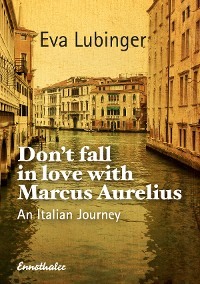
Read the book: «Don't Fall In Love With Marcus Aurelius»
Eva Lubinger
DON’T FALL IN LOVE WITH MARCUS AURELIUS
An Italian Journey
Illustrations by Thomas Posch
ENNSTHALER VERLAG STEYR
www.ennsthaler.at
eISBN 978-3-7095-0028-6 (EPUB)
eISBN 978-3-7095-0029-3 (MOBI)
1st edition 2013
Eva Lubinger • Don’t fall in love with Marcus Aurelius
All rights reserved
Copyright © 2012 by Ennsthaler Verlag, Steyr
Ennsthaler Gesellschaft m.b.H. & Co KG, 4400 Steyr, Österreich
Cover: fotolia.de
Not Little Cockington this time: but Rome instead!
“I think we should go travelling one more time,” said Emily Woods dreamily, while she gave an invigorating shove with her left hand to the swing in the canary’s cage. As a result it swayed wildly back and forth; all the tiny bells hanging off it jingled and rang, and the yellow bird took off all flustered from its perch.
“We have been at home such a long time,” she continued, putting down her tea cup, “that I can now imagine the shape of every tree and the contours of the hill outside the window without even needing to look.” She stared disdainfully at the delightful, gently undulating landscape of hills covered with large deciduous trees.
“Would you perhaps like another cup of tea, my dear?” answered Agatha with some unease and dragged her friend back, without her being quite aware of it, to familiar safe territory. Changes or even just the hint of them always had an effect on her like a blast of cold water and she needed a long time just to get used to them.
“Aren’t we a bit old now to be undertaking such long trips?” she added and filled Emily’s tea cup, which Emily was holding out silently towards her. “After all, it was only a couple of months ago that we spent that week in Little Cockington. Don’t you remember the lovely cream teas we had there, with the scones and strawberry jam?”
“Little Cockington!” Emily said disdainfully, while she crushed a chocolate biscuit between her fingers. “After Little Cockington we deserve another hundred years of travelling. That wasn’t a proper journey. No, I mean some genuine travel: Africa for example or South America or at least somewhere on the continent; and on top of that we would have to stay away for at least six weeks.”
“Yes but just remember what happened to poor old Uncle Eustace. He flew to Australia when he was seventy-six to visit his nieces: he suffered a stroke while surfing and never came back”, Agatha suggested anxiously.
“Oh Eustace was always a weakling,” Emily answered with that deep voice of hers, which when she had been headmistress of a large girls’ school had always terrified her pupils.
“A much better example would be Uncle Hilary. He did a bike tour of Belgium when he was ninety-two and it thoroughly agreed with him. He converted the cellar of his house into a gym, and continued to use it till well after his ninety-eighth birthday. If he hadn’t broken his neck mountain climbing in Wales, he would still be in great shape.” Emily emptied her third cup of tea and fell silent, full of sad reflection.
Agatha was drinking tea with small sips. Between each sip, she chewed absent-mindedly on her Scottish shortbread and looked anxiously at the tree-crowned hills outside the living-room window. Her heart started to beat faster, while images, thoughts and overflowing desires filled her soul – travelling, the act of leaving everything familiar behind, all these memories now discoloured by the dust of passing years - and then her thinking about them made those once luminous experiences glow with vibrant life again, evoking happiness, joy and a greater zest for life. It was almost as if these memories were forcing themselves back into her mind.
“We’re both old, Emily,” she said quietly. “Think about your poor eyesight. Why just recently there was that cyclist you didn’t see. You came within a hair’s breadth of being knocked over by him. And there’s your heart! How would your heart cope with the weather abroad and the different food? And look at me: my rheumatism has been especially bad this year…remember my right hand.” She lifted her delicate arm in front of the window so that the swollen bone on her wrist stood out against the incoming light. “I have no strength in this hand. I can’t even carry hand luggage, let alone a suitcase.” She fell silent and carefully pulled the cuff of her cardigan over the offending joint.
“Who said you’ll have to drag along a suitcase, Agatha? What complete nonsense! I can’t carry a suitcase either; I had a heart attack as you well know. All over the world they have porters for this sort of job. Or at the very least young men who have been brought up to be polite and helpful.”
Agatha looked at her friend with misgivings. On her part she wasn’t so sure that the youth of today would be scrambling to carry old ladies’ luggage or to protect them from the rigours and hardships of the world. Emily however was still the schoolmistress who still made her way in life with gravity through large crowds of people who to her may as well have been her students.
“All the same, we are old,” Agatha repeated with that gentle yet persistent tenacity, which sometimes brought a flush of anger into Emily’s plump cheeks. Emily placed her tea cup with some emphasis back down on the table, which made the canary flutter on its perch. She turned her face towards her friend and regarded her with a warning look from her sharp blue eyes, which once upon a time had made not just four hundred girls but the whole teaching staff tremble:
“Did you say we’re old, Agatha? How did you come to this absurd assumption? I am seventy-six and, as I recall, in three months’ you’ll be celebrating your seventy-fourth birthday – you are plainly still a greenhorn, not to mention the fact that you are never going to grow up properly anyway.” Agatha looked at her friend with that smile of resignation, reflecting both subordination and constancy, and said nothing.
"Old," Emily went on and she placed the empty cup on the tray, "you start getting old after eighty. But before that, you are elderly at worst - elderly but not old! "
She got to her feet ponderously. Ultimately Emily had come to weigh a solid eighty-five kilos, despite belonging to a weight watchers’ group; which was definitely too much when compared to her height of one metre sixty-five. Then she trudged determinedly down the passage which joined the living room and kitchen. Agatha rose too, picked up a small table brush and swept the crumbs from the place settings. In contrast to her friend, she was delicate and slender and had a certain girlish grace, which was however falling increasingly victim to the effects of rheumatism. Because of her looks, people had always wondered why she had never married, while just a glance at Emily’s appearance answered the same question immediately and decisively.
Emily wasn’t beautiful – she never had been and wasn’t even close to being so. However she radiated integrity and efficiency in such quantities that she came across as positive and cheerful, and it never even crossed anyone’s mind to find her ugly.
While the train rolled through the Po Valley, Emily slept under her green velvet hat, sunk into the corner of her seat and snoring gently. Agatha looked pensively out the window. She couldn’t believe that she and Emily were now actually on the continent and on Italian soil. The night ferry from Dover to Calais had been pleasant and up to now there had in reality been no difficulties with finding porters. While Agatha wrapped herself tighter in her cashmere scarf and watched the thin lines of poplars glide past, she thought with a shudder that they had almost travelled to Africa, then almost to India, then even almost to the Persian Gulf, where there almost certainly wasn’t going to be anything except heat and stench. But then, with the gift for diplomacy that had developed through their many years of living together, she had awoken Emily’s interest in Italy, in that country which, throughout her whole life, she could not put out of her mind. She had told stories about Rome and its countless fountains, until that background noise finally penetrated her stern schoolmistress’s temperament. And yet she still hesitated.
But at that point Agatha brought Marcus Aurelius into the reckoning. “Doesn’t that famous equestrian statue of Marcus Aurelius stand in Rome, the one you told me about over and over again?” she innocently and quietly asked her. Emily had reacted in exactly the desired manner. She sat bolt upright in her chair and her eyes sparkled. “Marcus Aurelius,” she said in an animated voice, “the great prototype for every equestrian statue that followed. And of course Marcus Aurelius stands in Rome, and on the Capitoline Hill!”
After that everything else came easily. Agatha won the day. “And when we’ve seen Rome, wouldn’t it be nice to go to Venice for a couple more days?” she went on to ask fearlessly and then Emily knew all she needed to know. The unconditional affection and love for her friend of such long standing, usually masked by sternness, was awoken in her, and she smiled indulgently. She then answered, full of warmth and more softly than she usually spoke: “But of course my dear, we’ll go to Venice as well, if that’ll make you happy, for as long as you want, and we’ll also go out to the islands – Murano, Burano and Torcello. And then from Venice we’ll take a ship and go to Spain too for a couple of weeks.”
Agatha was very grateful and happy and in that moment she could have embraced her friend. How well they understood each other!…despite the occasional small skirmish, which was inevitable in this shared life of two women who no longer went out to work. And now she forgot the poplars and the groves of peach trees gliding past and she didn’t even look out the window, even now that the train was crossing the bridge that spanned the broad, tranquil Po, whose water hardly even seemed to be flowing. She sank into her cashmere shawl and into her memories: Gregory!
And with the monotonous turning of the wheels she was for a little while that young fleet-footed girl again, who had gone for a gondola ride with her beloved through the city of canals and who had led him laughing to the shore of the Island of Torcello, edged by tamarisk trees. Gregory had looked so good back then, and he was so young! It was when they were in Venice that he mentioned for the first time that he wanted to go to Canada to build this bridge – the awful bridge that cost him his life. The wedding was set for when he came home…Agatha shivered in her shawl.
No, now she didn’t want to think about it anymore. She wanted to draw out the precious hours of being together with the one person who mattered, like pearls from a jewellery box, and let them run through her fingers and through her heart during the long hours of this journey.
Agatha did not notice that they had left the Po valley behind them, and also long ago Florence and silver-green Tuscany, and now they journeyed through the Castelli Romani: Narni, Orte, and Terni. Emily’s snoring broke off abruptly; she woke, yawned discreetly, and said to Agatha sleepily: “Agatha, my dear, would you be so kind as to pour me a cup of tea from the thermos? My mouth’s quite dry.” Agatha dragged herself back to the present. Where had she put that confounded bottle? It wasn’t in the holdall, where it was supposed to be. Agatha fumbled anxiously in various handbags and even needlessly opened their hat boxes. At the same time she tried suppressing an uncomfortable memory. At home Emily had pressed the thermos of tea into her hand - that elixir, without which neither of them could possibly endure the journey. She did it so that Agatha would put it in the holdall.
But then the taxi arrived and you couldn’t keep him waiting. So Agatha, panic-stricken, had rashly stuffed the thermos into the large trunk. Yes, that’s what must have happened. So there was probably no point in suppressing that uncomfortable memory anymore, as Emily was now demanding her tea, in a louder voice and for a second time.
Agatha opened the trunk and a scent rose up from the clothes in there, which really should have been one of lavender or at worst Elizabeth Arden’s Blue Grass. But instead it was the strong and spicy smell of Earl Grey tea. With trembling hands she lifted a Shetland jacket and the lime-green skirt from Emily’s Sunday best outfit. Both were moist to outright wet and had taken on the blackish and obtrusive colour of stagnant tea.
Shaking, she removed one article of clothing after another: there was nothing that was not carrying the traces of Earl Grey tea soaked through like marble cake. Emily sat bolt upright in her seat, and her eyes had developed that piercing clarity, which was reserved in past times for major disciplinary hearings at her school. As Agatha now pulled out Emily’s white dinner dress, which bore on the chest an extremely unbecoming and out-of-place stain the size of a soldier’s badge, she threw herself down on the case with a shriek, pushed aside the unfortunate Agatha (who had broken out in a plaintive lament) and brought back to the surface at last the thermos flask, which was long empty except for an insignificant amount of leftover tea. Emily then drank it in melancholy silence, and Agatha didn’t have the courage to petition her for a few drops of the life-giving liquid, even though she was very thirsty and in need of consolation. Funnily enough, she could quite easily have extracted a whole bowlful from her new nightdress, but she wasn’t really bold enough to try that.
So she ended up only putting the ill-treated garments back into the case, and folded them up again, still with trembling hands, even though it was quite pointless, while Emily regarded the proceedings in grim silence. Neither of them saw the Roman aqueducts, which could be seen all across the Roman Campagna, like a light melancholy prelude heralding the Eternal City.
And while they were still concerning themselves with eradicating the last traces of tea from Agatha’s pink flowery hat, they rolled into Termini Station and were in Rome.
Wolves of all kinds on the Capitoline Hill
In a bewildered fashion they stuffed the scattered items of clothing back into the suitcase and gathered up all their bags and bits of luggage. Now it was clear that they were at a major disadvantage, as Agatha, because of her rheumatism, couldn’t carry anything either, and Emily was likewise very much hindered by her considerable short-sightedness and her weak heart.
But somehow in the end they managed to get hold of a porter, and he in turn didn’t have the heart to rip off the elderly English ladies, who were tripping around their luggage like two lost chickens, this of itself was a genuine Roman miracle.
Now they both sat up in their beds in their room in a friendly Pension, close to Santa Maria Maggiore. The majority of their holiday clothes had already been handed over to a dry cleaner, which had come back to them with an invoice written in red numbers. Finally they had ordered tea to have in their room, feeling sad and that it was all a bit pointless. Emily tugged in a pensive manner at her hair curlers, which lent a grotesque expression to her dignified face, and Agatha read her favourite book, “King Solomon’s Mines” by Rider Haggard, which she had brought with her as a secure reminder, as it were, of her English home.
It would have been a pleasant night, if at eleven o’clock, just as Emily and Agatha shut their eyes with a peaceful sigh, a guitar player hadn’t started strumming soulful love songs in a backyard somewhere, accompanying himself from time to time with schmaltzy wailing. And when finally, tired of his courtship display, his guitar fell silent towards one in the morning, Emily then began with exasperation to fluff up her pillow. It just didn’t come close to meeting British standards: it was small, it was stretched too long. Sooner for her a hard roll than a sleep-promoting, feather-light pillow.
As a direct result of her bedtime reading, poor Agatha dreamt for a while of Zulu wars and skirmishes until she finally woke up and in the glow of the small bedside lamp saw Emily, looking like Medusa with her head full of curlers, executing a relentless drumbeat with her fists on the impassive Roman pillow.
She felt like complaining, but then she remembered the spilled tea, and, with a soft sigh, decided to hold her tongue. The absence of sleep pounded in her temples and she looked on apathetically, as Emily worked her corpulent body (not yet tamed by Weight Watchers) out of bed, such that the wobbly Italian bedstead, designed for much more delicate body types, groaned and swayed. She stepped across to the wash-stand, resolutely seized all the available towels and twisted them accusingly into a pillow-like mass, which, once she had got back into bed groaning to herself, she shoved under her head.
The first Roman morning dawned; it was light, bright and noisy. All the noisy people from the evening before were back in service after their short night’s sleep, back on their feet again and full of vitality, ready to fill out their existence with noise and joie de vivre.
Emily and Agatha rose, a little morning-afterish and flabbergasted on account of the seething Italian daily life going on all around them. Still just as flabbergasted, blinking in the unaccustomed brightness, they found themselves standing two hours later in St Peter’s Square, that majestic Piazza, infused with breadth and beauty, whose colonnades seemed capable of embracing every other square in the whole world.
They entered St Peter’s Basilica, the infinitely high ceiling of which is like a starry heaven, covering over a small self-contained universe, a sumptuous cool world of marble, too spread-out and immense truly to be thought of as an interior space. Neither of them said much: This church surpassed all normal dimensions by so very much that they were perplexed and felt slightly overwhelmed. Agatha gripped Emily’s hand as if for protection and not to get lost in the loneliness of that mighty space - a small speck of dust in a universe bristling with gold and marble.
Once they stepped back out into the open and the balmy waves of humanity and traffic noise broke around them again, of one accord they took a taxi and drove to the Colosseum. A zebra crossing led across to the other side of the road, which Emily wanted to get to, with a view to getting a better overview of that historical amphitheatre. Unsuspecting and trusting they stepped on to the designated crossing: Emily with heavy steps like a Roman mercenary of old and Agatha tripping along lightly beside her, chatting away cheerfully and excitedly.
They hadn’t even reached the halfway point before two cars came racing along the wide street from the direction of the Arch of Constantine and zoomed past so close to their noses that the passing slipstream whistled in their ears.
They both froze and instinctively took each other’s hands: What an unheard-of lack of discipline! Surely the police would soon be on the trail of these criminals! While they were still on the lookout for a police car, a couple more cars sped past at nearly a hundred miles an hour, and came so close that they almost brushed against Emily’s considerable behind. They drove with a sovereign and habitual non-observance of the common precedence given to pedestrians, those poor creatures who at the very least in other European cities are not completely outlawed on zebra crossings.
Agatha gasped for breath: “It’s not fair, no it’s really, really not fair,” she said weakly. The words were ripped from her lips by the next car and went on to flap like an imaginary hood ornament on the sleek nose of an Alfa Romeo.
The righteous anger of the former teacher was awakened in Emily. She positioned herself in all her glory, legs akimbo, right across the zebra crossing, swung the umbrella she had brought with her (despite the cloudless Roman skies) threateningly against the onrushing traffic, and cried out “Stop you rascals” with all the authority of a head teacher.
She cried out with that piercing voice, which had never failed to achieve its desired effect in her schooldays, but what happened now had never happened before throughout her long and distinguished career: she was disobeyed.
Agatha dragged the furious Emily between the cars that whizzed past and finally across to the other side of the road, from where they threw resentful looks back at the Colosseum, which was dozing in sublime timelessness in the midst of the city’s traffic.
Slightly exhausted by the sights and events of the day, by all the things that were so horribly un-English and could only really be encountered on the continent, the two ladies made for a small café near their pension, to refresh themselves with a nice cup of tea.

However the tea was yet another disappointment. The tea bag, swimming dismally in the hot water, gave out hardly any colour, let alone flavour. In England you wouldn’t even administer tea like that to an infant with a stomach ache.
Emily and Agatha gazed out, in between small disapproving sips of that concoction (so unlike tea!), upon the graceful and peaceful square, which was bordered on one side by the eastern facade of Santa Maria Maggiore. They had no eyes for the grace and bold vision of the three part stone staircase - one of many in hilly Rome - which for centuries had plunged down with a broad sweeping movement from the Basilica like a waterfall, whose rushing you are supposed to be able to hear on bright moonlit nights.
No, they were just upset about the bad tea and then about the Frutta di Mare for dinner back at the hotel which was dripping with fat and garnished with all sorts of greasy cold vegetables. Outraged, Emily and Agatha then dragged themselves back to their room, where Agatha took refuge in King Solomon’s Mines and Emily crocheted a small piece of wool in the shape of a petal, which at some later stage - with hundreds of other such pieces all side-by-side - was intended to form a bedspread. Bearing in mind her shortsightedness, this was a heroic undertaking.
The next few days were spent quietly. They took, as it were, careful sips and sampled the continent in small doses, which suited them much better. One particular bright spot was an outing to the Aventine, where amongst so many gardens, they felt content and almost at home. They wandered among the beautiful stone pine trees, whose shimmering green canopies stretched almost to the hill’s summit. It was early summer and the rose garden of the Aventine was in full bloom. They sat happy and joyous among the roses, letting the hours slip through their fingers, and watched peacefully, as the sun sank behind the outline of all the houses of the Eternal City, while the ancient ruins in the depth of the hill slowly drank in the red of the roses and clung on to it as deep glowing phosphorescence ready for the approaching night.
When it got dark, they took a taxi and were taken to the Trevi Fountain, where they both climbed down to the basin of the fountain, along steps that had been soaked by curtains of water, so that they could dutifully throw their coins into the fountain, which would guarantee their return to the eternal Rome. They stood there for a while and looked uncertainly into the fountain bowl, the bottom of which glowed silver with the coins of so many other foolish travellers and pilgrims who hoped, in their child-like optimism and hope which defied their better judgement, to pin down a wavering, wind-blown and uncertain future through one poor tiny coin and to be able to make that future amenable to their own wishes.
That night they slept long and deeply and in the morning Emily announced that it was now high time that they visited the wonderful equestrian statue of Marcus Aurelius on the Capitoline Hill, which they had been saving up to now, plus Michelangelo’s facade, the long staircase leading to the summit, and the Basilica of Santa Maria in Aracoeli which stood at the top. Once again they took a taxi which dropped them off at the foot of the Capitoline Hill. They climbed up slowly and painfully, and took a shuddering look back down the infinitely long and lofty staircase which led further up above them to the facade of the Aracoeli Church on their left in dazzling brightness. No, they couldn’t reach the top of these gruelling 124 steps, either on foot, or on their knees, like penitent pilgrims would have been obliged to do in earlier times.
So Emily and Agatha took a short breather. Above them the huge stone Dioskuri pair, Castor and Pollux, guarded the entrance to the Piazza del Campidoglio. Meanwhile Agatha caught sight of the wolf cage in between the blossoming oleanders and broke out into loud lamentations: “Look Emily, those poor poor animals...isn’t that terrible!”
Emily went over to Agatha’s side and, still panting softly from the unfamiliar exertions of climbing the staircase, they both observed with disgust and pity the skinny, shabby-looking wolves, prowling restlessly along the bars of the cage. The sight of captive wild animals, who had to live deprived of their natural habitat and their freedom of movement, was anathema to them.
And in addition Agatha, during her more active years, for around twenty years had been secretary to the Inspector General of the RSPCA: it was her vocation, so to speak, to be rebellious. It was a miracle that she didn’t sit herself straight down on the stone steps of the Capitoline and draw up a blazing protest letter to her former boss. It would probably however have been useless: the arm of the inspector of the RSPCA didn’t extend that far. And what could you really expect from a country in which, despite repeated appeals from Popes and many other sympathetic people, migrating songbirds from North and Central Europe are exterminated repeatedly and across a wide area every spring and autumn, and their small frail bodies - their songs forever silenced - are offered up on the menus of restaurants, to satisfy the thirst for profits of traders and the jaded palates of upmarket diners.
A well turned out, elderly gentleman had stopped next to the English women, and indicated towards the wolves: “Signore, this here is the Roman she-wolf, mother of Romulus and Remus....that was how the history della citta di Roma began.” He bowed slightly and went. But this reference to Rome’s foundation myth offered little comfort to Emily and Agatha.
They climbed the last few steps in silence, passed between the muscular stone calves of the twins Castor and Pollux and entered the splendid self-contained Piazza, whose floor was covered in a great star of wine-red marble. The perfect beauty and harmony of the Capitoline calmed their souls and in raptures they tripped around the equestrian statue of the philosopher emperor Marcus Aurelius with its patina of shimmering green.
Emily planted herself in front of the horse’s nose, tipped her head back and narrowed her myopic eyes. “I can’t quite recognize his face,” she murmured. “That’s a crying shame as we are talking here about the only extant equestrian portrait remaining in Roman sculpture. Perhaps I could climb up on to the pedestal...and then get on the Emperor’s foot.”
Agatha wasn’t listening. She had sunk deep into one of her reveries. The golden light of that Roman morning seeped into her half-closed eyes, favourably tempered by the rays of the marble star at her feet.
A moaning sound summoned her back to reality. She opened her eyes wide in shock and saw Emily, as clumsy as a fat beetle, stuck on Marcus Aurelius’s foot. Her broad face was extremely red and her thick glasses wobbled on her nose:
“Agatha, I can’t get down.” Groaning, she lowered her foot into the void and then, discouraged, pulled it straight back again.
“Oh God, Emily, why did you climb up there in the first place?”
“I wanted to see the Emperor’s face, his actual portrait,” Emily replied meekly.
Enzo Marrone was passing the morning leaning against one of the warm sunlit columns on the edge of the piazza. He had his hands in his trouser pockets, his head leaning back nonchalantly, and his eyes half closed, chewing slowly on a piece of gum and otherwise doing nothing. It was the sort of morning he liked. He had watched idly chewing while this impossible foreigner had scrambled up the monument - Madonna Mia, what a crazy idea! Only tourists could resort to such stupidity and squander energy so pointlessly. He watched with a cold gaze, while Agatha made fruitless attempts to help her stuck friend abseil off the monument. Agatha reached out her hand and frantically grabbed a tuft of bronze horse-hair. At that same moment, the large diamond on her ring flashed in the sunlight, and Enzo stopped chewing. His eyes opened wide, he threw off the morning’s inertia and began thinking. Two wealthy foreign ladies apparently, and English too - that was as much as he needed to hear. One of them had placed her handbag on the statue’s plinth. Enzo sauntered closer. Taking the bag would be easy. But there was the ring flashing again....
An idea, a plan started to stir in Enzo’s mind: Why just slaughter the calf when with a little ingenuity he could have the cow as well?
He took his hands out his pockets, spat out the gum so that it flew in a wide arc down on to the star-adorned square where it stuck to the marble somewhere, and strode zealously across to the Marcus Aurelius memorial: “Permesso!”
He vaulted skillfully on to the plinth, took Emily by the arm, supported her so that she could let go of the Emperor’s foot, jumped down, gave her some support again and with an “Ecco” let her slide unharmed back down on to solid ground, which she had left behind just now so rashly and with such a youthful zeal for art history. “Oh Emily,” Agatha said, “you could have broken an arm or a leg. I was so worried about you. And you know, my rheumatism: I couldn’t have helped you because I have no strength in my arms.”
Emily was still gasping. “Is there anywhere round here where you can get a cup of tea, ” she asked dryly, and managed successfully to maintain her English stiff upper lip. She soon hurried off to the little bar on the edge of the Piazza. Agatha followed her but completely forgot in her usual absent-minded manner the handbag which sat unnoticed at the feet of Marcus Aurelius. Enzo saw the abandoned calf, considered the cow which he still wanted to milk, so picked up the bag and took it back to the ladies.
“Oh thank you, thank you. Emily, this nice young man has brought my bag back. And to think that people told us Rome was full of thieves!” With a gracious smile Emily took her bag back from Enzo‘s hand.
“I also want to thank you, very much,” Emily now said in her deep voice. She extended her hand to Enzo, and looked at him in a firm and admiring way, as she would have done in the past with a well-behaved and satisfactory student:
“Will you have a cup of tea with us? Without your help I might have broken my neck and it would have served me right.” Enzo inclined his head courteously and accepted the invitation.
In that corner, behind the Capitol, where the side steps led up to the Aracoeli Church, stood the vision of a tensed-up little Roman hoodlum called Luigi. On the end of a rope he held a mongrel of undefined origin, which must have been brought into this world by two random strays. It was a mix of rough-, short- and long-haired; of spaniels, poodles and curly-tailed pugs, and those elements of all the different breeds were combined in a most unattractive fashion. It whined softly to itself while pulling hard on its rope.
Luigi tried desperately to restrain it. No way could he let the dog run over to Enzo and spoil the enterprise. For sure, Luigi had no idea why Enzo hadn’t taken the handbag, that beautiful bag that seemed so full of promise: why he hadn’t seeped with it into the very cracks of the square, flitted round the corner with it, or let it be absorbed into the air...in short, why he hadn’t brought the whole undertaking to a reasonable and profitable conclusion. Enzo, however, would have had his reasons.
Enzo was smart, much smarter than Luigi, who had quickly cottoned on to this and who had accepted Enzo’s supremacy humbly and without condition. Things went well for Luigi when he was with Enzo. He was having a better life since he had joined forces with him and since Enzo had started to help him to even out their social differences just a little. He had helped him to a life where he could eat without having to work on a regular basis.
They both possessed an aversion to work. Enzo, son of an English mother and an Italian father, an unintended and unwanted consequence of a holiday flirtation between a British tourist with a predisposition to cheap Italian romance, and a fairly successful Italian beach Romeo...Enzo thus ended up a dark-haired handsome lad with blue eyes and a classical profile. He possessed the demonstrative charm of the Italians, the easy going and almost feline movements of the native Roman and was lean and tall because of his English mother, whose language he had mastered fairly well since early childhood.
You may well have called him handsome, if his eyes hadn’t been so peculiarly slanted. This was apparently inherited from his father, whose ancestors had come from one of those noisy, grimy little towns on the Bay of Naples, from that melting pot of oriental peoples, which had produced such rich results across the millennia.
With those sloping, narrow eyes, which lent his face a somewhat sly and fox-like quality, he couldn’t hope to make a great career in his father’s line of work, and so he made do for the time being with pickpocketing and shoplifting, without ever even entertaining the thought of conventional work. He’d see how it went later....After all, Enzo was good-looking enough that he’d be able to find a wife, who would happily work for him, he was certain of that. And with a bit of luck she’d also not have to do too much either and they would live as one and pretty well on her daddy’s money.
Meanwhile poor old Luigi - still behind the railings of the church steps - gave the whimpering dog a frustrated kick, so that it cowered down and stayed quiet, and he looked intensely and anxiously towards the group sitting round the small table outside the bar.
Enzo sat between the two English ladies and drank his tea with composure and decorum, a concoction that he detested like the plague. But he consoled himself inside that such things were among the perils of his profession.
Agatha fumbled around once again in her roomy handbag – the one which Enzo had so cleverly restored to her - in a quest to find her headscarf, and Emily followed her movements with glances of disapproval. Agatha always had to be searching for something or other! She just got confused so easily; and unfortunately this was getting worse as the years passed. Just watching her made Emily nervous, and with an inaudible sigh she turned to the tea-drinking Enzo:
“We like your home town very much, except that the traffic is much too hectic, but......” At that moment Agatha dropped the open bag on the floor and its copious contents, including passport, cash, cheques, receipts, keys, make-up articles and tickets - everything but the proverbial kitchen sink - sailed out across the beautiful stone floor of the Capitoline Piazza. Enzo’s professional interest sparked into life and he stooped down quickly: He could at least then check out what was waiting for him in the near future, and while with his well-practised fingers he helped gather up all the bits and pieces, his eye fell upon a much leafed-through set of travel documents: Calais-Rome, and, on the next page, Rome-Venice. And then by boat from Venice to Mallorca. So when they leave Venice, they leave Italy....
Enzo straightened up slowly and gave the bewildered and contrite Agatha back her belongings. And as he broke into a radiant smile showing his flawless teeth, his plan was already quite settled in his mind. He turned politely to Emily and picked up the thread of their conversation once again:
“Rome is not my home city, Signora: I am just here for a short holiday. My home is La Serenissima, the city on the lagoon - Venice!”
“No, really? What luck!” cried out Agatha. “ You must see us again, when you are in Venice!”
“The young man will have better things to do in Venice, than visit two old ladies”, said Emily slightly defensively and she looked reprovingly at her friend. Agatha was always so impulsive. Actually, she had changed very little since the time when they had both been at boarding school together more than half a century ago. Agatha then had been a widely acknowledged enfant terrible and the terror of their dormitory.
Enzo then saw his ship sailing away over the horizon, and answered hurriedly: “Oh no, Signora, it would be a real pleasure for me to meet you in Venice! I worked there for years as a guide. Now I only take my friends and acquaintances round the sights. I could show you the city: The Doge’s Palace, the Grand Canal, the Islands..”
Emily, who had been eyeing him closely through her thick glasses, interrupted the flow of his speech: “What job do you do now, Signor......?”
His tea, that disgusting brew, went down his throat the wrong way, and Enzo choked. He bowed slightly, while still sitting. “Enzo - Enzo Marrone!” He had translated his mother’s name into Italian without any pang of conscience. “What work do I do, do you mean?” Enzo put down his tea cup, coughed extravagantly again and continued: “I am a freelancer, doing market research - it’s interesting work actually.” Enzo leaned back. Once again he was pleased with his ability to give a rapid response. He hadn’t actually lied. Was he not in fact researching the market, persistently and thoroughly, with his finger on the pulse of civic life? And you could call his profession freelance, well yes, by God, that would be a very apt description of it: freelance just like any outlaw!
Emily nodded a little uncertainly. She just couldn’t picture it in her own mind and, had Enzo been one of her former students, she would have advised him to go after a profession that was a bit more resilient. However you couldn’t apply British standards anyway to these people from the Continent, and that was even more the case with Italians, who were such a unique, hard to comprehend people, who were always fluctuating between extremes. A person would just make do with the fact that they are not devoting themselves to a too bizarre and extravagant lifestyle.
Meanwhile, after further energetic excavations into the unfathomable depths of her handbag, Agatha brought to light a scrap of paper and a pencil and she scribbled zealously.
“This is the address of our hotel in Rome,” she said, smiling guilelessly, and basically placing the rope into Enzo’s hand, which would then make it much less difficult for him to lead them where he wanted them, like a shepherd and his soft wooly lamb. For her un-English behaviour, and for showing a deplorable lack of reserve, she reaped a disapproving look from her friend and companion Emily.
“It’s getting a little bit hot here, Agatha, don’t you think?” she said in a slightly raised voice and stood up. “I believe we’d be better off now going back to the hotel.” Emily was inclined to get away from the Capitoline, before Agatha, this scatterbrained philanthropist, invited the young Italian man back to their home in England. Agatha was capable of anything.
Agatha took leave of Enzo with gracious respect and made her way quickly to the stone staircase. Even gratitude had its limits.

Enzo waited for a while, still watching as the two English women called for a taxi at the foot of the stairs and were driven away in it, and then he whistled nonchalantly in the direction of the church of Santa Maria in Aracoeli. Immediately Luigi and Dante, the dog he was walking, came running across:
“Why didn’t you take the bag? There must have ben a whole pile of money in it! I haven’t eaten anything yet today.” “Shut your mouth and stop annoying me,” Enzo interrupted him brusquely, while he gently ruffled the fur of the leaping, joyfully whining dog. “I have a plan, do you hear, a good plan which is going to lead to great things for both of us.”
“What sort of plan, Enzo, enlighten me...”
“Not yet,” Enzo snarled, “right now I need a Campari. I had to drink tea with them. Tea! Tea makes me sick.” He spat in a wide arc on to the star-decorated Piazza floor and ordered a double Campari without soda. When he saw Luigi’s hungry expression, he grumpily ordered him a Coke. The dog lay down under the small cafe table and promptly went to sleep.
Early summer on the Via Appia, or the ordeal in a rental car
Enzo had looked after the piece of paper with the hotel address on very well, and he kept his victims in his sights. He wanted to bump into them a couple more times in Rome, to make the transition to Venice seem easier and more natural. This fat and somewhat irksome matron obviously wouldn’t be wanting it, but he, Enzo, had made a decision and there were a thousand ways and means by which he could engineer a chance meeting.
Ultimately Rome was a pretty small place, when you considered that all the foreigners tended to set out repeatedly for the same focal points of interest: the churches and the ancient monuments.
Enzo sat on the steps of Santa Maria Maggiore, and kept watch over their hotel. The two old bats hadn’t been very ambitious these past few days. Perhaps they had fallen ill and were flying back to England prematurely? That would be the final straw. These foreigners just couldn’t take it. They had weak stomachs and intestines, which were affected by every little bit of dirt in their diet and every overdose of oil in their food. Enzo spat on the steps and, troubled, looked across at the hotel.
Then, just at that moment, they emerged out of the front door: the thin, lively and (heavens be praised) extremely trusting one, with the one with the thick glasses trudging alongside. She was carrying a large umbrella - Madonna Mia! - and next she slowly lifted her head and gave a shortsighted look up to the heavens. How else was the sky going to be other than blue, he thought with contempt, and he ambled slowly down the steps.
The two of them pattered up the street like two uncertain hens, and then they waved down a taxi. They were going to throw away all their lovely money - Enzo’s money - on these endless taxi journeys! He observed how Emily and Agatha chatted with the driver before they got in. Once they had driven away, Enzo ran quickly across to the old man who was loitering there on the pavement.
“Did you hear where the two old ladies wanted to go?”
“Let me have a think about it,” the old man said and he reached out a filthy palm. With reluctance Enzo placed a one hundred Lire note there.
“The Forum Romanum,” croaked the old man, as he closed his fingers on the note.
Enzo ran to the nearest bus stop. Ultimately he had to keep his expenses as low as possible and he certainly was in no position to fatten up Rome’s taxi drivers. He covered the last part of the journey in one long dash, and he arrived at the Forum breathless. He had to catch his breath behind one of the columns. There they stood in the Temple of Castor and Pollux, looking attentively up into the empty heavens, into whose blueness the roof of the Temple must once have soared a thousand years ago.
In that moment the Forum resembled a rural meadow in the Roman countryside in early summer: Everywhere the red blooms of poppies trembled in the breeze, and that same wave of flowers surged across the rocks and the stumps of columns and proliferated between the stones that formed the outline of the Temple of Vesta.
Agatha had let go of her bag in a dreamy absent-mindedness on the pedestal that supported the three tall columns of the Dioscuri Temple, which rose skyward alone, not yet brought low by time which makes all things vanish and which levels everything. Its richly decorated capital carried a trace of entablature, and a bird’s nest had been constructed in its Corinthian stone leaf-work. Agatha sank into raptures:
“Birds,” she murmured, “you lovely birds! I hope that that perch you have up there is big enough for a nest, because it would be terrible if your eggs fell out....” She looked up fixedly and her gentle heart contracted.
Enzo yawned. The Roman Forum bored him unspeakably every time he was there and he asked himself over and over again what people got from spending hours staring at truncated columns and, what was even more amazing, almost broke their necks admiring imaginary structures reaching high into the air that hadn’t even existed for well over a thousand years. And these fools even paid an entrance fee for all this stuff that wasn’t there, for a pile of dreary stone junk. You could barely comprehend the sheer weight of stupidity in the world. Enzo spat skilfully and in a wide arc past the column. He was still leaning on it so as not to tire himself unnecessarily or prematurely.
He sent a dull glance towards Emily, who was walking enterprisingly up to the Church of Santa Maria Antiqua at the foot of the Palatine Hill. The other one - the skinny one - was still gazing at the columns. Enzo gave a sigh. It had dawned on him by now that this enterprise would require nerves of steel. But it would be worth it, by blessed St Anthony! He just wanted to choose the appropriate time to do it.
She had left her bag standing alone yet again at the foot of the columns! This English woman was so dumb that, for a sporting pickpocket like him, there was almost no fun in stealing from her. A three year old bambino could have taken that thing off her! And now she too was walking away from the columns and was beginning to gather up some of the red, windswept poppy flowers. She was picking flowers - unbelievable! Enzo dug his hands deep in his pockets and tossed his head back with a suppressed groan.
Suddenly his posture tightened and he looked across eagerly towards the pillars of the Temple. If he was not mistaken, another guy had slipped in, in the apparently eager manner of an art lover. Yes yes, this scam was very familiar as it belonged in the professional repertoire of the Roman pickpocket. Enzo observed this other man with professional interest. Yes, quite good, the way he passed by, did no single movement in exactly the same way, went back past, stared at that boring column, yes not bad...But that now, no, that was a bit botched, not so quickly - that stood out. He, Enzo, would have taken longer to take the bag.
The bag! Enzo’s bag! Enzo tore like a panther out of his hiding-place, he sprang in just two steps over the poppy-adorned floor of the Temple of Vesta, ran as fast as he could, and then he had the guy, that damned idiot who dared interfere in Enzo’s business. He tore the bag out of his hand, launched a couple of curses towards the stunned thief, concluded by punching him firmly in the stomach, enough so that - caught unawares - he fell to the ground gasping for breath, and ran back to Agatha with the bag. She lifted up her head in astonishment and immediately returned from the guileless transparent world of the poppies to the unattractive land of reality.
He handed her the bag with a small bow: “This ladro, this mascalzone, this porco and umbriglione tried to rob you, Signora, but luckily I happened to be passing by.”
“Oh, thank you. How extraordinarily valiant and charming of you!” Agatha stammered, as it dawned on her that yet again she hadn’t kept an eye on her bag and had got herself distracted. She hoped that Emily hadn’t noticed. She looked across to the church. But there was Emily, already there, standing behind her. Nothing ever escaped her, despite her shortsightedness.
Emily looked at Enzo thoughtfully. When she was a teacher, she didn’t very often misjudge a student’s character. On the Capitoline this young man seemed to her somewhat dubious, despite his willingness to help. But she had obviously got this one wrong.
These Italians just possessed shifty faces, that’s all, and you probably couldn’t apply British standards to them. It was very nice of the young man to scrap with a thief over Agatha’s bag. Because he had hardly anything to gain from doing it. Should she give him some money? But perhaps that would offend him; after all, he was here in Rome on holiday too, and under these circumstances giving him money would be effectively treating him too much like service personnel. No, she knew better than to do that.
“What a wonderful city,” Emily began, once she had cast a withering look at Agatha - along the lines of “we’ll talk later about this” - “it’s truly magnificent this juxtaposition of antique greatness and pulsating modern urban life!” She smiled at Enzo as she would have done in the past on the last day of school, when the students were marching past her, on the way to their awards presentation. “Have you seen much of The Eternal City yet?”
Enzo thought about it fast and frantically. What the devil was he supposed to say? He didn’t actually know all that much about Rome, or rather he knew all the wrong things. He had hardly ever seen the inside of a church, and he only vaguely remembered, that he had once, when he was at school, been given a guided tour of the Vatican Collections, with a bunch of his worthless and stupid classmates. He had taken a slap round the ear from his teacher in front of the famous Laocoon sculpture, because he had tried to liven up the boring school trip by taking a well-aimed and skilful spit at the priceless work.
Enzo’s mind roamed across Rome and alighted on the dome of St Peter’s. He gave Emily that guileless look that he had inherited off his English mother, and said, “San Pietro, Signora - I always like to go to San Pietro.”
“Yes, with good reason”, Emily concurred, “St Peter’s is inexhaustible and I suppose for you Catholics there’s the added weight of all its religious connotations.”
Enzo lowered his eyes, to mask his confusion. For him the religious connotations of St Peter’s barely weighed anything. In fact, he had always thought of that enormous church as a waste of space which would be ideally suited to a massive garage.
“We have already seen a lot in Rome, but we have an old longing that’s not yet been fulfilled to see the Via Appia Antica. I think we’ll need to hire a car so we can drive ourselves there. The area is a bit isolated and the footpaths are hard for us. One should always be able to get out and hang around a while to get a proper look. Would you be so kind as to come with us? We could stop on the way back at one of those pretty little restaurants near the Trevi Fountain and have dinner together?”
Emily was pleased with herself. The young man seemed pleased about it, and this trip followed by an invitation to dine with them seemed in all likelihood to be a more tasteful reward for rescuing Agatha’s handbag than the painful handing over of cash.
Agatha in her bumbling absentmindedness regularly got them into these tricky situations. Emily threw poor Agatha, who was fumbling self-consciously at her bunch of poppies, one last critical look.
“Perhaps in the next few days you could ring us at our hotel?” she said with a benevolent smile. She then took Agatha by the arm and she stepped away with her towards the arch of Septimus Severus, treading determinedly and gracefully across the ancient pavement.
Half an hour later, Enzo was sitting, in a small tavern in Trastevere with a cappuccino, alongside that same “ladro, porco, mascalzone, and umbriglione” who had so disgracefully laid a finger on Agatha’s bag.
“Really Enzo, how was I supposed to know that she was a client of yours?” he protested, while rubbing his stomach, which was still hurting. “I thought the Capitoline was your patch.”
“When business is going badly on the Capitoline, I am then entitled to come down to the Forum,” growled Enzo and looked at the other one with a malevolent gaze of his slanting eyes. Among Rome’s criminals he was somewhat feared and could afford sometimes to encroach on other criminals’ territories, because in his line of work he was able to combine Italian cunning with English thoroughness and directness.
“Yes,” said the other thief thoughtfully, “there’s no place that’s always good all of the time. For example, earlier I made the most money in San Pietro in Vincoli. Michelangelo’s Moses there has done a lot for me! Too bad he’s not a saint. I would have offered a big thick candle to him, because he’s done me many a good service!”
The specialist thief of San Pietro in Vincoli leaned closer to Enzo: “Do you know, when those Stranieri look so closely at Moses’s beard...yes they are mad for that beard of his! It’s a classy beard, a beard like a waterfall...and then they forget everything, those Stranieri! What beautiful wallets I have already managed to take there, crocodile leather, pigskin, all well stocked ...on two occasions even a wristwatch…you undo it gently, cautiously, and avanti! A good little patch, by the blood of St Gennaro!” The ladro chuckled and finished his cappuccino: “God bless the beard of Moses. What a magnificent beard!”
But Enzo wasn’t listening anymore: the other thief’s exploits only made him annoyed. He was weighing something up in his head and thinking about the Via Appia: a small down payment on his great Venice coup – yes that would be just right and proper. Eventually he would get his expenses back on it, saddled as he was with Luigi and the dog Dante, who always wants to eat. Yes, a down payment but he had to get the ball rolling pretty smartly. The fat one with the glasses mustn’t smell a rat. Enzo's brain worked, made plans and then rejected them again, while the other one just talked and talked. If he wanted the benefits of Moses’s beard, he could have them!
Enzo could hear the ladro complaining from afar, that the foreigners lately had forfeited their fine breeding and their way of life, that they weren’t able to immerse themselves unreservedly like they did before in contemplating great works of art, like Michelangelo’s Moses. Yes, humanity was getting steadily worse, more superficial and more motivated by profit alone. At this rate Enzo did not even bother answering. He threw the coins for the cappuccino on the table, and walked away without another word, his hands thrust deep in his pockets.
Agatha sat gloomily in her bed in her room at the hotel by Santa Maria Maggiore and stared at the brown wooden blinds that she hadn’t opened for two days. She threw the covers back, placed her feet carefully on the floor, tried to stand up and groaned. This damn rheumatism! It had to be the sirocco..
The day before yesterday she had wanted to get out of bed, full of the joys of spring and ready for action with the Via Appia in her sights, when she noticed with horror that her spine, which tended to be a little bit stiff, had now changed into a hypersensitive broomstick, emitting major sharp pains. Agatha had to stay in bed, and Emily rubbed the small of her back with ointment. She did it puffing and continually pausing, because Emily herself was by no means fit and well and could feel her heart thumping, this too doubtless because of the sirocco.
Enzo had called once before and had been put off. He had swallowed down his rage with some difficulty, or rather he displaced it on to the unfortunate Luigi. And Dante the dog in turn collected a hefty kick, which persuaded him once more to frequent the dustbins of Rome, and for the time being he stopped begging for food from his masters. Dante was lean and cheerful - a dog of a measured and philosophical disposition - who took each day as it came. He found that he had a happy life, compared to the many abandoned dogs of Rome who didn’t have masters. A bad master was better than none at all.
And sometimes - Dante didn’t know why but accepted the inexplicable phenomenon like manna from heaven - sometimes quite unexpectedly his master would come and would play with him and laugh and bring him meat: proper good meat - not just leftovers - or half a bread roll or chocolate. Dante would then devour these hastily in a frenzy of enjoyment and he would stockpile them for times of emergency, when there was nothing going but the dustbin and Dante’s ribs would increasingly start emerging day by day from his seedy, colourless coat.
Agatha groaned again, but then she placed her feet down decisively on the floor and limped around the room with great lamentations. She’d got started and she had to keep going, because in the end she hadn’t come to Rome to stare for days on end at the patterns on the ceiling of a Roman hotel room that was last painted a long time ago. It was also not fair on Emily.
She looked across at her friend, who was breathing heavily and quietly measuring out drops of heart medicine into a glass. Poor Emily! Her heart would surely profit from her losing just a few pounds. The committee chair of her weight watchers’ club had seriously reproached her about it. But in Emily’s case a Scottish oatcake could transmute itself into a cushion of fat, that would craftily take up residence on her hips, and that’s not something that would ever change; it was as if it imposed itself on Emily, despite her heroic days of fasting.
In that very moment the telephone rang and it was Enzo enquiring whether perhaps, on this giornata bellisima, they might consider making their trip to the Via Appia. Agatha, who was just then massaging her aching back, heard Emily make a resolute pledge. Yes they would like to go out today and it should be in an hour. Agatha looked at her friend with admiration: Emily was so heroic, because she took no notice of her infirmities. She had not done so in all her long decades of teaching service, where she had been a model of self-discipline and of fulfillment of duty to her students and to the faculty. And Emily wouldn’t let life squirm out of her hands so easily: she dragged it back under her own control and with a strength and vitality that belied her ageing body.
Agatha wasn’t going to lag behind her. Suppressing all sounds of suffering, she got dressed quickly, and as a finale she put on the long golden amethyst necklace, which she had got for her twenty-first birthday. The Via Appia trip would be like a party and she wanted to celebrate it appropriately.
Emily got in touch with Hertz, and a handsome, clean, sparkling hire care was soon standing outside the hotel entrance. A man from the firm explained a few technicalities to Emily, while Agatha listened in dutifully, even though she hadn’t been allowed behind the wheel of a car for a long time because of her absent-mindedness.
Emily said her thanks and squeezed behind the steering wheel with a groan. She in turn didn’t drive in England very often and was somewhat out of practice. On top of that she was of course used to driving on the left. But neither of them were going to be put off by such small details. Beaming with joy they drove off and met Enzo on the corner, where he regarded the vehicle with some scepticism. Emily and Agatha let him in; then the car, which already had a tough day ahead, made a sudden lurch forward because Emily had let the clutch up too quickly. That was something she did often.
The free sample has ended.