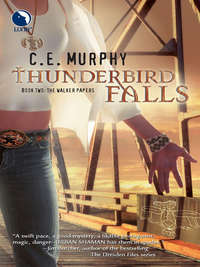
Read the book: «Thunderbird Falls»
Praise for
C.E. MURPHY
and her books:
The Walker Papers
Coyote Dreams
“Tightly written and paced, [Coyote Dreams] has a compelling, interesting protagonist, whose struggles and successes will captivate new and old readers alike.”
—Romantic Times BOOKreviews
Thunderbird Falls
“Thoroughly entertaining from start to finish.”
—Award-winning author Charles de Lint
“The breakneck pace keeps things moving…helping make this one of the most involving and entertaining new supernatural mystery series in an increasingly crowded field.”
—LOCUS
“Fans of Jim Butcher’s Dresden Files novels and the works of urban fantasists Charles de Lint and Tanya Huff should enjoy this fantasy/mystery’s cosmic elements. A good choice.”
—Library Journal
Urban Shaman
“C.E. Murphy has written a spellbinding and enthralling urban fantasy in the tradition of Tanya Huff and Mercedes Lackey.”
—The Best Reviews
“Tightly plotted and nicely paced, Murphy’s latest has a world in which ancient and modern magic fuse almost seamlessly…Fans of urban fantasy are sure to enjoy this first book in what looks to be an exciting new series.”
—Romantic Times BOOKreviews
[nominee for Reviewer’s Choice Best Modern Fantasy]
The Negotiator
Hands of Flame
“Fast-paced action and a twisty-turny plot make for a good read…Fans of the series will be sad to leave Margrit’s world behind, at least for the time being.”
—Romantic Times BOOKreviews
House of Cards
“Violent confrontations add action on top of tense intrigue in this involving, even thrilling, middle book in a divertingly different contemporary fantasy romance series.”
—LOCUS
“The second title in Murphy’s Negotiator series is every bit as interesting and fun as the first. Margrit is a fascinatingly complex heroine who doesn’t shy away from making difficult choices.”
—Romantic Times BOOKreviews
Heart of Stone
“[An] exciting series opener…Margrit makes for a deeply compelling heroine as she struggles to sort out the sudden upheaval in her professional and romantic lives.”
—Publishers Weekly
“A fascinating new series…as usual, Murphy delivers interesting worldbuilding and magical systems, believable and sympathetic characters and a compelling story told at a breakneck pace.”
—Romantic Times BOOKreviews

C.E. Murphy
Thunderbird Falls
BOOK TWO: THE WALKER PAPERS

This one’s for Alex Trebek.
(Really.)
Acknowledgments
Once more, thanks are due to both my editor, Mary-Theresa Hussey, and my agent, Jennifer Jackson, for making this a better book; and to cover artist Hugh Syme, whose artwork I am still delighted to have my book judged by.
They are further due to Silkie, for research above and beyond the call of duty (especially since there was no call of duty at all!); to Trip, for making me think harder than is my natural inclination; and to Anna, who is responsible for any geography I got right in Seattle.
As for the rest of it, if I started listing my support structure in detail, there wouldn’t be room for the book. Still, to my family, especially Ted and Shaun, who respectively keep me fed and keep the kitchen clean, thank you.
CONTENTS
CHAPTER ONE
CHAPTER TWO
CHAPTER THREE
CHAPTER FOUR
CHAPTER FIVE
CHAPTER SIX
CHAPTER SEVEN
CHAPTER EIGHT
CHAPTER NINE
CHAPTER TEN
CHAPTER ELEVEN
CHAPTER TWELVE
CHAPTER THIRTEEN
CHAPTER FOURTEEN
CHAPTER FIFTEEN
CHAPTER SIXTEEN
CHAPTER SEVENTEEN
CHAPTER EIGHTEEN
CHAPTER NINETEEN
CHAPTER TWENTY
CHAPTER TWENTY-ONE
CHAPTER TWENTY-TWO
CHAPTER TWENTY-THREE
CHAPTER TWENTY-FOUR
CHAPTER TWENTY-FIVE
CHAPTER TWENTY-SIX
CHAPTER TWENTY-SEVEN
CHAPTER TWENTY-EIGHT
CHAPTER TWENTY-NINE
CHAPTER THIRTY
CHAPTER THIRTY-ONE
CHAPTER THIRTY-TWO
CHAPTER THIRTY-THREE
CHAPTER THIRTY-FOUR
CHAPTER THIRTY-FIVE
CHAPTER ONE
Thursday, June 16, 6:19 a.m.
Two words I never thought would go together: Joanne Walker and 6:00 a.m.
Never mind that that’s actually four words, five if you spell out ante meridiem. If you’re going to get technical, you’re going to lose all your friends. The point is, it was Oh God Early and I was not only up, but at work. Not even at work. I was volunteering. Volunteering my own precious sleeping time, five hours before I was supposed to be at work. I was so noble I could kill myself.
While I was busy admiring my nobility, a bunch of protesters linked arms and waded toward the police line I was a part of. There were considerably more of them than there were of us—hence me being there at all—and the power of authority as granted to us by the city of Seattle wasn’t pulling a lot of weight with them. They weren’t violent, just determined. I spread my arms wide and leaned into the oncoming mass, blowing a whistle that was more noisome than effective. The protesters stopped close enough that I could count the individual silver hairs on the head of the man in front of me, who stood there, Right In My Personal Space.
People have gotten shot for less.
Not, however, by me, and besides, as one of the city’s finest, I wasn’t in a position to be shooting people just for getting in my personal space. Instead, I took a step forward, trusting my own presence to be enough to cow them. It was; the silver-haired guy in front of me shifted back, making a bow in his line. I pressed my advantage, arms still spread wide, and they all fell back a step.
I let go a sigh of relief that I couldn’t let them see, herding them back several more steps before I let up, and backed up again myself. They watched me, silent, sullen, and short.
I was working on a theory that said all environmentalists were short. I knew it was wrong—Al Gore is a tall man—but it gave me something to do while I played push-me-pull-you with the protesters. Of course, most people are short compared to me: I stood a smidge under six feet in socks, and the sturdy black walking shoes I wore put me an inch over.
Behind me lay the summertime glory of the Seattle Center, where a symposium on global warming was being held. Representatives from every oil company, every car manufacturer, every corporation that had ever been fined for too many dirty emissions being pumped out into the air were gathered there to argue their case against the bleeding-heart liberals who thought a little clean air wasn’t asking too much.
Sarcasm aside, the greenies were losing major ground and had been since the symposium had opened two days earlier. The federal administration favored big money and big companies, and those companies were taking as much advantage as they could.
My own sympathies lay a whole lot more with the protesters and their concerns about details like global warming. It was already in the high seventies and it wasn’t yet seven in the morning, which was just wrong for mid-June.
But it wasn’t my job to have an opinion about who was right and who was wrong. It was my job to keep the several thousand men and women who were gathered at the Center from breaking through and rending the Armani suits from the bodies of the corpulent pigs managing the slaughter.
“Officer?” A woman’s voice, high-pitched with worry, broke me out of my cheerfully spiraling cynicism. I turned toward her, one hand still lifted in warning against the crowd. I suspected a trick: distract the cop for a minute while everybody surges forward, therefore losing the law a few precious feet of land. There were more physical barriers than just the police officers keeping people off the Center grounds—bright orange, cordoned sawhorses surrounded the entire place—but it was its own sort of psychological warfare.
The woman held a pale-cheeked sleeping girl in her arms. “She fainted,” the woman said. Her voice was thready with concern and fear. “Please, I think she needs a doctor.”
Right behind the bottom of my breastbone, centered in the diaphragm, a coil of energy flared up, making a cool fluttering space inside me. It demanded attention, making my hands cramp and my stomach churn. I rubbed my sternum, swallowing back the wave of nausea. I’d gotten good at ignoring that sensation in the past several months, pretending I couldn’t feel it wrapped around my insides, waiting for me to give in and use it again. Having it crop up so sharply made me feel as pale as the girl. My hand, without any conscious order from my brain, reached out to touch her forehead. Her skin was cold and sticky with sweat.
For the first time since I’d nearly burned out in March, I lost the battle with the energy within me. It shot through me, making silver-tinted rainbows beneath my skin, and strained at my fingertips, trying to pass from me into the chilly-skinned child. Had she been an adult, I might have been able to pull back and refuse yet again to acknowledge its existence.
But she was a kid, and whether I wanted the power and responsibility I’d unintentionally taken on, a six-year-old didn’t deserve to suffer for my stubbornness. Silver-sheened magic told me in the most simple, non-medical terms possible, that the girl was suffering from near heatstroke.
To me—a mechanic by trade, even if I was a cop by day—that meant her engine had overheated.
Fixing an overheated engine’s not a hard thing. You pop the hood, pour new water into the radiator and try not to get burned by the steam, then do it again until the radiator’s full and the engine’s cooled down.
Translating that to a child sick with heat was surprisingly easy. The energy inside me boiled with eagerness to flow out of me and into the girl, but I made it drip instead of pour, afraid of what might happen if her system cooled down too rapidly. I could actually envision the steam hissing off her as heat gradually was replaced by my cool silver strength. It seemed a wonder that no one else could see it.
I was glad she was asleep. At her age she probably had very few perceptions about how health and illness worked, but it was a whole lot easier to heal somebody who couldn’t consciously disbelieve that what you were doing was possible.
The bitter truth of the matter was that I had to believe it was possible, too, and I didn’t want to. What I wanted and what was, however, were two very different things. Right through the core of me, I knew that cooling down an overheated little kid was only the bare edge of what I was capable of.
I let my hand fall off the girl’s forehead. There was a little color in her cheeks now, her breathing somehow more steady and less shallow. She was going to be all right, though an IV drip to help get her fluids back up would probably be a good idea. From the outside, it looked as if I’d touched the girl’s forehead as an assessment, then said, “I’ll escort you out.” I was the only one who knew better, and I was grateful for that. Headlines blaring Cop Turns Faith Healer! would not endear me to my boss.
The girl’s mother, bright-eyed with tears, whispered her thanks. I led them through the crowd, radioing for an ambulance as we walked.
Watching them drive away half an hour later, I realized I could breathe more easily than I’d been able to in months. I rubbed the heel of my hand over my breastbone again, irritably, and went back to work.
I left at nine, which was cutting it way too close to expect to get back to the university by nine-thirty. The traffic gods smiled on me, though, and I slid my Mustang into a parking spot outside the gym with a whole two minutes to spare.
I have never been what I would call the athletic sort. Not because I’m uncoordinated, but because I was never very good at working with a team in high school. I hadn’t improved at it since then, for that matter. The basketball coach had been endlessly frustrated by me. Alone I could shoot hoops till the cows came home, but put nine other people on a court with me and I got sullen and stupid and couldn’t hold on to the ball.
So fencing, which I’d started shortly after wrassling a banshee to ground, was the first sport I’d ever really pursued. I was surprised at how much I enjoyed it, even with sweat leaking into my eyes and my own hot breath washing back at me against the mask.
Metal clashed against metal, a twitchy vibration running up my arm, even through the heavy canvas gloves. Block and retreat, block and retreat, lunge and attack. I blinked sweat away as I extended.
My épée scraped along the other blade and slid home, thumping my opponent solidly in the ribs. For a moment we both froze, equally startled. Then through the mesh of her mask, I saw her grin as she came back to a full stand. She pulled the mask off, tucking short damp hair behind her ears, and saluted me. I straightened and yanked my mask off. My shadow splashed against her white tunic, my hair a hedgehog of sagging points.
“We might just make a fencer of you yet, Joanne.”
Panting and grinning, I tucked my mask under my arm, transferring my épée to my left hand, and offered Phoebe my right. She grabbed it in an old-fashioned warrior’s handshake, wrapping her fingers around my forearm, the way she always shook hands. She was small and compact, like a Porsche, and had muscles where I didn’t even have body parts. Most days she made me feel large and lumbering and slow.
Of course, on a bad day, Godzilla could make me feel large and lumbering and slow.
“That’s my plan.” I shook Phoebe’s hand solidly before falling back a step, rubbing a thumb over my sternum. Phoebe’s dark eyebrows knitted. It was very nearly her dark eyebrow knitting, but I was afraid to even think that too loudly, for fear she’d hear me and beat the tar out of me.
“Why do you do that?”
My hand dropped as if weighed down by a concrete brick, and I twisted it behind my back guiltily. “Do what?”
“You’re the worst liar I’ve ever met. Every time somebody makes a point against you and every time a match ends, you rub your breastbone. How come?”
“I had…surgery a while ago.” I took a too-deep breath, trying to will away the sensation of not getting enough air. “I guess it still bothers me.”
“Heart surgery?”
“More like lung.”
Phoebe’s eyebrows went up. “You don’t smoke, do you?”
“No.” I hadn’t snitched since January, when a steely eyed cab driver refused to give me a smoke because his wife of forty-eight years had died of emphysema. I could learn from other people’s lessons. That was what I told myself.
Quitting smoking had nothing to do with the crushing sensation of being unable to breathe from having a sword stuffed through my lung. I told myself that, too. It turned out myself was a skeptical bitch and didn’t believe me. Even so, I tried hard not to think about the truth: that the sword had been wielded by a Celtic god, and in a shadowland between life and death, a Native American trickster called Coyote offered me a choice between the two.
I had no idea what I was getting myself into when I chose a life and became a shaman. I felt that coil of energy bubble up again inside of me, and squelched it. There was no one around who needed healing right now. Nobody but myself, anyway, and I didn’t deny I had a lot of self-healing to do.
Actually, I denied it all the time. Which was part of why I was learning to fence, instead of sitting somewhere quietly, as Coyote would like me to, focusing on my inner turmoil and getting it all sorted out. Inner turmoil could wait, as far as I was concerned. External turmoil seemed inclined to stick me with pointy things or otherwise try to do me in. Under those circumstances, I figured learning how to parry was a much better use of my time than fussing over things I’d rather let lie.
I rolled my shoulders, pushing the thoughts away. “It wasn’t cancer. Sort of more hereditary. It’s fine now. Just kind of bugs me sometimes. I think it’s mostly mental.” I knew it was mostly mental. I didn’t even have a scar.
“Is that why you started coming here?” she wondered. “A lot of people find martial arts to be a great way to center themselves after they’ve had a life-changing experience.”
I ducked my chin and let out a breathy laugh. “Something like that, yeah. Plus I could use the exercise.”
“I thought cops were supposed to be in good shape.”
I looked back up through my eyebrows. “Don’t know many cops, do you? Speaking of which, I better hit the shower and get to work. Thanks for the lesson, Phoebe.” I headed for the locker room, Phoebe taking the lead and holding the door for me.
“My pleasure. I like beating up on the big girls. Makes me feel all studly.”
“You are all studly. And you’re not that small.”
“Compared to you I am.”
“Compared to me Arnold Schwartznegger is small.”
Phoebe laughed out loud. “You’re not that big.”
I grinned as I struggled out of my tunic. I was pretty sure it had a secret mission in life to strangle me as I undressed. “Nah. I lack the shoulders.” Phoebe turned the showers on, drowning out anything else I might say. Once I got loose of the tunic, I followed her, standing to the side while the pins-and-needles water pelted from cold to too hot.
The beauty of university showers is that they never run out of hot water. I stood there, leaning my forehead against the wall, until my skin turned boiled lobster-red. Phoebe turned her shower off with a squeak of faucets, and in the fashion of community showers everywhere, the water in mine got significantly hotter. Turning it down didn’t help. That was the flip side of never running out of hot water: the only way I’d ever found to keep a public shower from being too hot was to run more than one at a time. “Ow. Turn that back on, would you?”
“Sorry.” The faucets squeaked again and after a few seconds my shower faded back to a bearable heat. Water lapped over the top of my feet, and I pushed away from the wall with another groan, listening to Phoebe slosh to the drying area.
“Thanks.” I reached for my shampoo, scrubbing a palmful through my hair. If I weren’t so fond of standing mindlessly in the hot water, it would only take me about thirty seconds to shower. A minute and a half if I used conditioner, which my hair was too short to bother with except occasionally. But I wasn’t quite late for work, so I luxuriated in the heat. Water crept up around my ankles. “I think the drain’s plugged.”
“Check,” Phoebe said. “I’ll call maintenance if it is.”
“Okay.” I rinsed my hair, turned the water off, and wrapped a towel around myself as I slogged through the shower room in search of the drain.
Two stalls down from me, a naked black girl, her skin ashy blue with death, lay with her hip fitted neatly in the hollow of the drain.
CHAPTER TWO
“Phoebe,” I said, amazed at how calm my voice was, “call the cops.”
“You are the cops,” she said. I could hear the grin in her voice in the suddenly echoing shower room.
“Phoebe!”
“Yow, okay, what’s wrong?” Phoebe didn’t call the cops. She splashed back through the showers, rewetting her feet. “What’s wrong, Joanne?”
“There’s a dead girl in the shower,” I said, still very calmly. “Please go call the police, Phoebe.”
“There’s what?!” Phoebe looked around the edge of the shower stall and went pale under her olive skin. “Oh my God. Oh my God, we have to do something!” She surged forward. I grabbed her shoulder and pulled her back.
“We have to call the cops,” I repeated. “She’s dead, Phoebe. Look at her color. There’s nothing we can do. We shouldn’t touch her.”
“You are the cops!”
“I’m also the one who found the body. Again,” I added in a mutter.
“Again?” Phoebe’s voice rose and broke.
“I found a murder victim in January,” I said. My boss was going find a way to blame me for this. He was convinced I lived out each day with the deliberate intention to piss him off. Some days he was right, but it hadn’t been in my game plan today. I didn’t get up at five in the morning to volunteer at protests with irritating my boss in mind. Rather the opposite, in fact, not that I’d admit that out loud.
I took Phoebe’s other shoulder and steered her away from the body. “Shouldn’t we at least check to make sure she’s dead?” she demanded, voice rising. I exhaled, nice and slow.
“She’s dead, Phoebe. Look, okay.” I let her go and waded to the dead girl. She looked like she’d been posed for a photograph, her back against the tile wall, her bottom leg and arm stretched out long and her top leg folded gracefully forward into the water, bent at the knee. Her head was thrown back, slender neck exposed, as if she were laughing without inhibition. The edge of the drain was just barely visible beneath her hip, all of the drain holes covered. I wondered who would take that kind of picture, then remembered that if nobody else would, the police photographer would have to do the job.
“Christ.” I crouched and pressed two fingers against her neck, below her jaw. She was on the cool side of lukewarm, the skin pliant, and had no pulse. I tried a second time, then a third, shifting my fingers slightly. “She’s dead, Phoebe.” I stood up again, wiping my fingers against my towel. I’d never touched a dead body before. It hadn’t felt like I expected it to. “Go call the cops.”
“What’re you going to do?” Phoebe’s voice trembled as she backed away, water splashing around her ankles.
“I’m going to go get dressed.” I turned to follow Phoebe, who continued to back up, still staring at the dead girl. “Watch where you’re go—”
I lunged, too late. Phoebe’s heel caught the curb of the shower area and her feet slid out from under her, kicking water into my eyes. My fingers closed on empty air as she shrieked and crashed to the tile floor with a painful crack. My own feet slid on the wet tiles and for a moment I thought I’d dive after her. My arms swung wildly and I caught my balance, heaving myself upright with a gasp. Phoebe, her mouth a tight line, stared up at me, then let out an uncharacteristic soprano giggle. I stepped over the curb and offered her a hand up.
“I take it you’re okay, then.”
Phoebe wrapped her fingers around mine in a strong grip and I hauled her to her feet. “No, I’m not okay.” Her voice squeaked as high as her giggle had. “We just found a dead girl in the showers and I think my butt’s going to be bruised for a month.” She giggled again, then set her mouth and pressed her eyes shut, inhaling deeply through her nostrils. “I’m okay,” she said after several seconds. I nodded.
“I’ll call the cops. You get dressed.”
“Okay.” She gave me a pathetically grateful look that I didn’t like from my fencing instructor, and left me alone with the dead girl. I stole a glance at her over my shoulder, feeling power flutter behind my breastbone, urging me to use it.
I could think of one good reason to disregard it. Well, one reason. Good was debatable, especially since even in my own head I heard it as a whine: but I don’t want to be a shaman!
Except, possibly, when it meant I could save little girls from heatstroke. I sighed and went back to the dead woman, kneeling in the cooling water. The bottom edge of my towel drooped into it, sucking up as much as it could, and I debated running to put some clothes on before doing anything else. Only then I’d be soaking up water with my uniform, which, unlike a towel, wasn’t designed for it. It wasn’t like the police would arrive in the thirty seconds I intended to be out.
“Arright,” I muttered. “One healthy little girl for one esoteric death investigation. I guess that’s fair.” Five more minutes before calling the cops wasn’t going to make a difference to the body. “I’m here,” I said out loud, “if you want to talk.”
There was a place between life and death that spirits could linger in, a place that, with all due apology to Mr. King, I’d started calling the Dead Zone. If I could catch this young woman’s spirit there, I might just be able to learn something useful, like how she’d ended up filling a drain at the University of Washington’s gym locker rooms.
Reaching that world was easier with a drum, but somewhere in the shower room a shower leaked, a steady drip-drop of water hitting water. It was a pattern, and that was good enough. I closed my eyes. The sound amplified, deliberate poiks bouncing off the bones behind my ears. I lost count of the drops, and rose out of my body.
I slid through the ceiling, skimming through pipes and wires and insulation that felt laced with asbestos. The sky above the university was so bright it made my eyes ache, and for a few seconds I turned my attention away from the journey for the sake of the view.
The world glittered. White and blue lights zoomed along in tangled blurs, each of them a point of life. Trees glowed in the full bloom of summer and I could see the thin silver rivers of sap running through them to put out leaves that glimmered with hope and brightness. Concrete and asphalt lay like heavy thick blots of paint smeared over the brilliance, but at midmorning, with people out and doing things, those smears of paint had endless sparks of life along them, defying what seemed, at this level, to be a deliberate attempt to wipe out the natural order of the world.
Don’t get me wrong. Not only do I like my indoor plumbing and my Mustang that runs roughshod over those dark blots of freeway, but I also think that a dam built by man is just as natural as a dam built by a beaver. We’re a part of this world, and there’s nothing unnatural about how we choose to modify it. If it weren’t in our nature, we wouldn’t be doing it.
Still, looking down from the astral plane, the way we lay out streets and modify the world to suit ourselves looks pretty awkward compared to the blur of life all around it. Humans like right angles and straight lines. There weren’t many of those outside of man-made objects.
But even overlooking humanity’s additions to the lay of the land, there was something subtly wrong with the patterns of light and life. I’d noticed it months earlier—the last time I’d gone tripping into the astral plane—and it seemed worse now. There was a sick hue to the neon brilliance, like the heat had drawn color out, mixed it with a little death, and injected it back into the world without much regard to where it’d come from. It made my nerves jangle, discomfort pulling at the hairs on my arms until I felt like a porcupine, hunched up and defensive.
The longer I hung there, studying the world through second sight, the worse the colors got. Impatient scarlet bled into the silver lines of life, black tar gooing the edges of what had been pure and blue once upon a time. I had no sense of where the source of the problem was. It felt like it was all around me, and the more I concentrated on it the harder it got to breathe. I finally jerked in a deep breath, clearing a cough from my lungs, and shook off the need to figure out what was wrong. I suspected it had more to do with procrastination than anything else. I’d been warned more than once that my own perceptions could get me in trouble, in the astral plane.
It wasn’t that I was scared. Just wary. Apprehensive. Cautious. Uneasy. And that exhausted my mental thesaurus, which meant I had to stop farting around and go do what I meant to do.
Coyote had told me that traveling in the astral plane wasn’t a matter of distance, but a matter of will. It seemed like distance to me, always different, always changing. Seattle receded below me, darkening and broadening until the Pacific seaboard seemed to be just one burnt-out city, the sparks of life that colored it faded and scattered with distance. Skyscrapers that seemed to defy physics with their height leaped up around me and crumbled again, and the stars were closer.
A tunnel, blocked off by a wall of stone, appeared to my left, and I felt him waiting there. Him, it—whatever. Something was there, and it tugged at me. It laughed every time I forged past it, and every time I did I felt one more spiderweb-thin line binding me to it. The first time I traveled the astral plane I almost went to him, compelled by curiosity and a sense of malicious rightness. The second time, the stone wall was in place, my dead mother’s way of protecting me from whatever lay down that tunnel. This time I knew he was there, and it was easier to ignore him.
Someday I’m not going to be able to.
The tunnel whipped away into a wash of light, the sky bleeding gold and green around me. New skyscrapers blossomed into tall trees, filled with the light of life, but here that light was orange and red, not the blues and white I was used to. I grinned wildly and lifted my hands, encouraging the speed that the world swum around me with.
Under the gold sky, palaces built like where the Taj Mahal’s wealthy older sister grew up. A tiger paced by, sabre-toothed and feral, watching me like I might be a tasty snack. A man’s laughter broke over me, and the world spun into midnight, the sky rich and blue and star-studded. I relaxed, letting myself enjoy the changing vistas, and in the instant I did, the shifting worlds slammed to a stop.
A red man stood in front of me. Genuinely red: the color of bricks, or dark smoked salmon. His eyes were golden and his mouth was angry. “Haven’t you learned anything?”
I gaped at him, breathless. “What are you doing here?”
“You’re making enough noise to wake the dead.”
“That was kind of the idea.”
“Siobhán Walkin—”
“Don’t call me that.”
“It’s your name.”
“Don’t,” I repeated, “call me that. Not here.”
I’d become uncomfortably protective of that name: Siobhán Walkingstick. It was my birth name, the one I’d been saddled with by parents whose cultures clashed just long enough to produce me. My American father’d taken one look at Siobhán and Anglicized it to Joanne. Until I was in my twenties, no one had called me Siobhán except once, in a dream.
The last name, Walkingstick, I’d abandoned on my own when I went to college. I’d wanted to leave my Cherokee heritage behind, defining myself by my own rules. I was Joanne Walker. Siobhán Walkingstick was someone who barely existed.
But whether I liked it or not, that name belonged to the most internal, broken parts of me, and flinging it around astral planescapes made me vulnerable. I had learned to build protective shields around it, the one thing I’d managed to do to Coyote’s satisfaction over the past six months. I saw those shields as being titanium, thin and flexible and virtually unbreakable, an iridescent fortress in my mind. They were meant to protect my innermost self from the bad guys.
So I didn’t like having the two names rolled together in the best of circumstances, and I resented the shit out of having them flung around the astral plane as a form of reprimand by the very same brick-red spirit guide who’d insisted I develop the shields in the first place.
The spirit guide in question flared his nostrils, inclining his head slightly, and inside that motion, shifted. A loll-tongued, golden-eyed coyote sat in front of me, looking as disgruntled about the eyes as the man had.
“Dammit,” I said, “I hate when you do that.”
“This is not about what you hate,” the coyote said, in exactly the same tenor the man owned. His mouth didn’t move, and I was, as ever, uncertain if he was speaking out loud or in my mind. “You haven’t got the skill for this, Joanne.”
I wet my lips. “Looks to me like you’re wrong.”
“Do you really understand what you’re doing?” The coyote’s voice sharpened, making my chin lift and my shoulders go back defensively.
“I’m just trying to see if she can tell me anything about what happened, Coyote.”
“There are more mundane ways to find out. You are a policeman, are you not?”
“I’m a beat cop,” I said through my teeth. “Beat cops don’t get to investigate dead bodies in the women’s shower.”
Coyote cocked his head at me, a steady golden-eyed look that spoke volumes. Then, in case I’d missed the speaking of volumes, he said it out loud, too: “Then maybe you shouldn’t.”
Which comedian was it who said wisdom came from children, especially the mouth part of the face? I felt like he must have when he first thought it: like it would be nice to wrap duct tape around the talking part until nothing more could be said.
Coyote snapped his teeth at me, a coyote laugh. “Wouldn’t work anyway.”
“Oh, shut up.” Yet another incredibly annoying thing: he heard every thought I had, and I heard none of his. “This is supposed to be my dreamscape. Why can’t I hear your thoughts?”
He cocked his head the other way, wrinkles appearing in the brown-yellow fur of his forehead. “First,” he said, “it’s not your dreamscape. Haven’t you learned even that much? The astral plane is a lot bigger than just you or me.”
“I thought it was all basically the same,” I muttered. “How’m I supposed to know?”
“By studying,” Coyote suggested, voice dry with sarcasm. “Or is that asking too much?”
For one brief moment I wondered if it was possible that Coyote might also be my boss, Morrison.
“I’ll have to meet him someday,” Coyote said idly. I winced.
“Sure, he’ll like that a lot. Talking coyotes from the astral plane. That’ll go over well.” Morrison made Scully look like a paragon of belief. Once upon a time, our skepticism for the occult was the only thing we had in common. Then I’d done some unpleasantly weird things, like come back from the dead more or less in front of him, and now the only thing we had in common was neither of us was happy about me being a cop, though our reasons were different. “What was the second thing?” I asked, unwilling to pursue any more thoughts of Morrison.
For a moment Coyote looked blank as a happy puppy. Then he shook himself and stood up to pace, the tip of his tail twitching. “Second, you can’t hear my thoughts because I have shields, and I can hear yours because even after six months of study your shields are rudimentary and poorly crafted.”
“Thank you,” I said, “would you like me to lie down to make it easier to kick me?”
Coyote stopped turning in a circle and flashed, seamlessly, into the man-form. He had perfectly straight black hair that fell down to his hips, gleaming with blue highlights even in the star-studded blackness near the Dead Zone.
I closed up my thoughts like all the windows rolling up in a car at once, and privately admitted to myself that Coyote was a hell of a lot easier to deal with as a coyote. As a man he was almost too pretty to live, and I mostly wanted to look at him, not listen to him.
“Joanne, you took on a great power when you chose life.”
“If you say, ‘With great power comes great responsibility,’ so help me God, I’m going to kick you into last week.”
He gave me the same unblinking gaze that the coyote could. “Try it.”
A beat passed in which we neither moved nor spoke, until Coyote dropped his chin, watching me through long dark eyelashes. “You accepted this life months ago, Joanne. Why do you insist on fighting it?”
“I’m here, aren’t I?” I snapped. “Isn’t that something?”
“Something,” he agreed, but shook his head. “But not enough. Speaking with the dead is a dangerous art, and you’re not even doing that. You’re just opening yourself up and offering yourself as a conduit for anybody who has a piece to speak.”
“Yeah, so?” I admired my mature rebuttal. High school debate teams would weep to have me. “It’s all I know how to do.” Ah, a defensive attack. Good, Joanne, I said to myself, and hoped the windows of my mind were still sealed tight enough that Coyote didn’t hear me. That’ll show him you’re really the It girl. Any moment now legions of cheerleaders would leap out and rah-rah-rah their support of my rapier wit and keen discussion skills.
“That,” Coyote said with more patience and less sharpness than I deserved, “is my point. Has it occurred to you, Joanne, that I’d prefer it if you didn’t get yourself killed out here?”
I blinked, and swallowed.
“Why are you so afraid?” he asked, much more softly.
There are questions a girl doesn’t want to answer, and then there are the ones she doesn’t even want to think about. I reached out, around Coyote and beyond him, for the Dead Zone.
The stars shut down and the world went blank.
CHAPTER THREE
In time, stars began winking in and out again, solitary dots of light that made me feel like a single extremely small point on an endless curve of blackness. I was cold beneath my skin, but when I touched my arm, my body temperature seemed normal. I didn’t remember the chill in the Dead Zone before. It was as if it was tainted, too, with the same subtle wrongness that had marred Seattle.
I held my breath and turned, one slow circle, reaching out with my hands and my mind alike. The former felt nothing.
The latter encountered pain.
It rolled through me, a bone-cold ache that settled in my spine at the base of my neck, creating a headache. Ice throbbed into my veins with every heartbeat. My skin was flayed from my flesh and my flesh from my bones, knives thrusting into my kidneys and cutting out my heart. My bones broke, crushed by a weight of regret that lay heavier than the sea. It dragged me down to my knees, too weak from a hundred billion lifetimes of mistakes to bear up any longer.
And rapture shattered through me, turning the ice in my blood to golden heat. I staggered to my feet again, fire in my lungs so pure it seemed I could breathe it. Burning tears scalded my face, tracks following a thin scar to the corner of my mouth. I swallowed them down, not caring that they seared my throat.
Disbelief caught me in the belly, a bowel-twisting moment of realization that culminated in the words, “Oh, shit,” when I knew I couldn’t stop the carcrash-bombexplosionrunawayhorsetrainwreckshipsinking followed by relief and dismay, to put down the burden of a body after secondsminuteshoursdaysyearsdecades-centurieseons of life.
Dimly, I was aware that I was connected, hideously and intimately, to everything that had ever died.
More immediately, I understood that now I was going to die. Again. For good.
Then somebody hit me in the face. New, fresh pain blossomed, shattering all the old. I clapped both hands to my nose, doubling over and shrieking.
Note to self: grabbing a broken nose does not, in any fashion, help. Lightning shot through my head in blinding stabs of agony. I made a retching noise and fell to the ground, knocking my forehead against the featureless planescape. Brightness flashed in my eyes. I closed them, grateful for the ache in my skull that took a little away from the shards of pain in my nose. “Mother of Christ.”
I rolled onto my side, panting, and gingerly put my hand over my nose, envisioning a Mustang with a dented hood as I did so. Undenting it was easy: stick a suction cup over it and ratchet up the pressure until it popped back into place. In my mind’s eye, the dent banged into shape. I opened my eyes, relieved.
Pain slammed through my nose and stabbed me in the pupils. I shot to my feet, clutching my nose more cautiously, and stared accusingly at Coyote.
“This is the realm of the dead, Joanne,” he said with a shrug. He was back in coyote form, his narrow shoulders twitching lankily. “It’s not a place for healing.”
None of the things that came to mind were very ladylike. I managed to hold my tongue, but Coyote tilted his head at me and gave a very human snort of derision. “Nice girls don’t think things like that.”
“Thank you for getting me out of that,” I said without the slightest degree of genuine gratitude. I hadn’t felt even a hint of the healing power that normally boiled behind my breastbone when I envisioned fixing my nose. I should’ve known it hadn’t worked.
“You’re welcome,” Coyote said, not meaning it any more than I had. “Can we go now?”
“No, we’re here. I might as well see if I can find her.”
Coyote sighed, a tremendous puff of air. “All right. What’s her name?”
“I don’t know.”
I didn’t know dogs could look scathing. I thought they were supposed to be all about supportive looks and hopeful puppy eyes. Coyote turned a scathing look on me anyway.
“I’m not,” he said through his teeth, which seemed larger and whiter and much pointier suddenly, “a dog. How do you expect to find someone in the realms of the dead if you don’t even have a name to start with?”
“The others just met me here,” I said uncomfortably. Coyote said something in an Indian language I didn’t know, but I didn’t really need a translation. The tone was enough.
“When you get out of here,” he went on, “if you don’t find a teacher I’m going to…” He snapped his teeth.
“Bite me?” I supplied, as helpfully as I could. He snapped his teeth again.
“The others met you here,” he said, instead of completing the threat, “because you invited them to contact you. They drew you here through their skill. This time you’re on your own.”
“Am not. I have you.”
This time he said, “Ministers and angels of grace defend us,” in English, and shifted back into his human form, stepping forward to put his hands on my shoulders. I blinked. Aside from hitting me in the face a few minutes ago, I couldn’t remember him having touched me before. “Have you no sense of self-preservation at all, Joanne? Are you—” Sudden clarity lit his gold eyes to amber, and his chin came up with evident surprise. “Ah,” he said more quietly, and let me go.
“What? What? Am I what?”
“I think we’d better try to do what you came to do, and get out of here.” He stepped away from me. A strangled sound of frustration erupted from my throat. “This is a dangerous place for you, in more ways than one. Tell me what you know about this girl, and we’ll see if we can find her.”
I told him what I knew: young, black, dead in the shower of the women’s locker room. It was pathetically little, and I began to feel embarrassed. “Focus on her,” Coyote said. “Focus on what she looked like. If we’re lucky she won’t have lost her body sense yet, and we’ll be able to find her that way.”
“And if we’re not?”
“Then we’re going home and you’re going to have to do your research the old-fashioned way. I don’t want you to be here.”
I muttered under my breath as I closed my eyes, constructing an image of the dead girl behind my eyelids. She’d been pretty, with round cheekbones and a pointed chin. Her hair was short with kinky curls, a few of them bleached and dyed fire engine-red. She was dark-skinned, even in death, and I tried to imagine away the ashy blue that had tinged full lips and discolored her fingernails.
A chill slid down my back, slow and thick, like cold blood wending its way around my spine. Fine hairs stood up all over me, sweeping in waves until I shivered and shook my hands. “I’m sorry,” I said, eyes still closed. “I can’t do any better.”
Coyote’s voice came from a long way away, echoing as if through a cavernous chamber. “I think you’ve done more than well enough.”
I opened my eyes.
Snakes.
Snakes were everywhere, winding through the empty blackness of the floor like sanguine rivers, curdling in spots and making pools of heart’s-blood red. They wrapped around my ankles and crawled up my thighs, invasive and intimate. One twisted itself around my waist and ribs and lifted its face to mine, a hissing, flickering tongue tasting my breath. Smelling me and seeing me. Fangs curved dangerously past its wide-open lower jaw, drops of venom forming and splashing away. It didn’t blink; I couldn’t. “Coyote?” I could barely hear myself.
“I can’t help you.” He sounded even farther away. I dared to turn my head, the smallest motion I could manage, very aware that doing so exposed my jugular to the snake. It hissed softly, dropping its jaw wider.
Coyote was no longer off to my right. No, he was, just at an impossible distance, a speck of man-shape among the sea of snakes. They roiled and bubbled over one another, making the floor a living thing, and as I watched they began to drip from the emptiness above me.
I was caught in a Salvador Dali painting gone horribly wrong.
I laughed. It reverberated, short and broken, off the nonexistent walls of the Dead Zone. The snake around my middle tightened and hissed, bringing its head closer to my throat. My laughter cut off with a shudder.
Garter snakes, crimson and russet, crept up my body, tangling around my fingers and extending like writhing talons. They nestled through my hair until I could see them wriggling in my line of vision, making me a modern-day Gorgon. “Coyote, what’s happening?” My voice was scared and thin, just the way I hadn’t liked hearing Phoebe sound.
There was no answer from the trickster.
The snake at my waist still watched me. I felt my pulse jumping in my throat like a frightened mouse and ducked my head, trying to hide it from the snake. “What do you want?”
It drew its head back, flaring a hood, and hissed at me. My knees locked up, keeping me from bolting, but I didn’t know if that was good or bad. “What do you want?” I managed a second time. The snake spat, venom flying past my face so close I thought I could feel it burn. Then it twisted its head away from me without releasing its grip around my middle, focused on something I couldn’t see.
The Dead Zone heaved with a bloody mass of bodies, seething and knotted reptiles washing around one another in sea-sickening motion. A wave broke through them, like a submarine cruising just beneath the surface, displacing water without being visible. Then the surface ruptured, spraying frightened, twisting snakes through the air. They wriggled frantically, clutching at unsupportive sky, and collapsed soundlessly back down into the melting mess of serpents.
The thing that looked down at me was not at all like a submarine. Monster leaped to mind, and then a narrower classification: sea serpent. Why I was worried about the very specific kind of monster I was facing was beyond me, but the label hung in my thoughts as the thing reared up above me.
It was massive. It had a weight to it unlike anything I’d seen in the Dead Zone, a heaviness that seemed to bear down like the guilt and pain I’d experienced moments ago. There was no sense of being dead about the serpent. I wasn’t sure I’d ever seen anything so alive or so filled with purpose. It lived, and it lived to kill.
Its scales were black, fastened together like intricate armor, and gleamed so hard against the darkness of the Dead Zone they hurt to look at. It flared out a ruff, exposing gills that glittered and sparkled with hard edges. Tentacles, like Medusa gone mad, waved around its head. It had no legs, but the word snake fell pitifully short. Ridges crested its back, sharp and deadly. Even in the half-light, it looked as if the spires glistened with poison. It coiled higher, enough strength visible in its body to crush a ship. If this was the kind of thing that had inspired ancient mariners to their warnings of Here Be Dragons, I couldn’t blame them for wanting to avoid the unknown areas of the sea. It opened its mouth to hiss at me.
Its fangs were nearly as long as I was.
I wondered if I would stop feeling right away, or if I’d be alive a while inside the serpent’s maw, feeling the muscle of its throat crush me as it swallowed me down.
The smaller snakes began to drop off me, slithering down my arms and legs again and falling to the floor. I couldn’t blame them: I didn’t want to be facing their lord and master, either. One wriggled under my shirt and down my spine, then panicked, thrashing around, when it met the taut muscle of the snake around my ribs, blocking its passage. The snake around my ribs whipped its head around, pinning my arm against my body as it sank its teeth into the littler one under my shirt. The smaller reptile spasmed, flailing under my shirt in its death throes. Its cold terror seeped in through my skin, leaving me in an icy sweat. I stared up at the monster, feeling the snake die, little and boneless against the small of my back.
The rib-hugging viper began to unwind from me. Above me, the giant serpent swayed and moved closer, snakes below it squirming away from the weight of its huge body.
“Coyote,” I said once more, but this time I knew he wasn’t going to answer. The viper fell away from me. For the second time that morning, my hand reached out without consulting my mind. I caught the creature at the base of the neck, below its jaw, like I’d seen snake handlers do on the Discovery Channel. It hissed and spat and writhed, effectively neutered.
The thing above me went still.
“Oh good.” My voice cracked like a teenage boy’s. “You’re not a cannibal.”
It hissed. I wanted to look down to see if it had tiny impotent arms like a T Rex, waggling angrily at me, but I didn’t dare. Around me, the sea of snakes backed away, making a circle of blackness with the sea serpent at its head. Like their master, the ones closest to me reared up, and unlike the monster creature, swayed menacingly, as if to remind me I wasn’t the one in charge here.
I really didn’t need the reminder.
“So maybe now we make a bargain,” I said. It blinked at me, an action that in another creature might have read as surprise. In the giant serpent, it only served to make me aware that I could see my entire body reflected in the empty blackness. “You let us go,” I said hopefully, “and I’ll let it go.”
“Usssss.” The serpent’s voice was a river of sound, pounding behind my ears.
“Us,” I said again. “Me and Coyote.” Distance and space in the Dead Zone were malleable. I’d learned that the first time I’d visited, though I hadn’t been able to deliberately affect it. Now I swallowed against the tightness in my throat, clung to the idea of Coyote, and told the universe to change.
My feet went out from under me like I’d hit a patch of ice. My gut lurched with panic and I tightened my stranglehold on the snake in my fist. Space contracted into a needle point, then expanded again, snakes slithering down into that point like a sucking drain, and reappearing all around me. The dragon-thing slid with me, and so did the snake I held knotted in my fingers, but all the other snakes were new.
How I recognized one wriggling field of snakes from another, I didn’t know, but there it was.
The sea serpent flicked its tongue, long enough to wrap around me, and at my elbow, Coyote growled, “What,” and in an audible pause I heard him not saying “the hell” before he finished, “do you think you’re doing?”
“Rescuing us,” I said with all the confidence I could muster. My voice didn’t break again, so I counted that as good enough, and brandished my captive snake. “It for us,” I said to the waiting sea serpent. It flickered its tongue again, weaving back and forth to examine me from one side, then the other.
“There isss one of it,” it answered. “There are two of you.”
Crap. I’d been afraid it would notice that. “I don’t suppose you’ll give me time off for good behavior?”
It stared at me, unblinking.
Crap.
“Joanne,” Coyote said, a warning in his voice.
“Then let this one go,” I said, jerking my head at the red man beside me.
“Jo,” Coyote said again. “Don’t.”
The monster flattened its snout, tongue darting out, as if it were flaring its nostrils. “The sssacrifisse is ssweetesst when the victim isss willing.”
“I’m willing.” I waved the smaller snake at it. “This little guy for Coyote, and I’m all yours.”
“Done,” it said.
I released the little snake and shoved Coyote away from me with all my will, like the recoil from a car crash.
For an instant, Coyote resisted. He knew me; he knew that I work through the medium I know best, cars. In fact, he’d taught me to do that. So for a moment, the recoil of that car wreck was met by his own image, the steadfastness of a mountain, absorbing the energy I tried pushing him away with.
Then power surged through me, blood-red and deep and cool, a link from the serpent as it bent its will to the same ends I pursued. There was no metaphor to its desire, only the intent to remove that which it had promised to.
Coyote flickered like the serpent’s tongue, and disappeared.
The viper I’d dropped whipped around and hissed at me, striking forward so quickly I didn’t stand a chance.
The serpent spat, venom splashing over the smaller snake before it completed its attack. It shrieked, a high thin sound, and flipped onto its back, writhing and whining in pain.
“Yeah!” I spat at it, too, to much less effect. “I’m only a meal for the big guy!”
The serpent lifted its head and spread its hood, staring at me. It struck me that gloating was not a snakely trait. I cleared my throat. “Never mind. It’s just, you know, if you’ve got to go out, might as well get taken out by the…never mind.”
It reared up and doubled forward, jaws gaping. As I stared into its descending maw, my last thought was, isn’t there a Shel Silverstein poem appropriate to this situation?
The free sample has ended.