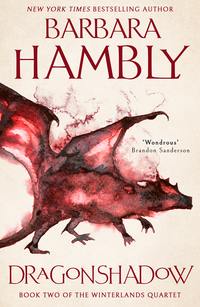
Read the book: «Dragonshadow»
DRAGONSHADOW
BOOK TWO OF THE WINTERLANDS QUARTET
Barbara Hambly

Copyright
HarperVoyager
An imprint of HarperCollinsPublishers Ltd
1 London Bridge Street
London SE1 9GF
www.harpercollins.co.uk
First published in Great Britain by HarperCollinsPublishers Ltd 1999
Copyright © Barbara Hambly 1999
Map © Shelly Shapiro
Cover illustration © Nakonechnyi Jaroslav
Cover design by Andrew Davis © HarperCollinsPublishers Ltd 2019
Barbara Hambly asserts the moral right to be identified as the author of this work.
A catalogue copy of this book is available from the British Library.
This novel is entirely a work of fiction. The names, characters and incidents portrayed in it are the work of the author’s imagination. Any resemblance to actual persons, living or dead, events or localities is entirely coincidental.
All rights reserved under International and Pan-American Copyright Conventions. By payment of the required fees, you have been granted the non-exclusive, non-transferable right to access and read the text of this e-book on screen. No part of this text may be reproduced, transmitted, down-loaded, decompiled, reverse engineered, or stored in or introduced into any information storage and retrieval system, in any form or by any means, whether electronic or mechanical, now known or hereinafter invented, without the express written permission of HarperCollins.
Source ISBN: 9780008374204
Ebook Edition © October 2019 ISBN: 9780008374211
Version: 2019-10-14
Dedication
For J.W.L.
Contents
Cover
Title Page
Copyright
Dedication
Maps
Book One: The Skerries of Light
Chapter One
Chapter Two
Chapter Three
Chapter Four
Chapter Five
Chapter Six
Chapter Seven
Chapter Eight
Chapter Nine
Chapter Ten
Chapter Eleven
Chapter Twelve
Chapter Thirteen
Chapter Fourteen
Book Two: The Burning Mirror
Chapter Fifteen
Chapter Sixteen
Chapter Seventeen
Chapter Eighteen
Chapter Nineteen
Chapter Twenty
Chapter Twenty-One
Chapter Twenty-Two
Chapter Twenty-Three
Chapter Twenty-Four
Chapter Twenty-Five
Chapter Twenty-Six
About the Author
Also by Barbara Hambly
About the Publisher
Maps


Book One

THE SKERRIES OF LIGHT
ONE
DRAGONSBANE, THEY CALLED him.
Slayer of dragons.
Or a dragon, anyway. And, he’d later found out, not such a very big one at that.
Lord John Aversin, Thane of the Winterlands, leaned back in the mended oak chair in his library as the messenger’s footfalls retreated down the tower stairs, and looked across at Jenny Waynest, who was curled up on the windowsill with a cat dozing in her lap.
“Bugger,” he said.
The night’s first appreciable breeze—warm and sticky as such things were in the Winterlands in summer—brought the grit of woodsmoke through the open window and made the candle flames shudder among the heaped books.
“A hundred feet long,” Jenny murmured.
John shook his head. “Gaw, any dragon looks a hundred feet long if you’re under it.” He pushed his round-lensed spectacles more firmly onto the bridge of his long nose. “Or in a position where you have to think about bein’ under it in the near future. I doubt it’s over fifty. That one we slew over by Far West Riding wasn’t quite thirty …” He nodded to the cold fireplace, where the black spiked mace of the golden dragon’s tail-tip hung. “And Morkeleb the Black was forty-two, though I thought he’d whack me over the back of the head when I asked could I measure him.” He grinned at the memory, but behind the spectacles Jenny could see the fear in his eyes.
Almost as an afterthought he added, “We’ll have to go after it.”
Jenny stroked the cat’s head. “Yes.” Her voice was inaudible. The cat purred and made bread on her knee.
“Funny, that.” John got to his feet and stretched to get the crick out of his back. “I’ve put together every account I can find of past Dragonsbanes—all them old ballads and tales—and matched ’em up as well as I could with the King-lists.” He gestured to the vast rummage that covered desk and floor and every shelf of the low-vaulted study: bound bundles of notes, parchments half copied from waterstained books found in the ruins south of Wrynde. Curillius on The Deeds of the Ancient Heroes, Gorgonimir’s Creatures and Phenomena. A fair copy of a fragment of the old Liever Draiken sent by the Regent of Bel, a connoisseur of both ancient manuscripts and the tales of Dragonsbanes. Notes yet to be copied—he’d jotted them down two years ago—of a dragon-slaying song sung by one of the garrison at Cair Corflyn, all mixed up with wax note tablets, candles, inkwells, scrapers, prickers, pumice, candle scissors, and dismantled clocks. For the fourteen years they’d been together, Jenny had heard John swear every year or two he’d put the place in order, and she knew that the phrase “put together” must not be taken too literally.
Magpie gleanings of learning by a man whose curiosity was an unfilled well; accretions of useful, interesting, or merely frivolous lore spewed back at random by circumstance and the mad God of Time.
“Some Dragonsbanes slay one dragon and that’s that, they’re in the ballads for good,” mused John. “Others slay two or three, and two of those, as far as I can figure ’em, are within ten years of the singletons. Then you’ll get generations, fifty, sixty, seventy years, when the dragons mind their own business, whatever that is, and nobody slays anybody. This is three for me. How’d I get so lucky?”
“The North is being settled again.” Jenny set Skinny Kitty aside and went to stand behind John, her arms around his waist. Through his rough red wool doublet and patched linen shirt she felt the ribs under the hard sheath of muscle, the warmth of his flesh. “It was the cattle herd at Skep Dhû garrison that the dragon hit. There probably hasn’t been this much livestock in the North since the Kings left. It may have drawn this one.”
“Gaw,” he said again, and set his hand over the folded knot of hers. An oddly deft hand for a warrior’s, inkstained and blistered in two places from a chemical experiment that took an unexpected turn. But thick, like his forearm, with the muscle of a lifetime of wielding a sword. In profile his was the face of a scholar. In his reddish-brown hair, hanging loose to his shoulders, the candlelight gilded the first flecks of gray.
He’d been twenty-four when he’d gone against the gold Dragon of Wyr, and his side still hurt like a knife-thrust from the damaged ribs whenever the weather turned. Jenny’s fingers could detect the ridge of the biggest scar he’d taken when he fought Morkeleb the Black in the burned-out Deep beneath Nast Wall. Life is fragile, she thought. Life is precious, and life is short. “How many is the most any Dragonsbane has been able to slay?” she asked, and John half-turned his head to grin down over his shoulder at her.
“Three. That was Alkmar the Godborn. His third dragon killed him.”
In the hour or so that separated them from moonrise, John and Jenny mustered all they would need for the slaying of the Dragon of Skep Dhû, such of them as were stored at the Hold. John’s battle armor, almost as battered and sorry as the doublet of black leather and iron in which he was wont to patrol his lands. Two axes, one a short, single-grip weapon that could be wielded from the back of a horse, the other longer and heavier, a two-handed thing for finishing a creature dying on the ground. Eight harpoons, like boar spears but larger, barbed and massive and written over with spells of death and ruin.
John’s half-brother Muffle, sergeant of the local militia and smith of the village of Alyn, had forged the first two in a hurry, when the Dragon of Wyr had descended on the herds of Great Toby fourteen years ago, and the others had been made a few weeks after that. Jenny had put spells of death on them all. In those days her powers had been small, hedge-witch magics taught her by old Caerdinn, who had once been tutor at Alyn Hold, and she had known little of dragons, only scraps and snippets culled from John’s books. Killing the golden dragon had taught her something of a dragon’s nature, so when Prince Gareth of Magloshaldon, later Regent for the King of Belmarie, had come begging John’s help against the Dragon of Nast Wall, she had been able to weave more accurate spells. Her magic was still, at that time, small.
Now she sat on the wooden platform that John and Muffle had built at the top of the tower for John’s telescope. The eight harpoons lay before her on the planks. Far below she heard John’s voice, and Muffle’s, distant as birdsong but far more profane, as they dragged out cauldrons and wood. She heard Adric’s voice, too, a gay treble—her second son, at eight burly and red-haired and every inch the descendant of John’s formidable, bearlike father: He should be in bed! Beyond a doubt three-year-old Mag was trailing, silent as a marsh fey, at his heels.
For a moment she felt annoyed at John’s Cousin Dilly, who was supposed to be looking after the children, and then let all thought of them slip away with the releasing of her breath. You cannot be a mage, old Caerdinn had said to her, if your thoughts are ever straying: to your supper, to your child, to whether you will have the next breath of air after this one is gone from under your ribs. The key to magic is magic. Never forget that.
And though she had found that magic’s key was something else, in many ways the old man had been correct. Her thought circled, like the power circle she had drawn on the platform around herself and the harpoons, and like the power that came down to her in silver threads from the shape of the stars, her thought took shape.
Cruelty. Uncaring. The quenching of life. The weary welcoming of the final dark.
Death-spells. And behind the death-spells, the gold fierce fire of dragon-magic.
For four years, now, that dragon-blaze had burned in her blood.
Morkeleb, she thought, forgive me.
Or was it not a thing of dragons to forgive?
Morkeleb the Black. The Dragon of Nast Wall.
She summoned the magic down from the stars, out of the air, called it from the core of fire within her that had burned into life when, by Morkeleb’s power, she had been transformed to dragon-kind. Though she had returned to human form, abandoning the immortality of the star-drakes, part of her essence, her inner heart, had remained the essence of a dragon, and she understood power as dragons understood it. Since it was not a thing of dragons to think or care, she did not, as she wove her death-spells, think or care about Morkeleb, who had loved her.
Loved her enough to let her return to human form.
Loved her enough to return her to John.
But after the death-spells were wrought and bound into the harpoons, she sat on the rickety platform above the Hold, her arms clasped round her knees, listening to the far-off voices of her husband and her son and remembering the skeletal black shape in the darkness, the silver labyrinthine eyes.
Morkeleb.
“Mother?”
Starlight showed the trapdoor that opened among the slates of the turret roof, but it did not penetrate the shadow underneath. Mageborn, Jenny was able to see her elder son, Ian, a weedy twelve-year-old, her own night-black hair and blue eyes in John’s beaky face. He stepped onto the steeply slanting roof and made to come down the stairs, and she said, “No, wait there.” The weariness of working the death-songs dragged at her bones. “Let me gather these up and send them on their way.”
Ian, she knew, would understand what she said. Only this year his own powers had started to manifest: small, as any teenager’s were—the ability to call fire and find lost objects, to sometimes see in fire things far away. Ian sat on the trapdoor’s sill and watched in fascination as she drew the glimmer from out of the circles, collecting it like cold spider-silk in her hands. All magic, Caerdinn had taught her, depended on Limitations. Before even beginning to lay down the circles of power, let alone summon the death-spells, she had cleansed the platform with rainwater and hyssop and laid on each separate rough-hewn plank such Words as would keep the vile magics from attaching to the place itself. Spells, too, were required to hold the wicked ferocity of what she had done within a small space, so it would not disperse over the countryside and cause ruin and death to everyone in the Hold, in the village, in the farms that nestled close to the walls. Like a miser picking up pinhead-sized crumbs of gold dust with his fingernails, so Jenny gathered into her palms each whisper and shudder of the death-spells’ residue, named them and neutralized them and released them into the turning starlight.
“Can I help?”
“No, not this time. You see what I’m doing, though?” He nodded. As she worked, she felt, rising through her—as it always rose, it seemed to her, at the most inopportune of times—the miserable flush of heat, the reminder that the change of a woman’s life was coming upon her. Patiently, wearily, she called upon other spells, little silvery cantrips of blood and time, to put that heat aside. “With spells of cursing you must be absolutely thorough, absolutely clean, particularly with spells worked in a high place,” she said.
Ian’s eyes went to John’s telescope, mounted at the far side of the platform; she saw he read her thought. It would not take much, they both knew, for the rail to give way, or John to lose his balance. A fragment of curse, a stray shadow of ill will, would be enough to cause John or Ian or anyone else to forget to latch the trapdoor, or for the latch to stick, so that Adric or Mag, or one of Cousin Rowanberry’s ever-multiplying brood, could come up here …
And even so, the platform was the safest place in all the Hold to work such spells.
As she and Ian bore the harpoons down the twisting stair, Jenny remembered what it had been, to be a dragon. To be a creature of diamond heart and limitless power. A creature to whom magic was not something that one did—well or less well—but the thing that one was: will and magic, flesh and bone, all one.
And not caring if a child fell from the platform.
With the moon’s rising John and Jenny and Ian rode out from Alyn Hold to the stone house on Frost Fell, where Jenny had for so many years lived alone. It had been Caerdinn’s house, and Jenny had lived as the old wizard’s pupil from the time she was thirteen and the buds of power she’d had as a child began to blossom. A single big room and a loft, bookshelves, a table of pickled pine, a vast hearth, and a big bed. It was to this house that John had first come to her, twenty-two and needing help against one of the bandit hordes that had been the scourge of the Winterlands in the days before the King sent his protecting armies to them again. He’d been challenged, Jenny recalled, to single combat by some bandit chief—maybe the one who had slain his father—and had heard that no weapon could harm a man who’d lain with a witch.
But she’d remembered him from her own childhood and his. His mother had been Jenny’s first teacher in the arts of power, a captive woman, an Icerider witch: the scandal when Lord Aver married her had been a nine days’ wonder through the Winterlands. When her son was four and Jenny seven, Kahiera Nightraven had vanished, gone back to the Iceriders, leaving Jenny with no better instructor than Caerdinn, who had hated all Iceriders and Kahiera above the rest. From that time until his arrival at Frost Fell, she had seen Kahiera’s son barely a score of times.
Riding up the fell now, she saw him in her mind as she had seen him then—cocky, quirky, aggressive, the scourge of maidens in five villages … And angry. It was his anger she remembered most, and the shy fleeting sweetness of his smile.
“Place needs thatching,” he remarked now, standing in Battlehammer’s stirrups to pull a straw from the overhang of the roof. “According to Dotys’ Catalogues, villagers on the Silver Isles used to braid straw into solid tiles and peg ’em to the rafterwork, which must have been gie heavy. Cowan”—the head stableman at the Hold—“says it can’t be done, but I’ve a mind to try this summer, if I can find how they did the braiding. If we’re all still alive by haying, that is.” Chewing the straw, he dropped from the warhorse’s back, looped the rein around the gate, and trailed Jenny and Ian into the house. “Garn,” he added, sniffing. “Why is it no matter what kind of Weirds you lay around the house, Jen, to keep wanderers from even seein’ the place, mice always seem to get in just fine?”
Jenny flashed him a quick glance by the soft blue radiance of the witchlight she called and bent to pull from under the bed the box of herbs she kept there. Hellebore, yellow jessamine, and the bright red caps of panther-mushroom, carefully potted in wax-stoppered jars. Jars and box were written around with spells, as the house walls were written, to keep intruders away, but there were two mice dead under the bed nevertheless.
Jenny traced the box with her blunt brown fingertips, automatically undoing the wards she had woven. Calabash gourds from the south contained the heads of water-vipers and the dried bodies of certain jellyfish. Nameless leaves were tied in ensorcelled thread, and waxed-parchment packets held deadly earths and salts. On the other side of the room Ian hunted among the few books still on the shelf; John caught Jenny around the waist, tripped her and tossed her onto the old flattened mattress, grinning impishly as she flung a spell across the room to keep Ian unaware of his parents’ misbehavior …
“Behave yourself.” She wriggled from his grasp, giggling like a village girl.
“It’s been too long since we’ve come here.” He let her up, but held her with one arm on either side of her, hands grasping the rough bedpost behind her back. Though only a little over medium height himself, John was easily a foot taller than she; the witchlight flashed silvery in his spectacles and in the twinkle of his eyes.
“And whose fault is that?” She kept her voice low—Ian was still preoccupied with his search. “I wasn’t the one who made stinks and messes and explosions in quest of self-igniting kindling all spring. I wasn’t the one who had to try to make a flying machine from drawings he’d found in some old book …”
“That was Heronax of Ernine,” protested John. “He flew from Ernine to the Silver Isles in it—wherever Ernine was—and I’ve gie near got the thing working properly now. You’ll see.”
He gathered her hair up in his hands, an overflowing double handful of oceanic night, and bent to kiss her lips. His body pressed hers to the tall, smooth-hewn post, and her hand explored the leather of his doublet, the rough wool of the dull-colored plaid wrapped over his shoulder, the hard muscle beneath the linen sleeve. Ian apparently bethought himself of some ingredient hidden inexplicably in the garden, for he wandered unseeing outside; the scents of the old house wrapped them around, moldy thatch and mice and the wild whisper of summer night in the Winterlands.
The heat of her body’s changing whispered to her, and she whispered back, Go away. It was not just the little cantrips, the knots of warding and change, that turned aside those migraines, those flashes of moodiness, those alien angers. It was this knowledge, this man, the lips that sought hers and the warmth of his flesh against her. The joy of a girl who had been ugly, who had been scorned and stoned in the village streets, who had been told, You’re a witch and will grow old alone.
The knowledge that this was not true.
Later she breathed, “And your dragon-slaying machine.”
“Aye, well.” He straightened from hunting her fallen hairpins, and the hard line returned to crease the corner of his mouth. “That’s near done, too. More’s the pity I spent this past winter tryin’ to learn to fly instead.”
Early in the morning Jenny kindled fire under the cauldrons that Sergeant Muffle had set up in the Hold’s old barracks court. She fetched water from the well in the corner and spent the day brewing poisons to put on the ensorcelled harpoons. In this she accepted Ian’s help, and John’s, too, and it was all John’s various aunts could do to keep Adric and Mag from stealing into the court and poisoning themselves in the process of lending a hand. By the late-gathering summer twilight they were dipping the harpoons into the thickened black mess, and the messenger from Skep Dhû joined them in the court.
“It isn’t just the garrison that relies on that herd,” the young man said, glancing, a little uncertainly, from the unprepossessing, bespectacled form of the Dragonsbane, stripped to a rather sooty singlet, doeskin britches, and boots, to that of the Witch of Frost Fell. His name was Borin, and he was a lieutenant of cavalry at the garrison, and like most southerners had to work very hard not to bite his thumb against evil in Jenny’s presence. “The manors the Regent is trying to establish to feed all the new garrisons depend on those cattle as well, for breeding and restocking. And we lost six, maybe eight bulls and as many cows, as far as we can gather—the carcasses stripped and gouged, the whole pasture swept with fire.”
John glanced at Jenny, who could almost read his thoughts. Fifteen cattle was a lot.
“And you got a good look at it?”
Borin nodded. “I saw it flying away toward the other side of the Skepping Hills. Green, as I said to you last night. The spines and horns down its back, and the barb on its tail, were crimson as blood.”
There was a moment’s silence. Ian, on the other side of the court, carefully propped two of the harpoons against the long shed that served John as a workroom; Sergeant Muffle leaned against the side of the beehive-shaped clay furnace in the center of the yard and wiped the sweat from his face. John said softly, “Green with crimson horns,” and Jenny knew why that small upright line appeared between his brows. He was fishing through his memory for the name of a star-drake of those colors in the old dragon-lists. Teltrevir, heliotrope, the old list said, the list handed down rote from centuries ago, compiled by none knew whom. Centhwevir blue, knotted with gold.
“Only a dozen or so are on the list,” said Jenny quietly. “There must be dozens—hundreds—that are not.”
“Aye.” He moved two of the harpoons, a restless gesture, not meeting her eyes. “We don’t even know how many dragons there are in the world, or where they live—or what they eat, for that matter, when they’re not makin’ free with our herds.” His voice was deep, like scuffed brown velvet; Jenny could sense him drawing in on himself, gathering himself for the fight. “In Gantering Pellus’ The Encyclopedia of Everything in the Material World it says they live in volcanoes that are crowned with ice, but then again Gantering Pellus also says bears are born shapeless like dough and licked into shape by their fathers. I near got meself killed when I was fifteen, findin’ out how much he didn’t know about bears. The Liever Draiken has it that dragons come down from the north …”
“Will you want a troop of men to help you?” asked Borin. In the short time he’d been at the Hold he’d already learned that when the Thane of the Winterlands started on ancient writings it was better to simply interrupt if one wanted anything done. “Commander Rocklys said she could dispatch one to meet you at Skep Dhû.”
John hesitated, then said, “Better not. Or at least, have ’em come, but no nearer than Wormwood Ford. There’s a reason them old heroes are always riding up on the dragon’s lair by themselves, son. Dragons listen, even in their sleep. Just three or four men, they’ll hear ’em coming, miles off, and be in the air by the time company arrives. If a dragon gets in the air, the man going after it is dead. You have to take ’em on the ground.”
“Oh.” Borin tried hard to look unconcerned about this piece of news. “I see.”
“At a guess,” John added thoughtfully, “the thing’s laired up in the ravines on the northwest side of the Skepping Hills, near where the herd was pastured. There’s only one or two ravines large enough to take a dragon. It shouldn’t be hard to figure out which. And then,” he said grimly, “then we’ll see who gets slain.”
TWO
IT WAS A ride of almost two days, east to the Skepping Hills. John and Jenny took with them, in addition to Borin and the two southern soldiers who’d ridden with him—a not-unreasonable precaution in the Winterlands—Skaff Gradely, who acted as militia captain for the farms around Alyn Hold, and two of Jenny’s cousins from the Darrow Bottoms, all of whom were unwilling to leave their farms this close to haying-time but equally unwilling to have the dragon move west. Sergeant Muffle was left in command of the Hold.
“There’s no reason for it,” argued Borin, who appeared to have gotten the Hold servants to launder and press his red military tunic and polish his boots. “There’s been no sign of bandits this spring. Commander Rocklys has put this entire land under law again, so there’s really no call for a man to walk armed wherever he goes.” He almost, but not quite, looked pointedly at Gradely and the Darrow boys, who, as usual for those born and bred in the Winterlands, bristled with knives, spiked clubs, axes, and the long slim savage northern bows. Jenny knew that in the King’s southern lands, farmers did not even carry swords—most of the colonists who had come in the wake of the new garrisons were, in fact, serfs, transplanted by royal fiat to these manors and forbidden to carry weapons at all.
“There’s never any sign of bandits that’re good at their jobs.” John signaled a halt for the dozenth time and dismounted to scout, though by order of the Commander of the Winterlands, roads in this part of the country had been cleared for a bow shot’s distance on either side. In Jenny’s opinion, whoever had done the clearing had no idea how far a northern longbow could shoot.
Borin said, “Really!” as John disappeared into the trees, his green and brown plaid mingling with the colors of the thick-matted brush. “Every one of these stops loses us time, and …”
Jenny lifted her hand for silence, listening ahead, around, among the trees. Stretching out her senses, as wizards did. Smelling for horses. Listening for birds and rabbits that would fall silent at the presence of man. Feeling the air as a wealthy southern lady would feel silk with fingers white and sensitive, seeking a flaw, a thickened thread …
Arts that all of Jenny’s life, of all the lives of her parents and grandparents, had meant the difference between life and death in the Winterlands.
In time she said, quietly, “I apologize if this seems to discount Commander Rocklys’ defenses of the Realm, Lieutenant. But Skep Dhû is the boundary garrison in these parts, and beyond it, the bandit troops might still be at large. The great bands, Balgodorus Black-Knife’s, or that of Gorgax the Red, number in hundreds. If I know them, they’ve been waiting all spring for a disruption such as a dragon would cause to raid the new manors while your captain’s attention is elsewhere.”
The lieutenant looked as if he would protest, then simply looked away. Jenny didn’t know whether this was because she carried her own halberd and bow slung behind Moon Horse’s saddle—women in the south did not customarily go armed, though there were some notable exceptions—or because she was a wizard, or for some other reason entirely. Many of the southern garrisons were devout worshipers of the Twelve Gods and regarded the Winterlands as a wilderness of heresy. In any case, disapproving silence reigned for something like half an hour—Gradely and the Darrow boys sitting their scrubby mounts ten or twelve paces away, scratching under their plaids and picking their noses—until John returned.
They camped that night in the ruins of what had been a small village or a large manor farm three centuries ago, when the Winterlands still supported such things. A messenger met them there with word that the dragon was in fact laired in the largest of the ravines east of the Skepping Hills—“The one with the oak wood along the ridge at its head, my lord”—and that Commander Rocklys had personally led a squadron of fifty to meet them at Wormwood Ford.
“Gaw, leavin’ who to garrison Cair Corflyn, if they get themselves munched up?” demanded John, horrified. “You get back now, son, and tell the lot of ’em to stay put. Do they think this is a bloody fox-hunt? The thing’ll hear ’em coming ten miles off!”
The second night they made camp early, while light was still high in the sky, in a gully just west of the Skepping Hills. Beyond, the northern arm of the Wood of Wyr lay thick, a land of knotted trees and dark, slow-moving streams that flowed down out of the Gray Mountains, a land that had never been brought under the dominion of the Kings. Lying with John under their spread-out plaids, Jenny felt by his breathing that he did not sleep.
“I hate this,” he said softly. “I’d hoped, after meeting Morkeleb—after speaking with him, touching him … hearing that voice of his speak in me mind—I’d hoped never to have to go after a dragon again in me life.”
Jenny remembered the Dragon of Nast Wall. “No.”
He sat up, his arms wrapped around his knees, and looked down at her, knowing how her own experience of the dragon-kind had touched her. “Don’t hate me for it, Jen.”
She shook her head, knowing that she so easily could. If she didn’t understand about the Winterlands, and about what it was to be Thane. “No.” John loved wolves, too, and studied every legend, every hunter’s tale: he’d built a blind for himself so he could sit and watch them for hours at their howlings and their hunts. He’d drive them away sooner than kill them, if they preyed on the cattle. But he’d kill them without compunction if he had to.
He was Thane of the Winterlands, as his father had been. He could no more turn his back on a fight with a dragon than he could turn his back should a bandit chief, handsome and wise as the priests said gods were, start raiding the farms.
Jenny supposed that if a god were to come burning the fields and killing the stock, exposing the people to the perils of these terrible lands, John would read everything he could on the subject, pick up whatever weapon seemed appropriate, and try to take it on.
The fact that he’d never wanted any of this was beside the point.
An hour after midnight he rose for good, ate cold barley bannocks—none of them had been so foolish as to suggest cooking, within a few miles of a dragon’s lair—and armed himself in his fighting doublet, his close-fitting helmet, and iron-backed gloves. Jenny knew that dragons were neither strictly nocturnal nor diurnal, but woke and slept like cats; still, she also knew that most dragons were aground and asleep in the hours just before dawn. She flung a little ravel of witchlight close to the ground, just enough for the horses to see the trail, and led the way toward the razor-backed hunch of the Skepping Hills and the oak-fringed ravine.
Mist swirled around the knees of the horses, floated like rags of silk among the heather. They left Borin on the edge of the heath, to watch from afar. Stretching her senses, Jenny felt everywhere the tingle and touch of magic. Had the dragon summoned these unseasonable mists for protection? she wondered. Would it sense her, sense them, if she raised a counterspell to send them away?
For a star-drake’s body to be simply of one color, she thought, it must be either very young or very old, and if very old, its senses would fill the lands around, like still water that would carry the slightest ripple to its dreams. But this she did not feel. She had sensed Morkeleb’s awareness when she and John had first ridden to do battle with the black dragon under the shadows of the Deep of Ylferdun … The red horns and spikes and tail seemed to argue for a young dragon anyway, but would a youngster be large enough to be mistaken for something a hundred feet long?
She touched John’s wrist and whispered, though they were close enough now to the head of the ravine to need absolute silence, “John, wait. There’s something wrong.”
The ravine before them was a drift of gray mist. His spectacles, framed by his helmet, glinted like the eyes of an enormous moth. In a hunter’s whisper, he asked, “Can it hear us? Feel us?”
“I don’t know. But I don’t … I don’t feel it. At all.”
He tilted his head, inquiring.
“I don’t know. Get ready to run or to charge.”
Then she reached out with her mind, her will, her dragonheart and dragon-spells, and tore the mists from the ravine in a single fierce swirl of chilling wind.
The slice and flash of early light blinked on metal in the oak woods above the ravine, and a second later something came roaring and flapping up from between the hills: green, red-horned, bat-winged, snake-headed, serpentine tail tipped with something that looked like a gargantuan crimson arrowhead and absolutely unlike any dragon Jenny had ever seen outside the illuminations of John’s old books. John said, “Bugger all!” and Jenny yelled, “John, look out, it’s an illusion …!”
Unnecessarily, for John was turning already, sword drawn, spurring toward the nearest cover. Jenny followed, flinging behind her a blast and hammer of fire-spells, ripping up from the heather between them and the riders that galloped out of the woods.
Bandits. The illusory dragon dissolved in midair the moment it was clear that neither John nor Jenny was distracted by its presence, and the bearded attackers in makeshift panoplies of hunting leathers and stolen mail converged on the cut overhang of a streambank that provided the only defensible ground in sight.
Jenny followed the fire-spells with a sweeping Word of Poor Aim, and to her shock felt counterspells whirl and clutch at her. Beside her, John cursed and staggered as an arrowhead slashed his thigh. She felt fire-spells in the air around them and breathed Words of Limitation and counterspells herself, distracting her mind from her own magics. Behind the spells she felt the mind of the wizard: an impression of untaught power, of crude talent without training, of enormous strength. She felt stunned, as if she’d walked into a wall in darkness.
John cursed again and nocked the arrows he’d pulled down with him when he’d dismounted; at least, thought Jenny, casting her mind to the head of the stream that the outlaws would have to cross to get at them, their attackers could only come at them from two sides. She tried to call back the mists, to make them work for her and John as they’d concealed the bandits before, but again the counterspells of the other wizard twisted and grabbed at her mind. Fire in the heather, at the same time damping the fire-spells that filled the cut under the bank with smoke; spells of breaking and damage to bowstrings and arrows …
And then the bandits were on them. Illusion, distraction—Jenny called them into being, worked them on the filthy, scarred, furious men who waded through the rising stream. Swords, pikes, the hammering rain of slung stones, some of which veered aside with her warding-spells, some of which punched through them as if they had not been there. A man would stop, staring about him in confusion and horror—Jenny’s spells of flaring lights, of armed warriors around herself and John taking effect … John’s sword, or Jenny’s halberd, would slash into his flesh. But as many times as not the man would spring back with a cry, seeing clearly, and Jenny would feel on her mind the cold grip of the other mage’s counterspell. Illusion, too, she felt, for there were bandits who simply dissolved as the illusion of the dragon had dissolved …
And through it all she thought, The bandits have a wizard! The bandits have a wizard with them!
In John’s words: bugger, bugger, bugger.
Jenny didn’t know how long they held them off. Certainly not much longer than it would take to hard-boil an egg, though it seemed far longer. Still, the sun had just cleared the Skepping Hills when she and John first saw the bandits, and when the blare of trumpets sliced golden through the ruckus and Commander Rocklys and her troops rode out of the hills in a ragged line, the shadows hadn’t shortened by more than a foot. Jenny felt the other wizard’s spells reach out toward the crimson troopers and threw her own power to intercept them, shattering whatever illusions the rescuers would have seen and attacked. Rocklys, standing in her stirrups, drew rein and fired into the thick of the outlaw horde; Jenny saw one of the leaders fall. Then a great voice bellowed, “Out of it, men!” and near the head of the ravine a tall man sprang up on a boulder, massive and black-bearded, like a great dirty bear.
John said, “Curse,” and Rocklys, whipping another arrow to her short black southern bow, got off a shot at him. But the arrow went wide—Jenny felt the Word that struck it aside—and then battle surged around them, mist and smoke rising out of the ground like dust from a beaten rug. The spells she’d called onto the stream were working now and the water rushed in furious spate, sweeping men off their feet, the water splashing icy on John’s boots and soaking the hem of Jenny’s skirt. Then the bandits fled; Rocklys and her men in pursuit.
“Curse it,” said John. “Balgodorus Black-Knife, damn his tripes, and they had a wizard with ’em, didn’t they, love?” He leaned against the clay wall of the bank, panting; Jenny pressed her hand against his thigh, where the first arrowhead had cut, but felt no poison in the wound.
“Somebody who knew enough about dragon-slaying to know we’d have to attack it alone, together.”
“Maggots fester it—ow!” he added, as Jenny applied a rough bandage to the wound. “Anybody’d know that who’s heard me talk about it, or talked to someone who had. Anyway, it wasn’t me they was after, love.” He reached down and touched her face. “It was you.”
She looked up, filthy with sweat and soot, her dark hair unraveled: a thin small brown woman of forty-five, flushed—she was annoyed to note—with yet another rise of inner heat. She sent it away, exasperated at the untimeliness and the reminder of her age.
“Me?” She got to her feet. The rush of the stream was dying as quickly as it had risen. Bandits slain by John’s sword, or her halberd, or by the arrows of Rocklys’ men, lay where the water had washed them.
“You’re the only mage in the Winterlands.” John tucked up a wet straggle of her hair into a half-collapsed braid, broke off a twig from a nearby laurel bush and worked it in like a hairpin to hold it in place. “In the whole of the King’s Realm, for all I know. Gar”—that was the Regent—“told me he’s been trying to find wizards in Bel and Greenhythe and all around the Realm, and hasn’t located a one, bar a couple of gnomes. So if a bandit like Balgodorus Black-Knife’s got a wizard in his troop, and we have none …”
“We’d have been in a lot of trouble,” Jenny said softly, “had this ambush succeeded.”
“And it might have,” mused John, “if their boy—”
“Girl.”
“Eh?”
“Their mage is a woman. I’m almost certain of it.”
He sniffed. “Girl, then. If their girl had known the first thing about star-drakes, beyond that they have wings and long tails, you might not have twigged soon enough to keep us out of the jaws of the trap. Which goes to demonstrate the value of a classical education …”
Commander Rocklys returned in a clatter of hooves, Borin at her side. “Are you all right?” She sprang down from her tall bronze-bay warhorse, a lanky powerful woman of thirty, gold-stamped boots spattered with mud and gore. “We were saddled and ready to ride to your help with the dragon when Borin charged into camp shouting you were being ambushed.”
“The dragon was a hoax,” John said briefly. He wiped a gout of blood from his cheekbone and scrubbed his gloved fingers with the end of his plaid. “Better if it had been a real drake than what’s really going on.”
Rocklys of Galyon listened, arms folded, to his account. It was a rare woman, Jenny knew, who could get men to follow her into combat; on the whole, most soldiers knew of women only what they saw of their victims during the sack of farmsteads or towns, or what they learned from the camp whores. Some, like John, were willing to learn different. Others had to be strenuously taught. Though the women soldiers Jenny had met—mostly bandits—tended to gang together to protect one another in the war camps, a woman commander as a rule had to be large and strong enough to take on and beat a good percentage of the men under her command.
Rocklys of the House of Uwanë was such a woman. The royal house of Bel was a tall one, and she was easily John’s nearly six-foot height, with powerful arms and shoulders that could only have been achieved by the most strenuous physical training. As a cousin of the King, Jenny guessed she would have been granted a position as second-in-command or a captaincy of royal guards regardless, but it was clear by the set of her square chin that an honorary post was not what she wanted.
For the rest, she was fair-haired, like her cousin the Regent Gareth—though the last time Jenny had seen Gareth, two years ago, he’d still affected a dandy’s habit of dyeing portions of his hair blue or pink or whatever the fashionable shade was that year. Her eyes, like Gareth’s, were a light, cold gray. She neither interrupted nor reacted to John’s tale, only stood with the slight breezes moving the gold tassels on her sword-belt and on the red wool oversleeves that covered her linen shirt. At the end of his recital she said, “Damn it.” Her voice was a sort of husky growl, and Jenny guessed she’d early acquired the habit of deepening it. “If I’d known there was a wizard with them I’d never have called off the men so soon. You’re sure?”
“I’m sure.” Jenny stepped up beside John. “Completely aside from the green dragon, which was sheer illusion—only created to lure John and me—I could feel this mage’s mind, her power, with every spell I tried to cast. There’s a wizard with Balgodorus, and a strong one.”
“Damn it.” Rocklys’ mouth hardened, and for a moment Jenny saw a genuine fury in her eyes. Then they shifted, thoughtful, considering the two people before her: the bloodied and shabby Dragonsbane and the Witch of Frost Fell. Jenny knew the look in her eyes, for she’d seen it often in John’s. The look of a commander, considering the tools she has and the job that needs to be done.
“Lady Jenny,” she said. “Lord John.”
“Now we’re in trouble.” John looked up from polishing his spectacles on his shirt. “Anytime anyone comes to me and says …” He shifted into an imitation of that of the Mayor of Far West Riding, or one of the councilmen of Wrynde, when those worthies would come to the Hold asking him to kill wolves or deal with bandits, “‘Lord John’—or worse, ‘Your lordship.’”
Commander Rocklys, who didn’t have much of a sense of humor, frowned. “But we are in trouble,” she said. “And we shall be in far worse trouble should Balgodorus Black-Knife continue at large, with a witch …” She hesitated—she’d used a southern word for the mageborn that had pejorative connotations of evil and slyness—and politely changed it. “… with a wizard in his band. Surely you agree.”
“And you want our Jen to go after ’em.”
Rocklys looked a little surprised to find her logic so readily followed. As if, thought Jenny, the necessity for her to pursue the renegade mage was not obvious to all. “For the good of all the Winterlands, you must agree.”
John glanced at Jenny, who nodded slightly. He sighed and said, “Aye.” The good of all the Winterlands had ruled his life for twenty-two years, since his father’s death. Even before that, when as his father’s only son he had been torn from his books and his music and his tinkerings with pulleys and steam, and had a sword thrust into his hand.
Four years ago it had been the good of all the Winterlands that took him south, to barter his body and bones in the fight against Morkeleb the Black, so the King would in return send troops to garrison those lost territories and bring them again under the rule of law.
“Aye, love, you’d best go. God knows if you don’t we’ll only have ’em besiegin’ the Hold in the end.”
“Good.” Rocklys nodded briskly, though she still looked vexed. “I’ve already sent one of the men back to Skep Dhû, with orders to outfit a pack-train, Lady Jenny; you’ll ride with twenty-five of my men here.”
“Twenty-five?” said John. “There were at least twenty in the band that attacked us, and rumor has it Balgodorus commands hundreds these days.”
Rocklys shook her head. “My scouts report no more than forty. Untrained men at that, scum and outlaws, no match for disciplined troops.
“If at all possible,” she went on, “bring the woman back alive. The Realm needs mages, Lady Jenny. You know that, you and I have talked of this before. It is only the most appalling prejudice that has caused wizardry to fall into disrepute, so that the Lines of teaching died out or went underground. I am told the gnomes have wizards: that alone should have convinced my uncle and his predecessors to foster, rather than forbid, the study of those arts. Instead, what did they do? Simply crippled themselves, so that four years ago when an evil mage like the Lady Zyerne rose up, no one was prepared to deal with her. That situation cannot be allowed to repeat itself. Yes, Geryon?”
She turned as an orderly spoke to her; John put his hands on Jenny’s shoulders.
“Will you be all right?” she asked him, and he bent to kiss her lips. She tasted blood on his, and sweat and dirt; he must have tasted the same.
“Who, me? With Muffle and Ian and me aunties to defend the Hold if we’re attacked? Nothing to it.” Deadpan, he propped his spectacles more firmly onto the bridge of his long nose. “Shall I send a messenger after you with your good shoes and a couple of silk dresses just in case you want a change?”
“I’ll manage with what I have,” said Jenny gravely. “Borin was right, you know,” she added. “The garrisons may be a nuisance, and the farmers may grumble about the extra taxes, but there hasn’t been a major bandit attack since their coming. I’ll scry you, and the Hold, in my crystal every night—a pity Ian’s powers haven’t grown strong enough yet for him to learn to speak with me through a crystal or through fire. But he’s a fair healer already. And if there’s trouble …” She raised her hand, touched the long hair where it straggled, pointy with sweat, over his bruised face. “Braid a red ribbon into your hair. I’ll see it when I call your image. If I can, I’ll return to you.”
John caught her hand as she would have lowered it and kissed her dirty fingers; and she drew down his in return, pressed her lips to the scruffy leather, the battered chain-mail of his glove. Skaff Gradely and the Darrow boys had come up by this time, arguing all the way with Borin’s fellow messengers, with the spare horses and the baggage, so there was little to stay for.
“Borin will ride with you,” Commander Rocklys said, “and his fellows. Send one of them to me when you’ve come up with these bandits and their wizard. Let us know where you are and if you need troops. I’ll dispatch as many as I can, as swiftly as I can. And bring the woman alive, at whatever the cost. We’ll make it worth her while to pledge her services to the Realm.”
“Even so.” Jenny swung to Moon Horse’s saddle again and adjusted her halberd and bow. She wondered what reward she herself would consider “worth her while” to betray John, to turn against him, to ride with his foes …
Or, she thought, as the twenty-five picked pursuers formed up around her, to leave him and our children and the folk of Alyn Hold to their own devices, when I know there’s a bandit wizard abroad in the lands?
The good of all the Winterlands, maybe.
The good of the Realm, which John considered his first and greatest loyalty.
She lifted her hand to him as she and the men rode off. A little later, as they crested the rise above the ravine and approached the oak woods into which the bandits had fled, she looked back to see Commander Rocklys marshaling her forces to ride back to Cair Corflyn, the garrison on the banks of the Black River, which was the headquarters for the whole network of new manors and forts. John’s doing, those garrisons, she thought. The protection he had bought with the blood he’d shed, dragon-fighting four years ago. His reward.
As the dragon-magic in her veins was hers.
John himself stood, a small tatty black figure on the high ground above the stream, watching her. She lifted her hand again to him, and his spectacles flashed like mirrors as he waved good-bye. The wasting moon still stood above the moors to the west, a pale crescent like a slice of cheese.
Less than three weeks later, before that moon waxed again to its full, a real dragon descended on the farms near Alyn Hold.
The free sample has ended.