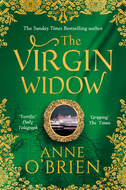
Read the book: «Virgin Widow»
Virgin Widow
Anne O’Brien

All the characters in this book have no existence outside the imagination of the author, and have no relation whatsoever to anyone bearing the same name or names. They are not even distantly inspired by any individual known or unknown to the author, and all the incidents are pure invention.
All Rights Reserved including the right of reproduction in whole or in part in any form. This edition is published by arrangement with Harlequin Enterprises II B.V./S.à.r.l . The text of this publication or any part thereof may not be reproduced or transmitted in any form or by any means, electronic or mechanical, including photocopying, recording, storage in an information retrieval system, or otherwise, without the written permission of the publisher.
This book is sold subject to the condition that it shall not, by way of trade or otherwise, be lent, resold, hired out or otherwise circulated without the prior consent of the publisher in any form of binding or cover other than that in which it is published and without a similar condition including this condition being imposed on the subsequent purchaser.
HQ is an imprint of HarperCollinsPublishers Ltd
Published in Great Britain 2010.
HQ
1 London Bridge Street
London
SE1 9GF
©Anne O’Brien 2010
ISBN 978-1-4089-2795-3
Version: 2019-04-12
About the Author
ANNE O’BRIEN taught history in the East Riding of Yorkshire before deciding to fulfil an ambition to write historical fiction. She now lives in an eighteenth-century timbered cottage with her husband in the Welsh Marches, a wild, beautiful place renowned for its black-and-white timbered houses, ruined castles and priories and magnificent churches. Steeped in history, famous people and bloody deeds, as well as ghosts and folklore, the Marches provide inspiration for her interest in medieval England.
Visit her at www.anneobrienbooks.com
Table of Contents
Cover
Title Page
Copyright
About the Author
Dedication
Acknowledgements
Epigraph
House of York
Chapter One
Chapter Two
Chapter Three
Chapter Four
Chapter Five
Chapter Six
Chapter Seven
Chapter Eight
Chapter Nine
Chapter Ten
Chapter Eleven
Chapter Twelve
Chapter Thirteen
Chapter Fourteen
Chapter Fifteen
Chapter Sixteen
Chapter Seventeen
Chapter Eighteen
Chapter Nineteen
Chapter Twenty
Chapter Twenty-One
Epilogue
Other titles by the author
Extract
Author Note
For my husband, George. In gratitude for his enduring support and his faith in me and Anne Neville.
Acknowledgements
With thanks to Jane Judd, my agent, whose belief in Virgin Widow was sometimes greater than mine. And to Maddie West and all at HQ. Their enthusiasm has been beyond price.
“Was ever woman in this humour wooed?"
William Shakespeare, Richard III
House of York


Chapter One
April 1469—on board ship, off the English port of Calais
ISABEL whimpered. With creaks and groans the ship listed and thumped against the force of water as if it would be torn apart by the next wave, casting us into the depths. Isabel clapped her hands to her mouth, her eyes staring at the heaving wooden walls that hemmed us in, the sides of a coffin.
‘Now what’s wrong with you?’ It was not fear of a watery death. I knew what it was, even as I prayed that it was not. The ship rolled again in the heavy swell, wallowing queasily in the dips before lifting and lurching. Sweat prickled on my forehead. Nausea clutched my belly before fear rapidly drove it out again. ‘Isabel.’ I nudged her arm sharply to get her attention. She was sitting in a high-backed chair, the only available chair in the cabin and the property of the captain, her whole body rigid, braced. Eyes tight closed to shut out the desperate pitch and roll, one hand was closed claw-like on the arm. I shuffled forwards on my stool. ‘Is it the baby?’
‘Yes,’ she gasped, then, ‘No…no. Just a quick pain.’ On a deep breath her body relaxed fractionally, fingers uncurling from the carved end. ‘There, it’s gone. Perhaps I mistook it.’
And perhaps she didn’t. I watched her cautiously as she eased her body in the confined space. Her face was as livid and slick as milk, drawn with near-exhaustion. Wedged into the chair in that crowded, low-ceilinged cabin, her belly strained against the cloak she clutched to herself as if she were cold. It was so close and airless that I could feel the sweat work its way down my spine beneath the heavy cloth of my gown. Nine months pregnant, my sister Isabel was. And even I knew that this was no time to be at sea on a chancy expedition.
I got up to pour a mug of ale, staggering as the vessel lifted and sank. ‘Drink this.’
Isabel sniffed as if the familiar aroma of malted hops repelled her. As it had for much of her pregnancy. ‘I don’t want it. I would rather it were wine.’
But I pushed it into her hands. ‘It’s all we have. Drink it and don’t argue.’ I struggled against telling her that this was no time for ungrateful petulance. I was very close to gulping the small-beer myself and letting her go thirsty. ‘It will ease your muscles if nothing else.’
‘But not my bladder. The child presses heavily.’ Another grimace, another groan, as she sipped. ‘Pray God it will be born soon.’ Isabel had never tolerated discomfort well.
‘But not here!’The prospect stirred the fear in my gut again. It churned and clenched. ‘We should soon make land. We’ve been at sea an age. When we get to Calais, that’s the time to pray for God’s help.’
‘I don’t think I can wait that long…’ Her complaints dried on a gasp. Dropping the cup on the floor so that it rolled and returned, she hissed out a breath. Her hands clutched her mountainous belly.
‘When we get to Calais…’ Taking my stool beside her again, I tried to think of some mindless conversation. Anything to distract.
‘When we get to Calais I’ll never set foot on board ship again,’ Isabel snapped. ‘No matter how much—’ She bit off the words, her renewed moans rising to the approximation of a howl. ‘The baby…It must be. Where’s our mother? I want her here with me…Send Margery to fetch her…’
‘No. I’ll get Margery to sit with you. I’ll get the Countess.’
Relief to escape the squalid cabin. Relief to pass the burden of this child to more experienced hands than mine. At fourteen years, I was old enough to know what would happen, but too young to seek the responsibility. I think I was always a selfish child. I summoned Margery, the Countess’s serving woman, to remain at Isabel’s side. And fled.
I found my mother exactly where I knew she would be on the deck. Despite the cold wind and the frequent squalls, I knew she would be with my father. The Countess of Warwick, swathed from head to foot in a heavy cloak, hood shadowing her face, stood in the shelter of the high stern, my father, the Earl, similarly wrapped about, harassed, thwarted in his planning, his fist clenched and opened on the gunwale. The two figures stood together in close conversation, looking out towards where we would soon see land, if the clouds, thick and heavy, enveloping us all in an opaque blanket of grey-green, ever saw fit to lift. Taken up with their concerns, their backs remained turned to me. So I listened. Eavesdropping was a skill I had perfected through my early years when, as the younger daughter, it was customary for our household to overlook my presence as if I were an infant or witless. I was neither. I approached with careful steps.
‘What if he refuses us entry?’ I heard the Countess ask.
‘He will not. Lord Wenlock is as loyal a lieutenant as any man could ask.’
‘I wish I could be as sure as you.’
‘I have to hold to it,’ the Earl stated with more conviction in his voice than the circumstances merited in my opinion. I knew that in recent days there were new lines of strain on his face between nose and mouth, engraved deep. Even so he placed an arm round the Countess’s shoulders to enforce his certainty. ‘We shall be safe here in Calais. From here we can plan our return, at the head of a force strong enough to displace the King…’
I was destined to hear no more as the deck heaved with more vehemence. I stumbled, tottered to regain my balance. And they turned. My mother immediately came towards me to catch my arm as if sensing the bad news.
‘Anne. What are you doing out here? It’s not safe…Is it your sister?’ Isabel had been in the forefront of all our minds in recent days.
‘Yes. She says the baby’s coming.’ No point in embroidering bad news.
My mother’s teeth bit into her bottom lip, her fingers suddenly tight on my arm, but her words were for my father. ‘We should not have set off so late. I warned you of the dangers. We knew she was too near her time.’
Then she was already on her way to my sister’s side, dragging me with her, except that my father stopped her with a brusque movement of his hand.
‘Tell her this, to ease her mind. Within the hour we’ll see Calais. Sooner if this cloud lifts. And then we will get her ashore. It will not stop the process of nature, but it may give her strength.’ He tried a smile. I knew it to be false. I could see his eyes, the fear in them. ‘Are not all first babies late?’
‘No! They are not!’ My mother shrugged off my father’s attempts at reassurance. ‘She should never have been put through this ordeal.’
A tall figure, similarly cloaked, loomed beside us from the direction of one of the rear cabins, pushing back the hood.
‘What’s amiss? Have we made landfall at last?’
Tall, golden haired, striking of face. George, Duke of Clarence, brother to King Edward and male heir apparent to the English throne. My sister’s husband of less than a year. His eyes shone brilliantly blue, his fair skin glowed in the murk. So beautiful, as Isabel frequently crowed her victory in becoming his wife, a maiden’s dream.
I loathed him.
‘No. It’s Isabel,’ I told him with barely a glance. The Countess would reprimand me for my ill manners, but nothing she could say would ever reconcile me to my brother by marriage. Not that it mattered to him. He rarely deigned to notice me.
‘Is she sick?’
The Countess interrupted my pert reply. ‘She is distressed. The child is imminent…’
Clarence scowled. ‘A pity we had not made landfall. Will the child be safe?’
I felt my lip curl and made no attempt to disguise it, even when my mother saw and stared warningly at me. She thought my hostility was a younger sister’s jealousy of Isabel’s good fortune, but I knew differently. Not, Will my wife suffer? Or, Can we do anything to ease her distress? Just, Will the child be safe? I hated him from the depths of my heart. How Richard, my own Richard, who was now separated from me and would remain so for ever as far as I could see, could be brother to this arrogant prince I could never fathom.
The Countess swept Clarence’s inopportune query aside, but found time and compassion to smile at me. ‘Don’t look so worried, Anne. She’s young and healthy. She’ll forget all her pain and discomfort when she holds her child in her arms.’
‘The child must be saved! At all costs.’ Clarence’s face was handsome no longer.
‘I shall bear your instructions in mind, your Grace. But my first concern is for my daughter.’ The Countess was already striding across the deck.
With relish at the curt reprimand, I also turned my back on the Duke of Clarence and scuttled after my mother. When I arrived in the cabin she had already taken charge. Her cloak dropped on to a stool, she had replaced Margery at Isabel’s side and was dispensing advice and soothing words in a forthright manner that would brook no refusal. In our northern home in Middleham where I had spent the years of my childhood, my mother, despite her high-born status, had a reputation for knowledge and skill in the affairs of childbirth. I feared that we would need all of it before the night was out.
My mother was right in one thing. With Isabel as far on as she was, we should never have put to sea when we did. Not that we had much choice in the matter, with the King and his army breathing down our traitorous necks and out for blood. A disastrous mix of ill luck, poor weather and royal Yorkist cunning—and we were reduced to this voyage on this mean little vessel in unreliable April weather. Here we were in this hot, dark, confined space, lurching on a sulky sea, with Isabel’s screams echoing off the rough walls to make me feel a need to cover my ears—except that my mother was watching—and reject any notion of motherhood for myself.
A fist hammered on the door.
‘Who is it?’ The Countess’s attention remained fixed on Isabel’s flushed face.
A disembodied voice. ‘My lord says to tell you, my lady, the heavy cloud has lifted and Calais is in sight. We are approaching the harbour, to disembark within the hour.’
‘Do you hear that, Isabel?’ The Countess gripped Isabel’s hand hard as Margery wiped the sweat from my sister’s forehead. ‘You’ll soon be in your own room, in the comfort of your own bed in Calais.’ Heart-warming words, but I did not think the Countess’s expression matched them as she helped Isabel to lie down on the narrow bed.
Isabel snatched her hand away. ‘How can I bear this pain, no matter where I am?’
At that exact moment, bringing a deathly silence to the cabin, there came the easily recognisable crack of distant cannon fire. One! Two! And then another. Shouts erupted on deck, the rush of running feet. The ship reeled and huffed against the wind as sails were hauled in and she swung round with head-spinning speed. The scrape of metal on wood rumbled as the anchor chain was dropped overboard.
We all froze, even Isabel’s attention dragged from her woes.
‘Heaven preserve us!’ Margery promptly fell to her knees, hands clasped on her ample bosom.
‘Cannon fire!’ I whispered.
‘Are they firing at us?’ Isabel croaked.
‘No.’ The Countess stood, voice strong with conviction. ‘Get up, Margery. Of course they are not firing at us. Lord Wenlock would never refuse us entry to Calais.’
But again the crash of cannon. We all tensed, expecting a broadside hit at any moment. Then Isabel groaned. Clutched the bed with talon-like fingers. Her once-flushed face was suddenly grey, her lips ashen. The groan became a scream.
Our mother approached the bed, barely turned her head towards me, but fired off her own instructions, as terse as any cannon. ‘Anne! Go and see what’s amiss. Tell your father we need to get to land immediately.’
I made it through the crash and bang of activity to my father’s side. There ahead, emerging from the cloudbank, was the familiar harbour of Calais. Temptingly close. But equally we were close enough that I could see the battery of cannon ranged against us, just make out their black mouths, and a pall of smoke hanging over them in the heavy air. They had been aimed at us, to prevent our landing if not to sink us outright. Now in the lull, across the water and making heavy weather of it, came a small boat rowed by four oarsmen with one man standing in the bows. His face, expressionless with distance, was raised to us.
‘Who is it?’ Clarence asked the Earl.
‘I don’t recognise him.’ But I recognised my father’s heavy mood of anger. ‘One of Wenlock’s men. What in God’s name is he about?’
The boat drew alongside and the visitor clambered on deck. Clothes brushed down, sword straightened, he marched across to where we stood and bowed smartly before the Earl. ‘A message from Lord Wenlock, my lord. To be delivered to your ears only. He would not write it.’
‘And you are?’
‘Captain Jessop, my lord. In my lord Wenlock’s confidence. ‘His expression was blandly impossible to read.
‘In his confidence, are you?’ Temper snapped in the Earl’s voice. ‘Then tell me—why in God’s name would you fire on me? I am Captain of Calais, man. Would you stop me putting into port?’
‘Too late for that, my lord.’ Captain Jessop might be apologetic, but gave no quarter. ‘Twelve hours ago we received our orders from the King. And most explicit they were too, on pain of death. With respect, my lord, we’re forbidden to allow the great rebel—yourself, my lord—to land on English soil in Calais.’
‘And LordWenlock would follow the orders to the letter?’ My father was frankly incredulous.
‘He must, my lord. He is sympathetic to your plight, but his loyalty and duty to the King must be paramount.’ A weighty pause. ‘You’ll not land here.’
The Earl’s crack of laughter startled me. ‘And I thought he was a loyal friend, a trustworthy ally.’ I could see the Earl struggle with his emotions at this blow to all his plans. Lord Wenlock, a man who had figured in Neville campaigns without number over as many years as my life. He had been a guest in our home and I knew there had never been any question over his allegiance.
‘He is both ally and friend,’ Captain Jessop assured, ‘but I must tell you as he instructed. There are many here within the fortress who are neither loyal nor trustworthy in the face of your—ah, estrangement from the Yorkist cause.’
‘Look, man.’ The Earl grasped the captain’s arm with a force that made the man wince. ‘I need to get my daughter ashore. She is with child. Her time has come.’
‘I regret, my lord. Lord Wenlock’s advice is that Calais has become in the way of a mousetrap. You must beware that you are not the mouse that comes to grief here with its neck snapped. He says to sail further along the coast and land in Normandy. If you can set up a base there, from where you can attract support, then he and most of the Calais garrison will back you in an invasion of England. But land in Calais you may not.’
‘Then I must be grateful for the counsel, mustn’t I?’ Releasing Captain Jessop’s arm, the Earl clasped his hand, but with little warmth and much bitterness. ‘Give my thanks to Wenlock. I see that I must do as he advises.’
I moved quickly aside as the captain made his farewells. So we were not to be welcomed into the familiar walls of Calais. A little trip of panic fluttered in my belly, even as I tried to reassure myself that I should not worry. My father would know what to do. He would not allow us to come to harm. A sharp wail of anguish rose above the sound of shipboard action. My instincts were to hide, but my sense of duty, well-honed at my mother’s knee, insisted otherwise. It took me back to the cabin with the bad news.
The activity in the small dark space brought me up short. My elegant mother, a great heiress in her own right who had experienced nothing but a life of high-born privilege and luxury, had folded back the wide cuffs of her over-sleeves and was engaged with Margery in pulling Isabel from the narrow bed. Ignoring Isabel’s fractious complaints, she ordered affairs to her liking, dragging the pallet to the floor and pushing my sister to lie down where there was marginally more space. Margery added her strength with a strange mix of proud competence at my mother’s side and sharp concern imprinting her broad face. But Margery had her own skills. She had been with my mother since well before the Countess’s marriage, tending her through her difficult pregnancies, as I had heard from her frequent telling of how Margery had caught both Isabel and myself when we slid into this world. So, as she informed us, what she didn’t know about such matters as bearing children, although having none of her own, was not worth the knowing.
‘Hush, child. Margery is with you. Sit there for Margery, now, and don’t weep so…’ As if Isabel were still a small girl to be cosseted for a grazed knee.
The Countess was made of sterner stuff. Seeing me hesitate in the doorway, she pounced with impressive speed and pulled me into the cabin. ‘No, you don’t. I shall have need of you.’
‘There’s no room—’
‘Anne. Be still. Your sister needs you.’
I feared that I would be the last person to soothe my pain-racked sister. Isabel merely tolerated me. We had always fought—I suspected we always would. But pity moved me at her wretched plight. ‘We cannot land.’ Adopting a martyred expression, I recounted to the Countess the gist of the conversation as I stepped over to replace Margery at Isabel’s side.
‘Ha! As I thought. Perhaps it’s too late anyway.’ We staggered and clutched as a rogue wave lifted the boat from prow to stern. I covered my mouth on another surge of nausea, the clammy sweat chilling me in the hot air.
‘Breathe deep, daughter. I can’t deal with two of you sick. Sit with Isabel, hold her hand, talk to her.’
‘What about?’ I looked to the Countess for guidance. There was a fear here in this cabin. Sharp and bright, it suddenly overwhelmed me.
‘Anything. Encourage her, distract her if you can. Now, Margery, let’s see if we can bring this child safe into the world.’
Three hours later we had made little progress.
‘We need the powers of the Blessed Virgin’s Girdle here, my lady,’ Margery whispered as Isabel’s whole body strained.
‘Well, we haven’t got it and so must do what we can without!’
Sniffing, Margery resorted to the age-old remedy of a knife slipped beneath the pallet to ease the pain and cut the birth pangs, adding a dull green stone for good measure. ‘Jasper,’ she whispered.’It gives strength and fortitude to ailing women.’
‘Then we could surely do with such powers this day. For all of us.’ The Countess did not stop her, but decided on a more practical approach.
‘Find the kitchen, or what passes for one, wherever it may be in this vessel, Anne. Tell the cook I need grease. Animal fat. Anything to coat my hands.’ The Countess leaned close, speaking to me as an equal in age and knowledge, with a foreboding that she no longer made any effort to hide. ‘The child is taking too long. Isabel grows weaker by the minute and the child’s not showing.’
I raced off, returning with a pot of noxious and rancid grease—from what source I could not possibly guess.
‘Don’t stand gawping, Anne. If nothing else, pray!’
My mother astounded me. Stripped of all her consequence along with her veils, skirts and under-robe tucked up, hair curling on to her neck in greasy strands, she was as rank as any common midwife, yet as awe inspiring as the most noble lady in the land.
‘Who shall I petition?’ I asked. Praying seemed to me a tedious affair when all around was fear and chaos.
‘Pray to the Virgin. And St Margaret—chaste and childless she may have remained, accepting death as the lesser of evils, although I cannot agree with her, but during torture she experienced all the pain of being swallowed up and spat out by a dragon. An unpleasant experience not given to many of us. Pray to her.’ She hesitated a moment, then held my eyes in a fierce stare. ‘But before you do, fetch the priest.’
I did not need to ask why.
The next hours were the most horrifying of my young life. Enclosed in that cabin it was difficult to tell when day passed into night, night into day. Candles were replaced as they guttered, food was sent in to us that we did not eat, until it was all over, except for the hot reek of blood and sweat and terror. There was little else to show for it. Isabel lay as pale and drained as whey cheese. The Countess knelt beside her, exhausted, whilst Margery fussed and fretted with pieces of soiled linen. The bones of my fingers were crushed as in a vice where Isabel had hung on in the worst of her pain. I had repeated every prayer of petition I knew, as well as a good many impromptu offerings, until my voice was hoarse and at the end I drooped with fatigue. But all we had was a poor dead baby. The grease to slick the Countess’s hands and ease the child into the world and the dire experience of St Margaret with the dragon saved my sister, but not the child. A poor weak creature smeared with blood and slime that managed to utter a cry little stronger than a kitten, then left this life almost as soon as it had entered it.
A girl. The priest, Father Gilbert, our own Neville priest who had come with us in our household, hustled in from where he had waited all this time within call, baptised her at the bedside to save her immortal soul and to free her from slavery to the Devil. I think we pretended that she was still alive when the water touched her forehead. It would have been too distressing to accept that her life had passed and so her soul was lost to God as well. Anne, she was called, because my mother’s eye fell on me as I would have shrunk from the room at the end to find some solitary space in which to shed the tears that now would not be restrained in my weakness. Her eye fixed me to the spot, where I stood frozen as the priest touched the unresponsive face with holy water from the little vial. Isabel watched glassy-eyed as her daughter was washed and wrapped and finally given into my reluctant care in my role as messenger.
‘Take the babe to the Earl,’ the Countess instructed, touching the waxen features with fingers that were unsteady. ‘He will know what to do.’
Such a small weight. The child lay in my arms as if she slept toil-worn from the excesses of the event, the skin on her eyelids translucent. Her fingernails were perfect too, but too weak to cling to life. How could I not weep as I carried the burden on to the deck? To my father, my mother had said. Not to the Duke of Clarence.
I stood before them where they waited for me, as if I were offering a precious gift.
‘Is it a boy?’ Clarence asked.
‘No. A girl. And she is dead. We called her Anne. She has been baptised.’ I knew my tone was blunt and unfeeling, but I dared do no other. Nor dared I look at him. Too many feelings crowded in, not least my hatred for this man who cared nothing for my sister other than the inheritance that came with her name. The power of her Neville family connections that would buy him support and, as was his ambition, the throne of England. If I had allowed it I would have sunk down to the rough decking and howled my hurt and disillusion, like one of my father’s hounds.
‘Perhaps next time it will be a boy.’ Clarence turned away, disappointed, uninterested. He did not ask about Isabel’s condition.
My father saw my distress. With a brusque gesture that held his own grief in check, he pulled me and the sad bundle close into his arms. ‘Isabel?’
‘She is tired and weak. I don’t think she understands.’
‘We must thank God for your mother’s skills. Without her we might have lost Isabel too.’ He lifted the child from me with great care. ‘Go back. Tell your mother. I will send the child’s body to Calais with Captain Jessop here.’ I became aware that the Captain had returned and was awaiting instructions. ‘I will ask that she be buried with all honour at the castle. She is very small and barely drew breath, but she is ours with Neville blood in her veins. Wenlock will see to it.’
I nodded, too weary to do or to think anything else.
‘Tell her…tell your mother…I was wrong. I should never have put to sea.’
‘I don’t think it mattered, sir.’ I rubbed my eyes and cheeks on my sleeve. ‘If any should take the blame it should be the Yorkists. King Edward who drove us on with fear of capture. King Edward is to blame.’
And Richard, my Richard, who has stayed loyal to his eldest brother and is now my enemy whether I wish it or not.
I gave the bundle into the Earl’s keeping, and left before I could see it carried over the side.
There began for us a long and distressing voyage west along the coast from Calais. The winds and tides did us no favours and there was an uneasy pall of death over the ship. Isabel regained her strength, enough to sit in her chair or walk a few steps on deck, but not her spirits. Clarence did not endear himself. He remained brashly insensitive, rarely asking about her, rarely seeking her company, too concerned with the instability of his own future now that he was branded traitor to his brother. The Earl and Countess held discussions deep into the night. I knew it was about our future plans, where we would go now that Calais was barred to us. We could not return to England unless we had an army at our back—that much I understood. All my father’s wealth was not sufficient to fund such an enterprise. If we returned to cast ourselves on King Edward’s mercy, we would all be locked up. Without doubt heads would roll. The line between my father’s brows grew deeper as his options narrowed. Not yet knowing what they were, still I realised that they were distasteful to the Earl and to the Countess. As for Clarence, he did not care, as long as there was a golden crown for him at the end.
I spent much time on deck, leaning on the side of the vessel to look back over the grey water that would separate me from all I had known, the security of my home at Middleham, my privileged life. And from Richard, who filled my thoughts even when I tried to banish him. Windblown and dishevelled, damp skirts clinging to my knees, I was as silent and sullen as the weather. Until the Countess took me to task and sent me off to keep my sister company.
‘Go and talk to Isabel. And if she wishes to talk to you about the child she has lost, do so. For her husband surely does not.’
Her less-than-subtle criticism of despicable Clarence spurred me on. Without argument, I allowed Isabel to weep out her loss on my shoulder and told her that surely everything could be made right once we had found a landing. I hated my empty words, but Isabel seemed to find some solace there.
Sometimes it seemed to me that we would never find a safe haven.
The Earl made his decision. On the first day of May, when the sun actually broke through the clouds and shone down on our wretched vessel, we reached our goal and anchored off the port of Honfleur in the mouth of the great river that flowed before us into the depths of France. Standing at the Earl’s side, I watched as the land drew closer, as the sun glinted on the angled wings of the wheeling gulls. For the first time in days my spirits rose from the depths.
‘The Seine,’ my father explained, but I already knew.
‘Do we land here? Do we stay in Honfleur?’ I was fairly sure of the answer. There was really only one destination possible for our party.
‘No. We go on to Paris.’
‘Why?’
‘Why, indeed, my percipient daughter. It’s a question I ask myself in the dark hours.’ The Earl laughed softly, but it held an edge that grated on my nerves. ‘It has been an unpalatable decision to make.’
So much I knew. Although I might anticipate the wealth and the luxury of the French Court—I had never been there, only heard of its sumptuous magnificence under the open-handed rule of King Louis XI—my father was not taking us there for the comforts of the feather beds and the culinary delight of roast peacock served on gold plate. We had all of that and more in our own home in London, Warwick Inn, where foreign ambassadors were sent to us to be impressed.
‘What choice do we have but to go to the French Court unless we wish to roam the seas for ever?’ he asked of no one, certainly not expecting an answer from me. ‘We are going to throw in our lot with Louis.’
‘Will he help us?’
‘I don’t know.’
A brutally honest answer. But why wouldn’t he? I knew my father had worked tirelessly for an alliance between King Edward and Louis. That Louis had always had a strong regard for the Earl, addressing him as my dear cousin Warwick despite the lack of shared blood.
‘Can you not persuade him?’
It caused the Earl to glance down at me, his preoccupation tinged with amusement. He smiled. ‘Yes, perhaps I can. I think he will help us, simply because it is in his French Majesty’s nature to find some personal gain for himself in doing so. I can accept that. Don’t we all snatch at our own desires out of the miseries of others? But…there’ll be some hard bargaining. I wager I’ll not like the result.’ He took a deep breath as he must, before he could tolerate his decision. I thought he might choke on the necessity of it. ‘Beggars can’t choose where to put their allegiance.’ I could sense his sour disgust in the salt wind that caused both of us to shiver. Suddenly age seemed to press heavily on him. His dark hair, almost black, and so like my own, might gleam in the sun, but flecks of grey told their own tale.
‘Will we be made welcome?’ I still wanted to know.
My father turned back to search my face with a quizzical stare. It was a strange look, full of careful calculation. ‘Yes, I think we will,’ he murmured, eyes widening as if a thought had struck home.’ You will be made welcome, my daughter, at all events.’
‘I? What does King Louis know of me?’
‘Nothing yet, other than that you are my daughter. But he will not turn you from his door.’
I did not know why, nor did I ask further, coward that I was on this occasion, subdued by the events of those moody past days. I was a younger daughter who had once been betrothed to Richard of Gloucester. And had rapidly become undesirable as a bride and so was promptly unbetrothed when my father had taken up arms against Richard’s brother, King Edward. Now I was a hopeless exile. I could not imagine why the French King would give me even a second look. But the skin on my arms prickled with an unpleasant anticipation.
Now, without words, I followed the direction of the Earl’s appraisal of the French coast, where the grey waters of the vast river-mouth opened up before us. The rain-spattered land was as bleak and almost as unfriendly as the shores we had just left. I tried to see it—and us, our present situation—through my father’s eyes, and failed. The Earl of Warwick, powerless and well-nigh destitute, his lands confiscated, his good name trampled in the bloodstained mud of treachery.
How had it all come to this?
Chapter Two
1462—Middleham Castle, North Yorkshire
DESPITE my lack of years, I knew that I was an important person. I had always known that I was important. I was told as much by my sister Isabel when I was six years old. Or at least she had informed me from her heady and condescending height of eleven years that I might be important, but not as important as she was. Which was a typical calumny by my sister. Stated with overwhelming conviction, but with imperfect knowledge and little truth.
Isabel was five years older than I. Five years is a long time at that age. So with all that wealth of experience and her acknowledged position as the elder child of the powerful Earl of Warwick, she lorded it over me. She was tall for her age with fine light hair that curled at the ends, fair skin and light blue eyes. She looked like our mother, and our mother’s father, Richard Beauchamp, so I was led to believe, whereas I favoured the Neville side, to my detriment as I considered the comparison between us. Slight and slimboned with dark hair—unfortunately straight—dark eyes and sallow skin that did me no favours in cold winter weather. It was generally accepted that I would not have my sister’s beauty when I was grown, nor would I grow very tall. I was small for my age and wary of Isabel’s sharp fingers that pinched and poked.
We had had an argument over the ownership of a linen poppet dressed in a fine Court gown fashioned from scraps of old damask. It had been stitched for us by Bessie, our nurse, with embroidered eyes, black as the fire grate, and a pout of berry-red lips. The hair had been fashioned of wool and was black and straight beneath her linen veil. Because of her resemblance, I claimed stridently that the poppet was mine, but the squabble ended as it usually did with Isabel snatching it from my hands and holding it out of reach.
‘You’re cruel, Isabel. It was given to me. It was made for me.’
‘It’s mine. I’m older than you.’
‘But that does not mean that you are cleverer. Or that the poppet is yours.’
‘It means I am more important.’
I glared, fearing that she might be right. ‘I don’t see why it should.’
Isabel tossed her head. ‘I am my father’s heir.’
‘But so am I.’ I did not yet understand the workings of the laws of inheritance. ‘My father is the Earl of Warwick, too.’
She sneered from her height. Isabel had a very fine sneer. ‘But I’m the elder. My hand will be sought in marriage as soon as I am of marriageable age. I can look as high as I please for a husband. Even as high as a Prince of the Blood.’
Which was true enough. She had been listening to our servants gossiping. The phrase had the smack of Margery at her most opinionated.
‘It’s not fair.’ A last resort. I pouted much like the disputed poppet.
‘Of course it is. No one will want you. You are the youngest and will have no inheritance.’
I hit her with the racquet for the shuttlecock. It was an answer to every difficulty between us. She retaliated with a sharp slap to my cheek. Our squawks echoing off the walls of the inner courtyard brought our mother on the scene as well as our governess, Lady Masham, and Bessie. The Countess waved the women aside with a sigh of long-suffering tolerance when she saw the tears and my reddened cheek and swept us away to her parlour. There she pushed us to sit on low stools before her. I remember being suitably subdued.
The Countess knew her daughters well. She preserved a stern face against the humour of our petty wilfulness as she sat in judgement.
‘What is it this time? Isabel? Did you strike your sister? Did you provoke her?’
Isabel looked aside, a sly gesture as I thought. ‘No, madam. I did not.’
I knew it! She thought I would be similarly reticent. We had been lectured often enough on the sin of pride and she would not wish to confess to the Countess the nature of our dispute. But the hurt to my self-esteem was as strong as the physical sting of the flat of Isabel’s hand and so I informed on her smartly enough. ‘She says that she’s more important. That no one will want me for a wife.’ The hot tears that sprang were not of hurt, but of rage.
‘Nor will they!’Isabel hissed like the snake she was. ‘If you can’t keep a still tongue—’
‘Isabel! Enough! It does not become you.’ The Countess’s frown silenced my sister as she leaned forwards to pull me, and the stool, closer. ‘Both of you are important to me.’ She blotted at the tears with the dagged edge of her over-sleeve.
I shook my head. That was not what I wanted to hear. ‘She says that she will get all our father’s land. That I will get nothing.’
‘Isabel is wrong. You are joint heiresses. You will both inherit equally.’
‘Even though I am not a boy?’ I knew enough to understand the pre-eminence of such beings in a household. There were none in ours apart from the young sons of noble families, the henchmen, who came to finish their education with us. And they did not count. My mother had not carried a son, but only two girls.
‘Well…’The Countess looked doubtfully from one to the other, then back to me. ‘Your father’s lands and the title—the Neville inheritance—are entailed in the male line. That means that they will pass on to the son of your Uncle John and his wife Isabella. But the lands I brought to this marriage with your father belonged to my father and my mother, Richard Beauchamp and Isobel Despenser. It is a vast inheritance—land and castles and religious houses the length and breadth of England. And it will be split equally between the two of you.’
‘But she is too young.’ Isabel sprang to her feet so that she could stare down at me with all the hostility of being thwarted. ‘It should all be mine.’
‘You are greedy, Isabel. Sit down.’ Our mother waited until she did with bad grace. ‘Anne will not always be so young. She will grow into a great lady as you will. The land will be split equally. So there—you are both equally important.’
‘But I look like you.’ Isabel smiled winningly.
The Countess laughed, although I did not understand why. ‘So you do. And I think you will be very beautiful, Isabel. But Anne has the look of her father.’ She touched the veil on my braided hair, still neat since it was early in the day. ‘She will become more comely as she grows. Looks mean nothing.’
I expect my answering smile was disgracefully smug. When we were dismissed, Isabel stalked off, chin raised in disdain, but I stayed and leaned close, struck by the appallingly adult consequence of this conversation.
‘Mother—will you have to be dead before we have the land?’
‘Yes.’
‘Then I don’t want it.’
She smiled, then hugged me. ‘It is a long way in the future, God willing, for both of us.’
So the course of my life was to be underpinned by the Countess’s inheritance, half of which would pass to me. More importantly, my existence was to be turned on its head by Richard Plantagenet. Richard came into my life when I was eight years old and I was not overly impressed. We were living at Middleham, far in the north of the country at the time, the Earl and Countess’s favourite residence of all our castles. There were always young boys of good birth living in our household, from the most pre-eminent of families since the Earl was the King’s chief counsellor. They came to learn what they would need to know for a life in the highest circles. I had little to do with them, being a girl about her lessons, whilst the arts of warfare exercised most of their time. I was still in the company of Bessie and Lady Masham, an impoverished widow from the Countess’s wide-flung family employed to instruct me in the skills as chatelaine of a great household. The boys with their rough games and combative sports, an endless succession of clouts to the head, scrapes and bruises, did not interest me. Nor did they have any time for me. Except for Francis Lovell, my father’s ward, who was a permanent presence in the household and was not averse to spending time to talk to me although he was more my sister’s age. Francis was kind, above and beyond the demands of chivalry, towards a nuisance of a child such as I was.
Then Richard arrived.
I first noticed him, I think, because he reminded me of myself—we both suffered similar deficiencies. Shorter rather than taller. Slightly built rather than robust. A lot of dark hair as black as the wing of one of the ravens that nested in the crags beyond Middleham, although a lot more untidy than their sleek feathers. With the cruelty of youth I decided that because of his unimpressive stature and build he would make heavy weather of the training. What he would make of me I did not care. He was just another boy come to eat at our table and improve his manners.
My father was away, sent by the King on an embassy to the French Court, so the Countess welcomed the newcomer in the main courtyard when he arrived with his escort, his body servant and train of baggage wagons. An imposing entourage for so young a person.
‘Welcome to Middleham, your Grace,’ the Countess received him.
He bowed with surprising deftness. Even I could see that he had been well taught in the demands of courtly behaviour. Some of the lads almost fell over in the effort, flushing the colour of a beetroot at so gracious a reception by so great lady as my mother, before being taken in hand.
‘My lady.’ His reply was low, but not unconfident. ‘My lady mother the Duchess sends her kind regards and thanks you for your hospitality.’
My mother smiled. ‘You are right welcome. The Master of Henchmen will show you where you will sleep and where to put your belongings. You will answer to him for all your training.’ She indicated Master Ellerby at her side. ‘Then my daughter Isabel will show you to my parlour where I will receive you.’
She pushed Isabel forwards. The unloading began, horses led off to the stabling, the escort to their quarters, our guest’s possessions carried within. It all took time. Isabel had no intention of waiting until it was all complete.
‘I’ll come back for you,’ she informed the boy, shockingly ill mannered, and took herself off about her own concerns. But for once I lingered. Why should I do so? I had no idea but impulse made me stay. The boy did not look particularly pleased to be with us but then the newcomers rarely did. His face was pale and set but composed enough. I studied him as he lifted a bundle containing two swords, a light bow and a dagger from one of the wagons. His lips were thin, with corners tightly tucked in as if he would not say more than he had to. He had a tendency to frown. Perhaps it was his eyes that caught my imagination. They were very dark and cold. No spark of warmth lurked in their depths. Dispassionately, I decided that he looked sad.
So I followed him up the stairs into the living apartments with all the assurance of a daughter of the house. Was I not Lady Anne Neville? I got under everyone’s feet in the doorway until at last Richard Plantagenet’s belongings were stowed away in chests and presses and he sat on the edge of the bed in the room allotted to him for his stay at Middleham.
I took a step into the room. I looked at him. He looked at me.
‘This is a very fine room,’ I informed him, out to impress the newcomer, but also curious. It was one of the circular tower rooms at one of the four corners of the great central keep where we, the family, lived. The stone walls curved in a pleasing fashion whilst the windows, long and narrow in the old style, looked out over the outer courtyard towards the chapel and so allowing more light and air than in many of the rooms. It had its own garderobe in a small turret, a desirable convenience in winter weather when it was necessary for most of the household to brave the chill of the garderobe tower. The Earl’s henchmen were rarely housed so well. Even Francis Lovell, who was almost as important as I and would be a lord, was installed in a bleak little room in the northerly tower that caught a permanent blast of cold air. ‘I think this is one of the best rooms in the castle.’
‘Is it? To my mind it’s cold and draughty.’
I followed his quick survey of the room. Well, it didn’t have the thick tapestries of the room that I shared with Isabel. Nor were the walls plastered and painted with fanciful flowers and birds as in the Countess’s own bedchamber. The floor was of polished oak boards rather than the fashionable painted tiles that had been laid in Warwick Castle. I frowned as I picked up what this boy might think was lacking. But the wooden bedstead was canopied and hung with silk drapes that must surely please, with a matching silk bedcover. The deep green shimmered as a dart of sunshine lanced across it. There was a chest and a press for garments. There was even a whole handful of wax candles in a tall iron candle-stand that could not be sneered at by anyone who wished to read…What more did he want?
‘And where have you come from?’ I hoped my brows rose in a semblance of the Countess at her most superior. How dared he sit in judgement on my home when his own was probably little more than a crude keep and bailey, with no improvements since its construction under William the Norman!
‘Fotheringhay. My father had a new wing built with wall fireplaces and lower ceilings.’ He cast another uncharitable eye around his accommodation.
‘This castle,’ I stated, voice rising, ‘is one of the largest in the country.’
‘That does not make it the most comfortable. Or where I would wish to be.’ He looked at me as if I were an annoying wasp. ‘Who are you, anyway?’ he asked.
‘I am Lady Anne Neville,’ with all the presumption of indulged youth. ‘Who are you?’
‘Richard Plantagenet.’
‘Oh.’ I was no wiser, although the name Plantagenet was a royal one. ‘My father is the Earl of Warwick.’
‘I know. The Earl is my cousin, so we are cousins once removed, I suppose.’ He did not seem delighted at the prospect.
‘Who is your father?’ I asked.
‘The Duke of York. He is dead.’
I ignored the shortness of the reply, homing in on the information. Now I knew. ‘So your brother is King Edward.’ That put the newcomer into quite a different category in my mind.
‘Yes.’
‘How old are you?’ I continued my nosy catechism. ‘You don’t look old enough to begin your training as a knight. I am more than eight.’
‘I am twelve years old. I am already a Knight of the Garter.’
‘Only because your brother is King!’
He shrugged as he bent to pat a hound that had wandered in, clearly not prepared to offer any more conversation.
‘I too am very important,’ I informed him. I had no dignity.
‘You are a girl. And still a child.’
Which put me entirely in my place. I turned on my heel and stomped from the room, leaving him to make his own way or wait for Isabel’s tender mercies. I think it was Francis Lovell who eventually took pity on him and took him to my mother’s chamber. I was not there. Lady Masham had run me to ground in her fussy manner and scolded me for absenting myself from my lessons.
I was not satisfied with my brief acquaintance.
Richard Plantagenet continued to say little, but took to his studies well enough. He intrigued me. His confidence. His quiet, self-contained competence. I began to haunt the exercise yard and the lists when I could where he practised the knightly drills. And I was right. He suffered. He did not have the stature or strength of muscle to hold his own against Francis, who was often pitted against him. Richard spent a lot of time sprawled in the dust and dirt. But he did not give in. And I had to admire his courage, his determination to scrape himself up from the floor. Quick and alert, he soon learned that he could make up in guile and speed for what he lacked in size and weight. He could ride a horse as if born in the saddle.
But still he was often on the floor with a bloody nose and dust plastered over his face. After a particularly robust session with sword and shield, Master Ellerby sent him to sit on the bench as the side of the exercise yard. Still dazed, Richard Plantagenet rubbed his face and nose on his sleeve. I crept along by the wall and sat on the bench with him. An opportunity too good to miss, to find out more whilst his guard was down. What did I want to know? Anything, really. Anything to explain this solemn youth who sat quietly at meals, who carved the roast beef with stern concentration, who watched and absorbed and said little.
‘Are you content here?’ I asked for want of anything more interesting to say.
He snorted, pushing his hair from his eyes. ‘Better when my head is not ringing from the Master’s gentle blows! I swear Edward did not intend me to be knocked senseless when he sent me here.’
‘You said you did not want to be here.’ The implied criticism of Middleham still rankled. ‘Where would you rather be, that’s better than here?’
‘With my brother. In London. That’s where I shall go when I am finished here.’
‘Do you miss your family?’
He thought for a moment. ‘Not much.’
‘Do you have brothers other than the King? Sisters?’
‘Yes. Ten.’
‘Ten?’ Shock made me turn to face him. ‘I only have Isabel. That’s enough.’
‘But some are dead, and all are older than I. George of Clarence is the one I know best.’
‘You are the Duke of Gloucester.’ I had acquired some knowledge since our exchange of views. ‘Your father was attainted traitor when he fought against the Lancastrian upstart Henry, the last king.’
‘Yes.’ Richard bared his teeth. ‘And he died for it on the battlefield at Wakefield. And my brother Edmund with him. Margaret of Anjou, Queen Margaret, had my father’s head cut from his body and put on a spike above Micklegate Bar in York. A despicable end for a brave man.’
It was the longest speech I had heard him make. He still felt the hurt of it.
‘Did you have to hide?’
‘In a way. We—my brother Clarence and my mother—had to go into exile for our safety. We went to the Netherlands.’ His guard was clearly down, offering so much.
‘Did you like it?’ I could not imagine being forced to leave England in fear of my life, being forced to beg for charity from some foreign family and be unsure that I would ever be able to return. I knew I would have hated it.
‘Well enough.’
Now what? I sought for another topic to lure him into speech. It was difficult. ‘Were you called Richard after your father? I was named Anne for my mother.’
‘No. After your grandfather, Richard Neville, the Earl of Salisbury. He stood as my godfather at my baptism and so I was named Richard.’
‘Oh.’ His connection with my family was getting stronger. His nose still bled and his sleeve was well spotted with blood. I handed him a square of linen. Lady Masham would have approved, I thought.
‘My thanks.’ He inclined his head with a courtly little gesture, then, wincing, applied the linen with careful enthusiasm.
‘Where were you born?’
‘Fotheringhay.’
‘I was born here. I like it here more than any place else.’
‘I like it too,’ he admitted suddenly, an admission that promptly warmed me to him. ‘It reminds me of Ludlow where I spent some months when I was much younger. Before we were driven out by the Lancastrians at the point of a sword.’ There was the bitterness again.
‘Why were you sent here? Why here?’
His angled look was wary as if unsure of the reason for my question. I had no ulterior motive other than basic inquisitiveness.
‘It was the only household of sufficient rank for my education. As King Edward’s brother…’ He seemed unaware that his shoulders had straightened. ‘My brother and your father are very close. The Earl fought for Edward, helped him get the throne. Perhaps without the Earl he never would have done it. So where other should I have been sent but here? My brother the King has paid well for my upkeep. He sent a thousand pounds.’
I nodded as if I understood. It sounded a vast sum. We sat in silence as he tried ineffectually to brush the dirt from the front of his jacket.
‘Will you fight again today?’
‘When I’ve got my breath back. Which I suppose I have since I’ve done nothing but talk to you for the past minutes.’ He stood and flexed his muscles in his back and thighs with a groan.
‘Perhaps you should not?’
‘Do you think I cannot?’ Looking down at where I still sat, a sudden sparkle, a glow of sheer pride, burst in the depths of those dark eyes. ‘I was lucky to survive my childhood, I’m told. It was a surprise to everyone, including my mother the Duchess who got into the habit of assuring everyone in the household every morning that I was still alive.’ He grinned, showing neat even teeth. ‘I survived and I will be a prince without equal. A bout with a blunt sword will not see me off to my grave.’
‘No.’ It made me smile too. I believed him.
As he would have picked up the practice sword from the bench, I found myself stretching out my hand to stop him. His eyes met mine and held, the light still there.
‘I’m glad you survived.’
I was astounded at what I had said, could not understand why I had said it. I leapt to my feet and ran before he could respond, or I was discovered where I should not be.
I think it was in September of that year that I had my first experience of the painful cut and thrust of political manoeuvring. It was when our household moved to York for a week of celebration and festivity.
It began auspiciously enough. The Earl, my father, was particularly good humoured, not a common occurrence in the months after the King’s marriage, which he viewed with tight-lipped displeasure. It seemed to circle round the King’s choice for his new Queen, Elizabeth Woodville. She was a widow from a low-born avaricious family, all of them grasping and greedy for power, and so quite unsuitable. I did not understand why being a widow should make her an unacceptable wife, since her previous husband was conveniently dead. Nor was avaricious quite within my grasp. But so it was. The marriage, I learnt, had been performed in disgraceful secrecy. I wondered why a King should need to do anything in disgraceful secrecy. Could he not simply order affairs to his own liking?
‘That’s exactly what he’s done,’ the Earl snarled over a platter of bread and beef. ‘He’s followed his own desires. And at what cost to this realm? He’s deliberately gone against my advice. I have to suppose I am of no further value to him, now that he has the Woodvilles ready to bow and scrape and obey every order.’ Temper sat on him like a thundercloud.
Thus it was a relief when our visit to York lightened his mood. We were dressed and scrubbed and polished and instructed on our behaviour, to be seemly at all times. I had a new gown because at nine years I was growing fast. We walked the short distance to the great cathedral and took our seats. Important seats in the chancel because, as Isabel whispered to me as the congregation massed behind us, we were the most important family present. The choir sang. The priests processed with candles and silver cross and incense. And there at the centre of it all was Bishop George Neville, my father’s youngest brother, my uncle, splendid in the rich cope and gilded mitre of his office. Now to be enthroned as Archbishop of York. It was a magnificent honour for our family.
Except that a heavy frown pulled the Earl’s brows into a black bar. He was not pleased. Nor his other brother, my uncle Lord John, the Earl of Northumberland. I could just see them seated together if I leaned forwards, impressive in satin and fur, in an angry, whispered conversation with each other. Their words held a sharp bite, but I was not close enough to make them out.
‘What is it?’ I whispered to Francis Lovell on my left side. ‘What’s wrong?’
He nodded over to our left. ‘Empty!’ he mouthed the word silently.
I leaned forwards to see. At the side of the chancel in pride of place were two magnificent thrones of carved and gilded wood, obviously placed there for some important personages. The only seats in the cathedral not occupied.
‘Who?’
It was Richard, seated neat and resplendent in dark velvet on my other side who answered with the croak of adolescent youth, ‘My brother the King and his wife, Elizabeth Woodville. They have not come. They were expected.’
‘Oh!’ I saw that there was a frown on his face almost to equal my father’s. ‘Does it matter?’ I hissed sotto voce.
Richard frowned harder. ‘Yes. I think it does.’
We were hushed with a sharp glance from the Countess as the new Archbishop took his episcopal throne. The ceremony drew to a close and the treble voices of the choir lifted in jubilation at George Neville’s investiture. Perhaps the pride on his features too was muted as he saw the proof of absent guests. His smile gained a sour edge.
Afterwards we gathered on the forecourt before the west door, collecting the household together before returning to our lodging.
‘We should have expected it, should we not!’The Earl made no attempt to lower his voice.
My mother place a placatory hand on his arm. ‘The King himself suggested the promotion for your brother. He chose George personally and it is a great honour.’
‘But not to be present at his enthronement? God’s Blood! It’s a deliberate provocation. An insult to our name and my position.’
‘There may be a reason—’
‘The only reason I can think of is a personal slight against me and mine. He should have been here. You can’t persuade me that the King was not aware of how his absence would be read by those who wish us ill.’
But who would wish us ill? I had known nothing but love and care in my nine years. The Lancastrians, of course, would have no affection for the Earl of Warwick, but they were defeated, old King Henry touched in his mind and kept fast in the Tower, his queen and son in exile, whilst King Edward held my father in high regard. So who would wish to cause us harm?
‘There may be other demands on his time…’ the Countess persisted.
‘Woodville demands. It’s that woman’s doing. She has the King wound round her manipulating fingers, as tight as any bowstring. I wager she kept him from York. Has the King no sense…?’
‘Hush! You’ll be overheard.’
‘I care not.’
I was increasingly aware of Richard’s taut figure beside me. When I edged close, took hold of his sleeve and pulled to attract his attention, to try to discover the reason for his stark pallor, the stormy glitter of his eyes, he snatched his arm away, which movement caught the Earl’s eye; as he glowered in Richard’s direction, I thought for the briefest of moments that he would turn his anger on this youngest brother of the King. He frowned at the pair of us as if we had been discovered in some mischief, sharp words rising to his lips.
But the Earl’s face softened as he moved towards us.
‘Anne.’ He touched my shoulder, a gentle clasp. Smiled at Richard, and there was no hostility there. ‘Don’t be concerned, boy. Whatever is between your brother and myself does not rest on your back. You need broader shoulders than yours yet to take on your brother’s misdemeanours. It’s not for you to worry about.’
‘No, sir.’ Richard dropped his eyes.
‘Is my uncle George still Archbishop, even though the King did not come?’ I asked.
‘He is.’ My childish query made my father laugh. ‘We’ll forget Edward and celebrate with your uncle, for his and our own promotion. It’s a proud day, after all.’
Yet the incident of the empty thrones had cast a cloud over the whole ceremony and again over the sumptuous feast where we continued to celebrate, when it was necessary for the chairs set for the King and Queen to be shuffled quickly away and the seating rearranged. The music and singing, the magnificent banquet, the noisy conversations of the Nevilles and their dependents neatly covered over any lack in the occasion, but it remained there, an unease, as unpleasant as a grub in the heart of an apricot. I did not understand, but I remembered the harsh reaction to the name of Woodville.
I cornered Richard before he could make his escape that night. He still had a bleak expression, but that had never stopped me. ‘Why was my father so angry?’
‘You must ask him.’
‘You think the Earl would tell me?’ I was of an age to resent being kept in the dark. ‘I’m asking you.’ Sympathy at the dark emotion in his eyes moved my inquisitive heart. ‘Tell me about Elizabeth Woodville.’
It was as if I had touched a nerve and his reply was without control. ‘My brother should never have married her. My mother hates her. I hate her too.’
Without further words or any courtesy he turned his back and leapt up the stairs two at a time. He kept his distance and his silence on the matter for the rest of the visit, whilst I was left to consider the strains that could tear a family apart so, where ambition and personal hatreds could replace compassion and affection that were at the heart of my own experience. I would hate it too if my family was as wrenched apart as Richard’s.
My childhood passed in an even seam with Richard a constant. Our paths crossed as those in an extended family must. At prayers in our chapel. At dinner in the Great Hall and the supper at the end of the day. Through the rains and snows of winter, the days that beckoned us outside in summer. But nothing of note happened between us. His time was demanded by the Master of Henchmen, mine by Lady Masham and the Countess.
As I grew I spied on Richard less often. Perhaps I was more self-conscious of my status in the household. Neville heiresses did not skulk and spy as a child might. But I knew that he learned to wield a sword with skill, that his talent with a light bow was praiseworthy, that he could couch a lance in the tilting yard to hit the quintain foursquare and ride to safety and not be thwacked for carelessness between the shoulder blades or on the side of the head by the revolving bag of sand. He was spread-eagled in the dirt less often.
I applied myself to my lessons. It was the Countess’s wish that her daughters learn to read and write as any cultured family would, and so we did. Mastering the skill, I read the tales of King Arthur and his knights with sighing pleasure. I wept over the doomed lovers Tristram and Isolde. Sir Lancelot of the Lake and his forbidden love for Guinevere warmed my romantic heart. The painted illustration in the precious book showed Guinevere to have long golden hair, too much like Isabel for my taste. And Lancelot was tall and broad with golden hair to his shoulders as he stood in heroic pose with sword in hand and a smile for his lady. Nothing like Richard, who would never be fair and broad and scowled more often than he smiled. But I could dream and I did.
I recall little in detail of all those days, until the momentous day of the marriage proposal, except for the Twelfth Night celebrations. After the processions, the festive feast with the boar’s head and the outrageous pranks of the Lord of Misrule, we exchanged gifts. I still have the one that Richard gave me. It has travelled with me into exile, into un-numbered dangers from imminent battle, and finally into captivity. I have never seen its like and would be dismayed if it were ever lost to me. Richard must have bought it from a travelling peddler when he had visited York. On its presentation I tore impatiently at the leather wrapping.
‘Oh! Oh, Richard!’
I laughed at the childish whimsy of it. Not of any intrinsic value, yet it was cunningly contrived of metal, a little hollow bird that would sit in the palm of my hand, plump and charming, its beak agape like a fledgling, its feathers well marked on the tiny wings that were arched on its back. When I moved the little lever on the side, the bird’s tongue waggled back and forth. When I blew across the hollow tail, it emitted a warbling whistle. I practised to everyone’s amusement.
‘Richard. Thank you.’ I was lost for words, but I made the appropriate curtsy, lifting my new damask skirts and much prized silken underskirt with some semblance of elegance.
He flushed. Bowed in reply with more flamboyance than I had previously seen. Kissed my fingers as if I were a great lady. His lessons in chivalry had gone on apace.
‘It is my pleasure. The little bird is charming, as are you, Cousin Anne.’
When he drew me to my full height and kissed my cheeks, one and then the other, and then my lips in cousinly greeting, I felt hot and cold at the same time, my face flushed with bright colour. Francis Lovell’s friendly salutes never had that effect on me.
I think it was then, with the imprint of Richard’s kiss on my astonished lips, that I determined, with true Neville arrogance, that I would have him as my own. No other girl would have him, I swore silently with one of the Earl’s more colourful oaths. Richard, I wager, felt no such significance in his gift from me. He was more taken up with the horse-harness the Earl had given him, an outrageously flamboyant affair, all polished leather with enamel and gilded fittings.
And what did I give to Richard Plantagenet? What would I, a ten-year-old girl, give to a prince who had everything, whose brother was King of England? With many doubts and some maternal advice I plied a needle. My mother said it would be good practice and Richard would be too kind to refuse my offering, however it turned out. I scowled at the implication, but stitched industriously. I stitched through the autumn months when the days grew short and I had to squint in candlelight to make for him an undershirt in fine linen, to fit under a light metal-and-velvet brigandine that was a present from his brother and his favourite garment. A mundane choice of gift from me, but I turned it into an object of fantasy by embroidering Richard’s heraldic motifs on the breast in silk thread and a few leftover strands of gold. A white rose for the house of York. The Sun in Splendour that his brother had adopted for the Yorkist emblem after the battle of Mortimer’s Cross when the miracle of the three suns appeared together in the heavens. And for Richard himself, his own device of a white boar. I was not displeased with the result. The rays of the sun were haphazard. Isabel scoffed that the boar had more of a resemblance to the sheep on the hills beyond Middleham. But my mother declared it more than passable and I presented it with all the pride of my hard labours.
Richard accepted it as if it were the most costly garment from the fashion-conscious Court of Burgundy. He did not remark on the less-than-even stitches as Isabel had. Nor did he laugh at my woeful depiction of the boar.
‘It is exactly what I could wish for.’
I blushed with pride. I know he wore it, even when much washed and frayed at cuff and neck and most of the embroidery long gone.
I might have decided that I wanted Richard Plantagenet, but I did not love him. Sometimes I hated him, and he me with equal virulence, although much of the tension between us was of my own making. As I grew I struggled with conflicting emotions that drove me to be capricious with him.
Richard and his horse had fallen heavily in a bout in the tilt yard and, mount limping, he had been dispatched to the stables. I had been looking for someone to annoy and here, on that particular morning, was the perfect target. I had no pity. He was dishevelled and sweaty, one sleeve of his leather jacket ripped almost away at the shoulder seam. Favouring one shoulder with a heavy wince of pain, he hissed between his teeth as he moved and stretched about his task. There was a raw graze along one cheekbone; his hair looked as if it had not seen a comb for days. In the dusty gloom of the stall he spoke with soft words to the restive horse, running his hand down a foreleg. Beside him on a bench was the makings of a hot poultice, steaming and aromatic, and a roll of stalwart bandaging. The horse shifted uneasily. I could see the white of its eye as it whickered and jibbed when Richard touched a sore spot. With long strokes, completely absorbed in his task so that he was unaware of my presence, he began to apply the hot mess, the remedy for all equine ills according to Master Sutton, the Earl’s head groom. He worked smoothly, gently, despite his own discomfort. I saw that his horse’s well-being came before his own ills, but I was not in the mood to admit to being impressed. I came to stand behind him.
‘What are you doing?’
‘As you see.’
He did not turn his head, or register my presence in any other way, and the answer did not please me. It had been a bad morning and I was in disgrace. Out of sorts since the moment I was roused from my bed, I was sullen and dull at my lessons. So I had to repeat them, but was even more uncooperative when Isabel had been released to freedom. Since Lady Masham had obviously prattled to my mother about my sins, the Countess sent me to the kitchens as punishment, to help in the making of candles for the household use. It was a fit task for a child who would not mind her lessons and was rude to her governess. Some practical work would soon set me to rights.
Isabel smirked. Francis Lovell laughed and refused to commiserate so, fingers burnt from hot tallow and a further sharp reprimand from the cook for my careless dipping of the long candles, I suppose I was out for blood at the short reply from Richard Plantagenet. I did not like to be ignored. I needed to wound and hurt.
‘Did you fall?’
‘Go away.’
I was not used to being spoken to like this, particularly not by a henchman, Duke of Gloucester, royal prince or not. ‘I will not. These are more my stables than yours! I suppose you were clumsy and caused the horse to fall.’
He looked up over his shoulder at me. Squinted at me as I stood outlined by light in the doorway. Then back to the task in hand. ‘I suppose I was.’
I had seen the pain and anxiety in his face, but I was not moved to show compassion. Why should I be the only occupant of the castle to suffer? ‘It will probably be crippled, poor thing. Not worth the keeping.’
‘It’s only a bad sprain. It will heal.’
‘It could be broken. See how the animal does not wish to put its foot down. My father has had horses destroyed for less.’
‘What do you know? Go away. You’re nothing but a nuisance.’
‘And you are changeling!’ Isabel was not the only one to listen to servants’ gossip. I had a ready store of disreputable information and, to my later shame, chose this moment to display it.
For a little time, to my disappointment, Richard did not react. He finished strapping the leg, tucked in the ends neatly, before straightening whilst I waited in the taut silence. As he drew himself to his full height I had to look up. I had not realised how tall he had grown over the weeks since his fourteenth birthday. His expression was not pleasant, his cheekbones stark beneath tight skin, and his dark eyes held mine as fierce as the talons of a hawk would hold down a rabbit before ripping it apart.
‘What did you say?’
I swallowed, but would not retreat even though common sense warned me that I should. Now I had all his attention, for good or ill. I stared back.
‘They say that you’re a changeling. That yours was an unnatural birth. That you came into this world with black hair to your shoulders, like an animal, and all your teeth already formed.’
‘Is that all?’ Undoubtedly a sneer. ‘What else do they say?’
I swallowed. Well, I would say it. ‘That you’re not well formed as a man should be. That you’ll never take to the field as a good soldier.’
‘And am I? You tell me what gossip says. What do you say?’
At the stern demand for truth rather than conjecture, I could not answer.
‘Why do you not answer? What do you see, Lady Anne Neville, from your self-righteous and selfappointed position of spreader of poisonous gossip? Am I such a monstrosity?’
I kept my chin high. ‘No.’
‘Why should I be a changeling?’ he demanded as if he had not heard my denial. ‘Because I do not bear the same physical appearance as my brother the King? The long bones and fair hair, like my brother Clarence or my sister the Lady Margaret? My dark hair is from the Neville breeding of my mother, Duchess Cecily. As for teeth I do not know, but I’m neither misbegotten nor a changeling.’
So he had heard the gossip too. Of course he would. And my repeating of it as an accusation had hurt him when his emotions were most compromised by his horse’s injury. I was undoubtedly in the wrong. The guilt smote heavily against my insensitive heart, a hammer blow to an anvil.
‘I did not think—’
‘No, you did not.’ There was no softening, and it struck me that he would be a dangerous enemy to have against you. Usually polite beyond measure, now he did not guard his words. ‘You should be ashamed of yourself to so slander a guest in your household. I think your mother the Countess would beat you if she knew.’
So did I.
‘I did not mean—’
‘Yes, you did. You would repeat what you heard, common tattle without foundation, as any kitchen wench might after a cup of ale. You’re no better than any one of our Lancastrian enemies who would use whatever means to blacken our name.’
He was wrong. I was not so deliberately vindictive, intent on destruction. Nor was I his enemy. Only childishly cruel with my words, demanding attention. Although perhaps there was little difference in the outcome. My attempt at silent self-justification did not make me feel any better.
‘I am sorry.’
‘So you should be.’
‘Forgive me.’
‘Of course.’ Now he withdrew into himself, face impassive, eyes flat. ‘As I must forgive a child who does not consider the repercussions of her taunts.’ He turned from me, brushing me off. But I could see his tense shoulders as he began once more to stroke the horse. Gentle hands for his injured animal even when furious with me. I would have given anything to take back those words. Perhaps I had lost his friendship for ever over a moment’s stupidity. I did not know what to do, but I could not leave it like this. Carefully I walked to his side and reached up to caress the animal’s neck.
‘He will be well,’ I assured in a small voice. I tried hard to prevent it from catching. ‘I only said it to hurt you. Master Sutton’s remedy is very good. My father says there’s none better.’ I stared at his unresponsive shoulders, willing him to turn and make it easy for me, but he didn’t. I took a breath. ‘I too had dark hair when I was born, and a lot of it.’
Richard did not reply, but ran his fingers through the animal’s tangled mane, teasing out the knots.
‘I don’t think I had my teeth. My nurse says I cried and fretted when my gums were sore.’
Nothing! He did not even bother to tell me to go away. Well, I would show him.
I lifted the embroidered fillet from my head and pulled off the linen veil, dropping them both carelessly on the straw. Then unpinned my bound and braided hair without compunction, a lengthy business undertaken every morning by Bessie. Shook it out so that it lay limply against my cheeks.
‘See. I too look nothing like my mother or my sister.’ I shook it again to loosen the tight weaving and my hair fell long and straight, past my shoulders, as dark as his.
‘No, you don’t.’ At least he was looking at me again.
‘Perhaps we are both changelings.’
‘Perhaps.’ There was the slightest curve to his mouth, but still nothing that could be called a smile. ‘Sometimes you are the Devil’s own brat.’
‘So Margery says.’ I smiled tentatively. So did he.
‘Does your shoulder hurt?’ I asked.
‘Yes. I fell on it when I rolled from my horse. But it is not deformed!’
I had the grace to drop my eyes. ‘I know. I only said it to wound.’
‘You succeeded. I thought you were my friend.’ He spoke to me as a brother to a younger sister, but still it pleased me. I was rarely admitted to such intimacy.
‘I am. Come with me, now. Margery has a salve that will bring out the bruise and give you some ease. She will stitch your jacket too.’
‘You should do it for your impertinence.’ Giving the horse a final pat, he gathered up the empty bowl and the unused bandages. ‘What will she say when she sees your hair?’ At last a true smile creased his lean cheeks.
‘She will be cross. So will Bessie.’ I sighed at the prospect of further punishment even as I accepted it as a price to pay to restore the closeness between us. I had learned one painful lesson. I must learn to guard my tongue. Richard might appear immune to the spurious gossip spread by adherents to Lancaster to hurt and maim, but he was not, and it would be a heartless friend who opened the wound. Richard Plantagenet had a surprising vulnerability.
I was not heartless and I would be his friend.
Chapter Three
MARRIAGE began to loom interestingly on the Neville front.
In the following year my father was absent more often than he was present. The household continued to keep its usual efficient order with the Countess at the head of affairs, but she missed him, and as I grew I sensed that something out of the way was afoot. Sometimes it was difficult for her to smile; she rarely laughed. At dinner when she sat in place of honour I could see, when I dragged my thoughts from my own concerns, that she picked at the dishes presented to her. She was pale and I think did not sleep well.
‘Where is he? Is my father at Calais?’ I would ask my mother. The Earl was often called upon to be there to oversee the defence of this most important possession on the coast of Europe.
‘No. The King has sent him to France again.’
‘Why?’
‘To make an alliance between our two countries.’
‘Will it be good for us?’
‘Yes. Your father thinks so.’
‘Why does he not sign with France, in the King’s name? Then he could come home.’
My mother’s brow knitted. ‘Because, my inquisitive daughter, King Edward is not in agreement. He would prefer an arrangement with Burgundy, rather than France.’
‘Is he arranging my betrothal?’ This was Isabel. At sixteen years Isabel was of an age or more to be wed or at least promised in a betrothal. So far no arrangement had been made, a matter that was not to her liking.
‘Yes. I think it is in my lord’s mind.’ A caustic reply for so celebratory an event.
‘Will it be a foreign lord? Will I have to live beyond the Channel?’ Isabel was relentless. For a moment, she looked doubtful at leaving home and family so far behind. Then her expression brightened again as if marriage to a foreign prince would please her mightily.
‘I’m not certain.’
‘Oh. Will Father tell me when he returns?’
‘He might—if his plans have progressed so far.’ The Countess’s brief smile held a wisp of dry humour. ‘Don’t worry, Isabel. I am sure it will be a match made in heaven.’
But in spite of this amusement at Isabel’s dreaming of a handsome knight, there was some issue here. My mother’s expression became even more strained, a thin line of worry between her brows as she made an excuse of a word with the steward to leave the supper table. Isabel was too intent on her future glory as a bride, but I knew that the Countess was deliberately selective with her opinions. Or perhaps she herself was uncertain of the Earl’s intentions.
At least she had given me some ammunition.
‘I thought you would be much sought after,’ I needled. ‘No one appears to be rushing to our door to claim your hand.’
‘I shall be sought after. You’re too young to know anything about it.’
‘You’ll soon be too old. Fit only for a convent.’
‘I shall marry one of the greatest in the land.’ She was, to my delight, crosser by the minute. ‘Do you think the Earl of Warwick will allow his heiress to go unmarried? Or to be claimed by a man who lacks importance and authority?’
No. I did not. I thought as did Isabel that it would be of prime importance for the Earl to secure a bridegroom of comparable standing and wealth to our own. But there was an uncertainty, an unease, about the situation that I could not unravel. If at sixteen years, most heiresses were formally betrothed if not wed, why was it different for Isabel? And what if Isabel did not marry? What would happen to me as a younger daughter? Was I destined for a convent? A Bride of Christ? I shrank from the prospect, enclosing walls, a life of strict obedience and enforced poverty. I swore that was not for me. As for any prospective bridegroom for myself, I could not picture him. At eleven years I did not care greatly, but Isabel did and was decidedly ill tempered as the days and weeks passed with no remedy.
The Earl returned at the end of the month, but after the briefest of greetings, hardly more than the briefest of smiles for Isabel and myself, a quick exchange of words with Master Ellerby, he spent the day closeted with my mother. He was wont to be an indulgent father and we were used to more of his attention, but his face bore a return to moody preoccupation and displeasure. When we were reunited before supper, when my mother’s company and a cup of Bordeaux had smoothed out the lines, I decided to risk his indulgence. I stood in front of him where he lounged in his favourite chair before the fireplace.
‘Did you make the treaty with France, sir?’ I asked.
‘I see you’ve been following diplomatic policy.’ I saw an appreciative gleam in the eyes he slid towards the Countess.
‘Yes. It would be a good alliance for England.’
‘So it would, and, yes, I have. King Louis will make a strong ally.’
‘What is he like?’
‘Uncommonly ugly and remarkably devious. He spins a web to trap and hold friends and enemies alike.’
I liked the picture, having an interest in powerful men—how would I not with the Earl of Warwick as my father?—but I changed course in pursuit of information on Isabel’s marriage and my own destiny. ‘When do you leave again, Father? Do you return to France?’
‘I shall not leave.’ His dark brows drew together. ‘I’ve had my fill of King Edward’s Court. And the role of Royal Ambassador.’
‘Does the King not mind?’
‘No. He has other voices of counsel. The Woodvilles are knee-deep around him, by God!’
There was a harshness there. I think he addressed the Countess more than me. This was interesting, far more than Isabel’s non-existent bridegroom. ‘Why is the King no longer your friend, sir?’ I asked.
Slowly the Earl turned his head to look at me. ‘So you would discuss politics now, Mistress Anne.’
‘Yes, sir. I would.’
‘Anne—you step beyond what is seemly. You’re too young for such weighty matters.’ The Countess frowned at me.
‘I am not. I wish to know,’ I persisted, waiting. Would the Earl refuse? Would he brush me off like a child? My heart trembled at my boldness.
The Earl gave a ghost of a laugh. ‘You have grown up without my noticing,’ he remarked, then, startling me, lifted me off my feet to sit on the lid of the coffer beside him, leaning forwards, his forearms on his thighs, so that our eyes were on a level. I saw the shadowy remains of temper in his face despite the Countess’s soft handling and I knew that he would answer me honestly. I crossed my ankles and folded my hands demurely in my lap.
‘Once the King was my friend, that’s true,’ he spoke softly. ‘I stood at his right hand, as his counsellor. Do you understand?’
I nodded. ‘You are Great Chamberlain of England—the most powerful man in the whole country.’
The Earl laughed. ‘But the King is more powerful than I and now the King is finding his wings, like a young hawk. He has little more than twenty-five years under his belt. Young men find the need to test their strength.’
It seemed a vast age to me, but I nodded with solemn wisdom. ‘But why does that mean he no longer likes you?’ I asked, reducing it to the low level of a squabble between Isabel and myself.
The Earl’s face became as set as a Twelfth-Night mask. ‘Liking is not the issue, Anne, nor the blood of family, which should bind us together. The quarrel—if you will—began when the King married Elizabeth Woodville. Her family has Edward’s ear now, against all good sense.’
The Woodvilles again. I knew more of this by now, than I had at York. Margery’s gossip—deliciously forbidden—was that dark magic had been used, a spell cast to bring the King to his knees in thrall to the Woodville woman. I knew enough not to repeat it in this company.
‘Her father Lord Rivers is pre-eminent at Court as Lord Treasurer and with a new Earldom,’ the Earl continued. ‘He pushes the King in the direction of Burgundy rather than France, against my advice…’ The words grated and I thought he no longer realised he was speaking to me. ‘Marriages have been arranged between the Queen’s sisters and the unwed heirs of the most noble families in the land—young men to whom I myself would look for an alliance…’ He took a breath and smiled wryly. ‘But that’s not important to you yet.’
‘So the King does not talk to you any more,’ I persisted. Friendship was everything to me.
‘We are still cousins,’ the Earl said simply, ‘but the King is misguided and I think I have to watch my back. The Woodvilles are no friends of ours.’ His face set again, and I saw his fist clench on his knee. ‘No one will rob the Nevilles of their wealth and power.’
‘Your father helped the King to take the throne, you see,’ the Countess intervened to draw the sting, handing the Earl another cup of wine. ‘We would have expected some loyalty, but the King has decided to repay us by ignoring my lord’s advice. The Queen is a determined woman. She will promote her family at the expense of the great magnates of the realm.’
‘Certainly at my expense,’ the Earl growled. ‘Does that tell you all you want to know?’ He managed a smile. ‘There’s nothing to worry you, Anne—or you, Isabel. One day King Edward will see that my counsel is good.’ He stroked a finger down the length of my nose, then lifted me to the floor. ‘Then we shall be friends again.’
‘Yes, sir.’ It all seemed very plain and I was perfectly satisfied. The King was in the wrong. The Earl would be patient and would triumph. There was no doubt in my mind and I pitied the King for his bewitchment by the Woodville woman.
‘But have you got me a husband?’ Isabel interrupted with a scowl in my direction for capturing the centre of attention. She had been burning to ask since the Earl’s horse had first set foot on the bridge over the moat and could wait no longer.
A tightening of the muscles in his jaw made me think that this was one of the issues to displease my father. With a flicker of eyes, he appealed to the Countess. But when she nodded and the Earl smiled at Isabel, I decided I was misled.
‘Yes. I think I have.’
‘Who? When?’ Excitement vibrated from Isabel until she glowed with it, her fair skin lit from within so that her future beauty became spectacularly apparent. Even I had to admit it, even though it filled me with despair that I should never rival her.
The free sample has ended.